Archive for the ‘Islamic integration’ category

Islam in the Heart of England and France

April 23, 2017

Islam in the Heart of England and France, Gatestone InstituteDenis MacEoin, April 23, 2017

For many years, the British government has fawned on its Muslim population; evidently the government thought that Muslims would in due course integrate, assimilate, and become fully British, as earlier immigrants had done. More than one survey, however, has shown that the younger generations are even more fundamentalist than their parents and grandparents, who came directly from Muslim countries.

********************************

“There are plenty of private Muslim schools and madrasas in this city. They pretend that they all preach tolerance, love and peace, but that isn’t true. Behind their walls, they force-feed us with repetitive verses of the Qur’an, about hate and intolerance.” — Ali, an 18-year-old of French origin, whose father was radicalized.

“In England, they are free to speak. They speak only of prohibitions, they impose on one their rigid vision of Islam but, on the other hand, they listen to no-one, most of all those who disagree with them.” — Yasmina, speaking of extremist Muslims in the UK.

“Birmingham is worse than Molenbeek” — the Brussels borough that The Guardian described as “becoming known as Europe’s jihadi central.” — French commentator, republishing an article by Rachida Samouri.

The city of Birmingham in the West Midlands, the heart of England, the place where the Industrial Revolution began, the second city of the UK and the eighth-largest in Europe, today is Britain’s most dangerous city. With a large and growing Muslim population, five of its electoral wards have the highest levels of radicalization and terrorism in the country.

In February, French journalist Rachida Samouri published an article in the Parisian daily Le Figaro, in which she recounted her experiences during a visit there. In “Birmingham à l’heure islamiste” (“Birmingham in the Time of Islam”) she describes her unease with the growing dislocation between normative British values and those of the several Islamic enclaves. She mentions the Small Heath quarter, where nearly 95% of the population is Muslim, where little girls wear veils; most of the men wear beards, and women wear jilbabs and niqabs to cover their bodies and faces. Market stalls close for the hours of prayer; the shops display Islamic clothes and the bookshops are all religious. Women she interviewed condemned France as a dictatorship based on secularism (laïcité), which they said they regarded as “a pretext for attacking Muslims”. They also said that they approved of the UK because it allowed them to wear a full veil.

Another young woman, Yasmina, explained that, although she may go out to a club at night, during the day she is forced to wear a veil and an abaya [full body covering]. She then goes on to speak of the extremists:

“In England, they are free to speak. They speak only of prohibitions, they impose on one their rigid vision of Islam but, on the other hand, they listen to no-one, most of all those who disagree with them.”

Speaking of the state schools, Samouri describes “an Islamization of education unthinkable in our [French] secular republic”. Later, she interviews Ali, an 18-year-old of French origin, whose father has become radicalized. Ali talks about his experience of Islamic education:

“There are plenty of private Muslim schools and madrasas in this city. They pretend that they all preach tolerance, love and peace, but that isn’t true. Behind their walls, they force-feed us with repetitive verses of the Qur’an, about hate and intolerance.”

Samouri cites Ali on the iron discipline imposed on him, the brutality used, the punishment for refusing to learn the Qur’an by heart without understanding a word of it, or for admitting he has a girlfriend.

Elsewhere, Samouri notes young Muslim preachers for whom “Shari’a law remains the only safety for the soul and the only code of law to which we must refer”. She interviews members of a Shari’a “court” before speaking with Gina Khan, an ex-Muslim who belongs to the anti-Shari’a organization One Law for All. According to Samouri, Khan — a secular feminist — considers the tribunals “a pretext for keeping women under pressure and a means for the religious fundamentalists to extend their influence within the community”.

Another teenager of French origin explains how his father prefers Birmingham to France because “one can wear the veil without any problem and one can find schools where boys and girls do not mix”. “Birmingham,” says Mobin, “is a little like a Muslim country. We are among ourselves, we do not mix. It’s hard”.

Samouri herself finds this contrast between secular France and Muslim England disturbing. She sums it up thus:

“A state within a state, or rather a rampant Islamization of one part of society — [is] something which France has succeeded in holding off for now, even if its secularist model is starting to be put to the test”.

Another French commentator, republishing Samouri’s article, writes, “Birmingham is worse than Molenbeek” — the Brussels borough that The Guardian described as “becoming known as Europe’s jihadi central.”

The comparison with Molenbeek may be somewhat exaggerated. What is perplexing is that French writers should focus on a British city when, in truth, the situation in France — despite its secularism — is in some ways far worse than in the UK. Recent authors have commented on France’s growing love for Islam and its increasing weakness in the face of Islamist criminality. This weakness has been framed by a politically-correct desire to stress a multiculturalist policy at the expense of taking Muslim extremists and fundamentalist organizations at face value and with zero tolerance for their anti-Western rhetoric and actions. The result? Jihadist attacks in France have been among the worst in history. It is calculated that the country has some some 751 no-go zones (“zones urbaines sensibles”), places where extreme violence breaks out from time to time and where the police, firefighters, and other public agents dare not enter for fear of provoking further violence.

Many national authorities and much of the media deny that such enclaves exist, but as the Norwegian expert Fjordman has recently explained:

If you say that there are some areas where even the police are afraid to go, where the country’s normal, secular laws barely apply, then it is indisputable that such areas now exist in several Western European countries. France is one of the hardest hit: it has a large population of Arab and African immigrants, including millions of Muslims.

There are no such zones in the UK, certainly not at that level. There are Muslim enclaves in several cities where a non-Muslim may not be welcome; places that resemble Pakistan or Bangladesh more than England. But none of these is a no-go zone in the French, German or Swedish sense — places where the police, ambulances, and fire brigades are attacked if they enter, and where the only way in (to fight a fire, for example) is under armed escort.

Samouri opens her article with a bold-type paragraph stating:

“In the working-class quarters of the second city of England, the sectarian lifestyle of the Islamists increasingly imposes itself and threatens to blow up a society which has fallen victim to its multicultural utopia”.

Has she seen something British commentators have missed?

The Molenbeek comparison may not be entirely exaggerated. In a 1000-page report, “Islamist Terrorism: Analysis of Offences and Attacks in the UK (1998-2015),” written by the respected analyst Hannah Stuart for Britain’s Henry Jackson Society, Birmingham is named more than once as Britain’s leading source of terrorism. [1]

One conclusion that stands out is that terror convictions have apparently doubled in the past five years. Worse, the number of offenders not previously known to the authorities has increased sharply. Women’s involvement in terrorism, although still less than men’s, “has trebled over the same period”. Alarmingly, “Proportionally, offences involving beheadings or stabbings (planned or otherwise) increased eleven-fold across the time periods, from 4% to 44%.” (p. xi)

Only 10% of the attacks are committed by “lone wolves”; almost 80% were affiliated with, inspired by or linked to extremist networks — with 25% linked to al-Muhajiroun alone. As the report points out, that organization (which went under various names) was once defended by some Whitehall officials — a clear indication of governmental naivety.

Omar Bakri Muhammed, who co-founded the British Islamist organization al-Muhajiroun, admitted in a 2013 television interview that he and co-founder Anjem Choudary sent western jihadists to fight in many different countries. (Image source: MEMRI video screenshot)

A more important conclusion, however, is that a clear link is shown between highly-segregated Muslim areas and terrorism. As the Times report on the Henry Jackson Society review points out, this link “was previously denied by many”. On the one hand:

Nearly half of all British Muslims live in neighbourhoods where Muslims form less than a fifth of the population. However, a disproportionately low number of Islamist terrorists — 38% — come from such neighbourhoods. The city of Leicester, which has a sizeable but well-integrated Muslim population, has bred only two terrorists in the past 19 years.

But on the other hand:

Only 14% of British Muslims live in neighbourhoods that are more than 60% Muslim. However, the report finds, 24% of all Islamist terrorists come from these neighbourhoods. Birmingham, which has both a large and a highly segregated Muslim population, is perhaps the key example of the phenomenon.

The report continues:

Just five of Britain’s 9,500 council wards — all in Birmingham — account for 26 convicted terrorists, a tenth of the national total. The wards — Springfield, Sparkbrook, Hodge Hill, Washwood Heath and Bordesley Green — contain sizeable areas where the vast majority of the population is Muslim.

Birmingham as a whole, with 234,000 Muslims across its 40 council wards, had 39 convicted terrorists. That is many more than its Muslim population would suggest, and more than West Yorkshire, Greater Manchester and Lancashire put together, even though their combined Muslim population is about 650,000, nearly three times that of Birmingham. There are pockets of high segregation in the north of England but they are much smaller than in Birmingham.

The greatest single number of convicted terrorists, 117, comes from London, but are much more widely spread across that city than in Birmingham and their numbers are roughly proportionate to the capital’s million-strong Muslim community.

Hannah Stuart, the study’s author, has observed that her work has raised “difficult questions about how extremism takes root in deprived communities, many of which have high levels of segregation. Much more needs to be done to challenge extremism and promote pluralism and inclusivity on the ground.”

Many observers say Birmingham has failed that test:

“It is a really strange situation,” said Matt Bennett, the opposition spokesman for education on the council. “You have this closed community which is cut off from the rest of the city in lots of ways. The leadership of the council doesn’t particularly wish to engage directly with Asian people — what they like to do is have a conversation with one person who they think can ‘deliver’ their support.”

Clearly, lack of integration is, not surprisingly, the root of a growing problem. This is the central theme of Dame Louise Casey’s important report of last December to the British government. Carried out under instructions of David Cameron, prime minister at the time, “The Casey Review: A review into opportunity and integration” identifies some Muslim communities (essentially those formed by Pakistani and Bangladeshi immigrants and their offspring) as the most resistant to integration within British society. Such communities do little or nothing to encourage their children to join in non-Muslim education, events, or activities; many of their women speak no English and play no role within wider society, and large numbers say they prefer Islamic shari’a law to British law.

Casey makes particular reference to the infamous Trojan Horse plot, uncovered in 2014, in which Muslim radicals conspired to introduce fundamentalist Salafi doctrines and practices into a range of Birmingham schools — not just private Muslim faith schools but regular state schools (pp. 114 ff.): “a number of schools in Birmingham had been taken over to ensure they were run on strict Islamic principles…”

It is important to note that these were not ‘Muslim’ or ‘faith’ schools. [Former British counterterrorism chief] Peter Clarke, in his July 2014 report said:

“I took particular note of the fact that the schools where it is alleged that this has happened are state non-faith schools…”

He highlighted a range of inappropriate behaviour across the schools, such as irregularities in employment practices, bullying, intimidation, changes to the curriculum, inappropriate proselytizing in non-faith schools, unequal treatment and segregation. Specific examples included:

  • a teachers’ social media discussion called the “Park View Brotherhood”, in which homophobic, extremist and sectarian views were aired at Park View Academy and others;
  • teachers using anti-Western messages in assemblies, saying that White people would never have Muslim children’s interests at heart;
  • the introduction of Friday Prayers in non-faith state schools, and pressure on staff and students to attend. In one school, a public address system was installed to call pupils to prayer, with a member of the staff shouting at students who were in the playground, not attending prayer, and embarrassing some girls when attention was drawn to them because girls who are menstruating are not allowed to attend prayer; and
  • senior staff calling students and staff who do not attend prayers ‘k****r’. (Kuffar, the plural of kafir, an insulting term for “unbelievers”. This affront reproduces the Salafi technique of condemning moderate or reformist Muslims as non-Muslims who may then be killed for being apostates.)

Casey then quotes Clarke’s conclusion:

“There has been co-ordinated, deliberate and sustained action, carried out by a number of associated individuals, to introduce an intolerant and aggressive Islamic ethos into a few schools in Birmingham. This has been achieved in a number of schools by gaining influence on the governing bodies, installing sympathetic headteachers or senior members of staff, appointing like-minded people to key positions, and seeking to remove head teachers they do not feel sufficiently compliant.”

The situation, Casey states, although improved from 2014, remains unstable. She quotes Sir Michael Wilshaw, Her Majesty’s Chief Inspector, in a letter to the Secretary of State for Education, which declared as late as July 8, 2016, that the situation “remains fragile”, with:

  • a minority of people in the community who are still intent on destabilising these schools;
  • a lack of co-ordinated support for the schools in developing good practice;
  • a culture of fear in which teachers operate having gone underground but still there;
  • overt intimidation from some elements within the local community;
  • organised resistance to the personal, social and health education (PSHE) curriculum and the promotion of equality.

Elsewhere, Casey notes two further issues in Birmingham alone, which shed light on the city’s Muslim population. Birmingham has the largest number of women who are non-proficient in English (p. 96) and the largest number of mosques (161) in the UK (p. 125).

For many years, the British government has fawned on its Muslim population; evidently the government thought that Muslims would in due course integrate, assimilate, and become fully British, as earlier immigrants had done. More than one survey, however, has shown that the younger generations are even more fundamentalist than their parents and grandparents, who came directly from Muslim countries. The younger generations were born in Britain but at a time when extremist Islam has been growing internationally, notably in countries with which British Muslim families have close connections. Not only that, but a plethora of fundamentalist preachers keep on passing through British Muslim enclaves. These preachers freely lecture in mosques and Islamic centres to youth organizations, and on college and university campuses.

Finally, it might be worth noting that Khalid Masood, a convert to Islam who killed four and injured many more during his attack outside the Houses of Parliament in March, had been living in Birmingham before he set out to wage jihad in Britain’s capital.

It is time for some hard thinking about the ways in which modern British tolerance of the intolerant and its embrace of a wished-for, peace-loving multiculturalism have furthered this regression. Birmingham is probably the place to start.

________________

[1] Hard copies of the report may be purchased via PayPal here. Essays, summaries etc. may be linked to from here. An excellent summary by Soeren Kern is available online here.

Europe’s Rising Islam-Based Political Parties

April 21, 2017

Europe’s Rising Islam-Based Political Parties, Investigative Project on Terrorism, Abigail R. Esman, April 21, 2017

So far, none of the existing [Islamic) parties has had a great deal of success – and the emerging parties have yet to make their platforms known, let alone acquire active supporters. But as Denk founder Tunahan Kuzu proudly announced after the March elections, a new voice has now gained power in a European government. But what that voice ultimately will be, and the strength of its commitment to secular and democratic values, remains yet to be seen.

*****************************

These past several months, eyes across the world have been trained on a growing far-right movement sweeping Europe and America – from the neo-Nazi groups in Germany and the United States to the increasing popularity of France’s National Front. But another, far less noticed but sometimes equally-radical movement is also emerging across Europe: the rise of pro-Islam political parties, some with foreign support from the Muslim world. And the trend shows no sign of stopping.

Holland’s Denk (“Think”) party, established and led by two Turkish immigrants, is among the most significant. Denk won three seats in the Dutch parliament last month, becoming the country’s “fastest-growing” new party, according to Dutch daily NRC Handelsblad. Its platform: replace ideas of integration with “mutual acceptance” – a charming but antiquated idea in a culture where one group accepts gay marriage and the other is taught that homosexuals should be shoved off of tall buildings; an “acceptance monitor” to measure the extent to which such “mutual acceptance” has succeeded; and the establishment of a dedicated “anti-racism” police force.

While not the first of such Islamic parties in European politics, Denk’s March 15 win makes it an inspiration to others. Existing parties now see a new chance for success, while political aspirants across Europe are making plans to start similar parties of their own.

Hence, while the focus in next week’s French elections will be on Marine le Pen’s National Front, many European Muslims will also be watching the Equality and Justice Party (PEJ), led by French-Turk Sacir Çolak. Like Denk, the party claims to be a voice for the downtrodden, aimed at fighting “inequalities and injustices,” according to a report by the Turkish Anadolu news agency. But also like Denk, it has been accused of representing not the political interests of French citizens, but those of Turkey’s president – a man who has spoken out against assimilation and integration and called on European Turks to reject Western values.

The PEJ is not alone in France: The French Union of Muslim Democrats (UDMF), founded in 2012, made headlines when it entered the 2015 electoral race. Its platform seems more moderate than many of its fellow Muslim parties across Europe: founder Nagib Azergui has insisted in interviews that he respects the secular foundation of the French republic, and advocates philosophy and civic education classes that would help mitigate against the recruitment efforts of Muslim extremists.

The party does, however, seek to establish sharia-compliant banks and calls for Turkey to become a member of the European Union. Further, it seeks to re-install the right of Muslim girls to wear headscarves in public schools, a move that could be seen as a gesture towards re-introducing religion into the secular sphere.

Austria, too, has seen a rise in Islamic political parties, such as the New Movement for the Future (NBZ), founded, like Denk and the PEJ, by Turkish immigrants. Unlike the others, however, NBZ has made little effort to hide its loyalty to Turkey. Following the failed 2016 Turkish coup, for instance, its leader, Adnan Dinçer, called on Austria to respect Turkish President Recep Tayyip Erdogan’s clampdown on the country and the mass arrests that followed. It is worth noting, however, that Austria’s far right has been particularly virulent in its anti-Islam activity, calling for Islam itself to be banned from the country. Such motions inevitably bring forth counter-movements from the targeted groups, and it was, just those actions which mobilized Dinçer to form the NBZ.

But it was Denk’s success, above all, that inspired Lebanese-Belgian activist Dyab Abou Jahjah to establish his newest political effort: a party (to date, unnamed) aimed at “Making Brussels Great Again, a la Bernie Sanders,” according to an interview in Belgian newspaper de Morgen.

This would be a third attempt for Jahjah, who first came into the public eye in 2002 as the founder of the Brussels-based Arab-European League, a pan-European political group that aimed to create what he called a Europe-wide “sharocracy” – a sharia-based democracy. In 2003, the AEL further organized a political party, RESIST, to run in the Brussels elections: it received a mere 10,000 votes. Now, Jahjah, who also runs an activist group called Movement X, hopes to run again in Brussels’ 2018 elections. While his party has yet to declare a platform, his anti-American, anti-Israel, pro-Palestinian and anti-European rants on Facebook and elsewhere give an indication of his plans. So, too, did a recent blog post in which he wrote: “we must defeat the forces of supremacy, the forces of sustained privileges, and the forces of the status-quo. We must defeat them in every possible arena.”

But he, too, is not alone: days after Denk’s win, fellow Belgian Ahmet Koç announced his own initiative, the details of which have also still to be determined. However, some things are easy enough to predict on the basis of his past: the Turkish-Belgian politician was thrown out of Belgium’s socialist party in 2016 for supporting Erdogan’s efforts to censor Europeans who insult him publicly, and calling for Belgian Turks to rise up against the “traitors” of the 2016 coup.

Both Koç and Jahjah will have to reckon with the ISLAM party, which has already established itself in the Brussels area. Founded in 2012, ISLAM – which poses as an acronym for “Integrité, Solidarité, Liberté, Authenticité, Moralité” is unapologetically religious. Leaders pride themselves on following the Quran, not party politics. With divisions already in place in the Brussels districts of Anderlecht, Molenbeek (the center of Belgian radicalism) and Luik, the party now plans to expand throughout the Brussels region.

So far, none of the existing parties has had a great deal of success – and the emerging parties have yet to make their platforms known, let alone acquire active supporters. But as Denk founder Tunahan Kuzu proudly announced after the March elections, a new voice has now gained power in a European government. But what that voice ultimately will be, and the strength of its commitment to secular and democratic values, remains yet to be seen.

Londonistan: 423 New Mosques; 500 Closed Churches

April 2, 2017

Londonistan: 423 New Mosques; 500 Closed Churches, Gatestone Institute, Giulio Meotti, March 2, 2017

(BREXIT seems to have come a few years too late. — DM)

British multiculturalists are feeding Islamic fundamentalism. Muslims do not need to become the majority in the UK; they just need gradually to Islamize the most important cities. The change is already taking place.

British personalities keep opening the door to introducing Islamic sharia law. One of the leading British judges, Sir James Munby, said that Christianity no longer influences the courts and these must be multicultural, which means more Islamic. Rowan Williams, the former Archbishop of Canterbury, and Chief Justice Lord Phillips, also suggested that the English law should “incorporate” elements of sharia law.

British universities are also advancing Islamic law. The academic guidelines, “External speakers in higher education institutions”, provide that “orthodox religious groups” may separate men and women during events. At the Queen Mary University of London, women have had to use a separate entrance and were forced to sit in a room without being able to ask questions or raise their hands, just as in Riyadh or Tehran.

“London is more Islamic than many Muslim countries put together”, according to Maulana Syed Raza Rizvi, one of the Islamic preachers who now lead “Londonistan“, as the journalist Melanie Phillips has called the English capital. No, Rizvi is not a right-wing extremist. Wole Soyinka, a Nobel Laureate for Literature, was less generous; he called the UK “a cesspit for Islamists”.

“Terrorists can not stand London multiculturalism”, London’s mayor Sadiq Khan said after the recent deadly terror attack at Westminster. The opposite is true: British multiculturalists are feeding Islamic fundamentalism. Above all, Londonistan, with its new 423 mosques, is built on the sad ruins of English Christianity.

The Hyatt United Church was bought by the Egyptian community to be converted to a mosque. St Peter’s Church has been converted into the Madina Mosque. The Brick Lane Mosque was built on a former Methodist church. Not only buildings are converted, but also people. The number of converts to Islam has doubled; often they embrace radical Islam, as with Khalid Masood, the terrorist who struck Westminster.

The Daily Mail published photographs of a church and a mosque a few meters from each other in the heart of London. At the Church of San Giorgio, designed to accommodate 1,230 worshipers, only 12 people gathered to celebrate Mass. At the Church of Santa Maria, there were 20.

The nearby Brune Street Estate mosque has a different problem: overcrowding. Its small room and can contain only 100. On Friday, the faithful must pour into the street to pray. Given the current trends, Christianity in England is becoming a relic, while Islam will be the religion of the future.

In Birmingham, the second-largest British city, where many jihadists live and orchestrate their attacks, an Islamic minaret dominates the sky. There are petitions to allow British mosques to call the Islamic faithful to prayer on loudspeakers three times a day.

By 2020, estimates are that the number of Muslims attending prayers will reach at least 683,000, while the number of Christians attending weekly Mass will drop to 679,000. “The new cultural landscape of English cities has arrived; the homogenised, Christian landscape of state religion is in retreat”, said Ceri Peach of Oxford University. While nearly half of British Muslims are under the age of 25, a quarter of Christians are over 65. “In another 20 years there are going to be more active Muslims than there are churchgoers,” said Keith Porteous Wood, director of the National Secular Society.

Since 2001, 500 London churches of all denominations have been turned into private homes. During the same period, British mosques have been proliferating. Between 2012 and 2014, the proportion of Britons who identify themselves as Anglicans fell from 21% to 17%, a decrease of 1.7 million people, while, according to a survey conducted by the respected NatCen Social Research Institute, the number of Muslims has grown by almost a million. Churchgoers are declining at a rate that within a generation, their number will be three times lower than that of Muslims who go regularly to mosque on Friday.

Demographically, Britain has been acquiring an increasingly an Islamic face, in places such as Birmingham, Bradford, Derby, Dewsbury, Leeds, Leicester, Liverpool, Luton, Manchester, Sheffield, Waltham Forest and Tower Hamlets. In 2015, an analysis of the most common name in England showed it was Mohammed, including spelling variations such as Muhammad and Mohammad.

Most important cities have huge Muslim populations: Manchester (15.8%), Birmingham (21.8%) and Bradford (24.7%). In Birmingham, the police just dismantled a terrorist cell; there is also a greater probability that a child will be born into a Muslim family than into a Christian one. In Bradford and Leicester, half the children are Muslim. Muslims do not need to become the majority in the UK; they just need gradually to Islamize the most important cities. The change is already taking place. “Londonistan” is not a Muslim majority nightmare; it is a cultural, demographic and religious hybrid in which Christianity declines and Islam advances.

Thousands of Muslims participate in a public outdoor prayer service in Birmingham, England, on July 6, 2016. (Image source: Ruptly video screenshot)

According to Innes Bowen, writing in The Spectator, only two of the 1,700 mosques in Britain today follow the modernist interpretation of Islam, compared with 56% in the United States. The Wahhabis control six percent of mosques in the UK, while the fundamentalist Deobandi control up to 45%. According to a survey from the Knowledge Center, a third of UK Muslims do not feel “part of British culture.”

London is also full of sharia courts. There are officially 100. The advent of this parallel judicial system has been made possible thanks to the British Arbitration Act and the system of Alternative Dispute Resolution. These new courts are based on the rejection of the inviolability of human rights: the values of freedom and equality that are the basis of English Common Law.

British personalities keep opening the door to introduce sharia. One of Britain’s leading judges, Sir James Munby, said that Christianity no longer influences the courts and these must be multicultural — which means more Islamic. Rowan Williams, the former Archbishop of Canterbury, and Chief Justice Lord Phillips also suggested that British law should “incorporate” elements of sharia law. The British cultural establishment is rapidly capitulating to Islamic fundamentalists in accepting their demands.

British universities are also advancing Islamic law. The official guidelines of the university, “External speakers in higher education institutions“, published by Universities UK, provide that “orthodox religious groups” may separate men and women during events. At Queen Mary University of London, women had to use a separate entrance and were forced to sit in a room without being able to ask questions or raise their hands — as in Riyadh or Tehran. The Islamic Society at the London School of Economics held a gala, in which women and men were separated by a seven-meter panel.

After the attack on the French satirical magazine Charlie Hebdo, the head of MI6, Sir John Sawers, recommended self-censorship and “some restraint” in discussing Islam. The British ambassador in Saudi Arabia, Simon Collis, converted to Islam and completed the pilgrimage to Mecca, the hajj. He now calls himself Haji Collis.

What will be next?

A Week of Terror and Diversity in Europe

March 24, 2017

A Week of Terror and Diversity in Europe, Front Page Magazine, Daniel Greenfield, March 24, 2017

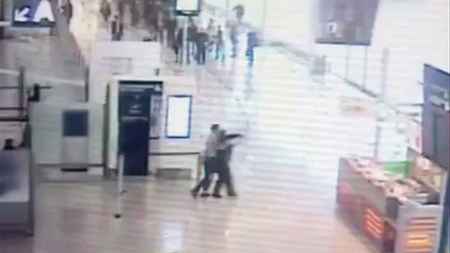
On Saturday, Ziyed Ben Belgacem pays a visit to Orly Airport in Paris. He grabs a female soldier from behind and grapples for her rifle while holding a pellet gun to her head. He warns the other soldiers to drop their rifles and raise their hands.

He shouts, “I am here to die in the name of Allah … There will be deaths.”

He’s mostly right. It’s the plural part he gets wrong. The soldier goes low. Her friends shoot him dead. But he’s not entirely wrong either. There will be deaths. Even if they aren’t at Orly Airport.

French Police go on to investigate the motive of the Tunisian Muslim settler. His father insists that he wasn’t a terrorist. The media rushes to blame drugs for his attack. It reports widely on the drugs in his system rather than the Koran found on his body. No one asks if he was on drugs or on Jihad.

Ziyed Ben Belgacem had been in and out of prison. He was known to the authorities as a potential Jihadist and had been investigated for “radicalization” back in 2015. He had been suspected of burglaries last year and had been paroled in the fall. The system had failed all over again.

Prince William and Kate had been in Paris meeting with victims of the Bataclan Islamic terror attack. They returned to the UK, but media reports emphasize that the latest attack wouldn’t change their plans. But the UK was no refuge from Islamic terror. Not even Westminster Palace was.

On Wednesday, Khalid Masood, a Pakistani Muslim settler, rents a car in a town near Birmingham from an Enterprise rent-a-car shop sandwiched between a Staples and a beauty salon offering walk-in eyebrow waxing. Over a fifth of Birmingham is Muslim and by the time the bloodshed was over and Masood was in the hospital, police raided a flat over a restaurant advertising “A Taste of Persia”.

Because diversity is our strength.

Masood’s victims were certainly diverse.  The men and women he ran over or pushed off Westminster Bridge included Brits, Americans, Romanians, Greeks, Chinese, South Koreans, Italians, Irish, Portuguese, Polish and French. That is the new form that diversity takes in the more multicultural cities.

The victims are diverse. The killers are Muslim.

Prime Minister May spoke of it as a place where “people of all nationalities and cultures gather to celebrate what it means to be free.” But not all nationalities and cultures. Some come there to celebrate what it means to kill infidels for the greater glory of Allah. Just as some pray for London and others pray for the flag of Islam to fly over Westminster Palace.

Khalid Masood, like Ziyed Ben Belgacem, had been in and out of prison. Like France’s Tunisian Muslim terror settler, the UK’s Pakistani Muslim terror settler had been investigated for “violent extremism”.

Nothing came of it.

For thirty years, Masood went in and out of prison. And one fine day he rented a car and began killing. He was on the radar, but nothing was done. And now some are dead and others are wounded. And the politicians who could have prevented it give their speeches and celebrate the magnificent diversity that filled hospitals with the citizens of a dozen nations.

“As I speak, millions will be boarding trains and aeroplanes to travel to London, and to see for themselves the greatest city on Earth,” Prime Minister May declared, throwing in a pitch for tourism. “It is in these actions – millions of acts of normality – that we find the best response to terrorism.”

Come to London. Stroll and see the sights. You probably won’t get Allahuakbared to death. And if you do, the best response is a million acts of normality, apathy and denial.

Mayor Sadiq Khan vowed that after a brief vigil, it would be “business as usual”.

He was right.

On Thursday, Mohammed, a Tunisian Muslim tries to drive a car through a pedestrian mall on a major shopping street in Antwerp. It was right around the anniversary of the Brussels bombings in which Moroccan Muslim settler terrorists had killed 32 people and wounded 300.

And a year later it was business as usual.

On Wednesday, King Philippe had dedicated a memorial in Brussels titled, ‘Wounded But Still Standing in Front of the Inconceivable’. “We have to stand up and say ‘no’ to those acts that are not believable, that are not bearable,” its sculptor insisted.

But the seventh King of the Belgians had a somewhat different message. “It’s the responsibility of each and every one of us to make our society more humane, and more just. Let’s learn to listen to each other again, to respect each other’s weaknesses,” he said. “Above all, let us dare to be tender.”

The Tunisian Muslim driving into a pedestrian mall did not dare to be “tender”. He didn’t respect the weaknesses of a society that tolerated him.

Belgian soldiers deployed for the anniversary spotted him. The police gave chase.  Pedestrians scurried out of the way. The Muslim settler from France was taken into custody for endangering the public. It is hoped that the arrest was made in a properly tender fashion.

Police found a riot gun, knives and fake passports in his car.

The Antwerp police chief said that Mohammed had been known to the police and had been involved in the illegal possession of weapons in France. But official reports blamed the drugs and alcohol in his system. Like fellow Tunisian Ziyed Ben Belgacem, he wasn’t a terrorist, just a drunk and a junkie.

The police urged everyone to keep calm and return to normalcy. Everything was being done to ensure the safety of Antwerp residents and tourists.

Business as usual.

Meanwhile the Antwerp Town Hall had gone from flying British colors in solidarity with the victims of the London attack to worrying over an attack at home.  Just as William and Kate had come from terror in France to terror at home.

British authorities claimed that they foiled a dozen terror attacks last year. There are arrests for terror plots in France and Germany. Every week there is either a terror plot or a memorial for the last terror attack before we are told to go on with our million acts of normalcy.

Some days the terrorists screw up. They pick what they think is an easy target, but she refuses to let go of the rifle. Or they overestimate how much alcohol and cocaine they need to nerve themselves up to kill and die. Other times they get it right. Or right enough. And the news flashes around the world.

Somewhere along the way it wasn’t life that became normal, but terror. And the insistence on normalcy just normalizes the terror. A week with three terror attacks across Europe is no longer extraordinary. We have come to expect that there will be men trying to stab and run us over from Paris to Antwerp to London. And we have come to expect another Islamic terror plot targeting Kansas City, Miami, Columbia, New York, San Bernardino, Boston, Tampa, Dallas, Rochester, Springfield and any city.

We don’t know when or where the next attack will come. But we know whom it will come from.

The question is what are we going to do about it? We can pretend to be baffled the next time some Jihadi with a rap sheet taller than the London Eye and longer than London Bridge goes on a killing spree. We can nod our heads while the politicians throw a vigil and encourage a million acts of apathy.

Or we can end the flow of future terrorists and deport the existing ones.

Because they can’t run us over if we don’t let them in. They can’t bomb us if we don’t let them stay.

We can listen to King Philippe and “dare to be tender”. Decades of such tenderness are what led us here. Or we can dare to make the hard choices that will make us and our children safe for generations.

Saturday. Wednesday. Thursday. How many more days will it take?

Will the West Please Stop Siding with Criminals?

March 24, 2017

Will the West Please Stop Siding with Criminals? Gatestone InstituteKhadija Khan, March 24, 2017

(But, but for Westerners to mention these things, let alone to do anything about them, would be “Islamophobic.” Besides, it’s easier for our “feminists” to demand free birth control, abortions and safe spaces. — DM)

What is agonizing is that people either enjoyed or criticized the joyful act of a teenager, but no one seems to be noticing that this public trial and her forced apologies only mean further isolation for the young Muslim women.

Most horrifying is that it seems that even the West has started to buy into the version of “modesty” that these extremists in the Middle East have been forcing on women.

Why has no one — especially politicized, self-absorbed women’s groups — come to help? Instead, as in the recent Women’s March, they have been advocating for more women’s imprisonment.

It is important for as many people as possible, both in Britain and world-wide, to say how much they love her beautiful spirit and that they totally stand by her right to dance, sing, play or have fun.

The growth in systematic abuse of women, especially by Islamists in the West, requires democratic governments to introduce strong measures to stop this abuse, before abusive mullahs start harassing women of all faiths, to force them to submit to their wishes.

The recent threats and harassment of a British “Hijabi girl” by Islamists in Birmingham, England, merely for a video showing her dance, have re-exposed the ugly face of this autocratic mindset that owes its existence to extremist states such as Saudi Arabia and Iran.

Enslaving women in general and inflicting repressive agendas — such as domestic violence, sexual abuse, segregation, allowing no say in choosing a partner, education or profession, with abysmal living standards often part of the abuse — is just a small measure of the jihad that the Islamists have managed to unleash across the globe.

The video of “Hijabi girl” (her name is not known), happily dancing in public, was recorded and uploaded to the internet by bystanders.

The video led to aggressive shaming and harassment of the girl by the local Islamist “morality police”: men who ranted against her “impious” act and reportedly made her apologize publicly online.

Sobbing, she admitted how supposedly evil and shameless she was to have brought such dishonor to her family and religion.

It is important for as many people as possible, both in Great Britain and world-wide, to say how much they love her beautiful spirit and that they totally standby her right to dance, sing, play or have fun. These are very normal human activities.

Have things come to such a pass that now. even in Britain, only the most courageous can spontaneously express feelings of fun?

What is agonizing is that people either enjoyed or criticized the joyful act of a teenager, but no one seems to be noticing that this public trial and her forced apologies only mean further isolation for the young Muslim women.

To accept this coercion would be just a call on young Muslim girls to be quiet and submit, rather than ever even to think about showing their normal, lighter side. Most horrifying is that it seems that even the West has started to buy into the version of “modesty” that for centuries these extremists in the Middle East have been forcing on women.

The human rights groups seem to have become so apologetic towards the extremist abusers that they now turn their backs on the victims of these abuses — the people who need human rights groups the most. Perhaps they believe that supporting the poor girl would mean offending Muslims or the “symbol of Islam” (hijab) — which means they endorse the extremist version of Islam and the abuses that come with it.

The poor girl was shown no solidarity by any supposed champions of liberal causes. Instead, she was thrown to the hounds and left to face her torment alone.

It is also sad that the girl’s family has probably also given up, possibly due to the threats, and possibly out of fear of these extremists.

The massively destructive, wrong-headed political policies of Western governments — such as keeping silent on the abuses of women by Muslim extremists involving, for example, underage and forced marriages, female genital mutilation (FGM), sharia courts in the UK and accepting the existence of no-go zones where the extremists enjoy impunity and thrive — are also to be blamed for the increase in violations of women’s rights. Politicians and the policy-makers are apparently too scared of being accused of committing some fabricated “Islamophobia” or “infringing on the rights of Muslim citizens”, so they choose to keep their eyes shut to the plight of these women.

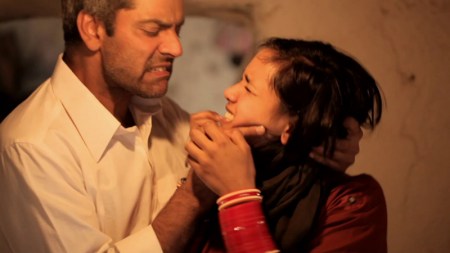
>An image from the video “Right to choose: Spotting the signs of forced marriage – Nayana”, produced by the UK Foreign & Commonwealth Office. In 2013, 1,302 victims of forced marriage sought help from the British government’s Forced Marriage Unit.

This is not an isolated incident in which a young Muslim girl was victimized by the extremists just for innocently being herself. In Canada, famous video blogger named Froggy, of Pakistani origin, suffered similar harassment. She was also vilified by puritanical extremists for wearing a hijab but living a Western lifestyle by hanging out with young men and uploading videos of teenage fun.

In Darmstadt, Germany, 19-year-old Lareeb Khan was killed in 2015 by her parents when she decided to take off her hijab and pursue a normal life. Her father, Asadullah Khan, claimed that he had killed his daughter to save the honour of his family. He alleged — whether it is true or not we do not know — that the girl was having sexual relations with a boy of whom her family disapproved.

Her mother admitted to being present at the time of Lareeb’s murder, but claimed she could not rescue her due to both fear and illness. Lareeb’s sister, Nida, however, stated that her mother was an accomplice to the crime, and used to thrash her.

In a pathetic attempt at exculpation, Lareeb’s parents claimed that they were victims of the extremist Pakistani state and society. However, they chose, when they were given refuge and protection by a Western state, to impose similar abuses.

Extremists use shaming and harassment as punishment and deterrence for any woman in their communities who tries to break a barrier to regain her life.

This double edged-sword not only silences the victims of the abuse but also sends a message to the other women also not to try to escape their imprisonment.

Why has no one — especially politicized, self-absorbed women’s groups — come to help? Instead, as in the recent Women’s March, they have been advocating for more women’s imprisonment.

The notion that a hijab or a conservative lifestyle is a matter of choice for Muslim women might sound sympathetic to Westerners. It is not. In reality, there is no choice. The supposed choice is, in fact, a one-way street from which trying to exit can cost a woman her life.

These extremist Muslims need to be taught by society itself that they must respect individual freedoms and equality — by law.

Many liberal women, doubtlessly well-intended, seem love to wearing hijabs supposedly “in solidarity”; what they do not understand is that for millions and millions of Muslim women, who dare not say so, it is not a symbol of freedom and “protection” — like a slave-owner “protecting” his property — but of repression and imprisonment. It is forced upon women, now even in the West, and, worse, with the wholehearted complicity of the West.

It is also a time for governments purportedly in favour of human rights no longer to sweep these mafia tactics under the carpet.

It is time for politicians, governments, policy-makers, clerics, human rights groups and “liberals” to stop siding with criminals who commit assault, battery, and even murder, and to start protecting their citizens.

Muslim woman called “Nazi scum” by leftists

March 20, 2017

Muslim woman called “Nazi scum” by leftists, Rebel Media via YouTube, March 20, 2017

(A Muslim woman from Pakistan, who does not want Sharia law or other Islamist “benefits” in Canada, characterized as Islamophobic and ignorant by Canadian leftists who have never been to Pakistan. Is she a “real” or “fake” Muslim? — DM)


Will the Dutch Protect their ‘Decadence’ from Islamic ‘Redeemers’?

March 19, 2017

Will the Dutch Protect their ‘Decadence’ from Islamic ‘Redeemers’? Gatestone InstituteGiulio Meotti, March 19, 2017

The Dutch and the Europeans should be proud of what Islamic fundamentalists call “decadence”, but they also must be ready to fight to defend it. “Safe spaces” are not enough. The world does not provide them. Otherwise, they will all end up in one of the “safe houses” that Geert Wilders’s puritanical tormentors have obliged him to spend his life in. “I am in jail”, he has said; “They are walking around free”.

********************************

“Erasmus… came to Holland because it was a haven for freedom of thought.” — Han ten Broeke, candidate for foreign minister in Prime Minister Mark Rutte’s government.

The Islamic supremacists in the Netherlands see themselves as redeemers, rescuing the West from Fortuyn’s “decadence”: drugs, prostitution, gay life, a blasphemous press. But will the Dutch establishment be able to defend these freedoms?

You can be gay, decadent and willing to fight for your freedoms. If you are just gay and decadent, you are doomed.

General elections in the Netherlands are over, but now begins a much bigger campaign: who will defend the famous Dutch freedoms?

Only in the Netherlands is it conceivable that a politician such as Geert Wilders, a brave maverick who for 13 years, 24 hours a day, has lived under police protection; held rallies while wearing a bulletproof vest; moved from one secret location to another one and was guarded as if he were an Asian potentate. The country has already had two political assassinations related to Islam: the politician Pim Fortuyn, and the filmmaker, Theo van Gogh. Another Dutch MP at the time, Ayaan Hirsi Ali — whose name, with Wilders’s, was next on the hit-list pinned with a knife to van Gogh’s corpse — ended up fleeing to the United States. Only Wilders’s protection, generously provided by the Dutch government, has so far avoided a third political murder.

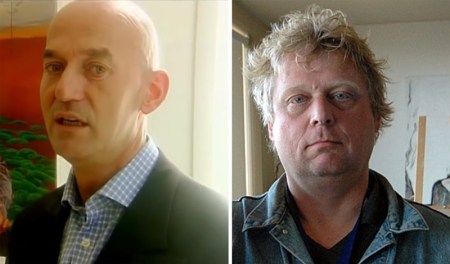
The Netherlands has already had two political assassinations related to Islam: the politician Pim Fortuyn (left), and Theo van Gogh (right), a filmmaker. (Image sources: Van Gogh – Wikimedia Commons; Fortuyn – Forza! Nederland video screenshot)

In the Netherlands, the philosopher Baruch Spinoza became the prophet of tolerance, Karl Marx investigated capitalism and John Locke penned his “Letter on Tolerance”. The mainstream media has claimed that Wilders’s rise and the new “populist” shift of Prime Minister Mark Rutte (who, in January, told immigrants to “act normal or leave“) has been a betrayal of that Dutch tolerance. Exactly the opposite is true.

It is from this tolerance that hard Dutch liberalism gets the will to fight against intolerance. Tolerating the intolerant does not sound like the way to have tolerance continue. This is how the Dutch multiculturalists turned their great legacy upside-down. The Dutch see themselves as “Enlightenment fundamentalists“, upholding the values of Enlightenment — even in the Islamic world.

The question now is: will the Dutch defend these freedoms or instead gradually dismantle them? Dutch Minister of Justice Piet Donner recently suggesting introducing Islamic sharia law into the Netherlands by democratic means.

The “hard liberal” Dutch tradition goes back to Pim Fortuyn, a homosexual proud of the supposed “decadence” of his country, its tolerance, and the freedoms it offers. As the late British journalist Alexander Chancellor wrote:

“The Muslim fanatics berate the West for its decadence, and many in the west guiltily agree that they have a point, but Fortuyn did not think so. He crusaded on behalf of what many would regard as decadence, and was so concerned for its survival”.

Fortuyn considered permissiveness the heart of Western culture. He was a “hard liberal”, militantly defending the post-9/11 Judeo-Christian, Western values against Islamic intolerance, in the same way as Oriana Fallaci, Bat Ye’or, Michel Houellebecq and Geert Wilders have been trying to do.

After last week’s Dutch elections, it is time for the Netherlands to rediscover Pim Fortuyn’s legacy and ideas. A flamboyant, shaven-headed homosexual who taught sociology, Fortuyn wore elegant Italian suits, lived in a palatial home in Rotterdam and wrote a great book entitled, “The Islamization of Our Culture“. He promised resistance against Islam, “a cold war against Islam“, as he called it in an interview in Rotterdam’s Dagblad.

“You have said”, the newspaper Volkskrant reported in an interview, “that foreigners snatch all our blonde women, and then turn around and call them ‘whores'”. “No”, Fortuyn calmly corrected him. “I said Islamic men do that. That’s quite different, sir, than ‘foreigners'”. Then, the Volkskrant asked, in what would become the defining moment of Pim Fortuyn’s life, “why the hate toward Islam?”. “I do not hate Islam”, Fortuyn said. “I find it a backward culture. I’ve traveled a great deal in the world; and wherever Islam rules, it is appalling”.

The Islamic supremacists in the Netherlands see themselves as “redeemers,” rescuing the West from Fortuyn’s “decadence”: drugs, prostitution, gay life, a blasphemous press. Will the Dutch establishment be able to defend these freedoms?

“Decadence” can become lethal for a country when it turns into hedonism, devirilization, the decline of education, and loss of historical memory. By “decadence”, however, Islamic supremacists seem to mean all Western freedoms, not just Dutch permissiveness. But these freedoms are what we should be proud of. And these are what we must be ready to fight to protect. Fortuyn did, and he paid the ultimate price: his own life. Theo van Gogh also did with his film on the submission of women under Islam. After van Gogh was slaughtered by Mohammed Bouyeri, the film immediately disappeared from public view.

The Dutch Left also needs to rediscover its roots. A debate about integration was started in the Netherlands not by the “xenophobic” right wing parties, but by Paul Scheffer, a respected academic belonging to the Labour Party, who in 2000 wrote an essay entitled, “The Multicultural Disaster” — before Fortuyn and Wilders had ever entered the picture. Scheffer wrote of a lenient Dutch people whose multicultural policies had failed to promote the Dutch culture in immigrant communities. Unfortunately, the Dutch Left took the opposite path and that is why it was severely beaten in the election last week.

Mark Rutte’s party also has a lot to learn from this hard liberalism. It was the liberals who put into practice many of Fortuyn’s ideas: banning the burqa, which many Muslims call a way of “protecting” their women, but others call a symbol of Islam dominating women. Prime Minister Rutte’s reaction against the Turkish Republic’s interference in Dutch life would be unthinkable in other European countries: Rutte, fearing Wilders’ rise, stood for his country’s independence and refused to bow to Islamist pressure to allow Turkish President Erdogan’s ministers to address a rally in Rotterdam.

In France, in fact, the authorities allowed Turkish rallies, and thereby showed a submissive mentality to political Islam. Rutte and the Dutch would be wise continue on their road, which is what allowed Rutte to retain his government. Fiscal conservatism may be important, but Western values are, too.

After Fortuyn’s murder, Wilders set himself as the “defender of liberalism“: on gender equality, separation of church and state, and personal autonomy. Unlike many liberals in the United States and Canada, however, Wilders is not willing to surrender these freedoms to Islam. Liberals and feminists in the United States refuse to stand for women’s rights in the Muslim world. They never raise the question of the separation of mosque and state. Instead, they blamed the carnage that the satirical magazine Charlie Hebdo suffered in 2015 on freedom of expression.

Did the Dutch “hard liberals” ever think about Ayaan Hirsi Ali’s brave battle for female rights under Islam, Theo van Gogh and other Dutch journalists, or the crusade Wilders has been leading to protect the country from Islamist intolerance?

Why are the LGBT militants not condemning the crimes of Islam, as Pim Fortuyn did? The editor of an LGBT magazine in Bangladesh was just hacked to death by Islamists; how come no one from the LGBT community in the West condemned or spoke out about it? Why are gay activists keeping silent about homosexuals being murdered by Islamists after, in Florida, a Muslim terrorist butchered 50 of them?

You can be gay, decadent and willing to fight for your freedom. If you are just gay and decadent, you are doomed.

Han ten Broeke, a candidate for foreign minister in Rutte’s government, recently justified the Dutch ban of Turkish ministers by noting that Erasmus came to the Netherlands “because it was a haven for freedom of thought”. This Erasmian tolerance remains very strong at the heart of the Dutch identity, but the presence, among them, of non-European, illiberal Muslims keeps testing the limits of it. The Dutch libertines and libertarians in line with Fortuyn and Wilders do not seem willing to commit suicide, unlike the liberals of Middlebury College in the US, who seem busy trying to lynch any conservative who stops by their campus.

The Dutch and the Europeans should be proud of what Islamic fundamentalists call “decadence”, but they also must be ready to fight to defend it. “Safe spaces” are not enough. The world does not provide them. Otherwise, they will all end up in one of the “safe houses” that Geert Wilders’s puritanical tormentors have obliged him to spend his life in. “I am in jail”, he has said; “They are walking around free”.

A Month of Islam and Multiculturalism in Britain: February 2017

March 12, 2017

A Month of Islam and Multiculturalism in Britain: February 2017, Gatestone InstituteSoeren Kern, March 12, 2017

(Just another gloriously happy multicultural month in Britainstan. — DM)

Muslim pupils outnumber Christian children in more than 30 church schools, including one Church of England primary school that has a “100% Muslim population.” — Sunday Times.

Six Muslim men shouted “Allahu Akbar” as they were sentenced at Sheffield Crown Court for a total of 81 years for sexually abusing two girls — including one who became pregnant at age 12 — in Rotherham.

“By 2030, one in three people will be a Muslim in the world — that is a huge population.” — Romanna Bint-Abubaker, founder of modest fashion website Haute Elan.

A Chatham House survey of more than 10,000 people from ten European countries found that an average of 55% agreed that all further migration from mainly Muslim countries should be stopped.

February 1. Jim Walker, a 71-year-old volunteer at Carnforth Station, was banned from the premises after someone complained about an alleged racist comment. Walker, who, for more than a decade, has been winding a famous clock at the station, was overheard discussing a newspaper article about young migrants entering Britain from the French port of Calais. Walker said:

“Carnforth Station Trust received a complaint from a visitor who was not happy about me speaking to somebody about the issue…. What they are doing is outrageous. It is absolutely unbelievable, it is a violation of free speech….

“I must be the only man in Carnforth who has a document saying where he can and can’t walk and all for expressing a point of view and quoting an editorial from a newspaper. Now [winding the clock] is no longer possible.”

February 1. Prime Minister Theresa May told the House of Commons that women should feel free to wear the hijab, a traditional Islamic headscarf. Several European countries have imposed bans on parts of Muslim religious dress. “What a woman wears is a woman’s choice,” May said after she was asked — on world hijab day — if she supported the right of women to wear the garment.

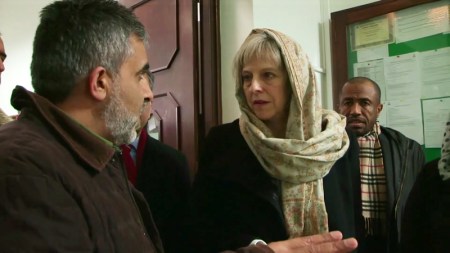
On February 1 (“world hijab day”), UK Prime Minister Theresa May said that women should feel free to wear the hijab, a traditional Islamic headscarf, stating: “What a woman wears is a woman’s choice.” Pictured above: Theresa May (then Home Secretary) wears a headscarf while attending an interfaith event at Al Madina Mosque in East London, in February 2015. (Image source: Imams Online video screenshot)

February 2. Six Muslim men shouted “Allahu Akbar” as they were sentenced at Sheffield Crown Court for a total of 81 years for sexually abusing two girls — including one who became pregnant at age 12 — in Rotherham. Three brothers and three other men were convicted of crimes including rape, indecent assault and false imprisonment after the pre-teen victims were “systematically groomed.”

February 4. Almost half of the new homes built in the next five years will go to migrants, according to government figures. Soaring immigration means that Britain will need to accommodate as many as 243,000 new households each year for the next 22 years. It is estimated that an extra 5.3 million new properties could be needed to meet the growth in population, and an extra 2.4 million of the new homes will be needed for migrants alone. In other words, one new home must be built every five minutes to house Britain’s burgeoning migrant population.

February 5. Muslim pupils outnumber Christian children in more than 30 church schools, including one Church of England primary school that has a “100% Muslim population,” according to the Sunday Times. St. Thomas in Werneth, Oldham, is reported by the local diocese to have no Christian pupils, while at Staincliffe Church of England Junior School in Batley, West Yorkshire, 98% of pupils “come from a Muslim background.” The Church of England estimated that about 20 of its schools had more Muslim pupils than Christians and 15 Roman Catholic schools had majority Muslim pupils, according to the Catholic Education Service. Some church schools include Islamic prayers in their services.

February 6. The Deputy Mayor of London, Sophie Linden, warned that people who inflict female genital mutilation (FGM) on girls have escaped justice “for too long.” Linden said that “inconsistencies in the way these crimes are recorded” had allowed perpetrators to avoid charges, despite FGM being a “widespread” problem. Although FGM has been illegal in Britain since 1985, no one has ever been successfully prosecuted for such offenses.

February 7. Zakaria Bulhan, a 19-year-old Norwegian national of Somali origin, was sentenced to indefinite confinement at Broadmoor Hospital after he admitted to killing American tourist Darlene Horton and wounding five others in a rampage in central London on August 3, 2016. Bulhan, from Tooting, South London, pled guilty at the Old Bailey to “manslaughter by diminished responsibility” on the grounds that he was suffering from paranoid schizophrenia at the time of the attacks. He had been charged with murder and attempted murder, but the court accepted his plea. During his arrest, Bulhan repeatedly muttered “Allah, Allah, Allah,” and police found a Muslim prayer book, “Fortress of the Muslim,” in his pants pocket. The court decided that Islam was not a factor in Bulhan’s behavior.

February 7. A Chatham House survey of more than 10,000 people from ten European countries found that an average of 55% agreed that all further migration from mainly Muslim countries should be stopped, 25% neither agreed nor disagreed and 20% disagreed. Majorities in all but two of the ten states agreed, ranging from 71% in Poland, 65% in Austria, 53% in Germany and 51% in Italy to 47% in the United Kingdom and 41% in Spain.

February 9. A 44-year-old man from Hertfordshire was arrested at Gatwick Airport on terrorism charges after he disembarked from a flight from Iraq. He was charged under Section 5 of the 2006 Terrorism Act: suspicion of preparation of terrorist acts.

February 12. A National Health Service (NHS) project based on research by Leeds University claimed that Muslims with mental health issues could be helped by re-embracing Islam. Traditionally, therapists have shied away from talking about religion as part of treatment. Lead researcher Dr. Ghazala Mir, of the university’s Leeds Institute of Health Sciences, said:

“We know that in Muslim populations people can get quicker results from faith-sensitive therapies that have been tested elsewhere in the world. They tend to use religion as a coping resource more than people in other religious groups.”

Mir has helped to create a new treatment. Patients are asked if faith was part of their life when they were well. Those who stopped being religious because of depression are re-introduced slowly using a self-help booklet, which highlights passages from the Koran that illustrate that “even people with strong faith” can become depressed and that it does not mean Allah is displeased.

February 13. Nadeem Muhammed, a 43-year-old Pakistani national, appeared at Westminster Magistrates’ Court in London after security officials at Manchester Airport discovered a pipe bomb in his hand luggage prior to boarding a flight to Italy. Muhammed, who lives in Greater Manchester, was arrested on January 30 but was later released on bail and was allowed to travel. He was re-arrested when he returned to Britain on February 11 and charged with possessing an improvised explosive device.

February 14. Clayton McKenna, a 22-year-old Briton who converted to Islam while in prison, appeared at Newcastle Crown Court after he carried an axe through the streets of Boldon Colliery, apparently with which to confront his Christian father over “religious differences.” McKenna allegedly told police that he was on his way to his father’s home “to ask him to bow down to me.” Judge Penny Moreland told McKenna:

“It appears you were sober, you had not been drinking or taking drugs. There has been an examination by the mental health team and they are satisfied there are no mental health issues I ought to be taking into account.

“You made a series of statements, both at the scene and in interview shortly afterwards, as to what you intended to do and what was in your mind. It is right to say they were confused and contradictory.

“The statements included a suggestion that you were going to use violence against your father, amongst a number of reasons you said was because he was a Christian and you were a recent convert to Islam.

“I am concerned that there is no real explanation for your confused thinking that morning, nor for those threats made, even though they appear to have been without substance.”

February 15. Faisal Bashir, a 43-year-old father of two from Ilford, was forced to move out of his home after he renounced Islam and stopped attending mosque. Bashir said he was subject to harassment, but police dismissed his pleas for help as “just a nuisance.” He explained:

“These people knew I had become an atheist and soon enough my whole family was being harassed. At least once a week they would hang around near my house, shouting and swearing at me. I was called an apostate, a non-believer, I was told I had betrayed my God and my faith. Sometimes they would even say things to my children — they are far too little to know what was happening, they were very frightened.

“Police always said they could not really do anything because no physical altercation ever took place. But I am not the kind of person to get violent with anybody. Also, it was always different people so they claimed they could not log it as similar complaint. Eventually a police officer told me I should just move house to get away from it all.

“We were not left with any other choice…. The new house is over a mile away, but they still managed to find us again.”

The Chairman of the Ilford-based British Pakistani Christian Association (BPCA), Wilson Chowdhry, said:

“Police and councils up and down the country just don’t understand the level of animosity people choosing to leave Islam can face.”

February 16. Sir Bernard Hogan-Howe, Britain’s top police officer, urged Muslim scholars to step up their efforts to counter the violent ideology of the Islamic State. He said he believed that IS fighters and terrorists were “political criminals” who were carrying out “horrific violence” which had no justification in Islam. In an interview with the Evening Standard, Hogan-Howe repeated the politically correct dogma that the Islamic State is not Islamic:

“The hardest part for the Western world is to interrupt this philosophy that Daesh [Islamic State] is perpetuating which is that Islam in any way supports this horrific use of violence.

“There is no interpretation I would argue that could say that, but some people are getting away with that. Muslim scholars have got to come up and be really challenging of that and be very clear that this can never be acceptable. There is no interpretation that can ever conclude it is okay to kill people. We cannot be at all sensitive to religious beliefs. We have all got to say that is wrong.

“The Muslim community feel particularly sensitive because Islamism is about people who profess to be Muslims. I would argue that they are political criminals — it just happens to be masked in religion. But when you are dealing with that issue you have to be sensitive to the majority who are good people trying to do the right thing.”

February 18. Britain’s first-ever “modest” fashion event was held in London with more than 40 designers displaying garments that comply with Muslim values. Event organizer Romanna Bint-Abubaker, founder of modest fashion website Haute Elan, told Sky News:

“The fastest growing global consumer is at the moment the Muslim market. By 2030, one in three people will be a Muslim in the world — that is a huge population.”

February 19. Counter-terrorism police launched an investigation into claims that Trish O’Donnell, head of Clarksfield Primary School in Oldham, was being forced to work from home after death threats from Muslim parents opposed to her Western values. O’Donnell reportedly has been subject to “harassment and intimidation” in the form of “aggressive verbal abuse” and “threats to blow up her car” from parents pushing conservative Muslim ideals. The school is mostly filled with Pakistani pupils who do not speak English as a first language.

February 20. Members of Parliament debated U.S. President Donald J. Trump’s state visit to Britain. Left-wing MPs called for the invitation to be withdrawn to protest Trump’s travel ban on people from seven Muslim-majority countries. Conservative Party MPs accused their opponents of hypocrisy and insulting the American people. The debate was triggered after an online parliamentary petition seeking to prevent Trump from making a state visit attracted nearly two million signatures. A counter-petition received over 300,000 signatures. After three hours of debate, Sir Alan Duncan, the deputy foreign secretary, reaffirmed the government’s intention to host Trump on a state visit, tentatively set for October 5-8, 2017.

February 21. Rezzas Abdulla, a 33-year-old man from South Shields, was sentenced to eight months in prison, a sentence then suspended so that he could receive treatment for mental health problems, for assaulting a woman and her nine-month old baby. Rebecca Telford, 25, and her daughter Layla-Jean, were strolling in South Shields in January 2016 when Abdulla leaned into the baby carriage and spat into the baby’s mouth, and allegedly said, “white people shouldn’t breed,” before launching into a tirade of racial abuse. Telford told police:

“There was no eye contact and no words had been exchanged. I had never seen him before. I believe he spat on her purely because we are white, I was a lone female and an easy target.”

February 22. Jamal al-Harith, a 50-year-old British convert to Islam, blew himself up at an Iraqi army base in Mosul on February 20. He had received £1 million (€1.1 million; $1.2 million) in compensation from the British government after being freed from Guantánamo Bay in 2004. Al-Harith, originally named Ronald Fiddler, was born in Manchester to parents of Jamaican origin and took the name Jamal al-Harith when he converted to Islam. He was also known more recently as Abu-Zakariya al-Britani. Captured in Afghanistan in early 2002, and released from Guantánamo Bay after two years, he later joined IS.

February 23. The BBC paid “very substantial” libel damages and broadcast a full apology to Chowdhury Mueen-Uddin, founder member of the Muslim Council of Britain, who was falsely accused of calling for the lynching of author Salman Rushdie.

February 26. Shahriar Ashrafkhorasani, a 33-year-old Iranian-born convert from Islam and who is set to be ordained as a Church of England priest, accused Oxford University of discrimination and bias after he was told he could not ask a lecturer critical questions about Islam. During a seminar about love in religion, Minlib Dallh, a research fellow at Regent’s Park College in Oxford, allegedly pointed at Ashrafkhorasani and said: “Everybody can ask a question except you.” Ashrafkhorasani said that Dallh had discovered during a coffee break that he was a convert from Islam. He said that Dallh refused to let him ask questions about the lecturer’s description of Islam as a religion of love and peace. Dallh’s project was partly being sponsored by the King of Jordan. Bishop Michael Nazir-Ali, who was a senior fellow at Wycliffe Hall until last year, said that a “politically correct” atmosphere is “very widespread in the university as a whole.” He added: “If people are taking money from these [Muslim] sources, then that can limit the critical approach to the study of Islam and Muslim civilization generally.”

February 27. A spokesman for the West Midlands Police wrote on social media that parents caught practicing female genital mutilation (FMG) on their children should not be prosecuted. He revealed that the force is opposed to “prosecuting/jailing” parents for FGM because it would be “unlikely to benefit” children who fall victim to the crime. He added that the best course of action is to focus on “education.” Tim Loughton, a member of the Home Affairs Committee, condemned the reluctance to pursue prosecution:

“It is absolutely key to expose perpetrators and to nail them for it. The police must go after offenders. This is deeply disturbing because a key part of eradicating the violence of FGM is exposing, prosecuting, and nailing the perpetrators. Every time a prosecution fails to materialize, it encourages those that are behind this that it is not a serious crime, and they can get away it.”

February 28. Patrick Kabele, a 32-year-old convert to Islam, was found guilty of preparing terrorist acts — namely attempting to travel to Syria — contrary to the 2006 Terrorism Act. During his trial, jurors at Woolwich Crown Court heard how Kabele, from Willesden in North London, tried to join the Islamic State in Syria, where he wanted to buy a “nine-year-old virgin, the younger the better.” He added that if he had enough money, he would buy four wives. Kabele was arrested after he tried to board a flight from Gatwick to Istanbul, Turkey on August 20, 2016 with £3,000 in cash. Kabele, who was born in Uganda and became a British citizen, told police after his arrest that he did not “owe an oath of allegiance” to the United Kingdom.

Germany: Muslim migrant who raped and murdered EU official’s daughter lied about being a minor

February 26, 2017

Germany: Muslim migrant who raped and murdered EU official’s daughter lied about being a minor, Jihad Watch

(Would it be unduly cynical to suggest that the status of the victim’s father may have resulted in a more thorough investigation than would otherwise have occurred? — DM)

Not only that, but he “had been sentenced to ten years in jail in Greece after he threw a 20-year-old student off a cliff on the island of Corfu in May 2013,” yet was inexplicably released long before his sentence was up.

Clearly it isn’t just the Muslim migrants who are culpable, but the European authorities who bring them in and turn a blind eye to the crimes they commit. No doubt a tougher stance would be “Islamophobic.”

hussein-khavari

“Afghan asylum seeker charged with raping and murdering EU official’s daughter in Germany will be tried as an adult after officials find he LIED that he was a minor,” by Emily Chan, Mailonline, February 23, 2017:

An Afghan asylum seeker charged with raping and murdering the daughter of an EU official will be tried as an adult, after it was found that he lied about being a minor.

Hussein Khavari was arrested over the rape and murder of 19-year-old medical student Maria Ladenburger in Freiburg, south-west Germany, in December last year.

He claimed he was 17, which meant he could only serve a maximum of ten years in jail if found guilty.

However, a report commissioned by the prosecutor’s office has concluded that Khavari was at least 22-years-old at the time of the offence.

Maria, who worked as a volunteer to help asylum seekers and whose father is a legal adviser to the European Commission in Brussels, was found raped and drowned on October 16 last year.

Khavari, who arrived in Germany as an unaccompanied minor in 2015, was arrested after police linked his DNA to traces found at the crime scene.

Police say he ambushed Maria as she rode her bicycle home after a party in the early hours of the morning, before raping her and drowning her in a river.

Khavari has been in custody since his arrest. He remains silent on all charges and did not allow himself to be questioned by forensic medical experts.

Investigators suspected that Khavari was lying when he said he was 17, as he had already told Greek authorities he was 17 back in 2013 before he came to Germany.

The new report on his age clears the way for prosecutors to charge him as an adult, meaning that if convicted, he could face a life sentence.

Following his arrest, it emerged that he had been sentenced to ten years in jail in Greece after he threw a 20-year-old student off a cliff on the island of Corfu in May 2013….

View from Sweden: Donald Trump was Right

February 26, 2017

View from Sweden: Donald Trump was Right, Jihad Watch

(Please see also, Trump Is Completely Right About the Crisis in Sweden. — DM)

sweden_riots

In a speech February 18, President Trump made an offhand remark about my home country of Sweden. He said:

“We’ve got to keep our country safe. You look at what’s happening in Germany, you look at what’s happening last night in Sweden. Sweden, who would believe this. Sweden. They took in large numbers. They’re having problems like they never thought possible. You look at what’s happening in Brussels. You look at what’s happening all over the world. Take a look at Nice. Take a look at Paris. We’ve allowed thousands and thousands of people into our country and there was no way to vet those people. There was no documentation. There was no nothing. So we’re going to keep our country safe.”

The statement met with a lot of criticism in Sweden. Former Prime Minister Carl Bildt tweeted:

“Sweden? Terror attack? What has he been smoking?”

But Trump wasn’t talking about a terror attack; he was talking about a new set of problems that very few people would associate with Sweden. The relevant question is – what has Carl Bildt been smoking to avoid seeing the fast, negative changes his country is now going through?

The answer is that Bildt has been getting high on over-consumption of Swedish mainstream media. Swedish journalists lean heavily towards the liberal left, and are marinated in the consensus culture that is so prevalent in Sweden’s academic institutions, where you are required to have the right opinions in order to fit in. One way to achieve this is to criticize Swedish and Western culture – and the United States in particular – but be very open-minded towards other cultures. When it comes to the issue of immigration, this means ignoring problems and dismissing those who want to discuss them as racists.

Journalists and politicians can look the other way, because they don’t live in the same world as ordinary people. Stockholm, in particular, is characterized by total segregation. Some areas are inhabited exclusively by rich, white ethnic Swedes. This is where most journalists live and work. And then there are the suburbs, where some, like Rinkeby – a part of Stockholm that has gained international notoriety due to recent riots and car fires – are inhabited solely by immigrants. You will be hard put to find any journalists in these areas. Thus they are unaware of the problems regular people in mixed suburbs and smaller cities experience, in places where things happen closer to home.

To most journalists, a critical view on immigration is just a negative theory and a theoretical, political viewpoint, not an actual observation of people’s everyday reality.

This is precisely why they believe the problems don’t exist – they themselves have never encountered them. And this legitimizes their fierce attacks on those who try to highlight the problems created by massive immigration from non-Western countries, Muslim countries in particular. A fresh example of this phenomenon is when the Swedish-Czech author Katerina Janouch spoke out recently and criticized Sweden’s migration policies on Czech television. Janouch was chastised by Prime Minister Stefan Löfven himself, who stated that he thought her remarks were “very odd”, and a bookstore in Uppsala withdrew all her books. Another example is economist Tino Sanandaji, who recently released his book Mass Challenge. In the book, Sanandaji criticizes the Swedish open-door migration policy, using statistics as a tool. A number of Swedish libraries have declared that they refuse to purchase the book, because it supposedly violates the United Nations Universal Declaration of Human Rights.

But despite the political and media establishment’s attempts to put a lid on the problems, the truth is now seeping out, and reality is reaching a boiling point.

A couple of weeks ago, I interviewed a Detective Inspector who investigates serious crimes in the immigrant-heavy neighborhoods of suburban Stockholm. He noted that while one squad car is enough to secure a “Swedish” suburb of Stockholm almost every day of the week, that would be unthinkable in the immigrant suburbs of Stockholm, where cars are set ablaze every week. In the immigrant suburbs, the police must be prepared for riots, violence and threats, and the risk of police vehicles being vandalized. False alarms are commonplace, the purposes of which are to lure the police into a trap and then pelt them with rocks. A friend of mine who lives in this kind of area has also attested to this happening on a regular basis.

The Detective Inspector also told me that a patriarchal Islamic culture has gained foothold in Rinkeby. Young women cannot go out at night, lest they be branded as whores. Ethnic Swedes – both men and women – run the risk of being brutalized. Further, there is an active “sharia police”: Muslim men approach women who they feel dress indecently, and explain to them that they need to cover themselves up. The Detective Inspector had observed such incidents in person, but since it is not a crime for men to approach women and talk to them, the police had been unable to intervene.

The Detective Inspector also told me that the rescue services – like the fire department and ambulance service – will not go into these suburbs without police escort. He also confirmed what police officer Peter Springare from Örebro has previously stated: when it comes to violent and serious crimes, you rarely see a Swedish name in the investigation papers.

Besides criminal activities in the suburbs, Sweden also has a problem concerning jihadism and salafism. At least 300 “Swedes” have traveled to Syria and Iraq to join the Islamic State. Historically, Sweden has had no experience of jihad or a paradise of virgins.

I have myself met with several salafists. In 2007, I had coffee with a crowd from the Örebro mosque (and briefly met Mehdi Ghezali, the “Swede” that was imprisoned at Gitmo), and I asked them what their view of the then-living terrorist leader Usama bin Laden was. Was bin Laden right or wrong to attack the United States? Wrong, they said. However, when asked to explain why he was wrong, it wasn’t the immorality of attacking what we in the West would call innocent civilians that disturbed them. Instead, they explained that bin Laden was wrong because only a caliph can order jihad. And bin Laden was, in their eyes, no caliph. This was the reason his actions were wrong. They also explained that they believed it is right to stone adulterers to death, but that the penalty can only be carried out in an Islamic state. When I asked if they wanted Sweden to become an Islamic state, they said yes.

Salafists have for a long time flown under the radar in the Swedish “exclusion areas”. A heartbreaking example from Rinkeby was the imam Fouad Shangole. He came to Sweden in 1994 and worked as an imam in Rinkeby, by all accounts living well off the Swedish welfare system. The Swedish security services had their eye on him, on good grounds. In 2004, he left Sweden and went to Somalia, where he became a leader within the Islamist militia movement Al Shabaab. Four years later, it was reported that a 13-year-old Somali girl, Aisha Ibrahim Duhulow, had been raped. When she reported the crime, a sharia court found that she was to blame. She was sentenced to death and the punishment was carried out by stoning. The judge who sentenced her was none other than the Swedish Rinkeby-imam. Ten years in Sweden didn’t seem to have rubbed off as far as Swedish values were concerned at all.

The purpose of this text is not to portray Sweden as a land of lawlessness. You do not have to be afraid to visit Sweden. The country still works, thanks to a historic spirit of entrepreneurship and bureaucratic order. However, it is quite possible that Sweden is changing along the lines that American documentary filmmaker Ami Horowitz described in his report on Sweden. A dark, parallel Sweden has emerged. And things are changing quickly.

The Swedish journalists and elite politicians such as Carl Bildt seem unable to understand this. And that is why it is very encouraging for the Swedes who want to defend the Sweden we love to hear the President of the United States talk about the things we can see with our own eyes, but about which we get no response from the elites who are more likely to travel to New York than to a Swedish suburb or small city.

It’s time to for the silent majority of the Swedish people to wake up and make Sweden great again. Mainstream media and establishment politicians won’t do it for us.