Posted tagged ‘Sharia law’

Before and After Sharia Law: A cautionary tale

April 23, 2017

Before and After Sharia Law: A cautionary tale, Rebel Media via YouTube, April 23, 2017

(Please see also, San Diego School District Pushes CAIR-Assisted ‘Anti-Islamophobia’ Plan and Sharia-Advocate Sarsour to Give Graduation Address at CUNY. Worried yet? — DM)


Sharia-Advocate Sarsour to Give Graduation Address at CUNY

April 23, 2017

Sharia-Advocate Sarsour to Give Graduation Address at CUNY, Clarion ProjectMeira Svirsky, April 23, 2017

(Caution: “Islamophobic” article. — DM)

Linda Sarsour speaks at a “Women for Syria” rally in NY. (Photo: Drew Angerer/Getty Images)

Pro-sharia activist Linda Sarsour was chosen to give the commencement speech by a division of CUNY, (City University of New York).

CUNY is part of the public university system of New York City, and the largest urban university in the United States.

Sarsour was selected chosen to give the address to CUNY’s Graduate School of Public Health and Health Policy at their June 1 ceremony. Sarsour was recently arrested in New York for blocking traffic along with other protesters outside the Trump International Hotel in New York City. She had been warned several times by police officers before being removed for disorderly conduct.

Sarsour was one of the main organizers of the Women’s March on Washington following U.S. President Donald Trump’s inauguration.

Her “credentials” include:

sharia law is reasonable and once u read into the details itmakes a lot of sense. People just know the basics.”

Sharia law is misunderstood & has been pushed as some evil Muslim agenda.”

“If you are still paying interest than Sharia Law hasn’t taken over America. #justsaying.”

“You’ll know when you’re living under Sharia Law if suddenly all your loans & credit cards become interest free. Sound nice, doesn’t it?”

  • Belittling the lack of women’s rights in Saudi Arabia. Sarsour tweeted:

“10 weeks of PAID maternity leave in Saudi Arabia. Yes PAID. And ur worrying about women driving. Puts us to shame.”

  • Belittling other activists who stand against sharia law. Sarsour tweeted: “Brigette Gabriel=Ayaan Hirsi Ali. She’s asking 4 an a$$ whippin’. I wish I could take their vaginas away – they don’t deserve to be women.”
  • Activist in campaign to discredit Clarion Project’s film Honor Diaries, which showcases the struggle of nine women’s-rights activists, some Muslim some not, as they campaign against honor violence and female genital mutilation.
  • Supporter of the Boycott, Divest and Sanction (BDS) anti-Israel movement

Islam in the Heart of England and France

April 23, 2017

Islam in the Heart of England and France, Gatestone InstituteDenis MacEoin, April 23, 2017

For many years, the British government has fawned on its Muslim population; evidently the government thought that Muslims would in due course integrate, assimilate, and become fully British, as earlier immigrants had done. More than one survey, however, has shown that the younger generations are even more fundamentalist than their parents and grandparents, who came directly from Muslim countries.

********************************

“There are plenty of private Muslim schools and madrasas in this city. They pretend that they all preach tolerance, love and peace, but that isn’t true. Behind their walls, they force-feed us with repetitive verses of the Qur’an, about hate and intolerance.” — Ali, an 18-year-old of French origin, whose father was radicalized.

“In England, they are free to speak. They speak only of prohibitions, they impose on one their rigid vision of Islam but, on the other hand, they listen to no-one, most of all those who disagree with them.” — Yasmina, speaking of extremist Muslims in the UK.

“Birmingham is worse than Molenbeek” — the Brussels borough that The Guardian described as “becoming known as Europe’s jihadi central.” — French commentator, republishing an article by Rachida Samouri.

The city of Birmingham in the West Midlands, the heart of England, the place where the Industrial Revolution began, the second city of the UK and the eighth-largest in Europe, today is Britain’s most dangerous city. With a large and growing Muslim population, five of its electoral wards have the highest levels of radicalization and terrorism in the country.

In February, French journalist Rachida Samouri published an article in the Parisian daily Le Figaro, in which she recounted her experiences during a visit there. In “Birmingham à l’heure islamiste” (“Birmingham in the Time of Islam”) she describes her unease with the growing dislocation between normative British values and those of the several Islamic enclaves. She mentions the Small Heath quarter, where nearly 95% of the population is Muslim, where little girls wear veils; most of the men wear beards, and women wear jilbabs and niqabs to cover their bodies and faces. Market stalls close for the hours of prayer; the shops display Islamic clothes and the bookshops are all religious. Women she interviewed condemned France as a dictatorship based on secularism (laïcité), which they said they regarded as “a pretext for attacking Muslims”. They also said that they approved of the UK because it allowed them to wear a full veil.

Another young woman, Yasmina, explained that, although she may go out to a club at night, during the day she is forced to wear a veil and an abaya [full body covering]. She then goes on to speak of the extremists:

“In England, they are free to speak. They speak only of prohibitions, they impose on one their rigid vision of Islam but, on the other hand, they listen to no-one, most of all those who disagree with them.”

Speaking of the state schools, Samouri describes “an Islamization of education unthinkable in our [French] secular republic”. Later, she interviews Ali, an 18-year-old of French origin, whose father has become radicalized. Ali talks about his experience of Islamic education:

“There are plenty of private Muslim schools and madrasas in this city. They pretend that they all preach tolerance, love and peace, but that isn’t true. Behind their walls, they force-feed us with repetitive verses of the Qur’an, about hate and intolerance.”

Samouri cites Ali on the iron discipline imposed on him, the brutality used, the punishment for refusing to learn the Qur’an by heart without understanding a word of it, or for admitting he has a girlfriend.

Elsewhere, Samouri notes young Muslim preachers for whom “Shari’a law remains the only safety for the soul and the only code of law to which we must refer”. She interviews members of a Shari’a “court” before speaking with Gina Khan, an ex-Muslim who belongs to the anti-Shari’a organization One Law for All. According to Samouri, Khan — a secular feminist — considers the tribunals “a pretext for keeping women under pressure and a means for the religious fundamentalists to extend their influence within the community”.

Another teenager of French origin explains how his father prefers Birmingham to France because “one can wear the veil without any problem and one can find schools where boys and girls do not mix”. “Birmingham,” says Mobin, “is a little like a Muslim country. We are among ourselves, we do not mix. It’s hard”.

Samouri herself finds this contrast between secular France and Muslim England disturbing. She sums it up thus:

“A state within a state, or rather a rampant Islamization of one part of society — [is] something which France has succeeded in holding off for now, even if its secularist model is starting to be put to the test”.

Another French commentator, republishing Samouri’s article, writes, “Birmingham is worse than Molenbeek” — the Brussels borough that The Guardian described as “becoming known as Europe’s jihadi central.”

The comparison with Molenbeek may be somewhat exaggerated. What is perplexing is that French writers should focus on a British city when, in truth, the situation in France — despite its secularism — is in some ways far worse than in the UK. Recent authors have commented on France’s growing love for Islam and its increasing weakness in the face of Islamist criminality. This weakness has been framed by a politically-correct desire to stress a multiculturalist policy at the expense of taking Muslim extremists and fundamentalist organizations at face value and with zero tolerance for their anti-Western rhetoric and actions. The result? Jihadist attacks in France have been among the worst in history. It is calculated that the country has some some 751 no-go zones (“zones urbaines sensibles”), places where extreme violence breaks out from time to time and where the police, firefighters, and other public agents dare not enter for fear of provoking further violence.

Many national authorities and much of the media deny that such enclaves exist, but as the Norwegian expert Fjordman has recently explained:

If you say that there are some areas where even the police are afraid to go, where the country’s normal, secular laws barely apply, then it is indisputable that such areas now exist in several Western European countries. France is one of the hardest hit: it has a large population of Arab and African immigrants, including millions of Muslims.

There are no such zones in the UK, certainly not at that level. There are Muslim enclaves in several cities where a non-Muslim may not be welcome; places that resemble Pakistan or Bangladesh more than England. But none of these is a no-go zone in the French, German or Swedish sense — places where the police, ambulances, and fire brigades are attacked if they enter, and where the only way in (to fight a fire, for example) is under armed escort.

Samouri opens her article with a bold-type paragraph stating:

“In the working-class quarters of the second city of England, the sectarian lifestyle of the Islamists increasingly imposes itself and threatens to blow up a society which has fallen victim to its multicultural utopia”.

Has she seen something British commentators have missed?

The Molenbeek comparison may not be entirely exaggerated. In a 1000-page report, “Islamist Terrorism: Analysis of Offences and Attacks in the UK (1998-2015),” written by the respected analyst Hannah Stuart for Britain’s Henry Jackson Society, Birmingham is named more than once as Britain’s leading source of terrorism. [1]

One conclusion that stands out is that terror convictions have apparently doubled in the past five years. Worse, the number of offenders not previously known to the authorities has increased sharply. Women’s involvement in terrorism, although still less than men’s, “has trebled over the same period”. Alarmingly, “Proportionally, offences involving beheadings or stabbings (planned or otherwise) increased eleven-fold across the time periods, from 4% to 44%.” (p. xi)

Only 10% of the attacks are committed by “lone wolves”; almost 80% were affiliated with, inspired by or linked to extremist networks — with 25% linked to al-Muhajiroun alone. As the report points out, that organization (which went under various names) was once defended by some Whitehall officials — a clear indication of governmental naivety.

Omar Bakri Muhammed, who co-founded the British Islamist organization al-Muhajiroun, admitted in a 2013 television interview that he and co-founder Anjem Choudary sent western jihadists to fight in many different countries. (Image source: MEMRI video screenshot)

A more important conclusion, however, is that a clear link is shown between highly-segregated Muslim areas and terrorism. As the Times report on the Henry Jackson Society review points out, this link “was previously denied by many”. On the one hand:

Nearly half of all British Muslims live in neighbourhoods where Muslims form less than a fifth of the population. However, a disproportionately low number of Islamist terrorists — 38% — come from such neighbourhoods. The city of Leicester, which has a sizeable but well-integrated Muslim population, has bred only two terrorists in the past 19 years.

But on the other hand:

Only 14% of British Muslims live in neighbourhoods that are more than 60% Muslim. However, the report finds, 24% of all Islamist terrorists come from these neighbourhoods. Birmingham, which has both a large and a highly segregated Muslim population, is perhaps the key example of the phenomenon.

The report continues:

Just five of Britain’s 9,500 council wards — all in Birmingham — account for 26 convicted terrorists, a tenth of the national total. The wards — Springfield, Sparkbrook, Hodge Hill, Washwood Heath and Bordesley Green — contain sizeable areas where the vast majority of the population is Muslim.

Birmingham as a whole, with 234,000 Muslims across its 40 council wards, had 39 convicted terrorists. That is many more than its Muslim population would suggest, and more than West Yorkshire, Greater Manchester and Lancashire put together, even though their combined Muslim population is about 650,000, nearly three times that of Birmingham. There are pockets of high segregation in the north of England but they are much smaller than in Birmingham.

The greatest single number of convicted terrorists, 117, comes from London, but are much more widely spread across that city than in Birmingham and their numbers are roughly proportionate to the capital’s million-strong Muslim community.

Hannah Stuart, the study’s author, has observed that her work has raised “difficult questions about how extremism takes root in deprived communities, many of which have high levels of segregation. Much more needs to be done to challenge extremism and promote pluralism and inclusivity on the ground.”

Many observers say Birmingham has failed that test:

“It is a really strange situation,” said Matt Bennett, the opposition spokesman for education on the council. “You have this closed community which is cut off from the rest of the city in lots of ways. The leadership of the council doesn’t particularly wish to engage directly with Asian people — what they like to do is have a conversation with one person who they think can ‘deliver’ their support.”

Clearly, lack of integration is, not surprisingly, the root of a growing problem. This is the central theme of Dame Louise Casey’s important report of last December to the British government. Carried out under instructions of David Cameron, prime minister at the time, “The Casey Review: A review into opportunity and integration” identifies some Muslim communities (essentially those formed by Pakistani and Bangladeshi immigrants and their offspring) as the most resistant to integration within British society. Such communities do little or nothing to encourage their children to join in non-Muslim education, events, or activities; many of their women speak no English and play no role within wider society, and large numbers say they prefer Islamic shari’a law to British law.

Casey makes particular reference to the infamous Trojan Horse plot, uncovered in 2014, in which Muslim radicals conspired to introduce fundamentalist Salafi doctrines and practices into a range of Birmingham schools — not just private Muslim faith schools but regular state schools (pp. 114 ff.): “a number of schools in Birmingham had been taken over to ensure they were run on strict Islamic principles…”

It is important to note that these were not ‘Muslim’ or ‘faith’ schools. [Former British counterterrorism chief] Peter Clarke, in his July 2014 report said:

“I took particular note of the fact that the schools where it is alleged that this has happened are state non-faith schools…”

He highlighted a range of inappropriate behaviour across the schools, such as irregularities in employment practices, bullying, intimidation, changes to the curriculum, inappropriate proselytizing in non-faith schools, unequal treatment and segregation. Specific examples included:

  • a teachers’ social media discussion called the “Park View Brotherhood”, in which homophobic, extremist and sectarian views were aired at Park View Academy and others;
  • teachers using anti-Western messages in assemblies, saying that White people would never have Muslim children’s interests at heart;
  • the introduction of Friday Prayers in non-faith state schools, and pressure on staff and students to attend. In one school, a public address system was installed to call pupils to prayer, with a member of the staff shouting at students who were in the playground, not attending prayer, and embarrassing some girls when attention was drawn to them because girls who are menstruating are not allowed to attend prayer; and
  • senior staff calling students and staff who do not attend prayers ‘k****r’. (Kuffar, the plural of kafir, an insulting term for “unbelievers”. This affront reproduces the Salafi technique of condemning moderate or reformist Muslims as non-Muslims who may then be killed for being apostates.)

Casey then quotes Clarke’s conclusion:

“There has been co-ordinated, deliberate and sustained action, carried out by a number of associated individuals, to introduce an intolerant and aggressive Islamic ethos into a few schools in Birmingham. This has been achieved in a number of schools by gaining influence on the governing bodies, installing sympathetic headteachers or senior members of staff, appointing like-minded people to key positions, and seeking to remove head teachers they do not feel sufficiently compliant.”

The situation, Casey states, although improved from 2014, remains unstable. She quotes Sir Michael Wilshaw, Her Majesty’s Chief Inspector, in a letter to the Secretary of State for Education, which declared as late as July 8, 2016, that the situation “remains fragile”, with:

  • a minority of people in the community who are still intent on destabilising these schools;
  • a lack of co-ordinated support for the schools in developing good practice;
  • a culture of fear in which teachers operate having gone underground but still there;
  • overt intimidation from some elements within the local community;
  • organised resistance to the personal, social and health education (PSHE) curriculum and the promotion of equality.

Elsewhere, Casey notes two further issues in Birmingham alone, which shed light on the city’s Muslim population. Birmingham has the largest number of women who are non-proficient in English (p. 96) and the largest number of mosques (161) in the UK (p. 125).

For many years, the British government has fawned on its Muslim population; evidently the government thought that Muslims would in due course integrate, assimilate, and become fully British, as earlier immigrants had done. More than one survey, however, has shown that the younger generations are even more fundamentalist than their parents and grandparents, who came directly from Muslim countries. The younger generations were born in Britain but at a time when extremist Islam has been growing internationally, notably in countries with which British Muslim families have close connections. Not only that, but a plethora of fundamentalist preachers keep on passing through British Muslim enclaves. These preachers freely lecture in mosques and Islamic centres to youth organizations, and on college and university campuses.

Finally, it might be worth noting that Khalid Masood, a convert to Islam who killed four and injured many more during his attack outside the Houses of Parliament in March, had been living in Birmingham before he set out to wage jihad in Britain’s capital.

It is time for some hard thinking about the ways in which modern British tolerance of the intolerant and its embrace of a wished-for, peace-loving multiculturalism have furthered this regression. Birmingham is probably the place to start.

________________

[1] Hard copies of the report may be purchased via PayPal here. Essays, summaries etc. may be linked to from here. An excellent summary by Soeren Kern is available online here.

Europe’s Rising Islam-Based Political Parties

April 21, 2017

Europe’s Rising Islam-Based Political Parties, Investigative Project on Terrorism, Abigail R. Esman, April 21, 2017

So far, none of the existing [Islamic) parties has had a great deal of success – and the emerging parties have yet to make their platforms known, let alone acquire active supporters. But as Denk founder Tunahan Kuzu proudly announced after the March elections, a new voice has now gained power in a European government. But what that voice ultimately will be, and the strength of its commitment to secular and democratic values, remains yet to be seen.

*****************************

These past several months, eyes across the world have been trained on a growing far-right movement sweeping Europe and America – from the neo-Nazi groups in Germany and the United States to the increasing popularity of France’s National Front. But another, far less noticed but sometimes equally-radical movement is also emerging across Europe: the rise of pro-Islam political parties, some with foreign support from the Muslim world. And the trend shows no sign of stopping.

Holland’s Denk (“Think”) party, established and led by two Turkish immigrants, is among the most significant. Denk won three seats in the Dutch parliament last month, becoming the country’s “fastest-growing” new party, according to Dutch daily NRC Handelsblad. Its platform: replace ideas of integration with “mutual acceptance” – a charming but antiquated idea in a culture where one group accepts gay marriage and the other is taught that homosexuals should be shoved off of tall buildings; an “acceptance monitor” to measure the extent to which such “mutual acceptance” has succeeded; and the establishment of a dedicated “anti-racism” police force.

While not the first of such Islamic parties in European politics, Denk’s March 15 win makes it an inspiration to others. Existing parties now see a new chance for success, while political aspirants across Europe are making plans to start similar parties of their own.

Hence, while the focus in next week’s French elections will be on Marine le Pen’s National Front, many European Muslims will also be watching the Equality and Justice Party (PEJ), led by French-Turk Sacir Çolak. Like Denk, the party claims to be a voice for the downtrodden, aimed at fighting “inequalities and injustices,” according to a report by the Turkish Anadolu news agency. But also like Denk, it has been accused of representing not the political interests of French citizens, but those of Turkey’s president – a man who has spoken out against assimilation and integration and called on European Turks to reject Western values.

The PEJ is not alone in France: The French Union of Muslim Democrats (UDMF), founded in 2012, made headlines when it entered the 2015 electoral race. Its platform seems more moderate than many of its fellow Muslim parties across Europe: founder Nagib Azergui has insisted in interviews that he respects the secular foundation of the French republic, and advocates philosophy and civic education classes that would help mitigate against the recruitment efforts of Muslim extremists.

The party does, however, seek to establish sharia-compliant banks and calls for Turkey to become a member of the European Union. Further, it seeks to re-install the right of Muslim girls to wear headscarves in public schools, a move that could be seen as a gesture towards re-introducing religion into the secular sphere.

Austria, too, has seen a rise in Islamic political parties, such as the New Movement for the Future (NBZ), founded, like Denk and the PEJ, by Turkish immigrants. Unlike the others, however, NBZ has made little effort to hide its loyalty to Turkey. Following the failed 2016 Turkish coup, for instance, its leader, Adnan Dinçer, called on Austria to respect Turkish President Recep Tayyip Erdogan’s clampdown on the country and the mass arrests that followed. It is worth noting, however, that Austria’s far right has been particularly virulent in its anti-Islam activity, calling for Islam itself to be banned from the country. Such motions inevitably bring forth counter-movements from the targeted groups, and it was, just those actions which mobilized Dinçer to form the NBZ.

But it was Denk’s success, above all, that inspired Lebanese-Belgian activist Dyab Abou Jahjah to establish his newest political effort: a party (to date, unnamed) aimed at “Making Brussels Great Again, a la Bernie Sanders,” according to an interview in Belgian newspaper de Morgen.

This would be a third attempt for Jahjah, who first came into the public eye in 2002 as the founder of the Brussels-based Arab-European League, a pan-European political group that aimed to create what he called a Europe-wide “sharocracy” – a sharia-based democracy. In 2003, the AEL further organized a political party, RESIST, to run in the Brussels elections: it received a mere 10,000 votes. Now, Jahjah, who also runs an activist group called Movement X, hopes to run again in Brussels’ 2018 elections. While his party has yet to declare a platform, his anti-American, anti-Israel, pro-Palestinian and anti-European rants on Facebook and elsewhere give an indication of his plans. So, too, did a recent blog post in which he wrote: “we must defeat the forces of supremacy, the forces of sustained privileges, and the forces of the status-quo. We must defeat them in every possible arena.”

But he, too, is not alone: days after Denk’s win, fellow Belgian Ahmet Koç announced his own initiative, the details of which have also still to be determined. However, some things are easy enough to predict on the basis of his past: the Turkish-Belgian politician was thrown out of Belgium’s socialist party in 2016 for supporting Erdogan’s efforts to censor Europeans who insult him publicly, and calling for Belgian Turks to rise up against the “traitors” of the 2016 coup.

Both Koç and Jahjah will have to reckon with the ISLAM party, which has already established itself in the Brussels area. Founded in 2012, ISLAM – which poses as an acronym for “Integrité, Solidarité, Liberté, Authenticité, Moralité” is unapologetically religious. Leaders pride themselves on following the Quran, not party politics. With divisions already in place in the Brussels districts of Anderlecht, Molenbeek (the center of Belgian radicalism) and Luik, the party now plans to expand throughout the Brussels region.

So far, none of the existing parties has had a great deal of success – and the emerging parties have yet to make their platforms known, let alone acquire active supporters. But as Denk founder Tunahan Kuzu proudly announced after the March elections, a new voice has now gained power in a European government. But what that voice ultimately will be, and the strength of its commitment to secular and democratic values, remains yet to be seen.

Sisi, Trump, and the Politics of Designating the Muslim Brotherhood

April 6, 2017

Sisi, Trump, and the Politics of Designating the Muslim Brotherhood, National Review, Clifford Smith, April 6, 2017

President Trump welcomes Egyptian President El-Sisi to the White House, April 3, 2017. (Reuters photo: Carlos Barria)

Hopes that the Trump administration will designate the Muslim Brotherhood as a terrorist organization have hit rough waters, with anonymous officials citing concerns about diplomatic blowback and frayed relationships with Muslims at home and abroad. The leaks come on the eve of a historic visit to Washington by Egyptian president Abdel Fattah el-Sisi, a key Arab ally and devoted Muslim who is locked in a life-or-death struggle with the Brotherhood.

The irony is hard to miss, particularly given that Egypt and several other Arab countries have already designated the Brotherhood a terrorist organization.

Whatever the truth behind the leaks, they underscore that the inside-the-Beltway conventional wisdom — that the Brotherhood is “moderate” and so popular that designation would be seen as “a declaration of war against . . . Islam itself” — will not die as easily as many hoped.

This thinking is rooted in a failure to understand the difference between Islamists — a sizable but distinct minority of Muslims who adhere to a totalitarian religious ideology — and the moderate majority of Muslims, who are our friends and allies. President el-Sisi, who has publicly called out extremism to clerics in Egypt, understands this. After all, Egypt is not the only state in which the Brotherhood engaged in attempts to kill its way to power. It did the same in Syria in the early 1980s.

Despite the Brotherhood’s long history of bloodshed, claims that it is “moderate,” or opposes violence, are still prominent. While above-ground Brotherhood organizations use peaceful means when effective, they are “prepared to countenance violence . . . where gradualism is ineffective,” as a 2015 report by the British government noted with significant understatement.

Claims that designation will complicate U.S. relationships with certain Arab allies are overblown. While it is true that some allies, such as Jordan, have Muslim Brotherhood–affiliated parties represented in their parliaments, this is easy enough to finesse. Members of Hezbollah, a U.S.-designated terrorist organization, have long served in Lebanon’s parliament, but American diplomats manage to avoid contact with them and still do business with the Lebanese.

Moreover, failure to designate the Brotherhood complicates some alliances. The Egyptian public has grown deeply suspicious of the U.S. government precisely because under Obama the U.S. came to be seen as overly sympathetic to the Brotherhood. When Senator Ted Cruz introduced the Muslim Brotherhood Terror Designation Act, many Egyptians saw it as a sign the U.S. may be waking from its long slumber. A tweet introducing the bill was the subject of a segment by popular Egyptian talk-show host Amr Adib and was retweeted 17,000+ times.

Domestically, in the wake of Trump’s admittedly troubling comments suggesting a “Muslim ban” during his presidential campaign last year, some fear that designation will fuel anti-Muslim bigotry and pave the way for “a legal assault on the institutions of American Muslim life.” After all, several organizations claiming to represent U.S. Muslims, particularly the Council on American–Islamic Relations (CAIR), have deep Muslim Brotherhood ties.

But groups such as CAIR are hardly “institutions of American Muslim life” — they’re just pretending to be. A 2011 Gallup poll found support for CAIR among U.S. Muslims to be just under 12 percent. Britain’s inquiry into the Brotherhood found that its activists in the U.K. “appear to be unable to generate any grassroots support.”

Frankly, however, if public support for CAIR were higher, that would be all the more reason to be concerned. Notwithstanding its carefully crafted public image, CAIR was named an unindicted co-conspirator in the 2007–09 Holy Land Foundation terror-finance case, and was blacklisted by the FBI as a result. Unfortunately, the Obama administration failed to aggressively continue an FBI investigation into CAIR after it conspired to fund terrorist-designated organization Hamas, the Palestinian wing of the Muslim Brotherhood. Indeed, the United Arab Emirates has declared CAIR itself a terrorist organization.

Trump’s rhetorical excesses cannot be understood without recalling the Obama administration’s refusal to name the problem. Using euphemisms such as “violent extremism” and feigning puzzlement as to the motives of obvious jihadists made the administration’s rhetoric concerning terrorism a national joke. In both the U.S. and Europe, when elites insist that voters must believe them, rather than their own “lying eyes,” the voters turn sharply in the opposite direction. The cure for Trump’s rhetorical excesses is increased security, not denial.

Trump laid out a number of smart proposals on radical Islam during his campaign. His administration should now use President el-Sisi’s visit to move forward with these ideas. In particular, it should follow up designation of the Brotherhood with the formation of a congressionally authorized commission on radical Islam tasked with developing a strategy for winning the war against Islamic extremists and explaining the threat of Islamism to the American people. Both are badly needed. Wrongheaded conventional wisdom won’t keep Americans, or our Muslim allies, safe.

U.S. Muslim Brotherhood and Saul Alinsky: A Match Made in America

March 28, 2017

U.S. Muslim Brotherhood and Saul Alinsky: A Match Made in America, Center for Security Policy, March 28, 2017

(Please see also Trump backs off Muslim Brotherhood’s designation as terrorist organization. — DM)

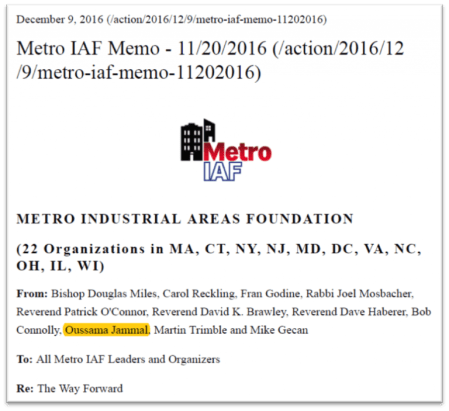
In September 2015, the Center for Security Policy (CSP) published Star Spangled Shariah: The Rise of America’s First Muslim Brotherhood Party. Warnings issued then have since been confirmed, specifically, that the United States Council of Muslim Organizations (USCMO), while deceptively cloaked in red, white, and blue, is simply the leading edge of the Islamic Movement in this country. In pursuit of Civilization Jihad, the Muslim Brotherhood’s information operations – including many tactics learned directly from the KGB – have enabled this organization to insinuate itself gradually into a position from which it can assault the pillars of our society. These include: academia, the U.S. judicial system, faith groups, all levels of government, the media, intelligence and security agencies, and our refugee resettlement and other immigration processes. As will be shown here, a development not new but recently uncovered reveals that USCMO Secretary General Ousamma Jammal is directly connected to Saul Alinsky’s Industrial Areas Foundation (IAF), a Marxist-Leninist organization dedicated to revolution in America.

In his Brotherhood/USCMO leadership role, Jammal has a well-established track record of political activism and success at developing strategic relationships for the benefit of the Muslim Brotherhood including with members of the U.S. government. In the ‘About Us’ section on the USCMO website, the third prong of the USCMO Mission Statement declares the necessity “to create and sustain an urgent, collective sense of direction that well-serves the American Muslim community toward the betterment and guidance of our nation.” What the USCMO fails to share with the American people is the USCMO’s commitment to the establishment of Islamic Law (shariah) in place of the U.S. Constitution.

It’s long been known that the USCMO is openly allied with far-left racist and revolutionary movements like Black Lives Matter. Recall that, in March 2016, the Center released a videowhich highlighted the statements of Muslim Brotherhood leaders that should be chilling to Americans who cherish the Constitution and oppose the expansion of shariah. That video showed top USCMO leadership figure, Nihad Awad (also the Executive Director of HAMAS USA dba the Council on American Islamic Relations or CAIR), explicitly aligning the U.S. Muslim Brotherhood with the Black Lives Matter movement. The Muslim Brotherhood alignment with the overall Red-Green Axis demonstrates the genuine aims of jihadis in suits: undermining the U.S. Constitution and national security through the global Islamic Movement.

In CSP’s Civilization Jihad Reader series publication, The Red-Green Axis: Refugees, Immigration, and the Agenda to Erase America, author James Simpson provides several crucial data points that hint at the Brotherhood’s other, Marxist-Leninist, affiliations.

  • The Catholic Campaign for Human Development (CCHD) is the grant making vehicle of the USCCB. It was founded in Chicago in 1969 with the help of radical organizer Saul Alinsky specifically to fund Alinsky’s Industrial Areas Foundation (IAF).
  • CCHD has been a radical leftist funding vehicle ever since, giving millions to ACORN, the radical training school, Midwest Academy and others. IAF receives the largest percentage of CCHD grants of any CCHD grantee.

In a Metro Industrial Areas Foundation action memo dated 20 November 2016 and published by member organization ‘Dupage United’ on 9 December 2016, USCMO Secretary General Oussama Jammal is listed among the leadership. The …And Take Counsel section on the USCMO website states, “When we speak with one clear, communal voice, our advice can help true the direction of American society toward justice.” It must be understood, however that within Islam, the word ‘justice’ means ‘shariah’ and only shariah. Thus, the Muslim Brotherhood version of social justice is not intended as benevolence towards non-Muslims; quite to the contrary. Rather, in true Saul Alinsky form, the aim of the Red-Green Axis is anarchy intended to collapse the U.S. system of Constitutional law and order.

Jammal is fully cognizant that the Muslim Brotherhood’s manipulation of progressive leftist social justice entities aligned with the Red-Green Axis is strategic for the advancement of the settlement process. The Muslim Brotherhood has both co-opted the interfaith religious dialogue movement and mastered the operational mechanics of the political process in the U.S. to advance Islam’s shariah objectives. That Jammal works so closely with IAF leadership should be a red flag warning and belies what the USCMO shares with non-Muslims when it says: “Our well-deliberated and sincerely expressed words for the benefit of the nation can fortify attitudes that propagate harmony between people and institutionalize policies that spread prosperity to all.”

This revelation, that the U.S. Muslim Brotherhood works directly with the Marxist-Leninist Alinsky-founded IAF at the highest levels, lends yet additional substance to the overall Red-Green Axis, whose seemingly disparate elements nevertheless have been collaborating to bring down this Republic for some time. Forthcoming CSP publications will delve even further into the Brotherhood-IAF connection.

Muslim woman called “Nazi scum” by leftists

March 20, 2017

Muslim woman called “Nazi scum” by leftists, Rebel Media via YouTube, March 20, 2017

(A Muslim woman from Pakistan, who does not want Sharia law or other Islamist “benefits” in Canada, characterized as Islamophobic and ignorant by Canadian leftists who have never been to Pakistan. Is she a “real” or “fake” Muslim? — DM)


Humor | Hundreds of ISIS fighters investigated for sharing photos of women’s uncovered faces

March 13, 2017

Hundreds of ISIS fighters investigated for sharing photos of women’s uncovered faces, Duffel Blog, March 13, 2017

ISIS representatives told reporters that all militants found to be involved in the scandal have been assigned a four-hour-long PowerPoint training on appropriate use of the Internet, while all women who were photographed have been summarily rounded-up and beheaded.

****************************

RAQQA, Syria — A massive scandal has rocked the self-proclaimed Islamic State after reports surfaced revealing that many of the group’s fighters have been sharing scandalous photos of Muslim females in a secret Facebook group.

The Facebook group, called ‘ISIS United,’ boasts some 30,000 Islamic State fighters and sympathizers. At least one hundred members have used the group as a forum to post pictures of scantily-clad women wearing revealing hijabs instead of the more conservative burqas prescribed by strict Sharia Law.

“This is outrageous and will not be tolerated,” said Rasool ul Mulaahim, a spokesman for the Islamic State. “Not only do these photos show eyes, but also noses and mouths. Nothing has been left to the imagination.”

In the Islamic State, men are forbidden from gazing upon the faces of women unless they come into ownership of them by forcing them into an arranged marriage.

“It is sickening that some of our men are posting images of someone’s private property for the entire world to see,” said Mulaahim, “and even more sickening that these vile temptresses would allow themselves to be photographed wearing those slutty hijabs.”

Still, the group does have its defenders. Some militants who were part of the secret page have noted that it served as a support group for ISIS fighters, helping to urge many to commit a suicide bombing.

ISIS representatives told reporters that all militants found to be involved in the scandal have been assigned a four-hour-long PowerPoint training on appropriate use of the Internet, while all women who were photographed have been summarily rounded-up and beheaded.

“That will surely teach a lesson to those whores of Babylon,” said Mulaahim.


More citizens of Saudi Arabia have joined the Islamic State than from any other country

March 11, 2017

More citizens of Saudi Arabia have joined the Islamic State than from any other country, Jihad Watch

(Saudi Arabia is a hell-hole for human rights and its ideology is congruent with that of the Islamic State. However, we have allied with other bad regimes with which we have shared common interests. Russia during WWII comes to mind. Our common interest with Saudia Arabia, beyond defeating the Islamic State, lies in diminishing Iran as a world power and, perhaps, finding common ground with other Arab nations via a vis Israel. — DM)

Saudi Arabia and the Islamic State share a history in the Wahhabi movement. “The Islamic State’s religious genealogy comes from ‘Jihadi Salafism’, a theological current that is very old in Islam that is quite literalist.” Muhammad ibn Abd al-Wahhab is the founder of Wahhabism, rooted in the Salafist tradition. He eventually connected with “the leader of the al-Saud family in 1744. That alliance had very strong and lasting effects,”: the Saudi state was and is based on Wahhabism.

President Trump’s anti-Iran coalition would bring together Saudi Arabia, the United Arab Emirates (UAE), Israel, Egypt, and Jordan.

**************************

The Sunni Islamic State (ISIS/ISIL) has boasted that key U.S. Middle East ally Saudi Arabia is the top provider of terrorists for the jihadist group in Iraq, reports Fox News, citing Iraqi military sources.

Reports of a Saudi Arabia/Islamic State alliance have been ongoing, despite the Saudi “friendship” with the West:

i) Slaves taken by the Islamic State are sold in auctions in Saudi Arabia;

ii) Saudi Arabia was caught funding Taliban forces in Afghanistan, and the Taliban’s former financial minister regularly traveled to Saudi Arabia to raise millions of dollars;

iii) A leaked intelligence report from Germany’s BfV domestic intelligence agency and Federal Intelligence Service (BND) revealed that Saudi Arabia (along with Kuwait and Qatar) was promoting and funding the growth of the jihadi Salafi ideology in Germany, where it has already attracted 10,000 followers and continues to expand.

Saudi Arabia and the Islamic State share a history in the Wahhabi movement. “The Islamic State’s religious genealogy comes from ‘Jihadi Salafism’, a theological current that is very old in Islam that is quite literalist.” Muhammad ibn Abd al-Wahhab is the founder of Wahhabism, rooted in the Salafist tradition. He eventually connected with “the leader of the al-Saud family in 1744. That alliance had very strong and lasting effects,”: the Saudi state was and is based on Wahhabism.

Al-Wahhab “would appoint teachers to educate people in his version of the faith” once a town was conquered by his jihadis. “He wrote a number of short books that were the basis for the teaching, books that are used by ISIS today.”

Saudi Arabia has denied financing the Islamic State, and the Islamic State is not happy with the Saudis, either: “ISIS claims that the Saudi state has deviated from the true beliefs of Muhammad ibn Abd al-Wahhab, and that they are the true representatives of the Salafi or Wahhabi message.” Nonetheless:

A high-ranking Iraqi intelligence officer said, “The Saudi presence in ISIS is very large. What we have left are mainly Iraqis and Saudis.”

Report: More Citizens of Saudi Arabia Have Joined Islamic State Than Any Other Country”, by Edwin Mora,  Breitbart, March 10, 2017:

The Sunni Islamic State (ISIS/ISIL) has boasted that key U.S. Middle East ally Saudi Arabia is the top provider of terrorists for the jihadist group in Iraq, reports Fox News, citing Iraqi military sources.

Sunni Saudi Arabia shares an estimated 500-mile-long border with war-ravaged Iraq.

Nevertheless, Fox News reports that the Saudi jihadists crossed into Iraq over the border the country shares with both Turkey and Syria.

The news outlet learned from unnamed Iraqi intelligence sources that jihadist from the Saudi kingdom comprise nearly one-third (up to 30 percent) of all ISIS terrorists in Iraq, adding that “Saudis comprise the largest single contingent of ISIS fighters, with Russian Chechens making up the second-largest contingent.”

Speaking to the news outlet on condition of anonymity, a high-ranking Iraqi intelligence officer said, “The Saudi presence in ISIS is very large. What we have left are mainly Iraqis and Saudis.”

“The Saudis make up a large number of suicide bombers, as they already have the ground work of radicalization installed in their minds from radical sheikhs in Saudi [Arabia]. And we’ve caught important ISIS commanders,” he added.

Fox News points out that it has seen various ISIS-linked photographs and documents showing identification and credit cards of Saudi terrorists.

The report comes nearly a month after an article by the Wall Street Journal (WSJ) revealed that President Donald Trump’s administration is considering forming a military alliance with major Middle East allies, including the Sunni Saudi kingdom, to combat Shiite Iran.

President Trump’s anti-Iran coalition would bring together Saudi Arabia, the United Arab Emirates (UAE), Israel, Egypt, and Jordan.

The Sharia law-compliant kingdom Saudi Arabia is regarded as a hotbed and top global exporter of radical Islamic thought, namely the Sunni extremist ideology of Wahhabism, adhered to by ISIS and various other jihadists groups.

Saudi Arabia imposes extremely strict Islamic laws on its citizens.

“Wahhabism was born in Saudi Arabia. Saudi is leading those extremist organizations like ISIS,” an anonymous Iraqi official told Fox News. “They have high-ranking officials and fighters among their ranks. Saudi is nothing without U.S. protection; it is only a bite for Iran to eat.”

Sunni Saudi Arabia considers Shiite Iran its regional rival. Iran exerts tremendous influence over the Shiite-led government of Iraq where militias backed by the Islamic Republic are fighting ISIS.

Saudi Arabia is part of the U.S.-led coalition against ISIS in Iraq and Syria…..

Don’t Leave Women Oppressed by Sharia Law Behind

March 9, 2017

Don’t Leave Women Oppressed by Sharia Law Behind, Center for Security Policy, Ayaan Hirsi Ali, March 9, 2017

There is a growing trend among some feminists to make excuses for Sharia law and claim it is nothing more than a personal moral guide, and therefore consistent with American constitutional liberties. Yet the rules that such “Sharia-lite feminists” voluntarily choose to follow are also invoked to oppress women—to marry them off, to constrain their economic and human rights, and to limit their freedom of expression—who have not consented to them. The moral conflict between Sharia and universal human rights should not be dismissed as a misunderstanding, but openly discussed.

*********************************

Wednesday is Wednesday is International Women’s Day, and the organizers of the Women’s March are holding another protest. This one is called A Day Without a Woman, in solidarity with those women who have lower wages and experience greater inequalities.

The protest encourages women to take the day off work, avoid shopping other than in small women- and minority-owned stores, and wear red.

The problems being protested against Wednesday—inequality, vulnerability to discrimination, sexual harassment, and job insecurity—are all too real for many disadvantaged women, but the legal protections for them are in place here in the United States. Women who are unfairly treated at work or discriminated against can stand up, speak out, protest in the streets, and take legal action. Not so for many women in other parts of the world for whom the hashtag #daywithoutawoman is all too apt.

Around the world women are subjected to “honor violence” and lack legal protections and access to health and social services. According to Amnesty International’s recent annual report, throughout the Middle East and North Africa, women and girls are denied equal status with men in law and are subject to gender-based violence, including sexual violence and killings perpetrated in the name of “honor.”

The relationship between the sexes in Muslim majority countries is inspired and often governed by a mix of tribal, traditional practices and Islamic law. Algerian author Kamel Daoud recently referred to this system as entailing “sexual misery” for both men and women throughout the Islamic world. Daoud favors the full emancipation of Muslim women, yet many commentators criticized him as being guilty of “Islamophobia,” a term increasingly used to silence meaningful debate.

International Women’s Day should be a day to raise our voices on behalf of women with no recourse to protect their rights. Yet I doubt Wednesday’s protesters will wave placards condemning the religious and cultural framework for women’s oppression under Sharia law. As a moral and legal code, Sharia law is demeaning and degrading to women. It requires women to be placed under the care of male guardians; it views a woman’s testimony in court as worth half that of a man’s; and it permits a husband to beat his wife. It’s not only women’s legal and sexual freedoms that are curtailed under Sharia but their economic freedoms as well. Women generally inherit half of the amount that men inherit, and their male guardian must consent to their choosing education, work, or travel.

In Saudi Arabia, Iran, Sudan, and parts of Nigeria, where Sharia law underpins the judicial system, women’s rights suffer greatly.

There is a growing trend among some feminists to make excuses for Sharia law and claim it is nothing more than a personal moral guide, and therefore consistent with American constitutional liberties. Yet the rules that such “Sharia-lite feminists” voluntarily choose to follow are also invoked to oppress women—to marry them off, to constrain their economic and human rights, and to limit their freedom of expression—who have not consented to them. The moral conflict between Sharia and universal human rights should not be dismissed as a misunderstanding, but openly discussed.

Many Western feminists struggle to embrace universal women’s rights. Decades ago, Germaine Greer argued that attempts to outlaw female genital mutilation amounted to “an attack on cultural identity.” That type of deference to traditional practices, in the name of cultural sensitivity, hurts vulnerable women. These days, relativism remains strong. Too many feminists in the West are reluctant to condemn cultural practices that clearly harm women—female genital mutilation, polygamy, child marriage, marital rape, and honor violence, particularly in non-Western societies. Women’s rights are universal, and such practices cannot be accepted.

The revival of part of the women’s movement, catalyzed by the election of Donald Trump, has deeper roots than can be seen on the surface. Like Wednesday’s protest, a large portion of Western feminism has been captured by political ideologues and postmodern apologists. Rather than protecting women’s rights, many feminists are focused on signaling opposition to “right-wing” politics.

One of the organizers of the Women’s March movement recently tweeted: “If the right wing is defending or agreeing with you, you are probably on the wrong side. Re-evaluate your positions.”

I’m all for dissent, but that “us vs. them” mentality has caused political gridlock, even on humanitarian issues where the left and right should work together. Hostility and intolerance to others’ views have made rational discussion on important issues taboo. A robust defense of universal women’s rights should welcome support from both the left and the right, overcoming domestic partisan divisions in order to help women abroad attain their full rights.

This International Women’s Day, we should protest the oppression of women who have no access to legal protections. We should support those Muslim reformers, such as Asra Nomani, Zuhdi Jasser, and Irshad Manji, who seek to reform Islam in line with full legal equality between men and women. And we should strive to overcome domestic political divisions to defend the universality of women’s rights.

Ayaan Hirsi Ali is a research fellow at the Hoover Institution, Stanford, and the founder of the AHA Foundation, which exists to protect women and girls from abuses of the sort described in this article.

Originally published at the Daily Beast