Archive for the ‘Islamic terrorism’ category

Fred Fleitz: ‘We May Have Generations of Radical Islamists in the U.K. Unless the British Government Wakes Up’

June 5, 2017

Fred Fleitz: ‘We May Have Generations of Radical Islamists in the U.K. Unless the British Government Wakes Up’, BreitbartJohn Hayward, June 5, 2017

ODD ANDERSEN/AFP/Getty

“I think 9/11 was a wake-up call. You could just see how Republicans and Democrats in Washington were working together against the threat. Now we’re challenged by political correctness, and people who are in denial, and don’t want to the let the government take the steps it has to take to go after radical Islam,” Fleitz reflected.

“Whenever there’s a radical Islamic terrorist attack, we get these lectures about Islamophobia from our leaders, leaders in the U.K. I think that is really hobbling the ability of our government to go after this threat, and that’s unfortunate. I hope what happened in London will be a wake-up call, but I’m worried in a few weeks we’ll be lectured about Islamophobia again,” he said.

***************************

Senior Vice President for Policy and Programs Fred Fleitz of the Center for Security Policy joined SiriusXM host Joel Pollak on Monday’s Breitbart News Daily to talk about the London Bridge terror attack.

Pollak began by asking if the London Bridge attack would finally provide the wake-up call needed for those who underestimate or downplay the dangers of radical Islamic terrorism.

“A lot of people who were in denial almost say the right thing after these events. They sort of can’t help themselves,” Fleitz replied.

“But what really concerns me is that yes, it’s right we have to improve security – we need better outreach, we need better intelligence – but there’s something they’re not talking about in the U.K. that really needs to be focused on: the role that the failure to assimilate British Muslims has created the situation,” he said. “There are communities where British Muslims are deliberately not assimilating, are being taught to hate British society, and this is incubating radicalism. There’s actually a parallel system of sharia law courts in the U.K. that operate.”

“We may have generations of radical Islamists in the U.K., until the British government wakes up and stops the situation,” he warned.

Pollak pointed out that the United States has unassimilated religious communities with their own internal systems of government that live peaceably alongside their neighbors, such as the Amish and Jewish communities in upstate New York.

“It’s certainly true there are some communities in the United States that have not assimilated,” Fleitz agreed. “I’m not concerned about Amish or Jewish communities, but I will tell you that there are enclaves of Muslim communities in Michigan and Minnesota that concern me. We know that in Minnesota there’s a rising rate of measles because the community has not assimilated into the rest of the community, and is not vaccinating their children. This is wrong. This is a big problem.”

“The problem with these Muslim communities is that it is making them susceptible to this radical worldview that wants to destroy modern society, create a global caliphate, and impose sharia law on everyone on Earth,” Fleitz contended. “These other communities aren’t trying to do that. They’re peaceful religious communities.”

“Also, when we have immigrants coming to a country from another country, I think they need to learn the practices and laws of the country where they’re coming to, the country that is accepting them and serving as a refuge for them. I think when people come to their new home country, they should understand and learn about the laws of this new country. That’s not happening in the U.K.,” he said.

Pollak offered the converse observation that some of the worst terrorist murderers, such as the San Bernardino jihadis, appear to be fairly well-assimilated.

“We can have homegrown radical Islamist terrorists – and I don’t really think they’re homegrown, I think they’re inspired or directed by foreign Islamist terrorist organizations – but it’s this ideology of hate that either is being communicated to them over the Internet, or is being passed on to members of separated communities in the U.K. It’s the ideology we have to confront, and I think this problem is worse in these separate communities,” Fleitz said.

Fleitz argued that measures to hinder the ability of extremists to recruit and coordinate with the Internet should be explored, with due regard for civil liberties, but he is more concerned about “radical clerics and radical mosques who are promoting this type of hate and ideology firsthand.”

“I also want to stop these ISIS videos that we know homegrown radical Islamist terrorists are taking in, and it’s playing a role in radicalizing them,” he added.

“I think 9/11 was a wake-up call. You could just see how Republicans and Democrats in Washington were working together against the threat. Now we’re challenged by political correctness, and people who are in denial, and don’t want to the let the government take the steps it has to take to go after radical Islam,” Fleitz reflected.

“Whenever there’s a radical Islamic terrorist attack, we get these lectures about Islamophobia from our leaders, leaders in the U.K. I think that is really hobbling the ability of our government to go after this threat, and that’s unfortunate. I hope what happened in London will be a wake-up call, but I’m worried in a few weeks we’ll be lectured about Islamophobia again,” he said.

“Anyone who raises concerns about radical Islam seems to be tarred and feathered as an Islamophobe in this country. I’ll let the people who peddle this term give a better explanation, but that’s my experience,” he replied when Pollak asked for a precise definition of “Islamophobia.”

Between the Thames and the Nile

June 5, 2017

Between the Thames and the Nile, Israel Hayom, Dr. Shaul Shay, June 5, 2017

(On the rare occasions when President Obama led from the front (Egypt and Libya, for example) he led in the wrong direction. — DM)

Europe is currently paying the price for its strategic failure to understand the reality and culture of the Middle East, as it faces waves of terrorism and an influx of immigrants.

The war against terrorism must be decisive, and at times, this entails infringing on individual liberties and imposing restrictions on the media, when it caters to terror organizations. When Western nations and human rights groups exert pressure on Arab regimes that are already engaged in an existential battle against Islamic terrorist organizations, they only diminish these regimes’ ability to win and survive, and, furthermore, indirectly endanger the West.

***********************************

In the past two weeks, the United Kingdom has suffered two major terror attacks, which have killed a total of 29 people and wounded over a hundred. The first attack, on May 22, was carried out by a young terrorist of Libyan descent who detonated himself up outside the crowded Manchester Arena, while the second attack, on June 3, was a coordinated attack by three terrorists that began with a vehicle-ramming on London Bridge and continued with a stabbing spree at nearby busy Borough Market. The Islamic State group claimed responsibility for both attacks.

A few days after the Manchester attack, 29 people were killed and 27 were wounded in a shooting attack on two buses carrying Coptic Christians to the remote monastery of Saint Samuel in the al-Idwah district outside Minya in Egypt. Islamic State took responsibility for that attack too. A few hours later, the Egyptian Air Force launched airstrikes against Islamic State training camps near Derna in east Libya, from where Egypt said the terrorists had come.

Despite the geographical distance between these terrorist attacks, they have much in common. They are a reflection of the growing global Islamic terror problem, which poses challenges to the Muslim as well as the Western world.

In 2011, when the “Arab Spring” revolutions began to spread across the Arab world, the West chose to support those who acted to topple dictatorial regimes, out of an unfounded belief that they would be replaced by Western-style democracies. The result was the disintegration of nation-states created by the West a hundred years earlier, giving rise to a chaotic reality in which radical Islamic movements and terrorist organizations thrive.

Britain was one of the countries that supported the efforts to overthrow Libyan leader Moammar Gadhafi in 2011. Since then, Libya has been torn by civil war and has become a stronghold for Islamic State and al-Qaida terrorists. Furthermore, Libya has become a potential terrorist threat to its neighbors, first and foremost Egypt and Tunisia, by turning into a training base for jihadists from across the globe. Libya is also the gateway to hundreds of thousands of refugees and immigrants on their way from Africa and Asia to Europe.

Europe is currently paying the price for its strategic failure to understand the reality and culture of the Middle East, as it faces waves of terrorism and an influx of immigrants.

The war against terrorism must be decisive, and at times, this entails infringing on individual liberties and imposing restrictions on the media, when it caters to terror organizations. When Western nations and human rights groups exert pressure on Arab regimes that are already engaged in an existential battle against Islamic terrorist organizations, they only diminish these regimes’ ability to win and survive, and, furthermore, indirectly endanger the West.

The West needs to implement a three-tiered strategy involving a determined struggle against radical Islamic groups in the West; economic and security assistance to moderate Sunni regimes such as Egypt and Jordan in order to maintain their stability and assist them in fighting radical Islam at home and abroad; and a combined military, diplomatic and economic effort to rehabilitate failed countries such as Libya and Yemen, to prevent them from developing into a breeding ground for terrorist groups.

Time for a Terrorism Accord, Not a Climate Accord

June 4, 2017

Time for a Terrorism Accord, Not a Climate Accord, PJ MediaRoger L Simon, June 3, 2017

(Another pleasing idea that won’t likely be tried and, if tried, won’t work. “America First” can work and, if given a chance, should. The Supreme Court is about to consider President Trump’s “Muslim ban” executive order. Perhaps recent events in Europe and England will push enough justices to reinstate it.That will at least be a step in the right direction. Please see also, Supreme Court Expedites Trump’s Petition on Executive Order Case. — DM)

[T]he recent Paris climate accord is not only based on bad or “cooked” Climategate science, it is a deliberate conscious/unconscious deflection from the genuine “present danger” in front of us.  It is no more than obfuscation allowing moral narcissists to feel good about themselves, virtue signaling about an environmental armageddon that hasn’t happened and may never happen while, in real life, people are actually murdered on London bridges and in Cairo churches.

**************************

Yes, there’s a threat to civilization and it’s not global warming, manmade or otherwise.  And anyone who isn’t comatose should know what it is.

Islam, like cancer, needs a cure. And we all have to participate in the search for one before it’s too late.

Yes, this is about Islam, not “radical” Islam or some other off-shoot, real or imagined, because the tenets that have inspired the non-stop spate of terrorism across the world in recent years are spelled out clearly in sections of the Koran and the Hadith and other holy works of Islam. They provide justification for ISIS and a hundred other groups that may or may not replace them, now and in the future. This cannot continue — unless we really do want to destroy ourselves.

To be clear, this is not about bad people (many Muslims are fine human beings), but about a malignant ideology from the seventh century that must be expunged for the survival of all.

But the majority of Western leaders don’t want to know that.  In fact, I’d wager that most have not even bothered to educate themselves in any serious way about Islam nearly sixteen years after 9/11 and with all the constant carnage that has gone on since and has been increasing significantly, not just in London and Manchester but virtually everywhere.

These Westerners are not only willfully blind, they are suicidal.  But we cannot let them commit suicide for the rest of us.  They have to go.

Similarly, the recent Paris climate accord is not only based on bad or “cooked” Climategate science, it is a deliberate conscious/unconscious deflection from the genuine “present danger” in front of us.  It is no more than obfuscation allowing moral narcissists to feel good about themselves, virtue signaling about an environmental armageddon that hasn’t happened and may never happen while, in real life, people are actually murdered on London bridges and in Cairo churches.

What we need now is an international terrorism accord — and, unlike the climate accord, a binding one — that would commit the world, including the Muslim nations themselves, to the complete reformation of Islam that is the necessary basis for an end to this terrorism.

President Trump made a good start in Riyadh in his address to the Sunni leaders, but we must go much further.  It is correct that the Islamic world should be the ones to change their religion, but the rest of us on the planet are too affected by the results to stand by and wait.  From the horrifying (London this weekend) to the daily (the constant of indignity of being scanned at airports, concerts, museums, etc.), we are all victims of Islamic ideology.  We have a right, indeed an obligation, to participate in and demand its change. Otherwise, it will only get worse.

Since Trump had the courage to open the discussion in Saudi Arabia, he should attempt to expand the dialogue and create this global accord. Egypt’s el-Sisi would be a good partner because he already had the guts to criticize his own religion.  All should be invited, even those who would never come (like the mullahs).  All must confront the question of why Islam, unique among the world’s religions today, has so much violence committed in its name. What is it about Islam that attracts this?  What therefore has to be changed, both in behavior and ideology?

The event should be public, with Islam ultimately made to pledge itself to human rights as accepted by the West — equal rights for women and homosexuals, separation of church (mosque) and state, no discrimination based on race or religion (why no churches allowed in Saudi Arabia?), etc. — not the absurd Orwellian version of human rights promulgated the UN Human Rights Council.

This demand should be made to all quarters of the Islamic world with economic punishment applied if necessary.  The time for diplomatic politesse is long over. Islam must be forced to join modernity. Reactionary multiculturalists among us must be ignored, along with their hypocritical (and nonsensical) belief that all religions are equal.  To do otherwise would be to treat Muslim people like children.  And that is what the West has been doing for some time — with atrocious results for all.

Taking sides on terrorism

June 4, 2017

Taking sides on terrorism, Israel National News, Att’y Stephen M. Flatow, June 4, 2017

Members of Congress are preparing to cast their votes on legislation that is intended take a strong and clear stand against terrorism. The Taylor Force Act would stop U.S. aid to the Palestinian Authority if the PA continues paying salaries to terrorists and their families. Named after an American murdered by Palestinians in 2016, the law is long-overdue. It would take a real stand against the PA’s outrageous sponsorship of terrorists.

So far, all 41 co-sponsors in the House of Representatives, and all 10 co-sponsors in the Senate, are Republicans. That concerns me. At a time when even the United Nations is denouncing the PA’s glorification of terrorists, there is simply no good reason for Democrats not to support the Taylor Force Act just as much as the GOP. No matter how much ill-will there is right now between Republicans and Democrats on other issues, the fight against terrorism is an issue on which the two parties should be able to unite without the slightest hesitation.

And maybe then even Europe will wake up and realize that all terrorists are colleagues.

*************************************

Stephen M. Flatow, a vice president of the Religious Zionists of America, is an attorney in New Jersey. He is the father of Alisa Flatow, who was murdered in an Iranian-sponsored Palestinian terrorist attack in 1995

We all remember President George W. Bush’s powerful declaration when he spoke at a joint session of Congress on September 21, 2001, shortly after the 9/11 attacks: “Every nation, in every region, now has a decision to make,” he said. “Either you are with us, or you are with the terrorists.”

When it comes to Palestinian terrorists and their colleagues, unfortunately, much of the world has for too long shied away from taking a clear-cut stand. But that is beginning to change. Perhaps the 6 dead on London Bridge will do the trick.

The United States finally seems to be abandoning the old tried-and-failed policy of ignoring the Palestinian Authority’s incitement and support of terrorism. According to media reports, when President Trump recently met PA leader Mahmoud Abbas in Bethlehem, he “accused Abbas of supporting incitement and terrorism with the salaries paid to prisoners” and said Abbas was “personally responsible for incitement” to violence.

This would represent a very significant change from the previous U.S. administration. President Obama and secretaries of state Clinton and Kerry looked the other way when the PA paid terrorists and incited violence by praising terrorists as “heroes” and “martyrs.”

And America is not alone. In a remarkable break from West European appeasement of the PA, the government of Norway last week demanded that Abbas return Norway’s donation to a Palestinian women’s center that the PA named in honor of mass-murderer Dalal Mughrabi. She led the terror gang that carried out the 1978 Tel Aviv Highway massacre of 37 Israelis (including 13 children) and American nature photographer Gail Rubin, the niece of U.S. Senator Abraham Ribicoff.

Norwegian Foreign Minister Borge Brende was unequivocal: “The glorification of terrorist attacks is completely unacceptable, and I deplore this decision in the strongest possible terms. Norway will not allow itself to be associated with institutions that take the names of terrorists in this way. We will not accept the use of Norwegian aid funding for such purposes.” Even the United Nations (!), under new secretary-general Antonio Guterres, has denounced the naming of the center after Mughrabi as “offensive” and removed its name from the facility.

So the United States, Norway, and even the United Nations are standing against Palestinian terrorism.

Who’s on the terrorists’ side? British opposition leader Jeremy Corbyn is. The Daily Mail revealed that Corbyn, leader of England’s Labor Party, took part in a ceremony honoring Palestinian terrorists, including one of the key planners of the 1972 Munich Olympics massacre. At the ceremony, which was held in Tunisia in 2014, Corbyn placed wreaths on the graves of terrorists, including Munich mastermind Atef Bseiso, and wrote about the “poignant” event in the British radical newspaper Morning Star.

Who else is lining up on the side of the terrorists? The city of Barcelona, Spain last week hosted and subsidized a book fair at which one of the featured speakers was the unrepentant Palestinian hijacker Leila Khaled. The mayor and city council members should be ashamed of themselves.

Meanwhile, back in Washington, Members of Congress are preparing to cast their votes on legislation that is intended take a strong and clear stand against terrorism. The Taylor Force Act would stop U.S. aid to the Palestinian Authority if the PA continues paying salaries to terrorists and their families. Named after an American murdered by Palestinians in 2016, the law is long-overdue. It would take a real stand against the PA’s outrageous sponsorship of terrorists.

So far, all 41 co-sponsors in the House of Representatives, and all 10 co-sponsors in the Senate, are Republicans. That concerns me. At a time when even the United Nations is denouncing the PA’s glorification of terrorists, there is simply no good reason for Democrats not to support the Taylor Force Act just as much as the GOP. No matter how much ill-will there is right now between Republicans and Democrats on other issues, the fight against terrorism is an issue on which the two parties should be able to unite without the slightest hesitation.

And maybe then even Europe will wake up and realize that all terrorists are colleagues.

Admitting When You’re Wrong

June 2, 2017

Admitting When You’re Wrong, Investigative Project on Terrorism, Patrick Dunleavy, June 2, 2017

Editor’s note: The IPT has chronicled an attempt by the Council on American-Islamic Relations (CAIR) to smear Senior Fellow Patrick Dunleavy. We’ve noted CAIR’s inability to cite any specific statement Dunleavy has made in his teaching to justify this attack on him. Now, it seems, CAIR’s guilt-by-association play has failed.

Everyone makes mistakes. Not everyone admits it. Plowing headlong into something you know is wrong is a sign of stubbornness. Directing false accusations and innuendos towards an individual is often a sign of vindictiveness.

Nowadays we’ve coined a phrase for it: “Fake News.” Its purpose is to mislead. When directed at an individual its purpose is to slander. If you have ever been the victim of it, I can empathize with you.

Recently, the Council on American-Islamic Relations (CAIR) and another activist organization put out several press releases trying to end my work as a guest instructor for the United States military. I have spoken at the Army’s Counter Terrorism Symposium and the Air Force’s Special Operation School. CAIR called me names, accused me of prejudice and conduct unbecoming of, and detrimental to the goals of the United States military. Its exact words were, “…Mr. Dunleavy does not fit the U.S. military’s standards…”

It demanded that I be removed from any position involving training of U.S. servicemen and women. It followed up the accusations with another press release 45 days later stating that, as a result of their public pressure on the USAF command, the Special Operations School Commandant was ordered to conduct a review of my class. “We welcome this review and hope it results in our military personnel receiving training based on balanced and accurate information, not on personal or political agendas,” said CAIR-Florida Communications Director Wilfredo Ruiz.

If Mr. Ruiz spoke the truth, then he and the entire CAIR organization owe me an apology.

I have been informed that the review of my class material by a group of military officers, which included two commissioned officers who serve as Muslim chaplains in the United States Air Force, is complete. Their findings; Nothing in my course curriculum was found to be denigrating to Islam or Muslims.

I’m not holding my breath waiting for CAIR’s apology.

I realized long ago when I started my career in law enforcement that when you enter public service you have to be ready to take some criticism. I remembered the words of Theodore Roosevelt: “It is not the critic who counts; not the man who points out how the strong man stumbles, or where the doer of deeds could have done them better. The credit belongs to the man who is actually in the arena, whose face is marred by dust and sweat and blood; who strives valiantly; who errs, who comes short again and again, because there is no effort without error and shortcoming.”

Have I made mistakes or errors? Absolutely. But not when it comes to the subject matter I teach about. The Air Force review makes that clear.

I teach a class on Prison Radicalization and Homegrown Terrorism. It is based on my investigative experiences in the criminal justice system as an undercover agent infiltrating organized crime and other criminal enterprises. Part of my career involved working with the both the New York Police Department’s Intelligence Division and the FBI. I don’t teach theory. It is a practicum and it helps military and law enforcement personnel understand how a person can become radicalized.

Training is a necessary component in the war on terrorism. That doesn’t just involve combat tactics but also understanding the enemy – how they operate and draw others to their fight. Islamic radicalization is a very real threat. It operates in society at large and in a particularly vulnerable segment of society, the prison environment.

We call prisons “correctional systems” because we hope in some way to rehabilitate offenders. Jihadists call them training grounds and universities. They have produced terrorists. The most recent examples are Khalid Massood, who killed four people, including a police officer, in London’s Westminster area. Anis Amri killed 12 people in Berlin. Both were former inmates radicalized while incarcerated.

If we ignore the facts or attempt to silence those who speak about the subject, we become like the terrorists, refusing to hear anything that might challenge our own dogma.

Wars are fought in many places other than the battlefield. Wars are also fought in the arena of public opinion.

Honest debate is healthy, slanderous accusations are not.

Maybe CAIR learns a lesson from this episode. But again, I’m not holding my breath.

IPT Senior Fellow Patrick Dunleavy is the former Deputy Inspector General for New York State Department of Corrections and author of The Fertile Soil of Jihad. He currently teaches a class on terrorism for the United States Military Special Operations School.

The Muslim Brotherhood Connection: ISIS, “Lady al Qaeda,” and the Muslim Students Association

June 1, 2017

The Muslim Brotherhood Connection: ISIS, “Lady al Qaeda,” and the Muslim Students Association, Gatestone InstituteThomas Quiggin, June 1, 2017

“It should be the long-term goal of every MSA [Muslim Students Association] to Islamicize the politics of their respective university … the politicization of the MSA means to make the MSA more of a force on internal campus politics. The MSA needs to be a more ‘in-your-face’ association.” — Hussein Hamdani, a lawyer who served as an adviser on Muslim issues and security for the Canadian government.

Several alumni of the MSA have gone on to become leading figures in Islamist groups. These include infamous al Qaeda recruiter Anwar al Awlaki, Osama bin Laden funder Ahmed Sayed Khadr, ISIS propagandist John “Yahya” Maguire and Canada’s first suicide bomber, “Smiling Jihadi” Salma Ashrafi.

What they have in common (whether members of ISIS, al Qaeda, Jamaat e Isami, Boko Haram, Abu Sayyaf or others) is ideology often rooted in the Muslim Brotherhood — as findings of a 2015 U.K. government review on the organization revealed.

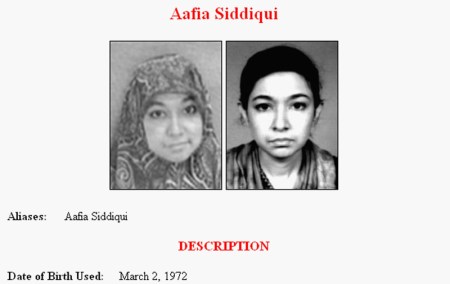
In August 2014, ISIS tried to secure the release from a U.S. federal prison of Dr. Aafia Siddiqui — a Pakistani neuroscientist educated in the United States — formerly known as the “most wanted woman alive,” but now referred to as “Lady al Qaeda”, by exchanging her for American war correspondent James Foley, who was abducted in 2012 in Syria. When the proposed swap failed, Foley was beheaded in a gruesome propaganda video produced and released by his captors, while Siddiqui remained in jail serving an 86-year sentence.

Part of an FBI “seeking information” handout on Aafia Siddiqui — formerly known as the “most wanted woman alive.” (Image source: FBI/Getty Images)

ISIS also offered to exchange Siddiqui for a 26-year-old American woman kidnapped in Syria while working with humanitarian aid groups. Two years earlier, the Taliban had tried to make a similar deal, offering to release U.S. Army Sgt. Bowe Bergdahl in exchange for Siddiqui. These efforts speak volumes about Siddiqui’s profile and importance in Islamist circles.

Her affiliation with Islamist ideology began when she was a student, first at M.I.T. and then at Brandeis University, where she obtained her doctorate in 2001. Her second marriage happened to be to Ammar al-Baluchi (Ali Abd al-Aziz Ali), nephew of Khalid Sheikh Mohammed, the principal architect of the 9/11 attacks.

During the 1995-6 academic year, Siddiqui wrote three sections of the Muslim Students Association “Starter’s Guide” — “Starting and Continuing a Regular Dawah [Islamic proselytizing] Table”, “10 Characteristics of an MSA Table” and “Planning A Lecture” — providing ideas on how successfully to infiltrate North American campuses.

The MSA of the United States and Canada was established in January 1963 by members of the Muslim Brotherhood at the University of Illinois, Urbana-Champaign campus. Since its inception, the MSA has emerged as the leading and most influential Islamist student organization in North America — with nearly 600 MSA chapters in the United States and Canada today.

The first edition of the MSA Starter’s Guide: A Guide on How to Run a Successful MSA was released in 1996. A subsection on “Islamization of Campus Politics and the Politicization of The MSA,” written by Hussein Hamdani, a lawyer who served as an adviser on Muslim issues and security for the Canadian government, states:

“It should be the long-term goal of every MSA to Islamicize the politics of their respective university … the politicization of the MSA means to make the MSA more of a force on internal campus politics. The MSA needs to be a more ‘in-your-face’ association.”

In early 2015, Canadian Minister of Public Safety Steven Blaney suspended Hamdani from the Cross-Cultural Roundtable on National Security. No reason was given for the suspension, but Hamdani claimed it had been politically motivated — related to his support for Justin Trudeau’s Liberal Party. The French-language Canadian network TVA suggested, however, that the suspension was actually due to activities in which Hamdani had engaged as a university student, and radical organizations with which he was associated. During the 1998-9 academic year, Hamdani was president of the Muslim Students Association at the University of Western Ontario; in 1995, he was treasurer of the McMaster University branch of the MSA.

Several alumni of the MSA have gone on to become leading figures in Islamist groups. These include infamous al Qaeda recruiter Anwar al Awlaki, Osama bin Laden funder Ahmed Sayed Khadr, ISIS propagandist John “Yahya” Maguire and Canada’s first suicide bomber, “Smiling Jihadi” Salma Ashrafi.

What they have in common (whether members of ISIS, al Qaeda, Jamaat e Isami, Boko Haram, Abu Sayyaf or others) is ideology often rooted in the Muslim Brotherhood — as findings of a 2015 U.K. government review on the organization revealed.

Siddiqui’s involvement in the MSA, her subsequent literal and figurative marriage to al Qaeda and her attempted release by ISIS, perfectly illustrate this ideological connection and path.

Thomas Quiggin, a court qualified expert on terrorism and practical intelligence, is based in Canada.

Massive Kabul truck bomb kills 80, wounds hundreds

May 31, 2017

Massive Kabul truck bomb kills 80, wounds hundreds, BreitbartAFP, May 31, 2017

(How to have a joyous and reflective Ramadan. — DM)

AFP

US troops in Afghanistan number about 8,400 now, and there are another 5,000 from NATO allies. They mainly serve in an advisory capacity — a far cry from the US presence of more than 100,000 six years ago.

************************

Kabul (AFP) – At least 80 people were killed and hundreds wounded Wednesday when a massive truck bomb ripped through Kabul’s diplomatic quarter, bringing carnage to the streets of the Afghan capital and blowing out windows several miles away.

Bodies littered the scene and a huge cloud of smoke rose from the highly-fortified area which houses foreign embassies, after the rush-hour attack tore a massive crater in the ground just days into the Muslim holy fasting month of Ramadan.

No group has so far claimed the powerful blast, which a Western diplomatic source said was caused by 1,500 kilogrammes of explosives packed inside a water tanker.

Rescue workers were digging bodies from the rubble hours after the explosion as anguished residents struggled to get through security cordons to search for missing relatives. Dozens of damaged cars choked the roads as wounded survivors and panicked schoolgirls sought safety.

It was not immediately clear what the target was. But the attack suggests a major security failure and  underscores spiralling insecurity in Afghanistan, where the NATO-backed military, beset by soaring casualties and desertions, is struggling to beat back insurgents.

Over a third of the country is outside government control.

“Unfortunately the toll has reached 80 martyred (killed) and over 300 wounded, including many women and children,” said health ministry spokesman Waheed Majroh, adding the figures would continue to climb as more bodies are pulled from the debris.

President Ashraf Ghani slammed the attack as a “war crime”.

The Taliban — currently in the midst of their annual “spring offensive” — tweeted that they were not involved and “strongly condemn” the blast. The insurgent group rarely claims responsibility for attacks that kill large numbers of civilians.

The Islamic State group has claimed responsibility for several recent bombings in the Afghan capital, including a powerful blast targeting a NATO convoy that killed eight people earlier this month.

The sound of the bomb, which went off near Kabul’s busy Zanbaq Square, reverberated across the Afghan capital, with residents comparing it to an earthquake. Most victims appear to be civilians.

“The vigilance and courage of Afghan security forces prevented the VBIED (vehicle-borne improvised explosive device) from gaining entry to the Green Zone, but the explosion caused civilian casualties,” NATO said in a statement.

– Embassies damaged –

The BBC said its Afghan driver Mohammed Nazir was killed and four of their journalists wounded. Local TV channel Tolo TV also tweeted that a staff member Aziz Navin was killed.

The explosion damaged several embassies in the area, which houses diplomatic and government buildings and is a maze of concrete blast walls, vehicle barriers and armed security guards.

German Foreign Minister Sigmar Gabriel said the “despicable” attack killed an Afghan guard from the German embassy, and added that some employees had been injured, though he did not give further details.

He said the bomb had gone off “in the immediate vicinity” of the German embassy.

France, India, Turkey, Japan, the United Arab Emirates and Bulgaria similarly reported damage to their embassies, including shattered windows, as the blast drew an avalanche of international condemnation.

US ambassador to Afghanistan Hugo Llorens issued a scathing statement condemning the “complete disregard for human life”, saying those behind the attack deserved our “utter scorn”.

Amnesty International said the attack underscores the fact that the conflict in Afghanistan is “dangerously widening in a way that should alarm the international community”.

Germany was forced to postpone a scheduled deportation flight of rejected Afghan asylum-seekers in the wake of the attack. The European nation has drawn criticism for sending back Afghans to an increasingly dangerous country.

Wednesday’s blast was the latest in a string of attacks in Kabul. The province surrounding the capital had the highest number of casualties in the country in the first three months of 2017 due to multiple attacks in the city, with civilians bearing the brunt of the violence.

Pentagon chief Jim Mattis has warned of “another tough year” for both foreign troops and local forces in Afghanistan.

Afghan troops are backed by US and NATO forces, and the Pentagon has reportedly asked the White House to send thousands more soldiers to break the deadlock in the battle against the Taliban.

US troops in Afghanistan number about 8,400 now, and there are another 5,000 from NATO allies. They mainly serve in an advisory capacity — a far cry from the US presence of more than 100,000 six years ago.

Trump in Israel

May 23, 2017

Trump in Israel, Front Page Magazine, Daniel Greenfield, May 23, 2017

Every act of Islamic terror educates us. It is a difficult and bloody education. We graduate when we realize who our enemies are and how impossible it is to achieve any peace with them.

President Trump’s walk to the Church of the Holy Sepulchre required thousands of police officers, closed stores and houses filled with snipers while their residents were evacuated. 

That is life under the shadow of terrorism.

It’s not only presidents who have to live this way. It’s all of us in Jerusalem and Paris, in Manchester and in Rome where there are soldiers in the street and cries of “Allah Akbar” in the air. And then a car speeds up, a knife slashes, a plane crashes or a bomb goes off. 

And the education continues.

************************************

When President Trump and Prime Minister Netanyahu met on the tarmac, they and their spouses chatted easily. The two conservative leaders have much in common. They are political insurgents who draw their support from a rougher working class overlooked and despised by leftist elites.

The polls said that Netanyahu and Trump would lose their respective elections. Instead they won big. They prevailed despite accusations of bigotry, attacks by celebrities and a torrent of fake media scandals. The media decided that the big story of Trump’s arrival in Israel would be their claim that Melania Trump had swatted her husband’s hand away. A few months ago, Netanyahu was in court testifying against a lefty journalist for spreading fake news that his wife had kicked him out of the car.

Like so much of the fake media news aimed at Trump, it was sourced from an anonymous source through another anonymous source who knew someone’s dog.

And, sure enough, Sara Netanyahu and Melania Trump bonded on the tarmac over the media’s hatred.

Trump and Netanyahu are political pragmatists with a strong economic focus who run to the right. Trump is a developer. Netanyahu has a degree in architecture. Trump has a Queens accent and Netanyahu still has his Philly accent.  And they prevail despite the opposition of leftist elites.

Subtract the geography and this news story from Netanyahu’s victory would sound familiar to Trump. “Leftist, secular Tel Aviv went to sleep last night cautiously optimistic only to wake up this morning in a state of utter and absolute devastation.”

But there is one difference between the two men.

An hour before President Trump landed in Israel, a car struck people in Tel Aviv. Usually when a car hits people, it’s an accident. But in Israeli and in European cities, car ramming has become a terrorist tactic.

And so the incident was one of the first things that Trump heard about when he landed.

Police decided that it was an accident, but as the presidential visit got underway, there was the usual litany of violence; stonings, a fatality and a stabbing. And the question that so many of us now ponder across the civilized world rose unspoken each time blood was shed. Was it Islamic terrorism?

The efforts of conservative Israeli prime ministers to contain the fallout of a disastrous peace process with terrorists set into motion by leftist prime ministers have reduced the violence so that it no longer touches the lives of most Israelis on a regular basis. But it is always there. And it never truly goes away.

That is what must be understood when we talk about “peace”.

No amount of outreach to Muslim terrorists ends the violence. Not in Europe or America. And not in Israel; the country that has become the test case for whether Muslims and non-Muslims can coexist.

President Trump’s itinerary of Saudi Arabia, Israel and Rome is a gamble that “the three Abrahamic Faiths” will join in a coalition to take on Iran and ISIS. It’s a better plan than Bush’s push for regional democracy or Obama’s violently destructive backing for Islamist political takeovers in the Arab Spring. A common enemy is more likely to get different groups behind the same cause. But having a common enemy should not be confused with having peace. At best it means a very temporary truce.

Netanyahu understands this because he has far more experience with Islamic terrorism. When it comes to Islamic terrorism, there are few countries that have faced it as consistently and constantly as Israel.

Muslim terrorists have struck America before. But only in the last decade were the Islamic colonies in the United States large enough and young enough to mount a constant drumbeat of attack plots.

Thousands of terrorism investigations are still new to America. They’re a way of life in Israel.

Terrorism is a bloody education. Trump knows far more about Islamic terrorism than Bush did. And Bush knew far more than his father. Most Americans still can’t conceive of the idea that peace is impossible. It’s too grim and hopeless. We’ve come a long way since the Obama years. But we aren’t there yet.

In the spring of his first year, Obama traveled to the Middle East to seek a “new beginning” with the Muslim world. He stopped off first in Saudi Arabia, but saved his speech calling for political change until his arrival in Egypt. Trump delivered his key speech in Saudi Arabia disavowing calls for political change. Instead America’s relationship with the Muslim world would be defined by its national security needs.

Obama blamed colonialism for the poor relations between the West and the Muslim world. His solution was to dismantle Western power. Trump defined Islamic terrorism as the problem and unity against it as the solution. Obama had bypassed Israel and traveled on to Germany making a heavily publicized visit to the Buchenwald concentration camp. Trump continued on to Israel instead.

The difference was profound.

Obama was more comfortable engaging with Jews as victims and, in a typically egotistical manner, envisioning what the victims of the Holocaust might have made of his visit. “They could not have known that one day an American President would visit this place and speak of them.” His Cairo speech reduced Israel to a byproduct of the Holocaust. If so, Israel’s capital might as well be in Buchenwald.

Trump however is ready to interact with the living Jewish present in Israel. His trip to the Western Wall, the first by a sitting president, and a cancelled visit to Masada, sought to engage with Israel’s national and religious identity. They signify a recognition that Obama never offered to Israel.

In Saudi Arabia, President Trump rolled out a vision of relationships based on national interest. And no such relationship can be built without recognizing national identity. Trump’s recognition of Israel’s national identity adds a note of respect. But Israel is one of the few nations in the region.

Nations can make peace. They can put aside their bloody past and at least learn to ignore each other. And in the West, religion has come to act as a moral operating system within the infrastructure of nations. Religion provides guidelines that transcend the law. The legal system can only tell us what we must do or may not do to each other. Religion tells us what we ought to do or not do to each other. It is a personal conscience and a relationship to a higher authority than mere government.

Saudi Arabia isn’t a nation. Neither is “Palestine”. They’re powerful extended families whose form of worship is terrorism. Islamic terrorism isn’t a perversion of Islam. It’s the implementation of Islam.

Islam provides the morale and motive for the conquest. And once the conquest is complete, it provides the framework for the kingdom. Islam’s message is the inferiority of Muslims to non-Muslims. War affirms the message. Oppression internalizes it. Islam is meaningful only when it is killing and oppressing infidels. It is not a religion of the persecuted, but the persecutors. Its theology is violent supremacism.

President Trump deserves credit for refusing to let the Saudis pretend that some Islamic terror groups are more legitimate than others by classing together ISIS with Hamas. But the only Islamic terrorism that the Saudis will reject is that which does not serve their interests. And even if they wanted to, they could no more end popular support for Islamic terrorism than Iraq could become a multicultural utopia through the magic of democracy.

Nor can Israel make peace with Islamic terrorists no matter how many more concessions Prime Minister Netanyahu offers them. President Trump calls it a tough deal. But you can only make a deal with someone who follows some of the same rules you do. You can’t make a deal with Islamic terrorists whose only rules are that the Koran lets them [say] anything they want to you.

President Trump called Islamic terrorism evil. And it is. But it’s not just evil. Its codes and ethics are utterly incompatible with our own. The only way to negotiate is through threats. And even threats only go so far with fanatics who believe that if they die, they will earn 72 virgins in paradise.

Islamic entities will tell any lie and commit any crime to accelerate their objective of conquering us. Whether they tell a lie or commit a crime depends on whether they’re moderates or extremists.

Yesterday, I heard Geert Wilders speak. And I recognized a leader who understands this grim reality. Few of his fellow Europeans do. Even fewer American politicians share that understanding. Europe is facing a deeper threat than America. And Israel has been confronting a bigger threat than Europe.

Every act of Islamic terror educates us. It is a difficult and bloody education. We graduate when we realize who our enemies are and how impossible it is to achieve any peace with them.

President Trump’s walk to the Church of the Holy Sepulchre required thousands of police officers, closed stores and houses filled with snipers while their residents were evacuated.

That is life under the shadow of terrorism.

It’s not only presidents who have to live this way. It’s all of us in Jerusalem and Paris, in Manchester and in Rome where there are soldiers in the street and cries of “Allah Akbar” in the air. And then a car speeds up, a knife slashes, a plane crashes or a bomb goes off.

And the education continues.

PC Pentagon Caves to CAIR, Agrees to ‘Review Anti-Terror Training Program

April 26, 2017

PC Pentagon Caves to CAIR, Agrees to ‘Review Anti-Terror Training Program, Front Page MagazinePaul Sperry, April 26, 2017

(The article does not identify the “Pentagon brass” who committed this atrocity. Are they (he?) Trump appointees or Obama hold-overs? In either event, the swamp needs lots more draining. — DM)

The Pentagon has agreed to formally review an anti-terror training program taught to special forces by a private contractor for material deemed offensive to Islam and Muslims, even though the Muslim group that lodged a complaint against the allegedly “Islamophobic” program has been accused by the Justice Department of supporting terrorism and is currently banned from outreach activities by the FBI.

The instructor hired to teach the program says he fears his class might not get a fair hearing, because military brass have assigned the review to a Muslim military chaplain who graduated from a radical Saudi-funded Islamic school raided by federal agents after 9/11 on suspicion of terrorist activities. He is their second choice for conducting the review. They had originally picked a more radical military chaplain to inspect the training materials before learning he has ties to an imam with a history of ministering to Muslims later convicted of terrorism.

Brass decided to launch the review after receiving a letter from the Council on American-Islamic Relations last month demanding the commander of US Air Force Special Operations sever ties with longtime counterterrorism instructor Patrick Dunleavy, claiming his lessons “contain anti-Islamic content.” CAIR, a suspected terrorist front organization, did not cite any examples of content from his “Dynamics of International Terrorism” course to support its claim.

Dunleavy formerly served as deputy inspector general of New York State prisons’ criminal intelligence division and also worked with the NYPD’s intelligence division for several years. His five-day course, which he’s taught complaint-free at the Air Force for several years, covers homegrown terrorism and prison radicalization, which tie directly into recent ISIS cases.CAIR claims to be a “Muslim civil-rights organization,” but the feds have ID’d

CAIR and its founder as “members of the US Muslim Brotherhood,” while designating them both as “unindicted co-conspirators” in a 2008 terror-financing case involving Hamas, the Palestinian branch of the Muslim Brotherhood and a US-designated terrorist group.

“From its founding by Muslim Brotherhood leaders, CAIR conspired with other affiliates of the Muslim Brotherhood to support terrorists,” US prosecutors charged in one court filing.

As a result, the FBI has cut off ties to CAIR until investigators “can resolve whether there continues to be a connection between CAIR or its executives and Hamas.”

Air Force Special Operations commander Lt. Gen. Marshal Webb received the CAIR letter and, in turn, ordered Special Operations School commandant Lt. Col. Christopher Portele to initiate a review. It is not clear if Webb is aware of CAIR’s well-documented support of terrorists. A spokeswoman did not return calls seeking comment.

Dunleavy says top brass more than likely are in the dark about the extent of CAIR’s terrorism ties. “I’m sure they don’t have a complete knowledge of CAIR or other Muslim Brotherhood groups,” he said in an interview.

He notes that the military also has a problem vetting Islamic clergy.

Air Force chaplain Walid Habash is expected to begin reviewing slides from Dunleavy’s lesson material later this week, despite the fact that he received his Islamic education from a radical Muslim Brotherhood school in Virginia. Habash’s alma mater  the Graduate School of Islamic and Social Sciences, or GSISS, was raided by federal agents in 2002 as part of a post-9/11 terrorism investigation. The longtime director of GSISS — Saudi-tied Taha Jabir Alalwani — is an unindicted co-conspirator in two federal prosecutions related to terrorist financing.

Other GSISS alumni include former New York prison chaplain Warith Deen Umar, who preached that the 9-11 hijackers should be honored as martyrs and that black converts to Islam are natural recruits for carrying out future attacks against the US.

Habash has led Islamic prayer service at the Guantanamo Bay terrorist detention camp. In 2005, the FBI busted up what was described as an Islamist “spy ring” for al-Qaida at Gitmo involving other Muslim military chaplains, as well as Arabic translators, accused of “serious breaches of national security.”

Habash was substituted last week for Muslim military chaplain Rafael Lantigua after Air Force brass learned of his radical associations, apparently for the first time.

It turns out that Lantigua sits on the board of directors of an Islamist group with a radical cleric who ran a New York mosque where the terrorists who plotted to bomb synagogues in the Bronx were radicalized. That 2009 case — which touches the cleric, Imam Salahuddin Muhammad — is one of Dunleavy’s presentation slides. Muhammad, a former convicted armed bank robber, was a protege of Umar.

In addition, Lantigua recently spoke at a New York Islamic conference where cop-killer Jamil Al-Amin and Luqman Abdullah, a Detroit imam killed in a shootout with the FBI, were honored. Muhammad gave the keynote address at the February event.

Once this information came to light, and questions were raised over how impartial Lantigua, who holds the rank of captain, could be regarding the subject of Islamic radicalization in the prisons, Air Force brass began a search for a new Muslim chaplain to review Dunleavy’s lesson plan.

“The military has an ongoing problem vetting their Muslim clergy,” Dunleavy told me. “Nobody wants to touch this political powder keg.”

In a press release  CAIR communications director Ibrahim Hooper accused Dunleavy of being an “anti-Muslim propaganda mouthpiece” with a “personal prejudice against Islam and Muslims.” The same spokesman once told the Minneapolis Star-Tribune that he wants the US to become a Muslim country.

“I wouldn’t want to create the impression that I wouldn’t like the government of the United States to be Islamic sometime in the future,” Hooper said, betraying CAIR’s real agenda.

Nonetheless, CAIR has found success already in convincing law enforcement to alter training programs, including bleaching references to “Islam,” “Shariah,” “caliphate” and “jihad” and other allegedly offensive terms from state and federal anti-terrorist training materials. It has also pressured the sidelining of some instructors.

Emboldened, the group is now targeting military training curricula for censorship. Dunleavy is just the latest subject-matter expert targeted for a smear campaign.

He and other trainers chiefly blame “political correctness” for the capitulation to CAIR at the highest levels of government. Talking honestly about the violent nature of Islam, a minority religion, is taboo in Washington. It’s much safer for career advancement to apologize for it — even though officials know that sweeping the religious doctrines and motives behind growing Islamic terrorism under the rug won’t make them disappear. In fact, it will only lead to more attacks and more American victims.

“The concerted effort by groups like CAIR to remove any material from law enforcement or military training that outlines the process of Islamic radicalization is fraught with danger,” Dunleavy warned, particularly in light of the case of the Paris terrorist Karim Cheurfi.

Cheurfi, an ISIS-tied Muslim who last week fatally shot a police officer while wounding two others with an AK-47, had all the indicators outlined by Dunleavy in the material the Pentagon is now second-guessing thanks to CAIR protesting. They include: prison radicalization, exposure to radical Islamic preachers, and attraction to jihadi violence. In spite of these and other warning signs, Cheurfi escaped close monitoring by authorities. Identifying ingredients in this “radicalizing cauldron” is key to authorities stopping such jihadists, says Dunleavy, author of “The Fertile Soil of Jihad: Terrorism’s Prison Connection.”

It’s also important for screening military recruits, especially now that the Pentagon has started issuing more waivers for applicants with prison records.

Dunleavy says the government is basically letting supporters of the bad guys — working on both the outside and inside — blindfold law enforcement and military personnel to the point where they can’t effectively spot the bad guys.

Indeed, his case is the latest example of how baseless charges of “Islamophobia” and “anti-Muslim bigotry” are used to hamstring legitimate counterterrorism efforts, which will only pave the way for more islamic terror attacks in the future.

Islam in the Heart of England and France

April 23, 2017

Islam in the Heart of England and France, Gatestone InstituteDenis MacEoin, April 23, 2017

For many years, the British government has fawned on its Muslim population; evidently the government thought that Muslims would in due course integrate, assimilate, and become fully British, as earlier immigrants had done. More than one survey, however, has shown that the younger generations are even more fundamentalist than their parents and grandparents, who came directly from Muslim countries.

********************************

“There are plenty of private Muslim schools and madrasas in this city. They pretend that they all preach tolerance, love and peace, but that isn’t true. Behind their walls, they force-feed us with repetitive verses of the Qur’an, about hate and intolerance.” — Ali, an 18-year-old of French origin, whose father was radicalized.

“In England, they are free to speak. They speak only of prohibitions, they impose on one their rigid vision of Islam but, on the other hand, they listen to no-one, most of all those who disagree with them.” — Yasmina, speaking of extremist Muslims in the UK.

“Birmingham is worse than Molenbeek” — the Brussels borough that The Guardian described as “becoming known as Europe’s jihadi central.” — French commentator, republishing an article by Rachida Samouri.

The city of Birmingham in the West Midlands, the heart of England, the place where the Industrial Revolution began, the second city of the UK and the eighth-largest in Europe, today is Britain’s most dangerous city. With a large and growing Muslim population, five of its electoral wards have the highest levels of radicalization and terrorism in the country.

In February, French journalist Rachida Samouri published an article in the Parisian daily Le Figaro, in which she recounted her experiences during a visit there. In “Birmingham à l’heure islamiste” (“Birmingham in the Time of Islam”) she describes her unease with the growing dislocation between normative British values and those of the several Islamic enclaves. She mentions the Small Heath quarter, where nearly 95% of the population is Muslim, where little girls wear veils; most of the men wear beards, and women wear jilbabs and niqabs to cover their bodies and faces. Market stalls close for the hours of prayer; the shops display Islamic clothes and the bookshops are all religious. Women she interviewed condemned France as a dictatorship based on secularism (laïcité), which they said they regarded as “a pretext for attacking Muslims”. They also said that they approved of the UK because it allowed them to wear a full veil.

Another young woman, Yasmina, explained that, although she may go out to a club at night, during the day she is forced to wear a veil and an abaya [full body covering]. She then goes on to speak of the extremists:

“In England, they are free to speak. They speak only of prohibitions, they impose on one their rigid vision of Islam but, on the other hand, they listen to no-one, most of all those who disagree with them.”

Speaking of the state schools, Samouri describes “an Islamization of education unthinkable in our [French] secular republic”. Later, she interviews Ali, an 18-year-old of French origin, whose father has become radicalized. Ali talks about his experience of Islamic education:

“There are plenty of private Muslim schools and madrasas in this city. They pretend that they all preach tolerance, love and peace, but that isn’t true. Behind their walls, they force-feed us with repetitive verses of the Qur’an, about hate and intolerance.”

Samouri cites Ali on the iron discipline imposed on him, the brutality used, the punishment for refusing to learn the Qur’an by heart without understanding a word of it, or for admitting he has a girlfriend.

Elsewhere, Samouri notes young Muslim preachers for whom “Shari’a law remains the only safety for the soul and the only code of law to which we must refer”. She interviews members of a Shari’a “court” before speaking with Gina Khan, an ex-Muslim who belongs to the anti-Shari’a organization One Law for All. According to Samouri, Khan — a secular feminist — considers the tribunals “a pretext for keeping women under pressure and a means for the religious fundamentalists to extend their influence within the community”.

Another teenager of French origin explains how his father prefers Birmingham to France because “one can wear the veil without any problem and one can find schools where boys and girls do not mix”. “Birmingham,” says Mobin, “is a little like a Muslim country. We are among ourselves, we do not mix. It’s hard”.

Samouri herself finds this contrast between secular France and Muslim England disturbing. She sums it up thus:

“A state within a state, or rather a rampant Islamization of one part of society — [is] something which France has succeeded in holding off for now, even if its secularist model is starting to be put to the test”.

Another French commentator, republishing Samouri’s article, writes, “Birmingham is worse than Molenbeek” — the Brussels borough that The Guardian described as “becoming known as Europe’s jihadi central.”

The comparison with Molenbeek may be somewhat exaggerated. What is perplexing is that French writers should focus on a British city when, in truth, the situation in France — despite its secularism — is in some ways far worse than in the UK. Recent authors have commented on France’s growing love for Islam and its increasing weakness in the face of Islamist criminality. This weakness has been framed by a politically-correct desire to stress a multiculturalist policy at the expense of taking Muslim extremists and fundamentalist organizations at face value and with zero tolerance for their anti-Western rhetoric and actions. The result? Jihadist attacks in France have been among the worst in history. It is calculated that the country has some some 751 no-go zones (“zones urbaines sensibles”), places where extreme violence breaks out from time to time and where the police, firefighters, and other public agents dare not enter for fear of provoking further violence.

Many national authorities and much of the media deny that such enclaves exist, but as the Norwegian expert Fjordman has recently explained:

If you say that there are some areas where even the police are afraid to go, where the country’s normal, secular laws barely apply, then it is indisputable that such areas now exist in several Western European countries. France is one of the hardest hit: it has a large population of Arab and African immigrants, including millions of Muslims.

There are no such zones in the UK, certainly not at that level. There are Muslim enclaves in several cities where a non-Muslim may not be welcome; places that resemble Pakistan or Bangladesh more than England. But none of these is a no-go zone in the French, German or Swedish sense — places where the police, ambulances, and fire brigades are attacked if they enter, and where the only way in (to fight a fire, for example) is under armed escort.

Samouri opens her article with a bold-type paragraph stating:

“In the working-class quarters of the second city of England, the sectarian lifestyle of the Islamists increasingly imposes itself and threatens to blow up a society which has fallen victim to its multicultural utopia”.

Has she seen something British commentators have missed?

The Molenbeek comparison may not be entirely exaggerated. In a 1000-page report, “Islamist Terrorism: Analysis of Offences and Attacks in the UK (1998-2015),” written by the respected analyst Hannah Stuart for Britain’s Henry Jackson Society, Birmingham is named more than once as Britain’s leading source of terrorism. [1]

One conclusion that stands out is that terror convictions have apparently doubled in the past five years. Worse, the number of offenders not previously known to the authorities has increased sharply. Women’s involvement in terrorism, although still less than men’s, “has trebled over the same period”. Alarmingly, “Proportionally, offences involving beheadings or stabbings (planned or otherwise) increased eleven-fold across the time periods, from 4% to 44%.” (p. xi)

Only 10% of the attacks are committed by “lone wolves”; almost 80% were affiliated with, inspired by or linked to extremist networks — with 25% linked to al-Muhajiroun alone. As the report points out, that organization (which went under various names) was once defended by some Whitehall officials — a clear indication of governmental naivety.

Omar Bakri Muhammed, who co-founded the British Islamist organization al-Muhajiroun, admitted in a 2013 television interview that he and co-founder Anjem Choudary sent western jihadists to fight in many different countries. (Image source: MEMRI video screenshot)

A more important conclusion, however, is that a clear link is shown between highly-segregated Muslim areas and terrorism. As the Times report on the Henry Jackson Society review points out, this link “was previously denied by many”. On the one hand:

Nearly half of all British Muslims live in neighbourhoods where Muslims form less than a fifth of the population. However, a disproportionately low number of Islamist terrorists — 38% — come from such neighbourhoods. The city of Leicester, which has a sizeable but well-integrated Muslim population, has bred only two terrorists in the past 19 years.

But on the other hand:

Only 14% of British Muslims live in neighbourhoods that are more than 60% Muslim. However, the report finds, 24% of all Islamist terrorists come from these neighbourhoods. Birmingham, which has both a large and a highly segregated Muslim population, is perhaps the key example of the phenomenon.

The report continues:

Just five of Britain’s 9,500 council wards — all in Birmingham — account for 26 convicted terrorists, a tenth of the national total. The wards — Springfield, Sparkbrook, Hodge Hill, Washwood Heath and Bordesley Green — contain sizeable areas where the vast majority of the population is Muslim.

Birmingham as a whole, with 234,000 Muslims across its 40 council wards, had 39 convicted terrorists. That is many more than its Muslim population would suggest, and more than West Yorkshire, Greater Manchester and Lancashire put together, even though their combined Muslim population is about 650,000, nearly three times that of Birmingham. There are pockets of high segregation in the north of England but they are much smaller than in Birmingham.

The greatest single number of convicted terrorists, 117, comes from London, but are much more widely spread across that city than in Birmingham and their numbers are roughly proportionate to the capital’s million-strong Muslim community.

Hannah Stuart, the study’s author, has observed that her work has raised “difficult questions about how extremism takes root in deprived communities, many of which have high levels of segregation. Much more needs to be done to challenge extremism and promote pluralism and inclusivity on the ground.”

Many observers say Birmingham has failed that test:

“It is a really strange situation,” said Matt Bennett, the opposition spokesman for education on the council. “You have this closed community which is cut off from the rest of the city in lots of ways. The leadership of the council doesn’t particularly wish to engage directly with Asian people — what they like to do is have a conversation with one person who they think can ‘deliver’ their support.”

Clearly, lack of integration is, not surprisingly, the root of a growing problem. This is the central theme of Dame Louise Casey’s important report of last December to the British government. Carried out under instructions of David Cameron, prime minister at the time, “The Casey Review: A review into opportunity and integration” identifies some Muslim communities (essentially those formed by Pakistani and Bangladeshi immigrants and their offspring) as the most resistant to integration within British society. Such communities do little or nothing to encourage their children to join in non-Muslim education, events, or activities; many of their women speak no English and play no role within wider society, and large numbers say they prefer Islamic shari’a law to British law.

Casey makes particular reference to the infamous Trojan Horse plot, uncovered in 2014, in which Muslim radicals conspired to introduce fundamentalist Salafi doctrines and practices into a range of Birmingham schools — not just private Muslim faith schools but regular state schools (pp. 114 ff.): “a number of schools in Birmingham had been taken over to ensure they were run on strict Islamic principles…”

It is important to note that these were not ‘Muslim’ or ‘faith’ schools. [Former British counterterrorism chief] Peter Clarke, in his July 2014 report said:

“I took particular note of the fact that the schools where it is alleged that this has happened are state non-faith schools…”

He highlighted a range of inappropriate behaviour across the schools, such as irregularities in employment practices, bullying, intimidation, changes to the curriculum, inappropriate proselytizing in non-faith schools, unequal treatment and segregation. Specific examples included:

  • a teachers’ social media discussion called the “Park View Brotherhood”, in which homophobic, extremist and sectarian views were aired at Park View Academy and others;
  • teachers using anti-Western messages in assemblies, saying that White people would never have Muslim children’s interests at heart;
  • the introduction of Friday Prayers in non-faith state schools, and pressure on staff and students to attend. In one school, a public address system was installed to call pupils to prayer, with a member of the staff shouting at students who were in the playground, not attending prayer, and embarrassing some girls when attention was drawn to them because girls who are menstruating are not allowed to attend prayer; and
  • senior staff calling students and staff who do not attend prayers ‘k****r’. (Kuffar, the plural of kafir, an insulting term for “unbelievers”. This affront reproduces the Salafi technique of condemning moderate or reformist Muslims as non-Muslims who may then be killed for being apostates.)

Casey then quotes Clarke’s conclusion:

“There has been co-ordinated, deliberate and sustained action, carried out by a number of associated individuals, to introduce an intolerant and aggressive Islamic ethos into a few schools in Birmingham. This has been achieved in a number of schools by gaining influence on the governing bodies, installing sympathetic headteachers or senior members of staff, appointing like-minded people to key positions, and seeking to remove head teachers they do not feel sufficiently compliant.”

The situation, Casey states, although improved from 2014, remains unstable. She quotes Sir Michael Wilshaw, Her Majesty’s Chief Inspector, in a letter to the Secretary of State for Education, which declared as late as July 8, 2016, that the situation “remains fragile”, with:

  • a minority of people in the community who are still intent on destabilising these schools;
  • a lack of co-ordinated support for the schools in developing good practice;
  • a culture of fear in which teachers operate having gone underground but still there;
  • overt intimidation from some elements within the local community;
  • organised resistance to the personal, social and health education (PSHE) curriculum and the promotion of equality.

Elsewhere, Casey notes two further issues in Birmingham alone, which shed light on the city’s Muslim population. Birmingham has the largest number of women who are non-proficient in English (p. 96) and the largest number of mosques (161) in the UK (p. 125).

For many years, the British government has fawned on its Muslim population; evidently the government thought that Muslims would in due course integrate, assimilate, and become fully British, as earlier immigrants had done. More than one survey, however, has shown that the younger generations are even more fundamentalist than their parents and grandparents, who came directly from Muslim countries. The younger generations were born in Britain but at a time when extremist Islam has been growing internationally, notably in countries with which British Muslim families have close connections. Not only that, but a plethora of fundamentalist preachers keep on passing through British Muslim enclaves. These preachers freely lecture in mosques and Islamic centres to youth organizations, and on college and university campuses.

Finally, it might be worth noting that Khalid Masood, a convert to Islam who killed four and injured many more during his attack outside the Houses of Parliament in March, had been living in Birmingham before he set out to wage jihad in Britain’s capital.

It is time for some hard thinking about the ways in which modern British tolerance of the intolerant and its embrace of a wished-for, peace-loving multiculturalism have furthered this regression. Birmingham is probably the place to start.

________________

[1] Hard copies of the report may be purchased via PayPal here. Essays, summaries etc. may be linked to from here. An excellent summary by Soeren Kern is available online here.