New London Mayor: Submit or You Will be Less Safe, Fox News via YouTube, May 13, 2016
The EU’s Kiss of Death, Gatestone Institute, Judith Bergman, May 10, 2016
♦ The European Union may yet come to realize that this latest ill-concealed jab at the Central- and Eastern European members of the European Union may signal the beginning of the unraveling of the European Union, an event which, considering the authoritarian structure of the organization, might be a good thing. The EU’s authority comes, undemocratically, from the top down, rather than from the bottom up; it is non-transparent, unaccountable and there is no mechanism for removing European Commission representatives.
♦ “We especially do not like it when people who have never lived in Hungary try to give us lectures on how we should cope with our own problems. Calling us racists or xenophobes is the cheapest argument. It’s used just to dodge the issues.” — Zoltán Kovács, spokesman for Hungary’s Prime Minister Viktor Orban.
♦ By persisting in pushing their agendas on European Union member states that still consider themselves sovereign and not merely provinces of the EU, Timmermans and his European Commission bureaucrats may just have given the European Union its kiss of death.
The European Union is hell-bent on forcing member states to take “their share” of migrants. To this end, the European Commission has proposed reforms to EU asylum rules that would see enormous financial penalties imposed on members refusing to take in what it deems a sufficient number of asylum seekers, apparently even if this means placing those states at a severe financial disadvantage.
The European Commission is planning sanctions of an incredible $290,000 for every migrant that recalcitrant EU member states refuse to receive. Given that EU countries such as Hungary, Poland, the Czech Republic, Slovakia and Austria have closed their borders to migrants or are in the process of doing so, it is not difficult to discern at whom the EU is aiming its planned penalties.
The EU may yet come to realize, however, that this latest ill-concealed jab at the Central- and Eastern European members of the European Union — if it passes muster by most member states and members of the European parliament — may just signal the beginning of the unraveling of the European Union, an event which, considering the authoritarian structure of the organization, might be a good thing. The EU’s authority comes, undemocratically, from the top down, rather than from the bottom up; it is non-transparent, unaccountable and there is no mechanism for removing European Commission representatives.
The migrant crisis has revealed a deep and seemingly irreconcilable rift between those countries that roughly two decades ago still found themselves on the wrong side of the Iron Curtain and have not forgotten it, and Western European countries spared from a merciless Soviet totalitarianism. The soft Western Europeans, instead, developed politically correct credos of “diversity” and “multiculturalism,” which they intractably push down the throats of those recently released from captivity, refusing to show the tolerance of which they themselves purport to be high priests.
In September, European Commission Vice President Frans Timmermans said,
“We should know more about Central European history. Knowing that they were isolated for generations, that they were under oppression by Moscow for so long, that they have no experience with diversity in their society, and it creates fear in the society.
…
“Any society, anywhere in the world, will be diverse in the future — that’s the future of the world. So [Central European countries] will have to get used to that. They need political leaders who have the courage to explain that to their population instead of playing into the fears as I’ve seen Mr Orbán doing in the last couple of months.”
Exactly because central Europeans were subjected to a totalitarian ideology for half a century, they are rather unenthusiastic about submitting to a new, increasingly totalitarian ideology, especially one which seeks to impose itself as the “only truth,” and in its intolerance is averse to any nonconformity — as Timmermans’ comments make condescendingly clear.
The European Union’s vision of an ideal “multicultural” and “diverse” society seems to be viewed by the central Europeans as humbug, perhaps because they have correctly observed that the “multiculturalism” on display in Western Europe is largely a monoculture of the Islamic variety.
If there is anything at which the Central Europeans became experts during their Soviet internment, it was deciphering the doublespeak of communist apparatchiks, which may account for their adeptness at deciphering the doublespeak coming from Eurocrats such as Timmermans. As the Hungarian Prime Minister’s spokesman, Zoltán Kovács, said in September, “… multi-culturalism in Western Europe has not been a success in our view. We want to avoid making the same mistakes ourselves.”
The magic that the European Union once held for Central European countries, which rushed to join the organization after the demise of communism — believing it to be the very antithesis of what they had just experienced under communist rule — is fast evaporating.
In February, Czech Prime Minister Bohuslav Sobotka said that, “If Britain leaves the EU, we can expect debates about leaving the EU in a few years too.” Three-fifths of Czechs say that they are unhappy with EU membership, and according to an October 2015 poll by the STEM agency, 62% said they would vote against it in a referendum.
In March, after the Brussels terrorist attacks, Polish Prime Minister Beata Szydło said, “I see no possibility at this time of immigrants coming to Poland.”
“Until procedures to verify the refugees are put in action, we cannot accept them,” Rafał Bochenek, a government spokesman, told reporters.
“The priority of the government is the safety of Poles … We understand the previous government … signed commitments which bind our country. We cannot allow a situation in which events taking place in the countries of Western Europe are carried over to the territory of Poland.”
In Poland, 64 percent of Poles want the country’s borders closed to migrants.
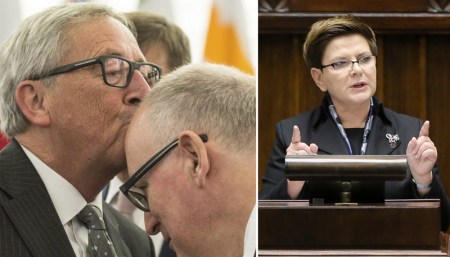 The European Commission, led by Jean-Claude Juncker and Frans Timmermans (left), is hell-bent on forcing member states to take “their share” of migrants. In March, Polish Prime Minister Beata Szydło (right) bluntly stated: “I see no possibility at this time of immigrants coming to Poland.”
In Hungary, Prime Minister Viktor Orban’s spokesman, Zoltán Kovács, stated:
“Mr. Timmermans is right that we have not had the same experience as Western Europe, where countries such as Holland, Britain and France have had mass immigration as a result of their colonial legacies. But we would like to deal with our problems in a way that suits us. And we especially do not like it when people who have never lived in Hungary try to give us lectures on how we should cope with our own problems. Calling us racists or xenophobes is the cheapest argument. It’s used just to dodge the issues.”
Even among those Eastern European countries still waiting to be admitted to the EU, the enthusiasm for the EU seems to have dwindled. “The EU that all of us are aspiring to, it has lost its magic power,” Serbian Prime Minister, Aleksander Vucic said in February, “Yes we all want to join, but it is no longer the big dream it was in the past.”
The reactions of countries such as Poland and Hungary are the normal, healthy reactions of nations who wish to remain prosperous, sovereign and safe for the sake of their own citizens. In addition, entertaining no illusions about “multiculturalism,” they appear to have a justifiable apprehension about the detrimental effects of the current migration crisis on national security and finances.
It is not only the newest members of the EU that have begun to realize that is a bad idea to defer decisions about borders and national security to an unelected supranational entity, which appears completely oblivious to the concerns of its member states.
In Norway, the government announced that it will not accommodate any more migrants beyond the 1500 that the country has already agreed to take during the next two years, as part of the EU’s refugee relocation scheme. “We have set a quota for refugees from the EU. Increasing it is not of current interest,” Immigration Minister Sylvi Listhaug said in April. Norway, in fact, has begun paying asylum seekers to return to their own countries.
In Austria, the government is imposing border controls at the Brenner Pass, the main Alpine crossing into Italy, and erecting a barrier between the two countries.
In the face of such resistance from member states, the European Commission’s plan to penalize them for not accepting “their share” of migrants could not possibly be more ill-timed and out of touch. It comes across as a desperate attempt by the EU’s executive body to force its way of handling the migrant crisis onto disobedient EU member states, like an authoritarian parent disciplining its unruly children. There is, however, such a thing as bending something until it snaps. By persisting in pushing their agendas on EU member states that still consider themselves sovereign and not merely provinces of the European Union, Timmermans and his European Commission bureaucrats may just have given the European Union its kiss of death.
The Failure of the Swedish Establishment, Gatestone Institute, Nima Gholam Ali Pour, May 6, 2016
♦ In Sweden’s third largest city, Malmö, the children of illegal migrants receive income support payments from the government, and the unemployment rate among foreign-born men aged 18-24 years is at 41%. In Sweden, those who do not have jobs receive generous welfare payments from the local authorities, and families in the country illegally have their rent paid by the taxpayers. It is an open invitation to more migrants to come to Sweden.
♦ The Swedish establishment tells Swedes that the more immigrants come to Sweden, the richer Sweden will become — no matter which country these immigrants come from.
♦ The Swedish establishment is characterized by incompetence combined with an extreme left-wing ideology and a hillbilly-like mentality that refuses to see the rest of the world and the risks involved in it. The Swedish establishment has not dealt with Sweden as if it were a country, but as if it were a village.
♦ By gross miscalculations, the Swedish establishment has eroded its own legitimacy. Today, fewer than one in four Swedes have confidence in their government. Meanwhile, the Swedish media is a major threat to Sweden’s security today: it downplays the migration crisis with ridiculous arguments.
A major threat to Sweden’s security today is the Swedish journalistic establishment: it downplays the migration crisis with ridiculous arguments.
As migrants flooded into Sweden in December 2015, Fredrik Virtanen, a writer for Sweden’s largest newspaper, Aftonbladet, wrote an article entitled, “Have refugees forced you to buy worse red wine?” It is not really dangerous, Virtanen argues, that that Sweden was accepting 160,000 migrants; such migratory movements, he wrote, do not really impact anyone’s life.
Today, however, we know that many people’s lives have been affected by the influx of migrants and that the problems are about more than wine. They are, for example, about sexual assault, the murder of staff in asylum accommodations and chaos in the Swedish school system. But Virtanen was right: red wine is still here.
Another of Aftonbladet’s editorial writers, Linnea Swedenmark, writes about a village in the Swedish province of Jämtland. The village she writes, is an example of how migrants are ensuring that the consumption of goods is increasing in the rural areas of Sweden.
What she did not write is that in Jämtland’s largest city, Östersund, many women have been assaulted by men who speak “Swedish with an accent.” The police have warned women not to go out alone. Swedenmark is right when she writes that “the grocery store sells three times as many eggs” — but the women of Jämtland feel less secure in the public domain.
In the magazine, Café, the journalist Andrev Walden wrote in December 2015, that “no nation has perished from too much goodness.” The pictures for his article compared Sweden’s new restrictive immigration laws with the Holocaust.
When the migration crisis started last year in Sweden, the Swedish comedian Henrik Schyffert calculated and wrote on Facebook that it costs each Swede “two Quattro Stagionis (a popular local pizza), a large Fanta soda and a Netflix subscription to save the lives of 80,000 people this year.”
His Facebook post was praised by all major media outlets in Sweden. They were apparently looking to a comedian who counted the counted the cost of immigration in pizza and soda currencies for the solution to Sweden’s migration crisis.
Since Schyffert made his statement, those amazing pizzas that would finance the mass influx of migrants are nowhere to be found, and Sweden has to borrow more money for the migration crisis on its hands.
These quotes are from the mainstream media in Sweden, and it is how large parts of the Swedish establishment sound every day. This is the level at which the debate on immigration in Sweden is being conducted.
While 800,000 migrants in Libya are waiting to invade Europe, Sweden has a refugee policy whereby only by obtaining livelihoods will those migrants with a refugee status and a temporary residence permit get permanent residence permits. So if you get a job, you get to stay in Sweden permanently. It is a strange refugee policy, because those who actually are refugees and not economic migrants are often traumatized and have difficulties finding a job. So Sweden’s refugee policy is tailored to economic migrants.
In Sweden’s third largest city, Malmö, the children of illegal migrants receive income support payments from the government, and families that are in Sweden illegally have their rent paid by the taxpayers. For some reason, the Swedish authorities want to pay people who should not even be in Sweden. It is an open invitation to more migrants to come to Sweden.
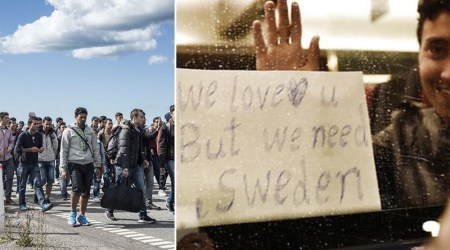 Tens of thousands of migrants have passed through Denmark to enter Sweden during 2015 and 2016, attracted by Sweden’s generous welfare payments and free housing.
What the established Swedish media does not tell people about are the threats and risks that come with increased migration. When the European Union’s border agency, Frontex, recognized that it could not control the migrants coming to Europe, and that many Europeans who had joined terrorist organizations outside Europe were coming back to Europe among the migrants, this was not major news in the Swedish media. This is strange, since Sweden is one of the countries in Europe from where many citizens have traveled from to the Middle East to fight in jihadi terrorist organizations.
Such news does not fit in the narrative that the Swedish media is trying to tell the Swedish people. The narrative that the Swedish establishment wants to tell the Swedes is that the more immigrants come to Sweden, the richer Sweden will become. It does not matter which country these immigrants come from. If they just come to Sweden, then Sweden will become a richer country.
A month before the migration crisis started making waves in the media, the think tank Arena Idé — which has close ties to the Social Democrats, the governing party — published a report that was mentioned in all the major Swedish media outlets.
According to the report, Sweden, between 1950 and 2014, had made a “profit” of $110 billion on immigration. The report also said that without immigration, an $8 billion tax increase would be needed to sustain Sweden’s defense, infrastructure and research. That there could be a conflict between a welfare state and immigration was called a “myth.” As expected, the established Swedish media rejoiced over these “facts.”
When the report went public in June 2015, the Swedish media celebrated it. Today, when the Swedish welfare state is under severe pressure because of immigration, the authors refuse to answer any questions about it. Last June, it was treated as a confirmation of the pro-immigration ideology of the Swedish establishment. With 9.5 million people in Sweden and its many universities, only a few economists protested the report. The loudest criticism came from the economist Tino Sanandaji. Needless to say, Sanandaji, despite being an immigrant from Iran with a Ph.D. in public policy from the University of Chicago, was depicted by some in the established Swedish media as a right-wing extremist.
No, Sweden is not the Soviet Union, but the way large parts of the Swedish establishment turn ideology into “facts” through “reports,” and smear those who have different opinions, undermines debates that are of such critical importance in a democracy.
Not only the media and think tanks connected to the government advocate a liberal immigration policy. There is also loud support for it in academic circles. “Immigrants are a profit for Sweden,” Dick Harrison, professor of history at Lund University, wrote in a December 2014 article for the Swedish newspaper Svenska Dagbladet. In the article, he states:
“Sweden is not in any way unique. The same logic — that immigration strengthens the country politically, economically and culturally – can be said of all peacetime immigrations through the ages, whether it has been about refugees or labor immigration. The more immigrants, the stronger [the] state. The prime example is the United States. There is not a single historical example of immigration in the long term being negative for the host country. At this point, our historical experience is crystal clear — the only form of immigration that has been, and is, directly harmful is comprised of warlike invasions.”
While Harrison gives the United States as an example, he forgets to mention that while immigrants to the U.S. often come from countries such as Mexico, China and India, the three countries from which Sweden received the highest number of asylum seekers in 2015 were Iraq, Afghanistan and Syria. They have also delivered most asylum seekers to Sweden during the first four months of 2016. As most people know, these three countries house large numbers of jihadi terrorists.
In Sweden, moreover, it is difficult for people without a high level of education to get a job. In Malmö, the unemployment rate among foreign-born men aged 18-24 years is at 41%. In Sweden, those who do not have jobs receive generous welfare payments from the local authorities.
Sweden also has a welfare system in which municipalities are obligated to ensure that everyone has housing. Sweden’s homeless people live in hostels or hotels paid for by taxpayers. These immigration policies have therefore have therefore saddled Swedish taxpayers with huge expenses.
Without the establishment’s campaign to convince the Swedish people that immigration will make Sweden rich, Sweden would not have the liberal immigration policies they do, eroding the country’s safety and welfare. Even though the Swedish establishment campaigns in every way possible for a liberal immigration policy, and despite the fact that a few months ago anyone advocating for a restrictive immigration policy was called a “racist,” resistance among Swedes against immigration has increased.
The Swedish people have defied their establishment and recently forced liberal politicians to support a more restrictive immigration policy. The Swedish people, despite having an ideologically blind establishment, have been smart enough to use their common sense.
As for the Swedish establishment, there is no word to describe them other than dangerous.
The Swedish establishment is characterized by incompetence combined with an extreme left-wing ideology and a hillbilly-like mentality that refuses to see the rest of the world and the risks involved in it. The Swedish establishment has not dealt with Sweden as if it were a country, but as if it were a village.
What is happening in Sweden right now is a cultural and political revolution. The Swedes have trusted their establishment for a long time. This trust has been a part of the political culture in Sweden. But now that culture is changing — to be anti-establishment in Sweden today is not marginalized anymore. Sweden is developing a powerful anti-establishment movement, dominating the political debate.
By gross miscalculations, the Swedish establishment has eroded its own legitimacy. Today, fewer than one in four Swedes have confidence in their government. The damage that the Swedish establishment’s liberal immigration policies inflicted on Sweden during the migration crisis of 2015 — and is about to inflict during the coming migration crisis of 2016 — is likely to cause a tectonic political shift in Sweden.
The Swedish media has failed in its journalistic obligation to report objectively about the problem, and Swedish politicians have not acted in the best interest of Sweden. While Sweden faces its biggest crisis since World War II, the Swedish establishment has clearly failed to lead.
The average Swede needs to be tougher to cope with the challenges facing Sweden today and in the years to come. The problems that will face Sweden after it has received 160,000 asylum seekers in 2015 and the 150,000 asylum seekers expected in 2016 will create a political, cultural and social environment in which there is no place for political naivety and ideological blindness. To survive as a stable and civilized country where the rule of law and democracy will prevail, Sweden will be forced to recognize the threats and risks that come with massive immigration — and to respond.
Importing Terror, Front Page Magazine, Joseph Klein, May 6, 2016

President Obama is willing to gamble with the lives of American citizens. He is intent on emptying Guantanamo of as many of the detainees as possible, even as some of the released jihadists have returned to the battlefield to fight against our soldiers. Now the Obama administration is reportedly planning to accelerate the screening process for Syrians claiming refugee status, so that they can be rapidly resettled in communities across the United States.
The Washington Free Beacon has reported that, according to its sources, “The Obama administration has committed to bring at least 10,000 Syrian refugees onto American soil in fiscal year 2016 by accelerating security screening procedures from 18-24 months to around three months.”
The current resettlement vetting process for self-proclaimed refugees begins with an initial screening by the United Nations High Commissioner for Refugees (UNHCR). The applications of some who make it through this preliminary UN screen are referred to United States authorities for further consideration and possible resettlement. UNCHR’s role in the front end of the vetting process should be reason enough for alarm.
The United Nations has called for more open borders to accommodate the millions of “refugees” and other migrants whom have left the Middle East and North Africa. To this end, UNCHR is said to be looking for alternative avenues to admit Syrian refugees that are faster than the current refugee “resettlement” vetting process. UN High Commissioner for Refugees Filippo Grandi suggested a number of such alternatives last March, at a high-level meeting held in Geneva to discuss “global responsibility sharing through pathways for admission of Syrian refugees.”
Among the alternative “pathways” listed by the UNCHR High Commissioner for Refugees were “labour mobility schemes, student visa and scholarships, as well as visa for medical reasons.” He added, “Resettlement needs vastly outstrip the places that have been made available so far… But humanitarian and student visa, job permits and family reunification would represent safe avenues of admission for many other refugees as well.”
The net effect of expanding the grounds for admitting Syrian refugees to include job and student related visas could be to bump American citizens from jobs and scholarships that are given to the refugees instead.
Apparently, the Obama administration is onboard with looking for alternatives to the current refugee resettlement system that depends on cooperation with the states. Perhaps it is reacting to the fact that numerous states have recently elected to opt out of refugee resettlement programs, including New Jersey.
“The United States joins UNHCR in calling for new ways nations, civil society, the private sector, and individuals can together address the global refugee challenge,” the State Department wrote in a Media Note following the Geneva conference. The State Department added that it has “created a program to allow U.S. citizens and permanent residents to file refugee applications for their Syrian family members.”
Who are such “family members?” Would they include siblings and cousins of fighting age? Do we really want to add more loopholes to the existing visa system, which was already breached by the female jihadist who took part in the San Bernardino massacre after being admitted to the United States on a “fiancé” visa? Apparently so, if the Obama administration gets its way. Speeding up the “refugee” admission process and avoiding state roadblocks in the current refugee resettlement pathway appear to have become its top priority.
Meanwhile, Obama administration officials tell us not to worry. They assure us they have a “robust” screening process in place to vet Syrians claiming to be refugees. Don’t believe them. They are deliberately turning a blind eye to the warnings of experts such as FBI Director James Comey, who said last year, during a House Committee on Homeland Security hearing, that the federal government lacked the data to adequately vet “refugees” seeking entry to the U.S.
“We can only query against that which we have collected,” Comey told the committee. “So if someone has never made a ripple in the pond in Syria in a way that would get their identity or their interest reflected in our database, we can query our database until the cows come home, but there will be nothing show up because we have no record of them.”
Director of National Intelligence James Clapper warned earlier this year that he considered ISIS and its branches to be the number 1 terrorist threat. Clapper pointed to ISIS’s success in “taking advantage of the torrent of migrants to insert operatives into that flow.”
Even those “refugees” who enter the United States without pre-existing ties to ISIS are vulnerable to indoctrination by jihadists already in this country. Somali “refugees” are a prime example. As Andrew Liepman, who was serving as deputy director for intelligence at the National Counterterrorism Center until he retired from government service in 2012, said during the first year of Obama’s presidency: “Despite significant efforts to facilitate their settlement into American communities, many Somali immigrants face isolation.”
Jihadists have been busy “recruiting and radicalizing young people,” Liepman added.
Nevertheless, seven years later, the Obama administration continues to send as many as 700 Somali “refugees” per month to cities across the United States, with the largest number settling in Minnesota where large concentrations of Somalis already live.
Barack Obama has said that it is wrong to “start equating the issue of refugees with the issue of terrorism.” He refuses to associate Islam or jihad with acts of terrorism or with what he calls violent extremism. He rails against “negative stereotypes of Islam” and “those who slander the prophet of Islam.” But telling the truth about the violent and supremacist strains in Islamic ideology, rooted in the Koran and the sayings of Prophet Muhammad, is neither stereotyping nor slander. It is identifying the enemy we are fighting. And wanting to make sure that we have a foolproof vetting system in place before admitting more Muslims from the sectarian conflict-ravaged areas in the Middle East or North Africa is neither fear-mongering nor discrimination. It is common sense defense of the American people from undue risk of attacks in our homeland, which is the primary duty of every U.S. president as commander-in-chief including Barack Obama.
Migrant Rape Epidemic Reaches Austria, Gatestone Institute, Soeren Kern, May 5, 2016
♦ A 20-year-old asylum seeker from Iraq confessed to raping a 10-year-old boy at a public swimming pool in Vienna. The Iraqi said the rape was a “sexual emergency” resulting from “excess sexual energy.”
♦ Those who dare to link spiraling crime to Muslim mass migration are being silenced by the guardians of Austrian multiculturalism.
♦ According to data compiled by the Austrian Interior Ministry, nearly one out of three asylum seekers in Vienna was accused of committing crimes in 2015. North African gangs fighting for control over drug trafficking were responsible for roughly half of the 15,828 violent crimes — rapes, robberies, stabbings and assaults — reported in the city during 2015.
♦Austria received 90,000 asylum requests in 2015, the second-highest number in the EU on a per capita basis, but this pales in comparison to what may lie ahead. Interior Minister Wolfgang Sobotka warned last month that up to one million migrants are poised to cross the Mediterranean from Libya to Europe.
The brutal gang rape of a woman by three Afghan asylum seekers in central Vienna on April 22 has shocked the Austrian public and drawn attention to a spike in migrant-related rapes, sexual assaults and other crimes across the country.
The migrant crime wave comes as the anti-immigrant Freedom Party of Austria (FPÖ) has surged in opinion polls. The party’s candidate, Norbert Hofer, won the first round of Austria’s presidential elections on April 24, and is on track to win the presidency in the second round, run-off election scheduled for May 22.
The three Afghans — two 16-year-olds and one 17-year-old — followed the woman, a 21-year-old exchange student, into a public restroom at the Praterstern train station, one of the main transportation hubs in Vienna. One of the migrants held the woman down while the other two took turns raping her.
A passerby called the police after she heard the woman screaming. By the time police arrived, the men had gone. The suspects, who were arrested as they were attempting to flee the station, do not speak German. Through an interpreter, the migrants told police they were drunk and do not remember carrying out the crime.
If convicted, they face a maximum sentence of seven-and-a-half years in prison. Due to the lenient nature of the Austrian judicial system, however, they may end up spending only two years behind bars, according to local observers.
It is also unlikely that the migrants will be deported: according to European law, sending them back to Afghanistan would be a violation of their human rights. Instead, observers say, the Afghans will qualify for Austrian social welfare benefits — €830 ($950) per month plus free healthcare — and probably for the rest of their lives become wards of Austrian state.
The assault in Praterstern is one of a growing number of migrant sex crimes in Austria (other migrant rapes and sexual assaults are included in the appendix below):
Those who dare to link spiraling crime to Muslim mass migration are being silenced by the guardians of Austrian multiculturalism.
In April, for example, the Austrian Press Council (Presserat) — a group that enforces a politically correct “code of ethics” to ensure that Austrian media outlets toe the line of state-sanctioned multiculturalism — censured the left-leaning magazine, Falter, for “blanket discrimination” against Muslims.
The magazine’s editors — otherwise faithful proponents of European multiculturalism — appear to have had enough of migrants raping their way through Europe with virtual impunity. For the January-February 2016 edition, Falter’s cover featured a black and white drawing of five “light skinned” European women surrounded by large numbers of “dark skinned” Arab males. The image evoked images of the taharrush assaults in Cologne.
In a three-page “decision,” the Presserat ruled that the image violates the “code of ethics” because it amounts to “blanket slander and discrimination” against Arab men:
“The men are all portrayed with the same fierce-looking facial expression, dark hair and noticeably dark eyebrows. In this way — in the context of the attacks in Cologne — the artist is constructing a prototype of men from North Africa, i.e., the Arab world. The uniformity of the image suggests that, rather than portraying individuals, it depicts a homogenous group whose members all behave in the same way.
“Therefore, readers could be left with the impression that the sexual assaults in Cologne were not the acts of individual persons or person groups, but that such conduct is typical for men from North Africa, i.e., the Arab world. The image could leave the impression that all North Africa men who are here in Europe fail to conduct themselves correctly vis-à-vis women.”
The editors of Falter defended themselves against accusations of racism:
“The fact is that North Africans were overwhelmingly responsible for the assaults in Cologne. This is what took place and we should be allowed to represent it as such.”
Vienna is the epicenter of migrant crime in Austria. According to data compiled by the Austrian Interior Ministry, nearly one out of three asylum seekers in Vienna was accused of crimes in 2015. Of the nearly 21,000 officially approved asylum seekers in the capital, 6,503 were known to have committed crimes in 2015, a jump of nearly 50% over 2014. The data shows that 2,270 of the criminals were under the age of 20, a 72% jump over 2014. Seven were under age nine, while 31 were under age 13.
According to Vienna Police Chief Gerhard Pürstl, North African gangs fighting for control over drug trafficking were responsible for roughly half of the 15,828 violent crimes — rapes, robberies, stabbings and assaults — reported in the city during 2015.
The area around the Praterstern station, where the exchange student was raped, has become overrun by shiftless migrants from Afghanistan and North Africa who are selling drugs, fighting turf battles and assaulting female passersby. Police were dispatched to the area a total of 6,265 times in 2015, or an average of 17 times a day, according to local media. But local authorities appear unable or unwilling to restore order to the area.
 The area around Praterstern train station in Vienna is overrun by shiftless migrants from Afghanistan and North Africa who are selling drugs, fighting turf battles and assaulting female passersby. Police were dispatched to the area 6,265 times in 2015, or an average of 17 times a day.
The head of the Austrian Police Union, Hermann Greylinger, estimates that Vienna needs around 1,200 more police officers in order to establish order in the capital:
“If we are allowing in our country 111,000 migrants, few of whom have had background checks, then clearly the police must be massively increased. Almost all asylum claimants are moving to Vienna. We now have more migrants than the population of the city of Salzburg, the fourth-largest city in Austria.”
Austria’s migrant crime problem is being exacerbated by an extremely lenient criminal justice system. On May 4, for example, a 21-year-old migrant from Kenya randomly killed a 54-year-old woman on a busy street in Vienna by hitting her over the head with an iron bar. It soon emerged that the Kenyan was well known to city police: since arriving in Austria in 2008, he had committed at least 18 previous crimes — including dealing drugs, attacking police officers and hitting someone over the head with an iron bar — but he has repeatedly been set free.
Given the growing insecurity, it comes as no surprise that Austrian voters are looking for a change in political direction.
In what amounts to a political earthquake, Freedom Party (FPÖ) candidate Norbert Hofer won 36% of the vote in the first round of Austria’s presidential election on April 24. Hofer — who has campaigned on a platform calling for strict limits on immigration and tough rules for asylum seekers — defeated all of the other candidates, including those from the two governing parties, the Social Democrats and the Austrian People’s Party, which have dominated Austrian politics since the end of World War II.
Hofer, who says that as president he will be the “protector of Austria,” is now on track to defeat the Green Party’s Alexander Van der Bellen, a 72-year-old economist who is opposed to limits on immigration, in a run-off ballot to be held on May 22.
Hofer’s meteoric rise is focusing the minds of the establishment parties. On April 27, just three days after Hofer’s electoral victory, the Austrian Parliament adopted what may be one of the toughest asylum laws in Europe.
Under the new law, Austria will declare a “state of emergency” on the migration crisis. This will allow Austrian authorities to assess asylum claims directly at the border. Only asylum seekers with immediate family members already in Austria, or those who can prove they are in danger in neighboring transit countries, will be allowed to enter the country. Other migrants will be turned away. The new law also limits any successful asylum claim to three years.
Interior Minister Wolfgang Sobotka said the new law is needed to stem the flow of migrants and refugees: “We cannot shoulder the whole world’s burden.”
Austria received 90,000 asylum requests in 2015, the second-highest number in the European Union on a per capita basis, but this pales in comparison to what may lie ahead. In a radio interview on April 28, Sobotka warned that up to one million migrants are poised to cross the Mediterranean Sea from Libya to Europe.
Sexual Assaults and Rapes by Migrants in Austria, January-April 2016.
Gatestone Institute has reported about the migrant rape epidemic in Germany and Sweden. The problem has now spread to Austria. Following are a few cases from the first four months of 2016:
April 29. A 35-year-old migrant from Algeria attempted to rape a woman at a bus stop in Linz. The man beat the woman unconscious, but not before she broke his nose. He was arrested after he went to a local hospital seeking medical attention. It later emerged that the Algerian has a long criminal record, including other attempted rapes, but cannot be deported because Algeria will not take him back.
On April 25, Kronen Zeitung, the largest newspaper in Austria, reported that an “Arabic-looking man” attempted to rape a 27-year-old woman at a bus stop in Vienna. “All he could say was sex, sex, sex,” the woman said. The man pulled a condom out of his pants pocket and then dropped his trousers. “I screamed as loud as I could,” the woman said, “until the man ran away.” She said that city police have been wholly uninterested in her case: “They have not even asked me for my name.” After local media reported on her case, police issued an apology and blamed their failure to take her seriously on a “regrettable misunderstanding.”
April 24. An unidentified migrant raped a 19-year-old woman in Eisenstadt.
April 22. Three asylum seekers from Afghanistan gang-raped a 21-year-old woman at a train station in Vienna.
April 22. A 17-year-old asylum seeker from Afghanistan attempted to rape a 20-year-old woman in Graz.
April 21. A 17-year-old asylum seeker from Afghanistan sexually assaulted a 19-year-old woman on a train in Grieskirchen. The train’s conductor intervened after he heard the woman scream. The Afghan told police that the woman was lying and demanded an apology.
April 20. Two North African migrants sexually assaulted a woman in front of the main train station in Salzburg. When a 26-year-old passerby attempted to intervene, the migrants punched and kicked him so hard that he was rushed to a nearby hospital. One of the attackers is a 31-year-old asylum seeker from Morocco. The other suspect remains at large.
April 15. A 42-year-old migrant from Slovenia was arrested for attempting to sexually assault two 18-year-old women in Leibnitz.
April 13. An “Arab looking” man sexually assaulted three women at a bus stop in Vienna.
March 24. Two Afghan migrants were arrested for raping a 20-year-old woman in Wels.
March 21. A migrant from North Africa assaulted a 27-year-old woman on a packed subway train in Vienna. The man began touching the woman on her hands. When she got up to find another seat, the man grabbed her and began kissing her on the mouth. Police told the woman there was nothing they could do because kissing does not qualify as sexual assault.
March 12. A 16-year-old asylum seeker from Libya attempted to kidnap and rape two women inVienna. After the three met on a subway train, the Libyan promised to take the women to a nightclub. He took them instead to an apartment where he attempted to lock the women in the basement and rape them. One of the women escaped and called the police.
March 8. A 20-year-old asylum seeker from Afghanistan was observed pointing to his genitals in front of a seven-year-old girl at a public swimming pool in Vienna. The pool director and a swimming instructor held the man until police arrived. The police let him go.
March 6. A “foreign looking” man sexually assaulted a 37-year-old woman at a public swimming pool in Klagenfurt after she intervened to prevent him from molesting her four-year-old boy.
February 25. A “southerner” sexually assaulted two teenage girls at a shopping mall inInnsbruck.
February 22. An 18-year-old migrant from Afghanistan was arrested for raping a 52-year-old woman in Innsbruck.
February 14. Six migrants sexually assaulted a 49-year-old woman on a subway in Vienna. Two of the men, an 18-year-old asylum seeker from Afghanistan and a 23-year-old asylum seeker from Iraq, were arrested as they tried to exit the station. The other four remain at large.
February 11. A 33-year-old migrant from Iran masturbated in front of female patrons at a public swimming pool in Linz.
February 8. A 22-year-old migrant from Macedonia identified only as Ibrahim J. was arrested inVienna for sexually assaulting more than 20 women in Vienna and other parts of Austria. Among other crimes, the man is accused of raping a 15-year-old girl.
February 6. A group of 28 male asylum seekers sexually harassed female patrons at an outdoor ice skating rink in Stockerau. The migrants then attacked security guards who tried to intervene. Police were needed to restore order.
February 4. Six “southerners” assaulted a 53-year-old woman in front of a grocery store in Spittalafter she refused to give them money.
February 3. Three migrants sexually assaulted a 16-year-old girl at a streetcar stop in Leonding. One of the men held the girl down while the other two took turns assaulting her.
January 26. A 24-year-old asylum seeker from Gambia raped and murdered a 25-year-old American woman in Vienna. The woman from Colorado, who was working as an au pair (nanny), had given the man, Abdou I., shelter in her apartment. He had fled his asylum shelter because his asylum request was denied and he feared being deported. After the murder, the man fled to Switzerland, where he was arrested after police traced his cellphone. It later emerged that he was wanted in Germany for sexually assaulting an underage girl.
January 23. A migrant from Macedonia attempted to rape a 21-year-old woman in Vienna. The man made eye contact with the woman on a subway and followed her after she got off the train.
January 16. A 21-year-old asylum seeker from Afghanistan raped an 18-year-old woman at the Prater, a large public park in Vienna.
January 10. A 29-year-old asylum seeker from Afghanistan tried to molest a six-year-old boy at a public swimming pool in Linz. The mother of the child said: “I noticed six migrants enter the building. Two of them sat down at the edge of the pool for children. One of them began stimulating his genitals while flirting with my youngest child.”
January 1. Mobs of Arab men sexually assaulted at least 24 women in Vienna, Salzburg and Innsbruck.
Islamist Extremism in France (Part II), Clarion Project, Leslie Shaw, May 4, 2016
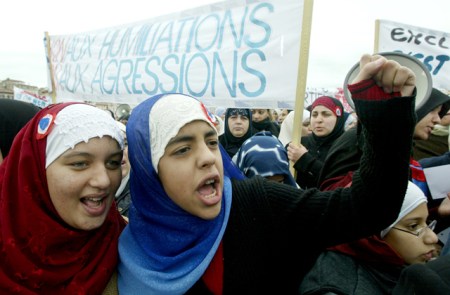 Muslims in France protest against a French law that forbids the wearing of religious symbols (including the hijab) in the primary and secondary schools. (Photo: © Reuters)
France has one of the largest Muslim communities in the West (estimated at 10% of the population), and French corporates have more experience than most in dealing with radical Islam.
City of Paris
In September 2012, in response to the encroachment of radical Islam, the mayor of Paris set up an Observatory on Secularism to ensure the principles of the 1905 separation of Church and State were being respected by the city’s 73,000 employees.
The observatory remained dormant but was reactivated in January 2015 after the Islamic terrorist attacks. Saïd Kouachi, one of the Charlie Hebdo killers, worked in the city sanitation department from 2007 to 2009. He was part of an employment program for young people from the ghettoes surrounding Paris.
A number of these youths were assigned to going door-to-door to inform householders on the benefits of domestic waste segregation. Many created problems for their supervisors due to their increasingly fundamentalist Islamic beliefs: refusing to shake hands with women, bringing prayer mats with them and taking time off to return to their workplaces to pray. Kouachi was moved from district to district as his supervisors, who described him as fundamentalist and unmanageable, became exasperated with his behavior. He was fired in July 2009.
A supervisor later revealed that city authorities had been notified about Kouachi’s radical behavior on several occasions, but that the subject was taboo. A “Charter on Secularism” was posted in the sanitation workshops and a one-day training program held for supervisors in 2013, but no action was taken to deal with the problem.
Since January 2015, the Observatory members meet regularly, have issued a 20-page rulebook to municipal employees and interviewed numerous city managers about the problems of radicalization. Departments most affected are sanitation, parks and gardens, public safety and security, and youth and sport. Common issues are praying in the workplace, refusal to shake hands with, look at or follow instructions from female supervisors, demands for work schedule accommodation on Fridays and during Ramadan, wearing of hijabs and other head-coverings.
RATP Paris Transit Authority
The RATP chapter of the CFDT union claims there is a groundswell of Islamist ideology within the company where Samy Amimour, one of the 2015 Paris suicide bombers, worked as a bus driver. In December 2015, a newspaper reported that several RATP employees were targeted by “Fiche S,” a law enforcement indicator that flags individuals linked to terrorism.
Religion-based workplace incidents are widespread. In 2013, RATP management issued a guidebook to supervisors listing typical infringements of secular principles and outlining rules to enforce. An RATP executive commented, “We pretend the problem has been solved, but the reality is that managers in contact with radicalized individuals in bus depots are left on their own to handle these kinds of things.”
ADP Paris Airports Authority
Following the November 2015 attacks in Paris, CDG Airport CEO Augustin de Romanet revealed that 70 airside security badges had been withdrawn from Muslim airport employees and 4,000 staff lockers raided by police as the employees were considered a security risk.
French Automobile Industry
The problems facing French public-sector companies have long been present in the automobile industry, where Muslims account for around 70 percent of the workforce. Militant Islam began to manifest itself in the 1980s, when it emerged that shop stewards frequently had links to the Muslim Brotherhood.
Employees began to shave their heads, grow beards and wear Islamic garb as the Salafist ideology gained ground in the suburbs where the auto plants are located. Automakers Renault and Peugeot integrated Muslim practices into their management model, setting up on-site prayer rooms and planning work schedules to fit in with prayer times and Ramadan.
Employee associations were established to cater to the needs of Muslim staff, organizing religious celebrations, pilgrimages to Mecca and arranging for the repatriation to North Africa of deceased workers. This policy of appeasement benefited the industry since it minimized religion-linked workplace conflict and litigation and fostered employee engagement.
Radical Islam and the Emergence of Jihadism
The first generation of Muslim immigrants who came to France in the 1950s kept their faith to themselves. The second generation was more militant and began making demands for accommodation of Islam. Opting for exclusion rather than integration into mainstream society, some turned to crime. Those caught and imprisoned often converted to radical Islam, spreading the ideology throughout the ghettoes upon release.
The third generation came of age with the nationwide 2005 riots, sparked by the electrocution of two juvenile delinquents who climbed over a fence into an electricity substation to escape from the police.
The same year, Abu Musab al-Suri published a 1,600-page Global Islamic Resistance Call urging the masterminds of jihad to exploit the presence of the huge disaffected Muslim populations in Europe by prompting them to set up terror cells targeting Western civilians. The strategy was rolled out on the internet and by Salafist imams operating in mosques financed by the Gulf states.
A growing number of Muslims in France and Europe converted to radical Islam resulting in the emergence of an informal jihadist army on the continent. In February 2016, the number of radical Islamists identified by French law enforcement was 11,700.
Florida Synagogue Bomber Plotted to Kill Jews for “Glory of Allah” Front Page Magazine, Daniel Greenfield, May 3, 2016
The last time I was in Los Angeles, there were guards at every synagogue. In New York, there are police officers in front of every synagogue. But the media won’t talk about Muslim anti-Semitism. Instead it’ll pretend that we face a grave Islamophobia threat. Two days from now this story will be buried beneath a deluge of “Muslims fear backlash” stories. And Jews will have to pray in synagogues under assault.
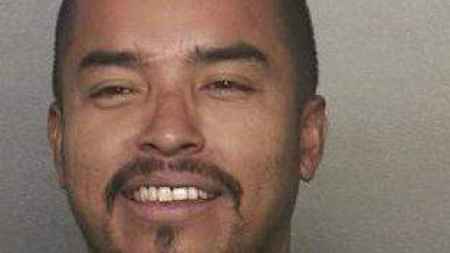
And so we turn to James Gonzalo Medina aka James Muhammad, who converted to Islam, threatened a church and then plotted to bomb a synagogue for Islam.
Medina has a number of prior arrests, including one in August 2012 when he was accused of sending violent threats via text message to a Coral Springs family.
One text read: “By next week, Ima bomb ya [curse word] … Bring him! I will buy a gun [off] the street and rampage [family member’s] church. Murder she wrote,” according to the 2012 affidavit.
And at some point, Muhammad/Medina prioritized killing Jews.
One of Medina’s associates informed the FBI source that Medina was planning to martyr himself in a firearms attack on the Aventura synagogue, using AK-47 assault rifles — then, the affidavit said, the conversation turned to claiming responsibility for it. Medina said he liked the source’s idea of using the name of a notorious terrorist group — ISIS or al-Qaida-linked Shabaab — to assume responsibility.
Medina, who told the source he had converted to Islam four years ago, said the planned synagogue attack would inspire other Muslims. Medina would later express his “current hatred for the Jewish people,” the affidavit said.
An FBI undercover employee questioned Medina about his resolve: “You’re sure this is something you want to do?” Medina answered: “I feel like it’s my calling,” adding he was “comfortable” with killing innocent women and children.
Initially, an FBI confidential source met with Medina and two of his associates in late March and discussed the attack plan for the first time, according to an FBI affidavit. In early April, Medina talked about the timing of the assault with the source, who mistakenly suggested it could be carried out in a couple of weeks on the Jewish holiday, Yom Kippur — not realizing the upcoming holiday was Passover.
Medina’s response: “… that’ll be a good day to go and bomb them,” the affidavit said.
Before his arrest, Medina made three videos with his cellphone: In the first, he was recorded saying, “Aventura, watch your back. ISIS is in the house.” In the second, he said, “Today is gonna be a day where Muslims attack America. I’m going to set a bomb in Aventura.” And in the third, he said his good-byes to his family.
And yes, he knew what he was doing. The “not a Muslim” thing did not fly.
CHS: MEDINA doesn’t have passion.
TI: No, no listen, listen, listen … no no it’s possible. I always knew in my heart …
CHS: MEDINA is suicidal, he’s not a Muslim.
TI: No, no, no, no listen, listen, listen. When, when I first met him, you know what he taught me. He taught me something you know. It’s not like he’s not knowledgeable. It’s not like he’s not bullshit.
CHS: It’s ok.
TI: It’s not like he’s not religious.
CHS was the FBI’s informant.
On April 1, 2016, MEDINA met with the CHS and at one point, while driving around in the CHS’s car, MEDINA directed the CHS to the synagogue in Aventura, the site of MEDINA’s intended attack. MEDINA described the synagogue (“it’s a real big one”), and when they drove up to it, MEDINA pointed it out (“[Y]ou see the, the, the David’s triangle star.”) Then MEDINA redirected the conversation from the location of the attack to its timing. MEDINA stated, “You see it there. And you see, I mean that’s where it is, but you gotta know when to go like.”
MEDINA explained some of his religious philosophies that form the basis for his current hatred for Jewish people… MEDINA explained that if he would conduct an attack be would want to do it at a synagogue because Jewish people are the ones causing the world’s wars and conflicts.
MEDINA further explained that attacking one synagogue would give hope and light to other Muslims in America.
MEDINA further explained that the “plot” that he and BH had discussed allowed them to “strike back to the Jews, by going to a synagogue and just spraying everybody … ‘ cause we’re Muslims you know what I mean? It’s a war man and it’s like it’s time to strike back here in America.” MEDINA then stated that he wanted to go inside to kill people while the others shot people as they were fleeing the scene.
MEDINA then commented that the news coverage could galvanize Muslims to worldwide action: “I wanna see it go worldwide with now all the Muslims realizing you know, when it’s our time .. . Next thing you know it will be in California, Washington, and the brothers are saying you know, it’s our time now.”
MEDINA then discussed placing the bomb in the parking lot of the synagogue, and added, ” [W]e can just lay one out there and then bomb it later … I’d like to put it like, as close as possible, to the door.”
MEDINA envisioned a terrorist operation that would inflict maximum casualties, commenting “‘Cause, uh, I’m sure this is gonna be hammered. All these people gonna die.” He provided detailed instructions to the CHS about how to drop him off and then pick him up after the bomb had been strategically placed.
MEDINA again recounted the operational plan, with emphasis on the fact that it shoUld be when the synagogue is full of people: “[Y]ou just let me in there real quick, and I find my opportunity to walk in while the service already started … When I see, uh, I find the clearance, it’s where you’re gonna tell me, okay now, pull up and drop me off.” MEDINA flatly told the CHS, “Oh my God, I can’t wait.”
MEDINA told a story about a Jewish woman he had met earlier who had given him a ride. A discussion had ensued regarding her fear of Muslims once she realized MEDINA was a Muslim and her thoughts that MEDINA might kill her. Thereafter, MEDINA remarked to the UCE and the CHS that he had told her, “[Y]ou know, we’re, we’re just getting bombed for no reason, and it was time to get out. But it made me just think more that, you know, it just, when she said that you will kill me, I’m thinking yeah man, I want to. You know what I mean? I really do … ”
The UCE asked, “Why do you wanna do this?” MEDINA responded, “Because I realize that I have a lot of love for Allah. And I know that all these, all these wars that are going on, it hurts me, too. You know? It’s my call of duty. I gotta 10 get back, when I’m doing this, I feel that I’m doing it for a good cause for Allah.”
MEDINA’s comments prompted the UCE to ask another question about his motivation, “What message are you sending?” The UCE wanted to know more about MEDINA’s purpose in attacking the synagogue, including what claim of responsibility would be made. MEDINA answered that “I’m gonna call that it’s ISIS in America.” MEDINA plainly told the UCE that “I do want to get the bomb,” and though he had considered using an AK.-47 assault rifle to “just go in there and rampage everybody,” he concluded, “Well I’d like to use the bomb.” MEDINA added, “And I’m hoping that that one bomb can just cause a big damage you know? And let them realize that their Yom Kippur’s going down.”
MEDINA responded that it is Allah’s will and that he’s not crazy and reckless to the point where he would get the UCE arrested: “No I’m not like that.” The UCE cautioned MEDINA one more time that “once you do this, there’s no going back.” MEDINA reiterated his plan to personally deposit the bomb, and after it detonated, enjoy watching the news coverage of the attack: “That we, they, whatever they’re sayin’, that they’re being bombed and all of that … , and knowing that it was from us. And just getting’ a joy that I’m doing this you know, I did it. It worked out. And whatever happens, it’s for the glory of Allah.”
2 days.
Then the media will be running stories about how Islamophobia is the real problem and Muslim anti-Semitism doesn’t actually exist. Then The Nation will be doing sob stories about Medina claiming that he was a mentally unstable man used as a pawn by the FBI, just like they’re still doing for synagogue bomber Ahmed Ferhani in New York.
How Many Molenbeeks in France? Gatestone Institute, Yves Mamou, May 3, 2016
♦ “There are today, we know, a hundred neighborhoods in France that present potential similarities with what’s happened in Molenbeek.” — Patrick Kanner, Minister for Urban Areas.
♦ The Salafists, in fact, do not want to “take the power in these neighborhoods.” In many, they already have it.
♦ “The farther I walked between the buildings, the more I was stunned. A courtyard of Islamist miracles; an enclave that wants to live like during the times of Muhammad. Bakery, hairdresser… It’s a mini Islamic Republic. During the sermons, they denounce, they criminalize. A woman who smokes? A degenerate. A woman who does not veil herself? A tease. A man that does not eat halal? He has an express ticket to hell.” — Paris Match.
♦ Remadna received a death threat over the phone: “We know where your kids go to school,” and “your daughter is very pretty.” The next day, a delegation of completely veiled Salafist “true Muslim mothers” came and told her, “We want mosques, not schools.”
Patrick Kanner, France’s Minister for Urban Areas, was undoubtedly not planning to tell the truth on March 27.
He was on the set of Europe 1 TV to emphasize the left’s credo: Islamist terrorism is rooted in poverty and unemployment. But they asked one question again and again: “How many Molenbeeks are in France?” Finally, he said: “There are today, we know, a hundred neighborhoods in France that present potential similarities with what has happened in Molenbeek.”
Molenbeek, as the entire world knows today, is the neighborhood of Brussels that has become the epicenter of jihad in Europe. It is a neighborhood under Salafist control that sent three of its residents to assassinate hundreds of people in Paris on November 13, 2015. These are the residents of the same neighborhood that bombed the Brussels airport and the Maalbeek Metro station.
 The Molenbeek neighborhood of Brussels has become the epicenter of jihad in Europe. Abdelhamid Abaaoud (right), mastermind of the November 2015 attacks in Paris, lived in Molenbeek. Amedy Coulibaly (left), who in January 2015 murdered a policewoman and four Jews in Paris, spent time in Molenbeek.
The reactions to Kanner’s statement have not been slow. The first secretary of the Socialist Party, Jean-Christophe Cambadélis, accused Kanner of “dissolving national harmony.” Julien Dray, another leading figure of the Socialist Party, also criticized Kanner, telling him: “I do not like it when we stigmatize [people].”
Nonetheless, Kanner will not let himself be intimidated. In a March 28 interview in Le Parisien, he recalled,
“Amedy Coulibaly [the killer in the Hyper Cacher attack], who was from the Grande-Borne à Grigny, Mehdi Nemmouche [the Brussels Jewish Museum killer], who passed through the Bourgogne neighborhood in Tourcoing. and Mohamed Merah, who was from the Mirail neighborhood in Toulouse.”
Malek Boutih, Socialist Deputy, came to Kanner’s aid. He declared,
“It is the first time that a minister of the suburbs says even a little bit of the truth, namely that the ghettos have transformed, little by little, into zones that we cannot control very well… Neighborhoods that are incubators for terrorists.”
Samia Ghali, a Senator from Bouches du Rhones (Socialist Party), echoed the statements of the Minister for Urban Areas: “There are training camps in the neighborhoods of Marseille where people are learning to shoot.” She adds, “I’ve gotten to the point of asking if we should build walls to protect schoolyards from Kalashnikov bullets or from rifles finding their way into the school yard.”
Gilles Kepel, professor at the Paris Institute of Political Studies, and one of the best experts on Islamism in France, explained in early April that three ingredients are necessary for making a Molenbeek:
“1) A strong system of crime organized around kif [a type of marijuana]; 2) Hideouts for terrorists and sites where they can stock weapons; 3) Local politicians who accept that the Salafists have opened countless uncontrollable mosques.”
These three ingredients would be uniformly present in all 100 French Molenbeeks, added Kepel. But the goal of the Salafists, he adds, is actually to seize neighborhoods in order to wage a “enclave war.”
Patrick Kanner, the Minister for Urban Areas confirmed this view: “The Salafists want to take the power in these neighborhoods.” The gravity of the situation was recently underscored by Prime Minister Manual Valls: a fundamentalist “minority,” he said, is about to win “the ideological and cultural battle” over Islam.
The Salafists, in fact, do not want to “take the power in these neighborhoods.” In many, they already have it.
On January 27, the magazine Paris-Match dedicated several pages to the neighborhood Reine-Jeanne in Avignon, a large city in the south of France, where the Salafists have systematically exploited half a million Muslims.
“The farther I walked between the buildings, the more I was stunned. A courtyard of Islamist miracles, a Salafist pocket, an enclave that wants to live like during the times of Muhammad. Bakery, hairdresser, building managers, teenagers. All (or almost) overcome with the Koran. Well, their Koran. It’s a mini Islamic Republic.
“During the sermons, they denounce, they criminalize. A woman who smokes? A degenerate. A woman who does not veil herself? A tease. A man that does not eathalal? He has an express ticket to hell. That female neighbor, the one who is divorced, with three kids, and works with men? She will end up losing her virtue. She should just give up. In order to not pass for an ‘easy woman,’ the unlucky choose the hard life, welfare benefits!”
In Sevran, a suburb of Paris, the Salafist mosque was sealed off several weeks ago because it had been recruiting a dozen young Muslims for the Islamic State. Six may have already been killed in Syria. Nadia Remadna, a Muslim social worker, lives in Sevran. She started the local “Mothers’ Brigade” to help women keep control over their children, against the Islamists. In 2014, she wrote the provocative book, How I Saved My Children, with the sub-title “Before, we feared our children would fall in with delinquents. Now, we fear they will become terrorists.”
On March 14, Remadna received a death threat over the phone: “We know where your kids go to school,” and “your daughter is very pretty.”
The next day, a delegation of completely veiled Salafist “true Muslim mothers” came and told her, “We want mosques, not schools.”
On March 29, the philosopher Yves Michaud spoke to the magazine Paris Match about his students:
“My ex-students who teach today in the suburbs… tell me that among their students they have some who could become terrorists overnight. They take on the weight of Islam, of adolescence, of the ghettoization that makes them question their identity, of cultural disorientation. It is an ideal breeding-ground for the jihadist calling.”
How many Salafists are there in France? 15,000 to 20,000, according to Bernard Godard, former head of the Bureau of Religion for the Ministry of the Interior. According to the politician Antoine Sfeir, there are 20,000 to 30,000 Salafists. According to police sources, out of 2,500 listed Islamic places of worship in metropolitan France, at least 90 are Salafist. The number doubles every three years. They are located in the suburbs of Paris, in the Lyon region and in Marseille.
According to the Ministry of the Interior, 41 Islamic places of worship have been the target of “infiltration,” meaning that “traditional” imams are being forcibly evicted and replaced by Salafist imams.
The real question is: If the state is aware of the situation — and it is — why has it not banned Salafism, and why does it not expel the Salafist imams who are prospering not only in these neighborhoods, but also on YouTube, Facebook, and Twitter?
Britain? Moderates? How’s That Again? Gatestone Institute, Douglas Murray, April 30, 2016
♦ A new poll of British Muslims found that a majority hold views with which most British people would disagree. For instance, 52% of British Muslims think that homosexuality should be made illegal. An earlier poll found that 27% of British Muslims have “some sympathy for the motives behind the attacks” at the offices of the French satirical magazine Charlie Hebdo last year.
♦ Whenever opinion poll results come out, nearly the entire Muslim community, including nearly all Muslims in the media and all self-appointed groups of “Muslim community leaders” try to prove that the poll is a fraud.
♦ If I had always known my “community” harboured such views, and a poll revealing this truth came out, I would be deeply ashamed. But when such polls emerge about the opinions of British Muslims, is that there is never any hint of introspection. There is no shame and no concern, only attack.
♦ If there were indeed a “moderate majority,” when a poll comes out saying that a quarter of your community wants fundamentally to alter the law of the land and live under Sharia, the other 75% would spend their time trying to change the opinions of that quarter. Instead, about 74% of the 75% not in favour of sharia spend their time covering for the 25% and attacking the polling company which discovered them.
One often hears about the “moderate Muslim majority.” ‘After any terrorist attack, politicians tell us that, “The moderate majority of Muslims utterly condemn this.” After any outrage, commentators and pundits spring up to say, “Of course the vast majority of Muslims are moderate.” But is it true? Are the vast majority of Muslims really “moderate”?
A number of factors suggest perhaps not — most obviously the problem repeatedly revealed by opinion polls. Time and again, the results of opinion polls in the Western world, never mind in the Middle East or North Africa, show a quite different picture from the “moderate majority” aquatint.
True, such polls can often show that, for instance, only 27% of British Muslims have “some sympathy for the motives behind the attacks” at the offices of the French satirical magazine Charlie Hebdo last year. True, that is only between a quarter and a third of British Muslims sympathizing with the blasphemy enforcement squad. On other occasions, such as recently in Britain with a new ICM poll commissioned by Channel 4, they find that a majority of Muslims hold views with which most British people would disagree. So for instance, the recent ICM poll found that 52% of British Muslims think that homosexuality should be made illegal. That’s a striking figure. Not 52% of British Muslims saying homosexuality is “not their cup of tea” or that they are “not entirely on board with gay marriage,” but 52% of British Muslims thinking that homosexuality should be made a crime under the law.
But it is what happens after such polls emerge that the “moderate majority” idea really comes under strain. First, of course, there is always an attempt to put a positive spin on the results. So for instance, when the post-Charlie Hebdo poll came out last year, the BBC (which had commissioned the poll) ran it with the headline, “Most British Muslims ‘oppose Muhammad cartoon reprisals.’” Although true, it is not the most striking aspect of its findings. But it is what happens next that is most revealing and more truly calls into question whether we are really dealing with a “moderate majority” or, more truthfully, with a “moderate minority.” Because whenever the results come out, nearly the entire Muslim community, including nearly all Muslims in the media and all self-appointed groups of “Muslim community leaders,” try to prove that the poll is a fraud. It happened with the release of the ICM poll in the UK, as it has happened with every previous poll. With the exception of only one or two prominent dissident Muslims, every Muslim voice in the media and every Muslim group decided not to concern themselves with the ICM findings, but to try to pull apart the validity, methodology and even ‘motives’ of the poll. This is deeply revealing.
It is worth trying a thought-experiment here. Whatever community you come from, imagine your reaction if a poll like the ICM one on British Muslims had come out about whatever community you feel a part of. Imagine you are a Jew and a poll had come out saying the majority of other Jews in your country want to make being gay a crime. What would your first reaction be? My impression is that most Jews would be deeply embarrassed. Very shortly after that first reaction, you might begin to wonder what could be done to change such a terrible statistic around. It is possible, if you knew nobody of your faith who thought that homosexuality should be criminalized and had never come across this position before (or any previous polling which suggested the same thing) that you might question the credibility and methodology of the poll. But otherwise, you would probably sigh and wonder what could be done to improve things. If you knew the findings to be fairly accurate, why would you try to tear apart the findings?
Likewise, if tomorrow a poll were published of the opinions of white British people of Christian upbringing in the UK, I would take some interest in it. If it revealed that 39% of British Christians believed that wives should always obey their husbands (as the ICM poll showed British Muslims believe) then I would have some worries. If it also found that almost a quarter (23%) of British people of Christian origin wanted areas of the UK to divest themselves of the law of the land and be run instead on some Biblical literalist “take” on the law, I would worry some more.
Of course, neither of these eventualities is remotely likely to arise. But let us say that it did. What would be my reaction? The first would be to hang my head in shame. And I would hang it just that bit lower if the findings came as absolutely no surprise to me. If I had always known my “community” harboured such views, and a poll revealing this truth came out, I would be deeply ashamed that what I had always known was now known by everyone else in the country.
What is most interesting then, when such polls emerge about the opinions of British Muslims, is that there is never, ever, any hint of such introspection. There is no shame and no concern, only attack. If there were indeed a “moderate majority,” then when a poll comes out saying that a quarter of your community wants fundamentally to alter the law of the land and live under Sharia law, the other 75% would spend their time trying to change the opinions of that quarter. Instead, about 74% of the 75% not in favour of sharia spend their time covering for the 25% and attacking the polling company which discovered them. It is a tiny symptom of a much larger problem, the repercussions of which our societies have hardly begun to face.

Germany: “We Need an Islam Law” Gatestone Institute, Soeren Kern, April 28, 2016
♦ “All imams need to be trained in Germany and share our core values. … It cannot be that we are importing different, partly extreme values from other countries. German must be the language of the mosques. Enlightened Europe must cultivate its own Islam.” – Andreas Scheuer, the General Secretary of the Christian Social Union party (CSU).
♦ The Turkish government has sent 970 clerics — most of whom do not speak German — to lead 900 mosques in Germany that are controlled by a branch of the Turkish government’s Directorate for Religious Affairs. Turkish clerics in Germany are effectively Turkish civil servants who do the bidding of the Turkish government.
♦ Erdogan has repeatedly warned Turkish immigrants not to assimilate into German society. During a trip to Berlin in November 2011, Erdogan declared: “Assimilation is a violation of human rights.”
A senior German politician has called for an “Islam law” that would limit the influence of foreign imams and prohibit the foreign financing of mosques in Germany.
The proposal — modelled on the Islam Law promulgated in Austria in February 2015 — is aimed at staving off extremism and promoting Muslim integration by developing a moderate “European Islam.”
The move comes amid revelations that the Turkish government is paying the salaries of nearly 1,000 conservative imams in Germany who are leading mosques across the country. In addition, Saudi Arabia recently pledged to finance the construction of 200 mosques in Germany to serve migrants there.
In an interview with the newspaper Die Welt, Andreas Scheuer, the General Secretary of the Christian Social Union (CSU), the Bavarian sister party to German Chancellor Angela Merkel’s Christian Democrats (CDU), said that Berlin should restrict Turkish financing of mosques in Germany and begin training and certifying its own imams. Otherwise, he argued, Muslim integration will be difficult or impossible to achieve. He said:
“We need to become more critical in our dealings with political Islam, because it hinders Muslim integration in our country. We need an Islam Law. The financing of mosques or Islamic kindergartens from abroad, e.g. from Turkey or Saudi Arabia, should be banned. All imams need to be trained in Germany and share our core values.
“It cannot be that we are importing different, partly extreme values from other countries. German must be the language of the mosques. Enlightened Europe must cultivate its own Islam.
“We are still at the beginning of our efforts. We must start now. We cannot on the one hand enact an Integration Law and on the other side close our eyes to what is being preached in mosques and by whom.”
Scheuer’s comments come amid reports that the Turkish government has sent 970 clerics — most of whom do not speak German — to lead 900 mosques in Germany that are controlled by the Turkish-Islamic Union for Religious Affairs (DITIB), a branch of the Turkish government’s Directorate for Religious Affairs, known in Turkish as Diyanet.
Successive German governments are responsible for this state of affairs. An essay in Der Tagesspiegel states: “Over past decades, the federal government has welcomed the fact that the Turkish religious authority exercises a great influence on German mosques. Turkey was considered a secular state, and their influence was viewed as a shield against religious extremism.”
This was before Turkish President Recep Tayyip Erdogan embarked on a mission to turn the formerly secular nation an Islamic country.
According to Die Welt, Erdogan has increased the size, scope and power of the Diyanet, which now has a budget of 6.4 Turkish lira ($2.3 billion; €1.8 billion), which is more than the budgets of 12 Turkish government ministries, including the interior ministry and the foreign ministry. The Diyanet now has 120,000 employees, up from 72,000 in 2004.
The Turkish clerics in Germany are effectively Turkish civil servants who do the bidding of the Turkish government. Critics accuse Erdogan of using DITIB mosques to prevent Turkish migrants from integrating into German society.
German politician Cem Özdemir, co-chairman of the Green Party, said that DITIB is “nothing more than an extended arm of the Turkish state.” He added: “Rather than being a legitimate religious organization, the Turkish government has turned DITIB into a political front organization of Erdogan’s AKP party. Turkey must let go of the Muslims in Germany.”
Erdogan has repeatedly warned Turkish immigrants not to assimilate into German society.
 The Cologne Central Mosque, run by DITIB, is used as a key base in Germany for Turkey’s intelligence agency, where they run a local “thug squad” to mete out “tough punishments” to Turkish dissidents in Germany. (Image source: © Raimond Spekking/CC BY-SA 4.0, via Wikimedia Commons)
During a trip to Berlin in November 2011, Erdogan declared: “Assimilation is a violation of human rights.” In February 2011, Erdogan told a crowd of more than 10,000 Turkish immigrants in Düsseldorf: “We are against assimilation. No one should be able to rip us away from our culture and civilization.” In February 2008, Erdogan told 16,000 Turkish immigrants in Cologne that “assimilation is a crime against humanity.”
For his part, Saudi Arabia’s King Salman recently announced a plan to finance the construction of 200 mosques in Germany to provide for the spiritual needs migrants and refugees who arrived there in 2015. The mosques would, presumably, adhere to Wahhabism, the official and dominant form of Sunni Islam in Saudi Arabia. Wahhabism is an austere form of Islam that insists on a literal interpretation of the Koran.
On April 11, Hans-Georg Maassen, the head of Germany’s domestic intelligence agency (BfV), expressed alarm at the growing number of radical Arab-language mosques in Germany. “Many mosques are dominated by fundamentalists and are being monitored because of their Salafist orientation,” Maassen said in an interview with Welt am Sonntag. He added that many of the mosques were being financed by donors in Saudi Arabia.
It remains uncertain, however, whether Merkel will back the “Islam Law,” which is certain to antagonize Erdogan, who effectively controls the floodgates of Muslim mass migration to Europe. If Merkel were openly to support a ban on foreign financing of mosques in Germany, Erdogan likely would threaten to pull out of the EU-Turkey deal on migrants, a deal Merkel desperately needs to stanch the flow of mass migration to Germany. It is yet another indication of the tremendous leverage Erdogan has gained over Merkel and German policymaking.
Germany’s coalition government has, however, reached a compromise deal on a new “Integration Law.”
On April 14, Merkel announced the broad outlines of the law, which will spell out the rights and responsibilities of migrants in Germany. Under the law, the text of which will be finalized by May 24, asylum seekers must attend German language classes and integration training or have their benefits cut.
The government pledged to make it easier for asylum seekers to gain access to the German labor market by promising to create 100,000 new “working opportunities.” The government will also suspend a law requiring employers to give preference to German or EU job applicants over asylum seekers.
In an effort to prevent the spread of migrant ghettoes in Germany, the new law, which is expected to enter into force this summer, will prohibit refugees from choosing where they live until they have secured asylum. Migrants who abandon state-assigned housing would face unspecified sanctions.
The new law also includes a counter-terrorism provision, which would allow German intelligence agencies to work more closely with their European, NATO and Israeli counterparts.
“We will have a German law on integration,” Merkel said. “This is the first time in post-war Germany that this has happened. It is an important, qualitative step.”
But critics say the proposed law does not go far enough because it does not threaten with deportation those migrants who refuse to integrate. In his interview with Die Welt, Scheuer insisted that Muslim immigrants must integrate or be deported:
“Anyone who fails to attend integration and language courses attests that they are not prepared to integrate and accept our values. Moreover, it is important that people who want to stay in Germany register with the Federal Employment Agency [Bundesagentur für Arbeit] and provide for their own livelihood. The message is clear: Those who are not integrated cannot stay here. We need to cease having romantic views of integration. Multiculturalism has failed. Those who are not integrated must count on deportation.”




 anneinpt
 artaxes
 danmillerinpanama
 davidking1530
 Peter Hofman
 Joseph Wouk
 Peter
Peter Louisiana Steve
 WarSclerotic
Recent Comments