Archive for the ‘Islamic invasion’ category

Europe: Denying the Threat of Islamic Imperialism

May 11, 2017

Europe: Denying the Threat of Islamic Imperialism, Gatestone InstituteMaria Polizoidou, May 11, 2017

The UN report and Erdogan’s rhetoric both evidently expresses the Muslim world’s thoughts about what it apparently thinks should be the fate of Israel and Europe. So far, not a single Muslim state has condemned or opposed Erdogan’s aggression against Judeo-Christian civilization.

The enemy is already inside the gates; many European regimes seem unaware that there is even a threat.

The logic of much of Europe’s religious and political community seems to be that if the elephant in the room is spoken to nicely and made to look cute and adorable, people will not think of it as a threat to their safety.

The Western world can no longer ignore the latest elephant in the room: Islamic imperialism. Europe has gone so far as to hamper free speech on the subject, apparently preferring to put the safety of its citizens at risk over admitting that the elephant exists.

Meanwhile, Muslim countries make not the slightest effort to hide their intentions, as recent actions of 18 such states at the United Nations illustrate. They cooperated in the preparation of the report released in March by the U.N. Economic and Social Commission for Western Asia (UNESCWA), which accused Israel of “the crime of apartheid,” despite knowing full well that such a baseless claim would be rejected by the world body now that Donald Trump is at the helm of the free world. The reason they went ahead with it anyway was to convey to the West that delegitimizing the Jewish state was merely the first step in a master plan to unravel all of Judeo-Christian civilization and values.

For a body such as UNESCWA to declare the State of Israel in an official Institute’s report, as being guilty of “the crime of apartheid” according to international law, shows that Islamic expansionism is a real and an active political problem.

UNESCWA must have had some idea, before publishing the report, that such a loopy conclusion could not be adopted, even by the UN, which has been doing its utmost to rewrite historical facts. In the last few years, UNESCO has repeatedly declared pre-Islamic historical sites Islamic.

Nevertheless, UNESCWA proceeded to pass this surreal political concoction, probably to declare to the Western world again its attempts to delegitimize the State of Israel and all the freedoms it represents in the Judeo-Christian world that might threaten the expansion of Islam.

It was an attempt to project power.

Recep Tayyip Erdogan’s Turkey, which even before his new, absolute powers, wanted to represent all of Sunni Islam, shows to the Western world the true face of Islamic imperialism and the conventional, irregular and cyber war it appears to have declared on the Christian world.

The UN report and Erdogan’s rhetoric both evidently expresses the Muslim world’s thoughts about what it apparently thinks should be the fate of Israel and Europe. So far, not a single Muslim state has condemned or opposed Erdogan’s aggression against Judeo-Christian civilization.

ANKARA, TURKEY – APRIL 17: Turkish President Tayyip Erdogan gives a referendum victory speech to his supporters at the Presidential Palace on April 17, 2017 in Ankara Turkey. Erdogan declared victory in Sunday’s historic referendum that will grant sweeping powers to the presidency, hailing the result as a “historic decision. 51.4 per cent per cent of voters had sided with the “Yes” campaign, ushering in the most radical change to the country’s political system in modern times.Turkey’s main opposition calls on top election board to annul the referendum. OSCE observers said that a Turkish electoral board decision to allow as valid ballots that did not bear official stamps undermined important safeguards against fraud. (Photo by Elif Sogut/Getty Images)

According to Turkish Minister of Foreign Affairs Mevlut Cavusoglu, “[T]here will soon be religious wars inside Europe”. The enemy is already inside the gates; many European regimes seem unaware that there is even a threat.

Corrupted elites, with the help of many in the international community, try to suffocate Israel economically; and the biased and dishonest media seem to be trying to hide from the public that they work as proxies of Islamic imperialism, promoting Islamic ideology and condemning the values of the West.

Pope Francis and Greek Orthodox Patriarch Bartholomew use Jesus’s phrase “Love each other as I have loved you” as a religious justification to love people who are ordered — under threat of eternal hellfire — not only never to love you, but to have nothing whatever to do with you, apart from trying to win you over to their firmly-held belief:

“O you who have believed, do not take the Jews and the Christians as allies. They are [in fact] allies of one another. And whoever is an ally to them among you – then indeed, he is [one] of them.” — Qur’an 5:51

The logic of much of Europe’s religious and political community seems to be that if the elephant in the room is spoken to nicely and made to look cute and adorable, people will not think of it as a threat to their safety.

Left-wing ideologues and unwitting fellow travelers hide the nature of the elephant. This was the approach of President Obama, who, along with European leaders, provided space in which the elephant could operate, grow and undermine the fabric of Western societies.

Key to this enabling has been a Western focus on fake politics — such as the obsession with issues such as transgender bathrooms and rights for women who are already blessed with rights — while Islamists are actually oppressing gays and women in the most rigid fashion.

The Obama administration metamorphosed real politics into fake politics, where people talk — instead of about freedom and democracy — about feminism, gender studies, transgender bathrooms, feeling offended and endless vaginology.

Christian leaders have also been trying to deflect from the threat. Both Pope Francis and Greek Orthodox Patriarch Bartholomew I use Jesus’s phrase, “Love each other as I have loved you” to disguise and minimize it.

Meanwhile, the elephant in the room gets bigger and bigger and is ready, according to the Turkish president’s statements, to destroy the house.

The West seems addicted to prettying up terrorist organizations such as the Muslim Brotherhood or the PLO. Wishing away danger is nothing new to the West. It was not until President Ronald Reagan exposed the Soviet Union as an “evil empire,” for example, that the threat of Communism began to be taken seriously. Within six years, the USSR collapsed.

The behavior of many Western political leaders, jumping from one definition to another about the “true nature of Islam,” has so far been disastrous. The tenets of Islam are there or all to see; people in the West seem not to want to look.

What are we Westerners doing trying to tell Muslims what their religion is, in the first place? Do they try to tell us what “real Christianity” is?

Sadly, too much of what we have seen of Islam in the West has been violent. Countless attacks, with shouts of “Allahu Akbar” have been claimed in the name of Islam. In terms of what their religion stands for, you at least have to give them credit for being forthright. We in the West are the ones who have lied.

Ultimately, if we do not confront this problem, this problem will confront us.

What Happened in France?

May 8, 2017

What Happened in France? PJ MediaBruce Bawer, May 7, 2017

(Please see also, France: Emmanuel Macron, Useful Idiot of Islamism and Europe’s Childless Leaders Sleepwalking Us to Disaster.– DM)

But – and this is a fact that some of us are thoroughly incapable of identifying with, and thus almost thoroughly incapable of grasping – some people don’t want to know the truth. And if they do know the truth, they want to un-know it.

Yes, they see Islam taking over. Bit by bit, here and there. Everything in their lives, everything familiar to them, is being transformed, in some cases at a terrifying pace. Perhaps their own lives haven’t been turned upside down – yet. But they know people who have suffered greatly because of these changes.

Yet they’re terrified to speak up about it, let alone do anything about it. Viewed through American eyes, it may seem a European thing (although it’s not as uncommon in America, alas, as it used to be).

********************************

How could Marine Le Pen have lost in a landslide?

Why, after the Brits chose Brexit, and Americans chose Trump, did the Dutch fail Wilders, and the French fail Le Pen?

How could a country that has been hit by several major terrorist attacks in recent years, and that has undergone a more profound social transformation owing to Islamic immigration, vote for business as usual?

Wilders, buoyed by the Brexit and Trump victories, said that 2017 would be a “Year of the Populist.” So far, alas, it’s not turning out that way.

Yes, there are positive signs. The Sweden Democrats are on the upswing. And Wilders did gain seats in the Dutch Parliament.

But if you’ve witnessed the reality of Islamization in cities like Rotterdam and Paris and Stockholm, you may well wonder: what, in heaven’s name, will it take for these people to save their own societies, their own freedoms, for their own children and grandchildren?

I’m not the only one who’s been obsessing for years over this question. I’ve yet to see a totally convincing answer to it.

One way of trying to answer it is to look at countries one by one. For example, the Brits and French feel guilty about their imperial histories, and hence find it difficult to rein in the descendants of subject peoples. The Germans feel guilty about their Nazi past – and the Swedes feel guilty about cozying up to Nazis – and thus feel compelled to lay out the welcome mat for, well, just about anybody. The Dutch, similarly, are intensely aware that during the Nazi occupation they helped ship off a larger percentage of their Jews to the death camps than any other Western European country, and feel a deep need to atone.

Postmodernism, of course, is a factor. According to postmodern thinking, no culture is better than any other – and it’s racist to say otherwise. No, scratch that – other cultures are, in fact, better than Western culture. Whites, by definition, are oppressors, imperialists, and colonialists, while “people of color” are victims.

And Muslims are the biggest victims of all.

Not that that makes any sense. Over the centuries since the religion was founded, Muslim armies have gained control over much of north Africa, the Middle East, and large parts of Europe. Islam itself, by definition, is imperialistic. And whenever Islam has conquered non-Islamic territories, it has proven itself to be profoundly oppressive, offering infidels exactly three options: death, subordination, or conversion. But to say these things has become verboten.

Living in a Muslim neighborhood of Amsterdam in early 1999, I read up on Islam and realized very quickly what Europe was up against. Two and a half years later, when the terrorist attacks of 9/11 occurred, I assumed pretty much everyone else would get it, too.

But it didn’t work that way. Yes, some people did get it almost instantaneously, in both America and Europe. They caught up on a lot of reading, did a great deal of soul-searching, and underwent a major philosophical metamorphosis.

But even after other horrific attacks occurred – in Madrid, London, and elsewhere – a lot of people refused to accept the plain truth. The plainer the truth got, in fact, the more fiercely they resisted it. And as skilled propagandists began to represent Muslims as the mother of all victim groups, many Westerners were quick to buy into it all.

How, again, to make sense of this?

Yes, the mainstream media have played a role, routinely whitewashing Islam, soft-pedaling the Islamic roots of jihadist terror, and staying silent about the dire reality of everyday Islamization. But no one who actually lives in western Europe has any excuse for ignorance about these matters. The truth is all around them. Even in the remotest places, however dishonest the mainstream media, the truth can be found on the Internet.

But – and this is a fact that some of us are thoroughly incapable of identifying with, and thus almost thoroughly incapable of grasping – some people don’t want to know the truth. And if they do know the truth, they want to un-know it.

Orwell understood. He called it doublethink. You can know something and yet can will yourself not to know it. And thereby give free rein to totalitarianism.

For those of us to whom the truth matters, and who wouldn’t be able to live with ourselves if we didn’t face the truth, however difficult, and try to act responsibly on it, it can be hard to conceive that not everything thinks about these things in the same way that we do.

And I’m not talking about people who are just plain obviously rotten through and through. I’m taking about people who, in everyday life, come across as thoroughly good and decent – but who, when push comes to shove, just don’t want to rock the boat. That’s a lot of people. Maybe most. People who are nice so long as it’s easy to be nice. The sort of people who – if they’d been, say, Christians living in the pre-war Netherlands – would’ve been the best of friends to their Jewish neighbors next door; but who, when those neighbors came to them and begged to be hidden from the Gestapo, would’ve refused.

No, come to think of it, you don’t even have to take it to the point where the Gestapo is on your tail. There are kind people who, the minute there’s any hint of trouble – which means, way before the death-camp round-up begins – prefer to lie low. Their highest value isn’t truth or virtue or beauty or even long-term security for them and their families but the ability to buy another day without major trouble.

You’d think they’d be able to look forward at least some distance into the future and dwell on that grim prospect. Able to see their children, their grandchildren, and so forth, living under sharia law. If, indeed, lucky to be living at all.

But I think it needs to be recognized that for some people, seeing that far into the future is just beyond their intellectual grasp. Or beyond what they dare to envision.

Yes, they see Islam taking over. Bit by bit, here and there. Everything in their lives, everything familiar to them, is being transformed, in some cases at a terrifying pace. Perhaps their own lives haven’t been turned upside down – yet. But they know people who have suffered greatly because of these changes.

Yet they’re terrified to speak up about it, let alone do anything about it. Viewed through American eyes, it may seem a European thing (although it’s not as uncommon in America, alas, as it used to be).

Part of what I’m saying is that these people don’t have much of a sense of ownership in their own countries, their own communities. They’re used to being ruled over. They’re used to the idea that there are people above them in the hierarchy whose job it is to think about, and take care of, the big things while they – the citizens, the mice – take care of their own little lives.

Over and over again, they’ve been given the message, explicitly or implicitly, that their countries don’t belong to them – the whole thing about democracy to the contrary – and that to assert any sense of ownership in any way would be a manifestation of the worst kind of bigotry.

You might think that, once in the voting booth, these people would be able – and not just able but eager, desperate even – to stand up against the powers above them that have turned their countries upside down and assert their power as citizens. But everything around them has conspired all their lives to render them incapable of feeling that power – or, perhaps, has rendered them incapable of feeling that they have the moral right to exercise that power in the way that their gut is begging them to.

That still, quiet voice in their heads, which I would describe as a voice of plain reason and common sense, is up against the resounding voices of all the higher-ups shouting in unison – the leading voices of politics, business, the academia, the media, and so on – that they’ve been bred from infancy to respect and take seriously. To, indeed, obey.

In America we’re taught (or, at least, used to be taught) that our leaders work for us; we learn (or used to) that it’s not only our right but our duty as individuals to stand up to those leaders when we think they’re wrong – especially when we think they’re exceeding their powers and infringing on our rights. But Europeans aren’t brought up that way. Not really. Yes, there’s lip service to the idea of freedom. But when it comes right down to it, they’re raised to bow down to the state – to prioritize not themselves, not the individual, but the society, the commonweal, that abstract ideal known as “solidarity.”

So it is that even in a secret ballot, it takes European voters a remarkable amount of nerve to resist the thunderous chorus of voices from above urging them to vote against their own interests; it feels like nothing less than an act of treason to heed the meek little voices in their own heads begging them to do the opposite – to do what’s actually best for themselves and their loved ones. They’ve been psychologically manipulated to the point where they truly believe, on some level, at least in some Orwellian doublethink kind of way, that acting in clear defense of their own existence, their own culture, their own values, and their own posterity, is an act of ugly prejudice.

These, for what it’s worth, are the places my mind has wandered since the vote from France came in. At this point I’ve lived in Europe for just short of twenty years, and have spent every day of that time observing Europeans and trying to understand what makes them tick when it comes to such matters. It helps to be an outsider, even after you’ve been an outsider so long that you’re not really an outsider any more. Frankly, Le Pen’s devastating loss doesn’t really surprise me. But I still can’t say that I get it.

Europe: More Migrants Coming

May 5, 2017

Europe: More Migrants Coming, Gatestone InstituteSoeren Kern, May 5, 2017

Müller added that only 10% of those currently on the move have reached Europe: “Eight to ten million migrants are still on the way.”

***************************

“In terms of public order and internal security, I simply need to know who is coming to our country.” — Austrian Interior Minister Wolfgang Sobotka.

Turkey appears determined to flood Europe with migrants either way: with Europe’s permission by means of visa-free travel, or without Europe’s permission, as retribution for failing to provide visa-free travel.

The migrants arriving in Italy are overwhelmingly economic migrants seeking a better life in Europe. Only a very small number appear to be legitimate asylum seekers or refugees fleeing warzones.

The director of the UN office in Geneva, Michael Møller, has warned that Europe must prepare for the arrival of millions more migrants from Africa, Asia and the Middle East.

The European Union has called on its member states to lift border controls — introduced at the height of the migration crisis in September 2015 — within the next six months.

The return to open borders, which would allow for passport-free travel across the EU, comes at a time when the number of migrants crossing the Mediterranean continues to rise, and when Turkish authorities increasingly have been threatening to renege on a border deal that has lessened the flow of migrants from Turkey to Europe.

Critics say that lifting the border controls now could trigger another, even greater, migration crisis by encouraging potentially millions of new migrants from Africa, Asia and the Middle East to begin making their way to Europe. It would also allow jihadists to cross European borders undetected to carry out attacks when and where they wish.

At a press conference in Brussels on May 2, the EU Commissioner in charge of migration, Dimitris Avramopoulos, called on Austria, Denmark, Germany, Norway and Sweden — among the wealthiest and most sought after destinations in Europe for migrants — to phase out the temporary controls currently in place at their internal Schengen borders over the next six months.

The so-called Schengen Agreement, which took effect in March 1995, abolished many of the EU’s internal borders, enabling passport-free movement across most of the bloc. The Schengen Agreement, along with the single European currency, are fundamental pillars of the European Union and essential building-blocks for constructing a United States of Europe. With the long-term sustainability of the single currency and open borders in question, advocates of European federalism are keen to preserve both.

Avramopoulos, who argued that border controls are “not in the European spirit of solidarity and cooperation,” said:

“The time has come to take the last concrete steps to gradually return to a normal functioning of the Schengen Area. This is our goal, and it remains unchanged. A fully functioning Schengen area, free from internal border controls. Schengen is one of the greatest achievements of the European project. We must do everything to protect it.”

The temporary border controls were established in September 2015, after hundreds of thousands of migrants arrived in Europe, and when EU member states, led by Germany, gave special permission to some EU countries to impose emergency controls for up to two years. Since then, the European Union has approved six-month extensions of controls at the German-Austrian border, at Austria’s frontiers with Hungary and Slovenia and at Danish, Swedish and Norwegian borders. (Norway is a member of Schengen but not the EU.) Since then, several countries have argued that they need border controls to combat the threat of Islamic militancy.

On May 2, Sweden, which claims to conduct the most border checks among the EU countries, announced that it will lift controls at its border with Denmark. Sweden received 81,000 asylum seekers in 2014; 163,000 in 2015; 29,000 in 2016, and the same is expected for 2017.

On April 26, Austria called for an indefinite extension of border controls. “In terms of public order and internal security, I simply need to know who is coming to our country,” Austrian Interior Minister Wolfgang Sobotka said. Austria, which accepted some 90,000 migrants in 2015, also called for a “postponement” of the EU refugee distribution program, which requires EU member states to accept a mandatory and proportional distribution of asylum-seekers who arrive in other member nations.

On March 9, Norway extended border controls for another three months.

On January 26, Denmark extended border controls for another four months. Integration Minister Inger Støjberg said that his government would extend its border controls “until European borders are under control.”

On January 19, Germany and Austria announced that border controls between their countries would continue indefinitely, “as long as the EU external border is not adequately protected.”

Meanwhile, the number of migrants making their way to Europe is once again trending higher. Of the 30,465 migrants who reached Europe during the first quarter of 2017, 24,292 (80%) arrived in Italy, 4,407 arrived in Greece, 1,510 arrived in Spain and 256 arrived in Bulgaria, according to the International Office for Migration (IOM).

By way of comparison, the number of arrivals to Europe during each of the first three months of 2017 exceeded those who arrived during the same time period in 2015, the year in which migration to Europe reached unprecedented levels.

The trend is expected to continue throughout 2017. Better weather is already bringing about a surge of migrants crossing the Mediterranean Sea from Libya to Europe. During just one week in April, for example, a total of 9,661 migrants reached the shores of Italy.

The migrants arriving there are overwhelmingly economic migrants seeking a better life in Europe. Only a very small number appear to be legitimate asylum seekers or refugees fleeing warzones. According to the IOM, the migrants who reached Italy during the first three months of 2017 are, in descending order, from: Guinea, Nigeria, Bangladesh, Ivory Coast, Gambia, Senegal, Morocco, Mali, Somalia and Eritrea.

In February, Italy reached a deal with the UN-backed government in Tripoli to hold migrants in camps in Libya in exchange for money to fight human traffickers. The agreement was endorsed by both the European Union and Germany.

On May 2, however, German Foreign Minister Sigmar Gabriel reversed course by saying the deal ignored the “catastrophic conditions” in Libya and would not curb migration. He said that Germany now favored tackling migration by fighting instability in Africa:

“What we are trying instead is to help stabilize the countries on the continent. But that is difficult. We will have to show staying power, stamina and patience. This is in the interest of Africans but also in the interest of Europeans.”

Gabriel’s long-term solution — which in the best of circumstances could take decades to bear fruit — implies that mass migration from Africa to Europe will continue unabated for many years to come.

Italy has emerged as Europe’s main point of entry for migrants largely because of an agreement the European Union signed with Turkey in March 2016 to stem migration from Turkey to Greece. In recent weeks, however, Turkish authorities have threatened to back out of the deal because, according to them, the EU has failed to honor its end of the bargain.

Under the agreement, the EU pledged to pay Turkey €3 billion ($3.4 billion), as well as grant visa-free travel to Europe for Turkey’s 78 million citizens, and to restart accession talks for Turkey to join the bloc. In exchange, Turkey agreed to take back all migrants and refugees who reach Greece via Turkey.

After the deal was reached, the number of migrants reaching Greece dropped sharply, although not completely. According to data supplied by the European Union on April 12, a total of 30,565 migrants reached Greece since the migrant deal took effect. Only 944 of those migrants have been returned to Turkey. Still, this is in sharp contrast to the hundreds of thousands of migrants who entered Greece at the height of the migration crisis. Turkey’s continued cooperation is essential to keep the migration floodgates closed.

On April 22, Turkey’s Minister for EU Affairs, Ömer Çelik, issued an ultimatum, warning the European Union that if it does not grant Turkish citizens visa-free travel by the end of May, Turkey would suspend the migrant deal and flood Europe with migrants.

On March 17, Turkey’s Interior Minister Süleyman Soylu warned that his country would “blow the mind” of Europe and renege on the deal by sending 15,000 Syrian refugees a month to Europe:

“We have a readmission deal. I’m telling you Europe, do you have that courage? If you want, we’ll send the 15,000 refugees to you that we don’t send each month and blow your mind. You have to keep in mind that you can’t design a game in this region apart from Turkey.”

In February 2016, Turkish President Recep Tayyip Erdoğan had already threatened to send millions of migrants to Europe. “We can open the doors to Greece and Bulgaria anytime and we can put the refugees on buses,” he told European Commission President Jean-Claude Juncker. In a speech, he signaled that he was running out of patience:

“We do not have the word ‘idiot’ written on our foreheads. We will be patient, but we will do what we have to. Don’t think that the planes and the buses are there for nothing.”

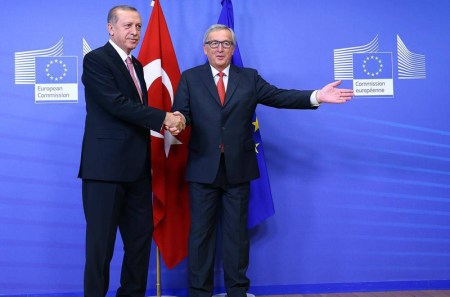
In February 2016, Turkish President Recep Tayyip Erdoğan (left) threatened to send millions of migrants to Europe. “We can open the doors to Greece and Bulgaria anytime and we can put the refugees on buses,” he told Jean-Claude Juncker (right), President of the European Commission. (Image source: Turkish President’s Office)

European officials say that to qualify for the visa waiver, Turkey must meet 72 conditions, including the most important one: relaxing its stringent anti-terrorism laws, which are being used to silence critics of Erdoğan, especially since the failed coup in July 2016. Turkey has vowed not to comply with the EU’s demands.

Critics of visa liberalization fear that millions of Turkish nationals may end up migrating to Europe. The Austrian newsmagazine, Wochenblick, recently reported that 11 million Turks are living in poverty and “many of them are dreaming of moving to central Europe.”

Other analysts believe Erdoğan views the visa waiver as an opportunity to “export” Turkey’s “Kurdish Problem” to Germany. According to Bavarian Finance Minister Markus Söder, millions of Kurds are poised to take advantage of the visa waiver to flee to Germany to escape persecution at the hands of Erdoğan: “We are importing an internal Turkish conflict,” he warned. “In the end, fewer migrants may arrive by boat, but more will arrive by airplane.”

The European Union now finds itself in a Catch-22 situation. Turkey appears determined to flood Europe with migrants either way: with Europe’s permission by means of visa-free travel, or without Europe’s permission, as retribution for failing to provide visa-free travel.

Greek officials recently revealed that they have drawn up emergency plans to cope with a new migrant crisis. Turkey is hosting some three million migrants from Syria and Iraq, many of whom are presumably waiting for an opportunity to flee to Europe.

Italy is also bracing for the worst. Up to a million people, mainly from Bangladesh, Egypt, Mali, Niger, Nigeria, Sudan and Syria are now in Libya waiting to cross the Mediterranean Sea, according to the IOM.

The director of the United Nations office in Geneva, Michael Møller, has warned that Europe must prepare for the arrival of millions more migrants from Africa, Asia and the Middle East. In an interview with The Times, Møller, a Dane, said:

“What we have been seeing is one of the biggest human migrations in history. And it’s just going to accelerate. Young people all have cellphones and they can see what’s happening in other parts of the world, and that acts as a magnet.”

German Development Minister Gerd Müller has echoed that warning:

“The biggest migration movements are still ahead: Africa’s population will double in the next decades. A country like Egypt will grow to 100 million people, Nigeria to 400 million. In our digital age with the internet and mobile phones, everyone knows about our prosperity and lifestyle.”

Müller added that only 10% of those currently on the move have reached Europe: “Eight to ten million migrants are still on the way.”

Germany: Migrant Crime Spiked in 2016

May 2, 2017

Germany: Migrant Crime Spiked in 2016, Gatestone InstituteSoeren Kern, May 2, 2017

None of this seems to be having an impact on the German elections set for September 24, 2017. Polls show that if the election for German chancellor were held today, Angela Merkel, who is largely responsible for the migration crisis, would be re-elected with 37% of the vote. Martin Schulz, the Social Democrat candidate who has pledged to increase migration to Germany even further, would win 29% of the vote and the anti-immigration Alternative for Germany would win 8%. For now, German voters appear to believe that the alternatives to Merkel are all worse.

*****************************

Although non-Germans make up approximately 10% of the overall German population, they accounted for 30.5% of all crime suspects in the country in 2016.

Nearly 250,000 migrants entered the country illegally in 2016, up 61.4% from 154,188 in 2015. More than 225,000 migrants were found living in the country illegally (Unerlaubter Aufenthalt) in 2016.

The Berlin Senate launched an inquiry into why migrants disproportionally appear as criminals in the city-state compared to Germans.

An official annual report about crime in Germany has revealed a rapidly deteriorating security situation in the country marked by a dramatic increase in violent crime, including murder, rape and sexual assault.

The report also shows a direct link between the growing lawlessness in Germany and Chancellor Angela Merkel’s decision to allow in more than one million mostly male migrants from Africa, Asia and the Middle East.

The report — Police Crime Statistics 2016 (Polizeiliche Kriminalstatistik, PKS) — was compiled by the Federal Criminal Police Office (Bundeskriminalamt, BKA) and presented by Interior Minister Thomas de Maizière in Berlin on April 24.

The number of non-German crime suspects (nichtdeutsche Tatverdächtige) legally residing in Germany jumped to 616,230 in 2016, up from 555,820 in 2015 — an increase of 11% — according to the report. Although non-Germans make up approximately 10% of the overall German population, they accounted for 30.5% of all crime suspects in the country in 2016, up from 27.6% in 2015.

In this year’s report, the BKA created a separate subcategory called “migrants” (Zuwanderer) which encompasses a combination of refugees, pending asylum seekers, failed asylum seekers and illegal immigrants.

According to the BKA, the number of migrant crime suspects (tatverdächtiger Zuwanderer) in Germany in 2016 jumped to 174,438 from 114,238 in 2015 — up 52.7%. Although “migrants” made up less than 2% of the German population in 2016, they accounted for 8.6% of all crime suspects in the country — up from 5.7% in 2015.

In terms of non-German crime suspects residing legally in Germany, Turks were the primary offenders in 2016, with 69,918 suspects, followed by Romanians, Poles, Syrians, Serbs, Italians, Afghans, Bulgarians, Iraqis, Albanians, Kosovars, Moroccans, Iranians and Algerians.

In terms of migrant crime suspects, Syrians were the primary offenders, followed by Afghans, Iraqis, Albanians, Algerians, Moroccans, Serbs, Iranians, Kosovars and Somalis.

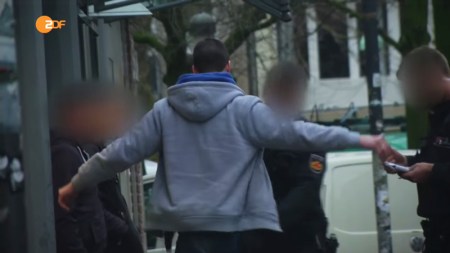
Police in Bremen, Germany frisk a North African youth who is suspected of theft. (Image source: ZDF video screenshot)

The report’s other findings include:

  • Violent crime surged in Germany in 2016. These include a 14.3% increase in murder and manslaughter, a 12.7% increase in rape and sexual assault and a 9.9% increase in aggravated assault. The BKA also recorded a 14.8% increase in weapons offenses and a 7.1% increase in drug offenses.
  • Non-German crime suspects committed 2,512 rapes and sexual assaults in Germany in 2016 — an average of seven a day. Syrians were the primary offenders, followed by Afghans, Iraqis, Pakistanis, Iranians, Algerians, Moroccans, Eritreans, Nigerians and Albanians. German authorities have repeatedly been accused of underreporting the true scale of the migrant rape problem for political reasons. For example, up to 90% of the sex crimes committed in Germany in 2014 do not appear in the official statistics, according to André Schulz, the head of the Association of Criminal Police (Bund Deutscher Kriminalbeamter, BDK).
  • Non-German crime suspects committed 11,525 robberies in Germany in 2016 — an average of 32 a day. Moroccans were the primary offenders, followed by Algerians, Syrians, Georgians, Tunisians, Albanians, Afghans, Serbs, Iraqis and Iranians.
  • Non-German crime suspects committed 56,252 aggravated assaults in 2016 — an average of 154 a day. Syrians were the primary offenders, followed by Afghans, Iraqis, Iranians, Moroccans, Algerians, Somalis, Albanians, Eritreans and Pakistanis.
  • Bavaria was the German state most affected by non-German criminality, followed by North Rhine-Westphalia, Baden-Württemberg, Hesse, Berlin, Lower Saxony, Rhineland-Palatinate, Saxony, Hamburg, Schleswig-Holstein, Saxony-Anhalt, Brandenburg, Mecklenburg-Vorpommern, Saarland, Bremen and Thüringen.
  • Berlin was the German city most affected by non-German criminality, followed by Munich, Hamburg, Frankfurt, Cologne, Düsseldorf, Hanover, Stuttgart, Dortmund, Bremen, Leipzig, Nürnberg, Essen, Duisburg, Mannheim, Karlsruhe, Dresden, Freiburg im Breisgau, Chemnitz, Aachen, Bielefeld, Wuppertal, Augsburg, Bonn, Bochum, Gelsenkirchen, Wiesbaden, Münster, Kiel, Halle, Krefeld, Braunschweig, Mainz, Lübeck, Mönchengladbach, Erfurt, Oberhausen, Magdeburg and Rostock.
  • The BKA also recorded 487,711 violations of German immigration laws (ausländerrechtliche Verstöße), up 21.1% from 402,741 violations in 2015. Nearly 250,000 migrants entered the country illegally in 2016, up 61.4% from 154,188 in 2015. More than 225,000 migrants were found living in the country illegally (Unerlaubter Aufenthalt) in 2016.

The new data contradicts claims made by the BKA in December 2016 — just four months before the current report — that migrant criminality was actually decreasing.

During a press conference in Berlin on April 24, Interior Minister Thomas de Maizière admitted:

“The proportion of foreign suspects, and migrants in particular, is higher than the average for the general population. This cannot be sugarcoated. There is an overall rise in disrespect, violence and hate. Those who commit serious offenses here forfeit their right to stay here.”

Separately, officials in Bavaria revealed that the number of crimes committed by asylum seekers and refugees there increased by 58% in 2016. They accounted for 9.6% of all crimes committed in the state, up from 3.2% in 2015 and 1.8% in 2012. Syrians were the primary offenders, followed by Afghans, Iraqis and Nigerians.

“The increase in crime in Bavaria in 2016 is mainly due to foreign suspects, especially immigrants,” said Bavarian Interior Minister Joachim Herrmann.

At the same time, officials in Baden-Württemberg noted a 95.5% increase in the number of physical assaults involving at least one migrant in 2016.

Meanwhile, the Berlin Senate launched an inquiry into why migrants disproportionally appear as criminals in the city-state compared to Germans. In 2016, 40% of all crime suspects in the German capital were non-Germans.

None of this seems to be having an impact on the German elections set for September 24, 2017. Polls show that if the election for German chancellor were held today, Angela Merkel, who is largely responsible for the migration crisis, would be re-elected with 37% of the vote. Martin Schulz, the Social Democrat candidate who has pledged to increase migration to Germany even further, would win 29% of the vote and the anti-immigration Alternative for Germany would win 8%. For now, German voters appear to believe that the alternatives to Merkel are all worse.

French Elections: Emmanuel Macron, a Disaster

May 1, 2017

French Elections: Emmanuel Macron, a Disaster, Gatestone InstituteGuy Millière, May 1, 2017

In the next election, in 2022, Catholic France may well see a Muslim candidate run — and win.

******************

Anti-West, anti-Israeli and anti-Jewish diatribes were delivered to enthusiastic crowds of bearded men and veiled women. One hundred and fifty thousand people attended.

Emmanuel Macron promised to facilitate the construction of mosques in France. He declared that “French culture does not exist” and that he has “never seen” French art. The risk is high that Macron will disappoint the French even faster than Hollande did.

On the evening of the second round of elections, people will party in the chic neighborhoods of Paris and in ministries. In districts where poor people live, cars will be set on fire. For more than a decade, whenever there is a festive evening in France, cars are set on fire in districts where poor people live. Unassimilated migrants have their own traditions.

Paris, Champs Elysees, April 20, 8:50 pm. An Islamic terrorist shoots at a police van. One policeman is killed, another is seriously wounded.

The terrorist tries to escape and shoots again. The policemen kill him. One hour later, the French Ministry of Interior reveals his name and his past. His name is Karim Cheurfi. He is a French Muslim born in an Islamized suburb of France. In 2003, he was sentenced to twenty years in prison for the attempted murder of two policemen. He was released before the end of his sentence. In 2014, he targeted a policeman and was sentenced again. And released again. In March, the police were informed that he was trying to buy military-grade weapons and that he contacted a member of the Islamic State in Syria. An inspector discovered that he had posted messages on jihadist social media networks expressing his willingness to murder policemen. The police searched his home and found several weapons and a GoPro video camera similar to the one terrorists use to film their crimes. The police and members of the French justice system did not think they had sufficient evidence place him under surveillance.

The Champs Elysées attack clearly shows that the French justice system is lax regarding dangerous people and that the French police pay only limited attention to suspects who are communicate with terrorist organizations and who seem to be hatching terrorist projects.

This terrorist attack summarizes everything that is broken in terms of security in France today.

Men with a profile similar to that of Karim Cheurfi have, in recent years, been responsible for most of the terrorist attacks in France and Belgium: Mohamed Merah, who killed three Jewish children and the father of two of them in Toulouse in 2012; Mehdi Nemmouche, who attacked the Brussels Jewish Museum in 2014 ; the Kouachi brothers, who committed the Charlie Hebdo massacre in 2015; Amedy Coulibaly, who murdered four Jews in the Saint Mandé grocery Kosher store Hypercacher; Samy Amimour and others who maimed and murdered 130 innocent people in the Bataclan theater in November 2015; Mohamed Lahouaiej Bouhlel, who drove a truck into the crowd in Nice in July 2016, killed 86 people and wounded many others, and, among others, those who beheaded a priest in Normandy a few weeks after the attack in Nice.

The successive French governments under the presidency of François Hollande showed themselves to be appallingly weak and impotent.

A climate of fear has overtaken the country. Attendance at theaters has declined. The particularly targeted Jewish community — two-thirds of the attacks in France in the last five years targeted Jews — feels abandoned. When a Jewish cemetery was vandalized on March 30 in Waldwisse, eastern France, neither the media nor the political leaders reacted. A week later, in Paris, a Jewish woman, Sarah Halimi, was tortured and then thrown out of a window by a non-radicalized Muslim, simply because she was Jewish: the French media and political leaders, with the exception of the courageous MP Meyer Habib, also did not react. A silent gathering below the window was organized by some leaders of the Jewish community. Only Jews came; they were greeted by anti-Semitic insults by Arab Muslims in the neighborhood. The implantation of radical Islam in the country is intensifying. The annual meeting of “Muslims of France” (the new name of the French branch of the Muslim Brotherhood), took place on April 14-17 in Le Bourget, ten miles north of Paris. Anti-West, anti-Israeli and anti-Jewish diatribes were delivered to enthusiastic crowds of bearded men and veiled women. One hundred and fifty thousand people attended.

Economically, France is in terrible shape. The unemployment rate remains above 10%. Nine million people are living below the poverty line –14% of the population. Economic growth is stagnant. Government spending accounts for 57% of GDP — 13% more than in Germany, France’s main economic competitor in Europe.

Month after month, polls shows that the French population is anxious, angry, immensely disappointed with current French policies. François Hollande ends his term with a popularity rating close to zero. He was so rejected and discredited that he decided not to run again for the presidency.

The first round of the French presidential election took place in this context, and one could expect that the French population would reject everything that looks like François Hollande’s policies and choose a new direction for the country.

That is not what happened; quite the opposite.

Benoit Hamon, the Socialist Party’s candidate, suffered a disastrous blow and received a mere 6% of the vote. Jean-Luc Mélenchon, a far-left candidate who left the Socialist Party a few years ago and who supported Hollande in 2012, received a much higher score: 19% of the vote. He is an admirer of Hugo Chavez, Fidel Castro, and the late Palestinian leader, Yasser Arafat. Immediately after the anti-Semitic Islamic attack in Saint Mandé, he claimed that “Jewish extremism is more dangerous than Islamic extremism”. That statement did not hurt him.

Above all, Emmanuel Macron, a candidate close to Hollande won the race and will be elected President on May 7. He was Hollande’s senior economic advisor for more than two years, and the main architect of Hollande’s failed economic policies. He then became Minister of the Economy, Industry and Digital Affairs, and held that post until he entered the presidential race.

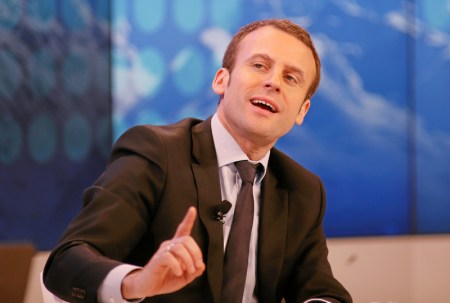
Emmanuel Macron, then Minister of the Economy, Industry and Digital Affairs of France, at the Annual Meeting 2016 of the World Economic Forum in Davos, Switzerland, January 22, 2016. (image source: World Economic Forum/Michele Limina)

Most of Macron’s speeches are copies of the speeches Hollande made during his 2012 presidential campaign. What is known of Macron’s positions on most subjects show that they are the same position Hollande had during the last months of his mandate.

Throughout the campaign, Macron virtually never spoke about the danger of Islamic terror; when he did, he used words even weaker than those used by Hollande. After the Champs Elysees attack on April 20, he said: “imponderable” events had occured, and they “will be part of the daily life of the French in the years to come”. The next day, when asked what he would do to prevent other killings, he said that he could not “devise a plan to fight terrorism overnight”.

When he speaks about the economy, he sounds like Hollande: he uses vague terms, such as the need for more “social mobility” and “success for all”. He insists that he will maintain all the sclerosis dear to so many, such as the compulsory 35-hour workweek or the legal age for retirement: 62. He said that he would leave the almost-bankrupt retirement system the way it is. He promised additional regulations aimed at “saving the planet” and, in a classically socialist way, tens of billions of euros of government “investments” supposed to finance “ecological transition” and “public services”.

Sometimes, he makes remarks so dismaying that even Hollande would not have said them. In Algeria, in the presence of the National Liberation Front representatives, an organization that came to power by terrorism and massacring hundreds of thousands of “harkis” (Algerians who had chosen France), he said that the French presence in Algeria was a “crime against humanity“, and later promised to facilitate immigration from the Arab world and from Africa to France by preserving an “open and welcoming” France. He promised to facilitate the construction of mosques in France. He declared that “French culture does not exist ” and that he has “never seen” French art.

He quite often has shown that he is a political novice and that it is his first election campaign. He stumbled upon the words of his speeches and admitted to those listening to him that he did not understand the meaning of the sentences he had just read, which showed that he had not read what was written for him before reading it to the public.

How to explain his success in these conditions?

The first explanation lies in the moderate right candidate’s elimination. François Fillon had a credible and coherent program for the country’s recovery, but he could hardly speak about it. His campaign was quickly engulfed in a fake jobs scandal. He presented himself as an impeccable candidate: he appeared not so impeccable. A book recently published revealed that the scandal was meticulously orchestrated from a “shadow Cabinet” in the Elysee Palace. Fillon was never able to recover from it. His excuses were weak and contradictory. He confirmed his weakness by announcing his unconditional support for Macron immediately after the first round results were published. For the first time in more than fifty years, the moderate right will not have a candidate in the second round of a French presidential election. Showing their own weakness, most of the moderate right leaders followed Fillon example and decided to support Macron.

The second explanation for Emmanuel Macron success lies in a very elaborate communication strategy.

Emmanuel Macron continuously benefited from François Hollande support and most of the last five years socialist ministers, but an allegedly neutral and apolitical political structure was created for him. It was called En marche! (“On the Move!”). The socialist ministers who joined him rallied On the Move!, and remained silent. Francois Hollande only announced his full support very late in the race. The communication strategy could work because Emmanuel Macron received the support of left-wing billionaires whom he helped when he was Minister of Economy, and who have close relations with the powers that be: Pierre Bergé, Xavier Niel and Patrick Drahi. These people also own most France’s mainstream media and were able to carry out strong media campaigns in support of Macron. No candidate in the French presidential election history has been on the cover of so many magazines and newspapers. Emmanuel Macron also enjoys main French investment banks support: he is a graduate of the Ecole Nationale d’Administration, which trains all senior civil servants and almost all French politicians since it was established in 1945 and, before joining Francois Hollande, he had a career in a financial institution.

The third explanation for Emmanuel Macron’s success is that the communication campaign in his favor has been largely devoid of any political content, just like On the Move. He was presented as a young man, embodying the “future”, a “renewal”, a “hope”, a “change”. For most of the campaign, Emmanuel Macron had no program. His program was only published on the internet six weeks before the election. The text is often meaningless. Fear is defined as a “daily anguish”. It says that France must offer “opportunities” and Europe must be a “chance”. Emmanuel Macron told socialists he is a socialist, then said that he is not a socialist at all when he addressed other audiences. Opinion polls have shown that many of those who voted for him in the first round were unaware of his proposals on any topic.

Those who designed Emmanuel Macron’s campaign took a lot of inspiration from Barack Obama’s 2008 presidential campaign, and the result shows that they were right.

The result is also very distressing, because it shows that a massive communication campaign can be effective, even if it is full of empty words and seems to considers voters as idiots. Emmanuel Macron’s campaign effectiveness is also due to the fact that in France, virtually no media is likely to contradict what is said in the mainstream media: the French economy is a very state-based economy in which creating and sustaining media independence from the government and from government subsidies is almost impossible.

The second round of the French presidential election will take place on May 7. Emmanuel Macron will face the only remaining candidate, populist Marine Le Pen.

During the entire campaign, she was almost the only one to speak clearly about the Islamic terrorist threat (François Fillon did, too, but more discreetly) and to offer credible solutions to fight it. She was the only one to speak of the rise of radical Islam in France and to denounce the Muslim Brotherhood gathering at Le Bourget. She was the only one to stress the increasing perils resulting from uncontrolled immigration, and the risk of French culture disappearing. She was also the only one to mention the demographic change that occurs in France and in Europe because of the new migrants. She was the only one to denounce the Islamic anti-Semitism that relentlessly kills Jews in France. Unfortunately, she has a nearly Marxist economic program, close to that of Jean Luc Melenchon. She is the leader of the National Front, a party founded by her father, an anti-Semite, Jean-Marie Le Pen; although she has excluded her father and virtually all her father’s anti-Semitic friends from the National Front, she is nonetheless the party leader and is regarded as her father’s daughter.

Marine Le Pen and the National Front will be used as scarecrows to urge voters to rally massively behind Macron, in the name of a “Republican front” against “fascism.” The strategy was developed thirty years ago by the French left, under President Francois Mitterrand. It has always worked, and in a few days, it will work again.

Macron now has the support of the entire Socialist party, and the support of virtually all other politicians. He also has the support of all French Muslim organizations. The rector of the Great Mosque of Paris said that Muslims must “massively vote” for him. The Jewish community leaders also rallied on behalf of Macron. On May 7, he will likely get more than 60% of the vote.

Most will not be based on the support for a project; the risk is high that Macron will disappoint the French even faster than Hollande did. The French may quickly discover that he is just a man chosen by the French left to preserve an unsustainable status quo a little longer, and a member of the self-appointed élites who do not care about ordinary people’s problems, who consider that terrorist acts are “imponderable events”, and who believe that national identities can melt in a no-border globalized world. When the French discover who Macron is, there will be nothing they can do to change what they voted in.

The risk to France in the next five years will probably be painful for the French. According to the Police, more than 12,000 radicalized Muslims live in the country and most of them are not under surveillance. The Police do not have the means to do more than they currently are doing, and Macron does not seem to care. The justice system is in the hands of judges who appear lenient to terrorists, and Macron seems to accept it. The flow of migrants will not stop, and Macron apparently does not intend to do anything about that. More and more, Muslims segregate themselves from French society in expanding Islamist mini-states.

Nothing Macron proposes can reverse the decline of the French economy and French society. Terror attacks will undoubtedly occur. Jews and others will undoubtedly be killed. Riots and discontent will undoubtedly take place.

On the evening of the first round of the election, there were riots in Paris and Nantes. On the evening of the second round of elections, people will party in the chic neighborhoods of Paris and in ministries. In districts where poor people live, cars will be set on fire. For more than a decade, whenever there is a festive evening in France, cars are set on fire in districts where poor people live. Unassimilated migrants have their own traditions.

In the next election, in 2022, Catholic France may well see a Muslim candidate run — and win.

Islam in the Heart of England and France

April 23, 2017

Islam in the Heart of England and France, Gatestone InstituteDenis MacEoin, April 23, 2017

For many years, the British government has fawned on its Muslim population; evidently the government thought that Muslims would in due course integrate, assimilate, and become fully British, as earlier immigrants had done. More than one survey, however, has shown that the younger generations are even more fundamentalist than their parents and grandparents, who came directly from Muslim countries.

********************************

“There are plenty of private Muslim schools and madrasas in this city. They pretend that they all preach tolerance, love and peace, but that isn’t true. Behind their walls, they force-feed us with repetitive verses of the Qur’an, about hate and intolerance.” — Ali, an 18-year-old of French origin, whose father was radicalized.

“In England, they are free to speak. They speak only of prohibitions, they impose on one their rigid vision of Islam but, on the other hand, they listen to no-one, most of all those who disagree with them.” — Yasmina, speaking of extremist Muslims in the UK.

“Birmingham is worse than Molenbeek” — the Brussels borough that The Guardian described as “becoming known as Europe’s jihadi central.” — French commentator, republishing an article by Rachida Samouri.

The city of Birmingham in the West Midlands, the heart of England, the place where the Industrial Revolution began, the second city of the UK and the eighth-largest in Europe, today is Britain’s most dangerous city. With a large and growing Muslim population, five of its electoral wards have the highest levels of radicalization and terrorism in the country.

In February, French journalist Rachida Samouri published an article in the Parisian daily Le Figaro, in which she recounted her experiences during a visit there. In “Birmingham à l’heure islamiste” (“Birmingham in the Time of Islam”) she describes her unease with the growing dislocation between normative British values and those of the several Islamic enclaves. She mentions the Small Heath quarter, where nearly 95% of the population is Muslim, where little girls wear veils; most of the men wear beards, and women wear jilbabs and niqabs to cover their bodies and faces. Market stalls close for the hours of prayer; the shops display Islamic clothes and the bookshops are all religious. Women she interviewed condemned France as a dictatorship based on secularism (laïcité), which they said they regarded as “a pretext for attacking Muslims”. They also said that they approved of the UK because it allowed them to wear a full veil.

Another young woman, Yasmina, explained that, although she may go out to a club at night, during the day she is forced to wear a veil and an abaya [full body covering]. She then goes on to speak of the extremists:

“In England, they are free to speak. They speak only of prohibitions, they impose on one their rigid vision of Islam but, on the other hand, they listen to no-one, most of all those who disagree with them.”

Speaking of the state schools, Samouri describes “an Islamization of education unthinkable in our [French] secular republic”. Later, she interviews Ali, an 18-year-old of French origin, whose father has become radicalized. Ali talks about his experience of Islamic education:

“There are plenty of private Muslim schools and madrasas in this city. They pretend that they all preach tolerance, love and peace, but that isn’t true. Behind their walls, they force-feed us with repetitive verses of the Qur’an, about hate and intolerance.”

Samouri cites Ali on the iron discipline imposed on him, the brutality used, the punishment for refusing to learn the Qur’an by heart without understanding a word of it, or for admitting he has a girlfriend.

Elsewhere, Samouri notes young Muslim preachers for whom “Shari’a law remains the only safety for the soul and the only code of law to which we must refer”. She interviews members of a Shari’a “court” before speaking with Gina Khan, an ex-Muslim who belongs to the anti-Shari’a organization One Law for All. According to Samouri, Khan — a secular feminist — considers the tribunals “a pretext for keeping women under pressure and a means for the religious fundamentalists to extend their influence within the community”.

Another teenager of French origin explains how his father prefers Birmingham to France because “one can wear the veil without any problem and one can find schools where boys and girls do not mix”. “Birmingham,” says Mobin, “is a little like a Muslim country. We are among ourselves, we do not mix. It’s hard”.

Samouri herself finds this contrast between secular France and Muslim England disturbing. She sums it up thus:

“A state within a state, or rather a rampant Islamization of one part of society — [is] something which France has succeeded in holding off for now, even if its secularist model is starting to be put to the test”.

Another French commentator, republishing Samouri’s article, writes, “Birmingham is worse than Molenbeek” — the Brussels borough that The Guardian described as “becoming known as Europe’s jihadi central.”

The comparison with Molenbeek may be somewhat exaggerated. What is perplexing is that French writers should focus on a British city when, in truth, the situation in France — despite its secularism — is in some ways far worse than in the UK. Recent authors have commented on France’s growing love for Islam and its increasing weakness in the face of Islamist criminality. This weakness has been framed by a politically-correct desire to stress a multiculturalist policy at the expense of taking Muslim extremists and fundamentalist organizations at face value and with zero tolerance for their anti-Western rhetoric and actions. The result? Jihadist attacks in France have been among the worst in history. It is calculated that the country has some some 751 no-go zones (“zones urbaines sensibles”), places where extreme violence breaks out from time to time and where the police, firefighters, and other public agents dare not enter for fear of provoking further violence.

Many national authorities and much of the media deny that such enclaves exist, but as the Norwegian expert Fjordman has recently explained:

If you say that there are some areas where even the police are afraid to go, where the country’s normal, secular laws barely apply, then it is indisputable that such areas now exist in several Western European countries. France is one of the hardest hit: it has a large population of Arab and African immigrants, including millions of Muslims.

There are no such zones in the UK, certainly not at that level. There are Muslim enclaves in several cities where a non-Muslim may not be welcome; places that resemble Pakistan or Bangladesh more than England. But none of these is a no-go zone in the French, German or Swedish sense — places where the police, ambulances, and fire brigades are attacked if they enter, and where the only way in (to fight a fire, for example) is under armed escort.

Samouri opens her article with a bold-type paragraph stating:

“In the working-class quarters of the second city of England, the sectarian lifestyle of the Islamists increasingly imposes itself and threatens to blow up a society which has fallen victim to its multicultural utopia”.

Has she seen something British commentators have missed?

The Molenbeek comparison may not be entirely exaggerated. In a 1000-page report, “Islamist Terrorism: Analysis of Offences and Attacks in the UK (1998-2015),” written by the respected analyst Hannah Stuart for Britain’s Henry Jackson Society, Birmingham is named more than once as Britain’s leading source of terrorism. [1]

One conclusion that stands out is that terror convictions have apparently doubled in the past five years. Worse, the number of offenders not previously known to the authorities has increased sharply. Women’s involvement in terrorism, although still less than men’s, “has trebled over the same period”. Alarmingly, “Proportionally, offences involving beheadings or stabbings (planned or otherwise) increased eleven-fold across the time periods, from 4% to 44%.” (p. xi)

Only 10% of the attacks are committed by “lone wolves”; almost 80% were affiliated with, inspired by or linked to extremist networks — with 25% linked to al-Muhajiroun alone. As the report points out, that organization (which went under various names) was once defended by some Whitehall officials — a clear indication of governmental naivety.

Omar Bakri Muhammed, who co-founded the British Islamist organization al-Muhajiroun, admitted in a 2013 television interview that he and co-founder Anjem Choudary sent western jihadists to fight in many different countries. (Image source: MEMRI video screenshot)

A more important conclusion, however, is that a clear link is shown between highly-segregated Muslim areas and terrorism. As the Times report on the Henry Jackson Society review points out, this link “was previously denied by many”. On the one hand:

Nearly half of all British Muslims live in neighbourhoods where Muslims form less than a fifth of the population. However, a disproportionately low number of Islamist terrorists — 38% — come from such neighbourhoods. The city of Leicester, which has a sizeable but well-integrated Muslim population, has bred only two terrorists in the past 19 years.

But on the other hand:

Only 14% of British Muslims live in neighbourhoods that are more than 60% Muslim. However, the report finds, 24% of all Islamist terrorists come from these neighbourhoods. Birmingham, which has both a large and a highly segregated Muslim population, is perhaps the key example of the phenomenon.

The report continues:

Just five of Britain’s 9,500 council wards — all in Birmingham — account for 26 convicted terrorists, a tenth of the national total. The wards — Springfield, Sparkbrook, Hodge Hill, Washwood Heath and Bordesley Green — contain sizeable areas where the vast majority of the population is Muslim.

Birmingham as a whole, with 234,000 Muslims across its 40 council wards, had 39 convicted terrorists. That is many more than its Muslim population would suggest, and more than West Yorkshire, Greater Manchester and Lancashire put together, even though their combined Muslim population is about 650,000, nearly three times that of Birmingham. There are pockets of high segregation in the north of England but they are much smaller than in Birmingham.

The greatest single number of convicted terrorists, 117, comes from London, but are much more widely spread across that city than in Birmingham and their numbers are roughly proportionate to the capital’s million-strong Muslim community.

Hannah Stuart, the study’s author, has observed that her work has raised “difficult questions about how extremism takes root in deprived communities, many of which have high levels of segregation. Much more needs to be done to challenge extremism and promote pluralism and inclusivity on the ground.”

Many observers say Birmingham has failed that test:

“It is a really strange situation,” said Matt Bennett, the opposition spokesman for education on the council. “You have this closed community which is cut off from the rest of the city in lots of ways. The leadership of the council doesn’t particularly wish to engage directly with Asian people — what they like to do is have a conversation with one person who they think can ‘deliver’ their support.”

Clearly, lack of integration is, not surprisingly, the root of a growing problem. This is the central theme of Dame Louise Casey’s important report of last December to the British government. Carried out under instructions of David Cameron, prime minister at the time, “The Casey Review: A review into opportunity and integration” identifies some Muslim communities (essentially those formed by Pakistani and Bangladeshi immigrants and their offspring) as the most resistant to integration within British society. Such communities do little or nothing to encourage their children to join in non-Muslim education, events, or activities; many of their women speak no English and play no role within wider society, and large numbers say they prefer Islamic shari’a law to British law.

Casey makes particular reference to the infamous Trojan Horse plot, uncovered in 2014, in which Muslim radicals conspired to introduce fundamentalist Salafi doctrines and practices into a range of Birmingham schools — not just private Muslim faith schools but regular state schools (pp. 114 ff.): “a number of schools in Birmingham had been taken over to ensure they were run on strict Islamic principles…”

It is important to note that these were not ‘Muslim’ or ‘faith’ schools. [Former British counterterrorism chief] Peter Clarke, in his July 2014 report said:

“I took particular note of the fact that the schools where it is alleged that this has happened are state non-faith schools…”

He highlighted a range of inappropriate behaviour across the schools, such as irregularities in employment practices, bullying, intimidation, changes to the curriculum, inappropriate proselytizing in non-faith schools, unequal treatment and segregation. Specific examples included:

  • a teachers’ social media discussion called the “Park View Brotherhood”, in which homophobic, extremist and sectarian views were aired at Park View Academy and others;
  • teachers using anti-Western messages in assemblies, saying that White people would never have Muslim children’s interests at heart;
  • the introduction of Friday Prayers in non-faith state schools, and pressure on staff and students to attend. In one school, a public address system was installed to call pupils to prayer, with a member of the staff shouting at students who were in the playground, not attending prayer, and embarrassing some girls when attention was drawn to them because girls who are menstruating are not allowed to attend prayer; and
  • senior staff calling students and staff who do not attend prayers ‘k****r’. (Kuffar, the plural of kafir, an insulting term for “unbelievers”. This affront reproduces the Salafi technique of condemning moderate or reformist Muslims as non-Muslims who may then be killed for being apostates.)

Casey then quotes Clarke’s conclusion:

“There has been co-ordinated, deliberate and sustained action, carried out by a number of associated individuals, to introduce an intolerant and aggressive Islamic ethos into a few schools in Birmingham. This has been achieved in a number of schools by gaining influence on the governing bodies, installing sympathetic headteachers or senior members of staff, appointing like-minded people to key positions, and seeking to remove head teachers they do not feel sufficiently compliant.”

The situation, Casey states, although improved from 2014, remains unstable. She quotes Sir Michael Wilshaw, Her Majesty’s Chief Inspector, in a letter to the Secretary of State for Education, which declared as late as July 8, 2016, that the situation “remains fragile”, with:

  • a minority of people in the community who are still intent on destabilising these schools;
  • a lack of co-ordinated support for the schools in developing good practice;
  • a culture of fear in which teachers operate having gone underground but still there;
  • overt intimidation from some elements within the local community;
  • organised resistance to the personal, social and health education (PSHE) curriculum and the promotion of equality.

Elsewhere, Casey notes two further issues in Birmingham alone, which shed light on the city’s Muslim population. Birmingham has the largest number of women who are non-proficient in English (p. 96) and the largest number of mosques (161) in the UK (p. 125).

For many years, the British government has fawned on its Muslim population; evidently the government thought that Muslims would in due course integrate, assimilate, and become fully British, as earlier immigrants had done. More than one survey, however, has shown that the younger generations are even more fundamentalist than their parents and grandparents, who came directly from Muslim countries. The younger generations were born in Britain but at a time when extremist Islam has been growing internationally, notably in countries with which British Muslim families have close connections. Not only that, but a plethora of fundamentalist preachers keep on passing through British Muslim enclaves. These preachers freely lecture in mosques and Islamic centres to youth organizations, and on college and university campuses.

Finally, it might be worth noting that Khalid Masood, a convert to Islam who killed four and injured many more during his attack outside the Houses of Parliament in March, had been living in Birmingham before he set out to wage jihad in Britain’s capital.

It is time for some hard thinking about the ways in which modern British tolerance of the intolerant and its embrace of a wished-for, peace-loving multiculturalism have furthered this regression. Birmingham is probably the place to start.

________________

[1] Hard copies of the report may be purchased via PayPal here. Essays, summaries etc. may be linked to from here. An excellent summary by Soeren Kern is available online here.

Europe’s Rising Islam-Based Political Parties

April 21, 2017

Europe’s Rising Islam-Based Political Parties, Investigative Project on Terrorism, Abigail R. Esman, April 21, 2017

So far, none of the existing [Islamic) parties has had a great deal of success – and the emerging parties have yet to make their platforms known, let alone acquire active supporters. But as Denk founder Tunahan Kuzu proudly announced after the March elections, a new voice has now gained power in a European government. But what that voice ultimately will be, and the strength of its commitment to secular and democratic values, remains yet to be seen.

*****************************

These past several months, eyes across the world have been trained on a growing far-right movement sweeping Europe and America – from the neo-Nazi groups in Germany and the United States to the increasing popularity of France’s National Front. But another, far less noticed but sometimes equally-radical movement is also emerging across Europe: the rise of pro-Islam political parties, some with foreign support from the Muslim world. And the trend shows no sign of stopping.

Holland’s Denk (“Think”) party, established and led by two Turkish immigrants, is among the most significant. Denk won three seats in the Dutch parliament last month, becoming the country’s “fastest-growing” new party, according to Dutch daily NRC Handelsblad. Its platform: replace ideas of integration with “mutual acceptance” – a charming but antiquated idea in a culture where one group accepts gay marriage and the other is taught that homosexuals should be shoved off of tall buildings; an “acceptance monitor” to measure the extent to which such “mutual acceptance” has succeeded; and the establishment of a dedicated “anti-racism” police force.

While not the first of such Islamic parties in European politics, Denk’s March 15 win makes it an inspiration to others. Existing parties now see a new chance for success, while political aspirants across Europe are making plans to start similar parties of their own.

Hence, while the focus in next week’s French elections will be on Marine le Pen’s National Front, many European Muslims will also be watching the Equality and Justice Party (PEJ), led by French-Turk Sacir Çolak. Like Denk, the party claims to be a voice for the downtrodden, aimed at fighting “inequalities and injustices,” according to a report by the Turkish Anadolu news agency. But also like Denk, it has been accused of representing not the political interests of French citizens, but those of Turkey’s president – a man who has spoken out against assimilation and integration and called on European Turks to reject Western values.

The PEJ is not alone in France: The French Union of Muslim Democrats (UDMF), founded in 2012, made headlines when it entered the 2015 electoral race. Its platform seems more moderate than many of its fellow Muslim parties across Europe: founder Nagib Azergui has insisted in interviews that he respects the secular foundation of the French republic, and advocates philosophy and civic education classes that would help mitigate against the recruitment efforts of Muslim extremists.

The party does, however, seek to establish sharia-compliant banks and calls for Turkey to become a member of the European Union. Further, it seeks to re-install the right of Muslim girls to wear headscarves in public schools, a move that could be seen as a gesture towards re-introducing religion into the secular sphere.

Austria, too, has seen a rise in Islamic political parties, such as the New Movement for the Future (NBZ), founded, like Denk and the PEJ, by Turkish immigrants. Unlike the others, however, NBZ has made little effort to hide its loyalty to Turkey. Following the failed 2016 Turkish coup, for instance, its leader, Adnan Dinçer, called on Austria to respect Turkish President Recep Tayyip Erdogan’s clampdown on the country and the mass arrests that followed. It is worth noting, however, that Austria’s far right has been particularly virulent in its anti-Islam activity, calling for Islam itself to be banned from the country. Such motions inevitably bring forth counter-movements from the targeted groups, and it was, just those actions which mobilized Dinçer to form the NBZ.

But it was Denk’s success, above all, that inspired Lebanese-Belgian activist Dyab Abou Jahjah to establish his newest political effort: a party (to date, unnamed) aimed at “Making Brussels Great Again, a la Bernie Sanders,” according to an interview in Belgian newspaper de Morgen.

This would be a third attempt for Jahjah, who first came into the public eye in 2002 as the founder of the Brussels-based Arab-European League, a pan-European political group that aimed to create what he called a Europe-wide “sharocracy” – a sharia-based democracy. In 2003, the AEL further organized a political party, RESIST, to run in the Brussels elections: it received a mere 10,000 votes. Now, Jahjah, who also runs an activist group called Movement X, hopes to run again in Brussels’ 2018 elections. While his party has yet to declare a platform, his anti-American, anti-Israel, pro-Palestinian and anti-European rants on Facebook and elsewhere give an indication of his plans. So, too, did a recent blog post in which he wrote: “we must defeat the forces of supremacy, the forces of sustained privileges, and the forces of the status-quo. We must defeat them in every possible arena.”

But he, too, is not alone: days after Denk’s win, fellow Belgian Ahmet Koç announced his own initiative, the details of which have also still to be determined. However, some things are easy enough to predict on the basis of his past: the Turkish-Belgian politician was thrown out of Belgium’s socialist party in 2016 for supporting Erdogan’s efforts to censor Europeans who insult him publicly, and calling for Belgian Turks to rise up against the “traitors” of the 2016 coup.

Both Koç and Jahjah will have to reckon with the ISLAM party, which has already established itself in the Brussels area. Founded in 2012, ISLAM – which poses as an acronym for “Integrité, Solidarité, Liberté, Authenticité, Moralité” is unapologetically religious. Leaders pride themselves on following the Quran, not party politics. With divisions already in place in the Brussels districts of Anderlecht, Molenbeek (the center of Belgian radicalism) and Luik, the party now plans to expand throughout the Brussels region.

So far, none of the existing parties has had a great deal of success – and the emerging parties have yet to make their platforms known, let alone acquire active supporters. But as Denk founder Tunahan Kuzu proudly announced after the March elections, a new voice has now gained power in a European government. But what that voice ultimately will be, and the strength of its commitment to secular and democratic values, remains yet to be seen.

European Union Tells Hungary and Poland To Accept Mass Migration Or Leave

April 4, 2017

European Union Tells Hungary and Poland To Accept Mass Migration Or Leave, BreitbartVirginia Hale, April 4, 2017

(The European Union is like a Roach Hotel — easy to get in and very hard to leave, see BREXIT.  Will the EU kick Hungary and Poland out? That would probably be the EU’s most popular action ever in Hungary and Poland. It might also set a good precedent for other refugee-clogged EU countries.– DM)

ELLA IDE/AFP/Getty Images

Breitbart London reported that the European Union is to open asylum processing centres in west Africa and countries on the southern shore of the Mediterranean because the continent “needs six million migrants”, the European Commissioner for Migration Dimitris Avramopoulos said last month.

***********************

France and Germany, along with a host of up to 21 other countries, are set to demand Hungary and Poland either accept migrants under the quota system or leave the European Union (EU).

The two nations have ignored Brussels’ insistence that they take migrants presently residing in great numbers in Italy and Greece. Public opinion in Hungary and Poland is also strongly against being forced to accept thousands of migrants from non-European cultures.

Poland’s conservative Law and Justice Party (Prawo i Sprawiedliwość – PiS) swept to victory in 2015, partly due to voter anger over the previous government agreeing to take migrants under the quota system.

In Hungary, Prime Minister Viktor Orbán has been a vocal opponent of the scheme from its conception, asserting that forcing member countries to take a compulsory quota of migrants is unlawful and will “spread terrorism around Europe”.

Later this year, the two countries will be given an ultimatum and have to decide whether they are willing to maintain an anti-mass migration stances if it puts their membership of the EU at threat, a senior diplomatic source from one of the bloc’s six founding member states told The Times.

The source said: “They will have to make a choice: are they in the European system or not? You cannot blackmail the EU, unity has a price.”

The European Court of Justice (ECJ) is expected to hold a hearing on the legality of migrant quotas in the coming weeks, with a judgement — widely expected to be in favour of the scheme — likely by the end of the year.

“We are confident that the ECJ will confirm validation,” the source said. “Then they must abide by the decision. If they don’t then they will face consequences, both financial and political. No more opt-outs. There is no more ‘one foot in and one foot out’. We are going to be very tough on this.”

Hungary challenged the court, insisting that it is culturally and constitutionally unreasonable to impose asylum seekers on unwilling member states.

In December, referring to policies of importing large numbers of people from the third world, Orbán stated that Hungary and other countries in Central Europe “have had the opportunity to learn from Western Europe’s mistakes”.

“Hungary is a stable island in the turbulent western world because the people were consulted on their opinions here, and we defended the country against illegal immigration.”

In 2015, when European Commission Vice-President Frans Timmermans demanded Eastern and Central EU nations undergo similar demographic transitions as in Western Europe, Hungary was singled out for special mention.

“Any society, anywhere in the world, will be diverse in the future — that’s the future of the world,” Timmermans said. “So [Central European countries] will have to get used to that. They need political leaders who have the courage to explain that to their population instead of playing into the fears as I’ve seen Mr Orbán doing in the last couple of months.”

Breitbart London reported that the European Union is to open asylum processing centres in west Africa and countries on the southern shore of the Mediterranean because the continent “needs six million migrants”, the European Commissioner for Migration Dimitris Avramopoulos said last month.

Londonistan: 423 New Mosques; 500 Closed Churches

April 2, 2017

Londonistan: 423 New Mosques; 500 Closed Churches, Gatestone Institute, Giulio Meotti, March 2, 2017

(BREXIT seems to have come a few years too late. — DM)

British multiculturalists are feeding Islamic fundamentalism. Muslims do not need to become the majority in the UK; they just need gradually to Islamize the most important cities. The change is already taking place.

British personalities keep opening the door to introducing Islamic sharia law. One of the leading British judges, Sir James Munby, said that Christianity no longer influences the courts and these must be multicultural, which means more Islamic. Rowan Williams, the former Archbishop of Canterbury, and Chief Justice Lord Phillips, also suggested that the English law should “incorporate” elements of sharia law.

British universities are also advancing Islamic law. The academic guidelines, “External speakers in higher education institutions”, provide that “orthodox religious groups” may separate men and women during events. At the Queen Mary University of London, women have had to use a separate entrance and were forced to sit in a room without being able to ask questions or raise their hands, just as in Riyadh or Tehran.

“London is more Islamic than many Muslim countries put together”, according to Maulana Syed Raza Rizvi, one of the Islamic preachers who now lead “Londonistan“, as the journalist Melanie Phillips has called the English capital. No, Rizvi is not a right-wing extremist. Wole Soyinka, a Nobel Laureate for Literature, was less generous; he called the UK “a cesspit for Islamists”.

“Terrorists can not stand London multiculturalism”, London’s mayor Sadiq Khan said after the recent deadly terror attack at Westminster. The opposite is true: British multiculturalists are feeding Islamic fundamentalism. Above all, Londonistan, with its new 423 mosques, is built on the sad ruins of English Christianity.

The Hyatt United Church was bought by the Egyptian community to be converted to a mosque. St Peter’s Church has been converted into the Madina Mosque. The Brick Lane Mosque was built on a former Methodist church. Not only buildings are converted, but also people. The number of converts to Islam has doubled; often they embrace radical Islam, as with Khalid Masood, the terrorist who struck Westminster.

The Daily Mail published photographs of a church and a mosque a few meters from each other in the heart of London. At the Church of San Giorgio, designed to accommodate 1,230 worshipers, only 12 people gathered to celebrate Mass. At the Church of Santa Maria, there were 20.

The nearby Brune Street Estate mosque has a different problem: overcrowding. Its small room and can contain only 100. On Friday, the faithful must pour into the street to pray. Given the current trends, Christianity in England is becoming a relic, while Islam will be the religion of the future.

In Birmingham, the second-largest British city, where many jihadists live and orchestrate their attacks, an Islamic minaret dominates the sky. There are petitions to allow British mosques to call the Islamic faithful to prayer on loudspeakers three times a day.

By 2020, estimates are that the number of Muslims attending prayers will reach at least 683,000, while the number of Christians attending weekly Mass will drop to 679,000. “The new cultural landscape of English cities has arrived; the homogenised, Christian landscape of state religion is in retreat”, said Ceri Peach of Oxford University. While nearly half of British Muslims are under the age of 25, a quarter of Christians are over 65. “In another 20 years there are going to be more active Muslims than there are churchgoers,” said Keith Porteous Wood, director of the National Secular Society.

Since 2001, 500 London churches of all denominations have been turned into private homes. During the same period, British mosques have been proliferating. Between 2012 and 2014, the proportion of Britons who identify themselves as Anglicans fell from 21% to 17%, a decrease of 1.7 million people, while, according to a survey conducted by the respected NatCen Social Research Institute, the number of Muslims has grown by almost a million. Churchgoers are declining at a rate that within a generation, their number will be three times lower than that of Muslims who go regularly to mosque on Friday.

Demographically, Britain has been acquiring an increasingly an Islamic face, in places such as Birmingham, Bradford, Derby, Dewsbury, Leeds, Leicester, Liverpool, Luton, Manchester, Sheffield, Waltham Forest and Tower Hamlets. In 2015, an analysis of the most common name in England showed it was Mohammed, including spelling variations such as Muhammad and Mohammad.

Most important cities have huge Muslim populations: Manchester (15.8%), Birmingham (21.8%) and Bradford (24.7%). In Birmingham, the police just dismantled a terrorist cell; there is also a greater probability that a child will be born into a Muslim family than into a Christian one. In Bradford and Leicester, half the children are Muslim. Muslims do not need to become the majority in the UK; they just need gradually to Islamize the most important cities. The change is already taking place. “Londonistan” is not a Muslim majority nightmare; it is a cultural, demographic and religious hybrid in which Christianity declines and Islam advances.

Thousands of Muslims participate in a public outdoor prayer service in Birmingham, England, on July 6, 2016. (Image source: Ruptly video screenshot)

According to Innes Bowen, writing in The Spectator, only two of the 1,700 mosques in Britain today follow the modernist interpretation of Islam, compared with 56% in the United States. The Wahhabis control six percent of mosques in the UK, while the fundamentalist Deobandi control up to 45%. According to a survey from the Knowledge Center, a third of UK Muslims do not feel “part of British culture.”

London is also full of sharia courts. There are officially 100. The advent of this parallel judicial system has been made possible thanks to the British Arbitration Act and the system of Alternative Dispute Resolution. These new courts are based on the rejection of the inviolability of human rights: the values of freedom and equality that are the basis of English Common Law.

British personalities keep opening the door to introduce sharia. One of Britain’s leading judges, Sir James Munby, said that Christianity no longer influences the courts and these must be multicultural — which means more Islamic. Rowan Williams, the former Archbishop of Canterbury, and Chief Justice Lord Phillips also suggested that British law should “incorporate” elements of sharia law. The British cultural establishment is rapidly capitulating to Islamic fundamentalists in accepting their demands.

British universities are also advancing Islamic law. The official guidelines of the university, “External speakers in higher education institutions“, published by Universities UK, provide that “orthodox religious groups” may separate men and women during events. At Queen Mary University of London, women had to use a separate entrance and were forced to sit in a room without being able to ask questions or raise their hands — as in Riyadh or Tehran. The Islamic Society at the London School of Economics held a gala, in which women and men were separated by a seven-meter panel.

After the attack on the French satirical magazine Charlie Hebdo, the head of MI6, Sir John Sawers, recommended self-censorship and “some restraint” in discussing Islam. The British ambassador in Saudi Arabia, Simon Collis, converted to Islam and completed the pilgrimage to Mecca, the hajj. He now calls himself Haji Collis.

What will be next?

No Truth Please, We’re British

March 27, 2017

No Truth Please, We’re British, Front Page MagazineBruce Bawer, March 27, 2017

Hundal called on Londoners to learn from the spirit of the Battle of Britain: “Keep Calm and Carry on.” But there’s a big difference between now and then. During World War II, Brits named their enemy. Everyone openly recognized Nazism as a monstrous ideology. And the media didn’t respond to German bombings in the East End by slandering Churchill as a “Naziphobe.” 

******************************

After last Wednesday’s deadly attack outside London’s Houses of Parliament, the left-wing British media expressed outrage – not at the appalling way in which Islam and Islamic terrorism have transformed life and sown death throughout the Western world, but at the purported moral depravity of those who dare to connect the dots. 

In the Guardian, Jon Henley and Amber Jamiesen sneered at Marine Le Pen for “linking the London attack to migrant policy, despite the attacker being British.” (My emphasis.) They smeared as “xenophobic” Nigel Farage’s argument “that the London attacks proved Donald Trump’s hardline immigration and anti-Muslim policies were correct.” The Independent‘s Maya Oppenheimer censured Farage’s comments, too, countering his critique of multiculturalism by saying he’d “failed to mention the fact many of the victims of the attack were in fact foreigners themselves.” (My emphasis again.) Needless to say, the issue wasn’t Britishness vs. foreignness; it was Islam. But to say so was verboten. As Theresa May said (in what already seems destined to become an immortal statement), “Islamist terror” has nothing do with Islam.

Islam is a religion of hate. But when that hate manifests itself in jihadist terror, the proper leftist move is to turn away from the reality of that hate – which last Wednesday sent several innocent people to a hospital or a morgue – to the purported “hate” of decent, law-abiding individuals who have had quite enough of murderous jihadist hate. Instead of acknowledging that a large minority (if not an outright majority) of British Muslims support sharia law in the U.K. (and that more than a few privately applaud terrorism), you’re supposed to invoke the fantasy of a Britain in which all citizens, infidel and Muslim, share the same values and live together in harmony – except, of course, for the horrid Islamophobes, who, simply by mentioning the Islamic roots of Islamic terror, are exploiting terrorism, dishonoring its victims, and subverting social harmony.

And so we had the Guardian editorial on the terrorist attack, which cast the reality-deniers as good guys who believe in “standing together” and the truth-tellers as voices of “cynicism.” While praising MPs for their readiness “to emphasise the need for solidarity,” the editorial deplored Farage and UKIP leader Paul Nuttall, who “renewed their baseless and disgraceful campaign to drive a wedge between Muslims and non-Muslims in Britain.” The paper’s Nesrine Malik agreed. When she first heard of the attack, she wrote, a “familiar knot” appeared in her stomach. Why? Because of the horror of mass slaughter? Because, yet again, innocent people had lost their lives to jihad? No. Because she realized that she’d once again have to brace herself “for a predictable battle to separate fact from hysteria, plead for a sense of proportionality and entreat the hurt and the angry not to generalise.” For Malik, as for her paper’s editors, the real bad guys aren’t the terrorists: they’re people like Tommy Robinson (who “was at the scene stirring hate while the shock was fresh”) and Nigel Farage (who was “spewing predictable bile”).

The “right wing,” charged Malik, had plainly been “waiting in the wings, almost grateful that the imaginary fears it had been trying to provoke had become real ones.” (My emphasis yet again.) Now try to make sense of that: Robinson and Farage are selling “imaginary fears,” but on Wednesday those “imaginary fears” became “real ones.” Never mind that the “fears,” far from being products of anyone’s imagination, are based on a very real experience of terrorist acts in which thousands of very real people have died. “There was no respect for the dead, dying and grieving, there was just an opportunity,” wrote Malik. On the contrary: it’s Malik and her ilk who show less for the dead victims of Islamic terrorism than for the reputation of Islam. For Malik, Robinson and Farage are part of a “hate industry” that, she maintained, has grown with each of “the three Islamic terror attacks in London since 2005.” You’d think the fact that London had been subject to three Islamic terror attacks since 2005 would make it clear what the real “hate industry” is.

The same kind of thinking was on display at the Independent, where an outraged Holly Baxter denounced Robinson for saying that Muslims “are waging war on us,” that they’ve been doing so “for 1,400 years,” and that “Muslims make up only 4 per cent of the UK population, look at the continued chaos and destruction they cause, what do you think it will be like with 20 per cent?” For Baxter, Robinson’s statement was a disgusting display of hate, and proved that “London needs a Muslim mayor now more than ever” – for at a time when ISIS is pushing the idea of a war between Islam and the West, “[t]he existence of a Muslim mayor of London symbolically destroys that narrative from the outset.” No, the existence of a Muslim mayor of London – one who has defended terrorists, shared platforms with radical imams, blamed terrorism on the West, and sought to punish anti-Islam speech – shows just how successful Islam has been in that war.

Critics of Islam, complained Baxter, are “racists” who should “at least have the common decency to admit it’s all a far-right careerist exercise rather than anything to do with ‘protecting the innocent.’” Sunny Hundal made the same argument in another piece for the Independent: “No wonder the far-right was so quick to capitalise on the Westminster terror attack – it relies on atrocities for support.” That “far-right,” he seethed, was like a pack of “jackals circling their prey.” Get that? In this picture, the jackal isn’t the terrorist – it’s the critics of his guiding ideology. Maintaining that Islam’s critics “hate the very idea of cosmopolitan communities” (no, they hate barbarism), Hundal called on Londoners to learn from the spirit of the Battle of Britain: “Keep Calm and Carry on.” But there’s a big difference between now and then. During World War II, Brits named their enemy. Everyone openly recognized Nazism as a monstrous ideology. And the media didn’t respond to German bombings in the East End by slandering Churchill as a “Naziphobe.”