Archive for the ‘Islamic invasion’ category

Pope Francis Blasts Europe Over Migrants

May 7, 2016

Pope Francis Blasts Europe Over Migrants, Front Page Magazine, Daniel Greenfield, May 7, 2016

02

Sigh.

Europe is struggling to live up to the vision of its founders, Pope Francis has said in a powerful speech that asked: “What has happened to you, the Europe of humanism, the champion of human rights, democracy and freedom?”

Speaking as he became the first pope to accept the prestigious Charlemagne prize for his work on behalf of European solidarity, the pontiff called for Europe to reclaim the principles that had been established after the second world war, above all by embracing integration and revamping its economic model to “benefit ordinary people and society as a whole”.

…Founded in 1950 by Dr. Kurt Pfeiffer, the Charlemagne Prize is “the oldest and best-known prize awarded for work done in the service of European unification,” according to the organization’s website.

Kurt Pfeiffer was a Nazi. There are debates about whether he was a reluctant Nazi or not, but he was certainly a member. Rodney Atkinson has spoken about this in the past, I don’t know that I accept the whole thing, but certainly there are valid questions to be raised here.

The Charlemagne Prize. The prize was originally founded by the Nazis, but was then re-founded in 1949 by the efforts of the Aachen textile merchant Kurt Pfeiffer. Pfeiffer, who had previously been a member of the Nazi Party and of five other Nazi organizations, maintained that he had always tended to be a fundamental believer in Europe. And the Charlemagne Prize Society was to be associated with the imperial idea Reichsidee of the Emperor Charlemagne. The post-war image of Charlemagne as unifier of the Christian west was preceded by his Nazi portrayal as a unifier of the German tribes. Charlemagne had been compared with Hitler, his Reich and Greater Germany. This is clearly exemplified by the career of the Aachen professor of philosophy Peter Mennicken, who took over the professorship previously occupied by an expelled Jew, and who after the war had authorized influence over the symbolism of the Charlemagne Prize and the liturgy of its award ceremonies.

But we’ll skip over to the speech about the ideals of the EU’s founders. Some of whom just happened to Nazi-ish.

He expressed his desire for a Europe “where being a migrant is not a crime but a summons to greater commitment on behalf of the dignity of every human being,” and where youth can “breathe the pure air of honesty” in a culture that is “undefiled by the insatiable needs of consumerism.”

“I dream of fa Europe that promotes and protects the rights of everyone, without neglecting its duties towards all,” he said, and voiced his hope for a Europe “of which it will not be said that its commitment to human rights was its last utopia.”

Except you can’t protect the rights of all. Sometimes you have to choose.

You couldn’t protect German sovereignty and Polish sovereignty at the same time. You couldn’t protect German and French civilians at the same time. You had to make choices. You can’t protect Muslim rights to migrate and the right of the Jewish population of Europe not to be terrorized or murdered.

You have to choose. You have to decide between good and evil rather than providing a fuzzy humanistic picture in which evil does not appear to exist except as selfishness in the face of social justice demands. In which evil is not going along with the latest horrible and disastrous scheme executed at your own expense.

Pointing to French statesman Robert Schuman, the Pope echoed his insistence at the birth of the first European Community that the continent couldn’t be built all at once, but “through concrete achievements which first create a ‘de facto solidarity.’”

Schuman was one of Petain’s ministers. Again, like Pfeiffer, his legacy is complex and mixed, but it’s interesting that so many key EU people are so tainted.

The Pope also stressed the importance of cultural integration, rather than merely resettling foreigners geographically, allowing European peoples to overcome “the temptation of falling back on unilateral paradigms and opting for forms of ideological colonization.”

Francis advocated for a culture of dialogue involving “a discipline that enables us to view others as valid dialogue partners, to respect the foreigner, the immigrant and people from different cultures as worthy of being listened to.”

“Today we urgently need to build coalitions that are not only military and economic, but cultural, educational, philosophical and religious,” he said, and encouraged the leaders to arm their people “with the culture of dialogue and encounter.”

How does the culture of dialogue work within Islam? It’s the old “nice doggie” until you find a big enough rock school of dialogue.

And what does cultural integration mean? It seems to involve listening to Muslim migrants, rather than them listening.

To create dignified, well-paying jobs “requires coming up with new, more inclusive and equitable economic models, aimed not at serving the few, but at benefiting ordinary people and society as a whole,” he said.

“It would involve passing from an economy directed at revenue, profiting from speculation and lending at interest, to a social economy that invests in persons by creating jobs and providing training,” he said, adding that “we need to move from a liquid economy prepared to use corruption as a means of obtaining profits to a social economy that guarantees access to land and lodging through labor.”

An economy is based on profit. A social economy is just a welfare state funded by profitability somewhere. Even Communist countries ended up needing to find a profitable venue. China did really well at it. The USSR was terrible at it and collapsed.

In an actual economy, social mobility and dignity may not be perfect, but they are available. A social economy is just feudalism with more buzzwords and depends entirely on the goodwill of insiders. No one has dignity in a social economy. They have no sense of worth. They depend entirely on charity dispensed by political barons which is stolen from the people who have been enslaved and denied the profits of their work.

Pope Francis closed his speech by voicing his dream for “a new European humanism” based on the welcome for foreigners, care for the poor, and respect for human life and dignity.

You can have two out of three. But if you turn Europe into Pakistan and Saudi Arabia, you’ll eventually have none of the above.

The Failure of the Swedish Establishment

May 6, 2016

The Failure of the Swedish Establishment, Gatestone InstituteNima Gholam Ali Pour, May 6, 2016

♦ In Sweden’s third largest city, Malmö, the children of illegal migrants receive income support payments from the government, and the unemployment rate among foreign-born men aged 18-24 years is at 41%. In Sweden, those who do not have jobs receive generous welfare payments from the local authorities, and families in the country illegally have their rent paid by the taxpayers. It is an open invitation to more migrants to come to Sweden.

♦ The Swedish establishment tells Swedes that the more immigrants come to Sweden, the richer Sweden will become — no matter which country these immigrants come from.

♦ The Swedish establishment is characterized by incompetence combined with an extreme left-wing ideology and a hillbilly-like mentality that refuses to see the rest of the world and the risks involved in it. The Swedish establishment has not dealt with Sweden as if it were a country, but as if it were a village.

♦ By gross miscalculations, the Swedish establishment has eroded its own legitimacy. Today, fewer than one in four Swedes have confidence in their government. Meanwhile, the Swedish media is a major threat to Sweden’s security today: it downplays the migration crisis with ridiculous arguments.

A major threat to Sweden’s security today is the Swedish journalistic establishment: it downplays the migration crisis with ridiculous arguments.

As migrants flooded into Sweden in December 2015, Fredrik Virtanen, a writer for Sweden’s largest newspaper, Aftonbladet, wrote an article entitled, “Have refugees forced you to buy worse red wine?” It is not really dangerous, Virtanen argues, that that Sweden was accepting 160,000 migrants; such migratory movements, he wrote, do not really impact anyone’s life.

Today, however, we know that many people’s lives have been affected by the influx of migrants and that the problems are about more than wine. They are, for example, about sexual assault, the murder of staff in asylum accommodations and chaos in the Swedish school system. But Virtanen was right: red wine is still here.

Another of Aftonbladet’s editorial writers, Linnea Swedenmark, writes about a village in the Swedish province of Jämtland. The village she writes, is an example of how migrants are ensuring that the consumption of goods is increasing in the rural areas of Sweden.

What she did not write is that in Jämtland’s largest city, Östersund, many women have been assaulted by men who speak “Swedish with an accent.” The police have warned women not to go out alone. Swedenmark is right when she writes that “the grocery store sells three times as many eggs” — but the women of Jämtland feel less secure in the public domain.

In the magazine, Café, the journalist Andrev Walden wrote in December 2015, that “no nation has perished from too much goodness.” The pictures for his article compared Sweden’s new restrictive immigration laws with the Holocaust.

When the migration crisis started last year in Sweden, the Swedish comedian Henrik Schyffert calculated and wrote on Facebook that it costs each Swede “two Quattro Stagionis (a popular local pizza), a large Fanta soda and a Netflix subscription to save the lives of 80,000 people this year.”

His Facebook post was praised by all major media outlets in Sweden. They were apparently looking to a comedian who counted the counted the cost of immigration in pizza and soda currencies for the solution to Sweden’s migration crisis.

Since Schyffert made his statement, those amazing pizzas that would finance the mass influx of migrants are nowhere to be found, and Sweden has to borrow more money for the migration crisis on its hands.

These quotes are from the mainstream media in Sweden, and it is how large parts of the Swedish establishment sound every day. This is the level at which the debate on immigration in Sweden is being conducted.

While 800,000 migrants in Libya are waiting to invade Europe, Sweden has a refugee policy whereby only by obtaining livelihoods will those migrants with a refugee status and a temporary residence permit get permanent residence permits. So if you get a job, you get to stay in Sweden permanently. It is a strange refugee policy, because those who actually are refugees and not economic migrants are often traumatized and have difficulties finding a job. So Sweden’s refugee policy is tailored to economic migrants.

In Sweden’s third largest city, Malmö, the children of illegal migrants receive income support payments from the government, and families that are in Sweden illegally have their rent paid by the taxpayers. For some reason, the Swedish authorities want to pay people who should not even be in Sweden. It is an open invitation to more migrants to come to Sweden.

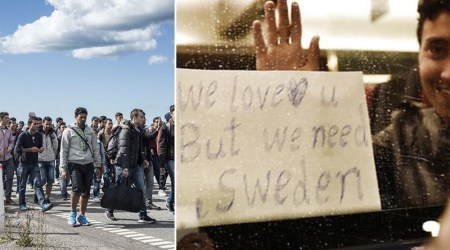
1587Tens of thousands of migrants have passed through Denmark to enter Sweden during 2015 and 2016, attracted by Sweden’s generous welfare payments and free housing.

What the established Swedish media does not tell people about are the threats and risks that come with increased migration. When the European Union’s border agency, Frontex, recognized that it could not control the migrants coming to Europe, and that many Europeans who had joined terrorist organizations outside Europe were coming back to Europe among the migrants, this was not major news in the Swedish media. This is strange, since Sweden is one of the countries in Europe from where many citizens have traveled from to the Middle East to fight in jihadi terrorist organizations.

Such news does not fit in the narrative that the Swedish media is trying to tell the Swedish people. The narrative that the Swedish establishment wants to tell the Swedes is that the more immigrants come to Sweden, the richer Sweden will become. It does not matter which country these immigrants come from. If they just come to Sweden, then Sweden will become a richer country.

A month before the migration crisis started making waves in the media, the think tank Arena Idé — which has close ties to the Social Democrats, the governing party — published a report that was mentioned in all the major Swedish media outlets.

According to the report, Sweden, between 1950 and 2014, had made a “profit” of $110 billion on immigration. The report also said that without immigration, an $8 billion tax increase would be needed to sustain Sweden’s defense, infrastructure and research. That there could be a conflict between a welfare state and immigration was called a “myth.” As expected, the established Swedish media rejoiced over these “facts.”

When the report went public in June 2015, the Swedish media celebrated it. Today, when the Swedish welfare state is under severe pressure because of immigration, the authors refuse to answer any questions about it. Last June, it was treated as a confirmation of the pro-immigration ideology of the Swedish establishment. With 9.5 million people in Sweden and its many universities, only a few economists protested the report. The loudest criticism came from the economist Tino Sanandaji. Needless to say, Sanandaji, despite being an immigrant from Iran with a Ph.D. in public policy from the University of Chicago, was depicted by some in the established Swedish media as a right-wing extremist.

No, Sweden is not the Soviet Union, but the way large parts of the Swedish establishment turn ideology into “facts” through “reports,” and smear those who have different opinions, undermines debates that are of such critical importance in a democracy.

Not only the media and think tanks connected to the government advocate a liberal immigration policy. There is also loud support for it in academic circles. “Immigrants are a profit for Sweden,” Dick Harrison, professor of history at Lund University, wrote in a December 2014 article for the Swedish newspaper Svenska Dagbladet. In the article, he states:

“Sweden is not in any way unique. The same logic — that immigration strengthens the country politically, economically and culturally – can be said of all peacetime immigrations through the ages, whether it has been about refugees or labor immigration. The more immigrants, the stronger [the] state. The prime example is the United States. There is not a single historical example of immigration in the long term being negative for the host country. At this point, our historical experience is crystal clear — the only form of immigration that has been, and is, directly harmful is comprised of warlike invasions.”

While Harrison gives the United States as an example, he forgets to mention that while immigrants to the U.S. often come from countries such as Mexico, China and India, the three countries from which Sweden received the highest number of asylum seekers in 2015 were Iraq, Afghanistan and Syria. They have also delivered most asylum seekers to Sweden during the first four months of 2016. As most people know, these three countries house large numbers of jihadi terrorists.

In Sweden, moreover, it is difficult for people without a high level of education to get a job. In Malmö, the unemployment rate among foreign-born men aged 18-24 years is at 41%. In Sweden, those who do not have jobs receive generous welfare payments from the local authorities.

Sweden also has a welfare system in which municipalities are obligated to ensure that everyone has housing. Sweden’s homeless people live in hostels or hotels paid for by taxpayers. These immigration policies have therefore have therefore saddled Swedish taxpayers with huge expenses.

Without the establishment’s campaign to convince the Swedish people that immigration will make Sweden rich, Sweden would not have the liberal immigration policies they do, eroding the country’s safety and welfare. Even though the Swedish establishment campaigns in every way possible for a liberal immigration policy, and despite the fact that a few months ago anyone advocating for a restrictive immigration policy was called a “racist,” resistance among Swedes against immigration has increased.

The Swedish people have defied their establishment and recently forced liberal politicians to support a more restrictive immigration policy. The Swedish people, despite having an ideologically blind establishment, have been smart enough to use their common sense.

As for the Swedish establishment, there is no word to describe them other than dangerous.

The Swedish establishment is characterized by incompetence combined with an extreme left-wing ideology and a hillbilly-like mentality that refuses to see the rest of the world and the risks involved in it. The Swedish establishment has not dealt with Sweden as if it were a country, but as if it were a village.

What is happening in Sweden right now is a cultural and political revolution. The Swedes have trusted their establishment for a long time. This trust has been a part of the political culture in Sweden. But now that culture is changing — to be anti-establishment in Sweden today is not marginalized anymore. Sweden is developing a powerful anti-establishment movement, dominating the political debate.

By gross miscalculations, the Swedish establishment has eroded its own legitimacy. Today, fewer than one in four Swedes have confidence in their government. The damage that the Swedish establishment’s liberal immigration policies inflicted on Sweden during the migration crisis of 2015 — and is about to inflict during the coming migration crisis of 2016 — is likely to cause a tectonic political shift in Sweden.

The Swedish media has failed in its journalistic obligation to report objectively about the problem, and Swedish politicians have not acted in the best interest of Sweden. While Sweden faces its biggest crisis since World War II, the Swedish establishment has clearly failed to lead.

The average Swede needs to be tougher to cope with the challenges facing Sweden today and in the years to come. The problems that will face Sweden after it has received 160,000 asylum seekers in 2015 and the 150,000 asylum seekers expected in 2016 will create a political, cultural and social environment in which there is no place for political naivety and ideological blindness. To survive as a stable and civilized country where the rule of law and democracy will prevail, Sweden will be forced to recognize the threats and risks that come with massive immigration — and to respond.

Migrant Rape Epidemic Reaches Austria

May 5, 2016

Migrant Rape Epidemic Reaches Austria, Gatestone InstituteSoeren Kern, May 5, 2016

♦ A 20-year-old asylum seeker from Iraq confessed to raping a 10-year-old boy at a public swimming pool in Vienna. The Iraqi said the rape was a “sexual emergency” resulting from “excess sexual energy.”

♦ Those who dare to link spiraling crime to Muslim mass migration are being silenced by the guardians of Austrian multiculturalism.

♦ According to data compiled by the Austrian Interior Ministry, nearly one out of three asylum seekers in Vienna was accused of committing crimes in 2015. North African gangs fighting for control over drug trafficking were responsible for roughly half of the 15,828 violent crimes — rapes, robberies, stabbings and assaults — reported in the city during 2015.

♦Austria received 90,000 asylum requests in 2015, the second-highest number in the EU on a per capita basis, but this pales in comparison to what may lie ahead. Interior Minister Wolfgang Sobotka warned last month that up to one million migrants are poised to cross the Mediterranean from Libya to Europe.

The brutal gang rape of a woman by three Afghan asylum seekers in central Vienna on April 22 has shocked the Austrian public and drawn attention to a spike in migrant-related rapes, sexual assaults and other crimes across the country.

The migrant crime wave comes as the anti-immigrant Freedom Party of Austria (FPÖ) has surged in opinion polls. The party’s candidate, Norbert Hofer, won the first round of Austria’s presidential elections on April 24, and is on track to win the presidency in the second round, run-off election scheduled for May 22.

The three Afghans — two 16-year-olds and one 17-year-old — followed the woman, a 21-year-old exchange student, into a public restroom at the Praterstern train station, one of the main transportation hubs in Vienna. One of the migrants held the woman down while the other two took turns raping her.

A passerby called the police after she heard the woman screaming. By the time police arrived, the men had gone. The suspects, who were arrested as they were attempting to flee the station, do not speak German. Through an interpreter, the migrants told police they were drunk and do not remember carrying out the crime.

If convicted, they face a maximum sentence of seven-and-a-half years in prison. Due to the lenient nature of the Austrian judicial system, however, they may end up spending only two years behind bars, according to local observers.

It is also unlikely that the migrants will be deported: according to European law, sending them back to Afghanistan would be a violation of their human rights. Instead, observers say, the Afghans will qualify for Austrian social welfare benefits — €830 ($950) per month plus free healthcare — and probably for the rest of their lives become wards of Austrian state.

The assault in Praterstern is one of a growing number of migrant sex crimes in Austria (other migrant rapes and sexual assaults are included in the appendix below):

  • A 20-year-old asylum seeker from Iraq confessed to raping a 10-year-old boy at a public swimming pool in Vienna. The Iraqi said the rape was a “sexual emergency” resulting from “excess sexual energy.” The man, who left his wife and child behind in Iraq, said he had been unable to control his libido because he had not had sexual relations since arriving in Austria in September.
  • An 18-year-old asylum seeker from Afghanistan was sentenced to 20 months in prison for raping a 72-year-old woman in Traiskirchen. “First he beat the woman black and blue, then he raped her, and then he took her underwear as a trophy,” local police said. In addition to a lenient sentence, the man will be allowed to remain in Austria and, after he leaves prison, collect social welfare benefits.
  • A 20-year-old asylum seeker from Afghanistan was arrested after he coerced 13-year-old girl from the town of Korneuburg repeatedly to have sex with him. The man, who was living in an asylum shelter in Hollabrunn, first established contact with the girl over the Internet. Each time they met in person, he verbally threatened her until she agreed to have sex. The man was arrested after the girl told her parents about the relationship, which had been going on for more than three months.
  • Mobs of Arab migrants sexually assaulted dozens of women in Vienna, Salzburg andInnsbruck on New Year’s Eve. The sex attacks, known in Arabic as taharrush (“harassment”), were similar to those carried out that day by North African migrants in Cologne, Germany and other cities. Police initially denied that the attacks had taken place, but later admitted to lying, purportedly to protect the privacy of the victims.

Those who dare to link spiraling crime to Muslim mass migration are being silenced by the guardians of Austrian multiculturalism.

In April, for example, the Austrian Press Council (Presserat) — a group that enforces a politically correct “code of ethics” to ensure that Austrian media outlets toe the line of state-sanctioned multiculturalism — censured the left-leaning magazine, Falter, for “blanket discrimination” against Muslims.

The magazine’s editors — otherwise faithful proponents of European multiculturalism — appear to have had enough of migrants raping their way through Europe with virtual impunity. For the January-February 2016 edition, Falter’s cover featured a black and white drawing of five “light skinned” European women surrounded by large numbers of “dark skinned” Arab males. The image evoked images of the taharrush assaults in Cologne.

In a three-page “decision,” the Presserat ruled that the image violates the “code of ethics” because it amounts to “blanket slander and discrimination” against Arab men:

“The men are all portrayed with the same fierce-looking facial expression, dark hair and noticeably dark eyebrows. In this way — in the context of the attacks in Cologne — the artist is constructing a prototype of men from North Africa, i.e., the Arab world. The uniformity of the image suggests that, rather than portraying individuals, it depicts a homogenous group whose members all behave in the same way.

“Therefore, readers could be left with the impression that the sexual assaults in Cologne were not the acts of individual persons or person groups, but that such conduct is typical for men from North Africa, i.e., the Arab world. The image could leave the impression that all North Africa men who are here in Europe fail to conduct themselves correctly vis-à-vis women.”

The editors of Falter defended themselves against accusations of racism:

“The fact is that North Africans were overwhelmingly responsible for the assaults in Cologne. This is what took place and we should be allowed to represent it as such.”

Vienna is the epicenter of migrant crime in Austria. According to data compiled by the Austrian Interior Ministry, nearly one out of three asylum seekers in Vienna was accused of crimes in 2015. Of the nearly 21,000 officially approved asylum seekers in the capital, 6,503 were known to have committed crimes in 2015, a jump of nearly 50% over 2014. The data shows that 2,270 of the criminals were under the age of 20, a 72% jump over 2014. Seven were under age nine, while 31 were under age 13.

According to Vienna Police Chief Gerhard Pürstl, North African gangs fighting for control over drug trafficking were responsible for roughly half of the 15,828 violent crimes — rapes, robberies, stabbings and assaults — reported in the city during 2015.

The area around the Praterstern station, where the exchange student was raped, has become overrun by shiftless migrants from Afghanistan and North Africa who are selling drugs, fighting turf battles and assaulting female passersby. Police were dispatched to the area a total of 6,265 times in 2015, or an average of 17 times a day, according to local media. But local authorities appear unable or unwilling to restore order to the area.

1585 (1)The area around Praterstern train station in Vienna is overrun by shiftless migrants from Afghanistan and North Africa who are selling drugs, fighting turf battles and assaulting female passersby. Police were dispatched to the area 6,265 times in 2015, or an average of 17 times a day.

The head of the Austrian Police Union, Hermann Greylinger, estimates that Vienna needs around 1,200 more police officers in order to establish order in the capital:

“If we are allowing in our country 111,000 migrants, few of whom have had background checks, then clearly the police must be massively increased. Almost all asylum claimants are moving to Vienna. We now have more migrants than the population of the city of Salzburg, the fourth-largest city in Austria.”

Austria’s migrant crime problem is being exacerbated by an extremely lenient criminal justice system. On May 4, for example, a 21-year-old migrant from Kenya randomly killed a 54-year-old woman on a busy street in Vienna by hitting her over the head with an iron bar. It soon emerged that the Kenyan was well known to city police: since arriving in Austria in 2008, he had committed at least 18 previous crimes — including dealing drugs, attacking police officers and hitting someone over the head with an iron bar — but he has repeatedly been set free.

Given the growing insecurity, it comes as no surprise that Austrian voters are looking for a change in political direction.

In what amounts to a political earthquake, Freedom Party (FPÖ) candidate Norbert Hofer won 36% of the vote in the first round of Austria’s presidential election on April 24. Hofer — who has campaigned on a platform calling for strict limits on immigration and tough rules for asylum seekers — defeated all of the other candidates, including those from the two governing parties, the Social Democrats and the Austrian People’s Party, which have dominated Austrian politics since the end of World War II.

Hofer, who says that as president he will be the “protector of Austria,” is now on track to defeat the Green Party’s Alexander Van der Bellen, a 72-year-old economist who is opposed to limits on immigration, in a run-off ballot to be held on May 22.

Hofer’s meteoric rise is focusing the minds of the establishment parties. On April 27, just three days after Hofer’s electoral victory, the Austrian Parliament adopted what may be one of the toughest asylum laws in Europe.

Under the new law, Austria will declare a “state of emergency” on the migration crisis. This will allow Austrian authorities to assess asylum claims directly at the border. Only asylum seekers with immediate family members already in Austria, or those who can prove they are in danger in neighboring transit countries, will be allowed to enter the country. Other migrants will be turned away. The new law also limits any successful asylum claim to three years.

Interior Minister Wolfgang Sobotka said the new law is needed to stem the flow of migrants and refugees: “We cannot shoulder the whole world’s burden.”

Austria received 90,000 asylum requests in 2015, the second-highest number in the European Union on a per capita basis, but this pales in comparison to what may lie ahead. In a radio interview on April 28, Sobotka warned that up to one million migrants are poised to cross the Mediterranean Sea from Libya to Europe.

Appendix

Sexual Assaults and Rapes by Migrants in Austria, January-April 2016.

Gatestone Institute has reported about the migrant rape epidemic in Germany and Sweden. The problem has now spread to Austria. Following are a few cases from the first four months of 2016:

April 29. A 35-year-old migrant from Algeria attempted to rape a woman at a bus stop in Linz. The man beat the woman unconscious, but not before she broke his nose. He was arrested after he went to a local hospital seeking medical attention. It later emerged that the Algerian has a long criminal record, including other attempted rapes, but cannot be deported because Algeria will not take him back.

On April 25, Kronen Zeitung, the largest newspaper in Austria, reported that an “Arabic-looking man” attempted to rape a 27-year-old woman at a bus stop in Vienna. “All he could say was sex, sex, sex,” the woman said. The man pulled a condom out of his pants pocket and then dropped his trousers. “I screamed as loud as I could,” the woman said, “until the man ran away.” She said that city police have been wholly uninterested in her case: “They have not even asked me for my name.” After local media reported on her case, police issued an apology and blamed their failure to take her seriously on a “regrettable misunderstanding.”

April 24. An unidentified migrant raped a 19-year-old woman in Eisenstadt.

April 22. Three asylum seekers from Afghanistan gang-raped a 21-year-old woman at a train station in Vienna.

April 22. A 17-year-old asylum seeker from Afghanistan attempted to rape a 20-year-old woman in Graz.

April 21. A 17-year-old asylum seeker from Afghanistan sexually assaulted a 19-year-old woman on a train in Grieskirchen. The train’s conductor intervened after he heard the woman scream. The Afghan told police that the woman was lying and demanded an apology.

April 20. Two North African migrants sexually assaulted a woman in front of the main train station in Salzburg. When a 26-year-old passerby attempted to intervene, the migrants punched and kicked him so hard that he was rushed to a nearby hospital. One of the attackers is a 31-year-old asylum seeker from Morocco. The other suspect remains at large.

April 15. A 42-year-old migrant from Slovenia was arrested for attempting to sexually assault two 18-year-old women in Leibnitz.

April 13. An “Arab looking” man sexually assaulted three women at a bus stop in Vienna.

March 24. Two Afghan migrants were arrested for raping a 20-year-old woman in Wels.

March 21. A migrant from North Africa assaulted a 27-year-old woman on a packed subway train in Vienna. The man began touching the woman on her hands. When she got up to find another seat, the man grabbed her and began kissing her on the mouth. Police told the woman there was nothing they could do because kissing does not qualify as sexual assault.

March 12. A 16-year-old asylum seeker from Libya attempted to kidnap and rape two women inVienna. After the three met on a subway train, the Libyan promised to take the women to a nightclub. He took them instead to an apartment where he attempted to lock the women in the basement and rape them. One of the women escaped and called the police.

March 8. A 20-year-old asylum seeker from Afghanistan was observed pointing to his genitals in front of a seven-year-old girl at a public swimming pool in Vienna. The pool director and a swimming instructor held the man until police arrived. The police let him go.

March 6. A “foreign looking” man sexually assaulted a 37-year-old woman at a public swimming pool in Klagenfurt after she intervened to prevent him from molesting her four-year-old boy.

February 25. A “southerner” sexually assaulted two teenage girls at a shopping mall inInnsbruck.

February 22. An 18-year-old migrant from Afghanistan was arrested for raping a 52-year-old woman in Innsbruck.

February 14. Six migrants sexually assaulted a 49-year-old woman on a subway in Vienna. Two of the men, an 18-year-old asylum seeker from Afghanistan and a 23-year-old asylum seeker from Iraq, were arrested as they tried to exit the station. The other four remain at large.

February 11. A 33-year-old migrant from Iran masturbated in front of female patrons at a public swimming pool in Linz.

February 8. A 22-year-old migrant from Macedonia identified only as Ibrahim J. was arrested inVienna for sexually assaulting more than 20 women in Vienna and other parts of Austria. Among other crimes, the man is accused of raping a 15-year-old girl.

February 6. A group of 28 male asylum seekers sexually harassed female patrons at an outdoor ice skating rink in Stockerau. The migrants then attacked security guards who tried to intervene. Police were needed to restore order.

February 4. Six “southerners” assaulted a 53-year-old woman in front of a grocery store in Spittalafter she refused to give them money.

February 3. Three migrants sexually assaulted a 16-year-old girl at a streetcar stop in Leonding. One of the men held the girl down while the other two took turns assaulting her.

January 26. A 24-year-old asylum seeker from Gambia raped and murdered a 25-year-old American woman in Vienna. The woman from Colorado, who was working as an au pair (nanny), had given the man, Abdou I., shelter in her apartment. He had fled his asylum shelter because his asylum request was denied and he feared being deported. After the murder, the man fled to Switzerland, where he was arrested after police traced his cellphone. It later emerged that he was wanted in Germany for sexually assaulting an underage girl.

January 23. A migrant from Macedonia attempted to rape a 21-year-old woman in Vienna. The man made eye contact with the woman on a subway and followed her after she got off the train.

January 16. A 21-year-old asylum seeker from Afghanistan raped an 18-year-old woman at the Prater, a large public park in Vienna.

January 10. A 29-year-old asylum seeker from Afghanistan tried to molest a six-year-old boy at a public swimming pool in Linz. The mother of the child said: “I noticed six migrants enter the building. Two of them sat down at the edge of the pool for children. One of them began stimulating his genitals while flirting with my youngest child.”

January 1. Mobs of Arab men sexually assaulted at least 24 women in Vienna, Salzburg and Innsbruck.

 

EU: Europeans Must Pay $280K For Each Muslim Migrant they Refuse

May 4, 2016

EU: Europeans Must Pay $280K For Each Muslim Migrant they Refuse, Front Page Magazine, Daniel Greenfield, May 4, 2016

2015-09-09_0134_2

Despite growing opposition, the EU is really doubling down on its aggressive push to distribute Muslim migrants across Europe. This is being described as “fair”, but that’s as fair as your neighbor setting his house on fire and then demanding that you either let him move in with you or he’ll set your house on fire.

Merkel decided to open the doors to any Muslim who wanted to come. Greece chose to pass them along without caring in the least what other countries would suffer. But other countries are supposed to be penalized for Merkel’s bleeding heart.

The European Commission made a proposal on Wednesday to automatically distribute asylum-seekers across the EU from member states overwhelmed by arrivals.

Depending on the number of asylum seekers in the European Union, each country would be assigned a “fair share”, based on the size of its population and economy. Should it face arrivals exceeding 1.5 times the fair share, automatic relocation would start to other EU states until it drops again.

There’s nothing fair about any of this. Nor is it much of a plan because the Muslim migrants have repeatedly said that they want to go to Germany or Sweden. And they want specific cities with large Muslim populations. Trying to send them to Poland won’t work for very long.

Countries could exempt themselves from relocation for one year at a time if they pay 250,000 euros per refugee they would otherwise need to take in to the country that accommodates the person.

The figure is meant to be “dissuasive” and is very high compared to 6,000 euros for every relocated person as offered by the European Commission last year under an emergency relocation plan that was due to cover 160,000 people.

That’s around $280K US. And rather few European countries can afford that. And since Muslim migrants keep coming, the question becomes moot anyway. As countries continue being overwhelmed, the figures will go on being recalculated.

While any reform would only apply mid- to longer-term, a calculation for Poland, the biggest eastern EU state, shows it would have to pay some 1.6 billion euros for fewer than 7,000 people it was assigned – but never took in – under the 160,000 plan.

Of course this isn’t going to shut down anything. It’s just meant to make Germans and some others feel better that other countries will do their “fair share”. It’s a political divide and conquer strategy.

Meanwhile smuggling migrants into Europe is a $7 billion business. And that’s not counting the payoffs that Turkey’s Islamist government will be getting.

The Great Western Retreat

May 4, 2016

The Great Western Retreat, Gatestone InstituteGiulio Meotti, May 4, 2016

♦ Of all French soldiers currently engaged in military operations, half of them are deployed inside France. And half of those are assigned to protect 717 Jewish schools.

♦ This massive deployment of armed forces in our own cities is a departure from history. It is a moral disarmament, before a military one.

♦ Why does anyone choose to fight in a war? Civilized nations go to war so that members of today’s generation may sacrifice themselves to protect future generations. But if there are no future generations, there is no reason whatever for today’s young men to die in war. It is “demography, stupid.”

On March 11, 2004, 192 people were killed and 1,400 wounded in a series of terrorist attacks in Madrid. Three days later, Spain’s Socialist leader, José Luis Rodríguez Zapatero, was elected prime minister. Just 24 hours after being sworn in, Zapatero ordered Spanish troops to leave Iraq “as soon as possible.”

The directive was a monumental political victory for extremist Islam. Since then, Europe’s boots on the ground have not been dispatched outside Europe to fight jihadism; instead, they have been deployed inside the European countries to protect monuments and civilians.

Opération Sentinelle” is the first new large-scale military operation within France. The army is now protecting synagogues, art galleries, schools, newspapers, public offices and underground stations. Of all French soldiers currently engaged in military operations, half of them are deployed inside France. And half of those are assigned to protect 717 Jewish schools. Meanwhile, French paralysis before ISIS is immortalized by the image of police running away from the office of the satirical magazine Charlie Hebdo during the massacre there.

1578French soldiers guard a Jewish school in Strasbourg, February 2015. (Image source: Claude Truong-Ngoc/Wikimedia Commons)

You can find the same figure in Italy: 11,000 Italian soldiers are currently engaged in military operations and more than half of them are used in operation “Safe Streets,” which, as its name reveals, keeps Italy’s cities safe. Italy’s army is also busy providing aid to migrants crossing the Mediterranean.

In 2003, Italy was one of the very few countries, along with Spain and Britain, which stood with the United States in its noble war in Iraq — a war that was successful until the infamous US pull-out on December 18, 2011.

Today, Italy, like Spain, runs away from its responsibility in the war against the Islamic State. Italy’s Defense Minister Roberta Pinotti ruled out the idea of Italy taking part in action against ISIS, after EU defense ministers unanimously backed a French request for help.

Italy’s soldiers, stationed in front of my newspaper’s office in Rome, provide a semblance of security, but the fact that half of Italy’s soldiers are engaged in domestic security, and not in offensive military strikes, should give us pause. These numbers shed a light not only on Europe’s internal terror frontlines, from the French banlieues to “Londonistan.” These numbers also shed light on the great Western retreat.

US President Barack Obama has boasted that as part of his legacy, he has withdrawn American military forces from the Middle East. His shameful departure from Iraq has been the main reason that the Islamic State rose to power — and the reason Obama postponed a military withdrawal from Afghanistan. This US retreat can only be compared to the fall of Saigon, with the picture of a helicopter evacuating the U.S. embassy.

In Europe, armies are no longer even ready for war. The German army is now useless, and Germany spends only 1.2% of GDP on defense. The German army today has the lowest number of staff at any time in its history.

In 2012, Germany’s highest court, breaking a 67-year-old taboo against using the military within Germany’s borders, allowed the military to be deployed in domestic operations. The post-Hitler nation’s fear that the army could develop again into a state-within-a-state that might impede democracy has paralyzed Europe’s largest and wealthiest country. Last January, it was revealed that German air force reconnaissance jets cannot even fly at night.

Many European states slumber in the same condition as Belgium, with its failed security apparatus. A senior U.S. intelligence officer even recently likened the Belgian security forces to “children.” And Sweden’s commander-in-chief, Sverker Göranson, said his country could only fend off an invasion for a maximum of one week.

During the past ten years, the United Kingdom has also increasingly been seen by its allies — both in the US and in Europe — as a power in retreat, focusing only on its domestic agenda. The British have become increasingly insular – a littler England.

The UK’s armed forces have been downsized; the army alone is expected to shrink from 102,000 soldiers in 2010 to 82,000 by 2020 – its smallest size since the Napoleonic wars. The former head of the Royal Navy, Admiral Nigel Essenigh, has spoken of “uncomfortable similarities” between the UK’s defenses now and those in the early 1930s, during the rise of Nazi Germany.

In Canada, military bases are now being used to host migrants from Middle East. Justin Trudeau, the new Canadian prime minister, first halted military strikes against ISIS, then refused to join the coalition against it. Terrorism has apparently never been a priority for Trudeau — not like “gender equality,” global warming, euthanasia and injustices committed against Canada’s natives.

The bigger question is: Why does anyone choose to fight in a war? Civilized nations go to war so that members of today’s generation may sacrifice themselves to protect future generations. But if there are no future generations, there is no reason whatever for today’s young men to die in war. It is “demography, stupid.”

Spain‘s fertility has fallen the most — the lowest in Western Europe over twenty years and the most extreme demographic spiral observed anywhere. Similarly, fewer babies were born in Italy in 2015 than in any year since the state was founded 154 years ago. For the first time in three decades, Italy’s population shrank. Germany, likewise, is experiencing a demographic suicide.

This massive deployment of armed forces in our own cities is a departure from history. It is a moral disarmament, before a military one. It is Europe’s new Weimar moment, from the name of the first German Republic that was dramatically dismantled by the rise of Nazism. The Weimar Republic still represents a cultural muddle, a masterpiece of unarmed democracy devoted to a mutilated pacifism, a mixture of naïve cultural, political reformism and the first highly developed welfare state.

According to the historian Walter Laqueur, Weimar was the first case of the “life and death of a permissive society.” Will Europe’s new Weimar also be brought down, this time by Islamists?

Islamist Extremism in France (Part II)

May 4, 2016

Islamist Extremism in France (Part II), Clarion Project, Leslie Shaw, May 4, 2016

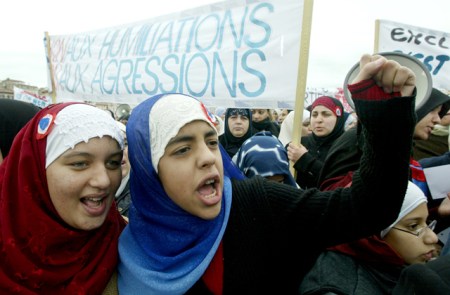
France-Muslims-Protest-Hijab-Ban-IP_0Muslims in France protest against a French law that forbids the wearing of religious symbols (including the hijab) in the primary and secondary schools. (Photo: © Reuters)

France has one of the largest Muslim communities in the West (estimated at 10% of the population), and French corporates have more experience than most in dealing with radical Islam.

City of Paris

In September 2012, in response to the encroachment of radical Islam, the mayor of Paris set up an Observatory on Secularism to ensure the principles of the 1905 separation of Church and State were being respected by the city’s 73,000 employees.

The observatory remained dormant but was reactivated in January 2015 after the Islamic terrorist attacks. Saïd Kouachi, one of the Charlie Hebdo killers, worked in the city sanitation department from 2007 to 2009. He was part of an employment program for young people from the ghettoes surrounding Paris.

A number of these youths were assigned to going door-to-door to inform householders on the benefits of domestic waste segregation. Many created problems for their supervisors due to their increasingly fundamentalist Islamic beliefs: refusing to shake hands with women, bringing prayer mats with them and taking time off to return to their workplaces to pray. Kouachi was moved from district to district as his supervisors, who described him as fundamentalist and unmanageable, became exasperated with his behavior. He was fired in July 2009.

A supervisor later revealed that city authorities had been notified about Kouachi’s radical behavior on several occasions, but that the subject was taboo. A “Charter on Secularism” was posted in the sanitation workshops and a one-day training program held for supervisors in 2013, but no action was taken to deal with the problem.

Since January 2015, the Observatory members meet regularly, have issued a 20-page rulebook to municipal employees and interviewed numerous city managers about the problems of radicalization. Departments most affected are sanitation, parks and gardens, public safety and security, and youth and sport. Common issues are praying in the workplace, refusal to shake hands with, look at or follow instructions from female supervisors, demands for work schedule accommodation on Fridays and during Ramadan, wearing of hijabs and other head-coverings.

RATP Paris Transit Authority

The RATP chapter of the CFDT union claims there is a groundswell of Islamist ideology within the company where Samy Amimour, one of the 2015 Paris suicide bombers, worked as a bus driver. In December 2015, a newspaper reported that several RATP employees were targeted by “Fiche S,” a law enforcement indicator that flags individuals linked to terrorism.

Religion-based workplace incidents are widespread. In 2013, RATP management issued a guidebook to supervisors listing typical infringements of secular principles and outlining rules to enforce. An RATP executive commented, “We pretend the problem has been solved, but the reality is that managers in contact with radicalized individuals in bus depots are left on their own to handle these kinds of things.”

ADP Paris Airports Authority

Following the November 2015 attacks in Paris, CDG Airport CEO Augustin de Romanet revealed that 70 airside security badges had been withdrawn from Muslim airport employees and 4,000 staff lockers raided by police as the employees were considered a security risk.

French Automobile Industry

The problems facing French public-sector companies have long been present in the automobile industry, where Muslims account for around 70 percent of the workforce. Militant Islam began to manifest itself in the 1980s, when it emerged that shop stewards frequently had links to the Muslim Brotherhood.

Employees began to shave their heads, grow beards and wear Islamic garb as the Salafist ideology gained ground in the suburbs where the auto plants are located. Automakers Renault and Peugeot integrated Muslim practices into their management model, setting up on-site prayer rooms and planning work schedules to fit in with prayer times and Ramadan.

Employee associations were established to cater to the needs of Muslim staff, organizing religious celebrations, pilgrimages to Mecca and arranging for the repatriation to North Africa of deceased workers. This policy of appeasement benefited the industry since it minimized religion-linked workplace conflict and litigation and fostered employee engagement.

Radical Islam and the Emergence of Jihadism

The first generation of Muslim immigrants who came to France in the 1950s kept their faith to themselves. The second generation was more militant and began making demands for accommodation of Islam. Opting for exclusion rather than integration into mainstream society, some turned to crime. Those caught and imprisoned often converted to radical Islam, spreading the ideology throughout the ghettoes upon release.

The third generation came of age with the nationwide 2005 riots, sparked by the electrocution of two juvenile delinquents who climbed over a fence into an electricity substation to escape from the police.

The same year, Abu Musab al-Suri published a 1,600-page Global Islamic Resistance Call urging the masterminds of jihad to exploit the presence of the huge disaffected Muslim populations in Europe by prompting them to set up terror cells targeting Western civilians. The strategy was rolled out on the internet and by Salafist imams operating in mosques financed by the Gulf states.

A growing number of Muslims in France and Europe converted to radical Islam resulting in the emergence of an informal jihadist army on the continent. In February 2016, the number of radical Islamists identified by French law enforcement was 11,700.

How Many Molenbeeks in France?

May 3, 2016

How Many Molenbeeks in France? Gatestone InstituteYves Mamou, May 3, 2016

♦ “There are today, we know, a hundred neighborhoods in France that present potential similarities with what’s happened in Molenbeek.” — Patrick Kanner, Minister for Urban Areas.

♦ The Salafists, in fact, do not want to “take the power in these neighborhoods.” In many, they already have it.

♦ “The farther I walked between the buildings, the more I was stunned. A courtyard of Islamist miracles; an enclave that wants to live like during the times of Muhammad. Bakery, hairdresser… It’s a mini Islamic Republic. During the sermons, they denounce, they criminalize. A woman who smokes? A degenerate. A woman who does not veil herself? A tease. A man that does not eat halal? He has an express ticket to hell.” — Paris Match.

♦ Remadna received a death threat over the phone: “We know where your kids go to school,” and “your daughter is very pretty.” The next day, a delegation of completely veiled Salafist “true Muslim mothers” came and told her, “We want mosques, not schools.”

Patrick Kanner, France’s Minister for Urban Areas, was undoubtedly not planning to tell the truth on March 27.

He was on the set of Europe 1 TV to emphasize the left’s credo: Islamist terrorism is rooted in poverty and unemployment. But they asked one question again and again: “How many Molenbeeks are in France?” Finally, he said: “There are today, we know, a hundred neighborhoods in France that present potential similarities with what has happened in Molenbeek.”

Molenbeek, as the entire world knows today, is the neighborhood of Brussels that has become the epicenter of jihad in Europe. It is a neighborhood under Salafist control that sent three of its residents to assassinate hundreds of people in Paris on November 13, 2015. These are the residents of the same neighborhood that bombed the Brussels airport and the Maalbeek Metro station.

1577The Molenbeek neighborhood of Brussels has become the epicenter of jihad in Europe. Abdelhamid Abaaoud (right), mastermind of the November 2015 attacks in Paris, lived in Molenbeek. Amedy Coulibaly (left), who in January 2015 murdered a policewoman and four Jews in Paris, spent time in Molenbeek.

The reactions to Kanner’s statement have not been slow. The first secretary of the Socialist Party, Jean-Christophe Cambadélis, accused Kanner of “dissolving national harmony.” Julien Dray, another leading figure of the Socialist Party, also criticized Kanner, telling him: “I do not like it when we stigmatize [people].”

Nonetheless, Kanner will not let himself be intimidated. In a March 28 interview in Le Parisien, he recalled,

“Amedy Coulibaly [the killer in the Hyper Cacher attack], who was from the Grande-Borne à Grigny, Mehdi Nemmouche [the Brussels Jewish Museum killer], who passed through the Bourgogne neighborhood in Tourcoing. and Mohamed Merah, who was from the Mirail neighborhood in Toulouse.”

Malek Boutih, Socialist Deputy, came to Kanner’s aid. He declared,

“It is the first time that a minister of the suburbs says even a little bit of the truth, namely that the ghettos have transformed, little by little, into zones that we cannot control very well… Neighborhoods that are incubators for terrorists.”

Samia Ghali, a Senator from Bouches du Rhones (Socialist Party), echoed the statements of the Minister for Urban Areas: “There are training camps in the neighborhoods of Marseille where people are learning to shoot.” She adds, “I’ve gotten to the point of asking if we should build walls to protect schoolyards from Kalashnikov bullets or from rifles finding their way into the school yard.”

Gilles Kepel, professor at the Paris Institute of Political Studies, and one of the best experts on Islamism in France, explained in early April that three ingredients are necessary for making a Molenbeek:

“1) A strong system of crime organized around kif [a type of marijuana]; 2) Hideouts for terrorists and sites where they can stock weapons; 3) Local politicians who accept that the Salafists have opened countless uncontrollable mosques.”

These three ingredients would be uniformly present in all 100 French Molenbeeks, added Kepel. But the goal of the Salafists, he adds, is actually to seize neighborhoods in order to wage a “enclave war.”

Patrick Kanner, the Minister for Urban Areas confirmed this view: “The Salafists want to take the power in these neighborhoods.” The gravity of the situation was recently underscored by Prime Minister Manual Valls: a fundamentalist “minority,” he said, is about to win “the ideological and cultural battle” over Islam.

The Salafists, in fact, do not want to “take the power in these neighborhoods.” In many, they already have it.

On January 27, the magazine Paris-Match dedicated several pages to the neighborhood Reine-Jeanne in Avignon, a large city in the south of France, where the Salafists have systematically exploited half a million Muslims.

“The farther I walked between the buildings, the more I was stunned. A courtyard of Islamist miracles, a Salafist pocket, an enclave that wants to live like during the times of Muhammad. Bakery, hairdresser, building managers, teenagers. All (or almost) overcome with the Koran. Well, their Koran. It’s a mini Islamic Republic.

“During the sermons, they denounce, they criminalize. A woman who smokes? A degenerate. A woman who does not veil herself? A tease. A man that does not eathalal? He has an express ticket to hell. That female neighbor, the one who is divorced, with three kids, and works with men? She will end up losing her virtue. She should just give up. In order to not pass for an ‘easy woman,’ the unlucky choose the hard life, welfare benefits!”

In Sevran, a suburb of Paris, the Salafist mosque was sealed off several weeks ago because it had been recruiting a dozen young Muslims for the Islamic State. Six may have already been killed in Syria. Nadia Remadna, a Muslim social worker, lives in Sevran. She started the local “Mothers’ Brigade” to help women keep control over their children, against the Islamists. In 2014, she wrote the provocative book, How I Saved My Children, with the sub-title “Before, we feared our children would fall in with delinquents. Now, we fear they will become terrorists.”

On March 14, Remadna received a death threat over the phone: “We know where your kids go to school,” and “your daughter is very pretty.”

The next day, a delegation of completely veiled Salafist “true Muslim mothers” came and told her, “We want mosques, not schools.”

On March 29, the philosopher Yves Michaud spoke to the magazine Paris Match about his students:

“My ex-students who teach today in the suburbs… tell me that among their students they have some who could become terrorists overnight. They take on the weight of Islam, of adolescence, of the ghettoization that makes them question their identity, of cultural disorientation. It is an ideal breeding-ground for the jihadist calling.”

How many Salafists are there in France? 15,000 to 20,000, according to Bernard Godard, former head of the Bureau of Religion for the Ministry of the Interior. According to the politician Antoine Sfeir, there are 20,000 to 30,000 Salafists. According to police sources, out of 2,500 listed Islamic places of worship in metropolitan France, at least 90 are Salafist. The number doubles every three years. They are located in the suburbs of Paris, in the Lyon region and in Marseille.

According to the Ministry of the Interior, 41 Islamic places of worship have been the target of “infiltration,” meaning that “traditional” imams are being forcibly evicted and replaced by Salafist imams.

The real question is: If the state is aware of the situation — and it is — why has it not banned Salafism, and why does it not expel the Salafist imams who are prospering not only in these neighborhoods, but also on YouTube, Facebook, and Twitter?

Europe’s Migration Crisis: No End in Sight

May 2, 2016

Europe’s Migration Crisis: No End in Sight, Gatestone Institute, Judith Bergman, May 2, 2016

♦ According to France’s Defense Minister, Jean-Yves Le Drian, 800,000 migrants are currently in Libyan territory waiting to cross the Mediterranean.

♦ The multitude of very costly social problems that Muslim migration into Europe has caused thus far, do not exist in this whitewashed European Union report, where the “research” indicates that migrants are always a boon. Similarly, any mention of the very real security costs necessitated by the Islamization occurring in Europe, and the need for monitoring of potential jihadists, simply goes unmentioned.

♦ Several European states have a less optimistic picture of the prospect of another three million migrants arriving on Europe’s borders than either the Pope or the European Commission do.

Pope Francis, on his recent visit to the Greek island of Lesbos, said that Europe must respond to the migrant crisis with solutions that are “worthy of humanity.” He also decried “that dense pall of indifference that clouds hearts and minds.” The Pope then proceeded to demonstrate what he believes is a response “worthy of humanity” by bringing 12 Syrian Muslims with him on his plane to Italy. “It’s a drop of water in the sea. But after this drop, the sea will never be the same,” the Pope mused.

The Pope’s speech did not contain a single reference to the harsh consequences of Muslim migration into the European continent for Europeans. Instead, the speech was laced with reflections such as “…barriers create divisions instead of promoting the true progress of peoples, and divisions sooner or later lead to confrontations” and “…our willingness to continue to cooperate so that the challenges we face today will not lead to conflict, but rather to the growth of the civilization of love.”

The Pope went back to his practically migrant-free Vatican City — those 12 Syrian Muslims will be hosted by Italy, not the Vatican, although the Holy See will be supporting them — leaving it to ordinary Europeans to cope with the consequences of “the growth of the civilization of love.”

There is nothing quite as free in this world as not practicing what you preach, and what the Pope is preaching is the acceptance of more migration into Europe, and more migration — much more — is indeed what is in the cards for Europe.

At the UN’s Geneva conference on Syrian refugees on March 30, Italy’s Minister of Foreign Affairs, Paolo Gentiloni, put the total number of asylum seekers into Italy in the first three months of 2016 at 18,234. This is already 80% higher than in the same period in 2015.

According to Paolo Serra, military adviser to Martin Kobler, the UN’s Libya envoy, migrants currently in Libya will head for Italy in large numbers if the country is not stabilized. “If we do not intervene, there could be 250,000 arrivals [in Italy] by the end of 2016,” he said. According to France’s Defense Minister, Jean-Yves Le Drian, the number is much higher: 800,000 migrants are currently in Libyan territory waiting to cross the Mediterranean.

Already in November 2015, the European Union estimated — in its Autumn 2015 European Economic Forecast, authored by the European Commission — that by the end of 2016, another three million migrants will have made it into the European Union.

Nevertheless, the European Commission optimistically noted that, “while unevenly distributed among countries, the estimated additional public expenditure related to the arrival of asylum seekers is limited for most EU member states.” It even concluded that the migrant crisis could have a small, positive impact on European economies within a few years citing that “Research indicates that non-EU migrants typically receive less in individual benefits than they contribute in taxes and social contribution.”

This is the classic, politically correct denial of facts on the ground. The multitude of very costly social problems that Muslim migration into Europe has caused thus far do not exist in this whitewashed report, where the “research” indicates that migrants are always a boon. Similarly, any mention of the very real security costs necessitated by the Islamization that is occurring in Europe and the consequent need for monitoring of potential jihadists, simply goes unmentioned. One wonders whether the EU bureaucrats, who authored this report, ever descend from their ivory towers and move about in the real Europe.

Several European states have a less optimistic picture of the prospect of another three million migrants arriving on Europe’s borders than either the Pope or the European Commission do. In February, Austria announced that it would introduce border controls at border crossings along frontiers with Italy, Slovenia and Hungary. On April 12, Austria began preparations for introducing border controls on its side of the Brenner Pass, the main Alpine crossing into Italy, by starting work on a wall between the two countries.

The Austrian decision to close the Brenner pass has received harsh criticism from the EU. European Commission spokeswoman Natasha Bertaud criticized the measure as unwarranted, claiming that “there is indeed no evidence that flows of irregular migrants are shifting from Greece to Italy”. Is Bertaud deliberately misrepresenting the issue? The issue is not whether the migrants are shifting from Greece to Italy after the EU’s unsavory deal with Turkey (they probably will) but the up to 800,000 migrants are already waiting to cross into Italy from Libya.

EU Migration Commissioner Dimitris Avramopoulos joined in the criticism of Austria, saying, “What is happening at the border between Italy and Austria is not the right solution.” He had criticized Austria already in February, when Vienna announced that it would cap asylum claims at 80 per day. At the time, Avramopoulos said,

“It is true that Austria is under huge pressure… It is true they are overwhelmed. But, on the other hand, there are some principles and laws that all countries must respect and apply… The Austrians are obliged to accept asylum applications without putting a cap.”

In response, Austria’s Chancellor Werner Faymann told the EU that Austria could not just let the influx of migrants continue unchecked — nearly 100,000 have applied for asylum in Austria — and he called for the EU to act. The EU has not yet acted.

The EU should hardly be surprised that a sovereign state decides to take matters into its own hands in the face of the EU’s failure to heed that call, and as it anticipates a repeat of last year’s migration chaos — which, given the predicted estimates, is bound to occur this year with even greater force.

Predictably, Italy has also criticized the decision, with Italian Interior Minister Angelino Alfano saying that Austria’s decision to erect the barrier is “unexplainable and unjustifiable.” Italy, however, only has itself to blame for Austria’s restrictions at the Brenner Pass. In 2014 and the first half of 2015, around 300,000 migrants arrived in Italy, mainly from Libya. Despite EU rules that require Italy to register those migrants, Italy simply let most of them pass through the country and continue into Austria. From there, most went further into Germany and Northern Europe. Clearly, Austria does not expect the Italians to change their practices.

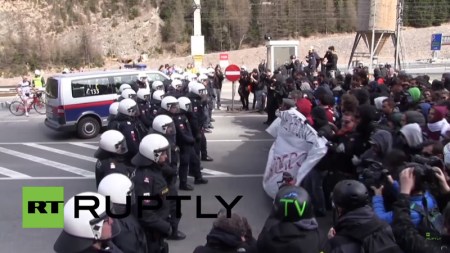
1573Austrian police prepare to hold the line at the Brenner Pass border crossing with Italy, as a crowd tries to break through during a violent protest on April 3, 2016, against Austria’s introduction of border controls to stem the flow of migrants. (Image source: RT video screenshot)

While the bureaucrats of the EU bicker with their member states over those states’ unwillingness to follow EU regulations — evidently not made to cope with a migration crisis of these huge proportions — Turkey’s President, Recep Tayyip Erdogan is threatening to drop his obligations under a recent EU-Turkey migration deal. Those obligations include taking back all new “irregular migrants” crossing from Turkey into Greek islands, as well as taking any necessary measures to prevent the opening of new sea or land routes for migration from Turkey to the EU. “There are precise conditions. If the European Union does not take the necessary steps, then Turkey will not implement the agreement,” Erdogan warned recently in a speech in Ankara.

Erdogan knows that in the current European reality, his words have the effect he intends: When he threatens to flood Europe with migrants unless it does what he wants — in other words, blackmail — EU leaders will do what he says. German Chancellor Angela Merkel, one of the driving forces behind the EU-Turkey deal, also recently bowed to Erdogan’s demands that Germany prosecute the satirist Jan Böhmermann, after he mocked and insulted the Turkish president in a poem. The German criminal code prohibits insults against foreign leaders, but leaves it to the government to decide whether to authorize prosecutors to pursue such cases. Angela Merkel gave her authorization, a decision widely criticized. Her own ministers — Foreign Minister Frank-Walter Steinmeier, and Justice Minister Heiko Maas — said they did not believe that the authorization should have been granted.

Another indication that Erdogan has no reason to fear any misbehavior on the part of the European Union regarding the EU-Turkey deal is that the European Parliament just voted in favor of making Turkish an official European Union language. Ostensibly, the vote came about in order to back an initiative by the president of Cyprus, Nicos Anastasiades, who asked the Dutch EU Presidency to add Turkish to the bloc’s 24 official languages in order to boost attempts to reach a reunification agreement for Cyprus.

In his letter to the EU presidency, Anastasiades noted that Cyprus had already filed a similar request during its EU entry talks in 2002, but, at that time, it “was advised by the [EU] institutions not to insist, taking into account the limited practical purpose of such a development … as well as the considerable cost”. Turkey’s occupation of northern Cyprus, which Turkey invaded in 1974, is one of the issues blocking Turkey’s accession negotiations with the EU.

Making Turkish an official language is seen by Turkey, according to a senior Turkish official, as “a very important, very positive gesture” for the Cyprus peace talks and for EU-Turkish ties more broadly. “If the blockage is lifted because of Cyprus being solved, then we can proceed very quickly,” the Turkish official said.

All of the other official and working languages of the European Union are tied to states which are full members of the EU. Although the vote has to be approved by the European Commission before the decision can come into effect, it speaks volumes about the EU’s deference to Erdogan.

In light of these developments, the granting of visa-free travel to European Union states for 80 million Turks looks as if it is a done deal, despite the 72 conditions, which Turkey, at least on paper, is expected to live up to. These include increasing the use of biometric passports and other technical requirements. So far, Turkey has only met half of these conditions. Perhaps that is why European Commission President Jean-Claude Juncker recently felt the need to mention that, “Turkey must fulfill all remaining conditions so that the Commission can adopt its proposal in the coming months. The criteria will not be watered down.” The question is whether Juncker himself even believes his own words.

With the provisions on visa-free travel for 80 million Turks, the EU may just have gone from the frying pan into the fire. The visa-free admission of Turks into Europe would give Erdogan completely free rein to control the influx of migrants into Europe. Moreover, anyone believing that Erdogan would not take great advantage of this opportunity would have to be dangerously naïve. The European Union may yet conclude that the migrant crisis, in all its enormity, is the far lesser evil.

Violent anti-Semitic Crimes in UK Increase 50%

May 1, 2016

Violent anti-Semitic Crimes in UK Increase 50%, Front Page Magazine, Daniel Greenfield, May 1, 2016

(Please see also, UK: The Left’s Little Antisemitism Problem. — DM)

muslim-antisemitism

But let’s all keep in mind that the real threat is Islamophobia. Noticing Muslim anti-Semitism is a well known form of Islamophobia. Over in the UK, where various members of the Labour Party are debating the Jewish question of ethnic cleansing, hate crimes against Jews have risen sharply.

Anti-Semitic crimes in Britain rose 25.7% in 2015, the Campaign Against Anti-Semitism revealed Saturday night – and a pact between Islamists and the Left is fueling the hate.

2015 remains the worst year on record for anti-Semitism in the UK, CAAS’s National Anti-Semitic Crime Audit reports.

Violent anti-Semitic crime jumped 50.8%, with 16.9% of anti-Semitic crimes being violent in 2014, and 20.3% of anti-Semitic crimes being violent in 2015.

Only 13.6% of all cases are prosecuted, however – with a 7.2% drop in police action against anti-Semitism in 2015.

So the UK goes the way of France. And America slowly goes the way of Europe. I recently visited Los Angeles after an absence of some years and there were guards at every synagogue. In New York, there are police officers at every synagogue. Meanwhile left-wing groups like HIAS and J Street howl for more Muslim migrants without caring about the consequences.

These are the consequences.

Op-Ed: Swedish “neutrality” has brought in the Islamist Trojan Horse

April 28, 2016

Op-Ed: Swedish “neutrality” has brought in the Islamist Trojan Horse, Israel National News, Giulio Meotti, April 28, 2016

When in 1988 the Greens landed at Swedish Parliament for the first time, they were called “the sons of seal”. Since then, their environmentalism has always supported political ideological battles. During the Cold War it was pacifism: “How to talk about ecology without talking about Vietnam?” So they said then. Today it is the turn of migrants and multiculturalism.

Now the Greens, who are part of the ruling coalition in Stockholm, are shaken by the accusation of being infiltrated by Islamic fundamentalists. Last week, the Minister of Housing, Mehmet Kaplan, resigned after the press revealed his ties with the Nationalist Islamists in his country of origin, Turkey (he also compared Israel to the Nazis).

Lars Nicander at the Swedish National Defence College said that “today people close to the Muslim Brotherhood, an Islamist party, have gained a strong position in the Green Party. I see a similarity with the way that Soviet communism was acting during the Cold War, when it tried to infiltrate into various democratic parties”.

Two senior officials of the Greens, Jon Karlfeld and Anders Wallner, stated that “although there are no signs of infiltration, the Green Party will go on and investigate the potential vulnerabilità”.

After Kaplan’s resignation, it was the turn of Yasri Khan, a candidate for a seat in the political leadership of the Greens and a former president of the organization “Muslims for Peace and Justice”, who refused to shake hands with a female journalist, in compliance with the Sharia, Islamic law . The prime minister, Stefan Löfven,, who already has to manage the entry of 250,000 immigrants in a country of 10 million people, had to intervene to condemn intolerance.

According to numerous surveys, 65 percent of Swedes now want the Greens, the most vocal advocates of open borders, to be expelled from the ruling coalition. “In our desire to embrace a pluralistic and multicultural society, we have turned a blind eye on the undemocratic views [they espouse],” said Gulan Avci, a member of the rightist opposition.

Trying to cool tempers, the leader of the Green Party Asa Romson, who is also a deputy prime minister, has made it worse and in a TV interview she described the September 11 attacks as “accidents”. Then founder of the Greens, Per Gahrton, has said that the former minister Kaplan was the victim of a witch-hunt concocted by Israel. Gahrton was the president of the Palestine Solidarity Association for ten years.

But it does not end here. New images have emerged in which Kaplan and other members of the Greens raise their four fingers, the gesture used by the Muslim Brotherhood in Egypt. One of them, the young Greens leader Salahaden Raoof, repeated the gesture during a broadcast on Swedish television. The four fingers raised to the sky is a reference to the Rabaa mosque, in Cairo: Rabaa, which in Arabic means “four.” It is where the largest sit-in in the capital took place, where the Muslim Brotherhood had gathered the day of deposition of Mohammed Morsi.

The gesture is not illegal in Sweden, but many Green members now question if representatives of the Muslim Brotherhood are compatible with the feminist and gay friendly platform of the Swedish Greens.

This “infiltration”, as it has been called, fomented anti-Semitism in Sweden. For the Global Peace Index, Sweden is a world model of equal opportunities. Stockholm excels only in a particular type of hate, the one against Israel. Social democratic, feminist and humanitarian, eurocommissioner 1999-2009, the minister of foreign affairs, Margot Wallström, charged Israel of “extrajudicial executions” in the Third Intifada.

A year ago, Sweden was officially the first EU country to recognize the “State of Palestine”. Meanwhile, anti-Semitism is fomented and flourishing in a large sector of Swedish society:

  •  The Israeli ambassador to Stockholm, Isaac Bachman, has been asked on the radio: “Are the Jews responsible for the growth of anti-Semitism?”
  • Omar Mustafa had to resign from the Social Democrats for having called for “bombarding” Israel.
  • The government has funded with 104,000 € a manual entitled “Colonialism and Apartheid”, which accuses Israel of ethnic cleansing.
  • The Swedish pension fund divested from the Israeli company Elbit.
  • The main Swedish supermarket chain, Coop, has eliminated some Israeli products from the shelves of its six hundred outlets (boycott eventually canceled due to protests).
  • Dagens Nyheter, the most sophisticated Swedish newspaper, published an editorial entitled “It is allowed to hate the Jews” in which the author, the historian of religions Jan Samuelson, explains that Islamic hatred of the Jewish State is justified.
  • The Stockholm National Museum has exhibited a work “of art” with a picture of Hanadi Jaradat, a Palestinian suicide bomber who killed 21 Israelis in a restaurant in Haifa.

During the Cold War, the Soviets took advantage of the famous Swedish “neutralità” with its rejection of the US-USSR conflict, the rapid recognition of Mao’s China, the suspension of relations with America after the bombing of North Vietnam, the nuclear disarmament preached by Swedish PM Olof Palme, the Swedish socialism and “non-alignment”, in short, the Swedish disengagement from the West.

A very ambiguous neutrality is now tinged with green: the color of Islam.