Archive for December 13, 2016

Report: Migrant-Heavy French Suburbs No-Go Zones for Women

December 13, 2016

Report: Migrant-Heavy French Suburbs No-Go Zones for Women, Breitbart, Virginia Hale, December 13, 2016

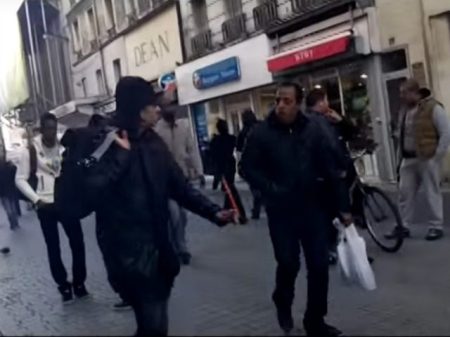
saint-denis-street-640x480YOUTUBE

Women are invisible in public spaces and are unwelcome in cafés and bars in France’s migrant-heavy suburbs, a shocking report broadcast on France 2 last week revealed.

Reporting from Saint-Denis, a commune where 36 per cent of residents were born overseas, journalist Caroline Sinz narrates: “The café terraces and the streets have something in common: women seem to have been erased. In some neighborhoods, men occupy public places and women suffer.”

Footage taken with a hidden camera captured how patrons react when women entered a café in the area. Two activists are shown walking into the venue, on the pretext they’re looking for a friend, but are told “It’s best to wait outside” by a customer, while another tells the women that “in this café, there is no diversity”.

The manager, asked by the activists to imagine he wants to bring a cousin or a female friend to the venue, explains that his cousin would be at home, adding “She does what she wants but she does not come here with me”.

“In the café there is no mixing. We are in Sevran [Saint-Denis], we are not in Paris. In 93 [Saint-Denis] it’s a different mentality — it’s like back home”, he tells the women.

Brigade of Mothers activists, who speak out against Islamic extremism, told Ms Sinz that conservative Muslim men took hold of heavily migrant suburbs in France following urban riots in 2005. Routinely threatened for opposing religious fundamentalism, the women decide to stop the interview when someone stops the car, to watch them.

The France 2 journalist then travels to a neighbourhood in Lyon, where the streets are apparently shown to be occupied almost solely by Muslim men. A young, white woman who works as a childminder says she wouldn’t dream of wearing a skirt or make-up outside in the area, and that she does her best to go unnoticed. Asked why, she tells the programme: “Simply, we are afraid”.

Secretary of State for Digital Affairs and Innovation, Axelle Lemaire, said the newscast shows “intolerable” examples of “discrimination against women”. On Sunday night Labour Minister Eric Woerth said scenes uncovered in the report “plant a dagger in the heart of the Republic”, and urged new Prime Minister Bernard Cazeneuve to take action.

Speaking on the decision to author the report, Ms Sinz said she felt driven “to break the law of silence” surrounding women in public spaces in certain areas of France. The biggest obstacle to creating the piece, she revealed, was finding women who would agree to be filmed voicing their concerns.

The France 2 journalist told franceinfo: “They are afraid, they have already spoken out in many cities, and were insulted and assaulted. So now to avoid threats, and being put under pressure, they censor themselves and keep quiet.”

Iranian Official Reveals ‘Uncovering’ of Major US Cyber-Attack Plot — Failing to Mention Info Obtained From American Docu-Drama

December 13, 2016

Iranian Official Reveals ‘Uncovering’ of Major US Cyber-Attack Plot — Failing to Mention Info Obtained From American Docu-Drama, AlgemeinerRuthie Blum, December 12, 2016

maxresdefault-4-1024x576The slide of a clip in which ‘Zero Days’ is discussed. Photo: YouTube.

As The Algemeiner has reported extensively, Iranian officials have been issuing daily threats against Washington — particularly since last month’s election of Donald Trump to the presidency — about the Islamic Republic’s “fierce” response to any American breaches of the JCPOA, alongside muscle-flexing about the quality and quantity of its long-range missiles. Two weeks ago, the Senate passed a motion to extend the Iran Sanctions Act for an additional 10 years, which spurred the regime in Tehran to warn President Barack Obama not to approve the move.

********************

An Iranian Civil Defense Organization official announced on Monday that the United States is plotting a major cyber-attack on the Islamic Republic that will be more dangerous and wreak far more havoc that the Stuxnet virus, the semi-official state news agency Fars reported.

Addressing a conference in Tehran, Alireza Karimi said, “At present, the US has launched a project named Nitro Zeus with the aim of attacking Iran’s defense and telecommunication infrastructures.”

Karimi failed to mention, however, that he was actually referring to information revealed in “Zero Days,” an Alex Gibney docu-drama that premiered in July at the Berlin International Film festival. The film claimed that Nitro Zeus was developed as a backup plan in the event that Western efforts to curb Iran’s nuclear program by diplomatic means failed.

According to a description of the movie in the Tech Times, the major operation “took on great urgency as the [US] government believed that Israel Prime Minister Benjamin Netanyahu would launch a strike on the nuclear facilities of Iran, a move that would draw in the United States into the hostilities that [would] follow.”

However, the film claims that Nitro Zeus, the code name given to the mass malware operation that cost many millions of dollars, was shelved when the Joint Comprehensive Plan of Action — otherwise known as the nuclear deal — was signed between six world powers and Iran last year in July 2015.

In an extensive piece about the film, Newsweek wrote:

Gibney traces the development of Stuxnet to the last years of George W. Bush’s administration. It was a major operation, participants tell him, involving the CIA, the National Security Agency (NSA) and U.S. Cyber Command. On the Israeli side, it involved the Mossad…and Unit 8200, its military signals intelligence division. Britain’s General Communications Headquarters, its signals intelligence corps, also played a role. After the code for Stuxnet was written, it was tested both in the US and Israel on centrifuges identical to those used by Iranians. When CIA officials showed Bush the shards of a centrifuge that Stuxnet had destroyed, the president gave the OK to use it against Iran. The era of cyberwarfare had officially begun.

The participants who confirmed Stuxnet’s American and Israeli origins did so anonymously and off-camera, for fear of violating strict prohibitions against discussing classified information. That’s why Gibney used an actor…through [whom he] breaks his news in the film. “Stuxnet was just part of a much larger Iranian mission,” the character says… “Nitro Zeus would take out Iran’s strategic communications, air defenses, power grid, civilian communications, transportation and financial system…Nitro Zeus was the plan for a full-scale cyberwar with no attribution.”

Fars reported that Karimi’s remarks about Nitro Zeus came on the heels of a statement by the Civil Defense Organization chief, Brigadier General Mohammad Hassan Mansourian, who boasted his office’s capability to “defuse cyberattacks and cultural invasions.”

As The Algemeiner has reported extensively, Iranian officials have been issuing daily threats against Washington — particularly since last month’s election of Donald Trump to the presidency — about the Islamic Republic’s “fierce” response to any American breaches of the JCPOA, alongside muscle-flexing about the quality and quantity of its long-range missiles. Two weeks ago, the Senate passed a motion to extend the Iran Sanctions Act for an additional 10 years, which spurred the regime in Tehran to warn President Barack Obama not to approve the move.

Sunni Muslims Storm Ahmadi Mosque On Prophet’s Birthday

December 13, 2016

Sunni Muslims Storm Ahmadi Mosque On Prophet’s Birthday, Clarion Project, Elliot Friedland, December 13, 2016

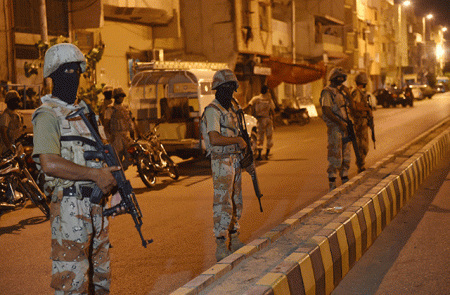
pakistan-rangers-copyright-rizwan-tabassum-afp-gettyimages-594355186-size-640-420Illustrative picture of Pakistani Rangers. (Photo: © Rizwan Tabassum/AFP/Getty Images)

The Ahmadis are regarded as heretical by mainstream strands of Islam, due to their belief that their founder, the 19th century preacher Mirza Ghulam Ahmad, is the second coming of Jesus Christ and a prophet. This is considered by orthodox Muslims as a direct violation of the foundational Islamic belief that Mohammed was the last of the prophets.

***************************

A procession of approximately 2,000 Sunni Muslims descended onto an Ahmadi mosque yesterday in Pakistan, firing weapons at worshippers and hurling bricks, reported Reuters. The attack took place in the Punjab province. The mob was able to wound several people before the police dispersed the crowd, which they had been unable to prevent from reaching and attacking the mosque.

“Police tried its best to stop the attackers but failed because of slim deployment,” Malik Nawaz, the highest ranking police officer in the Choa Saiden Shah area told Reuters. “Later, high officials reached the spot with more troops and chased out the occupants.”

A spokesman for the Ahmadi community, Amer Mahmood, told reporters the mob had been fired up by clerics who said the Ahjmadi community should not be allowed to worship on the prophet’s birthday.

The Ahmadis are regarded as heretical by mainstream strands of Islam, due to their belief that their founder, the 19th century preacher Mirza Ghulam Ahmad, is the second coming of Jesus Christ and a prophet. This is considered by orthodox Muslims as a direct violation of the foundational Islamic belief that Mohammed was the last of the prophets.

In 1974, this foundational belief was codified into Pakistani law and Ahamadis were prohibited from calling themselves Muslims. The Ahmadiyya dispute this and regard themselves as Muslims.

As a result of their beliefs, the Ahmadiyya are routinely persecuted in Pakistan.

Whether or not Ahmadis are authentically Muslim or are a heretical offshoot is completely irrelevant. Persecution and violence against a religious minority is unacceptable. Those who support freedom of religion for Muslims around the world must support the rights of Ahmadis to live in peace without persecution for their beliefs.

LOTAR: How my hometown of Eilat, Israel protects itself…

December 13, 2016

How President Trump Can Make American Intelligence Great Again

December 13, 2016

How President Trump Can Make American Intelligence Great Again, Center for Security Policy, Fred Fleitz, December 12, 2016

(But please see, Abolish the CIA? Perhaps Trump’s CIA will be better than the old CIA.– DM)
ciastuff

Source: National Review

In 2010, when I was on the staff of the House Permanent Select Committee on Intelligence, I attended a committee hearing on the North Korean nuclear program. That hearing epitomized the failure of post-9/11 reforms of U.S. intelligence and showed why the Trump administration must take aggressive steps to streamline American intelligence. Only then can it can return to being the great institution that provides the intelligence support our presidents need to protect our nation against national-security threats facing our nation today.

This process should start by sharply scaling back or eliminating the Office of the Director of National Intelligence (ODNI).

The lead witness at this hearing, seated at the center of a long witness table, was the ODNI North Korea issue manager. Seated next to him on each side were the ODNI issue manager for WMD proliferation and the director of the ODNI National Counterproliferation Center.

Joining them were the National Intelligence Council (NIC) officers for WMD proliferation and East Asia, both part of the ODNI. The CIA sent two witnesses, from its proliferation and North Korea–analysis offices. The Defense Intelligence Agency (DIA), the State Department, and the Department of Energy sent one witness each.

In addition to these 10 witnesses, other senior intelligence officials attended as backbenchers. There also was a gaggle of aides, handlers, and congressional liaison staffers. There were so many that they could not all fit into the hearing room.

The hearing seemed to go on forever, since the lead witness kept inviting all his colleagues to weigh in on every question asked by committee members. Some of the backbenchers spoke too. This became monotonous, since every witness (except for the one from DIA) parroted the same watered-down consensus view. Making this worse, the witnesses’ consensus statements were proven to be completely wrong a few months later.

This mob of intelligence officials spouting the same watered-down pablum exemplified why the reform of U.S. intelligence mandated by the 2004 Intelligence Reform and Terrorism Prevention Act (IRTPA) has been an utter failure. Although IRTPA created the position of the director of national intelligence as a new official to oversee all U.S. intelligence agencies, to ensure that these agencies would cooperate and share information, the Office of the Director of National Intelligence has developed into a huge additional layer of bureaucracy, with far too many officials, that has made American intelligence analysis and collection less efficient and more risk-averse.

This is in part due to blowback from 9/11 and Iraq War intelligence failures, but also is a typical situation for a 70-year-old, multi-billion-dollar bureaucracy that has become complex and complacent. As is true with many established government bureaucracies, political factors and fear of being wrong weigh heavily on the operations of U.S. intelligence agencies. While America still has the world’s best and most capable intelligence service, it has lost the “can-do” intrepid spirit of its predecessor, the heroic World War II-era Office of Strategic Services.

The ODNI has made this problem much worse — not just because it is an additional layer of stifling bureaucracy, but also because it has become a 17th intelligence agency, with its own intelligence analysts, thousands of employees, and a huge — and ever growing — budget.

In 2007, House Intelligence Committee members were so disturbed about the rapid growth of the ODNI bureaucracy that they approved, on a bipartisan basis, an amendment to the 2008 intelligence authorization bill to freeze the ODNI staff to the number working for it as of May 1, 2007. I drafted this amendment, which was co-sponsored by Congressmen Mike Rogers (R., Mich.) and Alcee Hastings (D., Fla.).

Hastings said at the time about this amendment:

We will not give you a blank check with which you could continue to grow a new bureaucracy before we know what you are doing with what you already have. A bigger bureaucracy does not make better intelligence.

Although Hastings was right, the Hastings/Rogers amendment was never implemented, since Congress did not pass an intelligence authorization bill that year. I hate to think how many times the ODNI staff has doubled since the House Intelligence Committee attempted to halt its growth in 2007.

The IRTPA reforms have hurt U.S. intelligence in other ways. The President’s Daily Brief (PDB), which used to be a lean and effective daily intelligence publication for the president produced by the CIA, has become an ODNI publication, weighed down with bureaucracy to make it “fair” so that all 17 intelligence organizations can participate and use it to publish articles justifying their budget requests to Congress.

The ODNI bureaucracy has also burdened intelligence agencies with unnecessary reports, regulations, and foreign travel by ODNI staff.

Aside from being an attempt to improve the sharing of information between intelligence agencies in the aftermath of the 9/11 intelligence failures, the ODNI also was created because some believed it is impossible for the CIA director to both manage the CIA and oversee the rest of the U.S. Intelligence Community.

I have long believed that these reasons are false. The CIA director, as the director of central intelligence (DCI), worked well for decades as the head of all U.S. intelligence agencies. The failure to share intelligence between U.S. intelligence agencies prior to the 9/11 terrorist attacks could have been addressed without creating the DNI position and its huge and plodding bureaucracy. Moreover, intelligence agencies have failed to share crucial information despite the creation of the ODNI.

For example, the Senate Select Committee on Intelligence (SSCI) issued a damning report in 2010 on how U.S. intelligence agencies failed to share information that could have prevented Umar Farouk Abdulmutallab — the 2009 “underwear bomber” — from boarding a plane from Europe that he almost blew up over the city of Detroit. The report found that U.S. intelligence agencies had the information to stop Umar Farouk Abdulmutallab from boarding a plane to the United States but had failed to cooperate with each other and share intelligence. According to the report, “no one agency saw itself as being responsible” for assessing such threats. The report identified 14 specific failures by intelligence agencies which included a bureaucratic process for adding names to terror watch lists that was too complicated and too rigid to address quickly emerging terrorist threats.

Concerning the argument that the CIA director can’t simultaneously manage the CIA and the rest of the intelligence community, if the president can manage the White House and the entire U.S. government, there’s no reason why we can’t have the CIA director in charge of his home agency and overseeing other U.S. intelligence agencies.

Eliminating the ODNI and rolling its duplicative organizations into the CIA would save at least $1 billion and could make U.S. intelligence more efficient and nimble. Such a move should include eliminating the huge number of redundant ODNI managers and officials such as those mentioned above.

More needs to be done to streamline U.S. intelligence and fix problems caused by earlier reforms and reorganizations.

For example, CIA director Brennan carried out a huge and controversial reorganization in 2015 that many critics believe created a confusing and bloated bureaucratic structure that will hurt long-term analysis and create security risks. This reorganization needs to be carefully reviewed by the next CIA director and possibly reversed.

There also are redundant units in multiple intelligence organizations that perform identical missions that should be streamlined. More of these crop up every year.

For example, U.S. intelligence agencies have increased their efforts to counter cyberwarfare over the last few years by creating large, separate organizations to address this issue. These include:

  • The ODNI Cyber Threat Intelligence Integration Center, created in 2015.
  • The U.S. Cyber Command, created in 2009, to defend Department of Defense networks, systems and information, to defend the homeland against cyberattacks, and to provide support to military and contingency operations.
  • The Department of Homeland Security National Cybersecurity and Communications Integration Center, created in 2009, to monitor cyber threats across government agencies and critical infrastructure.
  • The CIA Directorate of Digital Innovation, created in 2015.

There are many other examples of such duplication and redundancy, especially concerning counterterrorism.

To the greatest extent possible, these types of offices should be streamlined into a single inter-agency entity with one agency having the lead.

A reconstituted DCI should also take the lead in doing a better job of encouraging cooperation between intelligence agencies by pressing intelligence officers to take temporary assignments in other agencies. Having worked as an analyst with CIA and DIA, I know their analysis missions are very similar and would greatly benefit from closer collaboration, possibly by creating a joint CIA/DIA intelligence analyst service.

Managers and experts need to be brought in from outside the U.S. intelligence community to challenge the groupthink and analysis-by-committee that has gripped our intelligence agencies in the aftermath of the 9/11 and Iraq WMD intelligence failures. To deal with emerging security threats, we need more out-of-the-box and “competitive” analysis that provides policymakers with alternative assessments of global threats. There also is a great need for better strategic analysis of future threats.

U.S. intelligence agencies also need to improve their efforts to analysze and collect against new technological developments and challenges, including social media, big data, and hostile actors utilizing increasingly powerful encryption.

Outside managers and experts could also help counter the politicization of intelligence by intelligence officers who don’t like President Trump. This was a serious problem for previous Republican presidents. Recent leaks to the press by intelligence officers about Trump’s daily briefings suggest this problem has already resurfaced.

Implementing intelligence reforms to make U.S. intelligence agencies into the innovative and effective institution they once were will take strong leaders in top intelligence positions who will act independently and are not beholden to the intelligence community. These officials must have the full backing of the president.

President-elect Trump, by appointing Mike Pompeo as CIA director, General Mike Flynn as National Security advisor, and KT McFarland as deputy national security advisor, is off to an excellent start to implementing these kinds of intelligence reforms to make American intelligence great again.
The Palestinian Jihads against Israel

December 13, 2016

The Palestinian Jihads against Israel, Gatestone Institute, Khaled Abu Toameh, December 13, 2016

“We will not recognize Israel because it will inevitably go away. And we will not backtrack on the option of armed struggle until the liberation of all Palestine.” — Khalil Al-Haya, Hamas senior official.

The abandonment of Gaza by Israel in 2005 drove the Palestinian vote for Hamas the next year. It also explains why many Palestinians continue to support Hamas — because they still believe that violence is the way to defeat Israel.

Hamas believes that Israel does not have the right to defend itself against rockets and terror attacks. It even considers Israel’s self-defense as an “act of terror.”

In yet another sign that exposes Hamas’s ongoing preparations to attack Israel, the movement last week held a drill with live ammunition in the northern Gaza Strip.

“What has been achieved so far is a small jihad, and the big jihad is still awaiting us.” — Palestinian Authority President Mahmoud Abbas. Abbas is convinced that his “diplomatic jihad” against Israel is no less effective than Hamas’s jihad of terrorism.

Yet even if Abbas manages to achieve reconciliation with Hamas, this move should not be seen as sign of pragmatism on the part of the Islamist movement. Under no circumstances will Hamas relinquish its policy of the destruction of Israel and its replacement with an Islamist state.

From Abbas’s point of view, Hamas’s terrorism will only increase the pressure on Israel to capitulate. Here Abbas has an ally in Hamas: to multiply jihads to force Israel to its knees.

The Palestinian Islamist movement, Hamas, which is currently celebrating the 29th anniversary of its founding, misses no opportunity to broadcast its stated reason for being: to wage jihad (holy war) in order to achieve its goal of destroying Israel. Those who allege that Hamas is moving toward pragmatism and moderation might take note.

Last week, tens of thousands of Palestinians took to the streets of the Gaza Strip to participate in rallies marking the anniversary of the founding of Hamas. As in previous years, the rallies were held under the motto of jihad and “armed resistance” until the liberation of all Palestine, from the Jordan River to the Mediterranean Sea. Another message that emerged loud and clear from the rallies: Hamas will never recognize Israel’s right to exist.

This year’s rallies once again also served as a reminder of the enormous popularity that Hamas continues to enjoy among Palestinians — not only in the Gaza Strip, but also in the West Bank, where supporters of the Islamist movement celebrated the occasion, but on a smaller scale and with a lower profile, out of fear of the Palestinian Authority (PA) and Israeli security forces.

Khalil Al-Haya, a senior Hamas official, outlined in a speech before his supporters in the Gaza Strip his movement’s strategy, namely to pursue the fight until the elimination of Israel. “We will not recognize Israel because it will inevitably go away,” he declared.

“And we will not backtrack on the option of armed struggle until the liberation of all Palestine. Since its establishment, Hamas has been — and will remain — a Palestinian Islamic national and resistance movement whose goal is to liberate Palestine and confront the Israeli project. The liberation of the Gaza Strip is just the first step toward the liberation of Palestine — all Palestine. There is no future for the Israeli entity on our homeland.”

When Hamas leaders talk about the “liberation” of the Gaza Strip, they are referring to the total unilateral Israeli disengagement from that area in 2005. Hamas and many Palestinians have never viewed the full withdrawal from the Gaza Strip as a gesture on the part of Israel. Nor have they ever considered the disengagement as a sign that Israel is no longer interested in controlling the lives of nearly two million Palestinians living in the Gaza Strip.

On the contrary, Hamas and many Palestinians continue to see the Israeli disengagement from the Gaza Strip as a sign of weakness. In fact, this disengagement is why Hamas won the Palestinian parliamentary election in 2006, when it took credit for driving Israel out of the Gaza Strip through suicide bombings and rockets. Back then, this abandonment of land by Israel drove the Palestinian vote for Hamas. It also explains why many Palestinians continue to support Hamas — because they still believe that violence is the way to defeat Israel.

Many Palestinians see Israeli concessions, gestures and unilateral moves as proof of capitulation, rather than positive signs testifying to Israel’s peaceful intentions. These “concessions for peace” by Israel further increases Palestinians’ appetite for launching armed attacks against Israel. Today, many Palestinians are convinced that they can achieve more through stabbings, vehicular rammings and shooting attacks than sitting with Israel at the negotiating table.

The Qatar-based Hamas leader, Khaled Mashaal, seized the anniversary as an opportunity once again to remind everyone of his movement’s real goals. Speaking on the Al-Jazeera TV network, which serves as a platform for the Muslim Brotherhood organization (Hamas is an offshoot of Muslim Brotherhood), Mashaal said:

“We are moving forward with our resistance to achieve our national project… We are looking forward to liberating Palestine and cleansing the Al-Aqsa Mosque and protecting it from division and demolition. We also seek the return of the refugees to their homeland and the liberation of our prisoners from Israeli jails.”

When he talks about “cleansing” Al-Aqsa Mosque, the Hamas leader is referring to Jewish visits to the Temple Mount. Hamas and the Palestinian Authority have been exploiting these visits to incite their people against Israel. They claim that Jewish visitors are “desecrating” the holy site and should not be allowed to set foot there. These words mirror those used by President Mahmoud Abbas, who said that Palestinians will not allow Jews to “defile with their filthy feet” the Al-Aqsa Mosque (although no Jew has entered the mosque itself).

Mashaal, who in the past few years has been living as royalty in Qatar (the country that is the main patron of Muslim Brotherhood), went on to emphasize that Hamas has “not changed its strategy of liberating Palestine.” He also said that, “Military work remains the backbone of liberation.” Hamas, he added, “Continues to believe in the full liberation of Palestine and that jihad and resistance are the only means to expel the occupation and liberate Palestine and the blessed Al-Aqsa Mosque.” According to Mashaal, Hamas continues to look toward Arab and Islamic countries, including Iran, for the military, financial and political support to achieve its goal of destroying Israel.

Hamas’s armed wing, Ezaddin Al-Qassam, boasted on this occasion that 22 of its men have been killed since the beginning of 2016, while preparing for the next war with Israel. Most of the Hamas men were killed when the tunnels in which they were working in collapsed. Hamas continues to build new tunnels and renovate those that were destroyed during the last war with Israel in 2014. Hamas says it wants to use these tunnels in the future to infiltrate Israel and kill or kidnap Israeli civilians or soldiers.

Ironically, while Hamas pursues its round-the-clock efforts to prepare for war against Israel, its leaders do not hesitate to depict themselves as victims, and warn of supposed Israeli plans to launch a “new aggression” against Palestinians. Hamas believes that Israel does not have the right to defend itself against rockets and terror attacks. It even considers Israel’s self-defense as an “act of terror.”

Take, for example, Hamas spokesman Fawzi Barhoum’s recent assessment. Lashing out at U.S. aid to Israel, Barhoum said that the American military and financial aid to Israel constitutes “official support for terrorism.”

This is effectively Hamas’s message to the new U.S. administration: Stop supporting Israel with weapons and money because that hinders our goal of destroying Israel. In yet another sign that exposes Hamas’s ongoing preparations to attack Israel, the movement last week held a drill with live ammunition in the northern Gaza Strip. The drill enacted, among other things, an incursion into a civilian populated area. Hamas said the drill was the fruit of 380 hours of non-stop military training of its “Special Units.”

Hamas’s rhetoric and actions leave no room for doubt as to its intentions. Twenty-nine years after its establishment, a defiant Hamas continues to believe that Israel can, and should, be destroyed. The dream to eliminate Israel remains alive and well among many Palestinians, as evidenced at Hamas rallies by the massive turnouts.

Hamas and the Palestinian Authority, however, are kissing cousins when it comes to Israel. Hamas’s talk of jihad against Israel is right in line with Abbas’s speech before the 7th Congress of Fatah, which convened in Ramallah two weeks ago. “What has been achieved so far is a small jihad, and the big jihad is still awaiting us,” Abbas declared.

According to Abbas’s aides, the PA president was referring to a different type of jihad — one that relates to his ongoing efforts in the international arena to isolate and delegitimize Israel, to force it to make far-reaching concessions to the Palestinians. Abbas’s diplomatic warfare against Israel began several years ago, with the PA’s efforts to join international institutions and seek unilateral recognition in the UN of a Palestinian state. His ultimate goal is to have the international community exert pressure on Israel to withdraw fully to the pre-1967 lines. Abbas wants to establish a Palestinian state with the help of the international community, and not through direct negotiations with Israel. He is convinced that his “diplomatic jihad” against Israel is no less effective than the Hamas jihad of terrorism.

This Abbas talk of “small” and “big” jihad comes at a time when Abbas and Hamas are in courting mode. Some reports have suggested that Abbas recently sent conciliatory messages to Hamas in yet another bid to end the dispute between the two sides. He and Khaled Mashaal have had regular phone contact, with both expressing a desire to end the conflict between them. The reports have even suggested that the two rival parties may be preparing to resume their “reconciliation” talks in Doha under the auspices of Qatar. Last October, Abbas met in Doha with Mashaal and another Hamas leader, Ismail Haniyeh, as part of his rapprochement with the Islamist movement. The meeting was said to be held in a cordial atmosphere, and some Palestinian political analysts point to a warming of relations between the two sides.

677-1Last October, Palestinian Authority President Mahmoud Abbas met in Qatar with Khaled Mashaal and another Hamas leader, Ismail Haniyeh, as part of his rapprochement with the Islamist movement. Pictured above: Abbas (right) meets with Khaled Mashaal in Qatar on July 20, 2014, in a previous reconciliation attempt. (Image source: Handout from the PA President’s Office/Thaer Ghanem)

Yet even if Abbas manages to achieve reconciliation with Hamas, this move should not be seen as a sign of pragmatism on the part of the Islamist movement. Under no circumstances will Hamas relinquish its policy of the destruction of Israel and its replacement with an Islamist state. The movement’s own words on its anniversary provide the best proof of this intention. To their credit, Hamas leaders are nothing if not honest about their commitment to Israel’s destruction. Abbas certainly will not attempt to convince Hamas to abandon this fundamental goal. So, as far as Hamas is concerned, reconciliation means that Abbas will move closer to the Islamist movement and not vice versa.

In fact, Mahmoud Abbas seems to believe that Hamas’s and his jihads complement each other. Thus, Hamas will continue its deadly jihad, while Abbas will pursue his “diplomatic jihad” against Israel. From his point of view, Hamas’s terrorism will only increase the pressure on Israel to capitulate. Here Abbas has an ally in Hamas: to multiply jihads to force Israel to its knees.

Terror Experts ‘Very Concerned’ About Sen. Warren Aide and His Radical Mosque

December 13, 2016

Terror Experts ‘Very Concerned’ About Sen. Warren Aide and His Radical Mosque, Counter JihadPaul Sperry, December 12, 2016

warren-1

Sen. Elizabeth Warren said she made an ill-advised appearance at a Boston mosque linked to several major terrorism cases at the request of an office aide who attends the radical mosque.

The Massachusetts Democrat said she agreed to speak Sunday at the Islamic Society of Boston Cultural Center at the urging of staffer Hamza Abdelgany, who is a member of the mosque, which has graduated no fewer than 13 terrorists and recently was caught on video defending many of the terrorists, even after they were convicted in federal court.

Warren spoke before the congregation for several minutes chiefly to complain about “anti-Muslim hate” allegedly inspired by the election of GOP President-elect Donald Trump.

Charles Jacobs, founder of Boston-based Americans for Peace and Tolerance, told CJ that he is “very concerned” that a member of a mosque that supports and even raises money for the legal defense of known terrorists has such political clout. He said that Warren’s ill-considered visit bestowed undue legitimacy on ISB.

ISB operates two mosques: one in Roxbury, where the so-called “interfaith” event attended by Warren was held, and the other in Cambridge, where several terrorists and terrorist supporters have worshipped, including:

  • Boston Marathon bombers Dzhokhar Tsarnaev and Tamerlan Tsarnaev;
  • Aafia Siddiqui, aka Lady al-Qaida, who raised money for the terror group in area mosques and is serving an 86-year federal sentence for trying to murder a US Army captain in Afghanistan, where she was captured with plans to carry out a chemical attack on New York City;
  • ISB imam Abdullah Faaruuq, who was heard on tape urging Boston Muslims to “pick up the gun and the sword” to defend Siddiqui during her 2010 trial.
  • Tarek Mehanna, who in 2012 got 17 years in federal prison for conspiring to use automatic weapons to murder shoppers in a suburban Boston mall, as well as for conspiring to aid Al Qaeda;
  • Ahmad Abousamra, an indicted terrorist co-conspirator of Mehanna who fled to Syria in 2006 where he resurfaced as a top ISIS propagandist and was added to the FBI’s Most Wanted Terrorists list in 2013, where he remains today.
  • ISB congregant Rezwan Ferdaus, who in 2012 got 17 years in federal prison for plotting to attack the Pentagon and US Capitol with remote-controlled airplane bombs.
  • ISB major donor Oussama Ziade, who was indicted in 2009 for dealing with terrorist funds and is now a fugitive living in Lebanon.
  • ISB co-founder Abduraham Alamoudi, who was sentenced in 2004 to 23 years in prison for plotting terrorism and identified by the US government as a top Muslim Brotherhood figure as well as a key al-Qaida fundraiser in America.
  • ISB founding trustee Yusuf Qaradawi, who was placed on the US terror watchlist after calling for violent jihad against US troops in Iraq and is currently the subject of an Interpol arrest warrant on charges of incitement to murder.
  • Jamal Badawi, another former trustee who in 2007 was named an unindicted co-conspirator in a plan to funnel more than $12 million to Palestinian suicide bombers.

ISB leadership also includes Abdul-Malik Merchant, an associate imam who recently was forced to apologize to the Jewish community for posting anti-Semitic posts on social media.

ISB member Tamerlan Tsarnaev, who was caught on surveillance videotape planting a bomb along the Boston Marathon route, became an angry jihadist after joining the mosque. According to his ex-girlfriend, “One minute he was a normal guy, the next minute he is watching these crazy Muslim videos.”

In 2011, ISB hosted an event in support of no fewer than 22 terrorists who were convicted of providing material support for al-Qaeda, Hamas, Palestinian Jihad and Pakistani terrorist groups — including Siddiqui, Alamoudi and Mehanna. During the event, which was caught on video, relatives of the terrorists bashed the FBI, the Justice Department and the US government; and at least one speaker called for violent jihad against the US.

Still, Warren stood where they stood and bashed the president-elect.

“I am very concerned about how Donald trump is beginning to define his administration with the people he personally is picking to lead this country,” Warren said, while claiming that “since the election attacks on racial and religious groups have skyrocketed.”

“Now is a time when we must be willing to say loud and clear there is no room for bigotry anywhere in the United States of America — none,” she said. “An attack on one of us is an attack on all of us, and we will fight back against discrimination whenever and wherever it occurs.”

Six prominent religious leaders fired off a letter criticizing Warren for agreeing to appear at the mosque, arguing she provided “political cover to one of the most intolerant jihadist mosques in America.”

Warren was invited by ISB member Hamza Abdelgany, a staff assistant working out of Warren’s Quincy, Mass., office. Abdelgany was involved with the Muslim Students Association while attending the University of Massachusetts at Boston. The US government says MSA is a front group for the radical Muslim Brotherhood, which supports violent jihad and conspires to one day bring the US and other Western nations under Islamic rule.

“The Muslim Brotherhood was founded in Egypt … Its ultimate goal is the creation of a global Islamic State governed by Sharia law,” U.S. Attorney James T. Jacks said in a 2008 court filing related to a major terrorism case. “Muslim Brotherhood members first migrated to the United States in the 1960s, where they began their grassroots work on campuses through an organization called the Muslim Students Association.”

ISB is run by the Muslim American Society, a known Muslim Brotherhood front group which also runs the so-called “9/11 mosque” in the Washington area, Dar al-Hijrah Islamic Center.

Ilya Feoktistov, director of research for Americans for Peace and Tolerance, said that by ignoring ISB’s well-documented ties to terrorists, Warren is serving as an “enabler” of jihad.

“Hate Spaces” Film Exposes Campus Intolerance

December 13, 2016

“Hate Spaces” Film Exposes Campus Intolerance, Investigative Project on Terrorism, Noah Beck, December 13, 2016

hatespaces

A new documentary, “Hate Spaces,” exposes the epidemic of campus intolerance favoring Muslims and anti-Israel activists over Jews and Israel supporters when it comes to free speech, academic freedom, and protection from abuse.

The film is being released theatrically by Americans for Peace and Tolerance (APT), a Boston-based non-profit dedicated to raising public awareness about the increasingly hostile campus environment. “Hate Spaces” premiered Nov. 30 in New York, and will be screened at select locations around the country (contact info@peaceandtolerance.org for details). The film will also be available on DVD in early 2017 and eventually on YouTube. Click here to sign up for alerts.

The film’s title refers to the concept of “safe spaces” that has been used to silence unpopular speech on universities around the United States.

Executive Producer Avi Goldwasser, who also wrote and directed “Safe Spaces,” first noticed the extent of the campus problem in 2004, when he produced “Columbia Unbecoming.” That film documented the intimidation by Columbia University professors of Jewish students who supported Israel. “Jewish students were abused by faculty members and the administration ignored it,” Goldwasser told the Investigative Project on Terrorism (IPT). “The abusing professor got tenure.”

Indeed, anti-Israel lies, incitement, and hate speech are often tolerated under the banners of academic freedom and free speech. Last September, for example, the University of California, Berkeley reinstated a student-led course that presented a demonizing, one-sided history of the Palestinian-Israeli conflict after public outcry claimed that free speech and academic freedom were jeopardized by the course’s suspension. In contrast, pro-Israel speech is attacked by Israel critics who demand the right to have “safe spaces” free from “hate speech.”

“Any support of Israel is hate speech!” one protestor in the film proclaims.

Groups such as Students for Justice in Palestine (SJP), the Muslim Student Association (MSA), and American Muslims for Palestine (AMP) leverage their politically favored status to exercise rights and protections that they try to deny their political opponents. At Northeastern University, SJP violated school policies over a two-year period, including “vandalism of university property, disrupting the events of other student organizations, not getting the appropriate permits when required, distributing unauthorized materials inside residence halls and sliding them under the doors of private rooms, not providing a ‘civility statement’ which was required after a previous sanction [and] not meeting with university advisers,” according to Northeastern spokeswoman Renata Nyul.

“We have zero tolerance for anti-Semitism, zero tolerance for racism or any kind of hatred,” Northeastern University President Joseph Aoun said in the film, defending his school’s decision to suspend SJP.

But SJP successfully reframed the school’s response as suppression of free speech and rallied public and media pressure until their suspension was lifted. Thus, in an SJP-dominated campus, speech that violates school policies and harasses Jews and Israel supporters is protected as “free speech” rather than punished as “hate speech.”

By contrast, critics of Islam have been silenced with accusations of “hate speech” and “Islamophobia.” In 2014, Brandeis University canceled a speaking invitation and honorary degree to Ayaan Hirsi Ali, a campaigner for women’s rights and a fierce critic of Islam, after she was branded an “Islamophobe” by the Council on American-Islamic Relations (CAIR). Around the same time, CAIR used similar accusations to stop the screening of a documentary on honor killings.

Meanwhile, Jewish students and organizations are targeted with impunity, as feckless college administrators hesitate to take remedial action (as happened at Connecticut College). One of the reasons for their reluctance, the film suggests, is fear of jeopardizing funding – collectively, over $1 billion over the last six years – from Qatar, Saudi Arabia, and the United Arab Emirates.

Through brazen lies – like claiming that Israel “commits genocide” and “apartheid” – SJP and MSA have created campus environments that are hostile to Jews and pro-Israel students, while suppressing support for Israel as “hate speech.”

“Hate Spaces” was a story that had to be told, Goldwasser said, because “most people do not realize how the hostility is being institutionalized, made fashionable by a combination of forces including radical faculty, radical student organizations, and an enabling university administration. While many anti-Jewish incidents and the BDS (boycott, divestment and sanctions against Israel) campaign are reported by the media, few are willing to connect the dots and report on the underlying ideology and extremist organizations that are inciting the hostility.”

The film shows how such campus hostility can reach as far as student council meetings, events that should be focused on campus affairs and otherwise far-removed from Middle East politics. It features UCLA sophomore Rachel Beyda, who applied for a leadership position on the Undergraduate Students Association Council. She was challenged by an SJP-backed campaign that claimed her Jewish background would make her biased when deciding sensitive campus issues. For about 40 minutes, students questioned whether her Jewish identity would make her a less fair-minded leader, even though three other students deciding her fate had been similarly active in their respective communities (Iranian students’ group, the MSA, and the Sikh students’ group).

The film also highlights the extent of SJP’s infiltration into academia. The organization, which has ties to Muslim-Brotherhood-linked groups, has chapters on more than 600 campuses. “Hate Spaces” underscores how there is “sensitivity training” on many campuses for just about every group (including for bestiality and incest at Yale) but not when it comes to groups relating to Jews or Israel.

The film includes footage of SJP founder Hatem Bazian calling for an intifada in America during a 2004 San Francisco rally. In addition to heading the University of California, Berkeley’s Islamophobia Research and Documentation Project, Bazian is AMP’s founder and national chair. AMP provides funding, printed materials (including “Apartheid walls” for public demonstrations), and staff to SJP chapters.

“Hate Spaces” cites the IPT’s 2015 report about AMP support for Hamas and terrorism against Israel.

It includes footage from an AMP event with several disturbing quotes. “When I look at the people who fight with the Israeli Occupation Forces,” says AMP’s Munjed Ahmad in one example, “I don’t think we understand how many American Jews who were involved in the assault of Gaza the past summer were American…Of those people massacring those 500 children and those civilians, there were American Jews.”

Taher Herzallah asks: “What if as Muslims, we wanted to establish an Islamic State? Is that wrong? What if, as Muslims, we wanted to use violent means to resist occupation? Is that wrong?”

“Hate Spaces” attempts to explain how campuses became so hostile to Israel. By manipulating identity politics, SJP created an anti-Israel alliance of hard-left groups. They exploit the academically trendy concept of “intersectionality” – the idea that all injustices are interconnected – to demonize Israel and make common cause with activists from totally unrelated movements, like the campaign to address police violence.

SJP also attracts well-meaning students concerned about equality and social justice by portraying Palestinians as blameless victims of wholly unjustified Israeli attacks. “What drew me to SJP was my motivation to support equal human rights,” one student says in the film.I joined them because I felt that the Palestinian people were being oppressed.”

Another student explains how “SJP deliberately works with anti-Zionist Jewish organizations because working with those organizations helps to immunize them …against charges of bigotry and anti-Semitism. It gives SJP cover.”

“Hate Spaces” points out that student demographics have also helped SJP, because tens of thousands of students from Muslim countries that are traditionally hostile to Israel have arrived on U.S. college campuses in recent years. As noted by a former-SJP activist interviewed in the documentary, “There’s definitely a lot of ethnic solidarity between Muslims and Palestinians because [a] majority of the Palestinians are Muslims, so it’s almost like a brotherhood.”

Goldwasser describes the intended audience for “Hate Spaces” as “decent Americans, especially, those in leadership positions.” He believes that “once they are educated about this outrage on campus, there is a chance that changes will be made. All we ask is that Jewish students be treated equally, receive the same protection as any other minority on campus.”

The film notes that professors and administrators have only exacerbated the campus movement promoting BDS, through their indifference or open complicity with the movement’s campus leaders and tactics: “Many university officials are uncomfortable dealing with hatred that comes from a non-Western minority, preferring to selectively invoke the concepts of academic freedom and free speech instead of fulfilling their responsibility to Jewish students.”

Trying to overturn a free and fair election

December 13, 2016

Trying to overturn a free and fair election, Washington Times,

vlad

The world has turned itself upside down. Only yesterday the liberals and the left (the “progressives,” as they want to be called) regarded the CIA as the locus of evil, the gang that couldn’t shoot straight, forever poisoning gentle minds with a diet of conspiracy and tall tale.

In those gloomy days of the Cold War, where every day was seasoned with a sharp wind and a cold rain, it was the Democratic intellectuals who were forever chiding the rest of us that the Soviet Union was not so bad, the Russians just wanted to be understood and maybe deserved an occasional cuddle. It was the Republicans and other conservatives who were mindless rubes who imagined there was a mad Russian under everybody’s bed.

Now the CIA, in the liberal/left’s fevered dreams, is the last bulwark of the republic, the last remaining hope to turn the 2016 election result on its head and deprive Donald Trump of the victory he won. The Russians, it now turns out, are just as bad as the conservatives said they were.

President Obama, who mocked Mitt Romney four years ago for suggesting that Russia and Vladimir Putin was America’s No. 1 enemy, now says it was Mr. Romney who was smart and got it right four years ago. The president himself, in his telling, is the man dumber than a cypress stump.

The president, at last awake and paying attention to Russian cyber warfare, wants answers, and by noon on Jan. 20. He can then only dine out on the answers, because he won’t have any more authority to do anything about them than the cat.

Desperation pursues despair, and the Democrats are stumbling from inanity to insanity in search of a way to block Donald Trump’s path to the White House. Hilary Clinton’s remnant of a campaign has endorsed an attempt by a handful of members of the Electoral College — 9 Democrats and a rogue Republican — to get the “intelligence briefing” they think might derail next Monday’s scheduled day for the members of the Electoral College to vote for president, 306 of whom are honor bound to vote for the Donald. That’s 36 votes more than he needs.

“The bipartisan electors’ letter raises very grave issues involving our national security,” John Podesta said Monday. “Electors have a solemn responsibility under the Constitution and we support their efforts to have their questions addressed.

“Each day our campaign decried the interference of Russia in our campaign and its evident goal of hurting our campaign to aid Donald Trump. Despite our protestations this matter did not receive the attention it deserved by the media in our campaign. We now know that the CIA has determined Russia’s interference in our elections was for the purpose of electing Donald Trump. This should distress every American.”

What should distress every American is the way the left, the liberals, the progressives and their handmaidens in the press have discarded reasonable conversation to try out every absurd alarm, one after the other, to see whether one could stick, to undermine and undercut the results of what everyone agrees was a free and fair election on Nov. 8. None has worked. More than a month later, the republic stands.

Hysteria now threatens to become insanity. Rep. Jim Hines of Connecticut, a Democrat, says it came to him in the night, as if Marley’s ghost was rattling his chains at the bedside, “that this man is not only unqualified to be president, he’s a danger to the republic. I do think the Electoral College should choose someone other than Donald Trump to be president. That will lead to a fascinating legal issue, but I would rather have a legal issue, a complicated legal problem, than to find out the White House was now the Kremlin’s chief ally.”

Accusing a president-elect of treason, of plotting with the enemy against his country, and with no evidence at all, is something that even a congressman from Connecticut should understand is beyond the limits of rational and decent political debate. Alas, it’s par for the course on the left this season.

The sudden deep concern by President Obama and the Democrats about Russia and cyber warfare, is a bit rich. The Washington Post, which continues so deep in denial that its side lost the election that it may never find the way to the next stage of grief, hangs its survival on the conclusion of the intelligence agencies — which, to put it charitably, have a dismal record of finding out what’s going on anywhere.

A competent president and a responsible “intelligence community” would have done something about the Russians and their hackers a long time ago. Whining doesn’t work.

Italy: Priest bans Nativity scene for fear of offending Muslims

December 13, 2016

Italy: Priest bans Nativity scene for fear of offending Muslims, Jihad Watch

(The last Obama family “Christmas card” being sent from the White House does not mention Christmas, wishing everyone merely “Happy Holidays.” — DM)

Remember the rule: in Muslim countries, be careful to conform your behavior to Muslim sensibilities. And in non-Muslim countries, be careful to conform your behavior to Muslim sensibilities.

nativity-manger-scene

“Nativity Scene Could Offend Muslims, Priest Says,” by Nick Hallett, Breitbart, December 12, 2016:

A priest in Italy has caused uproar after announcing there would be no Christmas nativity scene at the local cemetery this year because it could offend Muslims and atheists.

Fr Sante Braggiè said there would be no crib in the cemetery in the northern city of Cremona because it may anger people of others faiths or none whose relatives are buried there.

“A small corner of the cemetery is reserved for Muslim graves,” Fr Braggiè said. “A crib positioned within sight of them could be seen as a lack of respect for followers of other faiths, hurt the sensibilities of Muslims, as well as Indians and even atheists.”

He also cited a lack of council workers to set up the crib as another reason for abandoning the tradition.

Corriere della Serra reports that Fr Braggiè’s predecessor as local priest, Fr Oreste Mori, strongly criticised the decision, saying: “Seriously? I can’t believe it!”

“We cannot renounce our culture and traditions,” he said. “That would be an unpardonable weakness.”

“I am, for the time being at least, in Italy, not Saudi Arabia.”…