Archive for December 12, 2016

ISIS seizes big Russian-Syrian T-4 air base

December 12, 2016

ISIS seizes big Russian-Syrian T-4 air base, DEBKAfile, December 12, 2016
cairo_terror480

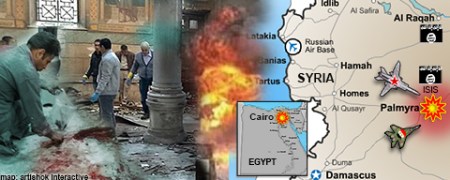
Islamic State forces pushed their assault forward to retake the central Syrian town of Palmyra Monday, Dec. 12. By evening, they had entered the big Russian-Syrian T-4 air base outside the town, carrying off substantial quantities of Russian armaments. Reporting this, DEBKAfile’s military sources add that the booty they snatched included different types of ground-to-ground missiles as well as anti-tank and anti-air rockets.

Russian forces manning the base were hurriedly evacuated from Palmyra and the T-4 base, after the worst defeat Russian armed forces had ever experienced at ISIS hands in Syria. Military circles in Moscow commented grimly that the Russian army had suffered “a major disgrace” in Palmyra.

According to our sources, long convoys of ISIS fighters backed by tanks taken booty from the Syrian army, first forced the Syrian 11th Tank Division to abandon the strategic Jhar Crossroad. After that, the way was clear for the jihadis’ column to reach the T-4 base.

DEBKAfile reported on the ISIS terrorists’ fresh momentum Sunday.

Judging from the rash of reports claiming US-Iraqi military progress in the Mosul offensive against ISIS and the extra American special operations forces personnel posted to Syria for an impending US-Kurdish operation to capture the ISIS Syrian stronghold of Raqqa, the Islamic State ought to be cowering under siege, finally defeated – or at least on the run.

But the facts tell another story. ISIS is on the offensive – so far in the Middle East. Over the weekend, Islamist terrorists accounted for dozens of deaths and injured hundreds more.

Sunday, Dec. 11, at least 25 people worshipping at the Coptic St. Peter’s and St. Paul’s church adjacent to St, Mark’s cathedral in Cairo were killed and scores injured. The Coptic pope often leads the prayers there. DEBKAfile’s counterterrorism sources reveal that the attack was carried out by Islamist terrorists from Raqqa who bided their time until they struck in the Egyptian capital. Saturday, six Egyptian troops were killed by another Islamist bomb near the Giza pyramids.

On the same day, ISIS fighters pushed back into the ancient Syrian town of Palmyra, nine months after their expulsion.

The Raqqa terrorist stronghold is clearly alive and kicking on more than one front. A number of contributing factors enable the Islamic State to unleash a fresh spate of terror.

1. The US-Iraqi-Kurdish drive has stalled without driving ISIS out of Mosul or choking off the terrorist fighters’ freedom to move between Mosul and Raqqa, their Syrian bastion.

US Defense Secretary Ashton Carter, who arrived in Baghdad Sunday, Dec. 11, was assigned by the Obama administration to make a last effort to reactivate the Mosul campaign. His chances of success are slim. The military coalition which launched the campaign two months ago has lost a vital component, the Kurdish Peshmerga, which backed out three weeks ago. The Iraqi military units which captured some of the city’s outskirts stopped short when they reached the strongest defense lines set up by the Islamic State and have been unable to break through, even with US air support.

The pro-Iranian Iraqi Shiite front which undertook to seize Tal Afar in order to sever the ISIS connecting link between Iraq and Syria are parked outside, having been warned by Turkey not to set foot in the town.

Added to these setbacks, the US CENTCOM which is running the aerial war in Iraq is at loggerheads with the Iraqi Air Force command and has practically grounded all Iraqi warplanes.

Even if Carter can wave a magic wand and resolve all these issues, the momentum and high hopes that actuated the Mosul campaign when it started have been lost and can hardly be recovered before Barack Obama leaves the White House.

At least two of the incoming president Donald Trump’s designated security advisers – Defense Secretary Gen, James Mattis and National security Adviser Gen. Michael Flynn – have criticized the operation in is current form.

2. What is happening in Raqqa doesn’t fit the designation of an offensive. At most, small Kurdish and Syrian rebel groups are mounting sporadic raids against ISIS fighters on the town’s outskirts, with the support of the Obama administration. Our military experts say that Raqqa can’t be captured from the Islamist terrorists by conventional means – mainly because it is spread over a large area of mostly empty desert. ISIS has taken advantage of this terrain to distribute knots of defenders across a vast area ranging hundreds of kilometers from northern to eastern Syria up to the winding, heavily overgrown banks of the Euphrates River.

So when Ash Carter announced Saturday that he would be sending another 200 Special Operations Forces into Syria to join the battle for Raqqa, he had no idea that he, the Russians and the Syrians were about to be caught off guard by a fresh ISIS initiative to reoccupy Palmyra, the ancient Syrian two from which they are thrown out in March.

This was a poke in the eye for Russian President Vladimir Putin who proclaimed Palmyra’s capture from ISIS as a signal coup for the Russian army in its war on Islamist terror.

3.  He might well commiserate with Egyptian President Abdel-Fatteh El-Sisi. For two years, the Egyptian armed forces have been fighting an uphill battle to crush the ISIS groups infesting the Sinai Peninsula. The jihadists constantly elude punishment with the help of supportive Bedouin tribes.

Every few months, they pose a real threat to the stability of the El-Sisi regime by striking inside Cairo, the capital, with some terrorist atrocity, for which they are aided by the Muslim Brotherhood underground and Palestinian Hamas extremists in the Gaza Strip.

The bombing of the Coptic church Saturday was unusually the work of jihadists deployed from Raqqa, Syria.  Egypt has reacted by placing extra guards at Christian sites and declaring three days of national morning for the disastrous bombing attack on Egypt’s largest minority.

The new Islamist drive is looking ominously like the onset of the Christmas-New Year holiday terror onslaught the Islamic State has threatened to unleash in the Middle East and beyond. US and European security services have been placed on high alert in the belief that returning jihadis are programmed to strike at home.
Abolish the CIA?

December 12, 2016

Abolish the CIA? Power Line, Steven Hayward, December 12, 2016

In the course of research for my two-volume history of Ronald Reagan I read through a lot of declassified CIA assessments and reports, and was amazed at how consistently bad, and most often wrong, the analysis was. Here’s one example I included in the book:

On October 5, 1973, the CIA’s daily bulletin commented on Egyptian military exercises on the west bank of the Suez canal, just across the canal from the Israeli-occupied Sinai peninsula: “The exercise and alert activities . . . in Egypt may be on a somewhat larger scale and more realistic than previous exercises, but they do not appear to be preparing for a military offensive against Israel.”  The very next day, the CIA’s daily bulletin reiterated its judgment that “For Egypt a military initiative makes little sense at this critical juncture.” Before the ink was dry, 70,000 Egyptian troops and 800 tanks started rolling across pontoon bridges over the Suez.  Syria launched a simultaneous surprise attack in the Golan Heights to Israel’s northeast.  The attack had been carefully planned for months, yet Egypt achieved complete surprise over the CIA.

I could go on with a whole catalogue of CIA assessment blunders, from the Bay of Pigs, repeated wrongheaded conclusions about Vietnam, completely wrongheaded conclusions about the Soviet economy almost to the very end, and underestimating Soviet military expenditures and arms buildups. The CIA concluded after Pope John Paul II was named in 1978 that it “will undoubtedly prove extremely worrisome to Moscow.” For this keen analysis American taxpayers must pay? (And who can forget the CIA concluding about 10 years ago that Iran had given up its drive to develop nuclear weapons. Was anyone fired for that assessment?)

The left loves to remind us of the CIA’s assurances that WMDs in Iraq was a “slam dunk,” but my favorite example of CIA cluelessness was its 1986 assessment that real per capital income in East Germany was higher than real per capita income in West Germany ($10,440 versus $10,220)—a proposition so absurd that you needed to have an Ivy League education to believe it. But that’s just the problem; any taxi driver in West Berlin could have told you this was nonsense, but the CIA didn’t have any taxi drivers on their payroll, preferring sophisticated Ivy League graduates instead. This misprision turned out to be a cause of alarm and dismay in the eastern bloc. East Germany’s chief spymaster Markus Wolf later confessed: “For a time in the late 1970s and 1980s the quality of the American agents was so poor and their work so haphazard that our masters began to ask fearfully whether Washington had stopped taking East Germany seriously.”

Richard Nixon hated the CIA, and they reciprocated that hatred in ways that are still probably not fully known. Reagan’s great CIA director, William Casey, knew the CIA was dysfunctional and mostly went around it in his drive to undermine the Soviet Union. Another excerpt from my second Reagan book:

What Casey found was a stifling bureaucracy; Robert Gates wrote that it had slowly turned into the Department of Agriculture. Casey had been around Washington long enough to know that the CIA bureaucracy would not be susceptible to sweeping reform schemes; he had said as much at his confirmation hearings, telling the Senate Intelligence Committee “This is not the time for another bureaucratic shake-up of the CIA.”  He also had the requisite distrust of the CIA’s inertia.  The Soviet dissident Vladimir Bukovsky recalled visiting Casey with a proposal for nasty deed against the USSR. “It’s just great,” Casey told him, “but let me give you some advice: don’t tell anyone in the CIA about it; they’ll screw it up.” He focused instead on trying to get specific divisions of the CIA to conceive of their mission in radically new ways. Casey and Gates did shake up CIA analysts when they announced that henceforth the accuracy of individual reports would be taken into account when it came time for promotions.

The basic problem of the CIA is that, like any other bureaucracy, it will tend to send up the kind of assessments that it thinks its political masters want. Hence the Vietnam-era findings that were always congenial to LBJ (until they weren’t congenial), etc. The latest CIA assessment that Russia influenced our election may be true, but it is also highly convenient for what the Obama Administration would like to hear just now, no?

So if Trump really wants to “drain the swamp,” maybe he should revive an idea first proposed by Daniel Patrick Moynihan back in the 1990s—abolish the CIA. And Trump can claim it is a bipartisan idea: Moynihan isn’t the only Democrat who has made the suggestion. Bernie Sanders has been for abolishing the CIA. It would be fun to watch liberal critics of the CIA twist themselves into knots if Trump proposed this. Pass the popcorn.

Chaser:

mccartyhjy-on-fake-news


10 Ways the CIA’s ‘Russian Hacking’ Story is Left-Wing ‘Fake News’

December 12, 2016

10 Ways the CIA’s ‘Russian Hacking’ Story is Left-Wing ‘Fake News’, BreitbartJoel B. Pollak, December 12, 2016

podesta-and-putin-640x480

On Monday, Senate Majority Leader Mitch McConnell (R-KY) pledged to support a congressional investigation into whether Russian hacking affected the 2016 election. Republicans have nothing to fear from such an investigation, because they won the election fair and square.

No, Russia is not the friend that President Barack Obama and former Secretary of State Hillary Clinton spent several years pretending it was. But the idea that Russian hackers coronated Trump is only the latest left-wing opiate — after white supremacists and “fake news” — designed to dull the pain of electoral defeat, and postpone the reckoning that must occur if Democrats are to pose a significant threat as an opposition party at any time in the near future.

Here are just ten of the reasons the “Russian hacking” story is a sham — a left-wing twist on the red-baiting McCarthyism of the 1950s.

1. There is actually no new information leading the CIA to its conclusion. The New York Times reports: “The C.I.A.’s conclusion does not appear to be the product of specific new intelligence obtained since the election, several American officials, including some who had read the agency’s briefing, said on Sunday. Rather, it was an analysis of what many believe is overwhelming circumstantial evidence — evidence that others feel does not support firm judgments — that the Russians put a thumb on the scale for Mr. Trump, and got their desired outcome.” In other words, someone only decided after Trump won that it the accusation was worth making.

2. The “evidence” that the CIA has gathered is inconclusive. The FBI also disagrees with some of the CIA’s conclusions about Russia’s motives. “While lawmakers were seemingly united on the need to present a strong bipartisan response, the FBI and CIA gave lawmakers differing accounts on Russia’s motives, according to The Post,” The Hill reported on Sunday.

3. The CIA is not making public claims that Russia hacked the election. Several CIA veterans, in fact, have urged caution about the leaked reports. As Newsweek reports: “‘I am not saying that I don’t think Russia did this,’ Nada Bakos, a top former CIA counterterrorism officer tells Newsweek, in a typical comment. ‘My main concern is that we will rush to judgment. The analysis needs to be cohesive and done the right way.’” Thus far there is not even a clear idea what the CIA’s conclusions are.

4. Despite left-wing “fake news,” there is no evidence Russian hackers actually distorted the voting process. The most that the CIA is alleging is that the Russians may have helped hack of the Democratic National Committee emails, as well as (possibly) the emails of Hillary Clinton campaign chaiman John Podesta. There is zero evidence Russian hackers messed with voting. Ironically, Green Party candidate Jill Stein’s recount has eliminated any doubt about the integrity of the results.

5. The Obama administration has a history of manipulating intelligence for political gain. The most under-reported scandal of Obama’s presidency was the CENTCOM scandal, in which it emerged that “senior U.S. Central Command (CENTCOM) leaders manipulated intelligence assessments in 2014 and 2015 to make it appear that President Barack Obama is winning the war against the Islamic State (ISIS/ISIL).” There is even more reason to doubt the truth of a selective leak about the election.

6. Julian Assange and Wikileaks have vigorously denied that the Russians were involved in Wikileaks’ disclosures. Of the Democratic National Committee emails, Assange said: “That is the circumstantial evidence that some Russian, or someone who wanted to make them look like a Russian, was involved, with these other media organisations. That is not the case for the material that we released.” Assange made similar denials about the Podesta email leaks later in the election.

7. The fact that the Russians might constantly be trying to hack U.S. systems, and might even specifically have targeted the election, does not prove that they succeeded. Nor does it prove that they tipped the election to Trump even if they had some effect. As pollster Frank Luntz tweeted: “Did Russia also hack Hillary’s campaign calendar and delete all her stops in rural Wisconsin, Penn., and Michigan?” Hillary Clinton lost the election for reasons entirely of her own making.

8. Foreign interference in elections is nothing new — and the Obama administration is a prime culprit. In 2015, the Obama administration made a strenuous and not-terribly-well-hidden effort to swing the Israeli elections toward the opposition and away from Prime Minister Benjamin Netanyahu. The State Department gave $300,000 to a “pro-peace” Israeli group, which then paid political activists whose goal was to unseat Netanyahu. In 1984, the late Sen. Ted Kennedy (D-MA) actually asked for Soviet help. Russian efforts to intervene would be bad, but not unique, either for Russia or for the U.S.

9. What would the consequences of allowing undue Russian influence in our elections be, exactly? Would we yield primacy in Eastern Europe to Vladimir Putin? Would we give up our plans for missile defense? Would we make deep unilateral cuts in our nuclear arsenal in exchange for flimsy concessions ? Would we tolerate a Russian land invasion of a friendly, pro-Western country? Would we cede the Middle East to Russian hegemony? Because Hillary Clinton and Obama already did that.

10. Occam’s razor: the simplest explanation for the “Russian hacking” story is that it is “fake news” that suits the left-wing media. It is not unknown for Russia to use false propaganda to affect public opinion in foreign countries. Nor is it unknown for the U.S. media to use bias, “fake news,” and outright lies to shift public opinion in this country. The current focus on Russian “hacking,” based on no new evidence and — again — zero evidence of tampering with the voting process.

Brooklyn: Feds raid businessmen linked to Penn. imam blamed for Turkey coup

December 12, 2016

Brooklyn: Feds raid businessmen linked to Penn. imam blamed for Turkey coup, Creeping Sharia, December 12, 2016

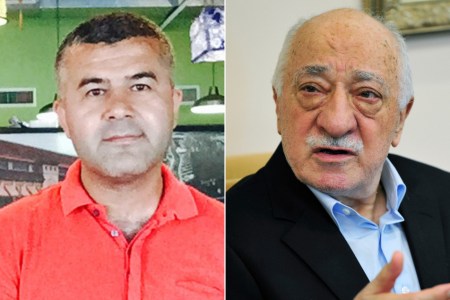
fethullah-gulen-index

Source: Feds raid businessmen linked to imam blamed for Turkey coup | New York Post

Federal authorities raided a Brooklyn cafe linked to the Pennsylvania imam blamed by Turkey for plotting July’s failed coup attempt in that country.

The feds seized computers from Masal Cafe in Sheepshead Bay — which operates in a portion of the old Lundy’s Restaurant — in October, said a source familiar with the Brooklyn Turkish community and accounts in the Turkish press.

Cafe owner Selahattin Karakus told the Daily Sabah, an English-language newspaper in Turkey, that agents were at his Sheepshead Bay home and the cafe.

“They told me not to talk about this with anyone,” he is quoted as saying.

Karakus, 39, is a supporter of Fethullah Gulen, an imam who fled Turkey in 1999 and lives in self-imposed exile in the Poconos. He heads a moderate religious movement that operates schools and cultural centers around the world, including one in Sheepshead Bay.

Turkish President Recep Tayyip Erdogan blamed Gulen for orchestrating the coup attempt and has demanded that the US extradite him to Turkey. The Turkish government considers Gulen’s movement a terrorist organization.

Gulen has denied involvement in the uprising, which killed more than 250 people.

Since the uprising, Erdogan has expanded a crackdown on the Gulenist movement, with more than 30,000 people arrested or detained and media outlets shuttered.

Shortly after the coup attempt, the Obama administration expressed its support for the Turkish democracy and said it would consider any evidence Erdogan presented to extradite Gulen.

Karakus is considered close enough to Gulen that the reclusive cleric is said to have suggested the name for his restaurant, which has become a meeting place for Gulen supporters, according to press reports. The word “masal” in Turkish means a tale or story.

He is among a number of Gulen adherents who have contributed to political campaigns across the country, according to a 2014 BuzzFeed article. Karakus denied at the time there was an orchestrated attempt at political influence.

He has donated $11,300 to congressional campaigns since 2012 including those of Democratic Reps. Hakeem Jeffries and Yvette Clarke in Brooklyn and Rep. Henry Cuellar, a Democrat from Texas. Texas is home to the greatest number of Gulen-backed charter schools.

Karakus has also given $2,500 to Brooklyn Assemblyman Steven Cymbrowitz, a Democrat from Sheepshead Bay. Cymbrowitz’s campaign has spent $130 at the Masal Cafe, records show.

“All I know about a federal raid is what I read in the newspaper. Mr. Karakus has a successful restaurant and is an active member of the Sheepshead Bay merchants’ association,” Cymbrowitz said.

The entity that operates the eatery, Boz Export and Import Inc., filed for bankruptcy protection in September, just days before the FBI raid. The company owes $450,803 in back rent, according to its bankruptcy filing.

Karakus refused to talk to The Post, and his lawyer declined to comment. The FBI would not comment.


Gulen has schools all across the U.S., many of them robbing taxpayers of funds and jobs. Watch: Killing Ed – Charter Schools, Corruption, and the Gülen Movement in America.

As we wrote in this post, Erdogan tells Obama to take care of Pennsylvania-based Islamist Gulen:

Will Obama back Erdogan – who is Islamizing Turkey, or will he back Gulen – who is Islamizing the U.S.?

It looks like Obama will back Gulen after one inning of play…

The Brooklyn raid should confirm that assessment.

Sheepshead Bay is the same Brooklyn neighborhood where Despite 20+ violations, 2 stop orders, Muslims impose mosque on residential Brooklyn neighborhood.

After one year, only half of Syrian adult refugees [in Canada] are working

December 12, 2016

After one year, only half of Syrian adult refugees are working, CIJ News, Ilana Shneider, December 12, 2016

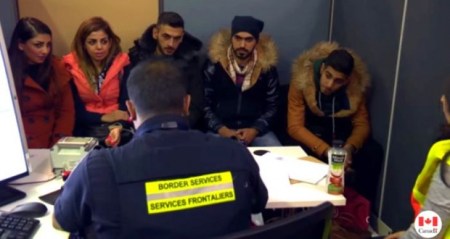
syrian-refugees-arriving-in-toronto-1-photo-screenshot-youtube-citizenship-and-immigration-canada-620x330Syrian refugees arriving in Toronto. Photo: screenshot YouTube Citizenship and Immigration Canada

During a debate on Global News between Parliamentary Secretary to the Minister of Immigration Arif Virani and Conservative immigration critic Michelle Rempel, Virani admitted that only 9,000 people, or about half of the adult Syrian refugees who were resettled in Canada in 2015, entered the Canadian labour force.

The numbers contradict Minister of Immigration, Refugees and Citizenship John McCallum’s assertion that the immigration policy of the federal government which welcomes more refugees “will help diversify the Canadian economy and create sustainable growth.” At a press conference on March 8, 2016, McCallum said: “As we continue to show our global leadership, Canada will reunite families, offer a place of refuge to those fleeing persecution, and support Canada’s long-term economic prosperity”.

Speaking to students at Mohawk College in Hamilton, Ontario on October 21, 2016, Prime Minister Justin Trudeau reaffirmed his commitment to resettle more refugees in Canada because of the social and economic benefits when he said that “Canada and countries around the world need to do more in welcoming people who are fleeing for their the lives, and that’s why I’m so proud of the fact that Canadians stepped up over the past year and welcomed in Syrian refugees to their communities right across the country, because we know that bringing in people and giving them an opportunity to succeed and build a better life for themselves, it’s good for them but it’s also good for the communities…, it’s good for our economy and it’s good for the world.”

During the Global debate, Rempel said that because the Liberal government was so focused on the numbers, they lacked a plan in terms of looking to the future in order to successfully integrate the refugees. She also told the host that witnessed who appeared in front of Standing Committee on Citizenship and Immigration complained about a lack of funding for schools and language training.

A report by the Senate Committee on Human Rights released last week found that many refugees are struggling to meet their basic needs because they are not receiving certain benefits in a timely manner, even though the government allocated $900 million towards resettlement of all newcomers, of which $30 million was allocated specifically to Syrian refugees, and which amount was increased by an additional $18 million last month.

When asked whether Virani expected that one year later only half of the Syrian refugees would be working, he said that the number is consistent with other refugee populations, and that it takes a “number of years for refugees to attain the same economic levels as other Canadians who have been here for multiple generations”.

Rempel said she wants the government to put forward a solid plan that’s transparent to the Canadian taxpayers on the true cost of the refugee resettlement programs. “When the government was running on a promise of 25,000 refugees during the campaign, they said in their ‘fully costed campaign document’ that it was only going to cost $250 million. And we now know that it’s going to be well above that”, Rempel told host Tom Clark.

Virani told Clark that Canadians want to see “more refugees, not less”, which echoed a claim made by Minister of Immigration John McCallum, who last September said “I have been hearing a lot of input, and all the hundreds of people I’ve spoken to across the country, most of them, almost all of them, have advocated [for] more immigrants, whether for demographic reasons or for job-shortage reasons”. However, both Virani and McCallum’s assertions are inconsistent with the findings of a recent Globe and Mail/Nanos survey which revealed that only 16% of Canadians think Canada should accept the same or more immigrants, while 39% think Canada should accept fewer and 37% think Canada should accept the same number of immigrants in 2017.

According to Immigration, Refugees and Citizenship Canada, fewer than 50 percent of all Syrian refugees who were resettled in Canada have completed high school, fewer than 10 percent have a university degree and the vast majority don’t speak either official language. The probability of finding employment without education and language skills is very low, which means those who relied on federal assistance for one year will now become the responsibility of the provinces where they reside.

On October 12, 2016, McCallum told reporters that the federal government had no idea that the Syrian refugees have many children, and this is why the provinces are still facing challenges related to finding proper housing and teachers for language training classes.

A recent study released by HungerCount – the only comprehensive annual national report on hunger and food bank use in Canada – found that almost 13% of all people helped by food banks in 2016 were immigrants and refugees.

In 2015-2016, a report released by the federal government revealed that in 2015-2016, the government spent $384.7 million on the Syrian resettlement initiative.

Obama Admin Staking Iran Deal Legacy on Doomed Bid to Sell Tehran Aircraft

December 12, 2016

Obama Admin Staking Iran Deal Legacy on Doomed Bid to Sell Tehran Aircraft, Washington Free Beacon, , December 12, 2016

kerry-zarifJohn Kerry, Javad Zarif / AP

The Obama administration is locked in a last minute bid to save last year’s nuclear deal with Iran by promoting the delivery of airliners to the Islamic Republic, despite mass opposition in Congress that has moved the administration to engage in a series of public relations maneuvers and backroom deals meant to secure the multi-billion dollar sale, according to multiple sources familiar with the administration’s thinking who spoke to the Washington Free Beacon.

The Obama administration has been scrambling for weeks to provide Iran with assurances the United States will continue to grant Iran vast relief from economic sanctions and help push through deals with Boeing and AirBus, American and French airplane manufacturers, respectively. The effort comes as the nuclear deal hangs in the balance following a flood of Iranian threats and the election of Donald Trump, a vocal opponent of the deal, as well as several new moves by Congress to increase pressure on Tehran’s global terror operations.

Boeing confirmed Monday it sealed a $16 billion deal to sell Iran 80 jetliners, an announcement that sources told the Free Beacon was meant to provide momentum to the nuclear deal and stop Tehran from walking away.

Multiple sources familiar with the situation told the Free Beacon the administration is promoting a false prognosis and that the pact is likely to collapse by next year, when President-elect Trump assumes control of the White House and is partnered with a Congress that is more than willing to put a kibosh on the sale, which lawmakers say will embolden Iran’s terrorist forces.

“The Obama administration oversold the deal to the Iranians by secretly promising to relieve a range of sanctions that Congress was never going to agree to,” said one senior congressional adviser apprised of the White House’s thinking on the matter.

“The administration then did everything it could do unilaterally, including lifting restrictions on military assets and ballistic missile banks, to try to make good on those secret promises,” the source said. “But Congress was never going to allow Iran to steamroll across the Middle East, even if the Obama administration was willing to look the other way, and so the deal was always going to collapse under its own weight.”

The State Department would not provide more details about the deal, including how it is being financed, by press time.

Tehran has a long history of using its national air carrier, Iran Air, to ferry weapons and support to terror groups across the region, including in Lebanon and Syria. Despite these concerns, the Obama administration has fast tracked special licenses permitting Boeing and AirBus to move forward with the sales without violating sanctions barring such agreements.

Experts have repeatedly warned that Iran Air could easily resell these planes to other Iranian airline companies still targeted by sanctions for their illicit activities.

David Pasch, a spokesman for Rep. Peter Roskam (R., Ill.), who has worked to block the plane sales to Iran, told the Free Beacon that Congress will have an easy time killing the deal next year.

“We will aggressively fight this deal next Congress, though we probably won’t even need new legislation to do it,” Pasch said. “The incoming appointees at Treasury and State will no longer report to a White House willing to bend over backwards and ignore national security concerns to keep Iran from walking away from the nuclear deal.”

One senior congressional aide who works on the issue told the Free Beacon that the flurry of recent news stories casting the deal as a lock is part of a public relations campaign by the White House meant to given the appearance the deal is set in stone, despite multiple obstacles standing in the way.

“The administration is creating a facade of false assurances to assuage Iranian concerns about completing these sales,” the source told the Free Beacon. “They want, in essence, to make this a fait accompli. In reality, there are a number of obstacles in the way of completing this deal. For example, the House has already passed legislation to cut off Ex-Im [export-import] financing for aircraft sales to Iran. I think with a Trump administration we can reasonably expect renewed movement in Congress to block these dangerous deals.”

The planes are not set to be delivered to Iran until 2018, meaning that Congress and the next administration have a couple years to disassemble the deal. There also remain questions about how these Western companies will get financing to seal the deal with Iran, which remains a safe haven for terrorist financing.

These obstacles are expected to grow more daunting under a Trump administration, which has discussed increased transparency for companies willing to deal with regimes that sponsor terrorism such as Iran.

Another issue of top concern to opponents of the sale is a carve out guaranteeing Boeing engineers work with Iran to provide spare parts and technical know-how, a move that immunizes Tehran from future sanctions targeting the airline sector.

“The Obama administration created a fantasy world in which it’s safe to sell airplanes to Iran, then pulled Boeing into that fantasy world,” said the congressional adviser quoted above. “But it’s not safe to sell airplanes to Iran, because the Iranians use their airplanes for all sorts of illegal things, including arming Syria’s war machine. That’s why the sale stalled, because no one wanted to touch it. But the administration is desperate to make it look like the sale was moving forward, so that when it collapses they can blame it on Trump.”

Trump Says He’s ‘A Smart Person,’ Doesn’t Need Daily Intelligence Briefings

December 12, 2016

Trump Says He’s ‘A Smart Person,’ Doesn’t Need Daily Intelligence Briefings, PJ MediaWalter Hudson, December 11, 2012

trump-primaries-sized-770x415xt

President-elect Donald Trump continues to defy convention and ruffle institutional feathers. In a wide-ranging interview with Chris Wallace on “Fox News Sunday,” Trump indicated he will delegate daily intelligence briefings to subordinates. From the Daily Mail:

“I get it when I need it,” [Trump] said on Fox News of the top-secret briefings sessions, adding that he’s leaving it up to the briefers to decide when a development represents a “change” big enough to notify him.

“I’m, like, a smart person. I don’t have to be told the same thing in the same words every single day for the next eight years,” Trump said.

Read in excerpt like that, Trump’s remarks may come across as arrogant. He presumes that he will be in office for two terms, touts his own intellect, and downplays the importance of a critical presidential role.

However, when viewed in context [below], Trump’s position proves much less provocative. His “smart person” comment comes off less as a reference to some exclusive ability, and more like the standard capacity most of us have to remember something when first told. He could have just as easily said, “I’m not an idiot. I don’t have to be told the same thing in the same words.”

Trump went on to note that his generals and Vice President-elect Mike Pence will receive routine daily briefings, presumably including the redundancies he seeks to avoid. This is consistent with his articulated tendency to delegate tasks to “the best people.”

Trump also addressed bipartisan concerns regarding Russia’s influence in the election.

“It’s ridiculous,” Trump said of the CIA’s assessment [that that Russia tried to interfere with the presidential election].

[…]

Trump’s incoming chief of staff, Reince Priebus, shrugged off allegations that Russia helped Trump win.

He said: “The Russians didn’t tell Clinton to ignore Wisconsin and Michigan.”

The Democratic candidate was expected to win in these two states but they went to Trump instead.

“She lost the election because her ideas were bad. She didn’t fit the electorate. She ignored states that she shouldn’t have and Donald Trump was the change agent,” Priebus said on ABC’s ‘This Week’.

Priebus may be overstating the case when he says the election results “had nothing to do with the Russians.” But those claiming Russia’s influence was decisive likewise overstate their case.

It remains unclear what actionable conclusions could emerge from investigations into suspected Russian hacking. Indeed, given the likely role Hillary Clinton’s private email server played in any such hacking, Democrats might be wise to let the issue go.

What Is Justice? Ohio State Students Protest Killing of Jihadi

December 12, 2016

What Is Justice? Ohio State Students Protest Killing of Jihadi, Clarion Project, Meira Svirsky, December 12, 2016

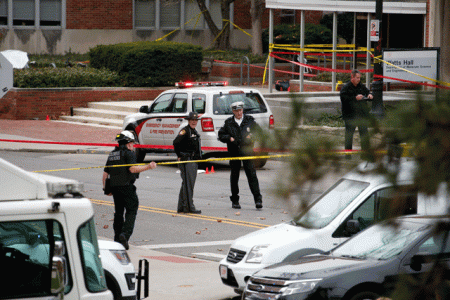
osuattackScene of the Ohio Attack (Photo: © Kirk Irwin/Getty Images)

Protests erupted at Ohio State University over the killing of terrorist Abdul Razak Ali Artan.  Claiming he had reached a “boiling point” after becoming “sick and tired” of the treatment of Muslims, Artan injured 11 students when he drove his car over them and afterwards tried to stab them to death with a butcher knife.

The protests were part of a larger gathering organized by the OSU Coalition for Black Liberation meant to eulogize “people of color” killed by police since October, as reported by the student newspaper, The Lantern.

Artan’s name was added to that list.

As explained by Maryam Abidi, a fourth-year in women’s, gender and sexuality studies, “We broadened the scope of what today was supposed to be, to talk about the aftermath of what happened on the 28th.”

The event commenced with a eulogy for each name on the list, followed by a reading of all of their names, ages and the location of their deaths.

While acknowledging the violent nature of some of their crimes, Abidi still countered, “The protest against police brutality extends to the innocent and the guilty alike, because we know that no matter the crime, justice and due process don’t come from a cop’s bullet.”

This flawed moral argument – as well as the sheer ludicrousness of such a statement – is breathtaking.  First and foremost, a person armed with a lethal weapon (whether it be a car, a knife or even his or her bare hands) engaged in an act meant to kill innocent people has opted out of any system of “due process.”

The definition of justice in the moral realm is not a static reality. Justice in this case was served, namely, the killing of the attacker before he was able to carry out his intentions.

If he had not been stopped by a policeman’s bullet – which, given the circumstances, was most likely the only way he could have been neutralized – where would the justice be for his victims who most certainly would have been dead by that time?

Contrary to Abidi’s concept of justice, moral values are not determined in a vacuum. As much as it would be convenient to deconstruct every moral dilemma into binary parts (in this case, killed by a bullet shot by a policeman or not), that is not how our world is constructed.

Justice takes into consideration more components than simply this one fact seized on by the OSU Coalition for Black Liberation.  In the case of a jihadi terrorist perpetrating an attack on innocent civilians, justice was served when Artan was stopped.

Remember when the Russians Hacked the White House’s Computers?

December 12, 2016

Remember when the Russians Hacked the White House’s Computers? Power Line, John Hinderaker, December 11, 2016

Now, the same news outlets that refused to cover the Russian government’s hacking into White House and State Department computers and email systems try to tell us that an intrusion into Debbie Wasserman Schultz’s and John Podesta’s email accounts by someone–allegedly the same Russian government–is a story of world-historical importance. What a load of bulls–t.

**************************

You probably don’t. We broke the story on Power Line in October 2014, writing about it here, here, here, here, here and here. The White House’s computers were down for weeks because of the intrusion by a “foreign power,” which the administration finally identified as Russia. It wasn’t just the White House, either; it was the entire Executive Office of the President, which comprises a good chunk of the executive branch. Nor was that all: the State Department’s computer system was hacked, too.

While we pounded away at the story, the White House refused to respond to our inquiries. The Washington press corps, which must have known that the White House’s computers were out of action, maintained a discreet silence, declining to write about the Russian hack, even though many D.C. reporters no doubt followed the story on Power Line. Why the coy silence? Because it was October 2014, weeks before the midterm elections, and the story reflected poorly on the Obama administration, which didn’t even discover the intrusion itself. It turned out that American officials were alerted to the Russian hack of the White House and State Department by an unidentified ally (I’m guessing Israel).

Only when the election was safely over did news outlets like CNN report the story (“How the U.S. thinks Russians hacked the White House”). Throughout, the Obama administration minimized the story, claiming that no harm was done and only unclassified material was accessed–an excuse that, as CNN wrote post-election, “belies the seriousness of the intrusion.”

Now, the same news outlets that refused to cover the Russian government’s hacking into White House and State Department computers and email systems try to tell us that an intrusion into Debbie Wasserman Schultz’s and John Podesta’s email accounts by someone–allegedly the same Russian government–is a story of world-historical importance. What a load of bulls–t.

Austrian Press Council: Don’t Report Anything that Could ‘Stir Up Prejudices’

December 12, 2016

Austrian Press Council: Don’t Report Anything that Could ‘Stir Up Prejudices’, Breitbart, Virginia Hale, December 12, 2016

germany-reinstates-border-controls-to-stem-migrant-influx-640x480Sean Gallup/Getty Images

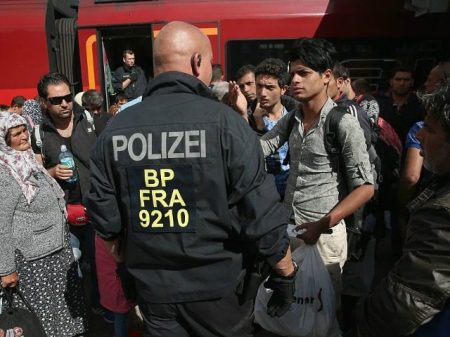
In a checklist on “responsible” reporting on migrants, Austria’s Press Council instructs journalists to omit any information that could “stir up prejudices”.

The checklist by the self-regulatory institution, which enforces a “code of ethics” for the country’s media, the Press Council, also advises journalists to leave out names if they’re foreign sounding and asks them to consider whether stories could be left open for comments “without having to fear the discussion getting out of hand”, before publishing them.

Warning that the topic of “refugees” is discussed “emotionally and controversially” not just among the general public but also by the media in Austria, the Press Council proclaims the list gives reporters a chance of “self-reflection”, and provides them with “practical guidelines”.

The first points in the checklist ask reporters to consider whether they would report the wrongful behaviour if it had not been committed by a migrant, whether the topic has been “adequately researched”, and to reflect on whether they have “presented the facts that are required for a comprehensive and balanced reporting of [their] topic”.

Following on, most of the subsequent Press Council directives appear to make self-censorship of stories so as to avoid causing “prejudice” – the primary focus of “responsible journalism in refugee reporting”.

Journalists are asked to think about “whether [their] reporting, choice of words or selection of photos could strengthen prejudices”, and “whether information that could stir up prejudices could be left out, without changing the meaning and true content of the story, or impairing readers’ understanding of the subject”.

 The list also warns reporters to check whether a piece contains any other information in a piece that might “thwart their intentions” not to inflame prejudice. “E.g. not mentioning a person’s origin, but mentioning a foreign first name”, the Press Council suggests.

It adds: “Note: the mere naming of the origin of a [suspected criminal] foreigner/asylum seeker/migrant is not an ethical infringement according to the current practice of the Press Council senate. However, journalists should weigh up whether it’s required for the reader’s understanding.”

Before publishing a story regarding migrants, the Press Council also asks reporters and people working in the media to consider whether they can “open an internet forum on the topic without having to fear that the discussion gets out of hand”.

Comments under the checklist are largely sceptical of the points, with one reader declaring: “This is a checklist for self-censorship. Do not be surprised if you are less and less believed… “

The Press Council “sees itself as a modern self-regulatory institution in the press sector, which serves editorial quality assurance as well as ensuring freedom of the press”.

In November, a comment piece in the Business Special supplement of NEWS magazine, which argued that Angela Merkel’s decision to open Europe’s borders will have disastrous consequences, fell foul of the council.

According to its ruling, the Press Council’s senate found “particularly problematic” the article’s assertion that Muslim migrants “have not come to integrate”, a statement which they say “fosters prejudices and fears”.

The judgement also condemned as unethical that the piece “attributed very negative attitudes and characteristics” to Muslim migrants, and said the article “gives the reader the impression that these immigrants are backward”.