Archive for December 7, 2016

Trump to nominate EPA critic Pruitt to lead agency

December 7, 2016

Trump to nominate EPA critic Pruitt to lead agency, Fox News, December 7, 2016

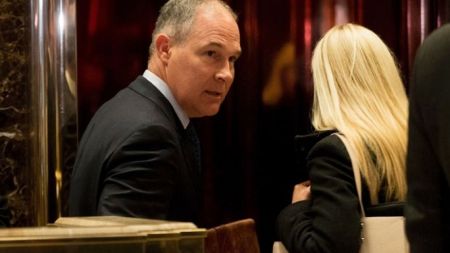
pruitOklahoma Attorney General Scott Pruitt arrives at Trump Tower in New York, Wednesday, Dec. 7, 2016. (AP Photo/Andrew Harnik) (Copyright 2016 The Associated Press. All rights reserved.)

President-elect Donald Trump is planning to nominate Oklahoma Attorney General Scott Pruitt – an outspoken critic of the EPA – to lead the environmental agency, a senior transition source confirmed to Fox News.

Word of Trump’s choice for the Environmental Protection Agency came as the president-elect also named Iowa Gov. Terry Branstad as his pick for ambassador to China and asked retired Gen. John Kelly to lead the Department of Homeland Security.

Pruitt may be the most controversial pick of the three.

Pruitt, 48, has been a reliable booster of the fossil fuel industry and a critic of what he derides as the EPA’s “activist agenda.”

Representing his state as attorney general since 2011, Pruitt has repeatedly sued the EPA to roll back environmental regulations and other health protections. He joined with other Republican attorneys general in opposing the Clean Power Plan, which seeks to limit planet-warming carbon emissions from coal-fired power plants. Pruitt has argued that curbing carbon emissions would trample the sovereignty of state governments, drive up electricity rates, threaten the reliability of the nation’s power grid and “create economic havoc.”

His installment, if confirmed, would mark a significant break with the current EPA approach toward global warming.

In an opinion article published earlier this year by National Review, Pruitt suggested the debate over global warming “is far from settled” and claimed “scientists continue to disagree about the degree and extent of global warming and its connection to the actions of mankind.”

He also filed court briefs in support of the Keystone XL Pipeline project blocked by the Obama administration, which would have run through his state. And Pruitt sued the EPA over the agency’s recently expansion of water bodies regulated under the federal Clean Water Act, which has been opposed by industries that would be forced to clean up contaminated wastewater.

“Respect for private property rights have allowed our nation to thrive, but with the recently finalized rule, farmers, ranchers, developers, industry and individual property owners will now be subject to the unpredictable, unsound and often byzantine regulatory regime of the EPA,” Pruitt said last year.

As word of Pruitt’s nomination spread Wednesday, environmental and liberal groups quickly responded with condemnation.

Public Citizen called him a “terrible choice,” saying in a statement: “Pruitt is cozy with the oil and gas industry and treats the EPA like an enemy.”

Business leaders in his home state, however, lauded Pruitt’s selection, especially those in the oil and gas industry.

“Scott Pruitt is a businessman and public servant and understands the impact regulation and legislation have in the business world,” said Jeffrey McDougall, chairman of the Oklahoma Independent Petroleum Association. “His appointment will put rational and reasonable regulation at the forefront.”

White House “Champion” Blasts Muslims Who Talk to Any Pro-Israel Jews

December 7, 2016

White House “Champion” Blasts Muslims Who Talk to Any Pro-Israel Jews, Investigative Project on Terrorism, December 7, 2016

1900

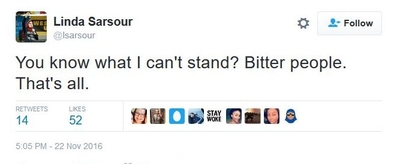
Palestinian activist Linda Sarsour took to Twitter Nov. 22 with a quick, venting post: “You know what I can’t stand? Bitter people. That’s all.”

Sarsour spoke at the annual American Muslims for Palestine (AMP) conference three days later. Evidently, she can’t stand herself.

Sarsour, who describes herself as a “racial justice and civil rights activist,” lashed out at Jews who extended a hand of friendship and solidarity over concerns that increasing hostility toward Muslims in America might lead to draconian government action. And she lashed out at fellow Muslims who accepted the gesture and joined in a new inter-faith dialogue.

Why the bitterness?

The Jews at issue support the state of Israel, support its existence and its vitality. Sarsour wants none of that.

“We have limits to the type of friendships that we’re looking for right now,” Sarsour told the AMP conference, “and I want to be friends with those whom I know have been steadfast, courageous, have been standing up and protecting their own communities, those who have taken the risk to stand up and say – we are with the Palestinian people, we unequivocally support BDS [boycott, divestment and sanctioning Israel] when it comes to Palestinian human rights and have been attacked viciously by the very people who are telling you that they’re about to stand on the front line of the Muslim registry program. No thank you, sisters and brothers.”

It’s a message that fit right in at the AMP conference. AMP claims its “sole purpose is to educate the American public and media about issues related to Palestine and its rich cultural and historical heritage.” But in practice, the group has defended Hamas and its leaders admit they seek “to challenge the legitimacy of the State of Israel.”

1901

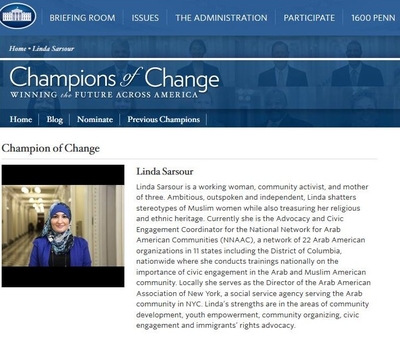
Sarsour, a media darling honored by the Obama White House as a “Champion of Change” and a high-profile surrogate for Bernie Sanders‘ failed Democratic presidential nomination campaign, seems to strike a different tone in public appearances. Her biography says she is “most known for her intersectional coalition work and building bridges across issues, racial, ethnic and faith communities.” That clearly wasn’t her intent at the AMP conference.

She acknowledges there’s a rift among Islamists about how hard a line to draw in the Israeli-Palestinian conflict, yet she was intent on pouring gasoline on the fire.

The “cracks in our community” are so wide, she said, they’re visible to “right-wing Zionists, Islamophobes, white supremacists.”

“They know where we’re divided. They know that we’re segregated,” she said. “So they, we could easily be targeted when we’re a fragmented community. But if we were a strong, united, steadfast community that stood up for each other first and foremost, you’d better believe that no opposition would ever be trying to take us down, because we’d be too big, too strong and too united.”

Some of her comments likely were directed at Anti-Defamation League chief Jonathan Greenblatt. Should a Trump administration create a registry for Muslims, an idea that does not seem to be on the table, Greenblatt recently pledged that “this proud Jew will register as Muslim.”

Sarsour not only rebuked the gesture, she cast Muslims who might respond more positively as sellouts of the Palestinian cause. Cooperation and solidarity gestures should only be reserved for those who share the depth of her hatred toward Israel, she said.

“I am tired of Muslims working towards acceptance and not respect of our communities. And I’m also tired of the Muslims willing to sell Palestine just for a little acceptance and nod from the white man and white power in these United States of America,” Sarsour said.

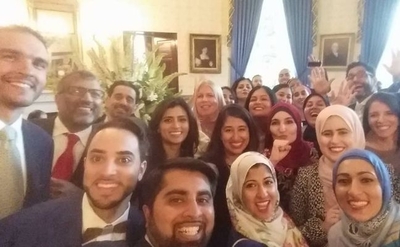
1902Sarsour, in the red hijab, poses with others at the White House Eid celebration.

Despite this extreme stance, Sarsour is a rising star among American Islamist activists. She has been welcomed to the White House at least 10 times during President Obama’s tenure, most recently in July for a celebration of the Muslim Eid holiday. Last year, a glowing New York Times profile described her as “a Brooklyn Homegirl in a Hijab.”

“But the most apparent thing about her voice is that it is exceedingly Brooklyn,” the story said. “She says ‘swag’ instead of ‘charisma.’ (‘Mr. B. has swag …) She calls her father, a Palestinian immigrant in his 60s, ‘Pops.’ Like the actress Rosie Perez in a hijab, Ms. Sarsour has perfected her delivery of the head-swaying ‘Oh no you dih-int’ and pronounces the word ‘Latino’ like, well, a Latino.”

Sarsour also says “nothing is creepier than Zionism,” and all-but accused the CIA of faking an attempted terrorist attack.

Those statements didn’t make the Times profile. And they didn’t prompt the Obama administration to reconsider the wisdom of elevating Sarsour’s clout with repeated White House access.

In February, just over a year after terrorists massacred the staff at the French magazine Charlie Hebdo, saying they “avenged the Prophet,” Sarsour told a Council on American-Islamic Affairs (CAIR) banquet in Chicago that she would not stand with the victims. The magazine was “a bigot and a racist” for publishing caricatures of Islam’s prophet Muhammad, she said. The images served to “vilify my faith, dehumanize my community [and] demoralize my prophet.”

Building off Sarsour’s rejection of anyone who breaks bread with Zionists, former AMP New York President Raja Abdulhaq defined the BDS movement – not as a tool to lead to peaceful negotiations – but as way to break Israel into total surrender.

“The rights are non-negotiable. And that’s the whole point of BDS, is that we demand, we want to apply pressure,” Abdulhaq said, “not sit down in a negotiated setting and figure out what you can give up so that I can give up something in return, because what you’re essentially doing is you’re asking the other side – give up your illegality, stop your illegality and I will give up my rights. What kind of negotiation is that? No, I demand my rights, and you stop your illegality. And that’s the whole basis of BDS.”

Among the non-negotiable “rights” Abdulhaq says AMP and the BDS movement insist upon is the so-called “right of return” for Palestinians. That would lead to a huge influx of Palestinians into Israel, swamping the country demographically and ending its existence as a Jewish homeland.

That’s just fine with conference speaker Lamis Deek, an attorney and board memberfor CAIR’s New York chapter. She repeatedly described Israelis as “serial killers” intent on ethnic cleansing.

“There is a serial killer in our home,” Deek said. “And what do you do when you are confronted with a serial killer, right? You protect yourself. You protect your family. You scream for help. And you expect that when you scream for help from a serial killer everybody is gonna come to your aid, they’re gonna come protect and defend you. Right? You don’t expect somebody to intervene on behalf of the serial killer … and say ‘the serial killer has some rights, let us tell you about the rights the serial killer has’ as he begins to kill you. Right?”

Like Sarsour, Deek expressed frustration at Muslims who accept other viewpoints.

“Nothing has set back the Palestinian movement in the U.S. more than demands by people who want to work and focus their efforts on [Washington] D.C., by their demands that we tame our demands for Palestine,” she said.

Dawud Walid, CAIR’s Michigan director, echoed the message about Muslim groups who appear too accommodating. “If these organizations claim to represent the Muslim community,” he said, “then when we see them doing things that go outside of the mainstream of the (UI word) of our community, we need to hold them accountable, and if they continue to step outside of the boundaries, then we should withdraw our support and make that very public.”

Walid has acknowledged that his employer, which works hard to project an image as a civil rights organization, really sees itself as “defenders of the Palestinian struggle.”

Deek, meanwhile, spoke of the harm done to the Palestinian cause by the U.S.-brokered Oslo Accords. While that initiative may have given Palestinians autonomy, it came at the cost of unity, she said.

It’s not clear what she means. But, since 2006, the Fatah-led Palestinian Authority has governed the West Bank while Hamas controls Gaza.

Oslo also made it more difficult to engage in terrorism – what Deek calls “armed resistance.”

“Now armed resistance, self-defense, has been the only direct challenge to Zionist colonial expansion. Nothing else is a direct challenge,” she told the AMP conference. “Everything else is an indirect challenge, right? Pressure – economic pressure, diplomatic pressure. So this national united Palestinian body was able – by supporting the resistance – was able to be part of directly impacting and influencing Zionist policy.”

Advocating more Palestinian violence is consistent for an AMP gathering. The organization’s message never mentions peaceful co-existence. An Investigative Project on Terrorism investigation found connections between at least five AMP officials and speakers and the defunct Hamas support network called the “Palestine Committee.”

During the 2014 war between Israel and Hamas, AMP’s then-National Campus Coordinator Taher Herzallah posted images of wounded Israelis, calling them “The most beautiful site (sic) in my eyes.” He defended indiscriminate Hamas rocket fire at Israeli civilian communities as “an audible cry for help” and “an act of resistance.”

Two clear messages emerged from the AMP conference. “Resistance” is better than renouncing violence and seeking peace. All Muslims who might disagree, even if they see eye-to-eye on other issues, are no longer welcome.

These extreme stands came from speakers who enjoy prominent political profiles and high-level contacts.

Sarsour is right about one thing. There is a rift in her community. She and her AMP panelists are the ones widening it.

Trump’s Pick for DHS Secretary Warned About Iranian Infiltration of South America

December 7, 2016

Trump’s Pick for DHS Secretary Warned About Iranian Infiltration of South America, Washington Free Beacon, December 7, 2016

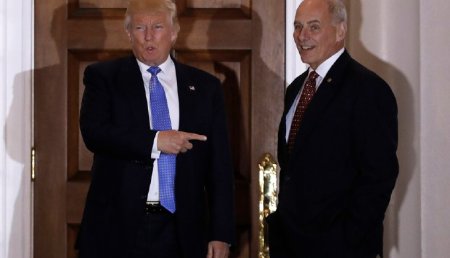
gestures with retired US Marine Corp General John Kelly Donald Trump prospective cabinet members at Trump International Golf Club, New Jersey, USA - 20 Nov 2016 (Rex Features via AP Images)

Trump gestures with retired US Marine Corp General John Kelly Donald Trump prospective cabinet members at Trump International Golf Club, New Jersey, USA – 20 Nov 2016 (Rex Features via AP Images)

President-elect Donald Trump’s pick to head the Department of Homeland Security has been warning for some time about Iranian influence along America’s southern border and in South America in another sign that the incoming administration is seeking to tackle the Islamic Republic’s terrorist footprint from its first days in office.

Retired Gen. John Kelly, a former commander of U.S. Southern Command, has been sounding the alarm about Iran’s efforts to counter U.S. influence in Central and South America, according to past testimony.

Kelly is expected to focus on this issue when he takes over DHS, which has been plagued by criticism about its failed attempts to seal the southern border under the Obama administration.

The selection follows a line of high-profile picks by Trump who are known for their outspoken criticism of Iran and the Obama administration’s diplomacy with the Islamic Republic.

Kelly, during his time as Southcom’s commander, informed Congress last year that Iran is bolstering its ties with Latin American countries in order to use the region as a base for operations.

“Over the last 15 years Iran has periodically sought closer ties with regional governments, albeit with mixed results,” Kelly said in testimony to Congress in March 2015. “Iranian legislators visited Cuba, Ecuador, and Nicaragua to advocate for increased economic and diplomatic cooperation. Iran’s outreach is predicated on circumventing sanctions and countering U.S. influence.”

Iran is building “cultural centers” in these countries to build support for its radical ideology among local Muslim populations, according to Kelly.

“Iran has established more than 80 ‘cultural centers’ in a region with an extremely small Muslim population,” he said. “The purported purpose of these centers is to improve Iran’s image, promote Shi’a Islam, and increase Iran’s political influence in the region. As the foremost state sponsor of terrorism, Iran’s involvement in the region and these cultural centers is a matter for concern, and its diplomatic, economic, and political engagement is closely monitored.”

Kelly has also warned that Hezbollah, a terror organization primarily funded by Iran, has been building support in Latin America. Kelly said terrorist organizations could exploit the porous southern border to infiltrate the United States.

“Members, supporters, and adherents of Islamic extremist groups are present in Latin America,” including Hezbollah, Kelly said in 2014.

Kelly described Iran’s presence in the region as “a matter for concern.”

Trump’s selection of Kelly is winning early support from congressional Republicans who have worked with the former commander.

“In my capacity as chairman of the House Subcommittee on the Western Hemisphere, I have worked firsthand with Gen. Kelly on numerous Western Hemisphere security issues during his tenure as the head of the Southern Command,” Rep. Jeff Duncan (R., S.C.), said in a statement. “He fully understands the threats from ISIS, Iran’s activities in South and Central America, as well as the risks America faces due to our porous southern border.”

“General Kelly has a wealth of experience and knowledge of the threats facing our country in the 21st Century, and I am confident he will help the president-elect form a robust strategy to protect America from radical Islamic extremism here at home, protecting American sovereignty and dealing with the numerous security issues here in the homeland,” Duncan said.

One source in direct contact with the Trump transition team told the Washington Free Beacon that Kelly brings direct experience with Iran’s infiltration of South America.

“General Kelly is an outstanding national security pick. It’s another sign the Trump administration knows exactly how Iran has been destabilizing countries and sowing terror across the globe,” the source said. “The Obama administration too often turned a blind eye to Iranian activities on U.S. soil, and even downplayed an Iranian terror plot to launch an attack in Washington, D.C. Clearly the Trump administration is signaling that it will do exactly the opposite, and will target Iranian aggression across all areas of national security.”

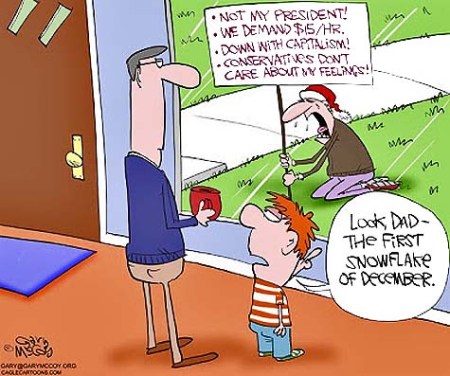
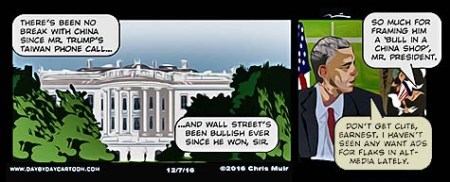
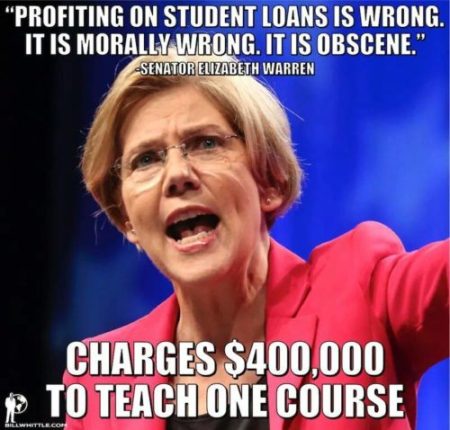
Cartoons of the Day

December 7, 2016

H/t Vermont Loon Watch

homeschool


snowflake


H/t Vermont Loon Watch

chinashop


H/t Freedom is Just Another Word

obscene


Dr. Jasser discusses Chancellor Merkel’s nationwide ban on Burqas on After the Bell

December 7, 2016

Dr. Jasser discusses Chancellor Merkel’s nationwide ban on Burqas on After the Bell , American Islam Forum for Democracy, Dr. Zuhdi Jasser, December 6, 2016

Trump chooses Kelly to lead homeland security

December 7, 2016

Trump chooses Kelly to lead homeland security, Washington ExaminerKeith Koffler, December 7, 2016

trumpkellyPresident-elect Donald Trump talks to media as he stands with retired Marine Gen. John Kelly, right, at the Trump National Golf Club Bedminster clubhouse Sunday, Nov. 20, 2016, in Bedminster, N.J.. (AP Photo/Carolyn Kaster)

President-elect Donald Trump has tapped retired Marine Gen. John Kelly to be secretary of homeland security, putting yet another general into a key national security post, according to reports.

Trump has already made Marine Gen. James Mattis his defense secretary and retired Lt. Gen. Michael Flynn his national security adviser, and he is considering retired Army Gen. David Petraeus for secretary of state.

Kelly, 66, is not expected to face difficulty being confirmed, according to the Post. He is viewed as a border security hawk who will please Trump backers looking for the president-elect to follow through on vows to limit immigration.

Mainstream Media Still Omits Uncomfortable Truth About Muslim ‘Grievances’

December 7, 2016

Mainstream Media Still Omits Uncomfortable Truth About Muslim ‘Grievances’, PJ Media, Raymond Ibrahim, December 7, 2016

ht-ohio-attack-suspect-lantern-jc-161128_12x5_1600-sized-770x415xt

Do you know the difference between a supremacist grievance and an egalitarian grievance? This is the key to understanding the widely held claim that Muslim grievances are the source of Muslim violence.

Take the latest Muslim attack on U.S. soil. Last week, Abdul Razak Ali Artan — an 18-year-old Muslim refugee from Somalia, who was receiving aid from Catholic charities — rammed his car into a building at The Ohio State University. He then got out and stabbed people with a butcher knife. He was eventually shot and killed by a guard; 13 people were hospitalized.

Why did he do it?

According to the “experts,” Artan — like so many other violent Muslim refugees before him — had grievances. CNN, NBC, the Washington Post, and many others cited a Facebook post by Artan:

I am sick and tired of seeing my fellow Muslim Brothers and Sisters being killed and tortured EVERYWHERE.

Yet despite this claim of ubiquity, he only cited one nation:

Seeing my fellow Muslims being tortured, raped and killed in Burma led to a boiling point. I can’t take it anymore.

The question before us is simple: Was Artan provoked to go on a murderous rampage in America because of grievances concerning the treatment of Muslims in Burma?

For about a decade now, I’ve argued that the “Muslim grievance” narrative is a myth meant to shield Islamic teachings from scrutiny. The “Muslim grievance” narrative goes like this: if Islam is a religion of peace yet Muslims everywhere are behaving violently, then the explanation we must all cling to is that they are really, really pissed off about something being done to them.

Most recently, the Islamic State, instead of disseminating and taking advantage of the “grievance” claim, could not have been clearer as they told the West the truth: no matter what the West does, the true reason ISIS hates and terrorizes us is because we are infidels.

Millions of Muslims — including Artan — do harbor strong grievances against the West and others. The problem is that they define “grievance” in a manner incompatible with liberty.

When most Westerners think of the word “grievance,” they think in egalitarian terms: X has a grievance against Y because Y doesn’t treat X with equality. For example, your boss or your teacher treats you worse — without equality — than other employees or other students. You then have a grievance which most in the West would say is legitimate: because the people of the West were raised on the unique idea of treating others as they would be treated.

This is not the sort of grievance that animates many Muslims – and certainly not those who resort to terrorism.

Rather, they are animated by a supremacist-based grievance: they get angry seeing infidels on an equal footing with Muslims. And they get murderous seeing infidels actually lording over Muslims.

Islamic doctrine, which persuades Muslims into believing they are superior to non-Muslims — to the degree that they are dogs and cattle — imbues Muslims with this sense of entitlement.

For example, in Pakistan, as Christian children were singing carols inside a church, Muslim men from a nearby mosque barged into the church with an axe, destroyed the furniture and altar, and beat the children. “You are disturbing our prayers. … How dare you use the mike and speakers?” explained the enraged Muslims. When a Muslim slapped a Christian and the latter reciprocated, the Muslim exclaimed: “How dare a Christian slap me!” Anti-Christian violence immediately ensued.

Islamic grievances are based on what I call Islam’s “How Dare You?” phenomenon. Remember it the next time media, politicians, and other talking heads tell you that Muslim mayhem and outbursts of violence are products of grievances. Missing from their rationale is the supremacist basis of these grievances.

Consider the Conditions of Omar, a foundational medieval Muslim text dealing with how “infidels” living under Muslim authority must behave, attributed to the second caliph and close friend of Muhammad, Omar.

Among other stipulations, it commands conquered Christians not to raise their “voices during prayer or readings in churches anywhere near Muslims” (hence the axe attack in Pakistan). It also commands them not to display any signs of Christianity — specifically listing Bibles and crosses — and not to build churches.

(See Crucified AgainExposing Islam’s New War on Christians, for my translation of “The Conditions of Omar.”)

If the supremacist nature of Islamic law is still not clear enough, the Conditions literally commands Christians to give up their seats to Muslims as a show of respect. By way of analogy, consider when Rosa Parks, a black woman, refused to give up her bus seat to white passengers. Any white supremacist at the time had sincere grievances: how dare she think herself equal?

But were such grievances legitimate? Should they have been accommodated? Similarly, are the endless supremacist-based “grievances” of Muslims legitimate and should they be accommodated?

These are the questions missing from the debate about easily bruised Muslim sensitivities.

One can go on and on with examples from all around the Islamic world:

— In Turkey, a Bible publishing house was stormed and three of its Christian employees tortured, disemboweled, and finally murdered. One suspect later said: “We didn’t do this for ourselves, but for our religion [Islam] … Our religion is being destroyed.”

— In Egypt, after a 17-year-old Christian student refused to obey his Muslim teacher’s orders to cover up his cross, the teacher and some Muslim students attacked, beat, and ultimately murdered the youth.

— These Turkish and Egyptian Muslims were truly aggrieved: As seen, Islam’s Conditions makes clear that Christians must not “produce a cross or Bible” around Muslims. How dare the Egyptian student and Turkish Bible publishers refuse to comply — thus grieving Muslims into murdering them?

— In parts of Indonesia, because it is becoming next to impossible for Christians to build churches, they often congregate outside to celebrate Christmas — only to be attacked by Muslims hurling cow dung and bags of urine at the Christians as they pray.

— In Egypt, the mere rumor that Christians are trying to build, or even renovate, an existing church sets off mass riots and attacks on Christians. The Muslims of Indonesia and Egypt are also sincerely aggrieved: how dare these Christians think they can build or renovate a church when the Conditions forbid it?

In short, anytime non-Muslims dare to overstep their Sharia-designated “inferior” status, supremacist Muslims become violently aggrieved.

From here, one can begin to understand the ultimate Muslim grievance: Israel.

For if “infidel” Christian minorities are deemed inferior and attacked by aggrieved Muslims for exercising their basic human rights, like freedom of worship, how must Muslims feel about Jews — the descendants of pigs and apes, according to the Koran — exercising power and authority over fellow Muslims in what is perceived to be Muslim land?

How dare they?!

Of course, if grievances against Israel were really about universal justice and displaced Palestinians, Muslims would be aggrieved at the fact that millions of Christians are currently being displaced in the name of jihad.

Needless to say, they are not.

Which brings us back to Artan’s “grievances.” Recall his Facebook lament:

I am sick and tired of seeing my fellow Muslim Brothers and Sisters being killed and tortured EVERYWHERE. Seeing my fellow Muslims being tortured, raped and killed in Burma led to a boiling point. I can’t take it anymore.

Note, he is aggrieved because his “Muslim Brothers and Sisters” are being abused. Key word: Muslim. He didn’t care about universal justice.

Otherwise, he would have been expressing his anger at the brutal persecution experienced by a tiny minority in his own home country of Somalia. There, any Somali discovered practicing Christianity is ruthlessly persecuted and sometimes butchered, especially by the popular Islamic organization Al-Shabaab — “The Youth.”

Somali Christians share the same looks, nationality, ethnicity, language, and culture as Artan. They are literally his true “brothers.” Yet their unjust persecution didn’t matter to him; his sympathies belonged instead with a people in distant Burma who have nothing in common with him other than being Muslim.

And it was that fact — that “subhuman infidels” dared to mistreat “superior Muslims” — that so irked the young Somali. Hence why he concluded his Facebook rant with the following sentence — often omitted by the same media that cited his post as evidence of “grievances”:

By Allah, I am willing to kill a billion infidels in retribution for a single disabled Muslim/Musliman.

Incidentally, like Muslim minorities in other nations, Muslims in Burma have long antagonized their Buddhist hosts — through the usual Muslim-on-infidel attacks, murders, rapes, temple burnings, etc. — and their current unenviable lot is in great part due to this fact.

In the words of Wirathu, the leading anti-Muslim Buddhist monk in Burma: “If we are weak, our land will become Muslim.” The theme song of his party speaks of people who “live in our land, drink our water, and are ungrateful to us,” a reference to Muslims. And that “we will build a fence with our bones if necessary” to keep them out. His pamphlets say “Myanmar [Burma] is currently facing a most dangerous and fearful poison that is severe enough to eradicate all civilization.”

In short, the next time you hear that Muslim rage and terrorism are products of grievances — from cartoons to territorial disputes to the treatment of Muslims in distant nations — remember that this is absolutely true. But these “grievances” are not predicated on any rational standards of equality or justice, but on a supremacist worldview.

DHS: Hamas-Tied NJ Imam Must Prove Why He Shouldn’t Be Deported

December 7, 2016

DHS: Hamas-Tied NJ Imam Must Prove Why He Shouldn’t Be Deported, Investigative Project on Terrorism, John Rossomando, December 7, 2016

Evidence being used against him in the Department of Homeland Security’s effort to deport him is the product of torture and is not credible, a Hamas-connected imam testified Tuesday in a Newark, N.J. immigration court.

Mohammad Qatanani is imam at the Islamic Center of Passaic County. Immigration officials have been fighting to deport him since 2006, alleging he failed to disclose connections with Hamas when he applied for permanent residency. When he came to the United States 10 years earlier, he claimed he had never been arrested or belonged to any terrorist groups.

That history makes Qatanani subject to deportation, DHS says.

Tuesday’s hearing centered on Qatanani’s October 1993 arrest and conviction by an Israeli military court on charges he provided support to Hamas. He claims Israeli authorities detained him and never charged him.

“No lawyer prior to 2008 ever told me that I had a conviction,” Qatanani said.

U.S. Immigration Judge Judge Alberto Reifkohl ruled in 2008 that the bulk of the evidence and testimony introduced by the Department of Homeland Security was not credible and granted Qatanani permanent residency, better known as a “green card.”

The Justice Department’s Board of Immigration Appeals sent the case back to Reifkohl in October 2009, finding that he erred rejecting the credibility of evidence and government testimony.

In addition, DHS attorneys bolstered some of the evidence obtained from Israeli officials, including two confessions which include statements Qatanani made about his Hamas connection. Three additional witness statements came from people who told Israeli officials that Qatanani recruited them to join Hamas

Qatanani claims he never was given translations of the Hebrew-language Israeli court records and never knew what they alleged. “There is no confession to my understanding” Qatanani said Tuesday.

He also disputed that the signatures on the documents were his, saying instead they were “similar” to his signature. DHS evidence was able to match the fingerprints on the documents to Qatanani.

He claims he was mistreated in Israeli custody, but never signed any documents he thought were confessions, describing them as “finishing papers.”

The legal standard in immigration court is less stringent than a criminal conviction. This means DHS only needs to show that Qatanani had associations with Hamas that he hid on his visa application. Under immigration law, the Qatanani has the burden of proof to show he is not a terrorist, said Department of Homeland Security Deputy Chief Counsel Chris Brundage.

It’s impossible for Qatanani to get around the fact he lied when he said he never had been arrested, Brundage said.

No ruling was issued before the hearing recessed. It is scheduled to resume next month.

US Senator pledges to cut all aid to PA, in response to PMW findings

December 7, 2016

US Senator pledges to cut all aid to PA,  in response to PMW findings, Palestinian Media Watch, Itamar Marcus, December 7, 2016

US Senator Lindsey Graham (Chairman Senate’s Foreign Operations Subcommittee), has introduced legislation to cut all funding to the Palestinian Authority, according to yesterday’s Jerusalem Post. This action follows other international outrage in response to PMW’s report The PA’s Billion Dollar Fraud, released earlier this year. PMW exposed that the PA tried to deceive international donors by making public statements that it had stopped paying salaries to terrorist prisoners, whereas in fact the PA continues to do so through the PLO.
 
Jerusalem Post:

“The United States Senate will aggressively promote legislation next month aimed at cutting funding… [Sen. Lindsey] Graham told the Jerusalem Post that as chairman of the Senate’s Foreign Operations Subcommittee, he will work to cut US aid to the PA for continuing to pay stipends to imprisoned Palestinian terrorists.” (Click to view PMW Report exposing this)

“Under PA law, if you get convicted in Israeli court of being a terrorist, they give you a military rank based on how long you’ve been in jail,” Graham said. “The longer you’re in jail, the higher rank you get.” (Click to view PMW bulletin exposing this)

[The Jerusalem Post, Dec. 6, 2016]

France: Decomposing in Front of Our Eyes

December 7, 2016

France: Decomposing in Front of Our Eyes, Gatestone Institute, Yves Mamou, December 7, 2016

Four officers were injured (two badly burned) when around 15 “youths” (Muslim gang-members) swarmed their cars and hurled rocks and firebombs at them. Police were aggrieved when the minister of interior called the attackers “little wild ones.” Police and opposition politicians replied that the attackers were not “little wild ones but criminals who attacked police to kill.”

Two students at a vocational training school in Calais attacked a teacher, and one fractured the teacher’s jaw and several teeth — because the teacher had asked one of the students to get back to work.

“This is a warning. These young people did not attack the school by chance; they wanted to attack the institution, to attack the State.” — Yacine, 21, a student at the University of Paris II.

The riot, which lasted for four nights, broke out after the arrest of a driver who did not stop when asked to by a policeman.

This revolt of one pillar of French society, the police, was the biggest that ever happened in modern France. Yet, virtually no one in France’s mainstream media covered the event.

“Everything that represents state institutions (…) is now subjected to violence based on essentially sectarian and sometimes ethnic excesses, fueled by an incredible hatred of our country. We must be blind or unconscious not to feel concern for national cohesion”. — Thibaud de Montbrial, lawyer and expert on terrorism.


France will elect a new president in May 2017. Politicians are already campaigning and debating about deficits, welfare recipients, GDP growth, and so on, but they look like puppets disconnected from the real country.

What is reality in France today?

Violence. It is spreading. Not just terrorist attacks; pure gang violence. It instills a growing feeling of insecurity in hospitals, at schools, in the streets — even in the police. The media does not dare to say that this violence is coming mainly from Muslim gangs — “youths,” as they call the in the French media, to avoid naming who they are. A climate of civil war, however, is spreading visibly in the police, schools, hospitals and politics.

The Police

The most jolting evidence of this malaise was to see more than 500 French police officers demonstrating with police cars and motorcycles on the night of October 17, without the backing of labor unions, without authorization, on the Champs Elysées in Paris. According to the daily, Le Figaro, “the Interior Ministry was in panic,” frightened by a possible coup: “Police blocked access to the Avenue Marigny, which runs beside the Presidential Palace and overlooks the Place Beauvau.”

On October 18, when Jean-Marc Falcone, director-general of National Police, met the leaders of the protest, he was surrounded by hundreds of police officers urging him to resign.

The main cause of their anger seems primarily the violence often directed against police, and terrorist attacks. On the terrorist level, two policemen were stabbed to death in Magnanville in June 2016 by a Muslim extremist, Larossi Aballa. This spring, more than 300 police officers and gendarmes were injured by demonstrators. In May, police unions demonstrated in the streets of Paris to protest “anti-police hatred.”

This autumn, the last straw was an attack on a police patrol in the Paris suburb of Viry-Châtillon. Four officers were injured when a group of around 15 “youths” (Muslim gang-members) swarmed their cars in the town and hurled rocks and firebombs at them. Two policemen were badly burned; one had to be placed in an induced coma. The same scenario took place a few days later: a police patrol was ambushed in another no-go zone in the “sensitive” area of Val-Fourré.
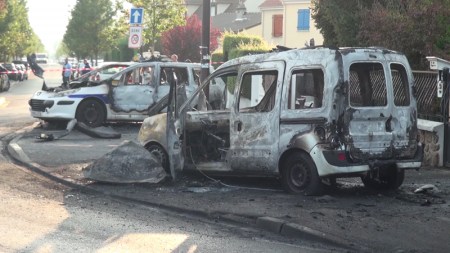
2103Four police officers were recently injured (two badly burned) when a group of around 15 “youths” (Muslim gang-members) swarmed their cars and hurled rocks and firebombs at them, in the Paris suburb of Viry-Châtillon. (Image source: Line Press video screenshot)

Police were also aggrieved by Bernard Cazeneuve, the minister of interior, who called the attackers “sauvageons” (“little wild ones”). Police and opposition politicians replied that the attackers were not “little wild ones but criminals who attacked police to kill.”

“Police are seen as an occupying force,” declared Patrice Ribeiro of the Synergie Officiers police commanders’ union. “It is not surprising that violence is spiking.”

On October 18, Le Figaro launched an online poll online with one question: “Do you approve the protest by policemen?” Ninety percent of the 50,000 respondents answered “yes.”

Since then, police demonstrations have spread to other cities. More than a month after the start of the discontent, police officers were still protesting in every big city. On November 24, two hundred police officers demonstrated in Paris between Place de la Concorde and the Arc de Triomphe, to express their “anger.” Police in civilian clothes, some wearing orange armbands, some hidden under a scarf or hood, supported by citizens, gathered in the evening at the Place de la Concorde, before walking the length of the Champs Elysée up to the Arc de Triomphe, where they formed a human chain around the monument and sang La Marseillaise (France’s national anthem).

This revolt of one pillar of French society, the police, was the biggest that ever happened in modern France. Yet, virtually no one in France’s mainstream media covered the event.

Schools

Tremblay-en-France (Seine-Saint-Denis close to Paris): The headmaster of the Hélène-Boucher training school was attacked on October 17 by several individuals outside the school. Some “youths” were attacking the building with firebombs, and when the headmaster tried to calm the situation, one of the “youths” answered with blows. Fifty unidentified people were involved in the incident. This was the third episode of violence to occur in the vicinity. Four days earlier, two vehicles were torched.

One month later, the daily Le Monde held a meeting with several students, The goal of this meeting was to try to understand the cause of the violence in in Tremblay. Yacine, 21, a student at the University of Paris II, said: “This is a warning. These young people did not attack the school by chance; they wanted to attack the institution, to attack the State.”

Argenteuil (Val d’Oise, suburb of Paris): A teacher at the Paul Langevin primary school, was beaten up in the street, on October 17, while leading children back to school from tennis courts a kilometer from the school. After hearing the teacher raise his voice at a child, two young men stopped their car, told the teacher he was a “racist” and beat him in front of the children. According to Le Parisien, one of the attackers justified his actions by accusing the professor of “racism”. “You are not the master,” said the man. “The only Master is Allah”.

Colomiers (Toulouse, south of France). A physical-education teacher was assaulted by a student on October 17, when the teacher tried to stop the student from leaving the school through a prohibited exit.

Calais (Pas-de-Calais): Two students at a vocational training school in Calais attacked a teacher, and one fractured the teacher’s jaw and several teeth on October 14, according the local paper, Nord-Littoral. The students attacked the electrical engineering teacher because he had asked one of the students to get back to work.

Saint-Denis (Seine Saint-Denis, suburb of Paris): On October 13, a school headmaster and his deputy were beaten by a vocational student who had been reprimanded for arriving late.

Strasbourg: A mathematics teacher was brutally attacked on October 17 at the Orbelin school. The headmaster of the institution told France Bleu that a “youth,” who is not a student at the school, had beaten the teacher. This was not the first time that the “youth” had entered the building. Earlier, when the teacher asked him to leave his class, the “youth” delivered several blows to the teacher’s face before fleeing.

All these attackers were not terrorists, but like Islamic terrorists, they apparently wanted to destroy “attack the institution, to attack the State.”

Hospitals

On October 16, fifteen individuals accompanying a patient sowed terror in the emergency department of Gustave Dron Hospital in Tourcoing, according to La Voix du Nord. A doctor was severely beaten; another pulled by the hair. Doctors and nurses told the newspaper they were still in shock. Said a nurse:

“Ten people forced their way into the heart of the ER. The doctors asked them to leave… When everything stopped, I realized that the ER was ravaged, patients terrorized, relatives of patients crying.”

The attackers were from the district of La Bourgogne, an area essentially populated with North African immigrants. Three people were arrested.

In the same area of La Bourgogne, there was a riot on October 4. Fourteen cars were burned and 12 people arrested. The riot, which lasted for four nights, broke out after the arrest of a driver who did not stop when asked to by a policeman.

Politics

On October 14, Nadine Morano, deputy of the opposition party Les Républicains, tried physically to prevent an Algerian businessman, Rachid Nekkaz, from entering the Center of Public Finance of Toul, in the east of France. Nekkaz is known for paying fines of Muslim women arrested because they were wearing a burqa in public, banned by law since October 2010. Police came to protect the right of Mr. Nekkaz to pay the fine. An amendment to the finance law is currently under discussion to block and punish practices, like those of Nekkaz, that circumvent the law.

President François Hollande is currently under fire after the publication of a book, A President Should Not Say That… In it, he is reported to have said, “France has a problem with Islam,” and “there are too many migrants in France” — remarks Hollande claims he never made. Another quote in the book that Hollande denies saying:

“We cannot continue to have migrants who arrive without control, in the context of the attacks… The secession of territories (no go zones)? How can we avoid a partition? Because it is still what is going to happen.”

President Hollande spends his time apologizing for things he never said, but should have said because they are true.

French People

French Chinese: The French Chinese live in the same suburbs as Muslims and are attacked and harassed, to the general indifference of police.

As crime against community members has spiraled, about 50,000 ethnic Chinese staged a protest march in Paris on September 4, after the fatal mugging of a Chinese tailor.

The protesters, all of them wearing white T-shirts reading “Security for All” and waving French flags, rallied at the Place de la République. They had organized the demonstration by themselves and were not supported by the traditional “human rights” groups, which prefer to help Muslim migrants.

Public Opinion: In January 2016, Cevipof, a think tank of the Paris Institute of Political Studies (Sciences Po), released its seventh Barometer of Political Trust, a poll published annually to measure the values of democracy in the country, and based on interviews with 2074 people:

  • What is your current state of mind? Listlessness 31%, Gloom 29%, Mistrust 28%, Fear: 10%
  • Do you trust government? Not much 58%, not at all 32%
  • Do you trust lawmakers? Not much 39%, not at all 16%%
  • Do you trust the president? Not much 32%; not at all 38%
  • Do politicians care about what the people think? Not much 42%, not at all 46%
  • How democracy is working in France? Not well 43%, not well at all 24%
  • Do you trust political parties? Not much 47%, not at all 40%
  • Do you trust the media? Not much 48% not at all 27 %
  • What do you feel about politics? Distrust 39%; disgust 33%, boredom 8%
  • What do you feel about politicians? Disappointment 54%; disgust 20%
  • Corruption of politicians? Yes 76%
  • Too many migrants? Yes, plus tend to agree: 65%
  • Islam is a threat? Yes, plus tend to agree: 58%
  • Proud to be French? Yes 79%

What this poll shows is the gap between people and politicians has never been so vast.

Thibaud de Montbrial, lawyer and expert on terrorism, declared on October 19 to Le Figaro:

The term “dislocation” of French society seems appropriate. Violence against police, hospitals, attacks that multiply against schools and teachers… are attacks against pillars of the ruling domain. In other words, everything that represents state institutions (…) is now subjected to violence based on essentially sectarian and sometimes ethnic excesses, fueled by an incredible hatred of our country. We must be blind or unconscious not to feel concern for national cohesion.”