Archive for March 2016

Satire | Rabid Rats Disparaged, CAIR Threatens

March 27, 2016

Rabid Rats Disparaged, CAIR Threatens, Dan Miller’s Blog, March 27, 2016

(The views expressed in this post are not necessarily mine, Warsclerotics, its other editors or any other sentient beings. — DM)

The Council Against Inhumanity to Rodents (CAIR) today announced that even though not all of the millions of Rodents on Earth are Rats, and even though not all Rats are rabid, all rats are being mercilessly disparaged due to the un-Rat actions of a few. Ratophobia must cease!

Happy rat

(Please see also, USA Today: U.S. cities face anti-Muslim backlash and Obama Praises “Enormous” Muslim Contributions to Our Country.)

Sadly, there was recently a deplorable incident in which a poor, disenfranchised Muslim woman was bitten by a rat. While hard at work in the kitchen preparing the evening meal for her beloved husband, an Islamophobic Rat jumped on her back and bit her. Unable to get to a hospital for treatment because all of her male relatives were worshiping at the local mosque and hence unavailable to accompany her, she died of rabies.

Because of this isolated Islamophobic incident involving a disturbed Rat, her friends and relatives promptly began to say unkind things about Rats and some even attempted to kill Rats — despite the lack of credible evidence that any of them were even rabid. Islamophobia is bad, and we have often counseled against it.

However, Ratophobia is even worse. Fewer than all Rats are rabid, and to assume that they are — or that the vast majority of non-rabid Rats are somehow responsible for the actions of those that are rabid — is disgraceful.

Our great nation owes tremendous debts to Rats, which have done much to make her grow and prosper. Had countless denizens of our teeming cities not migrated west to escape the rats in their apartment buildings and sewers, there would have been no westward expansion and the United States would now cower along the Atlantic Coast alone. There would be no San Bernardino and no sanctuary cities in California.

Rats, even rabid Rats, have feelings. They are sensitive to disparagements and to the loss of the freedoms they once enjoyed and still deserve. Many peaceful Rats are confined in small cages and used in medical experiments. In consequence, they experience great pain and suffering. We demand that such maltreatment of our brother Rats, and all other maltreatments — the use of Rat traps, for example — cease. Neither we nor our dear brother and sister Rats will be able to control Rat reactions if they are not. You have been warned. You had better change your ways or watch out!

Cartoon of the Day

March 27, 2016

H/t Vermont Loon Watch

one-note

Belgian Soldiers Deployed to Fight Terrorists had no Bullets in Rifles

March 27, 2016

Belgian Soldiers Deployed to Fight Terrorists had no Bullets in Rifles, Front Page Magazine, Daniel Greenfield, March 27, 2016

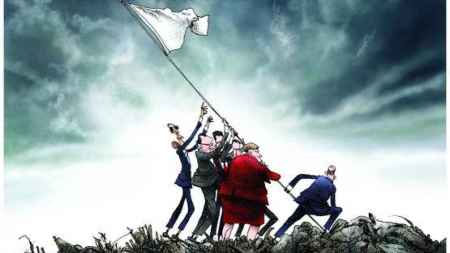
iran-white-flag

Much of counterterrorism is really security theater. TSA searches that have yet to stop a terrorist. Bombing raids that don’t drop bombs. Soldiers standing with rifles that have no bullets in them. It looks impressive. But there’s no substance behind it.

Rabbi Menachem Hadad of Brussels’ Shomre Hadas haredi Orthodox community said that soldiers who were posted outside a synagogue and the city’s Chabad House following the slaying of four Jews in Brussels’ Jewish Museum of Belgium in 2014 told him that for months, they used to guard the area with no bullets in their rifles. “It was just a show.”

Of course it’s just for show. Anything else would be too much. Western governments don’t want to actually stop Islamic terrorism. They want to look like they’re trying.

It’s not just Obama. It’s the whole system.

After every terror attack, there’s security theater. Empty reassurances that the guys running everything are really taking it seriously. But there’s no there, there. Instead they’ll keep on bringing huge numbers of Muslims, creating the next wave of terror, even while they put on a show of being serious about the latest attack.

Being serious about Islamic terrorism means ending Muslim migration. Any government that doesn’t want to do that is also not going to do much to fight Islamic terrorism except go through the motions.

Obama Praises “Enormous” Muslim Contributions to Our Country

March 27, 2016

Obama Praises “Enormous” Muslim Contributions to Our Country, Front Page Magazine, Daniel Greenfield, March 27, 2016

ced0nsiw4aa2e0y

No sensible person can doubt the enormous Muslim contributions to our country. I walk by one of them every time I pass the Freedom Tower. And the memorial at Ground Zero. Not to mention the TSA counters at the airport. And the rising body count of dead Americans.

It’s good of Mr. Obama to remind us of this.

During his weekly address on Saturday, Obama said, “[W]e have to reject any attempt to stigmatize Muslim-Americans, and their enormous contributions to our country and our way of life.”

Somebody sure thinks a lot of himself.

“As we move forward in this fight, we have to wield another weapon alongside our airstrikes, our military, our counterterrorism work, and our diplomacy. And that’s the power of our example,” Obama said. “Our openness to refugees fleeing ISIL’s violence.  Our determination to win the battle against ISIL’s hateful and violent propaganda – a distorted view of Islam that aims to radicalize young Muslims to their cause.”

We’re battling ISIS by bringing Muslim terrorists to America. That’s like fighting fire with gasoline.

But we can really set an example for Muslims by bringing Muslims to America. Maybe they’ll follow our example and not kill the few remaining Christians and Jews in the Middle East. And even if they do kill them, maybe when they become the majority in Europe, they won’t kill all the Christians and Jews living there.

And if we really go all out in setting a good example by taking in millions and millions of Muslims, maybe they’ll stop killing us.

Or maybe they’ll just keep doing what they’re doing… and what they’ve been doing for over a thousand years.

Those who forget the history of Islam are doomed to be beheaded, enslaved, raped, bombed, terrorized, oppressed, stabbed and subjugated.

Why Israeli airport security is so effective

March 27, 2016

Guest Post: Why Israeli airport security is so effective | Anne’s Opinions, 26th March 2016

(This is a guest post by Ralph Goodman. Ralph Goodman is a professional locksmith and an expert writer on all things locks and security over at the Lock Blog. The Lock Blog is a great resource to learn about keys, locks and safety. They offer tips, advice and how-to’s for consumers, locksmiths, and security professionals.

I noted that this article is particularly relevant in these days of increased terrorism such as the Brussels airport bombing, and even more so in the light of the latest news that an Israeli security firm’s advice on Brussels airport security went unheeded.)


Ben Gurion Airport

Ben Gurion Airport

Introduction

Anytime there is a tragedy in the world there is often a propensity within our humanity that leads us to anger and sadness. These are not the feelings that lead to answers. Without answers, there will be no end to the violence. In the wake of the terror attacks in Belgium, and the growing threat of lone wolf attacks across the globe, it is important not to lose sight of the main concern. Priority one should always be security. Keeping human life safe needs to be at the forefront of the world’s priorities well before blame, and certainly before hate. The question then becomes one of practicality. How can the world protect itself from the random violence of a few misguided individuals? The task seems insurmountable. But it is not. In fact, we do not even need to turn the knowledge of history. The answers we seek are being used at this very moment to keep the nation of Israel protected.

30 Years of Success

At this point, it has been more than three decades since any Israeli airliner has suffered a single hijacking or act of terrorism. Compare that to track record to the USA’s own Travel Security Administration (TSA), that when tested by Homeland Security failed to detect deadly threats 96% of the time. From these shockingly different rates of success, most people would assume that it must take an eternity to get through Israeli airport security. But that is not the case. Every passenger flying from Israel is not forced to take off his or her shoes and belts. There is no blanket pat down procedure for all travelers. You do not have to pour out your water, and there is not a body scanner that projects a simulated naked picture of every person’s body. In fact, most passengers pass through the security of Israeli airports faster than they would in the US. How is this possible? What are their policies? And is it possible to scale the success of this security to larger volume airports?

How They Do it

1. Personal Screening

The most glaring difference between Israel’s security and all other airport security is the personal attention every person receives. If you have never traveled through an Israeli airport, then this may seem invasive, and time-consuming. But with an average interview length of fewer than 30 seconds, it is hardly an inconvenience. The mentality of the security agents is that less than 1% of all of the people flying is a suspicious person, so there is no reason to treat everyone like a suspect. In fact, by limiting the number of people that need to be scrutinized, the vetting process can be done more efficiently and with greater depth. This personal interaction also begins before you get to the airport itself. People entering are screened before they drive in and park. Monitored before they enter the building. And interrogated with varying degrees of intensity upon entering. There are still metal detectors to walk through, but not every bag is screened. This shows a heavy reliance on the individual interaction between the security personnel and the passengers. With the track record they have, it shows that there may not be a need for anything more invasive or time-consuming.

2. Perimeter Patrols

Humans and remote controlled rovers monitor the outside of the airports. This allows the large area to be surveilled on multiple levels. The fences and surrounding areas are investigated for suspicious people and objects. If a planted item needs to be detonated, the unmanned rovers can do that remotely. The use of robots is meant to increase productivity by decreasing the time it takes to identify and neutralize a threat. These perimeter precautions also extend to the employees, which is a historically weak part of most airport security. Employees at Israeli Airports are scanned with biometric technology which checks fingerprints, and in some cases, conducts retinal scans. This solves any issues that may arise from non-passenger threats.

3. Air Marshals

airport2

Assuming that there is ever an active threat that boards a plane, at least, one Air Marshal is placed on each flight. Though there has never even been a bombing that needed to be thwarted on a flight, this security remains active. In the instance of all other security measures failing the plane will still be protected. Israeli security understands that there are many ways unsuspecting items can be turned into weapons. Glass can be broken to make a makeshift knife, and credit cards can be sharpened to have a razor edge. It may not have happened yet, but Israel’s Airport Security will be ready when it does. And in that situation trained military professionals that can neutralize a target in seconds. Though life is important, the marshals are said to terminate threats with extreme prejudice.

4. Profiling

Perhaps the most divisive methods used for security, profiling is also credited with being the most effective. Most officials are willing to say that race, gender, age, and religion are all factors in the profiling algorithm, but it is said that the methods extend far beyond just those features. Nir Ran, who is a former head of aviation security at the ISA (Israel Security Agency) and former Security Director at the Israeli Airline El Al, said “The passenger himself, arriving at the flight with a bomb in his suitcase will not necessarily be a Muslim, will not necessarily be a young man…on the contrary…in most of the cases… the people that were carrying the bomb to the plane were non-Muslim. [They were] young women” (VOA). If the people being stopped did not fit the profile that many think of as potential terrorists, then it could be said that these profilers are more unbiased than average citizens. This practice is not at all politically correct, but it has a proven history of working with the use of highly trained and intelligent workers.

Conclusion

The most important thing that we can learn from this effective security is that safety is possible. There are ways to protect life effectively, even in the chaotic times we live in. There is no way to doubt track record of these policies. Even if you do not think that profiling is morally right, there is no way to posit that it is not actively defeating terrorism. Because, although Israel may be a small nation, it is most certainly a target by the very same groups that are carrying out plane and airport attacks around the world. The morality of the practice must be balanced not only with your moral teachings but also weighed against the suspended liberties we have all endured. Being treated like a criminal without provocation, all in the name of security that does not protect us is a high and unnecessary price. Israel’s airport security embodies the humanity and personal attention that such complex issues need. There is no need for hate. There is not even a call for war. Security is possible with a reinvestment in education and training for the world’s transportation agencies. Have faith that peace can come without the loss of life or liberty.

Satire| Breakthrough military technology enables cutting-edge micromanagement

March 27, 2016

Breakthrough military technology enables cutting-edge micromanagement, Duffel Blog, March 27, 2016

TRUSTOVISION-1000x600

FORT MEADE, Md. — New technology unveiled by the Pentagon today promises to offer the Army “an unparalleled level of battlefield supremacy in micromanagement,” according to Pentagon Spokesman Peter Cook.

The breakthrough technology, dubbed “Trust-o-Vision,” enables the company commander on the battlefield the previously-limited ability to send continuous reports to higher and receive instant verbal critiques, guidance, and second guessing.

Col. Peter Hammond, Brigade Commander of 1st Brigade, 10th Mountain Division, heralded the advancement in technology as “exactly what Corps, brigade, and battalion commanders need in order to more efficiently keep control at ever increasing distances of time, space, and reality,” he said.

“With Trust-o-Vision, my junior leaders can rest assured that I will always be watching,” Hammond added, “and always be ready to step in at a moment’s notice when I’ve decided I’m needed.”

The next generation technology, set to be installed in garrison headquarters and Tactical Operations Centers (TOCs), as well as every vehicle and personal residence of company-level leaders everywhere, features a persistent full HD audio and video feed of every commander at every echelon, from Battalion to Chief of Staff of the Army.

Cook introduced a video demonstration of a recent field test of “Trust-o-Vision” by 2nd Brigade, 4th Infantry Division, during their deployment to Southern Afghanistan.

A captain using the callsign “Legion 6” contacts a lieutenant with callsign “Legion 1-6.” As Legion 6 announces movement of another unit, 3-6, an interruption occurs.

“Break break break,” says the voice, identified by subtitles as Brig. Gen. James Mingus, who is then immediately followed by Maj. Gen. Ryan Gonsalves, who asks “Hey! What is that guy doing?”

Mingus then asks the unidentified captain, “Why is that rifleman facing that direction? Shouldn’t someone be calling out sectors of fire.”

Gonsalves can then be heard ordering a machine gun team to “go cyclic on that 240, dummy!” while an unidentified voice argues they should use “sustained fire, to keep their heads down, stupid!”

Cook noted as the video ended that, “A number of awards are pending for the Division Staff for their unparalleled handling of the company in the face of sustained enemy resistance.”

Sources confirm that the static “Trust-o-Vision” will be supplemented in 2018 with a drone-based version that will be able to constantly hover in front of a dismounted company commander’s face.

Lee Ho Fuk and Jay contributed to this report


USA Today: U.S. cities face anti-Muslim backlash

March 27, 2016

USA Today: U.S. cities face anti-Muslim backlash, Jihad Watch, Robert Spencer, March 26, 2016

Here we go again. After every Islamic jihad massacre, the mainstream media acts as if Muslims, not non-Muslims, were killed. Notice that while this headline portends Muslims being persecuted all over the nation, the article doesn’t give any examples other than vague and unsubstantiated assertions from the Hamas-linked Council on American-Islamic Relations (CAIR), which wants and needs hate crimes against Muslims, because they’re the currency they use to buy power and influence in our victimhood-oriented society, and to deflect attention away from jihad terror and onto Muslims as putative victims. Hamas-linked CAIR, designated a terror organization by the United Arab Emirates, and other Muslims have on many occasions not hesitated to stoop even to fabricating “hate crimes,” including attacks on mosques. Most notably, in February, a New Jersey Muslim was found guilty of murder that he tried to portray as an “Islamophobic” attack, and in 2014 in California, a Muslim was found guilty of killing his wife, after first blaming her murder on “Islamophobia.”

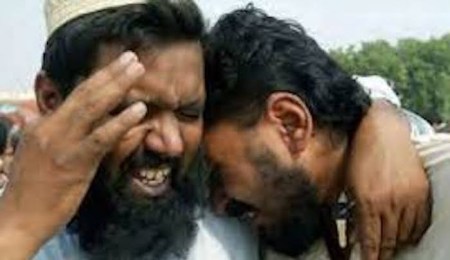
sad-Muslims

“‘Islamophobia’: U.S. cities face anti-Muslim backlash,” by Mike James and Linda Dono, USA TODAY, March 24, 2016 (thanks to Christian):

WASHINGTON — Cities across the USA are preparing for the next phase that inevitably follows a terror attack: anti-Muslim backlash.

Across social media, in public forums on college campuses, and even in mainstream political rhetoric from presidential candidates, anger over the deadly terror attacks in Brussels has spawned discontent and suspicion directed at Muslim groups. After the Islamic State claimed responsibility for the attacks, leaders in California, Kentucky, Massachusetts, Minnesota, New Jersey, New York, Ohio and spoke out quickly to dissuade anti-Muslim sentiment.

The aftermath of an attack “is always a difficult time for Muslims in the United States,” said Nabil Shaikh, a leader of the Muslim Students Association at Princeton University.

“On Princeton’s campus, students took to anonymous forums like Yik Yak to comment that there are Muslims at Princeton who are radical and would therefore condone yesterday’s attacks,” Shaikh said. “These comments not only are appalling and inaccurate but also threaten the well-being of Muslim students.”

Unlike in Belgium and Paris following the November terror attacks, the backlash in the U.S. is not as confrontational.

Europe has seen occasional anti-Muslim rallies in Flemish cities such as Antwerp and Ghent. Some Muslim leaders have accused police in Europe of overtly targeting Muslim communities in lockdowns and raids of homes.

“The average Muslim still feels intimidated, still feels scared, still feels insecure.” Khusro Elley, Chappaqua, N.Y.

Muslim communities in the U.S. face opposition more in the form of rhetoric — but in an election year, such rhetoric can lead to sweeping change.

The day of the Brussels attack, Republican presidential hopeful Ted Cruz said that the U.S. needs to “empower law enforcement to patrol and secure Muslim neighborhoods before they become radicalized.” His comments struck an already raw nerve in Muslim communities throughout the U.S. although Donald Trump praised Cruz’s idea.

President Obama called the approach “wrong and un-American.”

“I just left a country that engages in that kind of surveillance, which by the way the father of Senator Cruz escaped, to America, the land of the free,” he said, referring to Cuba.

Politics plays a role in fostering anti-Islamic sentiment, said Khusro Elley of Chappaqua, N.Y., a trustee at Upper Westchester Muslim Society in Thornwood, N.Y.

“The average Muslim still feels intimidated, still feels scared, still feels insecure,” especially in a political climate where it’s become common to depict Muslims as terrorists, he said.

While brutal attacks on Muslims in the United States haven’t been reported to the Council on American-Islamic Relations since the Brussels attack, bullying and hate speech are growing, said Ibrahim Hooper, spokesman for the Washington-based civil-liberties group.

“For girls, it’s pulling on the hijab and calling them terrorists, and for boys it’s saying that they have a bomb in their backpack and calling them terrorists,” Hooper said. Some politicians make the problems worse. “They really have mainstreamed Islamophobia.”

Children hear the hate speech on TV and hear their parents agreeing with it, he said. Increasingly, they’re taking the language to school.

In Louisville, more than two dozen Islamic leaders gathered Wednesday to condemn the attacks and urge the public not to link all Muslims with terrorism, describing a growing level of Islamophobia.

“I do feel that with the attacks in Brussels and especially after Paris, people feel like they are entitled to speak hatefully. It’s actually a lot worse than what happened after 9/11.”
Maira Salim, Muslim Student Association at Wichita State University

Louisville Mayor Greg Fischer, a Democrat, called some Republican political candidates’ responses in wake of the Brussels attack “naive and unrealistic.”

“For them to play to people’s basest fears” to gain political support is “contrary to American values,” Fischer said at an interfaith prayer vigil, contending that such candidates are “masquerading as presidential timber.”

Muslims in Louisville haven’t felt fearful, especially since non-Muslim volunteers came out in force to paint over anti-Islam graffiti two days after the Louisville Islamic Center was vandalized Sept. 16, said Mohammed Wasif Iqbal, head of the center. But Iqbal said some have criticized Islamic leaders for not condemning attacks strongly enough.

“We will stand here every single time and condemn it,” he said, arguing that extremists should not define the Islamic religion.

Muhammad Babar, a Louisville Islamic leader with Muslim Americans for Compassion, called the Brussels attack heartbreaking.

“Do not see us through the actions of ISIL,” he said. “We are as American as you are.”

The Council on American-Islamic Relations’ Florida chapter has seen a fivefold increase in reports of hate incidents during 2015 compared with 2014, 26 vs. five, said Hassan Shibly, the chapter’s chief executive director. A grand majority occurred in the final two months of the year, after the Paris terrorist attacks.

“Unlike what happens after the mass shootings committed by white supremacists that happen almost daily in America, whenever an act of terrorism involves those who identify themselves as Muslims, politicians respond by calling for the curtailment or the rights of American Muslims,” he said. “Our enemies can never destroy us. We can only destroy ourselves if we allow fear and hate to turn us against each other.”

The national Council on American-Islamic Relations, founded in 1994, called for Cruz to retract his demand for law enforcement to secure Muslim neighborhoods.

“Mr. Cruz’s call for law enforcement to ‘patrol and secure’ neighborhoods in which American Muslim families live is not only unconstitutional, it is unbefitting anyone seeking our nation’s highest office and indicates that he lacks the temperament necessary for any president,” the national council’s executive director, Nihad Awad, said in a statement.

Awad called Cruz’s plan fascist-like.

“I do feel that with the attacks in Brussels and especially after Paris, people feel like they are entitled to speak hatefully,” said Maira Salim, president of the Muslim Student Association at Wichita State University. “It’s actually a lot worse than what happened after 9/11. … I’m all for free speech, but hate speech is not OK.”

Assad’s troops enter Palmyra after massive Russian air blitz to smash ISIS

March 27, 2016

Assad’s troops enter Palmyra after massive Russian air blitz to smash ISIS, DEBKAfile, March 27, 2016

Forces loyal to Syria's President Bashar al-Assad drive a tank during their offensive to recapture the historic city of Palmyra in this picture provided by SANA on March 24, 2016. REUTERS/SANA/Handout via Reuters ATTENTION EDITORS - THIS PICTURE WAS PROVIDED BY A THIRD PARTY. REUTERS IS UNABLE TO INDEPENDENTLY VERIFY THE AUTHENTICITY, CONTENT, LOCATION OR DATE OF THIS IMAGE. FOR EDITORIAL USE ONLY. NOT FOR SALE FOR MARKETING OR ADVERTISING CAMPAIGNS. THIS PICTURE IS DISTRIBUTED EXACTLY AS RECEIVED BY REUTERS, AS A SERVICE TO CLIENTS

Forces loyal to Syria’s President Bashar al-Assad drive a tank during their offensive to recapture the historic city of Palmyra in this picture provided by SANA on March 24, 2016. REUTERS/SANA/Handout via Reuters

Vladimir Putin after all took the momentous decision for Russian carpet bombing to level the Islamic State forces holding Palmyra since last May, and so clear the way for Bashar Assad’s troops and allied forces to enter the heritage city Saturday and Sunday, March 26-27 and take control of several districts. Television footage showed waves of explosions inside Palmyra and smoke rising from buildings, as Syrian tanks and armored vehicles fired from the outskirts.

But just as the Iraqi army, even with foreign assistance, never completely captured Ramadi or Baiji from Islamist forces, so too Assad’s forces can’t hope for complete control of the strategic town of Palmya. After pulling back to the east, ISIS forces will continue to harass the Syrian army and town with sporadic raids. And government forces will stay dependent on a Russian air umbrella to hang on.

The big question DEBKAfile’s military and intelligence sources were asking Sunday was what brought president Putin to give this groundbreaking military success to the Syrian ruler, just days after he withdrew Russian air support in southern Syria and opened the door for an Islamic State advance. He did this in an effort to break Assad’s resistance to the US-Russian deal for a political solution of the Syrian conflict by August.

Our sources offer two likely motivations:

1. Palmyra is strategically important to the Russian command because its fall to government forces opens the way to ISIS headquarters at Raqqa, 225 kilometers away.

2. Palmyra is also the gateway to Deir ez-Zour, 188 kilometers distant on Syria’s eastern border with Iraq. For the Russian military command, the importance of Deir ez-Zour outweighs that of Raqqa, because it is the key to control of the Euphrates Valley and access from Syria to Baghdad.

While these considerations bear heavily on Moscow’s strategic calculations, they have little direct impact on Assad’s overriding objective, which is to hold on to power. While the Syrian ruler may hope for acclaim for achieving a major success against ISIS, the laurel wreath belongs to Russian pilots. His forces essentially performed  a ground operation in Palmyra in Moscow’s interest and goal, which is to strengthen the Russian grip on his country.

On Saturday, DEBKAfile set forth the background for these events.

Cracks in the united US-Russian front over the Syrian ruler’s fate surfaced – even before the ink was dry on the joint announcement issued in Moscow Friday, March 25, by US Secretary of State John Kerry and Russian Foreign Minister Sergey Lavrov, setting  August as the deadline for a political solution of the five-year Syrian conflict.

Shortly after Kerry’s departure for Brussels, Russian Deputy Foreign Minister Sergey Ryabkov told reporters, “Washington now accepts Moscow’s argument that Assad’s future shouldn’t be open for negotiation right now.” However, taking exception to the phrase “right now,” State Department spokesman John Kirby immedieately snapped back, “Any suggestion that we have changed in any way our view of Assad’s future is false.”

Did this exchange spell another Washington-Moscow impasse on the future of the war and the Syrian ruler? Not exactly; Our military and intelligence analysts report that the two powers are in accord on the principle that Assad must go, but are maneuvering on the timeline for the war to end and the Syrian ruler’s handover of power.

The Americans want it to be sooner. The transition should start in August and result in adding opposition parties to the regime in positions of real influence.

President Barack Obama, when he conducts his farewell Gulf tour in April, would like to show Saudi Arabia and Gulf emirates that he has finally kept his word to them to evict Bashar Assad from power before he leaves the White House next January. The US would also be better placed for bringing the Syrian opposition into line for a negotiated deal.

But Putin prefers a delay because he has problems to solve first. The six-month long Russian military intervention in the Syrian conflict turned the tide of the war. The Syrian army and its Iranian and Hizballah allies were able to stabilize their positions and even score some important victories against rebel forces in central and northern Syria. Last year, Putin and Iran’s supreme leader Ayatollah Ali Khamenei were definitely on the same page and fully coordinated.

That cordial relationship was thrown out of kilter by the Kremlin’s decision to work with the White House for bringing the disastrous Syrian war to an end and terminating the Assad era.

From November, Iran’s Gen. Qassem Soleimani’s frequent visits to Moscow on liaison duty petered out.

Khamanei is adamantly opposed to Russia and the US commandeering the decision on Assad’s departure and its timetable. He is even more outraged by the way Putin has moved in on Syria and made it Russia’s home ground in the Middle East.

The rift with Tehran prompted Putin to announce on March 14 the partial pullback of his military forces from Syria. It was a threat to pull the rug that had turned the tide of the war in favor of Damascus and Tehran.

4 (1)

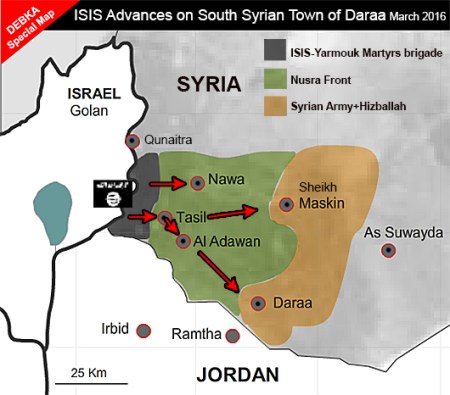
Reluctant to burn those boats, Moscow has been juggling its balls in the air, trying not to drop any. At first, he suspended Russian air cover for government-led battles. The Islamic State immediately seized on this opening in the south and advanced on the towns of Nawa, Sheikh Maskin and Daraa.

Moscow hoped that this setback would teach Bashar Assad to toe the Russian line.

Then, in the second part of last week, Putin ordered the Russian air force to renew its air strikes in the east in support of the Syrian army’s march from central Syria on the historic town of Palmyra. Friday and Saturday, the Syrian army and its allies were battling for control of the UNESCO World Heritage city, nearly a year after the Islamic State overran it and vandalized its historic remains.

DEBKAfile’s military sources stress that their capture of the reconstructed ancient Citadel perched on a hill over the city would have been beyond their strength without Russian air support. Finishing the job and recovering the entire city of Palmyra will depend heavily on Russian air strikes continuing to hammer the jihadist occupiers.

Putin faces a momentous decision. He has already taught Assad and Tehran a harsh lesson: with Russian air support, they win battles, but not without it, as their failure in the south has demonstrated.

Will he help Assad win Palmyra?

Crowning the Syrian dictator with such a striking victory would stiffen his resistance to American pressure for him to quit in short order. He would stand out as the only Syrian war leader capable of pushing ISIS back. But if the Russian leader decides to cut off air support in mid-battle for Palmyra, Assad and Iran will be forced to face the fact that without active Russian military support, they are in hot water.

The Syrian ruler would then have to accept his approaching end. That is the dilemma facing Putin.

Report: UK Pays Millions to Known Terrorists

March 27, 2016

Report: UK Pays Millions to Known Terrorists, The Jewish Press, March 27, 2016

Palestinian-presidential-palaceThe PA presidential palace / Photo credit: Palestinian Economic Council for Development and Reconstruction (PECDAR)

Thousands of Palestinian terrorists, including masterminds of suicide bombings and murderers of women and children, are given cash handouts by the UK, the Daily Mail revealed Sunday. A Mail two-month global investigation has revealed that in Judea and Samaria and Gaza, “despite promises by the ruling Palestinian Authority (PA) to end the practice of paying aid money to convicted terrorists … [have] simply duped the West by allowing the Palestine Liberation Organization to hand out the cash instead.”

Britain gives £72 million ($101 million) a year to the Palestinian Arabs, according to the report, “more than one-third of which goes straight to the PA,” which “openly admits supporting terrorists whom it hails as heroes for fighting illegal occupation, awarding lifetime payments that rise depending on time spent in jail and the seriousness of crimes.”

One example is a Hamas “master bomber” Abdallah Barghouti, who was given 67 life sentences: he has received a total of £106,000 ($150,000). UK funds also pay out “salaries” to the families of suicide bombers, as well as to “teenagers involved in the latest upsurge of deadly attacks on Israel.”

The UK government’s Department for International Development (DFID) and the European Union “are still effectively supporting these payments to thousands of terrorists – despite claims to have ended such links two years ago,” the Daily Mail report insists. This has been confirmed “by former prisoners and families receiving the cash, and in official statements by the PA.” Chairman Mahmoud Abbas used part of the UK gifts — £8 million ($11.31 million) — to build a palace in Ramallah.

The Sunday report presents an interview with Ahmad Musa, a convicted double murderer sentenced to life in prison, who was released from Israeli prison after five years, as part of Israel’s gestures to move along the “peace process.” He gets £605 ($855) every month. Others like him get much more, and after they die, the cash goes to their families. The money for these payments comes from British and European taxpayers. Amjad Awad, who murdered Ehud and Ruth Fogel and their three children in 2011, has received an estimated £16,000 ($22,600) from the fund so far.

Amr Nasser, adviser to the PA minister of social affairs, told the Mail: “It is not a crime to be fighting occupation. These people are heroes. We could be giving them much more money and it would not be enough.” Nasser added that, when Palestine wins its independence, its government would seek reparations from Britain for its historic role in encouraging Zionism. “You should pay us more money,” he stated.

Angry Israelis Demonstrate Outside Prison Where IDF Soldier Jailed for Killing Terrorist [video]

March 27, 2016

Angry Israelis Demonstrate Outside Prison Where IDF Soldier Jailed for Killing Terrorist , The Jewish PressHana Levi Julian, March 26, 2016

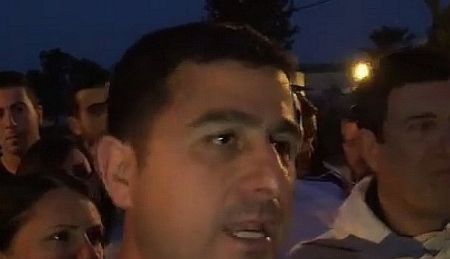
PROTESTERS-THIS-IS-WARAngry IDF veterans and other Israelis protest jailing of soldier who shot and killed terrorist to ensure he was neutralized in Hebron. Photo Credit: screenshot / social media

Demonstrators waving posters, honking horns and yelling slogans gathered in Be’er Sheva Saturday night to protest against the arrest and jailing of an IDF soldier who shot and killed a terrorist who was apparently “neutralized” in Hebron last week.

The protesters stood across from Prison No. 4 on Saturday night, where the soldier is incarcerated, according to Israeli radio.

One of the protesters spoke with Channel 1 as other bystanders shot video with their cellphones, saying that he had served as a member of the Border Guard Police, and as a father of two combat soldiers, understood the necessity for army discipline.

(Video at the link. — DM)

“But the army knows how to deal with this, and this should have been left to the army to deal with, and it wasn’t. This soldier was arrested because things were being dealt with in the light of the cameras, rather than in the military court, where it belongs.

”Moreover, we are at war. We need to deal with the situation on the ground, and we’re not doing that…. I have served in Judea, Samaria, Gaza, everywhere, and I have lost friends in all those places. I know what war is. This is war.”

Another protester, also an IDF veteran said, “The government keeps talking about a wave of terror, a terror wave. This is not a terror wave, this is a war. It’s a war.

“How do you know when a terrorist is neutralized? If his hands are cuffed, fine. If he takes a bullet to the head, then yes, you know. But if he has taken a bullet to a leg, he can still move. If he has taken a bullet to an arm or elsewhere, he can still move — and they do. We have seen it, and we have seen soldiers die because of it. So that is not neutralized. Neutralized is when you know he cannot move.”