Posted tagged ‘Republicans’

Can the establishment trump Trump?

March 6, 2016

Can the establishment trump Trump? Israel Hayom, Boaz Bismuth, March 6, 2016

Some in the Republican establishment are playing with fire. It is plain obvious that they would like to deny Donald Trump the party’s nomination, and they have every right to try to do so.

But this onslaught on Trump — led by GOP big guns, along with its two most recent presidential nominees, Mitt Romney and John McCain — could backfire and turn the real estate mogul into a political martyr. They face an excruciating dilemma: how to drive home the notion that Trump is unfit to be president even as the public rallies behind him?

Some in the GOP establishment failed to pick up the political undercurrents among rank-and-filed Republicans during the first few months of the campaign. This helped Trump’s ascent. But the establishment may still be oblivious to what GOP voters want. As a result of this disconnect, they may actually help him seal the deal. Saturday’s votes in Kansas, Kentucky, Louisiana and Maine could provide insight on the way forward. Remember, so far every attack on Trump has helped him.

Unlike the Democratic front-runner, Hillary Clinton, Trump has yet to run away with the delegates, despite having momentum on his side and winning 10 of the 15 states that held primaries (not including Saturday’s votes).

Before there was Trump, it was Texas Sen. Ted Cruz who was hated by the party’s big wigs. In fact, Cruz has yet to be endorsed by any of his colleagues in the Senate because of the bad rapport he has with the people in Washington. Nevertheless, in states where primaries have been closed (meaning, only registered Republicans can vote, like those on Saturday), Cruz has fared well.

At first, the establishment couldn’t decide between Florida Sen. Marco Rubio and former Florida Governor Jeb Bush; then it came out against Cruz; and all the while, it ignored Trump. Now the establishment has a conundrum on its hands: How do you attack two unwanted front-runners (the first of the two is the most pressing problem)? Former Arkansas Governor Mike Huckabee, an also-ran in this cycle and in 2008, has warned the establishment not to meddle with the process. “Let’s remember, we have an election process and not a selection process,” he said recently.

Republican voters have viewed the GOP establishment’s efforts with scorn and may very well set the house ablaze. In fact, 78% of Trump supporters say they would continue to back him no matter what he does. On Super Tuesday, Trump garnered almost 70% of the vote among those who said they wanted an outsider as their next president.

Rubio is not an outsider; neither is Cruz. The outsider is Trump. Trump has bested his opponents in virtually every possible measure. This only adds to his success and exacerbates the party’s headache.

The establishment’s efforts may very well be a case too much, too late. Perhaps the Republican voters truly are fed up with Washington; perhaps they truly are disappointed by the economy and view the billionaire as their savior (or at the very least, someone who can punish Washington). The establishment enlisted the help of Romney, who has become the face of the anti-Trump campaign. But Romney, lest you forget, lost to President Barack Obama in 2012 and to McCain in 2008.

These elections are about being a winner. They are about making America win again. Romney is not quite the right person. Perhaps the establishment has no choice but to attack. It is now or never. We are likely to see more surprises in this race, but for the time being, the campaign to stop Trump is the biggest story.

Let’s hope the Republican leaders don’t forget who their real adversary is. Judging from how they have conducted themselves, they could very well start viewing Hillary Clinton as their big savior. By doing so, they will have severed their ties with the GOP rank and file for good.

Off Topic | Inside the Republican Party’s Desperate Mission to Stop Donald Trump

February 27, 2016

The G.O.P.’s Last-Ditch, Frantic Effort to Stop Trump, New York Times, Alexander Burns, Maggie Haberman and Jonathan Martin, February 27, 2016

(Please see also, Off Topic:  Trump and the Rise of the Unprotected – WSJ. — DM)

The scenario Karl Rove outlined was bleak.

Addressing a luncheon of Republican governors and donors in Washington on Feb. 19, he warned that Donald J. Trump’s increasingly likely nomination would be catastrophic, dooming the party in November. But Mr. Rove, the master strategist of George W. Bush’s campaigns, insisted it was not too late for them to stop Mr. Trump, according to three people present.

At a meeting of Republican governors the next morning, Paul R. LePage of Maine called for action. Seated at a long boardroom table at the Willard Hotel, he erupted in frustration over the state of the 2016 race, saying Mr. Trump’s nomination would deeply wound theRepublican Party. Mr. LePage urged the governors to draft an open letter “to the people,” disavowing Mr. Trump and his divisive brand of politics.

The suggestion was not taken up. Since then, Mr. Trump has only gotten stronger, winning two more state contests and collecting the endorsement of Gov. Chris Christie of New Jersey.
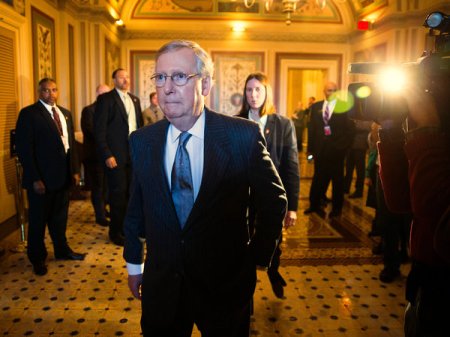
Mitch McThe Senate majority leader, Mitch McConnell, has laid out a plan that would have lawmakers break with Mr. Trump in a general election. Credit Doug Mills/The New York Times

In public, there were calls for the party to unite behind a single candidate. In dozens of interviews, elected officials, political strategists and donors described a frantic, last-ditch campaign to block Mr. Trump — and the agonizing reasons that many of them have become convinced it will fail. Behind the scenes, a desperate mission to save the party sputtered and stalled at every turn.

Efforts to unite warring candidates behind one failed spectacularly: An overture from Senator Marco Rubio to Mr. Christie angered and insulted the governor. An unsubtle appeal from Mitt Romney to John Kasich, about the party’s need to consolidate behind one rival to Mr. Trump, fell on deaf ears. At least two campaigns have drafted plans to overtake Mr. Trump in a brokered convention, and the Senate majority leader, Mitch McConnell of Kentucky, has laid out a plan that would have lawmakers break with Mr. Trump explicitly in a general election.

Despite all the forces arrayed against Mr. Trump, the interviews show, the party has been gripped by a nearly incapacitating leadership vacuum and a paralytic sense of indecision and despair, as he has won smashing victories in South Carolina and Nevada. Donors have dreaded the consequences of clashing with Mr. Trump directly. Elected officials have balked at attacking him out of concern that they might unintentionally fuel his populist revolt. And Republicans have lacked someone from outside the presidential race who could help set the terms of debate from afar.

The endorsement by Mr. Christie, a not unblemished but still highly regarded figure within the party’s elite — he is a former chairman of the Republican Governors Association — landed Friday with crippling force. It was by far the most important defection to Mr. Trump’s insurgency: Mr. Christie may give cover to other Republicans tempted to join Mr. Trump rather than trying to beat him. Not just the Stop Trump forces seemed in peril, but also the traditional party establishment itself.

Should Mr. Trump clinch the presidential nomination, it would represent a rout of historic proportions for the institutional Republican Party, and could set off an internal rift unseen in either party for a half-century, since white Southerners abandoned the Democratic Party en masse during the civil rights movement.

Former Gov. Michael O. Leavitt of Utah, a top adviser to Mr. Romney’s 2012 presidential campaign, said the party was unable to come up with a united front to quash Mr. Trump’s campaign.

“There is no mechanism,” Mr. Leavitt said. “There is no smoke-filled room. If there is, I’ve never seen it, nor do I know anyone who has. This is going to play out in the way that it will.”

Republicans have ruefully acknowledged that they came to this dire pass in no small part because of their own passivity. There were ample opportunities to battle Mr. Trump earlier; more than one plan was drawn up only to be rejected. Rivals who attacked him early, like Rick Perry and Bobby Jindal, the former governors of Texas and Louisiana, received little backup and quickly faded.

Late last fall, the strategists Alex Castellanos and Gail Gitcho, both presidential campaign veterans, reached out to dozens of the party’s leading donors, including the casino magnate Sheldon Adelson and the hedge-fund manager Paul Singer, with a plan to create a “super PAC” that would take down Mr. Trump. In a confidential memo, the strategists laid out the mission of a group they called “ProtectUS.”

“We want voters to imagine Donald Trump in the Big Chair in the Oval Office, with responsibilities for worldwide confrontation at his fingertips,” they wrote in the previously unreported memo. Mr. Castellanos even produced ads portraying Mr. Trump as unfit for the Oval Office, according to people who saw them and who, along with many of those interviewed, insisted on anonymity to discuss private conversations.

The two strategists, who declined to comment, proposed to attack Mr. Trump in New Hampshire over his business failures and past liberal positions, and emphasized the extreme urgency of their project. A Trump nomination would not only cause Republicans to lose the presidency, they wrote, “but we also lose the Senate, competitive gubernatorial elections and moderate House Republicans.”

No major donors committed to the project, and it was abandoned. No other sustained Stop Trump effort sprang up in its place.

Resistance to Mr. Trump still runs deep. The party’s biggest benefactors remain totally opposed to him. At a recent presentation hosted by the billionaires Charles G. and David H. Koch, the country’s most prolific conservative donors, their political advisers characterized Mr. Trump’s record as utterly unacceptable, and highlighted his support for government-funded business subsidies and government-backed health care, according to people who attended.

But the Kochs, like Mr. Adelson, have shown no appetite to intervene directly in the primary with decisive force.

The American Future Fund, a conservative group that does not disclose its donors, announced plans on Friday to run ads blasting Mr. Trump for his role in an educational company that is alleged to have defrauded students. But there is only limited time for the commercials to sink in before some of the country’s biggest states award their delegates in early March.

Instead, Mr. Trump’s challengers are staking their hopes on a set of guerrilla tactics and long-shot possibilities, racing to line up mainstream voters and interest groups against his increasingly formidable campaign. Donors and elected leaders have begun to rouse themselves for the fight, but perhaps too late.

Mit RomneyMitt Romney at an event in Mississippi last year. He has tried various ways to slow the progress of Mr. Trump, without success. Credit Rogelio V. Solis/Associated Press

Two of Mr. Trump’s opponents have openly acknowledged that they may have to wrest the Republican nomination from him in a deadlocked convention.

Speaking to political donors in Manhattan on Wednesday evening, Mr. Rubio’s campaign manager, Terry Sullivan, noted that most delegates are bound to a candidate only on the first ballot. Many of them, moreover, are likely to be party regulars who may not support Mr. Trump over multiple rounds of balloting, he added, according to a person present for Mr. Sullivan’s presentation, which was first reported by CNN.

Advisers to Mr. Kasich, the Ohio governor, have told potential supporters that his strategy boils down to a convention battle. Judd Gregg, a former New Hampshire senator who had endorsed Jeb Bush, said Mr. Kasich’s emissaries had sketched an outcome in which Mr. Kasich “probably ends up with the second-highest delegate count going into the convention” and digs in there to compete with Mr. Trump.

Several senior Republicans, including Mr. Romney, have made direct appeals to Mr. Kasich to gauge his willingness to stand down and allow the party to unify behind another candidate. But Mr. Kasich has told at least one person that his plan is to win the Ohio primary on March 15 and gather the party behind his campaign if Mr. Rubio loses in Florida, his home state, on the same day.

In Washington, Mr. Kasich’s persistence in the race has become a source of frustration. At Senate luncheons on Wednesday and Thursday, Republican lawmakers vented about Mr. Kasich’s intransigence, calling it selfishness.

One senior Republican senator, noting that Mr. Kasich has truly contested only one of the first four states, complained: “He’s just flailing his arms around and having a wonderful time going around the country, and it just drives me up the wall.”

Mr. McConnell was especially vocal, describing Mr. Kasich’s persistence as irrational because he has no plausible path to the nomination, several senators said.

While still hopeful that Mr. Rubio might prevail, Mr. McConnell has begun preparing senators for the prospect of a Trump nomination, assuring them that, if it threatened to harm them in the general election, they could run negative ads about Mr. Trump to create space between him and Republican senators seeking re-election. Mr. McConnell has raised the possibility of treating Mr. Trump’s loss as a given and describing a Republican Senate to voters as a necessary check on a President Hillary Clinton, according to senators at the lunches.

(video of Christie endorsing Trump at the link.- – DM) 

He has reminded colleagues of his own 1996 re-election campaign, when he won comfortably amid President Bill Clinton’s easy re-election. Of Mr. Trump, Mr. McConnell has said, “We’ll drop him like a hot rock,” according to his colleagues.

There is still hope that Mr. Rubio might be able to unite much of the party and slow Mr. Trump’s advance in a series of big-state primaries in March, and a host of top elected officials endorsed him over the last week. But Mr. Rubio has struggled to sideline Mr. Kasich and Senator Ted Cruz of Texas, who is running a dogged campaign on the right. He has also been unable to win over several of his former rivals who might help consolidate the Republican establishment more squarely behind him.

Mr. Rubio showed a lack of finesse in dealing with his fallen rivals’ injured egos.

Mr. Christie had attacked Mr. Rubio contemptuously in New Hampshire, calling him shallow and scripted, and humiliating him in a debate. Nevertheless, Mr. Rubio made a tentative overture to Mr. Christie after his withdrawal from the presidential race. He left the governor a voice mail message, assuring Mr. Christie that he had a bright future in public service, according to people who have heard Mr. Christie’s characterization of the message.

Mr. Christie, 53, took the message as deeply disrespectful and patronizing, questioning why “a 44-year-old” was telling him about his future, said people who described his reaction on the condition of anonymity. Further efforts to connect the two never yielded a direct conversation.

Mr. Trump, by contrast, made frequent calls to Mr. Christie once he dropped out, a person close to the governor said. After the two met at Trump Tower on Thursday with their wives, Mr. Christie flew to Texas and emerged on Friday to back Mr. Trump and mock Mr. Rubio as a desperate candidate near the end of a losing campaign.

Efforts to reconcile Mr. Rubio and Mr. Bush, a former governor of Florida, have been scarcely more successful, dating to before the South Carolina primary, when Mr. Rove reached out to their aides to broker a cease-fire, according to Republicans familiar briefed on the conversations. It did not last.

Mr. Bush has been nearly silent since quitting the race Feb. 20, playing golf with his son Jeb Jr. in Miami and turning to the task of thank-you notes. In a Wednesday conference call with supporters, he did not express a preference among the remaining contenders. When Mr. Rubio called him, their conversation did not last long, two people briefed on it said, and Mr. Rubio did not ask for his endorsement.

“There’s this desire, verging on panic, to consolidate the field,” said Senator Lindsey Graham of South Carolina,  a former supporter of Mr. Bush. “But I don’t see any movement at all.”

Mr. Rubio’s advisers were also thwarted in their efforts to secure an endorsement from Mr. Romney, whom they lobbied strenuously after the Feb. 20 South Carolina primary.

Mr. Romney had been eager to tilt the race, and even called Mr. Christie after he ended his campaign to vent about Mr. Trump and suggest that Mr. Christie help consolidate the field. On the night of the primary, Mr. Romney was close to endorsing Mr. Rubio himself, people familiar with his deliberations said.

Yet Mr. Romney pulled back, instead telling advisers that he would take on Mr. Trump directly.

After a Tuesday night dinner with former campaign aides, during which he expressed a sense of horror at the Republican race, Mr. Romney made a blunt demand Wednesday on Fox News: Mr. Trump must release his tax returns to prove he was not concealing a “bombshell” political vulnerability.

Mr. Trump responded only with casual derision, dismissing Mr. Romney on Twitter as “one of the dumbest and worst candidates in the history of Republican politics.”

Mr. Romney is expected to withhold his support before the voting this week on the so-called Super Tuesday, but some of his allies have urged him to endorse Mr. Rubio before Michigan and Idaho vote March 8. Mr. Romney grew up in Michigan, and many Idahoans are fellow Mormons.

But already, a handful of senior party leaders have struck a conciliatory tone toward Mr. Trump. Representative Kevin McCarthy of California, the House majority leader, said on television that he believed he could work with him as president. Many in the party acknowledged a growing mood of resignation.

Fred Malek, the finance chairman of the Republican Governors Association, said the party’s mainstream had simply run up against the limits of its influence.

“There’s no single leader and no single institution that can bring a diverse group called the Republican Party together, behind a single candidate,” Mr. Malek said. “It just doesn’t exist.”

On Friday, a few hours after Mr. Christie endorsed him, Mr. Trump collected support from a second governor, who in a radio interview said Mr. Trump could be “one of the greatest presidents.”

That governor was Paul LePage.

Off Topic | President Donald Trump and Vice President Ben Carson

February 21, 2016

President Donald Trump and Vice President Ben Carson, Dan Miller’s Blog, February 21, 2016

(The views expressed in this post are mine and do not necessarily reflect those of Warsclerotic or its other editors. — DM)

President Trump and Vice President Carson will be an excellent team. Each has qualities the other lacks: Carson is modest and soft spoken, Trump is not. Trump knows how business works and how to negotiate deals. Carson does not. Both love America and want to help us to make her great again.

Trunp ground game

Donald Trump interview, February 18th:

Not Donald Trump, but how some see him:

Recent speech by Ben Carson:

Not Ben Carson, but how some see him:

All too often, our perceptions of candidates are based, not on what they actually say and do, but on what opposing candidates and their supporters claim.

Oh well.

Here are Newt Gingrich’s remarks on Trump’s future after his South Carolina Republican primary win.

Don’t want Trump/Carson? Then let’s just keep things the way they are because the country’s in the very best of hands. Isn’t it?

Excuse me. I need some medicine.

Humor+ | Laugh. It’s the Best Medicine. Then get serious again.

February 11, 2016

Laugh. It’s the Best Medicine. Then get serious again. Dan Miller’s Blog, February 11, 2016

(The views expressed in this post are mine and do not necessarily reflect those of Warsclerotic or its other editors. — DM)

Obama and Hillary are evil and some Republican candidates are bad. Stay mad, but laugh occasionally because it’s refreshing. Then, let’s take America back.

Sometimes life is hard.

Yeah, but wouldn’t it be terrible if everything always happened just as we want it to?

This is pretty much how government really works. They just aren’t this good as telling us.

Jimmy Buffett manages to offend just about everyone while being funny as he does it. That’s good!

It’s about time for a drink.


OK, it’s time to get serious again.

Obama said, “You didn’t build that.” Yes we did; He didn’t, and He keeps trying to tear her down and to rebuild her in His own image.

Now she’s ours. We intend to keep her and to make her as productive, strong and hopeful as she once was. Xenophobic? Damn right.

We can take her back. Will we? You betcha!

A (Much) Better Year

February 5, 2016

A (Much) Better Year, Front Page Magazine, Caroline Glick, February 5, 2016

ob

[A] of the Republicans candidates are significantly more supportive of Israel than the Democratic candidates. So it is simply an objective fact that Israel will be better off if a Republican is elected in November no matter who he is and no matter who the Democratic candidate is.

Part of the reason Obama is acting with such urgency and intensity is that he knows that regardless of who is elected to replace him, the next president will not be as viscerally hostile to Israel or as emotionally attached to Islam as he is.

**********************

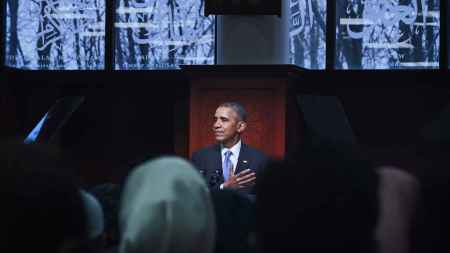
On Wednesday the U.S. media interrupted its saturation coverage of the presidential primaries to report on President Barack Obama’s visit to a mosque in Maryland. The visit was Obama’s first public one to a mosque in the US since entering the White House seven years ago. The mosque Obama chose to visit demonstrated once again that his views of radical Islam are deeply problematic.

Obama visited the Islamic Society of Baltimore, a mosque with longstanding ties to the Muslim Brotherhood and Hamas. During Operation Protective Edge, the leaders of the mosque accused Israel of genocide and demanded that the administration end US support for the Jewish state.

According to The Daily Caller, the mosque’s former imam Mohammad Adam el-Sheikh was active in the Islamic American Relief Agency, a charity deemed a terror group in 2004 after the US Treasury Department determined it had transferred funds to Osama bin Laden, Hamas, al-Qaida and other terrorist groups.

El-Sheikh left the Baltimore mosque to take over the Dar el-Hijra mosque in northern Virginia. He replaced Anwar al-Awlaki as imam after Awlaki moved to Yemen in 2003. In Yemen Awlaki rose to become a senior al-Qaida commander.

Awlaki radicalized many American jihadists both through direct contact and online. He radicalized US Army major Nidal Malik Hasan, and inspired him to carry out the 2009 massacre of 13 US soldiers and civilians at Fort Hood in Texas. Awlaki was killed by a US drone strike in 2011.

In 2010, a member of the Islamic Society of Baltimore was arrested for planning to attack an army recruiting office. According to the Mediaite news portal, the mosque reportedly refused to cooperate with the FBI in its investigation.

Obama’s visit to the radical mosque now is a clear signal of how he intends to spend his last year in office. It tells us that during this period, Obama will adopt ever more extreme positions regarding radical Islam.

Obama’s apologetics for radical Islamists is the flipside of his hostility for Israel. This too is escalating and will continue to rise through the end of his tenure in office.

The US Customs authority’s announcement last week that it will begin enforcing a 20-yearold decision to require goods imported from Judea and Samaria to be labeled “Made in the West Bank,” rather than “Made in Israel,” signals Obama’s intentions. So, too, it is abundantly clear that France’s plan to use the UN Security Council to dictate Israel’s borders was coordinated in advance with the Obama administration.

Part of the reason Obama is acting with such urgency and intensity is that he knows that regardless of who is elected to replace him, the next president will not be as viscerally hostile to Israel or as emotionally attached to Islam as he is.

On the Democratic side, neither candidate is a particularly energetic supporter of Israel or counter- jihad warrior. Former secretary of state Hillary Clinton’s recently released email discussions of Israel with her closest advisers indicate that all of Clinton’s closest counselors are hostile to Israel.

For his part, Vermont’s socialist Sen. Bernie Sanders harbors the far Left’s now standard anti-Israel attitudes. Not only did Sanders – like Clinton – support Obama’s nuclear deal with Iran. He boycotted Prime Minister Benjamin Netanyahu’s speech before the Joint Houses of Congress where Netanyahu laid out Israel’s reasons for opposing the deal. Sanders gave television interviews condemning Netanyahu for making the speech, accusing him of electioneering on the back of the US Congress. Sanders criticized Israel during Operation Protective Edge and supports decreasing US military aid to Israel.

For all their anti-Israel sensibilities, though, neither Clinton nor Sanders gives the impression that they are driven by them as Obama is.

Unlike Obama, neither appear to be animated by their hostility toward Israel. Neither seem to be passionate in their support for Muslim Brotherhood- affiliated groups or in their desire to realign the US away from Israel, from its traditional Arab allies and toward Iran. This lack of passion makes it safe to assume that if elected president, while they will adopt anti-Israel policies, they will not seek out ways to weaken Israel or strengthen its sworn enemies.

On the Republican side, the situation is entirely different. All of the Republican presidential candidates are pro-Israel. To be sure, some are more pro-Israel than others. Sen. Ted Cruz, for instance, is more supportive than his competitors. But all of the Republicans candidates are significantly more supportive of Israel than the Democratic candidates. So it is simply an objective fact that Israel will be better off if a Republican is elected in November no matter who he is and no matter who the Democratic candidate is.

It hasn’t always been this way. And it doesn’t have to remain this way.

Back in 1992 when Bill Clinton was running against George H.W. Bush, if Israel was your issue, you voted for Clinton because he was rightly viewed as more pro-Israel than Bush.

Twenty-four years ago, supporting Israel carried no cost for Clinton. According to Gallup, in 1992, 52 percent of Democrats were pro-Israel.

On the other hand, Bush was probably harmed somewhat for the widespread perception that he was anti-Israel. In 1992, 62% of Republicans were pro-Israel.

Over the past 15 years, the situation has altered considerably.

Today, Republicans are near unanimous in their support for Israel. According to a Gallup poll from February 2015, 83% of Republicans support Israel.

Only 48% of Democrats do. From 2014 to 2015, Democratic support for Israel plunged 10 points.

The cleavage on Israel is particularly acute among partisan elites.

Last summer, pollster Frank Luntz conducted a survey of US elite partisan opinion on Israel. His data were devastating. According to Luntz’s data, 76% of Democratic elite believe that Israel has too much influence over US foreign policy. Only 20% of Republicans do.

Nearly half (47%) of highly educated, wealthy and politically active Democrats think that Israel is a racist country. Thirteen percent of their Republican counterparts agree.

And whereas only 48% of Democrats believe that Israel wants peace, 88% of Republicans believe that Israel wants peace with its neighbors.

These trends affect voting habits. According to Luntz, while only 18% of Democrats say they would be more likely to vote for a politician who supports Israel, 31% said they are less likely to vote for a pro-Israel candidate. In contrast, 76% of Republicans say they want their representatives to support Israel.

Forty-five percent of Democrats said they would be more likely to vote for a politician who is critical of Israel and 75% of Republicans said they would be less likely to vote for an anti-Israel candidate.

These data tell us two important things. Today Democratic candidates will gain nothing and may lose significant support if they support Israel.

In contrast, a Republican who opposes Israel will have a hard time getting elected, much less winning a primary.

Partisan sensibilities aren’t the only reason that Israel is will be better off if a Republican wins in November. There is also the issue of policy continuity.

Even though neither Clinton nor Sanders share Obama’s anti-Israel passion, their default position will be to maintain his policies. Traditionally, when an outgoing president is replaced by a successor from his own party, many of his foreign policy advisers stay on to serve his successor.

Moreover, if American voters elect a Democrat to succeed Obama, their decision will rightly be viewed as a vote of confidence in his policies.

Obama has radicalized the Democratic Party in his seven years in office. When Obama was inaugurated, the Blue Dog caucus of conservative Democratic members of the House of Representatives had 54 members. Today only 14 remain.

Obama’s Democratic Party is not Bill Clinton’s party.

A party that isn’t forced to pay a price for its policies isn’t likely to change them. If the Democrats are not defeated in the run for the White House in November, their party will not reassess its shift to radicalism and reconsider its increasingly hostile stance on Israel.

That then brings us to the state of the presidential race following the Iowa caucuses and ahead of next Tuesday’s primary in New Hampshire. The Iowa caucuses showed a significant gap in enthusiasm among partisan voters. Participation rates in the Republican caucuses were unprecedented.

Cruz shattered the record for vote getting in the state that saw participation rates up 30% from 2012. On the Democratic side, participation rates were below the 2008 level.

On the Republican side, the three top candidates – Cruz, businessman Donald Trump and Sen. Marco Rubio – are all backed by committed, fervent supporters. On the Democratic side, Clinton’s supporters are reportedly diffident about her. And while Sanders enjoys enthusiastic support from voters under 45, he can’t seem to convince people who actually know what socialism is to support him.

If Sanders wins the Democratic nomination, on the face of it, it is difficult to see his path to victory in the general election. Whereas Obama was elected by hiding his radical positions, Sanders is running openly as a socialist and attacks Obama from the Left. Whether America is a center-right or center-left country, the undisputed truth is that it is a centrist country.

As for Clinton, the likelihood grows by the day that by the general election, her inability to inspire her base will be the least of her problems.

The FBI’s ongoing probe of her use of a private email server during her tenure as secretary of state is devastating her chances of getting elected.

The State Department’s revelation last week that 22 of Clinton’s emails were too classified to be released, even with parts blacked out, makes it impossible to dismiss the prospect that she will be indicted for serious felony offenses. Yet, as Jonah Goldberg argued Wednesday in National Review, with her narrow victory in Iowa, Clinton blocked the opening for a less damaged candidate – like Vice President Joe Biden or former New York mayor Michael Bloomberg – to step into the race.

In other words, the Republican nominee will have an energized base and will face either a legally challenged or openly socialist Democratic opponent.

According to terrorism expert Steven Emerson, before Obama visited the Islamic Society of Baltimore, he asked the FBI for its opinion of the mosque. FBI investigators informed Obama of the mosque’s ties to terrorism. They urged him not to confer it with the legitimacy that comes with a presidential visit.

Obama ignored the FBI’s advice.

The next 11 months will be miserable for Israel.

But we should take heart. By all accounts, next year will be better. And judging by the way the presidential race is shaping up, next year may be a much, much better year.

Islamic activists say 9/11 and San Bernardino were terrible — because of their effects on Muslims.

December 23, 2015

Islamic activists say 9/11 and San Bernardino were terrible — because of their effects on Muslims. National Review, Anne Bayefsky, December 22, 2015

Over at the United Nations, they are laying the groundwork for the 2016 American presidential election — on behalf of the Democratic party. The perceived golden ticket? Playing the victim card. Wild and repeated accusations are being hurled against the GOP of systematic racism, xenophobia, and, in particular, “Islamophobia.”

On December 18, 2015, the U.N. hosted two panels under the title “The Changing Dynamics of Islamophobia and Its Implications on Peaceful and Inclusive Societies.”

The predominant theme was victimhood. There were frequent mentions of 9/11, but not of the 2,977 who died, or their families. The alleged victims of 9/11 of interest to the U.N. gathering were the entirety of American Muslims. MuslimGirl.net editor Amani Al-Khatahtbeh told the U.N. audience: “I was in fourth grade when 9/11 happened. So I had to endure the height of Islamophobia during my formative years.” Wajahat Ali of Al Jazeera America said that 9/11 was “a baptism by fire. . . . As a result of that pain and trauma of 9/11, for my generation there is always a pre- and post-9/11.”

Each instance of radical Islamist terror was flipped the same way. Co-host Ufuk Gokcen, the U.N. representative of the Organization of Islamic Cooperation, had a long list of incidents bracketed by events in America: “9/11 terrorist attacks . . . and San Bernardino terrorist attacks. The level that Islamophobia has reached, and its mainstreaming into media and political discourse, is terrifying us.”

Terrifying who?

The idea was repeated in another form by his co-host, Sally Kader, head of the U.S. Federation for Middle East Peace, an NGO. She told the receptive crowd: “The FBI census on all the hate crime has always been against Jews, and, of course, blacks, and now we top everything. It’s about Muslims.”

Actually, the FBI census for 2014, released November 16, 2015, still found that 57 percent of anti-religious hate crimes were motivated by “anti-Jewish bias” and that 16 percent of victims were the object of “anti-Islamic (Muslim) bias.”

Then came the excuses. According to Joyce Dubensky, head of the Tanenbaum Center, “people talk about violent extremists and extremists as crazy. . . . I think that that’s an error. I think that’s a stereotype as well. They are also complex human beings, which is why we want to try to talk with them as well.”

One shudders to think of a meeting between Ms. Dubensky and Abu Bakr al-Baghdadi.

Scratch the surface of this latest batch of U.N. talking heads and the promotion of terrorism and anti-Semitism isn’t hard to find. The Muslimgirl.net site of Palestinian Al-Katahtbeh includes justifications of the “martyrdom” of Palestinian mothers and a drawing of the fashionable woman with a purse filled with knives, rocks, and a petrol bomb. Another speaker, journalist Haroon Moghul, wrote in the Huffington Post in January 2015 that he advocates terminating a Jewish state altogether: “A one-state solution . . . is the only option.”

Throughout the proceedings, one could have mistaken “impartial” U.N. New York headquarters for a Democratic political rally. Moghul was applauded for his political take on the GOP debate of December 15: “The Republican debate . . . was kind of terrifying and traumatizing,” and the GOP was “a political party that is increasingly indulging in open racism, antisemitism, and Islamophobia.”

Another crowd pleaser from the Al Jazeera America journalist was this: “If certain people with wavy hair became president . . . we might end up in concentration camps. We can brand it and call it Trump centers.”

So how did all this go down for the diplomat who represented the United States?

Here is Laurie Shestack Phipps when she took the microphone from the floor:

I’m from the U.S. Mission to the U.N., and I wanted to assure the audience and all the speakers that the U.S. government shares many of the concerns that you’ve expressed about the growing anti-Muslim discrimination in this country and around the world. . . . I did want to emphasize the position of the U.S. government very much in line with the focus of these two panels.

Remarkably, when this American diplomat could not manage to defend her country following hours of America-bashing — because her bosses don’t know the difference between humility and submission, or decorum and capitulation — she was put to shame by an Irish diplomat who could.

Speaking also from the floor, Michael Sanfey said:

Concerns were expressed for the state of American religious pluralism, but isn’t it still incredibly more pluralistic? Where is the religious pluralism in some of the Muslim-majority lands? It just seems to me there is no pluralism whatever. Couldn’t it help to combat Islamophobia if greater diversity was promoted in those lands where the churches [a]re absolutely forbidden?

The profoundly embarrassing spectacle makes the punch line perhaps less surprising.

Moderator Kader revealed to American taxpayers what happened to some of their half billion dollars that were used to renovate the U.N. in Turtle Bay. The event wrapped up on early Friday afternoon by announcing Friday prayers. It turns out that a part of the U.N. building has been taken over, in Kader’s words, for “Muslims to pray.”

No women allowed. Hillary and the U.N. A hell of a plan for 2016.

Hillary and the U.N. A hell of a plan for 2016.

Donald Trump and the American Future

December 22, 2015

Donald Trump and the American Future, Front Page Magazine, David Horowitz, December 22, 2015

dt_1

I have to confess that of late I have become increasingly pessimistic about the future of our country. For awhile I was hopeful that the electorate would finally cut through the fog of political correctness: the racist, collectivist, America-and-white people-are-guilty party line of the Democratic Party. Not so any more. Both the conservative punditry (with a few notable exceptions) and the Republican establishment are proving as feckless in resisting the left’s attacks, and as unfocused on the Democratic adversary as the Republican congress. The Democrats are at it full bore. Having gotten away with disarming the nation in the face of its enemies, and with promoting systematic racial discrimination, along with racist lynch mobs in the streets, the Democrats are busy on the attack. In their election campaign year, they are accusing Republican candidates of being racist and recruiters for ISIS. The only serious – i.e., bloody-minded – fire coming from the Republican side is directed at Donald Trump.  (Think about it – all the Democrats need is a damaged Trump. Then they can condemn Republicans for merely associating with him.) If Republicans want to join Democrats and match their viciousness in taking down the Republican front-runner, Hillary Clinton is going to be our next president.

The most recent explosion of outrage at Trump is his proposal for a temporary moratorium on Muslim immigration “until we figure it out” – i.e., figure out how to vet Muslim immigrants so that we don’t allow anymore Tashfeen Malik’s into the country where they are determined to kill innocent Americans. Otherwise perfectly intelligent conservatives have joined the Democrat smear squad in denouncing Trump’s suggestion as unconstitutional, illegal, and un-American. In fact, as a cursory Internet search should convince anyone free of anti-Republican bigotry, Trump’s proposal is not only constitutional (foreigners seeking entry into the country have no rights under the US Constitution – only US citizens do. It is also perfectly legal. There is an actual U.S. code that says the president has the authority to ban “any class” of individuals he deems a threat to the American citizens.

Moreover, Trump’s proposal is obviously sensible – i.e., is justified by a realistic confrontation with the facts. According to a Pew Poll, 64% of Muslims in Egypt and Pakistan believe that leaving the Muslim faith should be punished by death. In Afghanistan the figure is 78%. While 64% of Muslims are not active terrorists, there was not a single member of the Muslim community in San Bernardino willing to alert authorities to the hateful, indeed murderous ideas of the shooter couple. Punishing apostasy by death is only a crystallization of the jihadists’ belief that all non-Muslims who refuse to submit to the Islamic faith should be killed. That is what the war that Islamists have declared on us is about. Donald Trump has done the country a service by putting this issue – previously unmentionable – before the American public. Thus far he is the only candidate with the guts to do this, and that is why he is leading in the polls by a wide margin.

According to a 2009 “World Opinion Poll” conducted by the University of Maryland, between 30% and 50% of Muslims in Muslim countries approve of the terrorist attacks on America. If 64% of Muslims think that infidels deserve death – and an impressive percentage approve of the attacks on America and the West – that amounts to between 500 million and 800 million sworn enemies of our country and our culture.  Say it’s only a tenth of those numbers. That’s 50 million or more potential killers for Allah, and supporters of killers for Allah. Keep in mind that these terrorists already have chemical and biological weapons. Is there any person not blinded by leftwing ideas that doesn’t think this presents a vetting problem for us in dealing with Muslim immigrants and visitors? Moreover, a vetting problem that we obviously haven’t begun to solve? However, perhaps Trump’s blanket ban, though constitutional, legal and temporary – is also impractical. The details as Trump himself would be the first to admit are still negotiable. A practical plan even one of reduced scope is better than none.

So why are conservatives treating Trump as a pariah? Clinton and Obama have the blood of hundreds of thousands of Christians and non-ISIS Muslims on their hands not to mention the American victims of their rules of engagement. It is they and their party who have undermined the war on radical Islamists for 22 years since Bill Clinton refused to visit the thousand victims of the first World Trade Center bombing in 1993. Democrats have fought to try terrorist soldiers in civil courts where they would be given the rights of American citizens; they have fought to close Guantanamo, and have deliberately released terrorist generals to return to the battlefield and kill more Americans; Democrats have fought to abandon our military presence in Iraq, surrendering a hard won victory to ISIS and Iran; Obama and Hillary overthrew – illegally, immorally and unconstitutionally – the anti-al Qaeda government of Libya and turned that country into a terrorist hunting ground. Where are the Republican litanies high-lighting these betrayals?

In the meantime, jihadist mosques protected by Democrats continue to function – including the one attended by the San Bernardino shooters – the city of New York continues to bar first responders from monitoring mosques to see what they are preaching, 350 Sanctuary cities still refuse to cooperate with Homeland Security. All under the enemy-friendly doctrine that all Muslims belong to a protected species that cannot be scrutinized about their commitment to a religion that preaches hatred of non-Muslims, particularly Jews, and whose avowed goal is the political submission of the entire world to the Islamic faith.  On the other side, a Republican/conservative chorus has so tarred and feathered the Republican front-runner who is doing by default the work that they should be doing, that they have made it virtually impossible for him to win a general election. And make no mistake, they have also made it virtually impossible for any Republican candidate to speak frankly about the Democrats’ perfidy and the danger it poses to our country.

How much innocent blood do Barack Obama and Hillary Clinton have on their hands? How much innocent blood will be spilled in the next four years if Clinton is elected? These are the questions Republicans should be asking, not whether Donald Trump is a bigot. He obviously is not.  Impolitic yes. Racist no. Donald Trump has many faults but lack of political courage is not one of them. He seems motivated by concern for the pit into which this country has fallen under an administration with catastrophic priorities and uncertain loyalties. That is what Republicans need to think about when framing their next attacks. Otherwise the future is dim indeed.

Column One: Rubio, Cruz and US global leadership

December 18, 2015

Column One: Rubio, Cruz and US global leadership, Jerusalem Post, Caroline Glick, December 17, 2015

For the first time in a decade, Americans are beginning to think seriously about foreign policy; But are they too late?

At some point between 2006 and 2008, the American people decided to turn their backs on the world. Between the seeming futility of the war in Iraq and the financial collapse of 2008, Americans decided they’d had enough.

In Barack Obama, they found a leader who could channel their frustration. Obama’s foreign policy, based on denying the existence of radical Islam and projecting the responsibility for Islamic aggression on the US and its allies, suited their mood just fine. If America is responsible, then America can walk away. Once it is gone, so the thinking has gone, the Muslims will forget their anger and leave America alone.

Sadly, Obama’s foreign policy assumptions are utter nonsense. America’s abandonment of global leadership has not made things better. Over the past seven years, the legions of radical Islam have expanded and grown more powerful than ever before. And now in the aftermath of the jihadist massacres in Paris and San Bernadino, the threats have grown so abundant that even Obama cannot pretend them away.

As a consequence, for the first time in a decade, Americans are beginning to think seriously about foreign policy. But are they too late? Can the next president repair the damage Obama has caused? The Democrats give no cause for optimism. Led by former secretary of state Hillary Clinton, the Democratic presidential hopefuls stubbornly insist that there is nothing wrong with Obama’s foreign policy. If they are elected to succeed him, they pledge to follow in his footsteps.

On the Republican side, things are more encouraging, but also more complicated.

Republican presidential hopefuls are united in their rejection of Obama’s policy of ignoring the Islamic supremacist nature of the enemy. All reject the failed assumptions of Obama’s foreign policy.

All have pledged to abandon them on their first day in office. Yet for all their unity in rejecting Obama’s positions, Republicans are deeply divided over what alternative foreign policy they would adopt.

This divide has been seething under the surface throughout the Obama presidency. It burst into the open at the Republican presidential debate Wednesday night.

The importance of the dispute cannot be overstated.

Given the Democrats’ allegiance to Obama’s disastrous policies, the only hope for a restoration of American leadership is that a Republican wins the next election. But if Republicans nominate a candidate who fails to reconcile with the realities of the world as it is, then the chance for a reassertion of American leadership will diminish significantly.

To understand just how high the stakes are, you need to look no further than two events that occurred just before the Wednesday’s Republican presidential debate.

On Tuesday, the International Atomic Energy Agency voted to close its investigation of Iran’s nuclear program. As far as the UN’s nuclear watchdog is concerned, Iran is good to go.

The move is a scandal. Its consequences will be disastrous.

The IAEA acknowledges that Iran continued to advance its illicit military nuclear program at least until 2009. Tehran refuses to divulge its nuclear activities to IAEA investigators as it is required to do under binding UN Security Council resolutions.

Iran refuses to allow IAEA inspectors access to its illicit nuclear sites. As a consequence, the IAEA lacks a clear understanding of what Iran’s nuclear status is today and therefore has no capacity to prevent it from maintaining or expanding its nuclear capabilities. This means that the inspection regime Iran supposedly accepted under Obama’s nuclear deal is worthless.

The IAEA also accepts that since Iran concluded its nuclear accord with the world powers, it has conducted two tests of ballistic missiles capable of carrying nuclear weapons, despite the fact that it is barred from doing so under binding Security Council resolutions.

But really, who cares? Certainly the Obama administration doesn’t. The sighs of relief emanating from the White House and the State Department after the IAEA decision were audible from Jerusalem to Tehran.

The IAEA’s decision has two direct consequences.

First, as Iranian President Hassan Rouhani said Wednesday, it paves the way for the cancellation of the UN’s economic sanctions against Iran within the month.

Second, with the IAEA’s decision, the last obstacle impeding Iran’s completion of its nuclear weapons program has been removed. Inspections are a thing of the past. Iran is in the clear.

As Iran struts across the nuclear finish line, the Sunni jihadists are closing their ranks.

Hours after the IAEA vote, Turkey and Qatar announced that Turkey is setting up a permanent military base in the Persian Gulf emirate for the first time since the fall of the Ottoman Empire a century ago. Their announcement indicates that the informal partnership between Turkey and Qatar on the one side, and Hamas, the Muslim Brotherhood and Islamic State on the other hand, which first came to the fore last year during Operation Protective Edge, is now becoming a more formal alliance.

Just as the Obama administration has no problem with Iran going nuclear, so it has no problem with this new jihadist alliance.

During Operation Protective Edge, the administration supported this jihadist alliance against the Israeli-Egyptian partnership. Throughout Hamas’s war against Israel, Obama demanded that Israel and Egypt accept Hamas’s cease-fire terms, as they were presented by Turkey and Qatar.

Since Operation Protective Edge, the Americans have continued to insist that Israel and Egypt bow to Hamas’s demands and open Gaza’s international borders. The Americans have kept up their pressure on Israel and Egypt despite Hamas’s open alliance with ISIS in the Sinai Peninsula.

So, too, the Americans have kept Egyptian President Abdel Fattah al-Sisi at arm’s length, and continue to insist that the Muslim Brotherhood is a legitimate political force despite Sisi’s war against ISIS. Washington continues to embrace Qatar as a “moderate” force despite the emirate’s open support for the Muslim Brotherhood, Hamas and ISIS.

As for Turkey, it appears there is nothing Ankara can do that will dispel the US notion that it is a credible partner in the war on terror. Since 2011, Turkey has served as Hamas’s chief state sponsor, and as ISIS’s chief sponsor. It is waging war against the Kurds – the US’s strongest ally in its campaign against ISIS.

In other words, with the US’s blessing, the forces of both Shi’ite and Sunni jihad are on the march.

And the next president will have no grace period for repairing the damage.

Although the Republican debate Wednesday night was focused mainly on the war in Syria, its significance is far greater than one specific battlefield.

And while there were nine candidates on the stage, there were only two participants in this critical discussion.

Sens. Marco Rubio and Ted Cruz faced off after weeks of rising contention between their campaigns.

In so doing, they brought the dispute that has been seething through their party since the Bush presidency into the open.

Rubio argued that in Syria, the US needs to both defeat ISIS and overthrow President Bashar Assad.

Cruz countered that the US should ignore Assad and concentrate on utterly destroying ISIS. America’s national interest, he said, is not advanced by overthrowing Assad, because in all likelihood, Assad will be replaced by ISIS.

Cruz added that America’s experience in overthrowing Middle Eastern leaders has shown that it is a mistake to overthrow dictators. Things only got worse after America overthrew Saddam Hussein and supported the overthrow of Muammar Gaddafi and Hosni Mubarak.

For his part, Rubio explained that since Assad is Iran’s puppet, leaving him in power empowers Iran. The longer he remains in power, the more control Iran will wield over Syria and Lebanon.

The two candidates’ dispute is far greater than the question of who rules Syria. Their disagreement on Syria isn’t a tactical argument. It goes to the core question of what is the proper role of American foreign policy.

Rubio’s commitment to overthrowing Assad is one component of a wider strategic commitment to fostering democratic governance in Syria. By embracing the cause of democratization through regime change, Rubio has become the standard bearer of George W. Bush’s foreign policy.

Bush’s foreign policy had two seemingly contradictory anchors – a belief that liberal values are universal, and cultural meekness.

Bush’s belief that open elections would serve as a panacea for the pathologies of the Islamic world was not supported by empirical data. Survey after survey showed that if left to their own devices, the people of Muslim world would choose to be led by Islamic supremacists. But Bush rejected the data and embraced the fantasy that free elections lead a society to embrace liberal norms of peace and human rights.

As to cultural meekness, since the end of the Cold War and with the rise of political correctness, the notion that America could call for other people to adopt American values fell into disrepute. For American foreign policy practitioners, the idea that American values and norms are superior to Islamic supremacist values smacked of cultural chauvinism.

Consequently, rather than urge the Islamic world to abandon Islamic supremacism in favor of liberal democracy, in their public diplomacy efforts, Americans sufficed with vapid pronouncements of love and respect for Islam.

Islamic supremacists, for their part stepped into the ideological void without hesitation. In Iraq, the Iranian regime spent hundreds of millions of dollars training Iranian-controlled militias, building Iranian-controlled political parties and publishing pro-Iranian newspapers as the US did nothing to support pro-American Iraqis.

Although many Republicans opposed Bush’s policies, few dared make their disagreement with the head of their party public. As a result, for many, Wednesday’s debate was the first time the foundations of Bush’s foreign policy were coherently and forcefully rejected before a national audience.

If Rubio is the heir to Bush, Cruz is the spokesman for Bush’s until now silent opposition. In their longheld view, democratization is not a proper aim of American foreign policy. Defeating America’s enemies is the proper aim of American foreign policy.

Rubio’s people claim that carpet bombing ISIS is not a strategy. They are right. There are parts missing from in Cruz’s position on Syria.

But then again, although still not comprehensive, Cruz’s foreign policy trajectory has much to recommend it. First and foremost, it is based on the world as it is, rather than a vision of how the world should be. It makes a clear distinction between America’s allies and America’s enemies and calls for the US to side with the former and fight the latter.

It is far from clear which side will win this fight for the heart of the Republican Party. And it is impossible to know who the next US president will be.

But whatever happens, the fact that after their seven-year vacation, the Americans are returning the real world is a cause for cautious celebration.

Who’s the crazy one?

December 10, 2015

Who’s the crazy one? Front Page MagazineDavid Horowitz, December 10, 2015

dt

Donald Trump’s great contribution is saying the unsayable; putting things on the table that would otherwise be buried; calling a spade a spade in a time when political correctness has made us unable to discuss things that have to do with our basic national survival.  This is the crux of the issue.  Every time he creates a controversy like this he also tells this country that its emperors, Republican and Democrat, have no clothes. That they prefer propriety over defending the country.  That they are dedicated only to keeping the lid on a cauldron of threat and challenge they have allowed to boil over.

***********************

Presidential candidate Donald Trump has called for a moratorium on Muslim immigration until we can figure out why Islamic terrorists have been able to enter our country and devised ways to protect ourselves. This has caused the left and right establishments to dogpile on Trump. Echoing the sentiments of virtually all Democrats and many Republicans, aWashington Post editorial has declared that Trump’s proposal disqualifies him as a candidate because in the Post’s view what he recommends is unconstitutional and therefore un-American. But President Obama has issued executive orders – as it happens orders that sabotage our borders – that he himself has called unconstitutional (“I don’t have the authority to stop deportations”).  Has the Post editorialized that this is un-American and disqualifies him for the presidency? Has it called for Obama to be impeached? Have Democrats ridiculed Obama for his un-American prescriptions?

Consider the nature of the threat. A 2009 “World Opinion” survey by the University of Maryland showed that between 30 and 50% of Muslims in Jordan, Egypt and other Islamic countries approved of the terrorist attacks on America and that only a minority of Muslims “entirely disapproved” of them. ISIS has acknowledged its plans to use refugee programs to infiltrate its terrorists into the United States and other infidel countries. In Minneapolis we have a Somali refugee community many of whose members have returned to Syria to fight for ISIS. Other Muslim immigrants like Major Hassan and Tashfeen Malik have carried out barbaric acts of terror here at home. Today Muslim terrorists are using assault rifles and pipe bombs, but we know they have Sarin gas and other chemical weapons which they might use tomorrow. The terrorists inexorably arrive along with the other immigrants, no one in authority apparently knowing who’s who. Who, then, in his right mind does not think that Muslim immigration poses a serious security threat to us?

The outrage against Trump should properly have been directed at our president who refuses to identify the enemy as Islamic terrorism, who has opened the door to nuclear weapons and ballistic missiles to the Islamic America-haters in Iran, whose policies have created the vacuums that ISIS has filled, and who even after Paris and San Bernardino is determined to bring 100,000 immigrants from Syrian war zones to our unprotected shores. This outrage is missing and it is precisely because it is missing that Trump’s unconstitutional proposal resonates with so many rightly concerned Americans. When the man in charge of our security is by general consensus out to lunch in regard to fighting the war on Islamic terror, or protecting us at home, a proposal like Trump’s, which at least recognizes the threat, is going to resonate with the public.

In middle of a crisis of national security, the Democratic Party seems to think that climate change and especially gun ownership are greater threats to our survival than the one that comes from hundreds of millions of Muslims who think America should be attacked and who believe the whole world should be put under medieval Islamic law. In the face of this threat, the Democratic Party and its leaders seem to have no problem with the fact that we have more than 350 “Sanctuary Cities” that are dedicated to sabotaging our immigration laws; that we have no southern border and as a result have 179,000 illegal alien criminals and who knows how many terrorists in our country today.

Once again we have Trump to thank for changing the surreal conversation about whether having a border at all is compatible with American values, and forcing people to focus on the dangers we face. Republicans are generally defenders of this country, but not in this controversy over Donald Trump. Would that they would use the same ridicule and outrage over the Democrats’ many betrayals of our country and its citizens through proposals to expose us to our enemies as they do over a proposal to protect us from them. Trump’s idea may be unconstitutional and unworkable, but it springs from a desire that is honorable and patriotic. The appropriate response would be to propose alternatives that recognize the same dangers and serve the same ends but do so within constitutional limits.

Donald Trump’s great contribution is saying the unsayable; putting things on the table that would otherwise be buried; calling a spade a spade in a time when political correctness has made us unable to discuss things that have to do with our basic national survival.  This is the crux of the issue.  Every time he creates a controversy like this he also tells this country that its emperors, Republican and Democrat, have no clothes. That they prefer propriety over defending the country.  That they are dedicated only to keeping the lid on a cauldron of threat and challenge they have allowed to boil over.

The 2016 election will be a referendum on the defense of this country and its survival. Let’s see who answers the call.

The Elephant In The Room

October 2, 2015

The Elephant In The Room, Middle East Media Research Institute (MEMRI), Yigal Carmon*, October 2, 2015

(Please see also, Iran wants to renegotiate parts of the nuke “deal.” That may be good. Have opponents of the “deal” given up? If so, why? — DM)

It may be that these opponents believe that the agreement is a done deal that cannot be stopped and that the current U.S. administration will follow through with it no matter what. This approach reflects not realism but ignorance. Obviously the administration wants to follow through with the deal. But the deal is no longer in it hands. It is Khamenei who is throwing a spanner in the works, declaring that he will not implement the agreement that the West believed it concluded on July 14.

In order to get Iran to implement the agreement, the language of the JCPOA will have to be changed and a new Security Council resolution will have to be passed. While in theory this would not be impossible, it would require a new process, entailing, at the very least, a public political debate in the West – one that would reveal Iran’s unreliability as a partner and would cost valuable time. And time is not on the side of the U.S. administration.

*****************

On September 3, 2015, not two months after the July 14 announcement of the Joint Comprehensive Plan of Action at Vienna and its celebration at the White House and in Europe, Iranian Supreme Leader Ali Khamenei dropped a bombshell.

In a speech to the Iranian Assembly of Experts, he backtracked from the agreement, demanding a new concession: that the sanctions be “lifted,” not merely “suspended.”[1] If that term is not changed, said Khamenei, there is no agreement. If the West only “suspends” the sanctions, he added, Iran will merely “suspend” its obligations. Giving further credence to his threat, he announced that it is the Iranian Majlis that must discuss and approve the agreement (or not), because it represents the people – when it is well known that the majority of its members oppose it, and Iranian President Hassan Rohani made every effort to prevent such a discussion in the Majlis from taking place.

Adding insult to injury, Ali Akbar Velayati, senior advisor to Khamenei and head of Iran’s Center for Strategic Research, said on September 19 that the negotiations, concluded and celebrated less than two months previously on July 14, are actually “not over yet.”[2]

Khamenei’s demand to replace “suspension” with “lifting” is not just semantic. It is a fundamental change, because the snapback of sanctions – the major security mechanism for the entire agreement – cannot take place with “lifting,” but only with “suspension.”

Ever since Khamenei dropped this bombshell, the Western media has maintained total silence, as if this were a trivial matter not worthy of mention, let alone analysis.

One might understand this reaction on the part of those who support the deal. Perhaps they are shocked, at a loss, and therefore hope that if they pretend they don’t see it, it doesn’t exist. Indeed, this is the futile policy regularly adopted by ostriches.

However, one cannot but be astounded by the silence on the part of the opponents of the deal, including – oddly enough – Israel and the U.S. Republicans. One would expect these opponents to pounce on Khamenei’s statement and raise hell over Iran’s infanticide of the two-month-old agreement. One would expect them to bring it to the forefront of a new debate over the deal in any possible forum – in the U.S., the U.N., and the E.U.

But – nothing.

It may be that these opponents believe that the agreement is a done deal that cannot be stopped and that the current U.S. administration will follow through with it no matter what. This approach reflects not realism but ignorance. Obviously the administration wants to follow through with the deal. But the deal is no longer in it hands. It is Khamenei who is throwing a spanner in the works, declaring that he will not implement the agreement that the West believed it concluded on July 14.

In order to get Iran to implement the agreement, the language of the JCPOA will have to be changed and a new Security Council resolution will have to be passed. While in theory this would not be impossible, it would require a new process, entailing, at the very least, a public political debate in the West – one that would reveal Iran’s unreliability as a partner and would cost valuable time. And time is not on the side of the U.S. administration.

Right now, Iran is exposed almost daily as the ally of Russia against the U.S. Three months after the “historic” agreement declared by the White House, Iran continues to seek “Death to America,” and the Iranian foreign minister, the “hero” of the agreement, needs to apologize in Iran for “accidentally” shaking hands with the U.S. president. The truth of the agreement is emerging, and it is not certain that what Iran is now demanding will pass.

Interestingly enough, the White House’s first reaction was to brush off Khamenei’s demand. Iran, said Josh Earnest, should just do what it what it had undertaken to do in the agreement, and stop roiling the waters.[3]

A more sober response followed. There was hope that the meeting set for September 28 between the P5+1 and Iranian foreign ministers, on the margins of the 70th session of the U.N. General Assembly, would produce a solution, but this hope was in vain. Iranian President Rohani fled back to Iran, on the pretext of the hajj tragedy in Mecca, and no one in the West knows how to proceed.

The Western media, for its part, is perpetuating its total blackout on the issue, hoping perhaps for a miracle in the secret U.S.-Iran talks, which this administration has been conducting for years. But even a secret U.S. concession will be no solution. Even if it were to offer a secret commitment to remove the sanctions altogether, Khamenei will not be satisfied. He openly challenged the U.S., and he needs its public capitulation. He will celebrate publicly any secret concession. Moreover, any new U.S. concession will prompt Khamenei to make ever more demands.

The most recent developments, and the emergence of Russia as a new-old contender for power vis-à-vis the U.S. in the world, particularly in the Middle East, will only encourage Khamenei to cling to his tried and true ally, Russia. Indeed, this administration has no objection to Russia’s resurgence in the Middle East, but Russia’s blatant anti-U.S. stance in every venue except in the private, honeyed Putin-Obama talks will ultimately lead even the blindest of Democrats to realize that Iran is indeed an enemy of the U.S. – as Iran plainly declares – and that any further concessions to it make no sense.

It seems that the worst nightmare of the supporters of the deal – that Iran will do away with the July 14 agreement – is about to come to pass.

*Y. Carmon is president and founder of MEMRI.

Endnotes:

[3] Earnest said: “What we have indicated all along is that once an agreement was reached, as it was back in mid-July, that we would be focused on Iran’s actions and not their words, and that we will be able to tell if Iran follows through on the commitments that they made in the context of these negotiations. And that is what will determine our path forward here. We’ve been crystal clear about the fact that Iran will have to take a variety of serious steps to significantly roll back their nuclear program before any sanctions relief is offered – and this is everything from reducing their nuclear uranium stockpile by 98 percent, disconnecting thousands of centrifuges, essentially gutting the core of their heavy-water reactor at Arak, giving the IAEA the information and access they need in order to complete their report about the potential military dimensions of Iran’s nuclear program. And then we need to see Iran begin to comply with the inspections regime that the IAEA will put in place to verify their compliance with the agreement. And only after those steps and several others have been effectively completed, will Iran begin to receive sanctions relief.  The good news is all of this is codified in the agreement that was reached between Iran and the rest of the international community. And that’s what we will be focused on, is their compliance with the agreement.” Whitehouse.gov, September 4, 2015.