Posted tagged ‘Obama’s America’

Obama’s Dangerous Rhetoric

July 24, 2015

Obama’s Dangerous Rhetoric, Hoover Institution, Victor Davis Hanson, July 22, 2015
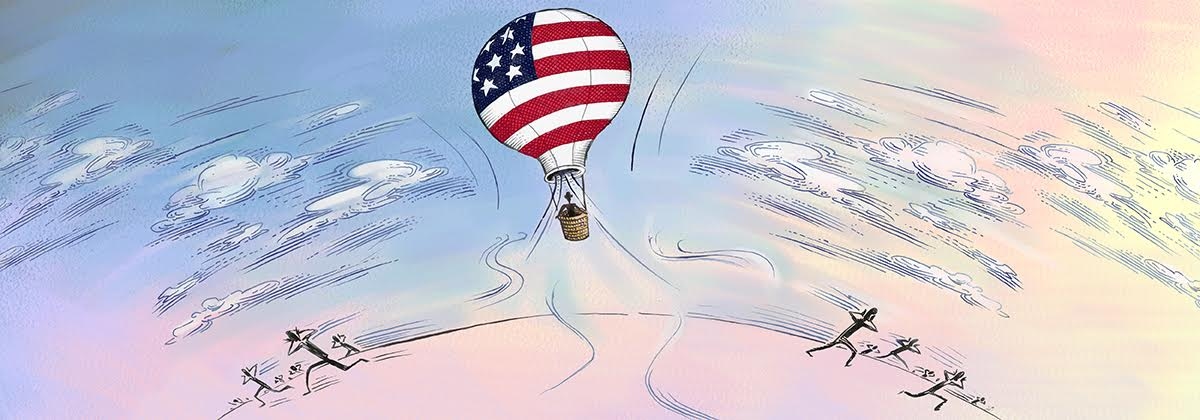
World runs awayImage credit: Barbara Kelley

President Obama has a habit of asserting strategic nonsense with such certainty that it is at times embarrassing and frightening. Nowhere is that more evident than in his rhetoric about the Middle East.

Not long ago, Obama reassured the world that, despite evidence of the use of chemical weapons in Syria, “Chlorine itself is not listed as a chemical weapon.” What could he have meant by that? Obama apparently was referring to the focus on Sarin gas by the Organization for Prohibition of Chemical Weapons, the UN watchdog agency that was supposed to monitor Obama’s Syria red line warnings against further gas attacks. To reassure the public that the United States would not consider chlorine gas a violation of its own red line about chemical weapons use in Syria—and, therefore, to assure the public that his administration would not intervene militarily in Syria—Obama said:  “Chlorine itself, historically, has not been listed as a chemical weapon.”

Nothing could be further from the truth. Chlorine was the father of poison gas, the first chemical agent used in World War I—and it was used to lethal effect by the Germans at the battle of Ypres in April 1915. Subsequently, it was mixed and upgraded with phosgene gas to make an even deadlier brew and employed frequently throughout the war—most infamously at the Battle of the Somme.

The president was clearly bothered that he had boxed himself into a rhetorical corner and might have had to order air strikes against the defiant Assad regime—lest he appear wavering in carrying out his earlier threats. One way out of that dilemma would be to deny that chorine constituted a serious weapon used to kill soldiers and civilians. Another would simply be to claim that he had never issued such a red line to Bashar al-Assad at all. That refuge is exactly what Obama fell back upon at press conference on September 4, 2013: “I didn’t set a red line. The world set a red line.”

Here is what the president had earlier stated on August 20, 2012, in threatening Assad: “We have been very clear to the Assad regime, but also to other players on the ground, that a red line for us is we start seeing a whole bunch of chemical weapons moving around or being utilized. That would change my calculus. That would change my equation.”

The use of the presidential pronouns “we” and “my” are synonymous with the voice of his administration. Indeed, Obama had doubled down on his 2012 red line with the clarification that, “When I said that the use of chemical weapons would be a game-changer, that wasn’t unique to—that wasn’t a position unique to the United States and it shouldn’t have been a surprise.”

In the summer of 2014, Obama had dismissed the emergence of ISIS with colorful language about its inability to project terrorism much beyond its local Iraqi embryo: “I think the analogy we use around here sometimes, and I think is accurate, is if a JV team puts on Lakers uniforms, that doesn’t make them Kobe Bryant. I think there is a distinction between the capacity and reach of a bin Laden and a network that is actively planning major terrorist plots against the homeland versus jihadists who are engaged in various local power struggles and disputes, often sectarian.”

ISIS, remember, had already conducted terrorist operations across the Mediterranean. Both organized and lone-wolf terrorists, with claims of ISIS ties or inspiration, would go on to attack Westerners from France to Texas.

Obama compounded his obfuscations by later claiming to Meet the Press anchor Chuck Todd that he had never said such a thing at all about ISIS—an assertion that was deemed false by even the liberal fact-checking organization PolitiFact. More recently, in July 2015, Obama claimed that the now growing ISIS threat could not be addressed through force of arms, assuring the world that “Ideologies are not defeated with guns, they are defeated by better ideas.”

Such a generic assertion seems historically preposterous. The defeat of German Nazism, Italian fascism, and Japanese militarism was not accomplished by Anglo-American rhetoric on freedom. What stopped the growth of Soviet-style global communism during the Cold War were both armed interventions such as the Korean War and real threats to use force such as during the Berlin Airlift and Cuban Missile Crisis— along with Ronald Reagan’s resoluteness backed by a military buildup that restored credible Western military deterrence.

In contrast, Obama apparently believes that strategic threats are not checked with tough diplomacy backed by military alliances, balances of power, and military deterrence, much less by speaking softly and carrying a big stick. Rather, crises are resolved by ironing out mostly Western-inspired misunderstandings and going back on heat-of-the moment, ad hoc issued deadlines, red lines, and step-over lines, whether to the Iranian theocracy, Vladimir Putin, or Bashar Assad.

Sometimes the administration’s faith in Western social progressivism is offered to persuade an Iran or Cuba that they have missed the arc of Westernized history—and must get back on the right side of the past by loosening the reins of their respective police states. Obama believes that engagement with Iran in non-proliferation talks—which have so far given up on prior Western insistences on third-party, out of the country enrichment, on-site inspections, and kick-back sanctions—will inevitably ensure that Iran becomes “a successful regional power.” That higher profile of the theocracy apparently is a good thing for the Middle East and our allies like Israel and the Gulf states.

In his well-publicized Cairo speech of June 2009, Obama declared that Islam had a hand in prompting the Western Renaissance and Enlightenment, as well as offering other underappreciated gifts to the West, from medicine to navigation. Obama’s tutorial was offered to remind the Muslim Brotherhood members in his audience that the West really does owe much to the Muslim World—and thus by inference should expect reciprocal consideration in the current war on terror.

In his February 2, 2015 outline of anti-ISIS strategy—itself an update of an earlier September 2014 strategic précis—Obama again insisted that “one of the best antidotes to the hateful ideologies that try to recruit and radicalize people to violent extremism is our own example as diverse and tolerant societies that welcome the contributions of all people, including people of all faiths.” The idea, a naïve one, is that because we welcome mosques on our diverse and tolerant soil, ISIS will take note and welcome Christian churches.

One of Obama’s former State Department advisors, Georgetown law professor Rosa Brooks, recently amplified that reductionist confidence in the curative power of Western progressivism. She urged Americans to tweet ISIS, which, like Iran, habitually executes homosexuals. Brooks hoped that Americans would pass on stories about and photos of the Supreme Court’s recent embrace of gay marriage: “Do you want to fight the Islamic State and the forces of Islamic extremist terrorism? I’ll tell you the best way to send a message to those masked gunmen in Iraq and Syria and to everyone else who gains power by sowing violence and fear. Just keep posting that second set of images [photos of American gays and their supporters celebrating the Supreme Court decision]. Post them on Facebook and Twitter and Reddit and in comments all over the Internet. Send them to your friends and your family. Send them to your pen pal in France and your old roommate in Tunisia. Send them to strangers.”

Such zesty confidence in the redemptive power of Western moral superiority recalls First Lady Michelle Obama’s efforts to persusade the murderous Boko Haram to return kidnapped Nigerian preteen girls. Ms. Obama appealed to Boko Haram on the basis of shared empathy and universal parental instincts. (“In these girls, Barack and I see our own daughters. We see their hopes, their dreams and we can only imagine the anguish their parents are feeling right now.”) Ms. Obama then fortified her message with a photo of her holding up a sign with the hash-tag #BringBackOurGirls.

Vladimir Putin’s Russia has added Crimea and Eastern Ukraine to his earlier acquisitions in Georgia. He is most likely eyeing the Baltic States next. China is creating new strategic realities in the Pacific, in which Japan, South Korea, Taiwan, and the Philippines will eventually either be forced to acquiesce or to seek their own nuclear deterrent. The Middle East has imploded. Much of North Africa is becoming a Mogadishu-like wasteland.

The assorted theocrats, terrorists, dictators, and tribalists express little fear of or respect for the U.S. They believe that the Obama administration does not know much nor cares about foreign affairs. They may be right in their cynicism. A president who does not consider chlorine gas a chemical weapon could conceivably believe that the Americans once liberated Auschwitz, that the Austrians speak an Austrian language, and that the Falklands are known in Latin America as the Maldives.

Both friends and enemies assume that what Obama or his administration says today will be either rendered irrelevant or denied tomorrow. Iraq at one point was trumpeted by Vice President Joe Biden as the administration’s probable “greatest achievement.” Obama declared that Iraq was a “stable and self-reliant” country in no need of American peacekeepers after 2011.

Yanking all Americans out of Iraq in 2011 was solely a short-term political decision designed as a 2012 reelection talking point. The American departure had nothing to do with a disinterested assessment of the long-term security of the still shaky Iraqi consensual government. When Senator Obama damned the invasion of Iraq in 2003; when he claimed in 2004 that he had no policy differences with the Bush administration on Iraq; when he declared in 2007 that the surge would fail; when he said in 2008 as a presidential candidate that he wanted all U.S. troops brought home; when he opined as President in 2011 that the country was stable and self-reliant; when he assured the world in 2014 that it was not threatened by ISIS; and when in 2015 he sent troops back into an imploding Iraq—all of these decisions hinged on perceived public opinion, not empirical assessments of the state of Iraq itself. The near destruction of Iraq and the rise of ISIS were the logical dividends of a decade of politicized ambiguity.

After six years, even non-Americans have caught on that the more Obama flip-flops on Iraq, deprecates an enemy, or ignores Syrian redlines, the less likely American arms will ever be used and assurances honored.

The world is going to become an even scarier place in the next two years. The problem is not just that our enemies do not believe our President, but rather that they no longer even listen to him.
Kerry raps Menendez over ‘classified’ Iran clause

July 23, 2015

Kerry raps Menendez over ‘classified’ Iran clause, Times of Israel, July 23, 2015

(Why, other than the likely embarrassment of the Obama Administration, would such a matter be “classified?” — DM)

John Kerry rebukes fellow Democrat Robert Menendez for revealing what he says is a “classified” clause in the Iran nuclear deal stating that Iran will be the one to provide the UN atomic agency with samples from sites with suspected nuclear activity.

“That is a classified component of this,” Kerry says when the New Jersey senator asks about the section of the deal. Menendez says it is “the equivalent of the fox guarding the chicken coop.”


UPDATE

Here is a video of Sen. Menendez questioning Secretary Kerry and others about the “deal.” The relevant question and answer begin at 10:oo into the video.


American Dream Does not Stop Radicalization of Terrorists

July 23, 2015

American Dream Does not Stop Radicalization of Terrorists, Act for America, July 22, 2015


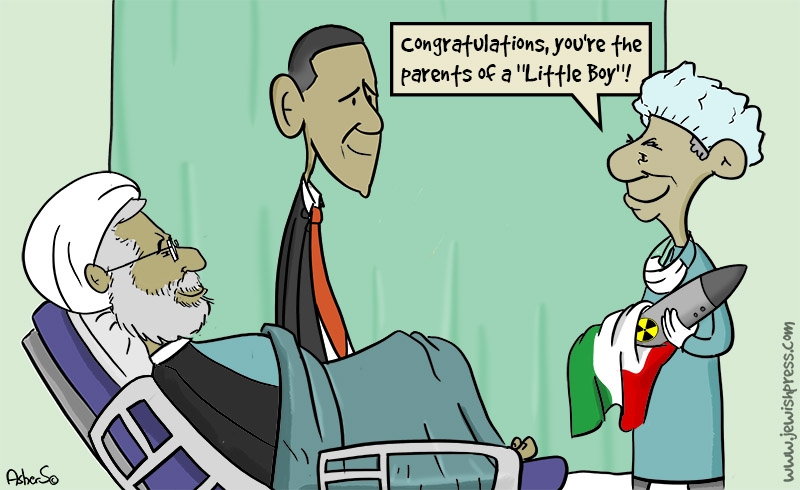
Cartoon of the day

July 23, 2015

H/t The Jewish Press


little-boy

Springtime for America’s Enemies

July 22, 2015

Springtime for America’s Enemies, The Daily BeastGarry Kasparov, July 22, 2015

(This is from The Daily Pest Beast. — DM)

Dangerous and short-sighted U.S. diplomacy has empowered no one except state sponsors of terrorism and fascistic regimes.

There has never been a better time in history to be an enemy of the United States of America. While America’s traditional allies in Europe and the Middle East express confusion and frustration, Obama’s White House delivers compliments and concessions to some of the most brutal dictatorships in the world. In the span of a single week, the U.S. has restored diplomatic relations with Cuba, pressured Ukraine to accept Vladimir Putin’s butchering of its eastern region, and brokered a deal to liberate Iran from sanctions.

These actions would represent a tremendous series of diplomatic triumphs if they improved human rights in these repressed nations, saved lives in conflict regions, or improved global security. That is, in fact, what the White House says these deals will do, despite copious evidence to the contrary. These negotiations represent willful ignorance of the fundamental nature of the regimes in question, especially those of Iran and Russia. Cuba is a political hotspot in the U.S. and remains a potent symbol of totalitarianism, but despite its regional meddling, especially in Venezuela, it isn’t on the scale of the global threats represented by Iran’s terrorism and nuclear ambitions and Putin’s nuclear-backed expansionism. Regardless of the wishes of the Iranian and Russian people, their leaders have no interest in peace, although they are very interested in never-ending peace negotiations that provide them with cover as they continue to spread violence and hatred.

The vocabulary of negotiation is a pleasant and comforting one, especially to a war-weary America. It’s difficult to argue against civilized concepts like diplomacy and engagement, and the Obama administration and the pundits who support it have made good use of this rhetorical advantage. In contrast, deterrence and isolation are harsh, negative themes that evoke the dark time of the Cold War and its constant shadow of nuclear confrontation. No one would like less a return to those days than me or anyone else born and raised behind the Iron Curtain. The question is how best to avoid such a return.

The favorite straw man of the “peacemongers” is that the only alternative to appeasement is war, which makes no sense when there is already an escalating war in progress. The alternative to diplomacy isn’t war when it prolongs or worsens existing conflicts and gives the real warmongers a free hand. Deterrence is the alternative to appeasement. Isolation is the alternative to years of engagement that has only fueled more aggression.

Perhaps it’s because I grew up in a Communist country that I cannot so casually ignore the suffering of the people being left behind as these treaties are signed. Ronald Reagan was called a warmonger by the same crowd that is praising Obama to the skies today and yet Reagan is the one who freed hundreds of millions of people from the Communist yoke, not the “peacemakers” Richard Nixon and Jimmy Carter.

Diplomacy takes two while capitulation is unilateral. Diplomacy can fail and there is real damage, and real casualties, when it does. Putin’s dictatorship was immeasurably strengthened by the catastrophe known as “the reset,” an Obama/Hillary Clinton policy that gave Putin a fresh start as an equal on the world stage just months after he invaded Georgia. Years that could have been spent deterring Putin’s crackdowns and centralization of power while he still needed foreign engagement were instead spent cultivating a partnership that never really existed. Time that could have been used to establish alternate sources of gas and oil were squandered, leaving Europe vulnerable to energy blackmail.

By 2014, Putin had consolidated power at home completely and, with no significant domestic enemies left and sure he would face little international opposition, he was confident enough to invade Ukraine and annex Crimea. The thousands of dead and hundreds of thousands of displaced people in Ukraine are Putin’s victims, of course, but they must also weigh on the conscience of the bureaucrats, diplomats, and leaders whose cowardice—well-intentioned or not—emboldened Putin to that point.

As recent days and past decades past have shown us, it is easy to paint the critics of nearly any diplomatic process as warmongers. Again, the language of peace and diplomacy is soothing and positive. If we just talk a little longer, if we just delay a little more, if we just concede a little more… To make the peacemonger position even more unassailable, every outbreak of violence large or small can be blamed on the failure of the diplomats to talk, delay, and concede more. And sometimes, to be fair, acceptable compromises are reached and, if not win-win, mutually satisfactory lose-lose agreements can defuse conflicts and avoid bloodshed. Diplomacy is supposed to be the modern way, the civilized way, and it should always be considered first—and second.

But diplomacy also requires a measure of good faith by all parties. It assumes that one side (or both) isn’t lying and cheating. It assumes that there is sufficient coercion and/or self-interest for the deal to hold. A peace treaty assumes that both sides actually want peace; a ceasefire assumes that both sides will cease firing. When these things cannot be assumed, any deal is a likely to be a bad deal. At best it will be meaningless and the regimes operating in bad faith will be quick to exploit the delays and concessions. By signing agreements with regimes that have proven time and again that they cannot be trusted and have no interest in peace or ceasefires, the Obama administration has turned the great game of diplomacy into Russian roulette.

Keeping a firm grip on power is the only thing that matters in a dictatorship. The consequences of losing power in an authoritarian regime rarely involve peaceful retirement and a long life. (Gorbachev is a notable exception, mostly due to his cleverly taking credit for the Soviet collapse he fought so hard to avoid, as well as to the shameful lack of appetite in Russia and the international community for holding Communist leaders accountable.) Both Khamenei and Putin have brutally cracked down on their own people to remove any challenges to their authority. Both rely on vicious propaganda to drum up nationalism and hatred for foreign enemies and “traitors” at home, i.e. anyone who opposes or criticizes the regime. Both wage war and terror on their borders and beyond. Both hold sham elections to provide a distraction for their citizens and fodder for the global press to blather on about the potential for liberalization. And this week, both Putin and Khamenei have been rewarded by President Obama with negotiations that will aid them in causing further suffering to their people and in making the world far less safe. Obama gets his “peace for our time” fanfare and the dictatorships continue with business as usual.

A remark made by Israeli Minister of Foreign Affairs Moshe Dayan is much repeated by the peacemongers in times like these. In a 1977 interview the renowned military man said that “if you want to make peace, you don’t talk to your friends.” This is both clever and true, but what has been forgotten is that Dayan continued, “But the question is whom do we want to make peace with—not just who are our enemies.” It’s delusional to think you can make peace with an unrepentant state sponsor of terror like Iran or a Russian regime that is sending tanks across a European border and adopting fascist propaganda.

It is clear that the Obama administration thinks it should and can make peace with anyone, whether they like it or not, and whether or not they actually change their odious behavior. These terrible deals with Cuba, Russia, and Iran—it’s like the old joke about the businessman who sells each unit at a loss but says he’ll make it up in volume. Cuba continues to jail journalists and dissidents. Putin’s forces are still illegally occupying Crimea and waging war in Eastern Ukraine while Assistant Secretary of State Victoria Nuland bullies the Ukrainian government into the concessions that Putin demanded in the latest Minsk ceasefire accord (which his troops ignore, of course).

Iran will dramatically upgrade its ability to support the military wings of Hezbollah, Hamas, and the Houthis in Yemen it has been supplying with weapons for years. There is little doubt Iran will also continue its attempts to develop a nuclear weapon, and even if it fails it is sure to spark a nuclear arms race in the region. Iran’s hardliners have been cemented in power by escaping sanctions while giving up nothing. Calling all of this a triumph for diplomacy is perverse. By the time Obama is polishing his Nobel Peace Prize in his presidential library, the next president will be left facing two aggressive despotic regimes that are stronger and more confident of their invincibility than ever.

Expansionist dictatorships never transform quietly. They most often end in collapse or violent revolution. Comparisons of the Iran agreement to the opening of China in the 1970s are absurd. China would have starved had they not abandoned Mao’s catastrophic plans and built an export economy, something that required formal relations with the free world. In contrast, petro-dictatorships like Iran don’t need their people or to be on good terms with the West—especially not now that the economic sanctions will be lifted.

The casualties that have resulted from weakness masked as diplomacy far outnumber those stemming from being too hasty to confront and deter aggression. The peacemongers should keep that in mind as Iran uses some of its $100 billion in newly unfrozen assets to arm its terror proxies. Before applauding the next ceasefire in Ukraine as progress they should recall what Putin did during the last two. More than anything, before Obama again praises the tyrannical leaders of Cuba, Iran, and Russia for their cooperation, he should remember that some enemies are worth having.

The emperor is stark naked

July 22, 2015

The emperor is stark naked, Israel Hayom, Judith Bergman, July 22, 2015

It did not take the Europeans long to approve the Iran nuclear deal. On Monday, less than a week ‎after the deal was finalized, the European Union had already given its blessing. Given the fact that the EU is a massive body consisting of 28 countries that rarely agree on any foreign policy ‎issues, certainly not those of such a magnitude, it is rather noteworthy that they could find such sweet ‎unison over the most infamous political deal since Chamberlain’s deal with Hitler.

‎”It is a balanced deal that means Iran won’t get an atomic bomb,” French Foreign Minister Laurent Fabius ‎said, “It is a major political deal.”

Sure it is.

Especially for the likes of France and Germany, which can barely contain themselves at the ‎prospect of doing business with the Iranian regime. It has been 12 years since the Europeans could legally ‎engage in trade with the genocidal, misogynistic, homophobic and generally murderous regime of the ‎mullahs and they are not wasting any time, now that the opportunity has resurfaced.

In fact, the ink was barely dry on the nuclear deal when German Vice Chancellor Sigmar Gabriel — who ‎also happens to be economy and energy minister and is therefore as senior a German official as Germany could get without ‎actually sending Angela Merkel herself — rushed himself and a group of representatives from German ‎companies and industry groups onto a plane for a three-day visit to Iran. ‎

Trying, yet utterly failing, to make the trip appear a little more dignified than the simple naked greed that ‎it represents, the vice chancellor “urged Iran at the start of [the] three-day visit to improve its relationship ‎with Israel if it wanted to establish closer economic ties with Germany and other Western powers,” ‎according to Reuters.

If Germany wanted Iran to take that poor show of accommodating Israeli concerns seriously, it might ‎have tried to contain itself just a little longer to at least see whether the U.S. Congress approves the ‎deal. However, as we all know, time is money and the Germans are well known for being efficient.

Yet, the Germans are far from the only ones lining up for immediate business with the Iranians. Fabius is due to visit Iran next week. “I find it completely normal that ‎after this historic deal was signed, France and Iran should restart normal relations,” Fabius said. Before ‎the sanctions took effect, French companies Peugeot and Renault were making billions of euros from ‎their involvement with the Iranian auto industry. Similarly, French company Total was heavily involved in ‎the oil sector. France is not missing a beat in bringing this lucrative trade back into la République.

The French employers’ federation, MEDEF, is due to visit Iran in September. So is Austria. The EU, which is ‎eager to find alternative suppliers of energy at a time when relations with Russia are rather tense, may ‎reopen an EU delegation in Tehran.

Notice how the European political elites consider it, in the French foreign minister’s words, “completely ‎normal” to do business with a heinous regime like Iran, which breaks every single rule in the book of human rights, the bible from which the Europeans pedantically lecture Israel ‎on every possible occasion. It is ostensibly in the name of those very same human rights that the EU wants to boycott Israeli products in order to avoid choking on an Israeli orange from beyond the ‎Green Line.‎

Yet these days the streets of Europe are eerily quiet and completely devoid of protests, as the citizens of ‎Europe demonstrably could not care less about the fact that their countries will now once again be trading ‎in a major way with the Iranian regime.

Where is the outrage, as it becomes increasingly clear that the EU, out of commercial ‎considerations for the lucrative trade and oil flowing from such a deal, has supported the agreement with ‎Iran? Where are the boycotts, divestment and sanctions? Where are the flotillas?

What European lawmaker, bureaucrat or ordinary citizen cares at all that women and children, political ‎prisoners and homosexuals are tortured and summarily executed in Iran, when Iranian oil and money will ‎now flow freely into the EU? ‎Is it of any concern to any of the European that Iran is a regime with genocidal intentions toward Israel and cares for ‎nothing but its own survival?‎

The hypocrisy and the double standards have become so thick and obvious that Hans Christian Andersen’s proverbial emperor is walking stark naked through the streets of Europe. However, should a ‎child appear to point out that the emperor is not wearing any clothes, no one would care to listen.

Atomic Energy Organization Of Iran Chief Ali Akbar Salehi: We Have Reached An Understanding With The IAEA On The PMD, Now Political Backing Exists And The Results Will Be Very Positive

July 22, 2015

Atomic Energy Organization Of Iran Chief Ali Akbar Salehi: We Have Reached An Understanding With The IAEA On The PMD, Now Political Backing Exists And The Results Will Be Very Positive. MEMRI, July 22, 2015

(Please see also House Republican: Obama Administration Won’t Release Full Iran Deal to Congress and State Spokesman Repeatedly Refuses to Answer Whether There Are ‘Side Deals’ Between Iran and Nuclear Watchdog. The questions now appear to have been answered.– DM)

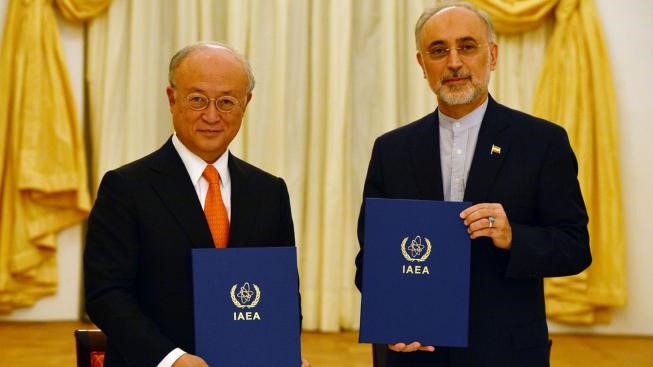
24178Secretary-general Amano (left) with AEOI’s Salehi (Image: IAEA)

The technical issues are now being resolved in a political framework. They have set a time frame and, God willing, the issue must be resolved by December 15.”

********************

The PMD (Possible Military Dimensions) issue that includes an investigation of suspicions that Iran previously conducted a military nuclear program, was one of the main stumbling blocks between Iran and the P5+1 group and primarily between Iran and the United States and the EU3. These suspicions are based inter alia on a November 2011 International Atomic Energy Agency (IAEA) report that the agency had information on Iran’s performance of activities related to nuclear weapons development until 2003 and that some of these activities were possibly continuing.[1] Iran persistently refused to respond to all the IAEA’s questions and due to its refusal to cooperate fully with the IAEA the UN Security Council passed six anti-Iran resolutions demanding that Iran cooperate immediately with the IAEA on this topic in order to disclose the truth.

On July 14, 2015, the day the Comprehensive Joint Plan of Action agreement between Iran and the P5+1 was declared, IAEA Secretary-General Yukio Amano and the Atomic Energy Organization of Iran chief Ali Akbar Salehi, one of the lead Iranian negotiator, signed a “roadmap agreement” in which Iran committed to provide the IAEA with clarifications and explanations on the PMD. Amano announced that if Iran would cooperate fully with the IAEA (as opposed to its conduct up to now) he could submit his conclusions by December 15, 2015. Under the agreement the lifting of sanctions enters into effect only following the IAEA report’s submission.

In an interview to the Iranian channel IRIB on July 21, 2015, Salehi disclosed that Iran has reached an understanding with the IAEA regarding the PMD; that now problems are solved on the political level and since political backing exists, the IAEA cannot do whatever it wants as it did in the past when such political backing did not exist. Therefore, the IAEA’s PMD investigation would be most positive for Iran. Salehi explained that the IAEA had to act reasonably otherwise it would be the loser.

Below is the transcript of Salehi’s IRIB interview:

Salehi: “By December 15, at the end of the year, the issue (of the PMD) should be determined. The IAEA will submit its report to the board of governors. It will only submit it. The Joint Comprehensive Plan of Action will continue independently of the results of this report. We have reached understandings with the IAEA. God willing, there will be very positive results. We do not accept the PMD issue, the (suspicions against) Iran’s past (military nuclear) activity. We are resolving this in a political-technical framework, in order to deny them any pretext. Look, if it was decided that the (IAEA) will not be convinced no matter what… As the saying goes: If someone pretends to be asleep, you cannot wake him up. If someone does not want to be convinced, it does not matter how hard you try. You tell him that it is daytime, and he tells you that it’s night. If the IAEA was not meant to be convinced in the regular track, it would never be convinced, regardless of what we did. They presented 18 questions, we answered them (but couldn’t convince them), and there is nothing more that could be done. Now that the technical issues are being resolved on the political level, the pace has picked up. The technical issues are now being resolved in a political framework. They have set a time frame and, God willing, the issue must be resolved by December 15.”

Interviewer: “But considering the IAEA’s bad record regarding…”

Salehi: “In short, they will be the losers. As I have said, the issue has received political backing. The work of (the IAEA) must be reasonable. They cannot do anything unreasonable. When there is no political backing, they do whatever they want, but now there is political backing, and the issue should be resolved, and God willing, it will be.”

Endnote:

[1] Iaea.org, July 14, 2015.

State Spokesman Repeatedly Refuses to Answer Whether There Are ‘Side Deals’ Between Iran and Nuclear Watchdog

July 22, 2015

State Spokesman Repeatedly Refuses to Answer Whether There Are ‘Side Deals’ Between Iran and Nuclear Watchdog, Washington Free Beacon, , July 22, 2015

(Please see also, House Republican: Obama Administration Won’t Release Full Iran Deal to Congress. — DM)

State Department spokesman John Kirby repeatedly refused to answer direct questions from MSNBC’s Joe Scarborough Wednesday over whether he knew about reported “side deals” between Iran and the nuclear watchdog International Atomic Energy Agency (IAEA) that would not be subject to scrutiny by Congress or the American public.

“I won’t speak for the IAEA,” Kirby said. “What I can tell you is that all relevant documents to this deal, certainly all those in our possession, have been delivered to Congress. They were delivered over the weekend, and they’ll have access to everything that we have access to.”

The U.N. nuclear watchdog plays the critical role of verification in the agreement by seeking to ensure Iran is not violating it with illicit nuclear activity.

National Review reported on two Republicans issuing a press release that they’d discovered these deals while meeting with IAEA officials in Vienna

Senator Tom Cotton (R., Ark.) and Congressmen Mike Pompeo (R., Kan.) issued a press release today on a startling discovery they made during a July 17 meeting with International Atomic Energy Agency officials in Vienna: There are two secret side deals to the nuclear agreement with Iran that will not be shared with other nations, with Congress, or with the U.S. public.

One of these side deals concerns inspection of the Parchin military base, where Iran reportedly has conducted explosive testing related to nuclear-warhead development. The Iranian government has refused to allow the IAEA to visit this site. Over the last several years, Iran has taken steps to clean up evidence of weapons-related activity at Parchin.

The other secret side deal concerns how the IAEA and Iran will resolve outstanding issues on possible military dimensions (PMDs) of Iran’s nuclear program. In late 2013, Iran agreed to resolve IAEA questions about nuclear weapons-related work in twelve areas. Iran only answered questions in one of these areas and rejected the rest as based on forgeries and fabrications.

Scarborough was unsatisfied with Kirby’s answer and pressed him repeatedly to give a definitive answer to whether the U.S. had knowledge of these details or whether such “side deals” existed at all. The exchange went on:

SCARBOROUGH: But Admiral, does the State Department know of secret side deals between Iran and the IAEA? Do you know of secret side deals between Iran and the IAEA? Does Secretary Kerry know of secret side deals between Iran and the IAEA?

KIRBY: What we know is that the IAEA will be working with Iran to make sure that they have the information and access that they need to be able to verify Iran’s commitments to this deal.

SCARBOROUGH: But that’s not the question I asked. That’s not the question I asked, Admiral. Are you all familiar with side deals between the IAEA as it pertains to Iran’s nuclear program that we don’t know about?

KIRBY: This isn’t about side deals, Joe. This is about making sure the IAEA gets the access they need to verify Iran’s commitments, and they’re going to do that. I can’t speak for the IAEA. What I can do is speak for the State Department, and I can say definitely that every relevant document –

SCARBOROUGH: But you certainly can speak to your knowledge and Secretary Kerry’s knowledge and the State Department’s knowledge and the White House’s knowledge. Do you all have knowledge of these side deals?

KIRBY: We know that the IAEA is going to work with Iran to make sure they get the access they need. How they do that and what manner they do that, I’m going to let them speak to that.

Co-host Mika Brzezinski cut in.

“It sounds like there’s side deals,” she said.

“I’m just trying to get a yes or a no,” Scarborough said.

Kirby looked perturbed at this point.

“I can’t really answer it any better than I did,” he said. “I mean, the IAEA needs to get the access to verify Iran’s compliance and they’ll do that. How they work with Iran on that is really for them to speak to. What I can you tell you though is every relevant document in this deal, and there’s a lot of them, everything has been delivered to Congress, and they’re going to get ample time to speak to Secretary Kerr and Secretary Moniz to answer all their questions.”

Scarborough concluded the exchange by saying Kirby actually could have answered better with a simple yes or no, but he moved on.

Op-Ed: Obama’s Deception Set Off a New Era

July 22, 2015

Op-Ed: Obama’s Deception Set Off a New Era, Israel National News, Dr. Joe Tuzara, July 22, 2015

Not surprising, the Obama administration considers both the US and Israel to be key threats to peace in the world.

**********************

President Barack Obama’s strange self-delusion for Iran to become a more “formidable regional power” has already triggered an undeclared new era for nuclear proliferation in the Middle East.

Despite this established ignominy of an emboldened Iran strengthened by Obama’s naive policies at the expense of Israel and Sunni Arab allies, the White House suggestion that they “sought to pursue diplomacy to prevent Iran from obtaining a nuclear weapon that could set off a nuclear arms race” is based on fantasy.

Whichever way they try to spin it, Obama’s rhetoric that the deal “cut off every pathway to nuclear weapons, prevented a nuclear arms race in the Middle East” doesn’t match reality.

The deal explicitly acknowledges that Iran is gaining benefits no other state would gain under the Non-Proliferation Treaty (NPT). In terms of its nuclear development, instead of dismantling Iran’s nuclear program, that program is now protected.

Such a deal, one that allows a leading state sponsor of terror to retain the ability to develop nuclear weapons, threaten Israel, continue their hegemonic ambitions and support for terrorism is a historic nadir of the Obama presidency.

As Obama’s secret letter to Ayatollah Khamenei makes clear, securing the deal simply legitimizes Tehran, a de facto regional US ally standing on the threshold of a nuclear weapon.

It is a shame that the Obama administration’s total capitulations were made in areas that were supposed to prevent Iran from acquiring nuclear weapons. The fake Iran deal does confirm Israeli and Sunni Arab Muslims fears that they can no longer depend on the Obama administration to protect their vital national security interests.

Even worse, Obama had given up on its stated goals of preventing Iran from obtaining a nuclear weapon and his dumb promise to fight a bad deal while underwriting the expansion of Iranian hegemony unquestionably was not just only reckless but cynical.

As it turned out, “détente” with Iran is the main goal of the Obama’s pretend diplomacy. In essence, Obama’s “appeasement” is not diplomacy and his secret back-channel negotiations with the fanatical, corrupt and Machiavellian terrorist regime is treason.

The moment Obama become an advocate for the “Islamic State of Iran” that enjoys the benefits of no real verification regime and no real consequences for serial violations of UN nuclear weapons resolutions, he has lost all credibility to govern our great nation. Similarly, when Obama negotiated away Israel’s existence, he became the real enemy of Israel.

Not surprising, the Obama administration considers both the US and Israel to be key threats to peace in the world. Given that Obama has done all it can to [prevent an Israeli preemptive strike, from leaking Israeli attack scenarios to denying Israel air space over Iraq, the fact that he] coordinated with the Iranian regime –and attempted to cut off weapons shipments to Israel in the midst of its war with Iranian proxy terror group Hamas, his statements about the strength of this deal carry no weight at all.

On the other hand, Obama’s flawed perspective and deception on a grand scale significantly risks the collapse of 50 year US alliance structure in the Middle East, contravenes 70 years of US nonproliferation policy and endangers 45 years of a landmark international treaty (NPT) whose objective is to prevent the spread of nuclear weapons and weapons technology.

Quite unfortunately, the Iran deal set a dangerous precedent that allows rogue states and radical fundamentalist elements in particularly issuing veiled threats to quickly go nuclear. With Iran getting active on the borders of Egypt and Saudi Arabia, those regimes would be foolhardy not to attempt to develop a nuclear capacity –especially given that Obama has shown there are no detriments to doing so.

Equally disturbing, Obama has given all the Sunni Arab Gulf countries the pathways to build civilian nuclear energy programs with possible military dimensions.

Ironically, Obama has created a major void allowing an opening for many potential benefits, that it holds for Russia. In the last six months, Russia has struck three significant nuclear deals with long-time US Middle East allies: Egypt, Jordan and Saudi Arabia.

An unnamed sources told the Al Arabiya TV network that Saudi Arabia and Russia agreed to build 16 nuclear reactors that Russia would play a significant role in operating. France became the first country to sign feasibility studies to build two nuclear reactors in Saudi Arabia potentially worth more than $10 billion.

Now we all know that Sunni Arabs will not sit idly as the world’s largest state-sponsor of terror becomes a nuclear-threshold state. The regional powers know this. Saudi Arabia has already said it will “match the nuclear capabilities Iran is allowed to maintain,” and it is an open secret that the Saudis have a nuke on the shelf in Pakistan.

The Center for Strategic and International Studies (CSIS) also noted that “the Arab Gulf states have acquired and are acquiring some of the most advanced and effective weapons in the world.”

One of many unintended outcomes of the nuclear talks is the emergence of covert Saudi and Gulf State alliance with their former archenemy, Israel. The Saudis and the Israelis have had five “secret” meetings to discuss common defense and intelligence issues related to Obama’s policy of strengthening Iran economically while permitting the terror state to become a potential nuclear power with a breakout capacity that is unknowable.

Tehran’s shocking nuclear bravado aside, the Middle East is going to experience another historic moment with the visit of Saudi Prince Talal bin Waleed  to Israel in what could be the most significant move toward peace between the Arabs and Israelis since Egypt’s Anwar Sadat’s iconic trip to Israel.

Saudi Prince Talal denounced the growing waves of anti-Semitism in the region and praised Israel as the region’s sole democratic entity. Calling for Muslims in the Middle East “to desist from their absurd hostility toward the Jewish people,” the prince went on to announce that Saudi King Salman bin Abdulaziz Al Saud has instructed him to open a direct dialogue with Israel’s intellectuals in pursuit of amicable ties with all of Israel’s Arab neighbors.

Amid the despair in the region generated by Obama’s Iran policy, this could be the most promising breakthrough  toward peace between Arabs and Israelis.

In arrogantly thinking he alone could decide the future of the Middle East, Obama has unleashed the unintended consequences that frequently shape great events: in this instance for the betterment of all the peoples of the Middle East but ultimately to the detriment of America’s interests.

Now, the moment of decision had finally come, Israelis must accept the risks and unintended consequences of preventive war rather than wait until Iran’s nuclear bombs are built.

Either way, for as long as the highly imperfect Iranian accords have not been ratified or rejected by Congress, a preemptive strike of Iran’s nuclear facilities is not an option.

Unless, Iran’s magical collaboration with the Obama administration ends up restocking its Iranian proxies with sophisticated radars and weapons from Russia, China and the United States, or facing the imminent threat of a nuclear attack- Israel will not hesitate  to deploy the “Samson option”.

And as long as the imminent proxy wars in the Golan Heights, Sinai Peninsula, Gaza or Lebanon remain conventional, Israel’s response would remain reciprocally non-nuclear.


House Republican: Obama Administration Won’t Release Full Iran Deal to Congress

July 22, 2015

House Republican: Obama Administration Won’t Release Full Iran Deal to Congress, National Review, Joel Gehrke, July 21, 2015

President Obama won’t allow Congress to review two key aspects of the Iranian Nuclear deal, Republican lawmakers learned from international partners last week. Under the terms of the Joint Comprehensive Plan of Action (JCPOA), the International Atomic Energy Agency would negotiate separately with Iran about the inspection of a facility long-suspected of being used to research long-range ballistic missiles and nuclear weapons.

“The Obama administration has failed to make public separate side deals that have been struck for the ‘inspection’ of one of the most important nuclear sites—the Parchin military complex,” said Representative Mike Pompeo (R., Kan.) in a statement Tuesday. “Not only does this violate the Iran Nuclear Agreement Review Act, it is asking Congress to agree to a deal that it cannot review.” The IAEA has been trying to gain access to the Parchin site since 2005, but Iran has refused, even as it apparently demolished various parts of the complex. “The hardliners do not want to grant any concessions unless Iran is suitably rewarded,” International Institute for Strategic Studies director Mark Fitzpatrick told the BBC in 2014, after reports emerged of explosions at the base.

The terms of the current agreement wouldn’t allow Congress to review any concessions the IAEA makes to get into the site. “Even members of Congress who are sympathetic to this deal cannot and must not accept a deal we aren’t even aware of,” said Pompeo. The IAEA will also separately negotiate “how the IAEA and Iran will resolve outstanding issues on possible military dimensions of Iran’s nuclear program,” according to a release from Pompeo’s office. Senator Tom Cotton (R., Ark.) and Pompeo, who serves on the House Intelligence Committee, learned of the arrangement while meeting with the IAEA in Vienna, Austria last week. “That we are only now discovering that parts of this dangerous agreement are being kept secret begs the question of what other elements may also be secret and entirely free from public scrutiny,” Cotton said in a statement to the press.


