Posted tagged ‘Islamophobia’

Germany’s Merkel to Voters: “No Change to Migration Policy”

March 18, 2016

Germany’s Merkel to Voters: “No Change to Migration Policy” Gatestone InstituteSoeren Kern, March 18, 2016

♦ Chancellor Angela Merkel ‘s migration policy is causing security mayhem in Germany, where mostly Muslim migts are raping and assaulting women and children with virtual impunity.

♦ Merkel’s party was defeated in two out of the three federal states voting in March 13 regional elections. By contrast, the Alternative for Germany (AfD) — an upstart anti-establishment party campaigning against Merkel’s liberal migration policy — surged to double-digit results in all three states.

♦ Political and media elites are ramping up a months-long campaign to delegitimize AfD voters as agitators, arsonists, far-right extremists, fascists, Nazis, populists and xenophobes.

♦ Vice Chancellor Sigmar Gabriel has called on German intelligence to begin monitoring the AfD, presumably in an effort to silence critics of the government’s migration policy. Gabriel has called for Germany to take in even more migrants by airlifting them into the country directly from the Middle East.

German Chancellor Angela Merkel has vowed to continue her open-door migration policy — despite heavy losses in regional elections that were widely regarded as a referendum on that very policy.

Merkel’s Christian Democratic Union (CDU) was defeated in two out of the three federal states voting on March 13. By contrast, the Alternative for Germany (AfD) — an upstart anti-establishment party campaigning against Merkel’s liberal migration policy — surged to double-digit results in all three states: Baden-Württemberg, Rhineland-Palatinate and Saxony-Anhalt.

In a press conference after the election results were in, Merkel remained defiant. She reprimanded German voters for questioning her handling of the migration crisis: “There are people who did not listen to us at all and simply cast protest votes. We need to solve this [migrant] problem, not through theoretical debates, but by finding a [European] solution to the problem.”

The elections were the most important in Germany since Merkel allowed more than one million migrants from Africa, Asia and the Middle East to enter the country in 2015. Merkel’s migration policy is causing security mayhem in Germany, where mostly Muslim migrants are raping and assaulting women and children with virtual impunity.

With immigration now the dominant issue in German politics, Merkel’s refusal to reverse her open-door migration policy has alienated many of her traditional supporters, scores of whom are flocking to the AfD to protest Germany’s pro-immigration, pro-EU political establishment.

The AfD was founded as a Eurosceptic party in 2013 by German economists advocating the abolition of the European single currency, the euro, and opposing financial bailouts of profligate eurozone countries such as Greece, Italy, Portugal and Spain.

At the time, the AfD was widely ridiculed by Germany’s mainstream media. In July 2013, for example, the Rheinische Post published an “analysis” which referred to the AfD as the “unlucky professor’s party” that “does not have many chances” as a political party. Nevertheless, in 2014 and 2015, the AfD secured seats in five of Germany’s 16 regional parliaments, and seven seats in the European Parliament.

After an internal power struggle, Frauke Petry — a 40-year-old chemist, entrepreneur and mother of four who hails from the former East Germany — assumed leadership of the AfD in July 2015. Since then, Petry has broadened the party’s initial focus on economics to immigration.

The AfD — now the third-largest party in Germany — poses a significant challenge to the political status quo in Germany. If its momentum holds, the AfD is on track to cross the 5% threshold in general elections in 2017 to qualify for seats in the national legislature, the Bundestag.

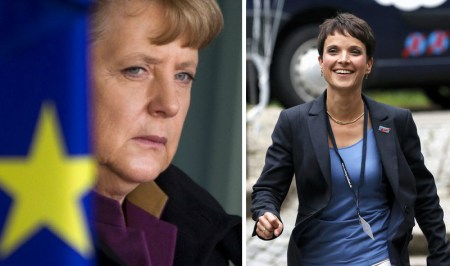
1515In recent regional elections, the CDU party of German Chancellor Angela Merkel (left) suffered heavy losses to the upstart anti-establishment party Alternative for Germany, led by Frauke Petry (right).

The left-leaning German newsmagazine, Der Spiegel, long hostile toward the AfD, acknowledged that the party has achieved a “breakthrough” and called the election result “Black Sunday” for Merkel:

“For a long time she had hoped, despite considerable popular opposition to her refugee policy, to win two chancelleries in the southwest of the country. This has come to nothing. Merkel will now have to live with the accusation that she has allowed the AfD finally to establish itself [as a democratic alternative] to the right of the CDU.”

The leader of the AfD, Frauke Petry, said the fact that her party won big in two states in western Germany — Baden-Württemberg and Rhineland-Palatinate — showed that “the AFD is an all-German party and that citizens in all regions of Germany want a change of politics.” In a Facebook post, she added:

“Yesterday we made a first important step in the right direction to break the cartels of consensus parties. Already, it has been indicated that they [mainstream parties] will not accept the will of the people. We will probably see the most colorful combination of political coalitions, just so they can continue to stay in power and further marginalize voters of the AfD.”

Petry was referring to Merkel’s spokesman, Steffen Seibert, who said that despite her electoral drubbing, Merkel will not reverse course on migration:

“The Federal Government will continue to pursue its refugee policy, with full determination, at home and abroad. At home, we will ease the path to integrate those people who have sought and found protection here. At European level, the goal must be a common, sustainable European solution that leads to a reduction in the number of refugees in all member states of the European Union.”

The CDU’s general secretary, Peter Tauber, echoed the view that there is no alternative to Merkel’s migration policy: “Considering what we have already achieved, I recommend that we continue on the path we are on.”

Some German commentators have tried to downplay the AfD’s gains by arguing that although Merkel lost the election, she actually won the election because the majority of Germans voted for mainstream parties. Bernd Ulrich, editor of Die Zeit, wrote:

“These three elections, which were in fact a plebiscite on the refugee policy, sent an encouraging message of approval. On average, two-thirds of voters cast ballots for parties that support the relatively liberal refugee policies of Angela Merkel.”

Writing in Der Spiegel, columnist Jakob Augstein argued:

“On Sunday Angela Merkel achieved an unlikely feat: her party was trounced, but her refugee policy was confirmed and strengthened… How did the chancellor do on Election Day? In truth, she has been strengthened. The fact is: a large majority of voters support the chancellor.”

According to Augstein, Merkel is “the right woman in the wrong party” because she has moved the center-right CDU to the left on so many issues, including migration policy, that the party is now virtually indistinguishable from its coalition partner, the center-left Social Democratic Party (SPD). What Augstein failed to mention is that Merkel’s move to the left is responsible for creating a political vacuum to the right of the CDU — a vacuum that is now being filled by the AfD.

Other political and media elites are ramping up a months-long campaign to delegitimize AfD voters as agitators, arsonists, far-right extremists, fascists, Nazis, populists and xenophobes.

German media are also churning out stories — many of which are based on hearsay — aimed at discrediting the AfD. The magazine, Stern, published this headline: “Reports of Nazi Songs at AfD-Election Party.” The Berliner Kurier: “Former Teacher Calls AfD Leader Frauke Petry a Liar.”Die Welt: “AfD Candidate Accused of Running Escort Service.” Berliner Morgenpost: “After AfD Coup, Saxony-Anhalt’s Hoteliers Are Anxious.” Stern: “AfD and Donald Trump: Hate is the Main Issue.” Die Zeit: “AfD Principles: Not So Important.”

On Election Day, Die Zeit ridiculed the AfD’s 70-point political platform by using the following bullet points:

“More popular referendums, more monitoring of citizens, stiffer penalties for criminals, dissolve the EU, shrink the state, lower taxes, cut social spending, put women back in the kitchen, ban employment quotas for women, make it harder to file for divorce, abolish abortion, close borders, harass Muslims, ruin the climate, expand nuclear power, expand the military, more private weapons, etc.”

Taxpayer-funded ZDF public television broadcast an interview with Thomas Kliche, a German psychologist, who compared AfD voters to “children who are stubborn and unreasonable.” The only way to deal with such people, he said, is “just have patience, ignore the stupidity, and confront it with rationalism.”

According to Kliche, AfD voters are suffering from “macro-social stress” induced by globalization (i.e., mass migration):

“People react with various forms of shock management. This begins with retrograde, regressive, childish fantasies that everything can be as it was before. Some believe that by shouting ‘We are the People!’ [the main slogan of anti-government demonstrators in East Germany in 1989-1990, reminding their leaders that Germany should be ruled by the people, not by an undemocratic party claiming to represent them], the migrants will disappear…. They have no solutions, just fantasies. Building a fence — this is a fantasy. Separate yourself from the world — that is a fantasy.”

Meanwhile, Vice Chancellor Sigmar Gabriel has called on German intelligence to begin monitoring the AfD, presumably in an effort to silence critics of the government’s migration policy. Gabriel — who leads the SPD, which also suffered significant losses on March 13 — has called the AfD a party of “right-wing extremists” who “use the language of the Nazis.” At the same time, Gabriel has called for Germany to take in even more migrants by airlifting them into the country directly from the Middle East.

By contrast, Horst Seehofer, the head of the Christian Socialist Union (CSU), the CDU’s sister party in Bavaria, said the rise of the AfD amounts to a “tectonic shift in the political landscape of Germany.” He warned that tectonic shifts trigger earthquakes that cause irreversible changes. Seehofer demanded that Merkel reverse course: “It cannot be that after such an election result, the answer to the electorate is: everything will go on as before.”

CSU politician Hans-Peter Uhl summed it up this way: “I expect the chancellor clearly to admit: ‘Yes, we have understood. We are going to return to the voters. Politics must move toward the voter, not the other way around. This is called democracy.'”

Merkel has not said if she plans to run for a fourth term in 2017.

Finland’s Immigration Crisis

March 6, 2016

Finland’s Immigration Crisis, Gatestone InstituteDawid Bunikowski, March 6, 2016

♦ The Tapanila gang-rape shocked the quiet Helsinki suburb, and all of Finland. Many wondered why these second-generation Somalis, citizens of Finland, would carry out such a savage attack.

♦ The rapists were eventually brought to trial. One was sentenced to a year and four months imprisonment, two were given one-year prison sentences and two others were acquitted. Penalties were softened due to the age of the rapists.

♦ “1,010 rapes were reported to the police in 2014, according to the Official Statistics of Finland. The number of suspected immigrants in these cases is about three times higher than of the suspected natives in relation to the population.” – Finland Today.

♦ The criminal law prohibiting blasphemy seem archaic in the eyes of many Finns, especially after the attack on the French satirical magazine, Charlie Hebdo. Unsuccessful attempts to decriminalize blasphemy took place between the 1910s until the 1990s. For many critics the concept of prohibited hate speech is problematic: there is no clear definition, a lapse that leads to confusion and acrimony.

Finland — an open country that prides itself on respecting different ways of life, cultures and religions — is being greatly tested by the wave of Middle Eastern asylum seekers.

Finland is a homogenous country that has roughly 5.5 million inhabitants, about 4% of which are foreign[1]. Twenty years ago, thousands of Somalis immigrated to Finland. In the last decade or so, more international students came to study, and more foreigners came to live and work.

Finnish universities and the academia are of a high level, and most Finns speak some English. But it is not easy for foreigners to find jobs. The barrier is the language: Finnish, like Hungarian, is a part of the Finno-Ugric languages, and difficult to learn.

How many asylum seekers from Syria, Iraq, and Afghanistan arrived in Finland in 2015? The figures keep changing. Authorities estimate between 30,000 and 50,000 — significant numbers in terms of the ratio of migrants to the native population.

Multiculturalism, Migration Policy, and the Law

“Hate speech” (vihapuhe) is defined in Finland as “speech that attacks a person or group on the basis of attributes such as gender, ethnic origin, religion, race, disability, or sexual orientation.” Hate speech is prohibited if such an act is a kind of ethnic agitation. For many critics — including Jussi Kristian Halla-aho, a member of the European Parliament for the True Finns Party — the concept of prohibited hate speech is problematic: there is no clear definition, a lapse that leads to confusion and acrimony.

The criminal law prohibiting blasphemy seem archaic in the eyes of many Finns, especially after the attack on the French satirical magazine, Charlie Hebdo. Many Finns believe that freedom of speech should be absolute. Unsuccessful attempts to decriminalize blasphemy took place between the 1910s until the 1990s. In one extreme case, Halla-aho was fined in 2008 for making links between Islam and paedophilia on his personal blog.

The current immigration situation in Finland is exceptional in nature. Muslims fleeing from the Middle East have opened up a humanitarian crisis the likes of which have not been seen in Europe in a long time. International public opinion and EU policy in the field are being tested. The current flow of Muslims through Sweden to northern Finland is chaotic.

The Ministry of the Interior website states that “Finland is an open and safe country” and explains the country’s policy toward migration:

“The Strategy views migration as an opportunity: mobility creates international networks and brings with it new ways of doing things. Migration will help to answer Finland’s dependency ratio problem, but at the same time, competition for workers between countries will increase. To succeed in this competition, Finland must be able to effectively attract skilled workers who will stay in the country for the longer term. As a responsible member of the international community, Finland is committed to providing international protection to those who need it.”

The ministry also adds that “everyone can find a role to play,” and “diversity is part of everyday life.”

Government officials have taken this strategy personally. Prime Minister Juha Sipilä attracted the attention of the international media last autumn when he offered his second home in Kempele to refugees. He stressed the values of mercy and compassion in the context of immigration.

While the Finnish government can produce liberal policies calling for more openness towards immigration, real politics eventually come into play. When it came time to vote in Brussels on the EU’s quota system for refugees and their relocation in EU countries, Finland abstained.

The ruling center-right political party, the Center Party (Keskusta), is both pragmatic and skeptical towards the European Union. The second most powerful political party, the True Finns (Perussuoamalaiset), is known for its anti-EU, anti-immigration and anti-Muslim rhetoric; its leader, Niko Soini, is the Minister of Foreign Affairs. The political cooperation between the Center Party and the True Finns exemplifies a powerful point on Finnish democracy: consensus is important.

Prior to last year’s election, the True Finns website stated: “Finland is not to make everybody happy in the world. Finland should take care of the Finns first.” The slogan explains much about the seemingly contradictory domestic and international immigration policies of the Finnish government.

The people of Finland have also commented on their government’s stance on immigration by ousting of former Prime Minister Alexander Stubb in the 2015 election.[2] The President of the Republic, Sauli Väinämö Niinistö, said in February 2016 that international commitments are treated too seriously, and that Finland does not the control migration flows. Niinistö’s comments were deemed politically incorrect and censored from public television for two days.

The Rape Problem

With all of Finland’s talk of multiculturalism and immigration, new narratives about the corrosive effects of both multiculturalism and the wave of asylum seekers have surfaced in the media, shocking both the government and the public. News stories discuss the increase in unemployment, the mounting cost of social benefits during the decline of welfare state, problems in educating foreigners, and issues of assimilation with the majority culture, which respects Finnish values and a secular, liberal and open society — all different from traditional Muslim values.

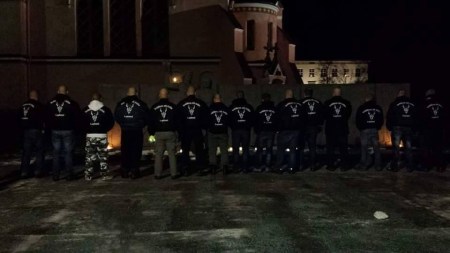
In Finland, more and more cases of Finnish girls and women being raped by asylum seekers are being widely publicized. Much of Finnish society seems shocked, embarrassed and angry because of the increase in rapes perpetrated by asylum seekers. These crimes have provoked many nationalists, and led to the establishment of a paramilitary movement known as the Soldiers of Odin. Members of the movement view themselves as Finnish patriots, roaming the streets of Finland, protecting against Muslim immigrant offenders.

The Soldiers of Odin are accused of being far-right and may de facto be related to previous skinhead movements from the 1990s. Their uniform is all black attire and their symbol makes reference to the ancient Viking god, Odin.

1497 (1)Members of the paramilitary movement known as the Soldiers of Odin view themselves as Finnish patriots, roaming the streets of Finland, protecting against Muslim immigrant offenders. Critics accuse them of being far-right, and they may de facto be related to previous skinhead movements from the 1990s.

The Tapanila Rape

On March 9, 2015, five males gang-raped a young Finnish woman near the Tapanila railway station. The rapists were of Somali heritage and between the ages of 15-18. According to reports, the Somalis boarded the same train as the woman and began harassing her. They followed her off the train and, under cover of darkness, brutally raped her in a nearby park. They were immediately caught.

The Tapanila rape shocked the quiet suburb, which lies on the outskirts of Helsinki, and all of Finland too. Many were left wondering why these second-generation Somali citizens of Finland would carry out such a savage attack.

When news of the attack first came to light, it was published by a far-right website, and many in Finland claimed it was a false report. However, authorities soon confirmed that the rape occurred, and uproar ensued.

According to an article published by Finland Today, the Somali community feared that its members would be unfairly labelled as criminals, and racist attacks would increase. However, the article also noted that

“1,010 rapes were reported to the police in 2014, according to the Official Statistics of Finland. The number of suspected immigrants in these cases is about three times higher than of the suspected natives in relation to the population. There is no unambiguous answer to why this is the case and is yet to be researched.”

The rapists were eventually brought to trial. One was sentenced to a year and four months imprisonment, two were given one-year prison sentences and two others were acquitted. Penalties were softened due to the age of the rapists. Prosecutor Eija Velitski called the sentencing “embarrassing.” The social impact of the attack spread far and wide.

The Kempele Rape

A second attack, the so-called Kempele rape, was met with a reaction by the prime minister himself. Kempele is a small town of roughly 15,000 inhabitants, located near Oulu. It is more famously known for its innovative entrepreneurs and high levels of overall satisfaction and happiness of its residents.

On the evening of November 23, 2015, a 14-year-old girl was walking home in Kempele, when a 17-year-old immigrant from Afghanistan attacked and raped her. She was later found by locals walking through the area.

A police dog led authorities to a nearby refugee center for underage asylum seekers. “The police dog patrol followed the tracks of the suspects, which led to an apartment. From the apartment, the police caught two men who are now suspected of aggravated statutory rape and aggravated child sexual abuse,” the police said in a statement. Police could not immediately interrogate the suspects because a qualified interpreter was unavailable. The 17-year-old denied any involvement in the attack, and the second suspect was eventually freed.

The Kempele rape caused outrage in Finland. Seppo Kolehmainen, the National Police Commissioner, admitted after the attack that Finnish authorities had previously received reports of disturbances, physical altercations, thefts and inappropriate treatment of women from in and around the reception center.

The Soldiers of Odin

The Tapanila and Kempele rape cases became fertile ground for Finnish nationalists. According to their Finnish Facebook page (their website has been taken down), the Soldiers of Odin blame “Islamist intruders” for the “uncertainty, lack of safety and crime in Finland.” The nationalist movement claims that the police have lost control and keeping order on the streets is now up to them. They say that preventing Muslim immigrants from committing crimes, especially rape, is one of their main priorities.

The Soldiers of Odin recently expanded their patrols to the city of Joensuu, in Eastern Finland. Paradoxically, the National Police Commissioner expressed his support for this type of self-organized behavior by the Finnish people. Some liberal Finns have accused the commissioner of racism and have demanded his dismissal.

Next for Finland?

Finland is a peaceful society, and many Finns are afraid of the consequences of the latest wave of immigration. However, due to political correctness and their own national character, most Finns abstain from openly expressing their concerns. But now the curtain of silence and political correctness has been fractured.

Finnish culture, law and policy encourage all people to live together despite cultural or ethnic difficulties. However, this can only go so far. Finns are now demanding action. The government must “do something” to show that Finland is still safe and to limit immigration.

________________________

[1] There is also a minority of the Swedish-speaking Finns (about 5% of the population), as well as a Russian minority (about 1.5%). For five centuries, Finland had been occupied by Sweden (by 1809). Later, it was a part of the Russian Empire (until 1917).

[2] The victory of two EU-skeptic parties over the EU-enthusiastic and pro-immigrant Kokoomus Party says much about the feelings of injustice felt by the Finnish public. But while Stubb’s Kokoomus joined the governmental coalition with Soini and Sipilä, its position is weak. Today, the Finnish government is at a crossroads. Tensions are running high and beginning slowly to fracture the nationalists, led by Soini’s party.

New York museum gives children the chance to discover Muslim culture

March 5, 2016

New York museum gives children the chance to discover Muslim culture, Al-Arabiya, March 5, 2015

(Frau Merkel, et al, have provided an entire country in which to observe, and even participate in, Muslim culture. Please see also, Germany: Migrant Rape Crisis Worsens. — DM)


Muslim children's museumThe Children’s Museum of Manhattan on the Upper West Side has been turned into an indoor playground. (AFP)

“I think it’s a nice antidote to some of the other ways that people are talking about Muslim cultures, a diverse non-threatening culture rather than what is in the media all the time,” said British tourist Grania Brigden.

***********************

The United States may have seen an unprecedented anti-Muslim backlash in recent months, but one New York museum has challenged perceptions by teaching children about the wealth and diversity of Islamic culture from Michigan to China.

The Children’s Museum of Manhattan on the Upper West Side has been turned into an indoor playground where children can touch and experiment with artifacts of Muslim culture in a vibrant, colorful exhibition.

One little girl wraps a piece of Senegalese fabric around her middle like a sarong and wriggles around. “It’s lots of fun for dancing!” she says.

(The video won’t embed. Please click on the link below. — DM)

Other children in her class are sorting through Turkish ceramics or inhaling the rich aroma of spices from Zanzibar.

Called “America to Zanzibar,” the exhibition focuses on culture in Muslim communities, not religion itself, so the tenets and practices of Islamic doctrine have been left well alone.

“We don’t interpret the religion,” said Andrew Ackerman, executive director of the museum. “It’s about the people. It’s about how people that share a common belief express it so differently,” he added.

The 2016 race for the White House has been dominated by the rise of Republican frontrunner Donald Trump, a New York real estate mogul who has repeatedly bashed Muslims and advocated a ban on them entering the country.

Recent attacks in Paris and San Bernardino, California have heightened what Muslim Americans call an unprecedented backlash in a country increasingly fearful about the risk posed by the so-called Islamic State extremist group.

Ackerman says current events had nothing to do with the decision to mount the exhibition, which has been six years in the making.

His desire is to lift the lid on culture in Muslim countries that is either poorly understood in the United States or not represented at all.

“The challenge of this project is how do you represent so many different cultures,” said Ackerman. “How do you pick and choose what to show to give the biggest overview possible in a small space. That conversation was completely independent of any current events.”

One strong point of the exhibition is that it also focuses on Muslim heritage in the United States and not just on far-off countries.

‘Not just Syria’

Children can learn about the mosque in Dearborn, Michigan, a Tajik-inspired tea house in Colorado and Senegalese fabric sold in Harlem, New York.

A room is also dedicated to Muslim Americans gathering together memories, books, CDs and photographs.

“We really wanted to think about the American story, which is so much more diverse than the rest of the world,” said Ackerman, adding that New York is home to people from every Muslim country in the world.

“It’s very good. They are learning about another culture,” said second grade teacher Judith Espaillat of her class of children visiting the exhibition.

The word Muslim doesn’t mean much to Alex, one of her pupils, but he hasn’t been bored at all.

During the first week of the exhibition, which opened February 13, the museum welcomed more than 13,000 visitors despite exceptionally cold temperatures.

“They want to show that this culture is normal, not crazy,” said visitor Francesca Azzariti, an Italian living in New York.

Other than fabric and ceramics, the museum devotes one room to mosques and the wealth of their architectural tradition.

The exhibition also shows contributions by Muslim thinkers to science.

“I think it’s a nice antidote to some of the other ways that people are talking about Muslim cultures, a diverse non-threatening culture rather than what is in the media all the time,” said British tourist Grania Brigden.

“It’s nice to see the other elements, the food, the colors,” she said. “Islam in Africa, Asia, it’s not just Syria.”

The exhibition will run at least a year before possibly travelling to other cities within the United States. Intended for children, it can also offer an entry point for parents too.

“There are a lot of people who don’t see themselves as museum goers but they’ll come here, because it’s for the children,” said Ackerman. “If we can inspire curiosity as a museum, that’s what we go for.”

France: Criticize Islam and Live under Police Protection

February 28, 2016

France: Criticize Islam and Live under Police Protection, Gatestone InstituteGiulio Meotti, February 28, 2016

“After a few moments of fear, I thought that if there are these threats it is because my fight foiled the plans of the Muslim Brothers by bringing them to light. I decided not to give up.” — Laurence Marchand-Taillade, National Secretary of the Parti Radical de Gauche (Radical Party of the Left).

The author Éric Zemmour lives under police protection. Two policemen follow him wherever he goes — including to court, where Muslim organizations tried to defame him and his work by accusing him of “Islamophobia,” to silence him.

In France, hunting season is still open for critics of Islam.

“You are sentenced to death. It’s just a matter of time.” This message, in Arabic, was sent by Islamists to Laurence Marchand-Taillade, National Secretary of the Parti Radical de Gauche (Radical Party of the Left). She now lives under the protection of the French police.

Marchand-Taillade forced the Muslim Brotherhood to withdraw, under pressure from France’s Interior Ministry, its invitation of three Islamic fundamentalists to a conference in Lille. The Islamists in question were the Syrian Mohamed Rateb al Nabulsi, the Moroccan Abouzaid al Mokrie and the Saudi Abdullah Salah Sana’an, who deem that the penalty for homosexuality is death, that the international coalition against the Islamic State is “infidel,” that Jews “destroy the nations” and that only religious music is permitted.

Laurence Marchand-Taillade published an article in Le Figaro in which she called for the ban of these Islamists with their “anti-Semitic and pro-jihadist message.”

In the magazine Marianne, Marchand-Taillade then penned, along with the French-Algerian journalist Mohamed Sifaoui, an article calling for the resignation of the leaders of the Observatory of Secularism.

“I am the president of an association that supports secularism in the Val-d’Oise” said Marchand-Taillade to me in an interview,

“and for years, I observed unreasonable sacrifices and compromises from the National Observatory of Secularism, which has encouraged radical communitarianism by participating to forums such as ‘We Are United,’ with the rapper Médine, who has called for the ‘crucifixion of the secularists,’ the ‘Collective against Islamophobia’ and Nabil Ennasri, a Muslim Brother from Qatar. The president of the Observatory of Secularism, Jean Louis Bianco, gave credit to these Salafist organizations at war with our values.

“Since the first months of 2014, I started also to report to the authorities of the arrival of imams such as Nader Abou Anas, who justifies marital rape, and Hatim Abu Abdillah, who promises a ‘cruel punishment’ for women. Then I went to Lille, on February 6 and 7, where Tariq Ramadan and others were indoctrinating our youths” Since then, her life has not been the same.

How did she react to the death sentence?

“After a few moments of fear, I thought that if there are these threats it is because my fight foiled the plans of the Muslim Brothers by bringing them to light. I decided not to give up. Islamists began a long process of infiltrating all sectors of civil society. The concept is based on the written doctrines of Hassan al-Banna, the grandfather of [Tariq] Ramadan. Their flag has two swords and the Koran; indoctrination and violence are the methods to gain power. France is a country chosen for several reasons: it has a large population from North Africa; it is a secular country in which you can use the freedoms of democracy as weapons against it, and it had weak policies. The only way to stop the threat is to reaffirm secularism and absolute freedom of conscience. We cannot allow entire portions of the French population to fall in the trap of hating the country where they are born and, above all, which considers them part of the nation. It is choice of civilization, while there is an attempt to destroy two centuries of progress for humanity.”

What happened to Marchand-Taillade — the 24-hour a day police protection she needs because she exercised her constitutional right to freedom of expression — tells us a lot about France, where dozens of academics, intellectuals, novelists and journalists now have to live under police protection just because of their criticism of Islam.

It is not only politicians such as Marine Le Pen and Samia Ghali, the mayor of Marseille, and not only judges such as Albert Lévy, who has conducted investigations on Islamic fundamentalists.

The most famous is Michel Houellebecq, author of the novel Submission, who lives under the protection of the gendarmerie since he published his last novel. There is also haute protection(“high protection”) for Éric Zemmour, the author of Le Suicide Français. Two policemen follow him wherever he goes — including to court, where Muslim organizations tried to defame him and his work by accusing him of “Islamophobia,” to silence him.

1486French politician Laurence Marchand-Taillade (left) lives under police protection after receiving a death threat from Islamists. French author Éric Zemmour also lives under police protection. Two policemen follow him wherever he goes — including to court, where Muslim organizations tried to defame him and his work by accusing him of “Islamophobia,” to silence him.

Charlie Hebdo‘s director, “Riss,” and the remaining cartoonists live under police protection, and their new offices are in an undisclosed location. My friend Robert Redeker, a professor of philosophy condemned to death in 2006 by Islamists for an article he wrote in Le Figaro, still lives like a fugitive, as if he is a political prisoner in his own country. His conferences and courses have been canceled, his house sold, his father’s funeral celebrated in secrecy, and his daughter’s wedding organized by the police.

Mohammed Sifaoui, who lived undercover in a French cell of al Qaeda and has written a shocking book, Combattre le terrorisme islamiste (“Combat Islamist Terrorism”) also lives under police protection. His photo and name appear on jihadi websites next to the word murtad(“apostate”).

The French philosopher and essayist, Michel Onfray, just withdrew the planned publication of an essay critical of Islam, He claims that “no debate is possible” in the country after the November 13 attacks in Paris (his book has just been published in my country, Italy).

Frédéric Haziza, a radio journalist and author for the magazine Le Canard Enchaîné, has been the target of threats from Islamists, and is under protection, as is Philippe Val, the former director of Charlie Hebdo and France Inter, who decided to publish the Mohammed cartoons in 2006. The Franco-Algerian journalist Zineb Rhazaoui is always surrounded by six policemen, as is the brave imam Hassen Chalgoumi, who is protected as if he were a head of state.

In Britain, the 1989 fatwa against Salman Rushdie eliminated any doubt among scholars and journalists whether it was appropriate or not to criticize Islam. In the Netherlands, it was enough to shoot dead Theo Van Gogh for having made a film, Submission, about a woman abused in a forced marriage. Dutch MP Geert Wilders had to debate wearing bulletproof vests and Ayaan Hirsi Ali, who wrote Submission’s script, fled the country and found a refuge in the U.S. In Sweden, that artist Lars Vilks now lives like a shadow. In Denmark, the headquarters of theJyllands Posten newspaper, which published the original Mohammed cartoons, has a barbed wire fence two meters high and one kilometer long. It has become like a U.S. embassy in the Middle East.

In France, hunting season is still open for critics of Islam, even after the decimation of Charlie Hebdo‘s brave artists. But for how long?

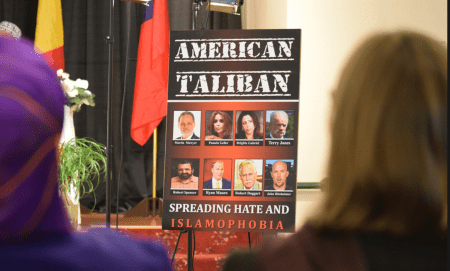
CAIR vows to Save us from ‘the Trumps, the Cruzs, the Palela Gelleers, the Robert Spencers’

February 26, 2016

CAIR vows to Save us from ‘the Trumps, the Cruzs, the Palela Gelleers, the Robert Spencers’ Front Page MagazineRobert Spencer, February 26, 2016

jacob_bender

Jacob Bender, the non-Muslim Useful Idiot who heads up Hamas-linked CAIR’s Philadelphia chapter, boasted Wednesday on the organization’s website: “What CAIR can do, however, and what it has been doing superbly for 10 years now, is to oppose the anti-Muslim ideology of the Trumps, the Cruzs, the Pamela Gellers, the Robert Spencers…” Notice that he doesn’t say that Hamas-linked CAIR is opposing the ideology of the Syed Rizwan Farooks, the Mohammed Abdulazeezes, the Dzhokhar Tsarnaevs, the Nidal Malik Hasans.

As for those he does mention, Hamas-linked CAIR is opposing us so superbly that Trump actually has a chance to become President of the United States, and whether he does or not, he has moved the public discourse to a place where the issues of jihad terror and Islamization can be discussed more honestly in the mainstream than has been possible for years. Cruz has outlasted most of the Republican candidates to remain one of Trump’s chief rivals. Pamela Geller is planning an exciting new initiative and I am busier than ever, having just completed a new book and busy traveling to speak all over the country: yes, Hamas-linked CAIR is doing its job of demonization and marginalization of foes of jihad terror superbly.

More importantly, Bender here repeats the common and hysterical claim that “Muslims are the new Jews,” which has been answered many times — as often as it has been asserted. Islamic apologist Karen Armstrong, Leftist “journalist” Jeffrey Goldberg, Iranian front group Board member Reza Aslan, Muslim Brotherhood-linked Congressman Keith Ellison,Nicholas Kristof, and Canadian Muslim leader Syed Sohawardy, among many others, have repeated it. The blazingly brilliant Daniel Greenfield takes it apart in this video.

And in 2014, Bill Maher noted: “Jews weren’t oppressing anybody. There weren’t 5,000 militant Jewish groups. They didn’t do a study of treatment of women around the world and find that Jews were at the bottom of it. There weren’t 10 Jewish countries in the world that were putting gay people to death just for being gay.” Indeed, and no one is calling for or justifying genocide of Muslims now; there is no individual or group remotely comparable to the National Socialists in any genuine sense.

The late Christopher Hitchens also refuted this idea when writing a few years ago about the Islamic supremacist mega-mosque at Ground Zero: “‘Some of what people are saying in this mosque controversy is very similar to what German media was saying about Jews in the 1920s and 1930s,’ Imam Abdullah Antepli, Muslim chaplain at Duke University, told the New York Times. Yes, we all recall the Jewish suicide bombers of that period, as we recall the Jewish yells for holy war, the Jewish demands for the veiling of women and the stoning of homosexuals, and the Jewish burning of newspapers that published cartoons they did not like.”

The purpose of this claim is to intimidate people into thinking that criticism of Islamic supremacism leads to the concentration camps, and thus there must be no criticism of Islamic supremacism. The unstated assumption is that if one group was unjustly accused of plotting subversion and violence, and was viciously persecuted and massacred on the basis of those false accusations, then any group accused of plotting subversion and violence must be innocent, and any such accusation must be in service of preparing for their subversion and massacre. It is simply a method to foreclose on any criticism of jihad terror and Islamic supremacism.

Jacob Bender, who is himself Jewish, ought to pause before making such a reckless and baseless comparison – especially in light of the fact that the new Jews are not the Muslims at all, but are none other than the old Jews: anti-Semitic hate crimes remain much more common in the U.S. than “Islamophobic” hate crimes, and Jews all over Europe face an increasingly dangerous and precarious situation because of the anti-Semitism of the rapidly increasing Muslim population. CAIR’s Hamas ties don’t seem to trouble him either. In his complacency and willful ignorance, as well as his active work for CAIR, Bender could be the poster child for our blinkered age.

Germany’s Migrant Crisis: January 2016

February 12, 2016

Germany’s Migrant Crisis: January 2016, Gatestone Institute, Soeren Kern, February 12, 2016

♦ Despite snow, ice and freezing temperatures across much of Europe, a total of 91,671 migrants entered Germany during January 2016.

♦ German taxpayers could end up paying 450 billion euros ($500 billion) for the upkeep of the million migrants who arrived in Germany in 2015. This would presumably double to nearly one trillion euros if another million migrants arrive in 2016.

♦ A 19-year-old migrant from Afghanistan sexually assaulted four girls between the ages of 11 and 13 at a swimming pool in Dresden. The migrant was arrested but then set free.

♦ Three teenage migrants from North Africa tried to stone to death two transsexuals in Dortmund after they were seen walking around in women’s clothing. The victims were saved by police.

♦ Bild reported that politicians in Kiel had ordered the police to overlook crimes perpetrated by migrants.

♦ “The topics we cover are determined by the government. … We must report in such a way that serves Europe and the common good, as it pleases Mrs. Merkel. … today we are not allowed to say anything negative about the refugees. This is government journalism.” – Wolfgang Herles, retired public media personality.

♦ The European Commission called for the “rejection of false associations between certain criminal acts, such as the attacks on women in Cologne on New Year’s Eve, and the mass influx of refugees.”

In January 2016, the German public appeared finally to wake up to the implications of their government’s decision to allow 1.1 million — mostly male — migrants from Africa, Asia and the Middle East to enter the country during 2015.

After more than a thousand Muslim migrants sexually assaulted hundreds of women in cities across Germany on New Year’s Eve, Chancellor Angela Merkel began to face a rising voter backlash to her open-door migration policy.

Merkel’s government has responded to the criticism by: 1) attempting to silence critics of the open-door migration policy; 2) trying to “export” the migrant problem to other countries in the European Union; and 3) announcing a series of measures — branded as unrealistic by critics — to deport migrants accused of committing crimes in Germany.

What Merkel has steadfastly refused to do, however, is reduce the number of migrants entering the country. Despite snow, ice and freezing temperatures across much of Europe, a total of 91,671 migrants — an average of around 3,000 migrants each day — entered Germany during the month of January 2016.

The following is a review of some of the more notable stories about the migration crisis in Germany during January 2016.

January 1. More than a thousand migrants sexually assaulted hundreds of German women in the cities of Cologne, Hamburg and Stuttgart. The government and the mainstream media were accused of trying to cover up the crimes, apparently to avoid fueling anti-immigration sentiment.

January 1. As Muslim migrants were causing mayhem on German streets, the Minister President of Baden-Württemberg, Winfried Kretschmann, said he could not understand public concerns about the “alleged Islamization” of Germany. In an interview with Die Welt, he said: “If you look at the facts, this fear is unfounded. We have a stable democracy and a free society. State and religion are separated. How should Muslims, who represent a minority, Islamize our society?” When asked why Germans are afraid, Kretschmann replied: “People are afraid of strangers they do not know.”

January 1. The International Monetary Fund (IMF) estimated that 1.3 million asylum seekers would enter the European Union annually during 2016 and 2017.

January 2. A fight between children as young as 11 at a refugee shelter in Stockach near Konstanz turned into a mass brawl after parents of the children joined in the fighting. Police were deployed to restore order. Seven people were injured.

January 3. A 16-year-old Moroccan migrant went on a rampage after a judge in Bremen ordered him to be jailed for stealing a man’s laptop at knife-point. On the way from the courthouse to the jail, the Moroccan seriously injured a police officer by kicking him in the face. Once inside the jail cell, the migrant ripped a toilet from the floor and smashed it against a wall.

The chairman of the Bremen Police Union, Jochen Kopelke, said that migrants were attacking city police with increasing frequency: “The tone has become extremely aggressive; sometimes the police must apply massive force to get a situation under control.” According to Bremen Senator Ulrich Mäurer, “the excesses of violence against police officers show that these people have no respect for our constitutional order and its representatives.”

January 3. More than 50 migrants were involved in a mass brawl at a refugee shelter inEllwangen near Stuttgart. Police said migrants attacked each other with fire extinguishers, metal pipes, rocks and stones. According to local media, mass brawls have become commonplace at migrant shelters in the area.

January 3. Hans-Werner Sinn, one of the best-known economists in Germany, cited estimates that German taxpayers could end up paying 450 billion euros ($500 billion) for the upkeep of the million migrants who arrived in Germany in 2015. This estimate would presumably double to nearly one trillion euros if another million migrants arrive in Germany in 2016.

January 4. An internal report written by a senior federal police officer revealed chaos “beyond description” in Cologne on New Year’s Eve. The report, which was leaked to the news magazineDer Spiegel and published in full by the newspaper Bild, said that women were forced to “run a gauntlet” of drunken men of a “migrant background” to enter or depart the main train station. “Even the appearance of the police officers and their initial measures did not stop the masses from their actions.” One migrant told a police officer: “I am Syrian; you have to treat me kindly! Mrs. Merkel has invited me.”

January 5. Cologne Mayor Henriette Reker said: “There is no reason to believe that those involved in the sexual assaults in Cologne were refugees.” Cologne Police Chief Wolfgang Alberssaid: “At this time we have no information about the offenders.”

January 6. Former Interior Minister Hans-Peter Friedrich said it was “scandalous that it took the mainstream media several days” to report on the sexual assaults in Cologne. He said public media was a “cartel of silence” exercising censorship to protect migrants from accusations of wrongdoing.

January 7. A charity called Refugees Welcome Bonn, which organized a Rhine River cruise as welcoming party for migrants in Bonn, apologized after it emerged that migrants groped and sexually harassed some female guests during the event.

January 8. The Interior Ministry revealed that of the 32 suspects identified in the Cologne assaults, 22 were asylum seekers. Cologne Police Chief Wolfgang Albers was fired for withholding information about the assaults from the public.

January 9. A vigilante group began patrolling the streets of Düsseldorf to “make the city safer for our women.” Similar groups emerged in Cologne and Stuttgart.

January 10. Three teenage migrants from North Africa tried to stone to death two transsexuals inDortmund after they were seen walking around in women’s clothing. The victims were saved by police, who happened to pass by in a car. One of the victims said: “I never could have imagined that something like this could happen in Germany.”

January 11. A 35-year-old migrant from Pakistan sexually assaulted a three-year-old girl at a refugee shelter in Kamen.

January 12. In an interview with Bild, Frank Oesterhelweg, a politician with the center-right Christian Democrats (CDU), caused a scandal when he said that police should be authorized to use deadly force to prevent migrants from raping German women:

“These criminals deserve no tolerance, they have to be stopped by the police. By force if necessary, and, yes, you read correctly, even with firearms. An armed police officer has a duty to help a desperate woman. One must, if necessary, protect the victims by means of force: With truncheons, water cannons or firearms.”

Police union leader Dietmar Schilff was irate: “These statements are outrageous and do not help the police at all. There are clear rules for using the service weapon. What would have happened in Cologne if the police had used clubs and guns?” According to Bild, many German police officers are afraid of using lethal force “because of the legal consequences.”

January 12. A YouGov poll showed that 62% of Germans believe the number of asylum seekers is too high, up from 53% in November. According to the poll, the growing resistance to immigration was being driven by the hardening of attitudes by German women.

January 13. An Interior Ministry report leaked to Bild warned that jihadist attacks like those in Paris could take place in Germany “at any time.” The report said that attacks would likely be spread over several days and against “various target categories.”

January 13. A 20-year-old migrant from Somalia was sentenced to four years in prison for raping an 88-year-old woman in Herford. His defense attorneys argued for leniency because, according to them, the man was traumatized by his flight from Somalia. In Gelsenkirchen, four migrantsattacked a 45-year-old man after he tried to prevent them from raping a 13-year-old girl.

January 14. The Bundestag, the lower house of the German parliament, approved a plan to provide all refugees with identity cards that will contain information such as fingerprints and country of origin. The cards will be linked to a centralized refugee data system. The plan may be too late: the German government has lost track of the whereabouts of hundreds of thousands of migrants who entered the country in 2015.

January 14. Prosecutors in Cologne said they were offering a reward of 10,000 euros ($11,000) for information leading to the arrest or identification of those who committed the sexual assaults and robberies on New Year’s Eve.

January 14. A Bavarian politician sent a bus carrying 31 refugees on a seven-hour journey to Chancellor Angela Merkel’s office in Berlin to protest her open-door refugee policy. Merkel sentthe migrants back to Bavaria.

January 14. City officials in Rheinberg cancelled this year’s carnival celebrations. Local police said that in wake of the sexual assaults in Cologne on New Year’s Eve, they were unable to guarantee the safety of female revelers.

January 15. A 36-year-old migrant sexually assaulted an eight-year-old girl at a public park in Hilden near Solingen. A 31-year-old migrant from Tunisia was arrested for attempting to rape a 30-year-old woman in Chemnitz. A 31-year-old migrant from Morocco appeared in court for raping a 31-year-old woman in Dresden. A migrant sexually assaulted a 42-year-old woman in Mainz. A migrant sexually assaulted a 32-year-old woman in Münchfeld. An African migrant sexually assaulted a 55-year-old woman in Mannheim.

January 15. Male migrants were banned from a public swimming pool in Bornheim, near Bonn, after they were accused of assaulting female patrons at the facility.
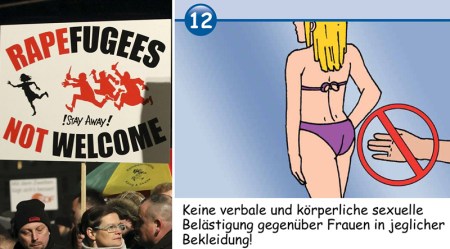
1470In January, there were thousands of cases of migrants sexually assaulting women in Germany, including many that took place in public pools. The government began to face a rising voter backlash to the open-door migration policy, including public protests (left). In some areas, authorities have distributed cartoon guides, to “educate” migrants that sexual assault is not acceptable (right).

January 15. Finance Minister Wolfgang Schäuble, in an interview with the Süddeutsche Zeitung, signaled his determination to export Germany’s migrant problem by calling for a Europe-wide gas tax to help pay for the cost of hosting millions of migrants. He said:

“If the funds in national budgets and the European budget are not enough, then let us agree, for example, to raise a levy on every liter of gasoline at a certain level. If a country refuses to pay, I am still prepared to do it. Then we will build a coalition of the willing.”

January 16. Norbert Röttgen, chairman of the foreign affairs committee in the German Bundestag and a lawmaker in Angela Merkel’s Christian Democratic Union (CDU), called upon the government to create a Ministry for Migration, Integration and Refugees. He said the migrant crisis had developed into a “primary and permanent task for the state” and is of “decisive importance for the future of our country and Europe.”

January 16. A 19-year-old migrant from Afghanistan sexually assaulted four girls between the ages of 11 and 13 at an indoor swimming pool in Dresden. The migrant was arrested but then set free. A migrant from Syria sexually assaulted a 12-year-old girl in Mudersbach. A 36-year-old migrant sexually assaulted an eight-year-old girl in Mettmann.

January 16. A group of between six and eight African migrants ambushed three people leaving a discotheque in Offenburg. The migrants were ejected from the discotheque after female clients complained that the men were sexually harassing them. After they left, at around 4AM, the migrants attacked them with metal rods, street signs and garbage bins.

January 17. In an interview with Bild am Sonntag, the president of the federal criminal police, Holger Münch, said that the number of crimes in refugee shelters had increased “significantly” since 2015, when the migrant influx began. He said that the migrants mostly responsible were from the Balkans and North Africa, especially Algerians, Tunisians and Moroccans. He added that half the offenses at the refugee shelters were physical assaults, but that there was also a growing number of homicides and sexual crimes.

January 17. In an interview with the Süddeutsche Zeitung, former Bavarian Prime Minister Edmund Stoiber warned that Chancellor Angela Merkel will “destroy Europe” if she refuses to reduce the number of migrants entering Germany.

January 17. Berlin clergyman Gottfried Martens accused German politicians and church leaders of ignoring the persecution of Christians by Muslims in German refugee shelters. He said that the Christians were facing “verbal threats, threats with knives, blows to the face, ripped crucifixes, torn bibles, insults of being an infidel, and denial of access to the kitchen because of uncleanness.”

January 18. A 26-year-old Algerian man was the first person to be arrested in connection with a string of sexual assaults during New Year’s celebrations in Cologne. He was apprehended at a refugee shelter in the nearby town of Kerpen. Cologne’s chief prosecutor, Ulrich Bremer, said that nearly 500 women had come forward with allegations of sexual assault, including three cases of rape.

January 18. A 24-year-old migrant from Sudan was released after being held for questioning at a police station in Hanover. After crossing the street, the man, who receives 300 euros ($335) a month in social welfare benefits, dropped his pants and exposed himself in public and shouted, “Who are you? You cannot do anything to me. Whatever I cannot get from the state, I will steal.”

January 19. Addressing the European Parliament in Strasbourg, European Council President Donald Tusk warned that the European Union had “no more than two months” to get control over the migration crisis or face the collapse of the Schengen passport-free travel zone.

January 19. A poll published by Bild showed that support for Chancellor Angela Merkel’s conservative bloc was down 2.5 points at 32.5%, its lowest result since the 2013 election. The poll showed that support for the anti-immigration Alternative for Germany (AfD) was up 1 point at 12.5%; support for the Social Democrats was up 1 point at 22.5%.

January 19. A 28-year-old migrant from Iran pushed a 20-year-old woman onto the tracks of an oncoming train in Berlin. She later died.

January 20. Bild reported that migrants invaded female changing rooms and showers at two public swimming pools in Leipzig. Migrants, dressed in their street clothes and underwear, also jumped into the swimming pools. According to Bild, the city hall had tried to keep the incidents quiet, but details were leaked to the media.

January 21. More than 200 migrants have sued the German government for delays in processing their asylum applications.

January 22. Facing political pressure over the migrant crisis, Chancellor Angela Merkel met in Berlin with Turkish Prime Minister Ahmet Davutoglu to discuss ways to stem the flow of Syrian and other refugees from Turkish shores. She renewed a pledge to provide Turkey with financial support. In November 2015, EU leaders pledged 3 billion euros ($3.4 billion) to Ankara to help care for an estimated 2.5 million Syrian refugees in Turkey; the deal has been delayed by a dispute among EU member states over who will pay.

January 22. A report by municipal authorities in Zwickau that was leaked to Bild revealed that migrants were defecating in public swimming pools. Security cameras also filmed migrants harassing women in the public sauna and attempting to storm the female dressing room.

January 22. Police in Hanover investigated four nightclub bouncers for allegedly beating an 18-year-old Algerian migrant after he tried to steal the purses of two teenage girls. Two days before the incident, the migrant had been sentenced to one year in juvenile detention for robbery, but he was free to roam the streets until his sentence began.

January 22. A migrant attempted to rape a 16-year-old girl in Feuerbach district of Stuttgart, and in downtown Stuttgart, four migrants sexually assaulted a 23-year-old woman.

January 23. The Süddeutsche Zeitung reported that migrants had attacked women in 12 of Germany’s 16 states on New Year’s Eve. In addition to the attacks Cologne, 195 women filed complaints in Hamburg; 31 in Hesse; 27 in Bavaria; 25 in Baden-Württemberg; 11 in Bremen; and six in Berlin.

January 23. Two migrants sexually assaulted an 18-year-old woman in Wiesbaden, and a 35-year-old migrant sexually assaulted a woman in a restroom on a train in Düsseldorf.

January 23. The Stuttgarter Nachrichten reported that dental work for migrants could end up costing German taxpayers billions of euros.

January 24. An official police report leaked to The Huffington Post showed that Interior Minister Thomas de Maizière was not being truthful when he said that between 100 and 200 migrants are being denied entry into Germany each day. The report stated that since September 14, border police had prevented 7,185 migrants from entering the country — or only about 60 migrants turned away each day.

January 25. A 30-year-old migrant from North African exposed himself to a 19-year-old woman on a public bus in Marburg, and then to passersby at the main train station.

January 26. In an interview with the German public radio, Deutschlandfunk, retired public media personality Wolfgang Herles admitted that public broadcasters receive “instructions from above” when it comes to reporting the news:

“We have the problem that we are too close to the government. The topics we cover are determined by the government. But many of the topics the government wants to prevent us from reporting about are more important than the topics they want us to cover…

“We must report in such a way that serves Europe [the European Union] and the common good, as it pleases Mrs. Merkel. There are written instructions … today we are not allowed to say anything negative about the refugees. This is government journalism, and this leads to a situation in which the public loses their trust in us. This is scandalous.”

Previously, Claudia Zimmermann, a reporter with the public television broadcaster WDR, said that public media outlets in Germany “have been warned to report the news from a pro-government perspective.”

January 26. A 24-year-old man on an evening stroll with his three-month-old baby daughter in the Eißendorf district of Hamburg was approached by two migrants who demanded his wallet and cellphone. When he said he was not carrying any valuables, the migrants attacked him with a knife. Fleeing for his life, the man ran onto a frozen pond and broke through the ice. A passerby heard the man calling for help. The baby, under water for an extended period, was revived by paramedics called to the scene. The baby remains in intensive care; the migrants remain at large.

January 26. A 28-year-old migrant from Algeria applied for asylum in Wesel. Authorities became suspicious because of his proficiency in German. They later determined that he had arrived in Germany in November 2014, rather than, as he claimed, in October 2015. It emerged that he had outstanding warrants for theft, but evaded police by using six different identities.

January 26. The Kieler Nachrichten reported that the proliferation of sexual assaults by migrants has women in the northern city of Kiel afraid to be out at night because the city is too dark. In an effort to save electricity, municipal officials decided to convert all of the city’s street lights to LED bulbs, but they do not provide sufficient light to keep the streets illuminated at night.

January 26. The mayor of Freiburg, Dieter Salomon, ordered police to take a hard line against migrants accused of snatching purses and assaulting women in the city’s discotheques. According to club owners, migrants have been robbing women on the dance floor and raping them in the restrooms. Many of the offenders are allegedly underage migrants from North Africa. Club owners say that the migrants are not afraid of authority: “They know that nothing will happen to them here.”

January 27. A 39-year-old migrant from Afghanistan tried to enter Germany at Simbach, a town on the border of Austria. A background check determined that in May 2000, a German court had sentenced the man to an eight-year prison term for rape. He had been deported to Afghanistan in 2006 with orders never to return.

January 27. The public radio and television channel, Mitteldeutscher Rundfunk, reported that German taxi drivers are profiting from the migrant crisis by taking migrants to doctors’ appointments and asylum interviews. The cab fares are being paid for by German taxpayers. MDR reported on a taxi company in Leipzig that had billed the government for 800 taxi fares for taking migrants to run errands. One taxi driver, for example, drove a migrant family on an 80 km (50 mile) journey for an appointment with migration authorities. The meter was left running while the driver waited for the migrants to return from their meeting. The fare was 309 euros ($344).

January 28. Bild reported that politicians in Kiel had ordered the police to overlook crimes perpetrated by migrants. According to the paper, the police in North Rhine-Westphalia and Lower Saxony have also been instructed to be lenient to criminal migrants.

January 28. A migrant from Sudan sexually assaulted a female police officer in Hanover as she was attempting to arrest him for theft. Public prosecutor Thomas Klinge confirmed the incident. “Such brazen behavior towards a police officer has been unheard of until now,” he said.

January 28. Berlin’s Tempelhof airport, the iconic site of the Berlin Airlift in 1948-49, is set to become the biggest refugee shelter in Germany. In a controversial move to alter the airport’s zoning regulations, Berlin’s municipal government — run by a coalition between the Christian Democratic Union and the Social Democratic Party — voted to build five massive structures to house 7,000 migrants there. Opposition politicians said the government was creating an “immigrant ghetto” in the heart of Berlin.

January 28. Police in Berlin said that a volunteer with the charity group Moabit Hilft hadfabricated a story about a 24-year-old migrant said to have died while waiting for days outside an asylum registration office. The story was allegedly faked in an effort to embarrass the government for its slow response to the migrant crisis.

January 29. The European Commission, the powerful administrative arm of the European Union, said that the sexual assaults in Cologne had nothing to do with the migrant crisis and were simply a matter of public order. A confidential memo leaked to The Telegraph stressed the importance of the Commission’s “continuing role in sounding the voice of reason to defuse tensions and counter populist rhetoric.” The Commission called for “the unconditional rejection of false associations between certain criminal acts, such as the attacks on women in Cologne on New Year’s Eve, and the mass influx of refugees.”

January 29. A public vocational school in the Wilhelmsburg district of Hamburg cancelled plans to host classes for refugees after male migrants sexually harassed dozens of female students at the school.

January 29. The German news magazine Focus published the results of a poll showing that 40% of Germans want Chancellor Angela Merkel to resign because of her migrant policies.

January 30. A gang of migrants on a Munich subway train were filmed attacking two elderly men who tried to stop them from groping a woman. Images show the migrants grabbing two men by the arms and neck and shouting abuse at them. It later emerged that the migrants were from Afghanistan; although they had been denied asylum in Germany four years ago, the German government refused to deport them because Afghanistan is “too dangerous.”

January 31. The Interior Minister of Saxony-Anhalt, Holger Stahlknecht, of the Christian Democrats, announced that he would delay releasing the 2015 crime statistics until March 29, two-and-half weeks after regional elections. The statistics are normally released in February or early March. Rüdiger Erben of the Social Democrats said: “The late release date reinforces my suspicion that the statistics are horrific.”

January 31. ISIS sympathizers defaced more than 40 gravestones at a cemetery in Konstanzwith slogans such as, “Germans out of Syria,” “Christ is Dead” and “Islamic State.”

January 31. A 30-year-old German, originally from Turkmenistan, raped a seven-year-old girl in Kiel. The man kidnapped the girl from a school playground at 11AM, took her to his apartment and, after abusing her, set her free. It later emerged that the man, who is the father of two children, had been accused of sexually assaulting a five-year-old girl at another kindergarten in Kiel on January 18, but the public prosecutors failed to pursue the case due to insufficient evidence. “In hindsight, we regret that decision,” the prosecutors said.

January 31. In an underhanded effort to silence critics of the government’s open door migration policy, Vice Chancellor Sigmar Gabriel called on German intelligence to begin monitoring the Alternative for Germany (AfD), the third-largest party in Germany. The AfD is surging in popularity because of its anti-immigration platform.
Our Good Islam/Bad Islam Strategy

February 11, 2016

Our Good Islam/Bad Islam Strategy, Front Page Magazine, Daniel Greenfield, February 11, 2016

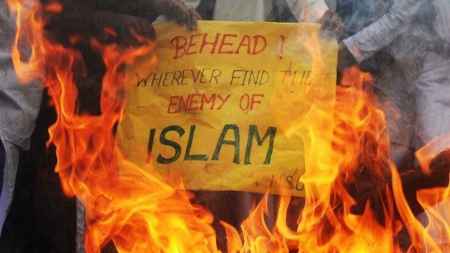
Behead them

There is no Good Islam. There is no Bad Islam. There is just Islam.

**********************

Our only hope of defeating Islamic terrorism is Islam. That’s our whole counterterrorism strategy.

But Islamic terrorism is not a separate component of Islam that can be cut off from it. Not only is it not un-Islamic, but it expresses Islamic religious imperatives. Muslim religious leaders have occasionally issued fatwas against terrorism, but terrorism for Muslim clerics, like sex for Bill Clinton, is a matter of definition. The tactics of terrorism, including suicide bombing and the murder of civilians, have been approved by fatwas from many of the same Islamic religious leaders that our establishment deems moderate. And the objective of terrorism, the subjugation of non-Muslims, has been the most fundamental Islamic imperative for the expansionistic religion since the days of Mohammed.

Our strategy, in Europe and America, under Bush and under Obama, has been to artificially subdivide a Good Islam from a Bad Islam and to declare that Bad Islam is not really Islam. Bad Islam, as Obama claims, “hijacked” a peaceful religion. Secretary of State Kerry calls Bad Islam’s followers, “apostates”. ISIS speaks for no religion. It has no religion. Which means the Islamic State must be a bunch of atheists.

Our diplomats and politicians don’t verbally acknowledge the existence of a Bad Islam. Even its name is one of those names that must not be named. There is only Good Islam. Bad Islam doesn’t even exist.

This isn’t just domestic spin, which it is, but it’s also an attempt at constructing an Islamic narrative. Our leaders don’t care what we think. They just want us to keep quiet and not offend Muslims. They do care a great deal about what Muslims think. And so, in their own clumsy way, they try to talk like Muslims.

They are attempting to participate in an Islamic debate without the requisite theological credentials. They want to tell Muslims that they should be Good Muslims not Bad Muslims, but they’re too afraid to use those words, so instead they substitute Good Muslims and Not Muslims. All Muslims are Good Muslims and Bad Muslims are Not Muslims is their Takfiri version of the No True Scotsman fallacy.

Our counterterrorism strategy has been constructed to convince Good Islam to have nothing to do with Bad Islam. And any of us who criticize Good Islam or argue that the artificial distinction between Good Islam and Bad Islam, between Saudi Arabia and ISIS, between Iran and Hezbollah, between Pakistan and the Taliban, is false are accused of provoking Good Islam to transform into Bad Islam.

Nothing so thoroughly proves that the difference between Bad Islam and Good Islam is a lie as the compulsive way that they warn that Good Muslims are capable of turning into Bad Muslims at any moment. Offend a Good Muslim, criticize his religion, fail to integrate him, accommodate his every whim and censor what he dislikes and he’ll join ISIS and then he’ll become a Bad Muslim.

After every terror attack, the media painstakingly constructs a narrative to determine why former moderates like Anwar Al-Awlaki, the Tsarnaevs or the San Bernardino killers turned bad without resorting to religious explanations. Their efforts at rationalization quickly become ridiculous; Nidal Hasan, the Fort Hood killer, contracted airborne PTSD, Anwar Al-Awlaki, the head of Al Qaeda in Yemen, became an “extremist” because he was afraid the FBI had found out about his prostitutes and the Times Square bomber turned into a terrorist because his “American Dream” was ruined.

Nobody, they conclude, becomes an Islamic terrorist because of Islam. Instead there are a thousand unrelated issues, having nothing to do with Islam, which creates the Muslim terrorist. Even the term “Radical Islamic Jihadist”, an absurd circumlocution (is there a moderate Islamic Jihadist), has become a badge of courage on one side and a dangerous, irresponsible term that provokes violence on the other.

But what is the distinction between Good Islam and Bad Islam? It isn’t fighting ISIS. Al Qaeda and the Taliban do that. It isn’t terrorism. Our Muslim allies, Saudi Arabia, Pakistan, Turkey and Qatar, are hip deep in the terror trade. It isn’t equality for non-Muslims. No Muslim country under Sharia law could have that. Equality for women? See above.

What are the metrics that distinguish Good Islam and Bad Islam? There aren’t any. We can’t discuss the existence of Bad Islam because it would reveal that Bad Islam and Good Islam are really the same thing.

Our Good Islam allies in Pakistan fight Bad Islam’s terror, when they aren’t hiding Osama bin Laden. Bad Islam in the Islamic State beheads people and takes slaves and Good Islam in Saudi Arabia does too. Qatar is our Good Islam ally helping us fight Bad Islam terrorists by arming and funding Good Islam terrorists who sometimes turn out to be Bad Islam terrorists so we can’t figure out if the Islamic terrorists the CIA is routing weapons to are Good Islam terrorists or Bad Islam terrorists.

The moderate Muslim Brotherhood wins democratic elections. The extremist Muslim Brotherhood then burns down churches. The moderate Palestinian Authority negotiates with Israel and then the extremist Palestinian Authority cheers the stabbing of a Jewish grandmother. The moderate Iranian government signs a nuclear deal and then the extremist Iranian government calls for “Death to America”.

Like the saintly Dr. Jekyll and the mean Mr. Hyde, Good Islam and Bad Islam are two halves of the same coin. When Dr. Jekyll wanted to act out his baser nature, he took a potion and turned into Mr. Hyde. But the nasty urges were always a part of him. When a moderate Muslim pulls a Keffiyah over his face and starts stabbing, bombing or beheading, he doesn’t become an extremist, he just expresses his dark side.

Good Islam borrowed all sorts of noble sentiments from Judaism and Christianity. But when non-Muslims didn’t accept Islam, then Mohammed stopped playing nice and preached murder. Bad Islam is not something ISIS invented on a website. It’s always been a part of Islam. We attempt to separate Good Islam and Bad Islam because we don’t like being beheaded. But Muslims don’t make that distinction.

Our counterterrorism strategy is based on empowering Good Islam, on building coalitions with Muslims to fight terrorism and enlisting their cooperation in the War on Terror. But we’re trying to convince Dr. Jekyll to help us fight Mr. Hyde. And Dr. Jekyll might even help us out, until he turns into Mr. Hyde.

Our moderate Afghan Muslim allies, when they’re aren’t raping young boys (one of their cultural peculiarities we are taught to ignore), sometimes unexpectedly open fire on our soldiers. The Muslim migrants who arrive here to “enrich” our societies sometimes start shooting and bombing. The head of Al Qaeda was hanging out near the West Point of Pakistan. The mastermind of 9/11 was saved by a member of the Qatari royal family. The call is coming from inside the house. Mr. Hyde is Dr. Jekyll.

When we “empower” and “build coalitions” with Good Islam, we’re also empowering and building coalitions with Bad Islam. Just ask all the Muslim terrorists running around with our weapons.

Our leaders want Good Islam to shield us from Bad Islam. If Good Islam is out front, then Muslims won’t see a clash of civilizations or a religious war, but a war between Good Islam and Bad Islam. But the Muslim understanding of Good Islam and Bad Islam is very different from our own.

Sunnis see their Jihadis as Good Islam and Shiites as Bad Islam. Shiites look at it the other way around. The Muslim Brotherhood, that our elites were so enamored with, saw secular governments as Bad Islam. To win them over, we helped them overthrow more secular governments because our leaders had adopted an understanding of Good Islam in which giving Christians civil rights was Bad Islam.

To win over Good Islam, we censor cartoons of Mohammed and criticism of the Koran, open our borders, Islamize our institutions and then wait to see if we’re on the good side of Good Islam. We adapt our societies and legal systems to Islamic norms and hope that it’s enough to let us join the Good Islam Coalition. If we go on at this rate, the experts will tell us that the only way to defeat Islamic terrorism is for us to become Muslims. Only then will we become members in good standing of Good Islam.

There is no Good Islam and no Bad Islam, as Muslim leaders occasionally trouble to tell us. The distinction that our leaders make between Good Islam and Bad Islam is not theological, but pragmatic. They dub whatever is shooting at us right now Bad Islam and assume that everything else must be Good Islam. That is the fallacy which they used to arrive at their Tiny Minority of Extremists formula.

There is no Tiny Minority of Extremists. Behind the various tiny minorities of extremists are countries and billionaires, global organizations and Islamic banks. Outsourcing our counterterrorism strategy to the countries and ideologies behind the terrorists we’re fighting isn’t a plan, it’s a death wish.

Islamic terrorism is just what we call Islam when it’s killing us.

The Jihad isn’t coming from some phantom website. It’s coming from our Muslim allies. It’s coming from Pakistan, Turkey, Qatar and Saudi Arabia. It’s coming from the Muslim Brotherhood and its front groups. It’s coming from the moderate Muslim leaders that our leaders pose with at anti-extremism conferences. And it’s coming from the mosques and homes of the Muslims living in America.

There is no Good Islam. There is no Bad Islam. There is just Islam.

CAIR Intertwines with US-based, Terror-Linked Fuqra Group

February 9, 2016

CAIR Intertwines with US-based, Terror-Linked Fuqra Group, Clarion ProjectRyan Mauro, February 9, 2016

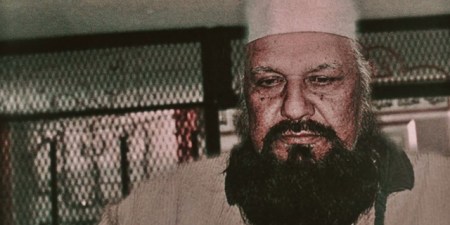
Gilani-HP_1Sheikh Mubarak Ali Gilani, the radical head of Jamaat ul-Fuqra, a terrorist organization fronted in the U.S. by Muslims of the Americas.

The Council on American-Islamic Relations (CAIR) and its “moderate” image is suffering from a self-inflicted wound now it has become intertwined with the Muslims of the Americas, a radical anti-Semitic front for the Jamaat ul-Fuqra terrorist group.

CAIR’s Massachusetts chapter now shares an official with MOA and two CAIR officials spoke at MOA’s International Islamophobia Conference.

The Massachusetts chapter of CAIR recently chose MOA’s general counsel, Tahirah Amatul Wadud, as a board member. CAIR, a U.S.Muslim Brotherhood entity banned for its own terror links in the UAE, wisely omitted mention of MOA. It described her generically as a “general counsel for a New York Muslim congregation.”

Wadud reportedly posted an article by MOA’s Pakistan-based leader, Sheikh Mubarak Ali Gilani, on her Facebook claiming the Islamic State (ISIS/ISIL) is a puppet of the British government and a Jewish conspiracy perpetrated the attacks on Pearl Harbor and September 11, 2001. The Clarion Project was the first to report on the inflammatory article.

“There was no need for America to go to war against Hitler. Hitler was not the enemy of America or the American people. There was a mutual animosity between Hitler and the Jews. So, the American people paid a very heavy price for fighting someone else’s war,” Gilani wrote.

American Taliban _ Mauro-240x145

Two CAIR officials spoke at MOA’s International Islamophobia Conference, which included a poster featuring the faces of the “American Taliban” that included Clarion Project national security analyst Ryan Mauro. They were CAIR-Michigan Executive Director Dawud Walid and CAIR-ArizonaExecutive Director Imraan Siddiqi. Walid was one of the CAIR officials who have questioned whether Muslims should honor fallen U.S. servicemen on Memorial Day, sparking a backlash from Muslims who appreciate the U.S. military.

Jamaat ul-Fuqra is led by Gilani. It is best known for a series of terrorist attacks and plots in the 1980s and early 1990s and for setting up “Islamic villages” across the country, including at least two that were shut down by the authorities. These “villages” are known to have been used for guerilla warfare training. Fuqra now goes primarily by the name of Muslims of the Americas (MOA), among other names. The group says it has 22 such “villages” in the U.S.

The Clarion Project obtained video of female members receiving basic paramilitary instruction in military fatigue at its “Islamberg” headquarters in New York. The date of the footage is cut off, only stating “Jan. 28 20,” presumably meaning it was made in 2000 or after. The best explanation MOA members have come up with is that it was a “self-defense class.”

View the video here:

The Clarion Project identified a Fuqra “village” in Texas in 2014 and retrieved an FBI intelligence report from 2007 that stated MOA “possess an infrastructure capable of planning and mounting terrorist campaigns overseas and within the U.S.” and “the documented propensity for violence by this organization supports the belief the leadership of the MOA extols membership to pursue a policy of jihad or holy war against individuals or groups it considers enemies of Islam, which includes the U.S. Government.”

The FBI also said “members of the MOA are encouraged to travel to Pakistan to receive religious and military/terrorist training from Gilani.” In 2001, ATF Special Agent Thomas P. Gallagher testified in court that “individuals from the organization are trained in Hancock, N.Y., and if they pass the training in Hancock, N.Y., are then sent to Pakistan for training in paramilitary and survivalist training by Mr. Gilani.”

After Clarion Project identified the Texas site and published the FBI report, a dozen Muslim groups have signed a statement calling for Fuqra’s designation as a Foreign Terrorist Organization. Of course, CAIR isn’t one of them. CAIR actually came to Fuqra/MOA’s defense. And now CAIR and Fuqra have shared leadership through CAIR-Massachusetts and hold events together.

CAIR Two Officials Siddiqi Walid-240x323

MOA’s International Islamophobia Conference took place at the Muslim Community Center of the Capital District in Schenectady, New York. CAIR-Arizona Executive Director Imraan Siddiqi is listed as a member of the Board of Directors, indicating he played more than a speaking role in setting the MOA event up.

The MOA’s event featured delegates representing the U.S., Canada, Pakistan, Senegal, India, Taiwan, Bangladesh and Egypt. Siddiqi was the delegate representing India. MOA flyers also list headquarters in Caracas, Venezuela and Las Lomas, Trinidad & Tobago. The MOA claims it had nearly 300 attendees and thousands watched online. It announced it would start a new political coalition named the “International United Muslim Forum.”

Ironically, MOA has tried to excuse itself from its terrorist and criminal history by claiming that it was infiltrated by Wahhabist/Muslim Brotherhood operatives who were sent to undermine Sheikh Gilani. It even claims that one operative was a shape-shifter who could go “through physical changes before speaking to people as if he were Sheikh Gilani.”

And now MOA is collaborating with a known Muslim Brotherhood entity. You can read our documented profiles of CAIR and MOA here and here.

The End Of The Multiculturalist Consensus In Europe

February 5, 2016

The End Of The Multiculturalist Consensus In Europe, Daily Caller, Michel Gurfinkiel, February 3, 2016

(Please see also, Latest Poll: Merkel in Free Fall, Germans Sensible; 76% of AfD Supporters OK with Genuine Refugees.  — DM)

One wonders why America, a nation of immigrants, can be suddenly so receptive to Donald Trump’s anti-immigration rhetoric. The best answer, so far, is that immigration does not seem to work any more the way it did, at least for certain groups of immigrants.

A similar situation has arisen in Europe. In 2009, the American journalist Christopher Caldwell famously characterized the changes that a massive non-European, non-Judeo-Christian, immigration was forcing over Europe as a “revolution.” We may now be on the brink of a counter-revolution, and that can be as violent and far-reaching as revolution itself.

Last year’s massacres in Paris (the attacks on satirical cartoonists and a kosher supermarket’s customers in January 2015, then the November 13 killing spree) were a tipping point : the French – and by extension, most Europeans — realized that unchecked immigration could lead to civil war.

Then there was the Christmas crisis in Corsica, a French island in the Mediterranean. On December 24, a fire was activated at an immigrant-populated neighborhood in Ajaccio, the capital of Southern Corsica. As soon as the firemen arrived, they were attacked by local youths, Muslims of North African descent. Such ambushes have been part of French life for years. This time, however, the ethnic Corsicans retaliated; for four days, they rampaged through the Muslim neighborhoods, shouting Arabi Fora! (Get the Arabs out, in Corsican). One of Ajaccio’s five mosques was vandalized.

Then, there was the New Year’s crisis in Germany and other Northern European countries. On December 31, one to two thousand male Muslim immigrants and refugees swarmed the Banhofvorplatz in Cologne, a piazza located between the railway Central Station and the city’s iconic medieval cathedral. As it turned out during later in the evening and the night, they intended to “have fun”: to hunt, harass, or molest the “immodest” and presumably “easy” German women and girls who celebrated New Year’s Eve at the restaurants and bars nearby, or to steal their money. 766 complaints were lodged. Similar incidents took place in other German cities, like Hamburg, Frankfurt and Stuttgart, as well as in Stockholm and Kalmar in Sweden, and Helsinki in Finland.

Here again, the local population reacted forcefully. Support for asylum seekers from the Middle East plummeted – 37 percent of Germans said that their view of them has “worsened,” and 62 percent said that there are “too many of them.” The Far Right demonstrated against immigration in many cities, but liberal-minded citizens were no less categorical. Le Monde, the French liberal newspaper, on January 20 quoted Cologne victims as saying, “Since 1945, we Germans have been scared to be charged with racism. Well, the blackmail is over by now.”

Indeed, postwar Europe, and Germany in particular, had been built upon the rejection of Hitler’s mad regime and everything it stood for. Nationalism, militarism, authoritarianism, and racism were out. Multinationalism, pacifism, hyperdemocracy, and multiculturalism were in. This simple, almost Manichean, logic is collapsing now – under the pressure of hard facts. Or rather the Europeans now understand that it was flawed in many ways from the very beginning, especially when it came to multiculturalism, the alleged antidote to racism.

What Europeans had in mind when they rejected racism in 1945 was essentially antisemitism. Today, the “correct” antiracist attitude would be to welcome non-European immigrants en masse and to allow them to keep their culture and their way of life, even it that would contradict basic European values. Hence last summer’s “migrants frenzy,” when the EU leadership in Brussels and major EU countries, including Angela Merkel’s Germany, decided to take in several millions of Middle East refugees overnight.
European public opinion is now awaking to a very different view. And the political class realizes that it must adjust – or be swept away.

European public opinion is now awaking to a very different view. And the political class realizes that it must adjust – or be swept away.

The Schengen regime – which allows free travel from one country to the other in most of the EU area – is being quietly suspended; every government in Europe is bringing back borders controls. The French socialist president François Hollande is now intent to strip disloyal immigrants and dual citizens of their French citizenship (a move that precipitated the resignation, on January 27, of his super-left-wing justice minister, Christiane Taubira). He is also hiring new personnel for the police and the army and even considering raising a citizens’ militia. Merkel now says that immigrants or refugees who do not abide by the law will be deported. Even Sweden, currently ruled by one of Europe’s most left-wing cabinets, has been tightening its very liberal laws on immigration and asylum.

Most Europeans agree with such steps. And wait for even more drastic measures.


A (Much) Better Year

February 5, 2016

A (Much) Better Year, Front Page Magazine, Caroline Glick, February 5, 2016

ob

[A] of the Republicans candidates are significantly more supportive of Israel than the Democratic candidates. So it is simply an objective fact that Israel will be better off if a Republican is elected in November no matter who he is and no matter who the Democratic candidate is.

Part of the reason Obama is acting with such urgency and intensity is that he knows that regardless of who is elected to replace him, the next president will not be as viscerally hostile to Israel or as emotionally attached to Islam as he is.

**********************

On Wednesday the U.S. media interrupted its saturation coverage of the presidential primaries to report on President Barack Obama’s visit to a mosque in Maryland. The visit was Obama’s first public one to a mosque in the US since entering the White House seven years ago. The mosque Obama chose to visit demonstrated once again that his views of radical Islam are deeply problematic.

Obama visited the Islamic Society of Baltimore, a mosque with longstanding ties to the Muslim Brotherhood and Hamas. During Operation Protective Edge, the leaders of the mosque accused Israel of genocide and demanded that the administration end US support for the Jewish state.

According to The Daily Caller, the mosque’s former imam Mohammad Adam el-Sheikh was active in the Islamic American Relief Agency, a charity deemed a terror group in 2004 after the US Treasury Department determined it had transferred funds to Osama bin Laden, Hamas, al-Qaida and other terrorist groups.

El-Sheikh left the Baltimore mosque to take over the Dar el-Hijra mosque in northern Virginia. He replaced Anwar al-Awlaki as imam after Awlaki moved to Yemen in 2003. In Yemen Awlaki rose to become a senior al-Qaida commander.

Awlaki radicalized many American jihadists both through direct contact and online. He radicalized US Army major Nidal Malik Hasan, and inspired him to carry out the 2009 massacre of 13 US soldiers and civilians at Fort Hood in Texas. Awlaki was killed by a US drone strike in 2011.

In 2010, a member of the Islamic Society of Baltimore was arrested for planning to attack an army recruiting office. According to the Mediaite news portal, the mosque reportedly refused to cooperate with the FBI in its investigation.

Obama’s visit to the radical mosque now is a clear signal of how he intends to spend his last year in office. It tells us that during this period, Obama will adopt ever more extreme positions regarding radical Islam.

Obama’s apologetics for radical Islamists is the flipside of his hostility for Israel. This too is escalating and will continue to rise through the end of his tenure in office.

The US Customs authority’s announcement last week that it will begin enforcing a 20-yearold decision to require goods imported from Judea and Samaria to be labeled “Made in the West Bank,” rather than “Made in Israel,” signals Obama’s intentions. So, too, it is abundantly clear that France’s plan to use the UN Security Council to dictate Israel’s borders was coordinated in advance with the Obama administration.

Part of the reason Obama is acting with such urgency and intensity is that he knows that regardless of who is elected to replace him, the next president will not be as viscerally hostile to Israel or as emotionally attached to Islam as he is.

On the Democratic side, neither candidate is a particularly energetic supporter of Israel or counter- jihad warrior. Former secretary of state Hillary Clinton’s recently released email discussions of Israel with her closest advisers indicate that all of Clinton’s closest counselors are hostile to Israel.

For his part, Vermont’s socialist Sen. Bernie Sanders harbors the far Left’s now standard anti-Israel attitudes. Not only did Sanders – like Clinton – support Obama’s nuclear deal with Iran. He boycotted Prime Minister Benjamin Netanyahu’s speech before the Joint Houses of Congress where Netanyahu laid out Israel’s reasons for opposing the deal. Sanders gave television interviews condemning Netanyahu for making the speech, accusing him of electioneering on the back of the US Congress. Sanders criticized Israel during Operation Protective Edge and supports decreasing US military aid to Israel.

For all their anti-Israel sensibilities, though, neither Clinton nor Sanders gives the impression that they are driven by them as Obama is.

Unlike Obama, neither appear to be animated by their hostility toward Israel. Neither seem to be passionate in their support for Muslim Brotherhood- affiliated groups or in their desire to realign the US away from Israel, from its traditional Arab allies and toward Iran. This lack of passion makes it safe to assume that if elected president, while they will adopt anti-Israel policies, they will not seek out ways to weaken Israel or strengthen its sworn enemies.

On the Republican side, the situation is entirely different. All of the Republican presidential candidates are pro-Israel. To be sure, some are more pro-Israel than others. Sen. Ted Cruz, for instance, is more supportive than his competitors. But all of the Republicans candidates are significantly more supportive of Israel than the Democratic candidates. So it is simply an objective fact that Israel will be better off if a Republican is elected in November no matter who he is and no matter who the Democratic candidate is.

It hasn’t always been this way. And it doesn’t have to remain this way.

Back in 1992 when Bill Clinton was running against George H.W. Bush, if Israel was your issue, you voted for Clinton because he was rightly viewed as more pro-Israel than Bush.

Twenty-four years ago, supporting Israel carried no cost for Clinton. According to Gallup, in 1992, 52 percent of Democrats were pro-Israel.

On the other hand, Bush was probably harmed somewhat for the widespread perception that he was anti-Israel. In 1992, 62% of Republicans were pro-Israel.

Over the past 15 years, the situation has altered considerably.

Today, Republicans are near unanimous in their support for Israel. According to a Gallup poll from February 2015, 83% of Republicans support Israel.

Only 48% of Democrats do. From 2014 to 2015, Democratic support for Israel plunged 10 points.

The cleavage on Israel is particularly acute among partisan elites.

Last summer, pollster Frank Luntz conducted a survey of US elite partisan opinion on Israel. His data were devastating. According to Luntz’s data, 76% of Democratic elite believe that Israel has too much influence over US foreign policy. Only 20% of Republicans do.

Nearly half (47%) of highly educated, wealthy and politically active Democrats think that Israel is a racist country. Thirteen percent of their Republican counterparts agree.

And whereas only 48% of Democrats believe that Israel wants peace, 88% of Republicans believe that Israel wants peace with its neighbors.

These trends affect voting habits. According to Luntz, while only 18% of Democrats say they would be more likely to vote for a politician who supports Israel, 31% said they are less likely to vote for a pro-Israel candidate. In contrast, 76% of Republicans say they want their representatives to support Israel.

Forty-five percent of Democrats said they would be more likely to vote for a politician who is critical of Israel and 75% of Republicans said they would be less likely to vote for an anti-Israel candidate.

These data tell us two important things. Today Democratic candidates will gain nothing and may lose significant support if they support Israel.

In contrast, a Republican who opposes Israel will have a hard time getting elected, much less winning a primary.

Partisan sensibilities aren’t the only reason that Israel is will be better off if a Republican wins in November. There is also the issue of policy continuity.

Even though neither Clinton nor Sanders share Obama’s anti-Israel passion, their default position will be to maintain his policies. Traditionally, when an outgoing president is replaced by a successor from his own party, many of his foreign policy advisers stay on to serve his successor.

Moreover, if American voters elect a Democrat to succeed Obama, their decision will rightly be viewed as a vote of confidence in his policies.

Obama has radicalized the Democratic Party in his seven years in office. When Obama was inaugurated, the Blue Dog caucus of conservative Democratic members of the House of Representatives had 54 members. Today only 14 remain.

Obama’s Democratic Party is not Bill Clinton’s party.

A party that isn’t forced to pay a price for its policies isn’t likely to change them. If the Democrats are not defeated in the run for the White House in November, their party will not reassess its shift to radicalism and reconsider its increasingly hostile stance on Israel.

That then brings us to the state of the presidential race following the Iowa caucuses and ahead of next Tuesday’s primary in New Hampshire. The Iowa caucuses showed a significant gap in enthusiasm among partisan voters. Participation rates in the Republican caucuses were unprecedented.

Cruz shattered the record for vote getting in the state that saw participation rates up 30% from 2012. On the Democratic side, participation rates were below the 2008 level.

On the Republican side, the three top candidates – Cruz, businessman Donald Trump and Sen. Marco Rubio – are all backed by committed, fervent supporters. On the Democratic side, Clinton’s supporters are reportedly diffident about her. And while Sanders enjoys enthusiastic support from voters under 45, he can’t seem to convince people who actually know what socialism is to support him.

If Sanders wins the Democratic nomination, on the face of it, it is difficult to see his path to victory in the general election. Whereas Obama was elected by hiding his radical positions, Sanders is running openly as a socialist and attacks Obama from the Left. Whether America is a center-right or center-left country, the undisputed truth is that it is a centrist country.

As for Clinton, the likelihood grows by the day that by the general election, her inability to inspire her base will be the least of her problems.

The FBI’s ongoing probe of her use of a private email server during her tenure as secretary of state is devastating her chances of getting elected.

The State Department’s revelation last week that 22 of Clinton’s emails were too classified to be released, even with parts blacked out, makes it impossible to dismiss the prospect that she will be indicted for serious felony offenses. Yet, as Jonah Goldberg argued Wednesday in National Review, with her narrow victory in Iowa, Clinton blocked the opening for a less damaged candidate – like Vice President Joe Biden or former New York mayor Michael Bloomberg – to step into the race.

In other words, the Republican nominee will have an energized base and will face either a legally challenged or openly socialist Democratic opponent.

According to terrorism expert Steven Emerson, before Obama visited the Islamic Society of Baltimore, he asked the FBI for its opinion of the mosque. FBI investigators informed Obama of the mosque’s ties to terrorism. They urged him not to confer it with the legitimacy that comes with a presidential visit.

Obama ignored the FBI’s advice.

The next 11 months will be miserable for Israel.

But we should take heart. By all accounts, next year will be better. And judging by the way the presidential race is shaping up, next year may be a much, much better year.