Posted tagged ‘Islamic supremacy’

Muslim Activists Demand Action vs Islamist Extremism

November 17, 2015

Muslim Activists Demand Action vs Islamist Extremism, Clarion Project, Elliot Friedland, November 13, 2015

(Shhh. Don’t tell Obama, but these Muslims think that the Islamic State is Islamic and want reform. He might treat them as he does Egyptian President Sisi.– DM)

Iraq-Protest-Sharia-Legislation-HP_1Protesters in Iraq march against anti-women sharia legislation. (Photo: © Reuters)

“The threat of global terrorism is unlikely to end until the resolution of the civil war of ideas between Muslim modernisers and those adhering to an outmoded theology of Islamic dominance.”

***************************

In the aftermath of Friday’s Paris attacks, Muslim human rights activists around the world are galvanizing the fightback against the Islamist extremist ideology and those who deny the conection between the Islamic State and Islam.

The chairman of the UK’s Conservative Muslim Forum, Mohammed Amin, slammed the inaction of Muslim groups saying “condemning terrorism is not enough if you are unwilling to acknowledge its causes.”

He said condemnations of terrorism from groups like Council on American Islamic Relations (CAIR) and the Muslim Council of Britain left him “feeling frustrated –  because they look so incomplete.”

“I am utterly fed up with hearing people, both Muslim and non-Muslim, argue that the religious views of the terrorists are irrelevant,” he said.

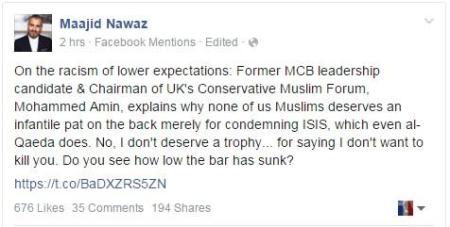
Counter-extremism activist Maajid Nawaz supported Amin on Facebook saying,“None of us Muslims deserves an infantile pat on the back merely for condemning ISIS, which even al-Qaeda does.”

Maajid-Nawaz-pat-on-back-500x253

Anti-extremism activist and journalist Felix Marquardt went further, demanding “We Muslims must hunt down these monsters who make a mockery of our religion” in a fiery op-ed in Britain’s The Daily Telegraph.

He called out Muslims who merely say ISIS has “nothing to do with Islam,” despite that being the first reaction of a Muslim. He labelled it “dubious intellectually and altogether irresponsible to keep our reaction at that.”

Dr. Zudhi Jasser, head of the American Islamic Forum for Democracy, identified a “cultural battle, a battle of ideologies” as the root cause.

Raheel Raza of the Council of Muslims Facing Tomorrow implored both Muslims and non-Muslims to “connect the dots to get to the root of terrorism,” arguing that “Since 9/11, the West has been waffling in the quicksand of political correctness and refuse to call a spade a spade.”

She too identifies the root cause of the Islamic State as the ideology of radical Islamism.

The former ambassador of Pakistan to the United States, Hussein Haqqani, also pointed to extremist ideology as the root cause of the Paris attacks.

“Just as the post-9/11 war against al-Qaeda degraded Osama bin Laden’s group but gave rise to the Islamic State in Iraq and the Levant (ISIL)” he writes, “extremist Islamist ideology will likely give birth to ‘Terrorism 3.0’ once the world has fought, contained and eliminated ISIL.”

This is because, he argues, “The threat of global terrorism is unlikely to end until the resolution of the civil war of ideas between Muslim modernisers and those adhering to an outmoded theology of Islamic dominance.”

Haqqani resoundingly concludes “only a concerted ideological campaign against medieval Islamist ideology, like the one that discredited and contained communism, could turn the tide.”

These are just a handful of the growing number of Muslims who are fighting the Islamist ideology on the front lines and within their own communities.

They, more than anyone, know that this is not a “clash of civilizations” between East and West but a political battle between tolerance and intolerance, between fundamentalism and openness and between theocracy and democracy.

These brave thinkers and leaders are sounding the charge and deserve our support.

Maajid Nawaz of the Quilliam Foundation names the Islamist ideology:

Cartoon of the day

November 17, 2015

H/t Freedom is just another word

before

H/t The Washington Times


Obama reaction to Paris

The West and Islam

November 17, 2015

The West and Islam, Washington Times, Robert W. Merry, November 16, 2015

West and IslamIllustration on the clash of civilizations by Linas Garsys/The Washington Times

France’s 4.7 million Muslims now constitute about 7.5 percent of the country’s population, and that number is projected to hit nearly 7 million by 2030. Generally, these people have not assimilated well into French society and hence constitute a mass of political and cultural anger that can only intensify in coming years.

**********************

As the full magnitude of Friday’s Paris carnage became known, President Obama spoke to America people and the world about the horrific bloodshed in that great Western city. The president said this was not an attack simply on Paris or the French people. “It was an attack,” he said, “on all of humanity and the universal values that we share.”

This is dangerously wrongheaded. History is not about all of humanity struggling to preserve and protect universal values against benighted peoples here and there who operate outside the confines of those shared values. History is about distinct civilizations and cultures that struggle to define themselves and maintain their identities in the face of ongoing threats and challenges from other civilizations and cultures.

Compare the president’s gauzy notion to what the late Samuel P. Huntington, probably the greatest political scientist of his generation, had to say about the relationship between the West and Islam. “Some Westerners,” wrote Huntington, ” have argued that the West does not have problems with Islam but only with violent Islamist extremists. Fourteen hundred years of history demonstrate otherwise.”

This is not to say, of course, that all or even most Muslims are Islamist extremists or that Western values don’t inspire many within that civilization. But the Islamist fervor we see bubbling up within Middle Eastern Islam today emanates directly from the doctrines and history of Islam. Most Muslims of the Levant know in their hearts, in a way that most Westerners don’t recognize, that Islam and the West have been locked in a civilizational struggle for centuries — reflected in the Moors’ conquest of Spain and incursion into France in the 8th century; the centuries-long Spanish struggle to push the Moors south and finally expel them entirely from Iberia; the wars of the Crusades, inexplicable as anything but a civilizational clash; the Ottoman conquest of the Balkans and slow push up the Danube to Vienna; the two Ottoman sieges at Vienna; the long effort to push the decaying Ottoman forces back toward Istanbul (a highly civilized seat of Christianity before it fell to Islam in 1453); the European takeover of large segments of the Islamic Middle East after World War I; and the eventual pushback by angry and frustrated Muslims bent on protecting their civilization through whatever means they can devise.

That’s a lot of civilizational clash, and it belies the notion that the Paris slaughter reflects the forces of civilization struggling to preserve universal values against the forces of darkness bent on destroying those values. Huntington again: “The underlying problem for the West is not Islamic fundamentalism. It is Islam, a different civilization whose people are convinced of the superiority of their culture and are obsessed with the inferiority of their power. The problem for Islam is not the CIA or the U.S. Department of Defense. It is the West, a different civilization whose people are convinced of the universality of their culture and believe that their superior, if declining, power imposes on them the obligation to extend that culture throughout the world.”

If Huntington presents the more accurate depiction of the relationship between the West and Islam, then certain conclusions follow. First, expect the clash to intensify with Western military incursions into the lands of Islam. This isn’t conjecture. President George W. Bush played into the hands of Islamist extremists when he invaded Iraq, and Mr. Obama did the same when he expanded the Afghanistan mission to reshape political structures and behavior in the Afghan countryside. The threat to the West is greater today than it was before those actions were undertaken.

Second, Muslim immigration into the West inevitably will heighten prospects for bloodshed of the kind we saw in Paris on Friday. We learn from news reports that at least one of the Paris killers probably entered the country with the refugees now flooding into Europe. That should not surprise anyone, certainly not those who understand the true nature of the civilizational clash between the West and Islam.

France’s 4.7 million Muslims now constitute about 7.5 percent of the country’s population, and that number is projected to hit nearly 7 million by 2030. Generally, these people have not assimilated well into French society and hence constitute a mass of political and cultural anger that can only intensify in coming years.

And yet we see the Continent’s most influential leader, Germany’s Angela Merkel, beating the drums for ever greater infusions of Muslim refugees into Europe. And we see the editors of The Economist labeling her “the indispensable European.” This is what happens when humanitarian universalism supplants civilizational consciousness.

Europe is beginning to show some signs of civilizational consciousness, and that sentiment likely will intensify in the wake of the Paris bloodshed. But humanitarian universalism is powerfully embedded into the Western consciousness. Mrs. Merkel’s remarks after the Paris massacre showed little inclination to adjust her view of the world or of Europe’s future. Certainly the editors of The Economist and other like-minded liberals will never alter their gauzy notions. And news coverage of the Paris aftermath reflected the prevailing sentiment by habitually characterizing those who want to curtail Europe’s Muslim immigration as “xenophobic” and “radical.”

But the Muslim infusion represents an existential threat to Europe and the West. Maybe the people there will get rid of their current leaders now living in another world and install leaders who understand the true nature of the threat. Then again, maybe not.

Obama: not bringing ISIS jihadists to America would “betray our values”

November 17, 2015

Obama: not bringing ISIS jihadists to America would “betray our values”

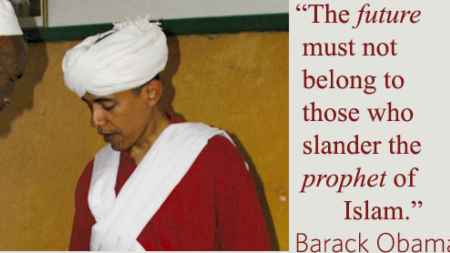
obama_muslim3

Also not freeing Al Qaeda terrorists from Gitmo would violate our values. And describing Islamic terrorism as Islamic terrorism would really violate our values.

It seems as if Obama’s version of American values is a little hard to tell apart from ISIS values. Right down to locking up a filmmaker who made a YouTube video about Mohammed.

Speaking to reporters from Islamic Turkey, a regime which has made it illegal to even discuss its own genocide and which sponsors Islamic terrorists around the world, Obama got on his high horse over the huge numbers of Syrian Muslim migrants he wants to import to America.

But not before making a bunch of excuses for his own incompetence.

“It’s not their sophistication or the particular weaponry that they possess, but it is the ideology they carry with them and their willingness to die,” Obama whined.

That would be the ideology whose name the administration is unwilling to speak. But ISIS would need much better weaponry if Europe and America didn’t insist on importing its fighters into their countries. Once there all they need is a gun or a homemade bomb to wreak havoc.

This is a war where we’re inviting in our own invaders. And Obama doubled down on keeping the invasion going.

“Slamming the door in their faces would be a betrayal of our values. Our nations can welcome refugees who are desperately seeking safety and ensure our own security. We can and must do both,” Obama promised.

Except we can’t do both. 9/11 and the World Trade Center bombing and the Boston Marathon bombing showed that. As well as the countless smaller terror plots since then.

Then Obama rejected the idea of focusing on helping persecuted Christians over the violent Islamic Supremacist majority. “When I hear folks say that, well, maybe we should just admit the Christians but not the Muslims, when I hear political leaders suggesting that there would be a religious test for which person who’s fleeing from a war-torn country is admitted, when some of those folks themselves come from families who benefited from protection when they were fleeing political persecution, that’s shameful. That’s not American. That’s not who we are. We don’t have religious tests to our compassion.”

Actually Obama does. It’s why his regime has been deporting Christians while taking in huge numbers of Muslims.

If we’re taking in refugees, we should be taking in those who genuinely have nowhere else to go in a region dominated by Muslim countries. Sunni or Shiite Muslims have their own countries they can go to.

They are not refugees.

During WW2, the United States did not admit Nazis, moderate or otherwise, as refugees. That would have been ridiculously stupid. Syria is in the middle of a religious civil war between Sunnis and Shiites. Neither side are victims. They are both perpetrators of massacres toward each other.

Obama claims that we should not “somehow start equating the issue of refugees with the issue of terrorism.”

The “somehow” part comes because refugees are an entrance point for terrorists and terrorism. It’s not “somehow”. It’s directly causative.

While Obama bleats about compassion, his compassion has been utterly lacking when it comes to persecuted Christians. He only has compassion for Muslims.

France’s Politically Correct War on Islamic Terror

November 16, 2015

France’s Politically Correct War on Islamic Terror, The Gatestone InstituteSoeren Kern, November 16, 2015

(Please see also, Why Islam is a religion of war. — DM)

  • French leaders consistently act in ways that undermine their stated goal of eradicating Islamic terror.
  • Critics of the policy say “Daesh” is a politically correct linguistic device that allows Western leaders to claim that the Islamic State is not Islamic — and thus ignore the root cause of Islamic terror and militant jihad.
  • French leaders have also been consistently antagonistic toward Israel, a country facing Islamic terror on a daily basis. France is leading international diplomatic efforts to push for a UN resolution that would lead to the establishment of an independent Palestinian state within a period of two years. The move effectively whitewashes Palestinian terror.
  • French critics of Islam are routinely harassed with strategic lawsuits that seek to censor, intimidate and silence them. In a recent case, Sébastien Jallamion, a 43-year-old policeman from Lyon was suspended from his job and fined 5,000 euros after he condemned the death of Frenchman Hervé Gourdel, who was beheaded by jihadists in Algeria.
  • “Those who denounce the illegal behavior of fundamentalists are more likely to be sued than the fundamentalists who behave illegally.” — Marine Le Pen, leader of France’s Front National.

French President François Hollande has vowed to avenge the November 13 jihadist attacks in Paris that left more than 120 dead and 350 injured.

Speaking from the Élysée Palace, Hollande blamed the Islamic State for the attacks, which he called an “act of war.” He said the response from France would be “unforgiving” and “merciless.”

Despite the tough rhetoric, however, the question remains: Does Hollande understand the true nature of the war he faces?

Hollande pointedly referred to the Islamic State as “Daesh,” the acronym of the group’s full Arabic name, which in English translates as “Islamic State of Iraq and the Levant,” or “ISIL.”

The official policy of the French government is to avoid using the term “Islamic State” because, according to French Foreign Minister Laurent Fabius, it “blurs the lines between Islam, Muslims and Islamists.”

Critics of the policy say “Daesh” is a politically correct linguistic device that allows Western leaders to claim that the Islamic State is not Islamic — and thus ignore the root cause of Islamic terror and militant jihad.

Islamic ideology divides the world into two spheres: the House of Islam and the House of War. The House of War (the non-Muslim world) is subject to permanent jihad until it is made part of the House of Islam, where Sharia is the law of the land.

Jihad — the perpetual struggle to expand Muslim domination throughout the world with the ultimate aim of bringing all of humanity under submission to the will of Allah — is the primary objective of true Islam, as unambiguously outlined in its foundational documents.

Consequently, even if the Islamic State were to be bombed into oblivion, France and the rest of the non-Muslim world will continue to be the target of Islamic supremacists. The West cannot defeat Islamic terrorism by attempting to conceptually delink it from true Islam. But still they try.

After the January 2015 jihadist attacks on the Paris offices of the magazine Charlie Hebdo that left 12 people dead, President Hollande declared:

“We must reject facile thinking and eschew exaggeration. Those who committed these terrorist acts, those terrorists, those fanatics, have nothing to do with the Muslim religion.”

French Prime Minister Manuel Valls said: “We are in a war against terrorism. We are not in a war against religion, against a civilization.” Again, he said: “We are at war with terrorism, jihadism and radicalism. France is not at war against Islam and Muslims.”

At a June conference with more than 100 leaders of the French Muslim community, Valls denied there is any link between extremism and Islam. He also refused to raise the issue of radicalization because the topic was “too sensitive.” Instead, he said:

“Islam still provokes misunderstandings, prejudices and is rejected by some citizens. Yet Islam is here to stay in France. It is the second largest religious group in our country.

“We must say all of this is not Islam: The hate speech, anti-Semitism that hides behind anti-Zionism and hate for Israel, the self-proclaimed imams in our neighborhoods and our prisons who are promoting violence and terrorism.”
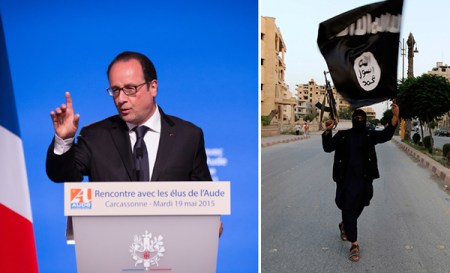
1348After the January 2015 jihadist attacks in Paris, France’s President François Hollande declared: “We must reject facile thinking and eschew exaggeration. Those who committed these terrorist acts, those terrorists, those fanatics, have nothing to do with the Muslim religion.”

France is home to around 6.5 million Muslims, or roughly 10% of the country’s total population of 66 million. Although most Muslims in France live peacefully, many are drawn to radical Islam. A CSA poll found that 22% of Muslims in the country consider themselves Muslim first and French second. Nearly one out of five (17%) Muslims in France believe that Sharia law should be fully applied in France, while 37% believe that parts of Sharia should be applied in the country.

France is also one of the largest European sources of so-called foreign fighters in Syria: More than 1,500 French Muslims have joined the Islamic State in Iraq and Syria, and many more are believed to be supporters of the group in France.

Since the Charlie Hebdo attacks, the French government has introduced a raft of new counter-terrorism measures — including sweeping surveillance powers to eavesdrop on the public — aimed at preventing further jihadist attacks.

French counter-terrorism operatives have foiled a number of jihadist plots, including a plan to attack a major navy base in Toulon, and an attempt to murder a Socialist MP in Paris.

As the latest attacks in Paris (as well as the failed attack on a high-speed train from Amsterdam to Paris in August) show, surveillance is not foolproof. Claude Moniquet, a former French intelligence operative, warns that European intelligence agencies are overwhelmed by the sheer number of people who may pose a threat. He writes:

“Some 6,000 Europeans are or were involved in the fighting in Syria (they went there, they were killed in action, they are still in IS camps, they are on their way there or their way back.)

“If you have 6,000 ‘active’ jihadists, this probably means that if you try to count those who were not identified, the logistics people who help them join up, their sympathizers and the most radical extremists who are not yet involved in violence but are on the verge of it, you have something between 10,000 and 20,000 ‘dangerous’ people in Europe.

“To carry out ‘normal’ surveillance on a suspect on a permanent basis, you need 20 to 30 agents and a dozen vehicles. And these are just the requirements for a ‘quiet’ target.

“If the suspect travels abroad, for instance, the figure could go up to 50 or 80 agents and necessitate co-operation between the services of various countries. Work it out: to keep watch on all the potential suspects, you’d need between 120,000 and 500,000 agents throughout Europe. Mission impossible!”

Meanwhile, French leaders consistently act in ways that undermine their stated goal of eradicating Islamic terror.

The French government has been one of the leading European proponents of the nuclear deal with Iran, the world’s biggest state sponsor of terrorism. Although Iran and its proxy, Hezbollah, are responsible for deaths of scores of French citizens, Fabius wasted no time in rushing to Tehran in search of business opportunities for French companies. In July, Fabius proclaimed:

“We are two great independent countries, two great civilizations. It is true that in recent years, for reasons that everyone knows, links have loosened, but now thanks to the nuclear deal, things are going to change.”

Fabius also extended an invitation for Iran’s President, Hassan Rouhani, to visit France in November. This trip — which has been mired in controversy, not over terrorism or nuclear proliferation, but over Iran’s demand that no wine be served during a formal dinner at the Élysée Palace — was postponed indefinitely after the Paris attacks. Hollande’s advisors apparently concluded that this is not the right moment for a photo-op with Rouhani, a career terrorist.

French leaders have also been consistently antagonistic toward Israel, a country facing Islamic terror on a daily basis.

After Israel launched a military offensive aimed at stopping Islamic terror groups in the Gaza Strip from launching missiles into the Jewish state, France led international calls for Israel to halt the operation. French Defense Minister Jean-Yves Le Drian said:

“France calls for an immediate ceasefire… to ensure that every side starts talking to each other to avoid an escalation that would be tragic for this part of the world.”

More recently, France has been a leading European advocate of a European Union policy that now requires Israel to label products “originating in Israeli settlements beyond Israel’s 1967 borders.” The move is widely seen as part of an international campaign to delegitimize the State of Israel. Israeli Prime Minister Benjamin Netanyahu slammed the move:

“The labelling of products of the Jewish state by the European Union brings back dark memories. Europe should be ashamed of itself. It took an immoral decision… this will not advance peace, it will certainly not advance truth and justice. It is wrong.”

France is also leading international diplomatic efforts to push for a United Nations resolution that would lead to the establishment of an independent Palestinian state within a period of two years. The move effectively whitewashes Palestinian terror. Netanyahu responded:

“The only way to reach an agreement is through bilateral negotiations, and we will forcibly reject any attempts to force upon us international dictates.

“In the international proposals that have been suggested to us — which they are actually trying to force upon us — there is no real reference to Israel’s security needs or our other national interests.

“They are simply trying to push us into indefensible borders while completely ignoring what will happen on the other side of the border.”

Meanwhile, after more than a year as a member of the US-led coalition against the Islamic State, French officials waited until late September to begin striking targets in Syria. But they refused to destroy the headquarters of the Islamic State in Raqqa — where the Paris attacks were reportedly planned.

Back in France, critics of Islam are routinely harassed with strategic lawsuits that seek to censor, intimidate and silence them.

In a recent case, Sébastien Jallamion, a 43-year-old policeman from Lyon, was suspended from his job and fined 5,000 euros after he condemned the death of Frenchman Hervé Gourdel, who was beheaded by jihadists in Algeria in September 2014. Jallamion explained:

“According to the administrative decree that was sent to me today, I am accused of having created an anonymous Facebook page in September 2014, showing several ‘provocative’ images and commentaries, ‘discriminatory and injurious,’ of a ‘xenophobic or anti-Muslim’ nature. As an example, there was that portrait of the Calif al-Baghdadi, head of the Islamic State, with a visor on his forehead. This publication was exhibited during my appearance before the discipline committee with the following accusation: ‘Are you not ashamed of stigmatizing an imam in this way?’ My lawyer can confirm this… It looks like a political punishment. I cannot see any other explanation.

“Our fundamental values, those for which many of our ancestors gave their life are deteriorating, and that it is time for us to become indignant over what our country is turning into. This is not France, land of Enlightenment that in its day shone over all of Europe and beyond. We must fight to preserve our values, it’s a matter of survival.”

Meanwhile, Marine Le Pen, the leader of France’s Front National (FN) and one of the most popular politicians in the country, went on trial in October 2015 for comparing Muslim street prayers to the wartime occupation of France. At a campaign rally in Lyon in 2010, she said:

“I’m sorry, but for those who really like to talk about World War II, if we’re talking about an occupation, we could talk about the [street prayers], because that is clearly an occupation of territory.

“It is an occupation of sections of the territory, of neighborhoods in which religious law applies — it is an occupation. There are no tanks, there are no soldiers, but it is an occupation nevertheless, and it weighs on people.”

Le Pen said she was a victim of “judicial persecution” and added:

“It is a scandal that a political leader can be sued for expressing her beliefs. Those who denounce the illegal behavior of fundamentalists are more likely to be sued than the fundamentalists who behave illegally.”

Responding to the jihadist attacks in Paris, Le Pen said:

“France and the French are no longer safe. It is my duty to tell you. Urgent action is needed.

“France must finally identify her allies and her enemies. Her enemies are those countries that have friendly relationships with radical Islam, and also those countries that have an ambiguous attitude toward terrorist enterprises.

“Regardless of what the European Union says, it is essential that France regain permanent control over its borders.

“France has been rendered vulnerable; it must rearm, because for too long it has undergone a programmed collapse of its defensive capabilities in the face of predictable and growing threats. It must restore its military resources, police, gendarmerie, intelligence and customs. The State must be able to ensure again its vital mission of protecting the French.

“Finally, Islamist fundamentalism must be annihilated. France must ban Islamist organizations, close radical mosques and expel foreigners who preach hatred in our country as well as illegal migrants who have nothing to do here. As for dual nationals who are participating in these Islamist movements, they must be stripped of their French nationality and deported.”

In the aftermath of the attacks, Le Pen, who has long been critical of President Hollande’s politically correct counter-terrorism policies, is certain to rise in public opinion polls. This will increase the political pressure on the government to take decisive action against the jihadists.

Faced with similar pressure after the Charlie Hebdo attacks in January, Hollande seemed reluctant to push too far, apparently fearful of the consequences of confronting the Muslim community in France. It remains to be seen whether the latest attacks in Paris, which some are describing as France’s September 11, mark a turning point.

Why can’t the terrorists see that climate change is the most important security issue?

November 16, 2015

Why can’t the terrorists see that climate change is the most important security issue? American ThinkerJack Hellner, November 16, 2015

(Do I really need to label this “satire?” –DM)

We shouldn’t allow this isolated event in Paris to take our eye off the ball. After all we have our President, Secretary of State and top Democratic candidate focused like a laser beam on the most dangerous threat to our freedom; climate change. They are showing true leadership. Al Gore was doing a 24 hour webcast at the Eiffel Tower Friday the 13th on climate change. If only the terrorists had been listening maybe they could have understood how much we cared and the attack wouldn’t have happened.

Thank goodness France is a gun free zone. That kept them safe.

As the President said Friday, ISIS is contained. As in 2012 when he said we have the terrorists on the run. His thoughts and talking points are obviously based on reality. After all we are sending in 50 advisors to Syria. That should handle it.

ISIS and other terrorist groups do not believe in economic freedom, political freedom, free speech, religious freedom or women’s’ rights but if we can control the temperature and sea levels that should change their minds.

The migrants from Africa would not be going to Europe if they could see all the work being done on climate change. If Africa could just reduce their quality and length of life by getting rid of fossil fuels they would stay. The secondary reason for them leaving is that tyrants and terrorists are killing them.

The World politicians can’t handle a relatively small terrorist group like ISIS, can’t figure out how to fix a small economy like Greece but yet are so arrogant they believe they can control the temperature within one or two degrees two hundred years out and absolutely control the levels of the sea.

When I heard about the Paris attack, I thought for sure it was caused by a video no one had seen.

Heaven help us!

Western leaders ignore ‘apocalyptic Islam’ at their peril

November 15, 2015

Western leaders ignore ‘apocalyptic Islam’ at their peril, Israel National News, Ari Soffer, November 15, 2015

img634813Bataclan concert hall following terror attackReuters

[G]laringly absent from the discussions [of the Paris attack] are any serious attempts to understand the ideological motivations of the Muslim extremists, several of them French citizens, who carried out the worse terror attacks in France in a generation – including the first-ever suicide bombings on French soil.

**************************

Despite years of warnings by intelligence agencies that radicalized Muslims would eventually emerge from the battlefields of Syria and Iraq to launch bloody attacks in the West, Europe has been blindsided by one of the most brutal terrorist atrocities in recent memory.

The coordinated attacks by three teams of ISIS terrorists in Paris on Friday sent shockwaves far beyond France, with the massacre of at least 129 people reigniting the debate around immigration after it was revealed that at least two of the attackers entered Europe posing as “refugees.”

The attacks also fueled debate over how to end the Syrian civil war, as well as over ongoing efforts to defeat ISIS on the battlefields of Syria and Iraq, the latter of which has seen several successes over the past few weeks.

But glaringly absent from the discussions are any serious attempts to understand the ideological motivations of the Muslim extremists, several of them French citizens, who carried out the worse terror attacks in France in a generation – including the first-ever suicide bombings on French soil.

That, says best-selling author Joel Rosenberg, is the reason such acts of terror are bound to repeat themselves.

Joel spoke to me prior to the attacks at the recent Jerusalem Leaders Policy Summit, and voiced concern that by failing to grapple with the apocalyptic ideology behind actors such as ISIS, Western states would never be able to decisively defeat them.

Watch: Author Joel Rosenberg speaks in Jerusalem:

A jovial, somewhat self-deprecating character, Rosenberg – who worked for Binyamin Netanyahu during his failed prime ministerial bid in 1999, as well as Natan Sharansky – describes himself as “a failed political consultant,” but boasts a rather more successful career as writer, selling millions of novels highlighting the threat of radical Islam.

Today he lives in Netanya in northern Israel with his family, having made aliyah from the US last August at the height of Operation Protective Edge (though a practicing Christian his father was Jewish, making him eligible for aliyah under the Right of Return). From there, he has continued his efforts to explain “the threats we mutually face as Israelis and Americans from radical Islam” – a threat he says he only fully appreciated after working with Netanyahu.

“Misunderstanding the nature of the threat… of evil, is to risk being blindsided by it,” he said, citing Peal Harbor and 9/11 as examples. “And we’re going to be blindsided by a nuclear Iran, just like we’re being blindsided by ISIS.”

“At the core of it, American leaders are refusing to deal with the theology and eschatology of our enemy,” he said. “Not every Muslim is a terrorist, not every Muslim is a threat, not every Muslim is a problem – in fact the vast majority are not.

“The question is, the ones who are – what do they want? What do they say they want? What motivates them?”

The current US administration is particularly hesitant to label the threat as it is.

“Obama refuses to even acknowledge radical Islam. Come on – really? At this stage in the 21st century you’re not even ready to acknowledge the ideology that is motivating these folks? That’s a problem.”

Days later, as the attacks in Paris unfolded, some criticized the US president for once again failing to mention radical Islam at all in his speech reacting to the massacre.

Watch: Obama delivers response to Paris attacks:

But beyond the relatively wide umbrella of “radical Islam” Rosenberg warns of a far deadlier threat.

“Radical Islam encompasses a wide range of groups… Hamas, the Muslim Brotherhood, Hezbollah, the Taliban, Al Qaeda – all of these are serious threats,” he noted. “But apocalyptic Islam is now the biggest threat. this is the Iranian leadership, this is ISIS.”

He argues that the hyper-messianic ideologies shared by both sides of the Shia-Sunni jihadist coin are unprecedented in the history of modern western civilization.

“Apocalyptic Islam is motivated by the idea that the end of days has come, that the Mahdi [Muslim messiah – ed.] is coming at any moment to establish a global Islamic kingdom or Caliphate, and that the way to hasten his coming is to annihilate two countries: Israel the ‘Little Satan,’ and America the ‘Big Satan,'” he explained, describing the messianic beliefs shared by both ISIS and the “Twelver Shia” sect which figures prominently among Iran’s leadership.

“But the western political class doesn’t want to even deal with the theological ideas that are driving the radical Islamists – let alone to explain the end of times theologies of two ‘nation states’,” he continued, referring to Iran and ISIS’s self-declared “Islamic State,” which encompasses huge swathes of territory in Iraq and Syria.

“Never in history have we had one, much less than two states, whose leaders are trying to force the end of the world,” Rosenberg noted.

While Jews and Christians also have their own beliefs in the “end of times” or the messianic age, the difference is that “we don’t believe we have to commit a genocide to bring about the end of times.”

While some strategic and doctrinal differences do clearly exist between Iran and ISIS – who are themselves mortal enemies – Rosenberg emphasized that the fundamental threat was essentially the same.

“Shia apocalypticism and Sunni apocalypticism are similar. Both believe the messiah is coming soon, that his kingdom is coming, they need to change their behavior to accelerate his coming… but the eschatology and strategies are different.

“ISIS’s strategy is to commit genocide today, because the goal is to build the caliphate, to force the hand of the messiah to come.

“Iran is not trying to build a caliphate today. They’re building the infrastructure to build nuclear weapons. Why? Because while ISIS wants to commit genocide today Iran wants to commit genocide tomorrow. The point is: don’t launch until you’re ready. Rather than kill thousands in one day, Iran wants to eventually kill millions.”

He disagreed with assessments shared by some experts that the Iranian regime, while extreme, ultimately functions as a rational actor, insisting their words, beliefs and actions only led to one conclusion.

“When you look a the messages of annihilation they are saying… when you look at the infrastructure they’re building and when you look at the eschatology, these roads converge.

“They’re not interested in negotiating something together with us – they’re taking a gift,” he said of the nuclear deal Tehran signed with world powers. “You’re giving us two paths to a nuclear bomb: if we cheat, or if we don’t cheat? OK we’ll take it!”

In the shorter term Iran might they use its nuclear capabilities for more limited political goals such as “blackmail or to give a cover for terror,” he said.

But in the long term its goals were just as bloodthirsty as ISIS. In facing down both threats, the West must recognize it is facing a zero-sum game.

“For these guys killing is at the center of what they’re doing. When you bear that in mind making concessions isn’t just a mistake or misguided – it’s insane.”

How the Paris Attacks Increase the Threat to America

November 15, 2015

How the Paris Attacks Increase the Threat to America, Clarion Project, Ryan Mauro, November 15, 2015

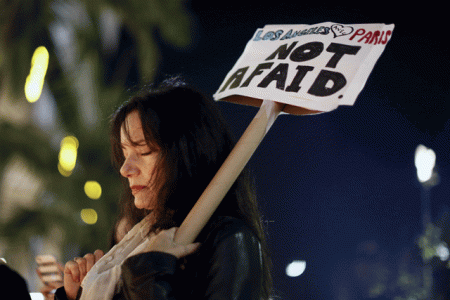
Paris-Attack-Los-Angeles-French-Consulate-IPA woman takes part in a vigil in front of the French Consulate in Los Angeles as a show of solidarity with the people of France. (Photo: © Reuters)

The coordinated attacks in Paris and suspected Islamic State bombing of a Russian airliner raises the risk that Islamic State supporters in the U.S. and other Western countries will spur into action. The opening of a new phase in Islamic State (ISIS) terror will also result in a fresh wave of recruits radicalized by the appearance that the Islamic State is quickly ascending.

You can watch Clarion Project National Security Analyst Ryan Mauro discuss this increasing threat on FOX News’ “America’s News HQ” on Saturday afternoon below:


First, there is a risk of “copycat” attacks by the Islamic State and other Islamist terrorist supporters, including those who are loyal to Al-Qaeda and want to show that the group hasn’t become a “has-been” in the jihadist world. It is hard to express the excitement that an aspiring jihadist will feel at two breakthrough moments in the war against the West in such short order. At this sensitive time, any kind of an attack—even a simple shooting or pipe bombing—takes on much greater significance.

If an Islamist terrorist is planning or considering an attack, it is difficult to resist the temptation to strike now. Even a relatively minor attack becomes part of a bigger story, rather than being forgotten amongst the wave of headlines about acts of violence. On an egotistical level, a jihadist will want to attach his name to this dramatic story.

Secondly, there are those who will worry that they might now lose their chance to strike and earn their ticket to Paradise by dying in jihad as a “martyr.” Supporters of the Islamic State have every reason to expect Western governments to become extra aggressive in rounding up possible terrorists. ISIS supporters who believe they are on the authorities’ radar could choose to act sooner instead of patiently preparing their plot and risk being foiled.

The attacks in Paris and on the Russian airliner show that the threat from the Islamic State is greater than ever, and we’ve entered a new period where they’ve moved towards more sophisticated, Al-Qaeda-style attacks in the West. They are engaging in pre-planning and dispatching teams of operatives instead of just hoping to inspire a random supporter into committing violence independently. This upgrade in quality is a powerful tool in the Islamic State’s propaganda arsenal.

The organization’s ability to recruit is largely based on the appearance of success. No one wants to join an organization whose recent history is filled with losses. Moreover, success is seen as Allah‘s endorsement; the ultimate winning argument in a theological debate among those dabbling in Islamist extremism.

Just as the Islamic State’s burst onto the scene with the capturing of Mosul in 2014 earned it a wave of recruits, these attacks will also earn it a wave of recruits and it will encourage the millions of Islamic State supporters who have yet to take up arms to finally act upon their beliefs.

It is critical that the West push back against the Islamic State’s convincing narrative of success. Those in the region understand the importance of this. We saw many tweets from people in the Middle East directed towards ISIS that told the group that their attacks in Paris cannot erase their setbacks elsewhere.

Dramatic events like these make recent losses like the killing of “Jihadi John” and the Kurds recapturing Sinjar seem like distant memories, but they deserve to be a part of the news coverage and U.S. government’s international messaging. Instead of focusing on single events that the Islamic State hopes will grab our attention, we must put them into a broader context that the Islamic State is less eager for the public to know about.

Cartoon of the day

November 15, 2015

H/t Freedom is just another word

reaction

Why the Paris Massacre Will Have Limited Impact

November 15, 2015

Why the Paris Massacre Will Have Limited Impact, Daniel Pipes Org., Daniel Pipes, November 14, 2015

The murder of some 127 innocents in Paris by a jihadi gang on Friday has again shocked the French and led to another round of solidarity, soul searching, and anger. In the end, however, Islamist violence against Westerners boils down to two questions: How much will this latest atrocity turn public opinion? And how much will it further spur the Establishment to deny reality?

As these questions suggest, the people and the professionals are moving in opposite directions, the former to the right, the latter to the left. In the end, this clash much reduces the impact of such events on policy.

Public opinion moves against Islamists specifically and Islam more generally when the number of deaths are large enough. America’s three thousand dead on 9/11 stands out as by far the largest mortality but many other countries have had their equivalent – the Bali bombings for Australia, the railroad bombing for Spain, the Beslan school massacre for Russia, the transportation bombings for Britain.

Sheer numbers are not the only consideration. Other factors can multiply the impact of an assault, making it almost the political equivalent of mass carnage: (1) The renown of those attacked, such as Theo van Gogh in the Netherlands and the Charlie Hebdo office in France. (2) The professional status of the victim, such as soldiers or police. (3) High-profile circumstances, such as the Boston Marathon bombing.

In addition to the over 27,000 attacks globally connected to Islam since 9/11, or more than 5 per day (as counted by TheReligionOfPeace.com), a huge increase in illegal immigration from the Middle East recently exacerbated feelings of vulnerability and fear. It’s a one-way street, with not a single soul ever heard to announce, “I used to worry about Islamism but I don’t any more.”

These cases make more Westerners worried about Islam and related topics from the building of minarets to female infibulation. Overall, a relentless march rightwards is underway. Surveys of European attitudes show 60 to 70 percent of voters expressing these concerns. Populist individuals like Geert Wilders of the Netherlands and parties like the Sweden Democrats are surging in the polls.

But when it comes to the Establishment – politicians, the police, the press, and the professors – the unrelenting violence has a contrary effect. Those charged with interpreting the attacks live in a bubble of public denial (what they say privately is another matter) in which they feel compelled to pretend that Islam has no role in the violence, out of concern that to recognize it would cause even more problems.

These 4-P professionals bald-facedly feign belief in a mysterious “violent extremist” virus that seems to afflict only Muslims, prompting them to engage in random acts of barbaric violence. Of the many preposterous statements by politicians, my all-time favorite is what Howard Dean, the former governor of Vermont, said about the Charlie Hebdo jihadis: “They’re about as Muslim as I am.”

This defiance of common sense has survived each atrocity and I predict that it will also outlast the Paris massacre. Only a truly massive loss of life, perhaps in the hundreds of thousands, will force the professionals to back off their deeply ingrained pattern of denying an Islamic component in the spate of attacks.

That pattern has the very consequential effect of shutting out the fears of ordinary voters, whose views thereby have negligible impact on policy. Worries about Shari’a, rape gangs, exotic diseases, and bloodbaths are dismissed with charges of “racism” and “Islamophobia,” as though name-calling addresses these real issues.

More surprising yet, the professionals respond to the public’s move to the right by themselves moving to the left, encouraging more immigration from the Middle East, instituting more “hate speech” codes to suppress criticism of Islam, and providing more patronage to Islamists. This pattern affects not just Establishment figures of the Left but more strikingly also of the Right (such as Angela Merkel of Germany); only Eastern European leaders such as Hungary’s Viktor Orbán permit themselves to speak honestly about the real problems.

3301Viktor Orbán’s Hungary may not last long in the EU. Or maybe he is the group’s future leader?

Eventually, to be sure, voters’ views will make themselves heard, but decades later and more weakly than democratically should have been the case.

Placing the murderous rampage in Paris into this context: it will likely move public sentiments substantially in one direction and Establishment policies in quite the opposite way, therefore ultimately having only a limited impact.

Mr. Pipes (DanielPipes.org, @DanielPipes) is president of the Middle East Forum.