Posted tagged ‘Islamic invasion’

Pamela Geller: EU Now Vows to Block Populist Parties, Another Sop To Europe’s Invaders

May 25, 2016

Pamela Geller: EU Now Vows to Block Populist Parties, Another Sop To Europe’s Invaders, Breitbart, Pamela Gekker, May 24, 2016

GettyImages-493750110-640x480Getty

It was reported Tuesday that the European Commission is moving to make sure that their hegemonic hold on European politics isn’t broken by populist parties that want to save Europe from the Muslim migrant invasion.

“Norbert Hofer failed in his bid for Austria’s presidency, but he would have been cut out of EU decision-making,” reported the Times of London.

“The EU will isolate and use sanctions against any far-right or populist governments that are swept to power or presidential office on the wave of popular anger against migration.”

The Times quoted Jean-Claude Juncker, president of the European Commission, saying flatly: “There is no debate or dialogue with the far-right.”

This is the modern face of fascism: the “anti-fascists.”

In the twentieth century, the idea of totalitarianism was a German initiative and most European countries fell into line. Forty-five thousand concentration camps located throughout Europe speaks to the enthusiastic support the Germans received.

In the 21st century, the European Union is the Reich, and they mean for their power to be absolute. Juncker made it clear that the parties they call “far-right” will never have a voice in the EU no matter how big their vote totals get.

“Far right” – what is that, anyway? Nazis? The Nazi Party was far-left: the National Socialist German Workers Party. What is far-right? Anti-Islamization? Anti-immigration? Pro-freedom?

When you import an influx of Muslims, you get jihad. It’s hardly rocket science. The West faces jihad terror because a certain percentage of the Muslim population will kill in the cause of Islam. Yet Juncker and the other European Commission authorities are not moving to stop the migrant influx, but to crush dissent from parties that want to save Europe’s free and pluralistic societies.

It seems the Nazis are back, in a different uniform and with a cheekier narrative, but the objective is very much the same.

Let’s be honest, they slaughtered six million Jews and imported 25 million Jew-haters. The problem for them is the fact that their new immigrants hate Europeans, too. But instead of facing that fact and doing something about it, the European Union is paving the way for the suicide of Europe and the West by guilt-tripping Europeans into thinking it’s morally wrong to oppose the migrant invasion.

Eight hundred thousand more Muslim migrants are lining up to invade Europe. Greece has its hands full. Muslim migrants are storming the border. They are violently rioting in refugee camps. Terror, terror, and more terror — and even aside from terror, there is the fact that Muslims are the only immigrant group that comes to Western countries with a ready-made model of society and government (sharia) which they believe to be superior to what we have here, and they work to institute it.

And that is exactly what they are doing now in Europe — by force, or lawsuit, or intimidation. But as far as the European Union is concerned, “Islamophobia” is the real problem that they need to confront.

The Europeans learned all the wrong lessons from the horrors of World War II. The lesson that Europe had decided to avail itself of in the aftermath of Auschwitz was not that they were evil and behaved like monsters, but rather that everything was caused by nationalism and therefore what they really needed to do was create a European Union that would obviate their need for nationalism, so that they could become this transnational gobbledygook, and they’ll all get together and therefore they won’t have another Auschwitz.

Wrong.

The lesson they should have learned was that they were evil and they have to be good. That is the lesson they never learned. They have to be able and willing to make moral distinctions and stand up for the good and fight evil, and that is something the Europeans refuse to do.

They did not learn that lesson.

The UK could send a powerful message – a clear rebuke – to the EU’s authoritarian tendencies by voting for Brexit on June 23rd. Whether the British people can surmount the media’s propaganda campaign and all the political fear-mongering remains to be seen.

Austrian Freedom Party: Victory in Defeat

May 24, 2016

Austrian Freedom Party: Victory in Defeat, Gatestone InstituteSoeren Kern, May 24, 2016

♦ European political and media elites have been quick to hail the election of Van der Bellen, who campaigned on a pro-immigration, pro-EU platform. They seem to believe his razor-thin win validates their uninterrupted pursuit of European multiculturalism.

♦ Meanwhile, European elites have expressed relief at Norbert Hofer’s defeat. Their reactions would indicate that they unaware that they are largely responsible for the rise of anti-establishment parties in Austria and other parts of Europe.

♦ “Europe has been polarized for years by misguided policies pursued by the old major parties, not only in Germany but in many European countries. The fact is that it must be our task to preserve freedom, democracy and the rule of law across the continent. And the policy of open borders does exactly the opposite.” — Frauke Petry, Alternative for Germany party.

Norbert Hofer of the anti-immigration Austrian Freedom Party (FPÖ) has been narrowly defeated in his bid to become Austria’s next president.

Alexander Van der Bellen, former leader of Austrian Greens party, won 50.3% of the vote, compared to 49.7% for Hofer. The margin of victory was 31,026 out of nearly 4.5 million votes cast.

European political and media elites have been quick to hail the election of Van der Bellen, who campaigned on a pro-immigration, pro-EU platform. They seem to believe his razor-thin win validates their uninterrupted pursuit of European multiculturalism.

But Hofer can claim victory even in defeat. By winning half the ballots cast, Hofer has exposed Austria’s gaping political divide on immigration and relations with the European Union. Hofer’s rise, which has effectively upended Austria’s political system, has also inspired anti-establishment parties in other parts of Europe.

Hofer had been in the lead after polls closed on May 22, with 51.9% of the vote to Van der Bellen’s 48.1%. In the end, however, the race was decided by 700,000 mail-in votes, accounting for 14% of eligible voters. Van der Bellen won 2,254,484 votes to Hofer’s 2,223,458, according to the Interior Ministry.

1620In this month’s Austrian presidential election, Alexander Van der Bellen (left), who campaigned on a pro-immigration, pro-EU platform, defeated Norbert Hofer (right) of the anti-immigration Austrian Freedom Party. (Image source: ORF TV video screenshot)

In what amounted to a political earthquake, Hofer won 36% of the vote in the first round of voting on April 24. Hofer — who campaigned on a platform calling for strict limits on immigration and tough rules for asylum seekers — defeated all of the other candidates, including those from the two governing parties, the Social Democrats and the Austrian People’s Party, which have dominated Austrian politics since the end of World War II.

Although the role of president in Austria has traditionally been largely ceremonial, Hofer had suggested that he would try to remove the current government led by newly appointed Chancellor Christian Kern and force new parliamentary elections. Opinion polls suggest that if parliamentary elections were held today, the Freedom Party would win. The next polls are scheduled for some time in 2018.

Van der Bellen, a 72-year-old economist, was gracious in victory, pledging to be “non-partisan president for all of those living in Austria.” He added: “All Austrians are equal. Austria consists of two halves. The one half is just as important as the other half.”

An analysis in the German newspaper Die Welt warned that Van der Bellen will not have it easy:

“It will be up to Van der Bellen to find the right tone and to show that he not only embodies the Austria of the city dwellers, but the whole country. He will have to bear in mind that according to the polls, 40% of those who voted for him did so only because they wanted to prevent a president from the Freedom Party.”

Conceding the election, Hofer wrote on Facebook: “Of course, it is a sad day. But please do not be discouraged. The effort in this election campaign is not wasted. It is an investment for the future.”

Hofer’s meteoric rise has focused the minds of the establishment parties. On April 27, just three days after Hofer’s initial electoral victory, the Austrian Parliament adopted what may be one of the toughest asylum laws in Europe.

Under the new law, Austria will declare a “state of emergency” on the migration crisis. This will allow Austrian authorities to assess asylum claims directly at the border. Only asylum seekers with immediate family members already in Austria, or those who can prove they are in danger in neighboring transit countries, will be allowed to enter the country. Other migrants will be turned away. The new law also limits any successful asylum claim to three years.

Austria received 90,000 asylum requests in 2015, the second-highest number in the European Union on a per capita basis, but this pales in comparison to what may lie ahead. In a radio interview on April 28, Interior Minister Wolfgang Sobotka warned that up to one million migrants are poised to cross the Mediterranean Sea from Libya to Europe.

Mass migration to Austria has been accompanied by a spike in migrant-related rapes, sexual assaults and other crimes across the country, and has contributed to the rise of the Freedom Party.

Reflecting on the outcome of the presidential election, Hofer’s campaign manager, Herbert Kickl, said: “This is a huge achievement. Hofer managed to convince half of the population in defiance of the system.”

In France, where polls show that the leader of the National Front, Marine Le Pen, is leading polls for presidential elections in 2017, party secretary general Nicolas Bay wrote on Twitter: “Despite the disappointment, a historic score for our ally from the Freedom Party. The future belongs to patriots!”

Meanwhile, European elites have expressed relief at Hofer’s defeat. Their reactions would indicate that they unaware that they are largely responsible for the rise of anti-establishment parties in Austria and other parts of Europe.

The president of the European Commission, Jean-Claude Juncker, said anti-EU parties should be completely shunned: “Neither a debate nor a dialogue is possible with right-wing populists.”

German Foreign Minister Frank-Walter Steinmeier said: “The election result removes a heavy burden for all of Europe.” Ralf Stegner, the deputy director of Germany’s Social Democrats (SPD)commented on Twitter: “This must serve as a warning that we can never again allow it [the rise of anti-establishment parties] go this far and that we have to combat this threat to our democracy with full force!”

But the leader of the Alternative for Germany party, Frauke Petry, said the vote was “an important day, not only for Austria, but for all of Europe.” She added:

“Europe has been polarized for years by misguided policies pursued by the old major parties, not only in Germany but in many European countries. The fact is that it must be our task to preserve freedom, democracy and the rule of law across the continent. And the policy of open borders does exactly the opposite.”

The outcome of the Austrian presidential election will not be official until June 1, the deadline for legal challenges to the vote count. Some Freedom Party members have expressed anger at the opaque manner in which mail-in ballots are counted.

Yazidis Ambushed by Muslim Migrants in Germany: Report

May 24, 2016

Yazidis Ambushed by Muslim Migrants in Germany: Report, Clarion Project, May 24, 2016

(Please see also, The Plight of the Yazidis, considered “devil worshipers” by Islamists. — DM)

Germany-Injured-Yazidis-HPYazidis injured in Germany after being reportedly attacked by Chechens (Photo: Twitter)

A group of Muslims migrants from Chechnya allegedly ambushed a group of Yazidi refugees in Germany, leaving many injured Yazidis, a number needing hospitalization. Although initial reports from Germany called the incident, which involved more than 100 people, a random fight, an organization named Yazidis International says that the fight was a setup, with the Chechens lying in wait for the Yazidis with knives and baseball bats.

Only Yazidis were injured. One Yazidi suffered a skull fracture, another a head injury and at least one other a serious stab wound.

Although there were threats of revenge, police kept the two groups apart and are considering ways to continue to do so in the future.

Reports out of Germany show that many non-Muslim refugees have been subjected to violence and other abuse from Muslim migrants.

In other news, a recent report from Germany’s investigative police agency showed a sharp increase in the number of potential violent Islamists being tracked by the agency.

The numbers rose from 270 in January of 2015 to 497 today.

In addition, the agency is also following 339 additional Islamists who the police feel are sympathetic to or capable of assisting terrorists.

In Austria, intelligence officials are also warning of a rise in suspected Islamists in the country, particularly with individuals associated with the Muslim Brotherhood.

Archbishop Outside Whose Cathedral Cologne Women were Raped, Defends Islam

May 23, 2016

Archbishop Outside Whose Cathedral Cologne Women were Raped, Defends Islam, Front Page Magazine, Daniel Greenfield, May 23, 2016

archbishop-of-cologne

It’s important to remember that the Cologne sexual assaults took place outside its cathedral.

In a crowd of 1,000 men, hundreds of Muslim refugees prowled, assaulting and robbing any woman they could find. A police officer described seeing crying women stumble toward him after midnight. He managed to rescue one woman whose clothes had been torn off her body from a group of her attackers, but could not save her friends because the mob had begun hurling fireworks at him.

The provost of the Cologne Cathedral had warned anti-Islamist protesters, “You’re supporting people you really don’t want to support.” But it was the provost and pro-refugee activists who had supported people they really didn’t want to support. There is no way to know whether any of the smiling young people holding, “I Love Immigration” banners had fallen victim to those refugees they loved so much.

And the cathedral itself came under attack.

Barbara Schock-Werner, who served as cathedral architect between 1999 and 2012, was present at the well-attended religious service along with several thousand other worshippers. Shock-Werner told the German newspaper, Frankfurter Allgemeine, that the cathedral experienced an unprecedented and massive rocket and ‘banger’ fireworks barrage that lasted the whole service.

“Again and again the north window of the cathedral was lit up red, because rocket after rocket flew against it,” she said. “And because of the ‘bangers’, it was very loud. The visitors to the service sitting on the north side had difficulties hearing. I feared at times that panic would break out.”

Cardinal Rainer Woelki, who presided at the New Year’s mass, also complained about the “massive disruptions.”

“During my sermon loud ‘bangers’ could be heard,” Woelki said in the paper, Die Welt. “I was already annoyed beforehand about the loud noises that were penetrating into the cathedral.”

But Woelki is attacking anti-Islamists.

Rainer Woelki posted a video where he ridiculed the right-wing party’s claim that Islam is incompatible with the German constitution. The archbishop’s intervention comes after the anti-immigration party said it would press for bans on minarets and burqas.

“Anyone who denigrates Muslims as the AfD leadership does should realise prayer rooms and mosques are equally protected by our constitution as our churches and chapels,” he said.

“Whoever says ‘yes’ to church towers must also say ‘yes’ to minarets.”

And then they have to say “yes” to sexual assaults and “no” to women walking the streets.


Islamic Extremism in France Part III: Stemming the Tide

May 23, 2016

Islamic Extremism in France Part III: Stemming the Tide, Clarion Project, Leslie Shaw, May 23, 2016

(Too little, too late. — DM

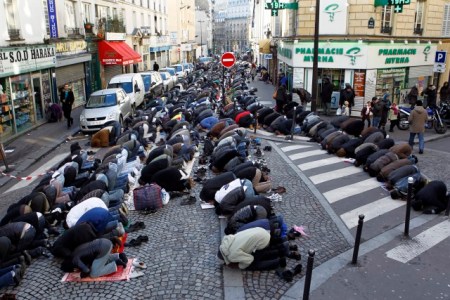
FranceMuslimPrayerStreetIP_2Illegal prayer on the street in France (Photo: © Reuters)

Radical threats require radical solutions involving measures that hurt, such as the police operations enabled by the current state of emergency. The French government’s soft, long-term strategy indicates ideological weakness and the absence of a will to fight the enemy. The enemy is global political Islam and not just a few thousand deviants that need to be neutralized or rehabilitated.

*********************

In April 2015, French Prime Minister Manuel Valls said that a Salafist minority was “winning the ideological and cultural war” for control of Islam in France.

“Salafists account for 1% of Muslims in the country, but all you hear about is their message, the messages on social media,” Valls declared in a closing address in Paris to a conference on the populist exploitation of Islamism in Europe.

“There is an activist minority of Salafist groups that is winning the ideological and cultural war,” he added, endorsing the claim of his Urban Affairs Minister Patrick Kanner that “around a hundred” French neighborhoods presented “similarities” to the Molenbeek district of Brussels, reputed to be a jihadist enclave, although deeming that “comparisons are not easy to make.”

The Prime Minister had earlier stirred controversy by speaking of “geographical, social and ethnic apartheid” after the January 2015 attacks in Paris. He reckoned that in some districts in France “an essential job of reconquest of the secular republic” was needed.

The latest figures on operations enabled by the state of emergency show that these words are finally being translated into action: 3,549 police raids, 407 people placed under house arrest, 743 arms caches seized, 395 arrests and 344 people placed in detention.

One of the mosques closed was described by Interior Minister Bernard Cazenuve as “a hotbed of radical ideology.” The closure of the Lagny-sur-Marne mosque by administrative decree in December 2015 was confirmed by the Council of State, France’s highest court, in February 2016.

The mosque, 20 miles east of Paris, had been frequented by around 200 people. During the raid, police discovered a handgun, documents on jihad and a clandestine Koranic nursery school. Nine members of the congregation were placed under house arrest and 22 more were barred from leaving France.

The mosque was run by the local Muslim Association, which managed to overturn the Council of State ruling on a technicality. The government responded by initiating proceedings to dissolve the Muslim Association, claiming it was promoting radical Islamic ideology and organizing travel for jihadists to Iraq and Syria. Mohamed Hammoumi, the 34 year-old Salafist Imam who ran the mosque until his departure for Egypt in 2014, continued to direct operations from there and acted as a go-between for the jihadists travelling from France to the combat zones.

French law enables the government to dissolve by decree, i.e. with no legal proceedings, associations whose activities are considered as amounting to a combat unit, a militia or a group agitating against the French Republic. The decision rests with the Council of State.

The role played by Muslim associations and mosques in the nationwide ecosystem of radical Islam is not just a recent discovery. The problem is that up until the 2015 attacks, nothing was done to stamp out these vectors of terror, and the few public figures who spoke out about the danger were branded as fascists, racists and Islamophobes.

At the same time, the criminals who transitioned from crime to jihad benefited from the lenience of French courts.

Ismaël Omar Mostefai, one of the Bataclan jihadists, had eight criminal convictions between 2004 and 2008 but never did any time in prison. In 2010 he was registered on the French anti-terrorism database for radicalization. He was a regular attendee at the Lucé mosque next to the historic town of Chartres. In 2004 the construction of this mosque led to demonstrations by local residents. A comment made at the time by Philippe Loiseau, a municipal politician, has turned out to be prophetic:

“I fear that this mosque will be a hotbed of radicalization that will pose a dangerous risk for the population.”

Twelve years and hundreds of deaths and injuries later, the French government has rolled out its strategy to tackle the existential threat that radical Islam poses to the country. Prime Minister Valls unveiled a new plan at a cabinet meeting on May 9. It consists of 30 existing and 50 new measures focused on six areas:

1.      Prevention and detection of youth radicalization

2.      Creation of deradicalization centres

3.      Enhanced surveillance in prisons

4.      Life sentences for perpetrators of terrorist attacks

5.      A central administrative command to co-ordinate local actions against jihadism

6.      Suspension of welfare payments for jihadists who travel to combat zones

The 30 existing measures incorporated in this new plan were rolled out at a cabinet meeting in April 2014 by Interior Minister Bernard Cazeneuve. The stated objectives were to prevent French citizens from leaving to wage jihad abroad and combat the radicalization of French Muslim youth. Two years later, these measures have proven to be ineffective. Time will tell if the 50 new measures will eradicate the threat, but it may be a case of locking the stable door after the horses have bolted.

The notion that “deradicalization,” whether in the form of prevention or rehabilitation, will stem the tide of radical Islam sweeping through France seems rather naïve. It is like telling young people not to use drugs or putting a junkie through rehab in the hope that he will never shoot up again. Half a century of measures to fight drug addiction have not solved that problem and these measures designed to combat radical Islam are likely to be as ineffective, what they really need is to check www.taylorrecovery.com to find a solution.

Radical threats require radical solutions involving measures that hurt, such as the police operations enabled by the current state of emergency. The French government’s soft, long-term strategy indicates ideological weakness and the absence of a will to fight the enemy. The enemy is global political Islam and not just a few thousand deviants that need to be neutralized or rehabilitated.a

Backlash in Europe: ‘Far Right’ Seethes Over Migrant Crisis

May 22, 2016

Backlash in Europe: ‘Far Right’ Seethes Over Migrant Crisis, Clarion Project, May 22, 2016

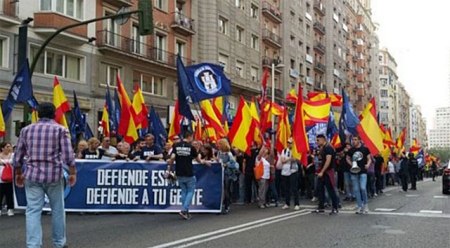
Spain-Anti-Migrant-Rally-IPAnti-immigration rally in Madrid (Photo: Screenshot video)

1. According to the latest news, Austria will elect as president the candidate from the far-Right Freedom Party in its upcoming elections. Analysts say Norber Hofer’s support (including, ironically some long-time immigrants) stems from voters frustrated by the two main parties over the immigrant crisis and its accompanying crimes, as well as unemployment.

Although the office is largely ceremonial, such a vote will be very significant, as analyst say that Hofer’s election may provide an impetus for populous change in Europe.

2. Wahhabism has taken root in Kosovo, just 17 years after America and its allies stepped in to free Muslims and prevent a total genocide at the hands of the Serbians. “Since then,” reports the New York Times, “much of that time under the watch of American officials — Saudi money and influence have transformed this once-tolerant Muslim society at the hem of Europe into a font of Islamic extremism and a pipeline for jihadists.”

Police say that over the past two years, per capita, more Muslims from Kosovo, have left to join the Islamic State, including suicide bombers, women and children.

3. Christians seeking asylum in Europe can be exposed to as much danger from Islamist extremists as those they fled from in the Middle East. A new survey shows that thousands of Christians in Germany have been attacked and harassed by fellow migrants and Muslim guards at asylum houses.

Particularly at risk are those Muslims who have chosen to convert to Christianity. The survey was conducted by Open Doors, a humanitarian relief organization. One member of the group, Markus Rhodes, called the survey the “tip of the iceberg.”

4. A senior law enforcement official in Germany has proposed monitoring mosques to know “what is preached there.”  Emily Haber, the state secretary at the German Ministry of the Interior, further stated, “We cannot stay indifferent.

“We need to bring into view more on what is developing there. We need to move fast. It must also be clear who and from what country comes to Germany as imams. This scene must not remain unwatched and uncontrolled.”

5. Rallies against immigration were held in Madrid and Rome over the weekend. In Spain, under the title “Defend Spain, defend your people,” marchers called for an end to the “invasion,” chanting “Refugees no, Spanish yes.”  A Facebook post explaining the reason for the demonstration read in part, “Sometimes, we try to avoid the problem by closing our eyes, and looking the other way. That makes us believe that the problem goes away, but it’s not like that.

“Passivity, and silence as demanded by the politically correct, wants us to believe that we are free, but by staying still we are complicit in the decline of our people, our identity, of our ways. Looking the other way just accelerates our own destruction, and sells our freedom to the highest bidder.”

6. Pope Francis will meet Egypt’s top cleric, Sheikh Ahmed al-Tayeb, the grand imam of Cairo’s of Al-Azhar Mosque, considered the seat of Sunni Islam. The historic visit at the Vatican is the first since relations were suspended in 2011 after Pope Benedict XVI called for the protection of Christians after a church bombing in Alexandria.

Al-Tayeb, was appointed by former Egyptian President Hosni Mubrak and supported the popularly-backed military coup that overthrew former Islamist President Mohammed Morsi in 2013. At a conference against terrorism in Saudi Arabia, al-Tayeb blamed Zionism and its allies (i.e. the United States) for the current problems in the Middle East.

Sweden’s Holy War on Children’s Books

May 21, 2016

Sweden’s Holy War on Children’s Books, Gatestone InstituteJudith Bergman, May 21, 2016

♦ Taken to its extremes, the urge to cleanse a culture of elements that do not live up to the politically correct orthodoxy currently in political vogue unsettlingly echoes the Taliban and ISIS credos of destroying everything that does not accord with their Quranic views. The desire “not to offend,” taken to its logical conclusion, is a totalitarian impulse, which threatens to destroy everything that disagrees with its doctrines. Crucially, who gets to decide what is offensive?

♦ The question arises: How much purging and expiation will be needed to render a country’s culture politically correct?

♦ “When we have days of carnivals and music the goal is that these days should be experienced as positive by everyone. The Swedish flag is not allowed as part of carnival dress. … Positive and bright feelings must be in focus. … School photos must obviously be free of national symbols.” — Swedish school in Halmstad.

♦ Rome covered up its classical nude statues for a visit from Iran’s president, Hassan Rouhani, in January 2016. A decade ago, who would have even imagined such sycophancy?

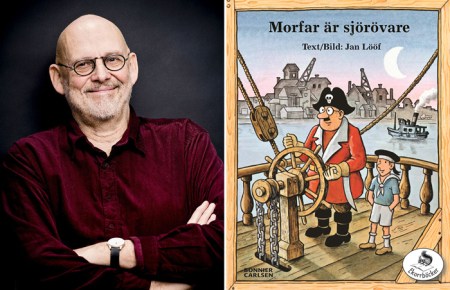
In 1966, one of Sweden’s most popular children’s writers, Jan Lööf, published Grandpa is a Pirate, an illustrated children’s book, which featured, among other characters, the wicked pirate Omar and the street peddler, Abdullah. The book has been a bestseller ever since, and has been translated into English (as My Grandpa is a Pirate), Spanish, French and other languages. Ten years ago, 100,000 copies of it were even distributed to the Swedish public with McDonald’s Happy Meals, as part of an initiative to support reading among children.

Ah, but those were the days of yesteryear! Now, fifty years later, the book is no longer tolerable. The now 76-year-old author told Swedish news outlets that his publisher recently said that unless he rewrites the book and changes the illustrations, it will be taken off the market. The publisher also threatened to withdraw another of his books unless it is redone: it features an illustration of a black jazz musician who sleeps with his sunglasses on.

Lööf’s publisher, the Swedish publishing giant Bonnier Carlsen, says that it has not yet made a final decision and that it only views the rewriting and re-illustrating of the books as “an option.” There is no doubt, however, that they consider the books in question extremely problematic.

“The books stereotype other cultures, something which is not strange, since all illustrations are created in a context, in their own time, and times change,” said Eva Dahlin, who heads Bonnier Carlsen’s literary department.

“But if you come from the Middle East, for instance, you can get tired from rarely being featured on the good side in literary depictions. Children’s books are special because they are read over a longer period of time and the norms of the past live on in them, unedited. As an adult, one may be wearing one’s nostalgic glasses and miss things that could be seen as problematic by others.”

Dahlin further explained that the publishing house spends a lot of time reviewing older publications, to check if such “problematic” passages occur. She added that the publishing house does not check for only culturally sensitive passages:

“There are many female editors, and therefore we have probably been more naturally aware of gender-biased depictions than these type of questions. But now we have better insights and a greater awareness of these issues.”

1612One of Sweden’s most popular children’s writers, Jan Lööf, was recently told by his publisher that unless he makes his bestselling 1966 book, Grandpa is a Pirate, more politically correct by rewriting it and changing the illustrations, it will be taken off the market

Sweden is no stranger to “literary revisions” of this kind, or other cultural revisions in the name of political correctness. Both Pippi Longstocking and other children’s books have gone through assorted revisions or have even been taken off the market. In the Pippi Longstocking television series, a scene in which Pippi squints her eyes to look Chinese has been edited out altogether, so as not to offend anyone. In 2013, a popular, award-winning Danish children’s book, Mustafa’s Kiosk, by Jakob Martin Strid, was taken off the market in Sweden after complaints on Swedish social media that it was racist and “Islamophobic.” Ironically, the author wrote it in 1998, when he was staying in Indonesia, the world’s most populous Muslim country, as “an anti-racist statement.” Tellingly, the book had been on the Swedish market since 2002 with no complaints. In his response to the criticism, the Danish writer noted that an equal and non-racist society only comes about “when you are allowed to make (loving) fun of everyone.” “I also make fun of Norwegians,” he added.

In 2014, after complaints on Swedish social media that some of its candy was “racist,” the Haribo company decided to change one of its products, “Skipper Mix,” which consisted of candies shaped in the form of a sailor’s souvenirs, including African masks.

The question arises: How much purging and expiation will be needed to render a country’s culture politically correct?

That question raises an even bigger one: How high is the price of political correctness in terms of “cleansing” the past and present of perceived slights, anywhere, to just about anyone?

Taken to its extremes, the urge to cleanse a culture of elements that do not live up to the politically correct orthodoxy currently in political vogue unsettlingly echoes the Taliban and ISIS credos of destroying everything that does not accord with their Quranic views. The desire “not to offend,” taken to its logical conclusion, is a totalitarian impulse, which threatens to destroy everything that disagrees with its doctrines. Crucially, who gets to decide what is offensive?

What begins innocently enough, by taking out passages from books that may hurt someone’s feelings, can end up turning into something far more sinister, as it indeed has in Sweden. Former Swedish Prime Minister Frederik Reinfeldt famously stated in 2014 that Sweden belongs to immigrants, not to the Swedes who have lived there for generations. He thereby communicated that he believes the future of Sweden will be shaped by non-Swedes, showing a curious contempt for his own culture.

This contempt has spread fast throughout official Sweden. In 2014, a Swedish school in Halmstad forbade displaying the Swedish flag, after a student painted his face in the Swedish colors for a carnival. In its new rules, the school specified why:

“Most students look forward to school traditions. When we have days of carnivals and music the goal is that these days should be experienced as positive by everyone. The Swedish flag is not allowed as part of carnival dress. … Positive and bright feelings must be in focus. … School photos must obviously be free of national symbols.”

However, the “precedent” for such rules had already been set ten years prior, in 2004, at a school in Vaargaarda, when two girls had worn printed sweatshirts which happened to display the Swedish flag and the word “Sweden.” They were told that this kind of clothing was not allowed at school. One of the girls told reporters that singing the national anthem had also been forbidden at the school.

In 2012, two members of Sweden’s parliament suggested that statues of the Swedish Kings Carl XII and Gustav II Adolf should be removed, because they represent a time when Sweden was a great military power, “a dark time in our country as well as in other countries, which were affected by Swedish aggression,” as the MPs wrote in the motion. Instead, the MPs suggested, the squares of central Stockholm should be adorned in a way such that they “signal peace, tolerance, diversity, freedom and solidarity.”

In 2013, a Baroque painting of the nude goddess Juno was removed from the restaurant of the Swedish parliament, ostensibly to avoid offense to feminist and Muslim sensibilities.

The above should not be discarded as crazy practices peculiar to Sweden. On the contrary, they present a perfect case-study of the consequences of politically correct culture driven to the extreme.

Indeed, these consequences are already proliferating across the Western world. One particularly noteworthy instance took place when Iranian president Hassan Rouhani visited Rome in January 2016. To prevent Rouhani having “a hormonal shock and ripp[ing] up the freshly signed contracts with our Italian industries,” as one Italian columnist, Massimo Gramellini, wrote, Rome covered up its classical nude statues. Who would have even imagined such sycophancy a decade ago?

In Britain, students have recently campaigned for the removal of symbols of British imperialism, such as a statue of Cecil Rhodes at Oxford University. These students claim the campaign is not only about the statue itself, but that it is “…a campaign against racism at Oxford, of which the Rhodes statue is a small but symbolic part.” Already in 2000, the London Mayor Ken Livingstone suggested that statues of two 19th-century British generals should be removed from Trafalgar Square in London, based on his own ignorance:

“The people on the plinths in the main square of our capital city should be identifiable to the generality of the population. I haven’t a clue who two of the generals there are or what they did. I imagine that not one person in 10,000 going through Trafalgar Square knows any details about the lives of those two generals. It might be time to look at moving them and having figures ordinary Londoners and other people from around the world would know.” The problem with all this, of course, is that most of London’s wealth and greatness in terms of art and architecture is due largely to British colonialism, so the question is just how many buildings would be left standing in the British capital, if one were to take this issue and bring it to its logical conclusion.

The trouble with wanting to scrub the cultural and historical slate clean, as it were, is, of course, that countries cannot just press “delete” on their culture and history. Such a move would entail not just the removal of books, paintings and statues, but a complete purge. Those who truly care for history will know that this experiment has already been attempted, not once but several times over, by the various communist and Nazi movements of the twentieth century. While there is little comparison between those movements and the culture of political correctness, the impulse governing them all nevertheless remains the same: To forge and impose one singular “truth” on everyone, rooting out everything that does not fit the utopian mold. That is neither “diverse” nor “tolerant.”

EU-Turkey Migrant Deal Unravels

May 18, 2016

EU-Turkey Migrant Deal Unravels, Gatestone InstituteSoeren Kern, May 18, 2016

♦ “It can be expected that, as soon as Turkish citizens will obtain visa-free entry to the EU, foreign nationals will start trying to obtain Turkish passports … or use the identities of Turkish citizens, or to obtain by fraud the Turkish citizenship. This possibility may attract not only irregular migrants, but also criminals or terrorists.” — Leaked European Commission report, quoted in theTelegraph, May 17, 2016.

♦ According to the Telegraph, the EU report adds that as a result of the deal, the Turkish mafia, which traffics vast volumes of drugs, sex slaves, illegal firearms and refugees into Europe, may undergo “direct territorial expansion towards the EU.”

♦ “If they make the wrong decision, we will send the refugees.” — Burhan Kuzu, senior adviser to Turkish President Recep Tayyip Erdogan.

♦ Erdogan is now demanding that the EU immediately hand over three billion euros ($3.4 billion) so that Turkish authorities can spend it as they see fit. The EU insists that the funds be transferred through international aid agencies in accordance with strict rules on how the aid can be spent. This prompted Erdogan to accuse the EU of “mocking the dignity” of the Turkish nation.

The EU-Turkey migrant deal, designed to halt the flow of migrants from Turkey to Greece, is falling apart just two months after it was reached. European officials are now looking for a back-up plan.

The March 18 deal was negotiated in great haste by European leaders desperate to gain control over a migration crisis in which more than one million migrants from Africa, Asia and the Middle East poured into Europe in 2015.

European officials, who appear to have promised Turkey more than they can deliver, are increasingly divided over a crucial part of their end of the bargain: granting visa-free travel to Europe for Turkey’s 78 million citizens by the end of June.

At the same time, Turkey is digging in its heels, refusing to implement a key part of its end of the deal: bringing its anti-terrorism laws into line with EU standards so that they cannot be used to detain journalists and academics critical of the government.

A central turning point in the EU-Turkey deal was the May 5 resignation of Turkish Prime Minister Ahmet Davutoglu, who lost a long-running power struggle with Turkish President Recep Tayyip Erdogan. Davutoglu was a key architect of the EU-Turkey deal and was also considered its guarantor.

On May 6, just one day after Davutoglu’s resignation, Erdogan warned European leaders that Turkey would not be narrowing its definition of terrorism: “When Turkey is under attack from terrorist organizations and the powers that support them directly, or indirectly, the EU is telling us to change the law on terrorism,” Erdogan said in Istanbul. “They say ‘I am going to abolish visas and this is the condition.’ I am sorry, we are going our way and you go yours.”

Erdogan insists that Turkey’s anti-terrorism laws are needed to fight Kurdish militants at home and Islamic State jihadists in neighboring Syria and Iraq. Human rights groups counter that Erdogan is becoming increasingly authoritarian and is using the legislation indiscriminately to silence dissent of him and his government.

European officials say that, according to the original deal, visa liberalization for Turkish citizens is conditioned on Turkey amending its anti-terror laws. Erdogan warns that if there is no visa-free travel by the end of June, he will reopen the migration floodgates on July 1. Such a move would allow potentially millions more migrants to pour into Greece.

European officials are now discussing a Plan B. On May 8, the German newspaper Bild reported on a confidential plan to house all migrants arriving from Turkey on Greek islands in the Aegean Sea. Public transportation to and from those islands to the Greek mainland would be cut off in order to prevent migrants from moving into other parts of the European Union.

Migrants would remain on the islands permanently while their asylum applications are being processed. Those whose asylum requests are denied would be deported back to their countries of origin or third countries deemed as “safe.”

The plan, which Bild reports is being discussed at the highest echelons of European power, would effectively turn parts of Greece into massive refugee camps for many years to come. It remains unclear whether Greek leaders will have any say in the matter. It is also unclear how Plan B would reduce the number of migrants flowing into Europe.
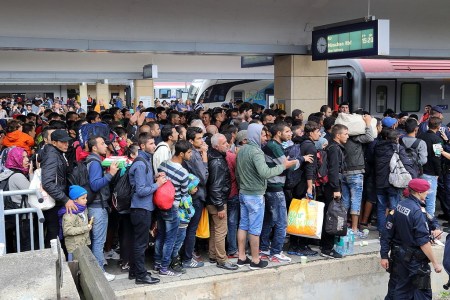
1607Thousands of newly arrived migrants, the vast majority of whom are men, crowd the platforms at Vienna West Railway Station on August 15, 2015 — a common scene in the summer and fall of 2015. (Image source: Bwag/Wikimedia Commons)

Speaking to the BBC News program, “World on the Move,” on May 16, Sir Richard Dearlove, the former head of the British intelligence service MI6, warned that the number of migrants coming to Europe during the next five years could run into millions. This, he said, would reshape the continent’s geopolitical landscape: “If Europe cannot act together to persuade a significant majority of its citizens that it can gain control of its migratory crisis then the EU will find itself at the mercy of a populist uprising, which is already stirring.”

Dearlove also warned against allowing millions of Turks visa-free access to the EU, describing the EU plan as “perverse, like storing gasoline next to the fire we’re trying to extinguish.”

On May 17, the Telegraph published the details of a leaked report from the European Commission, the powerful administrative arm of the European Union. The report warns that opening Europe’s borders to 78 million Turks would increase the risk of terrorist attacks in the European Union. The report states:

“It can be expected that, as soon as Turkish citizens will obtain visa-free entry to the EU, foreign nationals will start trying to obtain Turkish passports in order to pretend to be Turkish citizens and enter the EU visa free, or use the identities of Turkish citizens, or to obtain by fraud the Turkish citizenship. This possibility may attract not only irregular migrants, but also criminals or terrorists.”

According to the Telegraph, the report adds that as a result of the deal, the Turkish mafia, which traffics vast volumes of drugs, sex slaves, illegal firearms and refugees into Europe, may undergo “direct territorial expansion towards the EU.” The report warns: “Suspect individuals being allowed to travel to the Schengen territory without the need to go through a visa request procedure would have a greater ability to enter the EU without being noticed.”

While the EU privately admits that the visa waiver would increase the risk to European security, in public the EU has recommended that the deal be approved.

On May 4, the European Commission announced that Turkey has met most of the 72 “benchmarks of the roadmap” needed to qualify for the visa waiver. The remaining five conditions concern the fight against corruption, judicial cooperation with EU member states, deeper ties with the European law-enforcement agency Europol, data protection and anti-terrorism legislation.

European Commission Vice President Frans Timmermans said:

“Turkey has made impressive progress, particularly in recent weeks, on meeting the benchmarks of its visa liberalization roadmap…. This is why we are putting a proposal on the table which opens the way for the European Parliament and the Member States to decide to lift visa requirements, once the benchmarks have been met.”

In order for the visa waiver to take effect, it must be approved by the national parliaments of the EU member states, as well as the European Parliament.

Ahead of a May 18 debate at the European Parliament in Strasbourg over Turkey’s progress in fulfilling requirements for visa liberalization, Burhan Kuzu, a senior adviser to Erdogan, warned the European Parliament that it had an “important choice” to make.

In a Twitter message, Kuzu wrote: “If they make the wrong decision, we will send the refugees.” In a subsequent telephone interview with Bloomberg, he added: “If Turkey’s doors are opened, Europe would be miserable.”

Meanwhile, Erdogan has placed yet another obstacle in the way of EU-Turkey deal. He is now demanding that the EU immediately hand over three billion euros ($3.4 billion) promised under the deal so that Turkish authorities can spend it as they see fit.

The EU insists that the funds be transferred through the United Nations and other international aid agencies in accordance with strict rules on how the aid can be spent. That stance has prompted Erdogan to accuse the EU of “mocking the dignity” of the Turkish nation.

On May 10, Erdogan expressed anger at the glacial pace of the EU bureaucracy:

“This country [Turkey] is looking after three million refugees. What did they [the EU] say? We’ll give you €3 billion. Well, have they given us any of that money until now? No. They’re still stroking the ball around midfield. If you’re going to give it, just give it.

“These [EU] administrators come here, tour our [refugee] camps, then ask at the same time for more projects. Are you kidding us? What projects? We have 25 camps running. You’ve seen them. There is no such thing as a project. We’ve implemented them.”

In an interview with the Financial Times, Fuat Oktay, head of Turkey’s Disaster and Emergency Management Authority (AFAD), the agency responsible for coordinating the country’s refugee response, accused European officials of being fixated on “bureaucracies, rules and procedures” and urged the European Commission to find a way around them.

The European Commission insists that it was made clear from the outset that most of the money must go to aid organizations: “Funding under the Facility for Refugees in Turkey supports refugees in the country. It is funding for refugees and not funding for Turkey.”

The migration crisis appears to be having political repercussions for German Chancellor Angela Merkel, a leading proponent of the EU-Turkey deal. According to a new poll published by the German newsmagazine Cicero on May 10, two-thirds (64%) of Germans oppose a fourth term for Merkel, whose term ends in the fall of 2017.

In an interview with Welt am Sonntag, Horst Seehofer, the leader of the Christian Social Union (CSU), the Bavarian sister-party to Merkel’s Christian Democrats (CDU), blamed Merkel for enabling Erdogan’s blackmail: “I am not against talks with Turkey. But I think it is dangerous to be dependent upon Ankara.”

Sahra Wagenknecht of the Left Party accused Merkel of negotiating the EU-Turkey deal without involving her European partners: “The chancellor is responsible for Europe having become vulnerable to blackmail by the authoritarian Turkish regime.”

Cem Özdemir, leader of the Greens Party and the son of Turkish immigrants said: “The EU-Turkey deal has made Europe subject to Turkish blackmail. The chancellor bears significant responsibility for this state of affairs.”

Former al-Qaida Terrorist Sought Asylum in Norway

May 17, 2016

Former al-Qaida Terrorist Sought Asylum in Norway, Investigative Project on Terrorism, May 17, 2016

Norwegian police arrested a former Syrian al-Qaida fighter who sought asylum in Norway, the UK’s Daily Express reports.

Police arrested the 26-year-old man Friday at an asylum center after officers received a search warrant. Anne Karoline, a lawyer representing the Norwegian police, confirmed the arrest but could not provide further details concerning the indictment. Her client admitted to being a former operative of Jabhat al-Nusra – al-Qaeda’s branch in Syria – when he sought asylum in 2015, Karoline said.

The suspect came to Norway with his underage brother and denies any wrongdoing. Norwegian police are trying to keep the former al-Qaida fighter in custody for a month.

Many critics of Europe’s refugee policy argue that radical jihadist organizations, including the Islamic State and al-Qaida, could attempt to infiltrate the West by planting operatives among waves of Middle Eastern refugees.

In a December 2015 white paper, the Investigative Project on Terrorism (IPT) explored gaps in the American Immigration system which could enable terrorists to enter the country as refuges, to apply for asylum once in the U.S., or to enter as passport holders from the 38 countries in the Visa Waiver Program.

Weaknesses in the U.S. system include the tendency to offer refugees and asylum seekers the benefit of the doubt in their accounts of their plight and background; the rapid speed with which lawful permanent resident status is granted to asylees and refugees; the problems that arise concerning refugees who cannot provide documentation of their birth dates; inconsistency in the vetting process; and inadequacies featured in various application forms.

Click here to read the IPT’s white paper and its recommendations.

Brexit Can Only Be Good for the United Kingdom

May 17, 2016

Brexit Can Only Be Good for the United Kingdom, American ThinkerJustin O. Smith, May 17, 2016

Nigel Farage, UKIP leader, warns that the U.K. will not be able to handle the upcoming surge of migrants if it stays in the EU.  He observed during the April 1 Munk Debate that “Jeane-Claude Juncker, the unelected president of the European Commission, has changed the definition of what a refugee is, to include people … from war torn areas … [and] from extreme poverty … [and] perhaps 3 billion people could possibly come to Europe [as a result].”

************************

The British people seem ready to leave the European Union through a historic June 23 referendum, because they are tired of the high-handed tyrannical regulations, clauses and counter-clauses, emanating from the EU Council on even the simplest aspects of their everyday lives.  They have determined that leaving the EU will be the best step toward reclaiming their nation’s sovereignty and democratic rule in all matters of immigration and border control, their economy, free trade, and national security, and they are proudly waving the Union Jack, as they tell their would-be masters in Brussels to go to hell, declaring their independence.

In November 2015, U.K. prime Minister David Cameron attempted to renegotiate a treaty change with European Union Council president Donald Tusk concerning U.K. sovereignty, trade, immigration, and economic governance.  Tusk rejected it all, with a minor exception regarding the handling of a few million pounds for children’s benefits.  This dismal failure of P.M. Cameron only offered proof that the EU was closed to any substantial moves toward reform, which created a renewed and angry momentum for the Out of Europe, Vote Leave, and Brexit movements.

Corporatists, trans-nationalists, advocates of the U.N. 2030 Agenda, the BBC, and the Guardinista establishment are presenting dishonest and fear-based monologues regarding the uncertainty a U.K. exit from the EU might bring.  They enjoy being able to circumvent individual nation’s policies by going through Brussels, and most of them have been made rich through their deals with the tyrannical, unelected, and entrenched bosses of the European Union.

Despite disingenuous conclusions from the trans-nationalist President Obama, does anyone really believe that a hundred years of shared security concerns and initiatives and trade agreements between the U.S. and the U.K. will be detrimentally affected by a “yes” vote to leave the EU?

What cogent thought process could people, like Lena Komileva (London economist), possibly be using when they ascribe the term “illiberal” to the British people’s desire for nationalist policies and reclaiming Britain’s sovereignty?

It will not take years for the U.K. to renegotiate trade deals with the U.S., as Obama suggests, but rather only months.  And if small nations like South Korea and Chile can succeed in global markets, certainly Britain also will continue to succeed, especially since the EU already imports 45% of British exports.

Membership in the EU currently costs Britain approximately $30 billion annually.  Although $55 billion in austerity cuts were made by the chancellor of the exchequer during the last Parliament, Britain’s contribution to the EU was roughly $132 billion.  Every cut in public spending could be reversed, and Britain could still pay down its deficit faster if Britain were to leave the European Union.

In February, George Mason, senior vice president of Britain’s high-profile Tate and Lyle Sugars, made a mockery of claims by Britain Strong in Europe that Brexit would spell economic disaster for the U.K.: “we are absolutely certain that our business and people who work in it would have a more secure future outside the EU.”

Priti Patel, the U.K.’s employment minister, told the Daily Telegraph in March: “The Prime Minister has tried hard but the EU refused to give the British people what they want[.] … The only way to take back control over our economy[.] … [T]o create more jobs and growth is to Vote Leave.”

However, national security is the issue currently foremost in most Britons’ minds, but Eurocentrics, who believe that the U.K. will be safer in the EU through cooperation on crime and terrorism, have failed to see that the EU has never been capable of agreeing on effective foreign policy.  Also not taken into account, the EU recently embraced the expanded definition of “refugee” put forth by the United Nations in its 2030 Agenda.

Nigel Farage, UKIP leader, warns that the U.K. will not be able to handle the upcoming surge of migrants if it stays in the EU.  He observed during the April 1 Munk Debate that “Jeane-Claude Juncker, the unelected president of the European Commission, has changed the definition of what a refugee is, to include people … from war torn areas … [and] from extreme poverty … [and] perhaps 3 billion people could possibly come to Europe [as a result].”

There are also reports of Bosnia, with a population of 3.8 million, being infiltrated by Islamic State terrorists.  They are buying property there, and they would be free to travel to the U.K. if Bosnia is granted EU membership.

Andrew Rosindell, a Conservative member of Parliament, stated in March: “Being in the EU means we don’t have control of our own systems, we don’t have control of our own borders. We are effectively tied to countries which I think are not as good at protecting their people as we have been.”

One can only imagine the palpable red-hot anger of the British people upon hearing Martin Shulz, European Parliament president, say that he was “sad and angry [over] the undertone of national resentment” and it was “not possible” to make the changes PM Cameron wanted. Shulz added that Britain “belongs” to the EU.  Really?  Just watch, wait, and see.

Downing Street has declared that “a vote to leave is a vote to leave.”  A leave vote will facilitate the U.K.’s departure through Article 50 of the Lisbon Treaty, and terms for Britain’s withdrawal will then be negotiated over the next two years.

Over forty years ago, Britain last debated her relationship with Europe, and even then, elected officials on both the right and left, such as two of the most iconic political figures of that era, Enoch Powell and Tony Benn, campaigned against the U.K.’s membership in what was then the European Economic Community.  They objected to Britain’s elected government meekly surrendering Britain’s national sovereignty to unelected foreign entities and the fundamental lack of democracy in the EU.

Lady Margaret Thatcher knew that it would be near impossible to effectively and efficiently impose one currency, one economy, and one national identity on many different countries (now 28) with such different languages, histories, customs, and cultures in general.  Early on, the Iron Lady called the attempt to create a European super-state “the greatest folly of the modern era.”

Britons, excited and optimistic, are moving forward to reclaim a more free, prosperous, ally-connected, and nationally secure Britain, through their own elected officials and their own choices and wisdom, breaking free of the heavy bureaucratic chains of the European Union.  As they shout “Hail Britannia,” they will vote to leave in June.