Posted tagged ‘Islamic integration’

“Gangster Islam” in Europe

July 12, 2016

“Gangster Islam” in Europe, Gatestone Institute via YouTube, July 12, 2016

The blurb beneath the video states,

“Gangster Islam,” a crime wave packing prisons and overtaking Europe, is a problem the mainstream media will not report. Ordinary Europeans — for fear of being called “racist” or even being imprisoned for “hate speech” — are afraid even to talk about it.

Stabbing Policemen, “Slut-Shaming” and New Death Threats

July 12, 2016

Stabbing Policemen, “Slut-Shaming” and New Death Threats -One Month of Islam and Multiculturalism in France: June 2016, Gatestone InstituteYves Mamou, July 12, 2016

♦ Muslim perpetrators rationalize their violence by convincing themselves that they live in a racist society that rejects them and their religion. And the government legitimizes them when it asks Parliament to vote for a law that favors “diversity” on public television channels.

♦ Islamist terrorist Larossi Abballa, 26, stabbed to death police officer Jean-Baptiste Salvaing and his wife, police administrator Jessica Schneider, in front of their son, at their home in the Paris suburb of Magnanville. The murderer then live-streamed a video on Facebook, in which he pledged allegiance to the Islamic State (ISIS).

♦ After the Islamist, anti-gay attack in Orlando, left-wing politician Jean-Luc Mélenchon wrote in his blog that he fears a possible “wave of hatred against Muslims”. For many Islamists in France, the Muslim is always the victim, even when he is the killer.

Islamization is gaining ground in the Muslim community of France. For a long time, this trend remained restricted to the cultural sphere and created strong controversies between Islamists and secular intellectuals (such as the ban on face-covering veils in schools and public places). But the debate stopped being a debate. Sometimes Islamic intolerance takes on the appearance of a civil war. The violence, which was mostly concentrated in the suburbs prior to the January 2015 terrorist attack on the satirical magazine, Charlie Hebdo, is spreading now to the heart of French cities. Murders, assaults, death threats and “slut-shaming” happens almost every day here and there.

Muslim perpetrators rationalize their violence by convincing themselves that they live in a racist society that rejects them and their religion. And the government legitimizes them when it asks Parliament to vote for a law that favors “diversity” on public television channels. What is interesting is that judiciary system seems in disarray and does not know how to treat these types of conflicts: two jihadists back from Syria are condemned to a suspended sentence of six months in prison and a Muslim who slapped a female waiter because she served alcohol during the Ramadan was sentenced to eight months in prison.

The absence of political guidelines spreads fear and aids the rise of the right-wing political party, the Front National.

June 1. Karim Benzema, a French soccer star of Algerian descent, declared, in the Spanish sports newspaper Marca, that French national team’s coach, Didier Deschamps “bowed to the pressure of a racist part of France” by not including him in the team. Benzema was not included in the national soccer team for the UEFA Euro 2016 championship because he is apparently involved in a sex-tape extortion scandal targeting his colleague, Mathieu Valbuena.

June 2. Patrick Kanner, Minister of Urban Affairs, Youth and Sport, said in Le Parisien that Karim Benzema plays an “unfair and dangerous” game when he implies that “ethnic reasons” might have played a role in the decision not to include him in the French soccer team.

June 2. It was reported that the Saudi preacher, Mohammed Ramzan Al-Hajiri, was banned from entering France until 2050. The daily, La Voix du Nord, reported that on May 15, the salafist Abou Bakr Essedik mosque of Roubaix had arranged for him to preach by phone. In April 2014, the same Saudi preacher had declared in public: “Losing your faith makes you no better than an animal” and “to kill a Muslim is a less serious crime than to make him an infidel.”

June 5. A 25-year-old Frenchman was arrested at the border between Ukraine and Poland. According to the TV channel M6, his truck was loaded with three portable rocket launchers, more than 100 kilograms of TNT, 100 detonators and half a dozen Kalashnikov assault rifles. He was unknown to security services and was planning terrorist attacks against synagogues and mosques in France.

June 6. One thousand migrants from Afghanistan, Sudan and Somalia, who were living in tents in the 18th district of Paris (Les Jardins d’Eole), were evacuated peacefully by police. According to the media, it is the 23rd operation of this kind in Paris since 2015

June 6. Swastikas and the words “white power” were tagged on the walls of the synagogue of Verdun. A similar incident of vandalism took place two months prior, said Jean-Claude Lévy, leader of the Jewish community in Verdun.

June 6. Gérard Tardy, mayor of Lorette, a small city in the Loire region of France, posted two messages on the electronic information boards of the city:

  • “Ramadan must be lived in peace without noise”
  • “In the Republic, nobody covers his face.”

The far left and Muslims organizations said these messages were “outrageous” and “disrespectful” to Muslims.

June 7. A waitress at a bar in Nice was violently slapped by a Muslim because she was serving alcohol to customers on the first day of Ramadan. Both the owner of the bar and the victim filed a complaint at the police station. The attacker escaped.

June 8. In Grigny, an outer suburb of Paris, people filmed used their smartphones to film a riot between “youths” [the French media’s euphemism for young Muslims] and police, and aired it live on Periscope, an “app” for instant video. No one knows what caused the riot. A father living in Grigny said, “In my time, violence with cops had always a motive: arrest, a stolen car… But now, it is different. It looks like people fight with police for fun”.

June 8. At midnight, Aya Ramadan, a female activist of the Parti des Indigènes de la République, posted on Twitter her congratulations to the two Palestinian terrorists who shot people in a bar in Tel Aviv, killing three. She wrote; “Dignity and pride! Cheers to the two Palestinians who have led a resistance operation in Tel Aviv.”

Gilles Clavreul, the High Commissioner of the Fight against Racism and anti-Semitism, said he would sue Ramadan for acting as an “apologist for terrorism.” The maximum punishment for such an offense is two years in prison and €100,000 fine. The Parti des Indigènes de la République is a racialist organization developing a political ideology to take the power from the “whites” to give it to the “colored people” in France.

June 8. The Observatory of Secularism (Observatoire de la laïcité), an official body linked to the prime minister’s office, published its annual report. According to the report, anti-Semitic attacks remain at a high level (808 attacks) and anti-Muslim attacks have tripled (from 133 last year to 429 in 2015). The report failed to establish a proportion between the number of Jews in France (half a million) and the number of Muslims (between six to ten million). The report also does not relate that most anti-Jewish acts are committed by Muslims. The Observatory of Secularism found itself in the eye of a storm last year for its complacency towards Islamism.

June 9. Jacqueline Eustache-Brinio, Mayor of Saint-Gratien, declared war on shops with veiled saleswomen. She wrote on her Facebook page. “I have decided to boycott all shops who impose veiled cashiers and veiled saleswomen on me.” She says she is committed to support, by all means possible, women who refuse to wear veil.

June 9. Provocation? The Parti des Indigénes de la République issued a public invitation to all Muslims to begin the night of Ramadan in front of Saint Denis Basilica, a huge Catholic monument that played an important role in history of France. The Catholic kings of France were crowned and are buried in the Basilica.

June 9. Soldiers protecting a synagogue in Garges (a Paris suburb) were attacked with a barrage of stones launched by a group of twenty people. One soldier was wounded.

June 8. Twenty MPs co-signed and published an open letter in the news magazine Valeurs Actuelles, addressed to Minister of Education Najat Vallaud-Belkacem. They were protesting the decision of the Ministry of Education to promote teaching Arabic at schools to young children of five or six years old. “This decision is stupid. Priority must be given to teaching French, the language of the Republic”.

June 13. Jean-Luc Mélenchon, of left-wing New Anticapitalist Party (NPA), wrote in his blog after the Islamist, anti-gay attack in Orlando, that he fears a possible “wave of hatred against Muslims”. For many Islamists in France, the Muslim is always the victim, even when he is the killer.

June 13. Islamist terrorist Larossi Abballa, 26, stabbed to death police officer Jean-Baptiste Salvaing and his wife, police administrator Jessica Schneider, in front of their son, at their home in the Paris suburb of Magnanville. The murderer then live-streamed a video on Facebook, in which he pledged allegiance to the Islamic State (ISIS). When police stormed the house, they rescued the three-year-old boy. According to Le Figaro, the killer had been sentenced in 2013 to three years of prison for participating in recruiting jihadists and funneling them into Pakistan, but was released almost immediately.
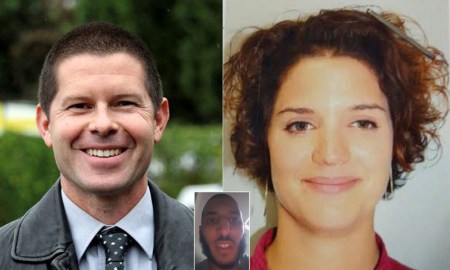
1691 (1)Paris police officer Jean-Baptiste Salvaing (left) and his wife, police administrator Jessica Schneider (right), were stabbed to death in front of their son by Islamist terrorist Larossi Abballa (inset) on June 13. The murderer then live-streamed a video on Facebook, in which he pledged allegiance to the Islamic State.


June 14. A 19-year-old female student was stabbed at a bus station in the city of Rennes. Passersby succeeded in capturing her attacker, a Muslim man who said he was obeying “voices” that ordered him to make a “sacrifice for Ramadan.” The young woman was taken to a hospital, and the attacker was taken to a psychiatric hospital.

June 14. In reaction to the June 13 murder of two police officers by an Islamist terrorist, the government authorized all policemen to keep their gun on them when they are not on duty.

June 15. According to the Belgian daily La Dernière Heure, the Belgian antiterrorism service informed police departments that ISIS fighters left Syria at the beginning of June to be sent to France and Belgium to commit terrorist attacks.

June 15. Maude Vallet, 18 years old, was harassed, insulted and threatened by five women in a bus because she was wearing shorts on her way back from the beach. She wrote her story on Facebook: “Hi, I am a bitch”. She denounced traditions and the clergy, but refused to mention that these “slut-shaming” attackers were Muslim women. She said the ethnicity to which they belonged was not relevant.

June 15. Ali S, 32, a Tunisian who slapped a female waiter in a bar in Nice because she was serving alcohol during Ramadan was sentenced to eight months in prison and ordered to pay 1000 euros to the waitress. Because he was residing illegally in France, he will be deported and prohibited from returning to France for three years.

June 16. A street encampment of around 400 Sudanese and Afghan migrants, mostly men, was evacuated by the police in the 18th district of Paris. It is the 24th evacuation since June 15, 2015.

June 16. In reaction to the June 13 murder of two police officers by an Islamist terrorist, the right-wing politicians began campaigning to send 13,000 people registered as an “S” (people who live in France and suspected of being affiliated with a terrorist organization) to special “camps”.

June 16. A 22-year-old convert to Islam was arrested in Carcassonne with a knife and a machete. He confessed to the police that he wanted to kill American and English tourists before stabbing a policeman or a soldier. He is being held in custody in Toulouse. The man is registered as an “S”.

June 18. Abou Kamel Chahid threatened on Facebook to commit terrorist attacks in France. “We are four brothers, each has a mission. I swear by Allah, France is going leave the coalition. They won’t have choice. These kouffars [infidels] will never feel well in this country. Be careful, brothers and sisters, things are going to accelerate”.

June 18. For a year, the public multimedia library of Lannion (Britany) has been suffered a rash of vandalizations of its books, comics and DVDs — all relating to the Jews, such as books about the Holocaust and comics by Johan Sfar, the author of “La chat du rabbin” (“The Rabbi’s Cat”), a bestselling comic book.

June 19: An inmate of the Beziers prison in the south of France was sentenced to an additional six months in prison because he said he wanted to commit a terrorist attack against the nudist beach of the Cap d’Agde. The man, Alain G, a convert to Islam, was reported by other inmates.

June 19: 4000 French Muslims responded to a call launched by a group of Mosques in the area of Magnanville, a Paris suburb, to participate in a silent march in tribute to two police officers stabbed to death at their home. It is the first time that French Muslims showed some collective solidarity with non-Muslims against Islamic terrorism. Pressure from the media had been huge to make the demonstration into a show. There was, however, some criticism: MP Guénhaël Huet tweeted “sincerity or duplicity?”. Many other critics observed the absence of women among the marchers, which was analyzed as a sign of the deepening of Islamist ideology among the French Muslims. When the marchers arrived in front of the police station to lay down flowers, no policemen came out to thank them or shake hands.

June 20. After three days of controversy on social media, it appeared that the policeman who refused to shake hands with President François Hollande at a memorial ceremony for the two police officers murdered by the Islamist, Larossi Abballa, was not a member of right-wing Front National party. According to Le Monde, the policeman just wanted to protest against the shrinking budget of the police.

June 21. The NGO “Action by Christians for the Abolition of Torture” (“Action des chrétiens pour l’abolition de la torture”) released a poll about the perception of torture by the French. The results were astounding:

  • 36% said it is acceptable to use torture “in exceptional circumstances.” The number was 25% in 2000 [Poll Amnesty/CSA. 2000].
  • 54% of those polled found it “justifiable” to use electric shocks to torture a terrorist suspected of planting a bomb.
  • 45% said they considered torture an efficient tool against terrorism.
  • 18% said they thought they could torture a terrorist themselves. 40% of Front National supporters said they thought they could torture a terrorist themselves.

June 21. More than 1000 women (mostly Muslims) signed a petition demanding separate hours for women at the public swimming pool of Mantes la Jolie, a Paris suburb. The petition included a request for only female employees to be present during women’s hours. Officials, in the name of secularism, refused the request.

June 21. The daily, Libération, published a report on the Turkish government’s strategy to gain control of Islamic institutions in France.

June 21. A Muslim security guard operating in the “fan zone” of the UEFA Euro soccer tournament in Nice was seen praying while on duty. Police were called to expel him; bystanders were afraid he was a terrorist.

June 22. The investment company Mayhoola, affiliated with the royal family of Qatar, the al-Thanis, spent half-a-billion euros for a controlling interest in the French fashion company Balmain. The same day, the news magazine Marianne published a full survey about the real estate properties of the royal Qatari family in France: 3 billion euros ($3.3 billion USD) in villas, buildings, malls, etc.

June 22. A Muslim from La Chapelle-Basse-Mer (western France) was given a four month suspended prison sentence, a €300 fine, and ordered to pay €1000 in damages each to the two people he threatened to kill, as well as €300 for court costs. In December 2015, he drove his car into a schoolyard and threatened to kill the cook and deputy cook of the school, because his eight-year-old son had eaten pork at the school cafeteria. The boy was hungry and apparently did not want to wait for a substitute meal for vegetarians and Muslims.

June 23: At 3am, in the heart of Barbes, the Muslim quarter of Paris, two men on a motor-scooter opened fire on a group of young men walking in the street. No one was wounded. The police found two 9mm bullet casings on the scene.

June 24: In Toulon, a hundred women demonstrated in the street, all of them wearing shorts. They said they wanted to support Maude Vallet who had been attacked in a bus by five women; the attackers had said that by wearing shorts, she did not respect herself. Like Maude Vallet, the demonstrators refused to mention that all the attackers had been Muslims. Instead, the demonstrators repeated the traditional litany that “it has nothing to do with Islam”.

June 24: In Portes-lès-Valence, an Islamist under surveillance by security services was convicted and imprisoned for the murder of his three-year-old stepdaughter. He had beaten the child to death. The mother was also charged for failing to report the abuse.

June 25: Can a female lawyer testify in court while wearing a veil? This controversy engulfed the bar association of Seine Saint Denis, a suburb of Paris. On June 24, at a students’ moot court competition, a young woman appeared with a tuque, a traditional hat which no lawyers in France wear anymore. But, in a visible way, under the tuque, she was wearing a Muslim veil. The controversial question of whether this is now a hot topic. Many observers think that the tuque will be reintroduced in France by Islamist lawyers in the next few months.

June 26: Bernard Cazeneuve posthumously admitted Hervé Cornara to the Order of Légion d’Honneur. A year ago, Cornara, a businessman, was murdered and beheaded by his Muslim employee, Yassine Salhi, who claimed to act on behalf of the Islamic State. Salhi placed Cornara’s severed head on display, alongside twin ISIS flags, at the gas factory near Lyon where they worked.

June 27: The press reported that two days earlier, 300 hundred migrants from Sudan, Eritrea and Afghanistan engaged in a mass brawl in the 18th district of Paris. The brawl apparently erupted because a woman was sexually harassed by a man from a different ethnic group. The police used tear gas grenades to stop the violence.

June 27: In Ales (southern France), Abdellah, a Moroccan, apparently had no money to pay for his meal at the Sushi bar where he had eaten, so he ran out of the restaurant with his girlfriend. When the police caught him, he began to shout:

“You pork-eaters! You sausage-eaters… We are going to kick France’s ass. Long live the Kouachis [brothers who murdered the Charlie Hebdo journalists in January 2015]! I swear to God, I have a Kalashnikov…”

Abdellah was sentenced to two years in prison for “defending terrorism,” and was ordered to pay the Sushi bar bill.

June 28: Azzeddine Taïbi, a communist, was elected mayor of Stains, a suburban city known for its Salafist population. On the same day, the Administrative Court of Montreuil rejected an appeal by the Seine-Saint-Denis Prefecture demanding the removal of a banner in support of Marwan Barghouti. Barghouti is currently serving five life sentences in an Israel prison for

“orchestrating three shooting attacks that killed 5 people: one attack in Jerusalem… in which Greek monk Tsibouktsakis Germanus was murdered… and one shooting and stabbing attack at the Sea Food Market restaurant in Tel Aviv (March 5, 2002). When arrested by Israel in 2002, Barghouti headed the Tanzim (Fatah terror faction).”

Barghouti’s supporters try to paint him as the “Palestinian Mandela.” So, today, the portrait of Barghouti is back covering “Liberty, Equality, Fraternity” on the pediment of the Seine-Saint-Denis Hall.

June 29: The prosecutor’s office in Paris opened in inquiry into death threats posted on social networks against the magazine, Charlie Hebdo. Some twenty “very threatening” messages, including the death threats, were posted on Charlie Hebdo’s Facebook page for three or four days in mid-June, Le Parisien reported. Police are investigating.

June 30: The French government introduced amendments to the “Equality and Citizenship” bill, to fight against “prejudice” and make “diversity” (ethnic minorities) more visible on public television.

According to the latest “barometer of diversity,” only 14% of people perceived as “non-white” (in the terminology) are present on the air. Erika Bareigts, secretary of state in charge of “real equality,” said that “diversity is the reality of French society, and we must show it. This soothes the debate, and everybody needs it.” She added: “The media do not show non-whites in positive or starring roles. That must change.”

June 30: Two jihadists, back from Syria, where they joined the Islamic State, were sentenced to six-month suspended prison terms. The jihadists are 16 and 17 years old. They stayed only six months in Syria and said they left ISIS because of the “rotten ambiance” in their battalion, which was composed of French volunteers.

Refugee Activists Worry Anti-Rape Laws Will Hurt Muslim Migrants

July 11, 2016

Refugee Activists Worry Anti-Rape Laws Will Hurt Muslim Migrants, Front Page Magazine, Daniel Greenfield, July 11, 2016

(Please see also, Germany’s New “No Means No” Rape Law. — DM)

four_lions_menus_3 (1)

This is one of those clarifying moments that show what the left really stands for. The left claims to fight for women. It claims to want gay rights. And yet Muslims come first. They always come first.

After mass sexual assaults in Cologne on New Year’s Eve, the German Parliament voted Thursday in favor of a stricter sexual-assault law that also could ease deportation rules for refugees convicted of sex-related offenses.

The changes appear aimed at two overlapping targets: closing legal loopholes over sexual assaults amid complaints that German codes are too lax and addressing mounting public backlash after the country absorbed the bulk of the wave of migrants and refugees from the Middle East and beyond last year.

But some lawmakers and activists oppose linking the two issues, claiming it could further stigmatize refugees and others as German public opinion increasingly turns against them.

Further stigmatize them… after the mass rapes that they carried out in which 2,000 men assaulted 1,200 women. This was the sexual assault equivalent of 9/11.

The parliamentary vote came on the same day that a court in Cologne sentenced two men in the New Year’s Eve assaults. Iraqi national Hussein A., 21, and Algerian Hassan T., 26, were handed suspended one-year sentences. They were the first suspects to be convicted over the assaults. Both had arrived in Germany in the past two years, a court spokesman said.

They got off with a slap on the wrist. But let’s not stigmatize them.

Bernward Ostrop, an expert on asylum law at the Berlin office of the Catholic charity Caritas, said Germany’s new sex assault law would most probably not make the country safer and was instead meant to send a message to voters. “We already have very good possibilities to deport persons who have committed crimes,” Ostrop said.

Yes, that would be why Hassan and Hussein got suspended one-year sentences.

Opposition politicians and activists have argued that amending the law to make it easier to deport foreign nationals guilty of sexual offenses could create the impression that foreigners are more likely to commit such crimes, stoking tensions further.

I wonder what could possibly create that impression?

A. The fact that it’s true

B. The fact that it’s true

or

C. The time that 2,000 Muslims sexually assault 1,200 women in one day

Halina Wawzyniak, a lawmaker from the Left Party, said that she was generally in favor of stronger sexual-assault laws but that sex assaults and immigration should not be linked.

Wawzyniak said she feared that the new law could lead to “disproportionate” sanctions for relatively minor offenses by asylum seekers and that they could face a “double punishment” by being deported.

This is the left. Remember that. They pretend to be feminists, but they put Muslim rapists over female victims.

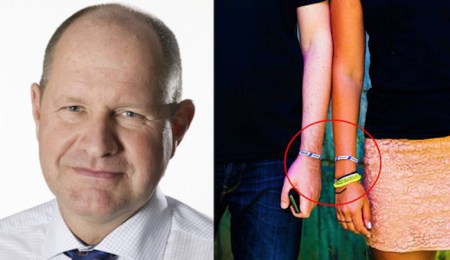
To counter Muslim migrant sex assaults, Swedish cops giving girls “Do not molest me” bracelets

July 2, 2016

To counter Muslim migrant sex assaults, Swedish cops giving girls “Do not molest me” bracelets, Jihad Watch

This will work. Can’t you picture it? A Muslim migrant is about to attack an Infidel girl and make her a “captive of the right hand” (cf. Qur’an 4:3, 4:24, 23:1-6, 33:50, 70:30), but then he spies her “Do not molest me” bracelet, apologizes, and hurries away.

Is there no one left in Sweden, or Europe in general, who has any spine? Is every last Western leader determined to stand up to jihad terror and Islamic supremacism in the wimpiest possible manner?

Dan-Eliasson-bracelets-do-not-molest-me

“‘Do not molest me’: Swedish police giving out bracelets to girls in the wake of immigrant attacks,” Fria Tider (Google Translate), June 30, 2016 (thanks to Maurice):

Domestic. In the aftermath of last year’s asylum-related sexual attacks at the “We Are Stockholm” youth festival, the Swedish police are now launching a new campaign. Officers will give out bracelets with the text “Do not molest me” to girls attending this year’s festival, of according to Dan Eliasson, head of the country’s national police force.

“The police are taking the reports of sexual molestation seriously, especially when it happens to young people,” Eliasson said in an official press release.

As a part of the new campaign, police officers equipped with bracelets with the text “Do not molest me” will be late to the Streets of Stockholm. The bracelets will be given out During The Summer Festival in the Swedish capital, and also in connection to other major events frequented by young people.

“This way, we can draw attention to the issue and urge Those Concerned to report,” Mr. Eliasson Continued.

Recently, the Swedish police published a report on sexual crimes in public swimming pools and other public places. : According to the report from May this year, the perpetrators are in most cases male asylum seekers from the Third World. One hypothesis put forward in the report Is that the asylum seekers are attacking Swedish girls as a “result of the Nordic alcohol culture, but overpriced Because of non-traditional gender roles” in the Scandinavian country.

Anger, Honor and Freedom: What European Muslims’ Attack On Speech Is Really About

June 30, 2016

Anger, Honor and Freedom: What European Muslims’ Attack On Speech Is Really About, Investigative Project on Terrorism, Abigail R. Esman, June 30, 2016

1052

Indeed, much of the Muslim violence in Europe is about exactly this: intimidating non-Muslims into a fearful capitulation, where words like “I hate Muslims” and drawings of Mohammed become extinct because the Muslim communities insist that it be so. It is about forcing Westerners to rearrange their lives, their culture, to accommodate the needs and values and culture of Islam. It is about control, and the power over freedom. And it is about creating a culture in which honor is injured by words and restored through violence and terror.

**********************

“Clash of civilizations,” some say. Others call it the “failure of multiculturalism.” Either way, the cultural conflicts between some Muslims and non-Muslims worldwide continue to play out as Western countries struggle to reconcile their own cultures with the demands of a growing Muslim population.

But herein lies the problem: in many ways, the two cultures are ultimately irreconcilable. There is no middle ground. And hence, the conflicts and the tugs-of-war continue.

Over the past two months, the events surrounding controversial Dutch columnist Ebru Umar have encapsulated that “clash” at its core, a salient metaphor for the tensions, particularly in Europe, between the West’s Muslim populations and its own. More, they illuminate the enormity of the problems we still face.

Umar is no stranger to the spotlight, or to the wrath of Dutch Muslims who read her many columns, most of them published in the free newspaper, Metro. For years, the Dutch-born daughter of secular Turkish immigrants has raged against the failure of other Dutch-born children of immigrants, mostly Moroccan, to assimilate into the culture of their birth. She loudly condemns Dutch-Moroccan families for the shockingly high rates of criminality and violence among Dutch-Moroccan boys – as much as 22 times the rate of Dutch native youth – a phenomenon she ascribes to their Islamic upbringing and their parents’ refusal to allow their children to mingle among the Dutch.

But her critiques have earned her no converts. Instead, Dutch-Moroccan youth, whom she calls “Mocros,” have regularly taunted her, both online and in the street.

This past April, however, Umar added a new team of enemies to her portfolio: when, in response to Turkish president Recep Tayyip Erodogan’s demand that a German satirist be prosecuted for insulting him on TV, Umar tweeted “f***erdogan,” Dutch Turks turned on her in fury. “How dare you insult our president!” cried these Dutch-born subjects of Holland’s King Willem-Alexander. And while Umar took a brief holiday on the Turkish coast, one such Dutch-Turk turned her in to the police. She was arrested at her vacation home in Kusadasi, and though released the following day, was forbidden to leave the country. The charge: Insulting the Turkish president. It took 17 days before discussions between Holland’s prime minister and Turkish authorities enabled her to return to the Netherlands.

But she could not return home. In her absence, Umar’s home had been burgled and vandalized, the word “whore” scrawled on a stairway wall. Death threats followed her both in Turkey and on her return. When it became clear she could not ever return to the apartment she had lived in for nearly 20 years, she announced on Twitter (Ebru Umar posts constantly on Twitter) that she would be moving out.

Meantime, in Metro and elsewhere, she continued her criticism of Moroccans and, as she herself notes, of Islam overall.

And so it was that on the day Ebru Umar moved out of her apartment in Amsterdam, a group of Dutch-Moroccans in their twenties came to see her off, taunting her with chants: Ebru has to mo-o-ve, nyah nyah.” Though furious, she ignored them – until one of them began to film her loading her belongings into her car. For Umar, being taunted by the very people whose threats had forced her from her home in the first place was bad enough: but this violation of what little privacy remained for her was more than she could take. She grabbed her iPhone and began filming them right back. “Go ahead,” she challenged. “Say it for the camera.”

Scuffles ensued, and soon one of the Moroccans had her iPhone in his hand. The others laughed. Then they ran away. Umar filed a police report and, still smarting, took to Twitter once again: “C**t Moroccans, I hate you,” she posted. “I hate you, I hate you, I hate you, I hate you and I hate your Muslim brothers and sisters, too. F**k you all.” (It is important to note that, however offensive, the expression “c**t Moroccans” is a common epithet in the Netherlands.)

But, hey – she was angry. Her phone had been snatched from her hand in a brutal, aggressive gesture that left her feeling violated and, vulnerable. She had just been forced to leave her home. She had endured prison, a criminal inquiry, and death threats, all at the hands of the same group on whom she now spewed her fury.

Her words may have been harsh or inappropriate, but they were words. She had not struck her tormenters as they filmed her. She did not call for their demise, or strap a bomb around her waist and visit the local mosques.

She took to Twitter and said: I hate you.

“But hate,” she tells me later in an e-mail, “is just an emotion.” And in a column penned more than two years ago, she observed, “Hate me till you’re purple, but keep your claws off me.”

Here is where Ebru Umar’s story becomes the story of the Western world. In response to her words (“I hate you. F*** you”), several Muslims – Moroccans and others – filed charges against her for hate speech. (Though ironically, “I hate you” does not legally qualify as “hate speech.”) Such words are an attack upon their honor, a humiliation: and if there is one thing experts on Arab and Muslim culture will agree on, it is the significance of humiliation and honor in governing their lives. For this, Dutch Moroccan youth threaten Umar on the streets, and have done so, she says, for years: after all, she insults them.

1664

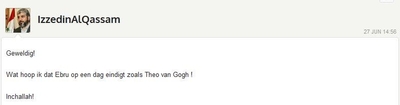
But in truth, it isn’t just the youth. The broader Muslim community stands by, silent: they do not condemn the youth who taunt her, who rip her telephone from her hands, or post things on the Internet like “We hate you, too – can you please kill yourself?” or “Oh, how I hope she ends up like Theo van Gogh.”

Theo van Gogh, also a controversial columnist, was shot and stabbed to death in 2014 by a radical Dutch-Moroccan Muslim.The commenter wishing her the same fate used the name “IzzedinAlQassam,” the founder of modern Palestinian jihad, and an icon of Hamas leader Khaled Meshaal.

For people like this, it doesn’t matter that Umar – or van Gogh – inflicted no violence, any more than it mattered that the editors of Charlie Hebdo were not violent. It was the insult, the humiliation – to them, to Islam, to Mohammed – that mattered: and an insult, a humiliation, deserves a violent response.

Indeed, much of the Muslim violence in Europe is about exactly this: intimidating non-Muslims into a fearful capitulation, where words like “I hate Muslims” and drawings of Mohammed become extinct because the Muslim communities insist that it be so. It is about forcing Westerners to rearrange their lives, their culture, to accommodate the needs and values and culture of Islam. It is about control, and the power over freedom. And it is about creating a culture in which honor is injured by words and restored through violence and terror.

When Umar says “I hate you,” what she hates, really, isn’t the Moroccans who attacked her or their “Muslim brothers and sisters.” What she hates is this – this effort, this battle over honor and speech and freedom, and this clash between violence and expression, guns and conversation.

“I don’t want Muslims to leave,” she tells me, again by e-mail. “I want them to embrace the Enlightenment, Western society, the Netherlands.” And in turn, she calls on the Dutch to “set rules: no violence in any sense. And stop using culture or religion as an excuse for behavior.”

Ebru Umar’s words. More of us should listen.

VIDEO — Geert Wilders: Stand for Freedom!

June 30, 2016

VIDEO — Geert Wilders: Stand for Freedom! Gatestone Institute via YouTube, June 30, 2016


Stop Importing Jihadists: Sharia Supremacists Have No Right to Enter the U.S.

June 29, 2016

Stop Importing Jihadists: Sharia Supremacists Have No Right to Enter the U.S., BreitbartJim Hanson, June 29, 2016

[T]he practice of Sharia is simply not compatible with life in the U.S. It is also the dividing line between Medieval Islam, with its abhorrent practices such as death for homosexuals; stoning for victims of rape; forced marriages and genital mutilation for girls; and Modern Islam, which could properly be called post-Sharia.

********************

Donald Trump lit off a firestorm with his call for a ban on all Muslims entering the United States. The deadly threat of Islamist terror and the migrant violence in Europe make a ban on Muslim immigration seem like a reasonable solution.

But we have Muslim allies, the King of Jordan for example, who would be affected by such an action. So if banning all Muslims is not the perfect solution, how can we deal with the ones who are a serious problem without alienating our allies?

The Center for Security Policy just released a white paper detailing how to do that entitled “Stop Importing Jihadists: Making Sharia-Supremacism a Bar to Immigration and Naturalization.” It explains how existing laws can be used to stop allowing Muslims from coming to this country who do not share our American values. This does not mean all Muslims, but it is a significant number who believe the totalitarian Islamist code called Sharia should be placed above the U.S. Constitution.

U.S. citizens have rights. But clearly, there are no rights for non-citizens to visit or migrate to the United States. It is a privilege. We need to make sure that anyone coming here doesn’t believe their mission is to bring with them an antiquated and barbaric system to impose on us. We have the authority under current law to stop members of totalitarian ideologies from infiltrating and working to subvert our free system.

The problem is not Muslims per se; it is Islamic Supremacists who push the totalitarian ideology called Sharia. Unfortunately, this is a significant number of Muslims worldwide; a Pew International poll shows more than half of them believe Sharia should be the law of their land. Most also believe this law should apply to non-Muslims, as well. That could hardly be more un-American and we have every right to tell those folks “That’s not how we do things here.”

There are differing versions of Sharia, but they agree that the practice of all aspects of life is governed by the unassailable word of Allah and not one single bit of it may be questioned. That includes an ironclad prohibition on any man-made law superseding Sharia and a requirement for believers to actively work to impose it everywhere. This makes it impossible for a Sharia-adherent Muslim to swear an oath to obey the U.S. Constitution or any other country’s governing document. There can be no agreement to render unto Caesar that which is Caesar’s, Caesar must submit to Allah.

That single fact makes it prudent to restrict immigration by anyone who holds those beliefs. We have done this previously to stop totalitarian communists and fascists from infiltrating with a mind to undermine our society from within. That subversion is actually the very goal articulated by groups such as the Muslim Brotherhood for its operations here in the United States: “The Ikhwan [Muslim Brotherhood] must understand that their work in America is a kind of grand jihad in eliminating and destroying the Western civilization from within and ‘sabotaging’ its miserable house.”

It makes perfect sense to say to a group that wants to destroy us “from within” that “you are not welcome to come in.”

The dividing line we need to use for making policy is Sharia; the practice of Sharia is simply not compatible with life in the U.S. It is also the dividing line between Medieval Islam, with its abhorrent practices such as death for homosexuals; stoning for victims of rape; forced marriages and genital mutilation for girls; and Modern Islam, which could properly be called post-Sharia. The problem is Modern Islam does not truly exist yet. There are Muslims who do not practice or believe in the barbaric acts Sharia requires, but they are technically apostates, defectors of Islam, and the penalty for leaving is death.

The current state of play has members of the medieval form acting as the loudest voices of the “Muslim” community. Those who wish to practice a modern version do so at their own peril: they face shunning at best and death at worst. The medieval practitioners are aided in this effort by vast support; even the U.S. government has embraced them both abroad, by supporting groups like the Muslim Brotherhood, and here at home, in the form of the Council on American-Islamic Relations (CAIR) and others.

Our U.S. government has a responsibility to safeguard this country and our way of life. That includes banning those who wish to destroy us from entering the United States. We must add Sharia to the list of totalitarian ideologies that trigger this prohibition. This will help all Americans including Modern Muslims who just want to live in peace in the land of the free.

Germany’s Turkish-Muslim Integration Problem

June 24, 2016

Germany’s Turkish-Muslim Integration Problem, Gatestone Institute, Soeren Kern, June 24, 2016

♦ Seven percent of respondents agreed that “violence is justified to spread Islam.” Although these numbers may seem innocuous, 7% of the three million Turks living in Germany amounts to 210,000 people who believe that jihad is an acceptable method to propagate Islam.

♦ The survey also found that labor migration is no longer the main reason why Turks immigrate to Germany: the most important reason is to marry a partner who lives there.

♦ A new statistical survey of Germany — Datenreport 2016: Social Report for the Federal Republic of Germany — shows that ethnic Turks are economically and educationally less successful than other immigrant groups, and that more than one-third (36%) of ethnic Turks live below the poverty line, compared to 25% of migrants from the Balkans and southwestern Europe.

♦ “In our large study we asked Muslims how strongly they feel discriminated against, and we searched for correlations to the development of a fundamentalist worldview. But there are none. Muslim hatred of non-Muslims is not a special phenomenon of Muslim immigration, but is actually worse in the countries of origin. Radicalization is not first produced here in Europe, rather it comes from the Muslim world.” — Ruud Koopmans, sociologist.

Nearly half of the three million ethnic Turks living in Germany believe it is more important to follow Islamic Sharia law than German law if the two are in conflict, according to a new study.

One-third of those surveyed also yearn for German society to “return” to the way it was during the time of Mohammed, the founder of Islam, in the Arabia of the early seventh century.

The survey — which involves Turks who have been living in Germany for many years, often decades — refutes claims by German authorities that Muslims are well integrated into German society.

The 22-page study, “Integration and Religion from the Viewpoint of Ethnic Turks in Germany” (Integration und Religion aus der Sicht von Türkeistämmigen in Deutschland), was produced by the Religion and Politics department of the University of Münster. Key findings include:

  • 47% of respondents agreed with the statement that “following the tenets of my religion is more important to me than the laws of the land in which I live.” This view is held by 57% of first generation Turkish immigrants and 36% of second and third generation Turks. (The study defines first generation Turks as those who arrived in Germany as adults; second and third generation Turks are those who were born in Germany or who arrived in the country as children.)
  • 32% of respondents agreed that “Muslims should strive to return to a societal order like that in the time of Mohammed.” This view is held by 36% of the first generation and 27% of the second and third generation.
  • 50% of respondents agreed that “there is only one true religion.” This view is held by 54% of the first generation and 46% of the second and third generation.
  • 36% of respondents agreed that “only Islam is able to solve the problems of our times.” This view is held by 40% of the first generation and 33% of the second and third generation.
  • 20% of respondents agreed that “the threat which the West poses to Islam justifies violence.” This view is held by 25% of the first generation and 15% of the second and third generation.
  • 7% of respondents agreed that “violence is justified to spread Islam.” This view is held by 7% of the first generation and 6% of the second and third generation. Although these numbers may seem innocuous, 7% of the three million Turks living in Germany amounts to 210,000 people who believe that jihad is an acceptable method to propagate Islam.
  • 23% of respondents agreed that “Muslims should not shake the hand of a member of the opposite sex.” This view is held by 27% of the first generation and 18% of the second and third generation.
  • 33% of respondents agreed that “Muslim women should wear a veil.” This view is held by 39% of the first generation and 27% of the second and third generation.
  • 31% of female respondents said that they wear a veil in public. This includes 41% of the first generation and 21% of the second and third generation.
  • 73% of respondents agreed that “books and movies that attack religion and offend the feelings of deeply religious people should be banned by law.”
  • 83% of respondents agreed that “I get angry when Muslims are the first to be blamed whenever there is a terrorist attack.”
  • 61% of respondents agreed that “Islam fits perfectly in the Western world.”
  • 51% of respondents agreed that “as an ethnic Turk, I feel like a second class citizen.”
  • 54% of respondents agreed that “regardless of how hard I try, I am not accepted as a member of German society.”

The study also found that Turks and native Germans hold radically different perceptions about Islam:

  • While 57% of Turkish Germans associate Islam with human rights, only 6% of Germans do.
  • While 56% of Turkish Germans associate Islam with tolerance, only 5% of Germans do.
  • While 65% of Turkish Germans associate Islam with peace, only 7% of Germans do.

Based on the answers provided, the authors of the survey concluded that 13% of respondents are “religious fundamentalists” (18% of the first generation and 9% of the second and third generation). Although these numbers may appear insignificant, 13% of the three million Turks in Germany amounts to nearly 400,000 Islamic fundamentalists, many of whom believe that violence is an acceptable means to spread Islam.

The survey’s findings mirror those of other studies, which show that Turkish migrants are poorly integrated into German society.

In 2012, the 103-page study, “German-Turkish Life and Values” (Deutsch-Türkische Lebens- und Wertewelten), found that only 15% of ethnic Turks living in Germany consider the country to be their home. Other key findings include:

  • Nearly half (46%) of Turks agreed with the statement, “I hope that in the future there will be more Muslims than Christians living in Germany”; more than half (55%) said that Germany should build more mosques.
  • 72% of respondents said that Islam is the only true religion; 18% said that Jews are inferior to Muslims and 10% said that Christians are inferior.
  • 63% of Turks between the ages of 15 and 29 said they approve of a Salafist campaign to distribute a Koran to every household in Germany; 36% said they would be willing to support the campaign financially.
  • 95% of respondents said it is absolutely necessary for them to preserve their Turkish identity; 87% said they believe that Germans should make a greater effort to be considerate of Turkish customs and traditions.
  • 62% of respondents said they would rather be around Turks than Germans; only 39% of Turks said that Germans were trustworthy.

The survey also found that labor migration is no longer the main reason why Turks immigrate to Germany: the most important reason is to marry a partner who lives there.

Meanwhile, a new statistical survey of Germany — Datenreport 2016: Social Report for the Federal Republic of Germany (Datenreport 2016: Sozial-bericht für die Bundesrepublik Deutschland) — shows that ethnic Turks are economically and educationally less successful than other immigrant groups.

The report, produced by Germany’s official statistics agency, Destatis, in cooperation with several German think tanks, shows that more than one-third (36%) of ethnic Turks are living below the poverty line, compared to 25% of migrants from the Balkans and southwestern Europe (Spain and Portugal). The average income of ethnic Turkish households is €1,242 ($1,400) per month, compared to €1,486 ($1,700) for non-Turkish migrants and €1,730 ($1,950) for German households.

Only 5% of ethnic Turks earn more than 150% of the average German income, compared to 21% of migrants from Eastern Europe, 18% of those from southwestern Europe and 11% of those from the Balkans.

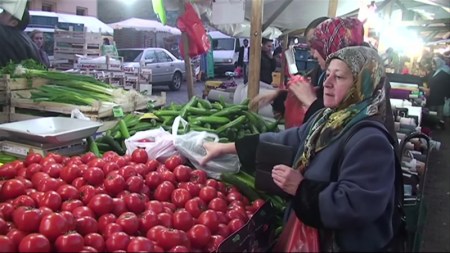
1662An open-air market in the heavily-Turkish Kreuzberg district of Berlin. (Image source: The Berlin Project video screenshot)

The report also shows that Turks have a lower educational attainment than other migrant groups in Germany. Only 60% of ethnic Turks complete secondary school (Hauptschulabschluss), compared to 85% of migrants from Eastern Europe. Moreover, only 8% of ethnic Turks between the ages of 17 and 45 earn a Bachelor’s degree, compared to 30% of migrants in the same demographic from Eastern Europe. Education is a determinative factor for successful integration, according to the report.

German multiculturalists often blame the lack of Turkish integration on the Germans themselves. Writing for Die Welt, economist Thomas Straubhaar argues that most Germans view Turks as guests, not as fellow citizens, an attitude which discourages Turks from integrating:

“Ethnic Turks are essentially treated as guests — hence the controversy over whether their faith belongs to Germany or not. Their immigration is seen as temporary. Their contribution to German culture is seen in a negative light.

“Those who treat migrants as guests should not be surprised when they behave as such. Guests are not expected to have any emotional devotion to the host, nor does the host feel any obligation to show irrevocable loyalty to the guest.

“Guests will not be willing to put all their cards on the table of the host country and take full responsibility for successful integration. Guests assume that sooner or later they must return home again. In everything they do, they will always consider their guest status and be only halfheartedly engaged. This applies to investments in language, culture, friendships, social contacts and professional career.”

Others counter that those who act like strangers should not be surprised if they are treated as strangers. Sociologist Ruud Koopmans argues that one of the most determinative factors in successful integration involves the cultural gap between host and guest. The greater the distance, the greater the integration challenge.

In a recent interview with WirtschaftsWoche, Koopmans criticized multiculturalists who for normative reasons insist that culture and religion should not be factored into the debate on integration:

“In all European countries, Muslim immigrants lag behind all other immigrant groups in almost every aspect of integration. This applies to the labor market, but also to educational achievement, inter-ethnic contacts, i.e., contacts with the local population, and identification with the country of residence.

“Three decisive factors determine cultural distance: language skills, inter-ethnic contacts — especially those involving marriage — and values about the role of women. They all have something to do with religion. This of course applies especially for ideas about the role of women, which are derived directly from the Islamic religion. The greater the cultural distance between groups — especially when there are cultural taboos — the more complicated inter-ethnic marriages become. Such taboos make it virtually impossible for a Muslim, and especially Muslim women, to marry a non-Muslim. Statistics from various European countries show that less than ten percent of Muslim marriages are inter-ethnic.”

Detlef Pollack, the author of the University of Münster study cited above, blames the lack of Turkish integration on discrimination: “The message to the majority German population is that we should be more sensitive to the problems encountered by those of Turkish origin,” he told Deutsche Welle. “It is our view that the feeling of not being accepted is expressed in the vehement defense of Islam.”

Koopmans rejects the link between discrimination and radicalization:

“This is a common assertion. But it is wrong. In our large study we asked Muslims how strongly they feel discriminated against, and we searched for correlations to the development of a fundamentalist worldview. But there are none. Muslim hatred of non-Muslims is not a special phenomenon of Muslim immigration, but is actually worse in the countries of origin. Radicalization is not first produced here in Europe, rather it comes from the Muslim world.”

German Architect: Demolish Churches, Build Mosques

June 23, 2016

German Architect: Demolish Churches, Build Mosques, Clarion Project, June 23, 2016

Germany-Mosque-Hamburg-HPThe call to prayer at a mosque in Hamburg (Photo: Video screenshot)

Breitbart notes that Reinig remarks come “after a report this month revealed that half of Turks in Germany regard Islamic law supreme over German laws and that young people are the most devout.”

************************

A prominent German architect has argued that the key to integration of Muslim immigrants in Germany is to build mosques, while at the same time demolishing churches.

Joaquim Reinig’s remarks were published in an interview with Die Tageszeitung and reported in English by Breitbart.

Reinig said that essential to integration is that immigrants should “have no fear” that their new country is asking them “to lose their identity in this society.”

The building of mosques, particularly the “visible minaret,” he says, sends this “message to the migrants.”

Reinig believes that the mosques are a positive influence on migrants, taking on the vital role of community workers.

Speaking about the previous influx of Turkish immigrants, who came to Germany as temporary workers, Reinig said that when they came, they were “relatively secular,” but when they decided to stay, they “remembered “their religion.

“The desire to become a German citizen and the activation of their faith ran parallel,” he said.

Breitbart notes that Reinig remarks come “after a report this month revealed that half of Turks in Germany regard Islamic law supreme over German laws and that young people are the most devout.”

Although Reinig says there is plenty of room for mosques in Hamburg – “theoretically 50 locations – he recommends demolishing churches rather than converting them.

Breitbart reports that Reinig “noted that around three per cent of Christians in Germany, 23,000 people, attend church in the region compared to the 17,000 Muslims who currently attend mosques in Hamburg.”

Reinig said he does not anticipate that other faiths will have a problem with his proposals.

“Jews, Christians and Muslims, as members of Abrahamic religions, are theologically brothers and sisters,” he said. “They have many similarities so should have no fear.”

The Impact of Islamic Fundamentalism on Free Speech

June 19, 2016

The Impact of Islamic Fundamentalism on Free Speech, Gatestone InstituteDenis MacEoin, June 19, 2016

♦ The 57-member-state Organization of Islamic Cooperation (OIC) have been working hard for years to render Islam the only religion, political system and ideology in the world that may not be questioned with impunity. They have tried — and are in many respects succeeding — to ring-fence Islam as a creed beyond criticism, while reserving for themselves the right to condemn Christians, Jews, Hindus, democrats, liberals, women and gays in often vile, even violent language. Should anyone say anything that seems to them disrespectful of their faith, he or she will at once be declared an “Islamophobe.”

♦ Like almost every world leader, Obama declares, with gross inaccuracy, that “Islam is a religion of peace”. It is politically expedient to deny the very real connection to jihad violence in the Qur’an, the Traditions (ahadith), shari’a law, and the entire course of Islamic history. They do this partly for political reasons, but probably more out of fear of offending Muslims. We know only too well how angry many Muslims can become at even the lightest offence.

♦ “If PEN as a free speech organization can’t defend and celebrate people who have been murdered for drawing pictures, then frankly the organization is not worth the name. … I hope nobody ever comes after them.” – Salman Rushdie, on the PEN members who objected to giving its award to Charlie Hebdo, after 12 of its staff were murdered by jihadists.

♦ The OIC succeeded in winning a UN Human Rights Council resolution that makes “defamation of religion” a crime. But the OIC knows full well that only Muslims are likely to use Western laws to deny free speech about their own faith. Last year, the US Congress introduced House Resolution 569, also purportedly intended to combat hate speech. It contains an oddity: it singles out Muslims for protection three times. It does not mention any other faith community.

One of the greatest achievements of the Enlightenment in Europe and the United States is the principle of free speech and reasoned criticism. Democracy is underpinned by it. Our courts and parliaments are built on it. Without it, scholars, journalists, and advocates would be trapped, as their ancestors had been, in a verbal prison. It is enshrined in the First Amendment to the US Constitution, in the words

“Congress shall make no law respecting an establishment of religion, or prohibiting the free exercise thereof; or abridging the freedom of speech, or of the press; or the right of the people peaceably to assemble, and to petition the government for a redress of grievances.”

Without full freedom to express ourselves in speech or in print, none of us could criticize a religion, an ideology, a political party, a law, an academic theorem, or anything else we might feel to be misguided, flawed, or even dangerous. Through it, we are free to worship as we choose, to preach as we see fit, to stand up in a parliament to oppose the government, to satirize the pompous, to take elites down a peg or two, to raise the oppressed to dignity, or to say that anything is nonsense.

Sir Karl Popper, the philosopher, wrote The Open Society and Its Enemies in defence of democracy, freedom and free speech. In Popper’s open society, all people have to be able to think and express themselves freely, without fear of punishment or censorship.

Closed societies are totalitarian and depend on claims to absolute truth. The citizen is not free to challenge the ideas of the state. Theocracies, including past and present Islamic states, rest for their authority on the rigid application of infallible scripture and divinely revealed laws.

The chief threat to free speech today comes from a combination of radical Islamic censorship and Western political correctness. Over the past century and more, Western societies have built up a consensus on the centrality of freedom of expression. We are allowed to criticize any political system or ideology we care to: capitalism, socialism, liberalism, communism, libertarianism, anarchism, even democracy itself. Not only that, but — provided we do not use personalized hate speech or exhortations to violence — we are free to call to account any religion from Christianity to Scientology, Judaism to any cult we choose. Some writers, such as the late Christopher Hitchens, have been uncensored in their condemnations of religion as such.

It can be hard for religious people to bear the harsher criticisms, and many individuals would like to close them down, but lack that power. Organizations such as Britain’s National Secular Society (established in 1866) flourish and even advise governments.

It used to be possible to do this with Islam as well. In some measure it still is. But many Muslim bodies — notably the 57-member-state Organization of Islamic Cooperation (OIC) — have been working hard for years to render Islam the only religion, political system and ideology in the world that may not be questioned with impunity. They have tried — and are in many respects succeeding — to ring-fence Islam as a creed beyond criticism, while reserving for themselves the right to condemn Christians, Jews, Hindus, democrats, liberals, women, gays, or anyone else in often vile, even violent language. Should anyone say anything that seems to them disrespectful of their faith, he or she will at once be declared an “Islamophobe.”

I am not talking here about hate literature comparable to the ubiquitous anti-Semitic writing so freely available on the internet. Much milder things have fallen and continue to fall afoul of Islamic defensiveness. We know some of the more obvious: a novel, a bunch of cartoons, some films, some political speeches, and a few blogs which have resulted in savage floggings, imprisonment, torture, death threats and murders. There is plenty of vulgar anti-Muslim comment online, just as there is plenty of everything in the public arena. But Muslim sensibilities have become so tender now that even fair, balanced, and informed questions about Muhammad, his early followers, the Qur’an, various doctrines, aspects of Islamic history, the behaviour of some Muslims, even the outrages committed by them, are rejected as Islamophobic.

Politicians and the media rush to disavow any connection between jihadi violence and Islam, and hurry to protect Muslims from the anticipated anger that massacres might provoke. Officials are not wrong to urge against reprisals or hatred targeting ordinary, uninvolved Muslims. But many often seem too quick to avoid pinning blame on actual Islamic laws and doctrines that inspire the jihad attacks.

Just after the horrendous slaughter in a gay nightclub in Orlando on June 12, U.S. President Barack Obama made a speech in which he described the attack as an “act of hate” and an “act of terror”. Not “Islamic terrorism” or even the misleading phrase “Islamist terrorism”. Like almost every world leader, he declares, with gross inaccuracy, that “Islam is a religion of peace”. It is politically expedient to deny the very real connection to jihad violence in the Qur’an, the Traditions (ahadith), shari’a law, and the entire course of Islamic history. Obama and many others simply deny themselves the right to state what is true, partly for political reasons, but probably more out of fear of offending Muslims in general, and Muslim clerics and leaders in particular. We know only too well how angry many Muslims can become at even the lightest perceived offence.

The list of threats, attacks, and murders carried out to avenge perceived irreverence towards Islam, Muhammad, the Qur’an or other symbols of Islam is now long. Even the mildest complaints from Muslim organizations can result in the banning or non-publication of books, distancing from authors, condemnations of alleged “Islamophobes” by declared supporters of free speech, the cancellation of lectures, arrests, and prosecutions of men and women for “crimes” that were not crimes at all. There are trials, fines and sentencings for advocates of an accurate and honest portrayal of Islam, its sources, and its history.

Danish author Lars Hedegaard suffered an attack on his life and lives in a secret location. Kurt Westergaard, a Danish cartoonist, suffered an axe attack that failed, and is under permanent protection by the security services. In 2009, in Austria, the politician Susanne Winter was found guilty of “anti-Muslim incitement,” for saying, “In today’s system, the Prophet Mohammad would be considered a child-molester,” and that Islam “should be thrown back where it came from, behind the Mediterranean.” She was fined 24,000 euros ($31,000) and given a three-month suspended sentence. The phrase “child molester” was based on the fact, recorded by Muslim biographers, that Muhammad had sexual relations with his new wife A’isha when she was nine years old.

In 2011, Elisabeth Sabaditsch-Wolff, a former Austrian diplomat and teacher, was put on trial for “denigration of religious beliefs of a legally recognized religion,” found guilty twice, and ordered to pay a fine or face 60 days in prison. Some of her comments may have seemed extreme and fit for criticism, but the court’s failure to engage with her historically accurate charge that Muhammad had sex with a nine-year-old girl and continued to have sex with her until she turned eighteen, regarding her criticism of it as somehow defamatory, and the judge’s decision to punish her for saying something that can be found in Islamic sources, illustrates the betrayal of Western values of free speech in defence of something we would normally penalize.

The stories of the bounty placed on Salman Rushdie’s head by the Ayatollah Khomeini, the threats and attacks against the artists who drew the Danish cartoons of Muhammad, or the murderous assault on the editorial team at Charlie Hebdo on January 7, 2015 are well known. Accustomed to free speech, open blasphemy, and satire, at home with irreverence for individuals and institutions, and assured of the legality of those freedoms — threats and attacks like those terrify us. Or should.

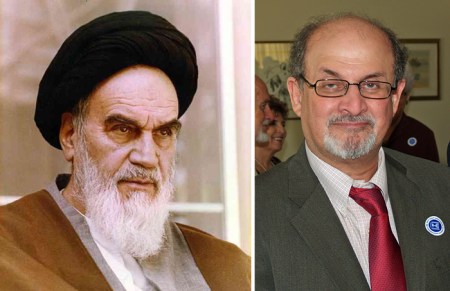
1505 (1)Iran’s then Supreme Leader Ayatollah Khomeini put a cash bounty on the head of British novelist Salman Rushdie 27 years ago, because he deemed Rushdie’s novel, The Satanic Verses, offensive. In February 2016, a group of Iranian media outlets added $600,000 to the cash reward.

But even more terrifying is the way in which so many politically correct Western writers and politicians have turned their backs on our most basic values. There are many instances, but the most disturbing has to be the reaction of Pen International, the internationally acclaimed defender of free speech everywhere, to Charlie Hebdo. PEN International is known worldwide as an association of writers. Together they work tirelessly for the freedom of authors from imprisonment, torture, or other restrictions on their freedom to write honestly and controversially. In 2015, PEN’s American Center planned to present its annual Freedom of Expression Award during its May 5 gala to Charlie Hebdo. The award was to be handed to Gerard Biart, the publication’s editor-in-chief, and to Jean-Baptiste Thorat, a staff member who arrived late on the day when Muslim radicals slaughtered twelve of his colleagues. This is the sort of thing PEN does well: upholding everyone’s right to speak out even when offence is taken.

When, however, this was announced, six PEN members, almost predictably, condemned the decision to give the award to Charlie Hebdo, and refused to attend the gala. Peter Carey, Michael Ondaatje, Francine Prose, Teju Cole, Rachel Kushner and Taiye Selasi exercised their right to double standards by blaming Charlie Hebdo for its offensiveness. Kushner expressed her discomfort with the magazine’s “cultural intolerance.” Does that mean that PEN should never have supported Salman Rushdie for having offended millions of Muslims just to express his feelings about Islam?

Peter Carey expressed his support, not for the satirists, but for the Muslim minority in France, speaking of “PEN’s seeming blindness to the cultural arrogance of the French nation, which does not recognize its moral obligation to a large and disempowered segment of their population.” We never heard Carey speaking out when a young Jewish man, Ilan Halimi, was tortured to death for weeks in France, or when Jews in Toulouse were shot and killed. He seems to be saying that the French government should shut up any writer or artist who offends the extreme sensitivities of a small percent of its population.

Teju Cole remarked, in the wake of the killings, that Charlie Hebdo claimed to offend all parties but had recently “gone specifically for racist and Islamophobic provocations.” But Islam is not a race, and the magazine has never been racist, so why charge that in response to the sort of free speech PEN has always worked hard to advance?

A sensible and nuanced rebuttal of these charges came from Salman Rushdie himself, a former president of PEN:

“If PEN as a free speech organization can’t defend and celebrate people who have been murdered for drawing pictures, then frankly the organization is not worth the name. What I would say to both Peter and Michael and the others is, I hope nobody ever comes after them.”

Those six later morphed into something like one hundred and forty-five. By April 30, Carey and the others were joined by another one hundred and thirty-nine members who signed a protest petition. Writers, some distinguished, some obscure, had taken up their pens to defy the principle of free speech in an organization dedicated to free speech — many of whom live in a land that protects free speech in its First Amendment precisely for their benefit.

The Organization of Islamic Cooperation had succeeded in winning a UN Human Rights Council resolution (16/18, 2010) that makes “defamation of religion” (read: blasphemy in the eyes of its followers) a crime. But the OIC knows full well that only Muslims are likely to use Western laws to deny free speech about their own faith. Five years later, in December 2015, the US Congress introduced House Resolution 569, intended to combat hate speech and other crimes. Insofar as it addresses matters of genuine concern to us all, it seems beyond reproach. But it contains an oddity. It singles out Muslims for protection three times. It does not mention any other faith community.

The greatest defence of our democracy, our freedom, our openness to political and religious debate, and our longing to live in Popper’s open society without hindrance — namely freedom of expression — is now under serious threat. The West survived the totalitarianism of the Third Reich and the Soviet Union without any loss of our freedoms. But today, a new enemy has arisen, global in its reach, more and more often militant in its expression, rooted in 1.6 billion people, seated at the UN and other international bodies, and already partially cowing us into submission to its repressive prejudices. Since the edict against Salman Rushdie, there is no way of calculating how many books have been shelved, how many television documentaries have never been aired, how many film scripts have been tossed in the waste bin, how many conferences have been cancelled or torn down, or how many killers are waiting in the wings for the next book, or poem, or song or sport that will transgress the strictures of Islamic law and doctrine.