Posted tagged ‘Islam and Christianity’

Belgium: Police hunt for imam’s son who walked down street loudly praying to Allah for “annihilation of all Christians”

August 10, 2016

Belgium: Police hunt for imam’s son who walked down street loudly praying to Allah for “annihilation of all Christians” Jihad Watch

Belgian authorities are trying to deport his father to…the Netherlands. That is insane enough in the first place, and they can’t even manage that. Authorities in both countries could at least move to ensure that El Alami Amaouch is no longer teaching or preaching at any mosque. But it is doubtful that they are doing that, either. The impotence of Western authorities is the chief enabler of the jihad against the West today.

https://www.youtube.com/watch?v=BpRwsDcY_vk

“Belgian police hunt 15-year-old son of radical imam and declare him a ‘serious threat’ after the boy posts a video calling for the murder of all ‘Christians,’” by Abe Hawken, Mailonline, August 9, 2016:

Belgian police are desperately hunting a radicalised 15-year-old son of an imam who appeared in a video pleading for the ‘annihilation of all Christians’.

The chilling video shows the teenager, who has not been named, calling for Allah to ‘destroy’ Christians and ‘kill them all’.

He sang the alarming outburst which was filmed in Verviers, east Belgium, and police added that the boy has been recognised and is on a list on radicalised people.

A source told the Daily Telegraph that the youngster is the son of a local radical imam – a leader of a mosque.

The source added that the teenager posed a potentially ‘serious threat’ to the public and officers wanted to trace him ‘as soon as possible’.

Muriel Targnion, Mayor of Verviers, said that the recorded clip is being taken seriously and requested that officers find him as ‘a matter of urgency’.

In the video – posted on Memri TV – he said: ‘Oh Allah, annihilate the hateful Christians. Oh Allah, kill them all. Do not leave a single one of them.’

The film was shot in Verviers, the scene of a successful anti-terrorism operation last year.

Belgian newspaper La Meuse reported that the boy is the son of imam El Alami Amaouch, who currently faces deportation to the Netherlands.

His father has duel Dutch-Moroccan nationality and is a leader at a mosque in the village of Dison, near Verviers.

Theo Francken, Belgium’s Minister for Asylum and Migration, said the authorities tried to extradite Amaouch to the Netherlands but his appeal delayed proceedings….

Polemic on the Demonstrations by Copts in the USA

August 7, 2016

Polemic on the Demonstrations by Copts in the USA, Gates of Vienna, August 6, 2016

copts-sisi

Should the Islamic revolution of the Arab Spring be victorious in Egypt, this state would sink into Islamic chaos like Libya, Iraq and Syria. Christians would be the big losers and would soon flee or be murdered. That is why the Coptic Church must maintain a good relationship with the Egyptian state, which can be so much easier with a president who is so critical of his own religion. It could even happen that a model may arise in Egypt of how Muslims and Christians can better coexist. Even if we of the West do not care to hear it, the Islamic states will never produce a democracy.

***********************

The following article from the German-language Copts Without Borders blog discusses the delicate problem posed by the demonstrations against Egypt organized by Coptic groups in exile. The author’s main point is that they, the Copts who stayed behind, must live as dhimmis under Islamic rule; there is no other choice. Copts in the diaspora are asked to consider the strategic ramifications of their protests, since the current Egyptian president has done more to help the Copts than any other president or dictator in recent times.

JLH, who translated the article, includes this note:

As our runaway government greases the skids for ever more Muslim immigrants to enter the country, and turns a blind eye to the pleas of Christian individuals and institutions being plowed into the ground in the Middle East, I was struck by the continuing outreach of the “dictator” Al-Sisi to the most endangered of his citizens. And by the tightrope the Copts feel they must walk in an attempt to survive in what was and should still be our highly valued ally.

The translated article:

Polemic on the Demonstrations by Copts in the USA

Egyptian citizens, whatever their religious affiliation, “all have the same rights and duties under the constitution.” And the Egyptian Christians have “displayed prudence and a spirit for the homeland” in the way in which they have reacted to sufferings and provocations in past years. They have remained sensibly united against the attacks of those who “want to use religion to sow discord and spread extremist ideas.”

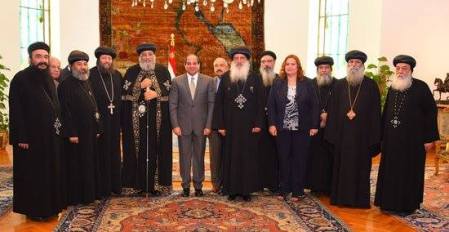
These are the significant thoughts expressed by Egyptian President Abdel Fatah al-Sisi during his meeting with Coptic Orthodox Patriarch Tawadros II, as he received him in the presidential palace, together with a delegation of several bishops from the synods of the church.

Al-Sisi emphasized the value of brotherliness between Christians and Muslims in Egypt by his positive evaluation of initiatives undertaken in the context of the Egyptian Family House. This so-named House of the Egyptian Family is an inter-religious organ for making connections that had arisen several years ago as an instrument for prevention and mitigation of sectarian contrasts.

However, the public demonstrations by several groups of the Coptic diaspora still trigger polemics, for instance those in recent days in Washington in front of the White House that protested against acts of violence against Christians in Egypt. Speakers for the Coptic Orthodox patriarchate did not wish to comment officially on these demonstrations. But recently there have been warnings from the patriarchate of their possible manipulation, as well as the warning against mobilizing public campaigns abroad which could be seen as “attempts at intervention” by foreign organizations and groups in Egypt’s domestic affairs.

The Egyptian writer Michael Fahmy spoke out sharply against such demonstrations organized by members of the Coptic Egyptian diaspora. He labeled them “stupid or treasonous” actions instigated by small groups. He also emphasized that only the Egyptian state can protect the Copts from acts of violence; that these groups are capable of protecting neither the militant Coptic-Orthodox diaspora nor the Copts now sitting in the Egyptian parliament.

Comment From Copts Without Borders

It may seem odd that the official Coptic Church is speaking against demonstrations abroad for Christians in Egypt. But the fact remains that only the Egyptian state — which is an Islamic one — can protect the Coptic Church and its faithful after a fashion, even though, after a period of relative calm, Islamic attacks on Copts in Egypt have increased. But the Copts’ overall situation has improved recently.

The Church must protect its members and make these statements officially. This induces a precarious situation. On the one hand, Christians abroad should not be indifferent to this imposed dhimmi status in Islamic countries, as in Egypt. On the other hand, these protests abroad put pressure on the recently moderate Islamic President Al-Sisi, who had the courage to criticize his own religion.

The churches in Islamic countries that are under increasing pressure in Iraq and Syria, where an extensive exodus of Christian life occurred and is still occurring, should be grateful for the involvement of the still-too-few Christians abroad. Because it is not to be taken for granted. In contrast to Iraq and Syria, where Christians have lost everything and the priests there rightly speak out against the Islamic reign of violence in these countries, the military in Egypt has succeeded in halting the “Arab Spring,” which pummeled especially the Christians and Yazidis. Despite the discrimination, the Copts there are relatively secure and protected. If the Arab Spring had swept across Egypt, there would be no more Copts in Egypt, as there are none in Iraq.

Such demonstrations would only be helpful in the event of the complete collapse of Islam in the Turkish-Arabic-North African area. But that is nowhere in sight. On the contrary, we are undergoing a worldwide radicalization of Islam. As a blog, we thank the demonstrators in the USA and elsewhere in the diaspora for their commitment and ask them not to slacken. But we also ask the Copts in the diaspora to have some consideration for the Copts who must live in Egypt. They could make posters repeating President Al-Sisi’s criticism delivered to the religious leaders in Al-Azhar University when he visited there on taking office. That would even be useful.

This dilemma could more easily be resolved if the Coptic groups abroad would exclusively oppose Islamic acts of violence in Egypt, which is also the Egyptian president’s point of attack. Al-Sisi has proceeded strenuously against the Muslim Brotherhood, and that has also provided relief for the Copts. Yet this, or other radical groups still practice violence against Copts. Europe too, is learning painfully how difficult it is to root out nests of Islamic radicals.

Throwing the baby out with the bath would mean losing everything in Egypt, as the Christians suffered and are still suffering in Syria and Iraq. This has unfortunately proven to be true. The Christian exodus from Iraq and Syria is taking place unnoticed where the Copts are demonstrating, in the USA, in Europe and in western churches. If this were not the case, there would have been, for decades now, much stronger support for fellow Christians and against the persecution of Christians. They have shown that their solidarity with their co-religionists is less than half-hearted. Nonetheless, we thank all those people in church and country who have continued to help to raise the awareness of the great tragedy of contemporary Christian persecution. This task has received too little support from the general population and the Church.

Should the Islamic revolution of the Arab Spring be victorious in Egypt, this state would sink into Islamic chaos like Libya, Iraq and Syria. Christians would be the big losers and would soon flee or be murdered. That is why the Coptic Church must maintain a good relationship with the Egyptian state, which can be so much easier with a president who is so critical of his own religion. It could even happen that a model may arise in Egypt of how Muslims and Christians can better coexist. Even if we of the West do not care to hear it, the Islamic states will never produce a democracy.

The path out of servitude for Christians in Islamic lands is stony and difficult and must be accompanied by tactical measures on the part of the affected churches. Some may find fault, but, under the present circumstances, it is the only practical survival strategy under dhimmi subjection.

We must trust in Jesus Christ, who has not yet abandoned the Coptic Church. We beseech Him to protect Christians in Iraq and Syria, strengthen them in number and in faith. Let us not falter in prayer for persecuted Christians and other persecuted minorities.

Will Europe Refuse to Kneel like the Heroic French Priest?

July 30, 2016

Will Europe Refuse to Kneel like the Heroic French Priest? Gatestone InstituteGiulio Meotti, July 30, 2016

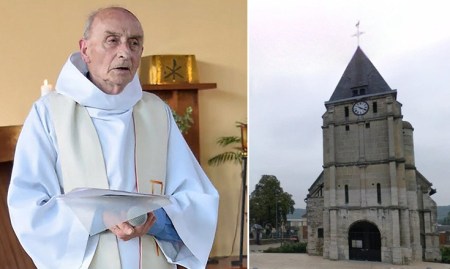
♦ Go around Europe these days: you will find not a single rally to protest the murder of Father Jacques Hamel. The day an 85-year-old priest was killed in a French church, nobody said “We are all Catholics”.

♦ Even Pope Francis, in front of the most important anti-Christian event on Europe’s soil since the Second World War, stood silent and said that Islamists look “for money”. The entire Vatican clergy refused to say the word “Islam”.

♦ Ritually, after each massacre, Europe’s media and politicians repeat the story of “intelligence failures” — a fig leaf to avoid mentioning Islam and its project of the conquest of Europe. It is the conventional code of conduct after any Islamist attack.

♦ Europe looks condemned to a permanent state of siege. But what if, one day, after more bloodshed and attacks in Europe, Europe’s governments begin negotiating, with the mainstream Islamic organizations, the terms of submission of democracies to Islamic sharia law? Cartoons about Mohammed have already disappeared from the European media, and the scapegoating of Israel and the Jews started long time ago. After the attack at the church, the French media decided even to stop publishing photos of the terrorists. This is the brave response to jihad by our mainstream media

Imagine the scene: the morning Catholic mass in the northern French town of Etienne du Rouvray, an almost empty church, three parishioners, two nuns and a very old priest. Knife-wielding ISIS terrorists interrupt the service and slit the throat of Father Jacques Hamel. This heartbreaking scene illuminates the state of Christianity in Europe.

1734Father Jacques Hamel was murdered this week, in the church of St. Étienne-du-Rouvray, by Islamic jihadists.

It happened before. In 1996 seven French monks were slaughtered in Algeria. In 2006, a priest was beheaded in Iraq. In 2016, this horrible Islamic ritual took place in the heart of European Christianity: the Normandy town where Father Hamel was murdered is the location of the trial of Joan of Arc, the heroine of French Christianity.

France had been repeatedly warned: Europe’s Christians will meet the same fate of their Eastern brethren. But France refused to protect either Europe’s Christians or Eastern ones. When, a year ago, the rector of the Great Mosque of Paris, Dalil Boubakeur, suggested transforming empty French churches (like that one in Etienne du Rouvray) into mosques, only a few French intellectuals, led by Alain Finkielkraut and Pascal Bruckner, signed the appeal entitled, “Do not touch my church” (“Touche pas à mon église“) in defense of France’s Christian heritage. Laurent Joffrin, director of the daily newspaper Libération, led a left-wing campaign against the appeal, describing the signers as “decrepit and fascist“.

For years, French socialist mayors have approved, in fact, the demolition of churches or their conversion into mosques (the same goal as ISIS but by different, “peaceful” means). Except in the Saint-Germain-des-Prés quarter of Paris, and in some beautiful areas such as the Avignon Festival, France is experiencing a dramatic crisis of identity.

While the appeal to save France’s churches was being demonized or ignored, the same fate was suffered by endangered Eastern Christian being exterminated by ISIS. “It is no longer possible to ignore this ethnic and cultural cleansing”, reads an appeal signed by the usual combative “Islamophobic” intellectuals, such as Elisabeth Badinter, Jacques Julliard and Michel Onfray. In March, the newspaper Le Figaro accused the government of Manuel Valls of abandoning the Christians threatened with death by ISIS by refusing to grant them visas.

Go around Europe these days: you will find not a single rally to protest the killing of Father Hamel. In January 2015, after the murderous attack on Charlie Hebdo, the French took to the streets to say “Je suis Charlie”. After July 26, 2016, the day an 85-year-old priest was murdered in a church, nobody said “We are all Catholics”. Even Pope Francis, in the face of the most important anti-Christian event on Europe’s soil since the Second World War, stood silent and said that Islamists look “for money“. The entire Vatican clergy refused to write or say the word “Islam”.

Truth is coming from very few writers. “Religions overcome other religions; police can help little if one is not afraid of death.” With these words, six months after the massacre at the magazine Charlie Hebdo, the writer Michel Houellebecq spoke with the Revue des Deux Mondes. Our elite should read it after every massacre before filling up pages on “intelligence failures.”

It is not as if one more French gendarmerie vehicle could have stopped the Islamist who slaughtered 84 people in Nice. Perhaps. Maybe. But that is not the point. Ritually, after each massacre, Europe’s media and politicians repeat the story of “intelligence failures”. In the case of the attack in Etienne du Rouvray, the story is about a terrorist who was placed under surveillance.

The “intelligence failure” theory is a fig leaf to avoid mentioning Islam and its project of the conquest of Europe. It is the conventional code of conduct after any Islamist attack. Then they add: “Retaliation” creates a spiral of violence; you have to work for peace and show good intentions. Then, in two or three weeks, comes the fatal “we deserve it”. For what? For having a religion different from them?

We always hear the same voices, as in some great game of dissimulation and collective disorientation in which no one even knows which enemy to beat. But, after all, is it not much more comforting to talk about “intelligence” instead of the Islamists who try, by terror and sharia, to force the submission of us poor Europeans?

Europe looks condemned to a permanent state of siege. But what if, one day, after more bloodshed and attacks in Europe, Europe’s governments begin negotiating, with the mainstream Islamic organizations, the terms of submission of democracies to Islamic sharia law? Cartoons about Mohammed and the “crime” of blasphemy have already disappeared from the European media, and the scapegoating of Israel and the Jews started long time ago.

After the attack at the church, the French media decided even to stop publishing photos of the terrorists. This is the brave response to jihad by our mainstream media, who also showed lethal signs of cowardice during the Charlie Hebdo crisis.

The only hope today comes from an 85-year-old French priest, who was murdered by Islamists after a simple, noble gesture: he refused to kneel in front of them. Will humiliated and indolent Europe do the same?

A Ramadan Piece: The “Other” Islam

July 5, 2016

A Ramadan Piece: The “Other” Islam, Gatestone InstituteSalim Mansur, July 5, 2016

(A fascinating history of the battle between political Islam and non-political Islam. The battle continues. — DM)

♦ Abrahamic monotheism as represented in Judaism, Christianity, and Islam, precedes and stands apart from politics as an ethical vision that transcends history. It was a vision which invited people to embrace their common humanity as created and gifted by one omnipotent deity, and to follow a revealed code of ethics for righteous living, holding the promise of peace with an end to interminable conflicts that divided people into warring tribes.

♦ Thoughtful Muslims, for nearly a century before the demise of the Ottoman Empire and the abolition of the Caliphate, had been writing about the need for an Islamic reform. Europe’s cultural advancement following the Reformation and Enlightenment held up a mirror for the Islamic world to follow in similar direction to similar ends. There was a consensus among Muslims that Islam was not intrinsically opposed to the modern world, and a readiness to follow in the footsteps of the West.

♦ This is the “other” Islam. This is submission to truth, whose most righteous exemplar was Abraham when his faith was tested by his Deity, according to the Hebrew Bible, to sacrifice his son. And this is the faith of Sufis who took Muhammad’s message to people in places far removed from the desert confines of Arabia. It is simply, as the Qur’an reminds (30:30), deen al-fitrah, the natural religion, or inclination, of man to know his Creator. There is no return of this “other” Islam; it never went missing.

The cover of the January 1976 issue of Commentary magazine announced its main story, “The Return of Islam,” by Bernard Lewis. The year of publication coincided with the coming end of the fourteenth century of Islam, and the anticipation of a new Islamic century beginning in 1979. Forty years later this essay by Lewis, widely recognized and respected as the most eminent scholar on the Middle East and Islam alive today, came to be celebrated as the first warning of the coming upheaval inside the world of Islam.

Lewis’s essay was a corrective to viewing the Middle East and its people, Arabs and Muslims, in terms of Western values. “Modern Western man,” wrote Lewis, “being unable for the most part to assign a dominant and central place to religion in his own affairs, found himself unable to conceive that any other peoples in any other place could have done so… [or to] admit that an entire civilization can have religion as its primary loyalty.” This meant, Lewis continued, the “inability, political, journalistic, and scholarly alike, to recognize the importance of the factor of religion in the current affairs of the Muslim world”.

Recent events have proven that Lewis was correct in pointing to this critical flaw in much of Western understanding of Islam and Muslims. But the title of the essay was unfortunate and misleading; there was no “return of Islam” for Muslims, since at no point in Islamic or Muslim history had Islam been missing, or dormant.

Instead of the “return of Islam,” it was the return of political Islam, or Islamism. Lewis’s essay was a timely review of Muslim history in terms of political Islam. But political Islam is but one facet of Islam. It is a recurring mistake to see political Islam as the defining feature of Islam that obscures Islam’s spiritual dimension, which is more vital than the coarse authoritarian features of political Islam.

In antiquity, politics was inseparable from religion. It might be said that politics was the handmaiden of religion. A ruler among people in ancient times was a chief priest, or a demigod. This feature of the ancient world in which religion and politics were bound together could be described as “theopolitics”, and Islam was as much influenced in its history by theopolitics as were Judaism and Christianity.

Lewis wrote:

“The three major Middle Eastern religions are significantly different in their relations with the state and their attitudes to political power. Judaism was associated with the state and was disentangled from it; its new encounter with the state at the present time raises problems which are still unresolved. Christianity, during the first formative centuries of its existence, was separate from and indeed antagonistic to the state with which it only later became involved. Islam from the lifetime of its founder was the state, and the identity of religion and government is indelibly stamped on the memories and awareness of the faithful from their own sacred writings, history, and experience.”

A lot of history is compressed in this passage, and so some misreading of that history is inevitable. Lewis went on to discuss Islam as being entwined with political Islam since its inception. “Islam was associated with power from the very beginning,” wrote Lewis, “from the first formative years of the Prophet and his immediate successors.” Consequently, in Islam “religion is not, as it is in Christendom, one sector or segment of life, regulating some matters while others are excluded; it is concerned with the whole of life—not a limited but a total jurisdiction.”

The problem with Lewis’s view of Islam is that he uncritically accepted the theology of political Islam. This theology was constructed during the three centuries after the Prophet Muhammad when, in the course of events between the seventh and the tenth century of the Common Era, Arabs came to rule a vast empire. It was consistent with the temper of late antiquity, and it put a stamp on Islam ever since that most Muslims have accepted without questioning.

Abrahamic monotheism as represented in Judaism, Christianity, and Islam, however, precedes and stands apart from politics as an ethical vision that transcends history. It was a vision which invited people to embrace their common humanity as created and gifted by one omnipotent deity, and to follow a revealed code of ethics for righteous living, holding the promise of peace with an end to interminable conflicts that divided people into warring tribes.

It was the resistance of pagans and polytheists to Judaism, Christianity, and Islam at their origins that compelled their early followers in the course of their respective histories to seek in politics protection for their religious beliefs. In Judaism and Islam, the founders — Moses and Muhammad — combined in their personalities the roles of prophet, warrior, and statesman. The life of Jesus, in this respect, was different.

In Moses’s case, he never entered the promised land, and it was left to his successors to eventually found a state for the Jews. In the instance of Muhammad, there is the question that has divided Muslims ever since his death: was his prophetic mission primarily to establish an Islamic state that would define, for Muslims for all times, Islam as the ideal arrangement in which religion and politics were one and indivisible?

The answer to this question was surrounded in controversy right from the moment of the Prophet’s last illness before his death. The controversy over his succession, and what such succession meant, tore apart the immediate followers of the Prophet, and incited tribal warfare, fratricide and schisms that since then have provided the backdrop to Muslims in respect to their own understanding and practice of Islam as religion and politics.

Islam as the Abrahamic vision of man’s relation with God was supplanted by the theology of political Islam. The process began in the midst of the Prophet’s last illness and accelerated with his death. The majority Sunni sect in Islam coalesced around the view that the immediate successors of the Prophet, elected or chosen, ought to be the closest companions of Muhammad, and their rulings in the formative stage of Muslim history became the standard by which subsequent generations of Muslims innovated the requirements of ruling an empire.

Those Muslims who dissented from the majority view represented by Sunni Islam were the Shi’a, or the party of Ali. Ali was a cousin of the Prophet, raised from his childhood in the Prophet’s household and, hence, the closest companion of Muhammad. Ali was also the Prophet’s son-in-law by marriage to Fatima, his only surviving child. The Shi’a Muslims believed Ali was the designated successor of the Prophet because of their familial ties, but he was forcefully denied the succession by those who usurped it immediately following the Prophet’s demise. Shi’a Islam evolved as the main minority sect with its own theopolitics within Islam.

The first Muslims were Arabs of the desert, the Bedouins, among whom Muhammad was born. Their tribalism persisted despite the Prophet’s warnings and it shaped Islam from the first hour of the post-Prophetic history. Sectarianism within Islam was the unavoidable outcome of clan and tribal conflicts among the first Muslims, and the Sunni-Shi’a divide became the main cleavage as a result, setting the template of further divisions as sects proliferated over time in the history of Islam.

Less than a century after the Prophet’s death in 632 C.E., his followers, the Bedouin Arabs, became the rulers of an empire that stretched from the Iberian Peninsula in the West to the Indus River in the East. There was nothing in the Qur’an, or in the traditions of the Prophet, to instruct these Arabs on the mechanics of administrating an empire. They took to imitating the rulers of Persia, whom they defeated, and adopted the administrative manuals of both Byzantine and Persian officialdom to rule the lands and peoples they conquered. And in order to provide legitimacy in the name of Islam to Arab rule in Damascus and later in Baghdad, the ulema(religious scholars) worked out the details of law and society, the Sharia, derived from the Qur’an and the Prophetic traditions.

The origin of Islamic culture and civilization lies in the empire that Bedouin Arabs, through the force of arms, established in a very short period. This was also the origin of political Islam, which came to represent the dominant face of Islam as theopolitics.

The fight that erupted, with the news of the Prophet’s demise, among his closest companions over succession related to temporal power that the Prophet had exercised, and not his role as a Messenger of God (Rasul Allah). This fight culminated in 680 C.E. with the defeat of the Prophet’s grandson, Husayn, killed and decapitated in the field of Kerbala, close to the banks of the Euphrates in Iraq, by the army sent out by Yazid I, the Ummayad Caliph of the rapidly expanding Islamic empire.

The event in Kerbala was a watershed in the history of Islam. Ethnic Arabs, recently converted to Islam, delivered Husayn’s cruel end. Ever since, this crime, as sordid as the crucifixion of Jesus, has stained Muslim history with the mark of Cain.

After Kerbala, it could no longer be said that Islam, as Abrahamic monotheism, guided politics ethically along the path of justice and mercy. Instead, the politics that surfaced upon the death of the Prophet hardened after the killing of Husayn, and politics henceforth came to define Islam as faith, culture, and society.
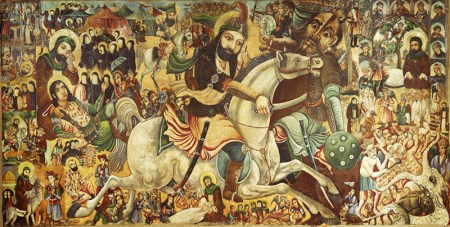
699In the Battle of Kerbala, depicted in Abbas Al-Musavi’s painting, Husayn, the son of Ali and grandson of Muhammad, was killed along with his family and all his followers by the armies of the Umayyad Caliphate. It was the most crucial moment in the split between Shi’a and Sunni Islam. (Image source: Brooklyn Museum)

The Ummayads in Damascus, the imperial capital, were the first dynastic rulers among Arabs in Islamic history. The founder of the dynasty, Muawiyyah, seized power following the murder of Ali, the fourth Caliph and the cousin and son-in-law of the Prophet. With the Ummayads the institution of the Caliphate, which was an innovation to fill the void of leadership among the Arabs in Medina following Muhammad’s death, adopted the pomp and pageantry of the Persian and Byzantine rulers. The Caliphate, from that first century of Islamic history until its abolition in 1924 by Mustafa Kemal Ataturk, the founder of modern Turkey, was the embodiment of Oriental Despotism.

Those Muslims who witnessed the tribal conflicts erupt after the Prophet’s demise and recoiled in revulsion from politics turned inward in seeking union with the divine mystery, as mentioned in the Qur’an. They sought solace in the spiritual dimension of Islam and emulated the Prophetic tradition of withdrawal from the world through prayer and meditation. They became the founders of the Sufi, or mystical, tradition in Islam. This was the “other” face of Islam, distinct from political Islam.

The physical expansion of the Islamic empire was carried forth by the armies of the Caliphs. But the spread of Islam as a faith tradition was a slow process, carried forth by Sufi missionaries belonging to various fraternal orders and independent of political rulers of the world of Islam.

There is a world of difference in conversion brought about at the point of sword of conquering armies, and conversion that results from the communion of hearts and minds among people. The latter is more genuine and transformative than the former in every religion. The Qur’an itself — verse 49:13 — warned the Prophet that the acceptance of Islam by the Arabs of the desert was one of submission in the face of defeat, and that belief had not entered their hearts. This verse might be read as forewarning of crimes Muslims would commit through history in the cause of political Islam, beginning with the killing of Husayn in Kerbala.

Political Islam from its outset was an inquisition. It began with Abu Bakr, the first Caliph, when he subverted the Islamic principle stated in the Qur’an — “there is no compulsion in religion” (2:256) — and declared war on those Arab tribes who withheld their loyalty from him following the death of the Prophet. The “Ridda Wars,” or the “Wars of Apostasy,” launched by Abu Bakr inaugurated political Islam, and since then, the precedent he set for Muslim-on-Muslim violence has plagued Islamic history into our times.

The role of the a’lem (pl. ulema; religious scholars) was instrumental in the making of political Islam. The ulema provided legitimacy to the Ummayad Caliphs in Damascus in the period of intra-tribal conflicts that had led to the killings of the three Caliphs (Umar, Uthman, and Ali) after Abu Bakr and then the massacre in the field of Kerbala.

The consensus of the ulema — accepted by those who eventually came to represent the majority Sunni Muslims (the word “Sunni” derived from Sunna, meaning following the path or tradition of the Prophet) — was that political and social order however provided and maintained was preferable to fitnah (disorder). This consensus provided doctrinal legitimacy to the Caliphs. In return, the Caliphs recognized the special function of the religious scholars and jurists in the drafting, codification, and implementation of Sharia, or Islamic laws.

As a result of this bargain between men wielding swords and men wielding pens, the foundational arrangement of political Islam was firmly established. It was an arrangement consistent with the thinking prevalent in antiquity that religion (deen in Arabic) prescribed the totality of human affairs. This meant, as it was understood by the ulema in the formative period of Islamic history, that the primary function of state and government (dawlat in Arabic) was the establishment of the rule of Sharia. As Ann K.S. Lambton in her study, State and Government in Medieval Islam(1981), observed:

“The law precedes the state and is immutable at all times and under all conditions. The state is there to carry out the law. To disobey a law or to neglect a law is not simply to infringe a rule of the social order: it is an act of religious disobedience, a sin, and as such involves a religious penalty.”

Once the bricks and mortar of political Islam were set in the making of the Islamic civilization, Islam as the official doctrine of the state and empire clearly demarcated the norm as prescribed in the Sharia and made the ulema its official guardians. The Islamic state was a nearly perfect embodiment of a closed totalitarian system designed by men towards the end of the first millennium of the Common Era, and any suggestion of change or adoption of new idea in matters of either religion or politics was condemned as bid’ah (heresy deserving punishment).

But Muslim dissidents who viewed the doctrine of political Islam, or what might also be referred to as “official” Islam, as an aberration, went underground and kept the “other” Islam free from the shackles of politics. Beneath the hardened features of political Islam, the “other” Islam of Sufis provided solace to Muslims by tending to their humanity in the light of God’s most favoured attributes of mercy and compassion.

The “other” Islam, unlike political Islam, is not bound by time and space. It is directed to man’s inner yearnings for that which is eternal. It plunges in search of the inner meaning of the Qur’an as the Word of God, and the assuredness that God’s mercy is not denied to any of His creations. The Qur’an states, “We are nearer to man than his jugular vein” (50:16), reassuring man that he is not alone and God is not some distant uncaring deity.

Whereas the defining characteristic of political Islam was religion inseparable from politics, in “other” Islam politics was the corruption of religion and the dissolution of belief. Hence, from the perspective of “other” Islam, the Sharia as the corpus of Islamic laws codified by the ulema and sanctioned by the Caliphs was a poor, even corrupt, representation of the divine Sharia (in Arabic, a “path”) imprinted in the hearts of all believers as the path to acquiring God’s infinite grace.

ii.

Political Islam and the Islamic civilization it inaugurated was time-bound as a theopolitical system constructed in a certain historical period or context. It was a construct of late antiquity and the early medieval era. Since it was a fixed and closed system, it was invariably given to decay and dissolution.

During the Middle Ages, the Islamic civilization flourished just as other civilizations had. As Abdus Salam (1926-1996) — a physicist of Indo-Pakistani origin and the first Muslim scientist awarded the Nobel Prize for Physics in 1979 — observed in one of his lectures, the world of Islam and the world of Christianity (Europe) were more or less at a similar stage of development around the middle of the seventeenth century.

The evidence of this relative equality of the two civilizations, Salam suggested, could be seen in their technological achievements represented by the two monuments, the Taj Mahal in Agra, India, and St. Paul’s Cathedral in London, England, completed about the same time. Some two decades later, Salam observed,

“there was also created — and this time only in the West — a third monument, a monument still greater in its eventual import for humanity’s future. This was Newton’s Principia, published in 1687.”

Newton’s monument had no counterpart in India, or anywhere else in the Muslim world.

The Renaissance, the Age of Enlightenment and the Scientific Revolution, led by men of astounding intellect from Leonardo da Vinci to Galileo and Newton, propelled Europe out of the medieval age into the making of the modern world. But Islamic civilization, held together by political Islam, descended into a death spiral. A century after Newton published his major work, the Ottoman Empire was turning irreversibly into a pale shadow of a civilization that once had threatened the powers of Europe at the gates of Vienna.

In the aftermath of September 11, 2001 attacks in New York and Washington by the Islamist terrorists of al Qaeda, Bernard Lewis published What Went Wrong? (2002). It was Lewis’s effort to answer why, and how, the world of Islam had failed to accommodate the imperatives of the modern world.

“In most of the arts and sciences of civilization, medieval Europe was a pupil and in a sense a dependent of the Islamic world,” wrote Lewis.

“And then, suddenly, the relationship changed. Even before the Renaissance, Europeans were beginning to make significant progress in the civilized arts. With the advent of the New Learning, they advanced by leaps and bounds, leaving the scientific and technological and eventually the cultural heritage of the Islamic world far behind them.”

The civilizational success of political Islam in late antiquity and the early medieval era ironically carried within it the seeds of its own decline and demise. World War I eventually put an end to the anachronism that the Ottoman Empire had become, and the abolition of the Caliphate was a formal effort to bury political Islam for good.

Thoughtful Muslims, for nearly a century before the demise of the Ottoman Empire and the abolition of the Caliphate, had been thinking and writing about the need for an Islamic reform. Europe’s cultural advancement following the Reformation and Enlightenment held up a mirror for the Islamic world to follow in similar direction to similar ends.

In India under British rule, for instance, there were a significant number of Muslims who painfully recognized the malaise of Islamic societies and offered remedy for their advancement into the modern world. Among them the notable were Sir Sayyid Ahmad Khan (1817-98), the founder of the Aligarh University; Syed Ameer Ali (1849-1928), jurist and historian; and Muhammad Iqbal (1877-1938), poet and philosopher.

One of the most important works was published in 1925 by Ali Abd al-Raziq (1888-1966), an Egyptian scholar and jurist at Al-Azhar University in Cairo. In his seminal work, titled al-Islam wa ‘Usul al-Hukm (Islam and the Fundamentals of Authority), al-Raziq pointed out that there was no basis in the Qur’an and the Sunnah (traditions) of the Prophet for the institution of the Caliphate.

Al-Raziq was not someone from outside the ranks of the ulema, or a lay scholar unfamiliar with the intricacies of Islamic jurisprudence and theology in the construction of Sharia. He was a student of Muhammad Abduh (1849-1905) at al-Azhar, when Abduh had been appointed the Grand Mufti of Egypt.

Al-Raziq’s main contention was based on the distinction between spiritual and temporal authority. He indicated that the confusion among Muslims in the period after the Prophet arose from their inability to distinguish between the Apostolic role of Muhammad and the authority he derived as the Messenger of God (Rasul Allah), and the Caliphate as a temporal institution. Al Raziq wrote:

“Muhammad was but an apostle, sent on behalf of a religious summons, one pertaining entirely to religion and unmarred by any taint of monarchy or of summons to a political state; and he possessed neither kingly rule nor government, and he was not charged with the task of founding a kingdom in the political sense, as this word and its synonyms are generally understood.”

Al-Raziq was denounced by his peers. He was made to appear before the Council of the Greatest Ulema of Al-Azhar to hear the judgment against him, as his license to teach and practice law was revoked. Egypt was then ruled under Britain’s supervision, which likely saved al-Raziq from even more severe punishment.

But al-Raziq had stripped away the argument of traditional Islam on the sanctity of the Caliphate, and with it went the idea of Sharia being sacred. In the half-century following the abolition of the Caliphate by Mustafa Kemal, Muslims under European rule gained their independence as new states emerged in the Middle East and elsewhere in the world of Islam.

This period in the middle decades of the last century was a period of intense expectations on the part of Muslims for progress in their living conditions. A massive effort was invested to make the transition from the world of pre-Newtonian knowledge and learning to the modern world of science, industry and democracy.

There was a consensus among the rich and the poor that Islam was not intrinsically opposed to the modern world. There was a readiness among Muslims to follow in the footsteps of the West.

This consensus was reflected in a well-known and widely circulated aphorism attributed to Muhammad Abduh. On returning to Cairo from a visit to Europe, Abduh told his students, “I travelled in the West and found Islam, but no Muslims; I have returned to the East and find Muslims, but not Islam.”

The transition into the modern world, however, proved immensely complex and difficult. Europe’s transition had required several generations and a couple of centuries to break away from the feudal age into the modern age. The resistance from those invested in the ancien arrangements of society and culture was immense, and wars that followed were fierce.

Something similar to the European experience was unavoidable for Muslims in their effort to break from the hold of their traditional culture. And not unlike the wars in Europe, wars within the world of Islam since the 1970s are symptoms of the Muslim struggle to transit into the modern world.

iii.

The abolition of the Caliphate in 1924 was the formal announcement of political Islam’s death. But it refused to die, even as it was laid to rest. Its twitching was felt in the deep dark interior of the world of Islam, in remote and unwelcome places such as Nejd inside Arabia.

Here in Nejd, the medieval theology of Ibn Taymiyyah had struck roots. It had impressed an eighteenth-century itinerant preacher in the region, Abdul Wahhab (1703-92), who turned Ibn Taymiyyah’s extremist thinking into an even more rigid and austere doctrine, hostile to all things inimical to the Bedouin tribal culture of his time and environment.

Abdul Wahhab’s version of political Islam impressed a local tribal chief, and the marriage of convenience between the preacher and the tribal leader gave birth to the first Saudi state in the interior of Arabia. But when it sent tribal warriors to raid towns inside the frontiers of the Ottoman Empire, it provoked the Caliph of Islam in Istanbul, on whose orders this nascent state of the Wahhabi ruler was destroyed.

But the eventual collapse of the Ottoman Empire provided the conditions for the rebirth of the Saudi state as a kingdom under Abdul Aziz ibn Saud in the 1920s. Fortune, in the guise of great power politics, smiled upon him. He seized the support offered by the British, in return for influence in a region of strategic importance. The discovery of oil made the Saudi kingdom a prize to be protected by the Western powers, first Britain and later the United States, with far reaching consequences for the rest of the world, and even more so for the world of Islam and Muslims.

Any modernizing revolution is hugely disruptive. The movement from one stage of social development to another is not linear; it is, instead, filled with zigzags and reversals at every stage of the process toward an uncertain future.

When a people, however, pushes back against this process of change in their midst, or seeks to abort it, this reactionary effort pins its hopes on longing for an idealized past. The Newtonian revolution and the emergence of modern Europe made political Islam anachronistic. Wahhabism, as the official doctrine of the Saudi kingdom, was much more than a return of the most extreme version of political Islam in the early decades of the last century. It was, and remains, a demented effort of the most backward people within the world of Islam to remain culturally tied to antiquity, or jahiliyya (the age of ignorance), which Islam at its origin derided and rejected.

Political Islam in whatever version — Wahhabism, Khomeinism, Ikhwanism (the Muslim Brotherhood) and their derivatives — has no answer for Muslims on how to make their historic transition into the modern world. It can continue to rage against the modern world until its civilized inhabitants, including Muslims, have had enough of its destructiveness and obliterate it.

Then that vision of Abrahamic monotheism, which Muhammad was mysteriously directed to deliver to his people, will be emancipated from political Islam.

This message Muhammad was given admonished Arabs for their lack of faith, provided them with ethics for living honorably, told them in no uncertain term that the God of Abraham made no distinction among nations and people who believe in Him, and that on the Day of Final Reckoning, they need have no fear if they strive in doing what is right.

This is the “other” Islam. This is submission to truth, whose most righteous exemplar was Abraham when his faith was tested by his Deity, according to the Hebrew Bible, to sacrifice his son. And this is the faith of Sufis who took Muhammad’s message to people in places far removed from the desert confines of Arabia. It is simply, as the Qur’an reminds (30:30), deen al-fitrah, the natural religion, or inclination, of man to know his Creator. There is no return of this “other” Islam; it never went missing.
The Imam Celebrated by the Church of Sweden: “The Jews are Behind the Islamic State!”

June 29, 2016

The Imam Celebrated by the Church of Sweden: “The Jews are Behind the Islamic State!” Gatestone InstituteIngrid Carlqvist, June 29, 2016

♦ Priests are afraid to talk about Jesus during mass. — Eva Hamberg, priest and professor, who in protest resigned from the priesthood and left the Church.

♦ The Church of Sweden may be headed towards “Chrislam” — a merging of Christianity and Islam. Swedish priests, noting the religious fervor among the Muslims now living in Sweden, enthusiastically take part in various interfaith projects

♦ “There are reliable sources from Egypt, showing that the Saudi royal family is really a Jewish family that came from Iraq to the Arabian Peninsula sometime in the 1700s. They built an army with the aid of British officers fighting the Ottoman sultanate.” — Imam Awad Olwan, with whom a priest, Henrik Larsson, is cooperating in an interfaith project.

♦ “The involvement that the Church of Sweden has shown for the vulnerability of Christian Palestinians, has been replaced with indifference to the ethnic cleansing of Christians in Syria and Iraq. In these countries, it is mostly Muslims who commit the atrocities, which is evidently enough to make the Church of Sweden concentrate on climate change and environmental issues instead.” — Eli Göndör, scholar of religion.

The Church of Sweden has departed from being a strong and stern state church. In the past, Swedes were born into it and, until 1951, no one was allowed to leave the church. These days, however, it is an institution that has very little to do with Christianity or Jesus. Sweden now, according to the World Values Survey, is one of the world’s most secular countries; every year a large number of Swedes leave the church.

It used to be that only atheists left the church; now it is the devout Christians that leave — in protest against the church’s increasingly questionable relationship to the Christian faith.

When, for example, the current Archbishop, Antje Jackelén, just before being appointed, participated in a question-and-answer session in the fall of 2013, and one of the questions was: “Does Jesus convey a more truthful image of God than Muhammad does?” surprisingly, the would-be archbishop did not immediately say yes, but instead involved herself in a long monologue about there being many ways to God. Evidently, this upset a lot of parishioners. A high-profile priest and professor, Eva Hamberg, resigned from the priesthood in protest and left the Church of Sweden.

“This made me leave faster,” she told the Christian newspaper, Dagen. “If the future Archbishop cannot stand by the Apostles’ Creed, but rather, rationalizes it, then secularization has gone too far.”

Hamberg, who has conducted research on the secularization process, said that in Sweden, secularization has escalated ever faster — even within the Church of Sweden. As an example, Hamberg said that Antje Jackelén does not believe in Immaculate Conception, but says it is a metaphor. Hamberg also said that there is a lack of reverence before the Triune God, and that the priests are afraid to talk about Jesus during mass.

“There is also a clear lack of tolerance within the Church of Sweden. The candidates [for the position of archbishop] were all very keen to talk about dialogue, and that sounds great, but it is all just empty phrases. The church leaders, in fact, persecute dissidents. If you do not agree with the ordination of women, you will not get ordained. The ceiling is incredibly low.”

When Antje Jackelén won the election and became Sweden’s first female Archbishop, it was time for the next shock. As her motto, she chose “God is Greater” — “Allahu Akbar” in Arabic. Jackelén referred to 1 John 3:19-21, which says:

“This is how we know that we belong to the truth and how we set our hearts at rest in his presence: If our hearts condemn us, we know that God is greater than our hearts, and he knows everything.”

However, few believe the choice of motto is anything other than an open flirt with the Muslims of Sweden. In Islam, “Allahu Akbar” are the first words heard in every call to prayer, from every minaret around the world, and it is the cry we hear time and again in connection with Islamist suicide bombings, decapitations of non-Muslims, and terrorist attacks.

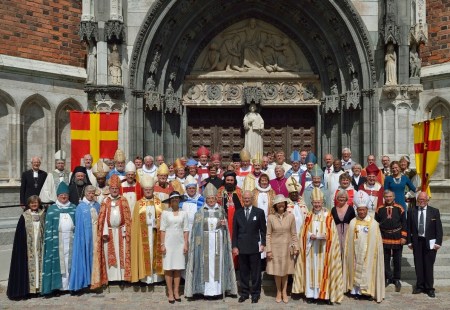
1448The King, Queen and Crown Princess of Sweden attend the archiepiscopal ordination of Bishop Antje Jackelén at Uppsala Cathedral, June 15, 2014. (Image source: Church of Sweden)

Archbishop Jackelén’s choice of a motto was not an exception; merely the most visible sign that the Church of Sweden may be headed towards “Chrislam” — a merging of Christianity and Islam. Swedish priests, noting the religious fervor among the Muslims now living in Sweden, enthusiastically take part in various interreligious projects. Last year, Stockholm’s Bishop, Eva Brunne, suggested removing the cross from the Seamen’s Church, enabling Muslims to pray there.

Gatestone Institute called her closest associate, Diocesan Priest Bo Larsson, to ask about this proposal.

Gatestone: Can the Christians in Muslim countries expect the same service in mosques?

Bo Larsson: “No, I don’t think so. To Muslims, the buildings have such a holy dignity.”

Gatestone: But not to Swedes?

Bo Larsson: “Apparently not. But there are already many mosques in Sweden.”

Gatestone: So why the need to pray in the Seamen’s Church?

Bo Larsson: “You know, it was just a suggestion. Many people on social media got it into their heads that this means Brunne is no longer a Christian, but that is not true of course.”

Gatestone: So we Christians should show Muslims respect, even though they do not respect us?

Bo Larsson: “I think so. That is my opinion. I have been a priest for 40 years. We are still the largest church in Sweden, and so we must provide opportunities for Muslims and Jews.”

Gatestone: “Are you sayingIf you cannot beat them, join them?'”

Bo Larsson “That is one way to look at it.”

Gatestone: The Church of Sweden is known for its positive attitude towards homosexuals. Your own bishop, Eva Brunne, is openly gay. Yet you support Islam, which persecutes homosexuals?

Bo Larsson: “That is a difficult question to answer. But sure, it is terrible that gay people do not have any rights in Muslim countries and cannot live openly. Terrible.”

Gatestone: And you still want to support this religion?

Bo Larsson: “There are Christians who are opposed to homosexuality, too, you know.”

Gatestone: Who want to hang gays?

Bo Larsson: “No, maybe not. But I think you’re oversimplifying. What we want in Sweden is a dialogue with the Muslim people.”

Gatestone: Have you discussed homosexuality with Muslims?

Bo Larsson: “No.”

Gatestone: Do you think you can change Islam in Sweden into a tolerant, open-minded religion?

Bo Larsson: “There are fundamentalist Christians in the United States who do not accept homosexuals.”

Gatestone: But do you think there is a difference between not accepting and wanting to kill?

Bo Larsson: “I have never heard a Muslim say he wants to kill homosexuals.”

“Chrislam” has gone farthest in the immigrant-heavy Stockholm suburb of Fisksätra, in which 8,000 people, speaking 100 different languages live. There, the Church of Sweden is now raising money to build a mosque — a project named “House of God” — next to the existing church. This is how the project is described on its official website:

“The House of God represents a desire for peace, and real work in the spirit of peace. We are building a mosque adjacent to the existing church in Fisksätra. Between the church and the mosque, a glass enclosed, joint indoor square will be built. The House of God is unique, and an example of the cooperation and religious dialogue that is so important in our time. Come join our work!”

Gatestone called Henrik Larsson, a priest and one of the founders of the House of God project. He assured us that Islam is peaceful and democratic, but then gave some other answers indicating that he may not be so enthralled by this religion after all.

“We Christians have also done some horrible things over the centuries,” he said. ” We have burned witches, we have colonized other countries, and sided with different armies throughout our history. I think all religions can be used in a similar way.”

Gatestone: Are you saying that we live in 2016, and that they are still stuck in the 1400s?

H. Larsson: “If that. They are striving towards creating a society like the one that existed right after the Prophet Muhammad’s death, and that means we are talking 600s, 700s and 800s. That is their ideal. But there is also an Islam searching for new ways, a European Islam, those who want to try to be Muslims within the democratic and secular society.”

Gatestone: Many Muslims in Sweden seem not to want to adapt to Swedish culture. Look at all the rapes and sexual assaults at public swimming pools.

H. Larsson: “Yes, it is not easy for Afghan boys who have grown up in a society where women have to throw a sheet over themselves before leaving the house; of course they are marinated in an attitude towards women miles away from ours. Of course they should not be allowed to do that, but it is no wonder that there are conflicts. But they need to learn how we see men and women here in Sweden.”

Henrik Larsson celebrates the imam with whom he is cooperating in the “House of God.” His name is Awad Olwan, a Palestinian who came to Sweden in the 1960s. According to Henrik Larsson, Olwan is a modern Muslim, who became an imam late in life and likes democracy.

But when Gatestone called Olwan, to ask why he supported the Popular Front for the Liberation of Palestine (PFLP) in the 1970s and refused to denounce the Munich massacre at the 1972 Olympic Games, he at first pretended not to know what the PFLP was. The BBC has described it as “Combining Arab nationalism with Marxist-Leninist ideology, the PFLP saw the destruction of Israel as integral to its struggle to remove Western capitalism from the Middle East.”

Olwan: “Oh, well, yes, we had a lot of different organizations back then, but forget that — that is history now. It meant Palestine Liberation something. I really do not remember to be quite honest.”

Gatestone: You refused to denounce the attack on the Jewish Olympians in Munich?

Olwan: “Yes, that’s right, but that was in the 70s! I don’t remember what I said then.”

Gatestone: Is your attitude different now?

Olwan: “Yes, of course. It was murder and nothing else.”

During our first conversation, Awad Olwan claimed to be very positive towards Jews. He said that there are no Jews in the House of God is simply because there is no Jewish congregation in Fisksätra, but that the organizers have invited a Jewish choir and are cooperating very well with them.

During our second talk, however, other thoughts emerged. When Olwan was asked some questions about the Quran and the hadith, he began cursing and saying that everything was the fault of “those f**king Mecca-Arabs.”

Gatestone: Are you saying Islam is not the problem; that it is the Saudi interpretation of Islam that messes everything up?

Olwan: “Exactly! And their religion [Wahhabism] was invented by a British imperialist 200 years ago. I cannot say anything more, because then I am an anti-Semite and whatnot.”

Gatestone: What is the truth about the Jews?

Olwan: “Okay, there are reliable sources from Egypt, showing that the Saudi royal family is really a Jewish family that came from Iraq to the Arabian Peninsula sometime in the 1700s. They built an army with the aid of British officers fighting the Ottoman sultanate. After that, they created the Jordanian army and so on and so on.”

Gatestone: Are you saying this is the reason the Jews are so quiet?

Olwan: “Yes. I wrote in my book that the purpose of ISIS/Daesh is to shift the focus from the Arab-Israeli conflict, and make this a conflict between Sunni and Shia — and they have succeeded. And now, they will erase the entire Middle East. You will see! It is Catholic land, Muslim land and a lot of other crap countries just to justify the existence of a Jewish state.”

Gatestone: I read online that many believe it was Mossad and the Jews who started ISIS?

Olwan: “Yes, that is a common theory in the Middle East, but if you say that in the West, you are told that you are a conspiracy nut and that you have no evidence. But here’s the deal: You cannot wage war against strong forces without having weapons delivered every day, you need planning and logistics. These are not f**king terrorists who have learned how to wage war on the internet, these are highly trained, highly skilled people. I have to go now.”

Gatestone: Are you referring to the Jews?

Olwan: “Exactly, exactly.”

Olwan is most likely a typical example of an imam who shows a conciliatory and friendly attitude towards naïve Swedish priests, but with a bit of encouragement, admits his hatred of Jews. He is, it seems, not too fond of the Church of Sweden’s friendly attitude towards gays, either.

Since the Church of Sweden became one of the first Christian communions in the world to approve gay marriage in 2005, more and more priests have come out as gay. In 2009, when Eva Brunne was appointed bishop of Stockholm, tongues wagged that the church is now being ruled by the “Lesbian League.” The Church of Sweden has participated in the Pride Festivals in Stockholm on many occasions, and several churches have allowed themselves be LGBT-certified. The price for this may be that the church will be forced to cut certain passages from Bible. Ulrika Westerlund, the chairperson for the RFSL (Swedish Federation for Lesbian, Gay, Bisexual, Transgender and Queer Rights), has warned the church: “There are elements in religious scriptures that are used against LGBT persons. Then we have to discuss if you want this certification, we do not want you to quote these passages from the Bible.”

Henrik Larsson, the priest, sees a problem with imams constantly condemning homosexuality as a sin — an Islamic tenet that presumably can never change because Allah said it [Quran,7:80-84.IG]. “We have to hope they catch up with us there. It was not so long ago that Christianity preached the same things.”

Gatestone: Do you hope and believe that Muslims can change, even though some hurl homosexuals from rooftops, hang them and flog them?

H. Larsson: “Yes, it is awful. But I believe that people are innately good at heart.”

Awad Olwan does not agree with Henrik Larsson. He thinks the Church of Sweden’s attitude towards homosexuality is a great sin:

“I disagree with them. Homosexuality is not good for the morals of society, and it is not what Jesus and Moses stood for. It is better if the whole thing with homosexuality in public life becomes a parenthesis.”

In the meantime, as the Church of Sweden is busy developing “Chrislam,” it never acknowledges that in the Middle East, Christians are being killed and effectively eradicated. In 2015, Eli Göndör, a scholar of religion, wrote in the magazine Dagens Samhälle:

“The involvement that the Church of Sweden has shown for the vulnerability of Christian Palestinians, has been replaced with indifference to the ethnic cleansing of Christians in Syria and Iraq. In these countries, it is mostly Muslims who commit the atrocities, which is evidently enough to make the Church of Sweden concentrate on climate change and environmental issues instead.”

To be fair, in February 2016, the Church of Sweden did do something for the Christians of the Middle East — it encouraged congregations and individuals to pray for them. The words Islam or Muslims were not mentioned in the appeal.

Gatestone called the Church of Sweden’s information service, to ask if the prayers had helped.

“I cannot answer that,” the voice on the phone said. “Can you send an e-mail with your question, and I’ll ask my colleagues to get you a reply?”

Orlando Shooting: Pickled in Hatred

June 13, 2016

Orlando Shooting: Pickled in Hatred, Gatestone InstituteShoshana Bryen, June 13, 2016

♦ The terrorists are pickled in hatred that simply does not allow for the humanity of “the other” and insists that individuals exist only as representations of religions, objects, and social or political points of view.

♦ The American homeland — free speech, religious institutions, open inquiry in academia, our military and our way of life — is under attack.

♦ America’s blessing is a political system built on tolerance of “the other.” Not all of us, not all the time — remember, we used to buy and sell our fellow human beings — but the principle to which we aspire is tolerance of “the other.”

♦ But our national blind spot is not seeing that we share this lovely space with people who want to kill us for the peculiar people we are.

It is a lot to process. Omar Mateen, the American-born son of Afghan parents, murdered 50 people and wounded scores of others in a gay nightclub Sunday. The first surprise is that it was not a surprise, especially to the FBI. Mateen was the subject of investigations in 2013 and 2014. “He was a known quantity,” a source said. “He has been on the radar before.” But Assistant Special Agent Ronald Hopper told reporters, “Those interviews turned out to be inconclusive, so there was nothing to keep the investigation going.”

Omar Mateen’s father probably wasn’t terribly surprised. He told NBC News “that his son became angry after seeing two men kissing a few months ago in Miami.” He speculated that could have triggered his decision to kill. “This has nothing to do with religion,” his father added.

President Obama was not exactly surprised, given, he said, the number of guns in America. He called again for gun control and said there was, “no definitive judgment on the precise motivations” of the terrorist.

Oh really?

President Obama’s response might have been a surprise to local police, who, according to CNN, received a 911 call from Mateen pledging his allegiance to ISIS just before the attack. Whether he was actually with ISIS or not, the Islamic State wasted no time blessing him as one of their own.

1647Omar Mateen (left), the American-born son of Afghan parents, murdered 50 people and wounded scores of others in a gay nightclub in Orlando, Florida, on May 12, 2016. Mateen pledged his allegiance to the Islamic State just before the attack.

So where do Americans go with this?

First, pray for the victims and their families, and thank the first responders.

Second, do not bother trying to “explain” terrorists, or figure out their “motivation.” They are pickled in hatred that simply does not allow for the humanity of “the other” and insists that individuals exist only as representations of religions, objects, and social or political points of view. There is no other way to explain Shalhevet Pass, a six-month old baby shot in her stroller by a sniper, or Malki Roth murdered while eating pizza, or the Fogel children murdered in their beds. There is also no other way to explain shootings at Max Brenner in Tel Aviv or stabbings in Jerusalem; Hamas rockets fired indiscriminately into Israeli towns; gay men thrown off buildings by ISIS in Iraq or dragged behind motorcycles in Gaza; barrel bombs and chlorine gas dropped on civilians by Assad’s Syrian forces; the kidnapping and forcible conversion to Islam of girls by Boko Haram; the sale of Yazidi women and girls as sex slaves by ISIS; and the skinning alive of prisoners by the Taliban. They are all of a piece.

Third, recognize that the same hatreds exist in our country. We imported them — already pickled — and we pickled some of them here. What Mateen’s father said was that seeing what he found unacceptable — men kissing — was enough to make his son kill. Maybe. Maybe not. Either way, what do we need to do about people willing to kill us under those circumstances?

The Heritage Foundation maintains an extremely useful timeline of terrorist plots in the US. It includes the “shoe bomber” (2002), the “underwear bomber” (2010), the Times Square bomber (2010), the Boston Marathon bombers (2013), and the San Bernardino shooters (2015). But there’s more. Here is sampling from a Jewish Policy Center analysis:

[T]here were also plots against U.S. landmarks and institutions including the NY Subway system (2005 & 09), Sears Tower (2006), the Brooklyn Bridge (2003), the Long Island Railroad (2009), DC Metro (2010), the Federal Reserve in Manhattan (2012), the Capitol (2011, 12 & 15), World Bank Headquarters (2005), JFK airport (2009), the NY Stock Exchange (2004), and the GOP convention (2004).There were plots against American service personnel, including military hit lists (2010 & 15); Ft. Hood (2009); Ft. Riley (2015); Ft. Dix (2007) and Ft. Myers (2011); recruiting stations in Arkansas (2009), Maryland (2011) and Washington (2011); the Pentagon (2011); Quantico Marine Base (2009); National Guard facilities (2005, 08 & 09); U.S. Marshals (2013); and the NYPD (2015). There were plots against the ambassadors of Saudi Arabia (2011) and Pakistan (2004), and the Israeli Embassy (2011).

There were assassination plots against Presidents Bush (2003) and Obama (2011).

There were regional attacks planned for a Chicago Bar (2012), NY and Chicago-area synagogues (2009 & 10), an Oregon Christmas tree ceremony (2010), the Wichita Airport (2014), a Canada-NY train (2013), a Dallas skyscraper (2009), a Wyoming refinery (2006), the Florida Keys (2015), shopping centers in Ohio (2003) and Illinois (2007), and the University of North Carolina (2006). The Lackawanna (PA) Six (2002), the Lodi (CA) jihad training camp (2005), and the VA Jihad Network (2003) operated along with smaller-scale plots in support of al Qaeda (2002, 09 & 10).

The American homeland — free speech, religious institutions, open inquiry in academia, our military and our way of life — is under attack.

America’s blessing is a political system built on tolerance of “the other.” Not all of us, not all the time — remember that we used to buy and sell our fellow human beings — but the principle to which we aspire is tolerance of “the other.” America’s glory is men and women who run into danger while everyone else is running out — without regard for the particulars of who they are saving. It was true on 9-11 and it was true this weekend in Orlando. But our national blind spot is not seeing that we share this lovely space with people who want to kill us for the peculiar people we are.

Top Dem Recognizes Christian ISIS Genocide, Won’t Take Christian Refugees

June 9, 2016

Top Dem Recognizes Christian ISIS Genocide, Won’t Take Christian Refugees, Front Page Magazine, Daniel Greenfield

Muslim privilege

The Democrats are championing the entry of huge numbers of Muslim refugees. Yet they continue to show no regard for the Christian refugees who unlike Muslims are actual refugees targeted for genocide and with no local countries of their own.

This is another example of the same double standard.

House Minority Whip Steny Hoyer (D-Md.), who voted for a resolution recognizing that the Islamic State in Iraq and the Levant (ISIL) is committing genocide against Christians in Syria, said he did not think Syrians should be given refugee status based on their religion.

At press briefing on Capitol Hill, CNSNews.com asked Rep. Hoyer: “You voted for the resolution stating ISIL is committing genocide against Christians in Syria. Yet, of the more than 1,000 refugees the U.S. admitted from Syria in May, only 2 were Christian and the rest were Muslims. What specifically are you proposing to help Christians seeking to escape ISIL’s genocide?”

Hoyer answered: “Well, I don’t think the criteria ought to be on religion, contrary to Mr. Trump. Criteria ought to be on their–first of all, I think we need to take more people who are fleeing for their safety–the safety of themselves and their families and we ought to apply fair criteria. Certainly not based upon religion.”

But those most in danger are Christians. And in fact we already recognize religion as a basis for refugee status. This isn’t something Trump invented. People facing religious persecution apply for asylum all the time. The problem is that Obama and his cohorts insist on taking a vast majority of Muslim migrants over Christian refugees. And Hoyer is pretending that there is no such thing as religious asylum.

REPORT: Migrants Burn Down Asylum Centre After Not Receiving Ramadan Wake Up Call

June 9, 2016

REPORT: Migrants Burn Down Asylum Centre After Not Receiving Ramadan Wake Up Call, Breitbart Oliver JJ Lane, June 8, 2016

(The most interesting part of the article begins after the third photo. — DM)

Refugee center burnedDPA / Getty

While migrants are commonly employed as security, staff, and translators in migrant camps across Germany, a move which helps the authorities with breaking down language barriers with their hundreds of thousands of guests, it brings a whole set of problems. As migrants import sectarian and racial conflict, placing one group of migrants in a position of power and authority over others has led to widespread abuses and violence.

Breitbart London has reported on the problem of migrant guards, who often lack basic qualifications and any sort of oversight by government agencies as they are employed and run by private contractors. One under-addressed expression of this problem is the attacks and discrimination against Christian refugees by Turkish heritage and Arab migrant guards.

***************************

A massive fire at Düsseldorf’s major international trade fair grounds yesterday has been followed by reports that the blaze was set deliberately by migrants who were angry because of Ramadan.

Officially, some 160 migrants were resident at hall 18 of the Messe Düsseldorf conference centre, but it was a facility plagued by racial conflict which had seen violence spark before. Düsseldorf’s Express newspaper reports these conflicts were not between European German staff and their guests, but between the predominantly Arab residents, and a minority of Afghans who sided with the security staff running the facility — who were mainly Iranian.

According to the testimony of “several burly Moroccan refugees” which the paper had spoken to even as the hall burnt down, the Iranians employed by the German state to look after other migrants from around the world had “deliberately” not woken the Arabs up in time for their Ramadan breakfast following a long run dispute.

Just three weeks ago there had been another, much smaller fire at the exhibition centre as a migrant set fire to his mattress in protest against the accommodation.

Refugee centerFire department spokesmen described the 5,000-sq-ft exhibition hall, normally used for storage for exhibitors, as a “total loss” / Getty / DPA

Under Islamic tradition, during the ninth month of the Islamic calendar the faithful enter a fast between sunrise and sunset in commemoration of Muhammed. In practice this means sleeping-in leaves the Muslim without food until sunset around half-past-nine at night.

The migrants who witnessed the fire being set, some of which even proudly recorded the moment on their mobile phones said the blaze was started “because we just want to get out of here”, away from their Iranian guards.

Breitbart London reported on the fire as it happened yesterday, with reports of as many as 280 migrants being evacuated from the site, which lies directly next to Düsseldorf’s international airport. Approximately 30 migrants were treated for smoke inhalation, and one of the 70 fire-fighters who turned out to tackle the arson blaze was hospitalised due to heat exhaustion.

There were initially two arrests of migrants that were found at the scene boasting about setting the fire, but this number later rose to six. The men arrested are reported to have been citizens of Morocco, Algeria, Syria and Iraq.

DusseldorfHall 18 burns yesterday / Twitter.com/humansinking

While migrants are commonly employed as security, staff, and translators in migrant camps across Germany, a move which helps the authorities with breaking down language barriers with their hundreds of thousands of guests, it brings a whole set of problems. As migrants import sectarian and racial conflict, placing one group of migrants in a position of power and authority over others has led to widespread abuses and violence.

Breitbart London has reported on the problem of migrant guards, who often lack basic qualifications and any sort of oversight by government agencies as they are employed and run by private contractors. One under-addressed expression of this problem is the attacks and discrimination against Christian refugees by Turkish heritage and Arab migrant guards.

Severe beatings are the order of the day for many Christian migrants in the care of the German state, who have given uniforms and authority to the exact people they fled the Middle East from in the first place. The hospital report of one Christian who was beaten near to death by “Turkish and Arab descent” guards read: “Skull contusion, monocular hematoma right stump chest trauma, blunt abdominal trauma history.

“Patient was today beaten by four security people since a massive headache and pain in the abdomen patient was brought to the A&E”.

Another Christian said: “[the guards] accused me of insulting Islam, beat me to the ground, and kicked me in the face”. A German priest witnessed security guards who caught two Iranians reading the bible in their migrant accommodation. He recalled: “The guards ran into the room shouting ‘the Bible is haram!’, pushed them both against the wall, while punching and kicking them”.

The priest lamented of the situation: “My impression is that now anyone who has a particular muscle circumference and speaks Arabic, will be hired”.

The Pope and the Imam

June 7, 2016

The Pope and the Imam via YouTube, June 7, 2016

The blurb beneath the video states,

Pope Francis met with a high level imam in order to spread peace and co-existence. The Pope is willing to ignore 1400 years of jihad against Christians to talk about peace. But peace in Islam only comes after submission. Co-existence in Islam comes when the Kafir becomes a dhimmi and accepts Sharia law.

The last Pope to talk about the history of Islamic murder of Christians caused Muslims to riot and kill.

This Pope calls terrorism the problem, not jihad. He also uses the phony phrase “true Islam” as if jihad is not true Islam. The shop-worn word “extremist” is used to divorce the doctrine of Islam from reality of current events and history.

The imam spoke the only word of truth: “We should not treat Muslims as a terrorist threat.” The threat is not Muslims; the threat is the doctrine of political Islam.

The Pope also brought home Muslim migrants, not Christian refugees from Islamic persecution. The Pope, Christians and everybody else ignore the suffering of Christians.

The Pope is no different from the ignorant Protestants and Jews. Ignorance is the problem, ignorance of the political nature of Islam.

Obama’s Refugee Policy: Yes to Potential Terrorists, No to Victims of Genocide

June 5, 2016

Obama’s Refugee Policy: Yes to Potential Terrorists, No to Victims of Genocide, Gatestone InstituteRaymond Ibrahim, June 5, 2016

(Please see also, No Refuge for the Victims of Jihadist Genocide. — DM)

♦ “Without doubt, Syrians of all confessions are being victimized by this savage war and are facing unimaginable suffering. But only Christians and other religious minorities are the deliberate targets of systematic persecution and genocide.” — U.S. Senator Tom Cotton, March 17, 1016.

♦ Christians account for 10% of Syria’s total population — yet they account for less than 0.5% of the refugees received into America. Sunni Muslims are 74% of Syria’s population — yet 99% of those received into America. In other words, there should be 20 times more Christians and about one-quarter fewer Sunnis granted refugee status than there already have been.

♦ ISIS is “taking advantage of the torrent of migrants to insert operatives into that flow.” — James Clapper, Director of National Intelligence.

♦ Although the U.N. and U.S. know that Sunni refugees are terrorizing Christians in their camps, they abandon the true victims who deserve sanctuary in the West, while “humanitarianly” taking in their persecutors.

The Obama administration has been escalating a policy that both abandons Mideast Christians and exposes Americans to the jihad.

Late last year it was revealed that 97% of Syrian refugees accepted into the U.S. were Sunni Muslims — the same Islamic sect to which the Islamic State belongs— while fewer than half-a-percent were Christians.

This disparity has since gotten worse. From May 1 to May 23, 499 Syrian refugees — a number that exceeds the total number of refugees admitted during the last three years — were received into the United States. Zero Christians were among them; 99 percent were Sunni (the remaining one percent was simply listed as “Muslim”).

These numbers are troubling.

First, from a strictly humanitarian point of view — and humanitarian reasons are the chief reason being cited in accepting refugees — Christians should receive priority simply because currently they are among the most persecuted groups in the Middle East. Along with the Yazidis, Christians are experiencing genocide at the hands of ISIS, as the State Department recently determined. The Islamic State has repeatedly forced Christians to renounce Christ or die; has enslaved and raped them, and desecrated or destroyed more than 400 of their churches.

As Sen. Tom Cotton (R-Ark.) put it this March, “Without doubt, Syrians of all confessions are being victimized by this savage war and are facing unimaginable suffering. But only Christians and other religious minorities are the deliberate targets of systematic persecution and genocide.”

Sunni Muslims are not being slaughtered, beheaded, and raped for refusing to renounce their faith; they are not having their mosques burned, nor are they being jailed and killed for apostasy, blasphemy, or proselytization. On the contrary, non-ISIS affiliated Sunnis are responsible for committing dozens of such atrocities against Christian minorities every single month all throughout the Islamic world.[1]

Unsurprisingly, many Sunnis entering America and Europe — including the terrorists who killed 120 people in Paris, 32 people in Brussels, and 12 in California — share the same Sunni-sanctioned hate for and opposition to non-Muslim “infidels.” Director of National Intelligence James Clapper admits that ISIS is “taking advantage of the torrent of migrants to insert operatives into that flow.”

Even if one were to operate under the assumption that refugee status must be made available to all Syrians, regardless of religion, the simple demographics of Syria expose the pro-Sunni, anti-Christian bias of the current Obama refugee policy: Christians account for 10% of Syria’s total population — yet they account for less than 0.5% of the refugees received into America. Sunni Muslims are 74% of Syria’s population — yet 99% of those received into America. In other words, there should be 20 times more Christians and about one-quarter fewer Sunnis granted refugee status than there already have been.

Finally, the excuse given by those who defend this disparity rings totally false: According to the U.N. refugee agency UNHCR, Christian and other minorities “fear that registration might bring retribution from other refugees.” So supposedly they do not register and are left out of the process. As ongoing reports reveal, however, the majority of those at refugee camps — Sunnis — are persecuting the Christians in their midst, sometimes killing them. During one Mediterranean crossing from Libya to Sicily, Muslim “refugees” shouted “Allahu Akbar!” [“Allah is the Greatest!”] as they hurled as many as 53 Christians overboard.

1638Migrants arrive by boat in Italy after crossing from Libya. (Image source: Wikimedia Commons/Vito Manzari)

Although the U.N. and U.S. know that Sunni refugees are terrorizing Christians in their camps, they abandon the true victims who deserve sanctuary in the West, while “humanitarianly” taking in their persecutors.

The Catholic Church and several mainline Protestant denominations are equally guilty. Most recently, “Christian refugees [were] ‘let down’ by Pope [Francis]: he promised to take them to Italy but then took only Muslims instead.”

Such hypocrisy has been on open display since recent the problem of the U.S. accepting refugees from the Middle East arose. Months ago, Barack Obama — who was raised a Sunni Muslim — described the proposal that preference should be given to Christian minorities as “shameful”: “That’s not American. That’s not who we are. We don’t have religious tests to our compassion,” he said loftily.

Today, however, it is clear from the statistics alone that there is a very clear bias[2] in the refugee program: it favors those most prone to committing acts of terror in America while ignoring those experiencing genocide. It is the Obama administration’s own refugee policies that are “shameful,” “not American,” and do not represent “who we are.”
___________________________

[1] Even before ISIS’ new “caliphate” was established, Christians were and continue to be targeted by Muslims— Muslim mobs, Muslim individuals, Muslim regimes, and Muslim terrorists, from Muslim countries of all races (Arab, African, Asian, etc.) — and for the same reason: Christians are infidel number one. See Crucified Again: Exposing Islam’s New War on Christiansf or hundreds of anecdotes before the rise of ISIS as well as the Muslim doctrines that create such hatred and contempt for Christians who are especially deserving of refugee status.

[2] These recent revelations of the Obama administration’s pro-Muslim and anti-Christian policies fit a clear and established pattern of religious bias within his administration. Examples follow:

  • When inviting scores of Muslim representatives, the State Department is in the habit of denying visas to solitary Christian representatives.
  • When a few persecuted Iraqi Christians crossed the border into the U.S., they were thrown in prison for several months and then sent back to the lion’s den.
  • When the Nigerian government waged a strong offensive against Boko Haram, killing some of its jihadi terrorists, Secretary of State John Kerry called for the “human rights” of the jihadis, who regularly slaughter and rape Christians and burn their churches. More recently, Kerry “urged Tajikistan not to go overboard in its crackdown on Islam.”
  • When persecuted Coptic Christians planned on joining Egypt’s anti-Muslim Brotherhood revolution of 2013, the U.S. said no.
  • When persecuted Iraqi and Syrian Christians asked for arms to join the opposition fighting ISIS, D.C. refused.