Posted tagged ‘Freedom’

Obama’s victory was won by a politician, not a statesman

September 13, 2015

Obama’s victory was won by a politician, not a statesman, Israel Hayom, Boaz Bismuth, September 13, 2015

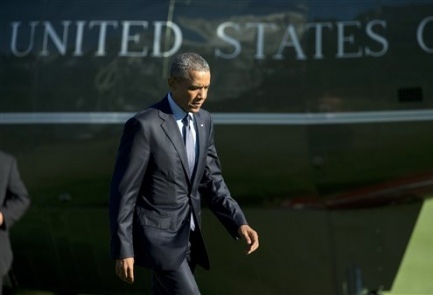
144213644746070861a_bU.S. President Barack Obama | Photo credit: AP

For once, however, Obama is right: Global warming is a burning issue that must be addressed, preferably starting in the Middle East, where the flames are unusually high.

*****************************

The U.S. House of Representatives voted Friday against the nuclear agreement with Iran, with a majority of 269 against, including 25 Democrats, and 162 in favor. This vote followed the expressed objections of 58 Senators, including four Democrats, who could not vote against the deal over a procedural win in the Senate on Thursday. It also followed a recent Pew Research Center survey showing that 49% of Americans oppose the deal, and only 21% support it.

Friday’s vote, albeit symbolic, proves that it is not the American people or their elected officials who want this deal — it is U.S. President Barack Obama who wants it, and what Obama wants, Obama gets.

The truth is, the U.S. does not believe Iran will adhere to the deal, but Obama, who since taking office has undermined the very foundations of the Middle East (and beyond), remains a savvy politician who knows exactly what needs to be done to push the nuclear deal through, despite the opposition it garners — opposition Obama is well aware of — so as to secure his legacy. Nevertheless, the nuclear deal is a victory won by a politician, not a statesman.

While Obama may have won the battle over the Iran nuclear deal, it was a procedural victory. History has taught us that the Senate rarely rejects a presidential foreign policy initiative.

The Iran nuclear deal would have been voted down if not for Obama’s considerable efforts. He understood the crucial need to present the Iran deal as an agreement, not as a treaty, which would have required he secure a two-thirds majority in the Senate, which he would not have been able to do. He also applied pressure on Democrats up for re-election, the majority of whom admitted the deal was far less than perfect.

According to American media, now that Obama has secured support for the Iran deal, he is turning his attention to global warming. For once, he is right — temperatures in the Middle East are scorching hot, and Obama had a hand in turning them up.

The recent sandstorm to cloud Israel was something of an ominous sign. The world has suddenly woken up to overt Russian presence in the Middle East. The Americans seem to have fallen asleep at the wheel, allowing Russian President Vladimir Putin to dictate a new reality on the ground, as he did in Ukraine. Could it be that Washington needed Moscow’s support for the Iran deal so badly it willingly dropped the ball?

The buildup of Russian forces in Syria has vast regional and international ramifications, which cannot be ignored. The West and Israel can no longer operate in Syria under the auspices of alleged “open skies,” and just in case that point was lost on anyone, Russia warned the U.S. against any “unintended incidents” on Syrian soil.

Russia has introduced its presence in the Middle East in a time when it could be seen as favorable. The international community wants to see the Islamic State group defeated, as do the Russians. Unlike in Ukraine, this time the Russians are on the same side as the good guys.

The Russians, however, are not alone: They have returned with the Iranians on their side, which is actually a gift from the U.S. — something that has irked the Saudis to no end, as they now have to find alternative avenues of dealing with both Moscow and Tehran.

For once, however, Obama is right: Global warming is a burning issue that must be addressed, preferably starting in the Middle East, where the flames are unusually high.

Satire but not funny|Kim Jong-un has replaced John Boehner as Speaker of the House

September 11, 2015

Kim Jong-un has replaced John Boehner as Speaker of the House, Dan Miller’s Blog, September 11, 2015

(The views expressed in this article are mine and do not necessarily reflect those of Warsclerotic or its other editors. — DM)

We have met the enemy and it is us: we have become too tired to be effective and hence are becoming indifferent. The charade on Capitol Hill continues, and not only about the nuke “deal” with Iran. Will the carnival end before it’s too late, or will Obama continue to win?

The House speaker is elected by all House members, not just those of the majority party. He need not be a member of the House. Boehner having resigned because a serious medical condition often reduces him to tears, one group of Democrats nominated Debbie Wasserman-Schultz to replace him. However, due to her support for Hillary Clinton, she fell out of favor with the White House so another group of Democrats nominated Kim Jong-un at Obama’s request. To avoid the appearance of confrontation, Republicans offered no candidates. Kim won by seventeen votes, becoming the first non-US citizen to hold the office thus far this month.

tearsofboehnerDebby


Reporting for duty!

REPORTING FOR DUTY!

The current upset was precipitated by Republican members’ disagreements with Boehner and other party leaders about how best to deal with the catastrophic Iran nuke “deal” without unnecessarily offending the President. Kim Jong-un is expected to substitute his own brand of leadership for Boehner’s leadership through ambivalence.

A majority also deemed Kim the best qualified to negotiate with Dear Leader Obama on behalf of the House because, as the undisputed leader of a rogue nuclear nation himself, he should be able to pull not only Obama’s strings but also those of the Supreme Leader of the Islamic Rogue Republic of Iran.

White House Press Secretary Josh Earnest declined comment on the situation beyond refusing to comment on whether Obama met privately with Kim to congratulate him. However, Obama is generally thought to have confirmed that He fully supports Kim’s way of governing his own Democratic Peoples’ Republic and — subject to the few pesky restraints still imposed by an antiquated Constitution that He has not yet found ways to sneak around — He does His best to emulate him. In that connection, Obama asked Kim for recommendations on antiaircraft guns to deal humanely with Jews and other traitors who oppose Him (Please see also, New York Times Launches Congress ‘Jew Tracker’ – Washington Free Beacon.)

Desiring to gain Obama’s total good will, Kim promised to have derogatory cartoons of Donald Trump and Hillary Clinton painted on all future North Korean nukes and missiles just before they explode. In return, Obama promised to issue executive orders granting North Korea the permanent right to declassify any and all U.S. documents it sees fit pertaining to the security of the United States and to obtain copies, gratis, from the Government Printing Office.

House Speaker Kim Jong-un will next meet with Supreme Leader Khamenei in Tehran to make two common sense proposals, with which Khamenei is certain to agree:

First, Kim will propose that a group of highly regarded North Korean nuclear experts — under his personal guidance and supervision — conduct all nuke inspections in Iran and draw all conclusions concerning any past or present Iranian nuclear program based on them exclusively. Those conclusions will be drawn on behalf of, and in lieu of any conclusions drawn by, the International Atomic Energy Agency (IAEA). The head of the IAEA, Yukiya Amano, immediately endorsed this plan as “splendid and totally consistent with any and all IAEA – Iran “secret deals.”

Second, Kim will propose that Khamenei promise not to nuke anyone until all sanctions have been permanently eliminated, unless he really wants to.

Obama is thought to have agreed with every aspect of the Kim plan and to have directed Secretary Kerry to tell Khamenei that if he agrees all sanctions will be eliminated permanently, via executive decree, and hence even more expeditiously than previously expected. Due to a successful Senate filibuster yesterday, Obama can issue the executive decree very soon; Today — Friday, September 11th — is being considered seriously due to the obvious symbolism of the date.

H/t Freedom is just another word

arming

The inevitable success of Kim’s mission will result in a win-win situation for nearly everyone, particularly the financially strapped IAEA, and the true Peace of Obama will prevail throughout all parts of the world that He considers worth saving. Remember — it’s all for the Children!

veto (1)Mushroom cloud


Addendum

하원 의장 김정은 의 문 사랑하는 북미 친구 , 그것은 오바마 대통령 아래에서 당신의 인생 이 곧 Amerika 민주주의 인민 공화국 이 될 것입니다 무엇 에 미래의 삶을 위해 잘 준비 것을 진심으로 희망 합니다. 배리 와 나는 제출 된 것을 기쁘게 사람들을 위해 가능한 한 오랫동안 지배 구조 의 우리의 양식 에 서서히 적응 을 하기 때문에 전환이 원활 하게 하기 위해 함께 열심히하고 고통 일했다 .

Translation:

Statement of House Speaker Kim Jong-un

My dear North American friends, it is my sincere hope that your life under President Obama has prepared you well for your future life in what will soon become the Democratic People’s Republic of Amerika. Barry [a.k.a. Barack] and I have worked long and hard together to acclimate you gradually to our transformed and transformational form of governance and hence to make the transition as smooth and painless as possible for those pleased to submit. Now, we will accelerate the progress.

Conclusions

It does not have to be that way. Here, in closing, are a few words from Daniel Greenfield.

We don’t have to give in to despair. If we do, we are lost. Lost the way that the left is lost. Lost the way that the Muslim world is lost.

We are not savages and feral children. We are the inheritors of a great civilization. It is still ours to lose. It is ours to keep if we understand its truths. [Emphasis added.]

We are not alone. A sense of isolation has been imposed on us as part of a culture war. The task of reconstructing our civilization and ending that isolation begins with our communication. We are the successors of revolutions of ideas. We need to do more than keep them alive. We must refresh them and renew them. And, most importantly, we must practice them.

We are not this culture. We are not our media. We are not our politicians. We are better than that.

We must win, but we must also remember what it is we hope to win. If we forget that, we lose. If we forget that, we will embrace dead end policies that cannot restore hope or bring victory.

What we have now is not a movement because we have not defined what it is we hope to win. We have built reactive movements to stave off despair. We must do better than that. We must not settle for striving to restore some idealized lost world. Instead we must dream big. We must think of the nation we want and of the civilization we want to live in and what it will take to build it.

Our enemies have set out big goals. We must set out bigger ones. We must become more than conservatives. If we remain conservatives, then all we will have is the America we live in now. And even if our children and grandchildren become conservatives, that is the culture and nation they will fight to conserve. We must become revolutionaries.

We must think in terms of the world we want. Not the world we have lost.

This is the America we live in now. But it doesn’t have to be.

It can be up to us, not to those who hate America and all for which she once stood.

An Illegal Immigrant Catastrophe… In Europe? ISIS Refugees!

September 10, 2015

An Illegal Immigrant Catastrophe… In Europe? ISIS Refugees! PJ Media via You Tube, September 9, 2015

(Perhaps the European Union should impose multiple two state solutions: each country facing an Islamic invasion would be split, part for Islamists and part for everyone else. Why not? If that’s fine for Israel, it should work as well there. — DM)

Nuclear Jihad

September 7, 2015

Nuclear Jihad, Gatestone InstituteDenis MacEoin, September 7, 2015

    • In the year 628, Muhammad, now ruling in Medina, signed the ten-year Treaty of Hudaybiyyah with his long-time enemies, the tribal confederacy of Quraysh, who ruled Mecca. Twenty-two months later, under the pretext that a clan from a tribe allied with the Quraysh had squabbled with a tribe allied to the Muslims, Muhammad broke the treaty and attacked Mecca, conquering it. It is as certain as day follows night, that the Iranian regime will find a pretext to break the deal. Already, on September 3, the Supreme Leader Ayatollah Khamene’i made it clear that he would back out of the deal if sanctions were not completely removed at once.
    • The Iranian regime not only despises democracy; it considers all Western law, including international law, invalid.
    • The Shi’a consider themselves underdogs, who are willing to sacrifice all to establish the rights of their imams and their successors. That was what the 1979 revolution was all about, and it is what present the Iranian regime still insists on as the justification for its opposition to Western intrusion, democracy, women’s rights and all the rest, which are deemed by Iran’s leadership as part of a plot to undermine and control the expansion of the Shi’i faith on the global stage. These are not Anglican vicars.
    • The Iranian Army and the Islamic Revolutionary Guard Corps “have responsibility… for a religious mission, which is Holy War (Jihad) in the path of God and the struggle to extend the supremacy of God’s law in the world.” — Iran’s Constitution, Article “The Religious Army”.
    • A Third World War is already taking place. The Iran deal strengthens the hands of a regime that is the world’s terrorist state, a state that furthers jihad in many places because its clerical hierarchy considers itself uniquely empowered to order and promote holy war.
    • Obama’s trust in Khamene’i’s presumed fatwa of 2013, forbidding nuclear weapons, rests on the assumption that it even exists. It does not. Even if it did,fatwas are not permanent.
    • Why, then, is this deal going ahead at all? Why is one of the world’s most tyrannical regimes being rewarded for its intransigence, and especially for repeatedly violating the Non-Proliferation Treaty?

“[Some] analysts,” writes the historian and former Israeli Ambassador to the United States, Michael Oren, “claimed the president [Barack Obama] regarded Iran as an ascendant and logical power — unlike the feckless, disunited Arabs and those troublemaking Israelis — that could assist in resolving other regional conflicts. I first heard this theory at Georgetown back in 2008, in conversation with think tankers and former State Department officials. They also believed Iran’s radical Islam was merely an expression of interests and fears that the United States could with sufficient goodwill, meet and allay. … Iran, according to Obama was a pragmatic player with addressable interest. For Netanyahu, Iran was irrational, messianic, and genocidal – ‘worse,’ he said, ‘than fifty North Koreas.'”[1]

Since the signing of the deal at the UN, hot-tempered criticisms and defences have gone into overdrive in the political, journalistic, and diplomatic spheres. Acres have been written and are still being written about the deal, making it the hottest political potato of recent years. Expert analysts such as Omri Ceren and, more recently, Joel Rosenberg have cut through the deliberate obfuscation to show the extent of the dangers the deal presents to the Middle East, the United States, Israel, and the world.

The deal’s supporters insist that it will bring peace and calm to the region, while a host of denigrators — chief among them Israeli Prime Minister Binyamin Netanyahu — have exposed the enormous risks it entails. Already, a vast majority of American citizens are opposed to the deal.

Within the U.S. Congress, bipartisan opposition to the deal is high and mounting. Yet, on September 2, President Obama succeeded in winning over a 34th senator, enough that ultimate passage of the deal is a foregone conclusion. That does not, however, mean that the debate will end. In all likelihood, it will grow fiercer as time passes and true consequences become clearer to the public and politicians alike.

Recent revelations that the International Atomic Energy Agency (IAEA), which oversees nuclear developments worldwide, has agreed that only Iranians will be allowed to inspect the most controversial of Iran’s nuclear sites, have raised anxieties about proper monitoring of the deal. The military complex of Parchin, where Iran is suspected of work on nuclear weapons, will be closed to outside inspection, making it certain that, if Iran decides to cheat (something it has done before), it will be able to do so with impunity. Sanctions will not be re-imposed. And, as we shall see, cheating on the deal can be justified by the Iranians who could always refer to the practice of the prophet Muhammad with the Quraysh tribe in Mecca.

Obama, his Secretary of State John Kerry, and the entire US administration are not merely behind the deal, but almost fanatically so. Many argue that Obama is more interested in securing his “legacy” as the world’s greatest peacemaker (or war-creator, as the case may well turn out to be), the statesman par excellence who alone could bring the theocratic regime of Iran in from the cold and shower the Middle East with true balance in its troubled affairs.

To bring this about, Obama has had to diminish, if not leave totally open to obliteration, American support for Israel, the single country in the world most clearly exposed to a possible genocide should the Iran’s Islamic regime choose to exterminate it, as it has so often threatened to do.

Mahmoud Ahmadinejad’s words mellal-e Eslami bayad Esra’il-ra qal’ o qam’ kard – “the Islamic nations must exterminate Israel” — have been given renewed vigour now that it is highly likely that Iran, evading serious inspections by the IAEA, will soon possess the weapons to do just that.

Even if the treaty is a done deal, it is time to show yet another massive hole in the administration’s strategy. Already, Obama, Kerry and the tightly knit administration have shown themselves remarkably obdurate in turning a blind eye to the many concerns that surround the deal. At the end of the “sunset period,” if not sooner, Iran gets to have, legitimately, as many bombs as it likes. Other problems include breakout times; centrifuge production; centrifuge concealment; uranium enrichment by stealth; refusal to allow the IAEA to inspect military sites; the acquisition of intercontinental ballistic missiles — presumably to be used intercontinentally at guess who. It is no secret that the hardliners in Iran still speak of America as “The Great Satan” and consider it their enemy. That does not even include the implications of lifting sanctions on, and paying billions of dollars to, the world’s main sponsor of terrorism.

As Michael Oren has shown, however, the American president presumably thinks he is doing a deal with a logical and pragmatic regime. Barack Obama, an intelligent, well-read man of Muslim origin, knows almost nothing about Islam; that is the greatest flaw in the Iran deal he has fought so hard to inflict on the human race. With access to platoons of experts, to some of the greatest libraries with holdings in Islamic doctrines and history, and with the Mullahs and Iran’s public still daily promising to destroy America, Obama apparently still believes Islam is a religion of peace and that a theocratic, terror-supporting, medieval regime should have the power to make nuclear bombs. The obverse is that he might like, perhaps not wittingly, to see America, Israel and the West brought to their knees.

This author has previously exposed one aspect of Iran’s serious lack of logic, rationality, or pragmatism — namely the extent to which apocalyptic thinking, messianic prophecy, and dreams of Islamic transcendence through universal conflict pervade the clerical elite, a high percentage of the masses, and even the Islamic Revolutionary Guard Corps. One might assume that this would be especially true when they are flush with cash and nuclear weapons, and the risk to their own survival is substantially lower.

On August 17, just over a month after the signing of the nuclear deal, Iran’s Supreme Leader, ‘Ali Khamene’i, addressed a religious conference, where he expressed his undying hatred for the United States. He said, for example:

We must combat the plans of the arrogance [i.e. the West, led by the U.S.] with jihad for the sake of Allah. … jihad for the sake of God does not only mean military conflict, but also means cultural, economic, and political struggle. The clearest essence of jihad for the sake of God today is to identify the plots of the arrogance in the Islamic region, especially the sensitive and strategic West Asian region. The planning for the struggle against them should include both defense and offense.

The deal has done nothing whatever to stop military threats to Israel, an ally of the United States (though treated with disrespect by America’s president). Speaking on 2 September, the Islamic Revolutionary Guard Corp’s top commander in Tehran province, Brigadier General Mohsen Kazemayni, stated that, “… they [the US and the Zionists] should know that the Islamic Revolution will continue enhancing its preparedness until it overthrows Israel and liberates Palestine.”

There is a simple word for this: warmongering.

Why is the U.S. President insisting on a bad deal with a warmongering regime?

When a military force at its strongest fantasizes about the coming of a Messiah (the Twelfth Imam) to lead them to victory over all infidels, talk of logic, rationality and pragmatism seems acutely out of touch with reality.

Obama’s assumption that there is something solid about the Iranian regime that makes it suitable as a recipient for such largesse and the chance to enrich uranium until kingdom come seems to be based on false consciousness. The regime has been in place for almost forty years, quite a respectable time for a dictatorship. In part, that has been because it has mastered the art of suppression, giving its people a degree of freedom that is missing in several other Islamic countries, such as Saudi Arabia, Sudan, or Afghanistan. These partial freedoms, especially for young people, lull the population into risk-averseness, possibly helped along by the memory in 2009 of pleas for more freedom, which the United States ignored and the mullahs savaged.

Obama, in his ongoing attempt to portray Islam as benign — and a dictatorial regime as a sold basis for peace and understanding in the Middle East — ignores the religious element of the theocracy, as well as the sadistic repression, and in doing so misses a lot.

First of all, Shi’ite Islam is different from its Sunni big brother. It is deeply imbued with features largely absent from Sunni Islam. The most important Shi’i denomination is that of the Twelvers (Ithna’ ‘Ashariyya), who, from the beginning of Islam, have believed themselves to be not only the true version of the faith, but the group destined by God to rule in its name. Beginning with ‘Ali, the son-in-law of the Prophet and the fourth Caliph of the Sunnis, the Shi’a began as his supporters. (Please see the Appendix that follows this article: it contains material that even Barack Obama and his advisors need to know; without it, they simply will not “get” what the ayatollahs are about. It comes to an important conclusion that has considerable bearing on today’s events — and not the one you may expect.)

Beneath the smiles and banter lie the unsmiling masks and the taqiyya-flavoured lies. Beneath the wheeling and dealing and the refusals to compromise lies a sense of destiny for the regime, a belief that it stands on the brink of the realization of the centuries-old Shi’ite dream: that God will finally set his people on the pinnacle of the world and usher in the never-ending reign of the Imam Mahdi, with all injustice gone, the martyrs in paradise, the ayatollahs and mujtahids andmaraji’ in glory, and all the infidels in hell.

It is precisely because Barack Obama and his aides have never got down and dirty to take in hard information that they have remained utterly out of touch with the real springs and cogs of Iranian Shi’ite thinking.

Obama has, when all is said and done, let himself be deluded by the charm offensive of Hassan Rouhani and his henchman Javad Zarif. Obama may not believe in the mystical land of Hurqalyaor the white steed on which the Twelfth Imam will ride to the world’s last battle any more than you or I do. But the clerical elite of Iran, and those who follow them blindly — men and women brought up from birth on these tales, and who travel in the thousands every day to send a message to the Imam at the Jamkaran Mosque near Qom — believe these things with absolute devotion, and that is why this story matters, because it has political consequences.

Shi’i Muslim law enshrines jihad, holy war, as fully as does Sunni law. For Sunnis, jihad has always been possible under the authority of a Caliph, whether fought under his orders or led by kings and governors under his broad aegis.

The Shi’a, however, do not recognize the Caliphate and have often been the victims of Sunni jihads. They may feel impelled to fight a holy war, but under what authority could they do so?

The power of the clergy had waned under the anti-clerical reign of Iran’s Pahlavi dynasty (1925-1979), only to burst out more strongly than ever in the Islamic Revolution, which placed all authority in a new system of government: rule by a religious jurist, a faqih.[2] Overnight, a jihad state was brought into existence; a jihad state with vast oil reserves, modern military equipment, and, at first, the support of almost the entire Iranian population. The clerical hierarchy under Ayatollah Ruhollah Khomeini did not just intend to prepare the way for the coming of the Mahdi. They were now his earthly deputies, in whose hands lay life and death for millions.

The new Shi’ism allowed the clergy to take on powers they had never imagined. More and more economic and legal power came to be concentrated in the hands of a narrow body of scholars, and sometimes a single man could be the source of religious and legal authority for the entire Shi’i world — in Iran, Afghanistan, eastern Arabia, Bahrain, and so on. Thus were the foundations laid for the revolutionary rank of Supreme Leader, taken by the Ayatollahs Khomeini and Khamene’i.

Look for a moment at the preamble to the Constitution of the Islamic Republic of Iran.[3] You will see quickly that this does not read like any other constitution you have seen. The preamble sets the tone. Here, in an account of the circumstances leading to the revolution we read of the clergy as the ruhaniyyat-e mobarez, “the militant or fighting clergy.” These are not Anglican vicars at their prayers or rabbis studying Talmud. A mobarez is a warrior, a champion, a fighter. Not far down the preamble, one encounters a description of their struggle as “The Great Holy War,”jihad-e bozorg. We are not in Obama’s world of logical and pragmatic striving for political and diplomatic coherence. This is made even clearer in one of the constitution’s earlier articles, “The Religious Army.” Here, we read that the Iranian Army and the Islamic Revolutionary Guard Corps “have responsibility… for a religious mission, which is Holy War (Jihad) in the path of God, and the struggle to extend the supremacy of God’s law in the world.”

How do you reach a compromise and a pragmatic deal with a regime that thinks in this way? Are the U.S. administration and the P5+1 blind to something the Iranians have never even bothered to conceal? Do they really take everything in the talks at face value? Perhaps they think references to jihad and fighting clergy are nothing more than pious talk “for domestic consumption,” as they tried to explain — as real and everyday as the myths and legends of other faiths. If they do, then they have far less excuse for their blindness, for the Iranian regime is already at war and is already fighting its jihad.

In Iraq, for example, a country with a majority Twelver Shi’i population, Iranian-backed militias have been at war for many years, first against the Americans, then the Sunnis, and now the hordes of Islamic State. In June 2014, Grand Ayatollah al-Sayyid ‘Ali al-Husayni al-Sistani issued a fatwa calling on Iraqis to fight against Islamic State, justifying their fight as jihad wajib kafa’i: a Jihad that is compulsory for those who choose it, but not for the entire population. The ruling calls for a struggle against ISIS’s irhab – their “terrorism.” Jihad is a religious and legal duty, and even though ISIS may call its fighting jihad, it is here condemned as terror.

Hezbollah, created and backed by Iran, is by far the largest terrorist group in the region. Hezbollah is considered a state within a state, with forces and infrastructure inside Lebanon and Syria. It has used the name “Islamic Jihad Organization” to cover its attacks on Israeli forces in Lebanon. In its 1988 Open Letter (Risala maftuha), it describes its followers as “Combatants of the Holy War” and goes on — in terms similar to those in the Hamas Covenant — “our struggle will end only when this entity [Israel] is obliterated. We recognize no treaty with it, no cease fire, and no peace agreements, whether separate or consolidated.”

Hezbollah and its creator, the Iranian Islamic regime, have a curious link to the Palestinian terror movement, Hamas, despite Hamas being exclusively Sunni. By financing, arming, and defending Hamas, Iran is fighting a strange proxy jihad that serves its own purposes of defying the West, achieving regional hegemony, and winning praise from all Muslims in the world for its own war against Israel. It also furthers the goals of the Muslim Brotherhood (of which Hamas is the Palestinian branch) in the same struggle.

I have dragged you through the briars and mud because it is important here to see another culture through its own eyes. If we insist in pretending that Shi’i Muslims think like Sunni Muslims or, worse still, like Jews or Christians — if we brush all that history and all those doctrines under the carpet of “any deal is better than no deal ” — we will go on making the same mistakes. We will believe that a purely political and diplomatic enterprise to bring Iran in from the cold and create a new trading alliance will transform an evil regime into a land of sweetness and light.

Members of the U.S. Congress must wake up and examine, in however cursory a fashion, these views that motivate the Iranian leadership, and must stop pretending that they are as logical and pragmatic as would be convenient for the wishes of the West.

Not that Obama and Kerry have ever sounded logical or pragmatic in how they have approached this debate and this deal-making process. In an act of supreme folly, the White House has dismissed Ayatollah Khamene’i’s recent call for “Death to America;” they pretend it is just empty rhetoric for the Iranian people.

1169Left: Senior Iranian cleric Ayatollah Mohammad Ali Movahedi Kermani, speaking on July 17 in Tehran, behind a banner reading “We Will Trample Upon America” and “We defeat the United States.” Right: Iran’s Supreme Leader, Ali Khamenei, proclaims “Death to America” on March 2

We are walking with a blindfold toward sure disaster. Forget the dreams of a Messiah if you will, but do not for one moment let yourself be lulled into thinking that only ISIS is serious about waging a jihad.

Despite their oft-expressed delusion that “Islam is a religion of peace,” President Obama, Secretary John Kerry and other leaders are, like it or not, already engaged in a war against jihad. They have already fought it in Afghanistan, Iraq, Libya and elsewhere. However much Obama wants to stand off from involvement in the jihad struggles of the Middle East, he cannot: Western states are fighting jihad, sometimes abroad, increasingly at home.

A Third World War is already taking place, a war the Islamists and Islamic states understand, but which many in the West still refuse to grasp. They are not even willing to respect the true motivations of the enemies against whom they fight. The Iran deal strengthens the hands of a regime that is the world’s terrorist state, a state that furthers jihad in many places because its clerical hierarchy considers itself uniquely empowered to order and promote holy war.

Let us for the moment ignore the nuclear aspect of this deal and look instead on what it offers the world’s leading jihad state. The removal of sanctions coupled with the business deals Europeans and others are rushing to secure, the delivery of perhaps $150 billion to Tehran, and the turning of many blind eyes to both Iran’s internal repression and its jihad wars in Iraq, Syria, Yemen, Gaza, and Lebanon leave the ayatollahs poised to dominate much of the Middle East.

And that is not all. Obama’s belief in the stability of the Iranian regime seems to rest on its endurance since 1979. His trust in Khamene’i’s presumed fatwa of 2013, forbidding nuclear weapons rests on the assumption that it even exists. It does not. No one has ever seen it. Even if the fatwa did exist, fatwas are not permanent. They are always regarded as temporary rulings with Twelver Shi’ism. This is a crucial technical point that the White House seems incapable of — or ill-disposed to — grasping.

Further, Obama’s faith in Iranian President Hassan Rouhani as a reformer and moderate flies in the face of Rouhani’s devotion to the hardline clerical leadership of which he is a part. Here are a few facts:

  • ‘Ali Khamene’i is 76 years old, but his health is poor and he may not live much longer. Already, factions within the hierarchy will be jostling for the Supreme Leadership.
  • In the Usuli Twelver version of Shi’ism, once a Mujtahid dies, his fatwas are no longer valid. A new Mujtahid or, in this case, a new Supreme Leader, has to issue fatwas of his own. A new fatwa may confirm an old one or radically differ from it.
  • A new Supreme Leader is an unpredictable personality.
  • The Iranian nuclear program is already up and running.
  • The breakout time for weapons grade materials may be as short as three months.
  • Iran already has and is acquiring ballistic missiles with an intercontinental range.
  • Jihad is hard-wired into the regime’s philosophy.
  • Iran is already conducting a series of jihad wars abroad.
  • Mahmoud Ahmadinejad has expressed a hope to return to the presidency in 2017. Ahmadinejad and his clique are bent on apocalyptic outcomes and actions to bring the Hidden Imam back to this world.

We only have to get this wrong once. Chants of “Death to America” and “Death to Israel” are not narcotic iterations of slogans but sincerely felt expressions of intent.

Khamene’i last month praised the Iranian people for calling for the deaths of the USA and Israel, and said that he hoped God would answer their prayers because in at most ten years, the Iranian mullahs and their IRGC will possess the power to exterminate Israel, if they and their God so wish.

Why, then, is this deal going ahead at all?

Why are sanctions against the world’s leading exporter of jihadi terrorism being lifted, not strengthened?

Why is one of the world’s most tyrannical regimes being rewarded for its intransigence, and especially for repeatedly violating the Non-Proliferation Treaty?

Why has Israel’s Prime Minister been vilified and sidelined simply for drawing attention to the weaknesses of a deal that could lead to the death of all of his people?

Why have the P5+1 never taken seriously the Shi’ite rule that it is permitted to lie to infidels and conceal one’s own true intentions?

Why are secrets being kept — such as the contents of the two side-deals?

Why is the U.S. Congress being asked to vote without the benefit of full disclosure?

Why is the IAEA banned from spontaneously inspecting only declared Iranian nuclear sites, and why are military sites completely off-limits?

The questions are so many and so critical that we remain in the dark about where this will lead mankind. No one who has ever done a financial or political deal would ever sign on the dotted line until they had answers to all their questions. Far more hangs on this deal than perhaps any deal in history. Yet those who want to make it enforceable under international law are uninformed about the most basic contents of the deal, as well as the beliefs and historical roots of their enemy.

Such folly is almost without precedence, except possibly in the process of appeasement that endeavoured to placate the Third Reich and treat Adolf Hitler as the best friend of democracy.

The Iranian regime not only despises democracy, it considers all Western law — including international law — invalid. This view has several deep roots. For both Sunni and Shi’i Muslims, only rule under God is valid, under a Caliph or a clerical theocracy under a Supreme Ruler. Human beings have no right to interfere. Democracy leads to the making of human laws that may contradict shari’a law, and such effrontery is considered arrogant and presumptuous. The democratic elements in Iran are tightly controlled, and supremacy rests in all areas beneath clerical authority. The same principle applies to international law, UN resolutions, treaties and so forth.

Iran has openly genocidal intent, as well as a devotion to holy war that goes to the very deepest level.

Before we leave the subject of jihad, there is one other factor that everyone has overlooked. It is the Treaty of Hudaybiyyah, the most important agreement in early Islamic history. In the year 628, Muhammad, now ruling in Medina, signed the ten-year Treaty of Hudaybiyyah with his long-time enemies, the tribal confederacy of Quraysh, who ruled Mecca. Twenty-two months later, under the pretext that a clan from a tribe allied with the Quraysh had squabbled with a tribe allied to the Muslims, Muhammad broke the treaty and attacked Mecca, conquering it.

What is important about this is that Muhammad had made the treaty while he was still relatively weak. But in the months after signing it, his alliances and growing conversions meant that he now possessed superior military strength — and that was when he pounced.

In 1994, the treaty became crucial to the issue of peace between Israel and the Palestinians.[4]In September 1993, Palestinian leader Yassir Arafat signed the Oslo Accords along with Israeli Prime Minister Yitzhak Rabin, and the following year the two leaders were awarded the Nobel Peace Prize.

However, even as he awaited that prize, Arafat spoke at a mosque in Johannesburg alluded to the Treaty of Hudaybiyyah and referred to “a jihad to liberate Jerusalem”: “I see this agreement,” he said, “as being no more than the agreement signed between our Prophet Muhammad and the Quraysh in Mecca.”

Non-Muslims may well have misunderstood this as a reference to some early Muslim peace-making. But Arafat made his meaning clear: “We now accept the peace agreement, but [only in order] to continue on the road to Jerusalem.”[5]

The nuclear deal that President Obama and his supporters have imposed will strengthen Iran considerably, removing sanctions and delivering perhaps $150 billion to the country. It is as certain as day follows night, that the Iranian regime will find a pretext to break the deal. Already, on September 3, the Supreme Leader Ayatollah Khamene’i made it clear that he would back out of the deal if sanctions were not completely removed at once.

Whatever happens in the days ahead, the U.S. Congress, backed by a majority of the American public, needs to strike this madcap deal down before it wreaks a storm of tribulations on everyone.

Denis MacEoin has a PhD (Cambridge 1979) in Persian Studies and has written widely on Iran and its religious beliefs.

Appendix

‘Ali became the first in a line of twelve imams, all deemed the true leaders of Islam, but all denied their right to rule and all but one assassinated (or so it is claimed) by the Sunni Caliphs. From this comes the Shi’i sense of suffering, injustice, oppression by despots, neglect and rights — all of which played an important part in the 1979 revolution and continue to play out across society.

The Shi’a are the underdogs who are willing to sacrifice all to establish the rights of their imams and their successors. That was what the 1979 evolution was all about, and it is what present the regime still insists on as the justification for its opposition to Western intrusion, democracy, women’s rights and all the rest, which are deemed by Iran’s leadership as part of a plot to undermine and control the expansion of the Shi’i faith on the global stage.

The twelfth imam, according to Shi’ite legend, was a young boy, Muhammad al-Mahdi, the son of the murdered eleventh imam. Born in 869 in the Iraqi city of Samarra during the reign of the Sunni Abbasid Caliphate, his father, Hasan al-‘Askari, died when Muhammad was born.

It is said that young Muhammad, in order to avoid his enemies, went into something called Occultation (ghayba). Even if this originally was physical, he was never seen alive again and is supposed to have entered the celestial realm of Hurqalya, from which he will one day return as the promised Saviour, the Qa’im bi’l-Sayf, the One Who will Arise with the Sword to do battle with injustice and infidelity.

This belief is what waters modern Shi’i apocalypticism, something promoted intensely by former president Mahmoud Ahmadinejad. This expectation has considerable significance for Iran’s drive to nuclear power. But that is not why I raise the issue here. There is another, more mundane, aspect to the Imam’s disappearance and continued Occultation, and it may be even more relevant to the matters at hand.

The answer to what authority they could fight under was that only the Imam in each generation could order or lead jihad. But when the twelfth Imam vanished from human sight, was jihad to remain in abeyance until his return or could it be fought under another authority? The answer was not at first simple, but one thing started to happen: the Shi’a began to consider their religious scholars to be the intermediaries with the Imam, and this laid the basis for the possibility that they might have the right to order jihad. For some time, this was just conjectural, for the Shi’a had little worldly power.

In 1501, a new dynasty, the Safavids, came to power in Iran, forced most of the population to convert to Shi’ism, and created a line of kings under whom the clerical class became more and more powerful. The Shah could still lead jihad, but the clergy were needed to give permission. The Safavid dynasty lasted till 1722, and an interregnum was followed by the emergence of a new line of Shahs, the Qajars, who ruled from 1796 to 1925.

Under the Qajars, the Shi’i clerical hierarchy underwent deep and lasting changes, producing today’s version of Twelver Islam, the Usulis.

The newly powerful ‘ulama of the 19th century took on the mantle of deputies for the Hidden Imam and ordered jihads in 1809 and 1826 (against Russia), 1836, 1843, and 1856-7 (against the British). In 1914, when the British occupied Iraq at the start of World War I, the Shi’i clergy in the shrine centres there declared jihad to reinforce the call for Holy War by the Ottoman empire.

__________________________________

[1] Ally by Michael Oren

[2] As in Khomeini’s theory and book, Velayat-e Faqih, the Custodianship of the Jurisprudent.

[3] Here in English, here in Persian.

[4] For a detailed discussion of the treaty and its implications for making peace with Muslims, see Daniel Pipes, “Lessons from the Prophet Muhammad’s Diplomacy,” The Middle East Quarterly, September 1999, pp. 65-72.

[5] Natasha Singer, “Arafat Text Raises Ire,” Forward, May 27, 1994.
Egypt’s Christians in the Shadow of the Muslim Brotherhood

August 11, 2015

Egypt’s Christians in the Shadow of the Muslim Brotherhood, Washington Free Beacon, August 11, 2015

(Please see also, WFB’s Bill Gertz discusses story on Obama support for Muslim Brotherhood on Steve Malzberg Show. — DM)

Copts view the Obama administration cynically. Egyptians now whisper that the American president who pleased Arab liberals with his speech “A New Beginning” at al-Azhar in 2009 is secretly funding the Muslim Brotherhood and purposefully neglecting the Islamic State. A group of Copts protested outside of the White House in February 2015, demanding more aggressive action against IS following the beheading of the 21 Copts.

Al-Ahram, the largest newspaper in Egypt, published reports in 2013 that the United States diplomatic mission in Egypt, led by Ambassador Anne Patterson, was discouraging Coptic Christians from participating in protests against Morsi. Even though Patterson adamantly denied the accusations, the report sowed more distrust among Copts.

Tensions between the Coptic community and the administration worsened when, in the same year, an Obama Homeland Security adviser named Mohamed Elibiary suggested Copts raising awareness of their persecution were promoting “Islamophobic” bigotry.

**************************

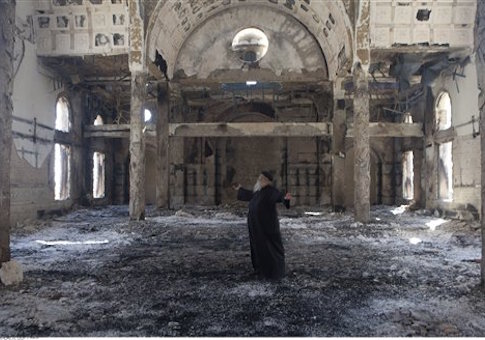
Christian Coptic Priest Father Samuel reacts as he stands inside the burned and heavily damaged St. Mousa church in Minya, Egypt / AP

In the nearly five years of turmoil that have followed the resignation of President Hosni Mubarak in 2011, no group in Egypt has suffered more than the 15 million Coptic Christians. Both a religious and ethnic minority, the Copts are descended from the native population of Egypt who lived and ruled there from the time of the pharaohs until the Roman conquest in 31 B.C. They are the largest Christian community in the Middle East today.

Copts have long been the target of discrimination and persecution in the majority-Arab nation. But this ancient people faced a terrifying new prospect in 2012: Muslim Brotherhood rule.

After Mubarak was ousted, the violence began almost immediately. Churches and schools were burned; peaceful protestors were massacred. When parliamentary elections were held nine months later, they were swept by the Muslim Brotherhood and other Islamist parties. When Mohamed Morsi won the presidential election in May 2012, the party’s victory looked complete. The same year, Morsi gave himself unlimited powers and the party drafted a new constitution inspired by Sharia law.

Morsi benefitted from the organizational advantage of the Muslim Brotherhood. Backed by imams preaching the benefits of religious rule, the previously banned political party was able to defeat the fractured coalitions of the pro-West, liberal, and secular candidates.

“They used thugs to carry out political intimidation against Christians,” a former member of Egyptian Parliament told the Washington Free Beacon. Chants celebrating the Brotherhood victory echoed through the streets of Cairo. “Morsi won! Copts out!”

Ousted president Mohamed Morsi / AP

During Morsi’s rule, Christians were murdered and tortured by the hundreds. Attacks and abductions of Christian children spiked significantly. “Most Americans do not know how vicious and bloody the Muslim Brotherhood is,” Ahmed, a 24-year old secular Muslim, said. “They really can’t understand.”

Pope Tawadros II, Egypt’s Coptic Christian leader, criticized Morsi for negligence after six Christians were killed when police and armed civilians besieged Egypt’s largest cathedral. “We want actions, not words,” the Pope said.

Public accusations of blasphemy also became ubiquitous. A Facebook post interpreted as undermining Islam could bring a mob of fundamentalists with rocks and Molotov cocktails to the homes of Christians, surrounding them with families trapped inside. Sham trials with no legal representation would follow. Anti-Christian terrorism was not punished, but the wrong words often landed Copts in prison, forcing the church to make public apologies and families to leave their towns and villages.

Lydia, an activist who provides relief supplies to torn Christian communities in Upper Egypt, and who requested that only her first name be used to preserve her safety and that of her colleagues, witnessed the Muslim Brotherhood offer the very poorest Egyptians social services that bought their allegiance. “When you have no food or money, you will listen to anyone who gives you the resources your family desperately needs,” Lydia said. “They brainwash the illiterate with extremism so they hurt Christians.”

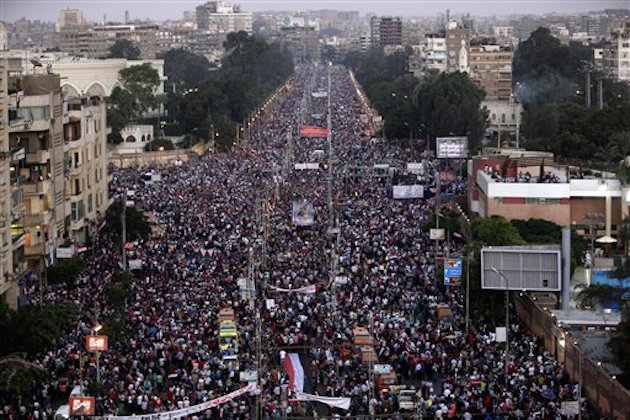
Still, Morsi’s authoritarian rule—rewriting the constitution, disbanding the Egyptian parliament, tossing potentially obstructive judges into jail—was not long lived. Barely a year after he assumed office, a reported 35 million citizens took to the streets to protest his rule, leading the Egyptian military, under Gen. Abdel Fattah al-Sisi, to remove him from power in July 2013.

Egypt’s ousted President Mohammed Morsi protest at the presidential palace in Cairo, Egypt, Friday, July 26, 2013 / AP

Sen. James Lankford (R., Okla.) told the Free Beacon that had al-Sisi not responded, the promise of Egyptian Democracy would have died. “What it seemed the Egyptian people wanted was more opportunity to be able have some sort of functioning democracy, elections, input into their own government,” Lankford said. “It was the immediate understanding as soon as the Muslim Brotherhood was elected, that was the last election Egypt would have.”

In 2014, al-Sisi was elected Egypt’s new president. He won a solid electoral victory, giving him control of the Egyptian government with the responsibilities of forming a new constitution, a new parliament, and a new judicial system. The Coptic Church fervently supported al-Sisi’s candidacy because the new president promised Copts equality in citizenship, security in their communities, and the ability to build places of worship.

The new Egyptian president challenged the leaders of the Islamic world to push a more moderate message. In December 2014, hundreds of Christian and Muslim theologians gathered at al-Azhar, Egypt’s leading mosque and religious university, participated in a conference to fight “jihad” and promote inclusion. Al-Sisi ambitiously called for a “religious revolution” in January 2015, saying that clerics bear responsibility for the growing extremism in the Middle East.

As president, al-Sisi took many symbolic steps to integrate the Coptic community with the majority Sunni population. In a surprise to most Egyptians, al-Sisi attended a mass at Saint Mark Orthodox Cathedral in Cairo on Christmas Eve, a first for any Egyptian president. Al-Sisi regularly invites Pope Tawadros II to appear beside him when he announces major policy rollouts or requests public dialogue from senior advisers.

Al-Sisi also appointed two Copts as members of his cabinet. Under the constitution, the president of Egypt has the power to select 10 members of parliament. Political observers believe he will select Copts to fill a majority of those appointed seats to offer a more representative parliament.

“Our lives haven’t changed much but one positive result of the revolution is the Egyptian people have politically woken up,” said Hala, a Mubarak-era government official who also wished to be identified by her first name only because she fears political retribution. “We no longer accept what we are told. Egyptians are at least aware of the government’s actions and they are more aware of the troubles Copts face.”

But while al-Sisi’s administration provides a welcome change of tone toward the Coptic community, the day-to-day lives of Copts remain little changed from the Mubarak days.

Coptic Solidarity is a five-year-old public charity organization and advocacy group devoted to advancing equality for Copts in Egypt. Their efforts have helped raise awareness about the persecution Christians face in the Middle East. Alex Shalaby, an Egyptian businessman currently residing in the United States and Coptic Solidarity’s new president, believes Egypt under al-Sisi has continued many of the same practices as previous presidents Sadat, Mubarak, and Morsi.

“Discrimination is rampant, especially in Upper Egypt. We still see reconciliation tactics pressuring the closing of Christian churches and there are still very few Coptic government appointees, he explained. “Coptic Solidarity monitors all developments within Egypt and we are not able to say much has been accomplished in terms of real change to improve Coptic lives in the last 12 months.”

Human rights groups have been critical of al-Sisi’s record. Amnesty International’s Hassiba Hadj Sahraoui accused the president of “employing the same methods of torture and other ill-treatment used during the darkest hours of the Mubarak era.” The Egyptian government received heavy criticism after a court sentenced hundreds of Muslim Brotherhood members to death, intensifying its crackdown on Islamists.

Despite assurances from al-Sisi, sectarian violence still regularly occurs in the rural villages of Upper Egypt where the government has less control.

In Nasreya, Islamists responded to a video of five Christian students making fun of the Islamic State terrorist groups by demanding the students be turned over to the authorities for insulting the religion of Islam. Villagers hurled rocks at Copts and vandalized their property. No arrests were reported for the attacks but the teacher and students were imprisoned for days.

On March 26, 2015, in El Galaa another horde gathered to protest the building of a new church that served 1,400 Christians, also attacking Christian homes in a similar manner. The local government forced the new church to have no outer symbol of Christianity. In Mayana and Abu Qurqas villages, police raided churches, confiscated items from the altar, and shut down reconstruction work.

Lydia, the activist based in Upper Egypt, has witnessed firsthand the damage from these attacks. “I had to console a girl, nine years old, crying because she was afraid her parents were going to be kicked out of their own home,” she said.
“They are poor, illiterate, and now their home is burned and their own community has banned them. All because they are Christians,” she continued.

“The police don’t bother to protect Christians. They do the exact opposite in Upper Egypt,” Lydia said. “The local governments have been loaded with Islamists for years.”

But violence is not exclusive to the country’s outskirts. On June 30, 2015, the two-year anniversary of the popular uprising against Morsi, Islamists detonated bombs by the homes of well-known Christians. Additionally, The Fathers Church in Alexandria was firebombed on July 22, 2015. This summer’s assassination of Egypt’s Attorney General Hesham Barakat in a car bombing, reportedly carried out by a wing of the Muslim Brotherhood, served as an ugly reminder that Egypt’s violence has not passed.

An Egyptian policeman stands guard at the site of a car bombing that killed n Egyptian policeman stands guard at the site of a car bombing that killed Hesham Barakat / AP

Despite these problems, al-Sisi still enjoys support among prominent Copts. Amir Ramzy is a prominent Coptic judge and public figure in Egypt’s legal system, and a loyal defender of al-Sisi’s administration.

“We cannot remove prejudice overnight,” Ramzy said. “We must focus on changing the attitude of the people on the ground first.”

The judge pointed to the dire state al-Sisi found the country in when he took office as reason for slow progress.

“Egypt is fighting Islamists inside and outside our borders. Egypt is fighting a horrid economy with massive unemployment. Al-Sisi is taking on large projects to change these conditions,” Ramzy said. “It is difficult to control chaos and promote social change at the same time.”

The judge referred to the decades it took the United States to implement civil rights reforms. He asked for reasonable expectations out of Egypt’s new president and insists under al-Sisi the country is heading in the right direction. “Just one year after his election, Egypt has new roads, a new canal, new investments, and a new hope for the poor.”

Despite not being content with the pace of progress, Shalaby said al-Sisi is an improvement over his predecessor. As a retired executive, he said he understood national security and economic development should be the president’s priority. “Al-Sisi must do what is best for Egypt first. What is best for Egypt is what is best for Copts. What is good for Copts is good for Egypt.”

Abdel-Fattah al-Sisi / AP

Copts view the Obama administration cynically. Egyptians now whisper that the American president who pleased Arab liberals with his speech “A New Beginning” at al-Azhar in 2009 is secretly funding the Muslim Brotherhood and purposefully neglecting the Islamic State. A group of Copts protested outside of the White House in February 2015, demanding more aggressive action against IS following the beheading of the 21 Copts.

Al-Ahram, the largest newspaper in Egypt, published reports in 2013 that the United States diplomatic mission in Egypt, led by Ambassador Anne Patterson, was discouraging Coptic Christians from participating in protests against Morsi. Even though Patterson adamantly denied the accusations, the report sowed more distrust among Copts.

Egyptians publicly celebrated when Patterson left the country.

Tensions between the Coptic community and the administration worsened when, in the same year, an Obama Homeland Security adviser named Mohamed Elibiary suggested Copts raising awareness of their persecution were promoting “Islamophobic” bigotry. Elibiary, who generated controversy due to views perceived by some to be friendly to the Muslim Brotherhood, released a series of tweets with the R4BIA salute, perceived to be a symbol of hate by many in Egypt.

Elbiary later deleted his tweets and removed the symbol. Bishop Angaelos, Pope Tawadros II’s personal representative called the incident “disturbing.” Elbiary left the Obama administration under pressure from critics in 2014.

Following the ouster of Morsi, the United States canceled weapons deliveries to Egypt and halted all military aid. As the White House took its time to build a relationship with al-Sisi, Russian President Vladimir Putin visited the country and signed a nuclear agreement.

The White House announced in the spring of 2015 that weapons deliveries to Egypt would ultimately be resumed.

Despite the uneasiness in the country, Christians believe they will one day be equal citizens in their homeland. Such progress may be slow and painful, but amidst anxiety there is hope in Egypt.

Much of this hope is derived from the perception of al-Sisi’s decent treatment of the Copts. Ramzy, the judge, told theFree Beacon, “al-Sisi may not be perfect, but he is Copts’ best chance to promote ourselves from second class citizens. He should receive America’s support.”

Army is breaking, let down by Washington

August 3, 2015

Army is breaking, let down by Washington, Stars and Stripes, Robert H. Scales, August 2, 2015

(Last year I also wrote a depressing article on the lamentable combat readiness of our military. It’s here at my blog and here at Warsclerotic. The situation has continued to deteriorate. How could Obama’s America help to protect freedom, particularly against an enemy whose name must not be mentioned, without a combat effective military — even if Obama wanted to do it? — DM)

image militaryU.S. paratroopers with the 173rd Airborne Brigade load a M119A2 howitzer at the 7th Army Joint Multinational Training Command’s Grafenwoehr Training Area, Germany, July 28, 2015.
GERTRUD ZACH/U.S. ARMY

Last month, Gen. Ray Odierno, outgoing Army chief of staff, and Gen. Mark Milley, his successor, testified to the difficulties faced by the Army. I’d like to make the same points by telling a story.

When I was a boy, tonsillitis was a dangerous illness. In 1952, it kept me in Tokyo General Hospital for weeks. I shared a cramped ward with dozens of soldiers horribly maimed in Korea. The hospital had only one movie theater. I remember watching a Western sandwiched between bandage- and plaster-wrapped bodies. I remember the antiseptic smells, the cloud of cigarette smoke and the whispers of young men still traumatized by the horrors of the war they had just left.

My dad came from Korea to visit me, and I recall our conversations vividly. At the time he was operations officer for the 2nd Engineer Battalion. He told me how poorly his men were prepared for war. Many had been killed or captured by the North Koreans. During the retreat from the Yalu River, some of his soldiers were in such bad physical shape that they dropped exhausted along the road to wait to be taken captive.

“We have no sergeants, son,” he told me, shaking his head, “and without them we are no longer an Army.”

In the early ’70s, I was the same age as my Korean-era dad. I had just left Vietnam only to face another broken Army. My barracks were at war. I carried a pistol to protect myself from my own soldiers. Many of the soldiers were on hard drugs. The barracks were racial battlegrounds pitting black against white. Again, the Army had broken because the sergeants were gone. By 1971, most were either dead, wounded or had voted with their feet to get away from such a devastated institution.

I visited Baghdad in 2007 as a guest of Gen. David Petraeus. Before the trip I had written a column forecasting another broken Army, but it was clear from what Petraeus showed me that the Army was holding on and fighting well in the dangerous streets of Baghdad. Such a small and overcommitted force should have broken after so many serial deployments to that hateful place. But Petraeus said that his Army was different. It held together because junior leaders were still dedicated to the fight. To this day, I don’t know how they did it.

Sadly, the Army that stayed cohesive in Iraq and Afghanistan even after losing 5,000 dead is now being broken again by an ungrateful, ahistorical and strategically tone-deaf leadership in Washington.

The Obama administration just announced a 40,000 reduction in the Army’s ranks. But the numbers don’t begin to tell the tale. Soldiers stay in the Army because they love to go into the field and train; Defense Secretary Ash Carter recently said that the Army will not have enough money for most soldiers to train above the squad level this year. Soldiers need to fight with new weapons; in the past four years, the Army has canceled 20 major programs, postponed 125 and restructured 124. The Army will not replace its Reagan-era tanks, infantry carriers, artillery and aircraft for at least a generation. Soldiers stay in the ranks because they serve in a unit ready for combat; fewer than a third of the Army’s combat brigades are combat-ready.

And this initial 40,000-soldier reduction is just a start. Most estimates from Congress anticipate that without lifting the budget sequestration that is driving this across-the-board decline, another 40,000 troops will be gone in about two years.

But it’s soldiers who tell the story. After 13 years of war, young leaders are voting with their feet again. As sergeants and young officers depart, the institution is breaking for a third time in my lifetime. The personal tragedies that attended the collapse of a soldier’s spirit in past wars are with us again. Suicide, family abuse, alcohol and drug abuse are becoming increasingly more common.

To be sure, the nation always reduces its military as wars wind down. Other services suffer reductions and shortages. But only the Army breaks. Someone please tell those of us who served why the service that does virtually all the dying and killing in war is the one least rewarded.

My grandson is a great kid. He’s about the same age I was when I was recovering at Tokyo General. Both of his parents served as Army officers, so it’s no wonder that in school he draws pictures of tanks and planes while his second-grade classmates draw pictures of flowers and animals. The other day he drew a tank just for me and labeled it proudly “Abrams Tank!”

Well, sadly, if he follows in our footsteps, one day he may be fighting in an Abrams tank. His tank will be 60 years old by then.

At the moment I’d rather he go to law school.

Robert H. Scales, a retired Army major general, is a former commandant of the U.S. Army War College.

Obama: Muslim, Napoleon Bonaparte redux or worse

July 5, 2015

Obama: Muslim, Napoleon Bonaparte redux or worse, Dan Miller’s Blog, July 5, 2015

(The views expressed in this post are mine and do not necessarily reflect those of Warsclerotic or its other editors. — DM)

Napoleon sometimes claimed to be a Muslim. Obama often claims to be a Christian. Napoleon sought, and Obama seeks, power and glory through pretense. 

Obams as Napoleon

Napoleon Bonaparte

Napoleon’s life and history are summarized at Wikipedia. He supported the French Revolution and was appointed General of the Army of Italy at the age of twenty-five. Three years later, he commanded an expedition against Egypt. This post compares his and Obama’s religious and political efforts to gain the confidence of Muslims. The lengthy quotations provided in this section of the post are from Worlds at Warthe 2,500 year struggle between East and West, 2008, by Anthony Pagden.

While en route to conquer Egypt, Napoleon had his “Orientalists” compose a  “Proclamation to the Egyptians.”

It is worth taking a closer look at this document for it summarizes not only the French hopes for the ‘Orient’, but also the ultimate failure of both sides to come to any approximate understanding of each other. It began with a familiar Muslim invocation: ‘In the name of God, the Merciful, the Compassionate. There is no God but God. He has no son nor has he any associate in His Dominion’, which was intended to indicate clearly that the French were not Christians. It then went on to assure the Egyptian people that Napoleon Bonaparte, commander of the French army, and ‘on behalf of the French Republic which is based upon the foundations of Liberty and Equality’, had not come to Egypt, as the Mamluks had put it about, ‘like the Crusaders’ in order to destroy the power of Islam. Nothing, Napoleon assured his readers, could be further from the truth. Tell the slanderers that I have not come to you except for the purpose of restoring to you your rights from the oppressors, that I, more than the Mam-luks, serve God— may He be praised and Exalted— and revere his prophet Muhammad and the glorious Qur’an … And tell them also that all people are equal in the eyes of God and that the circumstances which distinguish one from another are reason, virtue and knowledge. 578 Having thus done his best to conflate the principle of human rights— in a language in which there exists no obvious translation for the word ‘right’ 579— with what the Orientalists had persuaded him were the basic tenets of Islam, the man whom Victor Hugo would later describe as the ‘Muhammad of the West’ continued,

O ye Qadis [judges], Shaykhs and Imams; O ye Sharbajiyya [cavalry officers] and men of circumstance tell the nation that the French are also faithful Muslims and in confirmation of this they invaded Rome and destroyed there the Holy See, which was always exhorting the Christians to make war on Islam. And then they went to the island of Malta from where they expelled the knights who claimed that God the Exalted required them to fight the Muslims. 580 [Emphasis added.]

It is hard to say how much Napoleon believed in all this. One of his generals later told a friend in Toulouse that ‘we tricked the Egyptians with our feigned love of their religion, in which Bonaparte and we no more believe in than we do in that of the late pope’. 582 But Napoleon’s personal beliefs were largely beside the point. The point was policy. Napoleon had always practised religious toleration because he knew that religious faiths could make deadly enemies. Toleration, however, was one thing; credence, even respect, was another. It is indeed highly unlikely that Napoleon had read much of the Qur’an he claimed to venerate. As he told Madame de Rémusant, the only holy book which would have been of any interest to him would have been one he had written himself. [Pagden, pp 326 – 327] [Emphasis added.]

Egyptians did not appreciate Napoleon’s Proclamation.

Just as most Muslims today have failed to be persuaded that Western social values can be made compatible with the Holy Law, the Shari’a, so too were the Egyptians who confronted Napoleon. We know something of how they reacted to Napoleon’s profession of love for Islam from the account of the first seven months of the occupation written by a member of the diwan— or Imperial Council— of Cairo named Abd-al Rahman al-Jabarti. Al-Jabarti was a well-read perceptive man who was not unimpressed by French skills and technology (he was particularly taken by the wheelbarrow) and ungrudgingly admired French courage and discipline on the battlefield, which he compared, glowingly, to that of the mujahedin, the Muslim warriors of the jihad. 585 But for all that he was a firm Muslim who could conceive of no good, no truth which did not emanate from the word of God as conveyed by the Prophet. He excoriated Napoleon’s declaration for its language, for its poor style, for the grammatical errors, and the ‘incoherent words and vulgar constructions’ with which it was strewn, and which often made nonsense out of what Napoleon had intended to convey— all of which was no tribute to the skills of Venture de Paradis or those of the French Arabists in the expedition. But al-Jabarti reserved his most searing criticism for what he repeatedly describes as French hypocrisy. The opening phrase of the declaration suggested to him not, as Napoleon had meant it to, a preference on the part of a tolerant nation for Islam; but rather that the French gave equal credence to all three religions— Islam, Christianity, and Judaism— which in effect meant that they had no belief in any. Toleration for a Muslim such as al-Jabarti was as meaningless as it would have been for any sincere believer. It was merely a way of condoning error. The years when some kind of rapprochement between Judaism and its two major heresies might have been possible were long since past. There could now be only one true faith, and any number of false ones. Napoleon could not claim to ‘revere’ the Prophet without also believing in his message. The same applied to the Qur’ an. You could not merely ‘respect’ the literal word of God. You had to accept it as the only law, not one among many. ‘This is a lie,’ thundered al-Jabarti; ‘To respect the Qur’an means to glorify it, and one glorifies only by believing in what it contains.’

Napoleon was clearly a liar. Worse he was also the agent of a society which was obviously committed to the elimination, not only of Islam, but of all belief, all religion. The invocation of the ‘Republic’, al-Jabarti explained to his Muslim readers, was a reference to the godless state which the French had set up for themselves after they had betrayed and then murdered their ‘Sultan’. By killing Louis XVI, the French had turned against the man they had taken, wrongly because their understanding of God was erroneous, but sincerely nevertheless, to be God’s representative on earth. In his place they had raised an abstraction, this ‘Republic’ in whose name Napoleon, who had come not in peace as he claimed but at the head of a conquering army, now professed to speak. Since for a Muslim there could be no secular state, no law which is not also God’s law, the French insistence that it was only ‘reason, virtue and knowledge’ which separated one man from another was clearly an absurdity. For ‘God’, declared al-Jabarti, ‘has made some superior to others as is testified by the dwellers in the Heavens and on the Earth.’ There are few things a believer, especially a believer in the fundamental sacredness of a script, dislikes more than a non-believer. To al-Jabarti the French seemed to be not would-be Muslims, but atheists. [Emphasis added.] [Id. at 329].

Obama

Napoleon, in his mix of religious and political doctrine, was a power-grubbing scoundrel and liar. How about Obama?

Obama has not claimed to be a Muslim and I don’t know what He is. To claim to be a Muslim would be politically inexpedient. However, He has proclaimed His respect and even reverence for Islam and for the “Holy” Qur’an.

In Obama’s June 4, 2009 Cairo address, He stated that Islam and (His) America,

overlap, and share common principles — principles of justice and progress; tolerance and the dignity of all human beings.

Islam has a proud tradition of tolerance. . . .  People in every country should be free to choose and live their faith based upon the persuasion of the mind and the heart and the soul.  This tolerance is essential for religion to thrive, but it’s being challenged in many different ways. [Emphasis added.]

“Tolerance? Egyptian President al-Sisi is remarkable among Muslim leaders for his efforts to promote religious tolerance. Obama appears to despise him for supporting massive public protests against President Morsi and eventually becoming president. Morsi was a Muslim Brotherhood supporter and Obama appears to cherish the Muslim Brotherhood terrorist organization.

Islam is not part of the problem in combating violent extremism — it is an important part of promoting peace.

And, as Obama tells us, the Islamic State and other such groups are not Islamic.

That sort of stuff didn’t work out well for Napoleon. Are Islamists more dedicated to religious tolerance now than in the days of Napoleon? It does not seem that they are. See, e.g., Iran, Saudi Arabia, Pakistan and other Islamic nations.

Shortly after the attack on the U.S. consular annex in Benghazi, Libya — where four Americans were murdered by Islamists — Obama told the United Nations General Assembly,

The future must not belong to those who slander the prophet of Islam.  But to be credible, those who condemn that slander must also condemn the hate we see in the images of Jesus Christ that are desecrated, or churches that are destroyed, or the Holocaust that is denied.

He sought power and glory by opposing those who offend “slander” Islam, including the maker of the You Tube video on which He and others in His administration blamed “spontaneous” September 11, 2011 “demonstrations” at the U.S. Benghazi annex.

I have made it clear that the United States government had nothing to do with this video, and I believe its message must be rejected by all who respect our common humanity. It is an insult not only to Muslims, but to America as well — for as the city outside these walls makes clear, we are a country that has welcomed people of every race and every faith.  We are home to Muslims who worship across our country.  We not only respect the freedom of religion, we have laws that protect individuals from being harmed because of how they look or what they believe. We understand why people take offense to this video because millions of our citizens are among them.

I know there are some who ask why we don’t just ban such a video.  And the answer is enshrined in our laws:  Our Constitution protects the right to practice free speech.

The Obama Administration promptly had the video removed from You Tube and jailed its maker on unrelated charges (see excerpts from Daniel Greenfield’s Barack Obama’s Unholy Alliance: A Romance With Islamism below.)

Obama, who claims to want a peaceful “two state solution” for the Israelis and  Palestinians, has said little if anything about the propensity of Israel’s “peace partner,” the Palestinian Authority, to slander Israel and Judaism on a daily basis while honoring those who murder Jews.

Obama’s romance with Islam

Daniel Greenfield recently wrote a Front Page Magazine article titled Barack Obama’s Unholy Alliance: A Romance With Islamism. Please read the whole thing; it’s long but well worth the time. Mr. Greenfield notes, in connection with the Benghazi attack,

When the killing in Benghazi was done, the Jihadists left behind the slogan “Allahu Akbar” or “Allah is Greater” scrawled on the walls of the American compound.[6] These were the same words that Obama had recited “with a first-rate accent” for the New York Times’ Nicholas Kristof. Obama had called it [the Islamic call to prayer] “one of the prettiest sounds on Earth.”[7] On that too, the murderers of four Americans agreed with him.

Those who disagreed and were to be denied a future included Mark Basseley Youssef, a Coptic Christian, whose YouTube trailer for a movie critical of Islam was blamed by the administration for the attacks.

Two days after Obama’s UN speech, Youssef was arrested and held without bail. The order for his arrest came from the top. Secretary of State Hillary Clinton had told Charles Woods, the father of murdered SEAL Tyrone Woods, “We’re going to have that person arrested and prosecuted that did the video.”

The ACLU, which had developed deep Islamist connections,[9] sent a letter to Hillary Clinton thanking her for her support of freedom of speech.[10]

The Supreme Court’s “Miracle Decision”[11] had thrown out a blasphemy ban for movies, but Obama’s new unofficial blasphemy ban targeted only those movies that offended Islam. The government had joined the terrorists in seeking to deny such movies and their creators a future.

At the United Nations, Obama had compared the filmmaker to the terrorists. He had used a Gandhi quote to assert that, “Intolerance is itself a form of violence.”[12] Americans who criticized Islam’s violent tendencies could be considered as bad as Muslim terrorists and if intolerance of Islam was a form of violence, then it could be criminalized and suppressed. That became the administration’s priority.

. . . .

At the National Prayer Breakfast, Obama attacked Christianity for the Crusades in the presence of the foreign minister of Sudan, a genocidal government whose Muslim Brotherhood leader had massacred so many Christians and others that he had been indicted by the International Criminal Court for crimes against humanity.[20] [21] And he told Christians that they were obligated to condemn insults to Islam.[22]

Women’s rights? Obama supports those that don’t offend Islam. Continuing with Mr Greenfield’s linked article,

In August 2013, Al-Wafd, a paper linked to one of Egypt’s more liberal parties which supports equal rights for women and Christians, accused Obama of having close ties to the Muslim Brotherhood. [60]

A year earlier, Rose El-Youssef magazine, founded by an early Egyptian feminist, had compiled a list of six Muslim Brotherhood operatives in the administration.[61][62]

Beyond Huma Abedin, Hillary’s close confidante and aide, the list included; Arif Alikhan, Assistant Secretary of Homeland Security for Policy Development; Mohammed Elibiary, a member of the Homeland Security Advisory Council; Rashad Hussain, formerly the U.S. Special Envoy to the Organization of the Islamic Conference and currently the Coordinator for Strategic Counterterrorism Communications; Salam al-Marayati, co-founder of the Muslim Public Affairs Council (MPAC); Imam Mohamed Magid, president of the Islamic Society of North America (ISNA) and Eboo Patel, a member of President Obama’s Advisory Council on Faith-Based Neighborhood Partnerships.

These were the types of accusations that the media tended to dismissively associate with the right, but both Egyptian publications were on the other side of the spectrum.

Egyptian liberals were the ones brandishing placards of a bearded Kerry in Taliban clothes or a photoshopped Obama with a Salafist beard. The protesters Obama had supposedly sought to support by calling for Mubarak to step down were crowding the streets accusing him of backing terrorists.

What made the Egyptian liberals who had seen America as their ally in pursuing reform come to view it as an enemy? The angry Egyptian protesters were accusing Obama of supporting a dictator; the original sin of American foreign policy that his Cairo Speech and the Arab Spring had been built on rejecting.

The progressive critiques of American foreign policy insisted that we were hated for supporting dictators. Now their own man was actually hated for supporting a Muslim Brotherhood dictator.

By 2014, 85% of Egyptians disliked America. Only 10% still rated America favorably.[63] It was a shift from the heady days of the Arab Spring when America had slid into positive numbers for the first time.[64]

Obama had run for office promising to repair our image abroad. As a candidate, he had claimed that other countries believed that “America is part of what has gone wrong in our world.” And yet the true wrongness was present in that same speech when he urged, “a new dawn in the Middle East.”[65]

That dawn came with the light of burning churches at the hands of Muslim Brotherhood supporters. Under Obama, America really did become part of what had gone wrong by supporting the Muslim Brotherhood. It is a crime that Obama will not admit to and that the media will not report on.

The Muslim Brotherhood was born out of Egypt and yet Egyptian views of it are dismissed by the media. Despite the Egyptian Muslim Brotherhood’s final orgy of brutality as President Mohammed Morsi clung to power, despite the burning churches and tortured protesters, it is still described as “moderate.”

Morsi, who had called on Egyptians to nurse their children on hatred of the Jews,[66] was a moderate. Sheikh Rachid al-Ghannouchi, the leader of Ennahda, the Tunisian flavor of the Muslim Brotherhood, who had called for the extermination of the Jews “male, female and children,”[67] was also a “moderate.” Sheikh Yusuf Al-Qaradawi, the spiritual guide of the Muslim Brotherhood, went one better with a fatwa approving even the murder of unborn Jews.[68] Qaradawi was another moderate.[69] [Emphasis added.]

. . . .

Obama sits at the center of a web of intertwined progressive organizations. This web has infiltrated the government and it in turn has been infiltrated by the Muslim Brotherhood.

Consider the case of Faiz Shakir, who went from the Harvard Islamic Society where he helped fundraise for a Muslim Brotherhood front group funneling money to Hamas, the local Muslim Brotherhood franchise, to Editor-in-Chief and Vice President at the Center for American Progress, heading up the nerve center of the left’s messaging apparatus, to a Senior Adviser to House Democratic Leader Nancy Pelosi and then Senate Minority Leader Harry Reid.[73] The next step after that is the White House.

Time magazine described the Center for American Progress as Obama’s idea factory, crediting it with forming his talking points and his government.[74] In an administration powered by leftist activists, the integration between the Muslim Brotherhood and the left resulted in a pro-Brotherhood policy.

Egyptian liberals had expected that the administration’s withdrawal of support for Mubarak would benefit them, but the American left had become far closer to the Muslim Brotherhood than to them. Instead of aiding the left, it aided the Brotherhood. The Egyptian liberals were a world away while the Brotherhood’s activists sat in the left’s offices and spoke in the name of all the Muslims in America.

The [American] left had made common cause with the worst elements in the Muslim world. It formed alliances with Muslim Brotherhood groups, accepting them as the only valid representatives of Muslim communities while denouncing their critics, both Muslim and non-Muslim, as Islamophobes. [Emphasis added.]

. . . .

When Obama declared to the UN that the future must not belong to those who criticize Islam’s brutality, bigotry and abuse of women, he was also defining whom it must belong to. If the future must not belong to those who slander Mohammed, it will instead belong to his followers and those who respect his moral authority enough to view him as being above criticism in image, video or word. [Emphasis added.]

With these words, Obama betrayed America’s heritage of freedom and announced the theft of its future. The treason of his unholy alliance with Islam not only betrays the Americans of the present, but deprives their descendants of the freedom to speak, write and believe according to their conscience.

Obama has placed the full weight of the government’s resources behind Islam. He has suppressed domestic dissent against Islamists like the Muslim Brotherhood while aiding their international goals.

Is Osama Obama worse than Napoleon?

Napoleon represented a nation which, during the French Revolution, had become largely secular. Obama’s America, under His “leadership,” is becoming largely secular. Napoleon sought, and Obama seeks, each in his own way, to promote himself as deserving the approbation of Islam. Napoleon sought power and glory by lying. Obama does much the same, but He most often lies to the denizens of His America.

In the years immediately following the French Revolution, France was considered a great nation. When Obama took office, America was as well. Although some still celebrate America’s freedoms from tyranny on Independence Day, during the Reign of Obama she has become less free and large numbers of “His people” have become increasingly dependent. It’s time to put America back the way she was.

Oh well. Please see also, Pulling down the slaver flags of Islam and Africa.

Postscript: I have read of no reported Independence Day incidents of workplace violence random violence Islamic terror attacks on Obama’s America. Might it be possible that Obama has convinced the (non-Islamic) Islamic State, et al, that, so long as He remains in power, terror attacks would interfere with His plans to promote Islam and otherwise to destroy the nation.

UK: Politicians Urge Ban on the Term “Islamic State”

July 4, 2015

UK: Politicians Urge Ban on the Term “Islamic State,” The Gatestone InstituteSoeren Kern, July 4, 2015

  • “If we deny any connection between terrorism and religion, then we are saying there is no problem in any of the mosques; that there is nothing in the religious texts that is capable of being twisted or misunderstood; that there are no religious leaders whipping up hatred of the West, no perverting of religious belief for political ends.” — Boris Johnson, Mayor of London.
  • “O Muslims, Islam was never for a day the religion of peace. Islam is the religion of war… Mohammed was ordered to wage war until Allah is worshipped alone… He himself left to fight and took part in dozens of battles. He never for a day grew tired of war. — Abu Bakr al-Baghdadi, leader of the Islamic State.
  • While Western politicians claim that the Islamic State is not Islamic, millions of Muslims around the world — referring to what is approved in the Islamic texts — believe that it is.

The BBC has rejected demands by British lawmakers to stop using the term “Islamic State” when referring to the jihadist group that is carving out a self-declared Caliphate in the Middle East.

Lord Hall of Birkenhead, the BBC’s director general, said that the proposed alternative, “Daesh,” is pejorative and using it would be unfair to the Islamic State, thereby casting doubt upon the BBC’s impartiality.

Prime Minister David Cameron recently joined the growing chorus of British politicians who argue that the name “Islamic State” is offensive to Muslims and should be banned from the English vocabulary.

During an interview with BBC Radio 4’s “Today” program on June 29 — just days after a jihadist with links to the Islamic State killed 38 people (including 30 Britons) at a beach resort in Tunisia — Cameron rebuked veteran presenter John Humphrys for referring to the Islamic State by its name.

When Humphrys asked Cameron whether he regarded the Islamic State to be an existential threat, Cameron said:

“I wish the BBC would stop calling it ‘Islamic State’ because it is not an Islamic state. What it is is an appalling, barbarous regime. It is a perversion of the religion of Islam, and, you know, many Muslims listening to this program will recoil every time they hear the words ‘Islamic State.'”

Humphrys responded by pointing out that the group calls itself the Islamic State (al-Dawlah al-Islamiyah, Arabic for Islamic State), but he added that perhaps the BBC could use a modifier such as “so-called” in front of that name.

Cameron replied: “‘So-called’ or ISIL [the acronym for Islamic State of Iraq and the Levant] is better.” He continued:

“But it is an existential threat, because what is happening here is the perversion of a great religion, and the creation of this poisonous death cult, that is seducing too many young minds, in Europe, in America, in the Middle East and elsewhere.

“And this is, I think, going to be the struggle of our generation. We have to fight it with everything that we can.”

Later that day in the House of Commons, Cameron repeated his position. Addressing Cameron, Scottish National Party MP Angus Robertson said that the English-speaking world should adopt Daesh, the Arabic name for the Islamic State, as the proper term.

Daesh, which translates as Islamic State of Iraq and Sham (Syria), is the Arabic equivalent to ISIL. Daesh sounds similar to the Arabic word “Daes,” which means “one who crushes something underfoot,” and “Dahes,” which means “one who sows discord.” As a result of this play on words, Daesh has become a derogatory name for the Islamic State, and its leaders have threatened to “cut the tongue” of anyone who uses the word in public.

Robertson said:

“You are right to highlight the longer-term challenge of extremism and of radicalization. You have pointed out the importance of getting terminology right and not using the name ‘Islamic State.’ Will you join parliamentarians across this house, the US secretary of state and the French foreign minister in using the appropriate term?

“Do you agree the time has come in the English-speaking world to stop using Islamic State, ISIS or ISIL and instead we and our media should use Daesh — the commonly used phrase across the Middle East?”

Cameron replied:

“I agree with you in terms of the use of Islamic State. I think this is seen as particularly offensive to many Muslims who see, as I see, not a state but a barbaric regime of terrorism and oppression that takes delight in murder and oppressing women, and murdering people because they’re gay. I raised this with the BBC this morning.

“I personally think that using the term ‘ISIL’ or ‘so-called’ would be better than what they currently do. I don’t think we’ll move them all the way to Daesh so I think saying ISIL is probably better than Islamic State because it is neither in my view Islamic nor a state.”

Separately, more than 100 MPs signed a June 25 letter to the BBC’s director general calling on the broadcaster to begin using the term Daesh when referring to the Islamic State. The letter, which was drafted by Rehman Chishti, a Pakistani-born Conservative MP, stated:

“The use of the titles: Islamic State, ISIL and ISIS gives legitimacy to a terrorist organization that is not Islamic nor has it been recognized as a state and which a vast majority of Muslims around the world finds despicable and insulting to their peaceful religion.”

Scottish Nation Party MP Alex Salmond, in a June 29 newspaper column, wrote:

“We should start by understanding that in a propaganda war language is crucial.

“Any description of terrorists which confers on them the image that they are representing either a religion or a state must surely be wrong and an own goal of massive proportions. It is after all how they wish to refer to themselves.

“Daesh, sometimes spelled Daiish or Da’esh, is short for Dawlat al Islamiyah fi’al Iraq wa al Sham.

“Many Arabic-speaking media organizations refer to the group as such and there is an argument it is appropriately pejorative, deriving from a mixture of rough translations from the individual Arabic words.

“However, the real point of using Daesh is that it separates the terrorists from the religion they claim to represent and from the false dream of a new caliphate that they claim to pursue.

“It should become the official policy of the government and be followed by the broadcasting organizations.”

The BBC, which routinely refers to Muslims as “Asians” to comply with the politically correct norms of British multiculturalism, has held its ground. It said:

“No one listening to our reporting could be in any doubt what kind of organization this is. We call the group by the name it uses itself, and regularly review our approach. We also use additional descriptions to help make it clear we are referring to the group as they refer to themselves, such as ‘so-called Islamic State.'”

The presenter of the BBC’s “The World This Weekend” radio program, Mark Mardell, added:

“It seems to me, once we start passing comment on the accuracy of the names people call their organizations, we will constantly be expected to make value judgements. Is China really a ‘People’s Republic?’ After the Scottish referendum, is the UK only the ‘so-called United Kingdom?’ With the Greek debacle, there is not much sign of ‘European Union.'”

London Mayor Boris Johnson believes both viewpoints are valid. In a June 28 opinion article published by the Telegraph, he wrote:

“Rehman’s point is that if you call it Islamic State you are playing their game; you are dignifying their criminal and barbaric behavior; you are giving them a propaganda boost that they don’t deserve, especially in the eyes of some impressionable young Muslims. He wants us all to drop the terms, in favor of more derogatory names such as “Daesh” or “Faesh,” and his point deserves a wider hearing.

“But then there are others who would go much further, and strip out any reference to the words “Muslim” or “Islam” in the discussion of this kind of terrorism — and here I am afraid I disagree….

“Why do we seem to taint a whole religion by association with a violent minority? …

“Well, I am afraid there are two broad reasons why some such association is inevitable. The first is a simple point of language, and the need to use terms that everyone can readily grasp. It is very difficult to bleach out all reference to Islam or Muslim from discussion of this kind of terror, because we have to pinpoint what we are actually talking about. It turns out that there is virtually no word to describe an Islamically-inspired terrorist that is not in some way prejudicial, at least to Muslim ears.

“You can’t say “Salafist,” because there are many law-abiding and peaceful Salafists. You can’t say jihadi, because jihad — the idea of struggle — is a central concept of Islam, and doesn’t necessarily involve violence; indeed, you can be engaged in a jihad against your own moral weakness. The only word that seems to carry general support among Muslim leaders is Kharijite — which means a heretic — and which is not, to put it mildly, a word in general use among the British public.

“We can’t just call it “terrorism”, as some have suggested, because we need to distinguish it from any other type of terrorism — whether animal rights terrorists or Sendero Luminoso Marxists. We need to speak plainly, to call a spade a spade. We can’t censor the use of “Muslim” or “Islamic.”

“That just lets too many people off the hook. If we deny any connection between terrorism and religion, then we are saying there is no problem in any of the mosques; that there is nothing in the religious texts that is capable of being twisted or misunderstood; that there are no religious leaders whipping up hatred of the west, no perverting of religious belief for political ends.”

What does the leader of the Islamic State, Abu Bakr al-Baghdadi, have to say? In a May 2015 audio message, he summed it up this way:

“O Muslims, Islam was never for a day the religion of peace. Islam is the religion of war. Your Prophet (peace be upon him) was dispatched with the sword as a mercy to the creation. He was ordered to wage war until Allah is worshipped alone. He (peace be upon him) said to the polytheists of his people, ‘I came to you with slaughter.’ He fought both the Arabs and non-Arabs in all their various colors. He himself left to fight and took part in dozens of battles. He never for a day grew tired of war.

“So there is no excuse for any Muslim who is capable of performing hijrah [migration] to the Islamic State, or capable of carrying a weapon where he is, for Allah (the Blessed and Exalted) has commanded him with hijrah and jihad, and has made fighting obligatory upon him.”

1139Britain’s Prime Minister David Cameron (L) says of the Islamic State, “Islam is a religion of peace. They are not Muslims, they are monsters.” Abu Bakr al-Baghdadi (R), leader of the Islamic State, say, “Islam was never for a day the religion of peace. Islam is the religion of war. Your Prophet (peace be upon him) was dispatched with the sword as a mercy to the creation.”

While Western politicians claim that the Islamic State is not Islamic, millions of Muslims around the world — referring to what is approved in the Islamic texts — believe that it is. While the former are performing politically correct linguistic gymnastics, the latter are planning their next religiously-inspired attacks against the West. A new twist on an old English adage: The sword is mightier than the pen.

Humor| A real Grand Unification Theory: Christianity, Islam and Paganism

July 1, 2015

A real Grand Unification Theory: Christianity, Islam and Paganism, Dan Miller’s Blog, June 30,2015

(I refuse to acknowledge that the views expressed in this article are or are not mine. However, they do not necessarily reflect the views of Warsclerotic or any of its (other) editors. — DM)

Einstein tried but failed to develop a Grand Unification Theory. Perhaps he should have selected a name without the acronym GUT. Hope remains, and I developed one in less than an hour. It explains life, the universe and everything.

Einstein

I. posits:

1. An infinite number of universes exist, all of which have infinite numbers of galaxies.

2. Some universes and some galaxies are Christian (whatever that may mean there), some are Islamic (whatever that may mean there) and some are Pagan (whatever that may mean there). Pagan refers to all religions other than Christianity and Islam.

3. The allegedly Christian, Islamic and Pagan galaxies generally, but with exceptions, despise each other and, in some cases, themselves.

4. Each of the universes, and accordingly each of the galaxies, is controlled by a god of its own religion.

5. The multiple gods are, in reality, high-level laboratory technicians who enjoy damaging each other’s lab experiments.

II. Proofs:

1. The Islamic gods forbid alcohol, while the Christian and Pagan gods relish it.

2. Not many years ago, Haiti had developed the best rum in any universe — a fifteen year old nectar of the Christian and Pagan gods. Horrified, the Islamic gods conspired to ruin it and Haiti as well. To that end, they dispatched

a. Earthquakes,

b. Droughts,

c. United Nations peace keeping forces to spread disease, death, instability, poverty and

d. Clinton charities to take whatever Haiti still had.

e. In consequence, Haitian rum ceased to be palatable.

3. Since Dear Leader Osama Obama took office, the Islamic gods have encouraged The Islamic Republic of Iran to increase its nuclear energy weaponization program while pretending not to. By inducing Obama to ignore their efforts and to pretend that the Islamic Republic is as peaceful as He pretends the rest of Islam is, the Islamic gods inspired Him to give the Islamic Republic everything it wants and more. The Islamic gods also promised Him a great foreign policy legacy, akin to nothing ever accomplished by any former or future (if any) president.

Shaken by their defeat on alcohol, the Christian and Pagan gods abstained from interfering with the Islamic gods’ efforts. Some may even have converted to Islam, just to be on the winning side. Conversion — which no Islamic god would even consider — may have caused Christian gods little difficulty.

In the fourteenth century Pope Pius II, having given up on starting another crusade against the Islamist Turks because he could garner little support, wrote a letter to the Turkish ruler, Mehmed. It was distributed throughout Christendom. He

proposed not only to recognize Mehmed’s claim to be the ruler of the Eastern Roman Empire but also to transfer to him the imperium of the West, just as six and a half centuries earlier his predecessor Leo III, by the coronation of Charlemagne, had transferred (or “translated,” to use the technical term) it from the Greeks to the Franks. All the sultan had to do was to convert to Christianity. What, after all, asked the pope in somewhat unpapal terms, were “a few drops of baptismal water” in exchange for the right to rule over the entire Roman world?  It was an empty gesture, as he must have known. [Emphasis added,]

Some Christian and Pagan gods may be more amenable to conversion to Islam than Islamic gods are to Christianity.

Dedication

This otherwise incomparably short essay is dedicated to our Supreme Leader, Barack Humble Osama Obama who, by virtue of His equally incomparable empathy, insight, humility and intellect, has managed to come up even shorter.

barack-bicycle

I am not insane

If I were insane, that’s exactly what I would write. Go figure.

UK: Belfast Pastor Faces Prison for “Grossly Offending” Islam

June 28, 2015

UK: Belfast Pastor Faces Prison for “Grossly Offending” Islam, The Gatestone InstituteSoeren Kern, June 28, 2015

  • James McConnell’s prosecution is one of a growing number of examples in which British authorities — who routinely ignore incendiary speech by Muslim extremists — are using hate speech laws to silence Christians.
  • “My church funds medical care for 1,200 Muslim children in Kenya and Ethiopia. I’ve no hatred in my heart for Muslims… I believe in freedom of speech. I’m going to keep on preaching the gospel. I have nothing against Muslims, I have never hated Muslims, I have never hated anyone. But I am against what Muslims believe. They have the right to say what they believe in and I have a right to say what I believe.” — James McConnell, Pastor.
  • “Since the Islamic State took over, it [Mosul] has become the most peaceful city in the world.” — Raied Al-Wazzan, Executive Director, Belfast Islamic Center. Al-Wazzan is now trying to leverage the controversy over McConnell’s remarks to shame local politicians into providing him with free public land to build a mega-mosque.

An evangelical Christian pastor in Northern Ireland is being prosecuted for making “grossly offensive” remarks about Islam.

James McConnell, 78, is facing up to six months in prison for delivering a sermon in which he described Islam as “heathen” and “satanic.” The message was streamed live on the Internet, and a Muslim group called the police to complain.

According to Northern Ireland’s Public Prosecution Service (PPS), McConnell violated the 2003 Communications Act by “sending, or causing to be sent, by means of a public electronic communications network, a message or other matter that was grossly offensive.”

Observers say that McConnell’s prosecution is one of a growing number of examples in which British authorities — who routinely ignore incendiary speech by Muslim extremists — are using hate speech laws to silence Christians.

McConnell, who turned down an offer to avoid a trial, says the issue of Christians being singled out for persecution in Britain must be confronted, and that he intends to turn his case into a milestone trial “in defense of freedom of speech and freedom of religion.”

1133Pastor James McConnell of Belfast: “I have no regrets about what I said. I do not hate Muslims, but I denounce Islam as a doctrine and I make no apologies for that. I will be pleading ‘not guilty’ when I stand in the dock in August.”

The controversy began on the evening of Sunday, May 18, 2014, when McConnell, the founding pastor of the Whitewell Metropolitan Tabernacle, an evangelical mega-church in northern Belfast, preached a sermon on a foundational verse of the Christian Bible, 1 Timothy 2:5, which states: “For there is one God, and one mediator between God and men, the man Christ Jesus.”

Preaching with an oratorical flourish common to traditional Protestantism, McConnell said (sermon begins at 22m, 40s):

“For there is one God. Think about that. For there is one God. But what God is [the Apostle] Paul referring to? What God is he talking about? The God of Abraham, Isaac and Jacob. The God and Father of our Lord Jesus Christ.

“The God who we worship and serve this evening is not Allah. The Muslim God, Allah, is a heathen deity. Allah is a cruel deity. Allah is a demon deity. A deity that this foolish government of ours … pays homage to, and subscribes financial inducements to curry their favor to keep them happy….

“While in Muslim lands Christians are persecuted for their faith; their homes burned, their churches destroyed, and hundreds of them literally have given their lives for Christ in martyrdom. A lovely young [Sudanese] woman by the name of Miriam, 27 years-of-age, because she has accepted Christ as her Savior, will be flogged publicly and hanged publicly. These fanatical worshippers are worshippers of the god called Allah. Ladies and gentlemen, that is a fact and it cannot be denied and it cannot be refuted.

“I know the time will come in this land … and in this nation to say such things will be an offense to the law. It would be reckoned erroneous, unpatriotic. But I am in good company, the company of [Protestant Reformers] Luther and Knox and Calvin and Tyndale and Latimer and Cranmer and Wesley and Spurgeon and such like him.

“The Muslim religion was created many hundreds of years after Christ. Mohammed, was born in 570. But Muslims believe that Islam is the true religion, dating back to Adam, and that the biblical Patriarchs were all Muslims, including Noah and Abraham and Moses, and even our Lord Jesus Christ.

“To judge by some of what I have heard in the past few months, you would think that Islam was little more than a variation of Christianity and Judaism. Not so. Islam’s ideas about God, about humanity, about salvation are vastly different from the teachings of the Holy Scriptures. Islam is heathen. Islam is satanic. Islam is a doctrine spawned in Hell.”

McConnell’s comments about Islam comprised less than ten minutes of a 35-minute sermon that focused on Christian theology.

The blowback was as swift as it was predictable. The Belfast Islamic Center, which claims to represent all of the 4,000 Muslims thought to be living in Northern Ireland, complained to police, who dutifully launched an investigation into whether there was a “hate crime motive” behind McConnell’s remarks.

McConnell later issued a public apology, but he refused to recant. He also rejected a so-called informed warning. Such warnings are not convictions, but they are recorded on a person’s criminal record for 12 months. Anyone who refuses to accept the warning can be prosecuted, and McConnell now faces six months in prison. The first hearing of his case is set for August 6.

In an interview with the Belfast Telegraph, McConnell said he would rather go to prison than disavow his comments about Islam.

“I am 78 years of age and in ill health but jail knows no fear for me. They can lock me up with sex offenders, hoodlums and paramilitaries and I will do my time.

“I have no regrets about what I said. I do not hate Muslims, but I denounce Islam as a doctrine and I make no apologies for that. I will be pleading ‘not guilty’ when I stand in the dock in August.

McConnell said that the charges against him were symbolic of the persecution Christians are facing in Britain today:

“It is a case of back to the future. In the first century, the apostles were jailed for preaching the gospel. Early Christians were boiled in oil, burnt at the stake and devoured by wild beasts. If they faced that and kept their faith, I can easily do six months in jail.”

McConnell’s attorney, Joe Rice, vowed to fight the case “tooth and nail.” He said:

“I don’t agree with everything Pastor McConnell says but his prosecution represents a threat to freedom of speech and freedom of religion. If we’re moving into a genuinely pluralist society, these freedoms must be extended to Christians as much as they are to others.”

After public prosecutors announced that they plan to call eight witnesses in McConnell’s prosecution, Rice said:

“Rest assured we will call many, many more. This will be a landmark case with leading political, religious and academic figures giving evidence.

“The logic of the decision to prosecute Pastor McConnell means that many clerics — including Catholic priests and other evangelical pastors — could now find themselves under investigation for preaching with passion.

“My client’s remarks weren’t addressed at individual Muslims but at Islam in generic terms.”

McConnell stressed that he does not hate Muslims. “My church funds medical care for 1,200 Muslim children in Kenya and Ethiopia,” he said. “I’ve no hatred in my heart for Muslims, but I won’t be stopped from preaching against Islam.” He added:

“I apologized last year if I had unintentionally hurt anyone’s feelings. I would defend the right of any Muslim cleric to preach against me or Christianity. I most certainly don’t want any Muslim clerics prosecuted but I find it very unfair that I’m the only preacher facing prosecution.”

In an interview with the Guardian, McConnell reiterated that he is “not going to be gagged.” He said:

“The police tried to shut me up and tell me what to preach. It’s ridiculous. I believe in freedom of speech. I’m going to keep on preaching the gospel. I have nothing against Muslims, I have never hated Muslims, I have never hated anyone. But I am against what Muslims believe. They have the right to say what they believe in and I have a right to say what I believe.”

The executive director of the Belfast Islamic Center, Raied al-Wazzan, is leading the push to prosecute McConnell. “This is inflammatory language and it definitely is not acceptable,” he saidin an interview with the BBC.

Al-Wazzan is now trying to leverage the controversy over McConnell’s remarks to shame local politicians into providing him with public land, for free, to build a mega-mosque in Belfast. “We need the land from the government,” he told the BBC. “And there is a huge demand for it. The Muslim population is growing in Belfast, in Northern Ireland, but especially in south Belfast.”

In January 2015, al-Wazzan drew attention to himself when he praised the Islamic State’s rule of the northern Iraqi city of Mosul, where jihadists have decimated out the city’s 2,000-year-old, 60,000-strong Christian community. Speaking to the BBC, al-Wazzan said: “Since the Islamic State took over, it [Mosul] has become the most peaceful city in the world.”

After local politicians called for the government to cut public funding for the Belfast Islamic Center, al-Wazzan recanted. But the Belfast Islamic Center’s website continues to prominentlydisplay the writings of a Muslim extremist named Bilal Philips, who has been banned from entering the UK because of his preaching of violence against Jews, Christians and homosexuals, and his glorification of Islamic suicide bombers.

McConnell summed it up this way: “Islam is allowed to come to this country, Islam is allowed to worship in this country, Islam is allowed to preach in this country and they preach hate. And for years we are not allowed to give a tract out, we are not allowed in Islam, we are not allowed to preach the gospel. We are persecuted in Islam if we stand for Jesus Christ.”