Iraq Offers To Mediate Fight Raging Between Saudi Arabia & Iran, Fox News via You Tube, January 7, 2017
(How about a plague on both their houses? — DM)
Iraq Offers To Mediate Fight Raging Between Saudi Arabia & Iran, Fox News via You Tube, January 7, 2017
(How about a plague on both their houses? — DM)
A Strategy to Defeat Islamic Theo-fascism, American Thinker, G. Murphy Donovan, January 7, 2016
Surely, whatever passed for American foreign or military policy in the past three decades is not working. Just as clearly, in case anyone keeps score these days, the dark side of Islam is ascendant at home and abroad. What follows here is a catalogue of policy initiatives that might halt the spread of Islamic fascism and encourage religious reform in the Ummah.
Some observers believe that the Muslim problem is a matter of life and death. Be assured that the need for Islamic reform is much more important than either. The choices for Islam are the same as they are for Palestine Arabs; behave or be humbled. Europe may still have a Quisling North and a Vichy South; but Russia, China, and even America, at heart, are still grounded by national survival instincts – and Samuel Colt.
Call a spade a spade
The threat is Islam, both kinetic and passive aggressive factions. If “moderate” Islam is real, then that community needs to step up and assume responsibility for barbaric terror lunatics and immigrants/refugees alike. Neither America nor Europe has solutions to the Islamic dystopia; civic incompetence, strategic illiteracy, migrants, poverty, religious schisms, or galloping irredentism. The UN and NATO have no remedies either. Islamism is an Ummah, Arab League, OIC problem to solve. Absent moral or civic conscience, unreformed Islam deserves no better consideration than any other criminal cult.
Western Intelligence agencies must stop cooking the books too. The West is at war and the enemy is clearly the adherents of a pernicious ideology. A global war against imperial Islam might be declared, just as angry Islam has declared war on civilization. A modus vivendi might be negotiated only after the Ummah erects a universal barrier between church and state globally. Islam, as we know it, is incompatible with democracy, civility, peace, stability, and adult beverages.
Oxymoronic “Islamic” states need to be relegated to the dustbin of history. If the Muslim world cannot or will not mend itself, Islamism, like the secular fascism of the 20th Century, must be defeated, humbled in detail. Sooner is better.
Answer the Ayatollahs
Recent allied concessions to Tehran may prove to be a bridge too far. If the Persian priests do not abide by their nuclear commitments, two red lines might be drawn around Israel. Firstly, the ayatollahs should be put on notice, publicly, that any attack against Israel would be considered an attack against America — and met with massive Yankee retaliation. Secondly, any future cooperation with NATO or America should be predicated on an immediate cessation of clerical hate speech and so-called fatwas, those arbitrary death sentences.
Clerical threats to “wipe Israel off the face of the earth” and “death to America” injunctions are designed to stimulate jihad and terror globally. The only difference between a Shia ayatollah and a Sunni imam in this regard these days seems to be the torque in their head threads.
Ostracize the Puppeteers
Strategic peril does not emanate from Sunni tacticians like Osama bin Laden, Mullah Omar, or Abu Bakr al-Baghadadi. Nor does the real threat begin with or end with al Qaeda, the Taliban, Hezb’allah, Hamas, or the Islamic State. Lethal threat comes, instead, on four winds: toxic culture, religious politics, fanatic fighters, and furtive finance, all of which originate with Muslim state sponsors. The most prominent of these are Saudi Arabia, the Emirates, Turkey, Iran, and Pakistan.
Put aside for a moment the Saudi team that brought down the Twin Towers in New York. Consider instead, the House of Saud as the most egregious exporter of Salifism (aka Wahabbism) doctrine, clerics, imams, and mosques from which ultra-irredentist ideologies are spread. The Saudis are at once the custodians of Islam’s sacredshrines and at the same time the world’s most decadent, corrupt, and duplicitous hypocrites. Imam Baghdadi is correct about two things: the venality of elites in Washington and Riyadh. The House of Saud, an absolutist tribal monarchy, does not have the moral standing to administer “holy” sites of any description — Mecca, Medina, or Disneyland.
The cozy relationship between Europe, the European Union, and Arabia can be summarized with a few words; oil, money, arms sales, and base rights. This near-sighted blend of Mideast obscenities has reached its sell-by date. The “white man’s burden” should have expired when Edward Said vacated New York for paradise.
Jettison Turkey and Pakistan
What Saudi Arabia is to toxic ideology in North Africa, Turkey and Pakistan are to perfidy in the Levant and South Asia. Turkey and Pakistan are Islam’s most obvious and persistent grifters. Turkey supports the Islamic State and other Sunni terror groups with a black market oil racket. Pakistan supports the Taliban, al Qaeda, and ISIS with sanctuary and tolerance of the world’s largest opium garden. Oil and drug monies from Arabia, Turkey, and South Asia are financing the global jihad. Turkey also facilitates the migration of Muslims west to Europe while sending Islamist fighters and weapons south to Syria and Iraq.
With the advent of Erdogan and his Islamist AKP, Turkey has morphed into NATO’s Achilles Heel, potentially a fatal flaw. Turkey needs to be drummed out of NATO until secular comity returns to Ankara. Pakistan needs to be restrained, too, with sanctions until it ceases to provide refuge for terrorists. Pakistani troops harassing India could be more prudently redeployed to exterminate jihadists.
Sanctions against Russia and Israel are a study in moral and political fatuity whilst Arabs and Muslims are appeased midst a cultural sewer of geo-political crime and human rights abuses. If NATO’s eastern flank needs to be anchored in trust and dependability, Russia, Kurdistan, or both, would make better allies than Turkey. Ignoring Turkish perfidy to protect ephemeral base rights confuses tactical necessity with strategic sufficiency.
Recognize Kurdistan
Aside from Israel, Kurdistan might be the most enlightened culture in the Mideast. The Kurds are also the largest ethnic group in the world not recognized as a state. While largely Muslim, the Kurds, unlike most of the Ummah, appreciate the virtues of religious diversity and women’s rights. Indeed, Kurdish women fight alongside their men against Turkish chauvinism and Sunni misogyny with equal aplomb. For too long, the Kurds have been patronized by Brussels and Washington.
While Kurdish fighters engage ISIS and attempt to control the Turkish oil black market, Ankara uses American manufactured NATO F-16s to bomb Kurds in Turkey and Syria. Turkish ground forces now occupy parts of Iraq too. In eastern Turkey, Ergdogan’s NATO legions use ISIS as an excuse for bookend genocide, a cleansing of Kurds that might rival the Armenian Christian genocide (1915-1917).
 Kurdish angel of death
All the while, American strategic amateurs argue for a “no-fly” zone in contested areas south of Turkey. Creating a no-fly zone is the kind of operational vacuity we have come to expect from American politicians and generals. Such a stratagem would foil Kurdish efforts to flank ISIS and allow the Erdogan jihad, arms, and oil rackets to flourish. A no-fly zone is a dangerous ploy designed to provoke Russia, not protect Muslim “moderates.”
Putin, Lavrov, and the Russians have it right this time; Turkish and Erdogan family subterfuges are lethal liabilities, not assets.
Washington and European allies have been redrawing the map in Eastern Europe, North Africa, South Asia, and the Mideast since the end of WWII. The time has come to put Kurdistan on the map too. Kurdistan is a unique and exemplary case of reformed or enlightened Islam; indeed, a nation that could serve as a model for the Muslim world. If base rights are a consideration, Kurdistan would be an infinitely more dependable ally than Turkey or any corrupt tribal autocracy in Arabia. America has a little in common with desert dictators — and fewer genuine friends there either. Indeed, at the moment America is allied with the worst of Islam.
Create New Alliances
NATO, like the European Union, has become a parody of itself. Absent a threat like the Soviet Union or the Warsaw Pact, Brussels has taken to justifying itself by meddling in East Europe and resuscitating a Cold War with the Kremlin. Indeed, having divided Yugoslavia, NATO now expands to the new Russian border with reckless abandon; in fact, fanning anti-Russian flames now with neo-Nazi cohorts in former Yugoslavia, Georgia, and Ukraine.
NATO support for the Muslims of one-time Yugoslavia is of a piece with support for Islamic troublemakers in Chechnya and China too. Throughout, we are led to believe that jihad Uighurs and caliphate Chechens are freedom fighters. Beslan, Boston, Paris, and now San Bernardino put the lie to any notion that Islamists are “victims” (or heroes). Indeed, the Boston Marathon bombing might have been prevented had Washington a better relationship with Moscow.
Truth is, America has more in common with Russia and China these days than we do with any number of traditional European Quislings. Indeed, it seems that Europe and America can’t take yes for an answer.
The Cold War ideological or philosophical argument has been won. Moscow and Beijing have succumbed to market capitalism. Islamism, in stark contrast, is now a menace to Russian, Chinese, and American secular polities alike. The logic of a cooperative or unified approach to a common enemy seems self-evident. America, China, and Russia, at least on issues like toxic Islam, is a match made in Mecca.
The late great contest with Marxist Russia and China was indeed a revolution without guns. Now the parties to that epic Cold War struggle may have to join forces to suppress a theo-fascist movement that, like its Nazi predecessor, will not be defeated without guns. The West is at war again, albeit in slow motion. Withal, questions of war are not rhetorical. Saying that you are not at war does not make it so. Once declared, by one party or the other, the only relevant question about war is who wins and who loses. Losers do not make the future.
If America and Europe were as committed to Judeo/Christian secular values as Islamists are committed to a sick religious culture, then the war against pernicious Islam would have been won decades ago. Or as Jack Kennedy once put it: “Domestic policy can only defeat us; foreign policy can kill us.”
Trump Footnote
Donald Trump made several policy suggestions on the Islamism issue, one on immigration, the other on Mideast oil. On the former, he suggests a hiatus on Muslim immigration until America develops a plan or reliable programs to vet migrants. On Arab oil, he suggests, given the lives and treasure spent liberating Kuwait and Iraqi oil fields, America should have held those resources in trust and use oil revenues to finance the war against jihad, however long that takes. The problem with both Trump ideas is that they come perilously close to common sense, an American instinct in short supply these days.
Saudi Arabia stews in policy hell, Asia Times, David P. Goldman, January 3, 2016
Last week’s mass executions in Saudi Arabia suggest panic at the highest level of the monarchy. The action is without precedent, even by the grim standards of Saudi repression. In 1980 Riyadh killed 63 jihadists who had attacked the Grand Mosque of Mecca, but that was fresh after the event. Most of the 47 prisoners shot and beheaded on Jan. 2 had sat in Saudi jails for a decade. The decision to kill the prominent Shia cleric Nimr al-Nimr, the most prominent spokesman for restive Saudi Shia Muslims in Eastern Province, betrays fear of subversion with Iranian sponsorship.
 Official Saudi beheading
Why kill them all now? It is very hard to evaluate the scale of internal threats to the Saudi monarchy, but the broader context for its concern is clear: Saudi Arabia finds itself isolated, abandoned by its longstanding American ally, at odds with China, and pressured by Russia’s sudden preeminence in the region. The Saudi-backed Army of Conquest in Syria seems to be crumbling under Russian attack. The Saudi intervention in Yemen against Iran-backed Houthi rebels has gone poorly. And its Turkish ally-of-convenience is consumed by a low-level civil war. Nothing has gone right for Riyadh.
Worst of all, the collapse of Saudi oil revenues threatens to exhaust the kingdom’s $700 billion in financial reserves within five years, according to an October estimate by the International Monetary Fund (as I discussed here). The House of Saud relies on subsidies to buy the loyalty of the vast majority of its subjects, and its reduced spending power is the biggest threat to its rule. Last week Riyadh cut subsidies for water, electricity and gasoline. The timing of the executions may be more than coincidence: the royal family’s capacity to buy popular support is eroding just as its regional security policy has fallen apart.
For decades, Riyadh has presented itself as an ally of the West and a force for stability in the region, while providing financial support for Wahhabi fundamentalism around the world. China has been the kingdom’s largest customer as well as a provider of sophisticated weapons, including surface-to-surface missiles. But China also has lost patience with the monarchy’s support for Wahhabi Islamists in China and bordering countries.
According to a senior Chinese analyst, the Saudis are the main source of funding for Islamist madrassas in Western China, where the “East Turkistan Independence Movement” has launched several large-scale terror attacks. Although the Saudi government has reassured Beijing that it does not support the homegrown terrorists, it either can’t or won’t stop some members of the royal family from channeling funds to the local jihadis through informal financial channels. “Our biggest worry in the Middle East isn’t oil—it’s Saudi Arabia,” the analyst said.
China’s Muslims—mainly Uyghurs in Western China who speak a Turkish dialect—are Sunni rather than Shia. Like Russia, China does not have to worry about Iranian agitation among Shia jihadis, and tends to prefer Iran to the Sunni powers. As a matter of form, Beijing wants to appear even-handed in its dealings with Iran and Saudi Arabia, for example in recent contacts between their respective navies. Chinese analysts emphasize that Beijing has sold weapons to both—more in absolute to terms to Iran but more sophisticated weapons to the Saudis.
More pertinent than public diplomacy, though, is where China is buying its oil.
Nonetheless, China’s oil import data show a significant shift away from Saudi Arabia towards Russia and Oman (which China considers part of the Iranian sphere of influence). Russia’s oil exports to China have grown fourfold since 2010 while Saudi exports have stagnated. Given the world oil glut, China can pick and choose its suppliers, and it is hard to avoid the inference that Beijing is buying more from Russia for strategic reasons. According to Russian sources, China also has allowed Russian oil companies to delay physical delivery of oil due under existing contracts, permitting Russia to sell the oil on the open market for cash—the equivalent of a cash loan to Russia.

China’s interests in Syria coincide with Russia’s. Both have reason to fear the growth of ISIS as a magnet for their own jihadis. Thousands of Chinese Uyghurs make their way into Southeast Asia via the porous southern border of Yunnan province, with financial assistance from Saudi supporters and logistical support—including passports—from local Turkish consulates. Chinese Uyghurs were implicated in the bombing of Bangkok’s Erawan Temple last August, and have linked up with ISIS supporters as far south as Indonesia. Turkey reported last month that most jihadists crossing its border into Syria to join ISIS are Chinese Muslims.
With Kurdish and allied forces gaining control of Syria’s border with Turkey, aided by Russian air support, Chinese Uyghurs may lose access to Syria. Late in December Kurdish forces crossed to the western bank of the Euphrates River and are in position to link up with Kurdish militias in northwestern Syria, eliminating Turkish hopes of a “safe zone” controlled by Turkey on the southern side of the Syrian border. For its part, Turkey risks paralysis from a low-intensity civil war with its Kurdish population. The Kurdish-majority southeast of the country is under siege and fighting has spread to Turkey’s western provinces.
It’s an ill wind that blows nobody good, and China seems hopeful that it has contained its jihadist problem. On New Year’s Day, the Communist Party leader in China’s Xinjiang province declared that “the atmosphere for religious extremism has weakened markedly.”
China is extremely reluctant to commit military forces to overseas conflicts, and its military is ill-prepared to do so even if Beijing were to change its mind. The People’s Liberation Army lacks ground attack aircraft like the two squadrons of Russian Su-24 and Su-25 deployed in Syria. Nonetheless, Beijing is happy that Russia is reducing ISIS forces in Syria as well as Saudi- and Turkish-backed Sunni Islamists like the Army of Conquest.
It will be hard to evaluate the success of Russian bombing in Syria until the dust settles, but there is a great deal of dust in the air. According to Israeli sources, Russia is dumping vast amounts of its Cold War inventory of dumb bombs on Syrian Sunnis with devastating effect. The Russian bombing campaign makes up in volume what it lacks in sophistication, killing far more civilians than Western militaries would tolerate, but changing the situation on the ground. That explains Russian President Vladimir Putin’s newfound popularity among world leaders. He is doing their dirty work.
Saudi Arabia’s proxies in Syria are in trouble. Early in 2015, the Army of Conquest (Jaish al-Fateh), a coalition of al-Qaida and other Sunni Islamists backed by the Saudis, Turks and Qataris, had driven the Syrian army out of several key positions in Northwest Syria, threatening the Assad regime’s core Alawite heartland. The coalition began breaking up in November, however, and the Syrian Army recently retook several villages it had lost to the Army of Conquest. One of the Army of Conquest’s constituent militias, Failaq al-Sham, announced Jan. 3 that it was leaving the coalition to defend Aleppo against regime forces reinforced by Russia.
Everything seems to have gone wrong at once for Riyadh. The only consolation the monarchy has under the circumstances is that its nemesis Iran also is suffering from the collapse of oil revenues and the attrition of war. Iran began withdrawing its Revolutionary Guard forces from Syria in December, largely due to high casualties. The high cost of maintaining the war effort as Iran’s finances implode also may have been a factor. Iran’s Lebanese Shia proxy, Hezbollah, has suffered extremely high casualties, virtually neutralizing its whole first echelon of combat troops. And Russia has shown no interest in interfering with Israeli air strikes against Hezbollah.
The oil price collapse turns the competition between Saudi Arabia and Iran into a race to the bottom. But the monarchy’s panicked response to its many setbacks of the past several months raises a difficult question. In the past, the West did what it could to prop up the Saudi royal family as a pillar of stability in the region, despite the Saudis’ support for jihadi terrorism. Soon the West may not be able to keep the House of Saud in power whether it wants to or not.
The Islamic Revolutionary Guards’ troubling transformation, Front Page Magazine, Dr. Majid Rafizadeh, December 8, 2015

Despite the guidelines of the nuclear deal and contrary to President Obama’s claim that Iran will temper its foreign policy, Iran’s Supreme Leader, Ayatollah Ali Khamenei, is actively transforming the Islamic Republic’s Revolutionary Guard Corps’ operation. This will have significant impact on regional geopolitics and US national security.
The Islamic Republic used to deploy the Quds Force, which has been designated as a supporter of terrorism by the State Department and is a paramilitary arm of Iran’s Islamic Revolutionary Guards. Its purpose is to engage in irregular warfare operations, extraterritorial interventions, foreign policy missions, and interference in the affairs of other countries. The Quds Force has an estimated 10,000 to 15,000 personnel.
Recent developments clearly indicate that Iranian leaders are transforming the whole Revolutionary Guard Corps (IRGC) into an organization that operates like the Quds Force in order to achieve Iran’s Islamist, ideological, geopolitical and strategic goals, as well as its expansionist objectives.
Unlike the Quds Force, the IRGC has an estimated 100,000-200,000 military personnel. IRGC also funds, arms, trains, and controls other domestic and foreign militia groups such as Iran’s paramilitary Basij militia, which has approximately 90,000 personnel, Hezbollah, with an estimated 20,000-30,000 fighters, as well as several other Shiite militia groups in Iraq, Yemen, and throughout the region.
Iranian news media outlets used to downplay the IRGC’s role in other nations. But recently, Iran’s official news agency, Fars news, reported that several members of the Revolutionary Guard — including Mostafa Sadrzadeh, Milad Mostafavi, and Brigadier General Reza Khavari, the senior commander of IRGC’s Fatemiyoun Division — were among other fighters who were killed in the northern Syrian city of Aleppo. So far more than 100 IRGC fighters have been killed in Syria.
Iranian media and officials once characterized IRGC involvement in Syria as limited to advisory roles, providing tactical assistance, engaging in strategic planning, and providing intelligence.
But in the last few weeks, reports of public funerals have risen, putting the Quds Force in the public eye. Even the Supreme Leader has become more public. He tweeted about one of the Iranian fighters who died in Syria, posted a picture of him with the “martyred” family, and pointed out that “Gen. Hamedani devoted the final years of his fruitful life to fighting against anti-Islam Takfiris and fulfilled his martyrdom wish in the same front.”
Iran is increasing the amount of its IRGC fighters in Syria, with a concentration of forces in the critical cities of Allepo, Latakia, and Damascus, to prevent the fall of these strategic locations to the opposition.
While Iranian leaders project the image that they are fighting the Islamic State, Iranian forces are not positioned close to any IS stranglehold. Instead, they appear to be battling Syrian rebel groups, including the Free Syrian Army, in an attempt to force them to retreat, preventing them from capturing more territories in Allepo, Latakia and Damascus.
There are several reasons behind this tactical and IRGC organizational shift. First of all, the policy of the Obama administration is to appease Iran. This is made clear by its weak stance toward Iran. This allows Iran’s interventionist operations to be strengthened, and has empowered and transformed Tehran’s military organizations.
Secondly, The Islamic Republic pushed for Russia’s military assistance and involvement in Syria. The setbacks that Assad’s army and the Quds Force encountered in early 2015, mainly due to rise of the Islamic State and rebel groups advancements, propelled the Iranian Revolutionary Guard Commander Qassem Soleimani to visit Putin and ask for military help.
Nevertheless, Russia’s military superiority and interventions in Latakia did overshadow and bring into question Iran’s influence in Syria. By resorting to the IRGC and public acknowledgments of Iranian fighters operating on the ground in Syria, the Islamic Republic strives to reassert its presence in Syria.
In addition, the increasing Russian airstrikes are coordinated with the rising deployment of IRGC fighters on the ground. This inevitably will lead to a rise in Iranian casualties. Throughout these shifts, Assad has become increasingly dependent on Iran’s IRGC and Russia.
Furthermore, before the rise of the Islamic State, Iran played down its military role in the region because Tehran did not have a legitimate excuse to justify its presence in Syria. Iranian leaders were also worried about a direct confrontation with the West and other regional powers. They attempted to prevent the scuttling of nuclear negotiations. But after the nuclear deal was reached, and after the Islamic State grabbed global headlines, the Islamic Republic’s policy shifted in order to transform the IRGC’s function.
In the pursuit of hegemonic ambitions, Iran seizes any opportunity to reassert its regional supremacy, power and preeminence. By transforming the IRGC into a foreign offensive and interventionist force in other countries, by essentially making IRGC a regional military empire, and by announcing publicly that IRGC troops are present in Syria, Iran is demonstrating its hegemonic, Islamist, and powerful role in the region.
Although some policy analysts and scholars argue that the increasing death toll of Iranian fighters might change the IRGC’s decision to support the Syrian dictator, it is not likely that there will be any change in Iran’s policy of backing Assad. Tehran’s stakes in keeping Assad’s regime in power are high. Iran can afford several more years of assistance for the Syrian army and will continue to provide military, financial, advisory and intelligence support.
In closing, it is clear that the Islamic Republic is transforming the whole ideological and militaristic empire of the IRGC into an interventionist force which will operate in foreign countries for the purpose of fulfilling expansionist and Islamists objectives.
Oh by the way, Turkey is trying to get into a war w/Iraq, Front Page Magazine, Daniel Greenfield, December 6, 2015

Open question: What does Turkey’s deranged Islamist leader have to do to be disavowed by NATO, Europe and the US?
Erdogan armed terrorists in Syria, but pretty much everyone is doing that. He nearly began a war with Russia. Now Iraq keeps ordering Turkish troops off its soil. But they’re there at the supposed request of Sunnis militias around Mosul. Possibly to fight ISIS. But considering Turkey’s track record and Baghdad’s protests, probably not.
It’s a given that Baghdad, which has become a puppet regime for Iran, would oppose arming Sunni militias. Its preferred means of operation is through Iranian trained Shiite militias.
Since Turkey is really in Syria to overthrow Assad, it looks like its version of the Sunni-Shiite conflict is spreading to Iraq. Essentially Turkey is advancing into a war with the Shiite axis of Iran-Syria and its Russian patron, not to mention all the various Shiite terror militias.
I won’t object if Sunni and Shiite terrorists and their state sponsors shoot and bomb each other. Especially if it’s Turkey and Iran, but as long as Turkey is in NATO, its lunatic tyrant trying to revive the Ottoman Empire has the ability to drag us into his wars.
And that’s an obvious problem.
Turkey should not be in NATO. And only a madman would consider it for EU membership.
But Erdogan’s migrant games have forced Germany to come crawling to him offering cash and EU membership acceleration.
Obama, who was once closest to Erdogan, is obviously not about to cut him off no matter what he does. But the United States is now in the strange position of having a ridiculously confused presence in a Muslim civil war.
Obama is backing Sunni Jihadists in Syria and Shiite Jihadists in Iraq. He refuses to arm Sunni militias in Iraq, but stands by while Turkey carries out what is effectively an illegal invasion of Iraq. (Remember that one the next time Kerry squeals about Jews living in Jerusalem.) He backs Kurdish militias that Turkey is bombing. He’s trying to appease Iran and Turkey at the same time and it can’t work.
The only thing Obama has managed to do is shove the United States in the middle of a Muslim civil war while making occasional noises about un-Islamic ISIS.
No, the Islamic State Will Not Be Defeated — and if It Is, We Still Lose, Breitbart, Ben Shapiro, November 24, 2015

Barack Obama has now created an unwinnable war.
While all of the 2016 candidates declare their strategies for victory against ISIS, President Obama’s leading from behind has now entered the Middle East and the West into a free-for-all that cannot end any way but poorly.
The best way to understand the situation in Syria is to look at the situation and motivation of the various players. All of them have varying agendas; all of them have different preferred outcomes. Few of them are on anything approaching the same page. And Barack Obama’s failure of leadership means that there is no global power around which to center.
ISIS. ISIS has gained tremendous strength since Barack Obama’s entry to power and pullout from Iraq. They currently control northern Syria, bordering Turkey, as well as large portions of northern Iraq. Their goal: to consolidate their territorial stranglehold, and to demonstrate to their followers that they, and not other competing terrorist groups like Al Qaeda, represent the new Islamic wave. They have little interest in toppling Syrian dictator Bashar Assad for the moment. They do serve as a regional counterweight to the increasingly powerful Iranians – increasingly powerful because of President Obama’s big nuclear deal, as well as his complete abdication of responsibility in Iraq.
Iran. Iran wants to maximize its regional power. The rise of ISIS has allowed it to masquerade as a benevolent force in Iraq and Syria, even as it supports Assad’s now-routine use of chemical weapons against his adversaries, including the remnants of the Free Syrian Army (FSA). Iran has already expanded its horizons beyond Iraq and Syria and Lebanon; now it wants to make moves into heretofore non-friendly regions like Afghanistan. Their goal in Syria: keep Bashar Assad in power. Their goal in Iraq: pushing ISIS out of any resource-rich territories, but not finishing ISIS off, because that would then get rid of the global villain against which they fight.
Assad. The growth of ISIS has allowed Assad to play the wronged victim. While the FSA could provide a possible replacement for him, ISIS can’t credibly do so on the international stage. Assad knows that, and thus has little interest in completely ousting them. His main interest is in continuing to devastate the remaining FSA while pretending to fight ISIS.
Egypt/Saudi Arabia/Jordan. As you can see, ISIS, Iran, and Assad all have one shared interest: the continued existence of ISIS. The same is not true with regard to Egypt, Saudi Arabia, and Jordan, all of whom fear the rise of radical Sunni terrorist groups in their home countries. They are stuck between a rock and a hard place, however, because openly destroying ISIS on behalf of Alaouite Assad, they embolden the Shia, their enemies. Egypt, Saudi Arabia, and Jordan would all join an anti-ISIS coalition in the same way they did against Saddam Hussein in 1991, but just like Hussein in 1991, they won’t do it if there are no Sunni alternatives available. Tunisia, Saudi Arabia, and Jordan are the top three sources of foreign fighters for ISIS.
Turkey. The Turks have several goals: to stop the Syrian exodus across their borders, to prevent the rise of the Iranians, and to stop the rise of the Kurds. None of these goals involves the destruction of ISIS. Turkey is Sunni; so is ISIS. ISIS provides a regional counterweight against Iran, so long as it remains viable. It also keeps the Kurds occupied in northern Iraq, preventing any threat of Kurdish consolidation across the Iraq-Turkey border. They will accept Syrian refugees so long as those other two goals remain primary – and they’ll certainly do it if they can ship a hefty portion of those refugees into Europe and off their hands.
Russia. Russia wants to consolidate its power in the Middle East. It has done so by wooing all the players to fight against one another. Russia’s involvement in the Middle East now looks a good deal like American involvement circa the Iran-Iraq War: they’re playing both sides. Russia is building nuclear reactors in Egypt, Jordan, Turkey and Iran. They’re Bashar Assad’s air force against both the FSA and ISIS. Russia’s Vladimir Putin doesn’t have a problem with destroying ISIS so long as doing so achieves his other goal: putting everyone else in his debt. He has a secondary goal he thought he could chiefly pursue in Eastern Europe, and attempted with Ukraine: he wants to split apart the North Atlantic Treaty Organization, which he rightly sees as a counterbalance to check Russian aggression. Thanks to today’s Turkish attack on a Russian plane, and thanks to the West’s hands-off policy with regard to the conflict, Putin could theoretically use his war against ISIS as cover to bombard Turkish military targets, daring the West to get involved against him. Were he to do so, he’d set the precedent that NATO is no longer functional. Two birds, one war.
Israel. Israel’s position is the same it has always been: Israel is surrounded by radical Islamic enemies on every side. Whether Iranian-backed Hezbollah or Sunni Hamas and ISIS, Israel is the focus of hate for all of these groups. Ironically, the rise of Iran has unified Israel with its neighbors in Jordan, Egypt, and Saudi Arabia. All three of those countries, however, can’t stand firmly against ISIS.
All of which means that the only country capable of filling the vacuum would be the United States. Just as in 1991, a major Sunni power is on the move against American interests – but unlike in 1991, no viable option existed for leaving the current regime in power. And the US’ insistence upon the help of ground allies is far too vague. Who should those allies be, occupying ISIS-free ISISland?
The Kurds have no interest in a Syrian incursion. Turkish troops movements into ISIS-land will prompt Iranian intervention. Iranian intervention into ISIS-land would prompt higher levels of support for Sunni resistance. ISIS-land without ISIS is like Iraq without Saddam Hussein: in the absence of solidifying force, chaos breaks out. From that chaos, the most organized force takes power. Russia hopes that should it destroy ISIS, Assad will simply retain power; that may be the simplest solution, although it certainly will not end the war within the country. There are no good answers.
Barack Obama’s dithering for years led to this. Had he lent his support in any strong way to one side, a solution might be possible. Now, it’s not.
US-Russian discord over Syria stoked by Turkey’s downing of the Russian warplane, DEBKAfile, November 25, 2015
On Wednesday, Nov. 25, US President Barack Obama, in a conversation with Turkish President Tayyip Erdogan, said Turkey has the right to defend its territory just like any other country. He also said that the Russian Su-24 plane crossed the border and stayed in Turkey for 17 seconds. In other words, it was 1.6 km inside Turkish territory. However, when it was hit by an AIM-9X Sidewinder missile fired by the Turkish F-16, it was either right on the border or already inside Syrian territory. The pilots apparently landed on the Syrian side of the border and Moscow announced Wednesday that both were “in safe hands.”
No matter how the incident is interpreted, it has generated five points that could lead to an aerial or naval clash between US and Russian forces in the Syrian theater.
1. It was the first time in 65 years, since 1950, that an American-made warplane from a NATO member state shot down a Russian warplane with an American-made air-to-air missile. This ramifications of this incident were no doubt seriously pondered at the NATO session called after the event.
2. Obama did not only come out in support of the Turkish version of the incident, but asserted that Putin did not speak the truth when he said that the plane was 1 km inside Syrian territory when it was shot down. The Russian president has not yet answered the charge, but there is no doubt that he will.
3. The military clash between Russia and Turkey has now become part of the personal contest between Obama and Putin over the future of Syrian President Bashar Assad.
Obama says that as long as Assad remains in power, not only will there be no agreement on how to end the war in Syria, but it will be impossible to defeat ISIS.
Putin says, the exact opposite: that it is impossible to end the war, or to defeat ISIS, without Assad as president. After those goals are achieved, he says, Assad’s future may be discussed.

4. On Tuesday night, Nov. 24, Putin made his next move in the ramped-up chess match between the US and Russia in Syria.
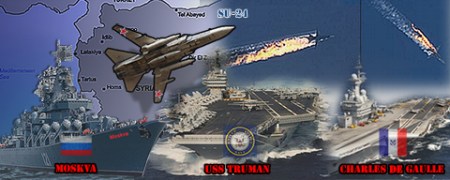
The Russian general staff announced that the missile cruiser Moskva, one of the largest warships in the world, was ordered to move closer to the Syrian coast opposite the port of Latakia, near the Turkish border, and to “destroy any target posing danger.”
DEBKAfile’s military sources say the Moskva serves as a floating missile base with a complement of advanced S-300 ground-to-air missiles.
This was a message for Ankara that any Turkish warplane nearing Syria, or flying in the Hatay province of southern Turkey – where the Su-24 incident occurred – was exposed to being shot down by Russian missiles. The Russian general command also announced that Russian warplanes would henceforth escort all Russian flights operating in Syrian airspace, including bombers.
5. Although he backed Erdogan verbally, Obama has not resorted to any military steps against Russia. But he does have a card up his sleeve. The USS Harry S. Truman carrier with strike force is on its way to the Mediterranean, having sailed from the US on Nov.16.
The Truman will join the French aircraft carrier Charles de Gaulle, whose planes started bombing ISIS targets in Iraq on Nov. 23. If Obama orders the Truman to enter the Syrian theater, there will be two warships from NATO member states facing Russian naval forces off the Syrian coast, led by the missile carrier Moskva.
US Not Sure Who It’s Fighting In Middle East, Bombs Israel ‘Just To Be Sure’ Duffel Blog, November 19, 2015
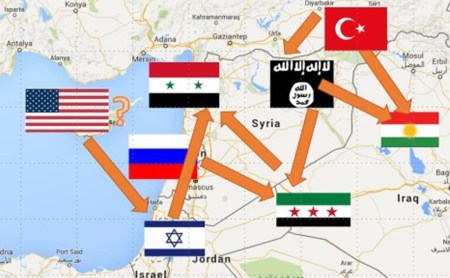 US officials are confident they understand the situation on the ground in Syria. (Duffel Blog photo.)
WASHINGTON, D.C. — Pentagon spokesperson Col. Steve Warren announced US aircraft participating in Operation Inherent Resolve, the code name for the campaign against the Islamic State of Iraq and al-Sham (ISIS), struck targets in Tel Aviv today.
When asked why US warplanes would attack a long-standing ally, Warren explained, “Look, guys, this all makes perfect sense,” pointing to a nebulous PowerPoint slide.
“This was all supposed to be a campaign to topple Bashar al-Asad in Syria, starting with the Arab Spring in 2011. Which, in turn, allowed us to get back at Iran and Russia, both of whom support Syria,” said Warren. “So the CIA considered arming the rebels in Syria, which kind of backfired, and now we have ISIS, a group we thought we had already defeated back when they were al-Qaeda in Iraq.”
Secretary of Defense Ashton Carter further explained, “Sure, we were a little worried when ISIS started running around the Middle East, chopping everyone’s heads off. But fortunately, Iran came to our rescue. Well, in Iraq, that is. We’re still fighting Iran in Yemen.”
Chairman of the Joint Chiefs General Joe Dunford stressed the contributions of America’s coalition partners.
Dunford explained how the US tried to empower allies among the Gulf States to take on ISIS, “which in turn sort of helps us get back at Iran.”
“Unfortunately, most of those states also covertly support ISIS, even though they’re nominally our long-standing allies. Whoops,” said Dunford.
“That’s not to say we don’t have some powerful allies in the region, though,” Dunford explained. “The Kurds have proven to be our greatest allies there, and the Turks are one of our longest-standing NATO allies. Unfortunately, they spend more time fighting each other than ISIS. That old saying, ‘nothing brings people together like a common enemy’ is completely useless here.”
Dunford concluded, “So, you see, ISIS is supported by Arabs, who are opposed by Iranians, who are both opposed and allied with the US, who is sort of allied with Turkey and the Kurds, who are opposed to each other. Since the enemy of my friend is now my enemy, it made sense for the US to bomb Israel, Iran’s bitter adversary.”
Events grew even more complicated in the wake of the deadly terrorist attacks in Paris last Friday. The attacks were reportedly the work of ISIS, who also claimed credit for the bombing of a Russian airliner earlier this month.
“France and Russia have formed an alliance, though in doing so, they automatically caused Germany, Austria-Hungary, and the Ottoman Empire to declare war in return,” said Pentagon Press Secretary Peter Cook. “And, let’s face it, this whole thing really is the fault of the Ottomans when you think about it.”
The briefing then shifted to issues surrounding Afghanistan and Pakistan.
“There, the situation is much more simple,” Cook continued. “The US is fighting the Taliban by providing billions of dollars in military aid to Pakistan, which is supporting the Taliban. Basically, it’s like that scene in The Empire Strikes Back where Luke Skywalker thinks he’s fighting Darth Vader, only to find his own face in Darth Vader’s helmet. That’s pretty much what we’ve gotten ourselves into.”
REAL men like Obama aren’t afraid of widows and three year old orphans! Dan Miller’s Blog, November 18, 2015
(The views expressed in this article are mine and do not necessarily reflect those of Warsclerotic or its other editors. — DM)
As Obama has told us, Islam is the religion of peace, tolerance and love. Islamists coming to America to flee the violent depredations of Crusader-inspired Quaker, Amish and Jewish terrorists produced by climate change must be welcomed. To reject them would be cowardly and un-Amerian un-Islamic.

Thus spake Obama, who has managed to become even more of a caricature of a president than previously. He needed to try manfully, but finally surpassed even Himself. Having set the bar so high, will He ever be able to surpass Himself again?
To ask “what Obama was thinking” when he made the remarks memorialized in the above video is to suggest that He was actually thinking. Perhaps He was thinking that His followers, who have been hiding in their “safe spaces” at Yale and other bastions of higher learning, are unaware of what happened in Paris. Maybe they are also unaware that it could happen in America if we permit the unfiltered immigration of Islamic terrorists like France, German, Sweden and much of the rest of Europe have done. Maybe they can be kept oblivious to such problems by happy talk about widows and young orphans. Or perhaps it was Obama’s way of showing courage and moral superiority: unlike His cowardly opponents, He isn’t scared of widows and three year old children! Other threats? He’s dealing really well with those, so let’s change the subject; He is too busy to talk about doing anything different.

Leading from behind is lots of work, but He does it with the same bravery, steadfastness and self-sacrifice He demonstrates daily in all other contexts.
Hashtags, the Obama Administration’s most effective Weapons of Mass Deception (WMDs), have again been deployed:

Shouldn’t the new hashtag read “#Widows and three year old orphans Welcome?” Shouldn’t also it disparage “racist” Halloween costumes and speech offensive to Muslims? In the holy name of Islam, we must submit to Obama’s wisdom; the Department of Domestic Tranquility (DDT) must get on the case immediately to make sure that we do.f
Hollande, Obama lack the troops and will for total war on ISIS. Mid East rulers are even more reluctant, DEBKAfile, November 16, 2015
 French anti-terror police
When French President Francois Hollande declared war on ISIS and called the attack in Paris an “act of war,” he gave the terrorist organization’s leader Abu Bakr Al-Baghdadi an unexpected boost. He upgraded the Muslim caliphate to a fully-fledged state against which France is now at war. US President Barack Obama was more cautious, declaring at the G-20 summit in Antalya that his country and France would fight together against terror, without specifying how.
Obama has problems of his own. The attempt to portray the Kurdish conquest of the city of Sinjar in northern Iraq as an important achievement in the war against ISIS dissipated quickly after Peshmerga troops were shown on TV moving into a city that was empty and lying in ruins, after it was abandoned by Islamic State forces. There was no battle there either.
Also, the US and Kurdish claims that they had severed the main road link between the ISIS capitals in Iraq and Syria, Mosul and Raqqa, proved hollow as ISIS had stopped using that route months ago after it became vulnerable to American air strikes.
If that wasn’t enough, Obama ran into an obstacle in Antalya.
The summit’s host, Turkish President Tayyip Erdogan, who is consumed by an overriding aversion to an independent Kurdish state rising on his country’s border, demanded a declaration that all Kurdish forces, including the Peshmerga, the PKK and the YPG, on which the US depends heavily for fighting the war against ISIS, be classified as terrorists and targeted by the West just like ISIS.
Therefore, before broaching any decisions about intensifying the war on the Islamist terrorists, Western and Muslim countries were already at odds on targets.
It therefore makes no sense for President Hollande to try and invoke Article 5 of the NATO charter under which an act of war against one member of the alliance is tantamount to a war on all. Furthermore, making this a NATO operation would rule out a priori any collaboration with Russia in the campaign against ISIS, despite their common objective. Vladimir Putin was already vexed over the feeble Western response to the bombing of a Russian airliner killing 224 people, compared to the global outcry over the Paris outrage.
In their responses and commentaries on what to do after the Paris assault, Western politicians and security experts seemed to agree that putting their own boots on the ground for finally getting to grips with ISIS was not on the cards – there would just be “more of the same,’ as one American security expert put it.
Others advised assigning the ground battle to the Egyptian, Jordanian, Kurdish, Iraqi, Saudi and other Gulf Arab states.
Who were they kidding? None of those Arab governments or armies is capable or willing to declare full-scale war on the Islamic State. The Kurds alone have stepped into the breach and are confronting the Islamists face to face, but they have sought in vain for the weapons they need, which the US refuses to supply.
Egypt, for instance, even after an ISIS network was able to breach its security system in Sharm El-Sheikh to plant a bomb on the Russian airliner on Oct. 31, has held back from a major military assault on the strongholds of the Ansar Beit Al-Maqdis, otherwise known as ISIS-Sinai. Egypt’s President Fattah Al-Sisi has not uttered a word on the Islamist threat since then.
French security and intelligence services demonstrated that they were unprepared for war on ISIS, and are pretty much in the same boat as other Western powers.
Since the outrage in Paris, French and Belgian security forces have conducted raid after raid to pick up Islamists, claiming to be rounding up the masterminds and confederates of the nine bombers and shooters who attacked Paris and murdered 132 people In fact, they are acting more to calm a jittery public than in the expectation of achieving meaningful results in the war on terror. Till now, neither France nor any Western government knows exactly how many people were involved in the attack on Paris, or the numbers and locations of the Islamic Caliphate’s worldwide terror networks.




 anneinpt
 artaxes
 danmillerinpanama
 davidking1530
 Peter Hofman
 Joseph Wouk
 Peter
Peter Louisiana Steve
 WarSclerotic
Recent Comments