Archive for the ‘national security’ category

The Great Western Retreat

May 4, 2016

The Great Western Retreat, Gatestone InstituteGiulio Meotti, May 4, 2016

♦ Of all French soldiers currently engaged in military operations, half of them are deployed inside France. And half of those are assigned to protect 717 Jewish schools.

♦ This massive deployment of armed forces in our own cities is a departure from history. It is a moral disarmament, before a military one.

♦ Why does anyone choose to fight in a war? Civilized nations go to war so that members of today’s generation may sacrifice themselves to protect future generations. But if there are no future generations, there is no reason whatever for today’s young men to die in war. It is “demography, stupid.”

On March 11, 2004, 192 people were killed and 1,400 wounded in a series of terrorist attacks in Madrid. Three days later, Spain’s Socialist leader, José Luis Rodríguez Zapatero, was elected prime minister. Just 24 hours after being sworn in, Zapatero ordered Spanish troops to leave Iraq “as soon as possible.”

The directive was a monumental political victory for extremist Islam. Since then, Europe’s boots on the ground have not been dispatched outside Europe to fight jihadism; instead, they have been deployed inside the European countries to protect monuments and civilians.

Opération Sentinelle” is the first new large-scale military operation within France. The army is now protecting synagogues, art galleries, schools, newspapers, public offices and underground stations. Of all French soldiers currently engaged in military operations, half of them are deployed inside France. And half of those are assigned to protect 717 Jewish schools. Meanwhile, French paralysis before ISIS is immortalized by the image of police running away from the office of the satirical magazine Charlie Hebdo during the massacre there.

1578French soldiers guard a Jewish school in Strasbourg, February 2015. (Image source: Claude Truong-Ngoc/Wikimedia Commons)

You can find the same figure in Italy: 11,000 Italian soldiers are currently engaged in military operations and more than half of them are used in operation “Safe Streets,” which, as its name reveals, keeps Italy’s cities safe. Italy’s army is also busy providing aid to migrants crossing the Mediterranean.

In 2003, Italy was one of the very few countries, along with Spain and Britain, which stood with the United States in its noble war in Iraq — a war that was successful until the infamous US pull-out on December 18, 2011.

Today, Italy, like Spain, runs away from its responsibility in the war against the Islamic State. Italy’s Defense Minister Roberta Pinotti ruled out the idea of Italy taking part in action against ISIS, after EU defense ministers unanimously backed a French request for help.

Italy’s soldiers, stationed in front of my newspaper’s office in Rome, provide a semblance of security, but the fact that half of Italy’s soldiers are engaged in domestic security, and not in offensive military strikes, should give us pause. These numbers shed a light not only on Europe’s internal terror frontlines, from the French banlieues to “Londonistan.” These numbers also shed light on the great Western retreat.

US President Barack Obama has boasted that as part of his legacy, he has withdrawn American military forces from the Middle East. His shameful departure from Iraq has been the main reason that the Islamic State rose to power — and the reason Obama postponed a military withdrawal from Afghanistan. This US retreat can only be compared to the fall of Saigon, with the picture of a helicopter evacuating the U.S. embassy.

In Europe, armies are no longer even ready for war. The German army is now useless, and Germany spends only 1.2% of GDP on defense. The German army today has the lowest number of staff at any time in its history.

In 2012, Germany’s highest court, breaking a 67-year-old taboo against using the military within Germany’s borders, allowed the military to be deployed in domestic operations. The post-Hitler nation’s fear that the army could develop again into a state-within-a-state that might impede democracy has paralyzed Europe’s largest and wealthiest country. Last January, it was revealed that German air force reconnaissance jets cannot even fly at night.

Many European states slumber in the same condition as Belgium, with its failed security apparatus. A senior U.S. intelligence officer even recently likened the Belgian security forces to “children.” And Sweden’s commander-in-chief, Sverker Göranson, said his country could only fend off an invasion for a maximum of one week.

During the past ten years, the United Kingdom has also increasingly been seen by its allies — both in the US and in Europe — as a power in retreat, focusing only on its domestic agenda. The British have become increasingly insular – a littler England.

The UK’s armed forces have been downsized; the army alone is expected to shrink from 102,000 soldiers in 2010 to 82,000 by 2020 – its smallest size since the Napoleonic wars. The former head of the Royal Navy, Admiral Nigel Essenigh, has spoken of “uncomfortable similarities” between the UK’s defenses now and those in the early 1930s, during the rise of Nazi Germany.

In Canada, military bases are now being used to host migrants from Middle East. Justin Trudeau, the new Canadian prime minister, first halted military strikes against ISIS, then refused to join the coalition against it. Terrorism has apparently never been a priority for Trudeau — not like “gender equality,” global warming, euthanasia and injustices committed against Canada’s natives.

The bigger question is: Why does anyone choose to fight in a war? Civilized nations go to war so that members of today’s generation may sacrifice themselves to protect future generations. But if there are no future generations, there is no reason whatever for today’s young men to die in war. It is “demography, stupid.”

Spain‘s fertility has fallen the most — the lowest in Western Europe over twenty years and the most extreme demographic spiral observed anywhere. Similarly, fewer babies were born in Italy in 2015 than in any year since the state was founded 154 years ago. For the first time in three decades, Italy’s population shrank. Germany, likewise, is experiencing a demographic suicide.

This massive deployment of armed forces in our own cities is a departure from history. It is a moral disarmament, before a military one. It is Europe’s new Weimar moment, from the name of the first German Republic that was dramatically dismantled by the rise of Nazism. The Weimar Republic still represents a cultural muddle, a masterpiece of unarmed democracy devoted to a mutilated pacifism, a mixture of naïve cultural, political reformism and the first highly developed welfare state.

According to the historian Walter Laqueur, Weimar was the first case of the “life and death of a permissive society.” Will Europe’s new Weimar also be brought down, this time by Islamists?

Europe Still Sleeps, and Europeans Still Die

March 30, 2016

Europe Still Sleeps, and Europeans Still Die, Front Page MagazineBruce Thornton, March 30, 2016

bt

While England Slept is the title of Winston Churchill’s 1938 book documenting the failure of England to counter Germany’s rearmament. Despite the gruesome price paid for ignoring Churchill’s warnings, postwar Europe has slumbered for decades while its cultural dysfunctions have nurtured the jihadist violence erupting across Europe. Last week’s attacks in Brussels, coming four months after the Paris attacks that killed 130, suggests there are more attacks to come. According to AP, 400-600 ISIS-trained terrorists are making their way to Europe.

Europe can’t say it wasn’t warned. In 2002 Oriana Fallaci published The Rage and the Pride, a passionate defense of Western civilization and an indictment of those who appease Islamic illiberalism.  Ten years ago Bruce Bawer’s While Europe Slept gave first-hand reports of Europe’s feckless immigration policies that fostered and appeased Muslim radicalism and violence. A year later Claire Berlinski’s Menace in Europe and Melanie Phillips’ Londonistan sounded the same alarms. And there are the dystopian novels of Michel Houellebecq like Platform and last year’s Submission, which link Europe’s cultural and spiritual exhaustion to the rise of homegrown jihadism and Islamization.

An even more important prophet is Bat Ye’or, whose Eurabia (2005) documented “Europe’s evolution from a Judeo-Christian civilization, with important post-Enlightenment secular elements, into a post-Judeo-Christian civilization that is subservient to the ideology of jihad and the Islamic powers that propagate it.” The result is the dhimmi mentality of Europe’s elites, which manifests in word and deed Western inferiority to Islam, and guilt over alleged crimes against the Muslim world.

But a secularized Europe committed to multicultural fantasies and la dolce vita as the highest goods has dismissed these prophets as bigots and “Islamophobes” who distort the “religion of peace.” Yet after the collapse of the Ottoman caliphate in 1923––the “catastrophe” Osama bin Laden mentioned after 9/11–– the theorists of modern jihadism were forthright and plain in expressing the intolerant and triumphalist Islamic beliefs and jihadist imperative consistent with Ye’or’s analysis. Islam’s nature, Muslim Brotherhood founder Hassan al-Banna wrote, is “to dominate, not to be dominated, to impose its laws on all nations, and extend its power to the entire planet.” Fellow Muslim Brother Sayyid Qutb concurred: “Islam has a right to remove all those obstacles which are in its path.” The Ayatollah Khomeini, leader of the Iranian Revolution, agreed: “The great prophet of Islam carried in one hand the Koran and in the other a sword; the sword is for crushing the traitor and the Koran for guidance . . . Islam is a religion of blood for infidels but a religion of guidance for other people.”

Nor are these sentiments alien to traditional Islamic beliefs as codified in the Koran, Hadith, Muslim histories, and the biographies of Mohammed. As such, the jihadist imperative, despite anticolonial and nationalist rhetoric, was the foundational motivation for the military attacks on Israel in 1948, 1967, and 1973, and today it still drives the terror campaigns against Israel waged by Hamas, Hezbollah, and the PLO. Jihad in the name of Allah sparked the Iranian Revolution of 1979, and the subsequent launching of the Iranian terrorist mother ship from which numerous jihadist organizations have continued to receive training and financial support. The Taliban who gave sanctuary to al Qaeda in Afghanistan are close students of jihad and shari’a law, executing transgressors in a soccer stadium paid for by the EU.

Nor has the West been spared. Jihad lay at the heart of al Qaeda’s serial attacks on the U.S. and its military in 1993 (first World Trade Center bombing), 1996 (Khobar Towers), 1998 (East African embassies), 2000 (U.S.S. Cole), and the spectacular carnage of September 11, 2001, as well as inspiring the terrorist murders in Madrid (2004), London (2005), Fort Hood (2013), Boston (2013), San Bernardino (2015), Paris (January and November, 2015), and now Brussels. And don’t forget the torture, rape, and murders perpetrated by ISIS, the latest and most successful example of modern jihadism inspired by traditional Islamic doctrine.

We know the terrorists’ Islamic bona fides because they continually tell us why they want to kill us, in speeches, internet videos, and writings filled with Koranic verses and precedents from the life of Mohammed. Yet despite this evidence, elites in Europe and the U.S. refuse to confront the religious origins of jihadism, settling for the stale environmental and psychological causes dear to the materialist mentality. Thus they continue to chant the “nothing to do with Islam” mantra, as our president did in response to the Brussels attack. “ISIL is not ‘Islamic,’” the president asserted. “No religion condones the killing of innocents, and the vast majority of ISIL’s victims have been Muslim.” The first two clauses are patently false to Koranic commands and Islamic history, and the third is a non sequitur.

But the most powerful refutation of this common delusion is the scarcity of public protests by observant Muslims against the “extremists” who allegedly have “hijacked” their faith. After each jihadist atrocity there is typically more celebratory ululation and cries of “Allahu Akbar” in the Muslim world than marches against terrorism by heretical “extremists.” There are no “million Muslim marches,” no “not in our name movements,” no large scale Muslim attendance at memorial services for the victims. Yet perceived insults to Islam or Mohammed will produce violent mobs and lethal rampages.

Nor should this surprise us, when poll after poll registers significant pluralities and majorities of Muslims who approve of violence against infidels, and support the implementation of illiberal shari’a law. The latest evidence for such support from “moderate Muslims” comes from Brussels, where the planner of the Paris and Brussels attacks, Salah Abdeslam, was hiding in plain sight in the Muslim-dominant district of Molenbeek. Yet it still took four months for Belgian police to find him, and when they moved in for the arrest, they were met with rocks and bottles from residents who knew he was there and never tipped off the authorities.

Yet this is just one of many such enclaves in Europe. Ca n’Anglada in Barcelona, Marxloh and Neukölln in Germany, Seine-Saint-Denis and Clichy-sous-Bois in France, Malmo in Sweden, and many other towns and neighborhoods across Europe house disaffected and unassimilated Muslim immigrants whose faith predisposes them to contempt for the infidel and his secular laws, and justifies violence against the enemies of Islam. And despite the segregation, unemployment, crime, costly welfare transfers, and jihad-preaching mosques in these neighborhoods, Europe has accepted hundreds of thousands more Muslim immigrants in 2015 alone. Undoubtedly among them are untold numbers of ISIS-trained terrorists, many of them from the 5000 European Muslims who have gone to fight for ISIS in Iraq and Syria.

That is the reality everyone knows who wants to know. But too many in the West do not want to know, just as those enamored of Soviet communism did not want to know about the gulags and show-trials and engineered famines that killed at least 20 million. Like yesterday’s communist sympathizers, today the sleepwalkers of Europe are trapped in their ideological fever-dreams––fashionable self-loathing, guilt for colonialism and imperialism, sentimental one-worldism, and noble-savage multicultural fantasies. Worst of all, they are crippled by a refusal to appreciate and defend their political and cultural inheritance––prosperity, human rights, freedom, consensual government, and tolerance––created by their ancestors.

The character of Michel in Houellebecq’s Platform (2001) articulates the failure of civilizational nerve that has paved the way for metastasizing jihadist violence. Europe’s forbears, the jaded hedonist Michel muses, “believed in the superiority of their civilization,” and “invented dreams, progress, utopia, the future.” But their “civilizing mission,” their “innocent sense of their natural right to dominate the world and direct the path of history had disappeared.” All that is left is the dwindling cultural capital being squandered by their descendants, who have lost “those qualities of intelligence and determination,” and who exist only for the present and its material pleasures. Like like Michel, they are “decadent” and “given over entirely to selfishness.”

But at least Michel, unlike the sleepwalking European elite, recognizes that this is cultural suicide: “I was aware, however, that such a situation was barely tenable, that people like me were incapable of ensuring the survival of a society. Perhaps, more simply, we were unworthy of life.”

The terrorists of Paris and Brussels agree.

Trump and the Left’s Accusations of Fascism

March 16, 2016

Trump and the Left’s Accusations of Fascism, Front Page MagazineBruce Thornton, March 16, 2016

trump

Donald Trump’s success in the primaries and his rhetoric have sparked troubled meditations about an awakening of fascist impulses among his supporters. Bret Stephens has drawn an analogy with the Thirties, “the last dark age of Western politics,” and compared Trump to Benito Mussolini. On the left, Dana Milbank, in a column titled “Trump Flirts with Fascism,” wrote about a campaign rally at which Trump was “leading supporters in what looked very much like a fascist salute,” a scene New York Times house-conservative David Brooks linked to the Nuremberg party rallies.

Much of the rhetoric that links Trump to fascism or Nazism is merely the stale ad Hitlerum fallacy used by progressives to demonize the candidate. They did the same thing when they called George W. Bush “Bushitler.” This slur reflects the hoary leftist dogma that conservatives at heart are repressed xenophobes and knuckle-dragging racists lusting for a messianic leader to restore their lost “white privilege” and punish their minority, immigrant, and feminist enemies. As such, the attack on Trump is nothing new or unexpected from a progressive ideology whose totalitarian inclinations have always had much more in common with fascism than conservatism does.

What Auden called the “low dishonest decade” of the Thirties, however, is indeed instructive for our predicament today, but not because of any danger of a fascist party taking root in modern America. Communism was (and in some ways still is) vastly more successful at infiltrating and shaping American political, cultural, and educational institutions than fascism ever was. But the same cultural pathologies that enabled both fascist and Nazi aggression still afflict us today. These pathologies and their malign effects are more important than the reasons for Trump’s popularity–– anger at elites, economic stagnation, and anti-immigrant passions–– that supposedly echo the “waves of fear and anger” of Auden’s Thirties.

The most important delusion of the Thirties still active today is the idealistic internationalism that had developed over the previous century. A world shrunk by new communication and transportation technologies and linked by global trade, internationalists argued, meant nations and peoples were becoming more alike. Thus they desired the same prosperity, political freedom, human rights, and peace that the West enjoyed. Interstate relations now should be based on this “harmony of interests,” and managed by non-lethal transnational organizations rather than by force. Covenants and treaties like the Hague and Geneva Conventions, and institutions like the League of Nations and the International Court of Arbitration, could peacefully resolve conflicts among nations through diplomatic engagement, negotiation, and appeasement.

The Preamble to the First Hague Convention (1899) captures the idealism that would compromise foreign policy in the Thirties. The Convention’s aims were “the maintenance of the general peace” and “the friendly settlement of international disputes.” This goal was based on the “solidarity which unites the member of the society of civilized nations” and their shared desire for “extending the empire of law and of strengthening the appreciation of international justice.” Two decades later, the monstrous death and destruction of World War I should have shattered the delusion of such “solidarity” existing even among the “civilized nations.” Despite that gruesome lesson, Europe doubled down and created the League of Nations, which failed to stop the serial aggression that culminated in World War II.

But the League wasn’t the only manifestation of naïve internationalism. The Locarno Treaty of 1925 welcomed Germany back into the community of nations with a seat on the League of Nations council. Nobel Peace prizes, and wish-fulfilling headlines like the New York Times’ “France and Germany Bar War Forever,” were all that resulted. The Kellogg-Briand pact of 1928 “condemn[ed] recourse to war for the solution of international controversies, and renounce[d] it as an instrument of national policy” in interstate relations. The signing powers asserted that “the settlement or solution of all disputes or conflicts . . . shall never be sought except by pacific means.”

All the future Axis Powers signed the treaty, and they all soon shredded these “parchment barriers.” In the next few years, Japan invaded Manchuria, Hitler remilitarized the Rhineland in gross violation of the Versailles Treaty, and Italy invaded Ethiopia. By the time Germany annexed Austria, and Neville Chamberlain’s faith in negotiation and appeasement handed Czechoslovakia to Hitler, all these treaties and conventions and conferences were dead letters, and the League of Nations was exposed as a “cockpit in the tower of Babel,” as Churchill suggested after the First World War.

However, such graphic and costly evidence showing the folly of “covenants without the sword,” as Hobbes put it, did not discredit this dangerous idealism over the following decades. Indeed, it lies behind the disasters of Obama’s foreign policy. Just consider his “outreach” to our enemies, his acknowledgement of our own “imperfections,” his reliance on toothless U.N. Security Council Resolutions, his preference for non-lethal economic sanctions to pressure adversaries, and his belief that negotiated settlements and agreements can achieve peace and good relations even with our fiercest enemies. All reflect the same failure to recognize that our adversaries in fact do not sincerely want to reach an agreement, for the simple reason they are not in fact “just like us,” and so they do not want peace and prosperity and good relations with their neighbors and the “world community.”

The catalogue of Obama’s failures is long and depressing. The “reset” with Russia and promise of “flexibility,” the empty “red line” threats against Bashar al Assad, the arrogant dismissal of a metastasizing ISIS as a “jayvee” outfit, the alienation of allies like Egypt, Saudi Arabia, and Israel, the cultivation of the jihadist Muslim Brotherhood, the ill-conceived overthrow of Muammar Ghaddafi, and the rhetoric of guilt and self-abasement are just the most noteworthy failures. The nuclear deal with Iran, of course, is the premier monument to this folly. Yet despite the increasing evidence of its futility­­––Iran’s saber-rattling in the Gulf, capture of U.S. military personnel, genocidal rhetoric, and testing of missiles in blatant violation of a U.N. Security Council resolution–– Obama still clings to this internationalist delusion.

A recent article in The Atlantic on Obama’s foreign policy shows, despite his protestations of hardheaded “realism,” that he has not learned from his failures. Thus he still thinks that the vigorous use of force is usually an unnecessary and dangerous mistake, and that verbal persuasion and diplomatic engagement are more effective. He also still believes that “multilateralism regulates [U.S.] hubris” of the sort that George W. Bush showed when he recklessly invaded Iraq, and that American foreign policy has frequently displayed.

Obama’s delusional faith in rhetoric, especially his own, comes through in his rationale for the infamous 2009 Cairo speech: “I was hoping that my speech could trigger a discussion, could create space for Muslims to address the real problems they are confronting—problems of governance, and the fact that some currents of Islam have not gone through a reformation that would help people adapt their religious doctrines to modernity.” The idea that Obama’s mere words could start a “discussion” that would transform 14-century-old religious doctrines fundamentally inimical to liberal democracy, human rights, and all the other Western goods we live by, is a fantasy. Obama’s self-regard recalls Neville Chamberlain’s boast after his meeting with Hitler at Bad Godesberg that he “had established some degree of personal influence with Herr Hitler.”

Or consider Obama’s take on Vladimir Putin:

He understands that Russia’s overall position in the world is significantly diminished. And the fact that he invades Crimea or is trying to prop up Assad doesn’t suddenly make him a player. You don’t see him in any of these meetings out here helping to shape the agenda. For that matter, there’s not a G20 meeting where the Russians set the agenda around any of the issues that are important.

A “player,” in Obama’s foreign policy universe, is a leader who uses “smart power” like diplomacy and negotiated deals, and recognizes that the use of force will backfire and lead to costly “quagmires.” As Secretary of State John Kerry suggested, Putin is using outdated “19th century” instruments of foreign policy like military force in a world that presumably has evolved beyond it.

In contrast, a genuine “player,” as Obama fancies himself, attends summits and conferences, such as the useless climate change conference in Paris, and “sets the agenda.” And like his rationale for the Cairo speech, as the leader of the world’s greatest power, his rhetoric alone can be a force for change. Thus just saying that Syria’s “Assad must go,” while doing nothing to achieve that end, is still useful, and refusing to honestly identify the traditional Islamic foundations of modern jihadism will build good will among Muslims and turn them against the “extremists.”

Meanwhile, Putin and Iran fight and bomb and kill in Syria and Iraq, and now they are the big “players” in a region that the U.S. once dominated, but that now serves the interests of Russia and Iran. I’m reminded of Demosthenes’ scolding of the Athenians for refusing to confront Phillip II of Macedon: “Where either side devotes its time and energy, there it succeeds the better––Phillip in action, but you in argument.”

In other words, for Obama as for Chamberlain, appeasing words rather than forceful deeds are the key to foreign policy––precisely the belief that led England to disastrously underestimate Hitler until it was too late. And that same belief has turned the Middle East into a Darwinian jungle of clashing tribes, sects, and nations.

Obama wraps his foreign policy of retreat in claims to “realist” calculations of America’s security and genuine interests, and buttresses his claim by citing his strategically inconsequential drone killings. But such rhetoric hides an unwillingness to risk consequential action and pay its political costs. And it reflects a commitment to the internationalist idealism that gives diplomatic verbal processes an almost magical power to transform inveterate enemies into helpful partners. Europe tried that in the Thirties, and it led to disaster. That’s a much more important lesson from that sorry decade’s history than the lurid fantasies about fascism coming to America on the wings of Trump’s rhetoric.

Immigration or an IPhone

February 25, 2016

Immigration or an IPhone, Front Page Magazine, Daniel Greenfield, February 25, 2016

male-refugees

The public argument between Apple and the FBI over cracking the encryption on an iPhone used by the San Bernardino Muslim terrorists is one of those ongoing civil liberties debates that negotiate the terms on which we are asked to sacrifice our civil liberties for the sake of Muslim immigration.

We have already made a thousand accommodations and we will make a thousand more. There will be more databases, naked scanners, eavesdropping, vans that can see through walls, backdoors to every server, registrations, warrantless searches, interceptions and regulations. There will be heavily armed police on the streets. And then curfews and soldiers. These things exist in Europe. They’ll come here.

Some libertarians will argue that we should have none of this and no restrictions on immigration. That we should just shrug off each terror attack and move on with our lives.

Eventually though there will be a terror attack that we can’t shrug off and that can’t be minimized by using the cheap statistical trick of comparing Terror Attack X to the number of people who die every year from cancer. Or there will just be an endless parade of daily attacks, bombings, stabbings or shootings, as in Israel, which create a constant climate of terror that will preclude any hollow rhetoric about the number of people falling off ladders each year or getting struck by lightning.

Some hawks will cheer every terror fighting measure short of closing the door on the root cause of the problem. They would rather see every American wiretapped, strip searched and monitored every hour of the day then just stop the flow of Muslim terrorists into this country.

The encryption methods of an iPhone, like the question of how many ounces there are in your tiny bottle of mouthwash, would not be much of an issue, if Muslim migration did not make it one.

Terrorists adapt to the terrain. They use the native population as protective coloration. They can find a way to transform a shoe, a tube of toothpaste or instant messaging on a game console into a terror tool. Just as the left can ‘politicize’ everything, Muslim terrorists can ‘terrorize’ everything. When everything is a potential terrorist tool, then there can be no such thing as privacy or civil rights.

Muslim immigration is forcing us to constantly choose between our lives and our civil liberties. It’s a Catch 22 decision with no good choices. Terrorists push governments toward totalitarianism so that their own alternative totalitarian state starts to seem like a less terrible alternative. But the refusal to fight terrorism also makes the totalitarian state of the terrorists more viable.

With every Muslim terror attack, successful or only attempted, they win and we lose. The pressure of terror attacks discredit Western ideologies and worldviews, both on the right and the left. Each attack helps generate new converts for Islam and more political influence for Islamist organizations.

Vociferous debates over the choice between civil liberties and security make it seem as if we have to choose between our worldviews because something in our society is the problem. It isn’t.

We do not have an American terror network problem. The Amish aren’t using iPhones or obscure apps to coordinate terror attacks. We have a Muslim terror network problem. It’s not because of the Methodists that we have to weigh our mouthwash or take our shoes off and put them in a greasy plastic tray at the airport. It’s because 19 Muslims entered this country, hijacked our airplanes and murdered thousands of Americans. Guantanamo Bay is not an issue because Buddhists are at war with America. It’s an issue because Muslim terrorists are at war with America.

We do not have an iPhone encryption problem or a shoe problem or a mouthwash problem. We have a Muslim terror problem.

Whatever decision is made about iPhone encryption will not be the last word. The simple reality is that privacy carries too high a price as long as we have large numbers of people in this country who want to kill us in equally large numbers. If we want our privacy back, it’s not the FBI that is standing in our way. It’s the religious organizations that are paid to bring Muslim “refugees” to this country. It’s the liberal, libertarian and even conservative voices that think there is something wrong with pausing the mass migration of the group that is disproportionately responsible for our terror problem. It’s the media that would rather discuss anything and everything than discuss the problem we are really dealing with.

The source of this problem is not whether the FBI handled the iPhone correctly or whether Apple should be obligated to build a way for law enforcement to access its devices. These arguments would exist even without Muslim terrorism, but they would lack the same level of life and death urgency.

This is not an iOS problem. It’s an immigration problem.

The San Bernardino massacre by Muslim terrorists would not have happened without Muslim immigration. The security flaw here was not in the work of FBI agents or of Apple programmers, but of our immigration laws. Just as we cannot and will not intercept every single Muslim terrorist who finds a way to hide explosives in his underwear, shoes, soda or laptop, we will not ever be able to crack every single encrypted Muslim terrorist device. And their underwear bombs and encrypted iPhones would not be an issue if we did not have Muslim terrorists in America in the first place.

Instead of discussing the Islamic root cause, we put stress on our own competing institutions, technology providers face off with law enforcement, hawks and civil libertarians berate each other as if they were each part of the threat. But we are not the problem here. They are the problem.

The only backdoor that should be at issue here is the one that Muslim terrorists use to enter America. We don’t need to violate everyone’s rights to close it. We just need the political will to do the common sense thing and shut down the source of the threat. Either that or give up on our privacy.

Our choice is very simple. We can have external security or an internal police state. But neither of the above is not an option. We can have open borders that fill our country with criminals, but that means that eventually any livable middle class neighborhood will have a cop on every corner. We can have airport security for the people coming into this country. Or we can have airport security for everyone.

Ongoing Muslim migration makes a police state inevitable. But to avoid the perils of profiling and the appearance of discrimination, it will be a universal police state that will strip away rights from everyone without regard to guilt or innocence in the hopes of averting the next Muslim terror attack.

The only way to protect our lives and our freedoms from Muslim terrorism and its consequences is by shutting down Muslim immigration. If we fail to do this, then we will lose our lives and our liberties.

What to Expect in Iran

February 22, 2016

What to Expect in Iran, Gatestone InstituteJagdish N. Singh, February 22, 2016

♦ “The destruction of Israel is non-negotiable.” — Mohammad Neza Naghdi, Commander of Iran’s Basij paramilitary force.

♦ Sanctions relief will mainly benefit Ayatollah Khamenei and members of the Revolutionary Guards: they control up to one-third of Iran’s economy.

♦ Part of the Iranian regime’s grand strategy is to inflict “death to America” and replace it with its own radical version of Islamic governance. Ayatollah Khamenei himself called for America’s destruction amid nuclear negotiations.

♦ Officials also believe Iran is indirectly funding the Islamic State (IS) in the Sinai. “Suitcases of cash” are sent directly to Hamas officials in the Gaza Strip; part of the money is then transferred to IS.

♦ Iran now poses an even greater threat. If democracies today continue their present policies towards Iran, it will only embolden Iran’s regime to continue its quest to obtain nuclear weapons as well as its terrorism and human rights violations.

Humanity seldom seems to learn its lessons. The governments of the world’s leading democracies appear to be suffering from this predicament in their nuclear dealings with the Islamic Republic of Iran. To avoid catastrophe, democracies need quickly to correct their course.

One of the fatal blunders of Western democracies is their repeated commitment to appeasing and delaying action against aggressive regimes. Between the two World Wars, despite plenty of evidence of the widely-declared global racist agenda of Germany’s Adolf Hitler, democratic powers waited to take action until it was too late. Hitler was able to carry out a genocide that continues to haunt many nations.

Today, Western democratic governments, with their Eastern counterparts such as India, seem on a similar course in dealing with the Islamic Republic of Iran.

The domestic and international agenda of the Khomeinist government is publicly documented. Since the Iranian Revolution of 1979, part of the regime’s open grand strategy is to inflict “death to America,” the leader of the free world, and replace it with its own radical version of Islamic governance. Under the current Supreme Leader Ayatollah Ali Khamenei and his Islamic Revolutionary Guards Corps (IRGC), Iran has been gaining influence across the Middle East, Latin America, the Caribbean and South Asia. Despite nuclear talks with the West, Iran’s goal of “death to America” remains. The Ayatollah himself even called for America’s destruction amid nuclear negotiations.

Currently, Iran is a major player in aiding the autocratic regime of Basher al-Assad in Syria, the Houthis in Yemen, Hezbollah in Lebanon, Palestinian Islamic Jihad and Hamas in the West Bank and Gaza and the Islamic State (IS) in Egypt’s Sinai Peninsula.

To advance its imperial agenda, Iran has proceeded to develop its conventional and nuclear ballistic missile program. According to Director of National Intelligence James Clapper, Iran has “one of the largest inventories of ballistic missiles in the Middle East.”

In line with Iran’s missile development program, Iran’s Revolutionary Guard Navy Rear Commander, Ali Fadavi, announced: “Based on the fifth five-year plan, we should materialize our objective of mass-producing military speedboats with the speed of 80 knots per hour… and are equipped with missiles with a range of 100km; the vessels no one can catch.”

Aside from its military aspirations, since the fall of the Shah in 1979, successive Iranian governments have voiced their plans to annihilate the State of Israel, the only pluralist democracy in the Middle East, and an effective military deterrent to Iran’s designs in the region.

Hostile messages have been pouring forth from Iran. Mohammad Neza Naghdi, Commander of the Basij paramilitary force, stated in clear terms in April 2015, that, “The destruction of Israel is non-negotiable.”

Major General Yahya Rahim Safavi, a former IRGC commander and a top military aide to Khamenei, warned in May 2015, that “More than 80,000 missiles are ready to rain down on Tel Aviv and Haifa.”

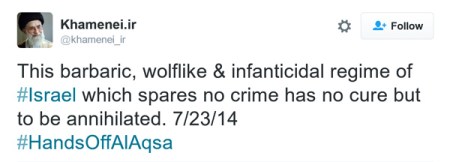
As late as November, Iran’s Supreme Leader Khamenei himself tweeted, “This barbaric, wolflike & infanticidal regime of #Israel which spares no crime has no cure but to be annihilated.”

1477

Bewilderingly, Western democracies have chosen to overlook Iran’s speeches and actions. They chose instead to appease the regime. Last July, despite genuinely serious reservations expressed by international strategic and military experts (including retired American military officers), the United States, United Kingdom, France and Germany – the four democracies in the P5+1 — concluded a nuclear deal with themselves that they proposed to Iran. Iran so far has not signed the deal, and apparently even if it did, according to the U.S. Department of State, the deal would not be legally binding.

Tehran will greatly benefit financially from the terms of the nuclear agreement in the months to come. Under the administration of President Barack Obama, nuclear sanctions against Iran have been lifted. To advance the deal and make it more appealing to Iran, the president has also agreed to pay Iran a $1.7 billion settlement for $400 million in “frozen” assets held in the United States since 1981.

The Society for Worldwide Interbank Financial Telecommunication (SWIFT), “the electronic bloodstream of the global financial system,” had disconnected 15 Iranian banks from its system in 2012. after coming under pressure from both the United States and the European Union at the height of efforts to curb Iran’s nuclear ambitions. Today, SWIFT is ready to let those banned banks, including the Central Bank of Iran, use its system once again. Iran now has an even greater ability to fund its terrorist proxies around the world.

European political and business leaders have been rushing to Tehran to sign new agreements. On January 28, in Paris, Iran’s President Hassan Rouhani and France’s President Francois Hollande signed major business deals, including a joint venture between car-makers PSA Peugeot Citroen and Iran’s Khodro. Iran is in the process of buying 118 Airbus passenger planes to update its aging fleet. The construction group Bouygues and the French airport operator ADP are now set to build an extension for Tehran’s airport, while Vinci, another construction firm, has been commissioned to design, build and operate new terminals for the Mashhad and Isfahan airports. The French oil company Total has agreed to buy Iranian crude oil, and agreements in shipping, health, agriculture and water provision have also been signed.

Democratic India is also cultivating relations with Iran. In a meeting in May, India’s Minister of Road Transport and Highways, Nitin Gadkari, and Iranian Transport and Urban Development Minister, Abbas Ahmad Akhoundi signed a Memorandum of Understanding on India’s participation in the development of the Chabahar Port in Iran.

The Chabahar project will impart strategic leverage to India and its access to Afghanistan and energy-rich Central Asia by bypassing Pakistan. The distance between the Chabahar Port and Gujarat – India’s westernmost state, located near the Persian Gulf, is less than the distance between Delhi and Mumbai. Transit times are estimated to be reduced by a third. Indian firms have already agreed to lease two existing berths at the port and operate them as container and multi-purpose cargo terminals.

The Chabahar project, New Delhi calculates, will be highly beneficial. As India has invested over $2 billion in Afghanistan, the Indian government plans to link the Chabahar port with the Zaranj-Delaram road it built in Afghanistan, thereby opening alternative routes to Afghanistan and enhancing access to regional and global markets.

Russia and China, permanent members of the UN Security Council, are also strengthening their cooperation with Iran. Both Russia and China adopted a policy of ambivalence towards Iran and saw to it that sanctions imposed by the West were not too tough. They also repeatedly blocked attempts at sanctioning Iran’s ally, the current Syrian regime, out of concern over financial ties in the region.

China is also capitalizing on the lifting of sanctions against Iran. Chinese President Xi Jinping rushed to Iran after the so-called nuclear agreement to discuss a 25-year strategic cooperation plan. In a landmark deal worth up to $600 billion, Xi committed to increase trade between the two nations during the next decade. Beijing and Tehran also agreed to enhance security cooperation through intelligence-sharing, counter-terror measures, military exchanges and coordination. Incidentally, despite international sanctions, China-Iran trade increased from $3 billion in 2001 to more than $50 billion in 2014.

Given its fanatical and sectarian ideological agenda, Iran is likely to use the new funds to boost its armament program and ongoing clandestine terror acts. Sanctions relief will mainly benefit Khamenei and members of the IRGC: they control up to one-third of Iran’s economy.

Iran now poses an even greater threat to the entire civilized world. The pattern of Tehran’s behavior shows the government can never be trusted on any promises it makes not to advance its nuclear weapons program. Khamenei has made an open declaration that Tehran will not allow effective inspections of its military sites or interviews with its nuclear scientists.

The links of the IRGC’s Qods Force with Hezbollah, Hamas, Palestinian Islamic Jihad, the Houthis and other terror militias pose a major threat to peace and stability in the Middle East.

Hezbollah’s networks have expanded over the years, infiltrating Latin America and the Caribbean through Shiite cultural centers in the region. According to an official Argentine report, Tehran has established its terrorist, intelligence and operational networks throughout Latin America as far back as the 1980s. Iran’s intelligence activities in the region are being conducted directly by Iranian officials or through its proxy, Hezbollah. Criminal activity may already be underway in Brazil, Colombia, Chile, Paraguay, Uruguay, Suriname and Trinidad and Tobago. Iran’s involvement in the cocaine trade has bolstered the regimes regional access and strengthened ties with its allies in Venezuela, Ecuador, Bolivia and elsewhere.

According to senior Western intelligence officials, the IRGC has transferred tens of millions of dollars to Hamas to be used for weapons, military equipment and training, and that Iran also delivers arms and funds to Hamas through the Red Sea and the Sinai. Officials also believe Iran is indirectly funding the Islamic State (IS) in the Sinai. “Suitcases of cash” are sent directly to Hamas officials in the Gaza Strip; part of the money is then transferred to IS.

Tehran’s links with Hamas and IS are part of a grander strategy of using proxy forces to gain hegemony over the Middle East and undermining American allies such as Egypt and Israel. In Lebanon, Iraq and Syria, Iran seeks to preserve its influence. By fighting IS, Iran strengthens existing pro-Iran regimes and maintains its relevance in the region.

While Iran does support IS indirectly in the Sinai, the government’s goal is to weaken the current Egyptian regime and the Sunni Arab alliance between Egypt, Saudi Arabia and Jordan. It has no problem with IS gaining strength in the Sinai right now. If IS does gain more power in the Sinai, Iran can use it to impose its own agenda in the future. Tehran evidently wants to use IS victories against Sunni states as an opportunity to take over.

Iran also supports the Gaza-based terror group al-Sabireen [“The Patient Ones”], established in the wake of previous tensions between Iran, Hamas and Islamic Jihad. The group has about 400 followers and its emblem is identical to that of Hezbollah. Each member receives a monthly salary of $250-$300, while senior members receive at least $700. Annually, the terror group receives a budget of $10 million from Iran, smuggled in suitcases through tunnels along the border with Egypt. Potential members are wooed by al-Sabireen through familiar channels of philanthropy and education. The group’s publications refer to the United States as “the source of superpower terrorism,” and its slogan is, “The road to the liberation of Palestinian goes through Karbala” — a Shiite holy city in Iraq.

Al-Sabireen has extended its operations from the Gaza Strip to the West Bank and Jerusalem with Iran’s backing. Hisham Salim, the founder of al-Sabireen, admitted that his group is directly financed by Iran. “We have an armed branch whose goal is to wage war on the Israeli occupation everywhere,” Salim said. “Within this framework we have members in the West Bank and Jerusalem.”

The Obama administration has forged ahead with its Iran policies despite knowing the regime’s support of global terrorism. U.S. President Barack Obama himself spoke about Iran’s terror activities in a press conference last year. “Now, we’ll still have problems with Iran’s sponsorship of terrorism; its funding of proxies like Hezbollah that threaten Israel and threaten the region; the destabilizing activities that they’re engaging in, including place like Yemen,” he said, adding that the nuclear “deal is not contingent on Iran changing its behavior. Its not contingent on Iran suddenly operating like a liberal democracy.”

History urges those living in democracies today to rein in their governments and correct their fatal Iran policies. The world cannot afford to overlook the damage of these governments. If democracies today continue their present policies towards Iran, it will only embolden Iran’s regime to continue its quest to obtain nuclear weapons as well as its terrorism and human rights violations.

Sean Hannity Full One-on-One Interview with Donald Trump (2/18/2016)

February 19, 2016

Sean Hannity Full One-on-One Interview with Donald Trump (2/18/2016), Fox News via You Tube, February 18, 2016

(Trump discusses the Israel – “Palestine” situation and the mess Obama has made beginning at 11:05 during the interview. The rest is very good too. — DM)

https://www.youtube.com/watch?v=4rcALd00L5k

Humor+ | Laugh. It’s the Best Medicine. Then get serious again.

February 11, 2016

Laugh. It’s the Best Medicine. Then get serious again. Dan Miller’s Blog, February 11, 2016

(The views expressed in this post are mine and do not necessarily reflect those of Warsclerotic or its other editors. — DM)

Obama and Hillary are evil and some Republican candidates are bad. Stay mad, but laugh occasionally because it’s refreshing. Then, let’s take America back.

Sometimes life is hard.

Yeah, but wouldn’t it be terrible if everything always happened just as we want it to?

This is pretty much how government really works. They just aren’t this good as telling us.

Jimmy Buffett manages to offend just about everyone while being funny as he does it. That’s good!

It’s about time for a drink.


OK, it’s time to get serious again.

Obama said, “You didn’t build that.” Yes we did; He didn’t, and He keeps trying to tear her down and to rebuild her in His own image.

https://www.youtube.com/watch?v=ArgMK2kAjzw

Now she’s ours. We intend to keep her and to make her as productive, strong and hopeful as she once was. Xenophobic? Damn right.

We can take her back. Will we? You betcha!

Hillary Classified Emails Included Names of Undercover CIA Agent

February 1, 2016

Hillary Classified Emails Included Names of Undercover CIA Agent, Front Page Magazine, Daniel Greenfield, February 1, 2016

Hillary NBCpix

A lifetime ago the left went mad over Valerie Plame, claiming that her exposure endangered her life, even though in no way, shape or form was Plame ever in a position in which she would be endangered. The same does not appear to be true of the CIA agents in Hillary Clinton’s classified emails.

From John R. Schindler at the Observer, it appears that the worst is true of Clinton’s email scandal… it endangered American lives.

Discussions with Intelligence Community officials have revealed that Ms. Clinton’s “unclassified” emails included Holy Grail items of American espionage such as the true names of Central Intelligence Agency intelligence officers serving overseas under cover. Worse, some of those exposed are serving under non-official cover. NOCs (see this for an explanation of their important role in espionage) are the pointy end of the CIA spear and they are always at risk of exposure – which is what Ms. Clinton’s emails have done.

Not only have these spies had their lives put in serious risk by this, it’s a clear violation of Federal law. The Intelligence Identities Protection Act of 1982, enacted due to the murder of the CIA’s station chief in Athens after his cover was blown by the left-wing media, makes it a Federal crime to divulge the true identity of any covert operative serving U.S. intelligence if that person has not previous been publicly acknowledged to be working for our spy agencies.

People really go to jail for breaking this law. John Kiriakou, a former CIA officer, recently emerged from two years in prison for unauthorized disclosure of classified information, including exposing the identity of an Agency colleague who was serving under cover.

This is about as bad as it gets. And all of this happened because Hillary Clinton wanted to preemptively protect her presidential aspirations by blocking transparency. This is the cost of that.

And there’s another troubling wrinkle.

Four emails from Sidney Blumenthal, Hillary’s close friend and factotum, were withheld by the Intelligence Community because they were judged to be entirely classified. How Mr. Blumenthal, who held no U.S. Government position after January 2001, when Bill Clinton left the White House, had access to classified information a decade after that is not explained.

This column has previously detailed how Mr. Blumenthal was running an impressive private intelligence agency for the Secretary of State, and that his emails to Ms. Clinton inexplicably included highly sensitive Top Secret Codeword intelligence from the National Security Agency. Since Mr. Blumenthal’s emails were illegally accessed by a private hacker, they can be safely assumed in to be in the hands of numerous foreign intelligence services.

Blumenthal is a deeply troubling individual whom even Obama Inc. did not want anywhere near the White House. His son Max is a rabid bigot who wants to destroy Israel and whose hate mails were routinely forwarded by his father to Hillary. Some of them may have shaped her view of Benghazi. Sidney Blumenthal had all sorts of troubling business interests and an agenda for the Libyan War.

There are many problems with him having classified information. And his email was hacked by Guccifer and partly made public.

And what about those 30,000 emails that Ms. Clinton had deleted? “I’ll spend the rest of my career trying to figure out what classified information was in those,” stated an exasperated Pentagon counterintelligence official, “everybody is mad as hell right now.” “The worst part,” the counterspy added,” is that Moscow and Beijing have that information but the Intelligence Community maybe never will.”

So we’ve got an escalating mess and a major national security breach and a woman who wanted to be president so badly that she put the lives of CIA personnel at risk in a preemptive coverup.

This is worse than Watergate. Much worse.

Humor | Hillary is Transparent and Open

January 31, 2016

Hillary is Transparent and Open, Dan Miller’s Blog, January 31, 2016

(The views expressed in this post are mine and do not necessarily reflect those of Warsclerotic or any of its other editors. — DM)

President Obama claimed to be the most open and transparent president ever but did not follow through. During her term as Secretary of State, Hillary Clinton showed her persistent openness and transparency to friend and foe alike.

Right.

Clinton emails

Hillary demonstrated her openness and transparency to the entire world  — friend and foe alike — through her use of an unsecured home-brew server for e-mails containing classified national security information. As of late December, more than 1,200 e-mails found on Hillary’s server had been deemed classified. More continued to be found.

According to a report by Intelligence Community Inspector General I. Charles McCullough III dated January 14th, “‘several dozen’ additional classified emails — including specific intelligence known as ‘special access programs’ (SAP)” had been discovered.

That indicates a level of classification beyond even “top secret,” the label previously given to two emails found on her server, and brings even more scrutiny to the presidential candidate’s handling of the government’s closely held secrets.

As of January 29th, at least twenty-two of the most recently discovered e-mails were top secret and contained such damaging information that not even redacted copies can be released to members of the Congress.

With such undiscriminating openness to our enemies, Hillary demonstrated unprecedented impartiality. By doing so, she helped to dispel vicious rumors that America helps only its few remaining friends. The State Department, now under the direction of John Kerry, was unwilling to extend the same courtesy to the Congress, doubtless a greater enemy than any foreign nation. This may have been hard for him to do. But then, sometimes it’s hard to be John Kerry.

https://www.youtube.com/watch?v=7M6YvDXQcgQ

Hillary’s principal opponent in the race for the Democrat presidential nomination, Bernie Sanders, merely says that to be true socialists we must share everything. Hillary does more than talk; she shares.

A vote for Hillary is a vote for openness. Due to her exceptional devotion to non-discriminatory transparency, our enemies will love us even more, perhaps even until death do us part.