H/t The Jewish Press
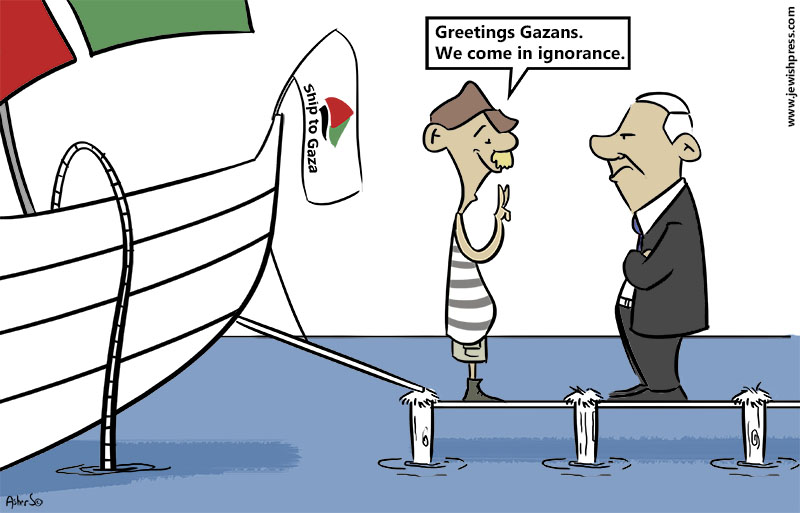
H/t The Jewish Press
On eve of Iran deal, US retreats on inspections of nuclear past, speeds up sanctions relief, DEBKAfile, June 29, 2015
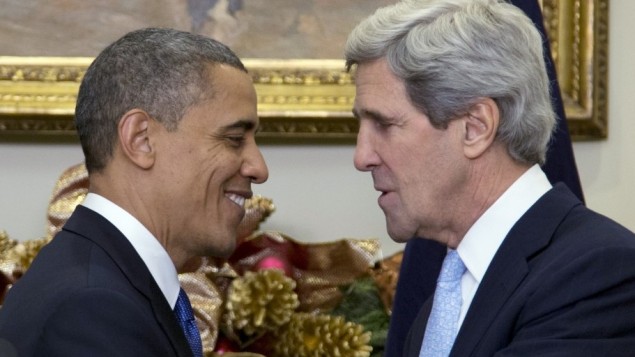 Obama and Kerry upbeat over concessions to Iran
Nothing is therefore left of the original US pledges to link sanctions relief to Iran’s compliance with its commitments or President Obama’s solemn vow to “snap back” sanctions any time for any Iranian violations. The IAEA is virtually left without teeth.
******************
Prime Minister Binyamin Netanyahu said Sunday, June 28: “We are seeing a clear retreat from the red lines that the world powers set recently and publicly.” Addressing the weekly cabinet meeting in Jerusalem and later the Knesset, he added: “There is no reason to rush to sign this bad agreement which is getting worse every day.”
Netanyahu was referring to three major concessions approved by President Barack Obama and Secretary of State John Kerry in the final stage of negotiations for a comprehensive nuclear accord with Iran.
They are outlined here by DEBKAfile:
1. After barring International Atomic Energy Agency (IAEA) inspections of suspect sites for years, Tehran will now be allowed to submit a paper with answers to queries about its past clandestine activities at those military sites, such as suspected tests of nuclear bomb detonators and explosives. That document would effectively draw a line on Iran’s suspect past
DEBKAfile: Iran has submitted countless documents to the IAEA, none of which gave specific replies to specific questions. The UN Security Council accordingly passed a number of resolutions requiring Tehran to come clean on the military aspects of its nuclear program. Tehran ignored them. Now Obama and Kerry are letting Tehran off the hook on its past secrets.
2. Obama and Kerry have withdrawn the “any time, anywhere” stipulation for snap inspections of suspect nuclear facilities, as mandated by the Additional Protocol signed by Iran. They now agree that international monitors must first submit a request to an “Iranian Committee” (not even a joint US-Iranian committee) for advance permission to inspect nuclear facilities.
This would leave Tehran free to approve, deny, or delay permission for inspections.
3. Washington has backed down on its insistence on predicating sanctions relief on Iran’s compliance with its obligations under the final accord. After Tehran countered with a demand for the sanctions to be lifted immediately upon the signing of the accord, the Obama administration agreed to remove them in three stages:
a) Straight after the deal is signed.
b) After ratification of the accord by the US Congress and Iranian Majlis.
This process is expected to take place by the end of 2015, and so Iran will win two multibillion windfalls this year without being required to meet any obligations beyond its signature
Obama counts on the support of 34 US senators. In any case, Congress is not empowered to reject or delay the deal
c) All remaining sanctions will be lifted when implementation of the accord begins.
Nothing is therefore left of the original US pledges to link sanctions relief to Iran’s compliance with its commitments or President Obama’s solemn vow to “snap back” sanctions any time for any Iranian violations. The IAEA is virtually left without teeth.
Syria, Hizballah torpedo understanding between Druze and Syrian rebel Nusra Front near Israeli border, DEBKAfile, June 28, 2015
 The Druze village of Khader – another flashpoint
Already it looks as though Assad and Nasrallah have succeeded in sabotaging the hard-won armistice deal that the US, Jordan and Israel brokered between the Druze and Nusra Front, by forcing the half million Druze of Syria to choose sides between the belligerents. Whichever it is, they will be clobbered.
********************
Syrian ruler Bashar Assad and Hizballah leader Hassan Nasrallah have gone all out to stir up adversity between the Druze communitys of the Golan and Israel, and the Syrian rebel Al Qaeda-linked Nusra Front.
To torpedo the armistice deal brokered between them earlier this month by the US, Jordan and Israel, 200 Syrian and Hizballah troops were pumped into the Druze village of Khader on the Syrian Golan, 3 km from the Israeli border. Since Friday, June 26, these troops have been attacking Nusra and the other Syrian rebel groups fighting to capture the Golan town of Quneitra. This has stalled the rebel operation for taking control of the highway to Damascus. Rockets from this battle strayed over to the Israeli side of Golan Sunday.
DEBKAfile’s military sources reveal that Nusra hit back over the weekend. They warned Druze leaders that if they don’t stop cooperating with Assad and Nasrallah, “their blood will be on their heads.” Fighters of this Islamist group then surrounded another, smaller Druze village, Skaska, on the western slopes of Jabal Druze and threatened to go in and massacre its inhabitants.
The Nusra ultimatum, posted Saturday, June 28, made it clear that since Syrian and Hizballah are firing against them from a Druze village, the Druze are held responsible for getting it stopped. Otherwise, they will be deemed collaborators of the Assad regime and in violation of the non-belligerence deal struck between them earlier this month.
Our sources add that Syria and Hizballah accompanied the 200-man force which infiltrated Khader, with Iranian and Syrian television crews and a group of Lebanese Druze members. The footage they showed was intended to demonstrate to the world that Lebanese Druze strongly challenged the Syrian rebel takeover of southern Syria including the Golan, and sided with Bashar Assad.
The fighting is so far low key between the Syrian and Hizballah troops ocupying the Druze village of Khadar and the Nusra Front fighters. But it is estimated by Israeli watchers that an escalation is not far off and, when it happens, the rebel Islamic group will make good on its threat of retribution against the Druze villagers of Skaska.
And then, yet another sensitive corner of the Syrian conflict may go up in flames, possibly putting Israel on the spot again.
Already it looks as though Assad and Nasrallah have succeeded in sabotaging the hard-won armistice deal that the US, Jordan and Israel brokered between the Druze and Nusra Front, by forcing the half million Druze of Syria to choose sides between the belligerents. Whichever it is, they will be clobbered.
Who is Responsible for the Atrocities in the Muslim World? The Gatestone Institute, Uzay Bulut, June 27, 2015
Every time the ISIS, Boko Haram, Iran, or any terrorist group in the Muslim world is discussed, many people tend to hold the West responsible for the devastation and murders they commit. Nothing could be farther from the truth. Blaming the failures in the Muslim world on Western nations is simply bigotry and an attempt to shift the blame and to prevent us from understanding the real root cause of the problem.
When these Islamic terrorist groups abduct women to sell them as sex-slaves or “wives;” conduct mass crucifixions and forced conversions; behead innocent people en masse; try to extinguish religious minorities and demolish irreplaceable archeological sites, the idea that this is the fault of the West is ludicrous, offensive and wrong.
Western states, like many other states, try to protect the security of their citizens. What they essentially need, therefore, are peaceful states as partners with which they can have economic, commercial and diplomatic relations. They do not need genocidal terrorist groups that destroy life, peace and stability in huge swaths across the Muslim world.
Western states also have democratic and humanitarian values, which Islamic states do not. The religious and historical experiences of the Western world and the Islamic world are so enormously different that they ended up having completely different cultures and values.
The West, established on Jewish, Christian and secular values, has created a far more humanitarian, free and democratic culture. Sadly, much of the Muslim world, under Islamic sharia law, has created a misogynistic, violent and totalitarian culture.
This does not mean that the West has been perfect and sinless. The West still commits some appalling crimes: Europe is guilty of paving the way for the slaughter of six million Jews in the Holocaust, and for still not protecting its Jewish communities. Even today, many European states contort logic to recognize Hamas, which openly states that it aims to commit genocide against Jewish people.
The West, however, accepts responsibility for the failures in its own territories: for instance, not being able to protect European women from Muslim rapists. These men have moved to Europe to benefit from the opportunities and privileges there, but instead of showing gratitude to European people and government, they have raped the women there, and tried to impose Islamic sharia law.
If we want to criticize the West for what is going on in the Muslim world, we should criticize it for not doing more to stop these atrocities.
The West, and particularly the U.S., should use all of its power to stop them — especially the genocides committed against Jews, Christians and other non-Muslims in the Muslim world.
We should also criticize the West — and others, such as the United Nations and its distorted Gaza War report — for supporting those who proudly commit terrorist attacks against Israeli civilians, and we should criticize the West for not siding with the state of Israel in the face of genocidal Jew-hatred.
We should criticize the West for letting Islamic anti-Semitism grow in Europe, making lives unbearable for Jews day by day.
We should criticize the West for having accepted without a murmur the Turkish occupation of Northern Cyprus for more than 40 years.
We should also criticize the West for leaving the fate of Kurds, a persecuted and stateless people, to the tender mercies of Turkey, Iran, Iraq and Syria — and now the Islamic State (ISIS). On June 25, ISIS carried out yet another deadly attack, killing and wounding dozens of people in the Kurdish border town of Kobani, in Syrian Kurdistan.
And we should criticize especially the current U.S. government for not being willing to take serious action to stop ISIS, Boko Haram and other extremist Islamic groups.[1]
The list could go on and on. Moreover, it would not be realistic to claim that these groups or regimes all misunderstand the teachings of their religion in exactly the same way.
It would also not be realistic to claim that the West has created all these hundreds of Islamic terror groups across the Muslim world.
The question, then, is: Who or what does create all these terrorist groups and regimes?
In almost all parts of the Muslim world, systematic discrimination, and even murder, are rampant — especially of women and non-Muslims. Extremist Islamic organizations, however, are not the only offenders. Many Muslim civilians who have no ties with any Islamist group also commit these offenses daily. Jihad (war in the service of Islam) and the subjugation of non-Muslims are deeply rooted in the scriptures and history of Islam.
Ever since the seventh century, Muslim armies have invaded and captured Jewish, Christian, Hindu, Buddhist and Zoroastrian lands; for more than 1400 years since, they have continued their jihad, or Islamic raids, against other religions.
Many people seem to be justifiably shocked by the barbarism of ISIS, but Islamic jihad does not belong just to ISIS. Violent jihad is a centuries-long tradition of Islamic ideology. ISIS is just one jihadist army of Islam. There are many.
All of this is an Islamic issue. The free West has absolutely nothing to do with the creation and preservation of this un-free culture.
The West has, on the contrary, been the victim of Islamic military campaigns and imperialistic pursuits: Christian peoples of Europe have been exposed to Ottoman invasions and subjugation for centuries. The fall of Byzantine Empire marked the peak of Islamic Jihad in Christian lands. Many places in Europe — including Greece, Bulgaria, Albania, Bosnia, Croatia, Hungary, Serbia, and Cyprus, among others — were all invaded and occupied by the Ottoman armies. Other targets, including Venice, Austria, and Poland, had to fight fierce defensive wars to protect their territories.
The historical and current troubles in the Muslim world are not, therefore, problems “imported” from an outside source; they are internal cultural and political problems, which Muslim regimes and peoples have reproduced for centuries.
Some of the things that women in Saudi Arabia may not do were listed in The Week magazine: Saudi women are not allowed to “go anywhere without a male chaperone, open a bank account without their husband’s permission, drive a car, vote in elections, go for a swim, compete freely in sports, try on clothes when shopping, enter a cemetery, read an uncensored fashion magazine and buy a Barbie and so on.”
Of course, there is nothing specific in Islamic scriptures about cars, fashion magazines or Barbie Dolls. But there is enough there that indicates why all of these abuses, and more, are widespread across the Islamic world, and why the clerics, imams and muftis approve them.
The central issue is to see how the lines that the Islamic theology draws seed the soil in which this kind of discrimination systematically buds, why it is extolled and how it is advocated.
Saudi Arabia is not the only Muslim country where women are dehumanized. Throughout almost the almost the entire Muslim world — including Turkey, considered one of the most “liberal” Muslim countries — women are continually abused or killed by their husbands, ex-husbands, boyfriends, fathers, brothers or other males. [2]
Is it America that tells these men to treat their wives or sisters as less than fully human?
Is the West really what stops them from respecting human rights or resolving their political matters through diplomatic and peaceful ways? Are Muslims too stupid to make wise decisions, and act responsibly? Why should Americans or Europeans have evil wishes for the rest of the world?
Demonizing Western nations — even after all of their cultural, scientific and rational progress — is simply pure racism.
“The belief that the West is always guilty is among the dozen bad ideas for the 21st century,”wrote the Australian pastor, Dr. Mark Durie. “This irrational and unhelpful idea is taught in many schools today and has become embedded in the world views of many. It is essentially a silencing strategy, sabotaging critical thinking.”
Another term that prevents one from understanding the root causes of the conflicts in the Muslim world is “moral relativism” — a politically correct term that really means moral cowardice.
Defending “moral relativism” and saying that “all cultures are equal” really means saying a culture that encourages child marriages, beating women and selling girls on slave markets has a value equal to a culture that respects women and recognizes their rights, and which renounces wanton violence.
Another popular target of blame for the failures in the Muslim world is historical British colonialism.
If colonialism were the main problem, however, Muslims, too, were, and still are, colonizers — and not particularly “humanitarian” ones, at that. The Muslim colonizers do not even seem to have contributed much to the culture of the places they invaded and colonized. In fact, they have actually delayed the progress of the areas they colonized. The printing press, for instance, came to the Ottoman territories almost 200 years later than to Europe.
“Books… undermine the power of those who control oral knowledge, since they make that knowledge readily available to anyone who can master literacy,” wrote Professor Daron Acemoglu and James Robinson. This threatened to undermine the existing status quo, where knowledge was controlled by elites. The Ottoman sultans and religious establishment feared the creative destruction that would result. Their solution was to forbid printing.” [3]
“European Empires — the British, French and Italians — had a short-lived presence in North Africa and the Middle East compared with the Ottoman Empire, which ruled over that region for more than 500 years,” said the historian Niall Ferguson.
“The culture that exists in the greater Middle East and North Africa today bears very, very few resemblances to the culture that Europeans tried to implement there, beginning in the late 19th century and carrying on through to the mid-20th century.
“You can’t say it is the fault of imperialism and leave out the longest living empire in the Middle East, which was the Ottoman Empire, a Muslim Empire, which went back much farther than any of the European Empires mentioned in that piece.”
Muslim states continue to occupy and colonize various territories — including Kurdistan, Baluchistan and the northern part of Cyprus, an EU member state.
“One of the most tragic consequences of the 1974 Turkish invasion,” according to the Ministry of Foreign Affairs of the Republic of Cyprus, “and the subsequent illegal occupation of 36.2% of the territory of the Republic of Cyprus, is the violent and systematic destruction of the cultural and religious heritage in the occupied areas.
“Hundreds of historic and religious monuments in various regions of the occupied areas have been destroyed, looted and vandalized. Illegal ‘excavations’ have been carried out and cultural treasures have been stolen from museums and private collections and were sold abroad.”
Muslim groups and regimes continue to persecute indigenous peoples such as Assyrians, Chaldeans, Mandaeans, Shabaks, Copts, Yezidis, and Bedoon, among many others.
“A substantial segment of the Bedoon population lives with the constant threat of deportation hanging over it,” according to the analyst Ben Cohen. “Around 120,000 Bedoon live without nationality and with none of the rights that flow from citizenship.”
“Its members cannot obtain birth or marriage certificates, or identity cards, or driving licenses. They are banned from access to public health and education services. Their second-class status means they have no access to the law courts in order to pursue their well-documented claims of discrimination. And on those rare occasions that they summon the will to protest publicly—as they did in 2011, when demonstrators held signs bearing slogans like, ‘I Have a Dream’—the security forces respond with extraordinary brutality, using such weapons as water cannons, concussion grenades, and tear gas with reckless abandon.”
It is not the West or Israel committing these crimes against the Bedoon community; it is Kuwait, a wealthy Islamic state, which treats defenseless people as if they are slaves.
In Qatar, another wealthy Islamic state, Nepalese migrants building a football stadium, “[h]ave died at a rate of one every two days… This figure does not include the deaths of Indian, Sri Lankan and Bangladeshi workers…. The Nepalese foreign employment promotion board said that 157 of its workers in Qatar had died between January and mid-November” last year. In 2013, the figure for that period was 168.”
 The family of a Nepalese migrant worker, who died in Qatar, prepares to bury him. Nepalese laborers in Qatar are forced to work in dangerous conditions, and die at the rate of one every two days. (Image source: Guardian video screenshot)
“In Libya, naturalisation is only open to a man if he is of Arab descent,” reported the United Nations High Commissioner for Refugees (UNHCR). “And many Akhdam in Yemen, a small ethnic minority who may be descendants of African slaves, are reportedly unable to obtain citizenship.”
Is that not apartheid?
In Kuwait, only Muslim applicants may seek naturalization, while Libya’s nationality law allows for the withdrawal of nationality on the grounds of conversion from Islam to another religion.”
Is that not apartheid? Apartheid laws seem to reign over many places in the Muslim world.
Trying to whitewash the damage the Islamic ideology has done to the Muslim world, while putting the blame of Islamic atrocities on the West, will never help Muslims face their own failures and come up with progressive ways to resolve them.
“All the world’s Muslims have fewer Nobel Prizes than Trinity College, Cambridge. They did great things in the Middle Ages, though,” wrote the evolutionary biologist Richard Dawkins on Twitter, after which other Twitter users piled on to criticize him.
It seems that having oil reserves, per capita, that dwarf anything available to Western countries does not create leading scientific nations.
What holds Muslims back when they have unmatched advantages of underground treasures? Why did the scientific revolution not happen in the Muslim world? Why has much of Islamic history been marked by aggressive jihad?
Islamic jihad and Islamic violence; the sanctioning of sex slavery; dehumanization of women; hatred and persecution of non-Muslims and homosexuals; suppression of free speech; and forced conversions have been commonplace in the Islamic world ever since the inception of the religion.
Many teachings in the Islamic scriptures, as well as the biographies of the founder of the religion, set up the parameters where these abuses not only occur but remain protected on a gigantic scale. These are the teachings that have become the culture of the Muslim world.
Sadly, most Muslims have wasted much time, energy and resources on killing and destruction, but — with the exception of some civilization’s most dazzling artistic splendors — not on scientific and cultural advancement.
Recently, Sheikh Hamad bin Jassim bin Jaber al-Thani, the former Prime Minister of Qatar, said that claims that Qatar paid bribes to win the hosting rights of the 2022 World Cup were “not fair” and stemmed from the West’s Islamophobia and racism towards Arabs.
Recent events indicate that he was, at best, “misinformed.”
Deny everything and blame “the infidel” for your shortcomings. Nothing is more important than your honor, and nothing worse than your shame.
If Muslims wish to create a brighter future, nothing is stopping us but ourselves. We should learn to analyze critically our present and our past.
Human rights activists and academics in the West are lying to Muslims about their culture, and bashing and threatening America, Europe or “Zionism” for the problems of Muslims; this can never lead to any positive developments in the Muslim world. It is the Islamic culture and religious ideology that are responsible for these problems
If there is ever going to be an enlightenment, reform or renaissance in the Muslim world, only a hard look and hard questioning can be its starting point.
_________________
[1] Also the Muslim Brotherhood, Islamic Republic of Iran, al-Qaeda, Al-Badr, al-Gama’a al-Islamiyya, Islamic Jihad, al-Nusra Front, Hizb-ut-Tahrir, Al Ghurabaa, Al-Itihaad al-Islamiya, Al-Mourabitoun, Abdullah Azzam Brigades, Jaish al-Muhajireen wal-Ansar, Jamaat Ul-Furquan, Jamaat-ul-Ahrar, Jamaat-ul-Mujahideen Bangladesh, Jamiat al-Islah al-Idzhtimai, Great Eastern Islamic Raiders’ Front, Al-Shabaab, Abu Sayyaf, Tehreek-e-Nafaz-e-Shariat-e-Mohammadi, Supreme Military Majlis ul-Shura of the United Mujahideen Forces of Caucasus, to name just a few.
[2] See: “Gender Equality Gap Greatest in Islamic Countries, Survey Shows“, by Patrick Goodenough, October 29, 2014; “The Treatment of Women In Islam,” by Rachel Molschky, October 7, 2013; “Women Suffer at the Hands of Radical Islam“, by Raymond Ibrahim, January 9, 2014; “As Muslim women suffer, feminists avert their gaze“, by Robert Fulford, National Post; Ayse Onal, a leading Turkish journalist, says in her book, Honour Killing: Stories of Men Who Killed, that in Turkey alone honour killings average about one a day — 1,806 were reported in the period between 2000 and 2005.
[3] Daron, Acemoglu & Robinson, James (2012), Why Nations Fail: The Origins of Power, Prosperity, and Poverty, Crown Publishing Group.
Behind the French “Peace Initiative,” The Gatestone Institute, Bassam Tawil, June 26, 2015
If it succeeds, may Allah prevent it, it will lead to an ISIS and Hamas takeover of every inch of Palestinian soil from which Israel withdraws if coerced by the initiative.
It is evidently too frustrating and unrewarding just to sit in the U.N. and not think of some project supposedly to spread beneficence that could make your country look important to the other 190 members — even if this beneficence is lethal to its recipient.
When the Byzantium fell to the Ottoman Empire, the churches, including the Hagia Sophia in Constantinople, were turned into mosques; that is the dream of the Islamists today, to turn the Vatican into a mosque.
Currently, Qatar is currently investing millions to overthrow the Egyptian regime. It is investing millions to finance incitement among Muslims around the globe by means of its Islamist network and da’wah, the cunning preaching of the Muslim Brotherhood’s variety of Islam.
The Arabs always secretly believed that anyone who hated their mutual enemies, the Jews, as deeply as the Europeans did, and who actually tried to achieve their total physical destruction during the Second World War, would be their ally and help to expel them from occupied Palestine.
Apparently, the commonly-held hatred between the Europeans and the Arabs was not enough to halt the Jews, so now the Arabs pay huge sums to bribe the leaders of Europe to help them get rid of the Jews now.
The latest missile to split the skies over the Middle East is not a rocket; it is the French “peace” initiative.
No one in the Middle East has the slightest doubt that whatever its objective may be, it will not promote peace between Israel and the Palestinians. It is a desperate attempt by the French government to buy a few more days of quiet from its Muslim community, especially from the members of the Muslim Brotherhood and the terrorist organizations to which it gave birth — all waiting for the order to run riot through the streets of France.
We, the Palestinians, have suffered, and continue to suffer, from the creation of the Islamist terrorist organizations within the Palestinian Authority territory; it is they who keep us from reaching a peace agreement with the Jews.
One has to be deaf, dumb and blind — or genuinely desperate, which is more likely — to present a unilateral peace agreement like the French one. If it succeeds, may Allah prevent it, it will lead to an ISIS and Hamas takeover of every inch of Palestinian soil from which Israel withdraws if coerced by the initiative.
One also has to be simply ignorant not to understand that the Middle East is going up in flames and that the Arab states are disintegrating. There is no logical reason, therefore, to construct a new state, which will be both unstable and prey to local and regional subversion. It will also be subject to a quick takeover, and the first people who will suffer will be the Palestinians in the occupied territories.
The Israelis know how to look out for themselves, but we will be left to the tender mercies of Hamas and ISIS mujahedeen. Just as they have done in Iraq and Syria, they will slaughter us without thinking twice, on the grounds that as we did not all become shaheeds [“martyrs” for Islam] trying to kill the Zionists, and even tried to reach a peace agreement with them, we are not sufficiently Muslim.
The French initiative is not a benevolent gesture meant to help the Palestinians. Without a doubt, the French government and its intelligence services know full well that the secret of the Palestinian Authority’s existence today — and its ability to function as a sovereign entity, demilitarized and de facto recognizing the State of Israel — is its security collaboration with the Israelis. It serves the interests of both sides. When, therefore, a Palestinian state is declared unilaterally, as the French propose, Israel will stop collaborating with it and the state, not even fully formed, will almost instantly fall prey to Islamist extremists. That is obvious to us: even our institutions of higher learning are ruled by Hamas today, as can be seen by Hamas’s landslide victory in the recent student elections in Bir Zeit University.
The recent visit of U.S. Senator Lindsey Graham to Israel helped the Palestinians understand even more thoroughly that behind the French initiative is an attempt, as with many members of the U.N., to “be a player.” It is evidently too frustrating and unrewarding just to sit in the U.N. and not think of some project supposedly to spread beneficence that could make your country look important to the other 190 members — even if this beneficence is lethal to its recipient. One way of doing spreading such beneficence is to take over the peace process through the Security Council, force both sides into a unilateral solution, and not even to feign dismay when its first victims are the Palestinians.
Senator Graham referred to the drastic nature of the initiative and stressed that the United States supported the solution of two states for two peoples, according to the vision of Israel’s current Prime Minister, Binyamin Netanyahu. It favors a demilitarized Palestinian state that would recognize Israel as a Jewish state and make it possible for everyone, both Jews and Palestinians, to live with self-respect and independence.
Graham threatened the UN, saying that if promotes the French initiative, he would bid to halt American funding for the UN — nearly a quarter of its budget.
Today, the UN’s funds are twisted into sending peacekeepers, who have diplomatic immunity and therefore cannot be sued, out to Africa to demand sex, often from children, in exchange for food or other necessities; and to passing resolutions aimed at harming Israel, while the organization callously ignores floggings in Saudi Arabia, slavery in Mauritania; escalating executions, calls for genocide and violations of nuclear treaties in Iran, just for a start.
The situation is grotesque. They are basically accusing Israel of “terrorism” for defending itself against by rockets fired from Hamas, in a confrontation where Gazan children were hurt because Hamas used them as human shields — while ignoring the real terrorism against the children of Africa committed by the U.N.’s own peacekeepers, Boko Haram, Iran and Sudan. When they so twist logic as to accuse Israel of “terrorism,” while turning their back on the horrendous abuses by other states, they are essentially giving paedophile UN “peacekeepers,” Iran’s torturers, executioners, and nuclear weapons factories a green light.
Graham was very clear about the American point of view. He said that any country that tried to bring Israel to the International Criminal Court in The Hague would have sanctions imposed on it by the United States.
The parade of the grotesque is the direct result of the Western surrender to Islamic terrorism. Now, sadly, the Vatican has also joined France. The assumption that the Islamists can be pandered to and propitiated by harming the Jews is yet another prevalent misconception. Every gesture to the Islamists, even if it is aimed at “helping” the Palestinians, sends a message of weakness and vulnerability, and increases the Islamists’ aggression against Christians and other non-Muslim minorities.
In the Middle East, anyone who “turns the other cheek,” such as the Pope saying that the Palestinian leader, Mahmoud Abbas, could be “an angel of peace,” will find his neck under the sword. When Byzantium fell to the Ottoman Empire, its churches, including the Hagia Sophia in Constantinople, were turned into mosques; that is the dream of the Islamists today, to turn the Vatican into a mosque.
The dangerous European surrender to radical Islam is not only an attempt to hold off its threat to the free society of Europe just a little longer. It is also the result of the economic distress of the Western world, which is seeking to keep afloat by selling itself, literally, for petro-dollars. The Vatican is in desperate financial straits — there are fewer practicing Catholics and therefore fewer donating Catholics. It is hard not to feel that the anti-Israel manipulations of the Vatican administration are motivated not by a genuine desire to help the Palestinians or to save Christians in the Middle East, but by a genuine desire to extricate itself from its financial straits.
Judas sold Jesus for thirty pieces of silver; Boko Haram sells girls for the price of a pack of cigarettes, and Europe is selling itself and the Israelis to Qatar.
Europe is in the same situation as the Vatican; and so are many American universities, which are selling radical Islamist education for petro-dollars from the Persian Gulf. This enables the Islamists to rewrite history and endanger the open way of life in the gullible West.
There is already a Muslim Brotherhood lobby in the United States, a syndicate trying to force the administration to undermine the current Egyptian president, who is an enemy of the murderous Muslim Brotherhood. Their aim is to restore to power the Islamist dictator Mohamed Morsi (who is also a member of the Muslim Brotherhood), and to sabotage the measures Egypt is currently taking to rehabilitate itself.
The ease with which Qatar, the petro-dollar heavyweight, manipulates terrorist organizations in the Middle East is unnerving. The country both hosts and finances senior Muslim Brotherhood figures such as Sheikh Yusuf al-Qaradawi and others responsible for spreading the doctrine of radical Islamism and terrorism around the world.
Qatar finances a wide range of subversive Islamist terrorist organizations, among them ISIS, Al-Qaeda, Hamas, Palestinian Islamic Jihad and various other global jihad organizations operating under the aegis of the Arab-Muslim regimes. Qatar also seeks to carve out enclaves in Africa and the West, and to turn the West’s pluralistic melting pot into a seething cauldron of terrorist operatives who will, when given the signal, bludgeon Europe and America to the ground.
The petro-dollars of the Qatari feudal lords, totalitarians who dictate their whims to a population with no rights, direct a global network of propaganda and incitement, through vehicles such as Al-Jazeera TV in Arabic, light years more toxic than Al Jazeera in English. It crowns kings and topples regimes throughout the Middle East, as it did by endlessly replaying the self-immolation of the young Tunisian fruit vendor who could not get a license, until it whipped up the Tunisians and Egyptians to start the “Arab Spring.” Currently, Qatar is investing millions to overthrow the Egyptian regime. It is investing millions to finance incitement among Muslims around the globe by means of its Islamist network and da’wah, the cunning preaching of the Muslim Brotherhood’s variety of Islam.
The Arabs always felt that the Europeans had a soft spot in their hearts for them. They always secretly believed that anyone who hated their mutual enemies, the Jews, as deeply as the Europeans did, and who actually tried to achieve their total physical destruction during the Second World War, would be their ally and help to expel them from occupied Palestine. Apparently, the commonly-held hatred between the Europeans and the Arabs was not enough to halt the Jews, so now the Arabs pay huge sums to bribe the leaders of Europe to help them get rid of the Jews now.
Just look at the extensive corruption of the heads of FIFA, bought and paid-for by Qatar. All it took was $100 million, and Qatar could host the World Cup. It makes one wonder what Qatar would be willing to pay for other projects, doesn’t it?
 Now where did that envelope of cash go…?
Iran’s supreme leader is laughing, for good reason, Israel Hayom, Boaz Bismuth, June 25, 2015
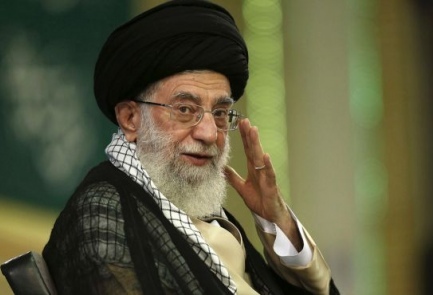 Iranian Ayatollah Ali Khamenei | Photo credit: AP
In Tehran on Tuesday, Khamenei spoke about his country’s “red lines.” Red lines? Can someone maybe explain what those are to the Obama administration?
********************
Iranian Ayatollah Ali Khamenei feels confident enough, only a few days before June 30 (the deadline for a final-status nuclear deal with world powers), to thumb his nose at the international community, including the American government, and declare Iran’s three noes: no to freezing its nuclear program, no to international oversight at its nuclear facilities, no to a phased lifting of sanctions (as proposed by the French). In other words, Khamenei is telling the world: Dear superpowers — bite me.
Meanwhile, almost simultaneously, we have received an Associated Press report from Vienna that the U.S. and its partners conducting the negotiations with Iran are prepared — for the sake of reaching a deal — to even provide the Iranians with advanced nuclear reactors and equipment. This isn’t a joke.
It’s possible, perhaps, to imagine Khamenei rejecting this generous offer outright because the Americans aren’t also including ballistic missiles in the package. If you’re going to be generous, then you might as well go all the way.
Truth be told, this entire business to this point seems quite like a joke. The problem is that it’s coming at our expense. And it’s also not that funny.
French Foreign Minister Laurent Fabius met on Wednesday with his Saudi counterpart and promised him a “tough deal.” The Saudis are no less worried than we are about a bad deal. But who is promising us a “tough deal?” The French, who ultimately always fall in line with the Americans, whose help they need for more burning issues closer to home (Ukraine)? Who? The Russians? The Chinese? The Americans? The Germans? The British? The truth is, it would be best to trust the Iranians to torpedo the deal on their own, but Khamenei’s and even Iranian President Hassan Rouhani’s promulgations from two weeks ago aren’t enough to scare anyone off.
In November 2013, as a reminder, we were just several days before the interim agreement. I remember how the Iranian and Western delegations leaked information about the many difficulties in the negotiations, but that in the end, in the middle of the night, the deal was born (how shocking). Eventually, we saw virtually the same scenario unfold in Lausanne this past March — the numerous problems were made public, the deadline was extended by a few days, and finally on April 2 we received the framework deal.
We can assume that in the coming days we will get to see “the best show in town,” at the end of which, in contrast to the previous rounds, we can expect a final status deal with an Iran that is not only slated to become a nuclear power but a stabilizing force in our crumbling Middle East.
In Tehran on Tuesday, Khamenei spoke about his country’s “red lines.” Red lines? Can someone maybe explain what those are to the Obama administration?
The West’s Misconceptions Over the Final Nuclear Deal, Front Page Magazine,

[W]hat is the Obama administration’s strategy? Apparently, the Obama administration does not have one. This is due to the fact that the administration believes that the Islamic Republic will not cheat, interfere in other nations’ affairs, or do any harm in case sanctions are lifted. In other words, the Islamic Republic is going to be another Switzerland.
****************
In a recent interview that President Obama gave to Israeli outlet Channel 2’s Ilana Dayan, he indirectly defended the Islamic Republic and suggested that the ruling clerics are not going to cheat on the terms of the final nuclear deal. But how can President Obama be so sure about Iran’s compliance if a deal is reached and when economic sanctions are lifted? Is he making such an argument based on Iran’s past history of nuclear defiance? Or based on its current military intervention in several nations and support for Shiite militia groups, proxies, and Islamic Jihad?
It is crucial to point out that the nuclear activities of the Islamic Republic came to the international spotlight due to Iran’s clandestine and underground nuclear sites. Iran had since repeatedly violated the IAEA’s terms by building additional underground nuclear sites and inching towards nuclear capabilities in order to obtain nuclear weapons.
President Obama also argued that sanctions will snap back in case Iran cheats. Nevertheless, the truth is that there is no such thing as automatic snapping back of sanctions. In addition, by the time that the international community realizes that Iran has cheated, Iran would have reduced the nuclear break-out capacity to zero, boosted its Revolutionary Guards’ economy, and gained billions of dollars. Secondly, Russia and China will scuttle any process that would snap back the economic sanctions.
There exists a crucial underlying misconception in the West headed by the Obama administration regarding the final nuclear deal with the Islamic Republic, which is approaching its June 30th deadline.
From President Obama and the Western powers’s perspective, the nuclear deal with the Islamic Republic is going to be transformational and revolutionary. This follows that the West, and particularly the White House, contends that the final nuclear deal or the nuclear resolution is going to transform the character of Iran’s political system in the long term; hence it will fundamentally alter Iran’s regional, domestic policies, shift its support for Shiite militia groups and proxies across the Middle East, moderate Iran’s foreign policy, and probably change the government in the long term.
On the other hand, from the Iranian leaders’s perspective, the nuclear deal is transitory, fleeting, momentary and transactional. In other words, Iranian authorities will follow the rules of the nuclear agreement for the limited time assigned in the deal. They will boost their economy, regain billions of dollars, and reinitiate their nuclear program soon after.
As long as Iran’s Supreme Leader, Ayatollah Ali Khamenei, is alive, the Islamic Republic is going to prioritize its Islamist revolutionary ideologies. The 75-years-old man, who has ruled over 25 years and continuously spread anti-American and anti-Semitic propaganda, is not going to change his position and become a Western-loving person open to forces of globalization and integration. His has created a powerful social base based on his anti-American and anti-Semitic propagandas.
Since Iranian leaders view the final nuclear deal on a short-term basis, from the perspective of Iranian leaders, particularly Ayatollah Ali Khamenei and influential officials of Iran’s Revolutionary Guard Corps (IRGC), reaching a final nuclear deal is a no-brainer, economically speaking. In addition, the leaders of the Islamic Republic are cognizant of the fact that they will not give up their nuclear program based on the current terms of the nuclear agreement.
Most recently, Royal Dutch Shell PLC, which owes the Islamic Republic an outstanding debt of more than $2 billion, has been talking about repaying Iranian leaders the debt after the nuclear deal is signed. and consequently the related sanctions are lifted. Several other foreign companies were unable to pay Iran due to the financial and banking sanctions imposed by the United Nations Security Council and previous US administrations. Nevertheless, President Obama is opening the way for the flow of billions of dollars into the revolutionary Islamist ideology of the Islamic Republic.
It is crucial to point out that the flow of billions of dollars into the Islamic Republic will not trickle down to the Iranian ordinary people or even be distributed equally among the governmental institutions such as Iran’s foreign ministry. An overwhelming majority of the cash will likely be controlled by the IRGC, Quds forces (an elite revolutionary branch of IRGC fighting in foreign countries) and office of the Supreme Leader. The IRGC and office of the Supreme Leader do enjoy a monopoly over major economic sectors of the Islamic Republic.
The issue of immediate access to billions of dollars is particularly appealing and crucial for the Iranian leaders due to the notion that Tehran looks at the final nuclear deal through the prism of short-term, immediate economic and geopolitical boosts.
As a result, the final nuclear deal is viewed as purely short-term business for the IRGC and the Supreme Leader.
Finally, it is rational for every government to have strategies to rein in Iran’s full economic return. But, what is the Obama administration’s strategy? Apparently, the Obama administration does not have one. This is due to the fact that the administration believes that the Islamic Republic will not cheat, interfere in other nations’ affairs, or do any harm in case sanctions are lifted. In other words, the Islamic Republic is going to be another Switzerland.
Can these forces stop a rotten Iran deal? The Washington Post, Jennifer Rubin, June 25, 2015
(Ms. Rubin is one of the Washington Post’s token conservatives, and anything she says is routinely disparaged by many WaPo readers. Others? Not so much. — DM)
Between the press leaks revealing serial concessions, the public incoherence of Secretary of State John Kerry and Ayatollah Ali Khamenei’s public declarations, the forces opposing an imminent Iran deal have plenty of material to work with. And if there is any doubt as to Israel’s position, opposition leader Isaac Herzog — whom President Obama dearly hoped would replace Prime Minister Benjamin Netanyahu, made clear what Israel-watchers already knew:
“There is no difference between me and [Prime Minister Benjamin] Netanyahu in reading the threat of Iran,” Herzog said in an interview with The Telegraph. “There is no daylight between us on this issue at all. I do not oppose the diplomatic process.
However, the proof of the pudding is in the eating.
We want to know ‘what is the deal?’ What’s the best deal possible that can be reached and would it change the region in a better direction? And here we are worried.”
In the article, Telegraph chief foreign correspondent David Blair appeared to express frustration that Herzog did not come across as opposing Netanyahu on Iran.
“If the US administration hoped that Mr. Herzog might dilute Israel’s visceral suspicion of an imminent nuclear deal with Iran, however, then he seems likely to disappoint,” Blair wrote.
There is no divide in the country at large, with 80 percent of Israelis declaring they have no confidence in President Obama’s handling of Iran.
Most GOP presidential hopefuls have decried the president’s giveaways. On Wednesday, former Texas governor Rick Perry, for example, put out a statement, which read in part: “In reckless pursuit of any agreement, President Obama has conceded point after point after point. Iran has used deadlines and extensions as a tactic for eliciting still more concessions from the U.S. We are well past the time where further concessions are tolerable if we still intend to prevent Iran from getting a nuclear weapons capability rather than manage its breakout time. This agreement is shaping up to spark a nuclear arms race in the Middle East and increase the odds of a devastating and catastrophic military conflict in the future. President Obama should abandon these dangerous negotiations and resume international sanctions until Iran understands and accepts that they cannot have a nuclear weapon.”
Meanwhile, the most influential Democrat on Iran, Sen. Robert Menendez (N.J.), has been taking to the Senate floor on a regular basis to denounce the reported concessions. On Wednesday, former Bill Clinton secretary of defense William Cohen denounced the deal as likely to start a nuclear arms race: “Once you say they are allowed to enrich, the game is pretty much up in terms of how do you sustain an inspection regime in a country that has carried on secret programs for 17 years and is still determined to maintain as much of that secrecy as possible.” He echoed multiple critics who saw it was all downhill once Obama did an about-face on the Syrian red line: “It was mishandled and everybody in the region saw how it was handled. And I think it shook their confidence in the administration. … The Saudis, the UAE and the Israelis were all concerned about that. They are looking at what we say, what we do, and what we fail to do, and they make their judgments. In the Middle East now, they are making different calculations.” (While Sen. Lindsey Graham strongly supported military action, none of the other three senators running for president did.)
More bipartisan opposition comes from ex-lawmakers. The American Security Initiative, headed by former senators Joe Lieberman (I-Conn.), Evan Bayh (D-Ind.), Norm Coleman (R-Minn.) and Saxby Chambliss (R-Ga.), announced a $1.4 million ad buy to inform the public about the contents of the imminent deal. Its targets include Democratic Sens. Richard Blumenthal of Connecticut, Michael Bennet of Colorado and Chuck Schumer of New York and independent Angus King of Maine. While Schumer likes to fancy himself as a great friend of Israel, when the chips are down, he has often given the administration cover, as he did in supporting the nomination of former senator Chuck Hagel (R-Neb.) for defense secretary.
In addition, an all-star group of Iran and military experts including former Obama advisers Dennis Ross, Robert Einhorn and Gary Samore warn against a deal that does not include anytime/anywhere inspections, revelation of possible military dimensions of Iran’s program before sanctions relief begins, “strict limits on advanced centrifuge R&D, testing, and deployment in the first ten years, and [measures to] preclude the rapid technical upgrade and expansion of Iran’s enrichment capacity after the initial ten-year period,” gradual lifting of sanctions and no relief from non-nuclear sanctions and a timely mechanism to reimpose sanctions if Iran cheats. In other words, they’ll support a deal utterly unlike the one we are likely to get.
Other voices now are speaking out on the administration’s willingness to lift sanctions while Iran continues its support for terrorism. Manhattan’s long-time Democratic district attorney Robert Morgenthau (who tracked Iranian finances and relations with dictators in our hemisphere) writes that “the fundamental question to be asked is whether the deal the U.S. is negotiating with Iran will curtail its role as a state sponsor of terrorism. The answer appears to be a resounding no. . . . These sanctions, particularly over the past decade, have given the U.S. powerful leverage. It appears that this leverage is being frittered away as U.S. negotiators bend over backward to strike a deal. But meaningful deals are negotiated from strength; not from desperation. Any deal that fails to address or curtail Iran’s role as a state sponsor of terrorism—and that actually undercuts our ability to confront that threat—is a deal that we must not make.”
There is little doubt that the most prominent pro-Israel organization, the American Israel Public Affairs Committee (AIPAC) will go all-out to defeat the deal if it contains the sorts of concessions reported in the media. As we have noted, it already has begun warning lawmakers and the public of the dangers in a deal that does not stop Iran from getting nuclear weapons.
The White House, aided by every left-wing group it can round up (including persistent Israel antagonist J Street) will try to make this a choice between war and its crummy deal. It will strong-arm every Democrat who will listen. It will gloss over concessions, trying to pass off critics as unfamiliar with the fine print of the deal. Working against the president, however — in addition to the ludicrous concessions — are two factors. He, according to every recent public poll out there, is distrusted on foreign policy. And he is increasingly ineffective in bullying his own party, as we saw on the Corker-Menendez bill giving Congress an up-or-down vote. (If not for GOP leadership in both houses, he’d never have gotten trade-promotion authority.) Still, opponents of the deal do not underestimate the task of getting enough votes in the Congress to override the president’s veto of a resolution of disapproval.
The most interesting figure in all this may be Hillary Clinton. Unlike trade authority, it is inconceivable that she could refuse to take a clear position on an Iran nuclear deal. If she breaks with the president (highly unlikely), the left will attack her mercilessly. If she stands by him she risks — as he does — a bipartisan repudiation and an irate electorate. It is fitting that the biggest loser in this may be Clinton, who initiated engagement with Iran and continually opposed congressional efforts to tighten sanctions. Obama’s name may be on the deal, as the president said, but if there is a deal, it will be a direct result of four years of her Iran policy that set the pattern for her successor.
Investigation Exposes AMP Leaders’ Ties to Former U.S-Based Hamas-Support Network, Investigative Project on Terrorism, June 24, 2015
(Please see also, Obama Hosts Israel-Haters at Iftar Dinner ‘President’s Table’. — DM)

Today, AMP routinely engages in anti-Israeli rhetoric, sponsors conferences that serve as a platform for Israel bashers, and openly approves “resistance” against the “Zionist state.” One AMP official acknowledged the goal is to “to challenge the legitimacy of the State of Israel.”
********************
Federal investigators shut down a massive Hamas-support network in the United States between 2001 and 2008, prosecuting some elements and freezing the assets of others.
But the Investigative Project on Terrorism finds that many of the same functions – fundraising, propaganda and lobbying – endure, now carried out by a group called American Muslims for Palestine (AMP). The IPT investigation identified at least five AMP officials and speakers who worked in the previous, defunct network called the “Palestine Committee.” It was created by the Muslim Brotherhood to advance Hamas’ agenda politically and financially in the United States.
Last year, AMP joined a coalition of national Islamist groups in forming the U.S. Council of Muslim Organizations. The Council on American-Islamic Relations (CAIR) is among the other founding members (for more on that coalition, click here). CAIR and its founders appear in internal Palestine Committee records admitted into evidence during the largest terror financing trial in U.S. history.
Several Palestine Committee entities were created by Mousa Abu Marzook, who remains a top Hamas political leader. One branch, the Holy Land Foundation for Relief and Development (HLF), was convicted in 2008 along with five senior officials, of illegally routing more than $12 million to Hamas. HLF’s role in the Palestine Committee was the chief fundraising arm for Hamas in the United States, prosecutors say.
“The purpose of creating the Holy Land Foundation was as a fundraising arm for Hamas,” said U.S. District Judge Jorge Solis during a sentencing hearing.
A flow chart of other Palestine Committee entities includes the Islamic Association for Palestine (IAP) and a Northern Virginia think tank called the United Association for Studies and Research (UASR). IAP served as a propaganda outlet, organizing rallies and publishing magazines with articles supporting Hamas. CAIR was added to a Palestine Committee meeting agenda shortly after its 1994 creation.
UASR published an academic journal and, prosecutors say, was “involved in passing Hamas communiques to the United States-based Muslim Brotherhood community and relaying messages from that community back to Hamas.”
Today, AMP routinely engages in anti-Israeli rhetoric, sponsors conferences that serve as a platform for Israel bashers, and openly approves “resistance” against the “Zionist state.” One AMP official acknowledged the goal is to “to challenge the legitimacy of the State of Israel.”
An April 2014 AMP-sponsored conference in Chicago, for example, hosted Sabri Samirah, the former chairman of IAP, as a speaker. There was little to no talk about how to achieve peaceful coexistence.
“We are ready to sacrifice all we have for Palestine. Long Live Palestine,” Samirah said. “We have a mission here [in the U.S.] also to support the struggle of our people back there in order to achieve a free land in the Muslim world, without dictators and without corruption.”
The U.S. government had earlier deemed Samirah a “security risk” and he was barred from reentering the country for several years following a trip to Jordan in 2003. While in Jordan, he served as a spokesman for the Jordanian Muslim Brotherhood’s political party, the Islamic Action Front. The charges against Samirah were subsequently dropped and he returned to the U.S. last year.
The AMP event also applauded Palestinian terrorist Rasmieh Odeh as “a great community member, a great member of the Palestinian cause, a great activist for the Palestinian cause.” Odeh was under indictment, and later convicted, on federal naturalization fraud charges for failing to disclose her conviction in an Israeli court for her significant role in a 1969 terrorist bombing at a Jerusalem grocery store that killed two university students. Those charges, the AMP claimed during an April 2014 event, were “politically motivated” so as “to hurt the active Palestinian solidarity movement and to hurt all strong Palestinian activists that are standing for the just cause of Palestine.”
AMP board member Osama Abu Irshaid has close affiliations to both the IAP and UASR. Abu Irshaid formerly served as editor of IAP’s Arabic periodical, Al-Zaitounah, a mouthpiece for pro-Hamas propaganda. The magazine also published advertisements by terrorist-tied charities, including HLF, the Global Relief Foundation (GRF), and the Benevolence International Foundation (BIF).
Abu Irshaid served on the board of the American Muslim Society (AMS), which served as another name for the IAP. He is listed as “Research Fellow at the United Association for Studies and Research” in a 1999 article published in the Middle East Affairs Journal, a UASR publication, titled, “Occupied Palestine or Independent Israel: ‘The Right to Existence’ After More Than Fifty Years of Occupation.”
In the article’s conclusion, Abu Irshaid argues against past peace agreements with the “Zionists” including the 1993 Oslo Accords: “The most unfortunate aspect of these agreements is that they put an end to the zero-sum game of ‘occupied Palestine or independent Israel,’ in favor of the latter, an independent Israel.” He adds, “The PLO effectively traded Palestinian historic and religious rights in its pursuit of a legacy for Yasser Arafat, the PLO Chairman. One motivation was its envy of the resistance, because the intifada earned greater admiration among the Palestinian people, who have consistently shown their support for the resistance by electing resistance candidates to various elected positions in lieu of PLO candidates. Perhaps Yasser Arafat and his cronies felt that the only way to stay in power and to defeat the resistance was to sell out the people and become a collaborator with the Zionists who promised them power, money, and peace.”
In addition to being formed by Marzook, UASR was headed by Ahmed Yousef who now serves as senior political advisor to the former HAMAS prime minister of Gaza, Ismail Haniya. In 1998, while serving as UASR’s executive director, Yousef gave an interview to the Middle East Quarterly in which he defended Hamas. When asked, “Is Hamas a terrorist group?” Yousef responded, “No. Hamas was founded during the intifada and it operated within the confines of the Geneva Convention. It later became a charitable and social service organization in the West Bank and Gaza, helping Palestinians forced off of their land and into unimaginable suffering, humiliation and poverty.”
Abu-Irshaid’s affection for Hamas continues today.
In a December Facebook post in Arabic, Abu Irshaid openly applauds Hamas war tactics against Israel and bashes the Palestinian Fatah party led by President Mahmud Abbas, alleging it “has grown old after deviating from the creed of liberation and resistance upon which it was established.” He writes: “There is a difference between those who resisted and those who compromise; between those who constitute an army for liberation, and those who ready battalions of lackeys; a difference between those who rise up for the blood of martyrs, and those who spill it in the wine glasses of Israel.” He then adds there is “a vast divide between those who hurt Israel and shattered its insolence and aggression in Gaza three times, and those who have conspired with Israel and are complicit with it.”
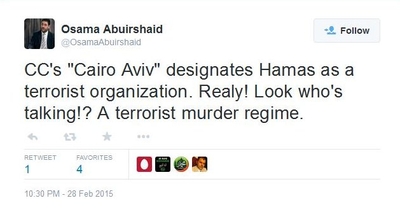
In a Feb. 28 tweet Abu Irshaid condemns Egyptian President Abdel Fattah el-Sisi’s designation of Hamas as a terrorist organization and refers to Sisi’s government as “Cairo Aviv” as a rebuke to existing close relations between Cairo and Tel Aviv.
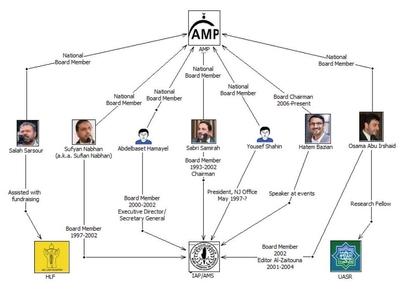
Salah Sarsour – A 2001 FBI reporttalks about Sarsour’s involvement with Hamas and fundraising on behalf of the Hamas charity, HLF. A 1998 Israeli police reportrecounting an interrogation of his brother Jamil Sarsour substantiates these claims, stating that Salah Sarsour was an HLF employee and “collected funds for this organization.”
Sarsour was arrested by Israeli authorities in the mid-1990s and sentenced to eight months in prison in Ramallah, allegedly for support to Hamas. While in prison, he became “very good friends” with Adel Awdallah, a former leader of Hamas’ al-Qassam Brigades, who was killed in an Israeli attack in October 1998. He also sent money to Awdallah “several times” through his brother Jamil Sarsour, who pleaded guilty to aiding Hamas and served a multiple year sentence in Israel before being deported to the U.S. in 2002.
Sufyan Nabhan (also Sufian Nabhan) – served on IAP’s Board of Directors. During a May 2010 event commemorating the Palestinian “Day of Catastrophe” (also known as “Al-Nakba”), Sufian criticized the “Israeli occupation of Palestine.” He was reported saying, “Occupation is apartheid, occupation is segregation. Massacres are going on daily.”
Abdelbaset Hamayel – Formerly served as IAP executive director and secretary general. Hamayel was also a representative of the Illinois and Wisconsin offices of the terror-tied charity, KindHearts for Charitable Humanitarian Development.
The U.S. Treasury froze the assets of KindHearts in 2006. The charity that was dissolved in January 2012 has made contributions to Hamas-affiliated organizations, including significant donations to Sanabil Association for Relief and Development, a Lebanese charity that was designated a Hamas front by the Treasury Department in 2003.
KindHearts was called “the progeny of Holy Land Foundation and Global Relief Foundation, which attempted to mask their support for terrorism behind the façade of charitable,” by then-Under Secretary for Terrorism and Financial Intelligence Stuart Levey.
A 2002 U.S. Treasury Department press release announcing the designation of the Global Relief Foundation alleged it “has connections to, has provided support for, and has provided assistance to Usama Bin Ladin, the al Qaida Network, and other known terrorist groups.” The press release further stated that GRF had received $18,521 from HLF in 2000.
Yousef Shahin – Identified in a feature article in Al-Zaitounah’s May 1997 issue as president of IAP’s new branch in New Jersey. “Then Yousef Shahin, president of the [IAP New Jersey] branch, spoke and thanked all who shared in the success of this project, and asked the sons of the community to support the project materially and morally,” a translation of the article in Arabic states.
Shahin has countered allegations against former British MP George Galloway for raising funds for Hamas: “He’s not taking money for terrorists,” Shahin was reported saying. “He’s buying medical supplies for the hospital. He’s not dealing with a terrorist organization. We were assured by him; he’s going to give everything to the hospital.”
Galloway’s now-defunct charity Viva Palestina claimed to “break the crippling siege of Gaza and deliver humanitarian aid” to Palestinians. During the first Viva Palestina convoy to Gaza in 2009, Galloway stated, “I personally am about to break the sanctions on the elected government of Palestine…” because, “[We] are giving three cars and £25,000 cash to Prime Minister Ismail Haniyeh. Here is the money. This is not charity. This is politics. The government of Palestine is the best people where this money is needed. We are giving this money now to the government of Palestine.”
Shahin was also listed as a point of contact for an AMP banquet that included Galloway and Osama Abu Irshaid as speakers.
Hatem Bazian – AMP’s chairman spoke at a number of IAP events. According to IAP’s Al-Zaitounah, Bazian was a guest lecturer at an IAP event at the University of Wisconsin in Milwaukee on April 13, 1998. The event was titled, “Fifty Years of Despair and Punishment for the Palestinian People.” An article in IAP’s Al-Zaitounahmagazine summarizes Bazian’s lecture: “During the lecture he [Bazian] spoke on the practices of the loathsome Zionist entity [against] the rights of the Palestinian people.”
Bazian has called on Americans to create a violent uprising at home in 2004 similar to the Palestinian intifada.
“Are you angry? …Well, we’ve been watching intifada in Palestine, we’ve been watching an uprising in Iraq, and the question is that what are we doing? How come we don’t have an intifada in this country,” Bazian said. “It’s about time that we have an intifada in this country that change[s] fundamentally the political dynamics in here. And we know every – They’re gonna say some Palestinian [is] being too radical – well, you haven’t seen radicalism yet.”
Further, at an AMP event at the University of California in Santa Cruz in November, Bazian provided the “victimization argument” to justify Palestinian violence. “Palestine is the victim that is being victimized once again by actually blaming them for the fact that they respond. Palestinians’ response to settler colonialism has been identical to every colonized people’s response when they are confronted by the colonization process,” Bazian said. He also failed to openly condemn Hamas, and instead held Israel responsible for the ongoing conflict in the region: “So the question—is Hamas good or not good for the Palestinians –it’s a question that is superficial because it does not address the context within the specificity of what is occurring on the ground of the Palestinians and how Israel is running a massive jail, shifting its powers and resources from one group to the other in order to manage an occupied colonized population.”
At an April fundraising dinner in Chicago, AMP National Media and Communications Director Kristin Szremski announced the recent opening of the organization’s Washington, D.C. office to advocate for the Palestinian cause. While claiming “we don’t lobby,” Szremski said that “for years the American Muslims for Palestine has been calling for an end to aid to Israel. Now Alhamdulillah (Praise to God) we are in a position to do something about it. Now the American Muslims for Palestine is in Washington, D.C., actually beginning the work with legislative staff in Congress to identify specific military units who receive foreign military financing from the United States.”
Szremski also named partnering organizations in its “educational and advocacy work in Congress” that included the U.S. Council of Muslim Organizations and U.S. Campaign to End the Israeli Occupation.
There is no indication AMP is routing money to Hamas. But its rhetoric and ideology, emphasizing “resistance” – a coded reference to armed jihad – and the significant representation of leaders tied to an old Hamas-support network, raise serious questions about its true objectives. This is not a mainstream organization seeking a peaceful settlement to the Israel-Palestinian conflict.
Hajj Amin Husseini’s Anti-Semitic Legacy, The Middle East Quarterly, Boris Havel, Summer 2015
(Islamic hatred of Jews goes back at least to the sixth century A.D. The pamphlet reproduced below, Islam and Judaism, was written by The Jerusalem Mufti, Muhammad Hajj Amin Husseini, apparently in the 1940s. A fascinating book by Anthony Pagden titled Worlds at War, The 2,500-year struggle between East and West, provides a scholarly account of rivalries and wars and includes highlights of the rise of Islam.
Jew hatred is now most visible in the Islamic Republic of Iran, soon to be welcomed into the “community of nations” by P5+1 “negotiators” under Obama’s guidance. — DM)
 The Jerusalem mufti, Muhammad Hajj Amin Husseini (left), meets with SS-Reichsführer Heinrich Himmler, April 1943.
Hitler’s Mein Kampf has been a bestseller for years in predominantly Muslim countries, including the Palestinian Authority and Turkey.
***********************
The Jerusalem mufti, Muhammad Hajj Amin Husseini, leader of the Palestinian Arabs from the early 1920s to the late 1940s, is widely known for his close collaboration with the Nazis during World War II. Aspects of the collaboration remain to be more thoroughly scrutinized.[1]However, and without discounting his culpability for the collapse and dispersal of Palestinian Arab society (or al-Nakba, the catastophe, as it is called by Palestinians and Arabs), Hajj Amin’s role in shaping Muslim perceptions of Jews might be a far more important and lasting legacy than his political activism in Palestine, Germany, or elsewhere.[2] An important source supporting this fact is a booklet he authored for Muslim soldiers enlisted in the Nazi SS division in Bosnia.
During the mufti’s stay in Berlin in 1941-45, he befriended Hitler’s right-hand man, Reichsführer-SS Heinrich Himmler. Himmler’s fascination with Islam and the mufti’s zealous support for the Nazi cause resulted in several common enterprises, notably the establishment of a volunteer Waffen-SS division in Bosnia, made up mostly of Bosnian Muslims, later named the Handzar division. Most books about the division display photographs of its soldiers—distinguishable by its insignia on uniform lapels and fez headgear—reading a booklet titled Islam und Judentum—most certainly the German version of the mufti’s Croatian or Bosnian pamphlet Islam i židovstvo (Islam and Judaism).
In whatever language the pamphlet was originally written, the intended readers were Muslims (Bosnian or otherwise) and not Germans. This author has been unable to locate a German copy of the pamphlet, but it is reasonable to regard the text written in the language of the Bosnian Muslims (at the time called Croatian) as the most relevant. A translation of the booklet is presented below, followed by an analysis of its significance and far reaching implications.[3]
_________________
For us Muslims, it is unworthy to utter the word Islam in the same breath with Judaism since Islam stands high over its perfidious adversary. Therefore, it would be wrong to carry out comparison of those two generally different counterpoints.
Unfortunately, it is insufficiently known that animosity between Islam and Judaism is not of a recent date. It reaches long back in history, all the way to the time of the Prophet Muhammad. This short historical overview will demonstrate the importance and perfidiousness of Jewry and its animosity toward the founder of Islam, the Prophet Muhammad.
Jews are known in history only as a subjugated people. Their vulgar[4] nature
and insufferable stance toward the nations that offered them hospitality, and toward their neighboring nations, are the reason that those same nations had to resort to [certain] measures in order to suppress a Jew’s efforts to obtain his[5] desire by force.
The history of antiquity shows us that the pharaohs were already forced to use all means against Jewish usury and Jewish immorality. Ancient Egyptians finally expelled the Jews from their land. Led by Moses, the Jews then arrived in the Sinai desert.
Arab theologian Muhammad ibn Jarir al-Tabari [839-923 C.E.] narrates that the Jews even wanted to kill their leader and savior Moses when he came back from Mount Sinai. Because of that, God punished them, and they had to meander in the wilderness for forty years. It should have brought them to their senses, and the new generation should have been cleansed from the low esteem of their fathers.
Following that, the Jews spread like locust all over the Arab peninsula. They came to Mecca, to Medina, to Iraq, and to Palestine, which is the land of milk and honey. The group of the Jews that came to Syria and Palestine was now under Roman rule. The Romans, however, soon discerned the peril that threatened the land from the Jews, and so they introduced harsh measures against them. Besides that, a serious, contagious illness of plague erupted, which was by common opinion brought into the land by Jews. When even medical doctors stated that the Jews were indeed the source of the infection—and their opinion was obviously correct—there arose among the people such upheaval against the Jews that many Jews were killed. In addition, that event is the reason why the Jews have been called “microbes” in Arabia to this very day.
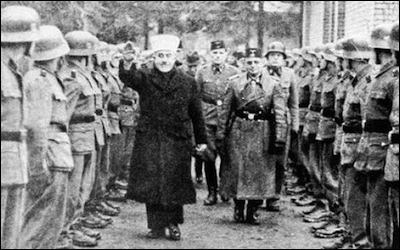 The mufti of Jerusalem, Muhammad Hajj Amin Husseini, visits the volunteer Nazi Waffen-SS division in Bosnia, made up mostly of Bosnian Muslims. The mufti was instrumental in the division’s formation.
The Arabs have a particular understanding for introducing forceful measures against Jews in Germany and for their expulsion from the country. After the [First] World War, England and America enabled the Jews to settle in Palestine and to establish a Jewish state there. Jewish excrement from all countries assembled there, rascally striving to seize the land from Arabs. And indeed, they succeeded in buying land from the poorest of the poor and from unscrupulous landlords. By doing so, they took poor widows’ bread and stole food from children to fatten themselves.[6] When the Arabs opposed the Jewish settlement, the Jews did not shun bloody murders. So they robbed many families of their livelihood and threw the families into misery and troubles. (God will punish them for those disgraceful deeds).
The Jewish struggle against Arabs is nothing new for us, except that as time passed, the location of the battlefield changed. Jews hate Muhammad and Islam, and they hate any man who wishes to advance the prosperity of his people and to fight against Jewish lust for possessions and Jewish corruption.
Struggle between Jews and Islam began when Muhammad fled Mecca to Medina where he created the base for the development of Islam. At that time, Jews were merchants, already permeated with guile, and they understood that Muhammad’s influence, in both the spiritual and business spheres, could turn into a danger for them. Thus they were possessed by a deep hatred toward Islam; hatred that intensified as Islam was growing more solid and powerful. The Jews breached the agreement they had concluded with Muhammad in Khaibar, of which we shall speak later. Moreover, their rage grew immensely when the Qur’an revealed the deepest inclinations of their soul, their heartlessness, and unscrupulousness by which their ancestors had been commonly known. At that time, the Jewish methods were already the same as they are today. Their weapon has been, as always, slander and quarrel, and so they attempted to humiliate Muhammad in the eyes of his followers. They claimed that he was a deceiver, an enchanter, and a liar. When they did not succeed in this, they attempted to undermine Muhammad’s honor by spreading a rumor that his wife Aisha committed adultery. The purpose of spreading such a rumor was to sow doubt in the hearts of Muhammad’s followers.
When that failed, they tried to show Muhammad’s teaching in a bad light. With that purpose, several Jews converted to Islam; only a few days later, they returned to the Jewish faith. When asked why they changed their mind so suddenly, they replied that they were very willing to settle in Islam but found that all of it is nothing but a lie. The following Qur’anic verse alludes to that:
Many of those knowledgeable in the Scriptures attempt to somehow render you infidels again by converting to our religion. It was, though, nothing but their souls’ envy, when they comprehended truth.[7]
When the Jews understood that they would not reach their goal by the means used until then, they started to ask Muhammad various meaningless and unsolvable questions. Thus, they wanted to convince others that Muhammad was poor in knowledge and wisdom. However, that method achieved no success. As they were thus persuaded that Islam was deeply rooted in the hearts of the Muslims, they commenced with the attempts to destroy the Muslims. Pursuant to that goal, they paid some non-Muslim tribes to fight against Muhammad. The almighty God, however, wanted it differently. With iron fist, Muhammad defeated the rebellious tribes and conquered their city. The Jews could not bear such a defeat, and so they decided to destroy Muhammad in every way. They hired men to murder him.
The Medina Jews lived in the city district of Banu Nadir. When Muhammad came to Medina, he concluded a contract with them. One day he set out to that city district, accompanied by only ten companions, to talk to the Jews and to try to convert them to Islam. Muhammad explained the principles of Islam to the Jews, and they seemed very interested and open-minded. Yet as Muhammad was talking in a friendly way with some of the Jews, another group prepared an attempt on his life. They persuaded a man to throw a piece of rock on Muhammad’s head. Surely Muhammad would have been killed were it not for God, who warned him. An inner voice advised him to leave that place, and so the treacherous Jews could not carry out their design. Consequently Muhammad sent a companion to deliver his message to the Jews to leave the city within ten days. They had breached the contract they concluded with him by trying to take his life. Any Jew found in the city after those ten days would be punished by death.
However, some of the Jews, who outwardly accepted Islam but in their innermost remained Jewish, persuaded other Jews not to leave the city. When the ten days passed, Muhammad was forced to expel the Jews from the city by armed force. Part of the Jews fled to Khaibar and part to Syria.
The Jews who fled to Khaibar, however, would not concede defeat and decided to avenge themselves on Muhammad. For that purpose, they turned to other Khaibar Jews and to the Jews of Taima and of Wadi Qura. Together they plotted a conspiracy: With large sums of money, they agitated non-Muslim Arab tribes to attack Medina. When Muhammad discovered their plan he quickly armed his men and set out toward the plotters’ base in Khaibar. Muhammad’s companions captured Khaibar and expelled most Jews from the site. With the remaining Jews, Muhammad concluded a contract by which peace was guaranteed.
Only after that devastating defeat [of the Jews] could an Islamic Empire peacefully develop. But when one takes into account the Jewish significance, it was not to be wondered that Jews, in spite of the agreements made, did not abandon their plans and continued to try to destroy Muhammad by all available means. They invited him to a feast, and he accepted the invitation suspecting no evil. In front of him was placed a roasted lamb prepared by the Jewess Zainab, wife of Sallam ibn Mishkam.[8] The [topic of] conversation around the table was the contract and a peaceful life in mutual agreement in which they now lived. Muhammad had not the slightest suspicion about treason. The Prophet and his faithful companion Bashr ibn Bara each took a piece of lamb meat. Muhammad, however, did not swallow his bite because its taste made him suspicious.
“The bone tells me that the lamb was poisoned,” he said and called the Jewess Zainab to ask whether the meat had been poisoned. She answered, “You know I am highly esteemed by the Jews, and I acknowledge that I have poisoned the lamb. In so doing, I thought that if you were a king, I would only kill a king, but if you were indeed a prophet, you would know that the meat had been poisoned.”
Muhammad’s companion soon succumbed to the poison’s effect, whereas Muhammad, despite spitting the poisonous bite, later suffered various health disorders, and the impact of the poison had always been evident. Some historians even believe that Muhammad’s death was a consequence of that poisoning. In this matter, they refer to a hadith by Abu Huraira, whereby the Prophet said shortly before his death, “The effect of Khaibar’s feast will manifest in me until I die!”[9]
 Many books about the Waffen-SS division in Bosnia display photographs of its soldiers reading a booklet titled Islam und Judentum—most certainly the German version of the mufti’s Croatian or Bosnian pamphlet Islam i židovstvo (Islam and Judaism). The booklet offers a stark illustration of the lengths taken by the mufti to demonize Jews and Judaism and clearly was produced for propaganda and incitement purposes.
Now, the Jews were persuaded that Muhammad was immune to their attacks. Therefore, they made a decision to spread discord among the Arab tribes, so as to break the power of Islam. When Muhammad went back to Medina, he succeeded in reconciling the Arab tribes of Kawsha and Karasha,[10] which had been fighting each other ceaselessly for 120 years. In doing so, he significantly strengthened Islam’s position. Members of those two [formerly] hostile tribes became brethren in Islam, and peace entered the city. In this regard, the Jews tried to undermine the Islamic empire.
A revengeful old man by the name of Shas ibn Qais one day walked with his friends and came across an assembly of the reconciled tribes held in city square. He could not bear to see how [the members of] those two tribes, formerly at war with each other, now communicated nicely, and so devised a hellish plan. He sent to their assembly a friend of his, knowledgeable in war poems, and persuaded him to recite some of his old poems that were full of hatred. That Jew, an outstanding orator, came indeed to the assembly and started to recite old war poems of both tribes. By doing so, he managed to find in each tribe a man in whom old hatred flared up. Those two men started to fight each other and then urged their fellow-tribesmen to take up arms. An immense tragedy would have ensued were it not for Muhammad, who learned about the fight amongst brethren and hurried up to the battlefield.
“Oh my God, are the old times returning even while I am still amongst you!” he shouted. “When I gave you Islam as religion, the old fratricidal discord was buried, and you became brothers in your hearts. Do you wish to slip into infidelity again?”
Both tribes understood that disturbances among them were sown by the Jews alone. They threw away their weapons and asked God for forgiveness, and then they hugged each other and concluded a new brotherly alliance. Regarding Shas ibn Qais the Jew, it is said in the Qur’an,
Oh, you scribes,[11] why do you prevent the believer from walking on God’s path when you are witnesses yourselves? But God is not blind for what you do.[12]
Regarding the tribes of Kawsha and Karasha, the Qur’an said,
Oh, you who believe, would you listen to those who received the Scripture, so that they would turn you into unbelievers again, after you have received faith! How can you be infidels when God’s words were read to you, and his apostle is among you? He who holds unto God has already been introduced to a straight path.[13]
Notwithstanding their attempts, the Jews never succeeded in spreading division among Muhammad’s followers and in dragging them back into infidelity. However, even after all these events should have taught them the futility of their efforts, they persistently continued to carry out their devilish plans. Once, they tried by deceit to even bring down Muhammad himself.
There was a quarrel between two Jewish tribes, and the side that was wrong held an assembly and sent its leaders to Muhammad. Those Jewish leaders said to Muhammad, “You know that we are influential people. If you support us in our dispute with our opponents, we will apply all our influence to make all Jews convert to Islam.” Muhammad, of course, dismissed them. There is a verse in the Qur’an about this event:
Be careful to make decisions according to what God has revealed and not to consider their desires. Keep your guard toward them so that they would not even partially shift you from what God has revealed to you. If they rebel, know that God will surely punish them for a part of their sins. There are, indeed, many men who are evildoers.[14]
Another example of Jewish subversive action was recorded by Ibn Abbas. At the time when Muhammad went from Mecca to Medina, prayers were directed toward Jerusalem. However, it lasted only for seventeen months. Then Muhammad received God’s revelation that the direction of prayers should be Mecca, and ever since, prayers are uttered with faces turned to Mecca. The Qur’an says about this:
We see how you turn your face toward heaven, and we would like to give it a direction which you will like: Turn your face toward the holy place of prayer; wherever you find yourselves, turn your face in that direction. Don’t you see that even those who had received the Scripture know that it is the truth before their Lord? And God is never heedless of what they do.[15]
When the Jews found out about this Qur’anic verse, they were angered and asked Muhammad to return to the previous direction of prayer, which was Jerusalem. Were he to do so, they promised, all Jews would accept Islam. Muhammad, however, did not allow himself to be led astray by such a proposal and to transgress against God’s command. We find the following in the Qur’an about that:
The direction to which you used to turn in prayer until now we have changed only for the purpose of distinguishing those who follow apostles from those who turn on their heel. That was surely difficult but not for those led by God. And God does not want to destroy your faith because God is full of goodness and compassionate to men.[16]
Here is another example how the Jews did not hesitate to stab Muhammad in the back at the time of his utmost distress. When Muhammad won the Battle of Badr, he sent a messenger on his own camel, because that camel was the fastest, to carry the news about his victory to Medina. The Jews, however, tried to bring confusion into the Muslims’ ranks by spreading false rumors that Muhammad had been killed in the battle. As evidence, they pointed out that Muhammad’s camel returned to the city with another rider.
When even that design failed, the Jews turned to Mecca to incite Muhammad’s enemies against him. Moreover, they declared their readiness to support the Meccans in their fight against Muhammad with an army of theirs. When the pagans of Mecca asked the Jews—since the Jews had received the Holy Scripture even before Muhammad—whether or not Muhammad’s religion was good, the Jews answered, “You know that we are men of letters. Believe us, therefore, when we tell you that your religion is much better.” The following verse is in the Qur’an about this:
Don’t you see those who received the Scriptures? They believe in Jibt and Taghut [superstition and idolatry], but they nevertheless say about pagans that their way is better than believers’ way. Those are the ones whom God has cursed, and he who was cursed by God cannot be helped.[17]
As we see, that curse came true. Without a homeland, the Jews are scattered throughout the whole world, and nowhere do they find true help and support. Another Qur’anic verse reads:
You will certainly find out that the greatest animosity toward the believers foster the Jews and the pagans.[18]
That idea has been even better expressed by words of Muhammad: “It will never be possible for you to see a Muslim and a Jew together without secret intention in the [heart of the] Jew to destroy the Muslim.”[19] Abu Huraira passed to us the following hadith:
Judgment Day will not come before the Muslims completely destroy the Jews, and when every tree with a Jew hidden behind will say to the Muslim, “There is a Jew behind me, kill him!” Only the gharqad tree, which is a small bush with many thorns growing around Jerusalem, will not participate in it because it is a Jewish tree! [Bukhari-Muslim VIII, p. 188].
The booklet Islam and Judaism offers a stark illustration of the lengths taken by the mufti to demonize Jews and Judaism. Qur’anic passages are freely paraphrased without reference to sura and verse while apparent quotations (like those about Jews converting insincerely to Islam in order to drag Muslims away from their faith) are nowhere to be found in the Qur’an, certainly not in the translation by Muhammed Pandža and Džemaluddin Čaušević[20] used by Yugoslav Muslims since 1937. Indicating the pamphlet’s clear propaganda and incitement purpose, this sloppiness reflected both Hajj Amin’s poor religious credentials and his apparent conviction that the pamphlet would not be subjected to critical scrutiny or even read by believers well-versed in the Qur’an. For, though bestowed with the title of Grand Mufti of Jerusalem, Mandatory Palestine’s highest religious authority, it was common knowledge at the time that Hajj Amin did not possess the necessary religious credentials for such a lofty post. Indeed, he even failed to make the final short-list for the mufti’s post having received only nine of the electors’ sixty-four votes; but the Husseinis and their British champions forced one of the final three candidates to step down in his favor, paving the road to his appointment.[21]
Some of the pamphlet’s assertions indicate the mufti’s deficient familiarity with Islamic history and theology. Nor was Hajj Amin averse to introducing novelties and fabrications for the purpose of defaming Jews. His text contains details with an unconventional interpretation of Qur’anic accounts, some of them erroneous. He accuses the Jews of having “attempted to undermine Muhammad’s honor by spreading a rumor that Muhammad’s wife Aisha committed adultery.” But renowned Islamic scholars, including Tabari, to whom the mufti refers in the booklet, do not mention the Jews at all in the context of this event: Aisha’s accusers were all Arabs. Some came from the tribe of Kharzaj; at least one was from the Quraish, Muhammad’s tribe, and another was the sister of Muhammad’s wife. Their names are listed in both Ibn Ishak’s and Tabari’s accounts of the event. After God revealed Aisha’s innocence to Muhammad, some of the accusers were punished by flogging.[22]
Furthermore, the mufti claimed that Muhammad attacked Khaibar because its Jews bribed Arab tribes to attack Medina. The sources, however, do not mention any such activity by the Khaibar Jews. Khaibar was in alliance with the Arab tribe of Ghatafan—which at this point seemed to be rather defensive—with the Quraish, and with the Persians. Muhammad’s attack occurred shortly after he concluded the peace of Hudaibiya (March 628) with the Meccans. It is hard to envisage that Muhammad’s enemies would plot an attack from the north without Meccan support. On the contrary, it seems that he concluded the peace of Hudaibiya to secure his southern front so as to be able to attack the Khaibar Jews, whose Persian allies had just been defeated by the Byzantine army.[23]
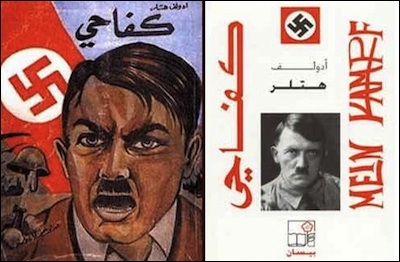 There remains a deep connection between Islamism and Nazism based on the common characteristics of racism, nationalism, religious bigotry, and intolerance. Hitler’s Mein Kampf has been a bestseller for years in predominantly Muslim countries, including the Palestinian Authority and Turkey.
There was, however, an event reminiscent of the mufti’s story that occurred a year earlier. The Jews of Medina had invited the Quraish and Ghatafan tribes to attack Muhammad. It was at this point, after the Battle of Badr, that the Quraish asked the Jews whose religion was better, theirs or Muhammad’s. Encouraged by the Jews, the two tribes marched on Medina, and their subsequent abortive attack came to be known as the Battle of the Ditch. After their retreat, Muhammad attacked Medina’s Jewish tribe of Banu Quraiza.[24] It seems likely that the mufti—unless he intentionally invented stories, a possibility that cannot be ruled out—confused the episode of the Banu Quraiza with that of Muhammad’s war on Khaibar.
Far more important than these technical details and idiosyncratic interpretations are the novelties the pamphlet introduces in Islamic political discourse regarding the Jews. By combining the Islamic canon with pre-Christian and Christian anti-Judaism, it attributes strengths and powers to Jews that cannot be found in Islamic tradition by portraying them as far more cunning and successful in their vicious designs than previous mainstream Islamic thought had recognized or permitted.
A simpler example of this anti-Jewish eclecticism can be found in the mufti’s accusation that Jews brought plague to Arabia. This statement evokes medieval European myths with similar themes. More significant is the notion that Muhammad’s death might have been a result of poison given to him by a Khaibar Jewess.
To be sure, Ibn Ishak and Tabari do mention how during the illness that led to his death Muhammad spoke to Umm Bashr, mother of his poisoned companion, and complained about his pain, caused by poisonous meat he had tasted three years earlier.[25] However, in classic Islamic thought, this tradition was not interpreted as proof that the Jewess had succeeded in her attempt on the Prophet’s life but as a desire to attribute to the Prophet the highest of virtues: martyrdom. In Ibn Ishak’s words, “The Muslims considered that the apostle died as a martyr in addition to the prophetic office with which God had honored him.”[26] Tabari repeats this explanation, as does Ibn Kathir (1300-73), who referred to eight different hadiths asserting that Muhammad had been warned by God about the poison: proof of his being a genuine prophet. Conversely, Ibn Kathir states that “the Messenger of God died a martyr.”[27]
The core theme of all these traditions is the Prophet’s martyrdom and not the Jews’ lethal craft; the reader is left with the clear impression that the two phenomena were unrelated. In contrast, the mufti’s pamphlet establishes the link and changes the emphasis from the Prophet’s virtue to the Jews’ mendacity. Apparently, his intention was to draw parallels with Christian traditions regarding Christ’s killing by the Jews. This accusation was intended to provoke more anger among Muslims, but it also violated Islamic tradition and theology.
The implications of the mufti’s claim that the Jews were successful in killing Muhammad despite God’s warning imply that Jews possess the power to defy God’s will. Such a blasphemous thought would be worse than Christian accusation of deicide. Jesus overcame death, and by his suffering, death and resurrection brought salvation to his community of believers; however, Muhammad not only remained dead but also failed to appoint his successor due to the rapid progression of his illness and his sudden, untimely demise. Consequently, the umma was split by different claimants to authority, and the dispute eventually led to the fiercest internecine strife in the history of early Islam, known as the fitna.
While the mufti’s Palestinian successors would not tire of reiterating this story (as late as November 2013, Palestinian Authority minister of religious affairs Mahmoud Habbash claimed that Yasser Arafat was poisoned by the Jews just as they had poisoned the Prophet Muhammad to death),[28]most contemporary Islamic scholars have a different understanding of this hazardous theology; inasmuch, the accusation that the Jews killed the Prophet has largely faded as a theological theme with mainstream Islamic commentary viewing the Jews, along the Qur’anic derision, as “adh-dhilla wa-l-maskan,” translated by Yehoshafat Harkabi as “humiliation and wretchedness.”[29] Bernard Lewis further explained:
The outstanding characteristic, therefore, of the Jews as seen and as treated in the classical Islamic world is their unimportance. … For Muslims, he might be hostile, cunning, and vindictive, but he was weak and ineffectual—an object of ridicule, not fear. This image of weakness and insignificance could only be confirmed by the subsequent history of Jewish life in Muslim lands.[30]
Departing from this conventional view, the mufti did not interpret contemporary events as a new historical phenomenon to which Muslims should respond in a new, ad hoc manner. Instead, he traced Jewish accomplishments of the 1920s, 1930s, and 1940s, and the alleged Jewish power and ambitions, to supposed Jewish activities at the time of Muhammad. In doing so, he created a precedent, later followed by prominent Islamic actors in the Middle East and elsewhere, particularly after Israel’s stunning military victories over its Arab adversaries. Thus Hamas accuses the Jews of “wiping out the Islamic caliphate” by starting World War I and of starting the French and the communist revolutions, establishing “clandestine organizations” and financial power so as to colonize, exploit, and corrupt countries.[31] Likewise, former Malaysian prime minister Mahathir Muhammad accused Jews of ruling the world by proxy.[32] Attributing such gargantuan accomplishments to the Jews, many of them at the expense of Muslims, presents a theological innovation with an immediate political consequence. Linking early Islamic with medieval Christian depictions of Jews results in their portrayal as “a demonic entity,” thus making their “extermination legitimate.”[33]
______________________
[1] Klaus-Michael Mallmann and Martin Cüppers, Nazi Palestine: The Plans for the Extermination of the Jews in Palestine, trans. Krista Smith (New York: Enigma Books in Association with the United States Holocaust Memorial Museum, 2010), p. viii.
[2] Boris Havel, “Haj Amin al-Husseini: Herald of Religious Anti-Judaism in the Contemporary Islamic World,”The Journal of the Middle East and Africa, 3 (2014): 221-43.
[3] The following text has been translated from the original pamphlet: Veliki Muftija Jeruzalemski Hadži Emin el-Huseini, Islam I Židovstvo (Zagreb: Hrvatski tiskarski zavod, 1943). I wish to thank the staff of the National and University Library in Zagreb for tracing the booklet. The Qur’anic verses and hadith are translated as they appear in the original text.
[4] The word “prostačkoj” can also be translated as: obscene, dirty, or indecent.
[5] This word was written in singular in the original text and introduces the notion that the average Jew was such; by referring to “a Jew,” the author refers to the whole people.
[6] The mufti fails to note that prominent members of his own family, including his father, were among the “unscrupulous landlords” selling plots of land to the Jews. See Efraim Karsh, Palestine Betrayed (New Haven: Yale University Press, 2010), pp. 15-19.
[7] Sura 2:109.-Ed.
[8] Ibn-Ishak, The Life of Muhammad: A Translation of Ibn Ishaq’s “Sirat Rasul Allah” by A. Guillaume(Karachi: Oxford University Press, 2004; repr., 1967), p. 516; Tabari, The History of al-Tabari [Ta’rikh al-Rusul Wa–l-Muluk] (New York: State University of New York Press, 1987-97), vol. VIII, pp. 123-4.- Ed.
[9] Bukhari’s Hadith, 4.394.-Ed.
[10] The author probably refers to the Arab tribes of Aws and Kharzaj though the transliteration (Kauša i Karaša) barely resembles those names.
[11] The word “pismenjaci” refers to the “People of the Book” (sljedbenici knjige in Čaušević-Pandža).
[12] Sura 3:99.-Ed.
[13] Sura 3:99-101.-Ed.
[14] Sura 5:41-5.-Ed.
[15] Sura 2:144-9.-Ed.
[16] Sura 2:142-3.-Ed.
[17] Sura 4:51-5.-Ed.
[18] Sura 5:82.-Ed.
[19] There is no Qur’anic verse with this message. The mufti perhaps refers to a non-canonical hadith or obscure tradition.
[20] Muhammed Pandža and Džemaluddin Čaušević (eds.), Kur‘an, Sedmo Izdanje (South Birmingham: Islamic Relief, 1937-89). Though the Qur’an condemns those who falsely feigned Islamic belief (e.g., sura 2:8-9, or sura 63), this condemnation does not specifically apply to the Jews but rather to the wider category of “hypocrites.”
[21] Karsh, Palestine Betrayed, p. 17; David Dalin and John Rothmann, Icon of Evil: Hitler’s Mufti and the Rise of Radical Islam (New York: Random House, 2008), p. 252.
[22] Ibn-Ishak, The Life of Muhammad, pp. 492-9; Tabari, The History of al-Tabari, vol. VIII, pp. 57-67; Qur’an: sura 24:11-26.
[23] Michael Lecker, “The Hudaybiyya-Treaty and the Expedition against Khaybar,” Jerusalem Studies in Arabic and Islam, 5 (1984), pp. 1-12.
[24] Ibn-Ishak, The Life of Muhammad, pp. 450-69.
[25] Tabari, The History of al-Tabari, vol VIII, p. 124.
[26] Ibn-Ishak, The Life of Muhammad, p. 516.
[27] Ibn-Kathir, The Life of the Prophet Muhammad (al-Sira al-Nabawiyya), trans. Trevor Le Gassick (Reading: Garnet Publishing, 2000-06), vol. 3, pp. 283-7.
[28] Palestinian Authority TV, Nov. 8, 2013; “PA: Arafat was poisoned by Jews like Islam’s Prophet Muhammad,” trans. Palestinian Media Watch, Nov. 12, 2013.
[29] Yehoshafat Harkabi, Arab Attitudes to Israel (Jerusalem: Israel Universities Press, 1972), p. 220.
[30] Bernard Lewis, Semites and Anti-Semites (London: Phoenix, 1997), pp. 117-39.
[31] See, for example, “Hamas Covenant 1988,” Yale Law School Avalon Project, accessed Mar. 14, 2015.
[32] CNN, Oct. 16, 2003.
[33] Moshe Sharon, Jihad: Islam against Israel and the West (Jerusalem: Moshe Sharon, 2007), pp. 77-8.




 anneinpt
 artaxes
 danmillerinpanama
 davidking1530
 Peter Hofman
 Joseph Wouk
 Peter
Peter Louisiana Steve
 WarSclerotic
Recent Comments