Archive for the ‘Islamisation of France’ category

In France, do not dare to criticize Islam

July 6, 2017

In France, do not dare to criticize Islam, Israel National News, Giulio Meotti, July 6, 2017

France, the country where the debate on Islam and integration has been more intensive, is the first target of the Islamic enemies of freedom. If France is now silent, the debate on Islam will be “resolved” all across Europe.

**************************

The controversy began with his intervention in September 2016 on the broadcast “C à vous”. Éric Zemmour was then immediately sued at the 17th Criminal Court of the Paris Court. He must respond to the alleged offense of “incitement to discrimination and hatred against people of Muslim faith”. The lawsuit is promoted by the EuroPalestine Association.

Zemmour is in trouble for a few sentences, such as the ones describing Muslims as those who “have to choose between Islam and France”, saying that “Jihad is a religious duty”, that “Muslims consider jihadists as good Muslims” and that “moderate Islam does not exist”. Ideas. Ideas are debatable in a European pluralist democracy proud of the free circulation of ideas, as well as goods and people. But these ideas are becoming forbidden in France.

Thus, Zemmour was sentenced of incitement to hatred and a fine of 5,000 euros. 8,000 spectators lodged a complaint at the State Council for Audiovisual. It is not the first conviction that Zemmour suffers for his ideas about France and Islam. In 2014, in an interview with the Italian daily Il Corriere della Sera, he said that France’s estimated five million Muslims should be “deported”  to avoid “chaos and civil war”.

In 2007, Charlie Hebdo ended up in court. The French journalists were cleared of any charge, but the jihadists were ready to silence them forever (in three years, not a single cartoon on Mohammed and Islam has been published). In 2013, the magazine Valeurs Actuelles was sentenced for “discrimination” against Muslims for publishing the national symbol Marianne with a Muslim veil (two thousand euros fine). The following year was the turn of Renaud Camus, condemned to pay five thousand euros for “hate instigation” for his theory of “Great Substitution”.

Zemmour was dragged many times to court. A year ago, it was when he gave an interview at Causeur magazine: “I respect the people willing to die for what they believe”, Zemmour said of the Islamic terrorists.

When Zemmour was dragged for the first time to court by the anti-racist and Islamic organizations in 2011, thirty MPs formed the “Freedom of expression collective”: “With the excuse of racism, a journalist is forced to silence when he wants to give an opinion”, said the 28 signatories, who condemned “the tyrants of the doctrine of anti-racism. Voltaire is buried”. Zemmour is only the best known of French journalists and intellectuals dragged into court to respond to the new intellectual offense: “Islamophobia”. There is a list of impressive names, from Georges Bensoussan to Pascal Bruckner.

France, the country where the debate on Islam and integration has been more intensive, is the first target of the Islamic enemies of freedom. If France is now silent, the debate on Islam will be “resolved” all across Europe.

France: Macron, President of the Elites and Islamists

May 26, 2017

France: Macron, President of the Elites and Islamists, Gatestone InstituteGuy Millière, May 26, 2017

“Today, Muslims of France are poorly treated … Tomorrow, a new structure will make it possible to relaunch the work sites of the Muslim religion in France: the construction and the improvement of worthy places of worship will take place where their presence is necessary, and the training of imams of France will be organized.”

***************************

French President Emmanuel Macron can only be described as close to the business world if one understands how things work in France. The French economy is a mixed system where it is almost impossible to succeed financially without having close relations with political leaders who can grant favors and subsidies, and either authorize, prohibit or facilitate contracts or hinder them. Macron is not supposed to bring any new impetus to business, but to ensure and consolidate the power of those who placed him where he is.

A deliberate side-effect of Macron’s policies will be population change. Macron wants Islam to have more room in France. Like many European leaders, Emmanuel Macron seems convinced that the remedy for the demographic deficit and the aging of ethnic European populations is more immigration.

The French branch of the Muslim Brotherhood published an official communiqué, saying: “Muslims think that the new President of the Republic will allow the reconciliation of France with itself and will allow us to go farther, together.”

Emmanuel Macron — whose victory in the French presidential election on May 7, 2017 was declared decisive — was presented as a centrist, a newcomer in politics with strong ties to the business world, and a man who could bring a new impetus to a stagnant country.

The reality, however, is quite different.

His victory was actually not “decisive”. Although he received a high percentage of the votes cast (66%), the number of voters who cast a blank ballot or decided to abstain was the highest ever in a French presidential election.

Although his opponent, Marine Le Pen, tried to dissociate herself from the anti-Semitism of her father, Jean-Marie Le Pen, she was treated as a walking horror by almost all politicians and journalists during the entire campaign. That she nevertheless drew 34% of the votes was a sign of the depth of the anger and frustration that has been engulfing the French people. More than half of those who chose Macron were apparently voting against Marine Le Pen, rather than for Macron.

Macron, who won by default, suffers from a deep lack of legitimacy. He was elected because he was the last man standing, and because the moderate right’s candidate, François Fillon, was sabotaged by a demolition operation carried out by the media and by a political use of justice. Significantly, the legal prosecution of Fillon stopped immediately after he was defeated.

Macron is not a centrist: he was discreetly supported throughout the campaign by most of the Socialist Party’s leaders and by the outgoing Socialist President, François Hollande. The day after the election, during a V-E Day ceremony, Hollande could not hide his joy. A few days later, on May 14, when he handed the office of the president over to Macron, Hollande said that what was happening was not an “alternative” but a “continuity”. All Macron’s team-members were socialists or leftists. Macron’s leading political strategist, Ismael Emelien, had worked for the campaign that led to the election of Nicolas Maduro in Venezuela.

Macron’s entire program is socialist. Proposals for additional public expenditures abound. “Climate change” is defined as “the key issue for the future of the world”. The proposed changes to the Labor Code and the tax system are largely cosmetic and seem intended more to give an illusion of change than to bring about real change. While Macron does not reject a market economy, he thinks that it must be placed at the service of “social justice”, and that the government’s role is to “guide”, to “protect”, “to help” — not to guarantee freedom to choose. Significantly, the economists who participated in the elaboration of Macron’s program are those who had drawn up Hollande’s economic program in 2012.

Even if he is young, Macron is not a newcomer to politics and does not embody renewal. He not only worked with Hollande for five years, but those who shaped his political ascent have long careers behind them: Jacques Attali was President François Mitterand’s adviser in the 1980s ; Alain Minc worked with all French Presidents since Valery Giscard d’Estaing was elected in 1974, and Jean-Pierre Jouyet was the cabinet director for Socialist Prime Minister Lionel Jospin in the late 1990s. Just after the election, three documentaries were broadcast on French television explaining in detail how Macron’s campaign was organized. Macron is the pure product of what analysts described as the “French nomenklatura” — an arrogant élite, composed of senior officials, political power-holders and the businessmen working in close collaboration with them.

Macron can only be described as close to the business world if one understands how things work in France. The French economy is a mixed system where it is almost impossible to succeed financially without having close relations with political leaders who can grant favors and subsidies, and either authorize, prohibit or facilitate contracts or hinder them.

During the years he spent at Hollande’s side, Macron helped various French businessmen. They thanked him by massively contributing to his campaign. It would be surprising if they do not expect a “return on investment”. The operation that allowed Macron’s election could be described in business language as a takeover. Almost all French private media outlets belong to those who supported Macron and were part of the takeover.

Macron is not supposed to bring any new impetus to business, but to ensure and consolidate the power of those who placed him where he is. Their goal is to create a large, single, center-left, technocratic political party that will crush the old political parties and that will be installed in a position of hegemony. The party’s slogan, “En Marche!” (“On the Move!”), was established to go forward in that direction; the old political parties have been almost destroyed. The official Socialist Party is dying. The main center-right party, The Republicans, is in disarray. One of its leaders, Edouard Philippe, was appointed Macron’s Prime Minister. Another, Bruno Le Maire, is now Finance and Economy minister: he will have to apply quite a different policy from those defined by his original party. The rightist National Front and the radical left will be treated as receptacles of anger: everything will be done so that they stay marginalized.

Another goal is to entrust ever more power to the technocratic unaccountable, untransparent and undemocratic institutions of the European Union: it is a goal Emmanuel Macron never stopped emphasizing. On May 7, as soon as the election result was known, the leaders of the European Union showed their enthusiasm. The president of the European Commission, Jean-Claude Juncker, spoke of “a signal of hope for Europe”. On May 15, immediately after the inauguration, Macron went to Berlin, met German Chancellor Angela Merkel and said that he hoped for a rapid “strengthening of the Union”. Macron says he wants the creation of an EU Ministry of Finance, whose decisions would have binding force for all member states.

French President Emmanuel Macron and German Chancellor Angela Merkel chat in Berlin on May 15, 2017. (Photo by Michele Tantussi/Getty Images)

A deliberate side-effect of Macron’s policies will be population change. Like many European leaders, Emmanuel Macron seems convinced that the remedy for the demographic deficit and the aging of ethnic European populations is more immigration. On September 6, 2015, he stated that “immigration is an opportunity for all of us”. On February 12, 2017, he said, “I will propose to the Algerian government the creation of a Franco-Algerian Bureau of Youth, to encourage mobility between the two shores of the Mediterranean”. A few weeks later, he declared that “the duty of Europe is to offer asylum to all those who seek its protection” and that “France must take its fair share of refugees”.

Almost all refugees arriving in France are Muslims. France already has the greatest percentage of Muslims in Europe. Macron wants Islam to have more room in France. His position concerning other religions is not known. His position on Islam is clear:

“Today, Muslims of France are poorly treated … Tomorrow, a new structure will make it possible to relaunch the work sites of the Muslim religion in France: the construction and the improvement of worthy places of worship will take place where their presence is necessary, and the training of imams of France will be organized.”

The French branch of the Muslim Brotherhood congratulated Macron on on his victory. It published an official communiqué saying: “Muslims think that the new President of the Republic will allow the reconciliation of France with itself and will allow us to go farther, together.”

Macron’s prime minister, Edouard Philippe, has close ties with the Muslim Brotherhood and favored their installation in the city of which he is the mayor, Le Havre. Richard Ferrand — a Socialist MP, the secretary-general of En Marche! since its inception, and now Minister for the Cohesion of Territories — has been financially contributing to the anti-Israel BDS movement and to “pro-Palestinian” organizations for years. Gerard Collomb, the Socialist Mayor of Lyon, and now Interior Minister, financed the French Institute of Muslim Civilization that will open its doors in December 2017.

In a recent article, Yves Mamou noted that Macron is not “an open promoter of Islamism in France” and could be defined as a “useful idiot.”

In another recent article, Bruce Bawer wondered how the French could have chosen Emmanuel Macron. His answer was that “the mainstream media have played a role”. Evidently, also, “some people do not want to know the truth,” even when the truth is in front of their eyes.

“Some people are accustomed to the idea that there are people above them in the hierarchy whose job is to think about, and take care of the big things while they, the citizens, the mice, take care of their own little lives”.

A majority of the French did not choose Macron but apparently accept that there are people above them. Those who do not accept this fact so easily are many, but in minority, and they are likely to become a smaller minority. Macron is counting on their resignation. It is not certain, however, that the millions of people who voted for Marine Le Pen, despite her extremely problematic closeness to Russia and the harsh campaign against her, or those who voted for the leftist candidates, will so easily give up. It is also not certain — thanks to willful blindness and appeasement — that Islamists will mellow, or that jihadist attacks will stop.

Macron said he was “dismayed” over Manchester Arena terror attack. He added that he was “filled with dread”. He did not express the necessity of confronting the danger. The French have every reason to be nervous.

What Happened in France?

May 8, 2017

What Happened in France? PJ MediaBruce Bawer, May 7, 2017

(Please see also, France: Emmanuel Macron, Useful Idiot of Islamism and Europe’s Childless Leaders Sleepwalking Us to Disaster.– DM)

But – and this is a fact that some of us are thoroughly incapable of identifying with, and thus almost thoroughly incapable of grasping – some people don’t want to know the truth. And if they do know the truth, they want to un-know it.

Yes, they see Islam taking over. Bit by bit, here and there. Everything in their lives, everything familiar to them, is being transformed, in some cases at a terrifying pace. Perhaps their own lives haven’t been turned upside down – yet. But they know people who have suffered greatly because of these changes.

Yet they’re terrified to speak up about it, let alone do anything about it. Viewed through American eyes, it may seem a European thing (although it’s not as uncommon in America, alas, as it used to be).

********************************

How could Marine Le Pen have lost in a landslide?

Why, after the Brits chose Brexit, and Americans chose Trump, did the Dutch fail Wilders, and the French fail Le Pen?

How could a country that has been hit by several major terrorist attacks in recent years, and that has undergone a more profound social transformation owing to Islamic immigration, vote for business as usual?

Wilders, buoyed by the Brexit and Trump victories, said that 2017 would be a “Year of the Populist.” So far, alas, it’s not turning out that way.

Yes, there are positive signs. The Sweden Democrats are on the upswing. And Wilders did gain seats in the Dutch Parliament.

But if you’ve witnessed the reality of Islamization in cities like Rotterdam and Paris and Stockholm, you may well wonder: what, in heaven’s name, will it take for these people to save their own societies, their own freedoms, for their own children and grandchildren?

I’m not the only one who’s been obsessing for years over this question. I’ve yet to see a totally convincing answer to it.

One way of trying to answer it is to look at countries one by one. For example, the Brits and French feel guilty about their imperial histories, and hence find it difficult to rein in the descendants of subject peoples. The Germans feel guilty about their Nazi past – and the Swedes feel guilty about cozying up to Nazis – and thus feel compelled to lay out the welcome mat for, well, just about anybody. The Dutch, similarly, are intensely aware that during the Nazi occupation they helped ship off a larger percentage of their Jews to the death camps than any other Western European country, and feel a deep need to atone.

Postmodernism, of course, is a factor. According to postmodern thinking, no culture is better than any other – and it’s racist to say otherwise. No, scratch that – other cultures are, in fact, better than Western culture. Whites, by definition, are oppressors, imperialists, and colonialists, while “people of color” are victims.

And Muslims are the biggest victims of all.

Not that that makes any sense. Over the centuries since the religion was founded, Muslim armies have gained control over much of north Africa, the Middle East, and large parts of Europe. Islam itself, by definition, is imperialistic. And whenever Islam has conquered non-Islamic territories, it has proven itself to be profoundly oppressive, offering infidels exactly three options: death, subordination, or conversion. But to say these things has become verboten.

Living in a Muslim neighborhood of Amsterdam in early 1999, I read up on Islam and realized very quickly what Europe was up against. Two and a half years later, when the terrorist attacks of 9/11 occurred, I assumed pretty much everyone else would get it, too.

But it didn’t work that way. Yes, some people did get it almost instantaneously, in both America and Europe. They caught up on a lot of reading, did a great deal of soul-searching, and underwent a major philosophical metamorphosis.

But even after other horrific attacks occurred – in Madrid, London, and elsewhere – a lot of people refused to accept the plain truth. The plainer the truth got, in fact, the more fiercely they resisted it. And as skilled propagandists began to represent Muslims as the mother of all victim groups, many Westerners were quick to buy into it all.

How, again, to make sense of this?

Yes, the mainstream media have played a role, routinely whitewashing Islam, soft-pedaling the Islamic roots of jihadist terror, and staying silent about the dire reality of everyday Islamization. But no one who actually lives in western Europe has any excuse for ignorance about these matters. The truth is all around them. Even in the remotest places, however dishonest the mainstream media, the truth can be found on the Internet.

But – and this is a fact that some of us are thoroughly incapable of identifying with, and thus almost thoroughly incapable of grasping – some people don’t want to know the truth. And if they do know the truth, they want to un-know it.

Orwell understood. He called it doublethink. You can know something and yet can will yourself not to know it. And thereby give free rein to totalitarianism.

For those of us to whom the truth matters, and who wouldn’t be able to live with ourselves if we didn’t face the truth, however difficult, and try to act responsibly on it, it can be hard to conceive that not everything thinks about these things in the same way that we do.

And I’m not talking about people who are just plain obviously rotten through and through. I’m taking about people who, in everyday life, come across as thoroughly good and decent – but who, when push comes to shove, just don’t want to rock the boat. That’s a lot of people. Maybe most. People who are nice so long as it’s easy to be nice. The sort of people who – if they’d been, say, Christians living in the pre-war Netherlands – would’ve been the best of friends to their Jewish neighbors next door; but who, when those neighbors came to them and begged to be hidden from the Gestapo, would’ve refused.

No, come to think of it, you don’t even have to take it to the point where the Gestapo is on your tail. There are kind people who, the minute there’s any hint of trouble – which means, way before the death-camp round-up begins – prefer to lie low. Their highest value isn’t truth or virtue or beauty or even long-term security for them and their families but the ability to buy another day without major trouble.

You’d think they’d be able to look forward at least some distance into the future and dwell on that grim prospect. Able to see their children, their grandchildren, and so forth, living under sharia law. If, indeed, lucky to be living at all.

But I think it needs to be recognized that for some people, seeing that far into the future is just beyond their intellectual grasp. Or beyond what they dare to envision.

Yes, they see Islam taking over. Bit by bit, here and there. Everything in their lives, everything familiar to them, is being transformed, in some cases at a terrifying pace. Perhaps their own lives haven’t been turned upside down – yet. But they know people who have suffered greatly because of these changes.

Yet they’re terrified to speak up about it, let alone do anything about it. Viewed through American eyes, it may seem a European thing (although it’s not as uncommon in America, alas, as it used to be).

Part of what I’m saying is that these people don’t have much of a sense of ownership in their own countries, their own communities. They’re used to being ruled over. They’re used to the idea that there are people above them in the hierarchy whose job it is to think about, and take care of, the big things while they – the citizens, the mice – take care of their own little lives.

Over and over again, they’ve been given the message, explicitly or implicitly, that their countries don’t belong to them – the whole thing about democracy to the contrary – and that to assert any sense of ownership in any way would be a manifestation of the worst kind of bigotry.

You might think that, once in the voting booth, these people would be able – and not just able but eager, desperate even – to stand up against the powers above them that have turned their countries upside down and assert their power as citizens. But everything around them has conspired all their lives to render them incapable of feeling that power – or, perhaps, has rendered them incapable of feeling that they have the moral right to exercise that power in the way that their gut is begging them to.

That still, quiet voice in their heads, which I would describe as a voice of plain reason and common sense, is up against the resounding voices of all the higher-ups shouting in unison – the leading voices of politics, business, the academia, the media, and so on – that they’ve been bred from infancy to respect and take seriously. To, indeed, obey.

In America we’re taught (or, at least, used to be taught) that our leaders work for us; we learn (or used to) that it’s not only our right but our duty as individuals to stand up to those leaders when we think they’re wrong – especially when we think they’re exceeding their powers and infringing on our rights. But Europeans aren’t brought up that way. Not really. Yes, there’s lip service to the idea of freedom. But when it comes right down to it, they’re raised to bow down to the state – to prioritize not themselves, not the individual, but the society, the commonweal, that abstract ideal known as “solidarity.”

So it is that even in a secret ballot, it takes European voters a remarkable amount of nerve to resist the thunderous chorus of voices from above urging them to vote against their own interests; it feels like nothing less than an act of treason to heed the meek little voices in their own heads begging them to do the opposite – to do what’s actually best for themselves and their loved ones. They’ve been psychologically manipulated to the point where they truly believe, on some level, at least in some Orwellian doublethink kind of way, that acting in clear defense of their own existence, their own culture, their own values, and their own posterity, is an act of ugly prejudice.

These, for what it’s worth, are the places my mind has wandered since the vote from France came in. At this point I’ve lived in Europe for just short of twenty years, and have spent every day of that time observing Europeans and trying to understand what makes them tick when it comes to such matters. It helps to be an outsider, even after you’ve been an outsider so long that you’re not really an outsider any more. Frankly, Le Pen’s devastating loss doesn’t really surprise me. But I still can’t say that I get it.

France: Emmanuel Macron, Useful Idiot of Islamism

May 7, 2017

France: Emmanuel Macron, Useful Idiot of Islamism, Gatestone InstituteYves Mamou, May 7, 2017

Emmanuel Macron, a “Useful Infidel,” is not a supporter of terrorism or Islamism. It is worse: he does not even see the threat.

Louizi’s article gave names and dates, explaining how Macron’s political movement has largely been infiltrated by Muslim Brotherhood militants.

Is Macron an open promoter of Islamism in France? It is more politically correct to say that he is a “globalist” and an “open promoter of multiculturalism”. As such, he does not consider Islamism a national threat because the French nation, or, as he has said, French culture, does not really exist.

During the cold war with the Soviet Union, they were called “Useful Idiots”. These people were not members of the Communist Party, but they worked for, spoke in favor of and supported the ideas of Lenin and Stalin. In the 21st century, Communism is finally dead but Islamism has grown and is replacing it as a global threat.

Like Communism, Islamism — or Islamic totalitarianism — has been collecting its “Useful Infidels” the same way Communism collected its Useful Idiots. There is, however, an important difference: under the Soviet Union, Useful Idiots were intellectuals. Now, Useful Infidels are politicians, and one of them may be elected president of France today.

Emmanuel Macron (Image source: European External Action Service)

Emmanuel Macron, Useful Infidel, is not a supporter of terrorism or Islamism. It is worse: he does not even see the threat. In the wake of the gruesome attacks of November 13, 2015 in Paris, Macron said that French society must assume a “share of responsibility” in the “soil in which jihadism thrives.”

“Someone, on the pretext that he has a beard or a name we could believe is Muslim, is four times less likely to have a job than another who is non-Muslim,” he added. Coming from the direction of Syria and armed with a Kalashnikov and a belt of explosives would, according to him, be a gesture of spite from the long-term unemployed?

Macron comes close to accusing the French of being racists and “Islamophobes”. “We have a share of responsibility,” he warned, “because this totalitarianism feeds on the mistrust that we have allowed to settle in society…. and if tomorrow we do not take care, it will divide them even more “.

Consequently, Macron said, French society “must change and be more open.” More open to what? To Islam, of course.

On April 20, 2017, after an Islamist terrorist killed one police officer and wounded two others in Paris, Macron said: “I am not going to invent an anti-terrorist program in one night”. After two years of continuous terrorist attacks on French territory, the presidential candidate said he had not taken the country’s security problems into account?

Moreover, on April 6, during the presidential campaign, professor Barbara Lefebvre, who has authored books on Islamism, revealed to the audience of the France2 television program L’Emission Politique, the presence on Macron’s campaign team of Mohamed Saou. It was Saou, apparently, a departmental manager of Macron’s political movement, “En Marche” (“Forward”), who promoted on Twitter the classic Islamist statement: “I am not Charlie”.

Sensing a potential scandal, Macron dismissed Saou, but on April 14, invited onto Beur FM, a Muslim French radio station, Macron was caught saying on a “hot mic” (believing himself off the air): “He [Saou] did a couple things a little bit radical. But anyway, Mohamed is a good guy, a very good guy”.

“Very good”, presumably, because Mohamed Saou was working to rally Muslim voters to Macron.

Is Saou an isolated case? Of course not. On April 28, Mohamed Louizi, author of the book Why I Quit Muslim Brotherhood, released a detailed article on Facebook that accused Macron of being a “hostage of the Islamist vote”. Republished by Dreuz, a Christian anti-Islamist website, Louizi’s article gave names and dates, explaining how Macron’s political movement has largely been infiltrated by Muslim Brotherhood militants. It will be interesting to see how many of them will be candidates in Macron’s movement in the next parliamentary elections.

On April 24, the Union of Islamic Organisations of France (UOIF), generally known as the French representative of Muslim Brotherhood, publicly called on Muslims to “vote against the xenophobic, anti-Semitic and racist ideas of the National Front and [we] call to massively vote for Mr. Macron.”

Why?

Is Macron an open promoter of Islamism in France? It is more politically correct to say that he is a “globalist” and an “open promoter of multiculturalism”. As such, he apparently does not consider Islamism a national threat because, for him, the French nation, or, as he has said, French culture, does not really exist. Macron has, in fact, denied that France is a country with a specific culture, a specific history, and a specific literature or art. On February 22, visiting the French expatriates in London, Macron said: “French culture does not exist, there is a culture in France and it is diverse”. In other words, on French territory, French culture and French traditions have no prominence or importance over imported migrant cultures. The same day, in London, he repeated the offense: “French art? I never met it!”

Conversely, in an interview with the anti-Islamist magazine, Causeur, he said: “France never was and never will be a multiculturalist country”.

Because he is a politician, Macron is not addressing the French people as a whole. He is addressing different political customer bases. When visiting Algeria, Macron said that colonization was a “crime against humanity”. He evidently hoped this remark would help him to collect the votes of French citizens of Algerian origin.

During the presidential campaign, Macron was always saying to people what they wanted to hear. French people may well be on their way to discovering that for Macron, belonging to a homeland, thinking of borders and defining oneself as belonging to a mother language or a specific literature or art, is nothing more than junk.

Islam in the Heart of England and France

April 23, 2017

Islam in the Heart of England and France, Gatestone InstituteDenis MacEoin, April 23, 2017

For many years, the British government has fawned on its Muslim population; evidently the government thought that Muslims would in due course integrate, assimilate, and become fully British, as earlier immigrants had done. More than one survey, however, has shown that the younger generations are even more fundamentalist than their parents and grandparents, who came directly from Muslim countries.

********************************

“There are plenty of private Muslim schools and madrasas in this city. They pretend that they all preach tolerance, love and peace, but that isn’t true. Behind their walls, they force-feed us with repetitive verses of the Qur’an, about hate and intolerance.” — Ali, an 18-year-old of French origin, whose father was radicalized.

“In England, they are free to speak. They speak only of prohibitions, they impose on one their rigid vision of Islam but, on the other hand, they listen to no-one, most of all those who disagree with them.” — Yasmina, speaking of extremist Muslims in the UK.

“Birmingham is worse than Molenbeek” — the Brussels borough that The Guardian described as “becoming known as Europe’s jihadi central.” — French commentator, republishing an article by Rachida Samouri.

The city of Birmingham in the West Midlands, the heart of England, the place where the Industrial Revolution began, the second city of the UK and the eighth-largest in Europe, today is Britain’s most dangerous city. With a large and growing Muslim population, five of its electoral wards have the highest levels of radicalization and terrorism in the country.

In February, French journalist Rachida Samouri published an article in the Parisian daily Le Figaro, in which she recounted her experiences during a visit there. In “Birmingham à l’heure islamiste” (“Birmingham in the Time of Islam”) she describes her unease with the growing dislocation between normative British values and those of the several Islamic enclaves. She mentions the Small Heath quarter, where nearly 95% of the population is Muslim, where little girls wear veils; most of the men wear beards, and women wear jilbabs and niqabs to cover their bodies and faces. Market stalls close for the hours of prayer; the shops display Islamic clothes and the bookshops are all religious. Women she interviewed condemned France as a dictatorship based on secularism (laïcité), which they said they regarded as “a pretext for attacking Muslims”. They also said that they approved of the UK because it allowed them to wear a full veil.

Another young woman, Yasmina, explained that, although she may go out to a club at night, during the day she is forced to wear a veil and an abaya [full body covering]. She then goes on to speak of the extremists:

“In England, they are free to speak. They speak only of prohibitions, they impose on one their rigid vision of Islam but, on the other hand, they listen to no-one, most of all those who disagree with them.”

Speaking of the state schools, Samouri describes “an Islamization of education unthinkable in our [French] secular republic”. Later, she interviews Ali, an 18-year-old of French origin, whose father has become radicalized. Ali talks about his experience of Islamic education:

“There are plenty of private Muslim schools and madrasas in this city. They pretend that they all preach tolerance, love and peace, but that isn’t true. Behind their walls, they force-feed us with repetitive verses of the Qur’an, about hate and intolerance.”

Samouri cites Ali on the iron discipline imposed on him, the brutality used, the punishment for refusing to learn the Qur’an by heart without understanding a word of it, or for admitting he has a girlfriend.

Elsewhere, Samouri notes young Muslim preachers for whom “Shari’a law remains the only safety for the soul and the only code of law to which we must refer”. She interviews members of a Shari’a “court” before speaking with Gina Khan, an ex-Muslim who belongs to the anti-Shari’a organization One Law for All. According to Samouri, Khan — a secular feminist — considers the tribunals “a pretext for keeping women under pressure and a means for the religious fundamentalists to extend their influence within the community”.

Another teenager of French origin explains how his father prefers Birmingham to France because “one can wear the veil without any problem and one can find schools where boys and girls do not mix”. “Birmingham,” says Mobin, “is a little like a Muslim country. We are among ourselves, we do not mix. It’s hard”.

Samouri herself finds this contrast between secular France and Muslim England disturbing. She sums it up thus:

“A state within a state, or rather a rampant Islamization of one part of society — [is] something which France has succeeded in holding off for now, even if its secularist model is starting to be put to the test”.

Another French commentator, republishing Samouri’s article, writes, “Birmingham is worse than Molenbeek” — the Brussels borough that The Guardian described as “becoming known as Europe’s jihadi central.”

The comparison with Molenbeek may be somewhat exaggerated. What is perplexing is that French writers should focus on a British city when, in truth, the situation in France — despite its secularism — is in some ways far worse than in the UK. Recent authors have commented on France’s growing love for Islam and its increasing weakness in the face of Islamist criminality. This weakness has been framed by a politically-correct desire to stress a multiculturalist policy at the expense of taking Muslim extremists and fundamentalist organizations at face value and with zero tolerance for their anti-Western rhetoric and actions. The result? Jihadist attacks in France have been among the worst in history. It is calculated that the country has some some 751 no-go zones (“zones urbaines sensibles”), places where extreme violence breaks out from time to time and where the police, firefighters, and other public agents dare not enter for fear of provoking further violence.

Many national authorities and much of the media deny that such enclaves exist, but as the Norwegian expert Fjordman has recently explained:

If you say that there are some areas where even the police are afraid to go, where the country’s normal, secular laws barely apply, then it is indisputable that such areas now exist in several Western European countries. France is one of the hardest hit: it has a large population of Arab and African immigrants, including millions of Muslims.

There are no such zones in the UK, certainly not at that level. There are Muslim enclaves in several cities where a non-Muslim may not be welcome; places that resemble Pakistan or Bangladesh more than England. But none of these is a no-go zone in the French, German or Swedish sense — places where the police, ambulances, and fire brigades are attacked if they enter, and where the only way in (to fight a fire, for example) is under armed escort.

Samouri opens her article with a bold-type paragraph stating:

“In the working-class quarters of the second city of England, the sectarian lifestyle of the Islamists increasingly imposes itself and threatens to blow up a society which has fallen victim to its multicultural utopia”.

Has she seen something British commentators have missed?

The Molenbeek comparison may not be entirely exaggerated. In a 1000-page report, “Islamist Terrorism: Analysis of Offences and Attacks in the UK (1998-2015),” written by the respected analyst Hannah Stuart for Britain’s Henry Jackson Society, Birmingham is named more than once as Britain’s leading source of terrorism. [1]

One conclusion that stands out is that terror convictions have apparently doubled in the past five years. Worse, the number of offenders not previously known to the authorities has increased sharply. Women’s involvement in terrorism, although still less than men’s, “has trebled over the same period”. Alarmingly, “Proportionally, offences involving beheadings or stabbings (planned or otherwise) increased eleven-fold across the time periods, from 4% to 44%.” (p. xi)

Only 10% of the attacks are committed by “lone wolves”; almost 80% were affiliated with, inspired by or linked to extremist networks — with 25% linked to al-Muhajiroun alone. As the report points out, that organization (which went under various names) was once defended by some Whitehall officials — a clear indication of governmental naivety.

Omar Bakri Muhammed, who co-founded the British Islamist organization al-Muhajiroun, admitted in a 2013 television interview that he and co-founder Anjem Choudary sent western jihadists to fight in many different countries. (Image source: MEMRI video screenshot)

A more important conclusion, however, is that a clear link is shown between highly-segregated Muslim areas and terrorism. As the Times report on the Henry Jackson Society review points out, this link “was previously denied by many”. On the one hand:

Nearly half of all British Muslims live in neighbourhoods where Muslims form less than a fifth of the population. However, a disproportionately low number of Islamist terrorists — 38% — come from such neighbourhoods. The city of Leicester, which has a sizeable but well-integrated Muslim population, has bred only two terrorists in the past 19 years.

But on the other hand:

Only 14% of British Muslims live in neighbourhoods that are more than 60% Muslim. However, the report finds, 24% of all Islamist terrorists come from these neighbourhoods. Birmingham, which has both a large and a highly segregated Muslim population, is perhaps the key example of the phenomenon.

The report continues:

Just five of Britain’s 9,500 council wards — all in Birmingham — account for 26 convicted terrorists, a tenth of the national total. The wards — Springfield, Sparkbrook, Hodge Hill, Washwood Heath and Bordesley Green — contain sizeable areas where the vast majority of the population is Muslim.

Birmingham as a whole, with 234,000 Muslims across its 40 council wards, had 39 convicted terrorists. That is many more than its Muslim population would suggest, and more than West Yorkshire, Greater Manchester and Lancashire put together, even though their combined Muslim population is about 650,000, nearly three times that of Birmingham. There are pockets of high segregation in the north of England but they are much smaller than in Birmingham.

The greatest single number of convicted terrorists, 117, comes from London, but are much more widely spread across that city than in Birmingham and their numbers are roughly proportionate to the capital’s million-strong Muslim community.

Hannah Stuart, the study’s author, has observed that her work has raised “difficult questions about how extremism takes root in deprived communities, many of which have high levels of segregation. Much more needs to be done to challenge extremism and promote pluralism and inclusivity on the ground.”

Many observers say Birmingham has failed that test:

“It is a really strange situation,” said Matt Bennett, the opposition spokesman for education on the council. “You have this closed community which is cut off from the rest of the city in lots of ways. The leadership of the council doesn’t particularly wish to engage directly with Asian people — what they like to do is have a conversation with one person who they think can ‘deliver’ their support.”

Clearly, lack of integration is, not surprisingly, the root of a growing problem. This is the central theme of Dame Louise Casey’s important report of last December to the British government. Carried out under instructions of David Cameron, prime minister at the time, “The Casey Review: A review into opportunity and integration” identifies some Muslim communities (essentially those formed by Pakistani and Bangladeshi immigrants and their offspring) as the most resistant to integration within British society. Such communities do little or nothing to encourage their children to join in non-Muslim education, events, or activities; many of their women speak no English and play no role within wider society, and large numbers say they prefer Islamic shari’a law to British law.

Casey makes particular reference to the infamous Trojan Horse plot, uncovered in 2014, in which Muslim radicals conspired to introduce fundamentalist Salafi doctrines and practices into a range of Birmingham schools — not just private Muslim faith schools but regular state schools (pp. 114 ff.): “a number of schools in Birmingham had been taken over to ensure they were run on strict Islamic principles…”

It is important to note that these were not ‘Muslim’ or ‘faith’ schools. [Former British counterterrorism chief] Peter Clarke, in his July 2014 report said:

“I took particular note of the fact that the schools where it is alleged that this has happened are state non-faith schools…”

He highlighted a range of inappropriate behaviour across the schools, such as irregularities in employment practices, bullying, intimidation, changes to the curriculum, inappropriate proselytizing in non-faith schools, unequal treatment and segregation. Specific examples included:

  • a teachers’ social media discussion called the “Park View Brotherhood”, in which homophobic, extremist and sectarian views were aired at Park View Academy and others;
  • teachers using anti-Western messages in assemblies, saying that White people would never have Muslim children’s interests at heart;
  • the introduction of Friday Prayers in non-faith state schools, and pressure on staff and students to attend. In one school, a public address system was installed to call pupils to prayer, with a member of the staff shouting at students who were in the playground, not attending prayer, and embarrassing some girls when attention was drawn to them because girls who are menstruating are not allowed to attend prayer; and
  • senior staff calling students and staff who do not attend prayers ‘k****r’. (Kuffar, the plural of kafir, an insulting term for “unbelievers”. This affront reproduces the Salafi technique of condemning moderate or reformist Muslims as non-Muslims who may then be killed for being apostates.)

Casey then quotes Clarke’s conclusion:

“There has been co-ordinated, deliberate and sustained action, carried out by a number of associated individuals, to introduce an intolerant and aggressive Islamic ethos into a few schools in Birmingham. This has been achieved in a number of schools by gaining influence on the governing bodies, installing sympathetic headteachers or senior members of staff, appointing like-minded people to key positions, and seeking to remove head teachers they do not feel sufficiently compliant.”

The situation, Casey states, although improved from 2014, remains unstable. She quotes Sir Michael Wilshaw, Her Majesty’s Chief Inspector, in a letter to the Secretary of State for Education, which declared as late as July 8, 2016, that the situation “remains fragile”, with:

  • a minority of people in the community who are still intent on destabilising these schools;
  • a lack of co-ordinated support for the schools in developing good practice;
  • a culture of fear in which teachers operate having gone underground but still there;
  • overt intimidation from some elements within the local community;
  • organised resistance to the personal, social and health education (PSHE) curriculum and the promotion of equality.

Elsewhere, Casey notes two further issues in Birmingham alone, which shed light on the city’s Muslim population. Birmingham has the largest number of women who are non-proficient in English (p. 96) and the largest number of mosques (161) in the UK (p. 125).

For many years, the British government has fawned on its Muslim population; evidently the government thought that Muslims would in due course integrate, assimilate, and become fully British, as earlier immigrants had done. More than one survey, however, has shown that the younger generations are even more fundamentalist than their parents and grandparents, who came directly from Muslim countries. The younger generations were born in Britain but at a time when extremist Islam has been growing internationally, notably in countries with which British Muslim families have close connections. Not only that, but a plethora of fundamentalist preachers keep on passing through British Muslim enclaves. These preachers freely lecture in mosques and Islamic centres to youth organizations, and on college and university campuses.

Finally, it might be worth noting that Khalid Masood, a convert to Islam who killed four and injured many more during his attack outside the Houses of Parliament in March, had been living in Birmingham before he set out to wage jihad in Britain’s capital.

It is time for some hard thinking about the ways in which modern British tolerance of the intolerant and its embrace of a wished-for, peace-loving multiculturalism have furthered this regression. Birmingham is probably the place to start.

________________

[1] Hard copies of the report may be purchased via PayPal here. Essays, summaries etc. may be linked to from here. An excellent summary by Soeren Kern is available online here.

A Month of Islam and Multiculturalism in France: February 2017

March 18, 2017

A Month of Islam and Multiculturalism in France: February 2017, Gatestone InstituteSoeren Kern, March 18, 2017

(Just as “there is no connection between Islam, radicalism and terrorism,” there is no connection between multiculturalism and any of Europe’s problems. Any fool can see that.– DM)

Children and women are being raped by human traffickers inside the Camp de la Linière, a migrant camp in the northern French city of Dunkirk; they are forced to have sex in return for blankets, food or the offer of passage to Britain. A volunteer worker referred to the children as being like “little steaks” because they were considered so appetizing and vulnerable to traffickers.

The breakdown in law and order in Muslim neighborhoods in Paris is being fueled by impunity for criminals and a lenient judicial system, according to Hugues Moutouh, a former advisor to the Interior Ministry.

“You can pass on my respects to the Grand Mufti, but I will not cover myself up.” — French presidential candidate Marine Le Pen, cancelling a meeting with the Grand Mufti of Lebanon.

The report implies that deradicalization, either in specialized centers or in prisons, does not work because most Islamic radicals do not want to be deradicalized.

February 1. The Interior Ministry reported a 45% decline in attacks against Jews and Muslims in France in 2016, but a 17.5% increase in attacks against Christians. The ministry said there were 1,125 attacks against Jews and Muslims in 2016, down from 2,034 attacks in 2015. It also reported 949 attacks against Christians in 2016, up from 808 attacks in 2015. Attacks against Christians jumped by 245% between 2008 and 2016.

February 2. Undercover police wearing burqas and qamis (traditional Arab gowns) were filmed apprehending a drug dealer in the Marseille’s Bricarde district, a notorious no-go zone. Police confirmed the “totally normal camouflage technique” after the cellphone video was posted on social media. A local resident complained: “This gives the impression that you basically have to be Muslim or look like a Muslim in order to blend in.” Another resident said:

“I think that trying to blend into the crowd in order not to attract attention is a good way of catching traffickers. What’s more, the police are not really respected on the council estates, which have become no-go areas. Even the police are scared to go there, which isn’t right. So it’s hardly surprising that when they come they have to disguise themselves — although I can understand why lots of people are criticizing them for it.”

February 3. Abdallah El-Hamahmy, a 29-year-old Egyptian national, attacked four French soldiers at the Louvre in Paris. He was carrying two backpacks when he approached the soldiers, who were on patrol at the entrance to the Carrousel du Louvre shopping mall, beneath the museum. When they told him that he could not bring his bags into the mall, he lunged at them with a machete and began shouting “Allahu Akbar.” After a brief struggle, one of the soldiers opened fire, leaving El-Hamahmy in critical condition. El-Hamahmy had arrived in Paris legally on January 26 after obtaining a one-month tourist visa in Dubai. Prime Minister Bernard Cazeneuve called the attack “terrorist in nature.”

February 5. Marine Le Pen, the leader of the anti-establishment National Front party, officially launched her campaign to become the next president of France. Speaking at a rally attended by thousands of her supporters in Lyon, Le Pen launched a two-pronged attack on globalization and radical Islam. She promised French voters a referendum on remaining in the European Union, and also to deport Muslims who are deemed a security risk to France.

February 5. A police officer was charged with raping a 22-year-old man named Théo during an identity check in the Paris suburb of Aulnay-sous-Bois. The man was allegedly beaten and then raped with a police baton. He was subsequently hospitalized for injuries to his rectum that required surgery. The arrest sparked riots in Paris and other cities across France. The Inspector General of the National Police (IGPN) later determined that the sodomy was an accident which occurred after Théo refused to allow himself to be handcuffed. “It is undoubtedly very serious, it is violence that has resulted in permanent disability, but it is not a rape,” the IGPN said. The police finding sparked another wave of riots.

February 7. A majority (61%) of French respondents agreed with the statement, “All further migration from mainly Muslim countries should be stopped,” according to a Chatham House survey of European attitudes toward Muslim immigration.

February 8. A new study by the National Institute of Statistics and Economic Studies (INSEE) offered a partial view of the ethnic composition of French society. Journalist Yves Mamou wrote:

“In 2015, 7.3 million people born in France had at least one immigrant parent (11% of the population). Of these 7.3 million people, 45% are of European origin, most of whom are children of immigrants who arrived in France from Spain (8%) or Italy (12%) as early as the 1930s, or from Portugal in the 1970s onwards. One can assume, although it is not written in the study, that these people are of Christian origin.

“Another group is composed of Africans. 42% of the 7.3 million children born in France to an immigrant parent are of African background, mainly North Africa. They came from Algeria (15%), Morocco (11%), Tunisia (5%) and sub-Saharan Africa (11%). Although it is also not specified in the study, it would seem that the great majority are Muslim.

“Another group, children from Turkish migrant families, represent 4% of the 7.3 million. These people are classified as Asian; they are not included in the African and Muslim group. Most of these Turks are also presumably Muslim.

“A conclusion therefore would assume that 46% of the descendants of immigrants are Muslim and 45% are Christian. The remaining 9% are from East Asia or the Americas.”

February 8. Two jihadists who were under house arrest in Bayonne evaded French authorities and left for Syria to join the Islamic State. The duo was intercepted in Slovenia. “This does not mean that Bayonne is a fertile ground for radicalization,” said Éric Morvan, the prefect of Pyrénées-Atlantiques. “We are very far away, even if some individuals are closely monitored.”

February 9. The Paris mayor’s office announced a plan to build a 2.5 meter-high (8ft) wall of reinforced glass around the Eiffel Tower to protect against jihadist attacks. If approved, the €20 million ($21 million) project will begin later this year.

February 10. The Constitutional Council, the highest court in France, ruled that a law adopted in June 2016, which makes it a crime to consult jihadist websites, is unconstitutional. The ten-member council ruled that the law, which sets a two-year prison sentence and €30,000 ($32,000) fine for anyone “habitually” consulting jihadist websites, infringed on the fundamental freedom of communication. The case was brought before the court by Sami Khankan, a lawyer whose client, a convert to Islam named David Pagerie, was found guilty of the offense and was sentenced for two years by a court in Anger.

February 10. Cédric Herrou, a French farmer who helped migrants evade police to cross the French-Italian border, was handed a €3,000 suspended sentence. A court in Nice found him guilty of meeting migrants, most of them Eritrean, on Italian soil to bring them to France. The court found him not guilty of other charges, in particular housing illegal immigrants and placing them in a disused holiday home belonging to the SNCF rail company. France’s immigration law punishes people who facilitate the illegal entry, movement or residence of a foreigner in France. The law allows for sentences of up to five years in prison and a fine of €30,000. After the verdict, Herrou vowed to carry on helping migrants.

February 10. The Pentagon confirmed that it targeted an Islamic State jihadist, Rachid Kassim, a French national, in a strike by the U.S.-led coalition near Mosul, Iraq. Kassim, who was in his 30s and originally from Roanne in the Loire Valley, is believed to have inspired the June 2016 attack on a senior French police officer and his partner, and the July 2016 murder of an elderly priest, whose throat was cut.

February 11. Children and women are being raped by human traffickers inside the Camp de la Linière, a migrant camp in the northern French city of Dunkirk, according to the London-based Observer. Corroborating accounts from volunteers, medics, refugees and other officials revealed that sexual abuse is common within the camp, and that children and women are forced to have sex in return for blankets, food or the offer of passage to Britain. Accounts from those at the camp, which currently holds up to 2,000 refugees, of whom an estimated 100 are unaccompanied minors, portray a squalid site with inadequate security and atrocious living conditions.

A volunteer coordinator, testifying on the condition of anonymity, said:

“Sexual assault, violence and rape are all far too common. Minors are assaulted and women are raped and forced to pay for smuggling with their bodies.

“Although the showers are meant to be locked at night, particularly dangerous individuals in the camp have keys and are able to take the women to the showers in the night to force themselves on them. This has happened to women I know very well.”

She said that one of the most in-demand products distributed to women in the Dunkirk Camp are adult diapers: “Women are too scared to go to the toilets in the night,” she said. “None of the locks in the women’s toilets in the camp work.”

The volunteer also recounted several incidents where minors had been attacked:

“A 12-year-old girl was groomed in the camp by a man well over twice her age. When she no longer wanted to speak with him because his behavior towards her had become so obscene, he threatened her. A 13-year-old boy ended up returning to his home country having been raped in the camp.”

Another statement provided by an ex-NGO worker, who spent more than three years volunteering at Dunkirk, said men targeted women and children because they were so vulnerable. “You see women in a male environment with men that are disconnected from reality, so there are serious incidents such as rape. Women, children, young teens, male and female.” The worker referred to the children as being like “little steaks” because they were considered so appetizing and vulnerable to traffickers, of whom dozens reside on site.

One woman travelling by herself said that unaccompanied individuals were viewed as prey: “All men see that I’m alone, and it’s the same for the children. Men see me and they want to rape me.”

February 13. The South Korean embassy advised Korean tourists to avoid parts of Paris after a tour group was robbed in a tour bus stuck in traffic in Bobigny (Seine-Saint-Denis).

February 13. The breakdown in law and order in Muslim neighborhoods in Paris is being fueled by impunity for criminals and a lenient judicial system, according to Hugues Moutouh, a former advisor to the Interior Ministry. In an essay for Le Figaro, he wrote:

“Another night of riots in the Paris suburbs. Again and again the same scenes of urban violence, the same images of cars burned, attacks of police stations, Molotov cocktails launched on the forces of law and order….

“A part of the French political class, on the left, is even an accomplice to these abuses by justifying the revolt of those whom it still persists in calling ‘young people’…

“The suburbs of our big cities are being gangrened by gangs of traffickers…. They no longer fear the police and increasingly do not hesitate to attack them violently. Public utilities, schools and police stations are routinely ransacked. Our forces of order are exhausted and disgusted… Politicians, by their attitudes, may also give the impression of endorsing or even encouraging public disorder.”

February 13. A hundred Eritrean and Sudanese migrants rioted at a rest area in Steenvoorde, on the highway linking Lille to Dunkirk, in northern France. Police said the fight was over “control of the territory” for trucks on their way to Britain. “When the police arrived, the migrants scattered in the woods and there were no arrests,” police said.

February 13. The Paris City Hall installed large boulders to dissuade migrants from setting up makeshift camps outside an official migrant shelter at Porte de La Chapelle. Migrants often sleep outdoors while waiting for one of the 400 spaces in the shelter to become available. Paris Mayor Anne Hidalgo said the city wants to carry out “a reflection on the appropriation of public spaces to avoid the installation of new migrant camps in Paris.”

February 14. Two men and a 16-year-old girl were charged in southern France on suspicion of planning a terror attack that the authorities said was imminent. The three, arrested on February 10 near the coastal city of Montpellier, were identified as Muslim convert Thomas Sauret, 20; his partner, a 16-year-old named only as Sarah; and Malik Hammami, 33. They were indicted for “criminal association in connection with a criminal terrorist enterprise.”

February 18. The LigneRock Festival, an annual music festival in Saint-Christophe-du-Ligneron, Vendée, was cancelled after concert organizers received three anonymous phone calls warning of a “bloodbath” if the event went ahead as planned.

February 18. Police reported escalating tensions between Afghans and Sudanese at a new migrant reception center in northern Paris. “It was tense for a week,” a police source told Le Monde. “The Sudanese and Afghans are not friends.” The facility also reported a surge in migrants from Germany and Sweden. “Seventy percent of arrivals may not satisfy the criteria for asylum in France,” the source said.

February 19. A 32-year-old man shouting “Allahu Akhbar” and “we are going to kill all of you” was shot by police after stabbing a female passerby and then attacking an elderly couple in Montauban, near Toulouse. The public prosecutor’s office ordered the man to be hospitalized for treatment of “psychiatric disorders.”

February 21. Prosecutors in Paris launched an investigation after two French Jews, aged 29 and 17, reportedly were assaulted by a group of men described as having a Middle Eastern appearance. The incident allegedly occurred at a traffic light in the Paris suburb of Bondy (Seine-Saint-Denis). The attackers pulled the victims, who were wearing skullcaps, out of their vehicle and attempted to sever their fingers with a hacksaw. The attackers hurled anti-Semitic slogans at the victims, including “Dirty Jews, you’re going to die.” Interior Minister Bruno Le Roux expressed “outrage” and pledged to do everything he could to find the perpetrators.

February 21. Three men were arrested in separate counter-terrorism raids in Paris, Marseille and Clermont-Ferrand. “The suspects had a plot that was sufficiently advanced for the police to decide to arrest them,” according to anti-terrorism prosecutors in Paris.

February 21. The Paris region lost an estimated €1.3 billion ($1.4 billion) in tourist income in 2016 due to a steep decline in tourism since the 2015-2016 terror attacks on France. The number of tourists visiting Île-de-France, a region which includes Paris and the surrounding area, fell by 1.5 million in 2016. The steepest decline was in Chinese and Japanese visitors.

February 21. French presidential candidate Marine Le Pen cancelled a meeting with Lebanon’s Grand Mufti after he insisted that she wear a headscarf. “The highest authority in the Sunni world did not have this requirement, therefore, there is no reason to wear the veil,” Le Pen said in reference to her meeting with the Grand Imam of Al-Azhar mosque in Cairo, Egypt, in May 2015. “You can pass on my respects to the Grand Mufti, but I will not cover myself up.”

On Feb. 21, French presidential candidate Marine Le Pen cancelled a meeting with Lebanon’s Grand Mufti after he insisted that she wear a headscarf. “You can pass on my respects to the Grand Mufti, but I will not cover myself up,” she stated. (Image source: France24 video screenshot)

February 22. The government’s flagship program to deradicalize jihadists is a “total failure” and must be “completely reconceptualized,” according to the initial conclusions of a parliamentary fact-finding commission on deradicalization. The report reveals that the government has nothing to show for the tens of millions of taxpayer euros it has spent over the past several years to combat Islamic radicalization in France, where 238 people have been killed in jihadist attacks since January 2015. The report implies that deradicalization, either in specialized centers or in prisons, does not work because most Islamic radicals do not want to be deradicalized.

February 22. A court in Paris sentenced two French jihadists, Ibrayima Sylla, 37, and Pierre Roubertie, 26, to a combined 38 years in prison for invading the home of Jacques Penhouet, a post office teller in Seine-et-Marne, and taking his pregnant wife and son hostage, in August 2013. While Roubertie, a convert to Islam, guarded the mother and son, Sylla dragged Penhouet to his workplace to empty the post office safe. The attackers made off with a meagre €2,080 ($2,100). Prosecutors said the two men had planned to use the stolen money to fund jihadist attacks on French soil.

February 28. Foreign Minister Jean-Marc Ayrault, during a visit to Jakarta, Indonesia, insisted that there is no connection between Islam, radicalism and terrorism. “Terrorism has no nationality or religion,” he said.

France: Le Pen Launches Presidential Campaign

February 6, 2017

France: Le Pen Launches Presidential Campaign, Gatestone InstituteSoeren Kern, February 6, 2017

(Please see also, European Conservative Parties Are Not ‘Far Right’. — DM)

“The question is simple and cruel: will our children live in a free, independent, democratic country?” — Marine Le Pen, leader of France’s National Front party.

“Economic globalization, which rejects any limits, has weakened the immune system of the nation by dispossessing it of its constituent elements: borders, national currency, the authority of its laws in conducting economic affairs, and thus allowing another world to be born and grow: Islamic fundamentalism.” — Marine Le Pen.

“Islamic fundamentalism instrumentalizes the principle of religious freedom in an attempt to impose patterns of thought that are clearly the opposite of ours. We do not want to live under the yoke or threat of Islamic fundamentalism.” — Marine Le Pen.

“Globalism is based, as we see, on the negation of the values on which France was built and on the principles in which the immense majority of French people still recognize themselves: the pre-eminence of the person and therefore its sacred character, individual freedom and therefore individual consent, national feeling and therefore national solidarity, equality of persons and therefore the refusal of situations of submission.” — Marine Le Pen.

“Those who come to France are to accept France, not to transform it to the image of their country of origin. If they want to live at home, they should have stayed at home.” — Marine Le Pen.

“In terms of terrorism, we do not intend to ask the French to get used to living with this horror. We will eradicate it here and abroad.” — Marine Le Pen.

“Everyone agrees that the European Union is a failure. It did not deliver on any of its promises, particularly on prosperity and security…. That is why, if elected, I will announce a referendum within six months on remaining or exiting the European Union…” — Marine Le Pen.

“The old left-right debates have outlived their usefulness…. This divide is no longer between the left and the right, but between patriots and globalists.” — Marine Le Pen.

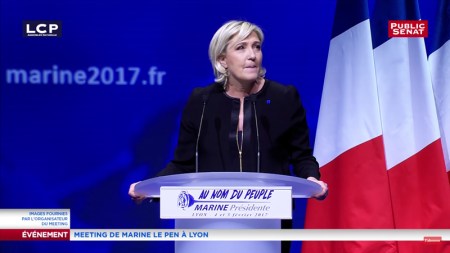
Marine Le Pen, the leader of the anti-establishment National Front party, has officially launched her campaign to become the next president of France.

Speaking at a rally attended by thousands of her supporters in Lyon on February 5, Le Pen launched a two-pronged attack on globalization and radical Islam. She promised French voters a referendum on remaining in the European Union, and also to deport Muslims who are deemed a security risk to France.

2279National Front party leader Marine Le Pen, speaking at a rally in Lyon, France on February 5, 2016. (Image source: Public Senat video screenshot)

Le Pen’s political platform is contained in a manifesto of 144 promises regarding immigration and global trade.

Polls show that Le Pen — who said the election of U.S. President Donald J. Trump “shows that people are taking their future back” — is one of the most popular politicians in France.

A February 2 Ifop-Fiducial poll for Paris Match, iTELE and Sud-Radio showed Le Pen with 24.5% of the vote, compared to 20% for François Fillon of the center-right Republicans party. In December 2016, Fillon, who has become engulfed in a corruption scandal, held a three-point lead over Le Pen.

The poll also showed the independent centrist candidate Emmanuel Macron with 20% of the vote, the Socialist Party candidate Benoît Hamon with 17%, and the far-left candidate Jean-Luc Mélenchon with 9.5%.

The first round of the election will be held April 23. If no candidate gets more than 50% of the vote, a runoff will be held on May 7.

Following is an abridged translation of key parts of Le Pen’s speech:

In all respects, this presidential election is unlike previous ones. Its outcome will determine the future of France as a free nation and our existence as a people.

After decades of errors and cowardice, we are at a crossroads. I say it with gravity: the choice we will have to make in this election is a choice of civilization.

The question is simple and cruel: will our children live in a free, independent, democratic country? Will they still be able to refer to our system of values? Will they have the same way of life as we did and our parents before us?

Will our children, and the children of our children, still have a job, a decent wage, the possibility of building up a patrimony, becoming an owner, starting a family in a safe environment, being properly cared for, to grow old with dignity?

Will our children have the same rights as us?

Will they live according to our cultural references, our values of civilization, our style of living, and even they will speak our French language, which is disintegrating under the blows of political leaders who squander this national treasure — for example, by choosing a slogan in English to promote the candidacy of Paris to host the 2024 Olympic Games?

Will they have the right to claim French culture when certain candidates for the presidential election, puffed up by their own empty-headedness, explain that it does not exist?

I ask this important question because, unlike our adversaries, I am interested not only in the material heritage of the French, but I also want to defend our immaterial capital. This immaterial capital is priceless because this heritage is irreplaceable. In fact, I am defending the load-bearing walls of our society.

Our leaders have chosen deregulated globalization. They wanted a happy outcome, but the result is frightful.

Globalization develops at two levels: from below with massive immigration and global social dumping; and from above with the financialization of the economy.

Globalization, which became a fact with the multiplication of exchanges, has become an ideology. Economic globalization, which rejects any limits, has weakened the immune system of the nation by dispossessing it of its constituent elements: borders, national currency, the authority of its laws in conducting economic affairs, and thus allowing another world to be born and grow: Islamic fundamentalism.

The latter has grown up within a deleterious communitarianism, itself a child of mass immigration, suffered year after year by our country.

We have thus fulfilled our first political act, which is to name the enemy.

These two globalisms, today, give a leg up to:

  • Economic and financial globalism, of which the European Union, the financiers and the domesticated political class are its zealous servants;
  • Jihadist globalism, which undermines our vital interests abroad, but which also takes root in our national territory, in certain neighborhoods, in certain places, in certain weak minds.

Both work towards the disappearance of our nation, that is to say, of France as we live it, as we love it, which is why the French have a feeling of dispossession.

These two ideologies want to subjugate our country.

One in the name of globalized finance, that is to say, the ideology of all commerce, the other in the name of a radicalized Islam, that is to say, the ideology of the whole of religion.

Faced with these two totalitarianisms that threaten our liberties and our country, we must demonstrate lucidity, determination and unity.

Economic globalism kills by asphyxia — slow, progressive, but certain.

Islamic fundamentalism attacks us by the calculated harassment of republican resistance, by incessant demands, by demands for accommodation, none of which, for us, can be reasonable and therefore conceivable.

Nor let us forget that Islamic fundamentalism is barbaric, that it manifests itself every day in the world by killing, massacring, using in particular the vile and cowardly weapon of terrorism or mass murder.

As in all ideological wars, we find useful idiots and more or less conscious accomplices who, through cowardice, blindness or greed, facilitate these undertakings for the establishment of this barbarous ideology, the enemy of France.

To advance, the advocates of these two globalist ideologies give the illusion of relying on our principles; in reality, they falsely invoke freedom to set up their totalitarianism: it is the freedom of the fox in the chicken coop.

The first, economic and financial globalism, invokes freedom of trade, freedom of movement, freedom of establishment; all those who venture to reveal their failures are accused of ignorance, accused of some ideological drift, and are struck down with moral reproach.

Economic and financial globalism is based on a pseudo economic expertise that never yields, not even to the evidence of its economic failure and the social devastation that it provokes. The objective is to reduce man to his role as consumer or producer.

Countries are no longer nations united by matters of the heart, but by markets, spaces where the commodification of everything and every human being is conceivable, possible, accepted and even organized.

People are no more than populations. Borders are erased, as with Schengen, to make of our countries station concourses where everyone is free to come and stay and to participate in the leveling of the social protections, the reduction of wages and the dilution of culture into the smallest common denominator.

With the globalists, cultures of peoples, that is, what makes the world’s diversity, are destined to be erased in order to facilitate the commercialization of standard products and to facilitate hyper profits at the cost of ecological depletion of the planet or child labor of the Third World.

This world where economics is an end in itself and man, a simple tool in its service, plunges us into an ephemeral era, in short, an artificial and deeply dehumanized world.

The rights of people, their social situation, their well-being, the environment in which they live, become the variable of adjustment of the interests of large groups and castes.

For them, the nation is a non-tariff barrier. In their eyes, the country is an open geographical space where the only requirement is to “live together,” that is to say, not to interfere with each other.

I want to denounce this powerful alliance between the promotion of savage globalization on the one hand, and the culpable inaction, even in the face of uncontrolled immigration and its direct consequence, the establishment of Islamic fundamentalism.

If economic globalism advances with the shield of free trade, the second of these globalisms, Islamic fundamentalism, instrumentalizes the principle of religious freedom in an attempt to impose patterns of thought that are clearly the opposite of ours.

The carelessness and weakness of our leaders have been a growth hormone to this ideology that tried to sow death in the Louvre two days ago.

We do not want to live under the yoke or threat of Islamic fundamentalism.

It tries to impose upon us pell-mell:

  • The prohibition of mixing in public places,
  • The integral veil or not,
  • Prayer halls in companies, street prayers, cathedral mosques,
  • The submission of woman by prohibiting the skirt, work or bistro.

No Frenchman, no Republican, no woman attached to dignity and liberty can accept it.

Behind these two ideologies is inexorably the enslavement of people: An enslavement, at first mental, which is effected by disaffiliation, by isolation, by dissolution of traditional bonds.

Economic globalism professes individualism, and radical Islamism communitarianism.

Globalism is based, as we see, on the negation of the values on which France was built and on the principles in which the immense majority of French people still recognize themselves: the pre-eminence of the person and therefore its sacred character, individual freedom and therefore individual consent, national feeling and therefore national solidarity, equality of persons and therefore the refusal of situations of submission.

These principles for which we are fighting are affirmed in our national motto “Liberty, Equality, Fraternity,” which itself proceeds from a secularization of principles stemming from our Christian heritage.

But these two globalist ideologies do not only attack our nation. Both of them attack our Republic by questioning its indivisibility.

The answer is not technical but regal, which is why we call for the moral rearmament of the country and a surge of national energy. We call for resistance and reconquest.

There is nothing for us more beautiful than France. There is nothing for us greater than France. There is nothing for us more useful to the world than France!

I say to the French who are watching or listening to us: the fate of France is in your hands!

The Revolution of Patriotism

France is a millennial country with a history and a culture. France is an act of love. This love has a name: patriotism. It is what makes our hearts beat in unison when the Marseillaise sounds or when our national colors beat the wind of history.

It is what unites the French left and right, from the cradle to the cane, from the factory to the office. It is what pits our vision against that of the globalists.

We believe it is time to revitalize national sentiment, to live it on a daily basis, to teach our children all that makes and has made their country, to teach them to love their compatriots, to be proud of their history, to be confident in the forces of France.

When one aspires to settle in a country, one does not begin by violating its laws. We do not begin by claiming rights. To all, and especially to people of all origins and all faiths that we have welcomed into our country, I repeat: there are no and there will be no other laws and values in France than those that are French.

On this subject there will be no retreat and no compromise.

Those who come to France are to accept France, not to transform it to the image of their country of origin. If they want to live at home, they should have stayed at home.

We will strictly apply the rules of secularism in a country whose tragic history has learned to guard against the wars of religion. We will extend the rules of secularism to public spaces and we will inscribe them in labor laws. We will respond to those who see with concern the rise of religious demands and the rise of conflicts in the workplace.

We no longer want the state to allow the spread of the hatred of France. We want a France that transmits and a France that is transmitted!

The Revolution of Liberty

The first liberty is security. You may ask how to improve security when for thirty years all governments have failed? Our method is simple: we will apply the law!

As Cardinal de Richelieu said, “to make a law and not enforce it is to authorize the thing that one wishes to defend against.”

We will re-establish the rule of law, that is, enforce Republican law in those places where it has been lost, where our rulers obviously lack the courage and willpower. We are going to put an end to the impunity of criminals, the no-go zones, the dictatorships of kingpins in certain districts, drug and weapons trafficking, burglaries, burned cars.

We will stress the certainty of prosecution, the certainty of sanction, the certainty of punishment, the certainty that delinquent aliens are automatically deported.

I say to the mothers who listen to me, support me: Do not accept that our children live in fear, in this daily violence of which they are the first victims, sometimes at the cost of their young lives.

In order to fulfill their mission, so important to this country, we will give back to our security forces the human and material resources as well as the necessary support and instructions.

We shall rearm them, including morally, with the establishment of the presumption of self-defense.

We will open suitable prison places, conclude agreements with countries of origin so that foreign offenders will serve their prison sentences in their country of origin, increase the means of justice and organize a response to criminals that can be summarized in two words: zero tolerance.

In terms of terrorism, we do not intend to ask the French to get used to living with this horror. We will eradicate it here and abroad.

Since we are at war with Islamic fundamentalism, we will apply to the enemies of France the legal devices of the state of war.

We will give ourselves the necessary technical and human means and will create the conditions and cooperation necessary for intelligence on the national territory as well as outside.

Foreigners with an “S” file [Fiche “S” or Sûreté de l’État (state security)] will be deported. Binationals with “S” files will be deprived of their French nationality and sent back to their country of origin. Frenchmen with “S” files will be prosecuted for aiding the enemy.

Places of Islamic preaching will be closed and the sowers of hatred condemned and expelled. The legal windows of Islamism, especially on the Internet, will be extinguished.

Finally, this revolution of liberty is that of our collective liberties, for state sovereignty, that is to say, for a free people to decide for themselves. This struggle for sovereignty is first, principal, essential, cardinal — it conditions everything else.

Without sovereignty, no protection is possible, no action is possible. Without sovereignty, a promise becomes a false promise.

My political opponents claim to control borders, to prevent immigration, to fight against unfair competition. They are lying to you. By refusing to free themselves from the straitjacket of the European Union, which is the decision-maker on these subjects, they refrain from any even minor inflection.

Worse, by staying in the euro, they are plaguing our economy, maintaining mass unemployment and giving the European Union the means of pressure to impose its inept views, its millions of migrants.

Everyone agrees that the European Union is a failure. It did not deliver on any of its promises, particularly on prosperity and security and, worse, it has put us under guardianship and kept us on a short leash.

Who could be satisfied with doing nothing against a system which enchains us, which does not work, and worse, whose dysfunctions ruins us?

That is why, if elected, I will announce a referendum within six months on remaining or exiting the European Union, and I will immediately engage with our European partners — many of whom aspire as we do to sovereignty — a renegotiation with this tyrannical Europeanist system which is no longer a project, but a parenthesis in history and I hope one day a bad memory.

The objective will be to find within six months a compromise that will allow us to recover our four sovereignties: monetary, economic, legislative and territorial.

If the European Union does not submit, then I will ask the French to vote in the referendum to resign from this nightmare and become free again.

In the same spirit, because we believe that France is great only when it makes its voice heard in favor of independence and world balance, we will leave the integrated command of NATO. We will re-examine our diplomacy with regard to our national interests and will give the means of our internal and foreign policy by the reconstruction of our military potential.

My commitment is to put France back in order in five years. In practice this concerns all sectors of our lives:

  • Putting our economy back in order
  • Putting our schools back in order
  • Putting our justice back in order
  • Putting our diplomacy back in order
  • Putting our security back in order
  • Putting our solidarity back in order

We open our arms to all those who share with us the love of France and wish to engage our country on the path of national recovery.

The old left-right debates have outlived their usefulness. Primaries have shown that debates about secularism or immigration, as well as globalization or generalized deregulation, constitute a fundamental and transversal divide. This divide is no longer between the left and the right, but between patriots and globalists.

The collapse of traditional parties and the systematic disappearance of almost all of their leaders shows that a great political re-composition has begun.

Other peoples have shown the way.

The British have chosen freedom with the Brexit. The Italians have shown their disapproval in the referendum on the Constitution. The Greeks are thinking about leaving the Euro. The Americans have chosen their national interest.

This awakening of the peoples is historical. It marks the end of a cycle. The wind of history has turned. It will bring us to the top and, with us, our country: France. Long live the people! Long live the Republic! Long live France!
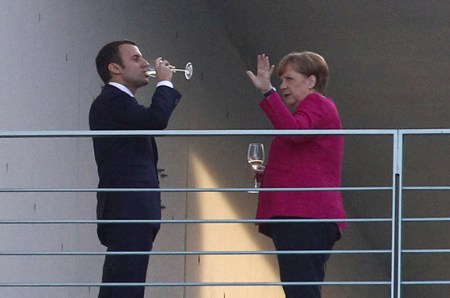
Undercover video: Muslim neighborhoods in France are no-go zones for women

December 17, 2016

Undercover video: Muslim neighborhoods in France are no-go zones for women, Creeping Sharia, December 17, 2016

Source: Immigration: French women organise protests to take back streets in Muslim majority areas | World | News | Daily Express

A women’s rights campaign group is organizing marches and protests in a bid to retake streets in predominantly Islamic neighbourhoods which they say have become entirely male dominated.

La Brigade des Mères, which is aiming to restore gender equality in France’s troubled ‘banlieues’, says women in many communities are now too scared to go out because gangs of young men rule the streets.

And a shocking undercover report, compiled by the TV channel France 2, shows how women are not welcome in bars and cafes in Muslim majority areas, with many men openly hostile to their presence in public at all.

https://www.youtube.com/watch?v=fjOvbJNJ46U

Pascale Boistard, the women’s rights minister, declared: “There are now areas in our country where women can no longer go.”

For the report two brave women from La Brigade des Mères wore button-hole cameras and headed alone into the Muslim majority Paris suburb of Sevran, which was at the centre of the French capital’s 2005 race riots.

Nadia Remand and Aliza Sayah visited the streets and cafes of the notorious banlieue to build up a picture of how welcome women were in its public spaces.

As soon as they entered one bar, which was filled entirely with young men, the owner approached them and asked what they were doing there, and if they were waiting for a man.

When the women said that they were, he advised them: “It’s better to wait outside. There are men in here.”

When the pair countered that it was perfectly normal for women and men to be in a bar together another young man spotted them, and shouted incredulously: “There are men in here!”The women then asked him why he thought their presence was unusual, suggesting that he would perhaps go out for a coffee with a female friend or cousin, to which he replied: “My cousin stays at home.”He continued: “In this cafe there is no mixing. You are in Sevran, you’re not in Paris. It’s a different mentality.”The man insisted the Paris suburb was like the “bled” – A French slang term for a person’s home country which is frequently used by Muslim migrants from north Africa.Following the exchange the two women said that the government’s decision to bring in imams to quell the religious tensions which led to the 2005 riots had led to a more hardline version of Islam taking hold.In Lyon, France’s second biggest city, the report unearthed evidence that women are now actively altering their dress to avoid being threatened or abused by Muslim men.

One young woman told the broadcaster that she does everything she can to not be noticed, including wearing baggy trousers and avoiding wearing skirts and makeup.

When asked why, she replied: “Because I’m afraid, as simple as that.”

… in a video response to the report, Ms Maréchal-Le Pen said was evidence that some parts of the country are “no longer the land of France, because Islamic law has taken hold”.

She said: “It is no longer the law of France that applies, it is not the law of the Republic, we are witnessing the establishment of mini Caliphates where it’s Islamic law, Sharia, that applies every day.“I believe that these revelations show the fractures that are dividing the French population, with these types of people who have French nationality but with whom we do not share very much at all.“We don’t walk the same streets, we don’t have the same ancestors, we don’t have the same history, the same culture, the same law, the same way of life.“The problem of radical Islam today is evidently the problem of immigration and of the division of communities.”

France: ‘The Jungle’ Migrant Camp

September 30, 2016

France: ‘The Jungle’ Migrant Camp, Gatestone InstituteSoeren Kern, September 30, 2016

In 2001 alone, 54,000 people “attacked” the Channel Tunnel terminal in Calais and 5,000 had gotten through.

Migrants evicted from Calais moved to Paris and established a massive squatter camp at the Jardins d’Eole, a public park near the Gare du Nord station, from where high-speed Eurostar trains travel to and arrive from London. The area has become a magnet for human traffickers who charge migrants thousands of euros for fake travel documents, for passage to London.

The President of the Alpes-Maritimes region, Eric Ciotti, criticized the government’s “irresponsible” plan to relocate migrants in Calais to other parts of France. He said the plan would “proliferate a multitude of small Calais, genuine areas of lawlessness that exacerbate lasting tensions throughout the country.”

A whistleblower reported that volunteer aid workers at “The Jungle” were forging sexual relationships with migrants, including children. “Female volunteers having sex enforces the view (that many have) that volunteers are here for sex,” he said.

French President François Hollande has vowed “definitively, entirely and rapidly” to dismantle “The Jungle,” a squalid migrant camp in the northern port town of Calais, by the end of this year.

Hollande made the announcement during a September 26 visit to Calais — but not to the camp itself — amid growing unease over France’s escalating migrant crisis, which has become a central issue in the country’s presidential campaign.

The French government plans to relocate the migrants at the camp to so-called reception centers in other parts of the country. But it remains unclear how the government will prevent migrants from returning to Calais.

Sceptics say the plan to demolish “The Jungle” is a publicity stunt that will temporarily displace the migrants but will not resolve the underlying problem — that French officials refuse either to deport illegal migrants or else to secure the country’s borders to prevent illegal migrants from entering France in the first place.

The decision to demolish the camp came just days after construction work began on a wall in Calais, a major transport hub on the edge of the English Channel, to prevent migrants at the camp from stowing away on cars, trucks, ferries and trains bound for Britain.

In recent months, peoplesmugglers armed with knives, bats and tire irons have forced truck drivers to stop so that migrants can board their vehicles. The Deputy Mayor of Calais, Philippe Mignonet, has described the main route to the port as a “no-go area” between midnight and 6am.

“The Jungle” — the name “jungle” comes from “dzhangal,” the Pashto word for forest — now houses around 10,000 migrants from Africa, Asia and the Middle East who are trying to reach Britain. Migrants at the camp are from Sudan (45%), Afghanistan (30%), Pakistan (7%), Eritrea (6%) and Syria (1%), according to aid agencies. The migrants at the camp are mostly young men and boys, including some 800 unaccompanied minors, who are seeking jobs in Britain’s underground economy.

Migrants have been gathering in Calais in large numbers ever since the Channel Tunnel linking France and Britain opened in May 1994, and the Schengen Agreement, which abolished border controls between France and most of its neighbors (but not the UK), entered into force in March 1995.

In 1999, the French government asked the Red Cross to build a migrant “reception center” in Sangatte to accommodate a growing number of migrants on the streets of Calais and surrounding areas. The Sangatte camp, which was housed in a giant warehouse situated about a half mile from the entrance to the Channel Tunnel, had a capacity of 600 people.

Far from resolving the migrant problem in Calais, the Sangatte facility served as a magnet, quickly drawing thousands more people to the area. Within months, some 2,000 migrants were living in the camp in increasingly cramped conditions. Many of those staying at Sangatte tried to jump onto slow-moving trains at the entrance to the Channel Tunnel, or hide inside trucks crossing to Britain on ferries.

At the time, French authorities reported a massive increase in the number of arrests in or around the Channel Tunnel. In 1999, 8,000 people were arrested in Calais for immigration offenses. By 2001, that number had jumped ten-fold to 80,000 arrests. Eurotunnel, the company that manages and operates the Channel Tunnel, said that in 2001 alone, 54,000 people had “attacked” the terminal in Calais and 5,000 had gotten through. Many of those were living in Sangatte.

The Sangatte camp was closed in late 2002, after a series of riots between Afghan and Kurdish migrants. In all, some 67,000 migrants stayed at the facility during its three years in operation.

In February 2003, France and Britain signed the Treaty of Le Touquet, which allows for so-called juxtaposed controls, meaning that travelers between the two countries now clear immigration in the country of departure rather than upon arrival. In effect, the treaty pushed parts of the British border to France. By doing so, it exacerbated the migration bottleneck in Calais.

As part of the agreement to close Sangatte, Britain took in 1,200 migrants. Those who remained in France sheltered in at least a dozen different squats both inside and on the outskirts of Calais. These camps — Africa House, Fort Galloo, Leader Price/Sudanese Jungle or Tioxide Jungle — have been repeatedly raided or bulldozed by French police, only for other squats to crop up elsewhere.

Many of the migrants housed at Sangatte moved a few kilometers east to a disused industrial zone called The Dunes. Situated just steps from the Port of Calais, the area would become known as “The Jungle.” Over the years, French authorities have repeatedly tried to demolish all or parts of the camp, only for it to reemerge time and time again, and always with more migrants.

On September 22, 2009, French police bulldozed “The Jungle” and rounded up hundreds of migrants hoping to stow away on trucks headed for Britain. A day later, Calais Mayor Natacha Bouchart said she had “spotted between fifteen and twenty new squats” nearby. She also reported that Afghan migrants were establishing makeshift camps at the Hoverport, a disused collection of buildings which closed in 2005 after the last hovercraft sailed from Dover to Calais.

September 12, 2014. Police in Calais warned that migrants were becoming increasingly violent in their quest to reach Britain. Gilles Debove, the Calais area delegate for the French police union, said tear gas was being used to stop “mass onslaughts” on vehicles about to cross the Channel:

“The other day, two to three hundred migrants tried to get into a lorry park and we fired tear gas to scatter them because there are too few of us to control situations like this any other way. We’re also facing an increase in crimes by migrants who mug people, steal mobile phones and carry out sexual assaults.”

September 10, 2015. French media reported that police were searching for an Islamic State jihadi who was hiding in “The Jungle” in the hope of reaching Britain to launch an attack there.

November 11, 2015. More than 250 French riot police were deployed to “The Jungle” after weeks of unrest. Local government official Fabienne Buccio said the rise in violence was due to the migrants’ frustration at being prevented from reaching Britain.

January 19, 2016. French authorities leveled one-third of “The Jungle” to create a 100-meter “buffer zone” between the camp and an adjacent highway that leads to the ferry port.

February 7, 2016. The migrant crisis spread to other parts of France due to an increased police presence in Calais. Migrant camps sprouted up in the nearby ports of Dunkirk, Le Havre, Dieppe and Belgium’s Zeebrugge, as migrants seek new ways to cross the English Channel to Britain.

February 29, 2016. After a court in Lille approved a plan by the French government to evict 1,000 migrants from “The Jungle,” demolition teams began dismantling the southern part of the camp. The government tried to relocate the migrants to official accommodation inside converted shipping containers in the northern part of the camp. But most refused the offer, fearing they would be forced to claim asylum in France. “Going to Britain is what people here want,” Afghan migrant Hayat Sirat said. “So destroying part of the jungle is not the solution.”

1915French riot police attempt to control a crowd of migrants in “The Jungle” squatter camp near Calais, on February 29, 2016, as demolition teams begin dismantling the southern part of the camp. After being pelted with stones and other objects, police responded with tear gas and water cannon. (Image source: RT video screenshot)

March 7, 2016. Migrants evicted from “The Jungle” moved to a new camp in Grande-Synthe near the northern port of Dunkirk, just up the coast from Calais. Critics said the new camp risks becoming a “new Sangatte,” referring to the Red Cross center in Calais that was closed in 2002.

May 31, 2016. Migrants evicted from Calais moved to Paris and established a massive squatter camp at the Jardins d’Eole, a public park near the Gare du Nord station, from where high-speed Eurostar trains travel to and arrive from London. The area, which is so dangerous that the government has classified it as a no-go zone (Zone de sécurité prioritaires, ZSP), has become a magnet for human traffickers who charge migrants thousands of euros for fake travel documents, for passage to London.

August 11, 2016. In an interview with Le Figaro, a French counter-terrorism officer warned that Islamic State jihadis were hiding in “The Jungle.” He said: “What is happening in The Jungle is truly mind boggling. Our officers are rarely able to penetrate the heart of the camp. It is impossible to know if a jihadi from Belgium, for example, is hiding in the camp. This camp is a blind spot for national security.”

September 5, 2016. Hundreds of French truck drivers, businessmen and farmers blocked off the main route in and out of Calais, in an attempt to pressure the French government to close The Jungle. The blockage brought to a standstill the route used by trucks from all over Europe to reach Calais and Britain.

September 12. A document leaked to Le Figaro revealed the government’s plan, dated September 1, to relocate 12,000 migrants from Calais to other parts of France. The migrants would be relocated to around 60 so-called Reception and Orientation Centers (centres d’accueil et d’orientation, CAO), each with a capacity of between 100 and 300 migrants.

September 13, 2016. The President of the Alpes-Maritimes region, Eric Ciotti, criticized the government’s “irresponsible” plan to relocate migrants in Calais to other parts of France. He said the plan would “proliferate a multitude of small Calais, genuine areas of lawlessness that exacerbate lasting tensions throughout the country.” He added:

“This plan reflects the resignation of the government in the face of massive illegal immigration. It weakens national cohesion under a false pretext of humanity which hides a dangerous ideology that denies any distinction between foreigners who seek asylum, who France should decently receive, and those who are economic migrants, whom we can no longer tolerate, and who should be returned to their countries of origin.

“The only solution is to deport, without delay, all illegal immigrants who do not intend to remain on our territory, and to place asylum seekers in centers dedicated to the study of their cases.”

September 14, 2016. The President of the Auvergne-Rhône-Alpes region, Laurent Wauquiez, expressed anger at the government’s “diktat” to relocate 1,800 migrants from Calais to his region. He said: “This is madness and it is not a matter of solidarity. The problem of Calais is not solved by multiplying Calais throughout France. We expect the government to solve the problem of Calais, not move it to other parts of the country.”

September 16, 2016. Steeve Briois, the Mayor of Hénin-Beaumont and Vice President of the National Front criticized the government’s plan to relocate migrants from “The Jungle” to the rest of the country. He said:

“This crazy policy would consequently multiply mini-Calais on the entire national territory, without consulting the people and local elected officials. This forced policy of the Socialist government is simply unacceptable; it seriously threatens public order and the safety of our citizens.”

September 20, 2016. Construction work began on a wall to prevent migrants at the camp from stowing away on cars, trucks, ferries and trains bound for Britain. Dubbed “The Great Wall of Calais,” the concrete barrier — one kilometer (half a mile) long and four meters (13 feet) high on both sides of the two-lane highway approaching the harbor — will pass within a few hundred meters of “The Jungle.”

September 21, 2016. A whistleblower reported that volunteer aid workers at “The Jungle” were forging sexual relationships with migrants, including children. “I have heard of volunteers having sex with multiple partners in one day, only to carry on in the same vein the following day,” he wrote. “And I know also, that I’m only hearing a small part of a wider scale of abuse.” He added that the majority of cases in question involved female volunteers and male migrants. “Female volunteers having sex enforces the view (that many have) that volunteers are here for sex,” he wrote.

September 28. Calais Mayor Natacha Bouchart expressed skepticism about President Hollande’s pledge to close “The Jungle.” In an interview with Europe 1, she said: “This dismantling will be very complicated. I am skeptical about the commitment of François Hollande that there will be no migrant camp in the territory of Calais. I do not know how he will do it.”

France: Human Rights vs. The People

September 22, 2016

France: Human Rights vs. The People, Gatestone InstituteYves Mamou, September 22, 2016

♦ French politicians seem to believe they are elected NOT to defend French people and the French nation, but to impose a “human rights ideology” on society.

♦ The rule of law is there to protect citizens from the arbitrary actions of the State. When a group of French Muslims attacks the entire way society is constructed, the rule of law now protects only the perpetrators.

♦ For Western leaders, “human rights” have become a kind of new religion. Like a disease, the human rights ideology has proliferated in all areas of life. The UN website shows a list of all the human rights that are now institutionalized: they range from “adequate housing” to “youth.” At least 42 categories of human rights fields are determined, each of which are split into two or three subcategories.

♦ With what result? More than 140 countries (out of 193 UN members) engage in torture. The number of authoritarian countries has increased. Women remain a subordinate class in nearly all countries.

♦ “Saudi Arabia ratified the treaty banning discrimination against women in 2007, and yet by law subordinates women to men in all areas of life. Child labour exists in countries that have ratified the Convention on the Rights of the Child. Powerful western countries, including the US, do business with grave human rights abusers.” — Eric Posner, professor at the University of Chicago Law School.

♦ Human rights, originally conceived of as an anti-discrimination tool, became a Trojan horse, a tool manipulated by Islamists and others to dismantle secularism, freedom of speech and freedom of religion in European countries.

On August 13, the Administrative Court in Nice, France, validated the decision of the Mayor of Cannes to prohibit wearing religious clothing on the beaches of Cannes. By “religious clothing,” the judge clearly seemed to be pointing his finger at the burkini, a body-covering bathing suit worn by many Muslim women.

These “Muslim textile affairs” reveal two types of jihad attacking France: one hard, one soft. The hard jihad, internationally known, consists of assassinating journalists of Charlie Hebdo (January 2015), Jewish people at the Hypercacher supermarket (January 2015) and young people at the Bataclan Theater, restaurants and the Stade de France (November 2015). The hard jihad also included stabbing two policeman in Magnanville, a suburb of Paris, (June 2016); truck-ramming to death 84 people in Nice on Bastille Day (July 14), and murdering a priest in the church of Saint-Étienne-du-Rouvray, among other incidents. The goal of hard jihad, led by ISIS, al-Qaeda, and others, is to impose sharia by terror.

The soft jihad is different. It does not involve murdering people, but its final goal is the same: to impose Islam on France by covering the country in Islamic symbols — veils, burqas, burkinis and so on — at all levels of the society: in schools, universities, hospitals, corporations, streets, beaches, swimming pools and public transportation. By imposing the veil everywhere, soft Islamists seem to want to kill secularism, which, since escaping the grip of the Catholic Church, has become the French way of “living together.”

1347-1Scenes from the “hard jihad” against France; the November 2015 shootings in Paris, in which 130 people were murdered by Islamists.

No one can understand secularism in France without a bit of history.

“Secularism is essential if we want the ‘people’ be defined on a political basis” wrote the French historian, Jacques Sapir.

“Religious allegiance, when it turns into fundamentalism, is in conflict with the notion of sovereignty of the people. … the Nation and State in France were built historically by fighting feudalism and the supranational ambition of the Pope and Christian religion. … Secularism is the tool to return to the private sphere all matters that cannot be challenged comfortably …. Freedom for diversity among individuals implies a consensus in the common public sphere. The distinction between the public sphere and the private sphere is fundamental for democracy to exist.”

And this distinction is secularism.

The Problem Now is Political

French politicians seem to believe they are elected NOT to defend French people and the French nation, but to impose a “human rights ideology” on society. They also seem unable to understand the challenges that common people in the streets are currently facing. They are also unable or unwilling to defend the country against either hard or soft jihad.

French Prime Minister Manuel Valls, for instance, said in a July 29 interview for Le Monde:

“We must focus on everything that is effective [to fight Islamism], but there is a line that may not be crossed: the rule of law. … My government will not be the one to create a Guantanamo, French-style.”

Only Yves Michaud, a French philosopher, dared to point out that the rule of law is there to protect citizens from the arbitrary actions of the State. When a group of French Muslims attacks the entire way society is constructed, the rule of law now protects only the perpetrators.

The same is true for French President François Hollande. After the murder by two Islamists of the Father Jacques Hamel in Saint-Étienne-du-Rouvray in July 2016, he said: “We must lead the war by all means in respect of the rule of law.”

Elisabeth Levy, publisher of the French magazine, Causeur, wrote in response:

“We need to know: by all means? … Or in respect of the rule of law? What is this rule of law that authorizes a judge to release an Islamist interested in waging jihad in Syria and, because he could not go to Syria, was free while wearing an electronic bracelet, to walk the streets to slit the throat of a priest?”

She concluded: “If we want to protect our liberties, it might be interesting to take some liberties with the rule of law.”

The ideology of human rights is common to all European countries. Because authorities in European countries act, speak and legislate on the basis of human rights, they put themselves in a position of weakness when they have to name, apprehend and fight an Islamist threat.

In Sweden:

A 46-year-old Bosnian ISIS jihadi, considered extremely dangerous, was taken into custody by the Malmö police. The terrorist immediately applied for asylum, the Swedish Migration Agency stepped in, took over the case — and prevented him from being deported. Inspector Leif Fransson of the Border Police told the local daily newspaper, HD/Sydsvenskan: “As soon as these people throw out their trump card and say ‘Asylum’, the gates of heaven open. Sweden has gotten a reputation as a safe haven for terrorists.”

In Germany: Chancellor Angela Merkel said in a press conference, at the end of July 2016, that her mission was not to defend German people and German identity but “to fulfill humanitarian obligations [towards migrants].” She added it was “our historic task… a historic test in times of globalization.”

For Western Leaders, Human Rights Has Become a New Religion

The human rights movement was born in 1948 with the Universal Declaration of Human Rights, launched by Eleanor Roosevelt. For 70 years, nine major “core” human rights treaties were written and ratified by the vast majority of countries.

Like a disease, the “human rights ideology” has proliferated in all areas of life. The United Nations website shows a list of all the human rights that are now institutionalized: they range from “adequate housing” to “youth” and include “Food”, “Freedom of Religion and Belief”, “HIV/AIDS”, “Mercenaries”, “Migration”, “Poverty”, “Privacy”, “Sexual orientation and gender identity”, “Situations”, ” Sustainable Development”, “Water and sanitation.” At least 42 categories of human rights fields are determined, each of which are split into two or three subcategories.

With what result? More than 140 countries (out of 193 countries that belong to the UN) engage in torture. The number of authoritarian countries has increased: “105 countries have seen a net decline in terms of freedom, and only 61 have experienced a net improvement” reported the NGO, Freedom House, in 2016. Women remain a subordinate class in nearly all countries. Children continue to work in mines and factories in many countries.

Professor Eric Posner of the University of Chicago Law School, writes:

“Saudi Arabia ratified the treaty banning discrimination against women in 2007, and yet by law subordinates women to men in all areas of life. Child labour exists in countries that have ratified the Convention on the Rights of the Child: Uzbekistan, Tanzania and India, for example. Powerful western countries, including the US, do business with grave human rights abusers.”

What is disturbing is not that the “religion” of “anti-discrimination” has become a joke. What is disturbing is that human rights, originally conceived of as an anti-discrimination tool, became a Trojan horse, a tool manipulated by Islamists and others to dismantle secularism, freedom of speech, and freedom of religion in European countries. What is disturbing is that human rights and anti-discrimination policies are dismantling nations, and placing States in a position of incapacity — or perhaps just unwillingness — to name Islamism as a problem and take measures against it.

The Religion of Human Rights as a Tool of Europe’s Muslim Brotherhood

Jean-Louis Harouel, Professor of the History of Law at the Paris-Panthéon-Assas University, recently published a book entitled, Les Droits de l’homme contre le peuple (Humans Rights against the People). In an interview with Le Figaro, he said:

“Human rights, are what we call in France ‘fundamental rights’. They were introduced in the 70’s. The great beneficiaries of fundamental rights were foreigners. Islam took advantage of it to install in France, in the name of human rights and under its protection, Islamic civilization, mosques and minarets, the Islamic way of life, halal food prescriptions, clothing and cultural behavior — Islamic laws even in violation of French law: religious marriage without civil marriage, polygamy, unilateral divorce of wife by husband, etc.

“Through the assertion of identity, Islamists and mainly UOIF [Union of Islamic Organizations of France — the French branch of the Muslim Brotherhood] exploited human rights to install their progressive control on populations of Northern African descent, and coerce them to respect the Islamic order. In particular, they do all that they can to prevent young [Arab] people who are born in France from becoming French citizens.”

The human rights and anti-discrimination “religion” also gave Islam and Islamists a comfortable position from which to declare war on France and all other European countries. It seems whatever crime they are committing today and will commit in the future, Muslims and Islamists remain the victim. For example, just after the November 13 terrorist attacks in France, in which more than 130 people were murdered by Islamists at the Bataclan Theater, the Stade de France, cafés and restaurants, Tariq Ramadan, an Islamist professor at Oxford University, tweeted:

“I am not Charlie, nor Paris: I am a warrant search suspect”.

Ramadan meant that because of the emergency laws and because he was a Muslim, he was an automatic suspect, an automatic victim of racism and “Islamophobia.”

In another example, just after the terrorist attack in Nice on July 14, when an Islamist rammed a truck into a crowd celebrating Bastille Day, killing at least 84 people, Abdelkader Sadouni, an imam in Nice, told the Italian newspaper Il Giornale: “French secularism is the main and only thing responsible for terror attacks.”

Global Elites against the People

The question now is: have our leaders decided to cope with the real problems of the real people? In other words, are they motivated enough to throw the human rights ideology overboard, restore secularism in society and fight Islamists? The problem is that they do not even seem to understand the problem. What Peggy Noonan, of the Wall Street Journal, wrote about Angela Merkel can apply to all leaders of European countries:

“Ms. Merkel had put the entire burden of a huge cultural change not on herself and those like her but on regular people who live closer to the edge, who do not have the resources to meet the burden, who have no particular protection or money or connections. Ms. Merkel, her cabinet and government, the media and cultural apparatus that lauded her decision were not in the least affected by it and likely never would be.

Nothing in their lives will get worse. The challenge of integrating different cultures, negotiating daily tensions, dealing with crime and extremism and fearfulness on the street — that was put on those with comparatively little, whom I’ve called the unprotected. They were left to struggle, not gradually and over the years but suddenly and in an air of ongoing crisis that shows no signs of ending — because nobody cares about them enough to stop it.

The powerful show no particular sign of worrying about any of this. When the working and middle class pushed back in shocked indignation, the people on top called them “xenophobic,” “narrow-minded,” “racist.” The detached, who made the decisions and bore none of the costs, got to be called “humanist,” “compassionate,” and “hero of human rights.”

So the fight against Islamism might first consist of a fight against the caste that governs us.