Archive for the ‘Islamic nations’ category

Op-Ed: Contemplating a US/Russia Alliance

February 16, 2016

Op-Ed: Contemplating a US/Russia Alliance, Israel National News, Ted Belman and Alexander Maistrovoy, February 16, 2016

Before Donald Trump’s blowout win in New Hampshire he shocked the world by saying he would allow the Russians to do the “dirty work” and would “let them beat the s*** out of ISIS also.”. Trump went further, “I have always felt that Russia and the United States should be able to work well with each other towards defeating terrorism and restoring world peace, not to mention trade and all of the other benefits derived from mutual respect,”

Putin, responded by saying: “He (Trump) says that he wants to move to another level of relations, to a deeper level of relations with Russia. How can we not welcome that? Of course we welcome it.”

The condemnation of Trump for his remarks was immediate but certainly not universal. Many American’s are beginning to see Russia in a new light.

Until the fall of the USSR, the 20th Century was dominated by an ideological struggle between American capitalism and Russian communism. But now that Russia has abandoned communism and the US is embracing socialism, as seen by the Sander’s victory in the New Hampshire primary, the two powers are more alike than ever before.

Now we have a different ideological struggle to contend with, namely a civilizational war between the Christian/Secular West and the Islamic Caliphate. They are inimical to each other. North America, Europe and Russia are natural allies in this struggle as they are different daughters of one civilization.

In the past, both Russia and the US have backed different Arab states or Muslim groups, including radical Islamists. The end result of this US/Russia enmity was to destabilize the ME and Europe and to allow an Islamic fifth column into America and Europe.

The reality is that Russia, Europe and the US desperately need each other. Together they can withstand the hydra of pan-Islamism with its countless heads (ISIS, al-Qaeda, Jabhat al-Nusra, Salafis, Muslim brothers, etc.), can stabilize the Middle East, the cradle of Islamic fanaticism and can stabilize Europe.

For Russia, the triumph of the Caliphate in any form will be a deadly threat to its “soft underbelly”: the Caucasus and Volga region with Tatarstan.

Penetration of Islamic militancy from Afghanistan into Central Asia means the appearance of the Islamists on the longest and vulnerable southeastern border of Russia.

From Europe’s point of view, a destabilized North Africa and Middle East is resulting in a mass migration of Muslims including radical Islamists which threaten to tear it apart and irreparably change it. This in turn will have dire consequences for both Russia and America.

Both US and Russia are not able to cope with the global “jihad” separately” especially when they are supporting different sides. Russia has no resources for a war against radical Islam made more difficult by western sanctions and pressure. The West, in spite of its material power, lacks the will needed to defeat such a savage and ruthless enemy.

Thus an alliance is imperative.

“New Middle East”

A new Middle East is in the making. It will not look like the “New Middle East” as envisioned by Shimon Peres.  Syria, Iraq and Libya are no more. Lebanon looks like it will also fracture due to the influx of 1.5 million Sunnis, either Palestinian or Syrian. Hezbollah Shia have been reduced from 40% to 25% of the population by this influx so expect a power struggle to ensue there.

Alawite Syria, a strong Kurdish state in the north of former Iraq and Syria, tribal unions in Libya, Druze enclaves in Syria, a Christian enclave in Lebanon and perhaps in Iraq, all will appear on the map of the new Middle East. They will all need the support, both militarily and diplomatically, of either the US or Russia. In this way, the west will be empowered to keep the radical Islamists out.

Russia already has supported the Kurdish PYD (Democratic Union Party) in northern Syria diplomatically (Kremlin insists on PYD’s participation in negotiations about the future of Syria) and by providing them with weapons. The US is also supportive of the Kurds but bas been restrained by Turkey’s insistence that the Kurds be denied independence.  If the US forms an alliance with Russia it no longer needs an alliance with Turkey.

The American embrace of the Muslim Brotherhood and Turkey must be seen as the aberration it is. Rather than support the Islamization of the Middle East and North Africa, America should fight it. Rather than embrace the Muslim Brotherhood and other Islamists, as Obama did, the US should embrace Russia.

Pressure could then be brought to bear on Turkey to change its Islamist allegiances and to allow greater autonomy to its 10 million Kurdish citizens who otherwise will want to join the newly formed Kurdistan.

The US, by destroying Qaddafi and Mubarak, greatly destabilized North Africa. By waging war against Assad, the US has destabilized the Middle East and Europe. What is needed now is that the US and Russia come together to strengthen President al Sisi of Egypt to enable him to defeat ISIS in Sinai and Libya. Russia should be invited back into Libya to assist in its stabilization.  Europe and Tunisia will also benefit from this stabilization as will African states to the south.

In addition, US and Russia should cut a deal for a political solution for Syria in which Syria is divided into three states based on ethnic lines; Alawite Syria in which Russia holds sway, Kurdish Syria which will join with Kurdistan in Iraq and a Sunni state amalgamating the Sunni areas of both Syria and Iraq.

Such a deal will involve cooperation between Russia, US, Turkey and Saudi Arabia. ISIS must be defeated and non-Islamist Sunnis must be put in charge. Saudi Arabia would have a major role in the creation and maintenance of such a state. It is not inconceivable that Jordan would in the end, amalgamate with this state given the number of Sunni refugees it is now host to. This state would serve as a bulwark to an expansionist Iran.

It is in the interest of Russia to placate Saudi Arabia so that Saudi Arabia will cut down on her oil production and allow the price of oil to rise. Saudi Arabia would be agreeable to doing so and to such a division of Syria if Russia would restrain Iran.

Iran

Today, Russia is the de facto ally of Iran and the US is a wannabe.  The Iranian star reached its zenith with the total capitulation of the US in the Iran Deal. Since then it’s been downhill all the way. Without the help of Russia they would have lost Syria as an ally and their connection to Hezbollah. But with that help, Russia is now calling the shots.

It wasn’t so long ago that Russia supported the sanctions on Iran and didn’t want to remove them because it meant the addition of Iranian oil to the world market and the weakening the already weak ruble. Kremlin couldn’t betray its ally but in fact (aside from rhetoric) will not object to a renewal of sanctions. This will save Russia from a powerful competitor in the energy market.

Moscow needs Iran primarily as a means to put pressure on the West but it can quite easily sacrifice it for the sake of strategic considerations. Iran is not a natural ally of Russian for it doesn’t have any historical or cultural connection similar to the connection both Serbia and Armenia have for example.

The View from the Kremlin

Since the 16th century, the main threat to Russia came from the West. Moscow was occupied by Poles in the 17th century and by Napoleon in the 19th century.  In 1941, the troops of the Wehrmacht came within a few kilometers of Moscow.  St. Petersburg was built by Peter Great to resist the invasion of the Swedes.

The collapse of the Soviet Union was a painful blow to Russia and the West took advantage of this collapse. The bombing of Serbia and recognition of Kosovo, the “color revolutions” in the former Soviet Union, NATO’s extension to the Baltic countries, and the constant hectoring of Russia on human rights served to undermine Russia and make her feel threatened. This formed the impetus for the revival of nationalism under the leadership of Vladimir Putin.

The US, Britain and France intervened in Libya in order to both destroy the Gadaffi regime and oust Russia.  Accordingly, they refused Russia’s mediation efforts.  Similarly they tried to oust Assad. But this time, Russia, who had lost its Mediterranean port in Libya was determined to keep its Mediterranean port in Syria.  After many years of death and destruction in Syria brought about by the desire of the US and Saudi Arabia to oust Assad, Assad was on his “death bed”. Russia and Iran doubled down on their efforts to support him. Russia supplied their air force and air defense radar systems and Iran provided more troops. As a result Assad has gained much ground and is in a much better negotiating position today.

During this period, Russia acquired Crimea from the Ukraine and supported an insurgency in eastern Ukraine. A majority of the population of both areas are Russian. The Russians didn’t understand why the West came to the defense of Ukraine. It’s impossible to believe that EU wanted to bring Ukraine into the EU given its large population and systemic corruption.  Moscow believes the West didn’t do so in order to protect the sovereignty of Ukraine but to weaken Russia.  Ukraine, after all, is the backyard of Russia, as Mexica is backyard of US and Corsica is backyard of France.

Last week Russia’s Prime Minister, Medvedev, urged a “more constructive and more cooperative relationship with Russia… I strongly believe that the answer lies with both more defense and more dialogue.”

Last week Henry Kissinger delivered a speech in Moscow in which he began:

“I am here to argue for the possibility of a dialogue that seeks to merge our futures rather than elaborate our conflicts. This requires respect by both sides of the vital values and interest of the other,”

And concluded,

“It will only come with a willingness in both Washington and Moscow, in the White House and the Kremlin, to move beyond the grievances and sense of victimization to confront the larger challenges that face both of our countries in the years ahead.”

Should the West want to pursue such an alliance, it must recognize Russia’s “Near Abroad” – its traditional zone of influence since the 18th century: Ukraine and Belarus, Crimea, whose history is inseparable from Russia, the Caucasus and Central Asia. Russia also seeks influence in Europe and in the Eastern Mediterranean. This is imperial policy but Russia is no longer obsessed with ideological madness.  Thus, it is possible to negotiate a rapprochement and to respect each other’s sphere of influence.

Israel is not an ally of Russia nor its enemy.  Israel and Russia agreed to respect each other’s spheres of interest in Syria. In addition, Moscow mediated in delicate situations between Israel and Hezbollah.  This model can be used on a global scale by the US.

It is of historical note that the Byzantium, otherwise known as the Eastern Roman Empire, fought a sustained battle against the Ottoman Turks, who had invaded, only to finally succumb in 1453.  The Turks changed the name of their capital city, Constantinople, to Istanbul.  The Ottoman Empire succeeded over the years in conquering more of Europe and finally laid an unsuccessful siege to Vienna in 1529. There followed 150 years of bitter military tension and attacks, culminating in the Battle of Vienna of 1683. This battle was won by the Holy Roman Empire of the German Nations in league with the Polish-Lithuanian Commonwealth thereby saving Europe from Islamic conquest.

What is needed today is a similar resolute stand by both east and west against the Islamic Jihad’s attempt to conquer Europe.

Will the old prejudices and enmity focused on Russia prevail over rational considerations and the instinct for self-preservation?

According to the Munich Accords just signed, perhaps not.

It now appears that Russia and the US have come to an agreement for the implementation of a ceasefire and a division of spheres of influence. The document was signed by 17 nations, including Saudi Foreign Minister Adel al-Jubayr for the Syrian opposition and Iran’s top diplomat Muhammed Javad Zarif in the name of the Assad regime.

DEBKA reports:

“The nub of the Munich accord was therefore the parties authorized to name the terrorists. This was spelled out as follows: “The determination of eligible targets and geographic areas is to be left up to a task force of nations headed by Russia and the United States.”

“This puts the entire agreement in the joint hands of the US and Russia. Lavrov emphasized, “The key thing is to build direct contacts, not only on procedures to avoid incidents, but also cooperation between our militaries.”

“The Munich accord therefore provided the framework for expanding the existing US-Russian coordination on air force flights over Syria to cover their direct collaboration in broader aspects of military operations in the war-torn country.

“Lavrov mentioned a “qualitative” change in US military policy to cooperate with Russia in continuing the fight against the Islamic State, but it clearly goes beyond that.”

“This pact as sets out a division of military responsibility between the two powers: The Americans took charge of areas east of the Euphrates, leaving the Russians responsible for the territory east of the river. “

Hopefully, this accord is just the beginning of a new alliance.

The volcano of Islamic terrorism

January 10, 2016

The volcano of Islamic terrorism, Israel Hayom, Yoram Ettinger, January 10, 2016

Terrorism has dominated the history of Islam, as demonstrated by the murder of three of the first four caliphs who succeeded the Prophet Muhammad: Umar ibn Abd al-Khattab (644 C.E.), Uthman Ibn Affan (656 C.E.) and Ali ibn Abi Talib (661 C.E.). Islamic terrorism has been one of the most active and dangerous volcanoes — domestically, regionally and globally — since the inception of Islam in the seventh century. Historically, all Arab regimes have achieved, sustained and eventually lost power through domestic violence, subversion or terrorism.

Currently, Yemen, Iraq, Syria and Libya have become battlegrounds of rival Islamic terror organizations. Pro-U.S. Arab regimes such as Egypt, Jordan, Saudi Arabia, Kuwait, Bahrain and the UAE face clear and present terror threats. Iran and Saudi Arabia — the two leading sources of funding for Islamic terrorism — are confronting each other militarily, economically, ideologically and religiously. Intra-Muslim fragmentation, unpredictability, instability, intolerance, subversion, terrorism and the provisional nature of Islamic regimes have been recently intensified in an unprecedented manner.

So far, the lava of Islamic terrorism has affected mostly Muslims, but it is aiming to spill over into the abode of the “infidel” and is currently spreading into the streets of the U.S., Europe, Russia, China, India, Africa, Asia and Australia.

While most terrorists are Muslims, the majority of Muslims are not terrorists. However, the will of the majority has been systematically suppressed or oppressed in most Muslim societies (including Muslim communities in Western countries). These Muslim societies have never experienced democracy, exposing the majority to tectonic eruptions of violence by rogue regimes and organizations.

Contrary to conventional wisdom, the 1,400-year-old volcanic Islamic terrorism has traditionally not been triggered by social and economic deprivation or by the absence of civil liberties. It has been triggered by the 14-century-old megalomaniacal, supremacist, intolerant, anti-democratic, repressive, non-negotiable and eternal aspiration — led by educated Islamic elites — to force the world of the infidel and the apostate to submit to Islam. The latter is, supposedly, the only legitimate religion, divinely ordained to rule the world.

According to the Quran, Islam is the only worthy and legitimate successor to the Abrahamic and Mosaic Judaism. Thus, the subordination of humanity to the legacy of Muhammad should be achieved, preferably, via nonviolent means (dawah), deceit/double-talk (taqiyya) and immigration (hegira). But, in face of defiant infidels and apostates, the believers should resort to non-compromising, non-merciful violence (jihad), subversion, breach of international accords and terrorism.

Unlike the Western definition of terrorism (the deliberate and systematic targeting of civilians), the Quran’s definition of terrorist (irhab) is the derivative of the verb arhaba (to terrify, scare), which is a tactic employed against the infidel to advance the goals of Islam (Quran 8:60). The Muslim bottom line is that “there is no God but Allah and Muhammad is his prophet.”

Contrary to political correctness — and as demonstrated by the 1,400-year-old track record of Islamic violence and terrorism and the lack of intra-Muslim peaceful coexistence — Islam has never considered itself to be “a religion of peace” as defined by Western dictionaries.

According to Muhammad’s legacy, the term salam (peace) — which is derived from the same root as Islam — is employed when addressing fellow Muslims, but not when addressing non-Muslims, unless constrained by temporary military, economic or political inferiority.

Furthermore, Arab/Muslim societies invoke verses from the Quran and precedents from Islamic history as guidelines for contemporary, daily, personal, tribal, regional and national conduct. For example, Sura 20, verses 47-48 state that “peace be on whoever follows the guidance [of Allah] … and punishment shall afflict those who deny and turn their back [on Allah].” Thus, salam is reserved only for those who submit to Islam, while those who renege on their commitment to Islam are doomed. Moreover, any agreement with the infidel is defined as sulh, hudna, a tenuous truce of limited duration, until the balance of power facilitates total submission of the infidel to Islam.

Sacrificing reality and long-term national security on the altar of political correctness and short-term convenience, key Western policymakers and public opinion molders have refused to recognize the central role (or any role) played by Islam in the intensifying threat of terrorism. These movers and shakers have also insisted that providing employment and educational opportunities is the most effective way to combat terrorism.

Tariq Alhomayed, the former editor-in-chief of leading Saudi daily Asharq Al-Awsat, wrote on February 22, 2015: “ISIS is not looking for jobs, neither are al-Qaida or Hezbollah. … According to [U.S. President Barack] Obama, oppressing the opposition leads to extremism and terrorism. However, the oppression of the Green Revolution by the Iranian regime has not led to extremism or terrorism in Iran. … Why is the entire Middle East, except Iran, targeted by terrorism? Why are some of al-Qaida’s leaders in Iran?”

Winston Churchill’s famous words on relations with communists apply even more so to terrorists: “Trying to maintain good relations with a communist is like wooing a crocodile. You do not know whether to tickle it under the chin or beat it over the head. When it opens its mouth, you cannot tell whether it is trying to smile or preparing to eat you up. … An appeaser is one who feeds a crocodile, hoping that it will eat him last.”

A Strategy to Defeat Islamic Theo-fascism

January 7, 2016

A Strategy to Defeat Islamic Theo-fascism, American ThinkerG. Murphy Donovan, January 7, 2016

Surely, whatever passed for American foreign or military policy in the past three decades is not working. Just as clearly, in case anyone keeps score these days, the dark side of Islam is ascendant at home and abroad. What follows here is a catalogue of policy initiatives that might halt the spread of Islamic fascism and encourage religious reform in the Ummah.

Some observers believe that the Muslim problem is a matter of life and death. Be assured that the need for Islamic reform is much more important than either. The choices for Islam are the same as they are for Palestine Arabs; behave or be humbled. Europe may still have a Quisling North and a Vichy South; but Russia, China, and even America, at heart, are still grounded by national survival instincts – and Samuel Colt.

Call a spade a spade

The threat is Islam, both kinetic and passive aggressive factions. If “moderate” Islam is real, then that community needs to step up and assume responsibility for barbaric terror lunatics and immigrants/refugees alike. Neither America nor Europe has solutions to the Islamic dystopia; civic incompetence, strategic illiteracy, migrants, poverty, religious schisms, or galloping irredentism. The UN and NATO have no remedies either. Islamism is an Ummah, Arab League, OIC problem to solve. Absent moral or civic conscience, unreformed Islam deserves no better consideration than any other criminal cult.

Western Intelligence agencies must stop cooking the books too. The West is at war and the enemy is clearly the adherents of a pernicious ideology. A global war against imperial Islam might be declared, just as angry Islam has declared war on civilization.  A modus vivendi might be negotiated only after the Ummah erects a universal barrier between church and state globally. Islam, as we know it, is incompatible with democracy, civility, peace, stability, and adult beverages.

Oxymoronic “Islamic” states need to be relegated to the dustbin of history. If the Muslim world cannot or will not mend itself, Islamism, like the secular fascism of the 20th Century, must be defeated, humbled in detail. Sooner is better.

Answer the Ayatollahs

Recent allied concessions to Tehran may prove to be a bridge too far. If the Persian priests do not abide by their nuclear commitments, two red lines might be drawn around Israel. Firstly, the ayatollahs should be put on notice, publicly, that any attack against Israel would be considered an attack against America — and met with massive Yankee retaliation. Secondly, any future cooperation with NATO or America should be predicated on an immediate cessation of clerical hate speech and so-called fatwas, those arbitrary death sentences.

Clerical threats to “wipe Israel off the face of the earth” and “death to America” injunctions are designed to stimulate jihad and terror globally. The only difference between a Shia ayatollah and a Sunni imam in this regard these days seems to be the torque in their head threads.

Ostracize the Puppeteers

Strategic peril does not emanate from Sunni tacticians like Osama bin Laden, Mullah Omar, or Abu Bakr al-Baghadadi. Nor does the real threat begin with or end with al Qaeda, the Taliban, Hezb’allah, Hamas, or the Islamic State. Lethal threat comes, instead, on four winds: toxic culture, religious politics, fanatic fighters, and furtive finance, all of which originate with Muslim state sponsors. The most prominent of these are Saudi Arabia, the Emirates, Turkey, Iran, and Pakistan.

Put aside for a moment the Saudi team that brought down the Twin Towers in New York. Consider instead, the House of Saud as the most egregious exporter of Salifism (aka Wahabbism) doctrine, clerics, imams, and mosques from which ultra-irredentist ideologies are spread. The Saudis are at once the custodians of Islam’s sacredshrines and at the same time the world’s most decadent, corrupt, and duplicitous hypocrites. Imam Baghdadi is correct about two things: the venality of elites in Washington and Riyadh. The House of Saud, an absolutist tribal monarchy, does not have the moral standing to administer “holy” sites of any description — Mecca, Medina, or Disneyland.

The cozy relationship between Europe, the European Union, and Arabia can be summarized with a few words; oil, money, arms sales, and base rights. This near-sighted blend of Mideast obscenities has reached its sell-by date. The “white man’s burden” should have expired when Edward Said vacated New York for paradise.

Jettison Turkey and Pakistan

What Saudi Arabia is to toxic ideology in North Africa, Turkey and Pakistan are to perfidy in the Levant and South Asia. Turkey and Pakistan are Islam’s most obvious and persistent grifters. Turkey supports the Islamic State and other Sunni terror groups with a black market oil racket. Pakistan supports the Taliban, al Qaeda, and ISIS with sanctuary and tolerance of the world’s largest opium garden. Oil and drug monies from Arabia, Turkey, and South Asia are financing the global jihad. Turkey also facilitates the migration of Muslims west to Europe while sending Islamist fighters and weapons south to Syria and Iraq.

With the advent of Erdogan and his Islamist AKP, Turkey has morphed into NATO’s Achilles Heel, potentially a fatal flaw.  Turkey needs to be drummed out of NATO until secular comity returns to Ankara. Pakistan needs to be restrained, too, with sanctions until it ceases to provide refuge for terrorists. Pakistani troops harassing India could be more prudently redeployed to exterminate jihadists.

Sanctions against Russia and Israel are a study in moral and political fatuity whilst Arabs and Muslims are appeased midst a cultural sewer of geo-political crime and human rights abuses. If NATO’s eastern flank needs to be anchored in trust and dependability, Russia, Kurdistan, or both, would make better allies than Turkey. Ignoring Turkish perfidy to protect ephemeral base rights confuses tactical necessity with strategic sufficiency.

Recognize Kurdistan

Aside from Israel, Kurdistan might be the most enlightened culture in the Mideast. The Kurds are also the largest ethnic group in the world not recognized as a state. While largely Muslim, the Kurds, unlike most of the Ummah, appreciate the virtues of religious diversity and women’s rights. Indeed, Kurdish women fight alongside their men against Turkish chauvinism and Sunni misogyny with equal aplomb. For too long, the Kurds have been patronized by Brussels and Washington.

While Kurdish fighters engage ISIS and attempt to control the Turkish oil black market, Ankara uses American manufactured NATO F-16s to bomb Kurds in Turkey and Syria. Turkish ground forces now occupy parts of Iraq too. In eastern Turkey, Ergdogan’s NATO legions use ISIS as an excuse for bookend genocide, a cleansing of Kurds that might rival the Armenian Christian genocide (1915-1917).

195876_5_Kurdish angel of death

All the while, American strategic amateurs argue for a “no-fly” zone in contested areas south of Turkey. Creating a no-fly zone is the kind of operational vacuity we have come to expect from American politicians and generals. Such a stratagem would foil Kurdish efforts to flank ISIS and allow the Erdogan jihad, arms, and oil rackets to flourish. A no-fly zone is a dangerous ploy designed to provoke Russia, not protect Muslim “moderates.”

Putin, Lavrov, and the Russians have it right this time; Turkish and Erdogan family subterfuges are lethal liabilities, not assets.

Washington and European allies have been redrawing the map in Eastern Europe, North Africa, South Asia, and the Mideast since the end of WWII. The time has come to put Kurdistan on the map too. Kurdistan is a unique and exemplary case of reformed or enlightened Islam; indeed, a nation that could serve as a model for the Muslim world.  If base rights are a consideration, Kurdistan would be an infinitely more dependable ally than Turkey or any corrupt tribal autocracy in Arabia. America has a little in common with desert dictators — and fewer genuine friends there either. Indeed, at the moment America is allied with the worst of Islam.

Create New Alliances

NATO, like the European Union, has become a parody of itself. Absent a threat like the Soviet Union or the Warsaw Pact, Brussels has taken to justifying itself by meddling in East Europe and resuscitating a Cold War with the Kremlin. Indeed, having divided Yugoslavia, NATO now expands to the new Russian border with reckless abandon; in fact, fanning anti-Russian flames now with neo-Nazi cohorts in former Yugoslavia, Georgia, and Ukraine.

NATO support for the Muslims of one-time Yugoslavia is of a piece with support for Islamic troublemakers in Chechnya and China too. Throughout, we are led to believe that jihad Uighurs and caliphate Chechens are freedom fighters. Beslan, Boston, Paris, and now San Bernardino put the lie to any notion that Islamists are “victims” (or heroes). Indeed, the Boston Marathon bombing might have been prevented had Washington a better relationship with Moscow.

Truth is, America has more in common with Russia and China these days than we do with any number of traditional European Quislings. Indeed, it seems that Europe and America can’t take yes for an answer.

The Cold War ideological or philosophical argument has been won. Moscow and Beijing have succumbed to market capitalism. Islamism, in stark contrast, is now a menace to Russian, Chinese, and American secular polities alike. The logic of a cooperative or unified approach to a common enemy seems self-evident. America, China, and Russia, at least on issues like toxic Islam, is a match made in Mecca.

The late great contest with Marxist Russia and China was indeed a revolution without guns. Now the parties to that epic Cold War struggle may have to join forces to suppress a theo-fascist movement that, like its Nazi predecessor, will not be defeated without guns. The West is at war again, albeit in slow motion. Withal, questions of war are not rhetorical. Saying that you are not at war does not make it so. Once declared, by one party or the other, the only relevant question about war is who wins and who loses. Losers do not make the future.

If America and Europe were as committed to Judeo/Christian secular values as Islamists are committed to a sick religious culture, then the war against pernicious Islam would have been won decades ago. Or as Jack Kennedy once put it: “Domestic policy can only defeat us; foreign policy can kill us.

Trump Footnote

Donald Trump made several policy suggestions on the Islamism issue, one on immigration, the other on Mideast oil. On the former, he suggests a hiatus on Muslim immigration until America develops a plan or reliable programs to vet migrants. On Arab oil, he suggests, given the lives and treasure spent liberating Kuwait and Iraqi oil fields, America should have held those resources in trust and use oil revenues to finance the war against jihad, however long that takes. The problem with both Trump ideas is that they come perilously close to common sense, an American instinct in short supply these days.


John Kerry describes how useless the “vetting” of Syrian refugees is

November 22, 2015

John Kerry describes how useless the “vetting” of Syrian refugees is, Front Page Magazine, Daniel Greenfield, November 22, 2015

(Mr. Greenfield seems to have missed at least one significant problem. As reported at Investors.com on November 17th, the UNHCR 

is working “hand in hand” with an international Islamist group of 57 Muslim nations — the Organization of Islamic Cooperation — whose founding charter seeks to propagate “legitimate jihad” and “the norms of Islamic Shari’ah.” Saudi-based OIC, in fact, is tied to the radical Muslim Brotherhood. [Emphasis added.]

“We are delighted to work … with the OIC,” said U.N. High Commissioner for Refugees Antonio Guterres.

So it’s really the U.N. and radical Islamists who are choosing your new Muslim neighbors.

What could possibly go wrong? — DM)

kerry_donuts_public_domain_stategovphoto

The official talking points about vetting so-called Syrian refugees, mainly Muslims from UN camps, a population that mostly excludes actual refugees, Christians, Yazidis, etc, talk about how “multi-layered” the vetting is.

Here’s John Kerry laying out the process.

First, many candidates for refugee resettlement in the United States are interviewed by the United Nations High Commissioner for Refugees (UNHCR) to determine whether they meet the definition of refugee…

In the interview, UNHCR identifies any red flags which would render individuals ineligible for resettlement under our laws and security protocols. UNHCR also screens applicants to determine whether they fall within the priorities the United States has established for resettlement those refugees who are deemed most vulnerable.

This means that we outsource our refugee policy to the UN and also the first layer of security screening. UNHCR is both notoriously corrupt and incompetent.

Obama Inc and its media allies try to pretend that we have a more reliable security screening policy than Europe does, but they both begin in the same place, with the overburdened disastrous UNHCR.

But it gets even better…

Second, a refugee applicant is referred by the UNHCR to the United States along with a package of information. At that point, the State Department takes over the process. Resettlement support centers, operated by faith-based and international organizations contracting with the State Department, first interview the applicant to confirm information about the case and collect any identification documents and aliases used by the refugee applicants and initiate security checks, which are exclusively conducted by the US. Government.

When the State Department takes over the process, Kerry means that the next stage gets outsourced to contractors who get paid money every time they resettle a refugee. These groups obsessively lobby for more refugees. They have a basic conflict of interest here… and yet they and UNHCR are the original sources of information used for the vetting.

Whatever interviews happen next, UNHCR and the resettlers have already given the applicant a script to follow, shown him what questions will be asked and helped prep him for them.

Neither organization is looking for “red flags” or has security concerns. Their priority is to move the settler further down the road.

Next, cue the databases.

For every single refugee applicant, the Department of State conducts biographic checks of the refugee?s primary name and any aliases against its Consular Lookout and Support System database (CLASS).

I sure hope we have the right name and the right spelling. If we don’t, the system is useless. If he’s not in the system, which the majority of members of ISIS, let alone assorted members of Jihadist groups in Syria aren’t, the system is useless.

USCIS collects biometric information, consisting of fingerprints, for each refugee applicant, ages 14 to 79. USCIS coordinates the screening of refugee applicant fingerprints against the vast biometric holdings of the Federal Bureau of Investigation?s Next Generation Identification system.

That’s really useful for identifying people who have been in trouble with the law before here. But again, the average ISIS member does not have his fingerprints in our database.

At the same time, a team of highly-trained USCIS refugee officers is responsible for personally conducting the refugee status interviews. These officers undergo five weeks of specialized and extensive training that includes comprehensive instruction on all aspects of the job, including refugee law, grounds of inadmissibility, fraud detection and prevention, security protocols, interviewing techniques, credibility analysis, and country conditions research.

Yup. 5 weeks of specialized training.

Our final line of defense, the refugee status interview, the one that unlike the useless UNHCR and the downright destructive resettler interview, is theoretically being conducted by people who have the interests of the United States at heart.

And the folks conducting them have a whole 5 weeks of training in “all aspects of their job”. Somewhere in there they fit in some “country conditions research”. The odds are good this interview will be conducted through an interpreter anyway and a friendly one at that.

But I’m sure the terrorists will just spill that he’s an ISIS member to the guy or gal who has 5 weeks of training in refugee law. Still wait… there’s an extra bonus week of training.

Officers conducting interviews of Syrian applicants now undergo an additional one-week training focusing on Syria-specific topics, including classified intelligence briefings.

That’s right. 1 whole extra week of extensive coffee breaks and snoozing through somebody mispronouncing Al-Nusra Front. What more do you people want?

Fourth, before an approved refugee arrives in the United States, US. Customs and Border Protection (CBP) at DHS receives a manifest of all refugees who have prior approval to travel to the United States. CBP receives this manifest eight days before a refugee’s scheduled travel.

Eight days.

No way ISIS is getting through.

To summarize, if the terrorist doesn’t have fingerprints in a database, he’ll get coached in multiple interviews how to respond and the only way he’s getting caught is if he announces during the actual interview that he’s a terrorist.

And even if he does, he’ll probably get a pass. Nidal Hassan did.

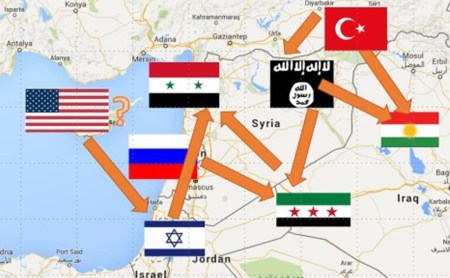
Satire | US Not Sure Who It’s Fighting In Middle East, Bombs Israel ‘Just To Be Sure’

November 19, 2015

US Not Sure Who It’s Fighting In Middle East, Bombs Israel ‘Just To Be Sure’ Duffel Blog, November 19, 2015

US bombs IsraelUS officials are confident they understand the situation on the ground in Syria. (Duffel Blog photo.)

WASHINGTON, D.C. — Pentagon spokesperson Col. Steve Warren announced US aircraft participating in Operation Inherent Resolve, the code name for the campaign against the Islamic State of Iraq and al-Sham (ISIS), struck targets in Tel Aviv today.

When asked why US warplanes would attack a long-standing ally, Warren explained, “Look, guys, this all makes perfect sense,” pointing to a nebulous PowerPoint slide.

“This was all supposed to be a campaign to topple Bashar al-Asad in Syria, starting with the Arab Spring in 2011. Which, in turn, allowed us to get back at Iran and Russia, both of whom support Syria,” said Warren. “So the CIA considered arming the rebels in Syria, which kind of backfired, and now we have ISIS, a group we thought we had already defeated back when they were al-Qaeda in Iraq.”

Secretary of Defense Ashton Carter further explained, “Sure, we were a little worried when ISIS started running around the Middle East, chopping everyone’s heads off. But fortunately, Iran came to our rescue. Well, in Iraq, that is. We’re still fighting Iran in Yemen.”

Chairman of the Joint Chiefs General Joe Dunford stressed the contributions of America’s coalition partners.

Dunford explained how the US tried to empower allies among the Gulf States to take on ISIS, “which in turn sort of helps us get back at Iran.”

“Unfortunately, most of those states also covertly support ISIS, even though they’re nominally our long-standing allies. Whoops,” said Dunford.

“That’s not to say we don’t have some powerful allies in the region, though,” Dunford explained. “The Kurds have proven to be our greatest allies there, and the Turks are one of our longest-standing NATO allies. Unfortunately, they spend more time fighting each other than ISIS. That old saying, ‘nothing brings people together like a common enemy’ is completely useless here.”

Dunford concluded, “So, you see, ISIS is supported by Arabs, who are opposed by Iranians, who are both opposed and allied with the US, who is sort of allied with Turkey and the Kurds, who are opposed to each other. Since the enemy of my friend is now my enemy, it made sense for the US to bomb Israel, Iran’s bitter adversary.”

Events grew even more complicated in the wake of the deadly terrorist attacks in Paris last Friday. The attacks were reportedly the work of ISIS, who also claimed credit for the bombing of a Russian airliner earlier this month.

“France and Russia have formed an alliance, though in doing so, they automatically caused Germany, Austria-Hungary, and the Ottoman Empire to declare war in return,” said Pentagon Press Secretary Peter Cook. “And, let’s face it, this whole thing really is the fault of the Ottomans when you think about it.”

The briefing then shifted to issues surrounding Afghanistan and Pakistan.

“There, the situation is much more simple,” Cook continued.  “The US is fighting the Taliban by providing billions of dollars in military aid to Pakistan, which is supporting the Taliban. Basically, it’s like that scene in The Empire Strikes Back where Luke Skywalker thinks he’s fighting Darth Vader, only to find his own face in Darth Vader’s helmet. That’s pretty much what we’ve gotten ourselves into.”


Ayaan Hirsi Ali: We need to face problem of radical Islam

November 17, 2015

Ayaan Hirsi Ali: We need to face problem of radical Islam, Fox News, November 17, 2015

“We Did What We Learned: Attacking Christians”

November 5, 2015

“We Did What We Learned: Attacking Christians,” The Gatestone InstituteRaymond Ibrahim, November 5, 2015

(Please see also, ‘Islamophobia’ in America vs. murderous Christophobia in the Islamic world. — DM)

  • Western “mainstream media” and academia continued to exonerate Islam in deceptive op-eds, such as the Huffington Post’s “ISIS Violates The Consensus Of Mainstream Islam By Persecuting Christians,” by Qasim Rashid, a recipient of Saudi largesse, by way of Harvard University’s Prince Alwaleed bin Talal Center.
  • A 12-year-old girl, raped by an Islamic State fighter, was told that “what he was about to do was not a sin” because she “practiced a religion other than Islam.”
  • “In school I only learned about Islam. Parts of our teaching were about destroying Christianity. So we did what we learned, by attacking Christians … Our teachers would tell us every time there was a new church in town and we were told to go and attack the people and destroy the church. So that is what we did.” — Tofik, a former Muslim cleric who converted to Christianity.

Throughout the month of August, the Obama administration and the so-called mainstream media kept insisting that Islam does not promote the persecution of Christians — all the while ignoring the direct testimonies of those who have undergone it.

According to Chaldean Archbishop Bashar Warda,

All the statements [by U.S. government and media] have not condemned strongly what damage it [persecution of Christians] is doing. What they are saying is just “This is not the true Islam. This is violating the picture of Islam.” The issue for them is the image of Islam, but none of these statements speak about the victims, about what has been done to the victims, they are not even mentioned. And that is one of the questions our people have. [Author’s emphasis].

Warda added that persecuted Christians are “being denied visas, while others who have participated [in the violence] or at least were silent, can go.”

Father Douglas al-Bazi, an Iraqi Catholic parish priest from Erbil, who still carries the torture scars he received nine years earlier at the hands of jihadis, denounced the Western refusal to accept reality about Islam:

I’m proud to be an Iraqi, I love my country. But my [Muslim] country is not proud that I’m part of it. What is happening to my people [Christians] is nothing other than genocide. I beg you: do not call it a conflict. It’s genocide… When Islam lives amidst you, the situation might appear acceptable. But when one lives amidst Muslims [as a minority], everything becomes impossible…. Wake up! The cancer is at your door. They will destroy you. We, the Christians of the Middle East are the only group that has seen the face of evil: Islam.

Meanwhile, Western “mainstream media” and academia continued to exonerate Islam in deceptive op-eds, such as the Huffington Post’s “ISIS Violates The Consensus Of Mainstream Islam By Persecuting Christians,” by Qasim Rashid, a recipient of Saudi largesse, by way of Harvard University’s Prince Alwaleed bin Talal Center.

The rest of August’s roundup of Muslim persecution of Christians around the world includes, but is not limited to, the following accounts:

Islamic State: Savagery and Sex Slavery

Mokhls Youssef Batk, an Iraqi Christian, was blinded by the Islamic State (ISIS or IS) after he refused to convert to Islam.

The “caliphate” threatened that captive Christian women would become sex slaves unless they were ransomed with money. It posted images of three Assyrian Christian women who were previously abducted. The women hold pieces of paper on which their names and a date — July 27, 2015 — are written: “It is feared they will be sold to ISIS fighters if a ransom is not paid for them.”

A 12-year-old girl, raped by an Islamic State fighter, was told that “what he was about to do was not a sin” because she “practiced a religion other than Islam.” IS also made clear in a 34-page manual released by its Research and Fatwa Department that “sex with Christian and Jewish women who were captured in battle is also permissible.”

Jihad on Muslim Converts to Christianity

Uganda: After he learned that his family had converted to Christianity, a Muslim man went berserk. Issa Kasoono beat, strangled, and left his wife for dead. He also severely beat their two teenage sons for the crime of apostasy. The youngest son managed to flee and bring help from the church where, three months earlier, the Muslim mother and sons had accepted Christ. Due to injuries from the strangling, Kadondi, the mother, lost her voice, has difficulty eating, and requires extensive surgery. According to a local source: “The mother and Ibrahim [older son] Kasoono were seriously injured. Ibrahim was hit with a blunt object, had his right arm broken and has stomach pains, while the mother was strangled and sustained neck and throat injuries.” Although Uganda’s population is 85% Christian and 11% Muslim, attacks on converts to Christianity are on the rise, and include the recent murder by poisoning of a mother, and the gang rape of a teenage daughter of a Christian pastor.

Somalia: A Muslim convert to Christianity (name withheld) managed to escape from Al Shabaab — the dominant Islamic front — but only after the jihadis chopped off four fingers from his right hand while interrogating him about his conversion. Another man, 31-year-old Sharif, fled his home after his conversion to Christianity was exposed: “My association with a visiting white missionary landed me in trouble… I feel sad because I cannot see my family, because if I return back to Somaliland, then the government will arrest me.” His wife and four children — aged 8, 6, 4, and 1 — have also relocated to an undisclosed town: “I am not sure what will happen to my wife and four children. I am praying that God will provide for their basic needs. Pray for me that one day I will see them.”

Pakistan: Khurram Naveed, 33, a Christian man, and Sobia, 25, a Muslim woman, are on the run. Sobia discovered Christianity through Khurram and decided to be baptized. Since they got married and had two daughters, her parents, Muslim neighbors, and imams have repeatedly tried to convert them to Islam or face the consequences. In the words of Khurram:

“Since we got married we have had to change places many times… Wherever we go, people ask about my beloved wife’s conversion. Sometimes, imams try to force us to convert to Islam, issuing terrible threats…. My wife, I and our children have had to flee from place to place. We feel threatened as soon as people find out about my wife’s Muslim past. However, running from one place to another is not easy. There are so many problems…. Until now I have to change job six times, and finding new employment is not easy. But we need security for our life and we ask for help from the people of God.

Horn of Africa: A former Muslim cleric, who converted to Christianity and is known as Tofik, explained in an interview what Islamic preachers teach about Christians in mosques and what such converts can expect. For the previous 24 years, he had trained to become an imam at an Islamic madrasa: “In school I only learned about Islam. Parts of our teaching were about destroying Christianity. So we did what we learned, by attacking Christians once we finished our training.”

Tofik said he was taught that Christians are evil and that he and other students should steal from and kill them: “We beat them, attacked the church and burnt their Bibles. … Our teachers would tell us every time there was a new church in town and we were told to go and attack the people and destroy the church. So that is what we did.” Due to a series of dreams, he eventually embraced Christ. News of his apostasy spread quickly, especially among his own tribe:

They reacted by coming to my home saying, ‘This brother is dead.’ In our culture, when someone dies their property is shared. So they destroyed my house, setting it on fire, and they took my cattle, and the remainder of my property. They then falsely accused me of burning another house, so I was jailed and taken to court. It was only in the court process that the witnesses proved their dishonesty by having contradicting testimonies.

After being released from jail, Tofik continued preaching Christ and even inspired more than 200 people to convert:

“As a result local villagers were upset. So again, they attacked me physically and burned my house…. The attackers assumed I was dead, so they threw me into the compound. Then they looted the small kiosk I owned and proceeded to loot and burn my children’s properties. They said they have killed the lead figure and now our area is free of his activities. They started shouting and singing.”

Jihad on Christian “Blasphemers”

Egypt: Medhat Ishak, a 35-year-old Christian, was arrested for handing out Bibles to Muslims outside El-Arab Mall in Sixth of October City. Mall security guards turned him over to national police, who accused him of evangelizing. The day after his arrest, a judge amended the charge against Ishak to “defamation of a revealed religion” and ordered him held for 15 days. After his term ended, the judge extended his detention for another 15 days. Ishak’s attorney, Rafik Rafaat, suspects the judge will keep extending the detention order, in violation of Egyptian law, until the case falls out of the public eye. Then he will hand Ishak a prison sentence of one to five years, in accordance with the defamation charge. This is because there are currently no charges against “evangelism” under Egyptian law. Handing out Bibles or even promoting Christianity does not constitute “defaming” Islam. “The word ‘blasphemy’ means that he was insulting the other religion [Islam], but he didn’t do that, and he didn’t talk about Islam or prophets or anything like that to be accused of blasphemy,” said the Christian’s lawyer. “So, now we are surprised that the attorney general accused him of blasphemy when he did not commit any act of blasphemy.”

Pakistan: Protestant Christian Pastor Aftab Gill and three other Christians from Gujrat were accused of blasphemy for having used the word rasool (“messenger” or “apostle”) during an event made public by their community, the Biblical Church of God. Local Muslims grew angry, saying that, as rasool is one of the Muslim prophet Muhammad’s attributes, Christian use of the word is blasphemous. But Christian activists say that because the word simply means apostle and appears in Urdu Bibles as such, it was used in that generic sense, and that the Christians were not trying to blaspheme. Muslims were nevertheless about to burn Christian homes and a church, but police managed to restore calm before the situation escalated. Unitan Gill, Pastor Aftab’s younger brother, said that local Muslim businessmen are jealous of the Christian family’s success in running a local grocery store, and that it was Muslim grocers who brought this matter to the attention of the police.

Islamic State Destruction of Syrian Churches

The Islamic State “caliphate” released a video showing its militants razing the ancient Mar Elian monastery to the ground. In the video, the jihadis can be seen removing the remains of Saint Elian, after whom the monastery was named, from their ancient stone sarcophagus, and then gleefully desecrating his bones. The church was built on the spot where Saint Elian was killed by his father, a Roman officer, for refusing to renounce Christ. Earlier, IS abducted an estimated 250 Christians from the monastery and its surrounding villages, many of whom were women and children.

1330Islamic State jihadists in the midst of destroying the ancient Mar Elian monastery in Syria.

On Sunday, August 23, a rain of mortars fell on a Damascus neighborhood. Two shells hit the roof of the Maronite church. Nine people were killed and about fifty were wounded. A nearby Catholic parish was also damaged. According to Maronite Archbishop Samir Nassar, “Part of the war in Syria is to live under indiscriminate bombing, a kind of Russian roulette which is always unpredictable.” Survivors tell the archbishop that those who die are better off, because they “will not have to see and live this cruel tragedy without end.”

Pakistani Dhimmitude

The Christian minorities of the “Land of the Pure” continued to be treated as third class, unwanted “citizens.”

Muslims attacked and severely beat a Christian family after a Muslim boy mocked a Christian boy by saying that his pregnant sister-in-law will “give birth as their cows and buffalos do.” The Christian boy reciprocated with an insult, and the Muslim boy began to beat him. Later in the evening, the Muslim boy and his brothers went to the Christians’ household and attacked the entire family. While beating the pregnant Christian women, they yelled, “You cannot be pregnant without permission of Muslim master who pays you.” After visiting the family, a human rights group stated that the “Christian Community is facing all sorts of discrimination and disgrace from their land Lords, neighbors, or where ever they live or work. Christians have no right to respect, education, free living and now they are under observation/mockery of giving birth, now our majority brothers [Muslims] will decide whether the Christian women will give birth respectfully or like animals.”

As torrential flooding spanned across various regions of Pakistan and washed away thousands of homes, Christians in Kasur received little humanitarian aid and were left to starve. Their two options — to receive help from Muslims or the government — was either to convert to Islam or willingly accept becoming modern-day slaves. According to Wilson Chowdhry, the president of the British Pakistani Christian Association, while Muslims in the region have benefited from temporary shelter, clean water and food provided by governmental agencies and Muslim charities, Christians have been left without those bare necessities and medication needed to fight illnesses. Said Chowdhry:

We are aware that this community has previously been offered aid from Muslim charities if they convert but they never accept conversion. They hold strong to their faith. They believe God will be their provider. These families have literally been struggling without food. Churches have opened up their doors but can’t provide them much aid because the churches themselves in the region are struggling. We are talking about a very rural part of Pakistan.

Chowdhry added that as desperation started to get the best of the Christian population in Kasur, many ended up signing bonded labor contracts in order to receive aid from Muslim landlords.

In a separate incident, a few days after a Christian man stopped two Muslim brothers from harassing Christian girls on their way to church, the two brothers broke into the Christian’s home, and beat and shot him. The man was later taken to a hospital, where he was reported in critical condition.

Boko Haram’s Slaughter of Christians

Jihadists from the Islamic organization Boko Haram slit the throats of sixteen Christian fishermen on the shores of Lake Chad in the Nigerian state of Borno. The increase in such incidents is supposedly in retaliation for the Chadian government’s efforts against Boko Haram around Lake Chad. According to Bishop Ramolo, “The Chadian President Idriss Deby has declared open war against the Islamists, and these acts represent an attempt at revenge.”

A Christian leader, stabbed in April by rampaging young Muslims in Kaduna state, suffered a relapse after an initial recovery. Pastor Emmanuel Danjuma of the Redeemed Christian Church of God, while visiting a Muslim-majority region of Nigeria, was attacked by Muslims reportedly angry about election results. “They called me an infidel and attacked me.” The pastor was clubbed and stabbed several times. A village elder apparently ordered the youths to stop. “I don’t know what happened then, as next I found myself in a hospital in Saminaka town. After a few days, my situation deteriorated and I was transferred to this Christian hospital.”

About this Series

While not all, or even most, Muslims are involved, persecution of Christians is expanding. “Muslim Persecution of Christians” was developed to collate some — by no means all — of the instances of persecution that surface each month.

It documents what the mainstream media often fails to report.

It posits that such persecution is not random but systematic, and takes place in all languages, ethnicities and locations.

Op-Ed: Chaos and 2nd Cold War, Part II: Israel’s Nuclear Strategy

October 11, 2015

Op-Ed: Chaos and 2nd Cold War, Part II: Israel’s Nuclear Strategy, Israel National News, Prof. Louis René Beres, October 11, 2015

(Part I is available here. — DM)

Israel should now be calculating the exact extent or subtlety with which it should consider communicating key portions of its nuclear posture and positions. Naturally, Israel should never reveal any too-specific information about its nuclear strategy, its nuclear hardening, or even its nuclear yield-related capabilities. Still, sometimes, the duty of finely-honed intelligence services should not be to maximize strategic secrecy, but rather, to carefully “share” certain bits of pertinent information.

**********************************

How will Russia respond to any ramped up American uses of force in the Middle East, and, more plausibly, vice-versa?  One must assume that Jerusalem is already asking these key questions, and even wondering whether, in part, greater mutualities of interest could sometime exist with Moscow than with Washington.

To wit, Prime Minister Benjamin Netanyahu met with Russia’s President Vladimir Putin in September 2015. Among other things, the Israeli leader must  be calculating: 1)Will the Obama Administration’s incoherent retreat from most of the Middle East point toward a more permanent United States detachment from the region; and 2) If it does, what other major powers are apt to fill the resultant vacuum? Just as importantly, and as an obvious corollary to (2), above, the prime minister should be inquiring: “How will the still-emerging Cold War II axis of conflict impact America’s pertinent foreign policy decisions?”

There are some additional ironies yet to be noted. Almost certainly, ISIS, unless it is first crushed by U.S. and/or Russian-assisted counter-measures, will plan to march westward across Jordan, ultimately winding up at the borders of West Bank (Judea/Samaria). There, ISIS Jihadists could likely make fast work of any still-posted Hamas and Fatah forces, in effect, taking over what might once have become “Palestine.” In this now fully imaginable scenario, the most serious impediment to Palestinian statehood is not Israel, but rather a murderous band of Sunni Arab terrorists.[16]

What about the larger picture of “Cold War II?” Israeli defense planners will need to factor into their suitably nuanced calculations the dramatically changing relationship between Washington and Moscow. During “Cold War I,” much of America’s support for the Jewish State had its most fundamental origins in a perceived need to compete successfully in the Middle East with the then Soviet Union. In the progressive development of “Cold War II,” Jerusalem will need to carefully re-calculate whether a similar “bipolar” dynamic is once again underway, and whether the Russian Federation might, this time around, identify certain strategic benefits to favoring Israel in regional geo-politics.

In all such strategic matters, once Israel had systematically sorted through the probable impact of emerging “superpower” involvements in the Middle East, Jerusalem would need to reassess its historic “bomb in the basement.” Conventional wisdom, of course, has routinely pointed in a fundamentally different policy direction. Still, this “wisdom” assumes that credible nuclear deterrence is simply an automatic result of  physically holding nuclear weapons. By the logic of this too-simplistic argument, removing Israel’s nuclear bomb from the “basement” would only elicit new waves of global condemnation, and would likely do so without returning any commensurate security benefits to Jerusalem.

Scholars know, for good reason, that the conventional wisdom is often unwise. Looking ahead, the strategic issues facing Israel are not at all uncomplicated or straightforward.  Moreover, in the immutably arcane world of Israeli nuclear deterrence, it can never really be adequate that enemy states merely acknowledge the Jewish State’s nuclear status. Rather, it is also important that these states should be able to believe that Israel holds usable nuclear weapons, and that Jerusalem/Tel-Aviv would be willing to employ these usable weapons in certain clear, and situationally recognizable, circumstances.

Current instabilities in the Middle East will underscore several good reasons to doubt that Israel could ever benefit from any stubborn continuance of deliberate nuclear ambiguity. It would seem, too, from certain apparent developments already taking place within Mr. Netanyahu’s “inner cabinet,” that portions of Israel’s delegated leadership must now more fully understand the bases of any such informed skepticism.

In essence, Israel is imperiled by compounding and inter-related existential threats that justify its fundamental nuclear posture, and that require a correspondingly purposeful strategic doctrine. This basic need exists well beyond any reasonable doubt. Without such weapons and doctrine, Israel could not expectedly survive over time, especially if certain neighboring regimes, amid expanding chaos,  should soon become more adversarial, more Jihadist, and/or less risk-averse.

Incontestably, a purposeful nuclear doctrine could prove increasingly vital to coping with various more-or-less predictable strategic scenarios for Israel, that is, those believable narratives requiring preemptive action, and/or an appropriate retaliation.

Typically, military doctrine carefully describes how national forces should fight in various combat operations. The literal definition of “doctrine” derives from Middle English, from the Latin doctrina, meaning teaching, learning, andinstruction. Though generally unrecognized, the full importance of doctrine lies not only in the several ways that it can animate and unify military forces, but also in the uniquely particular fashion that it can transmit certain desired “messages.”

In other words, doctrine can serve an increasingly imperiled  state as a critical form of communication, one directed to its friends, and also to its foes.

Israel can benefit from just such broadened understandings of doctrine. The principal security risks now facing Israel are really more specific than general or generic. This is because Israel’s extant adversaries in the region will likely be joined, at some point, by: (1) a new Arab state of “Palestine;” and/or by (2) a newly-nuclear Iran. It is also because of the evidently rekindled global spark of “bipolar” or “superpower” adversity, and the somewhat corollary insertion of additional American military forces to combat certain new configurations of Jihadi terror.

For Israel, merely having nuclear weapons, even when fully recognized in broad outline by enemy states, can never automatically ensure successful deterrence. In this connection, although starkly counter-intuitive, an appropriately selective and thoughtful end to deliberate ambiguity could improve the overall credibility of Israel’s nuclear deterrent.  With this point in mind, the potential of assorted enemy attack prospects in the future could be reduced by making available certain selected information concerning the safety of  Israel’s nuclear weapon response capabilities.

This crucial information, carefully limited, yet more helpfully explicit, would center on the distinctly major and inter-penetrating issues of Israeli nuclear capability and decisional willingness.

Skeptics, no doubt, will disagree. It is, after all, seemingly sensible to assert that nuclear ambiguity has “worked” thus farWhile Israel’s current nuclear policy has done little to deter multiple conventional terrorist attacks, it has succeeded in keeping the country’s enemies, singly or in collaboration, from mounting any authentically existential aggressions. This conclusion is not readily subject to any reasonable disagreement.

But, as the nineteenth-century Prussian strategic theorist, Karl von Clausewitz, observed, in his classic essay, On War, there may come a military tipping point when “mass counts.” Israel is already coming very close to this foreseeable point of no return. Israel is very small.  Its enemies have always had an  undeniable advantage in “mass.”

More than any other imperiled state on earth, Israel needs to steer clear of such a tipping point.

This, too, is not subject to any reasonable disagreement.

Excluding non-Arab Pakistan, which is itself increasingly coup-vulnerable, none of Israel’s extant Jihadi foes has “The Bomb.”  However, acting together, and in a determined collaboration, they could still carry out potentially lethal assaults upon the Jewish State. Until now, this capability had not been possible, largely because of insistent and  persistently overriding fragmentations within the Islamic world. Looking ahead, however, these same fragmentations could sometime become a source of special danger to Israel, rather than remain a continuing source of  national safety and reassurance.

An integral part of Israel’s multi-layered security system lies in the country’s ballistic missile defenses, primarily, the Arrow or “Hetz.” Yet, even the well-regarded and successfully-tested Arrow, now augmented by the newer and shorter-range iterations of “Iron Dome,” could never achieve a sufficiently high probability of intercept to meaningfully protect Israeli civilians.[17] No system of missile defense can ever be “leak proof,” and even a single incoming nuclear missile that somehow managed to penetrate Arrow or corollary defenses could conceivably kill tens or perhaps hundreds of thousands of Israelis.[18]

In principle, at least, this fearsome reality could be rendered less prospectively catastrophic if Israel’s traditional reliance on deliberate ambiguity were suitably altered.

Why alter? The current Israeli policy of an undeclared nuclear capacity is unlikely to work indefinitely. Leaving aside a Jihadi takeover of already-nuclear Pakistan, the most obviously unacceptable “leakage” threat would come from a nuclear Iran. To be effectively deterred, a newly-nuclear Iran would require convincing assurance that Israel’s atomic weapons were both (1) invulnerable, and (2) penetration-capable.

Any Iranian judgments about Israel’s capability and willingness to retaliate with nuclear weapons would then depend largely upon some prior Iranian knowledge of these weapons, including their expected degree of protection from surprise attack, as well as Israel’s expected capacity to “punch-through” all pertinent Iranian active and passive defenses.

Jurisprudentially, at least, following JCPOA in Vienna, a  nuclear weapons-capable Iran is a fait accompli. For whatever reasons, neither the “international community” in general, nor Israel in particular, had ever managed to create sufficient credibility concerning a once-timely preemptive action. Such a critical defensive action would have required very complex operational capabilities, and could have generated Iranian/Hezbollah counter actions that might have a  very significant impact on the entire Middle East. Nevertheless, from a purely legal standpoint, such preemptive postures could still have been justified, under the authoritative criteria of anticipatory self-defense, as permitted under customary international law.

It is likely that Israel has undertaken some very impressive and original steps in cyber-defense and cyber-war, but even the most remarkable efforts in this direction will not be enough to stop Iran altogether. Earlier, the “sanctions” sequentially leveled at Tehran – although certainly better than nothing – could have had no tangible impact on effectively halting Iranian nuclearization.

Strategic assessments can sometimes borrow from a Buddhist mantra. What is, is. Ultimately, a nuclear Iran could decide to share some of its nuclear components and materials with Hezbollah, or with another kindred terrorist group. Ultimately, amid growing regional chaos, such injurious assets could find their way to such specifically U.S- targeted groups as ISIS.

Where relevant, Israeli nuclear ambiguity could be loosened by releasing certain very general information regarding the availability and survivability of appropriately destructive  nuclear weapons.

Israel should now be calculating the exact extent or subtlety with which it should consider communicating key portions of its nuclear posture and positions. Naturally, Israel should never reveal any too-specific information about its nuclear strategy, its nuclear hardening, or even its nuclear yield-related capabilities. Still, sometimes, the duty of finely-honed intelligence services should not be to maximize strategic secrecy, but rather, to carefully “share” certain bits of pertinent information.

What about irrational enemies? An Israeli move from ambiguity to disclosure would not likely help in the case of an irrational nuclear enemy. It is even possible, in this regard, that particular elements of Iranian leadership might meaningfully subscribe to certain end-times visions of a Shiite apocalypse. By definition, any such enemy would not necessarily value its own continued national survival more highly than any other national preference, or combination of preferences. By definition, any such enemy would present a genuinely unprecedented strategic challenge.

Were its leaders to become authentically irrational, or to turn in expressly non-rational directions, Iran could then effectively become a nuclear suicide-bomber in macrocosm.  Such a profoundly destabilizing strategic prospect is improbable, but it is also not inconceivable. A similarly serious prospect exists in already-nuclear Pakistan.

To protect itself against military strikes from irrational enemies, especially those attacks that could carry existential costs, Israel will need to reconsider virtually every aspect and function of its nuclear arsenal and doctrine. This is a strategic reconsideration that must be based upon a number of bewilderingly complex intellectual calculations, and not merely on ad hoc, and more-or-less presumptively expedient political judgments.

Removing the bomb from Israel’s basement could enhance Israel’s strategic deterrence to the extent that it would heighten enemy perceptions of the severe and likely risks involved. This would also bring to mind the so-called Samson Option, which, if suitably acknowledged, could allow various enemy decision-makers to note and underscore a core assumption. This is that Israel is prepared to do whatever is needed to survive. Interestingly, such preparation could be entirely permissible under governing international law, including the 1996 Advisory Opinion of the International Court of Justice.[19]

Irrespective of  its preferred level of ambiguity, Israel’s nuclear strategy must always remain oriented toward deterrence, not to actual war-fighting.[20] The Samson Option refers to a policy that would be based in part upon a more-or-less implicit threat of massive nuclear retaliation for certain anticipated enemy aggressions.  Israel’s small size means, inter alia, that any nuclear attack would threaten Israel’s very existence, and could not be tolerated. Israel’s small size also suggests a compelling need for sea-basing (submarines) at least a recognizably critical portion of its core nuclear assets,

From a credibility standpoint, a Samson Option could make sense only in “last-resort,” or “near last-resort,” circumstances. If the Samson Option is to be part of a convincing deterrent, as it should, an incremental end to Israel’s deliberate ambiguity is essential. The really tough part of this transformational process will lie in determining the proper timing for such action vis-a-vis Israel’s security requirements, and in calculating authoritative expectations (reasonable or unreasonable) of the “international community.”

The Samson Option should never be confused with Israel’s overriding security objective: To seek stable deterrence at the lowest possible levels of military conflict. As a last resort, it basically states the following warning to all potential nuclear attackers:  “We (Israel) may have to `die,` but (this time) we won’t die alone.”

There is a related observation. In our often counter-intuitive strategic world, it can sometimes be rational to pretend irrationality. The nuclear deterrence benefits of any such pretended irrationality would depend, at least in part, upon an enemy state’s awareness of Israel’s intention to apply counter-value targeting when responding to a nuclear attack. But, once again, Israeli decision-makers would need to be aptly wary of ever releasing too-great a level of specific operational information.

In the end, there are specific and valuable critical security benefits that would likely accrue to Israel as the result of a purposefully selective and incremental end to its historic policy of deliberate nuclear ambiguity.   The right time to begin such an “end”  has not yet arrived. But, at the precise moment that Iran verifiably crosses the nuclear threshold, or arguably just before this portentous moment, Israel should  promptly remove The Bomb from its “basement.”

When this critical moment arrives, Israel should already have configured (1) its presumptively optimal allocation of nuclear assets; and (2) the extent to which this preferred configuration should now be disclosed. Such strategic preparation could then enhance the credibility of Israel’s indispensable nuclear deterrence posture.

When it is time for Israel to selectively ease its nuclear ambiguity, a second-strike nuclear force should be revealed in broad outline. This robust strategic force – hardened, multiplied, and dispersed – would need to be fashioned so as to recognizably inflict a decisive retaliatory blow against major enemy cities. Iran, it follows, so long as it is led by rational decision-makers, should be made to understand that the actual costs of  any planned aggressions against Israel would always exceed any expected gains.

In the final analysis, whether or not a shift from deliberate ambiguity to some selected level of nuclear disclosure would actually succeed in enhancing Israeli nuclear deterrence would depend upon several complex and intersecting factors. These include, inter alia, the specific types of nuclear weapons involved; reciprocal assessments and calculations of pertinent enemy leaders; effects on rational decision-making processes by these enemy leaders; and effects on both Israeli and adversarial command/control/communications operations. If  bringing Israel’s bomb out of the “basement” were to result in certain new enemy pre-delegations of nuclear launch authority, and/or in new and simultaneously less stable launch-on-warning procedures, the likelihood of unauthorized and/or accidental nuclear war could then be substantially increased.

Not all adversaries may be entirely rational. To comprehensively protect itself against potentially irrational nuclear adversaries, Israel has no logical alternative to developing an always problematic conventional preemption option, and to fashion this together with a suitable plan for subsequent “escalation dominance.” Operationally, especially at this very late date, there could be no reasonable assurances of success against many multiple hardened and dispersed targets. Regarding deterrence, however, it is noteworthy that “irrational” is not the same as “crazy,” or “mad,” and that even an expectedly irrational Iranian leadership could still maintain susceptible preference orderings that are both consistent and transitive.

Even an irrational Iranian leadership could be subject to threats of deterrence that credibly threaten certain deeply held religious as well as civic values. The relevant difficulty here for Israel is to ascertain the precise nature of these core enemy values. Should it be determined that an Iranian leadership were genuinely “crazy” or “mad,” that is, without any decipherable or predictable ordering of preferences, all deterrence bets could then have to give way to preemption, and possibly even to certain plainly unwanted forms of war fighting.

Such determinations, of course, are broadly strategic, not narrowly jurisprudential. From the discrete standpoint of international law, especially in view of Iran’s expressly genocidal threats against Israel, a preemption option could still represent a permissible expression of anticipatory self-defense. Again, however, this purely legal judgment would be entirely separate from any parallel or coincident assessments of operational success. There would be no point for Israel to champion any strategy of preemption on solely legal grounds if that same strategy were not also expected to succeed in specifically military terms.

Growing chaotic instability in the Middle East plainly heightens the potential for expansive and unpredictable conflicts.[21] While lacking any obviously direct connection to Middle East chaos, Israel’s nuclear strategy must now be purposefully adapted to this perilous potential. Moreover, in making this adaptation, Jerusalem could also have to pay special attention not only to the aforementioned revival of  major “bipolar” animosities, but also, more specifically and particularly, to Russia’s own now-expanding nuclear forces.

This cautionary warning arises not because augmented and modernized Russian nuclear forces would necessarily pose any enlarged military threat to Israel directly, but rather because these strategic forces could determine much of the way in which “Cold-War II” actually evolves and takes shape. Vladimir Putin has already warned Washington of assorted “nuclear countermeasures,” and recently test launched an intercontinental nuclear missile.[22] One such exercise involved a new submarine-launched Bulava missile, a weapon that could deliver a nuclear strike with up to 100 times the force of the 1945 Hiroshima blast.

Current adversarial Russian nuclear posturing vis-à-vis the United States remains oriented toward the Ukraine, not the Middle East.[23] Nevertheless, whatever happens to U.S.-Russian relations in any one part of the world could carry over to certain other parts, either incrementally, or as distinctly sudden interventions or escalations. For Jerusalem, this means, among other things, an unceasing obligation to fashion its own developing nuclear strategy and posture with an informed view to fully worldwide power problems and configurations.

Whether looking toward Gaza, West Bank (Judea/Samaria), Iran, Lebanon, Iraq, Jordan, Egypt, or Syria, Israel will need to systematically prioritize existential threats, and, thereafter, stay carefully focused on critically intersecting and overriding factors of global and regional security. In all such meticulously careful considerations, both chaos and Cold War II should be entitled to occupy a conspicuous pride of place.

Sources:

[16] A further irony here concerns Palestinian “demilitarization,” a pre-independence condition of statehood called for by Israeli Prime Minister Benjamin Netanyahu. Should Palestinian forces (PA plus Hamas) ever actually choose to abide by any such formal legal expectation, it could makes these forces less capable of withstanding any foreseeable ISIS attacks. Realistically, however, any such antecedent compliance would be highly improbable. See, for earlier legal assessments of Palestinian demilitarization, Louis René Beres and (Ambassador) Zalman Shoval, “Why a Demilitarized Palestinian State Would Not Remain Demilitarized: A View Under International Law,” Temple International and Comparative Law Journal, Winter 1998, pp. 347-363; and Louis René Beres and Zalman Shoval, “On Demilitarizing a Palestinian `Entity’ and the Golan Heights: An International Law Perspective,” Vanderbilt Journal of Transnational Law, Vol. 28, No. 5, November 1995, pp. 959-972.

[17] There is another notable and more generic (pre-nuclear age) risk of placing too-great a reliance on defense. This is the risk that a corollary of any such reliance will be a prospectively lethal tendency to avoid taking otherwise advantageous offensive actions. Recall, in this connection, Carol von Clausewitz On War:  “Defensive warfare…does not consist of waiting idly for things to happen. We must wait only if it brings us visible and decisive advantages. That calm before the storm, when the aggressor is gathering new forces for a great blow, is most dangerous for the defender.” See: Carl von Clausewitz, Principles of War, Hans W. Gatzke, tr., New York: Dover Publications, 2003, p. 54.

[18] For early authoritative accounts, by the author, of expected consequences of a nuclear attack, see: Louis René Beres, Apocalypse: Nuclear Catastrophe in World Politics (Chicago: University of Chicago Press, 1980); Louis René Beres, Mimicking Sisyphus: America’s Countervailing Nuclear Strategy (Lexington, Mass., Lexington Books, 1983); Louis René Beres, Reason and Realpolitik: U.S. Foreign Policy and World Order (Lexington, Mass., Lexington Books, 1984); and Louis René Beres, Security or Armageddon: Israel’s Nuclear Strategy (Lexington, Mass., Lexington Books, 1986).

[19] See: “Summary of the Legality of the Threat or Use of Nuclear Weapons,” Advisory Opinion, 1996, I.C.J., 226 (Opinion of 8 July 1996). The key conclusion of this Opinion is as follows: “…in view of the current state of international law, and of the elements of fact at its disposal, the Court cannot conclude definitively whether the threat or use of nuclear weapons would be lawful or unlawful in an extreme circumstance of self-defense, in which the very survival of a State would be at stake.”

[20] This advice was a central recommendation of the Project Daniel Group’s final report,  Israel’s Strategic Future (ACPR, Israel, May 2004: “The overriding priority of Israel’s nuclear deterrent force must always be that it preserves the country’s security without ever having to be fired against any target. The primary point of Israel’s nuclear forces must always be deterrence ex ante, not revenge ex post.” (p. 11). Conceptually, the core argument of optimizing military force by not resorting to any actual use pre-dates the nuclear age. To wit, Sun-Tzu, in his ancient classic, The Art of War, counseled: “Supreme excellence consists of breaking the enemy’s resistance without fighting.”

[21] Once again, Prussian military thinker, Carl von Clausewitz, had already highlighted the generic (pre-nuclear age) dangers of unpredictability, summarizing these core hazards as matters of “friction.”

[22] ICBM test launches are legal and permissible under the terms of New START, It does appear, however,  that Russia has already developed and tested a nuclear-capable cruise missile with a range of 500-5500 KM, which would be in express violation of the Intermediate Nuclear Forces Treaty (INF). At the same time, current research into the U.S. Conventional Prompt Global Strike Program seeks to circle around INF Treaty limitations, by employing a delivery vehicle trajectory that is technically neither ballistic nor cruise.

[23] Russia, of course, is operating much more openly and substantially in Syria, but here, in the Middle East theatre, at least, Moscow’s public tone toward Washington is somewhat less confrontational or adversarial.


 

Jews, Islamophobia and compassion for refugees

October 4, 2015

Jews, Islamophobia and compassion for refugees, Israel Hayom, Isi Leibler, October 4, 2015

We should be under no illusions. Most emigrants from Muslim countries have been nurtured ‎with hatred of Western values, contempt for democracy and vicious anti-Semitism. Ironically, ‎Germany’s concern to demonstrate its severance from its evil Nazi past by hosting large ‎numbers of these “refugees” will inevitably strengthen the growing Islamist anti-Semitism in ‎Germany and throughout Europe.‎

We must rationally consider the ‎long-term repercussions of our actions and, while displaying compassion and joining calls for ‎Christians and Yazidis facing genocide in Syria to be accepted as refugees in Western countries, ‎we must also avoid creating a situation in which we lay the foundations for jihadis to achieve ‎their objectives by demographic means and devour the hand that feeds them. ‎

***********************

It would be inhumane not to react with compassion to the tragic and harrowing depictions of ‎the suffering of refugees. For Jews, more than any others, these images revive horrific ‎memories of their own collective past and the horrors endured by their families and kinsman ‎when an indifferent world effectively collaborated with the Nazis by denying haven to Jews ‎seeking escape from the gas chambers.‎

In this context, it is ironic that the most generous assistance to refugees emanates from the ‎Germans, who — even setting aside the Nazi era — were hardly renowned as adherents of ‎multiculturalism. Many attribute this to a guilt reflex and atonement for Germany’s iniquities ‎during the Holocaust. ‎

It is also not surprising that many Jewish communities in Europe, North America and Australia ‎are currently at the vanguard of those calling on governments to be more liberal and accept ‎greater numbers of refugees. We also hear passionate calls from rabbis and Jewish lay leaders ‎citing religious and ethical teachings that oblige us as Jews to provide haven for refugees. ‎Former British Chief Rabbi Lord Jonathan Sacks even went to the absurd extreme of making an ‎analogy between Syrian refugees and Jews in Europe during the Holocaust.‎

While reaching out and providing assistance to refugee families in distress is highly ‎commendable, to make analogies between these refugees and Jews facing the Nazi genocidal ‎policies is not merely misleading, but it also trivializes the Holocaust.‎

The Jews who found refuge from the Nazis integrated into their host societies and never ‎sought to impose their Jewish values — in stark contrast to the tensions created in Europe over ‎recent decades by Islamic migration of elements who seek to impose anti-democratic values, ‎restrict freedom of expression and promote the equivalent of Shariah law. In fact, the Jews ‎became the most committed advocates for strengthening democracy and made major ‎contributions to the economic and cultural enrichment of the countries that gave them haven. ‎

Nor can one point to a single example of a second-generation Jew transformed into a terrorist ‎by extremist rabbis, while this has been the case with many Muslim migrants. Indeed, the idea ‎of Jews engaging in terrorism in Western countries is simply inconceivable.‎

That European Union bureaucrats are pressuring European countries to absorb refugees ‎indeed reflects commendable humanitarian intentions. But there is a need to act rationally and ‎appreciate that a growing flood of Muslim migrants to Europe could lead to disaster and even ‎ultimately undermine West European civilization. ‎

That may sound hysterical and, in the current climate, such observations automatically ‎provoke accusations of Islamophobia and lack of compassion. ‎

But the reality is that the overwhelming majority of these “refugees” not only originate from ‎Muslim countries other than Syria, but 70% are estimated to be men of military age. That is to ‎say that the majority of this “refugee” population are not traditional families seeking ‎sanctuary, but men seeking economic enhancement.‎

Furthermore, these large numbers will act as a magnet which could result in profound ‎demographic changes with tens of millions of Muslims seeking to escape Arab countries for ‎better lives in Europe. Taking account of their high fertility rates in a continent with declining ‎birth rates, Islam could yet conquer Europe by demographic means, despite being vanquished ‎militarily hundreds of years ago on the battlefields.‎

Most European countries already face major problems integrating existing Muslim ‎communities, all of which include substantial extremist elements promoting objectives ‎incompatible with Western values and creating major social upheavals and conflicts.‎

We should be under no illusions. Most emigrants from Muslim countries have been nurtured ‎with hatred of Western values, contempt for democracy and vicious anti-Semitism. Ironically, ‎Germany’s concern to demonstrate its severance from its evil Nazi past by hosting large ‎numbers of these “refugees” will inevitably strengthen the growing Islamist anti-Semitism in ‎Germany and throughout Europe.‎

It would be absurd to imagine that these migrants will somehow miraculously be integrated ‎more effectively than their predecessors. We already have the specter of second-generation ‎Muslims educated and nurtured in European countries becoming jihadis, voluntarily serving ‎in terrorist militias in Syria and returning to Western countries to embark on terrorist activities.‎

In this environment, Europe’s current security problems will exponentially increase if large ‎numbers of Islamic refugees descend upon the continent — especially as there are no means ‎of identifying or excluding potential terrorists. The reality is that a significant proportion ‎support the jihadi movement and will never be integrated into democratic societies. ‎

These are indeed difficult problems and there is no easy solution. To allow compassion to ‎determine policy without reference to long-term repercussions reflects a total lack of resolve ‎to maintain democratic values and is almost comparable to lemmings heading to the slaughter ‎‎ — a true recipe for the demise of Western civilization.‎

The reality is that Western democratic values are under threat and that while multiculturalism ‎is an idyllic concept, it can only apply in an environment where all parties accept an open ‎democratic society. Alas, the reality is that the Muslim radicals are gaining strength and while ‎distinctions between moderate and radical Muslims may apply in realpolitik on the ‎international global arena, all evidence indicates the rapid expansion of powerful and surging ‎anti-democratic and jihadi elements in every expatriate Muslim community.‎

This is further highlighted by the astonishing but adamant refusal of the wealthy Arab oil ‎countries — Saudi Arabia and the Gulf states, which import vast numbers of Asian workers — ‎to absorb even a minimal number of their own kinsman. They justify their exclusion on the ‎grounds that such people will create disorder and represent security risks.‎

It is also scandalous that the Arab League and the 57-state Organization of the Islamic ‎Conference make pious comments but turn to the non-Muslim international community to ‎resolve issues created by Islamist extremism from their own ranks. The wealthy Muslim states ‎should be obliged to take the lead role in efforts to integrate their own people. ‎

There must be an intensive effort to stabilize the Middle East region. In this context, it should ‎be noted that the barbarism that today dominates the region is a direct outcome of U.S. ‎President Barack Obama’s concern not to alienate the Iranians, and the repudiation of his ‎commitment to act against the Syrians after Bashar Assad used chemical weapons against his ‎own people. ‎

There are no easy solutions but the Western world must seek to resolve these problems ‎without paving the way for anti-democratic forces to destroy our way of life. As Jews, despite ‎identifying with the harrowing images of suffering endured by those seeking to find a better ‎life in Western countries, we must not let ourselves be ruled by emotions or intimidated by the ‎threat that we will be accused of engaging in Islamophobia. We must rationally consider the ‎long-term repercussions of our actions and, while displaying compassion and joining calls for ‎Christians and Yazidis facing genocide in Syria to be accepted as refugees in Western countries, ‎we must also avoid creating a situation in which we lay the foundations for jihadis to achieve ‎their objectives by demographic means and devour the hand that feeds them. ‎

Satire | Three cheers for Terroristine

October 1, 2015

Three cheers for Terroristine, Sultan Knish Blog, Daniel Greenfield, October 1, 2015

(He refers, of course, to “Palestine.” — DM)

We need a terrorist state. Where the politicians are terrorists, the police are terrorists and even the men sitting at the desk when you come in to drop off a form are terrorists.

3egypt081613

There are states that support terrorists, and give safe harbor to them, but that’s not good enough. We don’t want another Pakistan or Iran. We’re not half-assing it this time. What we want is the genuine article. Terrorists from the top down. Terrorists everywhere. A state where every branch of government and the entire country is nothing but terrorists.

Terroristine has been an ancient dream since 1973 or was it 1967. A generation of keffiyah draped thugs, KGB operatives and human rights activists have looked out into the darkness and called it into being. It is a vision of a country where everyone is a murderer and children are taught from a very young age that their purpose in life is to die killing people who don’t share their religion.

And now after decades of negotiations, treaties, suicide bombings, mutilations, billions of dollars in vanishing into Swiss bank accounts and the death of its Egyptian born leader of AIDS– Terroristine is closer than ever to coming into being.

Abbas, its unelected dictator, who has struggled long and hard so that one of his sons might have his own cigarette monopoly in Gaza, has come to the UN to promise that Terroristine will have “will actively contribute to the achievement of economic, cultural, and humanitarian progress of civilization.”

And who can doubt him? Certainly not Terroristinians who don’t have elections or a free press.

Terroristine, whose noble flag (that looks like nearly every other Arab flag) flies over the UN, has done wonders for civilization. Consider the airplane hijacking. The suicide bomber. Has there ever been a civilization that did as much for civilized living as the Terroristinians?

Every time you get groped at an airport, thank Terroristine. Without the Terroristinian contribution to civilization, you might actually be able to get on a plane in peace. Or visit the Twin Towers.

The Terroristinian contribution to human progress is unquestionable. But only one thing stands in the way of it unleashing its full Terroristinian potential for all mankind.

Them. Those pesky people who live in that country that is always in the way. You know the ones, with too many Nobel prizes, newly invented tomatoes and microchips. They stand in the way of the great cultural contributions of Terroristine. They must die so that Terroristine must live.

They must be thrown out of their homes, village by village and city by city, so that the noble Terroristinians can plant their rockets on the rubble of their houses, the charred remains of their fields, and point them at their cities.

Trying to end terrorism by creating a terrorist state makes is like trying to put out a fire with more fire. It can’t work, but we must try. So that we can say that we tried. Over and over again. We’ll keep trying until we run out of land to try with. And people to try with.

Until there’s nothing left but Terroristines everywhere. Until all the world is Terroristine. The question is can we make it happen? Yes, we can. Oh sweet Allah, yes we can.

Israel must return to the 1967 borders, which are really the 1948 borders. Why are the borders of the 1948 war, so much better than the borders of the Six Day War? Because the Terroristinians came closer to winning that war. Came closer to driving the Yahood into the sea and ululating over miles  of their corpses.

boy_bomb.preview

But the dream failed. Farmers armed with outdated rifles. Volunteer pilots from America and Canada. Refitted cargo ships filled with half-dead men, women and children straight from the camps. Used Czech artillery. They held off the armies of seven Terroristinian nations. Farm by farm, they stood off tanks and infantry. In Jerusalem, they fought for every house. And so the Zionist entity survived.

Allah curse them. They survived.

But now it’s back to 1948 again. Every war undone. Every defeat turned to victory. Cut Jerusalem in two. Drive out the farmers. Burn their land. Dig up their graves. March the borders back to 1948. And fly the Terroristinian flag over dust and rubble. Had they won in 1948 or 1967 or 1973, there would be no Israel and no Terroristine. The land would have become part of Syria, Egypt and Jordan. And only when the mobs of the faithful would drive out the tyrants to replace them with Islamic states, would there finally be a Terroristine.

But despite what Abbas says, there is still hope for a two state solution. And we must do everything in our power to salvage the two state solution so that there will be a state of civilization on one side and a state of terrorists on the other. Hospitals here, launching pads there. Schools here, bomb factories there. Life here, death here. We all know the story. Olive trees and bomb belts. Rocks and dead families in burning cars by the side of the road. Children with their throats cut.

A dream. A nightmare. Who even knows anymore.

Why do we need Terroristine? Peace. There can be no peace without a terrorist state. Not a chance of it. The only way we’ll ever have peace is to give the terrorists a country of their own. A country dedicated to terrorism. Only then will the Terroristinians finally give up on all the killing, and dedicate themselves to medical research, quantum mechanics and the arts. It hasn’t happened yet to. But it’s bound to.

After decades as an autonomous territory, spreading death and destruction, it’s time for Terroristine to finally be recognized as an independent state. With contiguous borders cutting Israel in half. It is the only hope for peace in the region. Would Sunnis and Shiites be killing each other from Yemen to Iraq? Assuredly not. The moment the flag of Terroristine rises above the wounded hills, and its peaceful anthem, “Palestine is My Revenge” is heard in the land, then a great echoing sigh will rise up from the mouths of one billion Muslims. And the violence will cease.

The international community is impatient. They want Terroristine and they want it now. Whatever Israel has offered in the past, it isn’t enough. It must offer more and more. Whatever it takes. We know the Terroristinians want their own state. Every time they walk out of negotiations or end them with a round of terrorist attacks, it shows their deep and abiding passion for a state. They want it so badly they aren’t willing to make a single concession for it. Or even negotiate for it.

That’s how committed they are to realizing their great dream to Terroristine. And who can blame them? Have any people suffered the way the Terroristinians have? (Besides all the people the Terroristinians have killed over the last 1,400 years.) Have any other people been wholly subsidized by a UN agency dedicated only to them? Have any other people inspired such a stylish fashion statement? No more excuses. The world demands Terroristine. Middle East peace demands Terroristine.

How much longer can Israel expect to draw out the necessary concessions with weak justifications about terrorism. We know they’re terrorists. That’s why we’re giving them a state. If they weren’t terrorists, they could go to the back of the line with the Jews, Kurds and Armenians.

From one corner of the Muslim world to the other, a cry goes out. “We Are All Terroristinians.” They cry it it Cairo and Damascus, in Tehran and Islamabad, in Dubai and Paris. They mosques go up, the asses go up and the bombs go off. And off to the peace negotiations we go.

Islam will dominate the world

Everyone is impatient. Everyone is on fire. Especially the Terroristinians. Jewish store windows are smashed in London, Terroristinians butcher Rabbis in Jerusalem synagogues, fuming Terroristinians shoot up American recruiting centers. And the crowds cheer. “We Are All Terroristinians Now.”

It is a great day, I tell you. A great day for negotiating. ISIS impatiently beheads infidels to create its own Islamic Terroristine. In Afghanistan the word goes out, “We are the Taliban, we are the Afghan people, we are Terroristinians.” In Egypt and Turkey, they cry, “Khaybar Ya Yahood”. Churches burn. Soldiers die. The smoke rises to heaven. A man waits in line at the airport. His passport is Dutch, Welsh, German, American, it doesn’t matter. He is a Terroristinian. Yallah.

One day the borders of Terroristine will stretch from Spain to Pakistan. Or beyond Why settle for Jerusalem, when we can have London, Paris and Hamburg too. Why settle for anything at all? Allah is generous to the believers. Our people are in Africa. Even China. The Great Satan himself bows toward Mecca. The old governments are falling. The pawns of the Kufir are fleeing before our eyes.

We are all Terroristinians now. There is no other book on our shelves than the Koran. No law but Sharia in our hearts. And no nation but Terroristine. The ghost of Chamberlain stands outside No. 10 Downing Street promising peace. A Terroristinian refugee beheads him and holds up his spectral head to the cheers of the crowd. Rockets sail through the sky. The crowd cheers. Hip Hip Hooray. Hierosylma Est Perdita. Three cheers for Terroristine.