Archive for the ‘Islamic integration’ category

Islamist Extremism in France (Part II)

May 4, 2016

Islamist Extremism in France (Part II), Clarion Project, Leslie Shaw, May 4, 2016

France-Muslims-Protest-Hijab-Ban-IP_0Muslims in France protest against a French law that forbids the wearing of religious symbols (including the hijab) in the primary and secondary schools. (Photo: © Reuters)

France has one of the largest Muslim communities in the West (estimated at 10% of the population), and French corporates have more experience than most in dealing with radical Islam.

City of Paris

In September 2012, in response to the encroachment of radical Islam, the mayor of Paris set up an Observatory on Secularism to ensure the principles of the 1905 separation of Church and State were being respected by the city’s 73,000 employees.

The observatory remained dormant but was reactivated in January 2015 after the Islamic terrorist attacks. Saïd Kouachi, one of the Charlie Hebdo killers, worked in the city sanitation department from 2007 to 2009. He was part of an employment program for young people from the ghettoes surrounding Paris.

A number of these youths were assigned to going door-to-door to inform householders on the benefits of domestic waste segregation. Many created problems for their supervisors due to their increasingly fundamentalist Islamic beliefs: refusing to shake hands with women, bringing prayer mats with them and taking time off to return to their workplaces to pray. Kouachi was moved from district to district as his supervisors, who described him as fundamentalist and unmanageable, became exasperated with his behavior. He was fired in July 2009.

A supervisor later revealed that city authorities had been notified about Kouachi’s radical behavior on several occasions, but that the subject was taboo. A “Charter on Secularism” was posted in the sanitation workshops and a one-day training program held for supervisors in 2013, but no action was taken to deal with the problem.

Since January 2015, the Observatory members meet regularly, have issued a 20-page rulebook to municipal employees and interviewed numerous city managers about the problems of radicalization. Departments most affected are sanitation, parks and gardens, public safety and security, and youth and sport. Common issues are praying in the workplace, refusal to shake hands with, look at or follow instructions from female supervisors, demands for work schedule accommodation on Fridays and during Ramadan, wearing of hijabs and other head-coverings.

RATP Paris Transit Authority

The RATP chapter of the CFDT union claims there is a groundswell of Islamist ideology within the company where Samy Amimour, one of the 2015 Paris suicide bombers, worked as a bus driver. In December 2015, a newspaper reported that several RATP employees were targeted by “Fiche S,” a law enforcement indicator that flags individuals linked to terrorism.

Religion-based workplace incidents are widespread. In 2013, RATP management issued a guidebook to supervisors listing typical infringements of secular principles and outlining rules to enforce. An RATP executive commented, “We pretend the problem has been solved, but the reality is that managers in contact with radicalized individuals in bus depots are left on their own to handle these kinds of things.”

ADP Paris Airports Authority

Following the November 2015 attacks in Paris, CDG Airport CEO Augustin de Romanet revealed that 70 airside security badges had been withdrawn from Muslim airport employees and 4,000 staff lockers raided by police as the employees were considered a security risk.

French Automobile Industry

The problems facing French public-sector companies have long been present in the automobile industry, where Muslims account for around 70 percent of the workforce. Militant Islam began to manifest itself in the 1980s, when it emerged that shop stewards frequently had links to the Muslim Brotherhood.

Employees began to shave their heads, grow beards and wear Islamic garb as the Salafist ideology gained ground in the suburbs where the auto plants are located. Automakers Renault and Peugeot integrated Muslim practices into their management model, setting up on-site prayer rooms and planning work schedules to fit in with prayer times and Ramadan.

Employee associations were established to cater to the needs of Muslim staff, organizing religious celebrations, pilgrimages to Mecca and arranging for the repatriation to North Africa of deceased workers. This policy of appeasement benefited the industry since it minimized religion-linked workplace conflict and litigation and fostered employee engagement.

Radical Islam and the Emergence of Jihadism

The first generation of Muslim immigrants who came to France in the 1950s kept their faith to themselves. The second generation was more militant and began making demands for accommodation of Islam. Opting for exclusion rather than integration into mainstream society, some turned to crime. Those caught and imprisoned often converted to radical Islam, spreading the ideology throughout the ghettoes upon release.

The third generation came of age with the nationwide 2005 riots, sparked by the electrocution of two juvenile delinquents who climbed over a fence into an electricity substation to escape from the police.

The same year, Abu Musab al-Suri published a 1,600-page Global Islamic Resistance Call urging the masterminds of jihad to exploit the presence of the huge disaffected Muslim populations in Europe by prompting them to set up terror cells targeting Western civilians. The strategy was rolled out on the internet and by Salafist imams operating in mosques financed by the Gulf states.

A growing number of Muslims in France and Europe converted to radical Islam resulting in the emergence of an informal jihadist army on the continent. In February 2016, the number of radical Islamists identified by French law enforcement was 11,700.

Florida Synagogue Bomber Plotted to Kill Jews for “Glory of Allah”

May 3, 2016

Florida Synagogue Bomber Plotted to Kill Jews for “Glory of Allah” Front Page Magazine, Daniel Greenfield, May 3, 2016

james-medina-11-e1462213958443

The last time I was in Los Angeles, there were guards at every synagogue. In New York, there are police officers in front of every synagogue. But the media won’t talk about Muslim anti-Semitism. Instead it’ll pretend that we face a grave Islamophobia threat. Two days from now this story will be buried beneath a deluge of “Muslims fear backlash” stories. And Jews will have to pray in synagogues under assault.

And so we turn to James Gonzalo Medina aka James Muhammad, who converted to Islam, threatened a church and then plotted to bomb a synagogue for Islam.

Medina has a number of prior arrests, including one in August 2012 when he was accused of sending violent threats via text message to a Coral Springs family.

One text read: “By next week, Ima bomb ya [curse word] … Bring him! I will buy a gun [off] the street and rampage [family member’s] church. Murder she wrote,” according to the 2012 affidavit.

And at some point, Muhammad/Medina prioritized killing Jews.

One of Medina’s associates informed the FBI source that Medina was planning to martyr himself in a firearms attack on the Aventura synagogue, using AK-47 assault rifles — then, the affidavit said, the conversation turned to claiming responsibility for it. Medina said he liked the source’s idea of using the name of a notorious terrorist group — ISIS or al-Qaida-linked Shabaab — to assume responsibility.

Medina, who told the source he had converted to Islam four years ago, said the planned synagogue attack would inspire other Muslims. Medina would later express his “current hatred for the Jewish people,” the affidavit said.

An FBI undercover employee questioned Medina about his resolve: “You’re sure this is something you want to do?” Medina answered: “I feel like it’s my calling,” adding he was “comfortable” with killing innocent women and children.

Initially, an FBI confidential source met with Medina and two of his associates in late March and discussed the attack plan for the first time, according to an FBI affidavit. In early April, Medina talked about the timing of the assault with the source, who mistakenly suggested it could be carried out in a couple of weeks on the Jewish holiday, Yom Kippur — not realizing the upcoming holiday was Passover.

Medina’s response: “… that’ll be a good day to go and bomb them,” the affidavit said.

Before his arrest, Medina made three videos with his cellphone: In the first, he was recorded saying, “Aventura, watch your back. ISIS is in the house.” In the second, he said, “Today is gonna be a day where Muslims attack America. I’m going to set a bomb in Aventura.” And in the third, he said his good-byes to his family.

And yes, he knew what he was doing. The “not a Muslim” thing did not fly.

CHS: MEDINA doesn’t have passion.

TI: No, no listen, listen, listen … no no it’s possible. I always knew in my heart …

CHS: MEDINA is suicidal, he’s not a Muslim.

TI: No, no, no, no listen, listen, listen. When, when I first met him, you know what he taught me. He taught me something you know. It’s not like he’s not knowledgeable. It’s not like he’s not bullshit.

CHS: It’s ok.

TI: It’s not like he’s not religious.

CHS was the FBI’s informant.

On April 1, 2016, MEDINA met with the CHS and at one point, while driving around in the CHS’s car, MEDINA directed the CHS to the synagogue in Aventura, the site of MEDINA’s intended attack. MEDINA described the synagogue (“it’s a real big one”), and when they drove up to it, MEDINA pointed it out (“[Y]ou see the, the, the David’s triangle star.”) Then MEDINA redirected the conversation from the location of the attack to its timing. MEDINA stated, “You see it there. And you see, I mean that’s where it is, but you gotta know when to go like.”

MEDINA explained some of his religious philosophies that form the basis for his current hatred for Jewish people…  MEDINA explained that if he would conduct an attack be would want to do it at a synagogue because Jewish people are the ones causing the world’s wars and conflicts.

MEDINA further explained that attacking one synagogue would give hope and light to other Muslims in America.

MEDINA further explained that the “plot” that he and BH had discussed allowed them to “strike back to the Jews, by going to a synagogue and just spraying everybody … ‘ cause we’re Muslims you know what I mean? It’s a war man and it’s like it’s time to strike back here in America.” MEDINA then stated that he wanted to go inside to kill people while the others shot people as they were fleeing the scene.

MEDINA then commented that the news coverage could galvanize Muslims to worldwide action: “I wanna see it go worldwide with now all the Muslims realizing you know, when it’s our time .. . Next thing you know it will be in California, Washington, and the brothers are saying you know, it’s our time now.”

MEDINA then discussed placing the bomb in the parking lot of the synagogue, and added, ” [W]e can just lay one out there and then bomb it later … I’d like to put it like, as close as possible, to the door.”

MEDINA envisioned a terrorist operation that would inflict maximum casualties, commenting “‘Cause, uh, I’m sure this is gonna be hammered. All these people gonna die.” He provided detailed instructions to the CHS about how to drop him off and then pick him up after the bomb had been strategically placed.

MEDINA again recounted the operational plan, with emphasis on the fact that it shoUld be when the synagogue is full of people: “[Y]ou just let me in there real quick, and I find my opportunity to walk in while the service already started … When I see, uh, I find the clearance, it’s where you’re gonna tell me, okay now, pull up and drop me off.” MEDINA flatly told the CHS, “Oh my God, I can’t wait.”

MEDINA told a story about a Jewish woman he had met earlier who had given him a ride. A discussion had ensued regarding her fear of Muslims once she realized MEDINA was a Muslim and her thoughts that MEDINA might kill her. Thereafter, MEDINA remarked to the UCE and the CHS that he had told her, “[Y]ou know, we’re, we’re just getting bombed for no reason, and it was time to get out. But it made me just think more that, you know, it just, when she said that you will kill me, I’m thinking yeah man, I want to. You know what I mean? I really do … ”

The UCE asked, “Why do you wanna do this?” MEDINA responded, “Because I realize that I have a lot of love for Allah. And I know that all these, all these wars that are going on, it hurts me, too. You know? It’s my call of duty. I gotta 10 get back, when I’m doing this, I feel that I’m doing it for a good cause for Allah.”

MEDINA’s comments prompted the UCE to ask another question about his motivation, “What message are you sending?” The UCE wanted to know more about MEDINA’s purpose in attacking the synagogue, including what claim of responsibility would be made. MEDINA answered that “I’m gonna call that it’s ISIS in America.” MEDINA plainly told the UCE that “I do want to get the bomb,” and though he had considered using an AK.-47 assault rifle to “just go in there and rampage everybody,” he concluded, “Well I’d like to use the bomb.” MEDINA added, “And I’m hoping that that one bomb can just cause a big damage you know? And let them realize that their Yom Kippur’s going down.”

MEDINA responded that it is Allah’s will and that he’s not crazy and reckless to the point where he would get the UCE arrested: “No I’m not like that.” The UCE cautioned MEDINA one more time that “once you do this, there’s no going back.” MEDINA reiterated his plan to personally deposit the bomb, and after it detonated, enjoy watching the news coverage of the attack: “That we, they, whatever they’re sayin’, that they’re being bombed and all of that … , and knowing that it was from us. And just getting’ a joy that I’m doing this you know, I did it. It worked out. And whatever happens, it’s for the glory of Allah.”

2 days.

Then the media will be running stories about how Islamophobia is the real problem and Muslim anti-Semitism doesn’t actually exist. Then The Nation will be doing sob stories about Medina claiming that he was a mentally unstable man used as a pawn by the FBI, just like they’re still doing for synagogue bomber Ahmed Ferhani in New York.

How Many Molenbeeks in France?

May 3, 2016

How Many Molenbeeks in France? Gatestone InstituteYves Mamou, May 3, 2016

♦ “There are today, we know, a hundred neighborhoods in France that present potential similarities with what’s happened in Molenbeek.” — Patrick Kanner, Minister for Urban Areas.

♦ The Salafists, in fact, do not want to “take the power in these neighborhoods.” In many, they already have it.

♦ “The farther I walked between the buildings, the more I was stunned. A courtyard of Islamist miracles; an enclave that wants to live like during the times of Muhammad. Bakery, hairdresser… It’s a mini Islamic Republic. During the sermons, they denounce, they criminalize. A woman who smokes? A degenerate. A woman who does not veil herself? A tease. A man that does not eat halal? He has an express ticket to hell.” — Paris Match.

♦ Remadna received a death threat over the phone: “We know where your kids go to school,” and “your daughter is very pretty.” The next day, a delegation of completely veiled Salafist “true Muslim mothers” came and told her, “We want mosques, not schools.”

Patrick Kanner, France’s Minister for Urban Areas, was undoubtedly not planning to tell the truth on March 27.

He was on the set of Europe 1 TV to emphasize the left’s credo: Islamist terrorism is rooted in poverty and unemployment. But they asked one question again and again: “How many Molenbeeks are in France?” Finally, he said: “There are today, we know, a hundred neighborhoods in France that present potential similarities with what has happened in Molenbeek.”

Molenbeek, as the entire world knows today, is the neighborhood of Brussels that has become the epicenter of jihad in Europe. It is a neighborhood under Salafist control that sent three of its residents to assassinate hundreds of people in Paris on November 13, 2015. These are the residents of the same neighborhood that bombed the Brussels airport and the Maalbeek Metro station.

1577The Molenbeek neighborhood of Brussels has become the epicenter of jihad in Europe. Abdelhamid Abaaoud (right), mastermind of the November 2015 attacks in Paris, lived in Molenbeek. Amedy Coulibaly (left), who in January 2015 murdered a policewoman and four Jews in Paris, spent time in Molenbeek.

The reactions to Kanner’s statement have not been slow. The first secretary of the Socialist Party, Jean-Christophe Cambadélis, accused Kanner of “dissolving national harmony.” Julien Dray, another leading figure of the Socialist Party, also criticized Kanner, telling him: “I do not like it when we stigmatize [people].”

Nonetheless, Kanner will not let himself be intimidated. In a March 28 interview in Le Parisien, he recalled,

“Amedy Coulibaly [the killer in the Hyper Cacher attack], who was from the Grande-Borne à Grigny, Mehdi Nemmouche [the Brussels Jewish Museum killer], who passed through the Bourgogne neighborhood in Tourcoing. and Mohamed Merah, who was from the Mirail neighborhood in Toulouse.”

Malek Boutih, Socialist Deputy, came to Kanner’s aid. He declared,

“It is the first time that a minister of the suburbs says even a little bit of the truth, namely that the ghettos have transformed, little by little, into zones that we cannot control very well… Neighborhoods that are incubators for terrorists.”

Samia Ghali, a Senator from Bouches du Rhones (Socialist Party), echoed the statements of the Minister for Urban Areas: “There are training camps in the neighborhoods of Marseille where people are learning to shoot.” She adds, “I’ve gotten to the point of asking if we should build walls to protect schoolyards from Kalashnikov bullets or from rifles finding their way into the school yard.”

Gilles Kepel, professor at the Paris Institute of Political Studies, and one of the best experts on Islamism in France, explained in early April that three ingredients are necessary for making a Molenbeek:

“1) A strong system of crime organized around kif [a type of marijuana]; 2) Hideouts for terrorists and sites where they can stock weapons; 3) Local politicians who accept that the Salafists have opened countless uncontrollable mosques.”

These three ingredients would be uniformly present in all 100 French Molenbeeks, added Kepel. But the goal of the Salafists, he adds, is actually to seize neighborhoods in order to wage a “enclave war.”

Patrick Kanner, the Minister for Urban Areas confirmed this view: “The Salafists want to take the power in these neighborhoods.” The gravity of the situation was recently underscored by Prime Minister Manual Valls: a fundamentalist “minority,” he said, is about to win “the ideological and cultural battle” over Islam.

The Salafists, in fact, do not want to “take the power in these neighborhoods.” In many, they already have it.

On January 27, the magazine Paris-Match dedicated several pages to the neighborhood Reine-Jeanne in Avignon, a large city in the south of France, where the Salafists have systematically exploited half a million Muslims.

“The farther I walked between the buildings, the more I was stunned. A courtyard of Islamist miracles, a Salafist pocket, an enclave that wants to live like during the times of Muhammad. Bakery, hairdresser, building managers, teenagers. All (or almost) overcome with the Koran. Well, their Koran. It’s a mini Islamic Republic.

“During the sermons, they denounce, they criminalize. A woman who smokes? A degenerate. A woman who does not veil herself? A tease. A man that does not eathalal? He has an express ticket to hell. That female neighbor, the one who is divorced, with three kids, and works with men? She will end up losing her virtue. She should just give up. In order to not pass for an ‘easy woman,’ the unlucky choose the hard life, welfare benefits!”

In Sevran, a suburb of Paris, the Salafist mosque was sealed off several weeks ago because it had been recruiting a dozen young Muslims for the Islamic State. Six may have already been killed in Syria. Nadia Remadna, a Muslim social worker, lives in Sevran. She started the local “Mothers’ Brigade” to help women keep control over their children, against the Islamists. In 2014, she wrote the provocative book, How I Saved My Children, with the sub-title “Before, we feared our children would fall in with delinquents. Now, we fear they will become terrorists.”

On March 14, Remadna received a death threat over the phone: “We know where your kids go to school,” and “your daughter is very pretty.”

The next day, a delegation of completely veiled Salafist “true Muslim mothers” came and told her, “We want mosques, not schools.”

On March 29, the philosopher Yves Michaud spoke to the magazine Paris Match about his students:

“My ex-students who teach today in the suburbs… tell me that among their students they have some who could become terrorists overnight. They take on the weight of Islam, of adolescence, of the ghettoization that makes them question their identity, of cultural disorientation. It is an ideal breeding-ground for the jihadist calling.”

How many Salafists are there in France? 15,000 to 20,000, according to Bernard Godard, former head of the Bureau of Religion for the Ministry of the Interior. According to the politician Antoine Sfeir, there are 20,000 to 30,000 Salafists. According to police sources, out of 2,500 listed Islamic places of worship in metropolitan France, at least 90 are Salafist. The number doubles every three years. They are located in the suburbs of Paris, in the Lyon region and in Marseille.

According to the Ministry of the Interior, 41 Islamic places of worship have been the target of “infiltration,” meaning that “traditional” imams are being forcibly evicted and replaced by Salafist imams.

The real question is: If the state is aware of the situation — and it is — why has it not banned Salafism, and why does it not expel the Salafist imams who are prospering not only in these neighborhoods, but also on YouTube, Facebook, and Twitter?

Britain? Moderates? How’s That Again?

April 30, 2016

Britain? Moderates? How’s That Again? Gatestone InstituteDouglas Murray, April 30, 2016

♦ A new poll of British Muslims found that a majority hold views with which most British people would disagree. For instance, 52% of British Muslims think that homosexuality should be made illegal. An earlier poll found that 27% of British Muslims have “some sympathy for the motives behind the attacks” at the offices of the French satirical magazine Charlie Hebdo last year.

♦ Whenever opinion poll results come out, nearly the entire Muslim community, including nearly all Muslims in the media and all self-appointed groups of “Muslim community leaders” try to prove that the poll is a fraud.

♦ If I had always known my “community” harboured such views, and a poll revealing this truth came out, I would be deeply ashamed. But when such polls emerge about the opinions of British Muslims, is that there is never any hint of introspection. There is no shame and no concern, only attack.

♦ If there were indeed a “moderate majority,” when a poll comes out saying that a quarter of your community wants fundamentally to alter the law of the land and live under Sharia, the other 75% would spend their time trying to change the opinions of that quarter. Instead, about 74% of the 75% not in favour of sharia spend their time covering for the 25% and attacking the polling company which discovered them.

One often hears about the “moderate Muslim majority.” ‘After any terrorist attack, politicians tell us that, “The moderate majority of Muslims utterly condemn this.” After any outrage, commentators and pundits spring up to say, “Of course the vast majority of Muslims are moderate.” But is it true? Are the vast majority of Muslims really “moderate”?

A number of factors suggest perhaps not — most obviously the problem repeatedly revealed by opinion polls. Time and again, the results of opinion polls in the Western world, never mind in the Middle East or North Africa, show a quite different picture from the “moderate majority” aquatint.

True, such polls can often show that, for instance, only 27% of British Muslims have “some sympathy for the motives behind the attacks” at the offices of the French satirical magazine Charlie Hebdo last year. True, that is only between a quarter and a third of British Muslims sympathizing with the blasphemy enforcement squad. On other occasions, such as recently in Britain with a new ICM poll commissioned by Channel 4, they find that a majority of Muslims hold views with which most British people would disagree. So for instance, the recent ICM poll found that 52% of British Muslims think that homosexuality should be made illegal. That’s a striking figure. Not 52% of British Muslims saying homosexuality is “not their cup of tea” or that they are “not entirely on board with gay marriage,” but 52% of British Muslims thinking that homosexuality should be made a crime under the law.

But it is what happens after such polls emerge that the “moderate majority” idea really comes under strain. First, of course, there is always an attempt to put a positive spin on the results. So for instance, when the post-Charlie Hebdo poll came out last year, the BBC (which had commissioned the poll) ran it with the headline, “Most British Muslims ‘oppose Muhammad cartoon reprisals.’” Although true, it is not the most striking aspect of its findings. But it is what happens next that is most revealing and more truly calls into question whether we are really dealing with a “moderate majority” or, more truthfully, with a “moderate minority.” Because whenever the results come out, nearly the entire Muslim community, including nearly all Muslims in the media and all self-appointed groups of “Muslim community leaders,” try to prove that the poll is a fraud. It happened with the release of the ICM poll in the UK, as it has happened with every previous poll. With the exception of only one or two prominent dissident Muslims, every Muslim voice in the media and every Muslim group decided not to concern themselves with the ICM findings, but to try to pull apart the validity, methodology and even ‘motives’ of the poll. This is deeply revealing.

It is worth trying a thought-experiment here. Whatever community you come from, imagine your reaction if a poll like the ICM one on British Muslims had come out about whatever community you feel a part of. Imagine you are a Jew and a poll had come out saying the majority of other Jews in your country want to make being gay a crime. What would your first reaction be? My impression is that most Jews would be deeply embarrassed. Very shortly after that first reaction, you might begin to wonder what could be done to change such a terrible statistic around. It is possible, if you knew nobody of your faith who thought that homosexuality should be criminalized and had never come across this position before (or any previous polling which suggested the same thing) that you might question the credibility and methodology of the poll. But otherwise, you would probably sigh and wonder what could be done to improve things. If you knew the findings to be fairly accurate, why would you try to tear apart the findings?

Likewise, if tomorrow a poll were published of the opinions of white British people of Christian upbringing in the UK, I would take some interest in it. If it revealed that 39% of British Christians believed that wives should always obey their husbands (as the ICM poll showed British Muslims believe) then I would have some worries. If it also found that almost a quarter (23%) of British people of Christian origin wanted areas of the UK to divest themselves of the law of the land and be run instead on some Biblical literalist “take” on the law, I would worry some more.

Of course, neither of these eventualities is remotely likely to arise. But let us say that it did. What would be my reaction? The first would be to hang my head in shame. And I would hang it just that bit lower if the findings came as absolutely no surprise to me. If I had always known my “community” harboured such views, and a poll revealing this truth came out, I would be deeply ashamed that what I had always known was now known by everyone else in the country.

What is most interesting then, when such polls emerge about the opinions of British Muslims, is that there is never, ever, any hint of such introspection. There is no shame and no concern, only attack. If there were indeed a “moderate majority,” then when a poll comes out saying that a quarter of your community wants fundamentally to alter the law of the land and live under Sharia law, the other 75% would spend their time trying to change the opinions of that quarter. Instead, about 74% of the 75% not in favour of sharia spend their time covering for the 25% and attacking the polling company which discovered them. It is a tiny symptom of a much larger problem, the repercussions of which our societies have hardly begun to face.

1568

Germany: “We Need an Islam Law”

April 28, 2016

Germany: “We Need an Islam Law” Gatestone InstituteSoeren Kern, April 28, 2016

♦ “All imams need to be trained in Germany and share our core values. … It cannot be that we are importing different, partly extreme values from other countries. German must be the language of the mosques. Enlightened Europe must cultivate its own Islam.” – Andreas Scheuer, the General Secretary of the Christian Social Union party (CSU).

♦ The Turkish government has sent 970 clerics — most of whom do not speak German — to lead 900 mosques in Germany that are controlled by a branch of the Turkish government’s Directorate for Religious Affairs. Turkish clerics in Germany are effectively Turkish civil servants who do the bidding of the Turkish government.

♦ Erdogan has repeatedly warned Turkish immigrants not to assimilate into German society. During a trip to Berlin in November 2011, Erdogan declared: “Assimilation is a violation of human rights.”

A senior German politician has called for an “Islam law” that would limit the influence of foreign imams and prohibit the foreign financing of mosques in Germany.

The proposal — modelled on the Islam Law promulgated in Austria in February 2015 — is aimed at staving off extremism and promoting Muslim integration by developing a moderate “European Islam.”

The move comes amid revelations that the Turkish government is paying the salaries of nearly 1,000 conservative imams in Germany who are leading mosques across the country. In addition, Saudi Arabia recently pledged to finance the construction of 200 mosques in Germany to serve migrants there.

In an interview with the newspaper Die Welt, Andreas Scheuer, the General Secretary of the Christian Social Union (CSU), the Bavarian sister party to German Chancellor Angela Merkel’s Christian Democrats (CDU), said that Berlin should restrict Turkish financing of mosques in Germany and begin training and certifying its own imams. Otherwise, he argued, Muslim integration will be difficult or impossible to achieve. He said:

“We need to become more critical in our dealings with political Islam, because it hinders Muslim integration in our country. We need an Islam Law. The financing of mosques or Islamic kindergartens from abroad, e.g. from Turkey or Saudi Arabia, should be banned. All imams need to be trained in Germany and share our core values.

“It cannot be that we are importing different, partly extreme values from other countries. German must be the language of the mosques. Enlightened Europe must cultivate its own Islam.

“We are still at the beginning of our efforts. We must start now. We cannot on the one hand enact an Integration Law and on the other side close our eyes to what is being preached in mosques and by whom.”

Scheuer’s comments come amid reports that the Turkish government has sent 970 clerics — most of whom do not speak German — to lead 900 mosques in Germany that are controlled by the Turkish-Islamic Union for Religious Affairs (DITIB), a branch of the Turkish government’s Directorate for Religious Affairs, known in Turkish as Diyanet.

Successive German governments are responsible for this state of affairs. An essay in Der Tagesspiegel states: “Over past decades, the federal government has welcomed the fact that the Turkish religious authority exercises a great influence on German mosques. Turkey was considered a secular state, and their influence was viewed as a shield against religious extremism.”

This was before Turkish President Recep Tayyip Erdogan embarked on a mission to turn the formerly secular nation an Islamic country.

According to Die Welt, Erdogan has increased the size, scope and power of the Diyanet, which now has a budget of 6.4 Turkish lira ($2.3 billion; €1.8 billion), which is more than the budgets of 12 Turkish government ministries, including the interior ministry and the foreign ministry. The Diyanet now has 120,000 employees, up from 72,000 in 2004.

The Turkish clerics in Germany are effectively Turkish civil servants who do the bidding of the Turkish government. Critics accuse Erdogan of using DITIB mosques to prevent Turkish migrants from integrating into German society.

German politician Cem Özdemir, co-chairman of the Green Party, said that DITIB is “nothing more than an extended arm of the Turkish state.” He added: “Rather than being a legitimate religious organization, the Turkish government has turned DITIB into a political front organization of Erdogan’s AKP party. Turkey must let go of the Muslims in Germany.”

Erdogan has repeatedly warned Turkish immigrants not to assimilate into German society.

1567 (1)The Cologne Central Mosque, run by DITIB, is used as a key base in Germany for Turkey’s intelligence agency, where they run a local “thug squad” to mete out “tough punishments” to Turkish dissidents in Germany. (Image source: © Raimond Spekking/CC BY-SA 4.0, via Wikimedia Commons)

During a trip to Berlin in November 2011, Erdogan declared: “Assimilation is a violation of human rights.” In February 2011, Erdogan told a crowd of more than 10,000 Turkish immigrants in Düsseldorf: “We are against assimilation. No one should be able to rip us away from our culture and civilization.” In February 2008, Erdogan told 16,000 Turkish immigrants in Cologne that “assimilation is a crime against humanity.”

For his part, Saudi Arabia’s King Salman recently announced a plan to finance the construction of 200 mosques in Germany to provide for the spiritual needs migrants and refugees who arrived there in 2015. The mosques would, presumably, adhere to Wahhabism, the official and dominant form of Sunni Islam in Saudi Arabia. Wahhabism is an austere form of Islam that insists on a literal interpretation of the Koran.

On April 11, Hans-Georg Maassen, the head of Germany’s domestic intelligence agency (BfV), expressed alarm at the growing number of radical Arab-language mosques in Germany. “Many mosques are dominated by fundamentalists and are being monitored because of their Salafist orientation,” Maassen said in an interview with Welt am Sonntag. He added that many of the mosques were being financed by donors in Saudi Arabia.

It remains uncertain, however, whether Merkel will back the “Islam Law,” which is certain to antagonize Erdogan, who effectively controls the floodgates of Muslim mass migration to Europe. If Merkel were openly to support a ban on foreign financing of mosques in Germany, Erdogan likely would threaten to pull out of the EU-Turkey deal on migrants, a deal Merkel desperately needs to stanch the flow of mass migration to Germany. It is yet another indication of the tremendous leverage Erdogan has gained over Merkel and German policymaking.

Germany’s coalition government has, however, reached a compromise deal on a new “Integration Law.”

On April 14, Merkel announced the broad outlines of the law, which will spell out the rights and responsibilities of migrants in Germany. Under the law, the text of which will be finalized by May 24, asylum seekers must attend German language classes and integration training or have their benefits cut.

The government pledged to make it easier for asylum seekers to gain access to the German labor market by promising to create 100,000 new “working opportunities.” The government will also suspend a law requiring employers to give preference to German or EU job applicants over asylum seekers.

In an effort to prevent the spread of migrant ghettoes in Germany, the new law, which is expected to enter into force this summer, will prohibit refugees from choosing where they live until they have secured asylum. Migrants who abandon state-assigned housing would face unspecified sanctions.

The new law also includes a counter-terrorism provision, which would allow German intelligence agencies to work more closely with their European, NATO and Israeli counterparts.

“We will have a German law on integration,” Merkel said. “This is the first time in post-war Germany that this has happened. It is an important, qualitative step.”

But critics say the proposed law does not go far enough because it does not threaten with deportation those migrants who refuse to integrate. In his interview with Die Welt, Scheuer insisted that Muslim immigrants must integrate or be deported:

“Anyone who fails to attend integration and language courses attests that they are not prepared to integrate and accept our values. Moreover, it is important that people who want to stay in Germany register with the Federal Employment Agency [Bundesagentur für Arbeit] and provide for their own livelihood. The message is clear: Those who are not integrated cannot stay here. We need to cease having romantic views of integration. Multiculturalism has failed. Those who are not integrated must count on deportation.”

A fair shake

April 24, 2016

A fair shake, Israel Hayom, Annika Hernroth-Rothstein, April 24, 2016

Khan and his party are bringing Islamism into every Swede’s living room and into the halls of parliament, but the Swedish media would rather demand he shake a woman’s hand than have him denounce mass murder and anti-Semitism.

**********************************

Last week, Swedish minister of housing and development Mehmet Kaplan was forced to leave his position after his ties to the Turkish nationalist Islamist organization the Gray Wolves as well as to Turkish President Recep Tayyip Erdogan emerged and it was revealed that he had compared Israeli policy toward Palestinians to the Nazi annihilation of Jews.

Needless to say, this resignation of a high-profile minister caused quite a stir and led to the national media focusing its gaze on Kaplan’s party — the national Green Party. After scratching the surface a bit, one disturbing detail after another began to emerge, appearing to adhere to one particular theme.

Just in the past week, Swedish journalists discovered that party member Asa Romson called the September 11, 2001 attacks “an accident” and a “tough time for Muslims.” Other key party members have been revealed as working closely with the Muslim Brotherhood and with Turkish Muslim extremists the Gray Wolves and their former party leader, Per Gahrton. They were also quoted as saying that Kaplan was forced out of office by an “Israeli conspiracy.”

All this comes in addition to the scandals that were already known, such as Kaplan comparing ISIS jihadists to Swedish soldiers volunteering for the Finnish Winter War and cozying up to known Iranian anti-Semites during his time heading up the Swedish Muslim Association.

The Green Party has slowly but surely shifted away from being the starry-eyed idealist party that focused on public transport, alternative fuel sources and a six-hour workday to becoming the party of Islamists, shunning Western ideas of democracy and inclusion. This is a frightening trend, and one that deserves to be investigated and denounced, but unfortunately the debate has shifted in an uncomfortable fashion, just a few days into what should have been weeks of investigative journalism.

Until several days ago, Yasri Khan was one of the top names in the Green Party, slated to become the next junior minister. Khan is one of the founders of Swedish Muslims for Peace and Justice, an entity well known for its anti-Semitic sentiments and having murky international affiliations, but that was not the focus when he was interviewed on national television the other day. Instead, the interview revolved around his choice not to shake the reporter’s hand. Khan is a religious Muslim, and as such, he does not shake the hands of women, and to a secular Swedish society this seemed more shocking than the fact the he represents a party closely affiliated to radical Islam and that more often than not compares Israeli policy to the Holocaust.

Arab Israeli MK Hanin Zoabi of the Joint Arab List recently declined an invitation to attend a ceremony marking Holocaust Memorial Day, noting the “alarming similarities” between Nazi Germany and Israel’s policies toward Palestinians and Israeli Arabs. Zoabi wrote a letter to the organizers of the ceremony, asking, “How can you teach the lessons of the Holocaust when you don’t see the alarming similarity between what is happening today and what happened in Germany in the 1930s?” This was not the first time Zoabi made such remarks, and each time her comments were met with outrage and public controversy.

This is a fascinating difference between Israeli and Swedish culture, and perhaps in a larger sense, Israeli and European culture. What ultimately cost Khan his job was not his anti-democratic affiliations or inclinations, but rather Swedish society’s anti-religious panic.

As a religious Jew, I have no issue with Khan not wanting to shake hands with women because I see it as a natural part of the religious freedom that I fight and work for every day. What I do take issue with is his attempt to take freedoms and rights away from others through radical Islamism. But in a society like mine, that point gets lost in the overall panic over someone in public office arranging their private life around their belief in something as outdated as God.

It’s ironic, really, that Sweden spends so much time criticizing Israel for its democratic deficit and mistreatment of minorities when it just got a man fired from public office over his religious convictions and not wanting to shake a woman’s hand. In Israel, the Knesset is a mix of religious and secular, Muslim, Druze and Jewish, and as a country, it caters to the different faiths and focuses on the issues rather than the handshakes, or the lack thereof.

Zoabi is being grilled about her outrageous statements, and I bet she wishes the media would focus on some miniscule detail to throw everyone off the scent. It’s easy to point to Khan’s choice not to shake women’s hands and call it an outrage, because then you can avoid talking about what is really going on. Khan and his party are bringing Islamism into every Swede’s living room and into the halls of parliament, but the Swedish media would rather demand he shake a woman’s hand than have him denounce mass murder and anti-Semitism.

Zoabi will have to answer for her statements and beliefs, but Khan was given a golden opportunity to blame Sweden for being anti-religion rather than face the people because of what he and his party really represent. And as the media calls for inclusion in the form of handshakes, they are excluding the truths and the freedoms they were sent to cover, uncover and represent.

I Love Islam

April 22, 2016

I Love Islam, Front Page Magazine, Dr. Stephen M. Kirby, April 22, 2016

Islamic schools in US

What Muslim-American children are being taught.

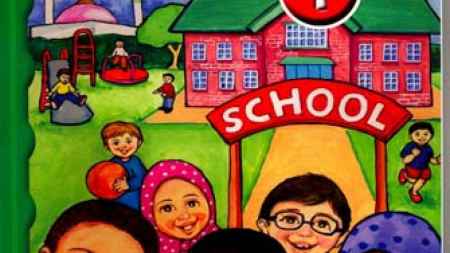
What are Muslim-American children being taught in private Islamic schools?  We can learn about some of it by looking at the I Love Islam series used to teach elementary-level Muslim-American children about Islam.  This series consists of five textbooks, each with a corresponding workbook and teacher/parent guide.  It is published by the Islamic Services Foundation (ISF).  According to the introduction to the series, its purpose is to gradually introduce Muslim students “to the essentials of their faith” by bringing “to light the historic and cultural aspects of Islam.”  And according to the ISF website, the I Love Islam series “is one of the best-selling Islamic curriculums in the US and Canada.”

So what does this series teach?

It’s Palestine, not Israel

When it comes to showing the State of Israel, this series takes two approaches in depicting maps of the Middle East.

In the first approach, the geographical boundaries of the State of Israel are shown, but Israel is not named.  The first example of this is on p. B7 of I Love Islam 1.  Here states such as Saudi Arabia, Syria, Jordan, Iraq, and Egypt are named; but there is no such mention of Israel.  An interesting addition is found when this same map is used again on p. B2 of I Love Islam 2.  On this map, the geographical boundaries of the State of Israel are now labeled “Palestine.”  On p. A24 of I Love Islam 4, there is another map titled “Map of Palestine”; it includes the geographical boundaries of the State of Israel.  This map shows the Gaza Strip, the West Bank, and the Golan Heights, which is labeled “Occupied by Israel”; this is the only mention of Israel on that map.

With the second approach, Israel is mentioned on other maps used in this series.  However, these maps are noticeably different from the maps mentioned above, in that these latter maps have more details and the print can be much smaller.  The nature of these maps is so different from the ones used in the first approach that they appear to have been taken from some type of geography book.  So if one looks closely (a magnifying glass helps), the name “Israel” can be found on the following three maps: I Love Islam 2, p. D13 (a map focusing on Egypt); and I Love Islam 4, pp. F8 and F24 (maps focusing on the African continent).  But the small print and the extensive details on these maps would most likely deter the average elementary school-age student from examining them closely.

So in reality the Muslim-American children are being taught that the State of Israel does not exist.  And, correspondingly, throughout this series the location for the city of Jerusalem is repeatedly stated as being in “Palestine”.[i]

Christians are in the “lowest status”

The Muslim-American children are taught this about Christians:

Many Christians believe that God has three parts:

  1. God the father,
  2. God the son, or Jesus Christ
  3. God the Holy Spirit

In Christianity this is known as the Trinity.  It says that the one God consists of three people.  AstaghfiruAllah![[ii]] This is also a major form of shirk.  As Muslims we know that God is the only Creator of the Universe.  God or Allah does not have a father or a son and cannot be divided into two or three parts.

I Love Islam 5, p. A41

Shirk is the worst sin in Islam.  The Muslim-American children learn that those who commit Shirk fall “from a very high status to the lowest one,” and are “forbidden” to enter Heaven.[iii]  So Christians have fallen to “the lowest status” and are forbidden from entering Heaven.

The Muslim-American children learn that a person who commits Shirk is called a Mushrik.[iv]  And the plural form ofMushrik is Mushrikun, so Christians are Mushrikun.

But why does it matter if Muslim-American children are being taught that Christians are Mushrikun?  Because they are also being taught to learn and practice the teachings of the Koran.[v]  So what does the Koran say about Mushrikun?

Here are some verses dealing with Mushrikun from a popular, authoritative translation of the Koran: Interpretation of The Meanings of the Noble Qur’an:[vi]

9:5 – Muslims are commanded to kill Christians unless the Christians convert to Islam:

Then when the Sacred Months (the 1st, 7th, 11th, and 12th months of the Islamic calendar) have passed, then kill the Mushrikun wherever you find them, and capture them and besiege them, and lie in wait for them in every ambush.  But if they repent [by rejecting Shirk (polytheism) and accept Islamic Monotheism] and perform As-Salat (the prayers), and give Zakat (obligatory charity), then leave their way free.  Verily, Allah is Oft-Forgiving, Most Merciful.

9:28 – Christians are impure and forbidden from entering Mecca:

O you who believe (in Allah’s Oneness and in His Messenger Muhammad)!  Verily, the Mushrikun (polytheists, pagans, idolaters, disbelievers in the Oneness of Allah, and in the Message of Muhammad) are Najasun (impure).  So let them not come near Al-Masjid Al-Haram (at Makkah) after this year…

9:33 – Islam will be superior to Christianity, even though the Christians don’t like it.

It is He Who has sent His Messenger (Muhammad) with guidance and the religion of truth (Islam), to make it superior over all religions even though the Mushrikun (polytheists, pagans, idolaters, disbelievers in the Oneness of Allah) hate (it).

9:113 – Muslims are forbidden from asking Allah to forgive Christians who die as Christians:

It is not (proper) for the Prophet and those who believe to ask Allah’s forgiveness for the Mushrikun ((polytheists, idolaters, pagans, disbelievers in the Oneness of Allah), even though they be of kin, after it has become clear to them that they are the dwellers of the Fire (because they died in a state of disbelief).

15:94 – Muslims are to shun Christians.

Therefore proclaim openly (Allah’s Message – Islamic Monotheism) that which you are commanded, and turn away from Al-Mushrikun (polytheists, idolaters, and disbelievers).

98:6 – Christians are among the worst of creatures (there is a double-tap here).

Verily, those who disbelieve (in the religion of Islam, the Qur’an and Prophet Muhammad) from among the people of the Scripture (Jews and Christians) and Al-Mushrikun, will abide in the fire of Hell.  They are the worst of creatures.

So the I Love Islam series ultimately teaches that Christians commit the worst sin in Islam; they are impure and forbidden from entering Mecca; Muslims are to shun them and not pray for them, but rather are to fight against them; that Christians are among the “worst of creatures”; and Islam is to be superior to Christianity.

The Example of Muhammad

Rasoolullah [Muhammad] was the best Muslim ever, and his job was to show all the Muslims the best way to do things.  If we follow him, we will have a better understanding of how to practice Islam.

I Love Islam 4, p. C19

Throughout this series Muhammad is continuously lauded as the perfect role model to be followed if one wants to become an excellent Muslim.  And it is specifically mentioned that the Sira (Seerah) of Muhammad “is there for us to learn lessons from.”[vii]  The Sira is the authoritative biography of Muhammad, titled The Life of Muhammad (Sirat Rasul Allah).[viii]  Here are some of the examples of Muhammad found in the Sira that “show all the Muslims the best way to do things”:

  1. Muhammad ordered adulterers to be stoned to death – pp. 266-267, 652, and 684.
  2. After a tribe was defeated, Muhammad would distribute some of the captured women and children among the Muslim warriors, and sell others of the captives – pp. 466, 511, and 791, n. 914.
  3. Muhammad possessed and gave away slaves – pp. 499, 511, 576, 593, and 677.
  4. Muhammad supervised the beheading of 600-900 captured Jewish males – p. 464.
  5. Muhammad said that Muslims could beat their wives, “but not with severity” – p. 651.

Children, try your best to be like the Prophet, to think and act like him. This is why it is so important for us to learn the Seerah!

I Love Islam 2, p. B46

Conclusion

Elementary school is where children really start learning about the world around them.  Beliefs and attitudes can be formed that may be difficult or impossible to later change.  This brief overview of the I Love Islam series gives us an insight into what many Muslim-American children are being taught about Israel, Christians, and proper conduct in their lives.  These “essentials” of Islam should not be comforting to non-Muslims.

____________________________


[i]               I Love Islam 1, p. D47; I Love Islam 1, Teacher/Parent Guide, p. 115; I Love Islam 2, p. D28; I Love Islam 3, p. D63; I Love Islam 3, Workbook, Unit D, Chapter 6, Exercise 2; I Love Islam 4, pp. A21 and A24; and I Love Islam 4, Teacher/Parent Guide, p. 24.

[ii]               I seek forgiveness from Allah! – An expression of shame or disapproval.

[iii]              I Love Islam 5, pp. A46 and A48.

[iv]              I Love Islam 5, p. A39.

[v]               I Love Islam 2, p. C7.

[vi]              Interpretation of the Meanings of The Noble Qur’an, trans. Muhammad Muhsin Khan and Muhammad Taqi-ud-Din Al-Hilali (Riyadh, Kingdom of Saudi Arabia: Darussalam, 2007).

[vii]             I Love Islam 2, Teacher/Parent Guide, p. 57.

[viii]             Muhammad Ibn Ishaq, The Life of Muhammad (Sirat Rasul Allah), trans. Alfred Guillaume (Karachi: Oxford University Press, 2007).

Muslim Refugees Married to Children in European Asylum Centers

April 22, 2016

Muslim Refugees Married to Children in European Asylum Centers, Front Page Magazine, Daniel Greenfield, April 22, 2016

(Integration is going well in Europe, as it integrates into Islamic culture. — DM)

2015-09-09_0134_2

This is what happens when the inmates are running the asylum. And the refugee policy.

Some child brides are living with older husbands in asylum centers in Scandinavia, triggering a furor about lapses in protection for girls in nations that ban child marriage.

That ban child marriage currently. How long will that hold up? It’s all about the numbers. As it is there are layers upon layers of special exceptions for Muslims. Case in point…

Authorities have in some cases let girls stay with their partners, believing it is less traumatic for them than forced separation after fleeing wars in nations such as Afghanistan or Syria.

Would child rape victims from Denmark or Norway be allowed to stay with their rapist because it was deemed less traumatic for them? That seems to be a special rule for Muslim refugees. And how did the authorities determine this? Were they able to talk to the girls directly, without an interpreter or their “husband” in the room? Did they even bother to try?

Both these issues have caused unease in Scandinavia, where critics say that the authorities risk complicity in child abuse.

Risk complicity? They are complicit. If you house a girl together with her abuser, you are complicit.

“Minors seeking asylum are in a difficult situation where they have left their homeland, family and friends, and the partner they have traveled with can be the only person they know and trust in Norway,” said Heidi Vibeke Pedersen, a senior UDI official.

o we’re now calling the abusers “partners”, are we?

“To place them with their partner in facilities rigged for adults is not acceptable,” said Camilla Kayed, of the Ombudsman for Children Norway, an official watchdog for children’s rights.

How Islamophobic. Mohammed married a six-year old. Aren’t his co-religionists entitled to the same freedom?

In February, Danish Integration Minister Inger Stojberg said that she would “stop housing child brides in asylum centers” after a review found dozens of cases of girls living with older men.

“There will never be exceptions in cases where one side is below the age of 15,” she said

Below 15. Yes that’s what we’re dealing with here.

In the north Norwegian county of Finnmark, authorities are investigating circumstances surrounding a Syrian girl, now aged 16 who already has one child and is pregnant again, police lawyer Jens Herstad said.

“We still have to hear the husband’s account,” he said.

Yup. Better get the full story. I’m sure he’s got a great story.

Sweden Facing Another Migrant Invasion?

April 21, 2016

Sweden Facing Another Migrant Invasion? Gatestone InstituteIngrid Carlqvist, April 21, 2016

♦ Swedish law only allows the government to operate border controls six months at a time, and there is a two-week waiting period before the controls can be reinstated. The two-week lapse is scheduled for July 4-17; many fear that tens of thousands of migrants will seize the opportunity to enter Sweden during this time.

♦ A new report on migrants in Sweden, based on interviews with 1,100 students in Stockholm (90% of respondents were Muslims) found that immigrant youths live in a different world from their Swedish peers. 83% of the girls are not allowed to have male friends, 62% of the boys are not allowed to have female friends.

♦ After several sexual attacks on women in Östersund, the local police issued a warning that women are not safe outdoors after dark. Since February 20, eight women have been sexually assaulted or raped in the town.

♦ A bus driver was suspended from work after sharing posts on Facebook that were critical of immigration. A wave of public criticism of the bus company then led them to reverse the decision. The company admitted that the driver had never treated anyone badly.

♦ The Swedish Security Service has identified at least 60 asylum seekers as terrorists and a threat to the country. However, the Immigration Service refuses to deport them.

In early March, the Swedish government announced that the country’s tighter border controls at the Öresund Bridge might remain in place for the foreseeable future, and that they may even become permanent. The problem, however, is that this summer, a two-week lapse will occur. According to the current law, the government can only operate border controls six months at a time, and there is a two week waiting period before the controls can be reinstated. The gap will occur July 4-17, right in the middle of the European vacation period. Many people fear that tens of thousands of migrants will seize the opportunity to enter Sweden during this time. When the migration wave peaked in the fall of 2015, Sweden received 9,000 migrants per week. So far this year, the number has been steady at 600-700 per week.

Prime Minister Stefan Löfven recently stated: “The number of people coming to Sweden has decreased dramatically. More are applying for asylum in the EU. That was the whole point.”

According to the government, the “public order and inner safety of Sweden” would still be at risk if the border and ID checks were to cease.

The Minister for Justice and Migration, Morgan Johansson, pointed out that sustaining the border controls sends an important signal to the half a million migrants now staying in Germany who have not sought asylum there. Neither minister mentioned anything, however, about how Sweden should avoid being flooded by these people during the two-week lapse in border controls.

March 2: An opinion poll by the Inizio polling institute, commissioned by the newspaperAftonbladet, showed that 46% of Swedish women feel unsafe when they go out alone at night. Women who venture out despite their fears say they stay in constant contact with a friend or relative on their mobile phones while out at night.

March 4: At an asylum seekers residence in the small rural village of Storå, a 19-year-old man received a fatal knife wound to his throat. The police apprehended three suspects, all residents of the asylum seekers home, one of whom has since been remanded into custody. The murder caused great concern among the residents of the village. “I worry about everything. I don’t go out at night,” one woman told the public radio broadcaster, Sveriges Radio.

March 4: The Minister for Justice and Migration, Morgan Johansson, explained that asylum seekers whose applications are rejected will no longer be entitled to free housing and a daily cash allowance. “We must make sure they go back home,” was the stern message from the minister. Presently, about 4,000 people are affected by the new rules, and if the decision is implemented, 2,000 of them will lose their place at asylum seekers residences. “We need these places for others who are seeking asylum, and that means making sure that those who have been rejected move and go home again,” said Johansson. Before the decision can come into effect, the Council on Legislation must have its say.

March 5: A new report on the lifestyle of migrants, in relation to the predominantly Islamic concept of honor, and based on interviews with 1,100 young people attending schools in the southern suburbs of Stockholm (90% of respondents were Muslims), confirmed the findings of earlier studies — that immigrant youths live in a different world from their Swedish peers. 83% of the girls are not allowed to have male friends, 62% of the boys are not allowed to have female friends, 51% have had secret relationships, 30% cannot date a person of a different ethnicity, and 65% said that their parents had already spoken to them about marriage.

Amineh Kakabaveh, president of the organization that conducted the interviews, told the local paper Södra Sidan that it is all due to patriarchal structures: “But why should we accept this in Sweden where we have equal rights by law? It is troublesome that so little has happened since 2005 when we [last] investigated the subject.”

March 6: The British Daily Mail newspaper accused its Swedish counterpart Aftonbladet of having faked a news story about an attack on Moroccan street children at the Stockholm Central Railway Station on January 29. Despite Aftonbladet’s vague information about a “violent vigilante mob of 200 people” and the inability of police to verify that anything actually happened, the news traveled rapidly across the planet. Daily Mail reporter Sue Reid flew to Sweden to investigate the story, and found it very much blown out of proportion. “This raises the disturbing question as to whether the anti-migrant rampage ever took place in the way described, ” Reid wrote.

The article probably caused the Swedish embassy in London even greater concern — the embassy had already expressed discontent with the Daily Mail’s coverage of Sweden back in February, when the embassy claimed that the paper was “campaigning against Sweden and Swedish immigration policy,” thus conveying a negative image of the state of affairs in Sweden.

March 6: After several sexual attacks on women in Östersund, the local police issued a warning that women are not safe outdoors after dark. Since February 20, eight women have been sexually assaulted or raped in the town, hence this very unusual and drastic warning by the police. The decision was heavily criticized. Östersund mayor AnnSofie Andersson, for example, said that she was convinced the police and the municipality had other means at their disposal, and that the police “should have come to us first, before making a statement like this.” After the warning, more criminal complaints were lodged, and now the police are focusing on nine cases involving multiple perpetrators — who may all belong to the same group.

March 7: It was reported that the young Syrian who murdered 15-year-old Arminas Pileckas at the Göingeskolan school in Broby will not be charged with murder, or penalized in any way — even though the investigation shows that he committed the murder. The age of criminal responsibility in Sweden is 15, and the murderer claims he is 14. Arminas Pileckas, whose family immigrated to Sweden from Lithuania, was apparently very well-liked. His murder stirred up emotion, not least because it turned out that he had protected a girl in his class from the Syrian’s unwanted sexual advances. Aftonbladet interviewed the murderer’s father, who blamed the school for his son’s stabbing Arminas in the back:

“The school did nothing to help him or to restore his honor [because the victim interfered with his sexual advances]. Instead, my son had to see [Arminas] at school every day. It upset him very much.”
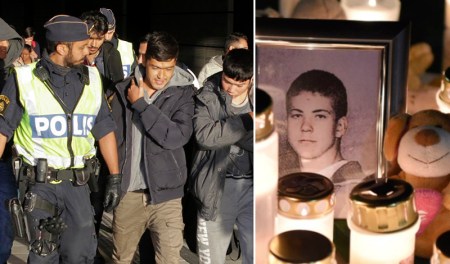
1559 (1)Left: According to Sweden’s current law, the government can only operate border controls six months at a time, and there is a two week waiting period before the controls can be reinstated. Right: Fifteen-year-old Arminas Pileckas was stabbed to death at school, but the young Syrian who murdered him will not be charged or penalized. The age of criminal responsibility in Sweden is 15, and the murderer claims he is 14. The murderer’s father blamed the school, saying they “did nothing to help him or to restore his honor [because the victim interfered with his sexual advances]. Instead, my son had to see [Arminas] at school every day. It upset him very much.”

March 7: A bus driver in Dalarna was suspended from work after sharing posts on Facebook that were critical of immigration. His employer claimed that there was concern that the bus driver would not treat the passengers equally. A wave of public criticism of the bus company then led them to reverse the decision, and the driver was allowed back to work the next day. The company admitted that the driver had never treated anyone badly, and conceded that Sweden, after all, does have constitutional freedom of speech.

March 7: The “unaccompanied refugee child” from Afghanistan, who on December 9, 2015 burned down an asylum seekers residence in Uppsala where he lived, was sentenced to juvenile detention. The fire caused over five million kronor ($615,000) in damage; the building was completely destroyed. The Afghan, who claims to be 16-years-old, had created havoc at the home even before the fire, by throwing objects at the staff, among other things. The night of the fire, he was not given permission to go out late at night to buy candy. Furious, he threatened to destroy the television, which prompted the staff to move it into an office. He then threatened to “destroy everything if I do not get my way.” Early the next morning, he set fire to the building; staff members and other residents fled for their lives.

March 9: Panicked shoppers at the Hallunda mall ran for cover when a masked burglar pointed an automatic weapon at them. A group of robbers drove a car into a jewelry store and were busy plundering it, when an elderly man tried to intervene: “I walked up to one of them, but he knocked me over and threatened me with a weapon,” the man told the news site, Nyheter Idag. Several shots were fired, but no one was injured. So far, there have been no arrests.

March 10: An Iraqi man with Swedish citizenship was sentenced to one year in prison for abusing his wife and child. The man tried to force his wife and daughter to wear a veil; when they refused, he beat them and threatened them with a knife.

March 10: Two asylum-seeker families were so dissatisfied with the housing they were offered, located on the upscale Nygatan street in central Norrköping, that they refused to get off the bus. Because of this, traffic on the street was blocked. The police told the local daily, Norrköpings Tidningar:

“We remain at the scene, because things are a little jumbled there right now. The families are displeased with the standard of the apartment, so they refused to get off the bus at first. We are talking to the families right now, and referring them to the Social Services office on Drottninggatan or the Immigration Service.”

March 10: The street artist Dan Park, who has been convicted of “hate speech” on several occasions, was arrested again. According to the prosecution, the alleged offenses this time were committed on social media in May, June and September 2015, when he “made condescending remarks against persons concerning their ethnicity.”

The Swedish justice system, which frequently lets rapists get away with a “slap on the wrist,” has let loose in its campaign against the artist and his provocative images of Roma, black people and Muslims. In October 2014, he was sentenced to five months in prison — for exhibiting his work at an art gallery.

The only Swedish artist that has stood up for Dan Park’s right to express himself as an artist is Lars Vilks, who is himself still living under constant threat of death after drawing the Muslim prophet Muhammad as a roundabout dog in 2007. There have been several foiled plots to kill Mr. Vilks, and in February 2015, he became the target of a terrorist attack in Copenhagen, in which two people were murdered. Vilks himself was unhurt – largely due to the resolute actions of his bodyguards.

In Denmark, Dan Park has received quite different treatment by the media and the establishment. The public television broadcaster Danmarks Radio recently aired an hour-long documentary on the artist, who himself feels that Sweden is applying the Nazi concept Entartete Kunst, (“Degenerate Art”), where the state imprisons artists who produce “objectionable” art.

March 10: During the last two years, the Swedish Security Service has identified at least 60 asylum seekers as terrorists and a threat to the country. However, the Immigration Service refuses to deport them — because that would put the terrorists in mortal danger: “We do not have the death penalty in Sweden, and we do not send people to their deaths,” Immigration Service Chief Operating Officer Mikael Ribbenvik told public television Sveriges Television.

The people in question are confirmed terrorists, some with connections to Islamist groups such as the Islamic State (ISIS), war criminals, and spies working for foreign intelligence services.

March 12: Several parents whose children attend the Centralskolan school in Kristianstad are keeping their kids home, after the children were physically abused by newly-arrived migrant students. The children were beaten, kicked, choked, and exposed to other kinds of abuse at the school, which has recently accepted a large number of new migrant students. The headmaster and the teachers have urged the Swedish students to just “walk away” when fights or conflicts with the immigrant children start.

March 12: Several Swedes were evicted from their homes in Örebro, when the house they live in was sold and remade into an asylum seekers residence. The tenants were notified via a letter that said they were to vacate their apartments within three months – or the Enforcement Authority would have them evicted. “I have lived here for four years, paid my rent and everything. But now I am being thrown out,” a tenant, Roger Lund, told the local daily Nerikes Allehanda. The landlord says that the tenants have been living in the building on so-called “demolition contracts,” and therefore, their leases can be terminated on short notice.

March 14: The catastrophic slide that Swedish students have undergone in the Pisa tests (Programme for International Student Assessment, testing the skills and knowledge of 15-year-old students) in the last few years is largely due to immigration from third world countries, according to a report by the National Agency for Education (Skolverket). About 85% of the drop in high school eligibility turns out to be due to an increasing number of students having arrived after the term has started, and thus having a poorer performance than the other students.

March 14: A 25-year-old immigrant from North Africa was sentenced to jail and deportation for raping a Swedish woman. The man was massaging the woman, when he suddenly started licking her ears, and then raped her. The rapist’s wife testified in court that her husband is a perfect gentleman.

During the trial, the rapist vehemently denied that he made any sexual advances towards the woman: “Only God knows how my DNA ended up in her ears,” he said.

March 14: A vigilante group calling themselves the Soldiers of Odin has started patrolling Swedish cities, with the declared goal of preventing rapes and other assaults. The police, who constantly complain that they are so understaffed they do not have the resources to be out on the streets helping the citizens, suddenly found the means to stop the group and search its members.

Soldiers of Odin was founded in 2015 in Finland, as a reaction to the country’s tenfold increase in immigration over the last year. Its founder, Mika Ranta, is said to have once belonged to a neo-Nazi organization. In a very short time, Soldiers of Odin has grown exponentially, and now has representatives in some 20 Swedish cities. In an interview with online news site Fria Tider, the group’s spokesman, Mikael Johansson, said that the members wished the police had the resources to do the “work” that they themselves are now doing.

March 17: A 19-year-old Somali was put on trial for a series of brutal muggings of elderly Swedes. Several of the victims were injured during the muggings. A 76-year-old woman was bitten on the hand. She had just been to the bank and had made a 10,000 kronor (about $1,100) withdrawal, without noticing that the thief was following her. When she went into a store and picked up her wallet, he tried to snatch it. When the woman would not let go, he bit her. The man was indicted on five counts of aggravated robbery – all of them against people aged 75-85. One of them lost 15,000 kronor ($1,700).

In the past, the Somali thief was convicted of aggravated robbery, aggravated theft, drug-related offenses, assaulting a police officer and resisting arrest. He is a Swedish citizen and lives on welfare.

March 18: The Australian TV show 60 minutes aired a program filmed when they visited the Stockholm suburb of Rinkeby – and were attacked. News of the attack on the Australian film crew arrived several weeks earlier, but was ridiculed and questioned, as 60 minutes were guided in Rinkeby by the Swedish immigration critic Jan Sjunnesson, of the alternative media site Avpixlat. Now, everyone could see for themselves how the crew was attacked as soon as they got out of their car, and that the police refused to escort them because that might “provoke the residents in the area.”

March 18: The government announced that this fall, age-testing of “unaccompanied refugee children” will be implemented. For many years, Swedish politicians have claimed that it is impossible to perform such age-testing, a policy which has led to obviously grown men passing as children.

March 21: Three immigrants from the Middle East were convicted of setting several fires targeting social workers in Botkyrka. The fires broke out on five different premises, all belonging to Social Services, and at a social worker’s private residence in Värmdö. The reason apparently was that a younger disabled brother of one of the accused had been taken into care by Social Services. The District Court ruled that the fires were part of a “planned and systematic campaign against Social Services in Botkyrka.” Two of the three were sentenced to 18 months in jail; one received probation.

March 22: In Sollefteå, the municipality suddenly discovered something that has been obvious to many Swedes for a long time: that adult asylum seekers claim to be “unaccompanied refugee children.” Three people were evicted from municipal housing for children when it became clear they were actually adults.

Majed Safaee, of the Sollefteå municipality, commented to Sveriges Television that “we’re not just talking about a couple of years here or there. We argue that these are adults who have no place in a home for unaccompanied children. Our reception operation needs to function, and it doesn’t if adults are living with children.”

The decision was immediately criticized by the reporter: “The damage is already done for the three refugee children. They were stripped of their trustees and lost their right to financial aid according to the Social Services Act, as soon as they were considered older than 18. Now they are on their own.”

March 23: The Immigration Service admitted, at least to some degree, that Christians are persecuted by Muslims at asylum seeker residences in Sweden. The Immigration Service said that something will be done about that — maybe. So far, the Immigration Service has refused to separate Christians and Muslims, because “segregated asylum houses would go against Swedish democratic values.”

But when the head of the Syrian-Orthodox church, Mor (S:t) Afrem Karim II, wrote a letter to the Swedish Minister for Migration and the Director General of the Immigration Service, pleading that Sweden offer special housing for Christians and other asylum seekers who are being threatened by Muslims, the answer was:

“We are currently examining the possibilities of offering a limited range of special housing for individuals that feel unsafe where they are staying due to the behavior of others. These facilities would be open to anyone in need of a safer place regardless of nationality or religious beliefs.”

March 23: In the heavily immigrant city of Malmö, several people were shot during the course of one evening, in incidents not thought to be related. In the Lindängen district, the police found two men shot and one severely beaten, in Rosengård, a cab driver reported that someone had fired shots at a person he had been sent to pick up, and later a man with gunshot wounds was found in an apartment in Augustenborg. Fortunately, everyone survived.

March 25: Dan Eliasson, the controversial National Police Chief, unilaterally decided to hire 700 new police officers, even though parliament has not yet decided to allocate funds for new recruits. For the highest police official in the country to take the law into his own hands is rather unorthodox, but Eliasson explained that he simply did not have time to wait for the go-ahead from the government, and that the need for additional staff was urgent:

“I have anticipated the parliament’s decision and asked the regions to hire more people, even if they do not have the money right now. I believe and hope that the parliament and the government realize the seriousness of the situation and give us the money after the fact.”

March 29: “Negro” is now officially a forbidden word in Sweden. In a short time span, several people have been convicted of “hate speech” after saying or writing this word. In March, a man in his thirties is sentenced to probation and will be made to undergo a Swedish Prison and Probation service treatment program. He is found guilty of “expressing himself in a derogatory manner and spreading contempt against this ethnic group” on the internet forum Flashback, where he used “terms such as negro and other derogatory remarks and comments.”

Since all users of the Flashback forum are anonymous, and the servers are located abroad, it is usually risk-free to write just about anything there. But in this case, the police had gotten an anonymous tip — which they processed with the utmost seriousness — about the man. They stormed the man’s apartment, and were lucky enough to find his computer turned on and logged on to Flashback under the username in question. The police seized the computer, memory cards, hard drives, a mobile phone and “propaganda” from the Sweden Democrats Party.

In October last year, three 15-year-old boys were convicted in the Court of Appeal for lower Norrland, after they had “uttered the word ‘negro’ several times” at school. In 2014, a 17-year-old girl was convicted of insulting a 29-year-old African, whom she called a negro. The fact that the insult came after the African called her and her friend “f**king Swedies” was not a mitigating circumstance, according to the court. Blacks are apparently allowed to call whites anything they choose; it is only a punishable offense when whites use supposedly inappropriate words against blacks.

March 29: A particularly brutal rape against a woman in Ludvika in August resulted in five Eritrean men being sentenced to eight months in prison, and one man, five years in prison. The woman was lured into an apartment in which there were eight men; one of them raped her while the others held her down. She escaped by jumping out a second story window. In December, a District Court acquitted two of the men, while five received ten months in prison for aggravated rape, and one, five years in prison. The prosecutor considered the men refugees, and therefore did not even press for deportation. The Court of Appeals concurred with the five-year sentence against the 21-year-old, but lowered the others’ sentences to eight months — for “neglecting to report a crime.”

March 30: Two men who participated in executions in Syria in 2013 were sentenced to life in prison by the Svea Court of Appeals, thereby confirming the conviction from the Gothenburg District Court from last year. One of the judges, Niklas Wågnert, explained to the Swedish public radio station, Sveriges Radio:

“The Court of Appeals also believes that the purpose of the murders was to instill serious fear in those who do not share the opinions of the accused, and that the deeds are such that they can be said to have done real damage to the state of Syria. This court shares the opinion of the District Court, that actions such as these warrant life in prison.”

The sentence is unusual — there has only been one such case in Sweden before, in which both the District and the Appeals courts have convicted someone of terrorist crimes; that was in 2005 and concerned financing attacks in Iraq.

March 30: Three African men were sentenced to four years in prison and deportation after gang-raping a Swedish woman in Ludvika in October 2015. The men followed the woman around town, and caught up with her in an alley where they formed a ring round her. They pulled down her underwear and held her down so they could rape her vaginally and anally. The rape lasted at least 15 minutes, and the woman cried for help the whole time. Finally, a Swedish man appeared at the scene, which caused the rapists scatter and run.

The police found the rapists by DNA-testing a number of suspects. Two of the men are from Eritrea, and have had permanent residency status in Sweden since 2015. The third man is an asylum seeker from Sudan. The court ruling states that “in light of the situation in Eritrea,” deportations to that country cannot be enforced — meaning that the rapists will remain in Sweden for the foreseeable future.

March 30: Another gang-rape took place aboard a ferry to Finland. In all, six young men are suspects in the case. Five of them have an immigrant background; the sixth has a Swedish mother and a Somali father.

The rape occurred when a large group of young people sailed on the M/S Galaxy to celebrate their high school graduation. Two of the accused rapists, now in custody, turned out to also be suspects in an earlier murder investigation. But because the prosecutor chose not to remand them into custody in connection with that investigation, they were free to go on the ferry trip, and apparently commit another serious crime.
 

Veiling Women: Islamists’ Most Powerful Weapon

April 20, 2016

Veiling Women: Islamists’ Most Powerful Weapon, Gatestone InstituteGiulio Meotti, April 20, 2016

♦ The first victim of the Islamist war in Algeria was a girl who refused the veil, Katia Bengana, who defended her choice even as the executioners pointed a gun at her head. In 1994, Algiers literally awoke to walls plastered with posters announcing the execution of unveiled women.

♦ In April 1947, Princess Lalla Aisha gave a speech in Tangiers and people listened astonished to that unveiled girl. In a few weeks, women throughout the country refused the scarf. Today Morocco is one of the freest countries in the Arab world.

♦ In the mid-1980s, sharia law was implemented in many countries, women in the Middle East were placed in a portable prison and in Europe they resumed the veil to reclaim their “identity,” which meant the refusal of assimilation to Western values and the Islamization of many European cities.

♦ First veils were imposed on women, then Islamists began their jihad against the West.

Laurence Rossignol, France’s Minister for the Family, Children and Women’s Rights, sparked a furor about the Islamic veil proliferating in her country, when she compared headscarved women to “American negroes who accepted slavery.” In addition, Elisabeth Badinter, one of France’s most famous feminists, even called for boycotting Europe’s fashion companies, such as Uniqlo and Dolce & Gabbana, which are developing Islamically correct clothes (in 2013, Muslims spent $266 billion dollars on clothing, and the figure could reach $484 billion by 2019).

A new trend is also emerging in Western popular culture, which was almost invisible in the media a decade ago: headscarved women are now also present in television programs such as MasterChef.

The mainstream culture now considers veiling women “normal.” Air France recently called on its female employees to wear veils while in Iran. The government of Italy recently veiled nude sculptures at Rome’s Capitoline Museum during a visit by Iran’s President Hassan Rouhani, out of “respect” for his sensibilities.

In the Arab-Islamic world, however, for a long time covered women were the exception.

It is hard to believe that, until the early 1990s, the majority of women in Algeria were not veiled. On May 13, 1958 at Place du Gouvernement in Algiers, dozens of women tore off their veils. Miniskirts invaded the streets.

Iran’s Revolution reversed this trend: the first scarf appeared at the beginning of the 1980s with the rise of the Islamic movements in Algeria’s universities and poor neighborhoods. The hijab was distributed by the Iranian Embassy in Algiers.

In 1990, Algeria was on the edge of a long season of death and fear: a civil war, with the specter of Islamist breakthrough (100,000 dead). People knew that something terrible was going to happen by counting the number of veils in the streets.

The first victim of the Islamist war in Algeria was a girl who refused the veil, Katia Bengana. She defended her choice even as the executioners pointed a gun at her head. In 1994, Algiers literally awoke to walls plastered with Islamist posters announcing the execution of unveiled women. Today, very few women dare to leave their house without a hijab or chador.

Look at the photographs of Kabul in the 1960s, 1970s and 1980s, and you will see many unveiled women. Then came the Taliban and covered them. The emancipation in Morocco was sparked by Princess Lalla Aisha, the daughter of Sultan Mohamed Ben Youssef, who took the title of king when the country proclaimed independence. In April 1947, Lalla gave a speech in Tangiers and people listened astonished to that unveiled girl. In a few weeks, women throughout the country refused the scarf. Today Morocco is one of the freest countries in the Arab world.

1558Look at the photographs of Kabul in the 1960s, 1970s and 1980s, and you will see many unveiled women. Then came the Taliban and covered them.

n Egypt, back in the 1950s, President Gamal Abdel Nasser took to television to mock the Muslim Brotherhood’s request to veil the women. His wife, Tahia, did not wear a scarf, even in official photographs. Today, according to the scholar Mona Abaza, 80% of Egyptian women are veiled. It was only in the 1990s that the strict Wahhabi version of Islam arrived in Egypt, through millions of Egyptians who went to work in Saudi Arabia and other Gulf countries. Meanwhile, Islamist political movements gained ground. Then Egyptian women began sporting the veil.

In Iran, the traditional black veil covering Iranian women from head to ankles, invaded the country under Ayatollah Khomeini. He asserted that the chador is the “banner of the revolution” and imposed it on all the women.

Fifty years earlier, in 1926, Reza Shah had provided police protection to women who had chosen to refuse the veil. On January 7, 1936, the Shah ordered all the teachers, the wives of ministers and government officials “to appear in European clothes.” The Shah asked his wife and daughters to go unveiled in public. These and other Western reforms were supported by Shah Muhammad Reza Pahlavi, who succeeded his father in September 1941, and instituted the ban on veiled women in public.

In Turkey, Mustafa Kemal Ataturk harangued female crowds, pushing them to set an example: taking off the veil meant hastening the necessary rapprochement between Turkey and Western civilization. For fifty years, Turkey refused the veil — until 1997, when the government headed by the Islamist Necmettin Erbakan abolished the ban on the veil in public places.

Turkey’s Erdogan used the veil to encourage the rampant Islamization of the society.

In contrast, Tunisia’s President, Habib Bourguiba, issued a circular banning the wearing of hijab in schools and public offices. He called the veil “odious rag,” and promoted his country as one of the most enlightened Arab nations.

It was not only the Muslim world that for a long time refused this symbol. Before the spread of radical Islam, the miniskirt, a symbol of Western culture, could also be seen all over the Middle East. There are many photographs to remind us of that long period: the unveiled stewardesses in skirts of the Afghan airline (what an irony that Air France today wants to veil them); the beauty contest that King Hussein of Jordan organized at Hotel Philadelphia; the Iraqi female football team; the Syrian female athlete Silvana Shaheen; the unveiled Libyan women marching in the streets; the female students at the Palestinian Birzeit University and the Egyptian girls on the beach (at that time, a burkini would have been rejected as a cage).

Then, in the mid-1980s, everything suddenly changed: Sharia law was implemented in many countries, women in the Middle East were placed in a portable prison, and in Europe they resumed the veil to reclaim their “identity,” which meant the refusal of assimilation to Western values and the Islamization of many European cities.

First veils were imposed on women, then Islamists began their jihad against the West.

First we betrayed these women by accepting their slavery as a “liberation,” then Air France started veiling women while in Iran as a form of “respect.” It is also revealing of the hypocrisy of most of Western feminists, who are always ready to denounce the “homophobic” Christians and “sexism” in the U.S., but keep silent about the sexual crimes of radical Islam. In the words of the feminist Rebecca Brink Vipond, “I won’t take the bait of a patronizing call for feminists to set aside their goals in America to address problems in Muslim theocracies.” These are the same feminists who abandoned Ayaan Hirsi Ali, the brave Dutch-Somali dissident from Islam, to her own defenses even after she found refuge in the U.S.: they prevented her from speaking at Brandeis University.

For how long we will maintain our ban on female genital mutilation (FGM)? A study just published in the U.S. suggests that allowing some “milder” forms of female mutilation, which affect 200 million women in the world, is more “culturally sensitive” than a ban on the practice, and that a ritual “nick” of girls’ vaginas could prevent a more radical disfiguring practice. The proposal didn’t come from Tariq Ramadan or an Islamic court in Sudan, but from two American gynecologists, Kavita Shah Arora and Allan J. Jacobs, who published the study in one of the most important scientific journals, the Journal of Medical Ethics.

It is a testament to the depths that can be reached in what the French “new philosopher,” Pascal Bruckner, called “the tears of White men” with their masochism, cowardice and cynical relativism. Why not also justify the Islamic stoning of women who are said to commit adultery? It is as if we cannot capitulate quickly enough.