Egypt-Saudi Arabia Relations: Substantial Rifts Despite Shared Basic Interests, MEMRI, Y. Graff*, November 9, 2015
Introduction
Since the ouster of Muhammad Mursi in July 2013, Saudi-Egyptian relations have been close and marked by common interests. Saudi Arabia backed the Egyptian military’s ousting of Mursi and supported its claim that the ouster expressed the will of the people, in the face of international claims that it was a military coup. Alongside political support for the new regime, Saudi Arabia also donated billions of dollars to restore Egypt’s economy. However, despite the friendly relations, Arab press has reported that, since the death of Saudi King ‘Abdallah in January 2014 and the ascension of King Salman, relations between the countries have chilled. Outwardly, the leaders of the two countries strive to demonstrate unity and friendship, yet reports in the Arab media point at a growing tension between Egypt and Saudi Arabia, mainly due to fundamental disagreements on various political issues.
It should be mentioned that, contra to Saudi expectations and despite this country’s generous financial assistance, Al-Sisi’s Egypt does not regard itself bound by Saudi policies. In fact, it has employed an independent policy in the hopes of forging bonds of friendship and alliances on several concurrent fronts – in a manner that has sometimes contravened and even thwarted Saudi foreign policy. This has led to disagreements with Saudi Arabia on several fronts:
The Saudi openness towards the Muslim Brotherhood (MB), to Egypt’s dismay: Saudi fears regarding Iran – which substantially increased after Iran’s Houthi allies took control of the Yemeni capital of Sana’a in September 2014, and later of all of southern Yemen, including Aden, and parts of the north up to the Saudi border, and after Iran signed the JCPOA with the P5+1 Group – have caused a tactical Saudi shift towards the MB after years of animosity towards it and towards its sponsors, Qatar and Turkey. This, in an attempt to form a unified Sunni front to confront the Iranian threat in the region. Saudi Arabia’s openness towards the MB, which Egypt sees as an enemy of the regime and a terrorist organization, is expressed in the Saudi view of the MB as future partners in ruling Yemen and Syria. Further expressions were a visit by Hamas Political Bureau Chief Khaled Mash’al to Saudi Arabia in July 2015, where he met with King Salman, as well as Saudi Arabia’s siding with Qatar in February 2015 when the latter opposed Egypt’s attack in Libya.
This Saudi rapprochement with the MB, Qatar and Turkey displeases the Egyptian regime, which regards them as its bitter enemies and rejects any cooperation with them, even at the cost of thwarting the cause of forming a united Sunni front against Iran.
An Egyptian openness towards Iran, to the chagrin of Saudi Arabia: Saudi Arabia sees Iran as a strategic threat to its security and the security of the entire Sunni world. Conversely, many elements in Egypt do not regard Iran as an existential threat and are reluctant to enter the Sunni-Shi’ite struggle. Al-Sisi’s Egypt is seeking economic investments and alliances to fill its dwindling coffers, and some there see the lifting of sanctions from Iran as an opportunity to renew business relations with it, even if this goes against Saudi Arabia and despite the fact that Egypt and Iran have had historically tense relations and do not maintain full diplomatic relations to this day.
Egypt’s openness towards the Syrian regime: Saudi Arabia demands the ouster of Assad, whether by political or by military means, and even supports the armed opposition to that end. Conversely, Egypt opposes a military solution and advocates dialogue with the Assad regime to achieve a solution that would preserve Syria’s state institutions and its unity. Moreover, Egypt refrains from addressing the issue of Assad’s personal fate.
Saudi disappointment at absence of sufficient support for its military operation in Yemen: Saudi Arabia, which is leading a large-scale military operation in Yemen against the Houthis and supporters of ousted president ‘Ali ‘Abdallah Saleh, is disappointed at Egypt’s refusal to participate more fully in this operation. Moreover, there are reports on disagreements between the two countries regarding the attitude towards the Yemeni MB, as well as reports that Egypt is in contact with Saudi Arabia’s rivals in Yemen in the hopes of finding a political solution to the crisis there.
This report will review the points of contention between Saudi Arabia and Egypt on various topics, as was reported in Arab media.
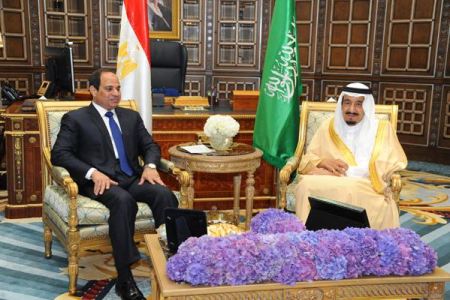 Egyptian President Al-Sisi with Saudi King Salman (image: elpah.com)
Egypt Furious Over Saudi Arabia Growing Close To Qatar, Turkey, MB
Since his ascension to the Saudi throne, King Salman continued efforts by his predecessor, King ‘Abdallah, to connect the traditional Sunni axis, led by Saudi Arabia and Egypt – which includes countries such as Jordan, the UAE, and Bahrain – with the MB axis – which includes Turkey, Qatar, and the various MB organizations and parties in the region such as Hamas, Al-Islah in Yemen, and the Syrian MB. The Saudis support the idea that both these axes should come together to confront Iran and its regional allies. In the opinion of Saudi Arabia and other Gulf states, Iran has become an increasing threat in the past decade after gaining crucial influence in three Arab capitals: Beirut, Baghdad, and Damascus. In the past year, Iran has also added the Yemeni capital of Sana’a to the list,[1] after the Shi’ite Houthi movement took control of it, as well as of South Yemen and Aden together with forces supporting ousted president ‘Ali ‘Abdallah Saleh. This takeover created a strategic threat to Saudi Arabia after the Houthis took control of the Strait of Bab Al-Mandeb, prompting the kingdom to launch Operation Decisive Storm in order to restore the rule of its ally President Hadi.
Up until the Houthi takeover of Sana’a, Saudi Arabia, much like Egypt, saw the MB axis as an equal threat to the one posed by Iran. It defined the MB as a terrorist organization, and conducted a public conflict with Qatar over this issue, which triggered a recall of its ambassador in March 2014.[2] However, the deterioration of the situation in Yemen, as well as the constant motion towards a nuclear agreement between Iran and the U.S. (which was eventually achieved in July 2015), caused Saudi Arabia to shift towards Iran as the central threat to its national security and the safety of Arabs in general. As part of this view, Saudi Arabia decided to grow close to its MB axis rivals and undertake the compromises necessary to achieve this.
Accordingly, Saudi Arabia began normalizing its relations with Qatar, even backing it in February 2015 during a harsh disagreement with Egypt.[3] Saudi Arabia’s openness towards Qatar and towards its ally, the MB, was also expressed by releasing many Egyptian MB prisoners, including high ranking activists who were imprisoned in Saudi Arabia during the reign of King ‘Abdallah, as well as by ending Saudi pressure on Britain to define the MB as a terrorist organization.[4]
Arab press also began reporting on contacts between MB officials and Saudi leadership. For example, Saudi officials met with Europe-based billionaire Youssef Nada, who is a noted MB donor;[5] Jordanian MB General Guide Himam Sa’id visited Saudi Arabia in June 2015 and met with the Saudi minister of religious endowments, and a delegation of Hamas officials led by Political Bureau Chief Khaled Mash’al held a meeting with King Salman in Mecca in July 2015, which led to a release of Hamas activists imprisoned in the kingdom.
In order to bring Egypt closer to the MB axis as well, Saudi Arabia attempted to reconcile between it and Qatar, and Egyptian and Gulf sources even claimed that it explored the possibility of promoting inter-Egyptian reconciliation between the regime and the MB.[6] In recent months, the Saudi press featured articles criticizing Egypt’s rigid policy towards the MB. Senior Saudi political analyst Khaled Al-Dakhil, writing in the London-based Saudi daily Al-Hayat on June 21, 2015, called it “a phobia” and “McCarthyism,” hinting that the Egyptian regime, which warns of a totalitarian MB rule, does not behave much differently itself. According to him, “this McCarthyist [attitude] towards the MB cannot be sustained for long… We need an alternative [to persecuting the MB], which has thus far not materialized.”[7] Saudi columnist Daoud Al-Shiryan made explicit calls for reconciliation with the MB in his June 17 column in the same daily: “The [Egyptian] enthusiasm for [meting out] the death penalty [to MB leaders], and the view that regards this as a tool for deterring and restraining them, and for imposing the country’s authority [over them], is an erroneous policy, since Egypt’s interest today demands to close the book on this topic and open a new horizon for political reconciliation [with the MB] while looking to the future.”[8]
Reports that Saudi Arabia was growing closer to the MB were of great concern to Egypt, but it seems that Mash’al’s visit to the kingdom and his meeting with King Salman were the straw that broke the camel’s back. Following the visit, several Egyptian columnists published articles featuring harsher tones than had been acceptable in Egypt up to that point. For example, ‘Abd Al-Rahim ‘Ali, editor of the Egyptian news portal Albawabhnews.com, who is close to Egyptian security forces, claimed in an article on Saudi-Egyptian tensions that Saudi Arabia was trying to “thaw the ice” with Hamas and grow close to this organization so it would join the anti-Iranian Sunni axis that Saudi Arabia heads and mediate between the kingdom and the Yemeni Al-Islah party. According to him, Egypt responded to these attempts by conveying that it refuses to be party to any plan in which the MB is involved. He claimed further that Egypt had conveyed a message to Saudi Arabia that “its alliance with this organization poses a threat to the Arab’s national security and especially to Egypt’s national security.” [9]
Even more critical of the Saudi openness towards the MB was editor-in-chief of the official daily Al-Ahram, ‘Abd Al-Hadi ‘Allam, who did not mention Saudi Arabia by name but alluded to it in a highly resentful tone. He wrote: “Forming an alliance with political Islam organizations [such as the MB] will never benefit the region and the Arab forces [such as Saudi Arabia] that aspire to forge a new alliance against Tehran… as though those organizations were not party to the regional chaos and bloodshed.” He added: “The thought that we can combat the pox of terrorism and extremist organization [referring to Shi’ite militias such as the Houthis and Hizbullah] by supporting equally radical organizations [such as Hamas and the various arms of the MB] constitutes ignorance, near-sightedness, and politically folly.”[10]
Different Attitudes Towards Iran As Strategic Threat To The Region
Egypt’s objections to Saudi Arabia growing close to the MB also touch on their differing views on Iran as a strategic threat. Egypt disagrees with the Saudi position that Iran constitutes such a threat to Arab national security as to justify allying with the MB. Egypt sees the MB as a no lesser threat to Arab national security, and some elements there even argue that Iran does not constitute a significant threat at all.
Egyptian Foreign Minister Sameh Shoukry said after the signing of the JCPOA that Egypt’s relations with Iran “are unrelated to the attitude of the Gulf states towards it.” He added: “Nobody is tying our hands. We are forging ties with [Iran] based on many considerations, including the regional one, not based on formal matters like the name of a street.”[11] Also, in late September, Shoukry met with his Iranian counterpart, Javad Zarif, on the periphery of the UN General Assembly, and conveyed to him that Egypt expects Iran to support regional stability and Arab national security. The two also discussed a political solution in Syria and the implications of the JCPOA.[12] Then Egyptian Oil Minister Sherif Ismail, who is now prime minister, even expressed hope that Egypt could begin importing oil from Iran, thus easing its severe energy crisis.[13]
Several Egyptian columnists strengthened this position and called Egypt to see the JCPOA as a chance to economically develop Egypt and foster ties with Iran after many years of disconnect. Al-Ahram columnist Ibrahim Sengab argued that “naming a street in Tehran for the murderer of President Sadat [Khalid Al-Islambouli] cannot be grounds for severing ties between the countries.[14] Al-Ahram columnist Muhammad Idris wrote that in light of the rise of Iranian might in the region, Egypt is faced with two options. One is to create “strategic integration with Saudi Arabia” and lead a joint Arab force that would constitute a counterbalance to Iran, and the other is to normalize relations with Iran. According to him, the schism between Saudi Arabia and Egypt, and Saudi attempts to compete with Egypt rather than cooperate with it, indicate that normalizing relations with Iran is the better option.[15] However, it should be mentioned that many Egyptian articles sided with the Saudi position that sees the JCPOA as dangerous.
Another Iran-related disagreement between Egypt and Saudi Arabia revolves around the Egyptian regime’s estimate that Saudi Arabia is turning its conflict with Iran into a Sunni-Shi’ite sectarian conflict, which Egypt has no interest in. Egyptian journalist Mai ‘Azzam harshly attacked Saudi Arabia’s conduct vis-à-vis Iran on this account, claiming that “Saudi Arabia is spearheading the transforming of the regional conflict into a sectarian one. It is the one that dragged the region into civil wars… [in which] members of the same nationality fight under sectarian banners, and it seems that this is a war between Shi’ites and Sunnis rather than a war of interests between Saudi Arabia and Iran.” She explained that “the clash between the interests of Saudi Arabia and Egypt is crystal clear.”[16] The editor of Al-Ahram, ‘Abd Al-Hadi ‘Allam, also addressed this point and stated in his aforementioned article that Egypt “would never lead a sectarian war against Iran.”[17]
Saudi-Egyptian Disagreements Regarding Resolution Of Syrian Crisis
Saudi and Egyptian officials have been stressing that there is no disagreement between the countries with regards to the Syrian crisis. Saudi Ambassador to Egypt Ahmad Qattan argued in an August 4 press conference that the two countries no longer disagree on the means to resolve the crisis, and that the two had always agreed on the goal: a political solution that preserves state institutions, while distancing Assad himself from a position of influence.[18] Egypt’s foreign minister also stressed, in a joint press conference with his Saudi counterpart, that the two countries had never disagreed and do not disagree today on the solution to the Syria crisis.[19]However, these statements do not seem to reflect reality, which points to major differences of opinion between the countries regarding the fate of Bashar Al-Assad and the ways to deal with the crisis. Egypt’s position on these matters appears closer to that of Russia, the strategic ally of the Assad regime along with Iran, than to that of Saudi Arabia.
The Saudi-Egypt disagreements on the Syrian issue can be divided into several topics:
Ways To Deal With The Syrian Crisis And The Fate Of President Assad
While Saudi Arabia sees Assad as the root cause of the problem, and sees his ouster as a condition to solving the crisis, Egypt believes that removing Assad would only exacerbate the crisis and lead to chaos, as happened with the ouster of Saddam Hussein in Iraq and of Mu’ammar Al-Qadhafi in Libya. While Egypt does not openly state that it supports Assad remaining in power, it does routinely warn of the implications of his ouster. In its view, removing Assad is not a condition to solving the crisis, and Assad’s fate is in the hands of Syrians – a position similar to that of Russia, Iran, and the Syrian regime itself. This was expressed in statements made by Egyptian President Al-Sisi, who called for a political solution in Syria, “not in order to support one side over the other, but rather to preserve the Syrian state and its institutions, and to solve [the crisis] without collapsing them.”[20]Egyptian Foreign Minister Shoukry also said that Assad’s fate should only be determined by the Syrian people, “who have a right to decide [their leadership] by [establishing] a transitional government and later in free elections held under international oversight and as part of the implementation of the Geneva 1 agreement.”[21]
Egypt does not view the “military option” as an alternative if a political solution cannot be reached, as Saudi Arabia has threatened.[22] Moreover, official elements in Egypt stress that a military solution in Syria is impossible, and that military action to topple the regime will only exacerbate the civil war in the country.
In Egypt’s opinion, only a political solution that ensures that the Syrian army and state institutions not be harmed can guarantee the stability of Syria and of the region. This Egyptian position was expressed in a document constituting a kind of roadmap to solving the Syrian crisis, which was presented by the Egyptian foreign ministry to several Syrian opposition parties and was published on the liberal Saudi website elaph.com on December 25, 2014.[23] The Egyptian document does not touch on the fate of Bashar Al-Assad, but stresses that the Syrian army cannot be dismantled since it is “the national institution defending the state and ensuring its independence and sovereignty, and [since it] will preserve national security and not interfere in politics.”[24]
The Root Causes Of The Crisis And The Priorities In Dealing With It
The two countries both see the spread of ISIS in Syria as a threat to the existence of the state and to regional stability, but differ on how to deal with it and the priorities in doing so. Saudi Arabia believes that the root of the problem is the Assad regime itself, since it is the cause of the uprising and the emergence of ISIS and other extremist Islamic groups, and therefore ousting it will end the uprising and weaken these groups.
Egypt, on the other hand, shares Russia’s, Iran’s, and the Syrian regime’s view that the essence of the crisis is the extremist Islamic terrorist organizations such as ISIS and Jabhat Al-Nusra, and therefore the top priority is eliminating them. Moreover, Egypt sees the Syrian army as the spearhead of the fight against ISIS. It supports the Russian initiative that calls to establish a regional alliance against ISIS together with the Assad regime. Egypt even expressed support for Russian airstrikes in Syria, in contrast to Saudi Arabia, which opposes them. Egyptian Foreign Minister Sameh Shoukry even supported the Russian involvement in Syria in an interview with the Saudi Al-Arabiya TV, saying that “the info given us in our direct contacts with the Russian side indicates that Russia is interested in combating terrorism and working to reduce the spread of terrorism in Syria.” He added that the Russian involvement would help eliminate terrorism in the country.[25]
Attitude Towards Syrian Opposition
Egypt and Saudi Arabia’s disagreement regarding the status of Assad is also reflected in their support for different opposition elements. Saudi Arabia supports armed opposition groups such as the Free Syrian Army and moderate Islamic militias with equipment, weapons, and money. The Saudis, in a joint move with Turkey and Qatar, which also support militias combatting Assad, recently established Jaish Al-Fath – an umbrella organization for several armed factions, including Islamist ones, which has made impressive achievements against the regime. Additionally, Saudi Arabia supports the National Coalition for Syrian Revolutionary and Opposition Forces, an unarmed political opposition to the regime, in which the Muslim Brotherhood (MB) has considerable weight, and which also calls for the ouster of Bashar Al-Assad.
Egypt, on its part, while not boycotting the National Coalition, supports opposition elements willing to conduct dialogue with the Syrian regime, such as the National Coordination Committee for the Forces of Democratic Change (NCC), which is based in Syria and receives Russia’s support. Additionally, Egypt does not recognize MB elements that are members of the National Coalition. Thus, in June 2015, Egypt organized a summit for Syrian oppositionists in Cairo, but did not invite any MB representatives. In response, the National Coalition boycotted the summit.
Furthermore, unlike the Saudis, Egypt rejects a military solution in Syria, and opposes armed opposition. In this context, it is worth mentioning an article penned by Ahmed Sayyid Al-Naggar, head of the board of directors ofAl-Ahram, who harshly criticized the Free Syrian Army and Saudi Arabia’s support for armed opposition in Syria. He wrote: “Egypt should not permit the rending of Syria and the destruction of the unity of the Syrian state, as is being attempted today by the terrorist gangs of Jabhat Al-Nusra, ISIS, and the ‘Free Collaborator Army’ [pejorative term for the FSA] with the support of several regional countries…”[26]
Saudi Arabia’s dissatisfaction with Egypt’s policy on solving the Syrian crisis is embodied by criticism levelled by the former editor of the London-based Saudi daily Al-Sharq Al-Awsat, Tariq Alhomayed, at Egyptian Foreign Minister Shoukry due to his statements in support of Russian involvement in Syria. According to Alhomayed, these statements by Shoukry indicate that he is “taking the criminal Assad lightly, and even showing sympathy for him, and [his statements] do not acknowledge that [Assad’s] crimes are the reason that Syria is in its current state, or that Assad is the official sponsor of terrorism and the reason for the appearance of ISIS there [in Syria]… It is a duty to say, even with a substantial delay, that there is a severe lack of understanding of the Syrian crisis in Egypt… What some people in Egypt do not understand is that the Assad army is sectarian and [moreover] has [now] been replaced by Shi’ite and Iranian militias and by Russian forces, and is no longer the same as the Egyptian army.”[27]
Reports On Warming In Egyptian-Syria Relations
In fact, since Al-Sisi’s rise to power in Egypt, and to Saudi Arabia’s dismay, there has been a noticeable warming of relations between Egypt and the Assad regime, embodied by Egypt’s uncompromising support for the survival of this regime and its army. This Egyptian position can be explained by the fact that the Syrian and Egyptian regimes both represent the Middle East’s old guard (authoritarian regimes leaning mainly on the army); by the strong ties between their militaries; by their similar view of the MB, ISIS and Al-Qaeda as threats to their security; and by their shared hostility for Turkey and Qatar, who sponsor the MB. It seems that similar interests and the similarity in the structure of both regimes lead Egypt to fear that the ouster of the Assad regime and its army, as well as the division of Syria, would open the door to a similar scenario in Egypt. Additionally, Egypt’s tightening relations with Russia – a strategic ally of the Syrian regime along with Iran – have contributed to its positive relations with the Assad regime. Furthermore, unlike its Gulf allies, Egypt did not participate in the international coalition attacks on ISIS in Syria, which the Assad regime called “illegitimate.”[28]
Over the past year, the Assad regime has recognized these disagreements between Saudi Arabia and Egypt and has attempted to exploit them to grow close to Egypt, including with positive statements on Egypt made by Syrian officials, and the dispatching of envoys to the country. For example, in a speech to Ba’th Party members in November 2014, President Assad showered Egypt with praise, saying: “We can describe the Egyptian role as positive. Our relations with the Egyptian security mechanisms, even during the days of [previous president Muhammad] Mursi, were good, and now they have developed; first, thanks to the rise of President ‘Abd Al-Fattah Al-Sisi, and second, due to the blows dealt to the MB in Egypt. This led to a major warming [between the countries].”[29] In an interview with Hizbullah’s Al-Manar TV in August 2015, Assad stressed the importance of relations with Egypt: “Even when Mursi, of the MB, was Egyptian president and despite his offenses towards Syria, we never tried to harm Egypt; first, due to the importance of our relations, and second, because contacts between Syria and Egypt were not severed even during the reign of Mursi.” Assad hinted at the pressure Saudi Arabia is applying to Egypt to avoid forging stronger ties with Syria, saying: “We want Egypt to play the role of an important… and influential country, [one] that assists the other Arab countries on the basis of its ancient history, not on the basis of a handful of petrodollars and recent history.” According to Assad, “rival countries are pressing Egypt in attempt to keep it from playing the part we wish it to play.” He also said that Syria-Egypt relations help attain balance in the Arab arena and that “Syria believes that it is in the same trench as the Egyptian army and people in dealing with terrorists…”[30]
Syrian Foreign Minister Walid Al-Mu’allem told the Egyptian daily Al-Ahram that “Egypt does not play a part [in Syria] for obvious reasons,” alluding to its alliance with Saudi Arabia, and added: “The Mursi regime, which decided to downgrade diplomatic relations [with Syria], is gone, and we hope that they will now return [to the previous level].”[31] In an interview with the Egyptian daily Al-Akhbar, Al-Mu’allem said that there is security coordination between Syria and Egypt and that it was an advanced step towards normalizing relations between the countries.[32] The Lebanese daily Al-Safir, which is close to the Syrian regime, even reported in February 2015 that Al-Sisi had renewed security coordination with Syria “to a small degree.”[33] Additionally, the website Alahednews.com, which is owned by Hizbullah, reported that Egypt was arming the Assad military.[34]
 Al-Mu’allem (center) posing with members of the Egyptian media (Image: Al-Ahram, Egypt, August 20, 2015)
Alongside these messages, the Syrian regime dispatched several envoys to Egypt. In December 2014, a delegation headed by ‘Imad Al-Assad, the cousin of President Bashar Al-Assad, visited Egypt.[35] One month later, in January 2015, an unnamed Syrian regime envoy met with Egyptian officials in Cairo. According to reports on a Syrian opposition website, the visit was meant to bolster Egyptian efforts to unite the Syrian opposition and promote indirect talks between the regime and opposition as a preamble to direct talks with Egyptian or international presence.[36]
Though Egyptian officials make sure to avoid explicit expressions of support for the Assad regime, the administration’s mouthpieces do express such support, unreservedly. Official Egyptian press featured numerous articles calling for Assad to remain in power and backing him in his struggle against terrorism. They also featured articles praising the tight relations between the two countries and peoples, articles which presented the events in Syria from the Egyptian regime’s standpoint, and discussed the common enemies of the two countries and the need for the Egyptian army to assist its Syrian counterpart.[37]
Thus, chief editor of Al-Ahram, ‘Abd Al-Hadi ‘Allam, wrote in April 2015 that “distancing Bashar Al-Assad from any solution to the crisis is a akin to imposing guardianship upon the Syrian people and its choices, and [constitutes] interference in its affairs, and marginalization of parts of the Syrian people who see him as a component in a solution.” ‘Allam also claimed that, had the MB regime remained in power in Egypt and had the Assad regime been ousted, tens of thousands of ISIS fighters would have entered Egypt, and therefore “the mighty stand of the Syrian regime and army in the face of terrorism constitutes defense of Egypt and its national security…”[38]
Similarly, Morsi ‘Atallah, former head of Al-Ahram‘s board of directors, wrote in June 2015 that, contrary to statements by Saudi Foreign Minster Al-Jubeir that Egypt and Saudi Arabia agreed that Assad must be removed and that Egypt would press Russia to abandon him, “this trend does not match the principles of Egyptian policy… which is far from sticking its nose into the internal affairs of its Arab sisters… regardless of circumstances and excuses.”[39] In a February 2015 article, Al-Ahram columnist Makram Muhammad Ahmad stated that Bashar Al-Assad would “necessarily be part of a peaceful solution to the Syrian crisis” because he still controls a large portion of the country, because the army will remain loyal to him, as well many minorities; and especially in light of estimates that the only alternative to his rule is ISIS.[40] In another article on September 8, 2015, written on the backdrop of the wave of Syrian refugees fleeing to Europe, Ahmad wrote that Syria “is being worn away by ISIS and Al-Qaeda due to the insistence on getting rid of Assad as a precondition to a nonviolent solution,” adding that “the crimes Assad has committed against his people are of limited [scope] compared to the crimes of Arabs who stand silent and helpless in the face of the great disaster of the Syrian people.”[41]
The Yemen Crisis: Saudi Arabia Disappointed At Insufficient Egyptian Aid; Egypt Fears MB Inclusion In Future Arrangement
It initially appeared that there was solidarity and cooperation between Egypt and Saudi Arabia on the Yemeni situation, since Egypt dispatched aerial and naval forces to join the Saudi-led coalition that launched Operation Decisive Storm in March against the Houthis and the supporters of ousted president ‘Ali ‘Abdallah Saleh. However, as time wore on, the rift between the countries became apparent, embodied by Egypt’s reluctance to dispatch ground troops to Yemen, while other coalition members such as the UAE, Sudan, and Mauritania have already done so.[42]
Egypt sees the Strait of Bab Al-Mandeb, which is the gateway to the Red Sea, as a strategic area, and Egyptian officials have repeatedly stressed that their country would prevent the Houthis from taking control of it. Moreover, in April 2015, President Al-Sisi said that Bab Al-Mandeb and the security of the Gulf States were matters of Egyptian national security, and that the Egyptian army would be mobilized to deal with them if necessary.[43]Nevertheless, it appears that Egypt is avoiding taking a more active role in this operation, possibly due to several reasons: The Egyptian army’s preoccupation with combating ISIS terrorism in Sinai; bitter memories of Egypt’s failed war in Yemen 50 years ago, which claimed the lives of thousands of Egyptian soldiers; and Egypt’s aversion to Saudi Arabia’s pact with the Yemeni MB against the Houthis and Saleh.
Since the onset of the Arab Spring in 2011, Saudi Arabia has opposed the MB-affiliated Al-Islah Party in Yemen, but since the ascension to the throne of King Salman, the Saudis seem to have been seeking to improve their relations with it.[44] The Al-Islah Party welcomes the anti-Houthi Saudi operation in Yemen, and Saudi reports even indicate that it has taken an active part in it. The independent Egyptian daily Al-Shorouq reported that Saudi Arabia has even insisted that Al-Islah be given a substantial role in the Yemeni regime. Egypt, on the other hand, is apparently still avoiding cooperating with the MB in Yemen or bolstering its political power. Al-Shorouqcited Egyptian sources as saying that, despite understanding Saudi fears of an Iranian takeover, they do not want to replace one religious force in Yemen (meaning the Houthis) with another (meaning the MB).[45] According to the Lebanese daily Al-Akhbar, Egypt in fact told Saudi Arabia that its participation in Operation Decisive Storm was conditional upon the Al-Islah Party not becoming part of the future regime in the country, and the Saudis were forced to make assurances along these lines, while simultaneously trying to preserve their alliance with the party.[46]
Two additional events in Egypt demonstrate this country’s opposition to Saudi policy in Yemen: In April 2015, a protest against Operation Decisive Storm was held outside the Saudi embassy in Cairo, which featured offensive slogans aimed at the Saudi king. A report in the Egyptian daily Al-Yawm Al-Sabi’ claimed that this was “a plot of the Egyptian MB to drive a wedge between Saudi Arabia and Egypt.”[47] However, the fact that such a protest even took place in Egypt, which strictly regulates protest activity,[48] raised many questions. Thus, following the protest, the independent e-daily Rai Al-Yawm wondered whether it had received the implicit blessing of the Egyptian regime, which does not air out its differences with Arab countries, choosing instead to express them in indirect ways and via messages in the media. The daily asked: “Is it possible that Egyptian authorities used this means to express their differences with Saudi Arabia [on Yemen]?”[49]
 Egyptians protesting Saudi Operation in Yemen. Right: “Stop barbaric aggression against Yemen.” Left: “Salman, you coward, you agent of the Americans” (Images: Watan.com, Arabic.cnn.com, April 6, 2015)
The second event took place in July 2015. The London-based Saudi daily Al-Hayat reported that the El-Sawy Culture Wheel[50] in Cairo, which is considered one of Egypt’s largest and most important cultural centers, was holding an exhibition depicting “Saudi aggression in Yemen,” adopting the Houthi narrative of events.[51] Saudi journalist Jasser Al-Jasser attacked the El-Sawy Culture Wheel in a July 16 article, calling it the abode of “political mercenaries” – a reference to Egypt’s political elites. According to him, the exhibition falsified reality and facts and constituted “a hostile act against all Saudis” and an offense to Saudi martyrs.[52] It should be mentioned that, according to a report in Al-Hayat, the Culture Wheel denied holding such an exhibition, likely after it caused diplomatic embarrassment to Egypt, which quickly issued a statement via the foreign ministry spokesman denying that there were any disagreements between it and Saudi Arabia on Yemen.
 The exhibition at the El-Sawy Culture Wheel (Image: Al-Misryyoun, Egypt, July 9, 2015)
However, Arab media featured reports on meetings held in Cairo between Egyptian officials and Abu Bakr Al-Qirbi, an emissary for ousted president Saleh, to formulate a solution to the Yemeni crisis that would not include the Al-Islah party. Sources said that Saudi Arabia had told Egypt it was displeased by this move.[53] Conversely, the Lebanese daily Al-Akhbar reported on July 24 that the Egyptian officials’ meetings with Saleh’s and Houthi representatives had been held with Saudi Arabia’s knowledge.[54]
Saudi Arabia Thwarts Egyptian Initiative To Establish “Joint Arab Force”
Another clear expression of the many disagreements between Egypt and Saudi Arabia can be seen in the fact that in recent months, Saudi Arabia has repeatedly delayed an initiative presented by President Al-Sisi to establish a joint Arab force empowered by the Arab League to carry out missions to defend Arab countries. Al-Sisi intends for this new force to be sent by the Arab League to Libya, to remove the increasing threat to Egypt from terrorist elements operating there, including ISIS.
Al-Sisi presented this initiative to Arab leaders at the Arab League summit in March 2015, shortly after ISIS in Libya executed 21 Egyptian Copts living in the country. The initiative received the support of Arab leaders at the summit, and it was decided to hold deliberations and formulate a protocol to establish it. However, the Arab defense and foreign ministers summit that is set to convene to approve the formulated protocol has already been postponed twice – once on July 26,[55] and again on August 26.[56]
The London-based Qatari daily Al-Quds Al-Arabi claimed on September 2, 2015 that Saudi Arabia was behind the postponements. The report stated that Saudi Arabia had thwarted the Egyptian initiative due to the severe disagreements between the two countries on various topics, chiefly Syria and Yemen, and added that “the fact that a [new] date has not been set for the summit indicates that the disagreements run deep.” According to sources cited in the report, one of the main reasons for Saudi Arabia blocking the Egyptian move is the strong ties between the Al-Sisi and Al-Assad regimes, and Egypt’s efforts to achieve a political solution to the Syrian crisis that ensures Assad remains in power, which is contrary to the Saudi position. The report also states that initially, Saudi Arabia supported the establishment of the Joint Arab Force in an attempt to entice Egypt do join its coalition for Operation Decisive Storm in Yemen, but after Egypt did not commit to the coalition sufficiently, Saudi Arabia decided to reign in the Egyptian initiative. The report also cited analysts and associates of the Saudi regime who estimated that Al-Sisi’s aim in establishing the Joint Arab Force was not to combat terrorist organizations in Libya, but rather to suppress pro-MB Libyan rebels and establish a government under his sponsorship, allowing him to take control of the oil in eastern Libya. They said that Saudi Arabia was disinclined to take sides in the Libyan crisis and preferred to reach an UN-brokered solution geared at establishing a national consent government that includes the MB.[57]
Saudi Arabia Fails To Block Egyptian Media Assault; Tense Relations Persist
On July 30, 2015, Saudi Crown Prince Muhammad bin Salman arrived in Cairo for an official visit, meeting with President Al-Sisi and attending a graduation ceremony at the military college, during which Al-Sisi stressed that the prince’s visit to Egypt sent the message that Saudi Arabia and Egypt were “together.” The visit ended with the “Cairo Declaration,” which states that both countries will work to strengthen their military and economic ties and will cooperate on the strategic level.[58] The visit alleviated the concerns of many in the Egyptian media for a time, and the Cairo Declaration assured that the future of cooperation between the countries was secure. And indeed, immediately after the visit, Egypt approved an extension of its forces’ activity in Yemen until the end of the operation, even committing to dispatch ground forces to protect the ports of ‘Aden after they were liberated by forces loyal to Yemeni President Hadi. Furthermore, during and after the visit, the Egyptian press featured several articles praising the close relations between the countries. An article by journalist Mohammed Mujahid Al-Zayyat, published in Al-Ahram on August 3, even directly rejected the anti-Saudi allegations published in the Egyptian press mere weeks earlier. He claimed that Saudi Arabia did not really belong to the Turkey-Qatar-MB axis and that the visit to Saudi Arabia by Hamas Political Bureau Chief Khaled Mash’al had not been meant to show Saudi support for Hamas, which is in conflict with Egypt, or to circumvent Egypt as mediator in the intra-Palestinian reconciliation.[59]
 Saudi Crown Prince Muhammad Bin Salman and Egyptian President Al-Sisi during the former’s visit to Cairo (Image: Al-Quds Al-Arabi, London, July 30, 2015)
However, Al-Misryyoun editor Gamal Sultan, who is known for criticizing the regime, stressed that anti-Saudi articles had appeared in official dailies, indicating that the tensions were real.[60] Moreover, even though there are occasional high-level meetings between Egypt and Saudi Arabia where the strong cooperation between the countries is emphasized and reports on their disagreements are denied, Arab press continues to feature numerous reports on the ongoing tensions between them. Thus, for example, Al-Quds Al-Arabi reported that King Salman had been scheduled to visit Egypt in early September after visiting the U.S., but eventually did not come. The daily claimed that the king’s change of plans reflected ongoing Saudi-Egyptian tensions.[61] On the other hand, Egyptian Foreign Minister Sameh Shoukry said in an interview on September 10 that the countries were preparing for a visit to Egypt by King Salman, even though a date had not been set yet, and reiterated that there were no disagreements between the countries, but rather that each country “has its own role and its own attitude…”[62]
On October 13, Al-Quds Al-Arabi reported that, following a proposal by Saudi ambassador to Egypt Ahmad Qattan, Saudi Arabia had paid to fly 50 Egyptian media figures to participate in the annual pilgrimage to Mecca and Medina. The daily stated that each year, Saudi Arabia funds the pilgrimage of media figures from countries friendly to Saudi Arabia, and that this year the largest group had been from Egypt. According to the report, Saudi Arabia hoped this move would help bridge its gaps with the Egyptian media, but this goal was not achieved. When the journalists returned to their country, they once again attacked Saudi policy, mainly on Syria.[63] This may have angered the Saudi ambassador, who reportedly had a harsh argument several days later with Sayyid Ahmed Al-Naggar, head of Al-Ahram‘s board of directors, during a festive dinner at the home of the Algerian ambassador to Egypt. Following the argument, news sites reported that the Saudi ambassador had left Cairo in a rage. Qattan quickly denied these reports, and speaking to the Egyptian daily Al-Watan he said: “Would I leave Egypt because of Ahmed Al-Naggar? That makes no sense.”[64] Official elements in both countries also issued swift denials that the ambassador had left Egypt, but the e-daily Rai Al-Yawm remained unconvinced, and claimed, in an October 19 editorial, that alongside the cancellation of King Salman’s visit to Egypt, this was another expression of the deteriorating relations between the countries.[65]
* Y. Graff is a research fellow at MEMRI.
Endnotes:
[1] See MEMRI Inquiry & Analysis Series Report No. 1155, Iran’s Support For The Houthi Rebellion In Yemen: ‘Without Iran There Would Be No War In Syria And Ansar Allah Would Have Never Emerged’, April 21, 2015.
[2] See MEMRI Inquiry & Analysis Series Report No. 1075, Unprecedented Tension Between Qatar And Saudi Arabia/UAE/Bahrain Threatens To Break Up Gulf Cooperation Council, March 14, 2014.
[3] After ISIS executed 21 Egyptian Copts living in Libya, Egypt retaliated by attacking ISIS targets in the country, an attack backed by the Arab League, aside for Qatar, which expressed reservations about the move. Egypt’s representative to the Arab League claimed that Qatar’s position “reveals its support for terrorism,” leading Qatar to recall its ambassador from Egypt. The Gulf Cooperation Council (GCC), in which Saudi Arabia is a central member, condemned the Egyptian Arab League representative’s statements against Qatar and the London-based Saudi dailies Al-Sharq Al-Awsat and Al-Hayat published articles expressing reservations about the military attack in Libya (see for example a February 18, 2015 article by Tariq Alhomayed in Al-Sharq Al-Awsatand a February 18, 2015 article by Randa Takieddine in Al-Hayat).
[4] Al-Arabi Al-Jadid (London), March 15, 2015.
[5] Al-Shorouq (Egypt), July 24, 2015.
[6] Al-Akhbar (Lebanon), April 18, 2015.
[7] Al-Hayat (London), June 21, 2015.
[8] Al-Hayat (London), June 17, 2015.
[9] Albawabhnews.com, July 18, 2015.
[10] Al-Ahram (Egypt), July 24, 2015.
[11] Al-Shorouq (Egypt), July 13, 2015. The reference is to a street in Tehran which the Iranian regime named after Khalid Al-Islambouli, who assassinated Egyptian president Sadat in 1981. Officially, Iran has had no diplomatic relations with Egypt since 1980, when Khomeini severed them in protest of the Israel-Egypt peace treaty and of Egypt’s hosting of the deposed Iranian Shah. The name of the street in Tehran has long been emblematic of the difficulties facing a reconciliation between Egypt and Iran.
[12] Alarabiya.com, September 24, 2015.
[13] Al-Ahram (Egypt), July 29, 2015.
[14] Al-Ahram (Egypt), July 22, 2015.
[15] Al-Ahram (Egypt), September 8, 2015.
[16] Al-Masri Al-Yawm (Egypt), July 23, 2015.
[17] Al-Ahram (Egypt), July 24, 2015.
[18] Al-Masri Al-Yawm (Egypt), August 5, 2015.
[19] Al-Riyadh (Saudi Arabia), October 26, 2015.
[20] Al-Ahram (Egypt), September 10, 2015.
[21] Al-Sharq Al-Awsat (London), September 9, 2015.
[22] While Saudi Arabia states that it supports a political solution for the crisis, it seems to believe that the Assad regime should be pressured militarily in order to bring him to the negotiating table and force far-reaching concessions from him. Following a meeting of the Gulf Cooperation Council (GCC) foreign ministers on September 16, Saudi Foreign Minister ‘Adel Al-Jubeir said that if a political solution cannot be reached, then “the military option is still on the table,” and that the Syrian opposition has been dealing with Assad with increasing effectiveness. Al-Watan (Saudi Arabia), September 16, 2015. Al-Jubeir reiterated these statements in a press conference during the UN General Assembly on September 30. Al-Watan (Egypt), September 30, 2015.
[23] After elaph.com published the document, Egypt issued an official denial that it had formulated an initiative to solve the Syrian crisis. Elaph.com, December 25, 2014. The document published by the website proposed that opposition and regime delegations conduct direct talks sponsored by the UN based on the Geneva 1 declaration, Security Council resolutions on Syria, and the six point peace plan proposed by Kofi Annan, who served as the UN and Arab League’s joint special envoy to Syria, which he presented to the Security Council on March 16, 2012. Annan’s plan included: calling on the Assad regime to commit to a political process that meets the aspirations of the Syrian people; ending fighting and withdrawing troops from population areas; enabling the transfer of humanitarian aid; releasing political prisoners; and enabling journalist’s freedom of movement as well as freedom of expression and protest. See Aljazeera.com, March 27, 2012.
[24] In his speech at the 70th UN General Assembly on September 28, 2015, Al-Sisi called on Syrian opposition and regime elements to come to Cairo to negotiate “in order to formulate a clear vision for a transitional phase in accordance with the Geneva document, which will provide a common ground for all Syrians to build a democratic Syria that is sovereign over all its territory, and which preserves the state’s essence and institutions, respects the variety of elements in its population, and strengthens their national affinity.” He stressed that “these Syrian national elements are invited today to participate and invest every effort in negotiations to find a political solution to the crisis that realizes the ambitions of the Syrian people. ” Al-Quds Al-Arabi (London), September 30, 2015. In this statement, Al-Sisi expressed the main principles of Egypt’s policy on the Syrian crisis: Finding a political solution through dialogue with the regime, and preserving existing state institutions.
[25] Al-Ahram (Egypt), October 5, 2015.
[26] Al-Ahram (Egypt), September 7, 2015.
[27] Al-Sharq Al-Awsat (London), October 4, 2015.
[28] See MEMRI Inquiry & Analysis Series Report No. 1125, Egypt’s Position On International Anti-ISIS Coalition: Reserved Support Alongside Refusal To Commit To Military Participation, October 22, 2014.
[29] Al-Akhbar (Lebanon), January 3, 2015.
[30] Presidentassad.net, August 25, 2015.
[31] Al-Ahram (Egypt), August 20, 2015.
[32] Al-Akhbar (Egypt), August 19, 2015.
[33] Al-Safir (Lebanon), February 11, 2015.
[34] Alahednews.com, September 22, 2015.
[35] Al-Hayat (London), December 18, 2014.
[36] Aksalser.com, January 26, 2015.
[37] See for example, Riyadh Sanih, Al-Ahram (Egypt), August 9, 2015; ‘Asim Bakri, Al-Masri Al-Yawm (Egypt), August 19, 2015; Gamil ‘Afifi, Al-Ahram (Egypt), September 8, 2015; and Muhammad Hussein Abu Al-Hassan,Al-Ahram (Egypt), September 9, 2015.
[38] Al-Ahram (Egypt), April 17, 2015.
[39] Al-Ahram (Egypt), June 9, 2015.
[40] Al-Ahram (Egypt), February 17, 2015.
[41] Al-Ahram (Egypt), September 8, 2015.
[42] Al-Shorouq (Egypt), May 31, 2015.
[43] Al-Yawm Al-Sabi’ (Egypt), April 4, 2015.
[44] Al-Akhbar (Lebanon), April 17, 2015.
[45] Al-Shorouq (Egypt), May 31, 2015.
[46] Al-Akhbar (Lebanon), August 21, 2015.
[47] Al-Yawm Al-Sabi’ (Egypt), April 6, 2015.
[48] See MEMRI Inquiry & Analysis Series Report No. 1061, Egyptians Deeply Divided Over Law Restricting Public Protests, January 28, 2014.
[49] Raialyoum.com, April 9, 2015. The article mentioned a tweet by Saudi journalist Jamal Khashoggi, who also implied that Egyptian authorities might have quietly approved of the protest or even organized it, since “the operating principle of the Egyptian police is: If you protest without authorization – you will be killed.”
[50] Named for Abdel Moneim El-Sawy (died 1984), who founded the Egyptian news agency and served as culture minister under President Sadat.
[51] Al-Hayat (London), July 13, 2015.
[52] Al-Jazirah (Saudi Arabia), July 16, 2015.
[53] Al-Arabi Al-Jadid (London), June 6, 2015; Albawabhnews.com, July 18, 2015.
[54] Al-Akhbar (Lebanon), July 24, 2015.
[55] Al-Sharq Al-Awsat (London), July 27, 2015.
[56] Alarabiya.com, August 26, 2015.
[57] Al-Quds Al-Arabi (London), September 2, 2015.
[58] Al-Hayat (London), August 3, 2015. At the last Summit of South American-Arab Countries, held in Riyadh on November 10-11, 2015, Al-Sisi met with the Saudi king in another show of unity. Following this meeting the two countries’ FMs signed a protocol for establishing an “Egyptian-Saudi Corrdination Council” to implement the resolutions of the Cairo Declaration. Elaph.com, November 11, 2015.
[59] Al-Ahram (Egypt), August 3, 2015.
[60] Al-Misryyoun (Egypt), August 2, 2015.
[61] Al-Quds Al-Arabi (London), September 8, 2015.
[62] Al-Sharq Al-Awsat (London), September 9, 2015.
[63] Al-Quds Al-Arabi (London), October 13, 2015.
[64] Al-Watan (Egypt), October 17, 2015.
[65] Raialyoum.com, October 19, 2015.







 anneinpt
 artaxes
 danmillerinpanama
 davidking1530
 Peter Hofman
 Joseph Wouk
 Peter
Peter Louisiana Steve
 WarSclerotic
Recent Comments