Archive for February 2017

A Muslim Woman’s Fight Against Radical Islam

February 25, 2017

A Muslim Woman’s Fight Against Radical Islam, Investigative Project on Terrorism, Abigail R. Esman, February 23, 2017

1990

If one were to find a single question that defines the geo-politics of our age, it might well be the question Farhana Qazi has been asking herself for almost 20 years: why do so many Muslims kill in the name of their religion?

If she has not found all the answers, Qazi has done much to facilitate our understanding of the issues, primarily as they relate to Muslim women and the rise in women extremists. A Muslim herself, she has worked largely behind the scenes: at the Counter-Terrorism Center in Washington, D.C.; at the Rand Corporation think tank; as an instructor on terrorism for the U.S. military; and as an author. Her work has taken her back to her native Pakistan, where she has immersed herself in the lives of Muslim extremist women, met with the mothers of suicide bombers, come to know women who have endured imprisonment, and shared stories with women who, in her words, “have tried to break the barriers of patriarchy and patrilineal traditions.”

Born in Lahore, Pakistan, Qazi came to America with her mother at the age of 1, joining her father who was already working in Tennessee. Soon after, the family moved to Austin, Texas, which Qazi considers her hometown. Her work since then, both in the service of her country and as a beacon for moderate Muslims seeking to reconcile their beliefs with the violent extremism facing the world, has received lavish praise and numerous awards. She is now working on a book that examines why Muslims turn violent, and the ways in which recent political events contribute to violent extremism.

She told us her story in a recent interview, and shared her crucial insights on radical Islam, women terrorists, and where we stand now in the face of the radical Islamist threat.

Abigail R. Esman: Why did your family move to the U.S., and how old were you at the time?

Farhana Qazi: My father came to the U.S. because it was his dream since he was a child. He admired Western values and later, he worked with American clients when he was a young accountant in Lahore, Pakistan. He came to the U.S. (to the rolling hills of Tennessee to pursue an MBA), and thanks to Al Gore, my father was allowed to stay in this country to work after his student visa expired. Gore wrote a letter on my father’s behalf. I was a year old when I moved here with my mother. I barely remember my birth city, Lahore – the cultural nerve of Pakistan. I lived in a small town in Tenn. before moving to the capital city of Austin, Texas, my childhood home.

ARE: How important was religion to you growing up?

FQ: My parents were born Muslim but their practice was liberal, almost secular. My father is an intellectual and philosopher who admires all religions; he values the Ten Commandments that came from Moses. He idolizes the principles of Buddhism and he believes in the Christian concept of charity. My father has raised me to be a “humanist” rather than a Muslim. I embraced Sunni Islam later in life

ARE: Many women in Pakistan face oppression, forced marriage, and family violence. How do you explain the freedom you have had in your life?

FQ: I am blessed to be an American Muslim woman. My father often tells me he came to the U.S. for me; because I am a girl from a middle-class family in Pakistan who would not have had the same opportunities in life had I lived in a country with patriarchal norms, age-old customs, and traditions, most of which deny girls and women their basic rights in Islam. Culture trumps religion in Pakistan. But it’s not true in America, where I can practice faith openly or privately. Because I am free in America, I chose a male-dominated field – in the 1990s, counter-terrorism work was dominated and dictated by men mostly. Often, I was the only female speaker at international conferences and addressed why Muslims kill in the name of my religion. Now, there are more women in the CT field, but at the time, I was not only female, American, but also Muslim – the combination of the three made me stand alone, which is a blessing in disguise. I welcome the opportunity (and attention) for speaking on a subject that I understood. And that’s how my father raised me: to be a bridge between the East and the West. To learn from both worlds, both cultures and to close the gap of misunderstanding.

ARE: Was having that freedom part of what has guided you in your work?

FQ: Yes, my unique cultural and linguistic background made me marketable for the intelligence community. There were no female Muslims in the Counter-Terrorism Center. I believe I was hired to help the Center understand the extremists’ narrative, rhetoric, and recruitment patterns. Later, upon leaving the Center, I joined the RAND Corp as a policy analyst-researcher and traveled to the Muslim world to engage local communities. Because I understand both cultures, I have been able to speak to women who might have not been accessible to other American men or women. When I trained the U.S. forces as a senior instructor, I received the highest honor – the 21st Century Leader Award from The National Committee on American Foreign Policy (NCAFP) in 2012 for my service as an American Muslim woman – when I was presented with the award, I was told that because I knew how to serve the U.S. government as a woman and Muslim is the reason why I was chosen for the award.

ARE: You in fact began working in the area of counterterrorism and issues surrounding the lives of Muslim women very early in your career. What motivated this?

FQ: My mother is a war hero to me. She joined the Pakistani Army when she was barely 20 years old to fight for Kashmir. In the 1960s, Pakistan was at war with India for the second time to fight for the valley of Kashmir. My mama, barely five feet tall and a petite frame, volunteered for the Army and trained at Qaddafi stadium in Lahore, holding a British .303 rifle which was taller than she was. She often told me, “I wanted to prove to my country that women can fight, too.” She was raised in a country at a time when women and girls had few career choices and were often bound by familial responsibilities. But not my mother, who dreamed of being a politician had she not married my father and then settled in the U.S.

ARE: Mostly, you’ve focused your work on women.

FQ: I’d say my work focuses on understanding radical Islam and the divisions in the Muslim world today – a broken mass of billions blinded by age-old customs, traditions, and patriarchal norms steeped in ancient cultures. I’m trying to understand the way that Islam has been destroyed by splinter groups, religious fanatics, and hardline conservatives, issuing fatwas that oppose women’s rights. I’ve come to learn has that while terrorists claim to empower women, the reality is that women are cannon fodder or a ‘riding wave of terrorists’ success.’ In the end, women don’t matter, which begs the question: why do they join?

ARE: Then for many years you worked at Rand. What did you do there?

FQ: Research on Al Qaeda networks and the female suicide trend that began to capture headlines in the conflict in Iraq. I was the first to predict that there would be a series of bombings by women – I wrote my first op-ed on the subject in The Baltimore Sun, predicting more attacks. Women were an anomaly so no one paid attention, until females strapped on the bomb. And then a Newsweek piece caught the attention of multi-national forces in Iraq and the U.S. embassy. Suddenly, we began to pay attention to a trend that would continue to this day, though I have been saying this for the past 17 years: women are deadly, too.

ARE: And the Counter-Terrorism Center.

FQ: I was the first American Muslim girl to be hired. I was 25 years old.

ARE: How serious is the problem of Muslim women extremists right now? Is it a threat that is growing?

FQ: This is an ongoing threat that is shielded by men. We don’t hear of attacks by women because it is unreported. For example, I know from my U.S. military contacts that there were a number of Afghan women strapping on the bomb and I am writing about this in a chapter for my next book on female terrorists, but that phenomenon was not reported. Because we don’t hear of it in the news doesn’t mean it’s not happening. The real concern is women who support extremist men – women have done this since the Afghan jihad. Women write in jihadi magazines. Women raise their children to be terrorists. And women stand by their radical men. This is nothing new.

ARE: Are Muslim women in the West generally more or less likely to radicalize than their counterparts in the Islamic world?

FQ: Western women have different challenges; the main concern for a Muslim girl or woman in the West has to do with identity. Often, girls who join ISIS are trapped between two opposing cultures and societies – the life at home and their life outside the home (at school, for example).

One of my chapters in my new book is called “The Denver Girls” – I remember visiting with the community that was affected by the three East African girls who boarded a plane to join ISIS but were brought back home (the father of one of the girls reported his daughter missing). A Sudanese woman I interviewed told me that ISIS empowers our girls, and I can see why. Because many Muslim girls living in the West are still bound by cultural (read controlled) rules and have little freedom outside of their home environment; they aren’t allowed to ‘hang out’ with Western friends and these girls certainly don’t have the same opportunities as their brothers or male cousins. In these cases, girls look for alternatives, which terrorism provides.

Further, I believe the teachings of Islam (which I live by: peace, compassion and mercy) are not preached or taught at home. When Muslims have spiritual pride and believe that God’s love is only for the select few, then this teaching restricts children in many ways: they are unable to cope in a Western society and compelled to stay within their own communities, which makes girls more vulnerable to extremist recruitment and makes them feel they do not belong.

ARE: What are some of the major reasons you’ve found that explain the phenomenon of female Muslim terrorists?

FQ: No two Muslim female terrorists are alike. And while the motives will vary, I do believe that patterns don’t lie. Contextual clues are important indicators for violence, and by context, this would include a girl’s home (private) and public life; her exposure to violence or trauma or abuse; her access to violent messaging online and the time she spends reading and engaging with violent individuals in the digital space; a personal tragedy (did she lose someone to violence?); and much more. I’ve learned that there is no “aha” moment or trigger point but a sequence of triggers and “aha” moments that lead to the path of violence.

ARE: Based on your expertise, what do you think of Trump’s “Muslim ban” or travel ban?

FQ: The travel ban may have the adverse effect. I believe in protecting our country from external threats. What worries me is that the threat is already here. If we look back at attacks or attempted attacks over the past decade, radical Muslims have been living in our midst. [Orlando shooter] Omar Mateen, [San Bernardino killers] Syed and Tashfeen Farook, [Chattanooga shooter] Muhammad Youssef Abdulazeez, [Fort Hood shooter] Nidal M. Hassan, and more. Many of these terrorists were not from the countries listed in the travel ban. What we need is greater civic involvement and community policing.

ARE: Have you experienced threats of any kind in relation to your work?

FQ: I have been warned to change careers and not talk about Muslim terrorists. But to do that would be to ignore the realities of our time. As a devout Muslim woman, who still believes in Islam’s core message of peace, I have to acknowledge that there are Muslims who kill in the name of Islam, manipulating the faith for political or personal reasons. And these individuals, male or female, need to be stopped and countered by Muslims, too.

ARE: In the now-infamous words of Mitch McConnell, “she persisted.” Why do you persist?

FQ: My father taught me the word “persistence’ when I was a young girl in Texas. He often said, “every challenge is an opportunity,” which made the word “persist’ a positive term in my mind. To persist is to succeed and to succeed is to make a difference. I live by the maxim: lead a life of service – and the only way to do that is to persist.

Dr. Jasser participates in a panel discussion about the state of the Middle East & ISIS

February 25, 2017

Dr. Jasser participates in a panel discussion about the state of the Middle East & ISIS, AIFD via YouTube, February 24, 2017

(It’s an about thirty-five minute long video about Middle East related topics, including America’s relations with Russia, Islamist terrorism, Islamist nations, the clash between Judeo-Christian and Islamist cultures and what the Trump administration can and should do. — DM)


How is Mass Islamic Immigration Working Out in Europe?

February 25, 2017

How is Mass Islamic Immigration Working Out in Europe?, Power Line, John Hinderaker, February 25, 2017

(Please see also, Anti-Semitism in Canada skyrockets. — DM)

Poorly, to put it briefly. This is why immigration-skeptic parties have cropped up and prospered across the continent. Why is it that so many Europeans think mass Islamic immigration is a bad idea? Incidents like this one in Paris:

Two Jewish brothers said they were abducted briefly and beaten by several men in suburban Paris in an incident that ended with one brother having his finger sawed off by an assailant. …

The kippah-wearing brothers, whose father is a Jewish leader in Bondy, were forced off the main road by another vehicle on to a side street, according to the BNVCA report. While the vehicle was in motion, the driver and a passenger shouted anti-Semitic slogans at the brothers that included “Dirty Jews, You’re going to die!” …

The vehicle forced the brothers to stop their car, and they were surrounded by several men whom they described as having a Middle Eastern appearance. The men came out of a hookah café on to the side street, according to the case report published by the news website JSSNews.

The alleged attackers surrounded the brothers, then kicked and punched them repeatedly while threatening that they would be murdered if they moved. One of the alleged attackers then sawed off the finger of one of the brothers.

Just don’t tell the Parisian tourism board.

Here in the U.S., there is an upsurge in anti-Semitic incidents, including coordinated telephone threats against Jewish organizations and desecration of Jewish cemeteries. Liberals try to pretend that these incidents are perpetrated wholly or in part by Trump supporters, notwithstanding the fact that Trump’s own family is partly Jewish. (Logic has never been a liberal strong point.) I would gently suggest that the problem lies principally elsewhere, and that Europe’s experience is instructive.

Iraq hits ISIS in Syria – with Russia, without US

February 25, 2017

Iraq hits ISIS in Syria – with Russia, without US, DEBKAfile, February 25, 2017

If indeed President Donald Trump gave a quiet nod to the four-way Russian-Iranian-Syrian-Iraqi military partnership for fighting this enemy, it would signify the start of US-Russian cooperation for the war on Islamic terror in the Middle East and mean that the two powers were running local forces hand in hand.

But if the Iraqis chose to work in conjunction with Moscow and Tehran, cutting America out, that is a completely different matter. It would indicate that President Vladimir Putin, having noted Trump’s difficulties in lining up his team for a deal with Moscow – and the opposition to this deal he faces from his intelligence agencies – had given up on the US option and was going forward in Syria and Iraq with Tehran instead.

****************************

The Iraqi air force Friday, Feb. 24, conducted its first ever bombardment of the Islamic State in Syria. The target was the southeastern town of Abu Kemal near the Iraqi border, to which ISIS has removed most of its command centers from its main Syrian stronghold in Raqqa. Iraqi Defense Ministry spokesman Brig. Gen. Tahseen Ibrahim stated that Baghdad had coordinated the attack with Moscow, Damascus and Tehran using shared intelligence.

When he was asked if the United State military was involved, he said he did not know.

Likewise, in referring to the Abu Kemal attack, Iraqi Prime Minister Haydar al-Abadi said: “We are determined to follow the terrorism that is trying to kill our sons and our citizens everywhere.” He made no mention of the United States, despite ongoing US support for the Iraqi army’s long offensive to retake Mosul from ISIS.

This omission is of pivotal importance for the future of the war on the Islamic State and America’s involvement in that campaign.

If indeed President Donald Trump gave a quiet nod to the four-way Russian-Iranian-Syrian-Iraqi military partnership for fighting this enemy, it would signify the start of US-Russian cooperation for the war on Islamic terror in the Middle East and mean that the two powers were running local forces hand in hand.

But if the Iraqis chose to work in conjunction with Moscow and Tehran, cutting Ameica out, that is a completely different matter. It would indicate that President Vladimir Putin, having noted Trump’s difficulties in lining up his team for a deal with Moscow – and the opposition to this deal he faces from his intelligence agencies – had given up on the US option and was going forward in Syria and Iraq with Tehran instead.

The Iraqi prime minister’s actions in this regard must have been critical. He may be playing a double game – working with the US commander in Iraq and Syria, Lt. Gen. Stephen Townsend, for the capture Mosul from the jihadis, while at the same time, using Russian and Iranian partners on other anti-ISIS fronts.

DEBKAfile’s military and counterterrorism sources say that in any event the Iraqi air strike presented a major affront to President Donald Trump’s avowed determination to fight radical Islamic terror to the finish. Its timing is unfortunate: Defense Secretary Gen. James Mattis and Joint Chiefs of Staff Chairman Gen. Joseph Dunford are due Monday to submit the review the president commissioned from the Pentagon on policy planning for Syria and the war on terror. Trump’s foreign policy address to Congress is scheduled for the next day.

If the Pentagon’s recommendations hinge on the enlistment of regional military strength for the campaign against ISIS, then Moscow will be seen to have snatched the initiative first.

There are more signs that the war on ISIS may be running away from Washington. The Trump administration has made it clear that it objects to any role for the Turkish army in the offensive to capture Raqqa from ISIS. However, on Saturday, Turkish Foreign Minister Mevlut Cavusoglu, after hailing the victory of the Turkish army over ISIS in the northern Syrian town of Al-Bab, announced that Turkey was planning to lead an operation for the recovery of Raqqa, in cooperation with… France, Britain and Germany, after holding consultations with their representatives. America was not mentioned.

Cartoons and Video of the Day

February 25, 2017

My Fair Lady via YouTube


H/t Power Line

govt-protest


trump-law


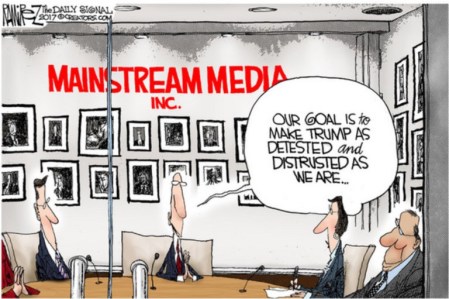
media-goal


trump-to-media


wine-answers


H/t Freedom is Just Another Word

fakenews


feministprotest


oaded


Anti-Semitism in Canada skyrockets

February 25, 2017

Anti-Semitism in Canada skyrockets, CIJ NewsIlana Shneider, February 25, 2017

bibivampireAnti Israel demonstration in Toronto (October 16, 2015). Photo: Blogwrath.com

According to Statistics Canada, Canadian Jews who comprise 1% of the population were the most targeted minority group in Canada, 8 times more likely to be the victims of a hate crime than Canadian Muslims, who make up 3% of the population. In 2013, Canadian Muslims were victims of 6.2 hate crime incidents per 100,000 people while Canadian Jews experienced 54.9 incidents per 100,000 people.

***************************************

On Thursday, February 23, 2017 the words “Gas the Jews” and a Nazi swastika were spray-painted on the ground in Hamilton’s Escarpment Rail Trail.

This incident is just the latest in a string of anti-Jewish hate crimes and vandalism that occurred in Canada in the last few years.

On Tuesday, posters questioning the number of Jewish Holocaust victims were found taped to windows and doors at the University of Calgary. The posters read, in part, “did ‘6 million’ really die?”

During a sermon at a London, Ontario mosque in 2011 an imam chastised his congregation for hiring Jewish lawyers. “Islamic institutions organizations are suing one another. All appointing lawyers. Who are these lawyers? Jews. And who is the judge? A Jew as well. Who is paying for these lawyers? You and I”, complained Riad Ouarzazi.

During al-Quds Day rally in 2013 in Toronto, Elias Hazineh, former President of the Palestine House in Canada, called for the killing of the Israeli Jews if they do not leave Palestine immediately.

An imam at Al Andalous Islamic Center in Montreal was exposed praying in 2014 to Allah to “destroy the accursed Jews” and to “make their children orphans and their women widows”.

A hate crimes complaint has been filed with Toronto police by the Jewish Defence League of Canada against a downtown mosque affiliated with the Muslim Association of Canada, whose imam prayed in 2016 for killing Jews/ disbelievers/ enemies of Islam. The imam subsequently tweeted an apology explaining that his supplications were “misspoken” and referred to the Palestinian – Israeli conflict, implicitly meaning that his statement “slay them one by one and spare not one of them” was meant not for all Jews, but “only” for Israeli Jews who “occupy Palestine”.

A McGill University student leader and advocate for the anti-Israel boycott, divestment and sanctions (BDS) movement came under fire for inciting violence when he tweeted “punch a Zionist today”. On February 23, 2017 Igor Sadikov finally handed in his resignation from the student board after pressure from the McGill administration which allegedly threatened to withhold student fees collected on behalf of the student union if the Student Society of McGill did not publicly call for his resignation.

In the Winnipeg neighbourhood of St. Vital, a large swastika was drawn into the snow with the words “F–k Jews.”

Sault Ste. Marie Police Services have recently launched an investigation after a swastika and sexist slur in the snow was found on the front lawn of B’nai Brith Canada columnist Sara McCleary.

The Winnipeg Police Department and its Hate Crimes Coordinator opened an investigation into an anti-Semitic incident that occurred in a residential neighbourhood near downtown Winnipeg on New Year’s Eve. When the homeowners arrived at their residence at around 10 p.m., they found a red gift bag that was placed near the front steps containing a large rock wrapped in a ribbon. Painted on the rock in red, uppercase letters, was a swastika and the words: “DIE JEW BITCH. EINSATZGRUPPEN” (Nazi death squad). On the red ribbon were the words, “Jude Bitch get out of neighberhood (sic).”

In November, 2016, a motion to hold Holocaust Education Week at Ryerson University was deliberately sabotaged by Obaid Ullah, Ryerson Student Union president, who orchestrated a mass walkout, causing a loss of quorum before the motion was put to a vote.

At Western University in London, Ontario, anti-Semitic flyers targeting the Jewish community were circulated on campus. The flyers, printed by the Canadian National Independence Party (C.N.I.P.), accused Jews for the murder of 6 Muslim worshippers at a mosque in Quebec in late January, blamed “Jewish Zionist terrorists in Israel” for assassination of Muslims in Palestine and demanded that that all Zionists in Canada be tried as terrorists and imprisoned.

B’nai Brith Canada, a Jewish human rights advocacy organization, submitted a complaint against Ayman Elkaswary, an imam at Masjid Toronto and teaching assistant at the university, who in 2016 recited a supplication at the mosque asking Allah to give Muslims victory over the infidels, annihilate the enemies of Islam and “purify Al-Aqsa Mosque from the filth of the Jews”.

February 20, 2017, Jewish residents at an apartment building in North York discovered that their doors were vandalized with Nazi symbols and their Mezuzahs (ritual scrolls affixed to doorposts) were damaged or removed. In Montreal more than 300 swastikas were spray-painted on buildings and public property during the last year.

According to Statistics Canada, Canadian Jews who comprise 1% of the population were the most targetedv minority group in Canada, 8 times more likely to be the victims of a hate crime than Canadian Muslims, who make up 3% of the population. In 2013, Canadian Muslims were victims of 6.2 hate crime incidents per 100,000 people while Canadian Jews experienced 54.9 incidents per 100,000 people.

According to B’nai Brith, which tracks anti-Semitic incidents in the country, the Jewish community is disproportionately targeted and anti-Semitism is a growing problem in Canada.

In a 2015 Annual Hate/Bias Crime Statistical Report, Toronto Police again listed the Jewish community, which is on the receiving end of nearly one in every three reported hate crimes incidents, as the most targeted group for hate crimes, followed by the Lesbian, Gay, Bisexual, Transgender and Queer (LGBTQ) community. “The Jewish community was the most victimized group for mischief to property occurrences, while the LGBTQ community was the most victimized group for assault occurrences” the report said.

Would You Want Your Vaccine Produced by Supporters of Jihad?

February 25, 2017

Would You Want Your Vaccine Produced by Supporters of Jihad?

by Judith Bergman

February 25, 2017 at 5:00 am

Source: Would You Want Your Vaccine Produced by Supporters of Jihad?

  • “Selling the crucial manufacture of vaccines to an ideologically hostile country, which might – for whatever reason – suddenly decide to shut down production, does not sound like a good idea… Those who say that the Saudis are merely interested in profit, just like everybody else, should know better”. — Rachel Ehrenfeld, expert on financing terrorism
  • Virtually all political parties supported the Danish government’s sale of its vaccine manufacturing facility to the Saudi conglomerate.
  • After the publication of the Danish Mohammad cartoons in 2006, Saudis boycotted Danish goods. Do Danish politicians really have such short memories?
  • Vaccines are not an easy commodity to come by. It takes minimum six months for an order of vaccines to be delivered, but, according to the World Health Organization, delivery can also easily take up to two years.
  • How much trust are Danish consumers supposed to have in a Saudi owned conglomerate, which employs jihadists such as Usmani and donates heavily to jihadist organizations such as the Muslim Brotherhood, who want to bring about a caliphate? The potential for political exploitation is too evident to reject.

Would you want your vaccines produced by a Saudi company that supports jihad? Danes, it seems, may have no choice.

Denmark recently sold its state-owned vaccine manufacturing facility to a conglomerate owned by the Aljomaih Group, a Saudi family dynasty[1] led by Sheikh AbdulAziz Hamad Aljomaih. The sheikh is also the largest single stockholder and chairman of Arcapita Bank, (formerly First Islamic Investment Bank) headquartered in Bahrain. As an Islamic bank, it has a so-called Sharia Supervisory Board comprised of Islamic scholars, who ensure that the bank’s activities comply with sharia (Islamic law).

Former Islamic judge and leading Islamic scholar Taqi Usmani, who sits on the bank’s Sharia Board, in his book, “Islam and Modernism”, writes ruminations such as: “Aggressive Jihad is lawful even today… Its justification cannot be veiled…”

Usami had also, after Danish newspapers reprinted the Mohammad cartoons in 2008, co-signed an appeal to the Organization of the Islamic Conference (OIC), urging it to boycott Denmark:

“If the Danish government does not declare the [publication of] shameful and blasphemous cartoons as a criminal act, the OIC [should] appeal to all Islamic nations for a trade boycott of that bigoted country”.

Equally noteworthy is that the spiritual leader of the Muslim Brotherhood, Yussuf al-Qaradawi, used to sit on Arcapita’s sharia board, until he eventually resigned. Qaradawi, already in 1995, told a Muslim Arab Youth Association convention in Toledo, Ohio, “We will conquer Europe, we will conquer America!” According to Qaradawi, sharia law should be introduced gradually, over a five-year period in a new country. Presumably, this gradually-introduced sharia legal system would include the end of free speech under “blasphemy laws”, the denigration and oppression of women, such as women worth half as much as men in court, polygamy, the persecution of Jews (Qaradawi advocates killing all of them), beating wives as a way of “disciplining” them and so on. Only after this transition phase, sharia laws such as killing apostates and homosexuals, as well as chopping off hands for theft, would be introduced.

Given Qaradawi’s former prominence in Arcapita, it hardly comes as a surprise that the bank has given financial support to the Muslim Brotherhood in Bahrain, known there as the Al Islah Society. According to a leaked report by former US Ambassador to Bahrain, Ambassador William T. Monroe:

“Arcapita reported giving a total $591,000 in 2003 and $583,000 in 2002 to a variety of charitable organizations… the Islamic Education Society (Al Tarbiya Al Islamiya – Sunni Salafi) and the Al Islah Society (Sunni Muslim Brotherhood) are the largest beneficiaries of Arcapita’s charitable giving… We are aware of concerns linking Arcapita advisors and staff to questionable organizations.”

In August 2016, the Danish government announced that it “…rejects any organization representing antidemocratic and radicalized environments” and considers the Muslim Brotherhood to be “deeply problematic” and something they “strongly reject”.

Clearly not strongly enough.

“Selling the crucial manufacture of vaccines to an ideologically hostile country, which might — for whatever reason — suddenly decide to shut down production, does not sound like a good idea. Those who say that the Saudis are merely interested in profit, just like everybody else, should know better”, Rachel Ehrenfeld, an expert on the financing of terrorism, told Ekstra Bladet.

Denmark’s Statens Serum Institut (State Serum Institute). Image source: Wikimedia Commons/Froztbyte.
Virtually all political parties supported the Danish government’s sale of its vaccine manufacturing facility to the Saudi conglomerate. This is strange, given the recent history of Danish-Saudi relations.

After the publication of the Danish Mohammad cartoons in 2006, Saudis boycotted Danish goods. Saudi Arabia’s religious leader, Grand Mufti Sheikh Abdul Aziz al-Sheik, demanded that the Danish government hold Jyllands-Posten, the newspaper that printed the Mohammad cartoons, to account and force the newspaper to give an apology: “The government should give [the newspaper] a fine as a deterrence. This is the least that Muslims should demand”, he said.

Do Danish politicians really have such short memories?

Vaccines are not an easy commodity to come by. It takes minimum of six months for an order of vaccines to be delivered, but, according to the World Health Organization, delivery can also easily take up to two years. Astonishingly, the Danish state has given the Aljomaih group an incredible start by promising to buy all its children’s vaccines from the sheikh for the first 30 months. Only after that will Danish authorities be able to buy their children’s vaccines elsewhere. The Danish government has also promised the Aljomaih group not to create new Danish state vaccine production for the first three years.

Should consumers not be able to trust a producer of something as critical as vaccines? How much trust are Danish consumers supposed to have in a Saudi owned conglomerate, which employs jihadists such as Usmani, which donates heavily to jihadist organizations such as the Muslim Brotherhood, which in turn wants to bring about a caliphate? The potential for political exploitation is too evident to reject. Ekstra Bladet ran a poll on its website asking whether Danes were in favor or against the sale: 95% were against it.

Even more remarkable is that the government claims not to have known about the connection between the Muslim Brotherhood and Aljomaih; all the information is easily accessible on the internet.

Health Minister Ellen Trane Nørby has defended the sale: “We did not have several buyers to choose from. We have the buyer we have and it has saved 600 Danish jobs, which would otherwise have been lost”.

Is she saying that the safety of Danish citizens is worth 600 jobs?

The sale of the Danish vaccine production facility to the Saudi conglomerate captures perfectly everything that is wrong with European politicians today: their apparent gullibility, their carelessness and their desire to sell out to places such as Saudi Arabia, seemingly without giving much thought to the long-term consequences.

Judith Bergman is a writer, columnist, lawyer and political analyst.


[1] The Group has been active in healthcare through its investment arm AJ Pharma Holding, and it is its Malaysian subsidiary, AJ Biologics, which will take over the vaccine production in the Danish facility in Copenhagen with its 100-year-old history and approximately 500 Danish employees. The deal was a steal for the Aljomaih group, which acquired the vaccine production company for what is believed to be a tenth of its actual value, a mere 15 million DKK.

Trump’s McMasterpiece

February 25, 2017

Source: Trump’s McMasterpiece

Meet the new National Security Adviser. There is a lot to like.


President Trump announced that H. R. McMaster will be his new National Security Adviser, replacing Michael Flynn.

Removing Flynn was already addition by subtraction, and adding one of the military’s foremost intellectuals will strengthen the administration’s foreign policy team. But how much influence McMaster will have remains to be seen.

To counterinsurgency wonks like me, McMaster is a living legend. In Iraq, he stabilized Tal Afar, a city of 200,000, with 5,200 soldiers.

For states fighting an asymmetric campaign against non-state actors, as in post-Saddam Iraq, there are essentially two available strategies: counterterrorism (CT) and counterinsurgency (COIN).

CT is terrorist hunting. Locate enemies and kill or capture them. But insurgencies are fluid, willing to flee areas where the military is concentrated. Critics deride CT as whack-a-mole, since the military kills insurgents in one place only for them to pop up elsewhere.

COIN addresses this shortcoming with a strategy known as clear, hold, build.

The first part is similar to counterterrorism: clear an area of enemy fighters. But unlike CT, forces continue holding the territory so insurgents cannot return. This provides security, sending a signal to the population that they should side with the counterinsurgents. Then, in the build phase, the military partners with locals, earning their trust, developing basic services such as water and electricity, and training local forces so they can eventually provide security themselves.

The downside is that it’s more resource intensive. COIN campaigns require a sustained commitment, and put soldiers in vulnerable positions. Holding territory and working with local forces leaves counterinsurgents exposed. They have to go on patrol, openly protect infrastructure projects, and take risks to establish relationships. The strategy is expensive, and leads to more casualties than CT.

McMaster’s Tal Afar campaign is already a textbook example of successful counterinsurgency. The clear phase demonstrated his tactical prowess, and the partnerships he established with local leaders facilitated both security and economic development, further building trust.

McMaster recognizes that war, especially asymmetric war, is fundamentally political. Force plays an important role, but popular sentiment is a key component. In Tal Afar, McMaster made humane treatment of detainees and respect for Iraqi culture and religion central to his strategy. He will be a valuable addition to a White House that appears tone deaf about how much al-Qaeda and ISIS gain from the perception that the United States is making war on Islam in general, rather than jihadists specifically.

McMaster made his name speaking truth to power. His dissertation, later turned into a book called Dereliction of Duty, challenged the U.S. military’s belief that Vietnam was everyone else’s fault.

Dereliction doesn’t spare politicians, especially the Johnson administration, but denounces military leaders for failing to provide advice that could have led the war in a better direction. In a memorable phrase, McMaster called LBJ’s Joint Chiefs of Staff “the five silent men.”

This instinct might seem like a bad fit for a president known to bristle at criticism, but Trump appears open to disagreement from prominent military officers. For example, Secretary of Defense James Mattis got Trump to change his public stance on torture.

McMaster’s appointment means the Mattis camp will likely gain influence over foreign and security policy relative to the radical revisionists led by chief political strategist Steve Bannon. How much, however, is unclear. McMaster will chair the National Security Council, but Bannon set up what amounts to a shadow NSC, called the Strategic Initiatives Group. The SIG is light on foreign policy and national security experience, and heavy on anti-Muslim sentiment. The poorly designed, strategically counterproductive travel/refugee ban came from them.

To gauge how much McMaster’s appointment reduces the SIG’s influence, keep your eye on senior NSC staff, especially Deputy National Security Adviser K.T. McFarland. McFarland’s previous experience in national security was speechwriting and public relations jobs in the 1980s. In recent years, she was a commentator for FOX news.

Trump’s original replacement for Flynn, retired Vice Admiral Robert Harward, turned down the job because the president denied Harward’s request to bring in his own staff (among other reasons). Unlike Harward, McMaster is active duty, and couldn’t really say no to the Commander in Chief. If McFarland stays on, that’s a sign McMaster’s influence is limited.

My McMaster Story

When I was in graduate school, I worked on a project with my adviser George Quester on preemptive warfare. In 2008, Quester took me with him to present our results to the Office of Net Assessment, the Pentagon’s internal think tank, which focuses on long-term grand strategy. I expected a moderately sized audience, but it ended up being just me and Quester in a room with the Director of Net Assessment, Andrew Marshall.

Marshall is the most powerful person the public hasn’t heard of. His influence-to-fame ratio is off the charts. When the Pentagon set up Net Assessment in 1973, Nixon tapped Marshall to run it, and he remained director until retiring in 2015.

Military strategists nicknamed him Yoda. The Chinese military translated all his public writing (and presumably some classified writing if they could get their hands on it). When I later told a former Undersecretary of State about my presentation to Net Assessment, he responded “you met God? Circle that date and save the calendar.” Marshall is, to quote Ron Burgundy, kind of a big deal.

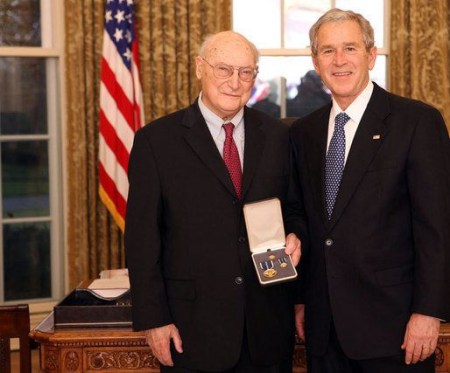
Andrew Marshall, receiving the Presidential Citizens Medal from George W. Bush in 2008.

He might not be a public figure, but he’s not a secret, and as someone in grad school for security studies I knew who he was. I didn’t expect the opportunity to meet him, and I wasn’t going to squander it.

Right after the presentation, I launched into a conversation. In one of his questions, Marshall lamented that the United States wasn’t as strategic as it used to be, and I argued there were two positive recent developments:

  1. The nuclear deal with India. If China is America’s long-term rival, then India is our natural ally. By normalizing nuclear relations with India — even though it remains outside the Nuclear Non-Proliferation Treaty — the Bush administration cultivated India as a balancer in Asia.
  2. The McMaster promotion.

Advancing McMaster from colonel to brigadier general was a watershed moment for the Army. After his successful Tel Afar campaign, McMaster, along with John Nagl and other COIN experts, worked with David Petreaus to revise the Counterinsurgency Field Manual. Under Petreaus, American strategy in Iraq shifted from counterterrorism to counterinsurgency, yielding greater success.

This was popularly known as “the Surge,” because the United States deployed over 20,000 additional soldiers. However, the biggest reason violence decreased was the shift to a population-centric strategy, especially cooperation with Sunni Arab tribes in what came to be known as the Sunni Awakening.

Given his successes in Iraq, many believed McMaster’s advancement was a sure thing. But the Army promotions board passed over him in 2006, and then again in 2007. Board members tend to promote officers like themselves, which meant WWII tank commanders promoted tank commanders, who, in turn, promoted more tank commanders rather than counterinsurgents. This institutional sclerosis got bad enough that Secretary of the Army Pete Geren took the unusual step of asking Petreaus to come home from Iraq to oversee promotions.

The Army announced McMaster’s promotion in July 2008. In 2014 he earned his third star, becoming Deputy Commanding General of the Training and Doctrine Command, shaping how the Army fights.

In my one opportunity with Andrew Marshall, that’s what I talked about: how promoting McMaster indicated the Army finally recognized the importance of asymmetric warfare to America’s 21st century security challenges.

And now he’s National Security Adviser. I hope the president listens to him.

It’s Time for Europe’s Militaries to Grow Up | Foreign Policy

February 25, 2017

Source: It’s Time for Europe’s Militaries to Grow Up | Foreign Policy

It’s Time for Europe’s Militaries to Grow Up

The transatlantic partnership between the United States and Europe has been the linchpin of U.S. grand strategy for more than half a century. It is also in deep trouble. During the 2016 presidential campaign, Donald Trump repeatedly suggested that NATO was obsolete, accused U.S. allies in Europe of “not paying their fair share,” and said “the U.S. must be prepared to let these countries defend themselves.”

Not surprisingly, his election rang alarm bells in Europe, and his erratic behavior since taking office has only intensified European concerns. How can America’s European partners be confident in their most important ally when the U.S. president lives in an alternative reality derived from Breitbart, Fox News, and whatever dark conspiracies he’s being fed by Steve Bannon? Would you trust a president who prefers to rely on shady Ukrainian politicians, convicted fraudsters, and his own personal lawyer to deal with sensitive diplomatic matters, instead of the normal channels of statecraft?

Secretary of Defense James Mattis and Vice President Mike Pence spent last week trying to reassure U.S. allies at the Munich Security Conference, but their efforts were only partly successful. Each made strong pro-NATO statements — and Pence even said the U.S. commitment was “unwavering” — but their message wasn’t unambiguous. In particular, Mattis warned his NATO counterparts that the United States might moderate its commitment to Europe if they didn’t ramp up their defense spending to roughly 2 percent of GDP.

This recurring concern with European defense spending is understandable, but it mostly misses the point. Why? Because the fundamental problem isn’t inadequate latent capacity or even a lack of mobilized resources. The only “clear and present” military threat Europe faces today is a resurgent Russia (though this threat may not be nearly as great as alarmists maintain), and NATO’s European members possess the wherewithal to deal with the challenge on their own. Leaving the United States and Canada out of the equation, NATO’s European members have nearly four times Russia’s population, and their combined GDP is more than 12 times greater. More importantly, even at today’s supposedly “inadequate” spending levels, every year NATO’s European members (again: not counting the United States and Canada) spend at least five times more on defense than Russia does.

The problem, in other words, is not the amount of money that European countries devote to national security. The problem rather is that they don’t spend these funds very effectively and don’t coordinate their defense activities as well as they could. Despite numerous attempts, Europe’s long-promised “Common Foreign and Security Policy” remains an aspiration, not a reality. This failure isn’t at all surprising, because CFSP is an EU initiative and the EU is still more of a collection of nation-states rather than a fully integrated community. The key point, however, is that throwing more euros (or kroner or zlotys) at the problem won’t fix it.

Among other things, this situation tells you that if NATO were to meet U.S. demands and get all of its members up to the canonical target of 2 percent of GDP, it wouldn’t do all that much to improve the overall balance of power unless they started spending the money more effectively. In short, the narrow focus on “defense spending as a percentage of GDP” is a red herring.

U.S. efforts to pressure Europe into spending more by threatening to reduce its own commitment to Europe are also inherently contradictory. When he warned that the United States might “moderate” its support, Secretary of Defense Mattis was telling his European counterparts that they might not be able to count on the United States if they didn’t start spending more. The flip side of the coin, however, is an implicit pledge that if they do start hitting that 2 percent target, then Washington will stay “all in,” too. But that’s a recipe for Europe doing just enough to keep Uncle Sam happy while Washington remains its protector of first and last resort.

From a broader strategic perspective, getting Europe to bear more of the burden of its own defense is meaningful only if it allows the United States to reduce the resources it devotes to European security so that it can focus more attention on other theaters, such as Asia. And given the enormous imbalance between Europe’s military potential and those of its potential foes, that formula should be relatively easy to negotiate. Instead of the familiar kabuki dance where Americans threaten to do less but don’t really intend to, the United States and its European partners ought to be developing a long-term plan to reduce the U.S. commitment more or less permanently (or until such time as there is a serious threat to the European balance of power). As John Mearsheimer and I explained last summer, as long as there is no potential hegemon in Europe — and Russia doesn’t qualify — it is not necessary for the United States to take the lead in defending it.

In short, the hype devoted to relative defense spending levels is mostly just symbolic politics. What American politicians are really saying is that it looks bad when Americans spend 3.5 percent of GDP on defense and our relatively wealthy allies in Europe (or Asia, for that matter) spend less than 2 percent. And they’re right: It does look bad. But if U.S. officials can somehow convince those same allies to boost their spending a bit, they can go back to American voters and claim success, even if it doesn’t reduce U.S. defense burdens or make Europe any safer.

Finally, constantly harping about burden sharing distracts attention from the more serious challenges that threaten the transatlantic partnership. The first challenge is the lack of a compelling strategic rationale for it. Much as I hate to admit it,

Trump was not entirely wrong to suggest NATO was obsolete — at least in its current form — because it was created to deal with a problem (the Soviet Union) that no longer exists.

Trump was not entirely wrong to suggest NATO was obsolete — at least in its current form — because it was created to deal with a problem (the Soviet Union) that no longer exists. It is harder to justify an expensive U.S. commitment to defend Europe when there is no potential hegemon there and the new missions that NATO has taken on after the Cold War ended (Afghanistan, Libya, etc.) have fared rather poorly. (NATO’s other implicit purpose — “to keep the Germans down” — isn’t relevant either, despite Germany’s central role in the EU. With a declining and rapidly aging population, Germany today could never aspire to European hegemony.)The second challenge is European disunity itself, especially in the wake of the 2008 financial collapse, eurozone crisis, and Brexit decision. Centrifugal forces in Europe make it even less likely that its member states will create effective all-European defense forces, even if individual countries do manage to boost their own spending levels a bit. And they certainly won’t do the hard work to create a genuine pan-European defense capability if they remain convinced Uncle Sam will always be there to bail them out.

Then throw in various right-wing populist politicians who are either ruling or contending for power in France, the Netherlands, Hungary, Poland, and Turkey. Many of these would-be leaders are openly hostile to the idea of European unity, and Trump has made this problem worse by embracing Brexit and giving rhetorical support to right-wing xenophobes like Marine Le Pen.

This approach is exactly what Washington should not be doing today. If you want Europe to take on more responsibility for its own security, the last thing you’d want to do is undermine Europe’s increasingly delicate political order. A Europe led by politicians like Le Pen or Geert Wilders is not a Europe that will stable and secure enough to take care of itself so that the United States could focus its energies and resources elsewhere. If Trump really wanted to get the United States out of the business of protecting Europe, backing European xenophobes and coddling Vladimir Putin is not the way to go. But you weren’t expecting clear, coherent, or consistent strategic thinking from this president, were you?

Gorka & Jasser: We Are Fighting ‘Not a War with Islam, but a War Inside Islam’

February 24, 2017

Gorka & Jasser: We Are Fighting ‘Not a War with Islam, but a War Inside Islam’, BreitbartJohn Hayward, February 24, 2017

isis-koran-640x480Flickr/AFP

Broadcasting live from CPAC 2017, SiriusXM host Alex Marlow spoke with Dr. Sebastian Gorka and Dr. Zuhdi Jasser about national security, Islamist terrorism, and their panel discussion, “When Did World War III Begin?”

(Audio at the link. — DM)

Marlow began by asking his guests what they expected from the national security segment of President Donald Trump’s scheduled address to the Conservative Political Action Conference.

“Exactly what we’ve heard before,” Gorka replied. “If you really want to understand the direction of the White House and how much everything changed at 12:01 on January the 20th, you look at two things: you look at a speech that really wasn’t carefully addressed or really paid enough attention to, that’s the Youngstown campaign speech, which was about the threat of jihad in general and what we’re going to do about ISIS.”

“Specifically, it really bears repeating, the inauguration, the address that the president gave at the inauguration, was explicit,” he continued. “Number one, we are going to eradicate the Islamic State – not degrade, not manage, not ameliorate – eradicate. And secondly, words have meaning. When he says our enemy is ‘radical Islamic terrorism,’ that is a 180 degree  change from the last eight years, when we weren’t allowed to even say who the enemy was.”

“Zuhdi knows it better than anybody because he understands that this isn’t about poverty or lack of education. It’s about people who are fighting for the soul of Islam – not a war with Islam, but a war inside Islam; as King Abdullah, as General Sisi has said, for which version is going to win,” Gorka said.

Marlow asked Dr. Jasser about the topic of language control Gorka touched upon and the previous administration’s reluctance to use explicit language like “radical Islamic jihad” to describe the enemy.

“We got to this point because we had an administration who was being whispered to by Muslim Brotherhood sympathizers, by apologists, by governments that might be our allies against al-Qaeda and ISIS, but they love a whack-a-mole program. They don’t want to treat the disease, which is not ‘violent extremism’ but violent Islamism,” Jasser charged.

“We have to start focusing on our own values,” he urged. “There’s nothing more American than fighting theocracy, and yet the Left for the last eight years has invoked blasphemy laws in America by telling us we can’t criticize Islamist political movements.”

Jasser predicted the new administration would succeed in destroying ISIS but warned that “it will come back in another form – two, three, four years later – unless we engage Muslim reformists, like our Muslim reform movement, to treat the underlying theocracy.”

Marlow complained that the mainstream media swiftly denounce candid talk about the problem of radical Islam as “hate speech” even when confined to straightforward reporting without editorial opinion, making it difficult to have a constructive discussion about the problem.

“I think this is exactly what the Saudi regime, the Iranian Khomeinists, the Brotherhood want, is they want to dominate what Islam means,” Jasser said. “And yes, it’s not my Islam, but we have to thread that needle. Because if you don’t call it political Islam or Islamism as the threat, you’re not going to be able to figure out who to engage. We want to engage anti-Caliphate, anti-violent jihad Muslims who are pro-freedom, pro-equality of men and women, who share our values. If we don’t do that discernment in our verbiage, we’re going to miss it and actually end up helping our enemies and end up actually not only being the firefighters, but the arsonists. We have to stop that cycle.”

“Let’s just take it one level deeper. It’s not just empowering our enemies, which would be bad enough,” Gorka added. “If you don’t talk truthfully about who the enemy is, how are you going to win? What we saw in the last eight years is a policy that actually weakened our most important allies.”

“So when you’ve got the president of the most populous Arab nation in the world say this is a war for the heart of Islam, General Sisi, when you’ve got King Abdullah with his Amman statement saying, ‘Look, we have to stop the jihadis hijacking the religion’ – we have a president here who stands up and says, ‘No, no, no, these are not the droids you’re looking for, the religion has nothing to do with this,’” he elaborated, referring to the Obama administration’s insistence on framing the war as a struggle against generic violent extremism.

“Do you know who we hurt the most? Those Muslims who are on the front lines with the jihadis, who understand this isn’t about poverty or lack of education; it’s about an ideology. So we’ve actually hurt the people who are on the front line the most. We’re not prepared to do that anymore. This administration’s going to help the Jordanians, help the Egyptians, help them fight this war,” Gorka vowed.

“I think we have to own what it means to be diverse,” Jasser suggested. “What is ‘diversity’ in the Muslim community? It’s not ethnic diversity. Being Muslim is not an identity movement of a monolithic homogenous group. It is a diverse ideological movement that has fundamentalist, orthodox, liberal, secularists that are all in this Muslim diverse group. So if the Left actually believes in diversity different from what Pelosi whispered into Andre Carson’s ear – ‘Tell them you’re Muslim’ – Islam is not a race. They’re racializing the faith. That’s the biggest obstacle.”

“I think the other thing I hope to see is not only us being against jihadists, but what are we for,” he added. “I think that will be the difference between some of the dictators in the Middle East, that yes, some of them have been on our side against jihad, the militants, but we are the adults in the world, in being for liberty and freedom. I hope that will be part of a Trump Doctrine.”

Gorka agreed, saluting Jasser as “the point man here in America for sense, for common sense in this battle.”

“The saddest part is there are people like him in the Middle East. There are people every day risking their lives on their blog sites, in North Africa, in the Middle East pushing back on this, saying, ‘I’m a Muslim, but I don’t think an infidel needs to be killed.’ That means he’s put the crosshairs on his chest,” Gorka noted. “In some parts of the Muslim world, that’s an instant death sentence.”

“That’s why the four million Muslims in America need to step up and act because we can do things here that you just can’t do in the Middle East,” Jasser said. “They end up in prison. They end up slaughtered, tortured.”

Marlow proposed that “the stifling of speech in the Muslim world is really what has allowed a lot of the jihadist movements to flourish.”

“Why do you think they use the term ‘Islamophobia’ instead of talking about, yes, there might be some bigotry against Muslims in the West?” Jasser asked. “They use the term Islamophobia because they want to anthropomorphize Islam so that you don’t criticize it, and they suppress free speech. That’s how they invoke blasphemy laws in the West.”

“You’re absolutely right. The freedom of speech issue is huge in the Middle East because it’s a life and death issue in many cases,” Gorka said. “But here, it’s almost as important. It’s not life and death, but it is closing down the discussion.”

“You look at what’s happened in the last four weeks with this administration,” he said. “There’s a phrase in soccer: you play the man on the ball. We’re not going to talk about policies; we’re going to attack individuals, whether it’s Kellyanne, the president, myself, Steve Bannon. They do that how? ‘We don’t want to talk about the threat to America. You’re a racist. You’re an Islamophobe. You’re a xenophobe. Oh, well, in that case, we can’t talk to you.’ That’s as dangerous as just the constant ad hominem attacks because then there is no discussion.”

Jasser said his message to CPAC was that “there is hope” for a lasting victory in the long war against Islamist extremism.

“The first step is to defeat the militants, which this president will finally do,” he said. “The second step is to go back to our American roots and defeat theocracy, work with Muslims and our Muslim reform movement. We have a two-page declaration that can be used, I hope, not only to vet refugees, to figure out which groups are with us and against us. I hope we start doing security clearances through those who share our values.”

“There are so many that are – not in this administration, but that are in the government from the previous administration – that I think are Islamists, that might not be violent extremists, but we need to shift the axis of the lens of Homeland Security, foreign policy, to countering violent Islamism. There’s nothing this group here and the country can do to better empower reform-minded Muslims that share our values than to shift from this blasé CVE to CVI,” Jasser said, lampooning the Obama administration’s acronym for “Countering Violent Extremism.”

Gorka referred to CVE as “garbage from the last eight years that obfuscated the threat.”

He said the most important step taken by the new administration was President Trump’s executive order to temporarily limit immigration from the most unsecure Middle Eastern nations.

“Whatever the final version of the reform measures are, the fact is, when an Iraqi collars me in the halls of Congress and says, ‘My friends back home in Iraq applaud this measure because they know how many bad guys are in Iraq that want to come over here, so do it. Thank you,’” Gorka said.

Dr. Sebastian Gorka is deputy assistant to President Trump and was formerly national security editor for Breitbart News. He is the author of Defeating Jihad: The Winnable War. Dr. Zuhdi Jasser is the founder and president of the American Islamic Forum for Democracy and author of A Battle for the Soul of Islam: An American Muslim Patriot’s Fight to Save His Faith.