Archive for April 2016

Rouhani threatened unless he keeps Iran’s “provocative”

April 2, 2016

Rouhani threatened unless he keeps Iran’s “provocative” DEBKAfile, April 2, 2016

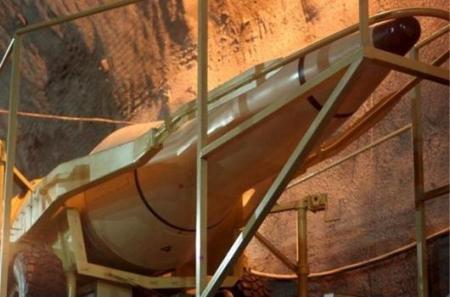
A missile is seen inside an underground missile base for Iran's Islamic Revolutionary Guards Corps (IRGC) Aerospace Force at an undisclosed location in this undated handout photo courtesy of Fars News. REUTERS/farsnews.com/Handout via Reuters

A missile is seen inside an underground missile base for Iran’s Islamic Revolutionary Guards Corps (IRGC) Aerospace Force at an undisclosed location in this undated handout photo courtesy of Fars News. REUTERS/farsnews.com/Handout via Reuters

President Barack Obama said Friday April 1, that “Iran has so far followed the letter of the [nuclear] agreement [with the six powers], but, he added, “the spirit of the agreement involves Iran also sending signals to the world community and business that it is not going to be engaging in a range of provocative actions that may scare business off,” such as fire-testing nuclear-capable ballistic missiles, calling for Israel’s destruction and providing Hizballah with missiles.

At a news conference ending the two-day nuclear summit in Washington, Obama went on to say: “Some of the concerns that Iran has expressed, we are going to work with them to address.” But meanwhile, he said, the US and its allies are taking steps to help Iraq benefit from the agreement by facilitating trade and banking transactions with the Islamic Republic; and the US Treasury Department is seeking to set clearer investment guidelines for Iran.

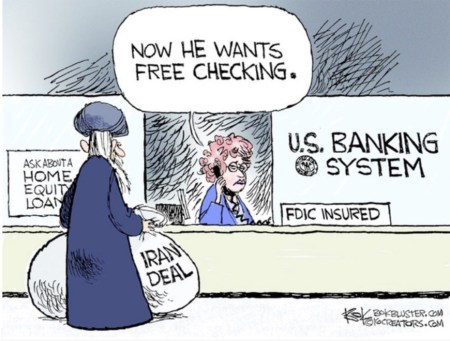
Two days earlier, on Wednesday, March 30, the Obama administration was reported acting to give Iran limited access to US dollars, since the almost complete lifting of sanctions in January, which netted Tehran an injection of approximately $150 billion “hasn’t provided the country with sufficient economic benefits.”

DEBKAfile’s analysts note the inherent contradiction in the US president’s approach to Tehran: He wants Iran to be compensated with a never-ending shower of dollars for agreeing to limit its nuclear program, but “the US and its allies” cannot question how the money is spent.

So while the West, under orders from Washington, must scramble to boost the Iranian economy, Tehran may continue to test ballistic missiles until they are nuclear capable, and top up the Hizballah terrorists’ arsenal with ever deadlier tools of death.

This glaring inconsistency arises from a fact largely hidden from the world public: last year’s landmark nuclear accord was concluded by Iran’s President Hassan Rouhani and Foreign Minister Mohammed Javad Zarif – not by the real powers in Tehran, supreme leader Ayatollah Ali Khamenei, the Revolutionary Guards chiefs and the ayatollahs at the head of the fundamentalist Shiite movement.

Indeed, even Rouhani was never allowed to formally sign the deal, much less gain Khamenei’s ratification.

But now, Rouhani’s fate depends on keeping those ruling elites happy.  He has found himself in the position of their hostage, a cash machine for keeping the funds for the Islamic Republic’s projects termed by President Obama “provocative” constantly on tap.

Those projects which are currently in full spate clearly leave every little over from the $150bn to even start lifting the Iranian economy out of its mess, while the Rouhani’s government carries the can for that too. Indeed, DEBKAfile’s Iranians sources disclose, the president is forced to earmark 50 percent of the funds released by sanctions relief for items listed under “defense”, namely,  the nuclear and missile development programs, Iran’s overseas military operations, including the Syrian war, subsidizing the Lebanese Hizballah, and establishing new terrorist organizations for attacks on Israel, such as the Al-Sabirin, on the Golan.

These enterprises eat up billions of dollars. Just Iran’s operations in Syria and support for Hizballah cost Tehran $2 billion every month.

Syrian president Bashar Assad didn’t surprise anyone when he revealed that the five-year civil war in his country had cost $200 billion so far. With this kind of spending on “defense,”  the Iranian economy will continue to decay, while Rouhani’s government, which promised the people a better life after the nuclear accord, must bow to the will of the hard-liners or face the consequences.

Our Iranian sources report that Obama’s inconsistent approach to Iran has sharpened the discord between the two major political camps in Tehran and put the “reformists” in extreme peril should they dare to defy the hard-liners who hold the levers of power. Khamenei has publicly threatened to liquidate such opposition leaders as Rouhani and his ally, former president Ayatollah Akbar Hashemi Rafsanjani.

President Rouhani has been put by Obama’s policy in the position of having to keep Tehran’s hungry war- and terror-mongers flush with cash, if he is to save himself and fellow “reformists” from “liquidation.”

The supreme leader was pretty blunt when he said on Friday, March 29, “Those who say the future is in negotiations, not in missiles, are either ignorant or traitors.” This comment underlined Iran’s overriding commitment to developing nuclear missiles and a warning to “traitors” of their fate: execution or a life sentence in a grim Iranian jail.

Cartoons of the Day

April 2, 2016

H/t Power Line

Iran-ree-Checking-copy


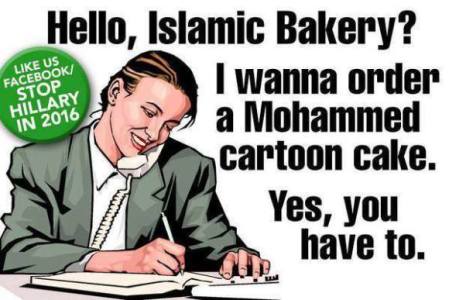
Islamic-Bakery


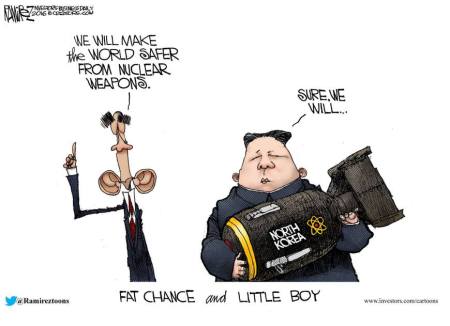
Fat-Chance-and-Little-Boy


Marginalize-Trump


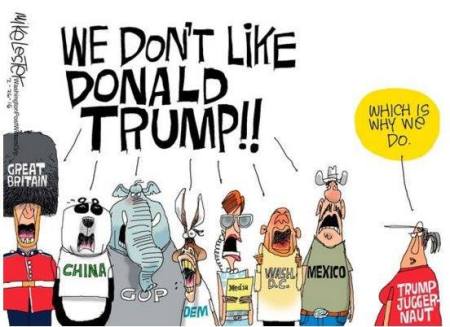
Trump-Popularity


Make-America-Drunk-Again


H/t Joopklepzeiker

screenshot_4


Spain: Courses on Islam in Public Schools

April 2, 2016

Spain: Courses on Islam in Public Schools, Gatestone InstituteSoeren Kern, April 2, 2016

♦ The guidelines for teaching Islam in public schools — drafted by the Islamic Commission of Spain and approved by the Ministry of Education — are aimed at stirring religious fervor and promoting Islamic identity among young Muslims in Spain.

♦ The guidelines, which envision the teaching of every aspect of Islamic doctrine, culture and history, are interspersed with “politically correct” terminology… but the overall objective is clear: to inculcate young people with an Islamic worldview.

♦ According to the guidelines, preschoolers (ages 3- 6) are to learn the Islamic profession of faith, the Shahada, which asserts that “there is no God but Allah and Mohammed is his messenger.” The Shahada is the gateway into Islam: one becomes a Muslim by repeating the Shahada three times in front of a witness. They are also encouraged to “emulate, through different forms of expression, the values observed by Mohammed.”

♦ In primary school (ages 6-12), the guidelines call for children to “recognize Mohammed as the final prophet sent by Allah and accept him as the most important.”

The Spanish government has published new guidelines for teaching Islam in public preschools and primary and secondary schools.

The guidelines are being touted as a way to prevent Muslim children and young people from being drawn into terrorism by exposing them to a “moderate” interpretation of Islam.

On closer inspection, however, the guidelines — drafted by the Islamic Commission of Spain and approved by the Ministry of Education — are aimed at stirring religious fervor and promoting Islamic identity among young Muslims in Spain.

The new plan, which is the most ambitious in all of Europe, amounts to a government-approved program to establish a full-fledged Islamic studies curriculum at public schools nationwide, at a time when Christian religious symbols are being systematically removed from Spanish public schools by official enforcers of secularism.

Although Spanish taxpayers are being expected to pay for the religious education of up to 300,000 Muslim students between the ages of 3 and 18, it remains unclear whether Spanish authorities will have any oversight of the teaching of Islam in public schools. The government has agreed to allow local Muslim organizations to draft the course syllabi, choose the textbooks, and even determine who will teach the classes.

Spain’s Ministry of Education quietly published the guidelines in the official state gazette (Boletín Oficial del Estado) on March 18. The curriculum for teaching Islam in Spanish public preschools can be found here; in public primary schools here; and in public secondary schools here.

The guidelines, which envision the teaching of every aspect of Islamic doctrine, culture and history, are interspersed with “politically correct” terminology — the documents are rife with buzzwords such as coexistence, diversity, equality, human rights, inclusion, integration, intercultural education, interreligious dialogue, moderation, pluralism, religious liberty, respect and tolerance — but the overall objective is clear: to inculcate young people with an Islamic worldview.

According to the guidelines, preschoolers (ages 3- 6) are to learn the Islamic profession of faith, the Shahada, which asserts that “there is no God but Allah and Mohammed is his messenger.” The Shahada is the gateway into Islam: one becomes a Muslim by repeating the Shahada three times in front of a witness.

Block 6 is aimed at instilling “interest for Islamic religious and cultural texts,” stirring “curiosity for the Koran in oral and written language,” and learning “Islamic recitations, narrations and descriptions.”

Children should develop an “attitude of listening to Koranic and prophetic texts” and memorize “short Hadiths [reports about the words, actions or habits of Mohammed] and Koranic stories.” They are also encouraged to “emulate, through different forms of expression, the values observed by Mohammed.”

In primary school (ages 6-12), the guidelines call for children to “recognize Mohammed as the final prophet sent by Allah and accept him as the most important.” Students are to “recite the Shahada in perfect Arabic and Spanish,” and “recognize that the Koran is a guide for all of humanity.” Children are to “know certain Arabisms in the Spanish language and appreciate the linguistic contributions of Islam to the history of Spain, using verbal language to communicate emotions and sentiments.”

Primary school students are to “know examples of Mohammed’s coexistence with non-Muslims,” although there is no indication that Muslim pupils will be taught about the 900 Jews of the Banu Qurayza tribe in Medina that Mohammed ordered to be beheaded in 627AD.

Students are also to “understand that Islam is a religion of peace — spiritual or internal peace and social or communitarian peace. The prophet teaches us to live in peace. Islam promotes solutions to resolve conflicts and social inequality.”

Moreover, the guidelines call for primary students to “comprehend and explain the existence of other monotheistic revelations of Allah: Judaism and Christianity.” But it remains unclear whether students will learn about the three instances in the Koran (Suras 2:65, 5:60 and 7:166) in which Allah turns Jews into apes and/or pigs.

In secondary school (ages 12-18), the guidelines call for students to “know, analyze and explain the affective-emotional attitudes of Mohammed when confronting personal offenses, valuing conflict resolution.” It remains unclear whether students will learn about Suras 5:33 and 33:57-61, which call for curses against those who “annoy Allah and His Messenger.”

Block 4 calls on students to evaluate the “transversality present in the Koran and the Hadiths regarding social relations.” It does not, however, mention whether students will be taught that the Koran and the Hadiths require non-Muslim subjects (dhimmis) residing in Muslim lands to pay a protection tax known as the jizya.

In a section on the “Islamic model for economics and jurisprudence,” students are asked to identify Islamic solutions to world problems. They are also asked to “analyze and explain the benefits of interest-free loans [aka Sharia finance].”

In Block 8, students are asked to “analyze the stages of the establishment and flourishing of Islamic jurisprudence [Sharia law] during the splendor of al-Andalus.”

Al-Andalus is the Arabic name given to those parts of Spain, Portugal and France that were occupied by Muslim conquerors (also known as the Moors) from 711 to 1492. The Islamic State (ISIS) has repeatedly vowed to “liberate” al-Andalus from non-Muslims and make it part of their new Islamic Caliphate.

The guidelines also encourage students to use the internet to learn more about Islam, even though the internet is playing an increasingly important role in the radicalization of young Muslims.

The legal basis for teaching Islam in Spanish public schools can be found in Article 27.3 of the Spanish Constitution of 1978, which establishes that although Spain is non-confessional (meaning that it does not recognize an official state religion), “the State guarantees parents the right for their children to obtain a religious and moral education which conforms to their own convictions.” Muslims (and Roman Catholics) have long understood this to mean that children are entitled to religious education in public schools.

On November 10, 1992, the Socialist government of Felipe González — seeking to end the monopoly of the Roman Catholic Church over Spanish education — negotiated a “Cooperation Agreement between the Government of Spain and the Islamic Commission of Spain” (Comisión Islámica de España, CIE). That agreement, codified in Law 26/1992, recognized Islam as a minority religion in Spain and guaranteed that “Muslim students … receive Islamic religious education in public schools.”

(Also on November 10, 1992, the Spanish government approved the “Cooperation Agreement between the Government of Spain and the Federation of Evangelical Christian Entities in Spain.” That agreement was codified in Law 24/1992. In June 1993, the Spanish government published guidelines for the teaching of evangelical Christianity in public schools.)

In recent years, Muslim leaders in Spain have complained that the Spanish government has failed to implement the 1992 agreement. According to the CIE, 90% of Muslims students in Spain lack access to Islamic studies in public schools. The new guidelines appear to signal the current government’s commitment to follow through on the promises of past governments.

The guidelines were drafted by CIE president Riaÿ Tatary, a Syrian who has lived in Spain for more than 45 years. Tatary, a medical doctor who is also the imam of the Abu-Bakr Mosque, the second-largest mosque in Madrid, is often portrayed as the epitome of Muslim integration and moderation.

Tatary is the chief interlocutor between Spain’s Muslim community and the Spanish government and has received a civilian merit award from the Ministry of Justice for his work on Spain’s law on religious liberty.

But Spanish counterterrorism analysts (here and here) have long suspected that Tatary is closely linked to the Muslim Brotherhood, which is highly critical of Western concepts of justice and democracy. The Brotherhood’s motto is: “Allah is our objective; the Prophet is our leader; the Koran is our law; Jihad is our way; dying in the way of Allah is our highest hope.”
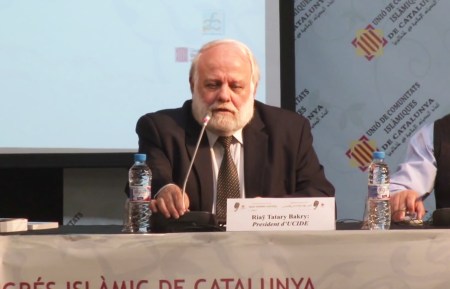
1536The Spanish government’s curriculum guidelines for public school Islamic studies were drafted by Riaÿ Tatary, imam of the Abu-Bakr Mosque. Spanish counterterrorism analysts have long suspected that Tatary is closely linked to the Muslim Brotherhood.

Tatary denies the charges, although members of his mosque have, in fact, been tied to al-Qaeda.

Ahead of municipal elections in May 2015, Tatary admonished Muslims in Spain not to vote for any candidate who “hinders or impedes the establishment of mosques for our faithful, and cemeteries for our dead.” He also said that Muslim voters should not vote for anyone who “hinders or prevents the children of Muslim citizens from receiving Islamic religion courses in public or private schools.”

Spanish political analysts said Tatary’s attempt to enforce the Spanish Muslim vote was alarming:

“At first glance, it does not seem objectionable that a group, whatever its nature, defends the rights of its members. However, when it comes to an entity that appeals to religion to impose a massive discipline of the faithful in the political arena, we cannot but be alarmed. Especially when that religion is engaged in relentless war within itself and with the rest of the civilized world.”

It seems unlikely, however, that parents and imams will accept many of Tatary’s politically correct non-literal interpretations of the Koran, which apparently are aimed at securing the government’s approval of the guidelines. The challenge of reform-minded Muslims is to convince the majority of Muslims that the Koran and the Hadiths do not actually mean what they say.

In the end, the new guidelines may end up achieving a completely undesired objective: serving as gateway to radical Islam for tens of thousands of young Muslims in Spain.
“Trump” Sidewalk Chalk: #TheChalkening Students from 100s of colleges across the US, standing up

April 2, 2016

“Trump” Sidewalk Chalk: #TheChalkening Students from 100s of colleges across the US, standing up, You Tube, April 1, 2016

Palmyra mass grave: Tortured women & children among dozens of ISIS victims unearthed by Syrian Army

April 2, 2016

Palmyra mass grave: Tortured women & children among dozens of ISIS victims unearthed by Syrian Army

Published time: 2 Apr, 2016 04:58 Edited time: 2 Apr, 2016 08:11

Source: Palmyra mass grave: Tortured women & children among dozens of ISIS victims unearthed by Syrian Army — RT News

© Omar Sanadiki / Reuters

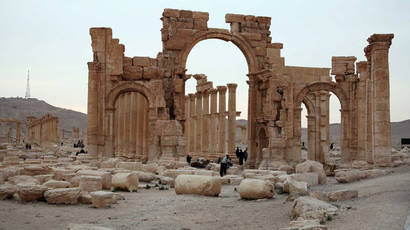
The Syrian Army is unearthing a mass grave consisting of at least 40 corpses, many of them women and children. They were butchered by Islamic State (IS, formerly ISIS/ISIL) in the recently liberated ancient city of Palmyra.

The grave was discovered by engineers and “popular defense forces” in the Masakin al-Jahizia neighborhood of the city, which lies only 500 meters from the ancient ruins, SANA reports.

So far the army has recovered 25 corpses. Among those killed by IS were three children and five females. As the excavation proceeded, 15 more corpses were unearthed – all of them women and children.

Read more

Historical city of Palmyra, Syria (Reuters / Nour Fourat)

Initial examination of the bodies revealed that some of the victims had been beheaded while other had been brutally tortured before their deaths.

The army continues to excavate the mass grave, fearing that more bodies may be found.

Engineering units continue their search for landmines and explosives as thousands were hidden by the jihadists before they were driven out of the city with the help of the Russian forces working with the Syrian Army.

Russian combat engineers arrived in Palmyra on Thursday with special robotic units to offer their expertise in detecting and dismantling mines in an area comprising over 180 hectares (445 acres), to save the UNESCO world heritage site, and help locals to return safely.

“At least 3,000 explosive devices were installed in the city,” the sapper explained to RT. He said IS created an almost invisible interconnected network, partially hidden under hard paved roads, which could blow up the entire city.

READ MORE:Palmyra booby-trap: ISIS had 3,000 bombs rigged, ready to level entire city with one click

A strategically important location, Palmyra was seized by IS jihadists in May 2015. That month, IS reportedly slaughtered 400 people, mostly women and children. At the time, Reuters reported that a video posted by IS’ supporters showed the militants entering governmental buildings in search of Syrian soldiers. They were also seen pulling down pictures of Syrian President Bashar Assad and his father, Hafez Assad.

White House Scrubs Translation of French President Saying ‘Islamist Terrorism’

April 1, 2016

White House Scrubs Translation of French President Saying ‘Islamist Terrorism’ BreitbartCharlie Spiering, April 1, 2016

Obama-WH-Censors-Islamist-Terrorism-White-House-Photo-640x480

White House staffers appear to have scrubbed the mention of “Islamist terrorism” from a video of a speech delivered by French President Francois Hollande at a bilateral meeting with President Obama.

According to the White House translation of Francois’ speech, he said the following:

We are also making sure that between Europe and the United States there can be a very high level coordination. But we’re also well aware that the roots of terrorism, Islamist terrorism, is in Syria and in Iraq. We, therefore, have to act both in Syria and in Iraq, and this is what we’re doing within the framework of the coalition. And we note that Daesh is losing ground, thanks to the strikes we’ve been able to launch with the coalition.

But in the White House video, the translated portion of his remarks about Islamist terrorism is muted, starting at 4:48 in this video, according to a report posted by the Media Research Center.

Watch the official White House video below:

In the White House video, starting at 4:48, Hollande’s female translator goes silent, while he continues speaking for about 15 seconds before the translation restarts.

Hollande’s reference to Islamist terror also appears to have been muted in the White House video.

The White House’s edited version of the video also has Hollande saying the following: “But we’re also well aware that the roots of terrorism–and we note that Daesh is losing ground thanks to the strikes we’ve been able to launch with the coalition.”

The edit excludes this passage; “Islamist terrorism is in Syria and in Iraq. We, therefore, have to act both in Syria and in Iraq, and this is what we’re doing within the framework of the coalition.”

The official video of the remarks posted by the Nuclear Security Summit was not edited, and includes the translation of Hollande’s remarks referring to “Islamist” terror.
Watch below:

A White House spokesman did not respond to Breitbart News’ request for comment.

Europe Goes Back to Sleep

April 1, 2016

Europe Goes Back to Sleep, Power LineSteven Hayward, April 1, 2016

Back in late February I reported (“Be Like France”) how the French appeared to be taking the problem of Islamic terrorism seriously, as opposed to Obama, who thinks it a risk somewhere not far above infection from hangnails.

You can call it all off. Europe is going back to sleep. From yesterday’s WSJ:

Hollande Retreats from Plan to Change French Constitution

PARIS—French President François Hollande abandoned a plan to strengthen his hand in fighting terrorism by amending France’s constitution, showing how political pressure at home is undermining his law-and-order response to the Nov. 13 attacks.

Mr. Hollande said Wednesday he would no longer seek to pass two constitutional amendments that would have enshrined the government’s power to declare a state of emergency and to strip some convicted terrorists of their French citizenship. . .

The groundswell of public support that buoyed Mr. Hollande in the immediate aftermath of the Paris attacks is fading. . .

Meanwhile, Belgium, whose interior minister admitted Wednesday that the government has cut security forces “too much,” is planning to respond to the terrorist threat with a new $448 million effort at . . . outreach:

After the Paris attacks, the Belgian government announced a €400 million ($448 million) investment in counterterrorism measures, which include significantly increasing counterradicalization efforts in Brussels’s most sensitive neighborhoods.

Good luck with that.

Like France, Belgium seems unable to pass its own version of the Patriot Act:

Four months ago, the Belgian government also announced other legal measures to fight terrorism more efficiently, such as creating a better database of foreign terrorist fighters and allowing house searches 24 hours a day, and not just between 5 a.m. and 9 p.m. as under current law.

Belgium’s parliament is still in the process of making the necessary legal changes needed to put those measures into effect.

The interior minister also said, “We will not change the rule of law in this country to be able to interrogate terrorists in a different way.”

Paging Donald Trump.

Op-Ed: The Left stands with the Islamist thought police

April 1, 2016

Op-Ed: The Left stands with the Islamist thought police, Israel National News, Giulio Meotti, April 1, 2016

The interview with Die Zeit is astonishing: “I feel much freer in Algeria than in France.” This shocking disclosure is from an Algerian writer who collected literary prizes in France, from the Mauriac to the Goncourt for his first novel.

On January 31, 2016, Kamel Daoud published an article on the events in Cologne in the French newspaper Le Monde .

What Cologne showed, says Daoud, is how sex is “the greatest misery in the world of Allah”.

So is the refugee a ‘savage?’

“No. But he is different. And giving him papers and a place in a hostel is not enough. It is not just the physical body that needs asylum. It is also the soul that needs to be persuaded to change”.

A few days later, Le Monde ran a response by sociologists, historians and anthropologists who accused Daoud of “recycling orientalist cliches” and of being an “Islamophobe.”

It was anathema for the “bête noire des intégristes”, (the fundamentalists’ bad guy) as Daoud was defined. The writer announced his decision to abandon journalism.

The attacks on this brave Algerian novelist and journalist also came from the London Review of Books, the journal of the Anglo-Saxon liberal elites, which defines Daoud as “irresponsible”. Rafik Chekkat called Daoud “the native informant,” arguing that “his decision to leave journalism would be the only good news in the midst of all this noise.” The Mediapart electronic magazine wondered: “Is Daoud Islamophobic?”, while its patron, Edwy Plenel, asked Daoud to issue an “apology.”

Olivier Roy, an Islamic scholar, published an article in Libération that, without ever naming Daoud, charged the writer of stigmatizing the Muslims. Jeanne Favret-Saada, an orientalist at the Ecole pratique des hautes études, wrote that Daoud “spoke as the European far right.” Jocelyne Dakhlia, professor at the Ecole des Hautes Etudes en Sciences Sociales, charged Daoud with “a culturalist vision of sexual violence.”

Daoud received a supportive phone call from the Prime Minister of his country, Abdelmalek Sellal, and has been openly defended in the press only by a few Arab colleagues.

One is Karim Akouche, who wrote in the magazine Marianne: “Our time is absurd, ridiculous, violent. They shoot without warning to those who dare shake (question, ed.) clichés (…)The voice of Daoud is more essential than ever for healing the ‘disease of Islam’”.

The Franco-Tunisian writer Fawzia Zouari wrote in Libération that the Left is silencing criticism like the bearded terrorists do, while Serenade Chafik, the author of “Repudiation”, pointed that “while the Islamists around the world shouted ‘death to blasphemers’, some journalists accused their colleagues from Charlie Hebdo of xenophobia. ‘Islamophobia’ has become the verdict of the new inquisitors and their Islamo-leftist Western friends.”

The Moroccan entrepreneur Ahmed Charai defended Daoud saying that “the intellectuals, at risk of their lives, are fighting for the universal values, but they are treated as ‘Islamophobic’. This is a great defeat of thought.”

Boualem Sansal, the author of the successful novel “2084” (Gallimard), said that Daoud is attacked by a “thought police lurking in the tall structures of culture and information.” According to Sansal, “saving Daoud means saving freedom, justice and truth.”

It is what happened to Salman Rushdie after the release of the “Satanic Verses”, when so many left-wing writers attacked not the Iranian Khomeini, but the writer: Roald Dahl, celebrated author of amusing children’s books, said that “Rushdie is a dangerous opportunist,” George Steiner, one of the most respected cultural critics, declared that “Rushdie has made sure to create a lot of problems,” Kingsley Amis commented that “if you go looking for trouble, you can not complain when you find it,” while the historian Hugh Trevor-Roper said to enjoy the suffering of Rushdie.

And it will happen again with Ayaan Hirsi Ali, the most brave and important Islamic dissident. In the book “Murder in Amsterdam” and in a series of articles for the New York Review of Books and The New York Times, leftist relativists such as Ian Buruma and Timothy Garton Ash attacked Hirsi Ali. Her call for the emancipation of women marked her as an “Enlightenment fundamentalist.”

A few days after the murder of Theo van Gogh, The Index on censorship, the magazine founded by Stephen Spender to defend freedom of expression during the Cold War,  published an essay by Rohan Jayasekera, associate director of Index, which described Hirsi Ali as a silly girl manipulated by Van Gogh in a “relation of exploitation.”

And when the Netherlands deprived Hirsi Ali of the bodyguards she needed for protection, the appeal to assign her protection of the European Union, promoted by French Socialist Benoît Hamon, failed in the absence of a sufficient number of votes, when only 144 of 782 supported the motion.

This is the terrible meaning of the “Daoud Affair.”

A great Arab writer told some important truths and the European intellectuals, instead of thanking and protecting him while Islamists threaten him with death, exhorted this novelist to choose silence, to take refuge in the novel, to surrender to his executioners.

It is an echo of what happened to Tahar Djaout, another famous Algerian writer, killed in 1993 by Islamists. The manuscript of his last novel was found among his papers after the assassination.

It recalls André Glucksmann’s famous title: “Silence on tue.” Silence, it kills!

US to Iran: ‘You Can Have Your Missiles and Buy Them With US Dollars’

April 1, 2016

US to Iran: ‘You Can Have Your Missiles and Buy Them With US Dollars’, The Jewish PressLori Lowenthal Marcus, April 1, 2016

US-DollarsU.S. dollars will now be available to the Mullahs

The Obama administration, ever eager to hand out more benefits to the enemies of Israel, the United States, and the rest of Western Civilization, is now planning to help Iran obtain access to U.S. dollars — which will help Iran buy more on the international markets, the Wall Street Journal reports today.

This concession by the U.S. to Iran is apparently being made because Iran has asserted that the unsigned, non-binding deal Iran entered into last year with the United States and other countries does not provide enough benefits to Iran.

At the same time that the Obama administration is trying to figure out how to give Iran access to U.S. dollars, the administration’s own Treasury Department still maintains that the entire Iranian banking system is one big “primary money laundering concern.”

Money laundering is a financial transaction designed to conceal what money is used for or where it came from. President Obama’s Treasury Department, not yet having completely unmoored itself from reality or common sense, sees Iran’s financial system as a money laundering operation because Iran moves money around to support a variety of programs that the rest of the world asserts – usually – are impermissible for Iran to engage in, such as funding terror organizations all around the world like Hezbollah and Hamas, as well as Iranian missile programs that some still believe Iran is barred from operating. To accomplish this, Iran conceals the true sources and uses of the money. That’s the money laundering.

But while the Treasury Department doesn’t want Iran to have access to dollars, the Treasury Department and the State Department want Iran to have access to U.S. dollars. Yes, you read that correctly. After all, says Treasury Secretary Jack Lew, we here in the United States must of course comply with “the letter and the spirit” of the unsigned, non-binding-on-Iran “agreement.”

Surprisingly for the most powerful economy in the world, the big worry here is not only that Iran will be unhappy with the U.S., but also that a continued ban on Iranian access to dollars “will ultimately drive business activity away form the U.S. financial system.” To say that more clearly: While the U.S. might prefer that Iran not engage in all these transactions, it’s going to do so anyway, and if we don’t help, Iran will simply conduct the transactions in another currency. Since we can’t beat ‘em, we might as well join ‘em.

The combination of these two pressures is apparently simply irresistible to the Obama administration, and as a result, in March, Lew told a congressional committee that the administration “will make sure Iran gets relief” from restrictions that limit its access to dollars. The relief will come in the form of changes in Treasury regulations, so no pesky Congressmen, or annoyances like a vote of the U.S. legislature, will be involved.

A few of those irritating Congressmen have complained to the administration about these proposed changes. They’ve written angry letters to President Obama and Secretary Lew. Those letters have had as much impact as your letters to The New York Timesabout its coverage of Israel.

Of course, readers with long memories may recall that back in the summer, when the Iran agreement was not yet an unsigned unbinding – usually – deal, Lew said this about the agreement’s impact on Iran’s access to dollars: after the agreement becomes final (he did not tell us it would be unsigned, of course, or non-binding, at least on Iran) “Iranian banks will not be able to clear U.S. dollars through New York, hold correspondent account relationships with U.S. financial institutions, or enter into financial arrangements with U.S. banks.”

The changes proposed now by the Obama administration and Secretary Lew will render all of those reassuring prohibitions true but irrelevant. That is because Treasury will create administrative work-arounds that enable Iranian banks to achieve the same effects as all of these direct relationships with U.S. financial institutions without Iran actually having any such direct relationships. Isn’t that special?

They’ll just be indirect relationships. No doubt the indirectness of the relationship will be a great comfort to people around the world who are blown up by bombs purchased with U.S. dollars provided by Iran. After all, it’s so much more comforting to be murdered by bombs purchased indirectly.

Palestinians: Presidents for Life, No Elections

April 1, 2016

Palestinians: Presidents for Life, No Elections, Gatestone InstituteKhaled Abu Toameh, April 1, 2016

♦ We hear often that Mahmoud Abbas is keen on having Palestinians vote in a democratic election. Yet Abbas turned 81 last week and appears ready to remain at the helm until his last day — free elections for Palestinians be damned. That makes sense: Hamas could easily best Abbas in such an election.

♦ Hamas and Abbas’s Fatah are still far from achieving any form of reconciliation. This, despite all the talk about “progress” that has been reportedly achieved in talks between the two parties taking place in Doha, Qatar.

♦ Hamas is also cracking down on journalists, academics, unionists and even lawyers in the Gaza Strip.

♦ Yet Abbas’s West Bank rivals Hamas in Gaza, in terms of a lack of human rights and freedom of speech. The idea of free and democratic elections there is a joke. Abbas will leave a legacy of chaos.

Best birthday wishes to Palestinian Authority (PA) President Mahmoud Abbas, who turned 81 last week. The octogenarian appears ready to remain at the helm until his last day — free elections for Palestinians be damned.

Abbas has inherited a tradition of tyranny. His predecessor, Yasser Arafat, was also president for life. Both have plenty of company, joining a long list of African presidents who earned the notorious title of “President for Life” – in Uganda, Equatorial Guinea, Angola, Zimbabwe, Sudan, Chad, Eritrea and Gambia. And let us not forget the Arab dictators in these ranks.

One might hope for at least a deputy — someone to fill the impending and inevitable power vacuum in the PA. Not likely.

Abbas has fiercely resisted demands from leaders of his ruling Fatah faction to name a deputy president or a successor. His reasoning: the time is not “appropriate” for such a move. Palestinians should instead concentrate their energies on rallying international support for a Palestinian state.

The PA president acquired his “private fiefdom,” as it is called by his detractors, in a January 2005 election, when Abbas was given a four-year mandate.

Such mandate seems to have been rewritten by the standing president. January 2016 marked the beginning of the eleventh year of Abbas’s four-year term in office. But it is business as usual in Ramallah.

We hear on a monthly basis that Abbas is keen on having Palestinians cast their ballots in a free and democratic vote. Yet we have seen no evidence to this effect. That make sense: Hamas could easily best Abbas in such an election. Despite his advancing age, Abbas still has clear memories of January 2006, when Hamas was permitted to run in the parliamentary election and won.

Abbas is also acutely aware that Hamas, which holds hostage nearly two million Palestinians in the Gaza Strip, would never allow a free vote there — especially for Abbas loyalists who have been seeking to undermine its rule.

Just a few days ago, a Hamas “military” court in the Gaza Strip sentenced two senior Palestinian Authority security officers, Sami Nisman and Naim Abu Ful, to 15 and 12 years in prison respectively, on charges of spying for the Palestinian Authority and plotting terror attacks against Hamas targets.

The verdicts are yet another sign that Hamas and Abbas’s Fatah are still far from achieving any form of reconciliation. This, despite all the talk about “progress” that has been reportedly achieved in talks between the two parties. Unconfirmed reports earlier this week leaked details of sticking points between Hamas and Fatah negotiators, have been meeting in Doha, Qatar, under the auspices of the Gulf state, towards forming a new unity government and holding new presidential and parliamentary elections. Qatar is the largest source of funds for the Muslim Brotherhood and its offshoot, Hamas.

Abbas’s fear of holding elections in the Gaza Strip is not without justification. In addition to the crackdown on his loyalists and security officers there, Hamas is also cracking down on journalists, academics, unionists and even lawyers.

Last week, Hamas security forces raided the offices of the Palestinian Bar Association in Gaza City and confiscated computers. The raid came as a result of the controversy surrounding the Bar Association not submitting lawyers’ financial and administrative records, in addition to complaints filed by some lawyers against the Bar Association, according to a statement released by the Palestinian Center for Human Rights (PCHR). The raid, some Palestinians claim, is in the context of Hamas’s effort to crack down on lawyers who are affiliated with the rival Fatah faction.

Yet Abbas’s West Bank rivals Hamas in Gaza, in terms of a lack of human rights and freedom of speech. The president’s security forces are in the midst of a massive and ongoing crackdown on political opponents of all stripes, making the idea of free and democratic elections there a joke. Abbas cannot tolerate the idea of having a deputy: how would he consider the establishment of a new party or the emergence of a potential candidate for the presidency.

Senior figures who have dared to challenge Abbas’s autocratic rule have already found themselves targeted by the president and his men. Ask former Prime Minister Salam Fayyad, who had his organization’s bank accounts seized by Abbas, or Mohamed Dahlan, the former Fatah commander and minister who was forced to flee the Palestinian territories after falling out with Abbas and his sons. Perhaps deposed PLO Secretary-General Yasser Abed Rabbo, who overnight was stripped of his powers and thrown to the dogs for speaking out against the president, would have a word to say. In Ramallah, they call them the “Abbas victims.”

909Palestinian Authority President Mahmoud Abbas (left), who turned 81 last week, has fiercely resisted demands from leaders of his ruling Fatah faction to name a deputy president or a successor. Senior figures who have dared to challenge Abbas’s autocratic rule have been targeted by the president — such as Mohamed Dahlan (right), the former Fatah commander and minister who was forced to flee the Palestinian territories after falling out with Abbas and his sons. (Image sources: U.S. State Dept., M. Dahlan Office)

We would need a crystal ball to know what will happen the day after Abbas disappears from the scene. Perhaps, say some, we shall witness a scene reminiscent of the old days of the Soviet Union “Politburo,” with the next president chosen by a group of Fatah and PLO leaders who will meet in Ramallah. This seems the most likely scenario, in the absence of any chance of free and democratic elections, and in light of the continued split between the two Palestinian entities in the West Bank and Gaza Strip.

We do not need a crystal ball, however, to know that Abbas will leave a legacy of chaos. His adamant refusal to name a deputy or even discuss the issue of succession in public has already created tensions among the top brass of the PLO and Fatah. The Palestinian public, for its part, has precious little confidence in its leaders.

The behind-the-scenes power struggle that has been quietly raging in Ramallah for the past few months is likely to lead to a state of paralysis in the Palestinian arena and leave the Palestinians without an acceptable leader. Or, as senior Fatah official Tawfik Tirawi put it, Abbas will be the last president for the Palestinians.

Palestinians are plagued with leaders who desire one thing: personal power. The Palestinians are marching away from achieving a state, partly because they seem incapable of the fundamental political principle of free and democratic elections. The day after does not look promising.