Posted tagged ‘Turkey’

Meet the New Authoritarian Masters of the Internet

September 29, 2016

Meet the New Authoritarian Masters of the Internet

by John Hayward

29 Sep 2016

Source: Meet the New Authoritarian Masters of the Internet – Breitbart

Getty Images

President Barack Obama’s drive to hand off control of Internet domains to a foreign multi-national operation will give some very unpleasant regimes equal say over the future of online speech and commerce.

In fact, they are likely to have much more influence than America, because they will collectively push hard for a more tightly controlled Internet, and they are known for aggressively using political and economic pressure to get what they want.

Here’s a look at some of the regimes that will begin shaping the future of the Internet in just a few days, if President Obama gets his way.

China

China wrote the book on authoritarian control of online speech. The legendary “Great Firewall of China” prevents citizens of the communist state from accessing global content the Politburo disapproves of. Chinese technology companies are required by law to provide the regime with backdoor access to just about everything.

The Chinese government outright banned online news reporting in July, granting the government even tighter control over the spread of information. Websites are only permitted to post news from official government sources. Chinese online news wasn’t exactly a bastion of freedom before that, of course, but at least the government censors had to track down news stories they disliked and demand the site administrators take them down.

Unsurprisingly, the Chinese Communists aren’t big fans of independent news analysis or blogging, either. Bloggers who criticize the government are liable to be charged with “inciting subversion,” even when the writer in question is a Nobel Peace Prize winner.

Chinese citizens know better than to get cheeky on social media accounts, as well. Before online news websites were totally banned, they were forbidden from reporting news gathered from social media, without government approval. Spreading anything the government decides is “fake news” is a crime.

In a report labeling China one of the worst countries for Internet freedom in the world, Freedom House noted they’ve already been playing games with Internet registration and security verification:

The China Internet Network Information Center was found to be issuing false digital security certificates for a number of websites, including Google, exposing the sites’ users to “man in the middle” attacks.

The government strengthened its real-name registration laws for blogs, instant-messaging services, discussion forums, and comment sections of websites.

A key feature of China’s online censorship is that frightened citizens are not entirely certain what the rules are. Huge ministries work tirelessly to pump out content regulations and punish infractions. Not all of the rules are actually written down. As Foreign Policy explained:

Before posting, a Chinese web user is likely to consider basic questions about how likely a post is to travel, whether it runs counter to government priorities, and whether it calls for action or is likely to engender it. Those answers help determine whether a post can be published without incident — as it is somewhere around 84 percent or 87 percent of the time — or is instead likely to lead to a spectrum of negative consequences varying from censorship, to the deletion of a user’s account, to his or her detention, even arrest and conviction.

This was accompanied by a flowchart demonstrating “what gets you censored on the Chinese Internet.” It is not a simple flowchart.

Beijing is not even slightly self-conscious about its authoritarian control of the Internet. On the contrary, their censorship policies are trumpeted as “Internet sovereignty,” and they aggressively believe the entire world should follow their model, as the Washington Post reported in a May 2016 article entitled “China’s Scary Lesson to the World: Censoring the Internet Works.”

China already has a quarter of the planet’s Internet users locked up behind the Great Firewall. How can anyone doubt they won’t use the opportunity Obama is giving them, to pursue their openly stated desire to lock down the rest of the world?

Russia

Russia and China are already working together for a more heavily-censored Internet. Foreign Policy reported one of Russia’s main goals at an April forum was to “harness Chinese expertise in Internet management to gain further control over Russia’s internet, including foreign sites accessible there.”

Russia’s “top cop,” Alexander Bastrykin, explicitly stated Russia needs to stop “playing false democracy” and abandon “pseudo-liberal values” by following China’s lead on Internet censorship, instead of emulating the U.S. example. Like China’s censors, Russian authoritarians think “Internet freedom” is just coded language for the West imposing “cultural hegemony” on the rest of the world.

Just think what Russia and China will be able to do about troublesome foreign websites, once Obama surrenders American control of Internet domains!

Russian President Vladimir Putin has “chipped away at Internet freedom in Russia since he returned to the Kremlin in 2012,” as International Business Times put it in a 2014 article.

One of Putin’s new laws requires bloggers with over 3,000 readers to register with the government, providing their names and home addresses. As with China, Russia punishes online writers for “spreading false information,” and once the charge is leveled, it’s basically guilty-until-proven-innocent. For example, one of the “crimes” that can get a blogger prosecuted in Russia is alleging the corruption of a public official, without ironclad proof.

Human-rights group Agora estimates that Russian Internet censorship grew by 900% in 2015 alone, including both court orders and edicts from government agencies that don’t require court approval. Censorship was expected to intensify even further throughout 2016. Penalties include prison time, even for the crime of liking or sharing banned content on social media.

Putin, incidentally, has described the entire Internet as a CIA plot designed to subvert regimes like his. There will be quite a few people involved in the new multi-national Internet control agency who think purging the Web of American influence is a top priority.

The Russian government has prevailed upon Internet Service Providers to block opposition websites during times of political unrest, in addition to thousands of bans ostensibly issued for security, crime-fighting, and anti-pornography purposes.

Many governments follow the lead of Russia and China in asserting the right to shut down “extremist” or “subversive” websites. In the United States, we worry about law enforcement abusing its authority while battling outright terrorism online, arguing that privacy and freedom of speech must always be measured against security, no matter how dire the threat. In Russia, a rough majority of the population has no problem with the notion of censoring the Internet in the name of political stability, and will countenance absolutely draconian controls against perceived national security threats. This is a distressingly common view in other nations as well: stability justifies censorship and monitoring, not just physical security.

Turkey

Turkey’s crackdown on the Internet was alarming even before the aborted July coup attempt against authoritarian President Recep Tayyip Erdogan.

Turkey has banned social media sites, including temporary bans against even giants like Facebook and YouTube, for political reasons. Turkish dissidents are accustomed to such bans coming down on the eve of elections. The Turkish telecom authority can impose such bans without a court order, or a warning to offending websites.

Turkey is often seen as the world leader in blocking Twitter accounts, in addition to occasionally shutting the social media service down completely, and has over a 100,000 websites blacklisted. Criticizing the government online can result in anything from lost employment to criminal charges. And if you think social-media harassment from loyal supporters of the government in power can get pretty bad in the U.S., Turks sometimes discover that hassles from pro-regime trolls online are followed by visits from the police.

Turkish law infamously makes it a crime to insult the president, a law Erdogan has already attempted to impose beyond Turkey’s borders. One offender found himself hauled into court for creating a viral meme – the sort of thing manufactured by the thousands every hour in America – that noted Erdogan bore a certain resemblance to Gollum from Lord of the Rings. The judge in his case ordered expert testimony on whether Gollum was evil to conclusively determine whether the meme was an illegal insult to the president.

The Turkish example introduces another idea common to far too many of the countries Obama wants to give equal say over the future of the Internet: intimidation is a valid purpose for law enforcement. Many of Turkey’s censorship laws are understood to be mechanisms for intimidating dissidents, raising the cost of free speech enough to make people watch their words very carefully. “Think twice before you Tweet” might be good advice for some users, but regimes like Erdogan’s seek to impose that philosophy on everyone. This runs strongly contrary to the American understanding of the Internet as a powerful instrument that lowers the cost of speech to near-zero, the biggest quantum leap for free expression in human history. Zero-cost speech is seen as a big problem by many of the governments that will now place strong hands upon the global Internet rudder.

Turkey is very worried about “back doors” that allow citizens to circumvent official censorship, a concern they will likely bring to Internet control, along with like-minded authoritarian regimes. These governments will make the case that a free and open Internet is a direct threat to their “sovereign right” to control what their citizens read. As long as any part of the Internet remains completely free, no sector can be completely controlled.

Saudi Arabia

The Saudis aren’t too far behind China in the Internet rankings by Freedom House. Dissident online activity can bring jail sentences, plus the occasional public flogging.

This is particularly lamentable because Saudi Arabia is keenly interested in modernization, and sees the Internet as a valuable economic resource, along with a thriving social media presence. Freedom House notes the Internet “remains the least repressive space for expression in the country,” but “it is by no means free.”

“While the state focuses on combatting violent extremism and disrupting terrorist networks, it has clamped down on nonviolent liberal activists and human rights defenders with the same zeal, branding them a threat to the national order and prosecuting them in special terrorism tribunals,” Freedom House notes.

USA Today noted that as of 2014, Saudi Arabia had about 400,000 websites blocked, “including any that discuss political, social or religious topics incompatible with the Islamic beliefs of the monarchy.”

At one point the blacklist included the Huffington Post, which was banned for having the temerity to run an article suggesting the Saudi system might “implode” because of oil dependency and political repression. The best response to criticism that your government is too repressive is a blacklist!

The Saudis have a penchant for blocking messaging apps and voice-over-IP services, like Skype and Facetime. App blocking got so bad that Saudi users have been known to ask, “What’s the point of having the Internet?”

While some Saudis grumble about censorship, many others are active, enthusiastic participants in enforcement, filing hundreds of requests each day to have websites blocked. Religious figures supply many of these requests, and the government defends much of its censorship as the defense of Islamic values.

As with other censorious regimes, the Saudi monarchy worries about citizens using web services beyond its control to evade censorship, a concern that will surely be expressed loudly once America surrenders its command of Internet domains.

For the record, the Saudis’ rivals in Iran are heavy Internet censors too, with Stratfor listing them as one of the countries seeking Chinese assistance for “solutions on how best to monitor the Iranian population.”

North Korea

You can’t make a list of authoritarian nightmares without including the psychotic regime in Pyongyang, the most secretive government in the world.

North Korea is so repressive the BBC justly puts the word “Internet” in scare quotes, to describe the online environment. It doesn’t really interconnect with anything, except government propaganda and surveillance. Computers in the lone Internet cafe in Pyongyang actually boot up to a customized Linux operating system called “Red Star,” instead of Windows or Mac OS. The calendar software in Red Star measures the date from the birth of Communist founder Kim Il-sung, rather than the birth of Christ.

The “Internet” itself is a closed system called Kwangmyong, and citizens can only access it through a single state-run provider, with the exception of a few dozen privileged families that can punch into the real Internet.

Kwangmyong is often compared to the closed “intranet” system in a corporate office, with perhaps 5,000 websites available at most. Unsurprisingly, the content is mostly State-monitored messaging and State-supplied media. Contributors to these online services have reportedly been sent to re-education camps for typos. The North Koreans are so worried about outside contamination of their closed network that they banned wi-fi hotspots at foreign embassies, having noticed information-starved North Korean citizens clustering within range of those beautiful, uncensored wireless networks.

This doesn’t stop South Koreans from attempting cultural penetration of their squalid neighbor’s dismal little online network. Lately they’ve been doing it by loading banned information onto cheap memory sticks, tying them to balloons, and floating them across the border.

Sure, North Korea is the ultimate totalitarian nightmare, and since they have less than two thousand IP addresses registered in the entire country, the outlaw regime won’t be a big influence on Obama’s multi-national Internet authority, right?

Not so fast. As North Korea expert Scott Thomas Bruce told the BBC, authoritarian governments who are “looking at what is happening in the Middle East” see North Korea as a model to be emulated.

“They’re saying rather than let in Facebook, and rather than let in Twitter, what if the government created a Facebook that we could monitor and control?” Bruce explained.

Also, North Korea has expressed some interest in using the Internet as a tool for economic development, which means there would be more penetration of the actual global network into their society. They’ll be very interested in censoring and controlling that access, and they’ll need a lot more registered domains and IP addresses… the very resource Obama wants America to surrender control over.

Bottom line: contrary to left-wing cant, there is such a thing as American exceptionalism – areas in which the United States is demonstrably superior to every other nation, a leader to which the entire world should look for examples. Sadly, our society is losing its fervor for free expression, and growing more comfortable with suppressing “unacceptable” speech, but we’re still far better than anyone else in this regard.

The rest of the world, taken in total, is very interested in suppressing various forms of expression, for reasons ranging from security to political stability and religion. Those governments will never be comfortable, so long as parts of the Internet remain outside of their control. They have censorship demands they consider very reasonable, and absolutely vital. The website you are reading right now violates every single one of them, on a regular basis.

There may come a day we can safely remand control of Internet domains to an international body, but that day is most certainly not October 1, 2016.

Turkey’s Erdogan plans to expand Syrian military op, wants ‘safe zones’

September 19, 2016

Turkey’s Erdogan plans to expand Syrian military op, wants ‘safe zones’

Published time: 19 Sep, 2016 12:22 Edited time: 19 Sep, 2016 12:25

Source: Turkey’s Erdogan plans to expand Syrian military op, wants ‘safe zones’ — RT News

Turkish soldiers on an armoured personnel carrier escort a military convoy on a main road in Karkamis on the Turkish-Syrian border in the southeastern Gaziantep province, Turkey, August 26, 2016. © Umit Bektas / Reuters

Ankara may continue its operation against Islamic State deeper into Syria – to within just 50km of Aleppo, as President Recep Tayyip Erdogan says the Turkish military plans to create a 5,000-sq-km safe zone within the country.

Erdogan says Turkey’s operation in Syria, Euphrates Shield, which started on August 24, has cleared border regions from Islamic State (IS, formerly ISIS/ISIL).

“As part of the Euphrates Shield operation, an area of 900 sq km has been cleared of terror so far. This area is pushing south,” Erdogan said, as cited by Reuters.

However, the Turkish president wants to increase the area of this safe zone, which is also aimed at stopping the advance of Syrian Kurdish forces. “We may extend this area to 5,000 sq km as part of a safe zone,” he added.

President Erdogan also stated that the Turkish military would continue its push further into Syria and its troops would look to capture the IS-held town of Al-Bab, which is some 50km north-east of Aleppo.

“Jarablus and Al-Rai have been cleansed, now we are moving towards Al-Bab… We will go there and stop [IS] from being a threat to us,” he said.

However, Turkey’s plans for a safe zone or a no fly zone have been questioned by its allies, who are unsure how feasible the plan is due to the number of ground troops and planes needed to patrol the area.

Read more

© Str

Turkey’s goal “is likely to require the deployment of thousands of Turkish soldiers in Syria for years and increase risks of a possible military confrontation with the Syrian forces,” Nihat Ali Ozcan, a strategist at the Economic Policy Research Foundation in Ankara, told Bloomberg.

Turkey has been supporting the Free Syrian Army (FSA) on the ground, which is a loose conglomeration of forces opposed to Syrian President Bashar Assad. However, Erdogan says he does not want the US military interfering in Ankara’s affairs and has blamed Washington for increasing tensions with the rebels.

The Turkish president was referring to a small number of US special forces who had entered Al-Rai to help coordinate airstrike against IS. However, the FSA, considered to be American allies, kicked the US military out, calling them “infidels” and “crusaders.”

“If you had rational people making rational policy – perhaps, but here is no evidence of that so far,” Jim Jatras, a former US diplomat, told RT when asked if the reports about Syrian rebels threatening American soldiers could be a turning point in the country’s conflict.

 “The Obama administration’s policy up to this point has been totally confused and contradictory, and now it is just reaching the point of bizarre,” Jatras added.

Russia Accuses US Of Defending ISIS, After Pentagon Admits Coalition Jets Killed 62 Syrian Soldiers

September 18, 2016

Russia Accuses US Of Defending ISIS, After Pentagon Admits Coalition Jets Killed 62 Syrian Soldiers

Source: Russia Accuses US Of Defending ISIS, After Pentagon Admits Coalition Jets Killed 62 Syrian Soldiers | Zero Hedge

Update 4:  The Obama administration officially expressed it’s “regret” for an airstrike that killed Syrian forces with a senior White House official saying “The United States has relayed our regret through the Russian Federation for the unintentional loss of life of Syrian forces.”

Meanwhile, the U.S. UN envoy called Russia’s request for an emergency Security Council meeting a “stunt.”


Russia’s U.N. Ambassador Vitaly Churkin responded by saying that the U.S. airstrike that struck Syrian government troops has put “a very big question mark” over the future of the U.S. and Russian-brokered cease-fire agreement in Syria adding that in his decades as a diplomat he had “never seen such an extraordinary display of American heavy-handedness as we are witnessing today.”

* * *

Update 3: Russia’s foreign ministry says it has “reached the terrifying conclusion” that the US is conniving with the Islamic State. As ABC reports, Russia has called for an emergency session of the United Nations Security Council over a U.S. air raid that it says struck Syrian troops battling the Islamic State group. Spokeswoman Maria Zakharova says Moscow is demanding “full and detailed explanations about whether this was deliberate support of the Islamic State or another mistake.”

Zakharova was quoted by the state news agency Tass as saying that “after today’s attack on the Syrian army, we come to the terrible conclusion that the White House is defending the Islamic State.”

The U.S. military says it halted an air raid against IS in eastern Syria after it was informed by Russia that it might have struck Syrian troops. If confirmed, it would be the first American strike on President Bashar Assad’s forces in the five-year-old conflict. The allegations come as Moscow and Washington are already at loggerheads over a five-day-old Syrian cease-fire, with each accusing the other of failing to fully implement it.

It appears this major diplomatic scandal is only starting to play out.

* * *

Update 2: it appears that Russia is angry, and has called a UN Security Council session, while reporting that Washington never announced any plans to conduct raids in the region in question:

Update: Centcom has issued a statement admitting the killing of over 60 Syrian troops was a mistake.


Earlier:

If the latest news out of Syria are confirmed, one can not only kiss last weekend’s so-called “ceasefire” goodbye, but a full blown war may be about to erupt. The reason: moments ago the Syrian Army General Command reported, and shortly thereafter the Russian military confirmed, that US-coalition forces struck the Syrian airbase at Deir el-Zour, killing at least 62 Syrian army troops, “paving the way” for ISIS militants to advance in the fiercely contested area..

According to Syria’s official SANA news agency, the bombing took place on al-Tharda Mountain in the region of Deir ez-Zor and caused casualties and destruction on the ground.

Sixty-two Syrian soldiers were killed and over 100 injured in the airstrike by the US-led coalition, Russia’s Defense Ministry spokesman, Major-General Igor Konashenkov, confirmed citing information received from the Syrian General Command.

There was no immediate comment from Washington. If confirmed, the attack could be tantamount to an act of war as it would be the first time the coalition has targeted Syrian government forces.  Subsequently, the Pentagon told RT that it is “aware of the reports and checking with Centcom and CJTF (Combined Joint Task Force).”


U.S. Secretary of State John Kerry (R) and Russian Foreign Minister

 Sergei Lavrov walk into their meeting room in Geneva, Switzerland

In a statement Saturday, the Syrian military says the airstrikes caused casualties and damage to equipment, and enabled an IS advance on the hill overlooking the air base. The statement calls it a “serious and blatant attack on Syria and its military” and “firm proof of the U.S. support of Daesh and other terrorist groups.” Daesh is an Arabic acronym for IS.

The Russian Defense Ministry said on Saturday that the aircraft which carried out the bombings had entered Syrian airspace from the territory of Iraq.  Four strikes against Syrian positions was performed by two F-16 jet fighters and two A-10 support aircraft, it added.

“Immediately after the airstrike by coalition planes, Islamic State militants launched their offensive. Fierce fighting with the terrorists is currently underway in the area of the airport where for a long a time humanitarian aid for civilians was parachuted,” Konashenkov said.

“If the airstrike was caused by the wrong coordinates of targets than it’s a direct consequence of the stubborn unwillingness of the American side to coordinate with Russia in its actions against terrorist groups in Syria,” Konashenkov stressed. Alternatively, the Syrians – and Russians – may claim that the US coalition attack meant to cripple Syrian army forces, taking the lethal conflict to an entirely new level, one where Syria and Russia are effectively at war with the US coalition.

Meanwhile, it appears that the Assad regime, which recently also garnered the support of Chinese military forces, is preparing for a full-blown escalation: the Syrian General Command has called the bombing a “serious and blatant aggression” against Syrian forces, and said it was “conclusive evidence” that the US and its allies support IS militants.

* * *

Earlier on Saturday, Russia accused the US of being reluctant to take measures to force rebels under its control to fall in line with the terms of the Syrian ceasefire. As RT reported, numerous Russian appeals to the American side remain unanswered, which “raises doubts over the US’s ability to influence opposition groups under their control and their willingness to further ensure the implementation of the Geneva agreements,” senior Russian General Staff official, Viktor Poznikhir, said. Poznikhir also said that the truce is being used by the militants to regroup, resupply and prepare an offensive against government troops.

Last week, Moscow and Washington agreed to influence the Syrian government and the so-called moderate rebel forces respectively in order to establish a ceasefire in the country “over pizza and vodka.”  We were skeptical, and for good reason: one week later it appears that not only is the ceasefire over but a whole new phase in the war may have broken out.

Russia has repeatedly alleged that the US is failing to keep its part of the bargain. The US, on its part, has blamed Russia for not pressuring Damascus enough to facilitate humanitarian access to Syria.

Both allegations may now be moot if Russia decides to retaliate against members of the US-led coalition, or directly against US forces.


Putin-Erdogan deal for Syria is ME exit for Obama

September 9, 2016

Putin-Erdogan deal for Syria is ME exit for Obama, DEBKAfile, September 9, 2016

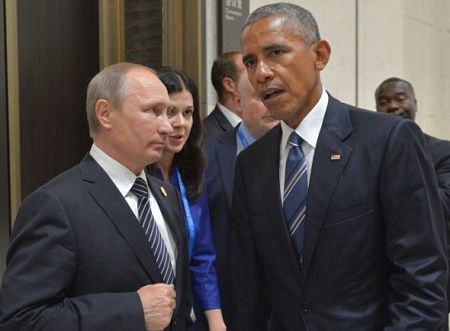
putin_obama_g-20_china

The fledgling “initiatives” reverberating this week in Washington, Moscow, Ankara, Jerusalem and the G20 summit were nothing but distractions from the quiet deals struck by two lead players, Russia and Turkey to seize control of the region’s affairs. Recep Tayyip Erdogan knew nothing would come of his offer on the G20 sidelines to US President Barack Obama to team up for a joint operation to evict ISIS from Raqqa. And, although Moscow was keen on hosting the first handshake in almost a decade between Israeli Prime Minister Binyamin Netanyahu and the Palestinian leader Mahmoud Abbas (Abu Mazen), neither were known to be ready for the last step toward a meeting.

But the game-changing events to watch out for took place in Hangzhou without fanfare – namely, the Obama-Putin talks and the far more fruitful encounter between Putin and Erdogan.

According to DEBKAfile’s intelligence and Mid East sources, Putin virtually shut the door on further cooperation with the United States in Syria. He highhandedly informed Obama that he now holds all the high cards for controlling the Syrian conflict, whereas Washington was just about out of the game.

Putin picked up the last cards, our sources disclose, in a secret deal with Erdogan for Russian-Turkish collaboration in charting the next steps in the Middle East.

The G20 therefore, instead of promoting new US-Russian understanding, gave the impetus to a new Russian-Turkish partnership.

Erdogan raked in instant winnings: Before he left China, he had pocketed Putin’s nod to grab a nice, 4,000-sq.km slice of northern Syria, as a “security zone” under the control of the Turkish army and air force, with Russian non-interference guaranteed.

This Turkish zone would include the Syrian towns of Jarablus, Manjib, Azaz and Al-Bab.

Ankara would reciprocate by withdrawing its support from the pro-US and pro-Saudi rebel groups fighting the Assad army and its allies in the area north of Aleppo.

Turkey’s concession gave Putin a selling-point to buy the Syrian ruler assent to Erdogan’s project. Ankara’s selling-point to the West was that the planned security zone would provide a safe haven for Syrian refugees and draw off some of the outflow perturbing Europe.

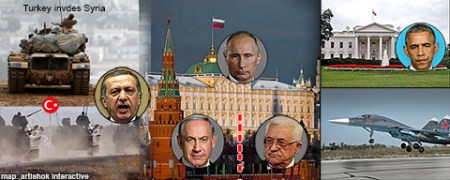
kremlinwhitehouse480

It now turns out that, just as the Americans sold the Syrian Kurds down the river to Turkey (when Vice President Joe Biden last month ordered them to withdraw from their lands to the eastern bank of the Euphrates River or lose US support), so too are the Turks now dropping the Syrian rebels they supported in the mud by re-branding them as “terrorists.”

The head of this NATO nation has moreover gone behind America’s back for a deal with the Russian ruler on how to proceed with the next steps of the Syrian conflict.

Therefore, when US Secretary of State John Kerry met Russian Foreign Minister Sergei Lavrov in Geneva Thursday and Friday, Sept. 8-9, for their sixth and seventh abortive sit-downs on the Syrian issue, there was not much left for them to discuss, aside from continuing to coordinate their air traffic over Syria and the eastern Mediterranean.

Washington and Moscow are alike fearful of an accidental collision in the sky in the current inflammable state of relations between the two powers.

As a gesture of warning, a Russian SU-25 fighter jet Tuesday, Sept 6, intercepted a US Navy P8 plane flying on an international route over the Black Sea. When the Russian jet came as close as 12 feet, the US pilots sent out emergency signals – in vain, because the Russian plane’s transponder was switched off. The American plane ended up changing course.

Amid these anomalies, Moscow pressed ahead with preparations to set up a meeting between the Israeli and Palestinian leaders, as the Russian Foreign Ministry announced Thursday.

Putin is keen to succeed where the Obama administration failed. John Kerry abandoned his last effort at peacemaking as a flop two years ago.  But it is hard to see Netanyahu or Abu Mazen rushing to play along with the Russian leader’s plan to demean the US president in the last months of his tenure – especially when no one can tell who will win the November 8 presidential election – Hillary Clinton or Donald Trump – or what policies either will pursue.

All the region’s actors will no doubt be watching closely to see how Turkey’s “Russian track” plays out and how long the inveterate opportunists can hang together.

Satire?| Obama Ratifies Treaty on Sharia Law

September 4, 2016

Satire?| Obama Ratifies Treaty on Sharia Law, Dan Miller’s Blog, September 4, 2016

(The views expressed in this post are mine and do not necessarily reflect those of Warsclerotic or its other editors. — DM)

Having personally ratified the Iran Scam Treaty and the Climate Change Treaty with China, President Obama today met with Turkish, Saudi and Iranian heads of state to ratify a new treaty making Sharia Law binding in the United States. Please see also, The West Needs Sharia Law – Pakistani cleric. Obama, a renowned constitutional scholar, quickly rejected objections by Senate leaders that “He shouldn’t oughta do that because it’s our job” by reminding them that He is the President and is therefore empowered by the Constitution to do whatever pleases Him.

TOTUS Seal

Here is the text of President Obama’s statement on ratification of the Sharia Law Treaty, provided by The Incomparably Honorable I. M. Totus, Teleprompter of the United States:

My beloved Islamist colleagues, men, women and whatever: today, with great pleasure and a heart-felt desire for a better future for all, I today ratified a treaty with The Republic of Turkey, the Kingdom of Saudi Arabia and the Islamic Republic of Iran making Sharia Law officially binding in America just as it is in those great progressive, humanitarian nations.

As United Nations Secretary General Ban Ki-moon recently stated, the debate about the horrors of man-made climate change is over and the issue is settled. So be it with any debate over My success in preventng Iran from using nuclear weapons and, indeed, over My constitutional powers as your humble President. I have settled those matters as well, as all loyal Americans must agree.

Sharia Law will make America a far happier and better place for all including, most importantly, refugees coming to our shores in increasing numbers from other Islamist nations. I can think of no better way to welcome them than by guaranteeing them the dignity, honor and freedoms under Sharia Law they so richly and justly deserve.

For too long has America based its laws on flawed Judeo-Christian principles. But that’s not who we are; we have a long, honorable and mutually beneficial history with Islam and many if not most of our best citizens are Muslims. The treaty I ratified today will finally put us on the right side of history. It will also facilitate My brilliant countering violent extremism initiative by encouraging an honest discussion of Sharia law, long rejected by “America First” nationalists and other Islamophobes who despise Allah and His one true Religion of Peace.

I am confident that all loyal Americans will be happy to abide by our Sharia Laws; common sense steps will be taken to encourage all to do so. Observers from Turkey, Saudi Arabia and Iran will soon come to America to assist us in implementing whatever encouragements may be needed.

We should all thank the three other splendid freedom loving nations which also ratified the new treaty and encourage all other nations of the world to join us as soon as possible.

Thank you and have a pleasant day.

Hated by many Americans until now, The Islamic Republic of Iran has shown that it is a truly glorious example of Islamist democracy in action, where Sharia Law is enforced, followed and enjoyed by all.

hangings_in_iran

With Obama leading the way as always, we are joining them. Just look at the Iranians depicted in the following Iranian propaganda video! They are proud, happy, peaceful, patriotic and loving despite the shameful efforts of America in the past and, indeed, of some war-mongering Americans today, to humble and destroy them and their beloved nation.

No longer will that happen. The President has spoken! This will be the most beneficial and longest lasting of all of His many great leaps forward to make America a country of which He, His beautiful wife Michelle and all other good people can and will be truly proud.

It is anticipated that President Obama will soon issue an executive order changing the name of the country from The United States of America to The Islamist Republic of Obama. The flag of the new Islamist Republic of Obama will combine the best elements of the flags of the Islamic Republic of Iran, the Republic of Turkey and the Kingdom of Saudi Arabia. A photo of Obama as the bringer of true Islamic peace and understanding will be superimposed over the other flag elements.

Obama:

Obama death to America

Iran:
Iranian flag

Turkey:
Flag_of_Turkey.svg

Saudi Arabia:
saudi flag

Oh well.

what me worry

Germany says Armenia genocide resolution ‘non-binding’ after reports Berlin keen to ‘satisfy’ Turkey

September 2, 2016

Germany says Armenia genocide resolution ‘non-binding’ after reports Berlin keen to ‘satisfy’ Turkey

Published time: 2 Sep, 2016 09:02 Edited time: 2 Sep, 2016 11:38

Source: Germany says Armenia genocide resolution ‘non-binding’ after reports Berlin keen to ‘satisfy’ Turkey — RT News

FILE PHOTO: The year 1915 is formed with candles during a memorial march by Armenians in front of the Brandenburg Gate © Fabrizio Bensch / Reuters

Germany’s foreign minister has said the Bundestag resolution recognizing the 1915 massacre of Armenians in the Ottoman Empire as genocide is “non-binding,” following media reports the German cabinet would disavow the resolution so as to continue using Turkey’s Incirlik airbase.

“The German parliament naturally has the right and the freedom to pass any resolution it likes, but the Bundestag itself has said that not every resolution is legally binding,” Foreign Minister Frank-Walter Steinmeier was quoted by Reuters as saying on Friday.

Earlier in the day, Spiegel said in an unsourced report that the Foreign Ministry and the Chancellery are likely to give cabinet spokesman Steffen Seibert the green light to make a public statement distancing the government from the resolution.

“There can be no talk of the German government distancing itself from the Armenia resolution,” Seibert told reporters at a planned news conference shortly after the magazine broke the news. He also said the resolution is not legally binding.

The resolution, adopted by German MPs on June 2, formally calls the 1915 massacre of ethnic Armenians by the Ottoman Turkish forces “genocide.” The vote was almost unanimous, and was met with delight by Armenian communities worldwide.

Ankara responded with a threat of retaliatory measures and denied German MPs access to Incirlik Airbase, used by Germany for the US-led campaign against the Islamic State (IS, formerly ISIS/ISIL).

In June, the Bundeswehr, Germany’s military, was seeking an alternative airbase in Cyprus or Jordan, while Social Democrats, the junior members of Chancellor Angela Merkel’s coalition government, demanded the jets and troops to be withdrawn by the end of the year.

As ties between Ankara and Berlin deteriorated rapidly, German MPs of Turkish origin who voted for the resolution reportedly began to receive death threats and were advised not to travel to Turkey for safety reasons.

According to the Spiegel report, Martin Ederer, the Foreign Ministry’s state secretary, and Andreas Michaelis, chief of the ministry’s political staff, have negotiated with the Turkish government in Ankara over the past few weeks to “find solution” to the crisis.

They have been told by the Turks that Ankara expects the resolution on Armenian genocide to be disavowed publicly.

To comply with the controversial deal, government spokesman Seibert would state that the parliament’s resolution is “non-binding for the German government…being a political declaration, not a legal document,” according to the magazine.

Seibert has been chosen as an appropriate second-tier figure after domestic debates on who would make the controversial statement on behalf of the government. The candidacies of Foreign Minister Frank-Walter Steinmeier and Chancellor Merkel were not considered at all, because that could be viewed as “servility” by President Recep Tayyip Erdogan.

Disavowing the recognition of Armenian genocide would become a “political gesture” enough to “satisfy” the Turkish government, Spiegel wrote, citing internal negotiations in Ankara.

In the meantime, the alleged statement would mean no change to Berlin’s attitude towards the Armenian genocide as Merkel and Steinmeier have always viewed the adoption of the resolution as a bad idea, the magazine stated.

Later on Friday, Chancellor Merkel told German MPs that she has not distanced herself from the resolution on Armenian genocide, according to Reuters.

Volker Kauder, the head of the CDU faction in the parliament, told his fellow party members that he had spoken with Merkel and she had emphasized her position, Reuters cited sources who attended the meeting.

Kauder said that Merkel noted that she had voted to support the resolution during a party meeting before the June vote, although she was not present when the resolution was adopted by the parliament.

“Liberal” Turkey Claims Europe Is Racist

September 1, 2016

“Liberal” Turkey Claims Europe Is Racist, Gatestone InstituteBurak Bekdil, September 1, 2016

♦ “There is no such religion as Christianity … In reality, Jesus Christ was a Muslim coming from Jewish tradition … The name of the religion revealed to Christ was Islam …” — Abdurrahman Dilipak, columnist, Yeni Akit.

♦ In Turkey, not even the smallest village of a few hundred inhabitants has a non-Muslim mayor.

♦ Against this embarrassing background, Turkey is accusing Europe of being racist. That would be like North Korea accusing Europe of being a rogue state.

It’s not a bad joke; it’s a very bad joke. Turkey, where all variants of ethnic and religious xenophobia are a national pastime, is accusing the West of being racist.

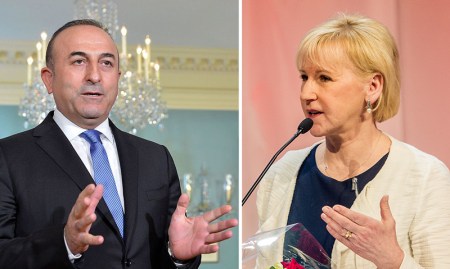
Speaking after a spat with Austria and Sweden over news reports and tweets from those countries that accused Turkey of allowing sex with children under the age of 15, Turkish Foreign Minister Mevlut Cavusoglu claimed that the behavior of European countries reflected the “racism, anti-Islamic and anti-Turkish (trend) in Europe.”

He is talking about the same Europe where the inhabitants of one of its biggest cities, London, recently elected a Muslim as its mayor. In Turkey, not even the smallest village of a few hundred inhabitants has a non-Muslim mayor.

1831Turkish Foreign Minister Mevlut Cavusoglu (left) blasted European countries for “racism, anti-Islamic and anti-Turkish (trend),” partly in response to a tweet by Swedish Foreign Minister Margot Wallstrom (right) that read: “Turkish decision to allow sex with children under 15 must be reversed. Children need more protection, not less, against violence, sex abuse.”

In “racist” Austria, the police immediately arrested two suspects in connection with an attempt to set fire to a Turkish cultural center in the northern Austrian town of Wels — and at a time of rising tensions with Turkey. By contrast, Turkish law enforcement officials arrested five former gendarmerie intelligence officers just recently — nine years after the murder of Turkish-Armenian journalist Hrant Dink. These officers would probably never have been implicated if the two Islamist allies, President Recep Tayyip Erdogan’s ruling Justice and Development Party (AKP) and Fethullah Gulen, his staunchest political ally when Dink was assassinated, had not turned into each other’s worst nemesis in power-sharing fight in 2013.

Yeni Akit is an Islamist newspaper and one of Erdogan’s media darlings, a kind of Turkish Pravda in its fanatical support of the president. Its editors always find a seat in the elite group of journalists who accompany the president in his private jet traveling to foreign capitals.

Recently, one of Yeni Akit’s most prominent columnists, Abdurrahman Dilipak wrote:

“There is no such religion as Christianity … In reality, Jesus Christ was a Muslim coming from Jewish tradition … The name of the religion revealed to Christ was Islam … Christianity is nothing more than a cultural adherence … Judaism is already a tradition that has imprisoned itself to its own race … [Jews’] fears are as big as their rage.”

Funny, Dilipak is an Islamist and his holy book acknowledges the two monotheistic religions he denies.

In another column, Dilipak claimed that “there is no such thing as the Greek nation or the Greek civilization.” Then, in following lines that exhibit typically an Islamist’s confused mind, he claims that “the Greek civilization is a civilization of … plagiarism.”

Yeni Akit did not need to hide its racism even in the aftermath of a bloodshed the entire world — except Islamist- denounced. In July, in Nice, France, shortly after the Islamist terror attack that killed more than 80 civilians, the newspaper’s headline read: “France, the perpetrator of genocide in Africa, deserves worse.”

Yeni Akit is a perfect reflection of Turkey’s popular and official racism. In March, when a jihadist suicide bomber killed three Israelis and one Iranian on a busy Istanbul street, Irem Aktas, head of the women’s and media division of the AKP branch in Istanbul’s Eyup district, commented on social media that: “Let the Israeli citizens be worse, I wish they all died.” When she wrote that in her Twitter account, at least 11 Israeli citizens injured by the bomb were being treated at Turkish hospitals. She was not prosecuted for her remarks that “wished death” to injured Israelis.

Turkey’s religious — and ethnic — xenophobia can take amusing turns, too. In September 2015, Turkish authorities banned showing religious symbols and playing music related to various religions at yoga centers. They said that having Buddha sculptures and mantra symbols, as well as playing religious music and burning incense, could be considered violations which could lead to the closure of these centers.

About a month before Turkey’s war on the “religion of yoga,” the country’s top religious body, the Religious Affairs General Directorate, issued a warning about the spreading of the new “religion” of Jediism” — the religion of the Jedi warriors in the Star Wars series. “Jediism … is spreading today in Christian societies. Around 70,000 people in Australia and 390,000 people in England currently define themselves as Jedis,” the article said, before engaging in an Islamic-based critique of a number of Hollywood blockbusters.

Against this embarrassing background, Turkey is accusing Europe of being racist. That would be like North Korea accusing Europe of being a rogue state.

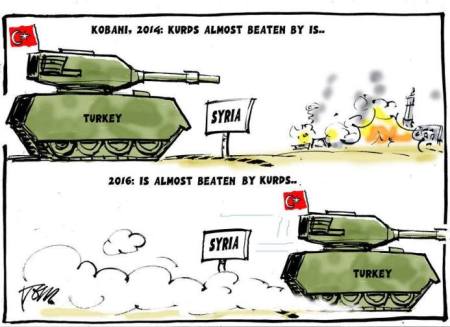
Cartoons of the Day

August 31, 2016

H/t Joop

is kurds


H/t Indyfromaz

extremists (1)


H/t Vermont Loon Watch

separated-at-mirth-1


Turkish EU bid ‘unrealistic’ while Erdogan in power – European commissioner

August 30, 2016

Turkish EU bid ‘unrealistic’ while Erdogan in power – European commissioner

Published time: 30 Aug, 2016 13:28 Edited time: 30 Aug, 2016 17:20

Source: Turkish EU bid ‘unrealistic’ while Erdogan in power – European commissioner — RT News


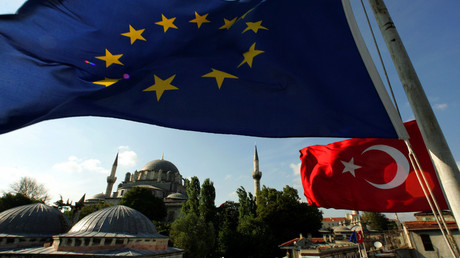
Turkey is unlikely to join the European Union as long as its president remains in office, a top official from the bloc has said, adding that Ankara’s bid will be an issue for negotiations “for the time after Erdogan.”

In the current circumstances Turkey’s EU accession “is not realistic all through the next decade,” Guenther Oettinger, the European Commissioner for Digital Economy and Society, told Bild newspaper on Tuesday.

“This will surely be an issue [for discussion] for the time after [President Recep Tayyip] Erdogan,” he said. The official added, however, that Ankara is an important geostrategic and economic partner for the EU, and keeping good bilateral ties is critical.

German Vice Chancellor and Economy Minister Sigmar Gabriel has also previously dismissed the Turkish accession bid, which started in 2005. Speaking to reporters in early June, he said Europe was not in a position to admit “even a small state” to its 28-nation ranks, according to the broadcaster Deutsche Welle (DW).

“The illusion … here comes someone to soon become a full member in the EU … that’s complete nonsense … that will not eventuate,” he was quoted as saying by DW.

Talks between Ankara and Brussels on Turkey’s EU membership have not been smooth, with Turkey linking the progress in discussions on granting visa-free travel for its nationals to its contribution to a controversial refugee deal.

In turn, the EU cites 72 conditions on issues such as the rule of law and human rights to be implemented by Turkey for lifting the visa requirements. A number of prominent European officials have accused Turkey of “blackmailing” Brussels or even behaving “like at a bazaar” by trying to raising the stakes.

European officials say that although Turkey has fulfilled most of the 72 conditions, it has failed to comply with the most important one, which is to relax its strict anti-terrorism laws, said to have been used to silence Erdogan’s critics.

Ankara maintains that it is Brussels which has not stuck to the initial arrangements and has failed to meet its own obligations.

In a July interview with the German broadcaster ARD, President Erdogan said that Turkey had so far received only €2 billion (US$2.23 billion) of the promised €3 billion as part of the refugee deal. “European leaders are dishonest,” he said. “We have stood by our promise. But have the Europeans kept theirs?”

Last month, top Turkish officials also threatened to withdraw from the controversial refugee deal which Brussels hopes will help stem the huge flow of migrants into the EU.

“If visa liberalization does not follow, we will be forced to back away from the deal on taking back [refugees] and the agreement of March 18,” Mevlut Cavusoglu, the Turkish foreign minister, told Frankfurter Allgemeine Zeitung in an interview.

“It can be early or mid-October, but we are waiting for an exact date,” he said.

Erdogan tells US: Stop backing the Kurds

August 30, 2016

Erdogan tells US: Stop backing the Kurds, DEBKAfile, August 30, 2016

5 (1)

US-Turkish discord over the Turkish army’s onslaught on the Kurds of northern Syria reached a new low Wednesday, Aug. 30, when the presidential palace spokesman Ibrahim Kalin said in Ankara: “The US must revise its policy of supporting Kurdish forces.”

The demand came after a senior US official called on “all the armed actors in the fight against the Islamic State in northern Syria to stand down,” in an effort to contain the new conflict dragging northern Syria into further chaos.

The call was addressed equally to Ankara to freeze its military operations in Syria and to the Kurdish PYD-YPG militia to halt the flow of fraternal reinforcements for defending Mabij, the Syrian town the militia wrested from ISIS earlier this month with US assistance.

DEBKAfile’s military sources report that the Turkish army and Kurdish forces are already tensely aligned for a decisive battle over Manbij that will determine the outcome of the Turkish invasion of Aug. 24. President Tayyip Erdogan calculates that a Turkish victory will force the Kurds to retreat to the eastern bank of the Euphrates and away from the Turkish border, while Kurdish leaders are determined to halt the Turkish army at the gates of the town, and so brand the invasion a fiasco and carry off an epic victory.

The Obama administration is making a huge effort to avert this confrontation. In the hope of reining in the Turks, Vice President Joe Biden arrived in Ankara on the day their army crossed the Syrian border and met them halfway by issuing an ultimatum to the Kurds to withdraw to east of the Euphrates or else lose US support.

Unheeding of the US warning, the Kurds went forward to build up their fighting strength and engage the Turkish army.

Ankara suspects that the Americans are continuing notwithstanding to give the Kurds weapons and assistance on the quiet.

Washington fears that a Turkish-Kurdish showdown in Manbij will further destabilize the military situation such as it is in northern Syria and northern Iraq, and all their efforts to persuade the Kurds to lead the ground forces of the coalition offensives against ISIS will go for nothing.

In an earlier report on Monday, DEBKAfile covered the conflict between Turkey and the Kurds as it unfolded after the Turkish invasion.

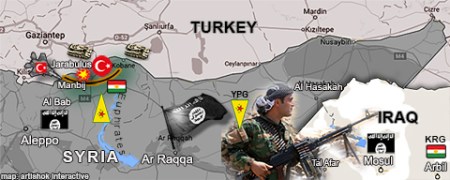
An all-out Turkish-Kurdish war has boiled over in northern Syria since the Turkish army crossed the border last Wednesday, Aug. 24 for the avowed aim of fighting the Islamic State and pushing the Syrian Kurdish YPG militia back. Instead of falling back, the Kurds went on the offensive and are taking a hammering. This raging confrontation has stalled the US-led coalition offensive against ISIS and put on indefinite hold any US plans for campaigns to drive the jihadists out of their Syrian and Iraqi capitals of Raqqa and Mosul.

The Kurdish militia ground troops, who were backed by the US and assigned the star role in these campaigns, are now fully engaged in fighting Turkey. And, in another radical turnaround, Iraqi Kurdish leaders (of the Kurdish Regional Republic) have responded by welcoming Iran to their capital, in retaliation for the US decision to join forces with Turkey at the expense of Kurdish aspirations.

The KRG’s Peshmerga are moreover pitching in to fight with their Syrian brothers. Together, they plan to expel American presence and influence from both northern Syria and northern Iraq in response to what they perceive as a US sellout of the Kurds.

DEBKAfile’s military analysts trace the evolving steps of this escalating complication of the Syrian war and its wider impact:

  • Since cleansing Jarablus of ISIS, Turkey has thrown large, additional armored and air force into the battle against the 35.000-strong YPG Kurdish fighters. This is no longer just a sizeable military raid, as Ankara has claimed, but a full-fledged war operation. Turkish forces are continuing to advancing in three directions and by Sunday, Aug. 28 had struck 15-17km deep inside northern Syria across a 100km wide strip.
    Their targets are clearly defined: the Kurdish enclave of Afrin in northwest Syria and the Kurdish enclave of Qamishli and Hassaka in the east, in order to block the merger of Kurdish enclaves into a contiguous Syrian Kurdish state.
    Another goal was Al-Bab north of and within range of Aleppo for a role in a major theater of the Syrian conflict. To reach Al-Bab, the Turkish force would have to fight its way through Kurdish-controlled territory.
  • The Turks are also using a proxy to fight the Syrian Kurds. Thousands of Syrian Democratic Army (SDF) rebels, whom they trained and supplied to fight Syria’s Bashar Assad army and the Islamic State, have been diverted to targeting the Kurds under the command of Turkish officers, to which Turkish elite forces are attached.
  • A Turkish Engineering Corps combat unit is equipped for crossing the Euphrates River and heading east to push the Kurds further back. Contrary to reports, the Turkish have not yet crossed the river itself or pushed the Kurds back – only forded a small stream just east of Jarablus. The main Kurdish force is deployed to the south not the east of the former ISIS stronghold.
KurdishWar480
  • Neither have Turkish-backed Syrian forces captured Manbij, the town 35km south of Jarablus which the Kurds with US support captured from ISIS earlier this month. Contrary to claims by Ankara’s spokesmen, those forces are still only 10-15km on the road to Mabij.
  • Sunday, heavy fighting raged around a cluster of Kurdish villages, Beir Khoussa and Amarneh, where the Turks were forced repeatedly to retreat under Kurdish counter attacks. Some of the villages were razed to the ground by the Turkish air force and tanks. At least 35 villagers were reported killed.
  • In four days of fierce battles, the Kurds suffered 150 dead and the Turkish side, 60.
  • DEBKAfile military sources also report preparations Sunday to evacuate US Special Operations Forces and helicopter units from the Rmeilan air base near the Syrian-Kurdish town of Hassaka. If the fighting around the base intensifies, they will be relocated in northern Iraq.
  • Fighters of the Iraqi-Kurdish Peshmerga were seen removing their uniforms and donning Syrian YPG gear before crossing the border Sunday and heading west to join their Syrian brothers in the battle against Turkey.
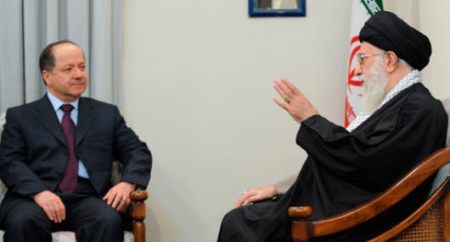
  • The KRG President Masoud Barazani expects to travel to Tehran in the next few days with an SOS for Iranian help against the US and the Turks. On the table for a deal is permission from Irbil for the Iranian Revolutionary Guards to win their first military bases in the Iraqi Kurdish republic, as well as transit for Iranian military forces to reach Syria through Kurdish territory..