Posted tagged ‘Islamic supremacy’

What do they have in common?

December 9, 2015

What do they have in common? inthebullpen via You Tube, March 4, 2007

(It’s a very difficult question, to which even Obama doesn’t have an answer. But be of good cheer. Perhaps some fine day, when we have enough Muslims to evaluate in Obama’s America, we will learn the answer. — DM)


Dispelling the ‘Few Extremists’ Myth – the Muslim World Is Overcome with Hate

December 8, 2015

Dispelling the ‘Few Extremists’ Myth – the Muslim World Is Overcome with Hate, National Review, David French, December 7, 2015

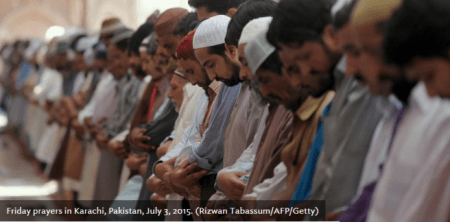
friday-prayersFriday prayers in Karachi, Pakistan, July 3, 2015. (Rizwan Tabassum/AFP/Getty)

It is simply false to declare that jihadists represent the “tiny few extremists” who sully the reputation of an otherwise peace-loving and tolerant Muslim faith. In reality, the truth is far more troubling — that jihadists represent the natural and inevitable outgrowth of a faith that is given over to hate on a massive scale, with hundreds of millions of believers holding views that Americans would rightly find revolting. Not all Muslims are hateful, of course, but so many are that it’s not remotely surprising that the world is wracked by wave after wave of jihadist violence.

To understand the Muslim edifice of hate, imagine it as a pyramid — with broadly-shared bigotry at the bottom, followed by stair steps of escalating radicalism — culminating in jihadist armies that in some instances represent a greater share of their respective populations than does the active-duty military in the United States.

The base of the pyramid, the most broadly held hatred in the Islamic world, is anti-Semitism, with staggering numbers of Muslims expressing anti-Jewish views. In 2014, the Anti-Defamation League released the results of polling 53,100 people in 102 countries for evidence of anti-Semitic attitudes and beliefs. The numbers from the majority-Muslim world are difficult to believe for those steeped in politically correct rhetoric about Islam. A full 74 percent of North African and Middle Eastern residents registered anti-Semitic beliefs, including 92 percent of Iraqis, a whopping 69 percent of relatively secular Turks, and 74 percent of Saudis.

The trend toward Muslim anti-Semitism continues even when Muslim nations are far removed from the Arab–Israeli conflict. A solid majority — 61 percent — of majority-Muslim Malays harbor anti-Semitic attitudes, while only 13 percent of neighboring majority-Buddhist Thais are anti-Jewish.

The next level of the pyramid is Muslim commitment to deadly Islamic supremacy. In multiple Muslim nations, overwhelming majorities of Muslims support the death penalty for apostasy or blasphemy. Collectively, this means that hundreds of millions of men and women support capital punishment for the exercise of the basic human rights of freedom of expression and free exercise of religion:

death-penalty-for-leaving-islam

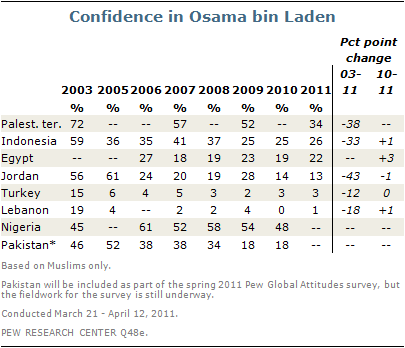
Moving beyond Islamic supremacy to the next step of the pyramid, enormous numbers of Muslims are terrorist sympathizers. It is still stunning to see how popular Osama bin Laden was early last decade, and even as his popularity plunged (as he grew weaker and more isolated), his public approval remained disturbingly high:

confidence-in-osama-bin-laden

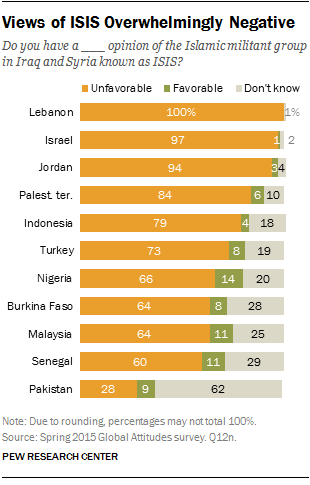
But what about ISIS — the world’s most savage and deadly terror organization? The latest polling data show that while a majority of Muslims reject ISIS, extrapolating from the populations of polled countries alone shows that roughly 50 million people express sympathy for a terrorist army that burns prisoners alive, throws gay men from buildings, and beheads political opponents. In Pakistan a horrifying 72 percent couldn’t bring themselves to express an unfavorable view of ISIS:

views-of-isis-overhelmingly-negative

But sympathy for terror is different from active support, and here’s where the numbers are difficult to pin down. I know of no reliable database that shows how many Muslims give to jihadist charities, spread jihadist propaganda on social media, support radical preachers, or otherwise take concrete actions to advance the terrorists’ cause. We do know, for example, that anti-Israel terrorism is so popular in Saudi Arabia that a telethon once raised $100 million to support the 2002 intifada. Shows of support included this charming scene:

A 6-year-old boy, with a plastic gun slung over his shoulder and fake explosives strapped around his waist, walked into a donation center and made a symbolic donation of plastic explosives, according to Al Watan daily.

It is from this fertile soil that jihadists grow. And here the numbers decisively belie the “few extremists” rhetoric. In Iran alone, the Revolutionary Guard represents a proportionate share of the population similar to the combined strength of the active-duty Army and Marines here in the United States. Between Boko Haram, the Al-Nusra front, ISIS, Hezbollah, Hamas, al-Qaeda, the Taliban, Yemeni militias, Libyan militias, and many others, the number of active jihadists numbers in the hundreds of thousands; some estimates indicate that 100,000 are fighting in Syria alone.

Interfaith dialogue is more urgent today than any time: professor

December 8, 2015

Interfaith dialogue is more urgent today than any time: professor, Tehran Times, Javad Heirannia, December 8, 2015

(Did Nader Entessar  ghost write parts of Obama’s December 6th address to the nation? — DM)

TEHRAN – Regarding Ayatollah Ali Khamenei’s second letter to the Western youth in which he called terrorism “our common enemy”, Professor Nader Entessar says it is necessary to counter “Islamophobia no matter where it emanates”.

In part of his letter issued on November 29, the Leader of Islamic Revolution said: Anyone who has benefited from affection and humanity is affected and disturbed by witnessing these [terrorist] scenes- whether it occurs in France or in Palestine or Iraq or Lebanon or Syria.

Entessar, professor and chair of political science at South Alabama University, tells the Tehran Times that “interfaith dialogue is more urgent today than any time in the past fifty or sixty years.”

Following is the text of the interview:

Q: Ayatollah Khamenei in his second letter to the Western youth has talked about terrorism and its roots. What is the importance of this issue?

A: Terrorism has been a major global scourge for some time now. Although the term “terrorism” is used extensively by journalists, pundits and politicians, there is no universal agreement on what terrorism is. There is certainly a need for a dispassionate treatment of this phenomenon and its root causes if one is serious about confronting the threat of terrorism in today’s world.

Q: Ayatollah Khamenei has emphasized in his message that Islam is the religion of friendship, however why do some try to equate Islam with violence?

A: In the West, Islam has become a political buzzword for politicians and political parties of differing ideological stripes to advance their personal agenda. In many ways, the term “Islam” has replaced communism as a rallying cry against which many politicians in the West can coalesce and advance their electoral agendas. For example, the Republican Party in the United States has incorporated Islamophobia as an essential part of its 2016 presidential campaign. In addition, the same trend can be witnessed at state and local elections as well where running against “Islam” has become a badge of honor for many U.S. politicians.

Q: Why do some try to associate Islam with terrorism whenever a terrorist act happens?

A: The emergence of such violent groups as al-Qaeda and Daesh in recent years and their terrorist campaigns under the guise of “Islam” has given a field day to the Islamophobes to advance their message. Unfortunately, the thrust of Islamophobia is not limited to extremist groups in the West. Several liberal groups and personalities have also jumped on the anti-Islam bandwagon in many Western countries. Again, as I previously indicated, it pays political dividends to adopt an anti-Islam posture in the West. Being an anti-Muslim bigot is relatively cost-free but may bring political advantages to a politician or would-be politician in several Western countries.

Q: What is the importance of Ayatollah Khamenei’s letter at this juncture of time?

A: It is very important to confront Islamophobia no matter where it emanates. Interfaith dialogue is more urgent today than any time in the past fifty or sixty years. Therefore, leaders of religious faith groups have a special responsibility to try to reach to other faith communities and highlight what unites the human race in order to promote the common good.

*********

[highlight]

“In the West, Islam has become a political buzzword for politicians and political parties of differing ideological stripes to advance their personal agenda,” Entessar says in an interview with the Tehran Times.

Op-Ed: Post San Bernardino — How stupid are we supposed to be?

December 7, 2015

Op-Ed: Post San Bernardino — How stupid are we supposed to be? Israel National News, Jack Engelhard, December 7, 2015

A house filled with some 2,000 rounds of ammunition and nobody saw nothin’. Zip.

The place was crawling with a massive arsenal of weapons that likely filled the garage to the kitchen sink — but who, me?

Nothing. Looked pretty normal, say relatives, friends, acquaintances and anybody who visited a house that was stockpiled for mass destruction.

Even people who lived in and around the house – WHAT? We saw nothing unusual.

They had to step over and around a mountain of Improvised Explosive Devices (IED) to get from the living room to the bathroom, but nobody winced?

Nobody asked – “Yo, Syed, what’s this?”

That’s what we are supposed to believe. Nobody else but those two had a hand in the murder of 14 innocents in San Bernardino.

Accomplices? Zero. So they say and so we are expected to believe.

Mr. Obama spoke to us a few moments ago. Finally called it terrorism, though not Islamic terrorism. For us to guess.

He announced that he is taking the fight to ISIS. We should feel safe. Except that ISIS, or ISIL, as he calls it, is one problem.

Worse is the local, the unaffiliated but radicalized freelancer who comes from within our own neighborhood.

We know where ISIS lives. But for the introvert, the retail operator we have no address until it’s too late. Case in point, San Bernardino.

We are not at war with Islam, said the president, so no wonder people who knew the Farooks were shocked…shocked!

Typical Americans, say people who knew them.

Quiet. Unassuming. Friendly. Hard-working, Doting father. Loving mother. Played Scrabble. How do you spell jihad? Capital J?

There were no clues. Nope. Nothing to suggest a husband and wife radicalized to the hilt and armed to the teeth.

“They lived the American dream,” said a neighbor, who likewise saw nothing, knew nothing, suspected nothing. Nothing at all.

Golly, he was born here, good old Syed. What more do you want? Wife came from Pakistan. Wonderful country, Pakistan.

So what if, as rumor has it, he hated Jews and maybe Christians. Doesn’t everybody? A regular Joe, Syed.

She kept to herself, did Tashfeen. All agree to this. Typical American wifey in a hijab. Most likely clipped coupons to save on milk and explosives.

“They were the perfect couple,” say people who knew them as the perfect couple.

Too bad it had to end like this. Obviously it was our fault. Global warming.

So the president assures us that he is keeping us safe.

Ban Radical Islamists and those Syrian migrants from entering the country and we’ll start believing.

Breaking down Obama’s gun control terror denial speech

December 7, 2015

Breaking down Obama’s gun control terror denial speech, Front Page Magazine, Daniel Greenfield, December 6, 2015

(Please see also, Satire | Advance copy of Obama’s Sunday address on the San Bernardino killings. — DM)

obama-wears-tan-suit-149481242256_1

Barack Hussein Obama II will stop striding around golf courses, Disneyland, pricey restaurants and assorted other photo ops long enough to sit down in the Oval Office and deliver a speech denying responsibility for the latest act of Muslim terror, denying that Muslim terrorism exists and demanding the abolition of the Bill of Rights.

It will predictably break down as

1. Muslims are Awesome – The Muslim community is our greatest resource for fighting terrorism, we need more of them, including tens of thousands of Syrian “refugees” (13% of whom poll in support of ISIS), to make us that more able to fight the “Un-Islamic” terrorism of Muslims. Anyone who disagrees loves terrorists and probably Hitler and discount cheese sandwiches.

2. Fear – We need to stop being afraid of Muslim terrorists because Obama has everything under control. ISIS is contained, except when it’s murdering Americans and Europeans, and expanding around the world. Muslim terrorism has nothing to do with Islam. Our greatest enemy is fear of Muslim terrorism which we can only combat with hefty doses of denial.

3. Gun Control – We need to give up our civil liberties to fight these un-Islamic terrorists (who have hijacked a great religion and flown into two skyscrapers and the Pentagon). It’s time for “common sense reforms” to outlaw the Second Amendment. Also we should bring Muslim terrorists to America, but deny 2nd amendment rights to anyone on a no-fly list… without actually deporting them.

Did I mention that these are “common sense reforms” that most “ordinary folks” like Washington D.C. lobbyists and Michael Bloomberg support?

4. Not Who We Are – Fighting Muslim terrorism is not “who we are”. We are more like the Swedes. We fill our country with Muslims who want to kill us and then double down on it after the latest attacks. Because these are our new “values”. We aren’t “afraid” of Muslim terrorists. That’s why we just stick our heads in the sand and double down on the same terror policies. We could change them, but that would not be who, Obama claims, “we are”.

Who are we? We are people who commit mass suicide. Who invite our enemies to kill us and then blame ourselves for offending them. That is Obama’s version of who we are.

5. Personal Stories – Pete from Cleveland is standing outside a mosque with a Nerf gun to guard it against imaginary hate crimes. Ahmed is fighting extremism in his mosque while shouting Allahu Akbar at Hamas rallies. Mohammed is sitting in the White House tweeting against ISIS and in support of the Muslim Brotherhood. Together they’ll defeat ISIS or America. Or something.

6. Someday We’ll Beat ISIS – Okay probably not today or tomorrow. But we have some of our best minds on it. And we’re making gains. Our policy of not really fighting ISIS is supported by political appointees like random Pentagon general and local police chief who attends mosque dinners. Go back to shopping at Whole Foods without fear. Obama has this covered. Right before his next vacation.

The logic of Islamic intolerance

December 2, 2015

The logic of Islamic intolerance, Front Page MagazineRaymond Ibrahim, December 2, 2015

we_1

A sermon delivered by popular Saudi Sheikh Muhammad Salih al-Munajjid clearly demonstrates why Western secular relativists and multi culturalists—who currently dominate media, academia, and politics—are incapable of understanding, much less responding to, the logic of Islamic intolerance.

During his sermon, al-Munajjid said that “some [Muslim] hypocrites” wonder why it is that “we [Muslims] don’t permit them [Western people] to build churches, even though they allow mosques to be built.”  The Saudi sheikh responded by saying that any Muslim who thinks this way is “ignorant” and

Wants to equate between right and wrong, between Islam and kufr [non-Islam], monotheism and shirk [polytheism], and gives to each side equal weight, and wants to compare this with that, and he asks: “Why don’t we build them churches like they build us mosques? So we allow them this in return for that?”  Do you want another other than Allah to be worshiped?  Do you equate between right and wrong? Are Zoroastrian fire temples, Jewish temples, Christian churches, monks’ monasteries, and Buddhist and Hindu temples, equal to you with the houses of Allah and mosques? So you compare this with that? And you equate this with that?  Oh! Unbelievable, for he who equates between Islam and kufr [non-Islam], and Allah said: “Whoever desires a religion other than Islam, never will it be accepted from him, and in the Hereafter he will be among the losers” (Koran 3:85).  And Prophet Muhamad said: “By Him in whose hand is the life of Muhamad (By Allah) he who amongst the Jews or Christians hears about me, but does not affirm his belief in that which I have been sent, and dies in his state (of disbelief), he shall be of the residents of Hellfire.”

What’s interesting about the sheikh’s zealous diatribe is that, although “intolerant” from a Western perspective, it is, in fact, quite logically consistent and reveals the wide gap between Islamic rationalism and Western fantasy (despite how oxymoronic this dichotomy might sound).

If, as Munajjid points out, a Muslim truly believes that Islam is the only true religion, and that Muhammad is its prophet, why would he allow that which is false (and thus corrupt, cancerous, misleading, etc.) to exist alongside it?  Such gestures of “tolerance” would be tantamount to a Muslim who “wants to equate between right and wrong,” as the sheikh correctly deplores.

Indeed, not only does Islam, like traditional Christianity, assert that all other religions are wrong, but under Islamic law, Hindus, and Buddhists are so misguided that they must be warred against until they either accept the “truth,” that is, converting to Islam, or else being executed (Koran 9:5). As for the so-called “people of the book”—Jews and Christians—they may practice their religions, but only after being subdued (Koran 9:29) and barred from building or renovating churches and synagogues and a host of other debilitations that keep their (false) religious practices and symbols (Bibles, crosses, etc.) suppressed and out of sight.

From an Islamic paradigm—where Allah is the true god and Muhammad his final messenger—“intolerance” for other religions is logical and difficult to condemn.

The “altruistic” aspect of Islamic “intolerance” is especially important.  If you truly believe that there is only one religion that leads to paradise and averts damnation, is it not altruistic to share it with humanity, rather than hypocritically maintaining that all religions lead to God and truth?

After blasting the concept of interfaith dialogue as beyond futile, since “what is false is false—even if a billion individuals agree to it; and truth is truth—even if only one who has submitted [a Muslim] holds on to it,” the late Osama bin Laden once wrote that “Battle, animosity, and hatred—directed from the Muslim to the infidel—is the foundation of our religion. And we consider this a justice and kindness to them” (The Al Qaeda Reader, pgs. 42-43).

Note the altruistic justification: It is a “justice and kindness” to wage jihad on non-Muslims in the hopes that they convert to Islam.  According to this logic, jihadis will always be as the “good guys”—meaning that terrorism, extortion, sex-jihad, etc., will continue to be rationalized away as ugly but necessary means to altruistic ends: the empowerment of, and eventual world conversion to, Islam.

All of this logic is alien to postmodern Western epistemology, which takes for granted that a) there are no objective “truths,” certainly not in the field of theology, and that b) religion’s ultimate purpose is to make this life as peaceful and pleasant as possible (hence why “interfaith dialogue” in the West is not about determining the truth—which doesn’t exist anyway—but finding and highlighting otherwise superficial commonalities between different religions so they can all get along in the now).

The net result of all this? On the one hand, Muslims, who believe in truth—that is, in the teachings of Islam—will continue attacking the “false,” that is, everything and everyone un-Islamic.  And no matter how violent, Islamic jihad—terrorism—will always be exonerated in Muslim eyes as fundamentally “altruistic.” On the other hand, Western secularists and multiculturalists, who believe in nothing and deem all cultures and religions equal, will continue to respect Islam and empower Muslims, convinced that terrorism is an un-Islamic aberration destined to go away—that is, they will continue disbelieving their own eyes.  Such is the offspring of that unholy union between Islamic logic and Western fallacy.

The New French “Résistance”

December 2, 2015

The New French “Résistance,” Gatestone InstituteGuy Millière, December 2, 2015

  • Some spoke of “resistance,” but to them, resistance meant listening to music. A man on a talk show said he was offering “free hugs.”
  • A French judge, Marc Trevidic, in charge of all the major Islamic terrorism cases over the last ten years, said a few days before the November attacks in Paris that the situation was “getting worse” and that “radicalized groups” could “carry out attacks resulting in hundreds of deaths.” He was quickly transferred to a court in northern France, where he has been assigned to petty crimes and divorce cases.
  • All the French political leaders know that the situation is out of control, but not one will say so publicly. Not one has asked the government why it took almost three hours for the police to intervene during the attack at the Bataclan Theater, where 89 people were murdered and over 200 wounded.
  • France’s political leaders are apparently hoping that people will get used to being attacked and learn to live with terrorism. In the meantime, they are trying to divert the attention of the public with — “climate change!”

Several weeks have passed since Islamist attackers bloodied Paris. France’s President François Hollande is describing the killers as just “a horde of murderers” acting in the name of a “mad cause.” He adds that “France has no enemy.” He never uses the word “terrorism.” He no longer says the word “war.”

France never was, in fact, at war. Police were deployed on the streets. Special Forces had to “intervene” a few days later in the Paris suburb of Saint-Denis. That was it.

French forces did bomb positions of the Islamic State in Syria; and Hollande traveled the world to find coalition, but could not. Now he says he wants to turn a page. The French public seems to want to turn a page, too.

From the beginning, pacifism and appeasement filled the air. A German pianist came to playJohn Lennon’s Imagine in front of the Bataclan Theater; since then, other pianists have come. On the Place de la République, people assemble every evening to sing more songs by the Beatles: All You Need Is Love; Love Me Do. Candles are lit, and banners deployed, calling for “universal brotherhood.”

Those invited to speak on TV about what happened allude to “senseless acts.” They do not blame anyone.

Some spoke of “resistance,” but to them, resistance meant listening to music. To others, it meant having a drink with friends in a bar. In a widely circulated video, a man tries to reassure his child. “They have guns,” he mutters, “but we have flowers.”

Heart-shaped stickers are posted on mosques. Words such as “We love you” and “We share your pain” are written on the hearts.
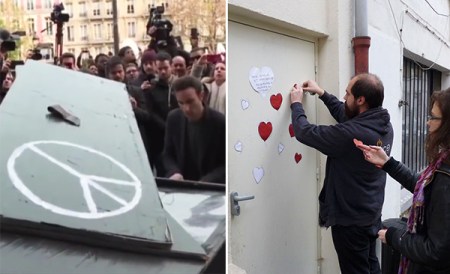
1372

Just after the attacks, French philosopher Michel Onfray said that France for many years had led Islamophobic bombings against the Muslim world, so “it was logical if the Muslims now attacked France.”

When his words were used in an Islamic State propaganda video, and reporters asked him if he regretted what he said, he replied, “No.”

A man who lost his wife in the Bataclan massacre said on a talk show that he would live in the future as he did before; that he had no hatred at all against the murderers, just compassion. Another man on a different talk show said he was offering “free hugs.”

If some French think otherwise, they are silent.

All political leaders in France speak like Hollande. They say the country must show “unity” and “solidarity.” All of them know the mood of the vast majority; even those who might want to say more, stay silent.

Almost no one mentions radical Islam. Those who do, prefer the word “jihadism,” and rush to emphasize that “jihadism” is “not related to Islam.”

Hollande, when he still spoke of war, said that France had “an enemy.” He avoided the word “Islamic,” instead referring to the Islamic State by its Arabic acronym, “Daesh.”

He knew that “Daesh” could not be defeated without an American intervention that would not take place. With symbolic gestures, he did the best he could.

He also seems to know that the main enemy of France is not in Syria or Iraq, but inside the country: France already finds herself defeated.

More than half the Islamists who attacked Paris on November 13 were Muslims born and raised in France. Mohamed Merah, the murderer of Jewish children in Toulouse in 2012, and those who attacked the satirical magazine Charlie Hebdo and the kosher supermarket in January all were Muslims born and raised in France.

Over 750 no-go zones — autonomous areas ruled by radical imams and Muslim gangs — exist in France.

Radical imams and Muslim gangs also control most of France’s prisons: 70% of prison inmates in France are apparently Muslim. Non-Muslim inmates are attacked and threatened; many are forced to convert to Islam.

A British survey published in 2014 showed that 16% of French approve of the Islamic State. Among people aged 18-25, the proportion rose to 27%. Within the French Muslim population, the numbers are undoubtedly higher.

More than 1000 French Muslims have left France to fight for the Islamic State. At least 400 havereturned without being stopped or vetted at a border. Thousands of radicalized French Muslims have never left. Many are good, loyal citizens; but many could have learned all they wanted to know on the internet and on Islamic satellite television stations. Still others — hundreds of thousands of French Muslims — are not radicalized but are ready to help the radicalized ones; ready to host them or offer them asylum.

More than 10,000 French Muslims are classified as extremely dangerous by the police and are linked to “jihadist activities”. They are registered in what the French government calls “S files,” but there is no way to monitor their whereabouts. Placing them all in detention centers would involve a complete break with what is left of the rule of law in France.

All of the French Muslims who participated in the November 13 attacks were registered in “S files,” but that did not change anything. They were free to act, and they did.

For the first time in Europe, suicide bomb attacks took place. The explosive used to make suicide belts, triacetone triperoxide (TATP), is powerful and extremely sensitive to friction, temperature change and impact. Making belts containing TATP requires a “professional.”

A French judge, Marc Trevidic, in charge of all the main Islamic terrorism cases over the last ten years, said a few days before the November attacks that the situation was “getting worse,” was now “out of control,” and that “radicalized groups” established in the country could “carry out attacks resulting in hundreds of deaths.” He was quickly transferred to a court in Lille, northern France, where he was assigned to petty crimes and divorce cases.

All the French political leaders know that Marc Trevidic is right — that the situation is out of control — but not one will say so publicly. Not one has asked the government why it took almost three hours for the police to intervene during the attack at the Bataclan Theater, where 89 people were murdered and over 200 wounded. There are simply not enough well-trained police, and not enough weapons in the hands of the police, and not enough bulletproof vests.

For the next few months, more soldiers and police officers will be placed in front of public buildings, synagogues, churches and mosques, but “soft” targets, such as theaters, cafés and restaurants, are not protected. It is as easy to enter a theater in Paris today as it was on November 13. French police do not have the right to carry a weapon when they are on duty.

In a few weeks, French military actions against the Islamic State will doubtless stop. President Hollande, the French government, and most French political leaders probably hope that the French will soon forget the attacks. They know that the problems are now too widespread to be solved without something resembling a civil war. When more attacks occur, they will talk of “war” again. They are supposedly hoping that people will get used to being attacked and learn to live with terrorism.

In the meantime, French politicians are trying to divert the attention of the public with — “climate change!” The conference in Paris will last a fortnight. President Hollande says he wants save the planet. He will be photographed next to America’s Barack Obama and China’s Jiang Zemin.

French journalists are no longer discussing jihad; they are discussing “climate change.”

Until December 11, at least, Paris will be the safest city.

In June 2015, five months after the January attacks, French Prime Minister Manuel Valls said that the French had to “adapt to Islam”. In November, he added that “Islam has to stand up to jihadism”. The French Council of the Muslim Faith, offering “condolences” to the families of the victims, specified that Muslims were “victims” too, and that they should not be “stigmatized.”

Regional elections will be held on December 6th and 13th, the same time as the conference on climate change.

Polls show that the rightist party, National Front, will almost certainly win in a landslide. Marine Le Pen, leader of the National Front, did not depart from the calls for “unity” and “solidarity.” She is, however, the only politician to say unambiguously that the main enemy is not outside the country, but within. She is also the only politician to say that a return to security implies a return to border controls. A National Front victory does not, however, mean that Marine Le Pen will win the 2017 presidential election: all the other parties and the media might band together against her.

France’s National Front is part of the increasingly popular rejection of the European Union. Thei nvasion of Europe by hundreds of thousands of mostly Muslim migrants has strengthened that stance. The Islamist attacks in Paris, combined with the state of emergency decreed in Belgium for several days after the attacks, have helped this rejection to gain more ground. In addition, the news that several of the Paris terrorists came to France among illegal migrants — and had successfully used false Syrian passports to enter Europe, where they could go from country to country unhindered — did not help.

The rise of populism is slowly destroying the unelected, unaccountable, and untransparent European Union. Many European mainstream journalists see this change as a “threat.”

The real threat to Europe might be elsewhere.

“The barbarians,” wrote the commentator Mark Steyn, “are inside, and there are no gates.”

After the attacks in Paris, Judge Marc Trevidic, again, raised the possibility of simultaneous attacks in several cities in France and in Europe. He said that if these attacks took place, the situation would become “really serious”. He said he had documents to show that Islamist groups were planning to organize such attacks. If the suicide bombers, he said, had been on time at the Stade de France, before the 79,000 spectators had entered, the death toll could have been worse. He concluded that too little had been done for too long, and that now it was probably too late.

During the November 27 official ceremony in Paris honoring the victims of the attacks, a song, If We Only Have Love, by Jacques Brel — selected by President Hollande – was sung: “If we only have love – We can melt all the guns – And then give the new world – To our daughters and sons.”

How could an Islamist not be moved by that?
Euro MPs: Don’t Use Border Controls to Fight Terror

December 1, 2015

Euro MPs: Don’t Use Border Controls to Fight Terror, Clarion Project, December 1, 2015

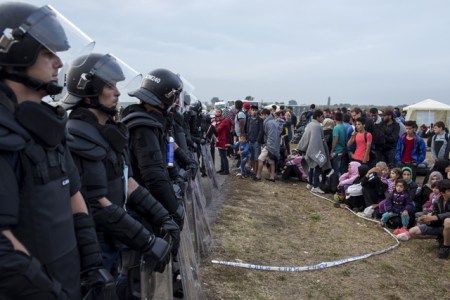
Refugees-riot-police-europe-640_2Hungarian police and immigrants. (Photo: © Reuters)

Members of the European Parliament (MEPs) voted on an amendment to a bill opposing the reintroduction of border controls into Europe to combat terrorism.

Amendment 48 to the ‘Prevention of Radicalization and Recruitment of European Citizen’s bill’ was tabled by the Socialists & Democrats group (S&D).

The amendment adds a new paragraph to the bill, stating that the EU “vehemently believes, in light of the current refugee and migrant crisis in Europe, that Member States must refrain from using any border control measures aimed at fighting terrorism and stopping the travel of suspected terrorists, for immigration control purposes.”

In other words, S&D opposes curbing or controlling immigration to prevent terrorism.

The lawmakers justified their stance highlighting “the risk of such measures being based on arbitrariness and racial or ethnic profiling, which is totally contrary to EU principles and values.”

The amendment was one of three put together, the other two adding more judicial restrictions on separating Islamist extremists from the general population in prisons and collecting evidence against terrorists.

The S&D group is a collation of various left-aligned parties in the European parliament. The group has 190/751 MEPs made up of representatives from each of the 28 European Union countries.

Parties included in the coalition include the Socialist Party in France (12), the Social Democratic Party of Germany (27), the Democratic Party of Italy (30), the Labour Party of the UK (20) and the Spanish Socialist Workers Party (14).

MEPs from anti-immigration parties strongly criticized the amendment.

“After the events of Paris I am astounded that Labour MEPs have voted for these amendments” said Diane James, an MEP for Britain’s UKIP party. “The free movement of people has led to the free movement of jihad and the only way to combat this is for Member States to regain control of their borders immediately.”

PBS discusses the European migrant crisis and fears of terrorist infiltration:

Op-Ed: Islam has superseded Christianity in France

December 1, 2015

Op-Ed: Islam has superseded Christianity in France, Israel National News, Giulio Meotti, November 30, 2015

France is busy building a coalition to strike Islamic State in Syria after the massacre of 130 citizens in Paris. But a “mini Islamic State” is already functioning in the French suburbs.

A 2,200-page report, titled “Banlieu de la République” (Suburbs of the Republic), commissioned by the French think tank Institut Montaigne, explained that suburbs are becoming “separate Islamic societies”, where sharia, the Islamic law, has overcome French secular rule. The French Interior Ministry called these “Priority Security Zones” (Zones de Sécurité Prioritaires) and they include heavily Muslim parts of Amiens, Aubervilliers, Avignon, Béziers, Bordeaux, Clermont-Ferrand, Grenoble, Lille, Lyon, Marseilles, Montpellier, Mulhouse, Nantes, Nice, Paris, Perpignan, Strasbourg, Toulouse and many other towns.

It is an ongoing French Intifada. The epicenter of this French Jihad is St. Denis, where the terrorists lived and planned the last attacks, and where French kings are buried. Isn’t it ironic that Islam now dominates the cradle of French Christianity?

Demography and identity are on the Islamists’ side in France.

A few days ago, the Association of French Mayors published a “Handbook of Secularism” which enumerates new rules. Among these, of course, there is the removal of Christian Nativity scenes from municipalities, considered disrespectful of the principle of “vivre-ensemble” and offensive to other religions (and Muslims in particular). In these 36 pages of recommendations, the mayors seem to have forgotten “16 centuries of history” as Franck Margain, vice president of the Parti Chrétien-démocrate, said, denouncing the handbook’s erasure of all vestiges of Christianity.

The France that was “Ainee fille de l’Eglise”, the eldest and favorite daughter of the Church, is no more. The country of Emmanuel Mounier, Georges Bernanos, Francois Mauriac, Jacques Maritain, Teilhard de Chardin, that country is now caught between two fires, state secularism and Islam.

Jean-Claude Chesnais, the famous French demographer, has no doubts: “There will be a hybridization of cultures that will lead to a rapid Islamization”. Demographically, Islam is the winner. Non-Muslims are growing at a rate of 1.2 children per family, while Islamic families up to five times faster. In the last 30 years more mosques and prayer centers for Muslims have been built in France than all the Catholic churches built in the last century.

Meanwhile, thousands of French Muslims left their country to wage the “holy war” in Syria and Iraq. Le Figaro Magazine published a story by the journalist Rachida Samouri who infiltrated in Seine-Saint-Denis to talk with the French who support ISIS. “In Raqqa, the capital of the Islamic State, the French are at home: the second most spoken language after Arabic is French, in the streets Isis spreads terror and the French are the worst, they threaten and beat women if the their face is not hidden by the niqab, or if they make noise with their shoes. The noise of the heels of a woman is considered a sin. These French left France for Syria perceiving it as their promised land. In Raqqa, their children turn into monsters. They have French passports, they will return one day. What will be the France of these children raised by cutting off heads in the name of Allah?”

This is the internal front the French authorities don’t want even to discuss.

Criticism of Islam is disappearing in France. This week, the renowned French atheist and left-wing philospher Michel Onfray withdrew the planned publication of a critical essay “Penser L’Islam” (Thinking Islam) claiming that “no debate is possible” in the country. Dozens of French writers and journalists, from Michel Houellebecq to Eric Zemmour and Mohammed Sifaoui, are under police protection for their criticism of Islam.

Once, in France, there was the war between “the cube and the cathedral”, the Grande Arche de la Défense in Paris built by François Mitterrand as a monument to a glittering secular modernity, and the Cathedral of Notre-Dame, today reduced to a museum.

Now both are dominated and looked down upon by the Islamic crescent.


Paradigms lost: The EU

December 1, 2015

Paradigms lost: The EU, Front Page MagazineBruce Thornton, December 1, 2015

rt_3

Historian of science Thomas Kuhn famously argued that scientific progress comes not from an incremental, stepwise accumulation of knowledge, but rather from a “paradigm shift,” the relatively sudden collapse of an old paradigm under the weight of new evidence and new insights. Kuhn’s idea has implications beyond scientific research. Historical changes as well often reflect an abrupt shift, as the old received wisdom is no longer adequate for understanding new events.

For example, the collapse of the Soviet Union was anticipated by at most a handful of analysts and historians. Indeed, in 1984 esteemed economist J.K. Galbraith claimed, “The Russian system succeeds because, in contrast to the Western industrial economies, it makes full use of its manpower.” Yet in a few years looming economic collapse swept away the communist superpower that for half a century threatened liberal democracy. In an instant, the seemingly permanent Cold War geostrategical paradigm disappeared, taking with it the whole academic discipline of Sovietology.

Perhaps today we are witnessing the beginning of a similar paradigm shift: the end of the notion that universal progress driven by scientific and technological innovations will eventually improve human life and political order to the point where the tragic constants of human existence––conflict, violence, oppression, brutal autocracy, and violations of basic human rights––will disappear. Considering the current failures of the West both domestically and abroad, this faith seems on shaky ground.

In Europe, the EU has been the institutional manifestation of this optimistic paradigm. Ethnic particularism, nationalist loyalties, parochial religious beliefs were remnants of the unenlightened past. A transnational organization of technocrats would be better placed to manage the economy, promote social justice, tend to the disadvantaged through redistributionist welfare transfers, and establish non-violent institutions of conflict resolution that would make collective violence a thing of the past. In practice, this meant diminishing national identity and the Christian faith, embracing a multiculturalism predicated on Western guilt and sentimental Third-Worldism, and inviting non-Western immigrants into Europe. These immigrants theoretically would do the work Europeans scorned, compensating for the decline in birthrates that attended increasing affluence and secularist values.

This paradigm today is wobbly. The EU still hasn’t recovered from the 2008 economic crisis, nor repaired the fissures in the EU laid bare by the still-looming Grexit (the departure of Greece from the common currency), the sluggish economic growth, the high levels of unemployment, the high taxes, debt, and deficits, and the burdensome regulatory regime. The EU faith in technocratic expertise and powers of control has been exposed as hubristic, a failure to acknowledge the “irreducible complexity” of human behavior and social relations, and the reality of conflicting economic interests among 500 million people spread over 28 countries with different languages, customs, histories, and religions. The nasty feud between Germany and Greece over the latter’s threatened default on its debt reminded us that Germans are still Germans and Greeks are still Greeks.

The on-going immigration crisis has further split the EU. The Eurocrats and other elites enjoyed their freer travel and “citizen of the world” identity, but millions of others lacking those opportunities remain French or Italian or Hungarian or Greek. Yet for all their differences, Europeans still live in a civilization created by Athens, Rome, and Jerusalem, a civilization embracing freedom, equal rights, separation of church and state, and numerous other ideals.

For many Europeans even if that tradition has been weakened by secularism, their political and social institutions are very different from those of the Muslims they invited into their countries, making assimilation difficult. Thus rather than workers, many immigrants, especially the young, became part of a permanent underclass living on the dole, alienated from the host country’s culture, and shut out from labor markets by onerous employment regulations.  Long before the Syrian refugee crisis and the terror attacks in London, Madrid, and Paris, these Muslim “youths,” as they’re delicately called, have been underemployed and overrepresented in prisons, committing crimes, particularly vandalism, assault, and rape, at a much higher rate than their proportion of the population. They crowd the welfare rolls, clustering in shabby neighborhoods beyond the reach of police control and ripe for recruitment into jihadist outfits. Meanwhile many Muslims practice the illiberal tenets of their faith––sex segregation, honor killings, stealth polygamy, aggressive public practice of their faith, intolerance of infidels, and waging or supporting violent jihad––contrary to the liberal democratic principles of their new homes.

Yet despite this long record of hostility and contempt towards the host countries, despite the recent massacre in Paris and disrupted plots in Belgium, Western European nations continue to profess their intent to let in as many as a million “refugees” from Syria. Most of them are seeking jobs and welfare, not fleeing persecution, from which they could find refuge in the neighboring Sunni nations of Turkey, Lebanon and Jordan. Worse, despite the fact that the ringleader of the Paris attack came from Syria, EU president Jean-Claude Juncker, fretting over the travails of the Syrian migrants, said, “There is no need for an overall review of the European policy on refugees.” Such a sentiment ignores, of course, the decades-long failure of Europe to assimilate the Muslims already there. Increasing their number likely means expanding the number of jihad-incubating Muslim ghettos, segregated from the culture and mores of the host countries and filled with obscene graffiti and the hulks of burned-out cars.

Elected national leaders and political parties across the EU, however, are increasingly more voluble in disagreeing with the EU president and Angela Merkel’s claim that “Islam belongs in Germany.” Hungarian president Viktor Orban has taken a hard line on the immigrants, building a steel fence on his country’s border, and frankly acknowledging the cultural differences between European and Islamic culture: “I think we have a right to decide that we do not want a large number of Muslim people in our country . . . We do not like the consequences,” he added, alluding to the Ottoman Muslim occupation of his country for 150 years. Slovenia, a victim of continual Ottoman raids in the 16th century, like Hungary has built a wall and imposed border controls. After the Paris attacks, other countries tightened their border controls as well, revising the 1985 Schengen agreement that opened up travel between EU states. The Dutch, meanwhile, have proposed creating a new Schengen-like confederation comprising the more ethnically homogenous Netherlands, Belgium, Luxembourg, Germany, and Austria.

More significant is the increasing popularity of nationalist Euroskeptic parties. The more hawkish reaction, so far at least, in France to the Paris attacks on the part of President Hollande suggests that the old multiculturalist orthodoxy that demonized national pride might be weakening, as does the influx of people enlisting in the French Army, at a rate five times greater than before the attacks. These developments might portend an opening for nationalist parties that Europhiles scorn as “right-wing extremist,” “far right,” or even “neo-fascist.”

While a few show such tendencies, most are more accurately defined as populist or nationalist, calling for a return of pride in and loyalty to their unique national identities, customs, heritage, and mores that the EU establishment dismisses as quaint relics from the benighted past. In France, Marine le Pen’s National Front could dominate upcoming regional elections, according to recent polls, and could become France’s next president. Le Pen has called for an “immediate halt” to further immigration. Elsewhere, the Swedish Democrats, the Dutch Party of Freedom, and the German Alternative for Germany are increasing in popularity. And Viktor Orban, leader of the Fidesz-Hungarian Civic Alliance, whom many EU leaders and commentators have reviled as xenophobic neo-fascist, is gaining credibility and respect among those who recognize the suicidal self-abasement of EU immigration policies.

Are these developments the harbingers of a larger paradigm shift away from the transnational, technocratic, undemocratic institutions of the EU? We should be cautious, for a real reformation would require a widespread return to patriotic allegiance, something a peaceful Europe, its security guaranteed and subsidized by the U.S., hasn’t felt a need for. Even more terrorist attacks might not be enough to awaken Europe from its multicultural slumbers. As we saw in London and Madrid ten years ago, initial bravado like the signs in Paris shops claiming “You don’t scare me” lasts as long as the public memorials and collective mourning. Likewise, protests against immigration have energized nationalist political parties before. In 1999 Austria’s Jörge Haider’s nationalist Freedom Party won 27% of the vote. By 2002 that support had shrunk to around 7%. On the other hand, the reaction against the EU caused by increasing economic failure and terrorist violence could take more sinister and violent forms as genuinely extremist groups find opportunity for growth.

Finally, the decline of faith in Europe has undercut the Judeo-Christian tradition upon which the civilization of Europe was founded, and which will have to provide the unifying principles, virtues, and beliefs necessary for correcting the dysfunctions of the EU and putting steel into Europeans’ resolve to destroy jihadism. But what today can replace “the accumulated capital of [Europe’s] Christian past,” as Christopher Dawson called it, “from which it drew the moral and social idealism that inspired the humanitarian and liberal and democratic movement of the last two centuries”? That “capital” has been dwindling for decades. Before the paradigm can shift, Europeans will have to rediscover what they are willing to kill and die for, especially in the face of an enemy filled with passionate intensity and fierce certainty in their knowledge of what their god commands them to kill and die for. That is the question the Eurocrats in Brussels and Strasburg are incapable of answering.