Posted tagged ‘Islamic invasion’

If you had doubts about the islamisation of Europe

July 2, 2016

Islam, Islamism and Islamophobia in Europe

\http://www.assembly.coe.int/nw/xml/XRef/Xref-XML2HTML-en.asp?fileid=17880&lang=en

If you had doubts about the islamisation of Europe

Resolution 1743 (2010) Final version

Author(s): Parliamentary Assembly

Origin – Assembly debate on 23 June 2010 (23rd Sitting) (see Doc. 12266, report of the Committee on Culture, Science and Education, rapporteur: Mr Mogens Jensen; Doc. 12303, opinion of the Political Affairs Committee, rapporteur: Mr Hancock; Doc. 12305, opinion of the Committee on Legal Affairs and Human Rights, rapporteur: Mr Rafael Huseynov; and Doc. 12304, opinion of the Committee on Equal Opportunities for Women and Men, rapporteur: Mrs Memecan). Text adopted unanimously by the Assembly on 23 June 2010 (23rd Sitting). See also Recommendation 1927 (2010).

1. The Parliamentary Assembly notes that Islamic radicalism and manipulation of religious beliefs for political reasons oppose human rights and democratic values. At the same time, in many Council of Europe member states, Muslims feel socially excluded, stigmatised and discriminated against; they become victims of stereotypes, social marginalisation and political extremism. The Assembly is deeply concerned about Islamic extremism as well as about extremism against Muslim communities in Europe. Both phenomena reinforce each other.
2. The Assembly recalls that Islamism is the view that Islam is not only a religion but also a social, legal and political code of conduct. Islamism can be violent or mainstream and peaceful, but in both cases it does not accept the separation between religion and state, which is a fundamental principle of democratic and pluralistic societies. The Assembly also recalls that discrimination against Muslims is unacceptable and must be combated. A great majority of European Muslims share the principles at the basis of our societies and it is essential to fight against Islamophobia, which stems mainly from lack of awareness and from negative perceptions associating Islam with violence. Failing to address these issues, many European governments pave the way to the rise of extremism.
3. Muslims are at home in Europe where they have been present for many centuries, as the Assembly noted in its Recommendation 1162 (1991) on the contribution of the Islamic civilisation to European culture. Islam, Judaism and Christianity – the three monotheist religions – share the same historic and cultural roots and recognise the same fundamental values, in particular the paramount value of human life and dignity, the ability and freedom to express thoughts, the respect for others and their property, and the importance of social welfare. Those values have been reflected by European philosophies and have been included in the European Convention on Human Rights (“the Convention”; ETS No. 5).
4. Article 9 of the Convention guarantees freedom of thought, conscience and religion, including the right to manifest one’s religion or belief, either alone or in community with others, in public or in private, in worship, teaching, practice and observance. Article 10 of the Convention enshrines freedom of expression, including the right to express religious or philosophical views or oppose and criticise them. Both freedoms constitute the necessary requirements for a democratic society. However, they are not absolute and may be subject to limits imposed under strict control. Moreover, in accordance with Article 17 of the Convention, they must not be abused for the destruction or undue limitation of any of the rights and freedoms set forth in the Convention.
5. The Assembly has already stressed the importance of reconciling these two freedoms in its Resolution 1510 (2006) on freedom of expression and respect for religious beliefs, as well as its Recommendation 1805 (2007) on blasphemy, religious insults and hate speech against persons on grounds of their religion. The Assembly firmly condemns death decrees and threats against people who criticise Islam or political views linked to Islam. It regrets, however, the initiatives taken by a number of United Nations member states that have resulted in the Human Rights Council adopting resolutions on action against defamation of religions, and in particular Islam, as this strategy constitutes a threat to freedom of expression.
6. Recalling its Recommendation 1804 (2007) on state, religion, secularity and human rights, the Assembly emphasises that democratic standards require a separation of the state and its organs from religions and religious organisations. Governments, parliaments and public administrations that democratically reflect and serve their society as a whole must be neutral towards all religious, agnostic or atheist beliefs. Nevertheless, religion and democracy are not incompatible, in particular as religions may play a beneficial social role. Member states should therefore encourage religious organisations to support actively peace, tolerance, solidarity and intercultural dialogue.
7. The Assembly notes with concern, however, that some Islamic organisations active in member states have been initiated by governments abroad and receive financial support and political guidance from those governments. The objectives of such organisations are hence not religious. National political expansion into other states under the disguise of Islam should be brought to light. In keeping with Article 11 of the Convention, member states can limit the activities of such organisations on condition that such limitations satisfy the requirements set forth in paragraph 2 of Article 11. Therefore, member states should require transparency and accountability of Islamic as well as other religious associations, for instance by requiring transparency of their statutory objectives, leadership, membership and financial resources.
8. As the Assembly indicated in its Recommendation 1774 (2006) on the Turkish presence in Europe: migrant workers and new European citizens, member governments and parliaments as well as the Council of Europe must give priority to fostering the social inclusion of Muslims and other religious minorities. The many efforts undertaken by member states to better integrate migrants are to be commended, but this integration is often still far from reality, in particular with regard to Muslim migrants. Thus, the Assembly invites member states to be proactive in dealing with social, economic and political inequalities.
9. The Assembly calls on member states to effectively address the social and economic exclusion of Muslims and other minorities in Europe – including through the adoption, implementation and regular monitoring of comprehensive anti-discrimination legislation, policies and practices to protect them from the day-to-day discrimination they face and to ensure better access to legal remedies when their rights have been violated.
10. While organisational structures of Muslim communities in member states are desirable in order to facilitate contacts with governmental and administrative bodies, member governments and parliaments should also seek to establish direct political contacts with Muslims as equal citizens. Such direct contacts could be facilitated, for example, through public hearings at local and regional levels as well as through regional and national discussion platforms on the Internet. Referring to Recommendation 170 (2005) of the Congress of Local and Regional Authorities of the Council of Europe on intercultural and inter-faith dialogue: initiatives and responsibilities of local authorities, the Assembly calls on national parliaments to ensure that local authorities in their countries have the necessary legal, administrative and financial frameworks for local activities intended to foster social inclusion and intercultural dialogue.
11. It is necessary that persons belonging to a minority culture in their country do not isolate themselves and do not attempt to develop a parallel society. Thus the Assembly calls on the representatives of the Muslim communities to encourage intercultural dialogue and fight against divisions which would otherwise lead to societal frictions and conflicts. Recalling its Resolution 1605 (2008) and Recommendation 1831 (2008) on European Muslim communities confronted with extremism, the Assembly invites Muslims, their religious communities and their religious leaders to combat any form of extremism under the cover of Islam. Islam is a religion which upholds peace. Muslims should be the first to react with dismay and opposition when terrorists or political extremists use Islam for their own power struggle and thus disrespect the fundamental value of human life and other values enshrined in Islam.
12. The Assembly deplores that a growing number of political parties in Europe exploit and encourage fear of Islam and organise political campaigns which promote simplistic and negative stereotypes concerning Muslims in Europe and often equate Islam with extremism. It is inadmissible to incite intolerance and sometimes even hatred against Muslims. The Assembly calls on member states to pursue political action in accordance with General Policy Recommendation No. 5 (2000) of the European Commission against Racism and Intolerance (ECRI) on combating intolerance and discrimination against Muslims. It reiterates that it is for the member states to reject political statements that stir up fear and hatred of Muslims and Islam, while complying with the stipulations of the Convention, in particular Article 10.2.
13. The Assembly also remains concerned at policies and practices – by both national as well as regional and local authorities – that discriminate against Muslims and at the danger of the abuse of popular votes, initiatives and referenda to legitimise restrictions on the rights to freedom of religion and expression which are unacceptable under Articles 9 and 10 of the Convention. In this context, the Assembly is particularly concerned about the recent referendum in Switzerland and urges the Swiss authorities to enact a moratorium on and repeal as soon as possible, the general prohibition on the construction of minarets for mosques.
14. Recalling its Resolution 1464 (2005) on women and religion in Europe, the Assembly calls on all Muslim communities to abandon any traditional interpretations of Islam which deny gender equality and limit women’s rights, both within the family and in public life. This interpretation is not compatible with human dignity and democratic standards; women are equal to men in all respects and must be treated accordingly, with no exceptions. Discrimination against women, whether based on religious traditions or not, goes against Articles 8, 9 and 14 of the Convention, Article 5 of its Protocol No. 7 and its Protocol No. 12. No religious or cultural relativism may be invoked to justify violations of personal integrity. The Parliamentary Assembly therefore urges member states to take all necessary measures to stamp out radical Islamism and Islamophobia, of which women are the prime victims.
15. In this respect, the veiling of women, especially full veiling through the burqa or the niqab, is often perceived as a symbol of the subjugation of women to men, restricting the role of women within society, limiting their professional life and impeding their social and economic activities. Neither the full veiling of women, nor even the headscarf, are recognised by all Muslims as a religious obligation of Islam, but they are seen by many as a social and cultural tradition. The Assembly considers that this tradition could be a threat to women’s dignity and freedom. No woman should be compelled to wear religious apparel by her community or family. Any act of oppression, sequestration or violence constitutes a crime that must be punished by law. Women victims of these crimes, whatever their status, must be protected by member states and benefit from support and rehabilitation measures.
16. For this reason, the possibility of prohibiting the wearing of the burqa and the niqab is being considered by parliaments in several European countries. Article 9 of the Convention includes the right of individuals to choose freely to wear or not to wear religious clothing in private or in public. Legal restrictions to this freedom may be justified where necessary in a democratic society, in particular for security purposes or where public or professional functions of individuals require their religious neutrality or that their face can be seen. However, a general prohibition of wearing the burqa and the niqab would deny women who freely desire to do so their right to cover their face.
17. In addition, a general prohibition might have the adverse effect of generating family and community pressure on Muslim women to stay at home and confine themselves to contacts with other women. Muslim women could be further excluded if they were to leave educational institutions, stay away from public places and abandon work outside their communities, in order not to break with their family tradition. Therefore, the Assembly calls on member states to develop targeted policies intended to raise Muslim women’s awareness of their rights, help them to take part in public life and offer them equal opportunities to pursue a professional life and gain social and economic independence. In this respect, the education of young Muslim women as well as of their parents and families is crucial. It is especially necessary to remove all forms of discrimination against girls and to develop education on gender equality, without stereotypes and at all levels of the education system.
18. Female genital mutilation under the pretext of Islamic or other customs should be considered as a crime as it violates the right to physical and moral integrity of all individuals and especially of girls. Member states must do their utmost to put an end to this crime and provide practical help to children and their parents, including in particular through education. The Assembly recalls in this context its Resolution 1247 (2001) on female genital mutilation.
19. The Assembly accordingly urges member states to take every step to prevent and combat all forms of oppression or violence undergone by women and, in particular, as part of the negotiations for the future Council of Europe convention on preventing and combating violence against women and domestic violence, to support the provisions enabling women irrespective of their origin or status to have access to protection, prevention and rehabilitation facilities.
20. Stereotypes, misunderstandings and fears with regard to Islam are typical symptoms of a widespread lack of adequate knowledge among non-Muslims in Europe. Similarly, many Muslims in Europe lack adequate knowledge of Islam let alone other religions, which can make them vulnerable to “Islamism” as a religiously disguised form of political extremism. In this context, the Assembly recalls its Recommendation 1720 (2005) on education and religion and calls on member states to ensure that knowledge about Islam, Judaism and Christianity is taught at school and through lifelong education.
21. Teaching about religions should be supported by member states, to raise public awareness of the common origin and values of Judaism, Christianity and Islam and their impact on modern European humanism. Institutions of higher education and research in Europe should provide Islamic studies in order to educate religious scholars, teachers and leaders and distinguish Islam from Islamism. The Assembly is confident that most European Muslims accept a common approach reconciling Islam with democratic values, human rights and the rule of law; indeed, many have done so for a long time.
22. The Assembly also welcomes the White Paper on Intercultural Dialogue prepared by the Council of Europe during the European Year of Intercultural Dialogue in 2008 as well as other activities by the Committee of Ministers in this field. Member governments should use the White Paper in their related national action, including in schools and educational institutions.
23. It is important to create synergies with other international organisations in this respect. Therefore, the Assembly invites the United Nations Alliance of Civilizations to co-operate more closely with the Council of Europe, in particular by setting up joint programmes of action. In this context, the Assembly invites the Secretary General of the Council of Europe to seek additional funding for such activities through member states and facilitate reciprocal secondment of staff between the two organisations.
24. The Assembly invites the Islamic Educational, Scientific and Cultural Organization (ISESCO) and the Arab League Educational, Cultural and Scientific Organization (ALECSO) to work with the Council of Europe on combating Islamism and Islamophobia or other religious discrimination as well as on promoting the respect for universal human rights. ISESCO and ALESCO can be particularly important in ensuring that their members respect the International Covenant on Civil and Political Rights (ICCPR) and the International Covenant on Economic, Social and Cultural Rights (ICESCR) of the United Nations.
25. In this context, the Assembly regrets that some member governments of ISESCO and ALECSO have adopted national legislation based on an interpretation of Sharia law or have pursued national policies which are in conflict with the ICCPR and the ICESCR: imposing severe penalties or even the death penalty on persons wishing to adopt a religion other than Islam is incompatible with Article 18 (2) ICCPR; imposing severe sanctions on, or passing public death decrees against, persons who have criticised Islam is incompatible with Article 19 of the ICCPR; calling for a “holy war” or violence against other countries or their citizens and glorifying terrorists as “holy martyrs” is incompatible with Article 20 (2) of the ICCPR; educating children to hate or fight persons of faiths other than Islam is incompatible with Article 13 (1) of the ICESCR.
26. Contacts between Muslim and non-Muslim Europeans and Muslims in North Africa, the Middle East and Asia should be facilitated, in particular among young people, students and teachers. The Assembly invites, therefore, the European Youth Forum to expand its activities in this field. Co-operation between educational and cultural institutions as well as cities around the Mediterranean Basin should be supported, for instance in the framework of the Convention on the Recognition of Qualifications concerning Higher Education in the European Region (ETS No. 165) and the European Outline Convention on Transfrontier Co-operation between Territorial Communities or Authorities (CETS No. 106).
H/T  E.J.Bron
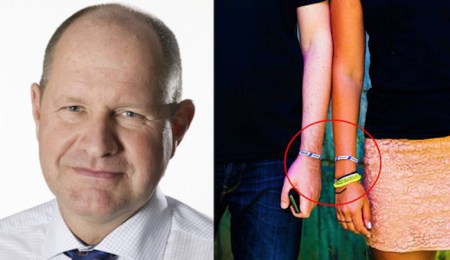


To counter Muslim migrant sex assaults, Swedish cops giving girls “Do not molest me” bracelets

July 2, 2016

To counter Muslim migrant sex assaults, Swedish cops giving girls “Do not molest me” bracelets, Jihad Watch

This will work. Can’t you picture it? A Muslim migrant is about to attack an Infidel girl and make her a “captive of the right hand” (cf. Qur’an 4:3, 4:24, 23:1-6, 33:50, 70:30), but then he spies her “Do not molest me” bracelet, apologizes, and hurries away.

Is there no one left in Sweden, or Europe in general, who has any spine? Is every last Western leader determined to stand up to jihad terror and Islamic supremacism in the wimpiest possible manner?

Dan-Eliasson-bracelets-do-not-molest-me

“‘Do not molest me’: Swedish police giving out bracelets to girls in the wake of immigrant attacks,” Fria Tider (Google Translate), June 30, 2016 (thanks to Maurice):

Domestic. In the aftermath of last year’s asylum-related sexual attacks at the “We Are Stockholm” youth festival, the Swedish police are now launching a new campaign. Officers will give out bracelets with the text “Do not molest me” to girls attending this year’s festival, of according to Dan Eliasson, head of the country’s national police force.

“The police are taking the reports of sexual molestation seriously, especially when it happens to young people,” Eliasson said in an official press release.

As a part of the new campaign, police officers equipped with bracelets with the text “Do not molest me” will be late to the Streets of Stockholm. The bracelets will be given out During The Summer Festival in the Swedish capital, and also in connection to other major events frequented by young people.

“This way, we can draw attention to the issue and urge Those Concerned to report,” Mr. Eliasson Continued.

Recently, the Swedish police published a report on sexual crimes in public swimming pools and other public places. : According to the report from May this year, the perpetrators are in most cases male asylum seekers from the Third World. One hypothesis put forward in the report Is that the asylum seekers are attacking Swedish girls as a “result of the Nordic alcohol culture, but overpriced Because of non-traditional gender roles” in the Scandinavian country.

Anger, Honor and Freedom: What European Muslims’ Attack On Speech Is Really About

June 30, 2016

Anger, Honor and Freedom: What European Muslims’ Attack On Speech Is Really About, Investigative Project on Terrorism, Abigail R. Esman, June 30, 2016

1052

Indeed, much of the Muslim violence in Europe is about exactly this: intimidating non-Muslims into a fearful capitulation, where words like “I hate Muslims” and drawings of Mohammed become extinct because the Muslim communities insist that it be so. It is about forcing Westerners to rearrange their lives, their culture, to accommodate the needs and values and culture of Islam. It is about control, and the power over freedom. And it is about creating a culture in which honor is injured by words and restored through violence and terror.

**********************

“Clash of civilizations,” some say. Others call it the “failure of multiculturalism.” Either way, the cultural conflicts between some Muslims and non-Muslims worldwide continue to play out as Western countries struggle to reconcile their own cultures with the demands of a growing Muslim population.

But herein lies the problem: in many ways, the two cultures are ultimately irreconcilable. There is no middle ground. And hence, the conflicts and the tugs-of-war continue.

Over the past two months, the events surrounding controversial Dutch columnist Ebru Umar have encapsulated that “clash” at its core, a salient metaphor for the tensions, particularly in Europe, between the West’s Muslim populations and its own. More, they illuminate the enormity of the problems we still face.

Umar is no stranger to the spotlight, or to the wrath of Dutch Muslims who read her many columns, most of them published in the free newspaper, Metro. For years, the Dutch-born daughter of secular Turkish immigrants has raged against the failure of other Dutch-born children of immigrants, mostly Moroccan, to assimilate into the culture of their birth. She loudly condemns Dutch-Moroccan families for the shockingly high rates of criminality and violence among Dutch-Moroccan boys – as much as 22 times the rate of Dutch native youth – a phenomenon she ascribes to their Islamic upbringing and their parents’ refusal to allow their children to mingle among the Dutch.

But her critiques have earned her no converts. Instead, Dutch-Moroccan youth, whom she calls “Mocros,” have regularly taunted her, both online and in the street.

This past April, however, Umar added a new team of enemies to her portfolio: when, in response to Turkish president Recep Tayyip Erodogan’s demand that a German satirist be prosecuted for insulting him on TV, Umar tweeted “f***erdogan,” Dutch Turks turned on her in fury. “How dare you insult our president!” cried these Dutch-born subjects of Holland’s King Willem-Alexander. And while Umar took a brief holiday on the Turkish coast, one such Dutch-Turk turned her in to the police. She was arrested at her vacation home in Kusadasi, and though released the following day, was forbidden to leave the country. The charge: Insulting the Turkish president. It took 17 days before discussions between Holland’s prime minister and Turkish authorities enabled her to return to the Netherlands.

But she could not return home. In her absence, Umar’s home had been burgled and vandalized, the word “whore” scrawled on a stairway wall. Death threats followed her both in Turkey and on her return. When it became clear she could not ever return to the apartment she had lived in for nearly 20 years, she announced on Twitter (Ebru Umar posts constantly on Twitter) that she would be moving out.

Meantime, in Metro and elsewhere, she continued her criticism of Moroccans and, as she herself notes, of Islam overall.

And so it was that on the day Ebru Umar moved out of her apartment in Amsterdam, a group of Dutch-Moroccans in their twenties came to see her off, taunting her with chants: Ebru has to mo-o-ve, nyah nyah.” Though furious, she ignored them – until one of them began to film her loading her belongings into her car. For Umar, being taunted by the very people whose threats had forced her from her home in the first place was bad enough: but this violation of what little privacy remained for her was more than she could take. She grabbed her iPhone and began filming them right back. “Go ahead,” she challenged. “Say it for the camera.”

Scuffles ensued, and soon one of the Moroccans had her iPhone in his hand. The others laughed. Then they ran away. Umar filed a police report and, still smarting, took to Twitter once again: “C**t Moroccans, I hate you,” she posted. “I hate you, I hate you, I hate you, I hate you and I hate your Muslim brothers and sisters, too. F**k you all.” (It is important to note that, however offensive, the expression “c**t Moroccans” is a common epithet in the Netherlands.)

But, hey – she was angry. Her phone had been snatched from her hand in a brutal, aggressive gesture that left her feeling violated and, vulnerable. She had just been forced to leave her home. She had endured prison, a criminal inquiry, and death threats, all at the hands of the same group on whom she now spewed her fury.

Her words may have been harsh or inappropriate, but they were words. She had not struck her tormenters as they filmed her. She did not call for their demise, or strap a bomb around her waist and visit the local mosques.

She took to Twitter and said: I hate you.

“But hate,” she tells me later in an e-mail, “is just an emotion.” And in a column penned more than two years ago, she observed, “Hate me till you’re purple, but keep your claws off me.”

Here is where Ebru Umar’s story becomes the story of the Western world. In response to her words (“I hate you. F*** you”), several Muslims – Moroccans and others – filed charges against her for hate speech. (Though ironically, “I hate you” does not legally qualify as “hate speech.”) Such words are an attack upon their honor, a humiliation: and if there is one thing experts on Arab and Muslim culture will agree on, it is the significance of humiliation and honor in governing their lives. For this, Dutch Moroccan youth threaten Umar on the streets, and have done so, she says, for years: after all, she insults them.

1664

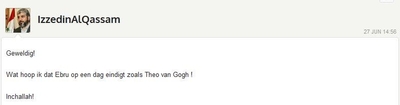
But in truth, it isn’t just the youth. The broader Muslim community stands by, silent: they do not condemn the youth who taunt her, who rip her telephone from her hands, or post things on the Internet like “We hate you, too – can you please kill yourself?” or “Oh, how I hope she ends up like Theo van Gogh.”

Theo van Gogh, also a controversial columnist, was shot and stabbed to death in 2014 by a radical Dutch-Moroccan Muslim.The commenter wishing her the same fate used the name “IzzedinAlQassam,” the founder of modern Palestinian jihad, and an icon of Hamas leader Khaled Meshaal.

For people like this, it doesn’t matter that Umar – or van Gogh – inflicted no violence, any more than it mattered that the editors of Charlie Hebdo were not violent. It was the insult, the humiliation – to them, to Islam, to Mohammed – that mattered: and an insult, a humiliation, deserves a violent response.

Indeed, much of the Muslim violence in Europe is about exactly this: intimidating non-Muslims into a fearful capitulation, where words like “I hate Muslims” and drawings of Mohammed become extinct because the Muslim communities insist that it be so. It is about forcing Westerners to rearrange their lives, their culture, to accommodate the needs and values and culture of Islam. It is about control, and the power over freedom. And it is about creating a culture in which honor is injured by words and restored through violence and terror.

When Umar says “I hate you,” what she hates, really, isn’t the Moroccans who attacked her or their “Muslim brothers and sisters.” What she hates is this – this effort, this battle over honor and speech and freedom, and this clash between violence and expression, guns and conversation.

“I don’t want Muslims to leave,” she tells me, again by e-mail. “I want them to embrace the Enlightenment, Western society, the Netherlands.” And in turn, she calls on the Dutch to “set rules: no violence in any sense. And stop using culture or religion as an excuse for behavior.”

Ebru Umar’s words. More of us should listen.

The Imam Celebrated by the Church of Sweden: “The Jews are Behind the Islamic State!”

June 29, 2016

The Imam Celebrated by the Church of Sweden: “The Jews are Behind the Islamic State!” Gatestone InstituteIngrid Carlqvist, June 29, 2016

♦ Priests are afraid to talk about Jesus during mass. — Eva Hamberg, priest and professor, who in protest resigned from the priesthood and left the Church.

♦ The Church of Sweden may be headed towards “Chrislam” — a merging of Christianity and Islam. Swedish priests, noting the religious fervor among the Muslims now living in Sweden, enthusiastically take part in various interfaith projects

♦ “There are reliable sources from Egypt, showing that the Saudi royal family is really a Jewish family that came from Iraq to the Arabian Peninsula sometime in the 1700s. They built an army with the aid of British officers fighting the Ottoman sultanate.” — Imam Awad Olwan, with whom a priest, Henrik Larsson, is cooperating in an interfaith project.

♦ “The involvement that the Church of Sweden has shown for the vulnerability of Christian Palestinians, has been replaced with indifference to the ethnic cleansing of Christians in Syria and Iraq. In these countries, it is mostly Muslims who commit the atrocities, which is evidently enough to make the Church of Sweden concentrate on climate change and environmental issues instead.” — Eli Göndör, scholar of religion.

The Church of Sweden has departed from being a strong and stern state church. In the past, Swedes were born into it and, until 1951, no one was allowed to leave the church. These days, however, it is an institution that has very little to do with Christianity or Jesus. Sweden now, according to the World Values Survey, is one of the world’s most secular countries; every year a large number of Swedes leave the church.

It used to be that only atheists left the church; now it is the devout Christians that leave — in protest against the church’s increasingly questionable relationship to the Christian faith.

When, for example, the current Archbishop, Antje Jackelén, just before being appointed, participated in a question-and-answer session in the fall of 2013, and one of the questions was: “Does Jesus convey a more truthful image of God than Muhammad does?” surprisingly, the would-be archbishop did not immediately say yes, but instead involved herself in a long monologue about there being many ways to God. Evidently, this upset a lot of parishioners. A high-profile priest and professor, Eva Hamberg, resigned from the priesthood in protest and left the Church of Sweden.

“This made me leave faster,” she told the Christian newspaper, Dagen. “If the future Archbishop cannot stand by the Apostles’ Creed, but rather, rationalizes it, then secularization has gone too far.”

Hamberg, who has conducted research on the secularization process, said that in Sweden, secularization has escalated ever faster — even within the Church of Sweden. As an example, Hamberg said that Antje Jackelén does not believe in Immaculate Conception, but says it is a metaphor. Hamberg also said that there is a lack of reverence before the Triune God, and that the priests are afraid to talk about Jesus during mass.

“There is also a clear lack of tolerance within the Church of Sweden. The candidates [for the position of archbishop] were all very keen to talk about dialogue, and that sounds great, but it is all just empty phrases. The church leaders, in fact, persecute dissidents. If you do not agree with the ordination of women, you will not get ordained. The ceiling is incredibly low.”

When Antje Jackelén won the election and became Sweden’s first female Archbishop, it was time for the next shock. As her motto, she chose “God is Greater” — “Allahu Akbar” in Arabic. Jackelén referred to 1 John 3:19-21, which says:

“This is how we know that we belong to the truth and how we set our hearts at rest in his presence: If our hearts condemn us, we know that God is greater than our hearts, and he knows everything.”

However, few believe the choice of motto is anything other than an open flirt with the Muslims of Sweden. In Islam, “Allahu Akbar” are the first words heard in every call to prayer, from every minaret around the world, and it is the cry we hear time and again in connection with Islamist suicide bombings, decapitations of non-Muslims, and terrorist attacks.

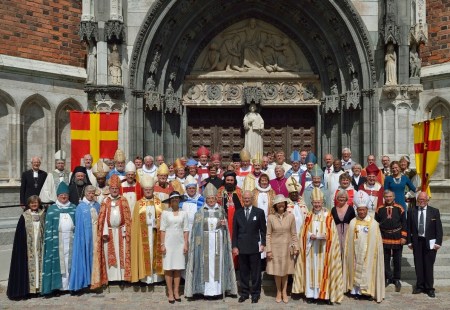
1448The King, Queen and Crown Princess of Sweden attend the archiepiscopal ordination of Bishop Antje Jackelén at Uppsala Cathedral, June 15, 2014. (Image source: Church of Sweden)

Archbishop Jackelén’s choice of a motto was not an exception; merely the most visible sign that the Church of Sweden may be headed towards “Chrislam” — a merging of Christianity and Islam. Swedish priests, noting the religious fervor among the Muslims now living in Sweden, enthusiastically take part in various interreligious projects. Last year, Stockholm’s Bishop, Eva Brunne, suggested removing the cross from the Seamen’s Church, enabling Muslims to pray there.

Gatestone Institute called her closest associate, Diocesan Priest Bo Larsson, to ask about this proposal.

Gatestone: Can the Christians in Muslim countries expect the same service in mosques?

Bo Larsson: “No, I don’t think so. To Muslims, the buildings have such a holy dignity.”

Gatestone: But not to Swedes?

Bo Larsson: “Apparently not. But there are already many mosques in Sweden.”

Gatestone: So why the need to pray in the Seamen’s Church?

Bo Larsson: “You know, it was just a suggestion. Many people on social media got it into their heads that this means Brunne is no longer a Christian, but that is not true of course.”

Gatestone: So we Christians should show Muslims respect, even though they do not respect us?

Bo Larsson: “I think so. That is my opinion. I have been a priest for 40 years. We are still the largest church in Sweden, and so we must provide opportunities for Muslims and Jews.”

Gatestone: “Are you sayingIf you cannot beat them, join them?'”

Bo Larsson “That is one way to look at it.”

Gatestone: The Church of Sweden is known for its positive attitude towards homosexuals. Your own bishop, Eva Brunne, is openly gay. Yet you support Islam, which persecutes homosexuals?

Bo Larsson: “That is a difficult question to answer. But sure, it is terrible that gay people do not have any rights in Muslim countries and cannot live openly. Terrible.”

Gatestone: And you still want to support this religion?

Bo Larsson: “There are Christians who are opposed to homosexuality, too, you know.”

Gatestone: Who want to hang gays?

Bo Larsson: “No, maybe not. But I think you’re oversimplifying. What we want in Sweden is a dialogue with the Muslim people.”

Gatestone: Have you discussed homosexuality with Muslims?

Bo Larsson: “No.”

Gatestone: Do you think you can change Islam in Sweden into a tolerant, open-minded religion?

Bo Larsson: “There are fundamentalist Christians in the United States who do not accept homosexuals.”

Gatestone: But do you think there is a difference between not accepting and wanting to kill?

Bo Larsson: “I have never heard a Muslim say he wants to kill homosexuals.”

“Chrislam” has gone farthest in the immigrant-heavy Stockholm suburb of Fisksätra, in which 8,000 people, speaking 100 different languages live. There, the Church of Sweden is now raising money to build a mosque — a project named “House of God” — next to the existing church. This is how the project is described on its official website:

“The House of God represents a desire for peace, and real work in the spirit of peace. We are building a mosque adjacent to the existing church in Fisksätra. Between the church and the mosque, a glass enclosed, joint indoor square will be built. The House of God is unique, and an example of the cooperation and religious dialogue that is so important in our time. Come join our work!”

Gatestone called Henrik Larsson, a priest and one of the founders of the House of God project. He assured us that Islam is peaceful and democratic, but then gave some other answers indicating that he may not be so enthralled by this religion after all.

“We Christians have also done some horrible things over the centuries,” he said. ” We have burned witches, we have colonized other countries, and sided with different armies throughout our history. I think all religions can be used in a similar way.”

Gatestone: Are you saying that we live in 2016, and that they are still stuck in the 1400s?

H. Larsson: “If that. They are striving towards creating a society like the one that existed right after the Prophet Muhammad’s death, and that means we are talking 600s, 700s and 800s. That is their ideal. But there is also an Islam searching for new ways, a European Islam, those who want to try to be Muslims within the democratic and secular society.”

Gatestone: Many Muslims in Sweden seem not to want to adapt to Swedish culture. Look at all the rapes and sexual assaults at public swimming pools.

H. Larsson: “Yes, it is not easy for Afghan boys who have grown up in a society where women have to throw a sheet over themselves before leaving the house; of course they are marinated in an attitude towards women miles away from ours. Of course they should not be allowed to do that, but it is no wonder that there are conflicts. But they need to learn how we see men and women here in Sweden.”

Henrik Larsson celebrates the imam with whom he is cooperating in the “House of God.” His name is Awad Olwan, a Palestinian who came to Sweden in the 1960s. According to Henrik Larsson, Olwan is a modern Muslim, who became an imam late in life and likes democracy.

But when Gatestone called Olwan, to ask why he supported the Popular Front for the Liberation of Palestine (PFLP) in the 1970s and refused to denounce the Munich massacre at the 1972 Olympic Games, he at first pretended not to know what the PFLP was. The BBC has described it as “Combining Arab nationalism with Marxist-Leninist ideology, the PFLP saw the destruction of Israel as integral to its struggle to remove Western capitalism from the Middle East.”

Olwan: “Oh, well, yes, we had a lot of different organizations back then, but forget that — that is history now. It meant Palestine Liberation something. I really do not remember to be quite honest.”

Gatestone: You refused to denounce the attack on the Jewish Olympians in Munich?

Olwan: “Yes, that’s right, but that was in the 70s! I don’t remember what I said then.”

Gatestone: Is your attitude different now?

Olwan: “Yes, of course. It was murder and nothing else.”

During our first conversation, Awad Olwan claimed to be very positive towards Jews. He said that there are no Jews in the House of God is simply because there is no Jewish congregation in Fisksätra, but that the organizers have invited a Jewish choir and are cooperating very well with them.

During our second talk, however, other thoughts emerged. When Olwan was asked some questions about the Quran and the hadith, he began cursing and saying that everything was the fault of “those f**king Mecca-Arabs.”

Gatestone: Are you saying Islam is not the problem; that it is the Saudi interpretation of Islam that messes everything up?

Olwan: “Exactly! And their religion [Wahhabism] was invented by a British imperialist 200 years ago. I cannot say anything more, because then I am an anti-Semite and whatnot.”

Gatestone: What is the truth about the Jews?

Olwan: “Okay, there are reliable sources from Egypt, showing that the Saudi royal family is really a Jewish family that came from Iraq to the Arabian Peninsula sometime in the 1700s. They built an army with the aid of British officers fighting the Ottoman sultanate. After that, they created the Jordanian army and so on and so on.”

Gatestone: Are you saying this is the reason the Jews are so quiet?

Olwan: “Yes. I wrote in my book that the purpose of ISIS/Daesh is to shift the focus from the Arab-Israeli conflict, and make this a conflict between Sunni and Shia — and they have succeeded. And now, they will erase the entire Middle East. You will see! It is Catholic land, Muslim land and a lot of other crap countries just to justify the existence of a Jewish state.”

Gatestone: I read online that many believe it was Mossad and the Jews who started ISIS?

Olwan: “Yes, that is a common theory in the Middle East, but if you say that in the West, you are told that you are a conspiracy nut and that you have no evidence. But here’s the deal: You cannot wage war against strong forces without having weapons delivered every day, you need planning and logistics. These are not f**king terrorists who have learned how to wage war on the internet, these are highly trained, highly skilled people. I have to go now.”

Gatestone: Are you referring to the Jews?

Olwan: “Exactly, exactly.”

Olwan is most likely a typical example of an imam who shows a conciliatory and friendly attitude towards naïve Swedish priests, but with a bit of encouragement, admits his hatred of Jews. He is, it seems, not too fond of the Church of Sweden’s friendly attitude towards gays, either.

Since the Church of Sweden became one of the first Christian communions in the world to approve gay marriage in 2005, more and more priests have come out as gay. In 2009, when Eva Brunne was appointed bishop of Stockholm, tongues wagged that the church is now being ruled by the “Lesbian League.” The Church of Sweden has participated in the Pride Festivals in Stockholm on many occasions, and several churches have allowed themselves be LGBT-certified. The price for this may be that the church will be forced to cut certain passages from Bible. Ulrika Westerlund, the chairperson for the RFSL (Swedish Federation for Lesbian, Gay, Bisexual, Transgender and Queer Rights), has warned the church: “There are elements in religious scriptures that are used against LGBT persons. Then we have to discuss if you want this certification, we do not want you to quote these passages from the Bible.”

Henrik Larsson, the priest, sees a problem with imams constantly condemning homosexuality as a sin — an Islamic tenet that presumably can never change because Allah said it [Quran,7:80-84.IG]. “We have to hope they catch up with us there. It was not so long ago that Christianity preached the same things.”

Gatestone: Do you hope and believe that Muslims can change, even though some hurl homosexuals from rooftops, hang them and flog them?

H. Larsson: “Yes, it is awful. But I believe that people are innately good at heart.”

Awad Olwan does not agree with Henrik Larsson. He thinks the Church of Sweden’s attitude towards homosexuality is a great sin:

“I disagree with them. Homosexuality is not good for the morals of society, and it is not what Jesus and Moses stood for. It is better if the whole thing with homosexuality in public life becomes a parenthesis.”

In the meantime, as the Church of Sweden is busy developing “Chrislam,” it never acknowledges that in the Middle East, Christians are being killed and effectively eradicated. In 2015, Eli Göndör, a scholar of religion, wrote in the magazine Dagens Samhälle:

“The involvement that the Church of Sweden has shown for the vulnerability of Christian Palestinians, has been replaced with indifference to the ethnic cleansing of Christians in Syria and Iraq. In these countries, it is mostly Muslims who commit the atrocities, which is evidently enough to make the Church of Sweden concentrate on climate change and environmental issues instead.”

To be fair, in February 2016, the Church of Sweden did do something for the Christians of the Middle East — it encouraged congregations and individuals to pray for them. The words Islam or Muslims were not mentioned in the appeal.

Gatestone called the Church of Sweden’s information service, to ask if the prayers had helped.

“I cannot answer that,” the voice on the phone said. “Can you send an e-mail with your question, and I’ll ask my colleagues to get you a reply?”

Brexit: The Nation is Back!

June 25, 2016

Brexit: The Nation is Back! Gatestone InstituteYves Mamou, June 25, 2016

♦ In France, before the British vote, the weekly JDD conducted an online poll with one question: Do you want France out of the EU? 88% of people answered “YES!”

♦ In none of the countries surveyed was there much support for transferring power to Brussels.

♦ To calm a possible revolt of millions of poor and unemployed people, countries such as France have maintained a high level of social welfare spending, by borrowing money on international debt markets to pay unemployment insurance benefits, as well as pensions for retired people. Today, France’s national debt is 96.1% of GDP. In 2008, it was 68%.

♦ In the past few years, these poor and old people have seen a drastic change in their environment: the butcher has become halal, the café does not sell alcohol anymore, and most women in the streets are wearing veils. Even the McDonald’s in France have become halal.

♦ What is reassuring is that the “Leave” people waited for a legal way to express their protest. They did not take guns or knives to kill Jews or Muslims: they voted. They waited an opportunity to express their feelings.

“How quickly the unthinkable became the irreversible” writes The Economist. They are talking about Brexit, of course.

The question of today is: Who could have imagined that British people were so tired of being members of The Club? The question of tomorrow is: What country will be next?

In France, before the British vote, the weekly JDD conducted an online poll with one question: Do you want France out of the EU? 88% of people answered “YES!” This is not a scientific result, but it is nevertheless an indication. A recent — and more scientific — survey for Pew Research found that in France, a founding member of “Europe,” only 38% of people still hold a favorable view of the EU, six points lower than in Britain. In none of the countries surveyed was there much support for transferring power to Brussels.

With Brexit, everybody is discovering that the European project was implemented by no more than a minority of the population: young urban people, national politicians of each country and bureaucrats in Brussels.

All others remain with the same feeling: Europe failed to deliver.

On the economic level, the EU has been unable to keep jobs at home. They have fled to China and other countries with low wages. Globalization proved stronger than the EU. The unemployment rate has never before been so high as inside the EU, especially in France. In Europe, 10.2% of the workforce is officially unemployed The unemployment rate is 9.9% in France, 22% in Spain.

And take-home salaries have remained low, except for a few categories in finance and high-tech.

To calm a possible revolt of millions of poor and unemployed people, countries such as France have maintained a high level of social welfare spending. Unemployed people continue to be subsidized by the state. How? By borrowing money on international debt markets to pay unemployment insurance benefits, as well as pensions for retired people. So today France’s national debt is 96.1% of GDP. In 2008, it was 68%.

In the the euro zone (19 countries), the ratio of national debt to GDP in 2015 was 90.7%.

In addition to these issue all, European countries have been remained open to mass-immigration.

Immigration was not an official question of the British “remain” or “leave” campaign. But as noted by Mudassar Ahmed, patron of the Faiths Forum for London and a former adviser to the U.K. government, the question of immigration and diversity has been latent:

“In personal conversations, I have found those most eager to leave the European Union are also most uncomfortable with diversity — not just regarding immigration, but of the diversity that already exists in this country. On the other hand, those who are most eager, in my experience, to support remaining in the European Union are far more open to difference in religion, race, culture and ethnicity”.

In France, the question of immigration tied to an eventual “Frexit” is not at all latent. The Front National (FN) strongly supports leaving the EU, and that position is tied to immigration. In France, 200,000 foreigners have been coming annually for several years — from poor countries such as those in North Africa, as well as sub-Saharan countries. The growing presence of Muslims has brought a growing feeling of insecurity, and the cultural traditions of Arab and African countries has created in Europe a cultural “malaise.” Not to everyone, or course. In big cities, people accept diversity. But in the suburbs, it is different. Because those who were on welfare, who were poor, who were old — all these people are living precisely in the same neighborhoods and the same buildings as the new immigrants.

1663Marine Le Pen, leader of the Front National, celebrates the Brexit vote under a sign reading, “And Now: France!”, June 24, 2016.

In the past few years, these poor and old people have seen a drastic change in their environment: the butcher has become halal, the café does not sell alcohol anymore, the famous French “jambon beurre” (ham and butter) sandwich disappeared, and most women in the streets are wearing veils. Even the McDonald’s in France have become halal. In Roubaix, for example,all fast food has become halal.

An eventual “Frexit” vote by the poor, the old, and the people on welfare would mean only one thing: “Give me my country back!” Today, to be against the EU is to reclaim the possibility of remaining French in a traditional France.

With the Brexit, the question of the nation is back in Europe. Without immigration, it might have been possible gradually to create an eventual European identity. But with Islam plus terrorism at the door, with politicians saying after each terrorist attack, “These men shouting, ‘Allahu Akbar’ have nothing to do Islam,” the rejection is big.

This “give me my country back” seems frightening. And it is. It is tainted with chauvinism, and chauvinism is not a good thing for any minorities in any country. Jewish people paid a heavy price for chauvinism in WWII.

What is reassuring, nevertheless, is that the “Leave” people waited for a legal way to express their protest. They did not take guns or knives to kill Jews or Muslims: they voted. They waited an opportunity to express their feelings. The “Leave” may not look modern or trendy, but it is peaceful, legal and democratic.

Hope things stay like that.

Brexit – Backlash from mass migration and ISIS

June 25, 2016

Brexit – Backlash from mass migration and ISIS. DEBKAfile, June 24,2016

BREXIT_23.6.16

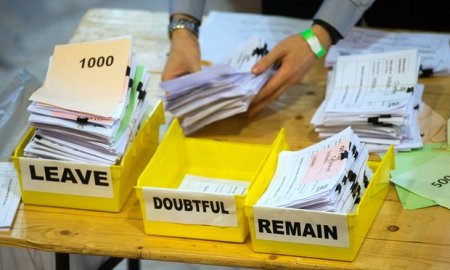
In a historic referendum, millions of British citizens voted Thursday, June 23, to leave the European Union after 43 years by a margin of 52 to 48 percent. Many were undoubtedly moved into approving this pivotal step by three seismic world events:

1. The mass migration flowing into Europe from the Middle East and Africa under the EU aegis. Forebodings in the UK were fueled by figures released a week before the referendum showing an influx of 330,000 migrants to Britain in 2015.

2. The war on the Islamic State which poses a peril which most Western governments avoid addressing by name as World War III in the making.

3. The inability of those governments, beyond empty words, to grapple with the war on ISIS or cope with the  mass of migrants expected to beat on the gates of Western societies for many more hard years.

Many Americans and Europeans are dissatisfied and resentful of President Barack Obama’s approach to the war on ISIS, which is to dismiss the enemy as a minor band of fanatics and thus, rather than a war against Islam. Neither do they accept German Chancellor Angela Merkel’s magnanimous invitation to take refugees in – 1.5 million in two years – as her country’s moral responsibility.

This popular disgruntlement has thrown up such antiestablishment figures as Donald Trump in the US and Boris Johnson in Britain and contributes to the rise of far right-wing movements and extremist violence on both continents.

Those two leaders, though different in most other ways, owe much of their popularity to the pervasive fear in their countries that surging immigration will forever alter the fabric of their societies.

Such social upheaval is the result of a trap deliberately set for the West by two Muslim leaders: ISIS “caliph” Abu Bakr al-Baghdadi, and Turkish President Tayyip Reccep Erdogan.

Al-Baghdadi conceived the idea of flooding the western world with waves of immigrants from Africa and the Middle East as a way to achieve three targets:

a) To change the composition of the population of Western countries by expanding the Muslim increment.

b) To plant networks of ISIS terrorists in the West.

c) To boost ISIS Middle Eastern arms, people and drugs smuggling networks as the organization’s main source of income. Migrants are willing to pay an average of between 5,000 and 10,000 dollars to reach the West even though they know that many never make it alive.

Al Baghdadi made up for the revenue shortfall caused by the US bombing of ISIS-held oil fields and money reserves by pushing over a new wave of immigrants.

President Erdogan’s motives are quite different.

He allowed the waves of immigrants to pass through Turkey on their way to the US and Europe – just as for years, he allowed Western jihadists joining ISIS to reach Siria via Turkey – because he was consumed with the desire to punish the US, namely, the Obama administration, for refusing to back up his hegemonic aspirations in the Middle East; Europe was punished for denying Turkey EU membership year after year.

The victory of Boris Johnson’s “leave” campaign – in the face of Obama’s personal championship of Prime Minister David Cameron’s bid to keep his country in, supported by the Democratic presumptive nominee Hilary Clinton – was a loud and clear signal for politicians running in future elections in the West, including the US presidential vote in November.

Republican candidate Donald Trump’s call to stop Muslim immigration into the US until proper screening measures are in place may sound like an unformed idea, but no other US politician has dared put it on the table, or directly challenge the hollow words and self-righteous hypocrisy of Obama and Clinton on the issues of terror, wars in the Middle East and mass immigration. This alone gives Trump a popular edge in widening circles in the USA over his rival.

Trump is not likely to lose votes either by his pledge to rebuild NATO for leading the West in the war against Islamic terror.

During the five months up until the US presidential election, the West can expect more large-scale ISIS terror coupled with dramatic events in the wars raging in at least seven countries  – Iraq, Syria, Lebanon, Jordan, Egypt, Libya and Afghanistan. Refugees in vast numbers will continue to batter down the doors of countries that are increasingly unable and unwilling to accept them.

Wars in general and religious wars in particular, have throughout history thrown up massive shifts of population displaced by violence, plague, falling regimes, famine and economic hardship.

The year 2016 will go down as the year in which Middle East crises spilled over into the west, bringing social change and far-reaching political turmoil in their wake.

And this is only the beginning.

How Brexit will Change America and the World

June 24, 2016

How Brexit will Change America and the World, Front Page Magazine, Daniel Greenfield, June 24, 2016

750x-1

During Obama’s first year in office, Count Von Rompuy grandly declared that “2009 is also the first year of global governance.” Like many such predictions, it proved to be dangerously wrong. And now it may just well be that 2016 will be the first year of the decline and fall of global governance.

The power of the establishment is illusory. Like the naked emperor, it depends on no one challenging it. The harder it is challenged, the harder it will fall. Brexit was an impossible dream. Then it was reality.

**********************

Yesterday the British people stood up for their freedom. Today the world is a different place.

Celebrities and politicians swarmed television studios to plead with voters to stay in the EU. Anyone who wanted to leave was a fascist. Economists warned of total collapse if Britain left the European Union. Alarmist broadcasts threatened that every family would lose thousands of pounds a year if Brexit won.

Even Obama came out to warn Brits of the economic consequences of leaving behind the EU.

Every propaganda gimmick was rolled out. Brexit was dismissed, mocked and ridiculed. It was for lunatics and madmen. Anyone who voted to leave the benevolent bosom of the European Union was an ignorant xenophobe who had no place in the modern world. And that turned out to be most of Britain.

While Londonistan, that post-British city of high financial stakes and low Muslim mobs, voted by a landslide to remain, a decisive majority of the English voted to wave goodbye to the EU. 67% of Tower Hamlets, the Islamic stronghold, voted to stay in the EU. But to no avail. The will of the people prevailed.

And the people did not want migrant rape mobs in their streets and Muslim massacres in their pubs. They were tired of Afghani migrants living in posh homes with their four wives while they worked hard and sick of seeing their daughters passed around by “Asian” cabbies from Pakistan in ways utterly indistinguishable from the ISIS slave trade while the police looked the other way so as not to appear racist. And, most of all, they were sick of the entire Eurocratic establishment that let it all happen.

British voters chose freedom. They decided to reclaim their destiny and their nation from the likes of Count Herman Von Rompuy, the former President of the European Council, selected at an “informal” meeting who has opposed direct elections for his job and insisted that, “the word of the future is union.”

When Nigel Farage of UKIP told Count Von Rompuy that “I can speak on behalf of the majority of British people in saying that we don’t know you, we don’t want you and the sooner you are put out to grass, the better,” he was fined for it by the Bureau of the European Parliament after refusing to apologize. But now it’s Farage and the Independence Party who have had the last laugh.

The majority of British people didn’t want Count Von Rompuy and his million-dollar pension, or Donald Tusk, Angela Merkel, Francois Hollande and the rest of the monkeys squatting on Britain’s back.

Count Von Rompuy has lost his British provinces. And the British people have their nation back.

The word of the future isn’t “union.” It’s “freedom.” A process has begun that will not end in Britain. It will spread around the world liberating nations from multinational institutions.

During Obama’s first year in office, Count Von Rompuy grandly declared that “2009 is also the first year of global governance.” Like many such predictions, it proved to be dangerously wrong. And now it may just well be that 2016 will be the first year of the decline and fall of global governance.

An anti-establishment wind is blowing through the creaky house of global government. The peoples of the free world have seen how the choking mass of multilateral institutions failed them economically and politically. Global government is an expensive and totalitarian proposition that silences free speech and funnels rapists from Syria, Sudan and Afghanistan to the streets of European cities and American towns. It’s a boon for professional consultants, certain financial insiders and politicians who can hop around unelected offices and retire with vast unearned pensions while their constituents are told to work another decade. But global government is misery and malaise for everyone else.

The campaign to stay in the EU relied on fear and alarmism, on claims of bigotry and disdain for the working class voters who fought and won the right to decide their own destiny. But the campaign for independence asked Britons to believe in their own potential when unchained from the Eurocratic bureaucracy. And now Brexit will become a model for liberation campaigns across Europe.

And it will not end there.

Brexit showed that it is possible for a great nation to defy its leaders and its establishment thinkers to throw off its multinational chains. And while the European Union is one of the biggest prisons forged by global government, it is far from the only one. America and Britain are sleeping giants covered in the cold iron links of multinational organizations that limit their strength and their potential.

It is time to break those chains.

Americans who want to cut their ties with the United Nations have found Brexit inspiring. Leaving the UK was once also seen as a ridiculous idea at the margins that could never be taken seriously. Serious politicians refused to listen to it. Serious thinkers refused to discuss it. And then it gathered speed.

There is growing opposition even among Democrats to treaties like the TPP. Trump has challenged NAFTA. Americans across the political spectrum are suspicious of economic treaties and organizations. Support for Brexit came from Labour areas in the UK. Support for Trump’s challenge to multinational treaties and alliances could very well come from unexpected places, like Bernie Sanders backers.

Brexit has shown us the weakness of the multinational establishment. Its vast bureaucratic power rests on using the media to suppress political dissent. When the media’s special pleading fails to stop the democratic process, it is more helpless than any dictator when the outraged mob pours into his palace.

What was true of Britain, is also true of America. Our elites are just as impotent. The power they have illegally seized is defended zealously by a media palace guard that spends every minute of every day lecturing, hectoring and messaging Americans. But when no one listens to the media, then the men and women who run our lives, who feed off us like a colony of parasitic insects, are helpless.

Their power is purely persuasive. When we stop listening, then we are free.

That is the lesson of Brexit. It is the future.

The future is not a vast behemoth of global government that swallows up nations and individuals, that reduces democratic elections to a joke and eliminates freedom of speech, but the individual. The elites have gambled everything on big government, big media and big data. But all of those lost to Brexit.

They lost to Brexit in the UK. They can lose in the US too. And they will lose.

The power of the establishment is illusory. Like the naked emperor, it depends on no one challenging it. The harder it is challenged, the harder it will fall. Brexit was an impossible dream. Then it was reality.

Our impossible dreams, the policies that conservatives are told by the establishment are not even worth talking about, can be just as real as Brexit.

If we are willing to fight for them.

Populist Anger Upends Politics on Both Sides of the Atlantic

June 24, 2016

Populist Anger Upends Politics on Both Sides of the Atlantic, New York TimesJune 24, 2016

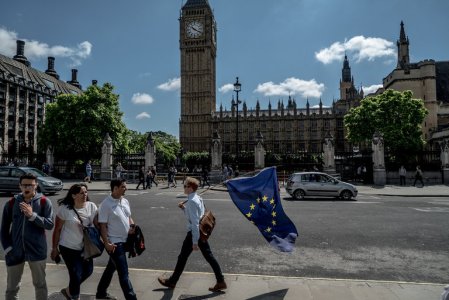
25europe-web2-master768Outside the Houses of Parliament in London on Friday. Credit Andrew Testa for The New York Times

Time and again, the European Union has navigated political crises during the past decade with a Whac-a-Mole response that has maintained the status quo and the bloc’s lumbering forward momentum toward greater integration — without directly confronting the roiling public discontent beneath the surface.

“There is a very widespread rejection of politics everywhere. There is a similar mood in the United States, an antipolitical sentiment.”

***************************

LONDON — From Brussels to Berlin to Washington, leaders of the Western democratic world awoke Friday morning to a blunt, once-unthinkable rebuke delivered by the flinty citizens of a small island nation in the North Atlantic. Populist anger against the established political order had finally boiled over.

The British had rebelled.

Their stunning vote to leave the European Union presents a political, economic and existential crisis for a bloc already reeling from entrenched problems. But the thumb-in-your-eye message is hardly limited to Britain. The same yawning gap between the elite and mass opinion is fueling a populist backlash in Austria, France, Germany and elsewhere on the Continent — as well as in the United States.

The symbolism of trans-Atlantic insurrection was rich on Friday: Donald J. Trump, the presumptive Republican presidential nominee and embodiment of American fury, happened to be visiting Britain.

“Basically, they took back their country,” Mr. Trump said Friday morning from Scotland, where he was promoting his golf courses. “That’s a good thing.”

25europe-web4-master675Donald J. Trump, the presumptive Republican presidential nominee for president, arriving at his Trump Turnberry resort in Scotland on Friday. Credit Jeff J Mitchell/Getty Images

Asked where public anger was greatest, Mr. Trump said: “U.K. U.S. There’s plenty of other places. This will not be the last.”

Even as the European Union began to grapple with a new and potentially destabilizing period of political uncertainty, the British vote also will inevitably be seized upon as further evidence of deepening public unease with the global economic order. Globalization and economic liberalization have produced winners and losers — and the big “Leave” vote in economically stagnant regions of Britain suggests that many of those who have lost out are fed up.

Germany’s Turkish-Muslim Integration Problem

June 24, 2016

Germany’s Turkish-Muslim Integration Problem, Gatestone Institute, Soeren Kern, June 24, 2016

♦ Seven percent of respondents agreed that “violence is justified to spread Islam.” Although these numbers may seem innocuous, 7% of the three million Turks living in Germany amounts to 210,000 people who believe that jihad is an acceptable method to propagate Islam.

♦ The survey also found that labor migration is no longer the main reason why Turks immigrate to Germany: the most important reason is to marry a partner who lives there.

♦ A new statistical survey of Germany — Datenreport 2016: Social Report for the Federal Republic of Germany — shows that ethnic Turks are economically and educationally less successful than other immigrant groups, and that more than one-third (36%) of ethnic Turks live below the poverty line, compared to 25% of migrants from the Balkans and southwestern Europe.

♦ “In our large study we asked Muslims how strongly they feel discriminated against, and we searched for correlations to the development of a fundamentalist worldview. But there are none. Muslim hatred of non-Muslims is not a special phenomenon of Muslim immigration, but is actually worse in the countries of origin. Radicalization is not first produced here in Europe, rather it comes from the Muslim world.” — Ruud Koopmans, sociologist.

Nearly half of the three million ethnic Turks living in Germany believe it is more important to follow Islamic Sharia law than German law if the two are in conflict, according to a new study.

One-third of those surveyed also yearn for German society to “return” to the way it was during the time of Mohammed, the founder of Islam, in the Arabia of the early seventh century.

The survey — which involves Turks who have been living in Germany for many years, often decades — refutes claims by German authorities that Muslims are well integrated into German society.

The 22-page study, “Integration and Religion from the Viewpoint of Ethnic Turks in Germany” (Integration und Religion aus der Sicht von Türkeistämmigen in Deutschland), was produced by the Religion and Politics department of the University of Münster. Key findings include:

  • 47% of respondents agreed with the statement that “following the tenets of my religion is more important to me than the laws of the land in which I live.” This view is held by 57% of first generation Turkish immigrants and 36% of second and third generation Turks. (The study defines first generation Turks as those who arrived in Germany as adults; second and third generation Turks are those who were born in Germany or who arrived in the country as children.)
  • 32% of respondents agreed that “Muslims should strive to return to a societal order like that in the time of Mohammed.” This view is held by 36% of the first generation and 27% of the second and third generation.
  • 50% of respondents agreed that “there is only one true religion.” This view is held by 54% of the first generation and 46% of the second and third generation.
  • 36% of respondents agreed that “only Islam is able to solve the problems of our times.” This view is held by 40% of the first generation and 33% of the second and third generation.
  • 20% of respondents agreed that “the threat which the West poses to Islam justifies violence.” This view is held by 25% of the first generation and 15% of the second and third generation.
  • 7% of respondents agreed that “violence is justified to spread Islam.” This view is held by 7% of the first generation and 6% of the second and third generation. Although these numbers may seem innocuous, 7% of the three million Turks living in Germany amounts to 210,000 people who believe that jihad is an acceptable method to propagate Islam.
  • 23% of respondents agreed that “Muslims should not shake the hand of a member of the opposite sex.” This view is held by 27% of the first generation and 18% of the second and third generation.
  • 33% of respondents agreed that “Muslim women should wear a veil.” This view is held by 39% of the first generation and 27% of the second and third generation.
  • 31% of female respondents said that they wear a veil in public. This includes 41% of the first generation and 21% of the second and third generation.
  • 73% of respondents agreed that “books and movies that attack religion and offend the feelings of deeply religious people should be banned by law.”
  • 83% of respondents agreed that “I get angry when Muslims are the first to be blamed whenever there is a terrorist attack.”
  • 61% of respondents agreed that “Islam fits perfectly in the Western world.”
  • 51% of respondents agreed that “as an ethnic Turk, I feel like a second class citizen.”
  • 54% of respondents agreed that “regardless of how hard I try, I am not accepted as a member of German society.”

The study also found that Turks and native Germans hold radically different perceptions about Islam:

  • While 57% of Turkish Germans associate Islam with human rights, only 6% of Germans do.
  • While 56% of Turkish Germans associate Islam with tolerance, only 5% of Germans do.
  • While 65% of Turkish Germans associate Islam with peace, only 7% of Germans do.

Based on the answers provided, the authors of the survey concluded that 13% of respondents are “religious fundamentalists” (18% of the first generation and 9% of the second and third generation). Although these numbers may appear insignificant, 13% of the three million Turks in Germany amounts to nearly 400,000 Islamic fundamentalists, many of whom believe that violence is an acceptable means to spread Islam.

The survey’s findings mirror those of other studies, which show that Turkish migrants are poorly integrated into German society.

In 2012, the 103-page study, “German-Turkish Life and Values” (Deutsch-Türkische Lebens- und Wertewelten), found that only 15% of ethnic Turks living in Germany consider the country to be their home. Other key findings include:

  • Nearly half (46%) of Turks agreed with the statement, “I hope that in the future there will be more Muslims than Christians living in Germany”; more than half (55%) said that Germany should build more mosques.
  • 72% of respondents said that Islam is the only true religion; 18% said that Jews are inferior to Muslims and 10% said that Christians are inferior.
  • 63% of Turks between the ages of 15 and 29 said they approve of a Salafist campaign to distribute a Koran to every household in Germany; 36% said they would be willing to support the campaign financially.
  • 95% of respondents said it is absolutely necessary for them to preserve their Turkish identity; 87% said they believe that Germans should make a greater effort to be considerate of Turkish customs and traditions.
  • 62% of respondents said they would rather be around Turks than Germans; only 39% of Turks said that Germans were trustworthy.

The survey also found that labor migration is no longer the main reason why Turks immigrate to Germany: the most important reason is to marry a partner who lives there.

Meanwhile, a new statistical survey of Germany — Datenreport 2016: Social Report for the Federal Republic of Germany (Datenreport 2016: Sozial-bericht für die Bundesrepublik Deutschland) — shows that ethnic Turks are economically and educationally less successful than other immigrant groups.

The report, produced by Germany’s official statistics agency, Destatis, in cooperation with several German think tanks, shows that more than one-third (36%) of ethnic Turks are living below the poverty line, compared to 25% of migrants from the Balkans and southwestern Europe (Spain and Portugal). The average income of ethnic Turkish households is €1,242 ($1,400) per month, compared to €1,486 ($1,700) for non-Turkish migrants and €1,730 ($1,950) for German households.

Only 5% of ethnic Turks earn more than 150% of the average German income, compared to 21% of migrants from Eastern Europe, 18% of those from southwestern Europe and 11% of those from the Balkans.

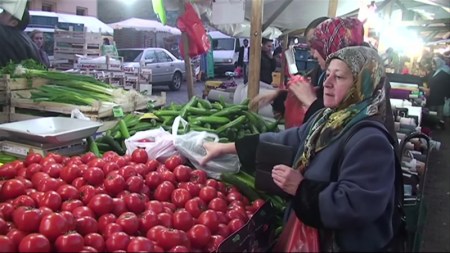
1662An open-air market in the heavily-Turkish Kreuzberg district of Berlin. (Image source: The Berlin Project video screenshot)

The report also shows that Turks have a lower educational attainment than other migrant groups in Germany. Only 60% of ethnic Turks complete secondary school (Hauptschulabschluss), compared to 85% of migrants from Eastern Europe. Moreover, only 8% of ethnic Turks between the ages of 17 and 45 earn a Bachelor’s degree, compared to 30% of migrants in the same demographic from Eastern Europe. Education is a determinative factor for successful integration, according to the report.

German multiculturalists often blame the lack of Turkish integration on the Germans themselves. Writing for Die Welt, economist Thomas Straubhaar argues that most Germans view Turks as guests, not as fellow citizens, an attitude which discourages Turks from integrating:

“Ethnic Turks are essentially treated as guests — hence the controversy over whether their faith belongs to Germany or not. Their immigration is seen as temporary. Their contribution to German culture is seen in a negative light.

“Those who treat migrants as guests should not be surprised when they behave as such. Guests are not expected to have any emotional devotion to the host, nor does the host feel any obligation to show irrevocable loyalty to the guest.

“Guests will not be willing to put all their cards on the table of the host country and take full responsibility for successful integration. Guests assume that sooner or later they must return home again. In everything they do, they will always consider their guest status and be only halfheartedly engaged. This applies to investments in language, culture, friendships, social contacts and professional career.”

Others counter that those who act like strangers should not be surprised if they are treated as strangers. Sociologist Ruud Koopmans argues that one of the most determinative factors in successful integration involves the cultural gap between host and guest. The greater the distance, the greater the integration challenge.

In a recent interview with WirtschaftsWoche, Koopmans criticized multiculturalists who for normative reasons insist that culture and religion should not be factored into the debate on integration:

“In all European countries, Muslim immigrants lag behind all other immigrant groups in almost every aspect of integration. This applies to the labor market, but also to educational achievement, inter-ethnic contacts, i.e., contacts with the local population, and identification with the country of residence.

“Three decisive factors determine cultural distance: language skills, inter-ethnic contacts — especially those involving marriage — and values about the role of women. They all have something to do with religion. This of course applies especially for ideas about the role of women, which are derived directly from the Islamic religion. The greater the cultural distance between groups — especially when there are cultural taboos — the more complicated inter-ethnic marriages become. Such taboos make it virtually impossible for a Muslim, and especially Muslim women, to marry a non-Muslim. Statistics from various European countries show that less than ten percent of Muslim marriages are inter-ethnic.”

Detlef Pollack, the author of the University of Münster study cited above, blames the lack of Turkish integration on discrimination: “The message to the majority German population is that we should be more sensitive to the problems encountered by those of Turkish origin,” he told Deutsche Welle. “It is our view that the feeling of not being accepted is expressed in the vehement defense of Islam.”

Koopmans rejects the link between discrimination and radicalization:

“This is a common assertion. But it is wrong. In our large study we asked Muslims how strongly they feel discriminated against, and we searched for correlations to the development of a fundamentalist worldview. But there are none. Muslim hatred of non-Muslims is not a special phenomenon of Muslim immigration, but is actually worse in the countries of origin. Radicalization is not first produced here in Europe, rather it comes from the Muslim world.”

The rout of the globalists

June 24, 2016

The rout of the globalists, American ThinkerPatricia McCarthy, June 24, 2016

Brexit prevailed and our globalist elites are shocked!  The rest of us are shocked that they are shocked.  The elites of the globalist world are shocked by the candidacy of Donald Trump.  What is wrong with this picture?  It is a loud shout-out re: the  willful blindness of those globalist elites…like Cameron, Obama, Kerry, etc.  Obama threatened the Brits: if they voted for Brexit, they would “go to the end of the queue.”  What a thug our misguided President is – and an ignorant one at that.  The Brits just gave Obama the back of their hand.

None of the  UK toffs, or the American lib elites thought this would happen.  How fun to see them so discombobulated.  But who on earth could believe the people of the Britain could possibly be happy with what has happened to their country?  They have been overrun by immigrants from vastly different cultures who demand and get submission to their religious mandates.They are being out-populated by the birthrates of those immigrants.  Entire neighborhoods are now governed by Sharia law. British citizens are daily victimized by the few but venal among those immigrants. And still, the elites of the world believed that the UK would vote to stay in the EU!  Can there be any question about the cluelessness of our self-regarded betters?

People who have been taught to feel entitled want free stuff from the people who earn what they desire.  Poor economies feel entitled to the perks that productive nations produce.  Greece thought, once it became a member of the EU, that  it could spend like Britain and now they are both broke and in debt, (Greek debt, $351b, UK debt $1.6 t) like the US (US debt, $19t). Obama has doubled our debt.  American taxpayers are his ATM just like they were for the Clintons and will be again if Hillary is elected.

Cameron has come forward to resign.  He backed the wrong horse. It will be interesting to see how this plays out. Was this subterfuge?  Did he really support the Remain camp?  Will he be coddled into staying in office?  London, wholly in the Remain camp,  is like NY, SF, LA and DC; bubbles like the one Pauline Kael inhabited when she was so shocked that Nixon had won and she knew no one who had voted for him.  Like NY, SF, LA and DC, it is the wealthy and powerful elites who are so, so willing to surrender their rights, their freedoms and their country’s sovereignty to be politically correct.  Support the Islamists, trash the Christians; Orlando was about guns, not terrorism.  Give us a break!

We have been sold down the river by members of some elite, juvenile fraternity of submission to nonsense.  Radical Islamists submit themselves to an utterly, brutal, murderous unreformed “faith.”  The Orlando shooter is a perfect example of what submission hath wrought.  The dems who staged that silly sit-in about guns are a laughingstock to all Americans who actually pay attention to facts and reality.

The Left’s response to Orlando is an hysterical defense of Islam and an even more hysterical move to repeal the Second Amendment .  Who are these people?  If Brexit is not a wake-up call for Americans, then we are truly mind-numbed.  Trump may be a jerk but he is not Hillary.  She is  America’s version of the UK elite,  ready to sell us out for the deadly imposition of political correctness.  Think before you vote.  Our lives  and the future of this once great nation depend upon who is elected in November.