Posted tagged ‘Islamic culture’

Saudi Writer Asks How Muslims Would Act If Christian Terrorists Blew Themselves Up In Their Midst

February 25, 2016

Saudi Writer Asks How Muslims Would Act If Christian Terrorists Blew Themselves Up In Their Midst, MEMRI, February 25, 2016

(Why, of course, the Muslim countries would mount well supported efforts to ban Christianophobia and Jewophobia. Oh. Wait. — DM)

Liberal Saudi journalist Nadine Al-Budair, who lives in Qatar, penned an article in the Kuwaiti daily Al-Rai in which she wondered how Muslims would have acted if Christians had blown themselves up in their midst or tried to force their faith on them. She called on the Muslim world to be introspective and enact reforms, instead of condemning Western attitudes towards it.

The following are excerpts from the article:[1]

26924Nadine Al-Budair (image: Alraimedia.com)

“Imagine a Western youth coming here and carrying out a suicide mission in one of our public squares in the name of the Cross. Imagine that two skyscrapers had collapsed in some Arab capital, and that an extremist Christian group, donning millennium-old garb, had emerged to take responsibility for the event, while stressing its determination to revive Christian teachings or some Christian rulings, according to its understanding, to live like in the time [of Jesus] and his disciples, and to implement certain edicts of Christian scholars…

“Imagine hearing the voices of monks and priests from churches and prayer houses in and out of the Arab world, screaming on loudspeakers and levelling accusations against Muslims, calling them infidels, and chanting: ‘God, eliminate the Muslims and defeat them all.’

“Imagine that we had provided an endless number of foreign groups with visas, ID cards, citizenships, proper jobs, free education, free modern healthcare, social security, and so on, and later a member of one of these groups came out, consumed by hatred and bloodlust, and killed our sons on our streets, in our buildings, in our newspaper [offices], in our mosques and in our schools.

“Imagine a Frenchmen or a German in Paris or Berlin leading his Muslim neighbor [somewhere] in order to slaughter him and then freeze his head in an ice box, in a cold and calculating manner… as one terrorist did with the head of an American in Riyadh years ago.[2]

“Imagine that we visited their country as tourists and they shot at us, blew up car bombs near us, and announced their opposition to our presence [there] by chanting: ‘Remove the Muslims from the land of culture.’

“These images are far from the mind of the Arab or Muslim terrorist because he is certain, or used to be certain, that the West is humanitarian and that the Western citizen would refuse to respond [in this manner] to the barbaric crimes [of the Muslim terrorists]. Despite the terrorist acts of Al-Qaeda and ISIS, we [Muslims] have been on [Western] soil for years without any fear or worry. Millions of Muslim tourists, immigrants, students, and job seekers [travel to the West] with the doors open [to them], and the streets safe [for them].

“However, how much longer [will this last]? Today things are different. [Western] anger [at Muslims] is apparent, and they make scary declarations. One who recently championed [these views] is Donald Trump, who demanded to bar Muslims from entering the U.S.

“It is strange that we [Muslims] believe we have the right to condemn such statements rather than address the implications of some of our extremist curricula, our education, and our regimes, and be ashamed [of them]… It is strange that we condemn [the West] instead of addressing what is happening in our midst – the extremist ways in which we interpret the shari’a and our reactionary attitudes towards each other and the world. It is strange that we condemn instead of apologizing to the world.

“How would you react if a European blew up a theater in your city or a café that your son frequents? What would you do if you heard curses against your religion and faith every Sunday, as they hear [against theirs] from some of our imams on Fridays and other days?

“Imagine being in Amsterdam, London, or New York and knowing that students [there] learn as part of their curricula that you are an infidel, and that killing you is jihad that leads to the virgins of paradise. Would you extend your stay there to the end of the summer, or stay away? [Would you] blow yourself up [as the Muslim terrorists do], or would you do less than that: [Merely] conquer your rage and demand to ban Christians from entering Arab countries. What would you do?

“[Imagine] the war that would break out had Westerners shed their values in the face of the bloody crimes committed by foreigners, and if Western or Christian counter-radicalism had emerged in our Arab cities?

“After all these farces, some Arab analyst comes out touting a pathetic message, and reciting the same words in his friend’s ear that he has repeated millions of times: ‘Those [Muslims who commit terrorism] do not represent Islam, but only themselves.’

“This is all we [know how to do] – absolve [ourselves] of guilt.


Endnotes:

[1] Al-Rai (Kuwait), December 15, 2015.

[2] A reference to American engineer Paul Marshall Johnson, who was abducted and beheaded by Al-Qaeda operatives in Saudi Arabia in 2004. His severed head was found in an ice box in a Riyadh apartment approximately one month later.

Police in Rotherham Turned Blind Eye to Islamic Child Rape Ring

February 25, 2016

Police in Rotherham Turned Blind Eye to Islamic Child Rape Ring, Counterjihad.com, February 25, 2o16

The Times of London reports on new evidence of police complicity in a child rape ring being run by Pakistani Muslims in Rotherham, England.  The ring groomed and then raped children for a decade and a half before it was broken up.  The authorities were repeatedly informed, as early as 2002, but agents did not want to risk their careers in an environment of intense pressure not to seem racist or critical of Islam.  There was a Home Office investigation into charges that Tony Blair’s government had known of the ring as early as 2001, but did nothing because it conflicted with “his government’s efforts to pacify Muslim communities.”  Some 1,400 children were raped over the ensuing 16 years.

Now the Times tells us that the police hadn’t just been warned, they knew and were sometimes complicit.

“Corrupt police and an influential politician fuelled a culture of impunity that allowed three brothers to ‘own’ the town of Rotherham and abuse children until their crimes were exposed by The Times. One officer had sex with under-age girls, passed drugs to the sex-grooming gang and tipped them off when colleagues were searching for missing children, a court was told. Another helped to broker a deal in which one brother returned an abused girl to police after receiving an assurance that he ‘wouldn’t get done’. The jury was told that Jahangir Akhtar, the former deputy leader of Rotherham council, also took part in the handover at a petrol station. Mr Akhtar, the former deputy chairman of South Yorkshire police and crime panel, was a relative of Arshid, Basharat and Bannaras Hussain, who behaved for years ‘like a pack of animals’ to pursue dozens of young girls before demanding sex, often with threats of violence.”

This sounds like a story of intense local corruption, and it is.  It sounds like a story of the failure of the police to uphold their most basic oath, and it is that too.  But it is also a story of the ways in which these criminals could rely upon protection from the highest levels of the British government.

The former Prime Minister of England, Tony Blair, is being investigated for having known about the ring as early as 2001.  Blair’s administration suppressed investigations into the ring because it would conflict with his Muslim outreach efforts — outreach efforts being advised by Muslim Brotherhood affiliate groups.  Even today, Tony Blair’s religious charity is accused of ties to the Muslim Brotherhood.  The culture of not questioning Islam or Muslims from on high made possible these corrupt police, who in turn made possible a child rape ring in the heart of England.

Follow the links.  They are links to the most famous newspapers in Britain:  the Times, the Guardian, theIndependent, the Daily Mail.  Believe your eyes.

What to Expect in Iran

February 22, 2016

What to Expect in Iran, Gatestone InstituteJagdish N. Singh, February 22, 2016

♦ “The destruction of Israel is non-negotiable.” — Mohammad Neza Naghdi, Commander of Iran’s Basij paramilitary force.

♦ Sanctions relief will mainly benefit Ayatollah Khamenei and members of the Revolutionary Guards: they control up to one-third of Iran’s economy.

♦ Part of the Iranian regime’s grand strategy is to inflict “death to America” and replace it with its own radical version of Islamic governance. Ayatollah Khamenei himself called for America’s destruction amid nuclear negotiations.

♦ Officials also believe Iran is indirectly funding the Islamic State (IS) in the Sinai. “Suitcases of cash” are sent directly to Hamas officials in the Gaza Strip; part of the money is then transferred to IS.

♦ Iran now poses an even greater threat. If democracies today continue their present policies towards Iran, it will only embolden Iran’s regime to continue its quest to obtain nuclear weapons as well as its terrorism and human rights violations.

Humanity seldom seems to learn its lessons. The governments of the world’s leading democracies appear to be suffering from this predicament in their nuclear dealings with the Islamic Republic of Iran. To avoid catastrophe, democracies need quickly to correct their course.

One of the fatal blunders of Western democracies is their repeated commitment to appeasing and delaying action against aggressive regimes. Between the two World Wars, despite plenty of evidence of the widely-declared global racist agenda of Germany’s Adolf Hitler, democratic powers waited to take action until it was too late. Hitler was able to carry out a genocide that continues to haunt many nations.

Today, Western democratic governments, with their Eastern counterparts such as India, seem on a similar course in dealing with the Islamic Republic of Iran.

The domestic and international agenda of the Khomeinist government is publicly documented. Since the Iranian Revolution of 1979, part of the regime’s open grand strategy is to inflict “death to America,” the leader of the free world, and replace it with its own radical version of Islamic governance. Under the current Supreme Leader Ayatollah Ali Khamenei and his Islamic Revolutionary Guards Corps (IRGC), Iran has been gaining influence across the Middle East, Latin America, the Caribbean and South Asia. Despite nuclear talks with the West, Iran’s goal of “death to America” remains. The Ayatollah himself even called for America’s destruction amid nuclear negotiations.

Currently, Iran is a major player in aiding the autocratic regime of Basher al-Assad in Syria, the Houthis in Yemen, Hezbollah in Lebanon, Palestinian Islamic Jihad and Hamas in the West Bank and Gaza and the Islamic State (IS) in Egypt’s Sinai Peninsula.

To advance its imperial agenda, Iran has proceeded to develop its conventional and nuclear ballistic missile program. According to Director of National Intelligence James Clapper, Iran has “one of the largest inventories of ballistic missiles in the Middle East.”

In line with Iran’s missile development program, Iran’s Revolutionary Guard Navy Rear Commander, Ali Fadavi, announced: “Based on the fifth five-year plan, we should materialize our objective of mass-producing military speedboats with the speed of 80 knots per hour… and are equipped with missiles with a range of 100km; the vessels no one can catch.”

Aside from its military aspirations, since the fall of the Shah in 1979, successive Iranian governments have voiced their plans to annihilate the State of Israel, the only pluralist democracy in the Middle East, and an effective military deterrent to Iran’s designs in the region.

Hostile messages have been pouring forth from Iran. Mohammad Neza Naghdi, Commander of the Basij paramilitary force, stated in clear terms in April 2015, that, “The destruction of Israel is non-negotiable.”

Major General Yahya Rahim Safavi, a former IRGC commander and a top military aide to Khamenei, warned in May 2015, that “More than 80,000 missiles are ready to rain down on Tel Aviv and Haifa.”

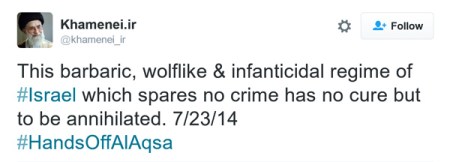
As late as November, Iran’s Supreme Leader Khamenei himself tweeted, “This barbaric, wolflike & infanticidal regime of #Israel which spares no crime has no cure but to be annihilated.”

1477

Bewilderingly, Western democracies have chosen to overlook Iran’s speeches and actions. They chose instead to appease the regime. Last July, despite genuinely serious reservations expressed by international strategic and military experts (including retired American military officers), the United States, United Kingdom, France and Germany – the four democracies in the P5+1 — concluded a nuclear deal with themselves that they proposed to Iran. Iran so far has not signed the deal, and apparently even if it did, according to the U.S. Department of State, the deal would not be legally binding.

Tehran will greatly benefit financially from the terms of the nuclear agreement in the months to come. Under the administration of President Barack Obama, nuclear sanctions against Iran have been lifted. To advance the deal and make it more appealing to Iran, the president has also agreed to pay Iran a $1.7 billion settlement for $400 million in “frozen” assets held in the United States since 1981.

The Society for Worldwide Interbank Financial Telecommunication (SWIFT), “the electronic bloodstream of the global financial system,” had disconnected 15 Iranian banks from its system in 2012. after coming under pressure from both the United States and the European Union at the height of efforts to curb Iran’s nuclear ambitions. Today, SWIFT is ready to let those banned banks, including the Central Bank of Iran, use its system once again. Iran now has an even greater ability to fund its terrorist proxies around the world.

European political and business leaders have been rushing to Tehran to sign new agreements. On January 28, in Paris, Iran’s President Hassan Rouhani and France’s President Francois Hollande signed major business deals, including a joint venture between car-makers PSA Peugeot Citroen and Iran’s Khodro. Iran is in the process of buying 118 Airbus passenger planes to update its aging fleet. The construction group Bouygues and the French airport operator ADP are now set to build an extension for Tehran’s airport, while Vinci, another construction firm, has been commissioned to design, build and operate new terminals for the Mashhad and Isfahan airports. The French oil company Total has agreed to buy Iranian crude oil, and agreements in shipping, health, agriculture and water provision have also been signed.

Democratic India is also cultivating relations with Iran. In a meeting in May, India’s Minister of Road Transport and Highways, Nitin Gadkari, and Iranian Transport and Urban Development Minister, Abbas Ahmad Akhoundi signed a Memorandum of Understanding on India’s participation in the development of the Chabahar Port in Iran.

The Chabahar project will impart strategic leverage to India and its access to Afghanistan and energy-rich Central Asia by bypassing Pakistan. The distance between the Chabahar Port and Gujarat – India’s westernmost state, located near the Persian Gulf, is less than the distance between Delhi and Mumbai. Transit times are estimated to be reduced by a third. Indian firms have already agreed to lease two existing berths at the port and operate them as container and multi-purpose cargo terminals.

The Chabahar project, New Delhi calculates, will be highly beneficial. As India has invested over $2 billion in Afghanistan, the Indian government plans to link the Chabahar port with the Zaranj-Delaram road it built in Afghanistan, thereby opening alternative routes to Afghanistan and enhancing access to regional and global markets.

Russia and China, permanent members of the UN Security Council, are also strengthening their cooperation with Iran. Both Russia and China adopted a policy of ambivalence towards Iran and saw to it that sanctions imposed by the West were not too tough. They also repeatedly blocked attempts at sanctioning Iran’s ally, the current Syrian regime, out of concern over financial ties in the region.

China is also capitalizing on the lifting of sanctions against Iran. Chinese President Xi Jinping rushed to Iran after the so-called nuclear agreement to discuss a 25-year strategic cooperation plan. In a landmark deal worth up to $600 billion, Xi committed to increase trade between the two nations during the next decade. Beijing and Tehran also agreed to enhance security cooperation through intelligence-sharing, counter-terror measures, military exchanges and coordination. Incidentally, despite international sanctions, China-Iran trade increased from $3 billion in 2001 to more than $50 billion in 2014.

Given its fanatical and sectarian ideological agenda, Iran is likely to use the new funds to boost its armament program and ongoing clandestine terror acts. Sanctions relief will mainly benefit Khamenei and members of the IRGC: they control up to one-third of Iran’s economy.

Iran now poses an even greater threat to the entire civilized world. The pattern of Tehran’s behavior shows the government can never be trusted on any promises it makes not to advance its nuclear weapons program. Khamenei has made an open declaration that Tehran will not allow effective inspections of its military sites or interviews with its nuclear scientists.

The links of the IRGC’s Qods Force with Hezbollah, Hamas, Palestinian Islamic Jihad, the Houthis and other terror militias pose a major threat to peace and stability in the Middle East.

Hezbollah’s networks have expanded over the years, infiltrating Latin America and the Caribbean through Shiite cultural centers in the region. According to an official Argentine report, Tehran has established its terrorist, intelligence and operational networks throughout Latin America as far back as the 1980s. Iran’s intelligence activities in the region are being conducted directly by Iranian officials or through its proxy, Hezbollah. Criminal activity may already be underway in Brazil, Colombia, Chile, Paraguay, Uruguay, Suriname and Trinidad and Tobago. Iran’s involvement in the cocaine trade has bolstered the regimes regional access and strengthened ties with its allies in Venezuela, Ecuador, Bolivia and elsewhere.

According to senior Western intelligence officials, the IRGC has transferred tens of millions of dollars to Hamas to be used for weapons, military equipment and training, and that Iran also delivers arms and funds to Hamas through the Red Sea and the Sinai. Officials also believe Iran is indirectly funding the Islamic State (IS) in the Sinai. “Suitcases of cash” are sent directly to Hamas officials in the Gaza Strip; part of the money is then transferred to IS.

Tehran’s links with Hamas and IS are part of a grander strategy of using proxy forces to gain hegemony over the Middle East and undermining American allies such as Egypt and Israel. In Lebanon, Iraq and Syria, Iran seeks to preserve its influence. By fighting IS, Iran strengthens existing pro-Iran regimes and maintains its relevance in the region.

While Iran does support IS indirectly in the Sinai, the government’s goal is to weaken the current Egyptian regime and the Sunni Arab alliance between Egypt, Saudi Arabia and Jordan. It has no problem with IS gaining strength in the Sinai right now. If IS does gain more power in the Sinai, Iran can use it to impose its own agenda in the future. Tehran evidently wants to use IS victories against Sunni states as an opportunity to take over.

Iran also supports the Gaza-based terror group al-Sabireen [“The Patient Ones”], established in the wake of previous tensions between Iran, Hamas and Islamic Jihad. The group has about 400 followers and its emblem is identical to that of Hezbollah. Each member receives a monthly salary of $250-$300, while senior members receive at least $700. Annually, the terror group receives a budget of $10 million from Iran, smuggled in suitcases through tunnels along the border with Egypt. Potential members are wooed by al-Sabireen through familiar channels of philanthropy and education. The group’s publications refer to the United States as “the source of superpower terrorism,” and its slogan is, “The road to the liberation of Palestinian goes through Karbala” — a Shiite holy city in Iraq.

Al-Sabireen has extended its operations from the Gaza Strip to the West Bank and Jerusalem with Iran’s backing. Hisham Salim, the founder of al-Sabireen, admitted that his group is directly financed by Iran. “We have an armed branch whose goal is to wage war on the Israeli occupation everywhere,” Salim said. “Within this framework we have members in the West Bank and Jerusalem.”

The Obama administration has forged ahead with its Iran policies despite knowing the regime’s support of global terrorism. U.S. President Barack Obama himself spoke about Iran’s terror activities in a press conference last year. “Now, we’ll still have problems with Iran’s sponsorship of terrorism; its funding of proxies like Hezbollah that threaten Israel and threaten the region; the destabilizing activities that they’re engaging in, including place like Yemen,” he said, adding that the nuclear “deal is not contingent on Iran changing its behavior. Its not contingent on Iran suddenly operating like a liberal democracy.”

History urges those living in democracies today to rein in their governments and correct their fatal Iran policies. The world cannot afford to overlook the damage of these governments. If democracies today continue their present policies towards Iran, it will only embolden Iran’s regime to continue its quest to obtain nuclear weapons as well as its terrorism and human rights violations.

Denmark Criminalizes Free Speech – Selectively

February 19, 2016

Denmark Criminalizes Free Speech – Selectively, Gatestone InstituteJudith Bergman, February 19, 2016

♦ According to the court decision, pointing out the totalitarian and cruel aspects of Islam itself is now a criminal offense, considered “insulting and demeaning” to Muslims in Denmark and therefore constituting “racism.” In effect, this means that the court is conflating what might possibly constitute blasphemy with racism.

♦ Conversely, when a Danish imam called Jews “the offspring of apes and pigs,” he was officially reported to the police for breaching § 266b, but no legal charges were ever filed against him.

♦ In Denmark, apparently, it is a crime to criticize Islam and “Islamists,” but calling Jews the “offspring of apes and pigs” and inciting their murder in a mosque (and calling non-Muslims in general “animals”) can be done with impunity.

Last week, a Danish district court ruled that what a Danish citizen had written on Facebook in November 2013 violated the Danish criminal code.

In response to a debate about the local activities of a radical Islamic organization, Hizb-ut-Tahrir, which works for the re-establishment of the Islamic caliphate, he wrote: “The ideology of Islam is as loathsome, disgusting, oppressive and as misanthropic as Nazism. The massive immigration of Islamists into Denmark is the most devastating thing to happen to Danish society in recent history.”

According to § 266b of Denmark’s criminal code, it is prohibited and punishable by fine or prison publicly to threaten, insult or demean a group of persons because of their race, skin color, national or ethnic origin, faith or sexual orientation.

The man was fined 1600 Danish kroner (approximately $240), which makes it unlikely that he will be allowed to appeal the sentence: the fine is so small that an appeal to the Higher Court requires special permission.

The Danish district court found that the man’s statements about Islam were “generalizing statements” that were “insulting and demeaning towards adherents of Islam.”

The district court reached this conclusion despite the defendant’s testimony, according to which he specifically wrote “the ideology of Islam” in order to make a distinction between the religion of Islam and the ideology of Islam. The defendant explained that, “‘Islamist’ is a normal term for extremist groups, who commit crimes against humanity and do the most terrible things, whereas Islam is a peaceful religion.”

The district court decided to disregard “the defendant’s explanation that a distinction should be made between the ideology of Islam and the religion of Islam”.

The court reasoned that

“the statements that the defendant has made should be seen in the societal and historical context of the fall of 2013, and in this context the court sees the statements about ‘the ideology of Islam’ as pertaining to Islam generally and not only the extreme part of Islam. In this regard, the court has furthermore emphasized that the quoted statements were written on 29 November 2013 at 17.13 and that at 17.27 on the same day — as pointed out by the defense — the defendant wrote in the same [Facebook] thread that “Islam wishes to abuse democracy in order to get rid of democracy.”

For the incredulous reader, it should be pointed out that the court presumably meant that in 2013, Islamism as an ideology had not manifested itself through terrorism in Denmark and Europe in the same way as it has today, a few years later. This is, of course, nonsense, as pointed out by the defendant’s lawyer, Karoly Nemeth: “I believe the court is expressing a lack of historical understanding. The ideology of Islam has existed for over 1,000 years,” he said.

According to this court decision, then, pointing out the totalitarian and cruel aspects of Islam itself is now a criminal offense, considered “insulting and demeaning” to Muslims in Denmark and therefore constituting “racism.” In effect, this means that the court is conflating what might possibly constitute blasphemy with racism. Despite this decision being wrong in every single aspect, the court did, however, get one thing right: It refused to distinguish between Islam as an ideology and Islam as religion. The prosecutor, Bente Schnack, said it did not make a difference whether the defendant spoke of the ideology or the religion of Islam. “It is pretty difficult to tell the difference,” she said.

While the court’s decision was widely criticized in Denmark, two leading professors of Danish criminal law agreed with it. One professor, Gorm Toftegaard Nielsen, said that, “§ 266b is about subjecting a group of people to hatred by threatening, insulting or demeaning them. When you group Islamists with Nazis, then it is not a compliment.”

The following question, of course, inevitably arises: Since when is public debate supposed to be restricted to complimenting each other?

The professor continued: “When he [the defendant] says ‘the massive immigration of Islamists,’ it can easily be interpreted as meaning that those people are as immoral as Nazis… It is not nice to compare those two groups. But that is what he does indirectly and that amounts to subjecting a group to hatred.”

What the Danish district court did was what the 57-member Organization of Islamic Cooperation has long sought: the establishment of Islamic “blasphemy laws,” making criticism of a religion a criminal offence. The UN Human Rights Commission’s Resolution 16/18 does exactly that, although it is non-binding — except presumably for the countries that want it to be. Infractions, as in Denmark now, are punishable by law. The UNHRC Resolution, originally known as “Defamation of Islam,” was changed in later versions — it would seem for broader marketability — to “Defamation of Religions.”

Conversely, in October 2014, when Mohamed Al Khaled Samha, a Danish imam from the Odense mosque, called Jews “the offspring of apes and pigs,” he was officially reported to the police, and local Danish police began an investigation of the imam with a view to charging him for breaching § 266b, but as far as Gatestone Institute has been able to ascertain, no legal charges were ever filed against him. (Incidentally, this imam was among the group of imams who traveled to the Middle East presumably to stir up anti-Danish sentiment in the aftermath of Jyllands-Posten newspaper’s printing of the Mohammed cartoons). In his sermon, Samha also said, “”Palestine has been and will remain the land of Islam. It is the land of the great battle, in which the Muslims will fight the Jews, and the trees and the stones will say: ‘Oh Muslim, oh servant of Allah! There is a Jew behind me. Come and kill him.'”

In July 2014 another Danish imam, Abu Bilal Ismail, from the Grimshøj mosque, prayed for the death of Jews at a sermon in a Berlin mosque. “Oh Allah, destroy the Zionist Jews. They are no challenge for you. Count them and kill them to the very last one. Don’t spare a single one of them,” Ismail said. This, too, was officially reported to the Danish police, who never acted against that imam, either.

Instead, it was German authorities who criminally charged him. In December 2015, he was sentenced to a €10,000 fine for inciting hatred against Jews as well as non-Jewish groups in Germany. The Berlin court found that Ismail targeted “Jews with hatred, as well as all other non-Muslim groups living in Germany.”

The German court also said that the Lebanese-born cleric had shown deep contempt for the United States and Europe in his sermon, and that his assault on European civilization and Zionists had met the definition of incitement. The verdict said that Ismail considered Jews as “criminals who kill prophets and children, and Jews are worse than wild beasts in the world of the jungle,” and that “Allah should kill Jews.” Since Ismail had already been convicted in Germany, and a person cannot be punished twice for the same criminal act, the Danish police decided not to press charges.

In another, ironic, development regarding the use of § 266b of the Danish penal code, the state Prosecutor decided that Hajj Saeed, who incited against Jews in the Masjid Al-Faru mosque in Copenhagen, on February 13, 2015 — the very same sermon, in fact, that the terrorist Omar Abdel Hamid El-Husseini attended the day before he murdered Dan Uzan at the Copenhagen synagogue — will not be prosecuted for his statements. In his sermon, Saeed said that the Western “infidel” civilization has led non-Muslims “to an abyss of deprivation and corruption and has reduced them from being human to being at the level of animals”. He incited Muslims to wage war against Jews:

“Our prophet Muhammad had Jewish neighbors in Medina. Did he talk about closer ties, harmony and dialogue with them — in the same way as the UN and those who call for reconciliation between what is true and what is false? Or did he tell them to worship Allah? When they broke their promise and did not accept his calling, well, you know what he did to them… He declared war against the Jews.”

Danish police investigated the imam and recommended that the state prosecutor indict him under the same provision of the penal code, § 266b, for inciting hatred and threatening a particular group of people because of their ethnicity — in this instance because they were Jews. The state Prosecutor, for reasons that are unknown at this point, evidently thought otherwise.

Ironically, the mosque in question, Masjid Al-Faru, is connected with Hizb-ut-Tahrir; and the imam, Hajj Saeed, is considered to be one of the organization’s “rising stars” in Denmark.

In 2002, in fairness, the spokesman at the time for Hizb ut-Tahrir, Fadi Abdullatif, was sentenced for violating § 266b, when his organization handed out flyers against Jews with the words, “And kill them, wherever you may find them and banish them from where they banished you.”

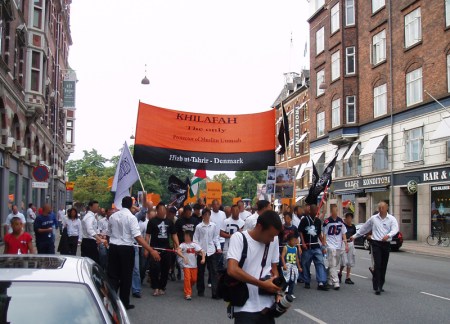
1476Members of the Islamist organization Hizb ut-Tahrir demand a worldwide Islamic Caliphate during a demonstration in Copenhagen, Denmark, in 2006. (Image source: Wikimedia Commons/Epo)

After the February 2015 terrorist attacks in Copenhagen against the synagogue, where Dan Uzan was murdered, and the Krudttønden café, where film director Finn Nørgaard was murdered, Hizb ut-Tahrir told Muslims not to condemn the terrorist attacks, but instead “put things in their right context.”

In Denmark, apparently, it is a crime to criticize Islam and “Islamists,” but calling Jews the “offspring of apes and pigs” and inciting their murder in a packed mosque (and calling non-Muslims in general “animals”) can be done with impunity.

Spring could bring a fresh surge of refugees. But Europe isn’t ready for them.

February 16, 2016

Spring could bring a fresh surge of refugees. But Europe isn’t ready for them. Washington PostGriff Witte and Anthony Faiola, February 16, 2016

LONDON — After an unparalleled tide of asylum seekers washed onto European shores last summer and fall, the continent’s leaders vowed to use the relative calm of winter to bring order to a process marked by chaos.

But with only weeks to go before more favorable spring currents are expected to trigger a fresh surge of arrivals, the continent is no better prepared. And in critical respects, the situation is even worse.

Ideas that were touted as answers to the crisis last year have failed or remain stuck in limbo. Continental unity lies in tatters, with countries striking out to forge their own solutions — often involving a razor-wire fence. And even the nations that have been the most welcoming toward refugees say they are desperately close to their breaking point or already well past it.

The result, analysts say, is a continent fundamentally unequipped to handle the predictable resurgence of a crisis that is greater than any Europe has faced in its post-Cold War history.

“It’s a very dangerous situation,” said Kris Pollet, senior policy officer at the European Council on Refugees and Exiles. “Anything can happen.”

On Thursday, European leaders will have one last opportunity to reckon with the crisis before the pace of new arrivals inevitably begins to climb again in the spring. But few have any expectations that this week’s summit will succeed where countless others before it have failed.

“Europe can deal with this if it wants to. But there needs to be a political breakthrough. And I’m not optimistic,” Pollet said.

Without one, he said, “it’s going to be chaos. That’s clear.”

The scale of disorder and political disruption could be even greater than what Europe faced in 2015.

The numbers themselves are already of an entirely new magnitude: Although arrivals are down from the height of the crisis last fall, the number of people who crossed the sea to reach Europe in the first six weeks of the year — around 75,000 — is 25 times what it was during the same period last year. More than 400 have drowned along the way.

On the Greek islands, the most common European landing spot for people fleeing war and oppression in the Middle East, South Asia and North Africa, thousands have arrived even on days when the rough winter seas have been churned by gale-force winds.

But once the asylum seekers have landed in Europe, the continent still has no coherent system for managing the flows. Just three out of an intended 11 “hot spots” — locations in Italy and Greece where those deemed likely to receive asylum will be separated from those expected to be denied — were up and running at the start of the week. A quota system that was intended to evenly distribute 160,000 refugees across the continent has similarly foundered: Fewer than 500 people have taken part. Countries in eastern and central Europe, meanwhile, have boycotted the program.

With countries improvising their own responses to the mass migration, the most basic tenet of Europe’s post-Cold War identity — that national leaders should act collaboratively to reach continent-wide solutions to common problems — is being called into question as never before.

At most immediate risk is Europe’s decades-old system for borderless travel, the Schengen zone. European leaders have warned that it could come crashing down within months, and it has already been riddled by an array of new fences, military patrols and identification checks where once there was free movement.

Greece could be the first casualty of Schengen’s decline, with the rest of the European Union threatening to kick the cash-starved nation out of the free-movement club unless authorities in Athens can get better control of the nation’s sea border with Turkey. Last week, the E.U. gave Greece a three-month deadline to do so.

But some do not want to wait that long. Eastern European countries including Poland and Hungary are attempting to form an anti-refugee front ahead of this week’s Brussels summit, seeking to combine forces on a plan that would effectively trap refugees in Greece and allow them to travel no farther into Europe.

Hungarian Prime Minister Viktor Orban, who on Monday called Europe “defenseless and weak” in stopping what he regards as an Islamic invasion, has called for the construction of razor-wire fences along Greece’s northern borders with Bulgaria and Macedonia.

Such a barrier is already going up on the Greek-Macedonian border, a major transit point for those heading farther north. Even governments regarded as reasonably pro-refugee say that border will soon need to be sealed.

On a visit to the Macedonian capital Friday, Austrian Foreign Minister Sebastian Kurz said that his country is rapidly nearing the limit it has set for asylum seekers this year — less than half the total of last year — and that Macedonia should be ready to “completely stop” the flow of migrants in the coming months.

On Tuesday, Austria announced a plan to limit new arrivals, part of what is now being called a “domino effect” of measures from Greece through the Balkans and into Western Europe meant to deter migrant flows. In a news conference, Interior Minister Johanna Mikl-Leitner said Austria was preparing to set up 12 new checkpoints along its southern border and impose a daily, perhaps even hourly, quota on migrant flows. Austria will also follow Sweden in denying entry to anyone without a valid travel document.

“If fences are necessary, additional fences will be built as well,” Mikl-Leitner said.

Those comments only add to the pressure on German Chancellor Angela Merkel, whose nation has taken more asylum seekers than any other in Europe but who faces growing demands to live up to her pledge to dramatically reduce the flows.

She heads to Brussels this week with an urgent need to break the political gridlock. One possibility would be to form what some are calling a new “coalition of the willing” — or a list of nations, probably in northern Europe, willing to take in asylum seekers who qualify for resettlement directly from Greece and Turkey.

She is also putting stock in a new NATO effort to combat people-smugglers in the Aegean Sea, while pushing Greece to more rapidly ramp up its hot spots for registering and processing asylum seekers. Meanwhile, she is continuing to press Turkish leaders to live up to their end of a bargain in which the E.U. agreed to pay Ankara 3 billion euros ($3.34 billion) in exchange for Turkish cooperation in cracking down on smuggler networks.

But with arrivals already far outpacing those in the same period last year, Germans are running out of patience with Merkel. At home, she faces a falling approval rating and a conservative backlash against her steadfast refusal to close Germany’s borders, even after it took in more than 1 million people last year.

The refugee crisis “is a Gordian knot Merkel has to cut. But she tied her political future to it, and there’s no way back for her,” said David Kipp, an associate at the German Institute for International and Security Affairs.

If Merkel fails in her attempts to cajole European leaders into cooperating, refugee advocates say there could be grave consequences — not only for the continent but also for the millions of people seeking an escape from the wars that have consumed Syria, Iraq, Afghanistan and other conflict zones.

“Our fear is that there will be a domino effect where countries say, ‘We’ve had enough,’ ” said William Spindler, a spokesman for the Office of the U.N. High Commissioner for Refugees. “Refugee flows are a reality. As long as you have conflict, you will have people fleeing for their lives.”

And at the moment, more people are doing so globally than at any time since World War II — some 60 million. The number trying to enter Europe is a relatively small fraction.

Heaven Crawley, who chairs the study of international migration at Britain’s Coventry University, said Europe should be able to handle the number of people reaching its shores. Syria’s neighbors, she noted, have coped with much higher proportional totals.

But, she said, the continent has been plagued by internal division, as well as a focus on keeping people out — rather than honestly reckoning with what should happen once refugees arrive.

“It’s a crisis of Europe’s own making,” she said. “If Lebanon and Jordan can manage it, why can’t the richest region in the world? It’s politics.”

Germany’s Migrant Crisis: January 2016

February 12, 2016

Germany’s Migrant Crisis: January 2016, Gatestone Institute, Soeren Kern, February 12, 2016

♦ Despite snow, ice and freezing temperatures across much of Europe, a total of 91,671 migrants entered Germany during January 2016.

♦ German taxpayers could end up paying 450 billion euros ($500 billion) for the upkeep of the million migrants who arrived in Germany in 2015. This would presumably double to nearly one trillion euros if another million migrants arrive in 2016.

♦ A 19-year-old migrant from Afghanistan sexually assaulted four girls between the ages of 11 and 13 at a swimming pool in Dresden. The migrant was arrested but then set free.

♦ Three teenage migrants from North Africa tried to stone to death two transsexuals in Dortmund after they were seen walking around in women’s clothing. The victims were saved by police.

♦ Bild reported that politicians in Kiel had ordered the police to overlook crimes perpetrated by migrants.

♦ “The topics we cover are determined by the government. … We must report in such a way that serves Europe and the common good, as it pleases Mrs. Merkel. … today we are not allowed to say anything negative about the refugees. This is government journalism.” – Wolfgang Herles, retired public media personality.

♦ The European Commission called for the “rejection of false associations between certain criminal acts, such as the attacks on women in Cologne on New Year’s Eve, and the mass influx of refugees.”

In January 2016, the German public appeared finally to wake up to the implications of their government’s decision to allow 1.1 million — mostly male — migrants from Africa, Asia and the Middle East to enter the country during 2015.

After more than a thousand Muslim migrants sexually assaulted hundreds of women in cities across Germany on New Year’s Eve, Chancellor Angela Merkel began to face a rising voter backlash to her open-door migration policy.

Merkel’s government has responded to the criticism by: 1) attempting to silence critics of the open-door migration policy; 2) trying to “export” the migrant problem to other countries in the European Union; and 3) announcing a series of measures — branded as unrealistic by critics — to deport migrants accused of committing crimes in Germany.

What Merkel has steadfastly refused to do, however, is reduce the number of migrants entering the country. Despite snow, ice and freezing temperatures across much of Europe, a total of 91,671 migrants — an average of around 3,000 migrants each day — entered Germany during the month of January 2016.

The following is a review of some of the more notable stories about the migration crisis in Germany during January 2016.

January 1. More than a thousand migrants sexually assaulted hundreds of German women in the cities of Cologne, Hamburg and Stuttgart. The government and the mainstream media were accused of trying to cover up the crimes, apparently to avoid fueling anti-immigration sentiment.

January 1. As Muslim migrants were causing mayhem on German streets, the Minister President of Baden-Württemberg, Winfried Kretschmann, said he could not understand public concerns about the “alleged Islamization” of Germany. In an interview with Die Welt, he said: “If you look at the facts, this fear is unfounded. We have a stable democracy and a free society. State and religion are separated. How should Muslims, who represent a minority, Islamize our society?” When asked why Germans are afraid, Kretschmann replied: “People are afraid of strangers they do not know.”

January 1. The International Monetary Fund (IMF) estimated that 1.3 million asylum seekers would enter the European Union annually during 2016 and 2017.

January 2. A fight between children as young as 11 at a refugee shelter in Stockach near Konstanz turned into a mass brawl after parents of the children joined in the fighting. Police were deployed to restore order. Seven people were injured.

January 3. A 16-year-old Moroccan migrant went on a rampage after a judge in Bremen ordered him to be jailed for stealing a man’s laptop at knife-point. On the way from the courthouse to the jail, the Moroccan seriously injured a police officer by kicking him in the face. Once inside the jail cell, the migrant ripped a toilet from the floor and smashed it against a wall.

The chairman of the Bremen Police Union, Jochen Kopelke, said that migrants were attacking city police with increasing frequency: “The tone has become extremely aggressive; sometimes the police must apply massive force to get a situation under control.” According to Bremen Senator Ulrich Mäurer, “the excesses of violence against police officers show that these people have no respect for our constitutional order and its representatives.”

January 3. More than 50 migrants were involved in a mass brawl at a refugee shelter inEllwangen near Stuttgart. Police said migrants attacked each other with fire extinguishers, metal pipes, rocks and stones. According to local media, mass brawls have become commonplace at migrant shelters in the area.

January 3. Hans-Werner Sinn, one of the best-known economists in Germany, cited estimates that German taxpayers could end up paying 450 billion euros ($500 billion) for the upkeep of the million migrants who arrived in Germany in 2015. This estimate would presumably double to nearly one trillion euros if another million migrants arrive in Germany in 2016.

January 4. An internal report written by a senior federal police officer revealed chaos “beyond description” in Cologne on New Year’s Eve. The report, which was leaked to the news magazineDer Spiegel and published in full by the newspaper Bild, said that women were forced to “run a gauntlet” of drunken men of a “migrant background” to enter or depart the main train station. “Even the appearance of the police officers and their initial measures did not stop the masses from their actions.” One migrant told a police officer: “I am Syrian; you have to treat me kindly! Mrs. Merkel has invited me.”

January 5. Cologne Mayor Henriette Reker said: “There is no reason to believe that those involved in the sexual assaults in Cologne were refugees.” Cologne Police Chief Wolfgang Alberssaid: “At this time we have no information about the offenders.”

January 6. Former Interior Minister Hans-Peter Friedrich said it was “scandalous that it took the mainstream media several days” to report on the sexual assaults in Cologne. He said public media was a “cartel of silence” exercising censorship to protect migrants from accusations of wrongdoing.

January 7. A charity called Refugees Welcome Bonn, which organized a Rhine River cruise as welcoming party for migrants in Bonn, apologized after it emerged that migrants groped and sexually harassed some female guests during the event.

January 8. The Interior Ministry revealed that of the 32 suspects identified in the Cologne assaults, 22 were asylum seekers. Cologne Police Chief Wolfgang Albers was fired for withholding information about the assaults from the public.

January 9. A vigilante group began patrolling the streets of Düsseldorf to “make the city safer for our women.” Similar groups emerged in Cologne and Stuttgart.

January 10. Three teenage migrants from North Africa tried to stone to death two transsexuals inDortmund after they were seen walking around in women’s clothing. The victims were saved by police, who happened to pass by in a car. One of the victims said: “I never could have imagined that something like this could happen in Germany.”

January 11. A 35-year-old migrant from Pakistan sexually assaulted a three-year-old girl at a refugee shelter in Kamen.

January 12. In an interview with Bild, Frank Oesterhelweg, a politician with the center-right Christian Democrats (CDU), caused a scandal when he said that police should be authorized to use deadly force to prevent migrants from raping German women:

“These criminals deserve no tolerance, they have to be stopped by the police. By force if necessary, and, yes, you read correctly, even with firearms. An armed police officer has a duty to help a desperate woman. One must, if necessary, protect the victims by means of force: With truncheons, water cannons or firearms.”

Police union leader Dietmar Schilff was irate: “These statements are outrageous and do not help the police at all. There are clear rules for using the service weapon. What would have happened in Cologne if the police had used clubs and guns?” According to Bild, many German police officers are afraid of using lethal force “because of the legal consequences.”

January 12. A YouGov poll showed that 62% of Germans believe the number of asylum seekers is too high, up from 53% in November. According to the poll, the growing resistance to immigration was being driven by the hardening of attitudes by German women.

January 13. An Interior Ministry report leaked to Bild warned that jihadist attacks like those in Paris could take place in Germany “at any time.” The report said that attacks would likely be spread over several days and against “various target categories.”

January 13. A 20-year-old migrant from Somalia was sentenced to four years in prison for raping an 88-year-old woman in Herford. His defense attorneys argued for leniency because, according to them, the man was traumatized by his flight from Somalia. In Gelsenkirchen, four migrantsattacked a 45-year-old man after he tried to prevent them from raping a 13-year-old girl.

January 14. The Bundestag, the lower house of the German parliament, approved a plan to provide all refugees with identity cards that will contain information such as fingerprints and country of origin. The cards will be linked to a centralized refugee data system. The plan may be too late: the German government has lost track of the whereabouts of hundreds of thousands of migrants who entered the country in 2015.

January 14. Prosecutors in Cologne said they were offering a reward of 10,000 euros ($11,000) for information leading to the arrest or identification of those who committed the sexual assaults and robberies on New Year’s Eve.

January 14. A Bavarian politician sent a bus carrying 31 refugees on a seven-hour journey to Chancellor Angela Merkel’s office in Berlin to protest her open-door refugee policy. Merkel sentthe migrants back to Bavaria.

January 14. City officials in Rheinberg cancelled this year’s carnival celebrations. Local police said that in wake of the sexual assaults in Cologne on New Year’s Eve, they were unable to guarantee the safety of female revelers.

January 15. A 36-year-old migrant sexually assaulted an eight-year-old girl at a public park in Hilden near Solingen. A 31-year-old migrant from Tunisia was arrested for attempting to rape a 30-year-old woman in Chemnitz. A 31-year-old migrant from Morocco appeared in court for raping a 31-year-old woman in Dresden. A migrant sexually assaulted a 42-year-old woman in Mainz. A migrant sexually assaulted a 32-year-old woman in Münchfeld. An African migrant sexually assaulted a 55-year-old woman in Mannheim.

January 15. Male migrants were banned from a public swimming pool in Bornheim, near Bonn, after they were accused of assaulting female patrons at the facility.
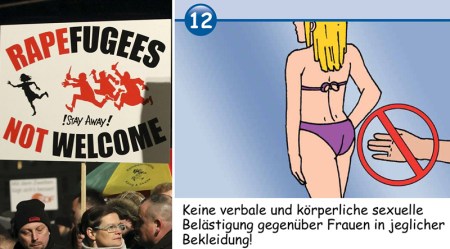
1470In January, there were thousands of cases of migrants sexually assaulting women in Germany, including many that took place in public pools. The government began to face a rising voter backlash to the open-door migration policy, including public protests (left). In some areas, authorities have distributed cartoon guides, to “educate” migrants that sexual assault is not acceptable (right).

January 15. Finance Minister Wolfgang Schäuble, in an interview with the Süddeutsche Zeitung, signaled his determination to export Germany’s migrant problem by calling for a Europe-wide gas tax to help pay for the cost of hosting millions of migrants. He said:

“If the funds in national budgets and the European budget are not enough, then let us agree, for example, to raise a levy on every liter of gasoline at a certain level. If a country refuses to pay, I am still prepared to do it. Then we will build a coalition of the willing.”

January 16. Norbert Röttgen, chairman of the foreign affairs committee in the German Bundestag and a lawmaker in Angela Merkel’s Christian Democratic Union (CDU), called upon the government to create a Ministry for Migration, Integration and Refugees. He said the migrant crisis had developed into a “primary and permanent task for the state” and is of “decisive importance for the future of our country and Europe.”

January 16. A 19-year-old migrant from Afghanistan sexually assaulted four girls between the ages of 11 and 13 at an indoor swimming pool in Dresden. The migrant was arrested but then set free. A migrant from Syria sexually assaulted a 12-year-old girl in Mudersbach. A 36-year-old migrant sexually assaulted an eight-year-old girl in Mettmann.

January 16. A group of between six and eight African migrants ambushed three people leaving a discotheque in Offenburg. The migrants were ejected from the discotheque after female clients complained that the men were sexually harassing them. After they left, at around 4AM, the migrants attacked them with metal rods, street signs and garbage bins.

January 17. In an interview with Bild am Sonntag, the president of the federal criminal police, Holger Münch, said that the number of crimes in refugee shelters had increased “significantly” since 2015, when the migrant influx began. He said that the migrants mostly responsible were from the Balkans and North Africa, especially Algerians, Tunisians and Moroccans. He added that half the offenses at the refugee shelters were physical assaults, but that there was also a growing number of homicides and sexual crimes.

January 17. In an interview with the Süddeutsche Zeitung, former Bavarian Prime Minister Edmund Stoiber warned that Chancellor Angela Merkel will “destroy Europe” if she refuses to reduce the number of migrants entering Germany.

January 17. Berlin clergyman Gottfried Martens accused German politicians and church leaders of ignoring the persecution of Christians by Muslims in German refugee shelters. He said that the Christians were facing “verbal threats, threats with knives, blows to the face, ripped crucifixes, torn bibles, insults of being an infidel, and denial of access to the kitchen because of uncleanness.”

January 18. A 26-year-old Algerian man was the first person to be arrested in connection with a string of sexual assaults during New Year’s celebrations in Cologne. He was apprehended at a refugee shelter in the nearby town of Kerpen. Cologne’s chief prosecutor, Ulrich Bremer, said that nearly 500 women had come forward with allegations of sexual assault, including three cases of rape.

January 18. A 24-year-old migrant from Sudan was released after being held for questioning at a police station in Hanover. After crossing the street, the man, who receives 300 euros ($335) a month in social welfare benefits, dropped his pants and exposed himself in public and shouted, “Who are you? You cannot do anything to me. Whatever I cannot get from the state, I will steal.”

January 19. Addressing the European Parliament in Strasbourg, European Council President Donald Tusk warned that the European Union had “no more than two months” to get control over the migration crisis or face the collapse of the Schengen passport-free travel zone.

January 19. A poll published by Bild showed that support for Chancellor Angela Merkel’s conservative bloc was down 2.5 points at 32.5%, its lowest result since the 2013 election. The poll showed that support for the anti-immigration Alternative for Germany (AfD) was up 1 point at 12.5%; support for the Social Democrats was up 1 point at 22.5%.

January 19. A 28-year-old migrant from Iran pushed a 20-year-old woman onto the tracks of an oncoming train in Berlin. She later died.

January 20. Bild reported that migrants invaded female changing rooms and showers at two public swimming pools in Leipzig. Migrants, dressed in their street clothes and underwear, also jumped into the swimming pools. According to Bild, the city hall had tried to keep the incidents quiet, but details were leaked to the media.

January 21. More than 200 migrants have sued the German government for delays in processing their asylum applications.

January 22. Facing political pressure over the migrant crisis, Chancellor Angela Merkel met in Berlin with Turkish Prime Minister Ahmet Davutoglu to discuss ways to stem the flow of Syrian and other refugees from Turkish shores. She renewed a pledge to provide Turkey with financial support. In November 2015, EU leaders pledged 3 billion euros ($3.4 billion) to Ankara to help care for an estimated 2.5 million Syrian refugees in Turkey; the deal has been delayed by a dispute among EU member states over who will pay.

January 22. A report by municipal authorities in Zwickau that was leaked to Bild revealed that migrants were defecating in public swimming pools. Security cameras also filmed migrants harassing women in the public sauna and attempting to storm the female dressing room.

January 22. Police in Hanover investigated four nightclub bouncers for allegedly beating an 18-year-old Algerian migrant after he tried to steal the purses of two teenage girls. Two days before the incident, the migrant had been sentenced to one year in juvenile detention for robbery, but he was free to roam the streets until his sentence began.

January 22. A migrant attempted to rape a 16-year-old girl in Feuerbach district of Stuttgart, and in downtown Stuttgart, four migrants sexually assaulted a 23-year-old woman.

January 23. The Süddeutsche Zeitung reported that migrants had attacked women in 12 of Germany’s 16 states on New Year’s Eve. In addition to the attacks Cologne, 195 women filed complaints in Hamburg; 31 in Hesse; 27 in Bavaria; 25 in Baden-Württemberg; 11 in Bremen; and six in Berlin.

January 23. Two migrants sexually assaulted an 18-year-old woman in Wiesbaden, and a 35-year-old migrant sexually assaulted a woman in a restroom on a train in Düsseldorf.

January 23. The Stuttgarter Nachrichten reported that dental work for migrants could end up costing German taxpayers billions of euros.

January 24. An official police report leaked to The Huffington Post showed that Interior Minister Thomas de Maizière was not being truthful when he said that between 100 and 200 migrants are being denied entry into Germany each day. The report stated that since September 14, border police had prevented 7,185 migrants from entering the country — or only about 60 migrants turned away each day.

January 25. A 30-year-old migrant from North African exposed himself to a 19-year-old woman on a public bus in Marburg, and then to passersby at the main train station.

January 26. In an interview with the German public radio, Deutschlandfunk, retired public media personality Wolfgang Herles admitted that public broadcasters receive “instructions from above” when it comes to reporting the news:

“We have the problem that we are too close to the government. The topics we cover are determined by the government. But many of the topics the government wants to prevent us from reporting about are more important than the topics they want us to cover…

“We must report in such a way that serves Europe [the European Union] and the common good, as it pleases Mrs. Merkel. There are written instructions … today we are not allowed to say anything negative about the refugees. This is government journalism, and this leads to a situation in which the public loses their trust in us. This is scandalous.”

Previously, Claudia Zimmermann, a reporter with the public television broadcaster WDR, said that public media outlets in Germany “have been warned to report the news from a pro-government perspective.”

January 26. A 24-year-old man on an evening stroll with his three-month-old baby daughter in the Eißendorf district of Hamburg was approached by two migrants who demanded his wallet and cellphone. When he said he was not carrying any valuables, the migrants attacked him with a knife. Fleeing for his life, the man ran onto a frozen pond and broke through the ice. A passerby heard the man calling for help. The baby, under water for an extended period, was revived by paramedics called to the scene. The baby remains in intensive care; the migrants remain at large.

January 26. A 28-year-old migrant from Algeria applied for asylum in Wesel. Authorities became suspicious because of his proficiency in German. They later determined that he had arrived in Germany in November 2014, rather than, as he claimed, in October 2015. It emerged that he had outstanding warrants for theft, but evaded police by using six different identities.

January 26. The Kieler Nachrichten reported that the proliferation of sexual assaults by migrants has women in the northern city of Kiel afraid to be out at night because the city is too dark. In an effort to save electricity, municipal officials decided to convert all of the city’s street lights to LED bulbs, but they do not provide sufficient light to keep the streets illuminated at night.

January 26. The mayor of Freiburg, Dieter Salomon, ordered police to take a hard line against migrants accused of snatching purses and assaulting women in the city’s discotheques. According to club owners, migrants have been robbing women on the dance floor and raping them in the restrooms. Many of the offenders are allegedly underage migrants from North Africa. Club owners say that the migrants are not afraid of authority: “They know that nothing will happen to them here.”

January 27. A 39-year-old migrant from Afghanistan tried to enter Germany at Simbach, a town on the border of Austria. A background check determined that in May 2000, a German court had sentenced the man to an eight-year prison term for rape. He had been deported to Afghanistan in 2006 with orders never to return.

January 27. The public radio and television channel, Mitteldeutscher Rundfunk, reported that German taxi drivers are profiting from the migrant crisis by taking migrants to doctors’ appointments and asylum interviews. The cab fares are being paid for by German taxpayers. MDR reported on a taxi company in Leipzig that had billed the government for 800 taxi fares for taking migrants to run errands. One taxi driver, for example, drove a migrant family on an 80 km (50 mile) journey for an appointment with migration authorities. The meter was left running while the driver waited for the migrants to return from their meeting. The fare was 309 euros ($344).

January 28. Bild reported that politicians in Kiel had ordered the police to overlook crimes perpetrated by migrants. According to the paper, the police in North Rhine-Westphalia and Lower Saxony have also been instructed to be lenient to criminal migrants.

January 28. A migrant from Sudan sexually assaulted a female police officer in Hanover as she was attempting to arrest him for theft. Public prosecutor Thomas Klinge confirmed the incident. “Such brazen behavior towards a police officer has been unheard of until now,” he said.

January 28. Berlin’s Tempelhof airport, the iconic site of the Berlin Airlift in 1948-49, is set to become the biggest refugee shelter in Germany. In a controversial move to alter the airport’s zoning regulations, Berlin’s municipal government — run by a coalition between the Christian Democratic Union and the Social Democratic Party — voted to build five massive structures to house 7,000 migrants there. Opposition politicians said the government was creating an “immigrant ghetto” in the heart of Berlin.

January 28. Police in Berlin said that a volunteer with the charity group Moabit Hilft hadfabricated a story about a 24-year-old migrant said to have died while waiting for days outside an asylum registration office. The story was allegedly faked in an effort to embarrass the government for its slow response to the migrant crisis.

January 29. The European Commission, the powerful administrative arm of the European Union, said that the sexual assaults in Cologne had nothing to do with the migrant crisis and were simply a matter of public order. A confidential memo leaked to The Telegraph stressed the importance of the Commission’s “continuing role in sounding the voice of reason to defuse tensions and counter populist rhetoric.” The Commission called for “the unconditional rejection of false associations between certain criminal acts, such as the attacks on women in Cologne on New Year’s Eve, and the mass influx of refugees.”

January 29. A public vocational school in the Wilhelmsburg district of Hamburg cancelled plans to host classes for refugees after male migrants sexually harassed dozens of female students at the school.

January 29. The German news magazine Focus published the results of a poll showing that 40% of Germans want Chancellor Angela Merkel to resign because of her migrant policies.

January 30. A gang of migrants on a Munich subway train were filmed attacking two elderly men who tried to stop them from groping a woman. Images show the migrants grabbing two men by the arms and neck and shouting abuse at them. It later emerged that the migrants were from Afghanistan; although they had been denied asylum in Germany four years ago, the German government refused to deport them because Afghanistan is “too dangerous.”

January 31. The Interior Minister of Saxony-Anhalt, Holger Stahlknecht, of the Christian Democrats, announced that he would delay releasing the 2015 crime statistics until March 29, two-and-half weeks after regional elections. The statistics are normally released in February or early March. Rüdiger Erben of the Social Democrats said: “The late release date reinforces my suspicion that the statistics are horrific.”

January 31. ISIS sympathizers defaced more than 40 gravestones at a cemetery in Konstanzwith slogans such as, “Germans out of Syria,” “Christ is Dead” and “Islamic State.”

January 31. A 30-year-old German, originally from Turkmenistan, raped a seven-year-old girl in Kiel. The man kidnapped the girl from a school playground at 11AM, took her to his apartment and, after abusing her, set her free. It later emerged that the man, who is the father of two children, had been accused of sexually assaulting a five-year-old girl at another kindergarten in Kiel on January 18, but the public prosecutors failed to pursue the case due to insufficient evidence. “In hindsight, we regret that decision,” the prosecutors said.

January 31. In an underhanded effort to silence critics of the government’s open door migration policy, Vice Chancellor Sigmar Gabriel called on German intelligence to begin monitoring the Alternative for Germany (AfD), the third-largest party in Germany. The AfD is surging in popularity because of its anti-immigration platform.

Our Good Islam/Bad Islam Strategy

February 11, 2016

Our Good Islam/Bad Islam Strategy, Front Page Magazine, Daniel Greenfield, February 11, 2016

Behead them

There is no Good Islam. There is no Bad Islam. There is just Islam.

**********************

Our only hope of defeating Islamic terrorism is Islam. That’s our whole counterterrorism strategy.

But Islamic terrorism is not a separate component of Islam that can be cut off from it. Not only is it not un-Islamic, but it expresses Islamic religious imperatives. Muslim religious leaders have occasionally issued fatwas against terrorism, but terrorism for Muslim clerics, like sex for Bill Clinton, is a matter of definition. The tactics of terrorism, including suicide bombing and the murder of civilians, have been approved by fatwas from many of the same Islamic religious leaders that our establishment deems moderate. And the objective of terrorism, the subjugation of non-Muslims, has been the most fundamental Islamic imperative for the expansionistic religion since the days of Mohammed.

Our strategy, in Europe and America, under Bush and under Obama, has been to artificially subdivide a Good Islam from a Bad Islam and to declare that Bad Islam is not really Islam. Bad Islam, as Obama claims, “hijacked” a peaceful religion. Secretary of State Kerry calls Bad Islam’s followers, “apostates”. ISIS speaks for no religion. It has no religion. Which means the Islamic State must be a bunch of atheists.

Our diplomats and politicians don’t verbally acknowledge the existence of a Bad Islam. Even its name is one of those names that must not be named. There is only Good Islam. Bad Islam doesn’t even exist.

This isn’t just domestic spin, which it is, but it’s also an attempt at constructing an Islamic narrative. Our leaders don’t care what we think. They just want us to keep quiet and not offend Muslims. They do care a great deal about what Muslims think. And so, in their own clumsy way, they try to talk like Muslims.

They are attempting to participate in an Islamic debate without the requisite theological credentials. They want to tell Muslims that they should be Good Muslims not Bad Muslims, but they’re too afraid to use those words, so instead they substitute Good Muslims and Not Muslims. All Muslims are Good Muslims and Bad Muslims are Not Muslims is their Takfiri version of the No True Scotsman fallacy.

Our counterterrorism strategy has been constructed to convince Good Islam to have nothing to do with Bad Islam. And any of us who criticize Good Islam or argue that the artificial distinction between Good Islam and Bad Islam, between Saudi Arabia and ISIS, between Iran and Hezbollah, between Pakistan and the Taliban, is false are accused of provoking Good Islam to transform into Bad Islam.

Nothing so thoroughly proves that the difference between Bad Islam and Good Islam is a lie as the compulsive way that they warn that Good Muslims are capable of turning into Bad Muslims at any moment. Offend a Good Muslim, criticize his religion, fail to integrate him, accommodate his every whim and censor what he dislikes and he’ll join ISIS and then he’ll become a Bad Muslim.

After every terror attack, the media painstakingly constructs a narrative to determine why former moderates like Anwar Al-Awlaki, the Tsarnaevs or the San Bernardino killers turned bad without resorting to religious explanations. Their efforts at rationalization quickly become ridiculous; Nidal Hasan, the Fort Hood killer, contracted airborne PTSD, Anwar Al-Awlaki, the head of Al Qaeda in Yemen, became an “extremist” because he was afraid the FBI had found out about his prostitutes and the Times Square bomber turned into a terrorist because his “American Dream” was ruined.

Nobody, they conclude, becomes an Islamic terrorist because of Islam. Instead there are a thousand unrelated issues, having nothing to do with Islam, which creates the Muslim terrorist. Even the term “Radical Islamic Jihadist”, an absurd circumlocution (is there a moderate Islamic Jihadist), has become a badge of courage on one side and a dangerous, irresponsible term that provokes violence on the other.

But what is the distinction between Good Islam and Bad Islam? It isn’t fighting ISIS. Al Qaeda and the Taliban do that. It isn’t terrorism. Our Muslim allies, Saudi Arabia, Pakistan, Turkey and Qatar, are hip deep in the terror trade. It isn’t equality for non-Muslims. No Muslim country under Sharia law could have that. Equality for women? See above.

What are the metrics that distinguish Good Islam and Bad Islam? There aren’t any. We can’t discuss the existence of Bad Islam because it would reveal that Bad Islam and Good Islam are really the same thing.

Our Good Islam allies in Pakistan fight Bad Islam’s terror, when they aren’t hiding Osama bin Laden. Bad Islam in the Islamic State beheads people and takes slaves and Good Islam in Saudi Arabia does too. Qatar is our Good Islam ally helping us fight Bad Islam terrorists by arming and funding Good Islam terrorists who sometimes turn out to be Bad Islam terrorists so we can’t figure out if the Islamic terrorists the CIA is routing weapons to are Good Islam terrorists or Bad Islam terrorists.

The moderate Muslim Brotherhood wins democratic elections. The extremist Muslim Brotherhood then burns down churches. The moderate Palestinian Authority negotiates with Israel and then the extremist Palestinian Authority cheers the stabbing of a Jewish grandmother. The moderate Iranian government signs a nuclear deal and then the extremist Iranian government calls for “Death to America”.

Like the saintly Dr. Jekyll and the mean Mr. Hyde, Good Islam and Bad Islam are two halves of the same coin. When Dr. Jekyll wanted to act out his baser nature, he took a potion and turned into Mr. Hyde. But the nasty urges were always a part of him. When a moderate Muslim pulls a Keffiyah over his face and starts stabbing, bombing or beheading, he doesn’t become an extremist, he just expresses his dark side.

Good Islam borrowed all sorts of noble sentiments from Judaism and Christianity. But when non-Muslims didn’t accept Islam, then Mohammed stopped playing nice and preached murder. Bad Islam is not something ISIS invented on a website. It’s always been a part of Islam. We attempt to separate Good Islam and Bad Islam because we don’t like being beheaded. But Muslims don’t make that distinction.

Our counterterrorism strategy is based on empowering Good Islam, on building coalitions with Muslims to fight terrorism and enlisting their cooperation in the War on Terror. But we’re trying to convince Dr. Jekyll to help us fight Mr. Hyde. And Dr. Jekyll might even help us out, until he turns into Mr. Hyde.

Our moderate Afghan Muslim allies, when they’re aren’t raping young boys (one of their cultural peculiarities we are taught to ignore), sometimes unexpectedly open fire on our soldiers. The Muslim migrants who arrive here to “enrich” our societies sometimes start shooting and bombing. The head of Al Qaeda was hanging out near the West Point of Pakistan. The mastermind of 9/11 was saved by a member of the Qatari royal family. The call is coming from inside the house. Mr. Hyde is Dr. Jekyll.

When we “empower” and “build coalitions” with Good Islam, we’re also empowering and building coalitions with Bad Islam. Just ask all the Muslim terrorists running around with our weapons.

Our leaders want Good Islam to shield us from Bad Islam. If Good Islam is out front, then Muslims won’t see a clash of civilizations or a religious war, but a war between Good Islam and Bad Islam. But the Muslim understanding of Good Islam and Bad Islam is very different from our own.

Sunnis see their Jihadis as Good Islam and Shiites as Bad Islam. Shiites look at it the other way around. The Muslim Brotherhood, that our elites were so enamored with, saw secular governments as Bad Islam. To win them over, we helped them overthrow more secular governments because our leaders had adopted an understanding of Good Islam in which giving Christians civil rights was Bad Islam.

To win over Good Islam, we censor cartoons of Mohammed and criticism of the Koran, open our borders, Islamize our institutions and then wait to see if we’re on the good side of Good Islam. We adapt our societies and legal systems to Islamic norms and hope that it’s enough to let us join the Good Islam Coalition. If we go on at this rate, the experts will tell us that the only way to defeat Islamic terrorism is for us to become Muslims. Only then will we become members in good standing of Good Islam.

There is no Good Islam and no Bad Islam, as Muslim leaders occasionally trouble to tell us. The distinction that our leaders make between Good Islam and Bad Islam is not theological, but pragmatic. They dub whatever is shooting at us right now Bad Islam and assume that everything else must be Good Islam. That is the fallacy which they used to arrive at their Tiny Minority of Extremists formula.

There is no Tiny Minority of Extremists. Behind the various tiny minorities of extremists are countries and billionaires, global organizations and Islamic banks. Outsourcing our counterterrorism strategy to the countries and ideologies behind the terrorists we’re fighting isn’t a plan, it’s a death wish.

Islamic terrorism is just what we call Islam when it’s killing us.

The Jihad isn’t coming from some phantom website. It’s coming from our Muslim allies. It’s coming from Pakistan, Turkey, Qatar and Saudi Arabia. It’s coming from the Muslim Brotherhood and its front groups. It’s coming from the moderate Muslim leaders that our leaders pose with at anti-extremism conferences. And it’s coming from the mosques and homes of the Muslims living in America.

There is no Good Islam. There is no Bad Islam. There is just Islam.

The End Of The Multiculturalist Consensus In Europe

February 5, 2016

The End Of The Multiculturalist Consensus In Europe, Daily Caller, Michel Gurfinkiel, February 3, 2016

(Please see also, Latest Poll: Merkel in Free Fall, Germans Sensible; 76% of AfD Supporters OK with Genuine Refugees.  — DM)

One wonders why America, a nation of immigrants, can be suddenly so receptive to Donald Trump’s anti-immigration rhetoric. The best answer, so far, is that immigration does not seem to work any more the way it did, at least for certain groups of immigrants.

A similar situation has arisen in Europe. In 2009, the American journalist Christopher Caldwell famously characterized the changes that a massive non-European, non-Judeo-Christian, immigration was forcing over Europe as a “revolution.” We may now be on the brink of a counter-revolution, and that can be as violent and far-reaching as revolution itself.

Last year’s massacres in Paris (the attacks on satirical cartoonists and a kosher supermarket’s customers in January 2015, then the November 13 killing spree) were a tipping point : the French – and by extension, most Europeans — realized that unchecked immigration could lead to civil war.

Then there was the Christmas crisis in Corsica, a French island in the Mediterranean. On December 24, a fire was activated at an immigrant-populated neighborhood in Ajaccio, the capital of Southern Corsica. As soon as the firemen arrived, they were attacked by local youths, Muslims of North African descent. Such ambushes have been part of French life for years. This time, however, the ethnic Corsicans retaliated; for four days, they rampaged through the Muslim neighborhoods, shouting Arabi Fora! (Get the Arabs out, in Corsican). One of Ajaccio’s five mosques was vandalized.

Then, there was the New Year’s crisis in Germany and other Northern European countries. On December 31, one to two thousand male Muslim immigrants and refugees swarmed the Banhofvorplatz in Cologne, a piazza located between the railway Central Station and the city’s iconic medieval cathedral. As it turned out during later in the evening and the night, they intended to “have fun”: to hunt, harass, or molest the “immodest” and presumably “easy” German women and girls who celebrated New Year’s Eve at the restaurants and bars nearby, or to steal their money. 766 complaints were lodged. Similar incidents took place in other German cities, like Hamburg, Frankfurt and Stuttgart, as well as in Stockholm and Kalmar in Sweden, and Helsinki in Finland.

Here again, the local population reacted forcefully. Support for asylum seekers from the Middle East plummeted – 37 percent of Germans said that their view of them has “worsened,” and 62 percent said that there are “too many of them.” The Far Right demonstrated against immigration in many cities, but liberal-minded citizens were no less categorical. Le Monde, the French liberal newspaper, on January 20 quoted Cologne victims as saying, “Since 1945, we Germans have been scared to be charged with racism. Well, the blackmail is over by now.”

Indeed, postwar Europe, and Germany in particular, had been built upon the rejection of Hitler’s mad regime and everything it stood for. Nationalism, militarism, authoritarianism, and racism were out. Multinationalism, pacifism, hyperdemocracy, and multiculturalism were in. This simple, almost Manichean, logic is collapsing now – under the pressure of hard facts. Or rather the Europeans now understand that it was flawed in many ways from the very beginning, especially when it came to multiculturalism, the alleged antidote to racism.

What Europeans had in mind when they rejected racism in 1945 was essentially antisemitism. Today, the “correct” antiracist attitude would be to welcome non-European immigrants en masse and to allow them to keep their culture and their way of life, even it that would contradict basic European values. Hence last summer’s “migrants frenzy,” when the EU leadership in Brussels and major EU countries, including Angela Merkel’s Germany, decided to take in several millions of Middle East refugees overnight.
European public opinion is now awaking to a very different view. And the political class realizes that it must adjust – or be swept away.

European public opinion is now awaking to a very different view. And the political class realizes that it must adjust – or be swept away.

The Schengen regime – which allows free travel from one country to the other in most of the EU area – is being quietly suspended; every government in Europe is bringing back borders controls. The French socialist president François Hollande is now intent to strip disloyal immigrants and dual citizens of their French citizenship (a move that precipitated the resignation, on January 27, of his super-left-wing justice minister, Christiane Taubira). He is also hiring new personnel for the police and the army and even considering raising a citizens’ militia. Merkel now says that immigrants or refugees who do not abide by the law will be deported. Even Sweden, currently ruled by one of Europe’s most left-wing cabinets, has been tightening its very liberal laws on immigration and asylum.

Most Europeans agree with such steps. And wait for even more drastic measures.


Swedish Cops had a Special “Code 291” to Cover up Migrant Crimes

February 1, 2016

Swedish Cops had a Special “Code 291” to Cover up Migrant Crimes, Front Page Magazine, Daniel Greenfield, February 1, 2016

code 291

Every time you hear the media follow up the report of a Muslim terror attack with worries about a “backlash”, this mindset goes up to the highest levels. The authorities are determined to cover up Muslim violence. They do this through the usual “nothing to do with Islam” and “nothing to do with the refugee crisis” lies. But they also have more sophisticated bureaucratic methods for doing this.

One of those has been exposed in Sweden.

Recently The Point discussed the murder of Alexandra Mezher, who was stabbed to death working with asylum seekers at a shelter.

A young asylum seeker on Monday allegedly stabbed and killed a female employee of the refugee centre for unaccompanied minors where he was staying in western Sweden, police said.

The 22-year-old victim was rushed to a nearby hospital but died of her wounds, police said.

“These kinds of calls are becoming more and more common. We’re dealing with more incidents like these since the arrival of so many more refugees from abroad,” police spokesman Thomas Fuxborg said.

That murder, like many other crimes, was marked Code 291.

Police have collected thousands of cases under the secret code 291 since October 2015. The code collects cases in which the victim, the suspect are migrants. Several highly publicized cases are collected under Code 291. One of them is the murder of Alexandra Mezher.

Code 291 was meant to be secret.

The National Operational Department, NOA, the police previously assessed that all information related to the flow of refugees had to be secret.

“Regarding an Asset 291 that has become known to the media. The code is used as working for the daily situation report. The daily situation report is classified why it says there shall not be disclosed.”

SvD can now reveal that under code 291 conceals over 5,000 reported incidents.

The people at the top wanted an overview of the crisis, but they did not want the public to know what was going on. That was what Code 291 was for.

Police would not disclose details of the resources spent on work with refugees and migrants.  This despite the fact that the agency kept separate statistics on this using the secret code “291” .

This is not how democracies work. This is not how free countries work. This is how totalitarian states work.

European governments are deliberately hiding information about Muslim migrant crimes from the public. They are covering up attacks, intimidating witnesses and even visiting the homes of people who criticize this on Twitter to intimidate them.

One example is Mark Jongeneel, a small business owner in the small city of Sliedrecht who tweeted his reaction to asylum plans in his city:

“The college of Sliedrecht has a proposal to receive 250 refugees in the coming 2 years. What a bad plan! #letusresist”

Hours later, his mother (with whom he lives) contacted him to say local police had visited her house and were now on their way to his office.

This is what a totalitarian system looks like. Code 291 should be a rallying call to bring down the iron curtain of collectivist bureaucracy and expose the truth about its migrant hordes.

Eurocrats: No Connection Between Migrants Raping Women and Migration Crisis

January 31, 2016

Eurocrats: No Connection Between Migrants Raping Women and Migration Crisis, Front Page Magazine, Daniel Greenfield, January 31, 2016

ll_1

Also there’s no connection between cars and traffic. Not a one.

The European Commission will be the “voice of reason” and tell the public that there is no link between the migration crisis affecting the continent and attacks on women in Germany, internal minutes disclose, amid growing fears of a “xenophobic” backlash.

The interior ministry, days after the attacks, said that “people with a migration background were almost exclusively responsible for the criminal acts”.

One perpetrator is alleged to have told police he was Syrian, adding: “You have to treat me kindly. Mrs Merkel invited me.”

So you see… no connection.

Now Eurocrats think there’s a connection between any criticism of the migrant invasion and supposed attacks on migrants. Even when some of the attacks, such as some of the fires, were actually started by migrants. Yet there’s no connection between migrants and migrant crime.

Also there’s no connection between Eurocrats lying to the people and the people hating Eurocrats.

“As far as the crimes in Cologne were concerned, he said that these were a matter of public order and were not related to the refugee crisis,” the minutes say.

All crimes are a matter of public order. But if you fill your countries with the people least likely to be “orderly”, then your migration crisis creates a public order crisis.

During the discussion that followed, Mr Juncker’s team stressed “the importance of the Commission’s continuing to play its coordinating role and sounding the voice of reason to defuse tensions and counter populist rhetoric.”

They called for “the unconditional rejection of false associations between certain criminal acts, such as the attacks on women in Cologne on New Year’s Eve, and the mass influx of refugees.”

At the same time, they agreed that they must “respond to the concerns of European citizens, particularly by stressing that Europe was also a union of security and values.”

Actually it’s a union where security plays second fiddle to values. And those values require the destruction of Europe to save European values. Or rather, Eurocratic values.