Posted tagged ‘Europe’

France: After the Third Jihadist Attack

July 23, 2016

France: After the Third Jihadist Attack, Gatestone InstituteGuy Millière, July 23, 2016

(Please see also, Another Day, Another Jihad Massacre. — DM)

♦ Successive French governments have built a trap; the French people, who are in it, are thinking only of how to escape. The situation is more serious than many imagine. Whole areas of France are under the control of gangs and radical imams.

♦ Prime Minister Manuel Valls repeated what he already said 18 months ago: “France is at war.” He named an enemy, “radical Islamism,” but he was quick to add that “radical Islamism” has “nothing to do with Islam.” He then repeated that the French will have to get used to living with “violence and attacks.”

♦ The French are increasingly tired of attempts to exonerate Islam. They know perfectly well that all Muslims are not guilty. But they also know that all those who committed attacks in France in recent years were Muslims. The French have no desire to get used to “violence and attacks.” They do not want to be on the losing side and they feel that we are losing.

Nice, July 14, 2016: Bastille Day. The evening festivities were ending. As the crowd watching fireworks was beginning to disperse, the driver of a 19-ton truck, zig-zagging, mowed down everyone in his way. Ten minutes and 84 dead persons later, the driver was shot and killed. Dozens were wounded; many will be crippled for life. Dazed survivors wandered the streets of the city for hours.

French television news anchors quickly said that what happened was almost certainly an “accident,” or when the French authorities started to speak of terrorism, that the driver could just be a madman. When the police disclosed the killer’s name and identity, and that he had been depressed in the past, they suggested that he had acted in a moment of “high anxiety.” They found witnesses who testified that he was “not a devout Muslim” — maybe not a Muslim at all.

President François Hollande spoke a few hours later and affirmed his determination to “protect the populace.”

Prime Minister Manuel Valls repeated what he already said 18 months ago: “France is at war.” He named an enemy, “radical Islamism,” but he was quick to add that “radical Islamism” has “nothing to do with Islam.” He then repeated what he emphasized so many times: the French will have to get used to living with “violence and attacks.”

The public reaction showed that Valls convinced hardly anyone. The French are increasingly tired of attempts to exonerate Islam. They know perfectly well that all Muslims are not guilty. They also know that, nevertheless, all those who committed attacks in France in recent years were Muslims. They do not feel protected by François Hollande. They see that France is attacked with increasing intensity and that radical Islam has declared war, but they do not see France declaring war back. They have no desire to get used to “violence and attacks.” They do not want to be on the losing side and they feel that we are losing.

Because the National Front Party uses more robust language, much of the public votes for its candidates. The National Front’s leader, Marine Le Pen, will undoubtedly win the first round of voting in the presidential election next year. She will probably not be elected in the end, but if nothing changes quickly and clearly, she will have a very good chance next time.

Moderate politicians read the public opinion polls, harden their rhetoric, and recommend harsher policies. Some of them might demand harsher measures, such as the expulsion of detained terrorists who have dual citizenship and the detention of people that praise attacks. Some have even called for martial law.

Calm will gradually return, but it is clear that the situation in France is approaching the boiling point.

The recent attacks served as an accelerant. Four years ago, when Mohamed Merah murdered soldiers and Jews in Toulouse, the population did not react. Most French did not feel directly concerned; soldiers were just soldiers, and Jews were just Jews. When, in January 2015, Charlie Hebdo cartoonists were slaughtered, an emotional reaction engulfed the country, only to quickly vanish. A huge demonstration was organized in the name of “freedom of speech” and the “values of the republic.” Hundreds of thousands claimed, “Je Suis Charlie” (“I am Charlie”). When, two days later, Jews were murdered again in a kosher grocery store, hardly anyone said “I am a Jew.”

Those who tried to speak of jihad were promptly reduced to silence. Not even a year later, in November, the Bataclan Theater bloodbath did not lead to protests, but was a deeper shock. The mainstream media and the government could no longer hide that it was an act of jihad. The number killed was too overwhelming; one could not just turn the page. The mainstream media and the government did their best to downplay anger and frustration and to emphasize sadness.Solemn ceremonies with flowers and candles were everywhere. A “state of emergency” was declared and soldiers were sent into the streets.

But then the feeling of danger faded. The Euro 2016 soccer championship was organized in France, and the French team’s good performance created a false sense of unity.

The Nice attack was a wake-up call again. It brutally reminded everyone that the danger is still there, deadlier than ever, and that the measures taken by the authorities were useless gesticulations. Memories of the previous killings came back.

Attempts to hide that Mohamed Lahouaiej-Bouhlel, the terrorist in Nice, was a jihadist fooled no one. Instead, it just created more anger, more frustration, and more desire for effective action.

Days before the Nice attack, the media reported that the parliamentary inquiry commission report on the Bataclan Theater attack revealed that the victims had been ruthlessly tortured and mutilated, and that the government had tried to cover up these facts. Now the entire public discovered the extent of the horror, adding fuel to the fire.

France seems now on the verge of a revolutionary moment; it would not take much to cause an explosion. But the situation is more serious than many imagine.

Whole areas of France are under the control of gangs and radical imams. The government delicately calls them “sensitive urban zones.” Elsewhere they are bluntly called “no go zones.” There are more than 570 of them.

Hundreds of thousands of young Muslims live there. Many are thugs, drug traffickers, robbers. Many are imbued with a deeply rooted hatred for France and the West. Recruiters for jihadists organizations tell them — directly or through social networks — that if they kill in the name of Allah, they will attain the status of martyrs. Hundreds are ready. They are unpinned grenades that may explode anywhere, anytime.

Although possessing, carrying and selling weapons are strictly regulated in France, weapons of war circulate widely. And, of course, the Nice attack has shown once again that a firearm is not necessary to commit mass murder.

Twenty-thousand people are listed in the government’s “S-files,” an alert system meant to identify individuals linked to radical Islam. Most are unmonitored. Toulouse murderer Mohamed Merah, the murderers of the Charlie Hebdo cartoonists, and many of the terrorists who attacked the Bataclan Theater were in the S-files. Mohamed Lahouaiej-Bouhlel, the terrorist who acted in Nice, was not.

France’s intelligence chief said recently that more attacks are to come and that many potential killers wander freely, undetected.

Doing what the French government is doing today will not improve anything. On the contrary. France is at the mercy of another attack that will set the powder keg ablaze.

Doing more will lead to worse before matters get better. Regaining control of many areas would entail mobilizing the army, and leftists and anarchists would certainly add disorder to disorder.

Imprisoning whoever could be imprisoned in the name of public safety would imply more than martial law; it would mean the suspension of democratic freedoms, and even so, be an impossible task. The jails in France are already full. The police are outnumbered and showing signs of exhaustion. The French army is at the limit of its capacity for action: it already patrols the streets of France, and is deployed in Africa and the Middle East.

1578 (1)The French army is at the limit of its capacity for action: it already patrols the streets of France and is deployed in Africa and the Middle East. Pictured above: French soldiers guard a Jewish school in Strasbourg, February 2015. (Image source: Claude Truong-Ngoc/Wikimedia Commons)

Successive governments have built a trap; the French, who are in it, are thinking only of how to escape.

President François Hollande and Prime Minister Manuel Valls bear all the guilt. For years, many in France supported any movement that denounced “Islamophobic racism.” They passed laws defining criticism of Islam as a “hate crime.” They relied more and more on the Muslim vote to win elections. The most important left-wing think tank in France, Terra Nova, which is considered close to the Socialist Party, published several reports explaining that the only way for the left to win elections is to attract the votes of Muslim immigrants and to add more Muslims to the France’s population.

The moderate right is also guilty. President Charles de Gaulle established the “Arab policy of France,” a system of alliances with some of the worst dictatorships in the Arab-Muslim world, in the belief that France would regain its lost power thanks to this system. President Jacques Chirac followed in the footsteps of de Gaulle. President Nicolas Sarkozy helped overthrow the Gaddafi regime in Libya and bears a heavy responsibility for the mess that followed.

The trap revealed its lethal effects a decade ago. In 2005, riots across France showed that Muslim unrest could lead France to the brink of destruction. The blaze was extinguished thanks to the appeals for calm from Muslim organizations. Since then, France has been at the mercy of more riots.

The choice was made to practice appeasement. It did not stop the rot gaining ground.

François Hollande made hasty decisions that placed France at the center of the target. Seeing that strategic interests of France were threatened, he launched military operations against Islamist groups in sub-Saharan Africa. Realizing that French Muslims were going to train and wage jihad in Syria, he decided to engage the French army in actions against the Islamic State.

He did not anticipate that Islamist groups and the Islamic State would hit back and attack France. He did not perceive the extent to which France was vulnerable — hollowed out from within.

The results put in full light a frightening landscape. Islamists view the landscape and do not dislike what they see.

On their websites, they often quote a line from Osama bin Laden: “When people see a strong horse and a weak horse, they will naturally want to side with the strong horse.”

They appear to think that France is a weak horse and that radical Islam can bring France to its knees in a pile of dust and rubble. Time, they seem to think, is on their side as well — and demography. Muslims now make up about 10% of the French population; 25% of teenagers in France are Muslims.

The number of French Muslims who want Islamic sharia law applied in France increases year after year, as does the number of French Muslims who approve of violent jihad. More and more French people despise Islam, but are filled with fear. Even the politicians who seem ready to fight do not take on Islam.

Islamists seem to think that no French politician will to overcome what looks more and more like a perfect Arab storm. They seem to feel that the West is already defeated and does not have what it takes to carry the day. Are they wrong?

Turkey – Roger Out

July 22, 2016

Turkey – Roger Out, Front Page MagazineCaroline Glick, July 22, 2016

turkey roger out

Originally published by the Jerusalem Post

On Wednesday, NATO Secretary-General Jens Stoltenberg insisted that the purge of thousands in the Turkish military – including a third of the serving generals – did not weaken the military.

Stoltenberg told Reuters, “Turkey has a large armed force, professional armed forces and… I am certain they will continue as a committed and strong NATO ally.”

It would be interesting to know whether the 1,500 US soldiers who have been locked down at Incirlik Air Base along with several hundred soldiers from other NATO countries since the failed coup Friday night would agree with him.

Following the failed coup, the Erdogan regime cut off the base’s external electricity supply and temporarily suspended all flights from the base.

The base commander Gen. Bekir Ercan Van and 11 other service members from the base and a police officer were placed under arrest.

Incirlik is the center of NATO air operations against Islamic State in Syria. It also reportedly houses 50 nuclear warheads. The atomic bombs belong to the US. They deployed to Turkey – under US control – as a relic of the Cold War.

It took US President Barack Obama two years of pleading to convince Turkish President Recep Erdogan to allow NATO forces to use the base at Incirlik. It was only after the Kurdish political party secured unprecedented gains in Turkey’s parliamentary elections last year, and Tayyip Erdogan decided to expand his operations against the Kurds of Iraq and Syria to dampen domestic support for the Kurds, that he agreed to allow NATO forces to use the base.

His condition was that the US support his war against the Kurds – the most effective ground force in the war against Islamic State.

Stoltenberg’s statement of support for Turkey is particularly troubling because Erdogan’s post-coup behavior makes it impossible to continue to sweep his hostility under the rug.

For nearly 14 years, since his AK Party first won the national elections in late 2002, Erdogan and his followers have made clear that they are ideologically – and therefore permanently – hostile to the West. And for nearly 14 years, Western leaders have pretended this reality under the rug.

Just weeks after AKP’s first electoral triumph, the Turkish parliament shocked Washington when it voted to reject the US’s request to deploy Iraq invasion forces along the Turkish border with Iraq. Turkey’s refusal to permit US operations from its territory are a big reason the Sunni insurgency in Iraq was able to organize.

It took the US some two months to take over northern Iraq. By that time, the Ba’athists had organized the paramilitary militias that later morphed into al-Qaida in Iraq and then, following the US withdrawal from Iraq in 2011, Islamic State.

Ever since then, Erdogan has paid lip service, and even assisted NATO and the EU from time to time, when it served his momentary interests to do so. But the consistent trend of his behavior has been negative.

Since taking power, Erdogan has galvanized the organs of state propaganda – from the media to the entertainment industry to the book world – to indoctrinate the citizens of Turkey to hate Jews and Americans and to view terrorists supportively.

This induced hatred has been expressed as well in his foreign policy. Erdogan was the first major leader to embrace Hamas after its electoral victory in the 2006 Palestinian Authority elections. He treated Hamas terror chief Ismail Haniyeh like a visiting monarch when he hosted him shortly after those elections.

During Hezbollah’s 2006 war against Israel, Turkey was caught red-handed as it allowed Iran to move weapons systems to Hezbollah through Turkish territory.

Erdogan has turned a blind eye to al-Qaida. And he has permitted ISIS to use Turkey as its logistical base, economic headquarters and recruitment center. Earlier this year the State Department claimed that all of the 25,000 foreign recruits to ISIS have entered Syria through Turkey.

As for Iran, until Obama engineered the lifting of UN sanctions against Iran through his nuclear deal with the ayatollahs, Turkey was Iran’s conduit to the international market. Turkey was Iran’s partner in evading sanctions and so ensuring the economic viability of the regime. According to a series of investigative reports by Turkish and foreign reporters, Erdogan’s family was directly involved in this illicit trade.

Then there is Europe. For ISIS, Turkey has been a two-way street. Fighters have entered Syria through Turkey, and returned to Europe through Turkey. Turkey is behind the massive inflow of Syrian refugees to Europe.

German Chancellor Angela Merkel tried to cut a deal with Erdogan that would stem the flow. Erdogan pocketed her economic concessions and did nothing to stop the hemorrhage of refugees to Europe.

As for the US, the years of anti-American incitement and indoctrination of Turkish society are now coming into full flower in the aftermath of the coup. Even before the dust had settled, Erdogan was pointing an accusatory finger at Washington.

Insisting that the failed coup was the brainchild of exiled Islamic cleric – and erstwhile ally of Erdogan – Fetullah Gulen, who took up residence in Pennsylvania’s Poconos Mountains 16 years ago – Erdogan demanded that the US immediately put Gulen on an airplane with a one-stop ticket to Turkey.

In the days that followed, the Erdogan regime’s accusations against the US became more and more unhinged. Prime Minister Binali Yildirim said that failure to comply with Erdogan’s extradition demand would be viewed as a hostile act by the US.

And Turkish Labor Minister Suleyman Soylu flat out said that “America is behind the coup,” in a media interview.

In other words, after arresting the base commander and other forces at Incirlik, and while effectively holding US-led NATO forces and 50 nuclear warheads prisoner for the past six days, Turkey is accusing the US of engineering the coup attempt.

But apparently, NATO has decided to try to again sweep reality under the rug, once more. Hence, Stoltenberg’s soothing insistence that there is no cause for worry. Turkey remains a trusted member of the alliance.

This isn’t merely irresponsible. It is dangerous, for several reasons.

First of all, Stoltenberg’s claim that the Turkish military is as strong as ever is simply ridiculous.

A third of the serving generals are behind bars along with thousands of commanders and soldiers, educators, police officers, jurists and judges.

Who exactly can be willing to take the initiative in this climate? Amid at best mixed messages from the regime regarding the war against ISIS, and with the generals who coordinated the campaign with NATO now behind bars, who will maintain the alliance with NATO ? No one will.

The implications of this passivity will be felt on the ground in Turkey as well as in Syria and Iraq.

Thanks to Erdogan’s passive support, ISIS has operatives seeded throughout Turkey. Who can guarantee that they will leave the nuclear weapons at Incirlik alone? Is the US really planning to leave those bombs in Turkey when its own forces are effective prisoners of the regime? And what are the implications of removing them? How can such a necessary move be made at the same time that NATO pretends that all is well with Turkey? Then there is the problem of chemical weapons.

In recent months, ISIS has used chemical weapons in Syria and Iraq. In February, James Clapper, the director of US national intelligence, warned that ISIS is developing a chemical arsenal and intends to use chemical weapons against the US and Europe.

In May it was reported that ISIS is conducting experiments with chemical weapons on dogs and prisoners in labs located in residential neighborhoods in Mosul.

Turkey is a NATO member with open borders to Europe, and the only thing that has prevented ISIS terrorists from bringing chemical weapons to Europe has been the Turkish military and police force. They are now being purged.

Moreover, as Soner Cagaptay reported in The Wall Street Journal this week, Erdogan used out and out jihadists to put down the coup on Friday night and Saturday. He has continued to embrace them in the days that have passed since then.

In so doing, Erdogan signaled that he may well use the post-coup state of emergency to dismantle what is left of Turkey’s secular state apparatus and transform the NATO member into an Islamist state, along the lines of the short-lived Muslim Brotherhood regime in Egypt, which Erdogan enthusiastically supported.

In this climate, it is difficult, if not as a practical matter impossible, to imagine that the military and police will work particularly hard to prevent ISIS terrorists from transporting weapons of mass destruction from Syria to Europe through Turkey.

The Obama administration is partly responsible for the current crisis. Secretary of State John Kerry just agreed to subordinate the US-led anti-ISIS campaign to Russia. In so doing, he made clear that the US will not protect Turkey from Russia. This gives Erdogan little choice other than to strike out a new, far more radical course.

To Erdogan’s own Islamist convictions and US incompetence must be added a third reason to assume the situation in Turkey will only get worse.

As David Goldman has reported in the Asia Times, Turkey is on the brink of economic collapse. Its currency has been devalued by 7 percent just since the failed coup. “With about $300 billion in foreign currency liabilities, Turkish corporations’ debt service costs rise as the currency falls. Stocks have lost more than half their value in dollar terms since 2013,” Goldman warned.

In the current climate, it is hard to imagine Erdogan instituting austerity measures to pay down the debt. So he needs a scapegoat for his failure. The chosen scapegoat is clearly the US.

To make a long story short then, the Turkish military is no longer capable of cooperating in any meaningful way with the US or NATO . Erdogan, never a reliable ally, is now openly hostile.

He is in the midst of committing aggression against NATO forces at Incirlik. And he is embracing Turkish jihadists who are ideologically indistinguishable from ISIS.

The US surrender to Russia means that America cannot protect Turkey from Russia. And Erdogan has chosen to blame American for Turkey’s fast approaching economic doomsday.

Under the circumstances, if NATO takes its job of protecting the free world seriously, it has no choice but to quit with the business as usual routine and kick Turkey out of the alliance, withdraw its personnel and either remove or disable the nuclear weapons it fields in the country.

As for anti-ISIS operations, the US will have to move its bases to Iraqi Kurdistan and embrace the Kurds as the strategic allies they have clearly become.

In the aftermath of the failed coup, Turkey is a time bomb. It cannot be defused. It will go off. The only way to protect the free world from the aftershocks is by closing the border and battening down the hatches.

Brexit Disrupts Nonchalant European Union Meddling

July 13, 2016

Brexit Disrupts Nonchalant European Union Meddling, Gatestone InstituteMalcolm Lowe, July 13, 2016

♦ In respect of the Palestinian problem, the European political elites have only the means to destabilize the status quo without installing an alternative. But Israel’s leaders can take heart. Any declarations made at French President François Hollande’s conference will be unenforceable, because the EU on its own lacks the means and because its energies must now focus on stopping its own disintegration.

♦ The underlying reasons for Brexit and for EU disintegration in general have still not been widely understood. Brexit was not merely a vote of no confidence in the EU but also in the UK establishment. Similar gaps between establishment and electorate now exist in several other major European states. In some cases, however, governments are united with their electorates in detesting the EU dictatorship in Brussels.

The June 23 vote by the United Kingdom electorate to leave the European Union should be seen in the context of two other recent European events. Three days earlier, on June 20, the EU’s Foreign Ministers Council decided to solve the Palestinian problem by Christmas with its endorsement of French President François Hollande’s “peace initiative.” Three days after the vote, on June 26, the second election in Spain within a few months failed once again to produce a viable majority for any government. Worse still, the steadily rising popularity of nationalist parties in France, Germany, Austria and the Netherlands suggests that political paralysis in other EU countries is on the way.

In short, the ambitions of the ruling political cliques of Europe to solve the problems of the world are being undermined by their own neglected electorates, which are increasingly furious at the failure of those cliques to solve the problems of Europe itself. Four years ago, we wrote about Europe’s Imminent Revolution. Two years ago, about the attempt and failure of those cliques to turn the EU into a make-believe copy of the United States. Today, that revolution is creeping ahead month by month.

Before threatening Israel’s security and local supremacy, the EU foreign ministers could have recalled the results of their previous nonchalant meddling in the area. We were all rightly horrified by the threat of Muammar Gaddafi to hunt down his enemies “street by street, house by house,” as he began by shooting hundreds in his capital, in February 2011. Hollande’s predecessor, Nicolas Sarkozy, rallied European leaders — first and foremost the UK’s David Cameron — to do something about it. President Obama turned up to give a speech, something that he is good at. More importantly, Obama supplied warplanes from the NATO base in Naples. The idea was to enable victory for the Libyan rebel forces by paralyzing Gaddafi’s own air force and bombing his land forces.

Victory was achieved. But the rebels were united only in their hatred of Gaddafi. So Libya has descended into a chaos that could have been prevented only by a massive long-term presence of European land forces, which Europe — after repeated cuts in army strength — does not have. Now it is the local franchise of the Islamic State, among others, that is hunting down enemies house by house.

Europe was incapable of achieving anything in Libya without the United States, and incapable of replacing a detestable regime with a superior alternative. The lesson could have been learned from Iraq. Here, a massive American military presence accompanied a constitutional revolution and the beginnings of parliamentary rule. But the whole costly achievement collapsed when Obama decided to remove even the residual military presence needed to perpetuate it.

In respect of the Palestinian problem, too, the European political elites have only the means to destabilize the status quo without installing an alternative. But Israel’s leaders can take heart. At Hollande’s conference in December, the UK will be half in and half out, if present at all. Neither Obama nor his by then elected successor will turn up to make a speech. Any declarations made at Hollande’s conference will be unenforceable because the EU on its own lacks the means and because its energies must now focus on stopping its own disintegration.

Of the authors of the Libyan adventure, David Cameron resigned after the vote for Brexit. Obama will shortly leave after what may charitably be called a mixed record in foreign affairs. Sarkozy’s aspiration to be reelected and succeed the unpopular Hollande, whose approval rate is now just 12%, has been challenge by a recent French court decision.

Sarkozy was trying to sue Mediapart, a French investigative agency, for publishing a letter of 2007 from Gaddafi’s intelligence chief about an “agreement in principle to support the campaign for the candidate for the presidential elections, Nicolas Sarkozy, for a sum equivalent to Euro 50 million.” (The maximum individual contribution permitted in French law is 1500 euros.) The judges investigating the corruption case against Sarkozy have ruled that the letter is genuine. The suspicion, then, is that Sarkozy’s campaign to eliminate Gaddafi was at least partly motivated by the need to eliminate the supplier of a bribe.

The underlying reasons for Brexit and for EU disintegration in general have still not been widely understood. Brexit was not merely a vote of no confidence in the EU but also in the UK establishment. Out of 650 members in the House of Commons, only around 150 — nearly all Conservatives — are estimated to have voted for Brexit. Against Brexit was also a clear majority of leading figures in commerce, academia and the churches. Similar gaps between establishment and electorate now exist in several other major European states. In some cases, however, governments are united with their electorates in detesting the EU dictatorship in Brussels.

That glaring discrepancy between the UK establishment and the electorate explains the establishment’s quick acceptance of Brexit, for fear of becoming totally discredited. A contributory reason was the broad consensus on both sides of the debate that the operative style of EU institutions is deeply flawed and often detrimental to UK interests. The concessions obtained by Cameron from the EU before the vote were widely regarded as derisory. Moreover, the President of the European Parliament, Martin Schulz, had loudly proclaimed that he could obtain a vote to cancel those concessions. The real issue, therefore, was whether a Remain vote could help to reform the EU, in cooperation with other member states, or whether the EU was fundamentally unreformable. The UK electorate decided for the latter view and the establishment is committed to implementing it.

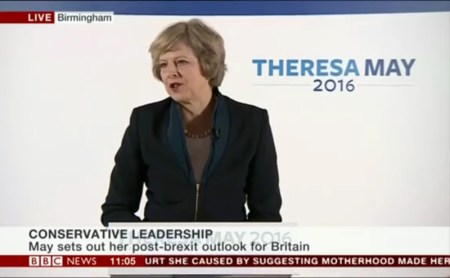
1693The glaring discrepancy between the UK establishment and the electorate explains the establishment’s quick acceptance of Brexit, for fear of becoming totally discredited. Pictured above: Theresa May launches her campaign for leader of the UK Conservative party on July 11, 2016, saying “Brexit means Brexit.”

The two earlier articles mentioned above first spotted the phenomenon of European disintegration and then explained it. Today, the intervening events have made the explanation all the simpler. Basically, the European political elites were correctly convinced, long ago, that considerable European integration was desirable, but their very successes in this area made them grossly overestimate what could and should be done further.

Up to a decade ago, it seemed that a similar pattern was becoming established in one EU country after another: the parliament was dominated by a large center-right party and a large center-left party that alternated in power from one election to another. The parallel to the United States seemed obvious, but the parallel was illusory, as we shall show.

Emboldened, the political parties concerned made the fatal mistake of trying to combine for the purpose of elections to the EU Parliament. Thus emerged a pan-European center-right pseudo-party, the “European People’s Party” (EPP), whose origins go back to a get-together of Christian Democrat parties in 1976. And a pan-European center-left pseudo-party, the “Party of European Socialists” (PES), founded in 1992 as an alliance between old-style Social Democrat parties and the former so-called Eurocommunist parties. The latter first emerged during the decline and discreditation of the Soviet Union in the 1970s and 1980s, then changed their names after its disappearance in December 1991. Thus, the core of Italy’s current Democratic Party derives from the Italian Communist Party (PCI), the major opposition party of post-war Italy.

Curiously but inevitably, the more those parties tried to unite, the more they lost support in their own countries of origin. Thus the Dutch Christian Democrats (CDA) are today a minor party of the right and the Panhellenic Socialist Movement (PASOK) barely crosses the threshold of 5% needed for entry into the Greek Parliament. (Incongruously, the last PASOK Prime Minister of Greece, George Papandreou, continues to be President of the Socialist International.) The reason for this development, however, is not far to seek.

Nationalism, it was forgotten, is an essential component of center-right sentiment. So a center-right party that prefers an international interest at the expense of the national interest of its own country loses credibility among its own core supporters; it becomes vulnerable to the rise of far-right upstart parties. Examples of this process in the EU are now so evident as not to need enumeration.

The attraction of socialism, it was forgotten, is that its core supporters expect increases in government social spending at the expense of financial stability. This becomes more difficult, the more a country is constrained by participation in a shared international framework. It becomes impossible to maintain once a country joins a common currency, since the usual remedy for socialist overspending is devaluation of the national currency. This is why PASOK has been eclipsed in Greece by the far-left SYRIZA, why the Spanish franchise of the PES (the PSOE) has lost severely to the upstart Podemos, and why support for its Dutch franchise (the PvdA) is now down to about the same as for each of two other left-wing parties.

It is also why in Britain, where the electoral system obstructs the rise of new parties, Jeremy Corbyn was voted leader by the Labour Party membership to the horror of the party establishment. Corbyn himself was a pronounced Euroskeptic until recently and only half-heartedly spoke in public for Remain, creating suspicions that he secretly voted for Leave.

A far-right party, like the Freedom Party (OFP) of Austria, has an easy sales pitch. Not so the far-left ones: after they come to power, it quickly and painfully becomes evident that they have no more ability than their derided Social Democrat predecessors to defy the constraints imposed by membership in the Eurozone.

Thus SYRIZA came to power in Greece and won a referendum to end austerity. The result was that all Greeks found that their bank accounts were virtually frozen: they were allowed to withdraw only sixty Euros a day. SYRIZA then split. The larger faction won the resulting general election and accepted the harsh conditions that the referendum had rejected. The paradoxical result in Greece is that the current government is a coalition of an upstart far-left party, SYRIZA, and an upstart nationalist party (the Independent Hellenes) that lies to the right of New Democracy (the Greek franchise of the EPP).

In other EU countries, however, the typical development has been the opposite: the erstwhile competing franchises of the EPP and the PES are in coalition against the motley upstart breakaway parties, since neither of the two gets an absolute majority in parliament any more. That is, their former raison d’être as competing alternatives has been abandoned in the need to survive in power at all. The paralysis in Spain comes from the fact that the two local franchises there are descended from the two sides in the murderous Civil War of 1936-1939. Joint government is still hardly imaginable especially for the losing socialists, who continued to suffer persecution long after the war.

Likewise, in the elections to the EU Parliament in May 2014, the EPP and the PES won only 221 and 191 seats respectively out of 751, each far short of a majority. So they clubbed together to make the top candidate of the EPP, Jean-Claude Juncker, President of the EU Commission and to retain the top candidate of the PES, Martin Schulz, as President of the Parliament. The incredible response of Juncker to Brexit has been to demand even tighter integration: he wants to force into the Eurozone the eight EU member states (other than the UK) that still have independent currencies. He also reiterated his proposal, originally made last March, to unite the armed forces of all states (with the UK gone) into a European army. For this he has the support of Schulz’s home party, the German SPD. That is, they want more and more of what the European electorates want less and less.

Especially in Eastern Europe, there are now also governments that resent the relentless centralizing urges of the EU establishment. In Hungary, for example, the government has rejected the demand of the EU Commission to absorb a quota of the immigrants currently streaming into Europe; it has scheduled a referendum on the matter for October 2. On the same day, Austria will hold a revote for the presidency, which the Freedom Party may narrowly win after narrowly losing the first time around.

These governments are among the new friends of Israel described in a recent Reuters article, titled “Diplomatic ties help Israel defang international criticism.” As it notes:

“Whereas a few years ago Israel mostly had to rely on Germany, Britain and the Czech Republic to defend its interests in the EU, now it can count Italy, Greece, Cyprus, Austria, Hungary and a handful of others among potential allies.”

These allies have no desire to penalize Israel on behalf of increasingly tedious Palestinians. On the contrary:

“Like Turkey, which last week agreed to restore diplomatic ties with Israel after a six-year hiatus, they see a future of expanding business, trade and energy ties.”

By “energy ties” is meant Israel’s recently discovered vast fields of natural gas, the phenomenon that we earlier dubbed “Israel as a Gulf State.” That is: just as governments care little for the human rights record of, say, Qatar in their eagerness to acquire its natural gas, so also the self-righteous moaning of the Palestinian Authority does not deter those governments from going for what Israel has to offer. As the Reuters article quotes a European ambassador: “There’s just no appetite to go toe-to-toe with Israel and deliver a really harsh indictment. No one sees the upside to it.”

Israel’s government is not, of course, gloating over the discontent spreading in the EU. But it surely appreciates some of the side effects.

“Gangster Islam” in Europe

July 12, 2016

“Gangster Islam” in Europe, Gatestone Institute via YouTube, July 12, 2016

The blurb beneath the video states,

“Gangster Islam,” a crime wave packing prisons and overtaking Europe, is a problem the mainstream media will not report. Ordinary Europeans — for fear of being called “racist” or even being imprisoned for “hate speech” — are afraid even to talk about it.

We Saved Our Democracy

July 7, 2016

We Saved Our Democracy, Pat Condell via YouTube, July 7, 2016

(Perhaps American will vote for her own Brexit on November 8th. — DM)

Independence and Identity: What Israel Knows, Europe Has Forgotten, and America May Yet Remember

July 4, 2016

Independence and Identity: What Israel Knows, Europe Has Forgotten, and America May Yet Remember, American ThinkerAbe Katsman, July 4, 2016

The Fourth of July is beautiful.  Independence Day marks arguably the most consequential positive political event in history and deserves every bit of the enthusiastic celebration with which it is observed.  Yet the day goes by insufficiently appreciated by so many – a symptom of the erosion of our American identity.

For some perspective, let’s start by looking at Memorial Day.  In Israel.

Israel.  Yom Hazikaron (Israel’s Day of Remembrance) is ushered in by a wailing siren.  Everyone – even drivers on the freeways – stops in his tracks for a minute of mournful silence.  The somber mood of the day is everywhere: no hot dogs or barbecues; no sales at the malls.  No rock music on the radio; no Friends reruns or light entertainment on TV – just reflective songs, unvarnished war documentaries, heart-piercing interviews with families of fallen soldiers, and coverage of countless memorial ceremonies at the nation’s cemeteries.  It is a poignant day, dripping with tragedy, loss, sacrifice, and suffering – but also with heroism, pride, honor, and gratitude.

Does that sound like your Memorial Day?

Israel may be unique in the intensity with which it observes Yom Hazikaron.  But other nations, including America, would be wise to learn from Israel about how and why it honors its fallen as it does.

Yom Hazikaron honors the 23,000 Israeli lives lost – mostly young citizen-soldiers, as well as some 2,500 terror attack victims – in modern Israel’s never-ending struggle to exist.  It is a heavy day, and everyone feels its weight: as a small nation resurrected in the wake of the Holocaust, with a culture that places a premium on each individual life, Israel knows too well not only that its freedom isn’t free, but that it comes at a steep, painful price.

As night falls on Yom Hazikaron, there is a jarring transition to raucous celebration: Yom Ha’atzmaut, Israel’s Independence Day, begins.  There are fireworks, official ceremonies and celebrations, street partying, and happy prayers of thanksgiving.  There are military flyovers, ubiquitous barbecues, and the International Bible Contest finals.  And there is an outpouring of national pride and a sense of accomplishment over how the country has survived and thrived for yet another year, feelings intensified by an appreciation for the fragility of its very existence.

Though quite the 48-hour emotional rollercoaster, the two days add depth and meaning to one another.  As painful as that price has been for Israel to gain and maintain independence, it is dwarfed by the price the Jewish people paid for their prior statelessness.

These two days are a distillation of Israelis’ remarkably strong sense of national identity, healthy cultural confidence, and appreciation for the state they have – imperfect as it may be.  These are sentiments widely shared, even – perhaps especially – by Israel’s sizeable population of immigrants from around the globe.

That is all well and good for Israel.  What is worrisome is that such a strong national identity, though once the norm, has become aberrational in the Western world.  The failure to nurture national identities among new generations and new immigrants threatens the survival of the culture and values Western nations once strongly stood for.

Europe.  The competing cultures of European nations once proudly rivaled each other, spawning revolutions in philosophy, law, science, art, exploration, industry, religion, and academia while raising the prosperity, education, and human rights levels of millions in the process.

But nationalism run amok was also a factor in Europe’s bloody wars.  Since the end of World War II, nationalism-phobia has driven Western European governments.  Though nationalism has only once mutated into Nazism, European elites threw out the baby with the bathwater: to ensure that expansionist racial fascism would not rise again, European leaders strove to minimize individual nationalisms and shrink the autonomy of individual states, cobbling together instead a new, transnational, pan-European identity.

They succeeded, perhaps too well, at diminishing the particular nationalisms of individual states.  Their artificial new Europeanist substitute, however, is a watery, post-Christian, least-common-denominator amalgam which fails any identity’s most basic test: hardly anyone is inspired to identify with it.  As Europeans lament the failure of waves of Middle Eastern and North African immigrants to assimilate, perhaps one question that should be asked is, assimilate into what, precisely?

European nations used to make history happen; “Europe” now passively endures history happening to it.  The U.K. Brexit vote notwithstanding, the exploding rates of violent crime (particularly rape), the metastasizing of terror cells, and the proliferation of no-go zones of debatable sovereignty  seem not to rouse paralyzed mainstream political leaders to act in defense of any cultural value other than so-called multiculturalism.

As cultural identities erode, so erode the senses of purpose, belonging, meaning, inspiration, and cultural confidence of citizens.   Identity-stripped societies are marked by risk aversion, listlessness, passivity, economic stagnation, lack of innovation, and – perhaps most ominous – sub-replacement-level birth rates.  (Israel, notably, has by far the highest fertility rate of any OECD country.)  The European nations, by and large, no longer seem to understand who they used to be or what they are becoming.  They have lost their way.  They are cultures in retreat.

America.  The Unites States has not yet traveled as far down the post-nationalist cul-de-sac as has Europe, but it is heading in the same direction.

We may feel Americanism in our bones, but that does not make it part of our DNA; it is not inherited automatically.  An understanding and appreciation of what America means requires transmission to each new generation.  Yet that transmission is getting ever weaker: it is no longer fashionable within the education establishment to teach students about American exceptionalism or why tens of millions fled their own countries, immigrated to America’s shores, and proudly adopted American identities and values or the degree to which America has been an unparalleled force for liberty and decency in the world.  (It doesn’t help matters that our post-nationalist president, not shy with opinions about everything else, rarely speaks of American greatness, past or present.)

Universities long ago abandoned any thought of instilling in all students some understanding and appreciation for Western and American civilization.  Instead, students are taught the arts of grievance-manufacturing and victimhood, of countering privilege and power structure, of squelching free speech and seeing a complex world exclusively through the race/class/gender prism, and of becoming expertly hypersensitive to nano-aggressions and cultural appropriations.  A wrecking ball of intellectually lazy cultural and moral relativism has displaced the Western/American canon.

Students come out of college arguably are even more ignorant of their Americanism than when they entered.  By signing the Declaration of Independence, men of wealth and stature effectively signed their own death warrants, all in the name of political principle.  Yet if university students are taught anything about those who committed their lives, fortunes, and sacred honor to secure the liberty these students take for granted, it is that the founders were privileged white male slaveholders, thus more deserving of contempt than deep study.

There is far more sense of entitlement and cynicism about America inculcated on campus than sense of appreciation and gratitude for what it means to be American, or for the ultimate sacrifice of 1.35 million American war dead.  And every year, America’s colleges churn out another 3 million graduates thus indoctrinated.

There are only a few remaining cultural institutions where Americanism is honored: the military, talk radio, and country music come to mind.  The prevailing mass cultural influences at best reflect mild embarrassment over American pride and patriotism.

Reclaiming Identity.  National identity does not mean lockstep unity or uniformity, cheerleading, or papering over a nation’s faults.  Israel, for example, soberly faces monumental challenges both internal and external, and Israeli society is fundamentally fragmented – too often along demographic lines – in how to approach them.  While American politicians sometimes call for “national conversations,” Israeli citizens live in one.  Yet Israel’s rollicking, caustic debates, frequently over core questions of just what Israeli identity means, are themselves part of that identity.

Every nation needs to find its own path to instill identity in its people and an understanding of why it is worth preserving.  In Israel’s case, as fractious as society may be, it has utilized several tools to forge its strong sense of common identity.  Through maintaining a strong Jewish historical memory and reconnecting to an ancient homeland; through breathing new life into its historic, though largely dormant, Hebrew language; through ingathering of exiles and rescue of persecuted Jews around the world; and through surviving crises together against often daunting odds, the Jewish people have re-created the nation of Israel.  Infighting aside, there is a widespread sense of shared fate and a still potent recollection of pre-state Jewish powerlessness.  Reinforced through common tradition, education, and ceremony – including Yom Hazikaron and Yom Ha’atzmaut – that powerful identity has kept Israelis together through some dangerous, trying times.

Tragically, reclamation of national identity may well be a lost cause in several European states.  But it is not yet lost in America.  The feelings of gratitude and appreciation for being American, and of understanding what America has meant to ourselves and to the wider world, still run deep in much of the population, in spite of prevailing cultural antipathies toward such attitudes.  But those sensibilities are endangered by insufficient transmission of American identity from one generation to the next and are in dire need of reinforcement.

America has always been a model to Israel of so much worth emulating.  Perhaps in the realm of strengthening of national identity, Israel can return the favor.

There are no simple solutions.  But we might start with something simple: perhaps it’s time to establish an Independence Day custom of sounding sirens for a national minute of silence.  Everyone can share a collective moment to honor the price paid for our liberty.  Linking the sacrifice of others with our own Independence Day celebration of freedom is a good way to enhance the respect and appreciation for both.  It is a small step, but it is at least a step forward, toward strengthening our American identity.


Anger, Honor and Freedom: What European Muslims’ Attack On Speech Is Really About

June 30, 2016

Anger, Honor and Freedom: What European Muslims’ Attack On Speech Is Really About, Investigative Project on Terrorism, Abigail R. Esman, June 30, 2016

1052

Indeed, much of the Muslim violence in Europe is about exactly this: intimidating non-Muslims into a fearful capitulation, where words like “I hate Muslims” and drawings of Mohammed become extinct because the Muslim communities insist that it be so. It is about forcing Westerners to rearrange their lives, their culture, to accommodate the needs and values and culture of Islam. It is about control, and the power over freedom. And it is about creating a culture in which honor is injured by words and restored through violence and terror.

**********************

“Clash of civilizations,” some say. Others call it the “failure of multiculturalism.” Either way, the cultural conflicts between some Muslims and non-Muslims worldwide continue to play out as Western countries struggle to reconcile their own cultures with the demands of a growing Muslim population.

But herein lies the problem: in many ways, the two cultures are ultimately irreconcilable. There is no middle ground. And hence, the conflicts and the tugs-of-war continue.

Over the past two months, the events surrounding controversial Dutch columnist Ebru Umar have encapsulated that “clash” at its core, a salient metaphor for the tensions, particularly in Europe, between the West’s Muslim populations and its own. More, they illuminate the enormity of the problems we still face.

Umar is no stranger to the spotlight, or to the wrath of Dutch Muslims who read her many columns, most of them published in the free newspaper, Metro. For years, the Dutch-born daughter of secular Turkish immigrants has raged against the failure of other Dutch-born children of immigrants, mostly Moroccan, to assimilate into the culture of their birth. She loudly condemns Dutch-Moroccan families for the shockingly high rates of criminality and violence among Dutch-Moroccan boys – as much as 22 times the rate of Dutch native youth – a phenomenon she ascribes to their Islamic upbringing and their parents’ refusal to allow their children to mingle among the Dutch.

But her critiques have earned her no converts. Instead, Dutch-Moroccan youth, whom she calls “Mocros,” have regularly taunted her, both online and in the street.

This past April, however, Umar added a new team of enemies to her portfolio: when, in response to Turkish president Recep Tayyip Erodogan’s demand that a German satirist be prosecuted for insulting him on TV, Umar tweeted “f***erdogan,” Dutch Turks turned on her in fury. “How dare you insult our president!” cried these Dutch-born subjects of Holland’s King Willem-Alexander. And while Umar took a brief holiday on the Turkish coast, one such Dutch-Turk turned her in to the police. She was arrested at her vacation home in Kusadasi, and though released the following day, was forbidden to leave the country. The charge: Insulting the Turkish president. It took 17 days before discussions between Holland’s prime minister and Turkish authorities enabled her to return to the Netherlands.

But she could not return home. In her absence, Umar’s home had been burgled and vandalized, the word “whore” scrawled on a stairway wall. Death threats followed her both in Turkey and on her return. When it became clear she could not ever return to the apartment she had lived in for nearly 20 years, she announced on Twitter (Ebru Umar posts constantly on Twitter) that she would be moving out.

Meantime, in Metro and elsewhere, she continued her criticism of Moroccans and, as she herself notes, of Islam overall.

And so it was that on the day Ebru Umar moved out of her apartment in Amsterdam, a group of Dutch-Moroccans in their twenties came to see her off, taunting her with chants: Ebru has to mo-o-ve, nyah nyah.” Though furious, she ignored them – until one of them began to film her loading her belongings into her car. For Umar, being taunted by the very people whose threats had forced her from her home in the first place was bad enough: but this violation of what little privacy remained for her was more than she could take. She grabbed her iPhone and began filming them right back. “Go ahead,” she challenged. “Say it for the camera.”

Scuffles ensued, and soon one of the Moroccans had her iPhone in his hand. The others laughed. Then they ran away. Umar filed a police report and, still smarting, took to Twitter once again: “C**t Moroccans, I hate you,” she posted. “I hate you, I hate you, I hate you, I hate you and I hate your Muslim brothers and sisters, too. F**k you all.” (It is important to note that, however offensive, the expression “c**t Moroccans” is a common epithet in the Netherlands.)

But, hey – she was angry. Her phone had been snatched from her hand in a brutal, aggressive gesture that left her feeling violated and, vulnerable. She had just been forced to leave her home. She had endured prison, a criminal inquiry, and death threats, all at the hands of the same group on whom she now spewed her fury.

Her words may have been harsh or inappropriate, but they were words. She had not struck her tormenters as they filmed her. She did not call for their demise, or strap a bomb around her waist and visit the local mosques.

She took to Twitter and said: I hate you.

“But hate,” she tells me later in an e-mail, “is just an emotion.” And in a column penned more than two years ago, she observed, “Hate me till you’re purple, but keep your claws off me.”

Here is where Ebru Umar’s story becomes the story of the Western world. In response to her words (“I hate you. F*** you”), several Muslims – Moroccans and others – filed charges against her for hate speech. (Though ironically, “I hate you” does not legally qualify as “hate speech.”) Such words are an attack upon their honor, a humiliation: and if there is one thing experts on Arab and Muslim culture will agree on, it is the significance of humiliation and honor in governing their lives. For this, Dutch Moroccan youth threaten Umar on the streets, and have done so, she says, for years: after all, she insults them.

1664

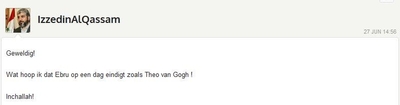
But in truth, it isn’t just the youth. The broader Muslim community stands by, silent: they do not condemn the youth who taunt her, who rip her telephone from her hands, or post things on the Internet like “We hate you, too – can you please kill yourself?” or “Oh, how I hope she ends up like Theo van Gogh.”

Theo van Gogh, also a controversial columnist, was shot and stabbed to death in 2014 by a radical Dutch-Moroccan Muslim.The commenter wishing her the same fate used the name “IzzedinAlQassam,” the founder of modern Palestinian jihad, and an icon of Hamas leader Khaled Meshaal.

For people like this, it doesn’t matter that Umar – or van Gogh – inflicted no violence, any more than it mattered that the editors of Charlie Hebdo were not violent. It was the insult, the humiliation – to them, to Islam, to Mohammed – that mattered: and an insult, a humiliation, deserves a violent response.

Indeed, much of the Muslim violence in Europe is about exactly this: intimidating non-Muslims into a fearful capitulation, where words like “I hate Muslims” and drawings of Mohammed become extinct because the Muslim communities insist that it be so. It is about forcing Westerners to rearrange their lives, their culture, to accommodate the needs and values and culture of Islam. It is about control, and the power over freedom. And it is about creating a culture in which honor is injured by words and restored through violence and terror.

When Umar says “I hate you,” what she hates, really, isn’t the Moroccans who attacked her or their “Muslim brothers and sisters.” What she hates is this – this effort, this battle over honor and speech and freedom, and this clash between violence and expression, guns and conversation.

“I don’t want Muslims to leave,” she tells me, again by e-mail. “I want them to embrace the Enlightenment, Western society, the Netherlands.” And in turn, she calls on the Dutch to “set rules: no violence in any sense. And stop using culture or religion as an excuse for behavior.”

Ebru Umar’s words. More of us should listen.

Trump, Brexit, Iceland, Turin, and Rome

June 30, 2016

Trump, Brexit, Iceland, Turin, and Rome, Gingrich Productions, Newt Gingrich, June 29, 2016

There has been a lot of commentary about the British decision to leave the European Union and its implications for Trump and the American presidential race.

Trump was at his golf course in Turnberry, Scotland the day after the vote. He was enthusiastic about Brexit and claimed it was a model for the American choice. He suggested the British hostility to bureaucracy in Brussels paralleled the American hostility to bureaucracy in Washington. He felt the concerns about massive immigration and Syrian refugees were the same in both countries. He drew a direct comparison between the British desire to be independent again and the American desire to put America first in foreign relations. And of course, he did the entire press conference wearing a “Make America Great Again” hat.

Clinton took the opposite approach. Despite the defeat of the British establishment and its “Remain” campaign, she was committed to stability and risk avoidance. She emphasized the dangers of Brexit whereas Trump had emphasized the opportunities.

Yet focusing on Brexit creates much too narrow a basis for understanding the winds of change sweeping through the Western world.

The first harbinger of change this year was May 23, the day of the Austrian presidential elections.

In the first round, the two parties that had dominated Austria for the past half-century came in fourth and fifth. An independent came in third. The two formerly minor parties in the run-off were a hardline conservative anti-immigrant candidate and a green who favored more immigration. The entire national establishment mobilized to block the anti-immigrant candidate. He got 49.65 percent of the vote.

The second big signal of change was the Italian municipal elections. Out of disgust with widespread corruption, an Italian comedian named Beppe Grillo launched the Five Star Movement in 2009. In the 2013 elections, it came in second. This month, the Five Star Movement candidates won the mayor’s offices in both Turin and Rome.

Virginia Raggi, 37, became the first female mayor in Rome’s 2,800-year history. In the midst of a corruption scandal which forced the previous mayor to resign, Raggi got 67 percent of the vote against the Prime Minister’s party. In Turin, the results were similar and the reform movement won in 17 other cities.

Brexit, then, was at least the third big-change election in the West this year. The entire British establishment, the business leadership, President Obama and Hillary Clinton all came out for the Remain side. They lost 52-48 in a stunning upset which the polls did not predict. In England and Wales, the margins were much higher as people voted to make Britain independent again.

Fourth and finally, last Sunday was the little-noticed election of a new president in Iceland. The former president had resigned in a scandal caused by release of the Panama Papers. He had broken no laws but his previously secret investments were very unpopular. The winner of the presidential elections with 39 percent of the vote was Gudni Johannesson, a history teacher. Second, with 28 percent of the vote, was Halla Tomasdottir, a businesswoman. The leading professional politician, a former prime minister, got 13 percent.

These results from four different countries show a consistent momentum toward throwing out established politicians and rejecting the establishment.

There are real warnings here for Clinton and real signs of encouragement for Trump.

Thank you, America!

June 25, 2016

Thank you, America! Wattsupwith that, Christopher Monckton of Brenchley via Anthony Watts, June 24, 2016

(This is by far the best address I have read thus far on Brexit. — DM)

head-for-the-brexit

“Your Majesty, with my humble duty, I was born in a democracy; I do not live in one; but I am determined to die in one.”

And now I shall die in one. In the words of William Pitt the Younger after the defeat of Napoleon, “England has saved herself by her exertions, and will, as I trust, save Europe by her example.”

The people have spoken. And the democratic spirit that inspired just over half the people of Britain to vote for national independence has its roots in the passionate devotion of the Founding Fathers of the United States to democracy. Our former colony showed us the way. Today, then, an even more heartfelt than usual “God bless America!”

***************************

For my final broadcast to the nation on the eve of Britain’s Independence Day, the BBC asked me to imagine myself as one of the courtiers to whom Her Majesty had recently asked the question, “In one minute, give three reasons for your opinion on whether my United Kingdom should remain in or leave the European Union.”

My three reasons for departure, in strict order of precedence, were Democracy, Democracy, and Democracy. For the so-called “European Parliament” is no Parliament. It is a mere duma. It lacks even the power to bring forward a bill, and the 28 faceless, unelected, omnipotent Kommissars – the official German name for the shadowy Commissioners who exercise the supreme lawmaking power that was once vested in our elected Parliament – have the power, under the Treaty of Maastricht, to meet behind closed doors to override in secret any decision of that “Parliament” at will, and even to issue “Commission Regulations” that bypass it altogether.

Worse, the treaty that established the European Stability Pact gives its governing body of absolute bankers the power, at will and without consultation, to demand any sum of money, however large, from any member state, and every member of that governing body, personally as well as collectively, is held entirely immune not only from any civil suit but also from any criminal prosecution.

That is dictatorship in the formal sense. Good riddance to it.

I concluded my one-minute broadcast with these words: “Your Majesty, with my humble duty, I was born in a democracy; I do not live in one; but I am determined to die in one.”

And now I shall die in one. In the words of William Pitt the Younger after the defeat of Napoleon, “England has saved herself by her exertions, and will, as I trust, save Europe by her example.”

Indeed, No-way and Nixerland having already voted down the EU, Brexit may well be swiftly followed by Frexit, Grexit, Departugal, Italeave, Czechout, Oustria, Finish, Slovakuum, Latviaticum and Byebyegium.  At this rate, soon the only country still participating in the European tyranny-by-clerk will be Remainia.

The people have spoken. And the democratic spirit that inspired just over half the people of Britain to vote for national independence has its roots in the passionate devotion of the Founding Fathers of the United States to democracy. Our former colony showed us the way. Today, then, an even more heartfelt than usual “God bless America!”

All who have studied the Madison papers will grasp the greatness of the Founding Fathers’ vision. They were determined that no law and no tax should be inflicted upon any citizen except by the will of elected representatives of the people in Congress assembled.

They regarded this democratic principle as of such central importance that they wrote it down as Article 1, Section 1 of the Constitution of the United States: “All legislative power herein granted shall be vested in a Congress of the United States, which shall consist of a Senate and House of Representatives.” Period. No ifs. No buts. No exceptions.

Except one. The Constitution establishes that foreign treaties ratified by a two-thirds majority of the Senate shall have the same force of law throughout the United States as enactments of Congress.

It is, therefore possible for any U.S. Government that can muster that Senate majority to ratify any treaty and thereby to thwart the central principle of Congressional democracy: that no Congress may bind its successors.

The Republicans, who are not always as lively in their understanding of the threat to democracy posed by supranational and global institutions such as the EU, the UN and its bloated climate bureaucracy, are too often snared or charmed by determined “Democrats” who fully understand and thirst to exercise the power to inflict perma-Socialism on their nation by bilateral, multilateral or global treaties.

It is astonishing how many of the GOP are willing to be cajoled and schmoozed into supporting monstrosities such as the Transatlatic Trade and Investment Partnership, which on its face sounds like a free-marketeer’s dream but is in its small print a series of outright Socialist measures which, once the Senate has ratified them, cannot be repealed. Its climate provisions, for instance, are highly dangerous.

It is no accident, therefore, that the bankers, the corporate profiteers, the Greens and the National Socialist Workers’ Party of Scotland – the corporatists and the communists together – made common totalitarian cause and heavily promoted the campaign to keep Britain in the EU, that paradise of vested interests and their poisonous lobbyists.

It is likewise no accident that precisely these same national and global vested interests heavily promote the campaign to subject Britain and the world to various unnecessary and damaging measures whose ostensible purpose is to control the climate but whose real ambition is to curb capitalism, fetter freedom, punish prosperity,. limit liberty and deny democracy.

The necessity to protect the flagile flower of democracy from the scythe of Socialism is now surely self-evident. Here are two modest proposals to ensure that the will of the people prevails over the power of the politicians, the Press, and the profiteers.

First, every new treaty, and as many pre-existing treaties as possible, should be made subject to repeal by a national referendum – and not just by a referendum called by the governing party because it thinks it can win it but by the people via the initiative procedure. Britain would have left the EU long before now if we, the people, and not those who govern us, had had the right to put referendum questions on the ballot.

Secondly, the governing bodies of all new supranational or global bodies exercising real sovereign power or spending taxpayers’ money from the states parties to the treaty that establishes them should be elected at frequent intervals by the peoples of those states parties.

Otherwise every international treaty, being a transfer of power from elected to unelected hands, diminishes democracy. Britain’s membership of the European Union effectively took away our democracy altogether, so that three new laws in five (according to the researchers of the House of Commons Library) or five in six (according to the German Government in a submission some years ago to the German Constitutional Court) are inflicted upon us solely because the unelected Kommissars require it.

Till now, our obligation has been to obey, on pain of unlimited fines.

The vote by the people of Britain to break free from this stifling, sclerotic tyranny has sent a shock-wave through every major international governing entity. It was no accident that the the International Monetary Fund, the Organization for Economic Corruption and Devastation, and various world “leaders” including Mr Obama, broke with democratic convention by openly promoting a “Remain” vote in a flagrant attempt to interfere in Britain’s decision.

Mr Obama’s intervention was decisive. The moment he demanded that Britain should remain within the EU, the polls began to swing against it. It was only when, in his maladroit fashion, he had sought to interfere in Britain’s decision that so many undecided voters woke up to the danger that the maneuverings and posturings of the international governing class represent to democracy.

What will Britain’s decision mean for the climate debate? Of course, it will break us free from the EU, whose governing elite had seized upon the climate issue as a purported ex-post-facto justification for the now-hated bloc’s continued existence.

We are left with our own British governing class, which has until now been no less determined than the EU to damage our economic and environmental interests by shutting down vital coal-fired power stations and carpeting our once green and pleasant land with windmills.

Now that the EU and its devoted poodle Mr Cameron have been consigned to the trashcan of history, it is near-certain that any new British Cabinet will take a more alert and less acquiescent stance than the present lot on the climate question.

It may even occur to the new Cabinet to check whether the rate of global warming is anything like what the profiteers of doom had predicted; to count the number of downstream businesses – such as cinder-blocks made from fly-ash out of coal-fired power stations – that have been destroyed by the EU’s war on coal; and even to wonder whether the forest of windmills that infest our once beautiful landscape are now extracting between them so much kinetic energy from passing storms that they are slowing them down, causing far more flash flooding than slightly warmer weather would (if and when it happened).

In the past, there was no point in our politicians asking any such questions, for our policies on all matters to do with our own environment were set for us by the unelected Kommissars of Brussels, whether we liked it or not.

Now that our politicians are going to have to learn to think for themselves again, rather than acting as an otiose, automated rubber stamp for directives from Them in Brussels, perhaps the Mother of Parliaments will begin to calculate the enormous economic advantage that Britain will gain by abandoning all of the climate-related directives that have driven our coal corporations, our steelworks and our aluminum works overseas, and have killed tens of thousands by making home heating altogether unaffordable.

We, the people, are the masters now. Our politicians will have to reacquire the habit of listening not to Them but to us. Here, and in the rest of Europe, and eventually throughout the world, let freedom ring!

Thank you, America, and God save the Queen!

Populist Anger Upends Politics on Both Sides of the Atlantic

June 24, 2016

Populist Anger Upends Politics on Both Sides of the Atlantic, New York TimesJune 24, 2016

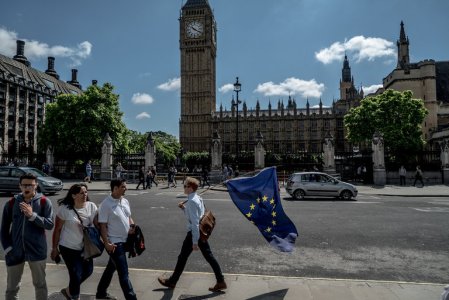
25europe-web2-master768Outside the Houses of Parliament in London on Friday. Credit Andrew Testa for The New York Times

Time and again, the European Union has navigated political crises during the past decade with a Whac-a-Mole response that has maintained the status quo and the bloc’s lumbering forward momentum toward greater integration — without directly confronting the roiling public discontent beneath the surface.

“There is a very widespread rejection of politics everywhere. There is a similar mood in the United States, an antipolitical sentiment.”

***************************

LONDON — From Brussels to Berlin to Washington, leaders of the Western democratic world awoke Friday morning to a blunt, once-unthinkable rebuke delivered by the flinty citizens of a small island nation in the North Atlantic. Populist anger against the established political order had finally boiled over.

The British had rebelled.

Their stunning vote to leave the European Union presents a political, economic and existential crisis for a bloc already reeling from entrenched problems. But the thumb-in-your-eye message is hardly limited to Britain. The same yawning gap between the elite and mass opinion is fueling a populist backlash in Austria, France, Germany and elsewhere on the Continent — as well as in the United States.

The symbolism of trans-Atlantic insurrection was rich on Friday: Donald J. Trump, the presumptive Republican presidential nominee and embodiment of American fury, happened to be visiting Britain.

“Basically, they took back their country,” Mr. Trump said Friday morning from Scotland, where he was promoting his golf courses. “That’s a good thing.”

25europe-web4-master675Donald J. Trump, the presumptive Republican presidential nominee for president, arriving at his Trump Turnberry resort in Scotland on Friday. Credit Jeff J Mitchell/Getty Images

Asked where public anger was greatest, Mr. Trump said: “U.K. U.S. There’s plenty of other places. This will not be the last.”

Even as the European Union began to grapple with a new and potentially destabilizing period of political uncertainty, the British vote also will inevitably be seized upon as further evidence of deepening public unease with the global economic order. Globalization and economic liberalization have produced winners and losers — and the big “Leave” vote in economically stagnant regions of Britain suggests that many of those who have lost out are fed up.