Posted tagged ‘Donald Trump’

5 Reasons Why Trump Would be a Better President than You Thought

March 8, 2016

5 Reasons Why Trump Would be a Better President than You Thought

by Brion McClanahan

7 Mar 2016

Source: 5 Reasons Why Trump Would be a Better President than You Thought – Breitbart

Would President Trump be that bad?

The establishment would have you thinking that.

Sen. Marco Rubio (R-FL)79%

repeated the same platitudes and half-truths several times following his embarrassing performance on Super Tuesday—Trump is a racist, Trump is not a conservative, Trump isn’t electable, etc. The reaction? Everyone laughed.Nothing changed at the Thursday night debate. Many of the attacks leveled at Trump seemed to be made up by a junior high school focus group. Those that actually had substance—and there were a few great barbs by both the candidates and the moderators—questioned not only Trump’s honesty and integrity, but also his “conservative credentials.”

Trump, the establishment says (along with the anti-Trump crowd), is all image and no substance, a “reality TV star” who doesn’t understand the Constitution or American government. His “debate” performance seemed to solidify this critique. After all, Trump does not give concrete answers to policy questions and maybe spends too much time on the size of his hands.

But let us consider five reasons why the establishment and the anti-Trump crowd may be wrong about a President Trump:

1.) “I’ll look into it”: A President Trump who will “look into” a particular situation is not the same as a president who will unconstitutionally legislate from the Oval Office. We have seen that Trump has good advisors, particularly

Sen. Jeff Sessions (R-AL)80%

of Alabama, a man whom no one would confuse with a weak-kneed liberal. Sessions has been the most vocal opponent of illegal immigration in the Senate. Does anyone think that his influence would lead to a Gang of Eight scenario and compromise from President Trump? “Looking into it” might produce a push for even more stringent immigration policies from Congress. If Trump says he will support it, Congress would be foolish not to act.


2.) Trump won’t start WWIII: Among the remaining candidates (including the Democrats), Trump has been the most vocal opponent of military adventurism. He has suggested he will take the fight to ISIS, but Trump has been insistent in his belief that the Iraq war was a mistake, that American blood has been shed in a misguided attempt to restructure the Middle East, and that a real conservative American foreign policy would place American interests first, ahead of those of foreign nations. Trump’s foreign policy would be closest to the founding generation’s desire for peaceful neutrality. As a businessman, Trump understands that peace produces prosperity, both for the American federal republic and the people who reside here.

3.) We may get Judge Napolitano: No, not Janet Napolitano, but Judge Andrew Napolitano for the Supreme Court. Critics have charged that Trump would likely appoint a rabid leftist for the bench, perhaps his sister, but in a recent interview, Trump advisor Roger Stone hinted that Andrew Napolitano might be Trump’s first choice to take Antonin Scalia’s seat on the bench. It would make sense. Napolitano has a high profile in the media and is rock solid on civil liberties. And though he appears regularly on Fox News, he is not an establishment favorite, nor would he be an establishment choice. It would be as unconventional as a Trump presidency. That is good for America. Who needs another Harvard lawyer on the Supreme Court bench? We have a clear example of how a Harvard Law grad has screwed up America. He currently resides at 1600 Pennsylvania Ave. Hillary Clinton thought he would make a good Supreme Court justice.

4.) Trump brings back the Reagan coalition: It wasn’t that long ago that people used to salivate over the 1980s Reagan coalition of blue-collar Democrats and white-collar Republicans. Trump has that kind of appeal. This is why his message resonates across the political spectrum and why many Americans are supporting him. If the Republican Party is serious about a “big tent” philosophy, Trump is their guy. Most conservatives vote Republican because they lack real alternatives. It is better, they think, to hold their nose and pull the lever for Mitt Romney than vote for Barack Obama. This hasn’t worked, and American knows it. Trump represents real America, what Glenn Beck recently derided as the “bubba effect,” and real America is ready to kick the establishment to the curb. They want jobs, security, and someone who isn’t afraid to stand up to the cultural Marxism of the establishment, both Left and Right. Reagan would agree. He nailed the “bubba” vote as well. That worked out ok.

5.) Trump cleans up corruption: Trump has made clear that he intends to prosecute Hillary Clinton if elected president. That is a good start, and candidate Hillary doesn’t stand a chance against the verbal onslaught Trump would bring to a Trump v. Clinton campaign. She has never encountered someone like Trump as a candidate. He is not awe struck by the Clinton machine. But more than that, Trump prides himself on efficiency. Grover Cleveland, the last good Democrat elected to the executive office, rode a wave of anti-corruption into the executive mansion and proceeded to remove as much of the cancer from Washington as possible. It would not be hard to image a similar great purge of establishment corruption from D.C. should Trump be elected. It would be like shining lights on cockroaches. Clinton would be the first target, but other vestiges of Washington corruption would be getting a Trump scrubbing. Who wouldn’t want that?

At the end of the day, Americans should ask, “Do we want a chief legislator, a dictator in chief who already has an agenda and like Teddy Roosevelt, Wilson, FDR, Truman, Kennedy, Johnson, Nixon, Obama etc., will force Congress into submission?” We have already seen how that screwed up America. Think the New Deal, Fair Deal, and the Great Society. Making America great again will take a different kind of leadership, one in which “I’ll look into it” is preferable to “I’ll act even if it’s unconstitutional.”

DONALD TRUMP has the strongest Jewish ties of any Republican candidate

March 8, 2016

DONALD TRUMP has the strongest Jewish ties of any Republican candidate Even among the early expansive field of Republican presidential candidates, Donald Trump has always been the most closely connected to the Jewish people.

Source: DONALD TRUMP has the strongest Jewish ties of any Republican candidate

Naturally, this won’t make a bit of difference to leftist/liberal Jews, about 70% of the Jewish population in America, many of whom are not supporters of Israel either.

3b9a8938dbdca97638db0bbc40734b4d3ea233227feec657071cae9b02f6a104_1

Forward  Trump is from New York, works in professions saturated with Jews and long has been a vocal supporter of Israel. His daughter and two grandchildren are Jewish, the executive vice president of his organization is Jewish — and Trump certainly has chutzpah.

Given his myriad Jewish associations, Trump is not an unfamiliar face in Jewish circles. He has served as a grand marshal at New York’s annual Salute to Israel Parade. After Hurricane Katrina, he was among a group of celebrities who decorated Jewish federation tzedakah boxes to be auctioned off to support hurricane disaster relief. And in February, he was honored with an award at the annual gala for the Algemeiner, a Jewish news organization.

Before the 2013 Israeli election, Trump recorded a video message endorsing Prime Minister Benjamin Netanyahu. What’s more, Trump has made clear he believes President Barack Obama is bad for Israel and has questioned how American Jews could support the president.

Trump’s closest Jewish association is with his daughter Ivanka’s family. Ivanka Trump, a fashion designer and celebrity in her own right, converted to Judaism before marrying Jared Kushner, the son of New York Jewish real estate developer Charles Kushner. She studied for her Orthodox conversion with Rabbi Haskel Lookstein of Manhattan’s Kehilath Jeshurun synagogue and the Ramaz School, and Lookstein officiated at her wedding. Trump and Kushner are members of Lookstein’s Orthodox synagogue and are Shabbat observant. They have two children with a third on the way.

Judge Jeanine: Mitt Romney awoke a sleeping giant

March 6, 2016

Judge Jeanine: Mitt Romney awoke a sleeping giant, Fox News via You Tube, March 5, 2016


Can the establishment trump Trump?

March 6, 2016

Can the establishment trump Trump? Israel Hayom, Boaz Bismuth, March 6, 2016

Some in the Republican establishment are playing with fire. It is plain obvious that they would like to deny Donald Trump the party’s nomination, and they have every right to try to do so.

But this onslaught on Trump — led by GOP big guns, along with its two most recent presidential nominees, Mitt Romney and John McCain — could backfire and turn the real estate mogul into a political martyr. They face an excruciating dilemma: how to drive home the notion that Trump is unfit to be president even as the public rallies behind him?

Some in the GOP establishment failed to pick up the political undercurrents among rank-and-filed Republicans during the first few months of the campaign. This helped Trump’s ascent. But the establishment may still be oblivious to what GOP voters want. As a result of this disconnect, they may actually help him seal the deal. Saturday’s votes in Kansas, Kentucky, Louisiana and Maine could provide insight on the way forward. Remember, so far every attack on Trump has helped him.

Unlike the Democratic front-runner, Hillary Clinton, Trump has yet to run away with the delegates, despite having momentum on his side and winning 10 of the 15 states that held primaries (not including Saturday’s votes).

Before there was Trump, it was Texas Sen. Ted Cruz who was hated by the party’s big wigs. In fact, Cruz has yet to be endorsed by any of his colleagues in the Senate because of the bad rapport he has with the people in Washington. Nevertheless, in states where primaries have been closed (meaning, only registered Republicans can vote, like those on Saturday), Cruz has fared well.

At first, the establishment couldn’t decide between Florida Sen. Marco Rubio and former Florida Governor Jeb Bush; then it came out against Cruz; and all the while, it ignored Trump. Now the establishment has a conundrum on its hands: How do you attack two unwanted front-runners (the first of the two is the most pressing problem)? Former Arkansas Governor Mike Huckabee, an also-ran in this cycle and in 2008, has warned the establishment not to meddle with the process. “Let’s remember, we have an election process and not a selection process,” he said recently.

Republican voters have viewed the GOP establishment’s efforts with scorn and may very well set the house ablaze. In fact, 78% of Trump supporters say they would continue to back him no matter what he does. On Super Tuesday, Trump garnered almost 70% of the vote among those who said they wanted an outsider as their next president.

Rubio is not an outsider; neither is Cruz. The outsider is Trump. Trump has bested his opponents in virtually every possible measure. This only adds to his success and exacerbates the party’s headache.

The establishment’s efforts may very well be a case too much, too late. Perhaps the Republican voters truly are fed up with Washington; perhaps they truly are disappointed by the economy and view the billionaire as their savior (or at the very least, someone who can punish Washington). The establishment enlisted the help of Romney, who has become the face of the anti-Trump campaign. But Romney, lest you forget, lost to President Barack Obama in 2012 and to McCain in 2008.

These elections are about being a winner. They are about making America win again. Romney is not quite the right person. Perhaps the establishment has no choice but to attack. It is now or never. We are likely to see more surprises in this race, but for the time being, the campaign to stop Trump is the biggest story.

Let’s hope the Republican leaders don’t forget who their real adversary is. Judging from how they have conducted themselves, they could very well start viewing Hillary Clinton as their big savior. By doing so, they will have severed their ties with the GOP rank and file for good.

Cartoons of the Day

March 5, 2016

Via Dry Bones

Dump Trump

H/t

Power Line

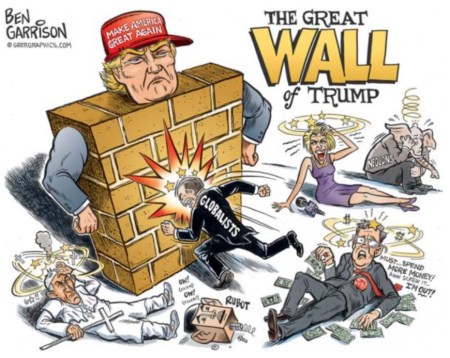
Great-Wall-of-Trump
Trump-Cannon


The Campaign to Toxify Donald Trump Among Jews

March 5, 2016

Blue State Blues: The Campaign to Toxify Donald Trump Among Jews

by Joel B. Pollak

4 Mar 2016

Source: The Campaign to Toxify Donald Trump Among Jews


Say what you will about Donald Trump, but he is not an antisemite. Yet there is a malicious campaign afoot to paint him as one.

Tablet Magazine, for example, has launched a “Trump Watch” series, complete with German Gothic script that is apparently meant to remind readers of antisemitic tabloids in Nazi Germany. Its mission: to show the “daily low-lights of Donald Trump’s attempt to use the dark forces of bigotry to become President.”

The inaugural post cites Louis Farrakhan’s praise for Trump for refusing money from Jews (as he has from virtually everyone, thus far).

The post goes further, and quotes Lloyd Grove’s absurd article at the Daily Beast, in which Breitbart is accused of inciting Twitter trolls to scare Federalist writer Bethany Shondark Mandel, who has never once been attacked by this website. Breitbart News has called on the Daily Beast to retract the article. (No one from Tablet contacted Breitbart News before regurgitating the article’s false innuendo, and wrongly associating Breitbart with bigotry.)

The next edition of Trump Watch links Trump with the anti-Israel Boycott, Divestment, and Sanctions (BDS) movement — though it admits he has nothing to do with it. Actual quote: “Factually, of course, they’ve little in common. But facts don’t matter here because facts don’t always make sense.”

The following Trump Watch hits him for comments about the KKK, whom he had already disavowed. And the next takes up a letter signed by foreign policy experts opposed to Trump’s candidacy, and suggests “maybe something darker is taking place … Republicans with fundamentally authoritarian instincts are beginning to shoot glances at one another and to see their opportunity.”

None of the above is convincing, or even attempts to be. It is aimed at toxifying Trump among potential supporters in the Jewish community and beyond.

Never mind his daughter Ivanka’s Orthodox Jewish conversion, or Trump’s endorsement for Israeli Prime Minister Benjamin Netanyahu. The man, and his supporters, must be demonized.

Take, for instance, Bill Kristol’s Emergency Committee for Israel (ECI), which did outstanding work in trying to stop the Iran deal. You might think Kristol and ECI would acknowledge Trump’s efforts to fight the deal, including his address to a large rally on Capitol Hill last fall.

Instead, ECI has waded into primary politics with a new ad this week claiming that Trump is dangerous for Israel because of his “disturbing affection for anti-American dictators.”

And earlier this week, Nefesh b’Nefesh, a non-profit organization that helps Jews who want to make aliyah (move to Israel), tweeted to Jewish Republicans who oppose Trump that “we’re here if you need us.” The tweet (for which the organization later apologized) was responding to an op-ed in the left-leaning Forward that claimed Jewish Republicans are worried about Trump because of his “nativist working class political movement,” adding that “the Jewish experience with overweening, oversensitive wannabe dictator-chieftains is not a good one.”

The article purported to speak for Jewish Republicans. But there are certainly some who support Trump as well.
There is much to criticize in Trump’s foreign policy, including on Israel. Trump arrived at a Republican Jewish Coalition candidate forum in December poorly prepared to answer policy questions on Israel, and was criticized for making Jewish jokes in a clumsy attempt to bond with the audience.

, his two main rivals, have slammed him repeatedly for saying he would be “neutral” in negotiations between Israelis and Palestinians. Yes, they have misconstrued his remarks, suggesting that he would be neutral towards Israel in general, when he specifically blamed Palestinians for the impasse. But that’s just politics.There’s also an argument to be made, as Ben Shapiro does, that Trump could speak out more forcefully against antisemitism.

All of that is legitimate criticism. The attempt to turn Donald Trump into Hitler is not. It is a game of guilt-by-association, the same nonsense that was unleashed against Gov. Sarah Palin in 2008, when Democrats immediately tried to link her to Nazis.

Then-Rep. Robert Weller (D-FL) said:

Sen. John McCain (R-AZ)

36%

’s decision to select a vice presidential running mate that endorsed Pat Buchanan for president in 2000 is a direct affront to all Jewish Americans. Pat Buchanan is a Nazi sympathizer with a uniquely atrocious record on Israel, even going as far as to denounce bringing former Nazi soldiers to justice and praising Adolf Hitler for his “great courage.”

The smear campaign against Trump comes out of the same playbook. It is not simple fear of populist nationalism. It is being carried out by those who know, or are capable of deducing, that Trump is neither an antisemite nor trying to appeal to antisemites. It is a vendetta by political opponents who are determined to stop Trump and have chosen to use this noxious slander as their weapon.

As with false accusations of racism, it tends to desensitize people to the real thing.

Off Topic | Deserve Hillary? Then vote for her

March 3, 2016

Deserve Hillary? Then vote for her, Dan Miller’s Blog, March 3, 2016

(The views expressed in this post are mine and do not necessarily reflect those of Warsclerotic or its other editors. — DM)

Democrats have done a bang up job for their people for the last fifty years. Want more of the same? Vote for Hillary.


How about Mit Romney? Surely, he must be right. After all, the proud godfather of ObamaCare did so well in 2012. His part of the video starts at 23:00.


So, all of you RINOs who prefer Hillary to Trump, have at it. Heck, with the RINOs and the Dems in charge, the country will stay in the very best of hands.


Off Topic: Exclusive Audio — Rubio Campaign Manager Plots Brokered Convention

March 3, 2016

Exclusive Audio — Rubio Campaign Manager Plots Brokered Convention In Manhattan Donor Meeting To Take Nomination From Trump

by Matthew Boyle

2 Mar 2016 Washington, DC

Source: Exclusive Audio — Rubio Campaign Manager Plots Brokered Convention In Manhattan Donor Meeting To Take Nomination From Trump – Breitbart

 Sen. Marco Rubio is plotting to take the Republican nomination away from Donald Trump using surreptitious tactics at a so-called “brokered convention,” according to an audio recording of his campaign manger in a private meeting with high dollar donors in Manhattan obtained exclusively by Breitbart News.

Last Wednesday evening in New York, according to CNN, Rubio campaign manager Terry Sullivan met privately with a group of supporters and top donors to chart Rubio’s path forward heading into Super Tuesday after abysmal performances from the first-term Florid Senator so far. During the meeting, Sullivan walked Rubio’s money men through the scenario he envisions he will use to stop Trump.

An audio recording of Sullivan giving the powerpoint presentation obtained exclusively by Breitbart News shows Sullivan plotting for a brokered convention.

“That is – I know if you watch the cable shows, they’re pretty breathless right about now that this is it, nothing is stopping Donald Trump,” Sullivan says at the opening of his remarks on aiming for brokered convention. “He can’t be stopped. He has got more momentum, this is it. It is over.”

But, Sullivan argued in the pre-Super Tuesday session: “5.3 percent of the delegates allocated in this thing. We have 94.7 percent remaining. You need to get to 1,237 delegates to win this thing.”

LISTEN TO THE AUDIO RECORDING:

The presentation came the day after Trump destroyed the rest of the field in Nevada among every demographic including Hispanics. Rubio finished more than 20 percent behind Trump, getting only 7 delegates—half of Trump’s 14 delegates. That was an embarrassing finish for Rubio, who spent much of his childhood in Las Vegas and emphasized the Silver State, campaigning there heavily throughout the course of 2015 and early 2016. That bad finish for Rubio came after three previous disappointments.

On Feb. 1, Rubio finished in third in Iowa with just 23 percent of the vote. He pulled in 7 delegates, the same amount Trump’s second place with 24 percent won the national frontrunner and one fewer than Iowa caucuses winner

Sen. Ted Cruz (R-TX) who got 8 delegates there. In New Hampshire, Trump’s astounding 35 percent victory—20 points better than Ohio Gov. John Kasich’s 15 percent—won Trump 11 delegates. Kasich got 4, Cruz won 3 with an 11.7 percent third place finish, and former Florida Gov. Jeb Bush beat Rubio out for fourth place winning 3 delegates. Rubio’s abysmal fifth place finish with just 10.6 percent won him only 2 New Hampshire delegates.

A couple weeks later in South Carolina, Rubio similarly failed to meet expectations. Even with the Palmetto State’s governor, Nikki Haley,

Sen. Tim Scott (R-SC) Rep. Trey Gowdy (R-SC) campaigning for him—and Sullivan hailing from South Carolina—Rubio failed to win the state after his team was previously telling people he’d finish in third in Iowa, second in New Hampshire and first in South Carolina, his 3-2-1 strategy. Trump’s definitive 32.5 percent victory there won him all 50 delegates in South Carolina, and Rubio came up empty as did everyone else.

Sullivan argued in the meeting in Manhattan that according to South Carolina exit polling, late deciders in these primaries are breaking for Rubio in a big way—so it’s not time to throw in the towel just yet. Exit polling from Virginia on Super Tuesday seemed to back that point up, but again like South Carolina—it was too little too late and Rubio lost to Trump.

“This is the exit polling in South Carolina, just kind of to give you a little – kind of a snapshot of the public,” Sullivan told the donors.

All of these states, when you start to looking at it, they close quickly at the end. People start paying attention, voters – there’s a big difference between a voter’s position on who they support and who they’re going to vote for two weeks before the election, a week before the election, a day before the election. That’s when it matters. We start to see here – and this is voters who decide in the last week who they are going to support, 28 percent chose Marco Rubio. On the electability, that was 47 percent. That is an angle we’re pushing hard because we know that we are the best candidate to beat Hillary, or Bernie. We are confident about that, and we know the voters are confident about that and they want him to win.

Sullivan added that this trend has been seen around the country. “That 28 percent close in the final week, that’s indicative of what we saw in Iowa and then, to a lesser extent in New Hampshire, obviously, that was not a good state for us – had a bad run there,” Sullivan said.

When Sullivan was giving this presentation, the final delegate counts from Nevada had not yet been totaled. But heading into Super Tuesday, Trump had 82 delegates while Cruz had 17 delegates and Rubio had 16 delegates. While the totals aren’t yet completely tabulated for Super Tuesday, Rubio—by any calculation—fared especially poorly since he failed to hit the 20 percent threshold statewide in Texas meaning he only will from there win a handful of delegates from congressional districts in which he topped 20 percent.

Rubio similarly failed in Alabama, winning just 1 of 50 delegates up for grabs—and the first term Florida senator only one won state, a victory in Minnesota. That prompted comparisons between Rubio and Walter Mondale, with some calling him “Marco Mondale” since the 1984 Democratic presidential candidate against incumbent President Ronald Reagan won only Minnesota and no other U.S. States. The unfortunate turn of events for Rubio also undercuts his carefully crafted image as the standard bearer of the next generation of Reagan’s legacy, since Rubio has only won where Reagan lost.

Back then, while publicly projecting that they could potentially beat Trump in a race to 1,237 delegates to win outright, Sullivan had already signaled that the race is about trying to broker the convention. At such a brokered convention, Sullivan’s plan to help swing it for Rubio even if Rubio has fewer delegates than Trump is to convince the delegates to back Rubio on a second ballot—where they would be technically unbound—and thereby essentially take the nomination away from Trump, its rightful winner if he has the most delegates.

“What this really comes down to, this race going forward on these delegates, is a race to get the most delegates at convention,” Sullivan said in the private Manhattan meeting.

If nobody gets to 50 percent of the delegates, if nobody gets to 1,237, then there’s a floor fight and delegates in most of these states, every state has different rules on these delegates, most of these states – the delegates are no longer bound after the first ballot. So if nobody has 50 percent, they do a perfunctory ballot, no one gets there. No one gets to 1,237, and then the vast majority of the next round of voting are free agents.

Sullivan further explained who the delegates actually are, and how they’re not people loyal to Trump in any way—but really party insiders.

“The interesting thing without getting too far into the weeds of these delegates is – you know, a little over 95 percent of the [inaudible], the delegates aren’t selected by the campaigns,” Sullivan said.

Donald Trump doesn’t choose his delegates for the national convention, I don’t choose Marco Rubio’s, Ted Cruz doesn’t choose his. These are people –in many cases who have already started the process, they ran on a slate at their precinct, then it was GOP conventions, then at their state conventions, to become a delegate for the national convention. Some of you I know have been delegates in the national convention here, different way, different state, it’s a pretty laborious process. It is generally not someone who just – a casual voter if you will, or someone who is just suddenly energized. These are people who have been involved in the process for a long time, have relationships with other activists, because you’re elected at your state convention. So why that’s important—and I know I’m side tracking, but this is an important [point]—when you show up at the convention, if I just say, ‘I want to go to Cleveland, because well it’s a fun place to go hangout in July—thank you Reince Priebus. After I spend 15 minutes at the Rock and Roll Hall of Fame.’ Most of the people go to these conventions because they believe in the Republican Party, they believe in a core set of issues, they’ve been doing this for a while.

In continuing to explain it, Sullivan even admitted that the debate audiences have been stacked against Trump and for Rubio—something the Rubio campaign and the Republican National Committee (RNC) have repeatedly denied.

“Most of them it’s not their first time: these are repeat delegates,” Sullivan said.

None of them look like a Donald Trump supporter. None of them look like a Donald Trump supporter. So my point in this little deviation here is: should this go to the convention, that’s a real problem for Donald Trump because he’s got to start persuading these same—the people that he’s getting booed at, that he’s talking about these debates that he’s mocking, you know what those are? You know what I like to call them? Delegates.

In this pre-Super Tuesday presentation by Sullivan, the Rubio campaign manager also made some fairly bold predictions that his boss fell well short of on election day. First, while he was right when he predicted that Cruz would win Texas, he was wrong about predicting a bounce for both second and third place finishers.

“Cruz will win Texas, which will be the biggest prize on March 1, but even with his win—first place finish—in Texas, he is not going to get the kind of bounce out of that … because the second place person in the state of Texas is going to get delegates, and the third place person in Texas is going to get delegates,” Sullivan said.

And that’s what matters. Whoever wrote the memos, it looks great to see Rubio in first place, second place, third place or fourth or fifth or all the way down on election night. What really matters is how many delegates do they have? That’s what is most important. And so to that point: we – coming in third in Texas, that should get you a lot of delegates. And then going over and playing in other states that matter more: Virginia is not proportional by congressional district; that’s a smart place to win. We’ve gone through this map and I don’t mean we’ve gone through this map in the last few weeks.

Cruz did win Texas, and he won it big with nearly 44 percent of the vote. While all of Texas’ 155 delegates haven’t yet been apportioned according to Politico, Cruz currently has 99 delegates there. Trump, who finished in second with nearly 27 percent, pulled down as of Wednesday afternoon 38 delegates. Rubio, as of Wednesday afternoon, got just 4 delegates since he missed the mark of 20 percent statewide to win a proportional share of the state delegates and only reached 20 percent in a couple congressional districts to pick up the scraps.

That may change, but not significantly, as the state’s final 14 delegates are apportioned. Rubio missed the 20 percent mark elsewhere throughout the country on Super Tuesday as well, earning just 1 delegate in Alabama thanks to a congressional district he hit 20 percent in for instance.

Rubio also lost Virginia to Trump despite Sullivan’s prediction nearly a week before Super Tuesday that is “a smart place to win.” Trump’s 34.7 percent in Virginia earned him 17 delegates, while Rubio’s second place 31.9 percent earned him 16 delegates.

Rubio failed to win Oklahoma, too, despite his campaign predicting he would win there–not place or show–according to Bloomberg News. In Oklahoma, Rubio placed third with just 26 percent winning only 11 delegates. Cruz’s 34.4 percent won the state–and 14 delegates–while Trump’s 28.3 percent won got the businessman 12 delegates.

Rubio underperforming in even accumulating delegates in proportional states makes it even more difficult for him to come back form the brink later in the game, or to broker the convention. The delegate count currently stands at 319 for Trump, 226 for Cruz, 110 for Rubio and 25 for Kasich. There’s a handful more Super Tuesday delegates to be apportioned in Vermont, Texas, Arkansas, Oklahoma, Georgia and Tennessee.

Sullivan, in his donor meeting, also laid out that Rubio has been planning to run for president since right after he got into the U.S. Senate, something that may explain Rubio’s serious delinquency as a U.S. Senator. Rubio has the worst attendance record—for voting and for committee hearings, including hearings regarding matters of national security—of any member of the U.S. Senate at this time. A senior adviser to Trump, Stephen Miller, even went so far on Wednesday to suggest that Rubio has “defrauded” the taxpayers of Florida and should repay his salary of more than $1 million over his time in the Senate back to the treasury with interest.

Part of Rubio’s delinquency as a Senator seems to be because, as Sullivan reveals in this private Manhattan donor meeting, that he’s been running for president for years—and that Sullivan, while working for Rubio even before he senator announced his campaign, was tasked with pulling together plans for the senator to run.

“I’ve worked for Marco now for five years,” Sullivan said.

It’s the longest I’ve worked—I’ve been running these campaigns my entire life – it’s the longest I’ve worked for any candidate exclusively. This isn’t something that we’ve started taking lightly, I fully believe that you don’t wake up one day and decide to start running for president and then start an organization. So it was my job to start thinking of these things years ago and start planning this, should he want to make that decision, so that he was ready on day one. So little – probably about a year and a half ago, right after the November election, I was prepared. And I sat down, with a Power Point presentation—actually 20 times as long as this, actually more than 20 times as long as this—but with some of these same slides, walking through.

Rubio’s campaign has not responded to a request for comment.

Off Topic | Inside the Republican Party’s Desperate Mission to Stop Donald Trump

February 27, 2016

The G.O.P.’s Last-Ditch, Frantic Effort to Stop Trump, New York Times, Alexander Burns, Maggie Haberman and Jonathan Martin, February 27, 2016

(Please see also, Off Topic:  Trump and the Rise of the Unprotected – WSJ. — DM)

The scenario Karl Rove outlined was bleak.

Addressing a luncheon of Republican governors and donors in Washington on Feb. 19, he warned that Donald J. Trump’s increasingly likely nomination would be catastrophic, dooming the party in November. But Mr. Rove, the master strategist of George W. Bush’s campaigns, insisted it was not too late for them to stop Mr. Trump, according to three people present.

At a meeting of Republican governors the next morning, Paul R. LePage of Maine called for action. Seated at a long boardroom table at the Willard Hotel, he erupted in frustration over the state of the 2016 race, saying Mr. Trump’s nomination would deeply wound theRepublican Party. Mr. LePage urged the governors to draft an open letter “to the people,” disavowing Mr. Trump and his divisive brand of politics.

The suggestion was not taken up. Since then, Mr. Trump has only gotten stronger, winning two more state contests and collecting the endorsement of Gov. Chris Christie of New Jersey.
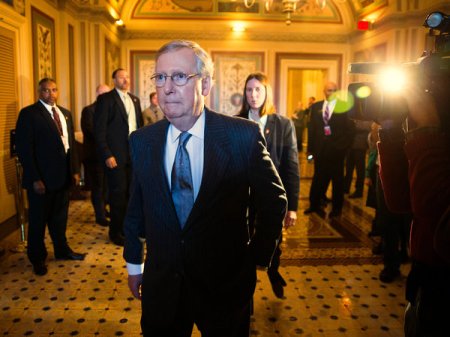
Mitch McThe Senate majority leader, Mitch McConnell, has laid out a plan that would have lawmakers break with Mr. Trump in a general election. Credit Doug Mills/The New York Times

In public, there were calls for the party to unite behind a single candidate. In dozens of interviews, elected officials, political strategists and donors described a frantic, last-ditch campaign to block Mr. Trump — and the agonizing reasons that many of them have become convinced it will fail. Behind the scenes, a desperate mission to save the party sputtered and stalled at every turn.

Efforts to unite warring candidates behind one failed spectacularly: An overture from Senator Marco Rubio to Mr. Christie angered and insulted the governor. An unsubtle appeal from Mitt Romney to John Kasich, about the party’s need to consolidate behind one rival to Mr. Trump, fell on deaf ears. At least two campaigns have drafted plans to overtake Mr. Trump in a brokered convention, and the Senate majority leader, Mitch McConnell of Kentucky, has laid out a plan that would have lawmakers break with Mr. Trump explicitly in a general election.

Despite all the forces arrayed against Mr. Trump, the interviews show, the party has been gripped by a nearly incapacitating leadership vacuum and a paralytic sense of indecision and despair, as he has won smashing victories in South Carolina and Nevada. Donors have dreaded the consequences of clashing with Mr. Trump directly. Elected officials have balked at attacking him out of concern that they might unintentionally fuel his populist revolt. And Republicans have lacked someone from outside the presidential race who could help set the terms of debate from afar.

The endorsement by Mr. Christie, a not unblemished but still highly regarded figure within the party’s elite — he is a former chairman of the Republican Governors Association — landed Friday with crippling force. It was by far the most important defection to Mr. Trump’s insurgency: Mr. Christie may give cover to other Republicans tempted to join Mr. Trump rather than trying to beat him. Not just the Stop Trump forces seemed in peril, but also the traditional party establishment itself.

Should Mr. Trump clinch the presidential nomination, it would represent a rout of historic proportions for the institutional Republican Party, and could set off an internal rift unseen in either party for a half-century, since white Southerners abandoned the Democratic Party en masse during the civil rights movement.

Former Gov. Michael O. Leavitt of Utah, a top adviser to Mr. Romney’s 2012 presidential campaign, said the party was unable to come up with a united front to quash Mr. Trump’s campaign.

“There is no mechanism,” Mr. Leavitt said. “There is no smoke-filled room. If there is, I’ve never seen it, nor do I know anyone who has. This is going to play out in the way that it will.”

Republicans have ruefully acknowledged that they came to this dire pass in no small part because of their own passivity. There were ample opportunities to battle Mr. Trump earlier; more than one plan was drawn up only to be rejected. Rivals who attacked him early, like Rick Perry and Bobby Jindal, the former governors of Texas and Louisiana, received little backup and quickly faded.

Late last fall, the strategists Alex Castellanos and Gail Gitcho, both presidential campaign veterans, reached out to dozens of the party’s leading donors, including the casino magnate Sheldon Adelson and the hedge-fund manager Paul Singer, with a plan to create a “super PAC” that would take down Mr. Trump. In a confidential memo, the strategists laid out the mission of a group they called “ProtectUS.”

“We want voters to imagine Donald Trump in the Big Chair in the Oval Office, with responsibilities for worldwide confrontation at his fingertips,” they wrote in the previously unreported memo. Mr. Castellanos even produced ads portraying Mr. Trump as unfit for the Oval Office, according to people who saw them and who, along with many of those interviewed, insisted on anonymity to discuss private conversations.

The two strategists, who declined to comment, proposed to attack Mr. Trump in New Hampshire over his business failures and past liberal positions, and emphasized the extreme urgency of their project. A Trump nomination would not only cause Republicans to lose the presidency, they wrote, “but we also lose the Senate, competitive gubernatorial elections and moderate House Republicans.”

No major donors committed to the project, and it was abandoned. No other sustained Stop Trump effort sprang up in its place.

Resistance to Mr. Trump still runs deep. The party’s biggest benefactors remain totally opposed to him. At a recent presentation hosted by the billionaires Charles G. and David H. Koch, the country’s most prolific conservative donors, their political advisers characterized Mr. Trump’s record as utterly unacceptable, and highlighted his support for government-funded business subsidies and government-backed health care, according to people who attended.

But the Kochs, like Mr. Adelson, have shown no appetite to intervene directly in the primary with decisive force.

The American Future Fund, a conservative group that does not disclose its donors, announced plans on Friday to run ads blasting Mr. Trump for his role in an educational company that is alleged to have defrauded students. But there is only limited time for the commercials to sink in before some of the country’s biggest states award their delegates in early March.

Instead, Mr. Trump’s challengers are staking their hopes on a set of guerrilla tactics and long-shot possibilities, racing to line up mainstream voters and interest groups against his increasingly formidable campaign. Donors and elected leaders have begun to rouse themselves for the fight, but perhaps too late.

Mit RomneyMitt Romney at an event in Mississippi last year. He has tried various ways to slow the progress of Mr. Trump, without success. Credit Rogelio V. Solis/Associated Press

Two of Mr. Trump’s opponents have openly acknowledged that they may have to wrest the Republican nomination from him in a deadlocked convention.

Speaking to political donors in Manhattan on Wednesday evening, Mr. Rubio’s campaign manager, Terry Sullivan, noted that most delegates are bound to a candidate only on the first ballot. Many of them, moreover, are likely to be party regulars who may not support Mr. Trump over multiple rounds of balloting, he added, according to a person present for Mr. Sullivan’s presentation, which was first reported by CNN.

Advisers to Mr. Kasich, the Ohio governor, have told potential supporters that his strategy boils down to a convention battle. Judd Gregg, a former New Hampshire senator who had endorsed Jeb Bush, said Mr. Kasich’s emissaries had sketched an outcome in which Mr. Kasich “probably ends up with the second-highest delegate count going into the convention” and digs in there to compete with Mr. Trump.

Several senior Republicans, including Mr. Romney, have made direct appeals to Mr. Kasich to gauge his willingness to stand down and allow the party to unify behind another candidate. But Mr. Kasich has told at least one person that his plan is to win the Ohio primary on March 15 and gather the party behind his campaign if Mr. Rubio loses in Florida, his home state, on the same day.

In Washington, Mr. Kasich’s persistence in the race has become a source of frustration. At Senate luncheons on Wednesday and Thursday, Republican lawmakers vented about Mr. Kasich’s intransigence, calling it selfishness.

One senior Republican senator, noting that Mr. Kasich has truly contested only one of the first four states, complained: “He’s just flailing his arms around and having a wonderful time going around the country, and it just drives me up the wall.”

Mr. McConnell was especially vocal, describing Mr. Kasich’s persistence as irrational because he has no plausible path to the nomination, several senators said.

While still hopeful that Mr. Rubio might prevail, Mr. McConnell has begun preparing senators for the prospect of a Trump nomination, assuring them that, if it threatened to harm them in the general election, they could run negative ads about Mr. Trump to create space between him and Republican senators seeking re-election. Mr. McConnell has raised the possibility of treating Mr. Trump’s loss as a given and describing a Republican Senate to voters as a necessary check on a President Hillary Clinton, according to senators at the lunches.

(video of Christie endorsing Trump at the link.- – DM) 

He has reminded colleagues of his own 1996 re-election campaign, when he won comfortably amid President Bill Clinton’s easy re-election. Of Mr. Trump, Mr. McConnell has said, “We’ll drop him like a hot rock,” according to his colleagues.

There is still hope that Mr. Rubio might be able to unite much of the party and slow Mr. Trump’s advance in a series of big-state primaries in March, and a host of top elected officials endorsed him over the last week. But Mr. Rubio has struggled to sideline Mr. Kasich and Senator Ted Cruz of Texas, who is running a dogged campaign on the right. He has also been unable to win over several of his former rivals who might help consolidate the Republican establishment more squarely behind him.

Mr. Rubio showed a lack of finesse in dealing with his fallen rivals’ injured egos.

Mr. Christie had attacked Mr. Rubio contemptuously in New Hampshire, calling him shallow and scripted, and humiliating him in a debate. Nevertheless, Mr. Rubio made a tentative overture to Mr. Christie after his withdrawal from the presidential race. He left the governor a voice mail message, assuring Mr. Christie that he had a bright future in public service, according to people who have heard Mr. Christie’s characterization of the message.

Mr. Christie, 53, took the message as deeply disrespectful and patronizing, questioning why “a 44-year-old” was telling him about his future, said people who described his reaction on the condition of anonymity. Further efforts to connect the two never yielded a direct conversation.

Mr. Trump, by contrast, made frequent calls to Mr. Christie once he dropped out, a person close to the governor said. After the two met at Trump Tower on Thursday with their wives, Mr. Christie flew to Texas and emerged on Friday to back Mr. Trump and mock Mr. Rubio as a desperate candidate near the end of a losing campaign.

Efforts to reconcile Mr. Rubio and Mr. Bush, a former governor of Florida, have been scarcely more successful, dating to before the South Carolina primary, when Mr. Rove reached out to their aides to broker a cease-fire, according to Republicans familiar briefed on the conversations. It did not last.

Mr. Bush has been nearly silent since quitting the race Feb. 20, playing golf with his son Jeb Jr. in Miami and turning to the task of thank-you notes. In a Wednesday conference call with supporters, he did not express a preference among the remaining contenders. When Mr. Rubio called him, their conversation did not last long, two people briefed on it said, and Mr. Rubio did not ask for his endorsement.

“There’s this desire, verging on panic, to consolidate the field,” said Senator Lindsey Graham of South Carolina,  a former supporter of Mr. Bush. “But I don’t see any movement at all.”

Mr. Rubio’s advisers were also thwarted in their efforts to secure an endorsement from Mr. Romney, whom they lobbied strenuously after the Feb. 20 South Carolina primary.

Mr. Romney had been eager to tilt the race, and even called Mr. Christie after he ended his campaign to vent about Mr. Trump and suggest that Mr. Christie help consolidate the field. On the night of the primary, Mr. Romney was close to endorsing Mr. Rubio himself, people familiar with his deliberations said.

Yet Mr. Romney pulled back, instead telling advisers that he would take on Mr. Trump directly.

After a Tuesday night dinner with former campaign aides, during which he expressed a sense of horror at the Republican race, Mr. Romney made a blunt demand Wednesday on Fox News: Mr. Trump must release his tax returns to prove he was not concealing a “bombshell” political vulnerability.

Mr. Trump responded only with casual derision, dismissing Mr. Romney on Twitter as “one of the dumbest and worst candidates in the history of Republican politics.”

Mr. Romney is expected to withhold his support before the voting this week on the so-called Super Tuesday, but some of his allies have urged him to endorse Mr. Rubio before Michigan and Idaho vote March 8. Mr. Romney grew up in Michigan, and many Idahoans are fellow Mormons.

But already, a handful of senior party leaders have struck a conciliatory tone toward Mr. Trump. Representative Kevin McCarthy of California, the House majority leader, said on television that he believed he could work with him as president. Many in the party acknowledged a growing mood of resignation.

Fred Malek, the finance chairman of the Republican Governors Association, said the party’s mainstream had simply run up against the limits of its influence.

“There’s no single leader and no single institution that can bring a diverse group called the Republican Party together, behind a single candidate,” Mr. Malek said. “It just doesn’t exist.”

On Friday, a few hours after Mr. Christie endorsed him, Mr. Trump collected support from a second governor, who in a radio interview said Mr. Trump could be “one of the greatest presidents.”

That governor was Paul LePage.

Caution – Politically Incorrect | The Vicious Snake

February 27, 2016

The Vicious Snake, Donald Trump via You Tube, January 18, 2016

H/t Puma by Design, February 7, 2016 and 1389 Blog, February 26, 2016. I had missed it. According to Puma by Design, “Donald Trump began reciting the lyrics to a song entitled “The Snake” at his rallies, a few weeks back, as not reported by the mainstream media.’  The video is apparently “going viral” in Europe.- DM)