Posted tagged ‘Democrats’

Democrats seek to undo political damage of the Iran Deal

November 12, 2015

Democrats seek to undo political damage of the Iran Deal, Legal Insurrection, November 12, 2015

The New White House Meme About Bibi: He Doesn’t Understand.

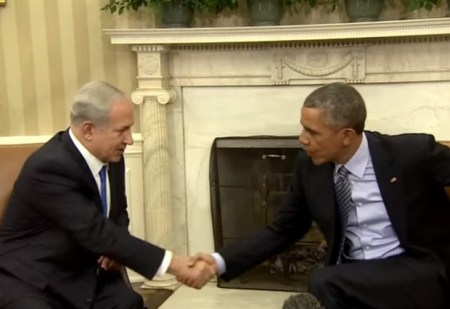
2015-11-12_090314_Netanyahu_Obama-620x426

[T]he nuclear deal has done tremendous political damage to the Democrats. And while much of the media is portraying Netanyahu’s D.C. visit as Netanyahu’s chance to mend fences, I think it’s been Obama’s.

Polling shows that despite the tensions between Obama and Netanyahu, which Jonathan Tobin correctly characterizes as being exacerbated by Obama, bipartisan support for Israel is strong and growing. Obama and Congressional Democrats are quite aware of this.

****************************

The New White House Meme About Bibi: He Doesn’t Understand.

In a look at the history of the tensions between President Barack Obama and Israeli Prime Minister Benjamin Netanyahu, The New York Times several days ago started with an interesting anecdote.

For President Obama, it was a day of celebration. He had just signed the most important domestic measure of his presidency, his health care program. So when Prime Minister Benjamin Netanyahu of Israel arrived at the White House for a hastily arranged visit, it was likely not the main thing on his mind.

To White House officials, it was a show of respect to make time for Mr. Netanyahu on that day back in March 2010. But Mr. Netanyahu did not see it that way. He felt squeezed in, not accorded the rituals of such a visit. No photographers were invited to record the moment. “That wasn’t a good way to treat me,” he complained to an American afterward.

The tortured relationship between Barack and Bibi, as they call each other, has been a story of crossed signals, misunderstandings, slights perceived and real. Burdened by mistrust, divided by ideology, the leaders of the United States and Israel talked past each other for years until the rupture over Mr. Obama’s push for a nuclear agreement with Iran led to the spectacle of Mr. Netanyahu denouncing the president’s efforts before a joint meeting of Congress.

It’s interesting because this is not at all how I remembered it. I remember that the lack of attention to the meeting was perceived as an intentional slight of Netanyahu. A quick check of the contemporaneous reporting confirmed this.

(Later when describing the meeting the article says that the situation was “made worse by exaggerated stories of shabby behavior in Israeli news media.” I don’t know that exaggerations were necessary.)

Reuters: In a sign of lingering tensions, the Obama administration withheld from Netanyahu some of the usual trappings of a White House visit. Press coverage of the Oval Office talks was barred, and the leaders made no public statements afterward.

Jackson Diehl of The Washington Post (who was, in fact, quoted by Prof. Jacobson at the time): Finally, Obama has added more poison to a U.S.-Israeli relationship that already was at its lowest point in two decades. Tuesday night the White House refused to allow non-official photographers record the president’s meeting with Netanyahu; no statement was issued afterward. Netanyahu is being treated as if he were an unsavory Third World dictator, needed for strategic reasons but conspicuously held at arms length. That is something the rest of the world will be quick to notice and respond to. Just like the Palestinians, European governments cannot be more friendly to an Israeli leader than the United States.

New York Magazine: It was an ominous signal when the White House didn’t provide photos or briefings after the much-anticipated meeting between President Obama and Israeli Prime Minister Benjamin Netanyahu earlier this week. After Joe Biden was blindsided by a surprise Israeli announcement of a new East Jerusalem housing project a couple of weeks earlier, the Obama administration was clearly sending a message of extreme displeasure.

BBC: But the White House had no immediate comment on their content. In a break with convention, reporters were not invited to witness the pair shake hands at the start of their discussions. It was a pointed contrast with the traditional public welcome for Israeli leaders at the White House, the BBC’s Steve Kingstone in Washington reports.

New York Time editorial a few days later: Mr. Obama was right to demand that Mr. Netanyahu repair the damage. Details of their deliberately low-key White House meeting (no photos, no press, not even a joint statement afterward) have not been revealed. We hope Israel is being pressed to at least temporarily halt building in East Jerusalem as a sign of good faith. Jerusalem’s future must be decided in negotiations.

In none of these accounts, was there any mention of the signing of Obamacare, (which did take place earlier that day.) The “low-key” approach to the meeting between the leaders was reported as a deliberate attempt by the administration to signal its displeasure with Netanyahu. I saw no indication that the administration tried to fight that impression at the time.

My best guess is that the New York Times reporters were simply writing the administration’s revisionist account of the events in 2010, without doing the necessary due diligence to ensure that the information they were given was accurate.

Still the article is mostly well-reported covering both sides. There are a few significant omissions (this and this, for example), but the article tries very hard to make the case that any tension between Obama and Netanyahu is the result not of malice, but of Netanyahu misunderstanding Obama. Perhaps the clearest expression of this came in a a description of meetings between Obama and American-Jewish leaders:

In those meetings, Mr. Obama expressed distress. “He bore his soul about how much he cares about Israel,” Mr. Foxman said. “It was painful, hurtful. ‘I care about Israel, I love Israel.”‘ Why did Mr. Netanyahu not understand?

So yes, I think we have a new meme, Obama is pro-Israel but misunderstood. The question is why the administration is so sensitive right now.

I have an idea.

First consider where the Democratic party is nearly one year before the next presidential election.

As Aleister noted recently, the Democrats have lost 12 governorship, 69 House seats, 14 Senate seats and over 900 local legislative seats in 7 years under Obama. While Obama’s personal popularity hovers just a little below 50%, this represents a widespread rebuke to his governance. Remember, his two signal achievements, Obamacare and the Iran nuclear deal were unpopular. As everyone sees increasing health insurance rates and the consequences of the nuclear deal are reported, voters will have reminders of schemes that were enabled by legislative manipulation lacking popular support.

The Sun-Sentinel reported on Saturday on the significance of the Obama-Netanyahu meeting:

The region is home to an estimated 500,000 Jewish residents — sizable enough to tip the results in the biggest swing state in the country. Florida awards 29 electoral votes, more than 10 percent of the total needed to win the presidency.

Changing the outcome “doesn’t require a majority shift,” said Steven Abrams, a county commissioner who was Palm Beach County chairman for Newt Gingrich’s unsuccessful 2012 presidential campaign. “The Jewish vote only needs to change by a percent or two or three in order to make a difference in the outcome of the state.” …

“I have three words: Iran nuclear deal,” Abrams said, referring to the Obama administration’s controversial effort to prevent Iran from developing a nuclear weapon. “It’s one of President Obama’s major initiatives. It’s not a small policy. And it’s a very prominent policy for Jewish voters and many Jewish Democrats and many more Jewish independents are not enthralled by it, and those are targeted voters.”

To be sure the Sun-Sentinel quoted several Democrats saying otherwise, but the nuclear deal according to polling throughout the summer is extremely unpopular.

A Quinnipiac poll in August found that voters in the crucial swing states Ohio, Pennsylvania and Florida opposed the deal by a ratio of greater than 2 to 1. And every time Iran arrests an American or stops cooperating with the terms of the nuclear deal, the deal will be in the news and everyone involved in making the deal will look worse. Even many of the senators who supported the deal and defied popular opinion to block a vote on the deal made persuasive cases about the dangers of the deal.

In terms of Jewish opinion, it’s fascinating that not a single Jewish federation backed the deal. Too many of them, for sure took no position, but none supported the deal. Aside from J-Street, not a single major Jewish organization backed the deal. (The question as to whether J-Street is primarily a Jewish organization is a different question.) Even the ADL, which is now headed by a former Obama staffer, Jonathan Greenblatt, opposed the deal. If nothing else, suggests a strong consensus in the organized Jewish community that the nuclear was a bad deal that endangers Israel.

This suggests that the nuclear deal has done tremendous political damage to the Democrats. And while much of the media is portraying Netanyahu’s D.C. visit as Netanyahu’s chance to mend fences, I think it’s been Obama’s.


So even if cynical in the extreme, the meme that Obama loves Israel but his love was misunderstood by Bibi makes perfect sense. It’s a way of tidying up the past and putting the best face on a contentious relationship.

It is also a pose one would expect the president to strike if he were trying to woo back Jewish voters who are concerned about the threats to Israel presented by the nuclear deal.

Although much of the media has portrayed Netanyahu’s trip to the United States as his bid to mend relations with the administration and more generally with Democrats, there is evidence that the opposite dynamic is in play.

In addition to Obama’s “misunderstood” meme, Jennifer Rubin observed that in the wake of the nuclear deal 16 Democratic senators – 14 of whom supported the deal – are “scrambling for cover” and urging Obama to extend and strengthen the “Memorandum of Understanding” governing the terms of American security assistance to Israel in the face of the Iranian threat. Democratic Whip, Rep. Steny Hoyer, who supported the nuclear deal, has released a letter calling on the United States and its partner to ensure that Iran is held accountable for any cheating.

Polling shows that despite the tensions between Obama and Netanyahu, which Jonathan Tobin correctly characterizes as being exacerbated by Obama, bipartisan support for Israel is strong and growing. Obama and Congressional Democrats are quite aware of this.

The Elephant In The Room

October 2, 2015

The Elephant In The Room, Middle East Media Research Institute (MEMRI), Yigal Carmon*, October 2, 2015

(Please see also, Iran wants to renegotiate parts of the nuke “deal.” That may be good. Have opponents of the “deal” given up? If so, why? — DM)

It may be that these opponents believe that the agreement is a done deal that cannot be stopped and that the current U.S. administration will follow through with it no matter what. This approach reflects not realism but ignorance. Obviously the administration wants to follow through with the deal. But the deal is no longer in it hands. It is Khamenei who is throwing a spanner in the works, declaring that he will not implement the agreement that the West believed it concluded on July 14.

In order to get Iran to implement the agreement, the language of the JCPOA will have to be changed and a new Security Council resolution will have to be passed. While in theory this would not be impossible, it would require a new process, entailing, at the very least, a public political debate in the West – one that would reveal Iran’s unreliability as a partner and would cost valuable time. And time is not on the side of the U.S. administration.

*****************

On September 3, 2015, not two months after the July 14 announcement of the Joint Comprehensive Plan of Action at Vienna and its celebration at the White House and in Europe, Iranian Supreme Leader Ali Khamenei dropped a bombshell.

In a speech to the Iranian Assembly of Experts, he backtracked from the agreement, demanding a new concession: that the sanctions be “lifted,” not merely “suspended.”[1] If that term is not changed, said Khamenei, there is no agreement. If the West only “suspends” the sanctions, he added, Iran will merely “suspend” its obligations. Giving further credence to his threat, he announced that it is the Iranian Majlis that must discuss and approve the agreement (or not), because it represents the people – when it is well known that the majority of its members oppose it, and Iranian President Hassan Rohani made every effort to prevent such a discussion in the Majlis from taking place.

Adding insult to injury, Ali Akbar Velayati, senior advisor to Khamenei and head of Iran’s Center for Strategic Research, said on September 19 that the negotiations, concluded and celebrated less than two months previously on July 14, are actually “not over yet.”[2]

Khamenei’s demand to replace “suspension” with “lifting” is not just semantic. It is a fundamental change, because the snapback of sanctions – the major security mechanism for the entire agreement – cannot take place with “lifting,” but only with “suspension.”

Ever since Khamenei dropped this bombshell, the Western media has maintained total silence, as if this were a trivial matter not worthy of mention, let alone analysis.

One might understand this reaction on the part of those who support the deal. Perhaps they are shocked, at a loss, and therefore hope that if they pretend they don’t see it, it doesn’t exist. Indeed, this is the futile policy regularly adopted by ostriches.

However, one cannot but be astounded by the silence on the part of the opponents of the deal, including – oddly enough – Israel and the U.S. Republicans. One would expect these opponents to pounce on Khamenei’s statement and raise hell over Iran’s infanticide of the two-month-old agreement. One would expect them to bring it to the forefront of a new debate over the deal in any possible forum – in the U.S., the U.N., and the E.U.

But – nothing.

It may be that these opponents believe that the agreement is a done deal that cannot be stopped and that the current U.S. administration will follow through with it no matter what. This approach reflects not realism but ignorance. Obviously the administration wants to follow through with the deal. But the deal is no longer in it hands. It is Khamenei who is throwing a spanner in the works, declaring that he will not implement the agreement that the West believed it concluded on July 14.

In order to get Iran to implement the agreement, the language of the JCPOA will have to be changed and a new Security Council resolution will have to be passed. While in theory this would not be impossible, it would require a new process, entailing, at the very least, a public political debate in the West – one that would reveal Iran’s unreliability as a partner and would cost valuable time. And time is not on the side of the U.S. administration.

Right now, Iran is exposed almost daily as the ally of Russia against the U.S. Three months after the “historic” agreement declared by the White House, Iran continues to seek “Death to America,” and the Iranian foreign minister, the “hero” of the agreement, needs to apologize in Iran for “accidentally” shaking hands with the U.S. president. The truth of the agreement is emerging, and it is not certain that what Iran is now demanding will pass.

Interestingly enough, the White House’s first reaction was to brush off Khamenei’s demand. Iran, said Josh Earnest, should just do what it what it had undertaken to do in the agreement, and stop roiling the waters.[3]

A more sober response followed. There was hope that the meeting set for September 28 between the P5+1 and Iranian foreign ministers, on the margins of the 70th session of the U.N. General Assembly, would produce a solution, but this hope was in vain. Iranian President Rohani fled back to Iran, on the pretext of the hajj tragedy in Mecca, and no one in the West knows how to proceed.

The Western media, for its part, is perpetuating its total blackout on the issue, hoping perhaps for a miracle in the secret U.S.-Iran talks, which this administration has been conducting for years. But even a secret U.S. concession will be no solution. Even if it were to offer a secret commitment to remove the sanctions altogether, Khamenei will not be satisfied. He openly challenged the U.S., and he needs its public capitulation. He will celebrate publicly any secret concession. Moreover, any new U.S. concession will prompt Khamenei to make ever more demands.

The most recent developments, and the emergence of Russia as a new-old contender for power vis-à-vis the U.S. in the world, particularly in the Middle East, will only encourage Khamenei to cling to his tried and true ally, Russia. Indeed, this administration has no objection to Russia’s resurgence in the Middle East, but Russia’s blatant anti-U.S. stance in every venue except in the private, honeyed Putin-Obama talks will ultimately lead even the blindest of Democrats to realize that Iran is indeed an enemy of the U.S. – as Iran plainly declares – and that any further concessions to it make no sense.

It seems that the worst nightmare of the supporters of the deal – that Iran will do away with the July 14 agreement – is about to come to pass.

*Y. Carmon is president and founder of MEMRI.

Endnotes:

[3] Earnest said: “What we have indicated all along is that once an agreement was reached, as it was back in mid-July, that we would be focused on Iran’s actions and not their words, and that we will be able to tell if Iran follows through on the commitments that they made in the context of these negotiations. And that is what will determine our path forward here. We’ve been crystal clear about the fact that Iran will have to take a variety of serious steps to significantly roll back their nuclear program before any sanctions relief is offered – and this is everything from reducing their nuclear uranium stockpile by 98 percent, disconnecting thousands of centrifuges, essentially gutting the core of their heavy-water reactor at Arak, giving the IAEA the information and access they need in order to complete their report about the potential military dimensions of Iran’s nuclear program. And then we need to see Iran begin to comply with the inspections regime that the IAEA will put in place to verify their compliance with the agreement. And only after those steps and several others have been effectively completed, will Iran begin to receive sanctions relief.  The good news is all of this is codified in the agreement that was reached between Iran and the rest of the international community. And that’s what we will be focused on, is their compliance with the agreement.” Whitehouse.gov, September 4, 2015.

Iran wants to renegotiate parts of the nuke “deal.” That may be good.

September 22, 2015

Iran wants to renegotiate parts of the nuke “deal.” That may be good. Dan Miller’s Blog, September 22, 2015

(The views expressed in this article are mine and do not necessarily reflect those of Warsclerotic or those of its other editors. — DM)


Iran wants sanctions relief to be lifted, immediately, and not merely suspended. Iran should not get that. If it doesn’t, it may well terminate the “deal” unilaterally. If Iran gets what it wants, the Senate should review the “deal” as a treaty and reject it. Either outcome would be a substantial improvement over the current “deal” and the morass in which it is embedded.

This post is based on a September 21st article at Middle East Media Research Institute (MEMRI) titled “Expected September 28 NY Meeting Between P5+1 Foreign Ministers And Iran Could Signify Reopening Of Nuclear Negotiations To Address Khamenei’s September 3 Threat That If Sanctions Are Not Lifted, But Merely Suspended, There Will Be No Agreement.”

The MEMRI article cites statements by Supreme Leader Khamenei and one of his senior advisers, Ali Akbar Velayat. The latter said, on September 19th,  “the nuclear negotiations are not over yet.” Khamenei has said much the same thing.

Khamenei said, in a September 3, 2015 speech to the Assembly of Experts, that he did not accept the terms of the agreement and demanded that the sanctions be immediately lifted rather than merely suspended; otherwise, he said, there would either be no agreement, or Iran too would merely suspend its execution of its obligations under the JCPOA.

. . . .

“Freezing or suspension [of the sanctions] is unacceptable to me… If they suspend [the sanctions], we too will suspend [what is incumbent upon us]. If we are to implement what [is required of us], the sanctions must be [actually] cancelled.

Iran has thus made clear that it will not abide by the nuke “deal” as written; unless it gets the changes it now demands, it will either terminate the deal or violate it. If, as seems likely for the reasons cited in the MEMRI article, the September 28th meeting involves discussion of the deal, it will either be renegotiated or it won’t be.

If the “deal” is not renegotiated, or is renegotiated and Iran does not get what it demands, it may very well terminate the deal. Iran has already received substantial sanctions relief, is already open for business and is already doing lots of it with many more nations than previously. Termination would be a rebuff to the “Great Satan,” would not damage Iran much economically and it could proceed with its “peaceful” nuke program without even farcical nuke self-inspections.

If The Obama administration and others cave and Iran gets what it demands or enough to satisfy it, the “deal” will be very different from what was previously presented to the Congress under the Corker legislation. That legislation purported to eliminate the constitutional requirement of approval of the “deal” by a two-thirds Senate majority before going into effect and permitted it to go into effect unless rejected by half of the membership of both houses; Obama promised to veto such a rejection and put the “deal” into effect. The House has disapproved the “deal” but the Senate has not acted because of Democrat fillibusters, urged by the White House. Under the new “deal,” the ability of the United States to “snap back” sanctions would be vitiated; a possible but very difficult if not impossible to accomplish, “snap back” had been among the reasons cited by many of those who favored the “deal” (often despite its many other flaws) for supporting it.

If a deal eliminating the “snap back” is struck, Obama, et al, may well claim that it’s none of the business of the Congress since, by virtue of the Corker legislation, it has already eliminated its constitutional authority to deal with the JCPOA as a treaty, regardless of any “minor” change.

I hope, but am less than confident, that both houses of the Congress will reject this contention vigorously and repeal the Corker legislation. Whatever benefits or other legitimacy the Corker legislation may once have been thought to have it no longer has. Repeal will probably require use of the “nuclear option” to invoke cloture to end a Democrat filibuster in the Senate. If — as seems likely — Obama vetoes the rejection, the Congress should state that it no longer considers itself bound by the Corker legislation. Next, the Senate should treat the renegotiated “deal” as a treaty, regardless of whether Obama agrees to send it to the Senate, and reject it. It should do so even if, as also seems likely, that requires use of the “nuclear option” to invoke cloture.

Obama has precipitated what may well become a constitutional crisis. If the Congress does its job, Obama will be the loser and America will be the winner — even if it becomes necessary to take out Iran’s nukes militarily.

Have the media become selectively “Islamophobic?”

September 20, 2015

Have the media become selectively “Islamophobic?” Dan Miller’s Blog, September 20, 2015

(The views expressed in this article are mine and do not necessarily reflect those of Warsclerotic or its other editors. — DM)


Although claiming repeatedly that Islam is the religion of peace, tolerance, otherwise good and therefore welcome in America, the media are horrified that Donald Trump failed to “correct” the “highly offensive” claim by a member of the audience at a New Hampshire rally that Obama is a Muslim. 

The media and others also seem to be offended by the parallel claim that Obama is not a Christian. However, Islam and Christianity have very different theological foundations and share very few beliefs. Hence, if Obama is a Muslim, He cannot also be a Christian.

True, Obama has occasionally claimed to be a Christian; if He is instead a Muslim He has lied about being a Christian. He has also lied about many other things, including Obamacare and, more recently, the nuke “deal” with Iran.

Barack Mitsvah

The claim that Obama is a Muslim seems to have produced significantly more media outrage than claims that He lied about Obamacare, the nuke “deal” and other topics. Perhaps in Obama’s America presidents are expected to lie as a matter of routine. Had Trump’s questioner merely claimed that Obama is not a Christian, without also claiming that He is a Muslim, would the outrage have been less? It seems to me that the major problem is that Trump’s questioner claimed that Obama is a Muslim.

If what we read in the press and hear on television is true (and I don’t think it is), being a Muslim is per se good. According to Obama, Islam helps to make His America great. Is it among the very few aspects of American exceptionalism of which He is proud?

https://www.youtube.com/watch?v=5Yx-gMcXCy4

Muslims don’t generally live in flyover regions (except in some jihad training compounds), clinging to their guns and bibles. Would Obama think better of Christians in flyover regions if they were to cling instead to their beheading implements and Qurans? What if they dealt with homosexuals (and political dissidents of all types) as do Iran (the peace partner featured in Obama’s nuke “deal”) and other Islamic countries?

Clerks of court in Iran don’t refuse to issue marriage licenses to homosexuals; torturing and hanging them (along with other regime opponents) must be politically correct and, therefore, acceptable.

Islamic reality, on which Obama and the media are generally silent aside, why should Trump be disparaged for failing to come to Obama’s defense by denying that He is a Muslim? What sort of defense would that be? Hasn’t Obama told us that Christians (unlike Muslims) are warlike and bad (please see the next to last video at the end of this post.)

Is being called a Muslim worse than being called a sexual predator?

Sometimes, presidents are accused of doing very bad things. President Clinton was accused of being a sexual predator. In western countries, sexual predation of any sort is often considered undesirable — although less so when the predators are Muslims who believe that Mohamed had the right ideas about sex.

https://www.youtube.com/watch?v=OTeAB4l0KCM

Please see also Ayan Hirsi Ali’s autobiography, Infidel. Much of it is about sex in the Muslim world where women are born to be submissive to men, who own them.

Hillary immediately came to her husband’s defense and blamed the accusations of sexual predation on a vast right wing conspiracy.

For some, former President Clinton remains a highly respected Democrat.

Are claims that Obama is a Muslim also part of a vast right-wing conspiracy, which all right-thinking people, Republicans as well as Democrats, should publicly reject, admonish and silence? Jeb Bush and several other RINOs seem to think so.

https://www.youtube.com/watch?v=4zvg08FJbHE

Is Obama a Muslim?

I don’t know whether Obama is a Muslim. I do understand that He appears to have substantially more affinity for that religion than for any other and is far more likely to defend Islam than to defend Christianity, Judaism or any other religion.

Is many Islamic countries, Christians, Muslims and the few remaining Jews are being persecuted in the most vicious ways conceivable by Muslims. Why are the asylum and immigration policies of Obama’s America so different for Christians, Jews and Muslims?

Might the differences be on account of Obama’s destructively great affinity for Islam? Does He agree with this preacher that Muslim males who migrate to previously non-Islamic countries should help to make them Islamic by breeding with local women to produce Muslim children? Wouldn’t that make Obama even more proud of His America?

https://www.youtube.com/watch?v=cdHg9TADZyA

I guess we can’t permit Obama to be insulted. Right? Wrong!

Democrats Explain the Iran Deal | SUPERcuts! #237

September 17, 2015


These Democrats all voted for the Iran deal, and even they know it’s terrible.

The nuclear option to stop the nuclear Iran?

September 16, 2015

The nuclear option to stop the nuclear Iran? Power LineSteven Hayward, September 16, 2015

No, I’m not talking about using nuclear weapons to stop Iran from getting nuclear weapons, though I have several times over the last few years heard from very knowledgeable and well-placed people in the defense and foreign policy community that if it comes down to Israel having to defend itself alone against the imminent deployment of Iranian nukes they might have to resort to using their nuclear capacities to stop it, because they lack our conventional capacity to penetrate Iran’s hardened nuclear facilities. It would be an awful moment for the world as well as Israel itself, but it serves as a prompt to ponder the consequences of Obama’s obvious decision to take U.S. military action off the table.

Rather, I’m speaking of using the so-called “nuclear option” in the Senate to abolish the filibuster for a vote on the disapproval of this terrible agreement, which right now Senate Democrats will block with a filibuster so they don’t have to go on record with a vote, and so Obama won’t have to cast an unpopular veto. With polls showing that public support for the Iran agreement is as low as 21 percent, Senate Republicans can quote Harry Reid’s arguments for invoking the “nuclear option” for confirming judges last session: surely having the Senate cast a vote on this treaty is way more important than confirming judges? Make Obama veto the bill disapproving the deal, and make Senate Democrats vote against overriding the veto.

If the Senate GOP took this step, it would go a long way toward showing the conservative grassroots that they can indeed stand up to Obama and the Democrats on the Hill. Plus they’d be reasserting their constitutional duty to render “advice and consent” on treaties, even if Obama has evaded this constitutional requirement by calling it an “executive agreement.”

Off topic (?) | To bring America back we need to break some stuff

September 15, 2015

To bring America back we need to break some stuff, Dan Miller’s Blog, September 14, 2015

(The article is not immediately pertinent to Israel because the current President will continue to be Obama and his tame Congress will continue to go along to get along. However, the 2016 U.S. presidential elections are very pertinent to Israel’s future, so I am taking the liberty of posting it here. For those not familiar with the acronym “RINO,” it is a term of disparagement referring to Republicans who would probably be happier if they were Democrats. Needless to say, the views expressed in the article are mine and do not necessarily reflect those of Warsclerotic or its other editors. — DM)

In December of 2011, I wrote an article titled The U.S. Constitution and Civil War. A remark by Cokie Roberts — that we need to ignore parts of the Constitution to save the rest — inspired my article. To bring America back, we don’t need to, nor should we, ignore or otherwise break the Constitution; it is America’s foundation. We do need to destroy and rebuild much of the mess that has been wrongly erected atop that foundation.

Obama and Constitution

Who should be our next President?

Daniel Greenfield, in an article titled This is the America We Live in Now, wrote,

We are not this culture. We are not our media. We are not our politicians. We are better than that.

We must win, but we must also remember what it is we hope to win. If we forget that, we lose. If we forget that, we will embrace dead end policies that cannot restore hope or bring victory.

What we have now is not a movement because we have not defined what it is we hope to win. We have built reactive movements to stave off despair. We must do better than that. We must not settle for striving to restore some idealized lost world. Instead we must dream big. We must think of the nation we want and of the civilization we want to live in and what it will take to build it. [Emphasis added.]

Our enemies have set out big goals. We must set out bigger ones. We must become more than conservatives. If we remain conservatives, then all we will have is the America we live in now. And even if our children and grandchildren become conservatives, that is the culture and nation they will fight to conserve. We must become revolutionaries. [Emphasis added.]

If we don’t, perhaps we should surrender and petition to join the European Union. Our unelected and unaccountable bureaucracy could merge with that of the EU and our Congress could merge with the impotent EU Parliament.

Joining the EU would not fit well with the U.S. Constitution, but so what? Obama and “pragmatic” judges have twisted and distorted it. They pay but scant attention to its clear language or that of the statutes they misconstrue. Most in the current crop of Republicans in the Congress have been willing to surrender whenever Obama blows His dog whistle and run to Him with hopes that He may offer them small bones.

Our once great nation is itself broken, but not necessarily beyond repair. It needs to be fixed before it gets to the point where it can’t be, and we are rapidly approaching that point. Our Constitution must be revived, and as revived survive, if America herself is to survive. America can’t be fixed with fresh paint and new floral arrangements featuring a “new” Bush.

When Ronald Reagan was first mentioned as a possible Republican presidential candidate, my first thought was that we don’t need a washed-up grade B movie actor/former Democrat leftist as President. I was wrong. He became the best President America has seen in my thus far seventy-four years on Earth. We need another Reagan, but who should it be? There are only a few good candidates and the Republican establishment opposes, with such insipid vigor as it can muster, all of them. It wants Jeb Bush, or in any event a Bush clone, to march stolidly toward a new Amerika.

Donald Trump

The mainstream media cannot understand why Trump continues to lead in the polls. Neither can the RINOs. Trump can’t possibly continue to lead; why, he is not even a politician! On September 12th, Sharyl Attkisson posted an article titled Donald’s Duck: 7 Reasons Why Nothing Sticks to Teflon Trump. In it, she explored seven of the reasons why it is claimed that Trump “can’t win.”

1. Trump doesn’t know the names of terror leaders.

2. Trump doesn’t have a plan.

3. Trump isn’t conservative enough.

4. Trump has flip-flopped.

5. Trump personally insults people.

6. Trump is against immigrants.

7. Trump won’t apologize.

Please read her analysis pointing out the fallacies behind these talking points as seen by Trump supporters; I think they are correct.

On September 13th Sundance, writing at The Last Refuge, posted an article titled The GOPe Roadmap, Status Update and The Event Horizon… There, he pointed out the RINOs’ multifaceted plan to defeat Trump and to install Jeb Bush as “our” next President. Jeb wants to lead us to more of the same namby-pamby nonsense that gave us Obama, the “great healer.” I don’t want to go there and want to stay as far away from there as possible. Please read Sundance’s article in its entirety. It’s excellent and so is this sequel about the upcoming CNN debate and the night of the long knives.

What will Trump do if elected?

I don’t know what Trump will do if elected President. He probably can’t make things worse, will try very hard to make them better and may well succeed. Please watch “lunatic” Trump respond to questions during this interview.

The only thing I am confident that the RINO candidates would do is to continue America’s collective swirl down the toilet. I very much like Ted Cruz (he would also be an excellent Secretary of State) and Ben Carson (Secretary of Health and Human Services?). Carina Fiorina? I like her thus far but need to learn more.

Trump has captured the public attention and, in many cases, its admiration and trust. Apparently many of his supporters feel as I do and are “mad as hell and don’t want to take it anymore.”

Please compare and contrast these Obama and Hillary campaign videos:

Obama won His last two elections by campaigning for change “we” can believe in. Trump has thus far campaigned for change those who think America was great before Obama got to mucking around with her do believe in and want to have implemented.

Much is yet unknown about where and how Trump will lead the nation as her President. One thing seems clear, at least to me: he will discard that which is broken and replace it with what we need. So long as he does not muck around with the Constitution (as Obama has done with abandon), I think we should give him an opportunity to try.

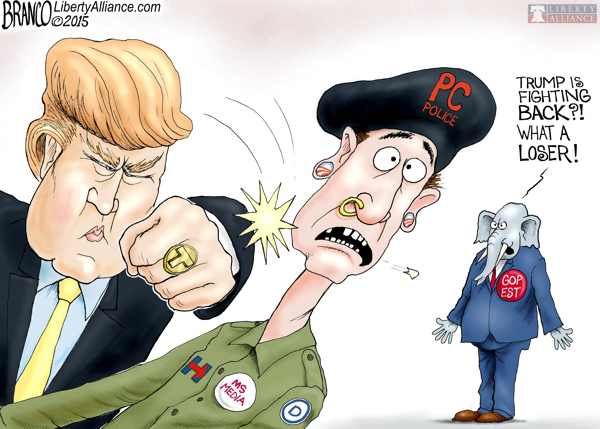
gop-elite

H/t Vermont Loon Watch

trump-punch-600-la

H/t Kingjester’s Blog

Cartoon of the day

September 15, 2015

H/t Town Hall

Jolly good mullah

The Shady Family Behind America’s Iran Lobby

September 15, 2015

The Shady Family Behind America’s Iran Lobby, Daily Beast, Alex Shirazi, September 15, 2015

(The National Iranian American Council is the voice of the Iranian regime. It found great favor with the Obama administration while becoming a significant part of it. — DM)

How one enterprising Iranian expat family and its allies successfully pushed for U.S.-Iran rapprochement—and now stands to make a fortune from sanctions relief.

When the world’s major powers struck a deal over Iran’s nuclear program in Vienna in July, it represented a victory not just for the Islamic Republic, which has now been granted international legitimacy as a nuclear threshold state, but also for a small but increasingly influential lobby in America, one which has long sought rapprochement between Washington and Tehran and now seeks to leverage a successfully concluded nuclear deal as a means to that end.

This Iran lobby, publicly represented by the National Iranian American Council (NIAC), has become a staunch institutional ally of the White House selling the Joint Comprehensive Plan of Action, as the nuclear deal is known. But while NIAC has done the heavy-lifting—the ad-buying, the leafleting, and Congressional meet-and-greets, all designed to sell lawmakers on the Iran deal—its political efforts also underwrite the economic interests of one very well connected but low-profile Iranian family, the Namazis, who played a key role as intellectual architects of NIAC.

Little known to the American press, the Namazis have rarely acted as spokespersons for their own cause. In fact, attempts to reach various members of the family for comment on this story were met with increasing levels of hostility and threats of legal action. Yet in many ways, the Namazi clan is the perfect embodiment of Iranian power politics, at least as it has played out among the Iranian diaspora. Those close to the Namazis say that they are savvy financial operators rather than ideologues, eager to do business with the West and enjoy all of its political freedoms and perquisites, and yet ever mindful that they’re straddling the delicate fault-line between cashing in with a theocratic dictatorship and being frozen out entirely. They have stayed on the right side of international law if not always on the right side of prevailing political interests in the Islamic Republic.

Nor did they begin their rise to prominence as supporters of the Islamic Revolution. Mohammad Bagher Namazi, also known as Baquer Namazi, is the patriarch of the family and formerly the governor under the Shah of the oil-rich Iranian province of Khuzestan. Despite his relationship with the ancien régime, Baquer Namazi was not persecuted by the Khomeinists after they seized power in 1979, and he and his family were allowed to emigrate in 1983 to the United States. There he raised two well-educated and Americanized sons, Babak and Siamak, while his niece, Pari Namazi, married Bijan Khajehpour, another Iranian expatriate.

The 1980s were the years of the fiery-eyed Ayatollah Khomeini and Iran’s ferocious war with Saddam Hussein’s Iraq. Iranian-backed terrorism in Lebanon included the bombing of the U.S. embassy and the Marine barracks there, while Iranian “hit teams” hunted down and murdered opponents of the regime in exile. Iran’s Hezbollah clients kidnapped Europeans and Americans, and in the Irangate scandal the Reagan administration was exposed trading weapons systems for hostages. Afterward it effectively went to war against Iran on the waters of the Gulf, and in the process blew an Iranian civilian airliner out of the sky. There seemed no possibility of improved relations between Washington and the theocracy in Tehran. But after the Iran-Iraq war ended in 1988 and Khomeini died in 1989, new possibilities for rapprochement—and huge deals for international companies—started to emerge.

***

Doing serious business in Iran has always required some measure of political protection. The Islamic Republic is a web of rival economic interests. Broadly speaking, the three largest are those tied through various semi-clandestine fronts to  Khomeini’s successor as “supreme leader,” Ayatollah Ali Khamenei; those linked to the regime’s praetorian Islamic Revolutionary Guards Corps (IRGC); and those associated with Iran’s president, who may hold the most conspicuous position in the country’s political life, but whose official powers are limited. Typically, to get things moving in the mire of Iran’s notorious bureaucracy, businesses have to have connections in one or more of these groups.

From 1989 to 1997, the president of Iran was Akbar Hashemi Rafsanjani, known as “the Shark,” an Iranian reference to a beardless man. He was also famous for getting rid of his rivals and political competitors one by one, like a great white shark. In addition, Rafsanjani had a reputation for corruption and taking advantage of power.

In this environment of increased willingness to do business with the West, the stage was set for a return of the Namazis. In 1993, Pari Namazi and her husband Bijan Khajehpour founded a company in Tehran called Atieh Bahar Consulting (AB). It offered a range of legal and industrial services to foreign enterprises, most importantly the access it provided to the regime, and the advice it dispensed on how best to navigate the vagaries of the regime’s entrenched factions and competitive interests.

At the time, it looked like Iran might even be opening up to big American-based oil companies, then unencumbered by any sanctions regime on the Islamic Republic. But after an announcement in 1995 that Iran had given Conoco a contract to develop an offshore gas field, and an uproar in the U.S.  Congress, the Clinton administration imposed unilateral sanctions and barred U.S. companies from doing business there.

Eventually Siamak Namazi, who had worked from 1994 to 1996 at Iran’s Ministry of Housing and Urban Planning, also joined AB. So did his brother Babak, a lawyer. And the AB client list just kept growing. Plenty of companies based outside the U.S. were more than happy to do business in Iran once they had the right connections. As Siamak eventually told Lebanon’s Daily Star newspaper, “If oil companies want to operate in the Iranian market they need to link up with a local partner, and this is where we step in and help them to find the right partner.”

With the surprise election of the “reformist” presidential candidate Mohammad Khatami in 1997, political and economic enthusiasm for better Iranian relations with the West grew dramatically. Meanwhile the “pragmatist” Rafsanjani took other powerful positions in the regime. In those optimistic times, AB’s non-American clients—free from any sanctions regime—included the German engineering giant Siemens; major oil companies BP, Statoil, and Shell; car companies Toyota, BMW, Daimler, Chrysler, and Honda; telecom giants MTN, Nokia, Alcatel; and international banks such as HSBC.

But the political winds were shifting. A nuclear cloud darkened the horizon, and the United States, slowly but surely, found ways to broaden the sanctions against Iran, forcing many international companies to dial back on their investments there or pull out altogether.

The Namazis, of course, had every reason to want to bring them back.

***

Atieh Bahar Consultancy had aligned itself with Rafsanjani’s faction early on by forging an especially close relationship with Rafsanjani’s influential son, Mehdi.

From 1993 to 2005, Mehdi Hashemi was employed at the National Iranian Oil Company (NIOC), the state-owned entity that controls almost all oil and gas production in a country that has the world’s largest gas reserves and third-largest oil reserves.

But Mehdi Hashemi brought some serious problems to the relationship. In 2004, Norway’s Statoil was caught paying bribes to a prominent Iranian official using the company Horton Investment, an entity run by a close Mehdi Hashemi confidant as intermediary. Hashemi would later be imprisoned for his complicity in the bribery, along with two other charges, and ordered to pay a total of $10.4 million; $5.2 million of the bribe money, plus an additional $5.2 million in fines. Abbas Yazdanpanah Yazdi, meanwhile, was allegedly kidnapped in the UAE in 2013 and has since “disappeared.”

The scandal came just as the elder Rafsanjani was plotting a presidential comeback in the 2005 elections, and it gave substance to the rumors of corruption that always swirled around him and his son. (Mehdi Hashemi denied the Statoil bribery allegation and said it was designed to hurt his father’s reputation.) He managed to make it into the second and final round, but finally lost to Mahmoud Ahmadinejad, who staked out a position as a “clean” populist who would give money to the poor and who didn’t give a damn about foreign business interests.

After Ahmadinejad came into office, the nuclear cloud grew much darker.

In 2003, the United States had led the invasion and occupation of neighboring Iraq, eliminating Iran’s old enemy Saddam Hussein in order to be sure that he had no weapons of mass destruction. And, as it turned out, by then he did not. A few months earlier in 2002, however, Israeli intelligence turned up evidence that Iran, a signatory of the Nuclear Non-Proliferation Treaty, had developed a secret uranium enrichment operation at a site called Natanz. (The first public airing of this intelligence came from a militant Iranian dissident group that had been nurtured by Saddam Hussein.)

This did not distract from the march to war with Iraq, but a few months later Iran was declared in material breach of the Treaty on the Non-Proliferation of Nuclear Weapons (NPT), and, under threat of heightened sanctions, a process of negotiations began between Iran and the European Union to limit the nascent enrichment program. At the time Iran had only 160 of the centrifuges needed to enrich uranium, and thousands would be required to get it to the point where it could produce fissile material for a bomb. U.S. intelligence estimates eventually concluded “with high confidence” that the Iranians also had a secret nuclear weapons program, in addition to enrichment, but shut it down in the fall of 2003.

When Ahmadinejad took over in 2005, he ditched all pretense of willingness to compromise over Iran’s “peaceful” nuclear program, an intransigence that led Western countries to tighten sanctions, making foreign investment ever more difficult. And what was worse for AB and the Namazis, Ahmadinejad went after his political rivals, particularly the Rafsanjani faction, with a vengeance. Mehdi Hashemi, naturally, was a prominent target. Ahmadinejad barred him from conducting any business in relation to Iran’s oil and gas sector. Ten years later, the courts actually sentenced him to a collective 25 years—and 50 lashes—in Tehran’s notorious Evin prison for all three charges against him including the Statoil corruption case. In reality, he will only serve 10 years.

AB needed to shore up some new alliances, and bide its time. Co-founder Bijan Khajehpour, worked for a leading Iranian politician named Hassan Rouhani who had served under the Khatami government as Iran’s nuclear negotiator. Rouhani also was the president of a think tank called the Center for Strategic Research (CSR). But relations with Iran in the middle of the last decade were almost as bleak as they had been after the 1979 hostage crisis and the grim terror and counter-terror campaigns of the 1980s.

By 2006, Iran, was in effect at war with the U.S. in Iraq. The Revolutionary Guards’ expeditionary Quds Force led by Qasem Soleimani had been training, financing, and arming Shia militias killing U.S. soldiers.

Moreover, the West was growing more alarmed about Iran’s nuclear program, which it seemed powerless to stop. Ahmadinejad had declared the resumption of uranium enrichment “irreversible” just as the country’s nuclear scientists had mastered the fuel cycle. He’d appointed conservative Ali Larijani as chief negotiator with the European Union (before Iran withdrew from talks altogether), and he said he’d “wipe [his] nose” on international sanctions.

A war with Iran, most likely started by Israel with the United States drawn in, began to seem possible, then probable, and almost inevitable. The International Atomic Energy Agency referred Iran to the UN Security Council for action forcing it to curtail its nuclear activities.

Out of this dark morass, the Namazis struggled to keep alive hopes of rapprochement and trade, while avoiding a war at all costs. And by then they had in place the architecture for convincing a war-weary U.S. policy establishment that not only was avoiding a military confrontation with Iran possible, but the Islamic Republic was really just a friend America had yet to make.

***

In November 1999, when Khatami was still president and, Siamak Namazi got together with a Swedish-Iranian expat named Trita Parsi at a conference in Cyprus. The conference, titled, “Dialogue and Action Between the People of Iran and America,” was convened jointly by the Centre for World Dialogue, a Cypriot non-governmental organization, and by Hamyaran, an Iranian non-governmental resource center for other NGOs, which was chaired by Mohammad Bagher Namazi, the family patriarch. Namazi fils and Parsi there presented an influential white paper (PDF), “Iran-Americans: The bridge between two nations,” which called for three steps to ameliorate U.S.-Iranian relations in advance of reconciliation:

1. Hold “seminars in lobbying for Iranian-American youth and intern opportunities in Washington DC.”

2. Increase “awareness amongst Iranian-Americans and Americans about the effects of sanctions, both at home and in Iran.”

3. End “the taboo of working for a new approach on Iran”—i.e., end the then two-decade-old U.S. policy of containment.

Namazi and Parsi wrote that “the fear of coming across as a lackey of the Iranian regime is still prohibiting many Iranian Americans from fully engaging in the debate on the future of Iran-U.S. relations.” The way around this, they submitted, was to mobilize the Iranian-American community and enlist “Americans of non-Iranian background” to lessen the adversarial posture of both nations.

The white paper led to the creation two years later, in 2001, of NIAC, a Washington, D.C.-based organization which Parsi founded and currently heads. During the formative period preceding NIAC’s launch, Parsi had sought advice and guidance from numerous sources, including and especially Mohammad Bagher, as was disclosed in documents (PDF) obtained during a defamation law suit brought by NIAC and Parsi against one of their most outspoken critics.

Parsi was extremely well-placed to front the Iran lobby. He had obtained a doctorate at Johns Hopkins on a subject intimately tied to the lobby’s central thesis—the relationship between Israel and Iran and how the former hindered the latter’s acceptance in the U.S. He even studied under Francis Fukuyama, a onetime neoconservative policy intellectual who abandoned his ideological comrades when the Iraq war went south. Finally, Parsi had gained valuable political experience on the Hill by working for Republican Congressman Bob Ney, a connection he has not included in his curriculum vitae and official website. (Ney went to jail in 2007 for accepting bribes from mega-lobbyist Jack Abramoff’s Native American casino clients.)

While serving as president of NIAC, Parsi also wrote intelligence briefings as an “affiliate analyst in Washington, D.C.” for AB, focusing on such topics as whether or not the American Israel Public Affairs Committee (AIPAC) would revive its anti-Iran campaigning on the eve of the Iraq war, or on efforts by the Mujahideen-e Khalq (MeK), the militant Iranian opposition group that exposed Natanz in 2002 would get itself de-listed as a terrorist entity by the U.S. State Department. Parsi was paid for his work for the consultancy, as disclosed by an email sent from Bijan Khajehpour to him, dated Sept. 22, 2002, an employment that Parsi did not mention when fulsomely praising Khajehpour in the Huffington Post as an ideal Iranian businessman.

Although it has only 5,000 dues-paying members, a mere one percent of the estimated 470,000 Iranian-Americans, NIAC’s network of activists and event attendees is said to extend into the tens of thousands. In June of this year, as the Iran deal looked likely, NIAC inaugurated an official “lobbying” arm called NIAC Action registered with the Internal Revenue Service as a 501(c)(4) organization, but for years, internally, the group has described its activities (PDF) as lobbying. NIAC Action is explicitly meant to counter the influence of AIPAC, which has spent millions to block the Iran deal’s passage in Congress by securing a veto-proof bipartisan majority of senators opposed to it—an effort that now appears close to failure.

Since its founding, NIAC has also proved a useful finishing school for rapprochement-minded Iranian-Americans, many of whom have either come from positions in U.S. government or graduated into them. Its current research director, for instance, is Reza Marashi, an Iranian-American dual national, who worked for Atieh Bahar until 2006 when he landed a  job at the U.S. government’s Institute for National Strategic Studies at the National Defense University, which acts as a research center for the Pentagon. Marashi then went to work for the Office of Iranian Affairs at the U.S. State Department as a desk officer overseeing Iran democracy and human rights programs.

Marashi is very outspoken on social media against any critics of NIAC’s agenda. Along with the rest of his organization’s staff, he has accused Jewish opponents of the Iran deal of being dual loyalists. “Shame on Chuck Schumer for putting #Israel’s interests ahead of America’s interests,” he tweeted after the New York senator’s decision to come out as the senior-most Democrat against the deal.

Given the obvious connection between NIAC and the Namazi family, Marashi makes no mention of his job at AB in his biography on NIAC’s official website. Nor did he respond to The Daily Beast’s repeated requests for comment on this story.

Perhaps NIAC’s most accomplished alum is Sahar Nowrouzzadeh, who is now National Security Council Director for Iran in the Obama administration and therefore the top U.S. official for Iran policy, bringing together the various departments of government working on U.S. strategy toward the country. She is also, after the White House principals, one of the leading advisors to President Obama on Iran. No doubt owing to the sensitivity (and influence) of her government role, Nowrouzzadeh has maintained a low profile, but her work at NIAC is publicly available. She drafted one of the organization’s annual reports for 2002-2003 (PDF) and was referred to by Dokhi Fassihian, then executive director, as a “staff member” (DOC). The Obama administration insists that Nowrouzzadeh was only ever an intern with NIAC, and Nowrouzzadeh does not seem eager to play-up her affiliation with the group. According to her LinkedIn profile, she has worked at the State Department and the Department of Defense. The profile doesn’t mention NIAC at all.

Such inconspicuousness stands in notable contrast to how other Obama administration officials who emerged NIAC’s nemesis—the pro-Israel lobbying establishment—tend to invoke their past credentials as a means of establishing their diplomatic bona fides.

But then, Israel is a longtime and “sacrosanct” American ally, as Obama has stated. Iran, on the other hand, has been a pariah state where crowds are encouraged to chant “Death to America.”

On NIAC’s website, in its mailings and in media interviews, NIAC rarely criticizes the IRGC or the Quds Force, a U.S.-designated terrorist entity. Parsi characterizes the Iranian regime, of which the Quds Force is the main military enforcer, as a U.S. ally in the war against the so-called Islamic State, or ISIS.  But neither he nor NIAC has discussed the Quds Force’s military role in Syria where it plays a key role in targeting U.S.-backed rebels deemed the best bulwark against both Assad and the so-called Islamic State widely known as ISIS and, more broadly, organizing the savage defense of the Assad dynasty, for which several of the Quds Force’s personnel have been sanctioned by the U.S. government.

NIAC publicly opposes designating the IRGC as a whole as a terrorist entity because doing so would only conform to part of a pattern of failed sanctions, “further entrenching U.S.-Iran relations in a paradigm of enmity.”

Instead, campaigning against any U.S. sanctions on Iran has been the mainstay of NIAC’s endeavors, and this held even when the Obama administration thought sanctions the most effective way to bring the Iranians back to the negotiating table. NIAC has maintained (PDF) that sanctions have cost the U.S. economy billions of dollars and hundreds of thousands of job opportunities.

Parsi’s activism won him praise from the Iranian regime during the very dark days a decade ago. Former ambassador to the United Nations Javad Zarif, who is now the heavily spotlighted foreign minister, wrote to Parsi in 2006, “Your help is always welcome,” and, after catching part of a Parsi interview on the BBC the same year, Zarif called his performance “Great.”

In March 2006 (at the height of the covert Iranian war with the U.S. in Iraq), Parsi told a colleague not to worry about a trip to Tehran, “NIAC has a good name in Iran and your association with it will not harm you.” When the colleague was briefly questioned by the regime, then released, he reported back (PDF) to Parsi that he’d been told the reason he was let go was “that they knew NIAC had never done anything seriously bad against the Islamic Republic.”

***

In 2009, Sen. Mark Kirk called NIAC Iranian “Regime Sympathizers” (PDF), stating “they came to Capitol Hill urging members of Congress to cut off U.S. funding for democracy programs in Iran.” NIAC had sought to eliminate the Bush administration’s “Democracy Fund” for programs in Iran, which it saw as nothing more than a vehicle for attempted regime change. NIAC responded to Kirk by calling the $75 million fund a “brainchild” of the Bush administration’s “disastrous Middle East policy,” which aimed to finance Iranian NGOs seeking overthrow the government of Iran.

And NIAC does some name-calling of its own, calling organizations it doesn’t like (i.e., those too critical of the Islamic Republic) “neocon puppets,” and warmongers. Indeed, it has also tried to define the parameters of acceptable Iranian civil society groups (i.e., ones that never really undermined the regime) by partnership with Hamyaran, described by NIAC as an “NGO umbrella organization” (PDF). In reality, however, it was conceived as more of a governmental non-governmental organization and launched by those close to Iranian President Mohammad Khatami—its board member was Hossein Malek Afzali, a deputy minister in Khatami’s government). By NIAC’s own admission, the organizatiom (PDF) “operates independently, but with the implicit permission of the Iranian government.” (Emphasis added.) Hamyaran’s board of directors was also once chaired by Namazi paterfamilias Mohammed Bagher.

Hamyaran obtained support from the congressionally funded National Endowment for Democracy—as did NIAC, which received Endowment funding in 2002, 2005, and 2006 in the collective amount of close to $200,000. NIACdescribed Hamyaran to the Endowment in 2004 as its “main partner in Iran.” Perhaps unsurprisingly, among those civil society groups selected for NIAC and Hamyaran’s “Digital Film Production Workshop Report,” a training program for Iranian activists to learn how to use digital media, were those described as having been “contracted by the Iranian government” or “worked closely with the Iranian government.”

As for NIAC, Carl Gershman, the president of the National Endowment for Democracy, told The Daily Beast, “We’re not supporting NIAC now and we have nothing to do with them.”

“Back then there were people arguing, ‘Try to get into Iran’ and we thought this was a way forward,” Gershman said. “We weren’t aware when these grants were made that NIAC were presenting themselves as a lobby. We didn’t know that. Our effort was to work with emerging space in Iran. We were trying something that might be a way to help people on the inside. But that quickly became unworkable; the grant didn’t work. Then NIAC showed itself as a lobby organization, so we have nothing to do with them anymore. Not every grant works out the way you want it to.” Asked if that meant that NED regretted working with NIAC , Gershman answered: “Yes, I think that’s true.”

At the same time it was taking U.S. taxpayer money, NIAC wanted to end U.S. government support for NGOs which categorically opposed the Islamic Republic. In April 2007, NIAC held a strategy meeting with international human rights groups including Amnesty International and Human Rights Watch (HRW). The HRW representative was himself a former NIAC board member, Hadi Ghaemi, who had (PDF) worked for NIAC in Iran, and then served HRW from 2004 to 2008. During the meeting, according to an email sent by Parsi afterward, Ghaemi “noted that certain groups being funded by the state dept [sic] are covers for regime change and that we need to be careful. Many groups misrepresent themselves as wanting to improve human rights and democracy in Iran.” Ghaemi did not specify which groups. When The Daily Beast contacted Ghaemi via email, he replied that he could not confirm the meeting in question. He was unavailable for further comment after The Daily Beast showed him Parsi’s email asking if that refreshed his memory.

***

In 2008, NIAC made a strategic mistake, waging a not-so-quiet campaign against the Voice of America’s Persian service, a U.S. government-funded broadcast medium. Both NIAC and the Namazis were aggravated by the frequent appearances of Hassan Dai, an Arizona-based Iranian exile, who lambasted NIAC as a regime mouthpiece.

Siamak Namazi (PDF) called for Dai to be banned from VOA in February 2007. NIAC chief lobbyist Emily Blout petitioned (PDF) Congress in September 2007 for an “independent review” of VOA Persian. After Dai appeared again on VOA in 2009, Parsi (PDF) remarked that its hosting of a NIAC critic “won’t change until the VOA leadership changes.” He was right. Today the editor-in-chief of VOA Persian is Mohammad Manzarpour, a former employee of Atieh Bahar Consultancy.

But serious damage to NIAC’s reputation was done, and much of it was self-inflicted. In 2008, Parsi and NIAC had brought a defamation suit against Hassan Dai, alleging that he had made “numerous false and defamatory statements that characterize plaintiffs as agents of the Iranian government.” Parsi and NIAC lost the case in 2012, with the judge rejecting their self-portrayal as critics of Tehran. “That Parsi occasionally made statements reflecting a balanced, shared blame approach is not inconsistent with the idea that he was first and foremost an advocate for the regime,” U.S. District Court Judge John D. Bates (PDF) wrote in his judgment. “After all, any moderately intelligent agent for the Iranian regime would not want to be seen as unremittingly pro-regime, given the regime’s reputation in the United States.”

Nor did NIAC do itself any favors in during the trial and on appeal. Three circuit judges of the U.S. Court of Appeals found its behavior (PDF) “dilatory, dishonest, and intransigent” and accused it of engaging in a “disturbing pattern of delay and intransigence. Seemingly at every turn, NIAC and Parsi deferred producing relevant documents, withheld them, or denied their existence altogether. Even worse, the Appellants also misrepresented to the District Court that they did not possess key documents [Dai] sought. Most troublingly, they flouted multiple court orders… A court without the authority to sanction conduct that so plainly abuses the judicial process cannot function.”

Unsurprisingly, then, NIAC and Parsi lost their appeal and were ordered to pay $183,480.09 in monetary sanctions in February 2015.

“NIAC and Parsi filed the lawsuit to break me under the financial burdens and silence other critics but they totally failed,” Dai told The Daily Beast. “The lawsuit, which lasted nearly seven years, showed the deceptive character of an organization that lobbies in favor of the mullahs’ theocratic regime but represents itself as a defender of peace.”

***

The fortunes of the entire Namazi clan waned after 2009, when a popular uprising against Ahmadinejad’s fraudulent re-election was met with murder, mass arrests, and torture.

Bijan Khajehpour was imprisoned because of the struggle raging in the regime between the Supreme Leader and the IRGC on one side, and the Rafsanjani camp on the other. And while praising the Obama administration for not speaking up on behalf of those who resisted the stealing of the 2009 election, the so-called Green Movement, on the grounds that doing so would have only given the regime an excuse to murder and torture more people, Parsi rushed to the defense of his friend and former employer Khajehpour, “who neither participated in the protests nor had any involvement with the opposition” but was instead a “self-made man” and “top-notch consultant drawing the attention of multinational and local firms to investment opportunities in the country.”

In The Huffington Post Parsi wrote as an acquaintance or friend of Khajehpour, nowhere disclosing his past business relationship writing reports for Atieh Bahar Consulting.

Khajehpour subsequently was released from prison and he and his wife, Pari Namazi, moved to Vienna.

Siamak Namazi also faced harassment after the 2009 election and the subsequent unrest. He left Iran for the United Arab Emirates and is currently the head of Strategic Planning at the UAE-based Crescent Petroleum, an oil and gas company based in Abu Dhabi.

Business in Iran was drying up. Ahmadinejad may have held onto power after he broke the Green Movement, but his drive toward nuclear “self-sufficiency” raised so many alarms that the Obama administration was able to persuade the four other members of the UN Security Council to impose draconian sanctions on the regime. Hundreds of billions of dollars worth of assets were frozen, and international commerce ground toward a halt.

Then, in 2013, Khajehpour’s former employer Hassan Rouhani, the former nuclear negotiator, the Rafsanjani-style “pragmatist,” was elected Iran’s new president. The ever affable-seeming former UN ambassador, Javad Zarif, was appointed foreign minister. Suddenly the door looked like it was open wide to a new relationship with the West of just the sort the Iran Lobby had worked for so hard and for so long. Rouhani was avuncular, good-humored, and had made it his goal to open Iran for business, if only the nuclear issue could be dealt with.

By the time serious talks with Washington were opened, Ahmadinejad’s nuclear program had built almost 14,000 centrifuges, and Iran was within a year, by some estimates within months, of producing enough fissile material to build a bomb, at least in theory.

Although there was talk in Washington about compelling Iran to dismantle the whole program, there was never really any question of that, and the deal as finally signed merely buys time—pushing Iran’s possibility of producing a potential nuclear weapon back from months to as many as 15 years.

As these pieces fell into place in the age of Obama, Parsi and NIAC found themselves in the unlikely position of power brokers. One prominent faction of the Iranian regime—Rafsanjani’s—sees them as convenient conduits for disseminating a pro-Iranian line in U.S. politics, while the “hardline” Iranian security services have classified their activities as benign to the interests of the Islamic Republic.

The U.S. government, meanwhile, has adopted many of NIAC’s talking points. Both Parsi and Atieh International, one of the companies in the Atieh Group, were fixtures on the sidelines of the Geneva and Vienna negotiations between the P5+1 and Iran. In fact, Atieh International held a joint briefing with NIAC at the Marriott in Vienna on June 29 to discuss a most pressing topic—renewed economic possibilities for the West once a deal was inked. The speakers were Bijan Khajehpour and Trita Parsi.

The Namazis’ alignment with Rafsanjani and Rouhani can now pay off. Because they were attacked so often and sometimes so viciously by “hard liners”—the very Iranian officials the Obama White House claims constitutes the only Iranian opposition to the nuclear deal—the Namazis and NIAC, the think tank and lobby they helped create, have gained great renewed credibility in the West, even promoting the idea that they can liberalize what remains by and large a fanatical theocracy and a fiercely competitive kleptocracy. At the same time, they can present themselves in today’s Iran as the best go-betweens with, well, with the not-so-Great Satan, who loves to listen to their advice.

— Alex Shirazi is a pseudonym for a well-known Iranian dissident who requested that The Daily Beast keep his identity concealed for fear of what might happen to his family in Iran in retaliation for this article.
Satire but not funny|Kim Jong-un has replaced John Boehner as Speaker of the House

September 11, 2015

Kim Jong-un has replaced John Boehner as Speaker of the House, Dan Miller’s Blog, September 11, 2015

(The views expressed in this article are mine and do not necessarily reflect those of Warsclerotic or its other editors. — DM)

We have met the enemy and it is us: we have become too tired to be effective and hence are becoming indifferent. The charade on Capitol Hill continues, and not only about the nuke “deal” with Iran. Will the carnival end before it’s too late, or will Obama continue to win?

The House speaker is elected by all House members, not just those of the majority party. He need not be a member of the House. Boehner having resigned because a serious medical condition often reduces him to tears, one group of Democrats nominated Debbie Wasserman-Schultz to replace him. However, due to her support for Hillary Clinton, she fell out of favor with the White House so another group of Democrats nominated Kim Jong-un at Obama’s request. To avoid the appearance of confrontation, Republicans offered no candidates. Kim won by seventeen votes, becoming the first non-US citizen to hold the office thus far this month.

tearsofboehnerDebby


Reporting for duty!

REPORTING FOR DUTY!

The current upset was precipitated by Republican members’ disagreements with Boehner and other party leaders about how best to deal with the catastrophic Iran nuke “deal” without unnecessarily offending the President. Kim Jong-un is expected to substitute his own brand of leadership for Boehner’s leadership through ambivalence.

A majority also deemed Kim the best qualified to negotiate with Dear Leader Obama on behalf of the House because, as the undisputed leader of a rogue nuclear nation himself, he should be able to pull not only Obama’s strings but also those of the Supreme Leader of the Islamic Rogue Republic of Iran.

White House Press Secretary Josh Earnest declined comment on the situation beyond refusing to comment on whether Obama met privately with Kim to congratulate him. However, Obama is generally thought to have confirmed that He fully supports Kim’s way of governing his own Democratic Peoples’ Republic and — subject to the few pesky restraints still imposed by an antiquated Constitution that He has not yet found ways to sneak around — He does His best to emulate him. In that connection, Obama asked Kim for recommendations on antiaircraft guns to deal humanely with Jews and other traitors who oppose Him (Please see also, New York Times Launches Congress ‘Jew Tracker’ – Washington Free Beacon.)

Desiring to gain Obama’s total good will, Kim promised to have derogatory cartoons of Donald Trump and Hillary Clinton painted on all future North Korean nukes and missiles just before they explode. In return, Obama promised to issue executive orders granting North Korea the permanent right to declassify any and all U.S. documents it sees fit pertaining to the security of the United States and to obtain copies, gratis, from the Government Printing Office.

House Speaker Kim Jong-un will next meet with Supreme Leader Khamenei in Tehran to make two common sense proposals, with which Khamenei is certain to agree:

First, Kim will propose that a group of highly regarded North Korean nuclear experts — under his personal guidance and supervision — conduct all nuke inspections in Iran and draw all conclusions concerning any past or present Iranian nuclear program based on them exclusively. Those conclusions will be drawn on behalf of, and in lieu of any conclusions drawn by, the International Atomic Energy Agency (IAEA). The head of the IAEA, Yukiya Amano, immediately endorsed this plan as “splendid and totally consistent with any and all IAEA – Iran “secret deals.”

Second, Kim will propose that Khamenei promise not to nuke anyone until all sanctions have been permanently eliminated, unless he really wants to.

Obama is thought to have agreed with every aspect of the Kim plan and to have directed Secretary Kerry to tell Khamenei that if he agrees all sanctions will be eliminated permanently, via executive decree, and hence even more expeditiously than previously expected. Due to a successful Senate filibuster yesterday, Obama can issue the executive decree very soon; Today — Friday, September 11th — is being considered seriously due to the obvious symbolism of the date.

H/t Freedom is just another word

arming

The inevitable success of Kim’s mission will result in a win-win situation for nearly everyone, particularly the financially strapped IAEA, and the true Peace of Obama will prevail throughout all parts of the world that He considers worth saving. Remember — it’s all for the Children!

veto (1)Mushroom cloud


Addendum

하원 의장 김정은 의 문 사랑하는 북미 친구 , 그것은 오바마 대통령 아래에서 당신의 인생 이 곧 Amerika 민주주의 인민 공화국 이 될 것입니다 무엇 에 미래의 삶을 위해 잘 준비 것을 진심으로 희망 합니다. 배리 와 나는 제출 된 것을 기쁘게 사람들을 위해 가능한 한 오랫동안 지배 구조 의 우리의 양식 에 서서히 적응 을 하기 때문에 전환이 원활 하게 하기 위해 함께 열심히하고 고통 일했다 .

Translation:

Statement of House Speaker Kim Jong-un

My dear North American friends, it is my sincere hope that your life under President Obama has prepared you well for your future life in what will soon become the Democratic People’s Republic of Amerika. Barry [a.k.a. Barack] and I have worked long and hard together to acclimate you gradually to our transformed and transformational form of governance and hence to make the transition as smooth and painless as possible for those pleased to submit. Now, we will accelerate the progress.

Conclusions

It does not have to be that way. Here, in closing, are a few words from Daniel Greenfield.

We don’t have to give in to despair. If we do, we are lost. Lost the way that the left is lost. Lost the way that the Muslim world is lost.

We are not savages and feral children. We are the inheritors of a great civilization. It is still ours to lose. It is ours to keep if we understand its truths. [Emphasis added.]

We are not alone. A sense of isolation has been imposed on us as part of a culture war. The task of reconstructing our civilization and ending that isolation begins with our communication. We are the successors of revolutions of ideas. We need to do more than keep them alive. We must refresh them and renew them. And, most importantly, we must practice them.

We are not this culture. We are not our media. We are not our politicians. We are better than that.

We must win, but we must also remember what it is we hope to win. If we forget that, we lose. If we forget that, we will embrace dead end policies that cannot restore hope or bring victory.

What we have now is not a movement because we have not defined what it is we hope to win. We have built reactive movements to stave off despair. We must do better than that. We must not settle for striving to restore some idealized lost world. Instead we must dream big. We must think of the nation we want and of the civilization we want to live in and what it will take to build it.

Our enemies have set out big goals. We must set out bigger ones. We must become more than conservatives. If we remain conservatives, then all we will have is the America we live in now. And even if our children and grandchildren become conservatives, that is the culture and nation they will fight to conserve. We must become revolutionaries.

We must think in terms of the world we want. Not the world we have lost.

This is the America we live in now. But it doesn’t have to be.

It can be up to us, not to those who hate America and all for which she once stood.