H/t Vermont Loon Watch (and in celebration of no more Obamamesses Obamamases)

H/t Power Line






Source: No offense to the ‘Arrow,’ but greater threats loom from the north | The Times of Israel
While Friday’s use of surface-to-air missiles by Assad against Israeli jets is worrying, Iranian-built rocket factories in Syria and Lebanon are worse

Set aside for one moment the celebrations here regarding the successful interception by the Arrow missile defense system of a Syrian missile early Friday. Israel has no shortage of reasons to be concerned by “the message” involved in Syria’s firing of surface-to-air missiles at Israeli fighter jets overnight. This is just the tip of the iceberg when it comes to the increasingly worrying situation taking shape in the north.
It would seem that Assad wants to put Israel on notice that he no longer intends to sit idly by while weapons convoys headed from Syria to the Hezbollah terror group in Lebanon are destroyed by the IDF.

Illustrative: An Israel Air Force airplane F-16 takes off, June 28 2010. (Ofer Zidon/Flash90)
According to Arab-language media reports, the target of the Israeli airstrike — which is said to have occurred near the Lebanese town of Baalbek — was a convoy of trucks carrying “strategic weapons,” a term which Israel has previously used to define advanced missiles and chemical weapons.
In the past, Assad has rarely responded to reported Israeli air and missile strikes on targets deep within Syria.
His apparent growing confidence would appear to come from his recent successes in defeating rebel groups and the Islamic State in the brutal Syrian civil war, thanks largely to massive Russian support.
It is unlikely that there was any Russian involvement in firing the missiles at the Israeli jets. Israel works very hard to coordinate with Moscow to ensure no accidental clashes with the superpower in Syria’s crowded skies.
Prime Minister Benjamin Netanyahu is a frequent visitor to Moscow, most recently last week where he went to press Russian President Vladimir Putin to try and prevent Israel’s arch-foe Iran from filling the vacuum in Syria left by the nearly vanquished Islamic state.
These concerns show that the use of surface-to-air missiles against Israeli fighter planes is only a minor headache for Israel.
A much greater problem for the Jewish state lies with a report published earlier this week in the Kuwaiti newspaper al-Jarida that Iran has established rocket factories in Syria and Lebanon capable of producing long-range missiles.
According to the al-Jarida report, the missile production facilities are built deep underground and are operated by advisers from the Iranian Revolutionary Guard Corps, as well as Lebanese experts trained at the Imam Hossein University in Tehran, a key training institution for IRGC personnel.
The goal of these factories is said to be to produce highly accurate missiles and rockets capable of striking strategic targets in Israel, and if reports leaking out in the Arab-language media are true, then it is safe to say these factories will not be easily destroyed in Israeli airstrikes.
The Iranian missile factories in Syria and Lebanon also correspond with Iran’s desire to establish a naval port in Syria to be leased for 50 years, which would help Iran guarantee its interests in the war-torn nation.
All of this points to a trend that we will likely see much more of in 2017: as the Islamic State terror group gets weaker, the influence of the Islamic Republic of Iran expands and gets stronger.
Source: Paris airport suspect previously investigated for Islamic extremism | The Times of Israel
French interior minister says man shot dead trying to grab soldier’s weapon was ‘known to the police and intelligence services’

The 39-year-old suspected attacker who was shot and killed at Orly Airport Saturday after attempting to seize a soldier’s weapon had already crossed authorities’ radar for suspected Islamic extremism, the Paris prosecutor’s office said.
Prosecutors said the suspect’s house was among scores searched in November 2015 in the immediate aftermath of suicide bomb-and-gun terror attacks that killed 130 people in Paris. Those searches targeted people with suspected radical leanings.
French Interior Minister Bruno Le Roux confirmed he was “known to the police and the intelligence services.”
French President Francois Hollande on Saturday said investigators were working to determine whether the suspect “had a terrorist plot behind him.”
French media reports identified the suspect as Ziyed Ben Belgacem, a 39-year-old born in France.
Hollande ruled out any link between Saturday’s attack and the upcoming French presidential election, and said the thwarted shooting showed that France’s policy of having military patrols guarding public sites “is essential,” and that the nation “must remain extremely vigilant.”

French Interior Minister Bruno Le Roux speaks to the press on March 18, 2017 at Paris’ Orly airport following the shooting of a man by French security forces after tried to grab a soldier’s weapon. (AFP PHOTO / Benjamin CREMEL)
The prosecutor’s office said its anti-terrorism division was handling the investigation and had taken the attacker’s father and brother into custody for questioning.
The incident further rattled France, which remains under a state of emergency after attacks over the past two years that have killed 235 people.
The suspect was pulled over by police at around 6:55am (0555 GMT) Saturday while driving in Garges-les-Gonesse. He drew a gun and fired shots at the officers, slightly injuring one in the head, before fleeing.
He then continued south to steal another car in the suburb of Vitry-sur-Seine about 10 kilometers (six miles) from Orly airport. In Vitry, he also “burst into a bar and threatened those present,” Le Roux said.
Minutes later, at around 8:30am (0730 GMT), he walked onto the departures floor of Orly-Sud terminal, where he tried to grab the rifle of a female officer on patrol with two others.

French Red Cross workers stand by as travelers are evacuated from Paris’ Orly airport on March 18, 2017 following the shooting of a man by French security forces. (Benjamin CREMEL)
A senior military source said he knocked the soldier to the ground and grabbed her rifle. The two other soldiers then opened fire, killing him, the source said. Le Roux was adamant that he “did not succeed” in taking the rifle.
No-one else was injured in the melee.
Identity documents found on the attacker matched those presented by the man who fired at police in Garges-les-Gonesse.
All flights in and out of Orly airport were suspended Saturday morning. Many inbound flights were diverted to the bigger Charles de Gaulle airport to the north of Paris.
Around 3,000 passengers were evacuated from Orly-Sud terminal, where the attack took place, while elite police teams secured it and swept it for possible explosives. Those at the nearby Orly-Ouest terminal were confined to the building.
By early afternoon Orly-Ouest had reopened and flights were starting to resume.
The soldier who was attacked is part of the Sentinelle special force installed around France to protect sensitive sites after a string of deadly Islamic extremist attacks. The force includes 7,500 soldiers, half deployed in the Paris region and half in the provinces.

Police officers cordon off the access to the Orly airport, south of Paris, Saturday, March, 18, 2017. (AP Photo/Thibault Camus)
Saturday was at least the fourth time that Sentinelle soldiers have been targeted since the force was created. It was set up after the attack January 2015 attack on satirical magazine Charlie Hebdo and reinforced after the assaults that left 130 people dead in Paris in November of that year.
Orly is Paris’ second-biggest airport, behind Charles de Gaulle. It has both domestic and international flights, notably to destinations in Europe and Africa.
The shooting comes after a similar incident last month at the Louvre Museum in which an Egyptian man attacked soldiers guarding the site and was shot and wounded. It also comes just days before the first anniversary of attacks on the Brussels airport and subway that killed 32 people and wounded hundreds of others.
Dershowitz: Revised travel order should have been upheld, Fox News via YouTube, March 18, 2017
( In the last minutes of the video, Prof. Dershowitz articulates his hopes for the Democrat Party. Has he allowed his hopes to override reality? — DM)
A Month of Islam and Multiculturalism in France: February 2017, Gatestone Institute, Soeren Kern, March 18, 2017
(Just as “there is no connection between Islam, radicalism and terrorism,” there is no connection between multiculturalism and any of Europe’s problems. Any fool can see that.– DM)
Children and women are being raped by human traffickers inside the Camp de la Linière, a migrant camp in the northern French city of Dunkirk; they are forced to have sex in return for blankets, food or the offer of passage to Britain. A volunteer worker referred to the children as being like “little steaks” because they were considered so appetizing and vulnerable to traffickers.
The breakdown in law and order in Muslim neighborhoods in Paris is being fueled by impunity for criminals and a lenient judicial system, according to Hugues Moutouh, a former advisor to the Interior Ministry.
“You can pass on my respects to the Grand Mufti, but I will not cover myself up.” — French presidential candidate Marine Le Pen, cancelling a meeting with the Grand Mufti of Lebanon.
The report implies that deradicalization, either in specialized centers or in prisons, does not work because most Islamic radicals do not want to be deradicalized.
February 1. The Interior Ministry reported a 45% decline in attacks against Jews and Muslims in France in 2016, but a 17.5% increase in attacks against Christians. The ministry said there were 1,125 attacks against Jews and Muslims in 2016, down from 2,034 attacks in 2015. It also reported 949 attacks against Christians in 2016, up from 808 attacks in 2015. Attacks against Christians jumped by 245% between 2008 and 2016.
February 2. Undercover police wearing burqas and qamis (traditional Arab gowns) were filmed apprehending a drug dealer in the Marseille’s Bricarde district, a notorious no-go zone. Police confirmed the “totally normal camouflage technique” after the cellphone video was posted on social media. A local resident complained: “This gives the impression that you basically have to be Muslim or look like a Muslim in order to blend in.” Another resident said:
“I think that trying to blend into the crowd in order not to attract attention is a good way of catching traffickers. What’s more, the police are not really respected on the council estates, which have become no-go areas. Even the police are scared to go there, which isn’t right. So it’s hardly surprising that when they come they have to disguise themselves — although I can understand why lots of people are criticizing them for it.”
February 3. Abdallah El-Hamahmy, a 29-year-old Egyptian national, attacked four French soldiers at the Louvre in Paris. He was carrying two backpacks when he approached the soldiers, who were on patrol at the entrance to the Carrousel du Louvre shopping mall, beneath the museum. When they told him that he could not bring his bags into the mall, he lunged at them with a machete and began shouting “Allahu Akbar.” After a brief struggle, one of the soldiers opened fire, leaving El-Hamahmy in critical condition. El-Hamahmy had arrived in Paris legally on January 26 after obtaining a one-month tourist visa in Dubai. Prime Minister Bernard Cazeneuve called the attack “terrorist in nature.”
February 5. Marine Le Pen, the leader of the anti-establishment National Front party, officially launched her campaign to become the next president of France. Speaking at a rally attended by thousands of her supporters in Lyon, Le Pen launched a two-pronged attack on globalization and radical Islam. She promised French voters a referendum on remaining in the European Union, and also to deport Muslims who are deemed a security risk to France.
February 5. A police officer was charged with raping a 22-year-old man named Théo during an identity check in the Paris suburb of Aulnay-sous-Bois. The man was allegedly beaten and then raped with a police baton. He was subsequently hospitalized for injuries to his rectum that required surgery. The arrest sparked riots in Paris and other cities across France. The Inspector General of the National Police (IGPN) later determined that the sodomy was an accident which occurred after Théo refused to allow himself to be handcuffed. “It is undoubtedly very serious, it is violence that has resulted in permanent disability, but it is not a rape,” the IGPN said. The police finding sparked another wave of riots.
February 7. A majority (61%) of French respondents agreed with the statement, “All further migration from mainly Muslim countries should be stopped,” according to a Chatham House survey of European attitudes toward Muslim immigration.
February 8. A new study by the National Institute of Statistics and Economic Studies (INSEE) offered a partial view of the ethnic composition of French society. Journalist Yves Mamou wrote:
“In 2015, 7.3 million people born in France had at least one immigrant parent (11% of the population). Of these 7.3 million people, 45% are of European origin, most of whom are children of immigrants who arrived in France from Spain (8%) or Italy (12%) as early as the 1930s, or from Portugal in the 1970s onwards. One can assume, although it is not written in the study, that these people are of Christian origin.
“Another group is composed of Africans. 42% of the 7.3 million children born in France to an immigrant parent are of African background, mainly North Africa. They came from Algeria (15%), Morocco (11%), Tunisia (5%) and sub-Saharan Africa (11%). Although it is also not specified in the study, it would seem that the great majority are Muslim.
“Another group, children from Turkish migrant families, represent 4% of the 7.3 million. These people are classified as Asian; they are not included in the African and Muslim group. Most of these Turks are also presumably Muslim.
“A conclusion therefore would assume that 46% of the descendants of immigrants are Muslim and 45% are Christian. The remaining 9% are from East Asia or the Americas.”
February 8. Two jihadists who were under house arrest in Bayonne evaded French authorities and left for Syria to join the Islamic State. The duo was intercepted in Slovenia. “This does not mean that Bayonne is a fertile ground for radicalization,” said Éric Morvan, the prefect of Pyrénées-Atlantiques. “We are very far away, even if some individuals are closely monitored.”
February 9. The Paris mayor’s office announced a plan to build a 2.5 meter-high (8ft) wall of reinforced glass around the Eiffel Tower to protect against jihadist attacks. If approved, the €20 million ($21 million) project will begin later this year.
February 10. The Constitutional Council, the highest court in France, ruled that a law adopted in June 2016, which makes it a crime to consult jihadist websites, is unconstitutional. The ten-member council ruled that the law, which sets a two-year prison sentence and €30,000 ($32,000) fine for anyone “habitually” consulting jihadist websites, infringed on the fundamental freedom of communication. The case was brought before the court by Sami Khankan, a lawyer whose client, a convert to Islam named David Pagerie, was found guilty of the offense and was sentenced for two years by a court in Anger.
February 10. Cédric Herrou, a French farmer who helped migrants evade police to cross the French-Italian border, was handed a €3,000 suspended sentence. A court in Nice found him guilty of meeting migrants, most of them Eritrean, on Italian soil to bring them to France. The court found him not guilty of other charges, in particular housing illegal immigrants and placing them in a disused holiday home belonging to the SNCF rail company. France’s immigration law punishes people who facilitate the illegal entry, movement or residence of a foreigner in France. The law allows for sentences of up to five years in prison and a fine of €30,000. After the verdict, Herrou vowed to carry on helping migrants.
February 10. The Pentagon confirmed that it targeted an Islamic State jihadist, Rachid Kassim, a French national, in a strike by the U.S.-led coalition near Mosul, Iraq. Kassim, who was in his 30s and originally from Roanne in the Loire Valley, is believed to have inspired the June 2016 attack on a senior French police officer and his partner, and the July 2016 murder of an elderly priest, whose throat was cut.
February 11. Children and women are being raped by human traffickers inside the Camp de la Linière, a migrant camp in the northern French city of Dunkirk, according to the London-based Observer. Corroborating accounts from volunteers, medics, refugees and other officials revealed that sexual abuse is common within the camp, and that children and women are forced to have sex in return for blankets, food or the offer of passage to Britain. Accounts from those at the camp, which currently holds up to 2,000 refugees, of whom an estimated 100 are unaccompanied minors, portray a squalid site with inadequate security and atrocious living conditions.
A volunteer coordinator, testifying on the condition of anonymity, said:
“Sexual assault, violence and rape are all far too common. Minors are assaulted and women are raped and forced to pay for smuggling with their bodies.
“Although the showers are meant to be locked at night, particularly dangerous individuals in the camp have keys and are able to take the women to the showers in the night to force themselves on them. This has happened to women I know very well.”
She said that one of the most in-demand products distributed to women in the Dunkirk Camp are adult diapers: “Women are too scared to go to the toilets in the night,” she said. “None of the locks in the women’s toilets in the camp work.”
The volunteer also recounted several incidents where minors had been attacked:
“A 12-year-old girl was groomed in the camp by a man well over twice her age. When she no longer wanted to speak with him because his behavior towards her had become so obscene, he threatened her. A 13-year-old boy ended up returning to his home country having been raped in the camp.”
Another statement provided by an ex-NGO worker, who spent more than three years volunteering at Dunkirk, said men targeted women and children because they were so vulnerable. “You see women in a male environment with men that are disconnected from reality, so there are serious incidents such as rape. Women, children, young teens, male and female.” The worker referred to the children as being like “little steaks” because they were considered so appetizing and vulnerable to traffickers, of whom dozens reside on site.
One woman travelling by herself said that unaccompanied individuals were viewed as prey: “All men see that I’m alone, and it’s the same for the children. Men see me and they want to rape me.”
February 13. The South Korean embassy advised Korean tourists to avoid parts of Paris after a tour group was robbed in a tour bus stuck in traffic in Bobigny (Seine-Saint-Denis).
February 13. The breakdown in law and order in Muslim neighborhoods in Paris is being fueled by impunity for criminals and a lenient judicial system, according to Hugues Moutouh, a former advisor to the Interior Ministry. In an essay for Le Figaro, he wrote:
“Another night of riots in the Paris suburbs. Again and again the same scenes of urban violence, the same images of cars burned, attacks of police stations, Molotov cocktails launched on the forces of law and order….
“A part of the French political class, on the left, is even an accomplice to these abuses by justifying the revolt of those whom it still persists in calling ‘young people’…
“The suburbs of our big cities are being gangrened by gangs of traffickers…. They no longer fear the police and increasingly do not hesitate to attack them violently. Public utilities, schools and police stations are routinely ransacked. Our forces of order are exhausted and disgusted… Politicians, by their attitudes, may also give the impression of endorsing or even encouraging public disorder.”
February 13. A hundred Eritrean and Sudanese migrants rioted at a rest area in Steenvoorde, on the highway linking Lille to Dunkirk, in northern France. Police said the fight was over “control of the territory” for trucks on their way to Britain. “When the police arrived, the migrants scattered in the woods and there were no arrests,” police said.
February 13. The Paris City Hall installed large boulders to dissuade migrants from setting up makeshift camps outside an official migrant shelter at Porte de La Chapelle. Migrants often sleep outdoors while waiting for one of the 400 spaces in the shelter to become available. Paris Mayor Anne Hidalgo said the city wants to carry out “a reflection on the appropriation of public spaces to avoid the installation of new migrant camps in Paris.”
February 14. Two men and a 16-year-old girl were charged in southern France on suspicion of planning a terror attack that the authorities said was imminent. The three, arrested on February 10 near the coastal city of Montpellier, were identified as Muslim convert Thomas Sauret, 20; his partner, a 16-year-old named only as Sarah; and Malik Hammami, 33. They were indicted for “criminal association in connection with a criminal terrorist enterprise.”
February 18. The LigneRock Festival, an annual music festival in Saint-Christophe-du-Ligneron, Vendée, was cancelled after concert organizers received three anonymous phone calls warning of a “bloodbath” if the event went ahead as planned.
February 18. Police reported escalating tensions between Afghans and Sudanese at a new migrant reception center in northern Paris. “It was tense for a week,” a police source told Le Monde. “The Sudanese and Afghans are not friends.” The facility also reported a surge in migrants from Germany and Sweden. “Seventy percent of arrivals may not satisfy the criteria for asylum in France,” the source said.
February 19. A 32-year-old man shouting “Allahu Akhbar” and “we are going to kill all of you” was shot by police after stabbing a female passerby and then attacking an elderly couple in Montauban, near Toulouse. The public prosecutor’s office ordered the man to be hospitalized for treatment of “psychiatric disorders.”
February 21. Prosecutors in Paris launched an investigation after two French Jews, aged 29 and 17, reportedly were assaulted by a group of men described as having a Middle Eastern appearance. The incident allegedly occurred at a traffic light in the Paris suburb of Bondy (Seine-Saint-Denis). The attackers pulled the victims, who were wearing skullcaps, out of their vehicle and attempted to sever their fingers with a hacksaw. The attackers hurled anti-Semitic slogans at the victims, including “Dirty Jews, you’re going to die.” Interior Minister Bruno Le Roux expressed “outrage” and pledged to do everything he could to find the perpetrators.
February 21. Three men were arrested in separate counter-terrorism raids in Paris, Marseille and Clermont-Ferrand. “The suspects had a plot that was sufficiently advanced for the police to decide to arrest them,” according to anti-terrorism prosecutors in Paris.
February 21. The Paris region lost an estimated €1.3 billion ($1.4 billion) in tourist income in 2016 due to a steep decline in tourism since the 2015-2016 terror attacks on France. The number of tourists visiting Île-de-France, a region which includes Paris and the surrounding area, fell by 1.5 million in 2016. The steepest decline was in Chinese and Japanese visitors.
February 21. French presidential candidate Marine Le Pen cancelled a meeting with Lebanon’s Grand Mufti after he insisted that she wear a headscarf. “The highest authority in the Sunni world did not have this requirement, therefore, there is no reason to wear the veil,” Le Pen said in reference to her meeting with the Grand Imam of Al-Azhar mosque in Cairo, Egypt, in May 2015. “You can pass on my respects to the Grand Mufti, but I will not cover myself up.”
 On Feb. 21, French presidential candidate Marine Le Pen cancelled a meeting with Lebanon’s Grand Mufti after he insisted that she wear a headscarf. “You can pass on my respects to the Grand Mufti, but I will not cover myself up,” she stated. (Image source: France24 video screenshot)
February 22. The government’s flagship program to deradicalize jihadists is a “total failure” and must be “completely reconceptualized,” according to the initial conclusions of a parliamentary fact-finding commission on deradicalization. The report reveals that the government has nothing to show for the tens of millions of taxpayer euros it has spent over the past several years to combat Islamic radicalization in France, where 238 people have been killed in jihadist attacks since January 2015. The report implies that deradicalization, either in specialized centers or in prisons, does not work because most Islamic radicals do not want to be deradicalized.
February 22. A court in Paris sentenced two French jihadists, Ibrayima Sylla, 37, and Pierre Roubertie, 26, to a combined 38 years in prison for invading the home of Jacques Penhouet, a post office teller in Seine-et-Marne, and taking his pregnant wife and son hostage, in August 2013. While Roubertie, a convert to Islam, guarded the mother and son, Sylla dragged Penhouet to his workplace to empty the post office safe. The attackers made off with a meagre €2,080 ($2,100). Prosecutors said the two men had planned to use the stolen money to fund jihadist attacks on French soil.
February 28. Foreign Minister Jean-Marc Ayrault, during a visit to Jakarta, Indonesia, insisted that there is no connection between Islam, radicalism and terrorism. “Terrorism has no nationality or religion,” he said.
French soldiers have shot dead a man at Paris Orly Airport after he tried to seize a weapon from one of them. An evacuation of the terminal was ordered after the incident.
An unidentified man tried to seize a firearm from a French soldier at the airport and shots were fired by the French military in the ensuing altercation.
“The man succeeded in seizing the weapon of a soldier. He was quickly neutralized by the security forces,” Interior Ministry spokesman Pierre-Henry Brandet told Reuters.
“We confirm that the man, who tried to seize a weapon from a soldier, has been neutralized,” the national police also told RT, adding that it would not disclose any detail immediately.
Aside from the attacker, no other deaths or injuries are reported at the airport.
The man is said to have acted alone. Police sources told Reuters he was known to intelligence services as a radicalized Muslim.
Brandet later confirmed that the same attacker had injured a police officer in the northern Paris suburb of Stains earlier that morning. The shooting occurred after a police patrol had pulled over the man’s car for an ID check.
Anti-terrorism prosecutors will probe the incidents. The Interior Ministry says that while terror motives are “possible,” it is early to draw conclusions.
The attacker’s father and son have been taken into police custody, Reuters reported citing judicial sources.
Around 3,000 people were evacuated from the terminal during the special operation, according to local media.
Bomb disposal units were sent to the site to make sure the attacker did not have a suicide vest. No explosives have been found.
Flights have been suspended at both terminals of Paris Orly Airport due to the incident, with some inbound flights diverted to Charles de Gaulle Airport, Orly management said.
The South Terminal where the incident took place may stay closed until the evening, while the West Terminal is expected to open shortly.
https://twitter.com/fr_souche_jura/status/843013066698752000?ref_src=twsrc%5Etfw
Some tweets reported a hostage situation, with several witnesses RT talked to confirming this.
“He was holding the woman by her neck with the police officer’s gun in his hand. We understood the seriousness of the situation and fled. Later we heard several shots,” a witness told RT outside the airport.
“When we entered the building, it was calm. Then, within several meters, I saw a young man. He took a female officer hostage and an evacuation happened very quickly,” another said.
The gunfire sparked panic at the airport, a witness identified as Dominque also told BFM television.
“The soldiers took aim at the man, who in turn pointed the gun he had seized at the two soldiers,” he said.
He added that, after snatching the female soldier’s weapon, the attacker grabbed her by the neck and threatened two others, before being shot.
https://twitter.com/prestiget75/status/843008724021268480?ref_src=twsrc%5Etfw
Located 13 km south of Paris, Orly Airport was the French capital’s primary airline hub before the opening of Charles de Gaulle Airport, and continues to serve some 30 million passengers annually.
It remains France’s busiest in terms of domestic flights.
The patrol involved in Saturday’s incident is part of the Sentinel special force, which was deployed throughout France in the wake of a string of deadly jihadist attacks. The force has some 7,500 soldiers, of whom roughly half operate in the Paris region
READ MORE: Machete-wielding man attacks security personnel at Louvre, terrorism suspected (PHOTOS)
A similar incident occurred at the Louvre last month, when an Egyptian man sustained a gunshot wound after attacking soldiers guarding the museum.
Source: Israel Hayom | The day after Mosul’s liberation
Islamic State’s impeding defeat in Iraq raises serious questions as to what will become of it in the future • With Iran eyeing a greater regional foothold, Islamic State’s fall will bolster Shiites in the Middle East • Israel still has cause for concern.
|
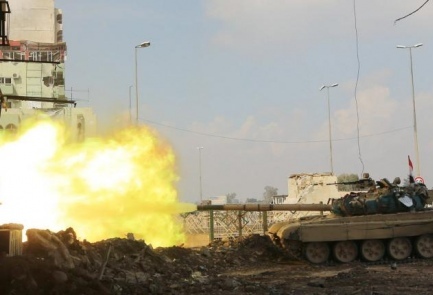
An Iraqi tank shelling an Islamic State post in Mosul
|
Two years ago, when the Islamic State group reached the height of its power, overrunning large areas of Syria and Iraq, it seemed nothing could stop the radical Islamist movement that splintered from al-Qaida.
Unlike al-Qaida, Islamic State took its radical doctrine further, with leader Abu Bakr al-Baghdadi declaring himself a caliph, meaning the leader of all Muslims worldwide, and one who demands his subjects’ fierce loyalty on pain of death. Islamic State’s control of such vast territory was the group’s greatest achievement, and in contrast to al-Qaida, Islamic State ruled the area as if it was the nucleus of a state actually predicated on the principles of Islam, with all the gruesome brutality that entails.
In retrospect, it was this combination that prompted countries in the region and the West to come together to rein in the threat. This effort has been successfully progressing, albeit slowly. The liberation of Mosul, the most important Iraqi city to fall to Islamic State, has taken longer than expected, but it has now entered its final stages; and the offensive to retake the city of Raqqa, Islamic State’s “capital” in Syria, is another advanced stage in the liquidation of the group’s strongholds on the ground.
Removing the Islamic State group from the territory it assumed to control raises the question of what will become of it in the future. There are three possible scenarios, which could all come to fruition simultaneously: The group may try to expand its global reach; it may increase its terrorist activity worldwide; and it may attempt to overrun areas in Syria again.
The first scenario, which is highly likely, will see Islamic State increase its efforts to spread its doctrine on a global scale, in an effort to preserve and nurture the notion of the Islamic caliphate among its followers. Ruling people’s minds and hearts will be the group’s alternative to territorial dominance, and this effort will take place wherever there are Muslims, including in Western countries and the weaker nations in Asia, Africa and the Arab world.
The second scenario will resemble what we know from al-Qaida, and would likely see Islamic State increase its efforts to terrorize the world wherever operational opportunities present themselves.
This effort will see the group make use of its tens of thousands of sympathizers, who will either become refugees or return to their homelands, where they will most likely partner with local Islamist and terrorist elements, from China to Africa. Another aspect of this effort will focus on areas where state control is failing. Such efforts can already be seen in Egypt’s Sinai Peninsula, and Libya. The organization will look for such opportunities and it will take full advantage of them without hesitation and with its trademark brutality.
The third scenario may see Islamic State lead a bloody battle to overrun new areas in Syria, for example in the northwestern area of Idlib. This will allow the organization to draw out the war waged against it, exhausting opposition forces that are waging fierce battles in Raqqa.
Either way, eradicating Islamic State in Iraq and Syria will be a lengthy process, and even after its major strongholds fall and it is declared as defeated, it will still have enough energy — and sympathizers — in both countries to spread occasional death and destruction.
Regional power plays
Islamic State is not about to disappear from the Fertile Crescent, mainly because the Shiite-Iranian threat is cause for major concern among the Sunni majority in the Middle East. Islamic State allows the Sunnis to dream of a better future when the present is, in fact, very bleak.
Iran stands to gain the most from the war on Islamic State. If the 2015 nuclear deal restored some of Iran’s international legitimacy, allowing it to collaborate with Russia on the civil war in Syria, the war on Islamic state is enabling Iran — this time with the global community’s support — to pursue forming a Shiite buffer in the heart of the Sunni world.
Iranian-affiliated Shiite militias are taking part in the battle of Mosul, once an almost exclusively Sunni city. These militias will stop at nothing, including the extermination or expulsion of civilians and bringing Shiites to the city to settle in their place, over the fact that Mosul in the gate to the strategic axis running to Raqqa, Aleppo, Damascus and Beirut, and establishing this axis in the Iranian dream — as it would give it direct access to the Mediterranean.
An Iranian-led Shiite success in creating such an axis would change Middle Eastern geopolitics, especially with respect to the Sunni-Shiite and Arab-Iranian struggles. An actual Iranian foothold in the Middle East is the Sunni world’s nightmare, and it stands to pose a real challenge for Israel.
An agreement seeking to end the Syrian civil war that would leave Iran and Hezbollah as permanent forces in Syria, alongside massive Russian support meant to prop up President Bashar Assad’s regime, will present a direct threat to Israel. Even more so if this Shiite presence is able to establish a ground link to Iran or a seaport in the Mediterranean.
Foiling this threat would require significant diplomatic effort, but there is no guarantee diplomacy will be enough. It is not for nothing that Prime Minister Benjamin Netanyahu’s recent trip to Russia focused on this threat, as it cannot materialize without Russian consent.
Another interesting question pertains to how Turkey might react to the new reality on its southern border.
Turkish President Recep Tayyip Erdogan is currently preoccupied with the constitutional referendum seeking to tighten his grip on power. His belligerent rhetoric may be aggravating tensions with some European nations, but they are not the long-term threat to Turkey. An active Shiite axis in northern Iraq and Syria is a far greater threat.
Ankara has thus far succeeded in preventing the classic Turkish nightmare, namely the establishment of a Kurdish state with maritime access. Such a state will unite the Kurds in Iraq and Syria and will pose a threat to Turkey’s integrity, as the latter is home to a large Kurdish minority.
Once the April 16 referendum is over, Ankara could potentially find itself facing another, equally menacing nightmare: Shiite-Iranian presence in its south with aspiration of Middle East hegemony.
This axis joins Ankara’s enemies in Syria, and they have vested interest in maintaining good relations with the Kurds, which in turn could change Turkey’s status as the largest and strongest nation bordering Syria and Iraq.
It remains to be seen how this new situation would affect Erdogan’s conduct, especially if he wins the referendum and realizes his dream of leading the Sunni world. Anything can happen, including the possibility of a renewed relationship between Turkey and Islamic State in the face of a growing Shiite enemy.
Source: Iran disputes cap on heavy water under nuclear deal | The Times of Israel
Tehran argues it should be allowed to hold more than the 130-ton limit as it searches for buyers for the excess material

Iran has said it may not agree to adhere to limitations on its heavy water stockpile, as stipulated in the nuclear deal reached with world powers in 2015.
The accord limits Tehran’s permitted level of heavy water — a modified form of water used in certain types of nuclear reactors — to 130 tons. It says excess heavy water will be exported to international markets.
In a new letter to the International Atomic Energy Agency, Iran challenged the 130-ton cap, Reuters reported, saying it should be allowed to hold more than the imposed amount as it searches for buyers.
In its letter to the IAEA Thursday Tehran insisted that “nothing in the (agreement) requires Iran to ship out the excess heavy water which is made available to the international market but has not yet found an actual buyer to which the heavy water needs to be delivered.”
In late February the UN watchdog said Iran was complying with the nuclear deal.

Head of Iran’s Atomic Energy Organization Ali Akbar Salehi, who is also a member of Iran’s nuclear negotiating team, speaks with journalists upon his arrival to Mehrabad Airport in Tehran, Iran, Wednesday, July 15, 2015 (AP/Ebrahim Noroozi)
The IAEA’s latest report said Iran has not exceeded the permitted level of 130 tons, as it did briefly during previous periods.
In November 2016, the atomic watchdog noted that Iran had crept above the 130-ton limit.
Tehran shipped out the excess amount and its current stock was just above 124 tons, the latest report said.
And Iran’s stockpile of low-enriched uranium — which can be used for peaceful purposes, but when further processed for a nuclear weapon — was 101.7 kilos (225 pounds), well below the agreed level of 300 kilos.
Verification has continued as agreed, according to the UN watchdog’s fifth quarterly assessment since the pact was struck.
Under the accord, Iran dramatically scaled back nuclear activities to put atomic weapons out of its reach — an aim Tehran always denied having — in exchange for the relief of crippling sanctions.
The agreement extends to at least a year the length of time Tehran would need to make one nuclear bomb’s worth of fissile material — up from a few months prior.
Steps taken by Iran included slashing by two-thirds its uranium centrifuges, cutting its stockpile of uranium and removing the core of the Arak reactor which could have given Iran weapons-grade plutonium.
Source: Rockets launched from Gaza, prompting IDF retaliatory strikes | The Times of Israel
Projectile explodes near city of Ashkelon causing no casualties or damage; Israel responds with tank fire at Hamas targets

Rocket sirens broke the Sabbath calm and sent residents throughout the Gaza periphery scrambling Saturday morning, as two projectiles were launched from the Strip.
One rocket exploded near the city of Ashkelon, north of Gaza, causing no casualties or damage. The second apparently fell inside Palestinian territory.
The Israel Defense Forces responded with tank fire at several Hamas targets in the Strip. There were no reports of casualties.
Early thursday Israeli Air Force jets struck two Hamas installations in the north of Gaza in response to rocket fire from the territory at Israeli communities. In that incident a rocket landed in an empty field in the Sdot Negev Regional Council near Netivot. The rocket exploded on impact. No one was hurt and no damage was reported from the explosion.
Hamas, the terror group that rules Gaza, has largely refrained from firing rockets into Israel since it fought a devastating war with Israel in 2014. Launches have often been ascribed to radical Salafist groups.
Still, Israel has routinely responded by striking Hamas targets, with the military saying it holds Hamas responsible for any attacks emanating from the territory it controls.
‘You Are Europe’s Future’: Erdogan Tells Turks in Europe Have Five Kids, Not Three, Breitbart, March 17, 2017
(Please see also, King: “we can’t restore our civilisation with someone else’s babies” — DM)

Pakistani students of the Pak-Turk International school chant slogans during a protest against the deportation of their teachers, in Islamabad, Pakistan, Friday, Nov. 18, 2016. (AP Photo/Anjum Naveed)
ANKARA (AFP) – President Recep Tayyip Erdogan on Friday urged Turks resident in Europe to have five children, telling the millions strong diaspora community “you are Europe’s future.”
Turkey and Europe are locked in a bitter spat after Germany and the Netherlands blocked Turkish ministers from holding rallies to campaign for a ‘yes’ vote in next month’s referendum on expanding Erdogan’s powers.
Erdogan has repeatedly accused EU states of behaving like Nazi Germany over what he sees as discrimination against Turks, in comments that have caused outrage across the continent.
“From here I say to my citizens, I say to my brothers and sisters in Europe… Educate your children at better schools, make sure your family live in better areas, drive in the best cars, live in the best houses,” said Erdogan.
“Have five children, not three. You are Europe’s future.”
“This is the best answer to the rudeness shown to you, the enmity, the wrongs,” he added in a televised speech in the city of Eskisehir, south of Istanbul.
Some 2.5 million Turkish citizens resident in Europe are eligible to vote in elections in their homeland. But millions more people living in EU states have Turkish origins.
Erdogan, a father of four, has previously urged women in Turkey to have at least three children to help boost the population, in comments denounced by women’s rights activists.




 anneinpt
 artaxes
 danmillerinpanama
 davidking1530
 Peter Hofman
 Joseph Wouk
 Peter
 Louisiana Steve


Recent Comments