‘Resolutely opposed’: China fumes after US supersonic bombers fly over disputed S. China Sea

Posted July 7, 2017 by Peter Hofman
Categories: Uncategorized

Published time: 7 Jul, 2017 10:47

Source: ‘Resolutely opposed’: China fumes after US supersonic bombers fly over disputed S. China Sea — RT News

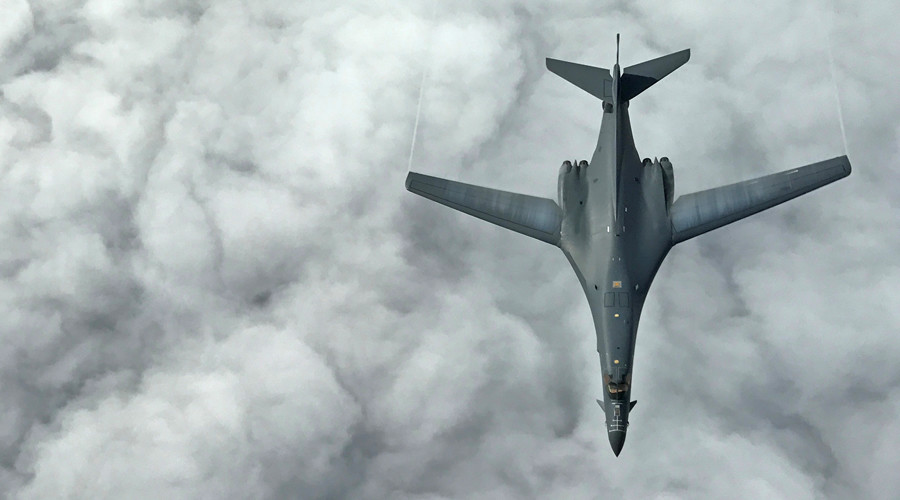
Beijing spoke out after two US long-range supersonic bombers flew over the disputed South China Sea, saying it opposes the use of freedom of overflight as an excuse to harm its security. The leaders of the US and China are set to meet Friday.

“China resolutely opposes individual countries using the banner of freedom of navigation and overflight to flaunt military force and harm China’s sovereignty and security,” Foreign Ministry spokesman Geng Shuang said on Friday.

The statement came after the US Air Force confirmed earlier on Friday that two B-1B Lancer bombers from Guam had flown over the disputed waterway.

Read more

FIL PHOTO: The Arleigh Burke-class guided-missile destroyer USS Stethem ©
U.S. Navy

Prior to the flyover, the Lancers conducted exercises with Japan in the East China Sea, representing the first time the two forces had conducted joint night-time drills.

Virtually all of the South China Sea is claimed by Beijing, despite conflicting claims from Brunei, Malaysia, the Philippines, Vietnam, and Taiwan.

The US has been exercising freedom of navigation over the sea in recent weeks, with two Lancers from Guam flying over the waterway last month. A US warship also carried out a maneuvering drill within a short range – reportedly just 12 nautical miles – of one of China’s artificial South China Sea islands in late May.

Washington has criticized China’s construction of artificial islands in the disputed Spratly chain. The islands have runways, aircraft hangars, radar sites, and hardened surface-to-air missile shelters, according to satellite photos analyzed by the Washington-based Center for Strategic and International Studies (CSIS).

The Friday flyover comes as US President Donald Trump prepares to meet Chinese President Xi Jinping on the sidelines of the G20 summit in Hamburg. The two leaders are expected to discuss North Korea.

Trump has repeatedly urged Beijing to put pressure on Pyongyang as its sole economic lifeline, but tweeted on Wednesday that such cooperation seems unlikely.

“Trade between China and North Korea grew almost 40% in the first quarter. So much for China working with us – but we had to give it a try!” Trump wrote.

Trump’s Warsaw Speech Evoked Reagan’s Cold War Rhetoric, Not The Alt-Right’s

Posted July 7, 2017 by danmillerinpanama
Categories: JFK, Ronald Reagan, Trump agenda, Trump and European Union, Trump and Islamists, Trump in Poland

Tags: , , , , ,

Trump’s Warsaw Speech Evoked Reagan’s Cold War Rhetoric, Not The Alt-Right’s, The Federalist, , July 7, 2017

President Trump gave a stirring defense of western civilization on Thursday morning in Warsaw ahead of the G-20 summit in Germany. In a remarkably candid speech about the threats facing the West, Trump praised Poland for resisting communist and Nazi efforts “to demolish freedom, your faith, your laws, your history, your identity—indeed the very essence of your culture and your humanity.”

Speaking at Krasinski Square in front of the iconic Warsaw Uprising monument marking Poland’s 1944 resistance to Nazi occupation, Trump proclaimed, somewhat dramatically, “Just as Poland could not be broken, I declare today for the world to hear that the West will never, ever be broken. Our values will prevail, our people will thrive, and our civilization will triumph.”

The world hasn’t heard such language from a U.S. president since Ronald Reagan inveighed against the Soviet Union during the Cold War. But apparently it’s racist and fascist these days to talk about resisting tyranny and defending western values—or even to talk about western civilization as such. The Guardian worried about Trump’s use of the word “civilization,” noting that he used it ten times, and claiming the speech “pits western world against barbarians at the gates” and calls for “a clash of civilisations.”

Vox blurted out the headline, “Trump’s speech in Poland sounded like an alt-right manifesto,” calling it “a speech that often resorted to rhetorical conceits typically used by the European and American alt-right. It sounded, at times, not just like the populists of the present but the populists of the past.” The New Republic’s Jeet Heer tweeted that Trump’s speech, “is evidence of how alt right still has a voice in White House” and later posted a commentary saying it “redefined the West in nativist terms.”

Even The Atlantic‘s James Fallows compared Trump’s rhetoric to the Nazi propaganda film, “Triumph of the Will,” saying Trump “represents our country as just another tribe.”

JFK Also Praised Poland’s History and Culture

These reactions belie a worldview that rejects entirely the very idea of “western civilization,” and insists that appeals to Enlightenment principles and cultural cohesion are inherently racist and fascist. And there’s a reason for that. As my colleague David Harsanyi noted, “many of the same people who believe Western values are alt-right dog-whistles want you to adopt a new set of values that have nothing to do with the founding principles and everything to do with their policy preferences.”

But Trump was espousing what used to be considered a fairly standard understanding of western values. “We treasure the rule of law and protect the right to free speech and free expression,” he said. “We empower women as pillars of our society and of our success. We put faith and family, not government and bureaucracy, at the center of our lives… And above all, we value the dignity of every human life, protect the rights of every person and share the hope of every soul to live in freedom.”

Progressives today reject almost all of this—not because Trump is invoking the rhetoric of the alt-right, but because they have moved so far to the left. In fact, far from echoing the blood-and-soil language of the alt-right, Trump’s rhetoric here sounds a lot like the rhetoric deployed in speeches about Poland by Reagan or John F. Kennedy during the Cold War.

Back then, Poland was under communist control, its government a puppet of the Soviet Union and its people prisoners of a tyrannical regime. In a 1960 speech to the Polish-American Congress, then-senator Kennedy recalled his time in Poland in 1939, and Poland’s history fighting the Nazis during World War Two: “After the war, I visited the Polish cemetery in Italy. Some of you who have been there may recall that at the cemetery are written the words, ‘These Polish soldiers for your freedom and theirs have given their bodies to the soil of Italy, their hearts to Poland, and their souls to God.’”

He went on to address the oppression of Poland by the Soviet Union, saying, “we must never… recognize the Soviet domination of eastern Europe as permanent. We must never do it. Poland’s claim to independence and liberty is not based on sentiment or politics. It is rooted in history, and it is to history that we must address ourselves.”

Kennedy called not only for a defensive military buildup so that the Russians would know “that the route of military force can no longer be open to them,” but also for increasing cultural ties to Poland, saying the United States must “strive to restore the traditional identification which Poland has had with the Western European community, which goes back into history. It is tied by culture ties. Poland has always looked to the West, never to the East.” The Polish people, he said, “have not accepted the idea that their culture, their religious heritage, their traditions, can be destroyed by domination by a foreign power.”

Reagan Invoked God, Heritage, and History

Two decades later, Poland was still under communist rule, its government still a puppet of the Soviet Union, but things had begun to change. When Reagan took office in 1981, the Solidarity movement in Poland was building steam. Led by future Polish president Lech Wałęsa and supported by members of the Catholic Church and the anti-Soviet left, Solidarity organized as a free trade union in opposition to communist rule.

By the end of 1981, Poland’s authoritarian government would declare martial law in an effort to crush Solidarity. Reagan gave a speech on December 23 addressing the situation, and praised the Polish people for showing their resistance by placing lit candles in their windows. He said the exiled former Polish ambassador, Romuald Spasowski, had requested that on Christmas Eve a lighted candle burn in the White House window as a “small but certain beacon of our solidarity with the Polish people,” and urged all Americans to do the same that Christmas Eve, invoking God, heritage, and history:

Once, earlier in this century, an evil influence threatened that the lights were going out all over the world. Let the light of millions of candles in American homes give notice that the light of freedom is not going to be extinguished. We are blessed with a freedom and abundance denied to so many. Let those candles remind us that these blessings bring with them a solid obligation, an obligation to the God who guides us, an obligation to the heritage of liberty and dignity handed down to us by our forefathers and an obligation to the children of the world, whose future will be shaped by the way we live our lives today.

Six months later, in his famous Westminster speech to members of the British Parliament, Reagan cast the Soviet Union in the same stark terms that Trump today reserves for ISIS and North Korea. He warned of “totalitarian forces in the world who seek subversion and conflict around the globe to further their barbarous assault on the human spirit. What, then, is our course? Must civilization perish in a hail of fiery atoms? Must freedom wither in a quiet, deadening accommodation with totalitarian evil?”

Reagan’s answer was an emphatic “no.” He again spoke of about Poland’s role in western civilization and its cultural lineage, saying, “Poland is at the center of European civilization. It has contributed mightily to that civilization. It is doing so today by being magnificently unreconciled to oppression.”

He closed that speech with language that would surely scandalize the progressives at Vox and The New Republic, calling the contest against totalitarianism “a crusade for freedom that will engage the faith and fortitude of the next generation. For the sake of peace and justice, let us move toward a world in which all people are at last free to determine their own destiny.”

Europe’s Political Elites Are a Threat to The West

Trump’s Warsaw speech should be understood in this historical context. The president rightly sees the contest between radical Islamic terrorism and the West as a contest between totalitarianism and freedom. He also rightly sees the growing tension between the European Union and the citizenry of European nations as a contest between authoritarian bureaucracy and representative, limited government. His remarks Thursday were aimed at ISIS, but also at a European elite that doesn’t have the inclination or will to defend its borders or cultural heritage.

That’s why Trump said: “The fundamental question of our time is whether the West has the will to survive. Do we have the confidence in our values to defend them at any cost? Do we have enough respect for our citizens to protect our borders? Do we have the desire and the courage to preserve our civilization in the face of those who would subvert and destroy it?”

Trump isn’t just referring to ISIS when he alludes to those who would destroy western civilization. He’s also pointing to European political elites who undermine their own societies by cultural relativism and its resulting slavish and destructive adherence to open borders and mass migration.

Reagan and JFK understood that communism sought ultimately to destroy western civilization and replace it with something else. That’s why they often spoke of civilization and cultural heritage during the Cold War. Trump is saying something similar about the political elites who now rule Europe, and he’s not wrong. That mainstream media outlets like Vox and The Atlantic are scandalized by this is evidence not of Trump’s radicalism, but of their own.

John is a senior correspondent for The Federalist. Follow him on Twitter.

Qassem Soleimani boasts of Tehran’s expanded footprint throughout Middle East

Posted July 7, 2017 by danmillerinpanama
Categories: Iran and Israel, Iran and Middle East, Iran and Palestinians, Iranian Revolutionary Guard, Islamic State, Rouhani, Saudi Arabia and Iran, Soleimani

Tags: , , , , , , ,

Qassem Soleimani boasts of Tehran’s expanded footprint throughout Middle East, Long War Journal,  , July 6, 2017

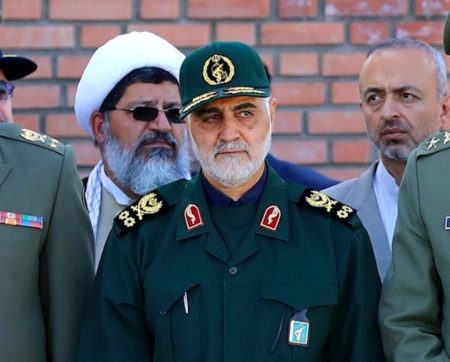
Qassem Soleimani

“The Islamic Republic has been the victor of all events that have happened in the region,” Soleimani claimed.

On domestic politics, Soleimani had strong words for critics of the IRGC, indirectly criticizing President Hassan Rouhani. “In the Islamic Republic, we’re all responsible towards martyrs, society, religion and our country. The biggest betrayal is to cast doubt toward the foundations of this system.” He continued, saying “none today must weaken the corps.” This is likely a reference to Rouhani’s recent criticism of the IRGC during and since the presidential campaign. [See FDD’s Long War Journal report: The Revolutionary Guard’s long shadow over Iran’s presidential election.]

**********************************

On July 3, Major General Qassem Soleimani, the chief of the Islamic Revolutionary Guard Corps’ (IRGC) Qods Force, spoke at an Iran-Iraq war veterans gathering in his home province of Kerman.

Soleimani praised the Islamic Republic’s decades-long effort to take the mantle of the Palestinian cause and boasted that Tehran’s influence in the Middle East has expanded as a result of the Syrian war. He excoriated Saudi Arabia, as well as domestic Iranian critics of the Guard Corps. And the general also lamented the drop in religious observance in Iran.

Soleimani hailed the importance of Qods Day, established by Ayatollah Ruhollah Khomeini to call for Israel’s destruction and express support for Palestinians. Tehran-sponsored Qods Day celebrations were held in several countries last month. [See FDD’s Long War Journal report: Qods Day commemorations highlight Tehran’s global reach.]

“One of the important and valuable innovations of Imam Khomeini was making central the system’s policies on the Palestinian issues, and the Imam (may the almighty God be pleased with him) hoisted the flag of mahdavi in the Islamic Republic of Iran,” Soleimani said. Mahdism is belief in the Mahdi, or the 12th Shiite Imam, who would rise before judgement day.

Soleimani then chastised “some Arab countries” who are “surrounding” the “oppressed” Palestinians. Tehran has accused Arab states of “selling out” the Palestinian cause, because these same Arab nations have expanded ties with Israel over shared concerns about Iranian power.

“The Islamic Republic’s global defense of the oppressed peoples of Iraq and Syria” has increased Iran’s global popularity, Soleimani claimed. Other evidence suggests the opposite has happened: over the past decade, Tehran’s regional policies have led to sharp drops in Iran’s favorability rating in the Middle East and around the globe.

“The target of the takfiri terrorists was to bring the Islamic Republic to the ground with these conspiracies and to make it kneel in front of this religious sedition,” Soleimani claimed. He elaborated: “Those who were behind this sedition and fanned it also had this imagination. This is while the greatness and strength of the Islamic Republic of Iran after the emergence of DAESH [the Islamic State] and toward the end of DAESH increased tens of times.”

Like other senior Iranian officials, Soleimani has claimed that the Islamic State was a conspiracy weaved by Tehran’s enemies to target the Islamic Republic. Although Iranian-backed forces and the Islamic State fight one anther in Iraq and Syria, Tehran has used the Sunni jihadist group’s rise to justify its involvement abroad and its own jihad to defend Shiite shrines from virulently anti-Shiite extremists.

Soleimani boasted about the Syrian regime’s rising fortunes, though he failed to mention that Russia’s military intervention was essential in turning the tide of war. “One day, Syria faced many problems, and today the Syrian government becomes stronger every day,” he stated. The “global belief today is that the Syrian system is undefeatable.”

Soleimani spoke about the expansion of Tehran’s operations in Syria during the war. “Several years ago in Syria, we didn’t have relations with individuals and movements more than the numbers of fingers, while we have relations with hundreds of thousands today,” he boasted. “While some countries that argued with us, ‘don’t defend Syria’s government,’ [they] are standing next to the Islamic Republic today and have changed their policies.”

The Qods Force chief lauded the rise of the Iraqi Popular Mobilization Forces (PMF), a conglomeration of Iraqi militias dominated by IRGC-backed factions. He omitted the fact that US air support has been crucial in the anti-Islamic State campaign.

“The Iraqi army is moving as a national, powerful Islamic army. This is due to popular forces. Something similar happened in our country,” he said, referring to the formation of the IRGC and the Basij paramilitary. Tehran aspires to consolidate its gains in Iraq through the vehicle of the PMF. [See FDD’s Long War Journal report: Qods Force commander to advance Tehran’s influence as ambassador to Iraq.]

The Iranian general mocked Saudi Arabia: “If there’s a lot of oil in a country…but mad logic rules, terrible events happen, and mad things like war with Yemen happen and these ignorant individuals are incapable of extinguishing this fire.” As the civil war in Yemen enters its third year, Soleimani has overseen increasing Iranian support for Houthi fighters and allied forces loyal to former President Ali Abdullah Saleh. The Houthi-Saleh alliance seeks to stymie the Saudi and UAE-led coalition.

“The Islamic Republic has been the victor of all events that have happened in the region,” Soleimani claimed.

He also praised the IRGC’s missile strikes on Islamic State positions in Syria last month, saying “this had several good benefits, one that it showed the Islamic Republic has the will to act, and the principle of will was more important than the result.” Israeli sources say Iran’s missile strikes were largely unsuccessful, with only one projectile striking their targets. Soleimani’s statement could be read as an admission that not all the missiles struck their targets. Regardless, he emphasized that the missile strikes highlighted the training of experts in building “precise” missiles.

“I have witnessed many scenes of missile raining down including American missiles,” he explained. He cited a Quranic verse in his praise, arguing “this movement of the corps was truly, ‘It was not you who threw when you threw; God is the One who threw.’”

On domestic politics, Soleimani had strong words for critics of the IRGC, indirectly criticizing President Hassan Rouhani. “In the Islamic Republic, we’re all responsible towards martyrs, society, religion and our country. The biggest betrayal is to cast doubt toward the foundations of this system.” He continued, saying “none today must weaken the corps.” This is likely a reference to Rouhani’s recent criticism of the IRGC during and since the presidential campaign. [See FDD’s Long War Journalreport: The Revolutionary Guard’s long shadow over Iran’s presidential election.]

“Do not compare the corps with me…target me, not the corps,” he said. “Without the corps, there wouldn’t be a country.”

Soleimani acknowledged the drop in religious observation in Iran, though he sought to deflect blame from the regime’s practice of shoving its version of religiosity down people’s throats. “We must not make people pessimistic toward religion and make society fear the devout, because turning people away from religion leads to higher divorce rate, and social corruption grows with reduction in values,” he said.

“How is it that some seek to make society afraid of the religiously devout? This is a wrong strategy and policy.”

A Revolutionary Guard commander once admitted that only five percent of Iran’s mosques are operational during the year.

Amir Toumaj is a Research Analyst at Foundation for Defense of Democracies.

President Trump in Poland

Posted July 6, 2017 by danmillerinpanama
Categories: Trump and European Union, Trump and Russia, Trump in Poland, Washington Post

Tags: , , ,

President Trump in Poland, Power Line, Paul Mirengoff, July 6, 2017

President Trump’s visit to Poland — a great U.S. ally and a nation with strong personal links to ours — has become the latest pretext for Trump bashing by the U.S. media. The Washington Post (paper edition) tells us, darkly, that Trump “shares ideological affinities” with Poland’s right-wing ruling party. In particular, he shares its aversion to immigration by Muslims and its combative relationship with the press.

The Post also suggests that the visit is a slap in the face of European allies, especially Germany, who are estranged to some degree from the current Polish government. In addition, it tells us that Trump picked Poland because the ruling party will be able to bus in cheering crowds from rural areas. The folks in Warsaw are too sophisticated to like Trump, the Post assures its readers.

Thus, Trump’s visit to Poland serves as a perfect confluence of anti-Trump talking points. He’s a right-winger; he’s anti-Muslim; he’s anti-free press, he’s against the European alliance; he depends on rubes for support; he’s an egomaniac in search of adoring crowds.

But one key anti-Trump talking point cannot be enlisted — the bogus Trump-Putin collaboration theme. As the Post gets around to acknowledging, grudgingly, very late in its story:

Poland also remains a strategically critical European nation that is particularly sensitive to the threat of rising Russian power. Despite Trump’s efforts to pursue warmer relations with Putin, the Polish government expressed optimism that Trump remains committed to the security of Central and Eastern Europe.

“It’s important that the president will be there and he will hopefully confirm again the U.S. commitment to NATO and to our cooperation,” said Piotr Wilczek, Poland’s ambassador to the United States. “For us, his visit to Poland before meeting with President Putin sends a very strong message.”. . .

“Poles were really afraid that it would be President Trump having a very successful summit with President Putin and sitting at the table together with Putin and making divisions or [establishing] a new order for this part of the world — that was a real threat here,” said Michal Kobosko, director of the Atlantic Council’s Warsaw office. “This has not materialized yet, so Poles are looking with some optimism toward Trump.

(Emphasis added)

Actually, the opposite seems to be materializing. In the speech President Trump delivered today in Poland, he reaffirmed the bond between the United States and its European allies, calling their pact as “strong as ever.”

In fact, he expressly affirmed his commitment to Article 5, the collective security provision of the NATO treaty. Trump stated: “The United States has demonstrated not merely with words, but with its actions, that we stand firmly behind Article 5, the mutual defense commitment.”

These are the magic words, the absence from which in some Trump speeches has given the mainstream media fits. Yet, its presence in this speech doesn’t get a mention until the back half of the Post’s story.

In addition, Trump rebuked Russia:

We urge Russia to cease its destabilizing activities in the Ukraine and elsewhere and its support for hostile regimes, including Syria and Iran, and instead join the community of responsible nations in our fight against common enemies and defense of civilization itself.

This too isn’t mentioned until relatively late in the Post’s report. By then, the Post has complained about the speech’s “dark nationalism,” the supposed Trump rift with Germany, and even his unwillingness to say with certainty that Russia interfered in the 2016 election.

The “darkness” of Trump’s speech is actually its virtue. Trump stated:

The fundamental question of our time is whether the West has the will to survive. Do we have the confidence in our values to defend them at any cost? Do we have enough respect for our citizens to protect our borders? Do we have the desire and the courage to preserve our civilization in the face of those who would subvert and destroy it?

If Trump’s critics were serious about countering Russia and defending Europe, they would be asking the same questions (with the possible exception of the one about immigration, at least as applied to the U.S.). The left can’t have it both ways. It can’t be the case both that no one is out to subvert or destroy our civilization and that we must maintain our commitment to defending Europe, while obsessing over the Russian threat.

And after the Poland visit, it can’t be the case that Trump is under the sway of Putin. It’s still early in his presidency, but so far Trump is, I think, the hardest-line U.S. president on Russia/the Soviet Union since Ronald Reagan.

President Obama was the least hard-line.

Nigel Farage Will Not Stand for UKIP’s Leadership

Posted July 6, 2017 by danmillerinpanama
Categories: British elections, British leaders, British Parliament, Nigel Farage, UKIP

Tags: , , , ,

Nigel Farage Will Not Stand for UKIP’s Leadership, PJ Media, Michael Van Der Galien, July 6, 2017

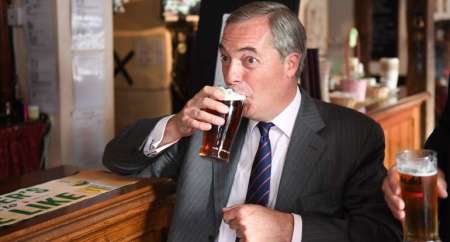
General Election 2017. Former Ukip leader Nigel Farage has a pint in a pub in South Thanet while on the general election campaign trail. Picture date: Saturday June 3, 2017. See PA ELECTION stories. Photo credit should read: Victoria Jones/PA Wire URN:31555123

Farage’s main problem is that UKIP is run by an elected National Executive Committee (NEC). This body is, sadly, occupied by rank amateurs. They’re passionate and enthusiastic, but they have no idea how to run campaigns, play the media, or raise money. As the leader, Farage felt that this governing body of the party was holding him back. “Time and again I was outvoted on important decisions and could not take the party in the direction I wanted,” he writes.

********************************

For well over a decade, Nigel Farage was the face of Britain’s eurosceptic movement and, as such, of the entire eurosceptic movement in Europe. Although he failed to win a seat for himself in the British Parliament, he did guide UKIP to great election victories in elections for the European Parliament. And, of course, he was vital in a) bringing about a referendum on Brexit and b) making sure the Leave campaign won.

Last year, Farage stepped down as UKIP’s leader. His absence caused a leadership struggle in the party. In the end, it was UKIP MEP Paul Nuttall who was selected to lead UKIP heading into the British elections. The results were a disaster: the party was wiped out.

As a result, Nuttall resigned. Candidates to succeed him have until the end of July to throw their hat in the ring.

Many people have been lobbying Farage to come back. I know I have. There are few politicians — if any — in Britain with his charisma and leadership abilities. Sure, the man has also failed on numerous occasions, but overall, UKIP couldn’t possibly wish for a better leader. Sadly, Farage has announced that he’s not interested in the job:

While many have been lobbying me and urging me to come back, I have decided that this would not be the right thing to do and I will not be standing. While I remain a strong supporter of the party and think there is a real chance in two years that Ukip may be more relevant than ever, the party itself needs serious reforms.

Farage’s main problem is that UKIP is run by an elected National Executive Committee (NEC). This body is, sadly, occupied by rank amateurs. They’re passionate and enthusiastic, but they have no idea how to run campaigns, play the media, or raise money. As the leader, Farage felt that this governing body of the party was holding him back. “Time and again I was outvoted on important decisions and could not take the party in the direction I wanted,” he writes. He concludes:

The thought of going back to a job I may not be allowed to do, if, again, I’m held back by totally unqualified people is not something I’m prepared to contemplate. I hope the new leader takes on the battle for major constitutional change or the party will return to being an amateur shambles.

Although political watchers can sympathize with Farage, he leaves behind a party that’s in shambles and that desperately needs a leader — a leader like Farage. Sadly, if the man himself doesn’t step up to the plate, there’s nobody with his gravitas to replace him. Nuttall tried but failed. His successor will undoubtedly suffer the same fate. There’s nobody else in UKIP with Farage’s political acumen and charisma.

And that means that the end of UKIP as a political player is in sight, which would be a terrible loss not only for Britain itself but also for the rest of Europe, which desperately needs eurosceptic parties — parties that put Brussels’ feet to the fire and warn the citizenry about the secret power grabs of the European elites.

In France, do not dare to criticize Islam

Posted July 6, 2017 by danmillerinpanama
Categories: France, Freedom of speech, Freedom of the press, Islamisation of France

Tags: , ,

In France, do not dare to criticize Islam, Israel National News, Giulio Meotti, July 6, 2017

France, the country where the debate on Islam and integration has been more intensive, is the first target of the Islamic enemies of freedom. If France is now silent, the debate on Islam will be “resolved” all across Europe.

**************************

The controversy began with his intervention in September 2016 on the broadcast “C à vous”. Éric Zemmour was then immediately sued at the 17th Criminal Court of the Paris Court. He must respond to the alleged offense of “incitement to discrimination and hatred against people of Muslim faith”. The lawsuit is promoted by the EuroPalestine Association.

Zemmour is in trouble for a few sentences, such as the ones describing Muslims as those who “have to choose between Islam and France”, saying that “Jihad is a religious duty”, that “Muslims consider jihadists as good Muslims” and that “moderate Islam does not exist”. Ideas. Ideas are debatable in a European pluralist democracy proud of the free circulation of ideas, as well as goods and people. But these ideas are becoming forbidden in France.

Thus, Zemmour was sentenced of incitement to hatred and a fine of 5,000 euros. 8,000 spectators lodged a complaint at the State Council for Audiovisual. It is not the first conviction that Zemmour suffers for his ideas about France and Islam. In 2014, in an interview with the Italian daily Il Corriere della Sera, he said that France’s estimated five million Muslims should be “deported”  to avoid “chaos and civil war”.

In 2007, Charlie Hebdo ended up in court. The French journalists were cleared of any charge, but the jihadists were ready to silence them forever (in three years, not a single cartoon on Mohammed and Islam has been published). In 2013, the magazine Valeurs Actuelles was sentenced for “discrimination” against Muslims for publishing the national symbol Marianne with a Muslim veil (two thousand euros fine). The following year was the turn of Renaud Camus, condemned to pay five thousand euros for “hate instigation” for his theory of “Great Substitution”.

Zemmour was dragged many times to court. A year ago, it was when he gave an interview at Causeur magazine: “I respect the people willing to die for what they believe”, Zemmour said of the Islamic terrorists.

When Zemmour was dragged for the first time to court by the anti-racist and Islamic organizations in 2011, thirty MPs formed the “Freedom of expression collective”: “With the excuse of racism, a journalist is forced to silence when he wants to give an opinion”, said the 28 signatories, who condemned “the tyrants of the doctrine of anti-racism. Voltaire is buried”. Zemmour is only the best known of French journalists and intellectuals dragged into court to respond to the new intellectual offense: “Islamophobia”. There is a list of impressive names, from Georges Bensoussan to Pascal Bruckner.

France, the country where the debate on Islam and integration has been more intensive, is the first target of the Islamic enemies of freedom. If France is now silent, the debate on Islam will be “resolved” all across Europe.

A challenge to Erdogan

Posted July 6, 2017 by danmillerinpanama
Categories: Erdogan, Turkey - protest march, Turkey and Europe, Turkey and human rights, Turkish democracy

Tags: , , , ,

A challenge to Erdogan, Israel Hayom, Eldad Beck, July 6, 2017

As leaders of the world’s biggest economies, including Turkish President Recep Tayyip Erdogan, gather in Hamburg this weekend to discuss global issues, In Istanbul, the biggest protest march in modern Turkey’s history will conclude.

Intensifying the persecution of regime opponents, the Turkish president is turning his country into a perfect democtatorship, where the people are only allowed to vote in favor of what the leader desires and anyone who objects is thrown in prison and accused of terrorism. This reality has led the leader of Turkey’s main opposition party, the Republican People’s Party (CHP), to call for a so-called Justice March from the capital Ankara to Istanbul. Until the march, Kemal Kilicdaroglu, a bland politician who lacks charisma and strongly resembles Mahatma Gandhi, was unable to brand himself as a worthy opponent to Erdogan. But the 450 kilometers (280 miles) between Ankara and Istanbul have bestowed upon him an aura of an opponent capable of putting up a fight.

Holding a small sign bearing a one-word slogan — Adalet (“Justice”) — and followed by thousands of marchers (with hundreds more expected to join along the way on each day), the leader of the republican, pro-secular party is posing a major challenge to the “sultan of Ankara”: He is bringing the battle to Erdogan’s home court, the Turkish street, and showing him that his grip on the people is not absolute.

A few days from now, the regime will mark a year since it quashed an attempted military coup, which made it possible for Erdogan to hunt down en masse everyone who opposed him: the Islamist Gulen Movement, the Kurds, republicans, military officers, politicians, journalists, government functionaries, police and teachers. Under a “state of emergency” that is still in effect, sweeping arrests have been made, over 100,000 people have been fired, and according to numbers from Turkey’s Justice Ministry, nearly 50,000 investigations have been launched this past year against people and institutions suspected of offending the president. The Justice Ministry approved trials for almost 5,000 suspects. Over 1,000 were convicted for crimes that carry sentences of up to four years in prison.

Erdogan’s and his government’s hysterical response to the opposition’s Justice March suggests that even in the grand presidential palace in Ankara, they feel the ground shaking beneath their feet. Erdogan accused Kilicdaroglu of supporting terrorist organizations and involving himself in crime by opposing court orders — when in reality he had opposed rulings by the justice system that facilitated the incarceration of several associates of the opposition leader on the pretext of terrorism. “The platform represented by the CHP has crossed the line of political opposition. They have reached the point of working with terrorist organizations and with forces that encourage them to operate against our country,” Erdogan declared. In other words: treason.

A spokesman for Turkey’s ruling party accused Kilicdaroglu and his party of trying to use the Justice March to drag Turkey into chaos in the service of “foreign interests” that are working against Erdogan and his government. That is: People are still trying to oust Erdogan, and such circumstances justify increased persecution of his opponents. But turning up the dial on the incitement against the opposition could nudge supporters of the president to commit violence against the marchers and opposition leaders. The marchers have already encountered the fury of the masses.

The Justice March is scheduled to conclude at the gate to the prison where a parliamentary delegate from the CHP, Enis Berberoglu, is incarcerated for giving the media information on Turkish intelligence agencies giving aid to terrorist groups in Syria. Berberoglu, a former journalist, was sentenced to 25 years behind bars for “revealing state secrets.” But the Justice March won’t really end so long as Erdogan continues to terrorize Turkey.

Will the opposition now take advantage Kilicdaroglu’s momentum and unite? Will it become possible to change the political atmosphere in Turkey? If Turkey wants to protect itself, it doesn’t need a military coup, it needs a popular one. Erdogan has done everything he can to prevent that from happening, even at the cost of military, political and foreign conflicts.

Germany’s Quest for ‘Liberal’ Islam

Posted July 6, 2017 by danmillerinpanama
Categories: "Liberal mosque", German values, Germany, Islamic invasion, Islamic supremacy, Islamisation of Germany, Islamist clerics, Islamist mosques, Islamist threats, Islamofascism

Tags: , , , , , , , , ,

Germany’s Quest for ‘Liberal’ Islam, Gatestone Institute, Vijeta Uniyal, July 6, 2017

(Please see also, President Trump’s Remarks to the People of Poland. — DM)

Recently, after dragging its feet for years, the Central Council of Muslims in Germany had agreed to call a march against Islamist terror. The Muslim organization boasted 10,000 registered participants for the “Not with us — Muslims and friends against violence and terror” rally, scheduled for June 17 in Cologne. On the much awaited day, only a few hundred people turned up, many of them ordinary Germans flanked by a huge media entourage. “Many Turkish weddings are larger than this demonstration,” wrote Robin Alexander, columnist in Die Welt.

Merkel and Germany’s establishment have their ground game covered ahead of the election, and know full well where their political interests lie. The question is, do the German voters know where their best interests lie?

**********************************

However, the media-driven PR campaign backfired as the news of the opening of the Berlin ‘liberal mosque’ reached Muslim communities in Germany and abroad. The liberal utopian dream quickly turned into an Islamist nightmare.

Why do Muslim organizations in Germany fail to mobilize within their communities and denounce Islamist terrorism? Because, if there really is a belief that “international terrorism should not be depicted as a problem belonging to Muslims alone” this view seems to indicate that, in general, Muslims do not see it as their problem.

The newly unveiled ‘liberal mosque’ in Berlin was supposed to showcase a ‘gentler’ Islam. An Islam that could be reformed and modernized while it emerges as the dominant demographic force in Europe. German public broadcaster Deutsche Welle touted the opening of the mosque as a “world event in the heart of Berlin.”

“Everyone is welcome at Berlin’s Ibn Rushd-Goethe Mosque,” Deutsche Welle wrote, announcing the grand opening last month. “Women and men shall pray together and preach together at the mosque, while the Koran is to be interpreted ‘historically and critically.'”

German reporters and press photographers, eager to give glowing coverage, thronged to witness the mosque’s opening on July 16 and easily outnumbered the handful of Muslim worshipers. Deutsche Welle reported: “fervent enthusiasm in the media and political realm.”

“For me there is no contradiction in being a Muslim and a feminist at the same time,” Seyran Ates, the mosque’s female imam told the German reporters.

“With Islam against Islamism,” wrote Germany’s leading weekly Der Spiegel. “Society in general will lionize [Imam Ates] as the long-awaited voice of Muslims that speaks clearly against Islamist terror,” prophesied another German weekly, Die Zeit.

The Washington Post, not to be outdone by German newspapers, hailed the mosque’s female founder Ates for “staging a feminist revolution of the Muslim faith.”

In what can only be described as one-way multiculturalism, a Protestant church in Berlin’s Moabit district had vacated its prayer hall to make way for this new mosque.

Prayers at the opening of the Ibn-Rushd-Goethe Mosque in Berlin, Germany on June 16, 2017. Seyran Ates, the mosque’s female imam, is pictured in the second row, wearing a white robe. (Photo by Sean Gallup/Getty Images)

However, the media-driven PR campaign backfired, as the news of the opening of the Berlin ‘liberal mosque’ reached Muslim communities in Germany and abroad. The liberal utopian dream quickly turned into an Islamist nightmare. Islamic fanatics from near and far started flooding the Berlin mosque with death threats. Al-Azhar University in Cairo, the foremost authority on Sunni Islam, issued a fatwa forbidding the ‘liberal mosque.’

The British newspaper The Guardian reported:

[The mosque’s Imam Ates] said she had received “300 emails per day encouraging me to carry on”, including from as far away as Australia and Algeria, but also “3,000 emails a day full of hate”, some of them including death threats.

Egypt’s Dar al-Ifta al-Masriyyah, a state-run Islamic institution assigned to issue religious edicts, issued a statement on Monday declaring that the Ibn Rushd-Goethe mosque’s practice of men and women praying side by side was incompatible with Islam, while the legal department of Egypt’s al-Azhar university reacted to news from Berlin with a fatwa on the foundation of liberal mosques per se.

After countless death threats, the newspapers reached out to Aiman Mazyek, head of the Central Council of Muslims. He shrugged his shoulders and said there were 2100 mosques in Germany and he “doesn’t need to comment on each and every one of them.” As the Berlin-based newspaper Der Tagesspiegel reported this week, the ‘liberal’
Mosque’s Iman was finally granted “around-the-clock heightened police protection.”

Within days, this was the second establishment-backed project devised to spruce up the image of Islam in Germany, to go up in flames.

Recently, after dragging its feet for years, the Central Council of Muslims in Germany had agreed to call a march against Islamist terror. The Muslim organization boasted 10,000 registered participants for the “Not with us — Muslims and friends against violence and terror” rally, scheduled for June 17 in Cologne. On the much awaited day, only a few hundred people turned up, many of them ordinary Germans flanked by a huge media entourage. “Many Turkish weddings are larger than this demonstration,” wrote Robin Alexander, columnist in Die Welt.

Germany’s largest Islamic organization, the Turkish-Islamic Union for Religious Affairs, DITIB, decided to skip the anti-terror demonstration. DITIB stated that Muslims fasting in Ramadan cannot be expected to “march and demonstrate for hours.” DITIB controls about 900 mosques in Germany and has 800,000 members.

The German daily, Die Welt, reported on DITIB General Secretary Bekir Alboga’s stated reason behind their withdrawal from the anti-terror march:

“We Muslims are striving to feel the spirituality of the special month that gives us power for the rest of the year.” Through the daily Quran recitation, fasting and helping the needy — in addition to the physical exertion from such a demonstration — political initiatives such as the planned anti-terrorism march are minimized during Ramadan.

“Had we been informed early enough about the rally and its date we would have suggested planning it for after the Ramadan and roping in other Muslim — and also non-Muslim organizations — because international terrorism should not be depicted as a problem belonging to Muslims alone.”

DITIB evidently did not want to divert fasting Muslims away from their spiritual pursuits, but it had no problem using its mosques and preachers to spy in Germany on behalf of Turkey’s Erdogan regime. In January, DITIB officials admitted that their preachers acted as informants for the Turkish regime.

This is not the first time in Germany that Muslim leaders thwarted an “anti-terror march”. The so-called “vigil of Muslims” at Berlin’s Brandenburg Gate, after the Islamist terror attack on the Paris offices of the satirical magazine Charlie Hebdo in January 2015, was also apparently a disappointment. As it turned out, the “vigil” was not even “Muslim”. It had been financed and stage-managed from the chancellery of Angela Merkel. As Die Welt revealed:

“That time, too, painfully few Muslims turned out. It later emerged that that Muslim organizations only called the vigil after the initiative of a staffer from Chancellor’s office and gentle pressure from the Minister of Interior. The expenses of the ‘Muslim vigil’ were borne by the Christian Democratic and Social Democratic Parties.”

Why do Muslim organizations in Germany fail to mobilize within their communities and denounce Islamist terrorism? Because, if there really is a belief that “international terrorism should not be depicted as a problem belonging to Muslims alone” this view seems to indicate that, in general, Muslims do not see it as their problem.

The Turkish-Islamic organization DITIB would, it seems, prefer to see Christian, Hindu and Jewish organizations address the non-existent problem of terrorism within their communities, than to address the real issue of radicalization of youth within its own congregations or the recruitment by Islamists insides its mosques.

Do not, however, expect the German state to make the Muslim leadership responsible for its failings. The Merkel government continues to hand over millions of euros to DITIB despite what critics regard as behavior that is “unacceptable.”

These stage-managed campaigns to fix the image of Islam in Germany come at an interesting time. With less than three months until the German general election, Chancellor Merkel’s government, with her career at stake, is probably hesitant to take on Islamic organizations with ability to mobilize the “Muslim vote”. Last year’s state election in Berlin already saw such a mobilization.

The September election will effectively be a referendum on Merkel’s “open door” migrant policy. The media’s peddling the liberal, gentler Islam will definitely help ease the German voters’ anxiety, given the ongoing demographic transformation of the country in the wake of the continued mass-migration from Arab and Muslim countries.

Merkel and Germany’s establishment have their ground game covered ahead of the election, and know full well where their political interests lie. The question is, do the German voters know where their best interests lie?

Vijeta Uniyal, a journalist and news analyst, is based in Germany.
President Trump’s Remarks to the People of Poland

Posted July 6, 2017 by danmillerinpanama
Categories: President Trump speech in Poland

Tags:

President Trump’s Remarks to the People of Poland, VOA via YouTube, July 6, 2017


In sweeping speech, Trump calls out Russia for supporting ‘hostile regimes’

Posted July 6, 2017 by danmillerinpanama
Categories: Islamic invasion, Islamic terrorism, Islamisation of Europe, NATO, Russia, Trump in Poland

Tags: , , , , ,

In sweeping speech, Trump calls out Russia for supporting ‘hostile regimes’, Washington Examiner, Sarah Westwood, July 6, 2017

(Please see also, Europe’s Migrant Crisis: Views from Central Europe.– DM)

President Trump applauded Poland’s commitment to secure borders, called out Russia for its activities in Ukraine and Syria and affirmed America’s collective defense commitment to NATO in a sweeping speech Thursday that set the tone for his visit to the G-20 summit this week.

“While we will always welcome new citizens who share our values and love our people, our borders will always be closed to terrorism and extremism of any kind,” Trump said before a large crowd in Warsaw’s historic Krasinski Square.

Unlike much of western Europe, Poland has resisted accepting large numbers of Middle Eastern refugees, and its right-wing ruling party has advocated for keeping Polish borders secure. Trump’s decision to visit Poland and deliver remarks about his worldview before moving on to Germany for the summit was widely viewed as a symbolic endorsement of Poland’s actions.

“This continent no longer confronts the specter of communism,” Trump said on Thursday. “There are dire threats to our security and to our way of life.You see what’s happening out there, they are threats. We will confront them. We will win.”

Trump pointed to the “steady creep of government bureacracy” as another threat facing Poland the U.S.

“The West became great not because of paperwork and regulations but because people were allowed to chase their dreams and pursue their destinies. Americans, Poles and nations of Europe value individual freedom and sovereignty,” Trump said. “We must work together to confront forces, whether they come from inside or out, from the South or the East, that threaten over time to undermine these values and to erase the bonds of culture, faith and tradition that make us who we are.”

“If left unchecked, these forces will undermine our courage, sap our spirit and weaken our will to defend ourselves and our societies,” the president added. “We put faith and family, not government and bureaucracy, at the center of our lives.”

Citing Poland’s historic mistrust of the Soviet Union, Trump went after Russia for its present-day conduct.

“We urge Russia to cease its destabilizing activities in Ukraine and elsewhere and its support for hostile regimes including Syria and Iran,” Trump said.

The president also voiced his support for NATO’s Article 5, the collective defense commitment Trump declined to endorse explicitly during his visit to a NATO summit in May.

“My administration has demanded that all members of NATO finally meet their full and fair financial obligation,” Trump said, referring to his push for NATO allies to honor their commitments to spend at least 2 percent of their gross domestic product on defense. “As a result of this insistence, billions of dollars more have begun to pour into NATO.

“To those who would criticize our tough stance, I would point out that the U.S. has demonstrated not merely with words, but with actions, that we stand firmly behind Article 5,” Trump said. “Words are easy, but actions are what matters.

“Europe must do more,” Trump added. “Europe must demonstrate that it believes in its future by investing its money to secure its future.”

Administration officials said the speech was intended to be “very philosphical.”

“The core theme of this speech is a defense of western civilization,” an official told reporters in Warsaw ahead of the speech. “But the basic question of the speech is, are we as a civilization confident enough in our own values to defend and preserve our civilization?”

Trump will head to the G-20 summit in Hamburg on Friday, where he will meet with a number of foreign leaders, including Russian President Vladimir Putin.