Trump’s Warsaw Uprising

Posted July 6, 2017 by danmillerinpanama
Categories: Europe and freedom, European establishment, European populism, European security, European values, European weakness, Islamic terrorism, NATO, Trump in Poland

Tags: , , , , , , , ,

Trump’s Warsaw Uprising, PJ Media, Roger Kimball, July 6, 2017

President Donald Trump delivers a speech at Krasinski Square at the Royal Castle, Thursday, July 6, 2017, in Warsaw. (AP Photo/Evan Vucci)

If you want to know why Donald Trump will go down in history as a great president, listen to (or read, when it is available) his speech in Krasinski Square, Warsaw today.

Yes, there is a lot of the usual diplomatic persiflage: “Thank you, President Duda. Thank you, Poland.” But be an adult and distinguish the gem from the setting. While the anti-Trump press was busy running stories warning about “unease in Brussels” over Trump’s visit to Poland, Trump once again totally outflanked his critics.  Those who have ears, let them hear:

  1. The United States is absolutely committed to securing Poland’s access to alternative sources of energy.  Now, to whom do you think that was addressed?  What country would use access to oil and gas as political blackmail (do what we say or you can’t warm your homes, light your streets, run your factories)? Who would do such a thing?
  2. The United States is absolutely committed to its trans-Atlantic partnership. That partnership, said Trump in his aspirational mode, has never been stronger: suitably translated, that means that he wishes to assure that it will never be stronger.  It was a proffered hand.  Will the EU bureaucrats reach out and grasp it?
  3. Speaking of bureaucrats, Trump also—mirabile dictu—warned about “steady creep of government bureaucracy” that, left unchecked, saps a people’s will and makes the flourishing of individual initiative, the very marrow of freedom, impossible.  This was a direct kick against the administrative state: I like to see it. Darin the Swamp.
  4. Trump reaffirmed his absolute commitment to Article 5 of the NATO agreement — the bit that pledges members to “collective defense”: an attack on one member is an attack on all. He praised Poland for stepping up to meet its statutory financial commitment to NATO and urged other European countries to do the same. A strong NATO means a strong Europe.
  5. Trump reaffirmed his commitment to battle against “radical Islamic terrorism” and other forms of extremism and highlighted his call in Riyadh in May for Muslim countries to step up and help quash the violence of jihad.
  6. He noted other challenges faced by the West, including cyber-warfare and Russia’s “destabilizing activities” in Ukraine, Syria, and Iran.
  7. But the best part came about three-quarters of the way through.  After reminding his audience about the million people who gathered to hear John Paul II celebrate Mass in 1979, he asked: what did the people want? Answer: “We want God.” This led into the heart of Trump’s speech.  The prerequisite for the success of Western civilization is not material riches. Economic prosperity and military might on their own are not sufficient. The critical leaven is the confidence in core Western values: such things as free speech, the equality of women, respect for individual rights, the rule of law, the affirmation of faith and family.  Hence, the “fundamental question” facing Western nations today is whether the people continue to nurture the cultural self-confidence in those fundamental values. If they do, the West is unbeatable. If those values dissipate, the West is lost.  “As long as we know our history,” Trump said, “we will know how to build our future.” Trump spent a lot of time in his speech rehearsing Poland’s heroic resistance to Nazi atrocities in the Warsaw uprising and its equally heroic resistance to Soviet aggression during and after the war. Not since Ronald Reagan has an American president gone so clearly to the nub of what makes the West great and what threatens that greatness.

China’s Creeping Invasion of India

Posted July 6, 2017 by danmillerinpanama
Categories: China vs India, Chinese military, India military

Tags: , ,

China’s Creeping Invasion of India, The Diplomat, Saurav Jha, July 6, 2017

(Please see also, Modi’s visit: Strategic leap in Indian-Israeli ties. India seems to be augmenting its ability to defend against an increasingly aggressive China. — DM)

New recruits of the Chinese People’s Liberation Army (PLA) patrol the border area at Ngari, Tibet Autonomous Region, China (April 26, 2017). Image Credit: Reuters

In late May, Indian Prime Minister Narendra Modi chose to commemorate three years of his administration by opening the country’s longest ever bridge over the Lohit river, Called the Bhupen Hazarika Setu (BP), the bridge will significantly cut down travel time to the easternmost parts of Arunachal Pradesh (AP), an Indian state that has been publicly claimed in its entirety by Beijing since 2006 as “Southern Tibet.” The high-profile opening was also intended to convey a message to the Chinese that India was moving forward with its current strategy of developing infrastructure in regions bordering Chinese-controlled territory in order to facilitate the defense of every inch of territory it considers its own. Overall, at a time of heightened India-China tensions and fears about Sino-Pak military collusion potentially culminating in a two-front situation, India is now working to upgrade its military posture vis-a-vis China from one of dissuasion to one of deterrence.

A conventional deterrence posture toward China requires the creation of appropriate last mile connectivity to facilitate axes of advance for counterstrike forces in addition to being able to reinforce “in sector” defensive formations. After years of deliberately keeping its frontier with China devoid of much infrastructure under the premise that the absence of such connectivity would lead to invading forces getting bogged down, India is now scrambling to match China’s extensive infrastructure in the Tibet Autonomous Region (TAR).

China’s Military Build-up 

That infrastructure now allows People’s Liberation Army Ground Force (PLAGF) units to mount patrols right into Indian territory along the 4,057 kilometer long Line of Actual Control (LAC). The LAC currently represents the de facto border between India and China and is divided into three sectors: the western, middle, and eastern. In the absence of timely Indian Army (IA) patrols to counter such intrusions, there would be concession of small bits of territory to China over time. In some places, particularly lacking in connectivity, Chinese-built helipads and short tracks inside Indian territory have been discovered by Indian forces in the past.

The Chinese can now also build up forces along the LAC at various points much more quickly than before and in more significant numbers if so desired. In any case, the Chinese have built motorable tactical roads to all 31 passes that are of military significance along the LAC. Various border “laterals” of low classification also exist just south of subsidiary axes to the main tactical roads and can be used for switching forces between sectors. Clearly, the IA no longer has the luxury of hanging back as the Chinese move in at a time or place of their choosing. While current defensive formations ensure that the Chinese cannot advance deep into Indian territory or, as IA insiders put it, “capture targets of value,” the need of the hour from the Indian perspective is to extend road infrastructure right up to various points along the LAC.

Post re-organization, the total area of responsibility (AOR) under the former Lanzhou and Chengdu military regions in China has been merged by the PLA into the newly created Western Theater Command, which now controls the 76th and 77th  “Combined Corps-Level” group armies (GAs) that are not merely integrated arms units of PLAGF but will also progressively include inter-service elements from the PLA Air Fore (PLAAF) and the PLA Rocket Force (PLARF) in furtherance of the integrated joint operations that are supposed to be a key facilitator of China’s doctrine of “winning local wars under conditions of informatization.” In addition to the 76th and 77th GAs, the Xinjiang Military Division (MD) and Tibet Military Division (MD), which are also part of the Western Theater Command have some additional eight infantry divisions/brigades and two special operations brigades at their disposal.

Indian military sources believe that the 77th and the 76th could concentrate the equivalent of up to seven division-sized formations (indicative figures, since the PLAGF is currently reorganizing itself into a brigade-based structure) in TAR within a week’s time with one “rapid reaction division” being inducted into Lhasa in as little as 24-36 hours. Using the 1,142 km long Qinghai-Tibet Railway, the three main highways that converge on Lhasa, as well as aviation infrastructure, the PLAGF could also bring 12 divisions into TAR in around a month’s time. For a much larger campaign that would see multiple fronts opened against India on the LAC, the PLAGF could mobilize up to 32 divisions in a single campaigning season and these could be sustained in TAR for a month (although it is debatable whether the PLAGF would really want to send deploy so many troops in TAR).

China can now not only mobilize such forces against India in a relatively short period of time but can also sustain them for relatively long periods of time. The significant number of camps that have come up in TAR simply plug into existing civilian water and power utility infrastructure. Incidentally, the Chinese have built hyperbaric chambers with storehouses in some of these camps to facilitate the rapid acclimatization of some troops inducted from lower altitudes in the event of a contingency. Apart from specialized storage (many underground), massive dual-use logistics centers, such as the one at Nagqu, have been constructed which also host command and control facilities.

Indeed, with its hub based around Lhasa-Nagqu, an optical fiber cable network radiates to Ngari in the West and Nyingchi in the east while also connecting with successive higher headquarters all the way up to Beijing. Together with the optical fiber cable mesh, 58 VSAT (Very Small Aperture Terminal) satellite stations have been built to provide the backbone for a C4ISR network necessary to prosecute a “local war under conditions of informatization.”

As far as airpower is concerned, besides the six fully operational dual-use airbases facing India at Lhasa Gonggar, Nyingchi, Qamdo, Hoping, Ngari Gunsa, and Shigatse, PLAAF has built another nine for its use in TAR. TAR also has some 27 additional airstrips that the PLAAF can utilize. Unlike in the past, the PLAAF now operates year-round from TAR, with reportedly some 24 combat aircraft, a mix of J-10s and J-11s, being based there on a near-permanent basis with other frontline combat aircraft being deployed to airfields in the region as detachments for durations of up to three months. Several airfields dedicated to helicopter and unmanned aerial vehicle (UAV) operations are also being constructed in TAR. In May 2017, the PLAAF took the lid off a base in TAR that hosts a GJ-1 armed UAV unit.

The PLAAF can also look forward to integrated joint operations with PLARF, which controls China’s missiles, in TAR. Opposite India, the PLARF currently deploys various versions of the DF-21 medium-range ballistic missile (MRBM) family, DF-15 short-range ballistic missile (SRBM) variants, and possibly the new DF-16 SRBM as well. The PLARF is likely to use conventionally armed missiles in the opening stages of any conflict to attack Indian Air Force (IAF) airbases in addition to other targets, thereby making it a key enabler of air operations for the PLAAF.

Overall, China’s ability to mobilize troops into TAR in addition to growing PLAAF activities backed by the PLARF has given it the confidence to engage in a game of brinkmanship along the LAC with numerous intrusions, despite the fact that the Tibet Military Division has only three regular and one special operations brigade permanently stationed there. And in May 2016, China raised the status of Tibet Military Command (TMC), by putting it directly under the jurisdiction of the PLAGF.

India’s Response

Despite the muscle flexing, the PLAGF is going to find it rather difficult to conquer any target of value along the LAC. Take Tawang, for instance. An entire IA mountain division, the 5th under IV Corps, has its headquarters in neighboring West Kameng district. Indian forces deployed in Tawang have the best firepower the IA has at its disposal and have essentially fortified Tawang. An advanced landing ground has also been approved for construction in Tawang, with surveys underway for a high-altitude rail link.

In addition to the 5th Division, India has eight more mountain divisions along with one dual-tasked formation under the III, IV, and XXXIII Corps of its Eastern Command, which are all defensively oriented against the Chinese. To support these formations, the IA has also built numerous logistics nodes, troop habitats and underground storage facilities. In recent times, India is also desperately trying to complete the India-China Border Roads (ICBR) Project, which envisages the construction of 73 strategic roads along the LAC of which 27 roads are currently operational. Each of these roads will be capable of conveying 155 mm howitzers and multi-barrel rocket launchers such as the 300 mm Smerch and the 220 mm Pinaka.

India is also progressively improving its aviation facilities in India’s northeast with composite aviation bases and dedicated UAV bases such as the one at Lilabari, Assam. Numerous other forward area refueling and arming points as well as forward operating bases are meant for helicopter aviation, including the soon to be acquired AH-64E Apaches as well as the indigenous Rudra armed helicopter, which is being deployed to the NE.

Even as India hastens military infrastructure in the northeast, the critical Depsang Plains at the northernmost part of the LAC in Eastern Ladakh has emerged as a flashpoint since it abuts the Siachen Glacier. In 2013, the area witnessed a major incursion by the PLAGF that led to a standoff, which was defused only after the IA managed to deploy sizable forces with the help of the IAF. Nevertheless, the area continued to be perceived by the PLAGF as vulnerable given its road network and its deployment of armor in the vicinity. However, India has reinforced this area, which falls under the area of responsibility of the IA’s XIV Corps, with a brigade in addition to deployment of T-72 tanks. Importantly, India is in the process of deploying an entire armored brigade in Eastern Ladakh, with two T-72 regiments already operational. Incidentally, the armored brigade in Eastern Ladakh could also be used to spearhead an attack toward the Western Highway passing through Aksai Chin via the Chushul-Demchok axis and this has the Chinese worried.

Perhaps the PLA is now thinking that the least disputed middle sector of the LAC is the one to eye, given that they have vastly superior accessibility to all five passes of military significance in this sector. Of late, Chinese helicopters have been violating Indian airspace this area and the PLAAF has flown its synthetic radar aperture equipped Tu-154s over this sector recently. Preemptive occupation of some features here would be difficult for the Indians to dislodge later. However, the Chinese would in turn find it rather difficult to sustain their ingressing forces in this sector since the passes remain closed for six to eight months in a year. As such, the lines of communication for Chinese forces would be rather vulnerable to interdiction by the IAF, which has several major airbases in the vicinity.

In fact, the IAF, with 31 airfields (nine in the western and 22 in the eastern sector) located much closer to the LAC, has an edge over the PLAAF in any air war over Tibet. IAF aircraft, with their bases in the plains, will be able to take off without any payload penalties and will require considerably less fuel to reach their targets. Even with extra lengthened runways, PLAAF aircraft flying out of TAR airfields, whose average elevation is 4,000 meters, will continue to suffer from payload restrictions. And the PLAAF currently does not have enough refueling capability to really sustain aircraft that can fly in from distant airbases located at lower altitudes. Moreover, most PLAAF airbases in TAR do not have hardened shelters and have only poor support facilities. PLAAF aircraft could well be caught out in the open during early stages of any conflict by the IAF, which has already deployed frontline aircraft like the Su-30 MKI to airbases near TAR. The IAF also intends to base a squadron each of Rafales at Hashimara and Ambala, both located very close to the LAC. The IAF has also activated seven advanced landing grounds (ALGs) in Arunachal Pradesh in recent times (besides three in Ladakh), whose efficacy was demonstrated with operations such as the landing of a Su-30 MKI in Pasighat ALG in August 2016 and then a C-17 in Menchuka ALG two months later.

To mitigate the threat posed by a PLARF missile attack, the IAF is introducing proper “rehabilitation” capabilities in its LAC facing airbases to ensure that it stays in the game. India is also deploying the Brahmos Block III cruise missile with steep dive capability in the northeast as a “symmetric counter” to the PLARF.

Indeed, rather than opt for a major campaign that isn’t going to end quickly, given that there would be no element of surprise, the PLAGF could use its ability to mobilize modest-sized forces much more quickly to make a grab at tactical features and a pass or two at certain places along the LAC where such opportunities exist. In the process, the PLAGF could create more encroachment possibilities for itself while possibly foreclosing axes that might be used by counter-attacking Indian forces. China would try to gain the initiative by striking first, very much in consonance with its philosophy of “active defense,” and then offer a negotiated settlement to India.

It is precisely to cater to this kind of a scenario that the IA has created the Mountain Strike Corps (XVII Corps) under its Eastern Command, which is designed to launch a quick counter-offensive to make a similar quid-pro-quo shallow grab of territory inside TAR to strengthen India’s hand in the ensuing negotiations. XVII Corps could also be launched in a “stabilization” role in the event of the Chinese opening a major front along the LAC at, say, the Doka La Pass in the Sikkim-Tibet-Bhutan tri-junction, which lies near the all-important Siliguri Corridor that is India’s link to its northeast (the site of a current stand-off).

The first division of the MSC, the 59th, headquartered at Panagarh in West Bengal, is set to be operationalized this year and is meant for the eastern sector of the LAC. The MSC’s second division, the 72nd, headquartered at Pathankot in Punjab, is currently being raised and is expected to be operational by 2020. The location of the 72nd Division indicates that it is a dual-tasked formation whose area of responsibility lies in the western sector of the LAC but could be used to reinforce Indian formations in the east once its task in the west is done.

However, if the MSC has to create tactical surprise, some of its elements must acquire serious air mobility (at least a brigade) in order to be deposited close to possible axes of advance in a much shorter timeframe. The number of such axes of advance must also be increased especially in the eastern sector, which will be the center of gravity for any Indian war effort against China. In the years ahead, India will seek to further extend its border roads network under a “General Staff Long-Term Perspective Plans” project, introduce hover barges in order to optimally use the Brahmaputra for riverine movement, and build strategic mountain railways. All this will be in aid of moving division sized forces (including dual-tasked formations) to their frontline stations in a very short period of time besides allowing for rapid switching of brigade and battalion sized forces between sectors.

Meanwhile, China is also busy extending the line from Lhasa to Nyngchi and then all the way to Dali in Yunnan province. Once the connection to Dali is ready, the PLAGF will be able to bring in sizeable forces even more quickly to the southeastern TAR opposite Arunachal Pradesh. The Chinese are extending a rail link to Yatong in the Chumbi Valley right next to the Doka La pass, which heads into Bhutan’s Doklam Plateau. While this is intended to reduce their vulnerability in the Chumbi Valley, since Indian forces sit atop its eastern shoulders, it also means that this area will emerge as more of a flashpoint in the near future, with the current standoff being only the beginning. Last year, Unit 77656 which sits at Khamba Dzong at the gates of the Chumbi Valley was honored as a “model plateau battalion” by President Xi Jinping and China has been trying to acquire the Doklam Plateau from Bhutan by offering greater amounts of territory in exchange elsewhere.

Clearly for the foreseeable future, the India-China border dispute will be contingent on the balance of “mutually assured construction” as each side tries to gain a tactical advantage.

Saurav Jha is a commentator on energy and security issues. He is currently writing a book on the India-China military balance. Follow him on twitter @SJha1618

Ayala Shapira’s mother: Why I didn’t go to court to see the terrorist sentenced

Posted July 6, 2017 by anneinpt
Categories: Israel, Palestinian terrorists, Palestinians

Tags: , , , , ,

Ayala Shapira’s mother: why I didn’t go to court to see the terrorist sentenced | Anne’s Opinions, 6th July 2017

(Ayala Shapira is a young teenager (and one of my granddaughter’s best friends) who, two and a half years ago, at age 11, was horrifically injured in a firebomb attack by a Palestinian terrorist.

The open letter below, in the body of my article, was written by her mother Ruth, and I would stress that I have translated it and posted it with her permission. — anneinpt)

You may remember that Ayala Shapira was the 11-year old girl who was terribly injured in December 2014 by a Molotov cocktail (i.e a firebomb) thrown by a Palestinian terrorist at the family car. She suffered horrific burns to her face and upper body, and was more dead than alive for a while. She has made a miraculous recovery but still suffers from the burns, has endured many operations and skin grafts, and will have to undergo still many more until she is completely rehabilitated. She has to wear a pressure mask for much of the time as well.

Ayala Shapira before the terrorist attack

Ayala has shown remarkable courage and stoicism in coping with the terrible pain and disfigurement, as well as her missing schoolwork and social life. Her friends (I’m proud to say my own granddaughter is one of her best friends) and her parents’ friends, family and community have been fantastic in helping out, whether practically or giving moral support, and of course the State has given the support that it gives to all victims of terrorism in Israel. Yet none of this compensates for the damage done.

Ayala Shapira in her pressure mask addressing the EU

Ayala recently addressed the EU, recounting the attack and the story of her not-yet-finished recovery, stressing that she is determined to continue her life as normally as possible.

The terrorists were arrested shortly after the attack, and this week the adult terrorist (the second was a minor) Muhammad Badwan, was sentenced in court to 18 years in prison and fined NIS 50,000 ($14,200) for the attack.

If you think that 18 years and a paltry fine is not enough for this attempted murder, you are not alone.

But it is not only the sentence that is infuriating the Shapiras and their supporters. It is the confused response of the Israeli government, that can’t decide whether this attack is a criminal offense or an act of war (which is what terrorism essentially is) which is angering not only them, but all victims of terrorism and their supporters, and probably most Israelis.

Below is an open letter written by Ruth Shapira explaining her thoughts and reactions, (you can read the original letter in Hebrew here) which I translated myself with her permission.

—-

Please share and distribute as much as possible.

After the sentence of the terrorist, I sent an article to all the media outlets in Israel. Unfortunately most of the media are not built for serious articles and therefore the article was cut and distorted. I would be happy for your assistance in distributing the original article:

So why did not I go to court?

Today, the trial ended of one of the two terrorists who threw firebomb that turned our lives upside down.

The defendant admitted to the court two incidents of throwing Molotov cocktails – the first lightly damaged our family car, and the second almost killed Ayala, my eldest daughter.

We often hear from families of victims of crime who came to court to “look the defendant in the eye.” We chose not to come.

The reason for this, we feel, is that the state has not really decided whether this is a specific criminal incident or an event on a national level.

On the one hand, the state recognizes us as victims of hostile acts, finances for us for the (very expensive) medical care and all the accompanying expenses, and supports and accompanies us in the long process of rehabilitation. The media interest in the story also seems to reflect public opinion and the ready spirit that is beating in the heart of the people.

Thus, in effect, the state recognizes Ayala as having been harmed by an act directed against the state, similar to a soldier who was injured during his army service.

(Or in the language of the law: harm from hostile acts by military or semi-military or irregular forces of a state hostile to Israel, from hostile acts by an organization hostile to Israel or hostile acts carried out while assisting one of them, as their emissary or on their behalf or in order to advance their objectives – The Law of Compensation for Victims of Hostilities, 5730-1970).

On the other hand, the same state treats the terrorist himself as a criminal transgressor and not as an enemy soldier and accordingly puts him on trial for “three attempts of murder” (mine, Avner’s, and our daughter Ayala’s) and not (if already) on assisting the enemy.

And the terrorist himself?
He would certainly agree to the language of the law. After all he does not know Ayala personally (in fact, I have difficulty remembering his name) and has nothing personal against her. Did he know, at the time of the act, that she was the one in the car? Definately not. Did he commit “three attempted murders”? He made two attempts to murder as many Jews as possible, with the clear intention of harming the sovereignty of the State of Israel.

But he did not look like a soldier! One of them is even a minor! Well, that’s exactly what “irregular forces of a hostile organization” look like.

How do you distinguish between irregular forces and a “regular” criminal? There are two easy tests:

1. The test of intention: Was the intention to harm the sovereignty of the State of Israel or a specific person?

2. The test of the environment: Was the arrest carried out as an ordinary police action, or was it more like a military operation? If there was a need for large forces to stop the terrorist, and there was a fear that someone might try to harm these forces during arrest, well, this is not a regular criminal, but an irregular combatant of a hostile organization (the hostile organization in this case, forms the hostile environment in which he lives).

And me? As a mother, of course I would like to see the terrorist punished. I would like him to suffer as Ayala suffers. That his mother will go mad with worry as he hovers between life and death. That he will writhe in pain even while he is asleep, and the percentage of painkillers in his blood will exceed all imagination. That he will undergo surgery, after surgery after surgery, without knowing when it will be over. Since there is no clause in Israeli law that matches such a sentence, I would have been content with the death sentence or life imprisonment.

But aside from being Ayala’s mother, I am also an Israeli citizen, and I care about the country’s future as well, so I can not come to terms with his being tried on a clause so far from the act he committed.

It is important for me to clarify that I have no complaints against the military prosecution, which does its work faithfully. The problem is with the government, which prefers to escape responsibility for managing the war, and to transfer it to the legal system.

Who is the main victim of this policy?
Well, the answer is easy. The State of Israel is losing a great deal of money, both on the rehabilitation of victims of hostile acts and on the holding of terrorists in prisons, it is losing the international public relations arena, and slowly losing its sovereignty.

So I should look at the terrorist in the eyes?

It is more important and urgent for policymakers to look into the eyes of the people.

Ruth Shapira, Tammuz 5771
4.7.17


(Translated by “anneinpt”).

‘Very, very bad behavior’: Trump vows consequences over N. Korea missile launch — RT News

Posted July 6, 2017 by Peter Hofman
Categories: Uncategorized

Source: ‘Very, very bad behavior’: Trump vows consequences over N. Korea missile launch — RT News

© Saul Loeb / AFP

US President Donald Trump has pledged that North Korea will face repercussions over its recent ballistic missile launch, also calling on other nations to confront Pyongyang’s “very, very bad behavior.”

“It’s a shame they’re behaving this way – they’re behaving in a very, very dangerous manner and something will have to be done about it,” Trump said in a news conference Thursday with Polish President Andrzej Duda.

“As far as North Korea is concerned, I don’t know. We will see what happens,” he added. “I have some pretty severe things that we are thinking about. That doesn’t mean we are going to do it. I don’t draw red lines.”

READ MORE: US threatens China & other nations trading with N. Korea after missile test

Earlier on Thursday, Moscow dismissed the US-led calls at the UN Security Council to step up sanctions. Moscow and Beijing urged Washington for more “creative” diplomacy.

On Tuesday, Pyongyang launched a missile of a new type and from a different location, as compared with the previous launches, according to the Pentagon.

Read more

Russian Deputy Ambassador to the United Nations Vladimir Safronkov © Mike Segar

The missile type was something that the US top brass admitted “they haven’t seen before”, and the launch was allegedly a threat to shipping in the Sea of Japan, as well as aircraft and satellites in space, US Department of Defense spokesman, Captain Jeff Davis, said.

Pyongyang claimed it had successfully launched its first intercontinental ballistic missile. North Korea said it is capable of carrying a “large, heavy nuclear warhead” and is able to strike the US mainland.

There are conflicting accounts of the kind of the missile in question – the Pentagon believes it was an ICBM, while the Russian Defense Ministry data referred to an intermediate range missile (IRBM), which flew some 535km, reached an altitude of 510km and fell into the Sea of Japan.

North Korea said the missile flew 933km in 39 minutes, reaching an altitude of 2,802km.

US missile defenses are capable of dealing with the “limited threat” posed by North Korea’s ICBM capability, the Pentagon said.

Read more

The intercontinental ballistic missile Hwasong-14 is seen in this undated photo released by North Korea's Korean Central News Agency in Pyongyang, July, 4 2017. © KCNA

Russia and China leaders have agreed on a joint initiative on Tuesday suggesting that North Korea should suspend its ballistic missile program, while the US and South Korea should put off military exercises in a bid to cool the tensions.

“The Russian Federation and the Peoples Republic of China put forth a join initiative, based on Chinese proposed ideas of a ‘double freezing’ [of missile and nuclear activities by the DPRK and large-scale joint exercises by the United States and the Republic of Korea] and ‘parallel advancement’ for the denuclearization of the Korean Peninsula, as well as establishing a peace mechanism on the peninsula,” Russia’s deputy envoy to the United Nations Vladimir Safronkov said at a UNSC meeting on Thursday.

The US Ambassador to the UN Nikki Haley said that Washington will “look at any country that chooses to do business with this outlaw regime.” Washington has singled out China as North Korea’s primary trading partner.

Haley said that the US “will work with China … but we will not repeat the inadequate approaches of the past that have brought us to this dark day.”

Haley on North Korean Missile Test: ‘Action is Required. The World is on Notice.’

Posted July 5, 2017 by danmillerinpanama
Categories: Military force, Nikki Haley, North Korea sanctions, North Korean missiles, North Korean nukes, UN Security Council

Tags: , , , ,

Haley on North Korean Missile Test: ‘Action is Required. The World is on Notice’, Washington Free Beacon via YouTube, July 5, 2017


Trump Admin Authorizes Strikes on Iranian-Backed Forces

Posted July 5, 2017 by danmillerinpanama
Categories: Iran - Syria war, Iranian military, Iranian proxies, Iranian Revolutionary Guard, Trump and Syria, U.S. Military

Tags: , , , , ,

Trump Admin Authorizes Strikes on Iranian-Backed Forces, Washington Free Beacon, , July 5, 2017

(Please see also, Astana Peace Talks Fail over Syrian Safe Zones. — DM)

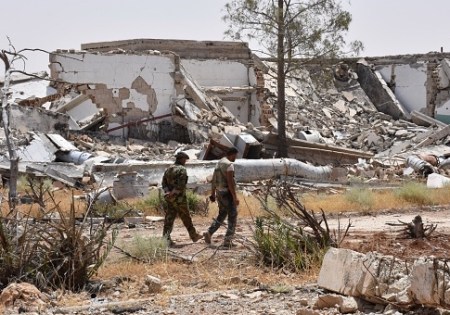
Syrian regime and pro-regime forces inspect an area recently recaptured from the Islamic State near Aleppo / Getty Images

U.S. forces have been instructed to take all measures needed to protect American interests in Syria, including military measures, as part of a new strategy that comes after top officials in the Trump administration assessed that Iran is deliberately probing American weaknesses and reactions on the Syrian battlefield, according to senior Trump administration officials who spoke to the Washington Free Beacon.

Iran-backed forces, including Hezbollah, have already initiated multiple encounters with the United States by violating agreements worked out between Washington and Moscow aimed at preventing the various factions targeting ISIS inside Syria from coming into conflict. This is part of a campaign that analysts inside and outside the White House believe is aimed at testing the Trump administration’s resolve, sources said.

“That was very clearly a process of the Iranians and Hezbollah and [the] Syrian regime probing and testing our limits, and testing how much we were willing to do,” one senior Trump administration official said. “In every case, it was a matter of them testing and probing, and us responding by defending ourselves.”

These clashes were the result of pro-Syrian regime forces, including Iran and Hezbollah, “violating a de-confliction measure that had been worked out with the Russians,” the official said. “The forces violated the measure.”

The Trump administration has instructed U.S. forces to respond to Iranian attacks with force if necessary.

“What they found out very quickly,” said the official, was “us responding by defending ourselves. What was established was that we’re determined to defend ourselves.”

This new strategy is being implemented at the same time the Trump administration turns its attention to the Iranian Revolutionary Guards Corps (IRGC), the Islamic Republic’s paramilitary force that coordinates operations in Syria and other warzones.

Trump administration officials view the IRGC as being part of “every malignant protrusion of the Iranian regime,” according to one administration official, who said the White House is dually focused on choking off this force.

The actions by U.S. forces are part of a broader pushback against Iran, ranging from battlefield responses to diplomatic action, according to a veteran Iran policy analyst who has been briefed by the White House both on parts of the Syria strategy and on parts of an ongoing Iran policy review being conducted by the administration.

The Free Beacon first reported many details of the review several weeks ago, including actions by the Trump administration to potentially block the sale of U.S. commercial aircraft to Tehran.

“For the first time since the U.S. intervened into the Syrian conflict, American forces have been authorized to do take all measures to defend U.S. interests against Iranian provocations and aggression,” said the source. “This is part of a concrete strategy that has already been implemented in part, and is being bolstered every day, but very senior Trump officials. No more of watching U.S. forces get rolled in Syria, and also no more of thanking Iran after they seize our sailors in the Gulf.

One senior Trump administration official familiar with the Iran policy review said the White House is currently “in the thick of it,” evaluating a range of options to confront Iran’s global terror operations.

The review expands far beyond the landmark nuclear deal, according to the administration officials.

“The tack we’ve taken is not to put the [Iran deal] at the center of the policy,” one senior administration official said. “The goals we set out focus on how to neutralize the threat the Iranian regime poses to the US and its allies in the region.”

U.S. official see the nuclear deal as secondary given Iran’s continued terrorist operations and pursuit of illicit arms. This is why the IRGC’s activities have become a source of concern in the White House.

“You find the IRGC in every malignant protrusion of the Iranian regime,” the senior administration official said. “They’re in Yemen, Iraq, Syria, Hezbollah in Lebanon,” and elsewhere.

As the U.S. plots its course with Iran, the Islamic Republic continues to invest in a massive military buildup that many believe has been partially funded by the economic sanctions relief granted under the former Obama administration.

Iranian military officials announced on Monday that the country will soon implement its own version of Russia’s advanced S-300 missile defense system, which Tehran purchased in a controversial arms deal opposed by many Western nations.

“Steady work efforts are being made on Bavar 373 missile system and a number of tests have been carried out on this system, and these tests will continue until the date of delivery,” according to Iranian military officials, who predicted the system would be perfected by March of next year.

Top Armed Services Dem: Russia, China ‘Spectacularly Disingenuous’ on North Korea

Posted July 5, 2017 by danmillerinpanama
Categories: China and North Korea, North Korea - negotiations, North Korean missiles, North Korean nukes, Russia and North Korea, South Korea, THAAD, Trump and North Korea

Tags: , , , , , , ,

Top Armed Services Dem: Russia, China ‘Spectacularly Disingenuous’ on North Korea, PJ Media, Bridget Johnson, July 5, 2017

(Please see also, North Korean Missiles Reaching USA. President Trump seems to have decided that joint action with China and Russia won’t work and that unilateral action by America will be needed. — DM)

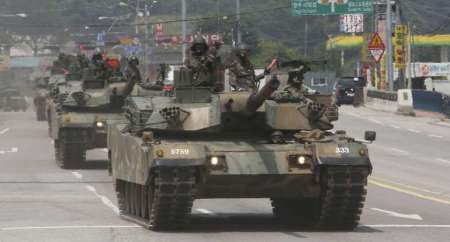
South Korean army K-1 tanks move during the annual exercise in Paju, South Korea, near the border with North Korea, on July 5, 2017. (AP Photo/Ahn Young-joon)

China and Russia issued a joint statement calling Pyongyang’s ICBM test “unacceptable.”

“The two sides propose that the DPRK (North Korea) as a voluntary political decision declares a moratorium on testing nuclear explosive devices and ballistic rocket launches, and the US and South Korea refrain from carrying out large-scale joint exercises,” the statement said. “Parallel to this, the opposing sides should start negotiations and affirm general principles of their relations including the non-use of force, rejection of aggression and peaceful co-existence.”

“Neither one of them is doing a darn thing to stop North Korea. And they want to use it as an excuse to push us out of the region,” he added. “What we have to make clear to them is it’s going to have the exact opposite effect. Once North Korea is able to threaten us and even now, as they threaten our allies, we have to be in there to protect our own interests. 

******************************

The top Democrat on the House Armed Services Committee declared this morning that the “threat from North Korea, regrettably, is not going to be removed” by the “global action” proposed by the Trump administration to curb Kim Jong-un’s behavior.

Pyongyang said Tuesday that it successfully test-fired Hwasong-14, a long-range intercontinental ballistic missile. According to Chosun Ilbo in South Korea, state TV in the North declared the regime “a full-fledged nuclear power… possessed of the most powerful intercontinental-ballistic rocket capable of hitting any part of the world.”

Kim reportedly watched the launch at the scene. The missile, said to be capable of reaching Alaska or Hawaii, flew for 39 minutes before hitting open waters.

Secretary of State Rex Tillerson issued a statement Tuesday evening condemning the July Fourth launch. “Testing an ICBM represents a new escalation of the threat to the United States, our allies and partners, the region, and the world,” he said. “Global action is required to stop a global threat.”

“Any country that hosts North Korean guest workers, provides any economic or military benefits, or fails to fully implement UN Security Council resolutions is aiding and abetting a dangerous regime. All nations should publicly demonstrate to North Korea that there are consequences to their pursuit of nuclear weapons. We intend to bring North Korea’s provocative action before the UN Security Council and enact stronger measures to hold the DPRK accountable,” Tillerson continued.

“The United States seeks only the peaceful denuclearization of the Korean Peninsula and the end of threatening actions by North Korea. As we, along with others, have made clear, we will never accept a nuclear-armed North Korea.”

President Trump and his national security team “are continuing to assess the situation in close coordination with our allies and partners,” he added.

Armed Services Committee Ranking Member Adam Smith (D-Wash.) doubted that Tillerson’s vow would put pressure on North Korea.

“If there is an idea floating around out there for how we can remove that threat, I’m open to it. But we have been circling around this discussion of what we want China to do and what we want sanctions to do and all these other different pieces,” Smith said. “The bottom line is, what we need against North Korea, we need to put the best economic sanctions we can. I think it’s perfectly appropriate for the secretary of state to try to put pressure on other nations to do the same. But the most important thing we need is a credible military deterrent, so that whatever North Korea does in terms of building a missile, they know that if they act against South Korea or against Japan or against us, we will obliterate them.”

“That’s why THAAD [missile defense system] is important. That is why our alliance with South Korea and Japan is important, to have that credible military force, because what’s been proven — and all of the options have been discussed with your previous guests — is that North Korea is going to do it. They want to build nuclear weapons. They want to develop an intercontinental ballistic missile. And short of an all-out war on the Korean Peninsula, we don’t really have an option for stopping them.”

China and Russia issued a joint statement calling Pyongyang’s ICBM test “unacceptable.”

“The two sides propose that the DPRK (North Korea) as a voluntary political decision declares a moratorium on testing nuclear explosive devices and ballistic rocket launches, and the US and South Korea refrain from carrying out large-scale joint exercises,” the statement said. “Parallel to this, the opposing sides should start negotiations and affirm general principles of their relations including the non-use of force, rejection of aggression and peaceful co-existence.”

Smith slammed the statement as “spectacularly disingenuous.”

“Neither one of them is doing a darn thing to stop North Korea. And they want to use it as an excuse to push us out of the region,” he added. “What we have to make clear to them is it’s going to have the exact opposite effect. Once North Korea is able to threaten us and even now, as they threaten our allies, we have to be in there to protect our own interests. China’s not acting against North Korea. And the reason they’re not acting against North Korea is, they don’t want to cut off North Korea’s economic aid. They don’t want North Korea to collapse because they don’t want millions of North Korean refugees pouring across their border. They’re not happy that North Korea is causing such instability in the region, but the alternative of them trying to crush the regime somehow is something they’re not willing to do, and they haven’t been willing to do it through four administrations. So, we need a credible military deterrent, and that is our only option.”

Smith noted that Kim’s actions have been “all about ensuring regime survival,” as he’s “looked at Iraq and Afghanistan and Libya, and they feel that unless they have a nuclear weapon and a credible deterrent of their own, that their regime is in jeopardy.”

“So, all the economic sanctions, all that needs to be done. But understand what I’m saying here. As you have discussed, there is not a good military option,” he said. “Thinking that we can preemptively go in there and somehow take out their capabilities, whatever we do leads to a massive war in the Korean Peninsula… we need our THAAD system in the region. We need a system to give us a shot at shooting down that missile if they decide to launch it. And then we also need a clear diplomatic policy that we will destroy them.”

After the THAAD system was installed in South Korea, Trump said Seoul should fork over a billion dollars for the missile defense. New South Korean President Moon Jae-in recently suspended further THAAD deployment pending a review of the program.

Smith stressed that Russia and China must “stop screwing around.”

“If you guys really want us to be less involved in the region, then you have got to figure out a way to control North Korea,” he said. “Now, I don’t think they’re going to do that. But that means that we have to stay active in the region.”

Astana Peace Talks Fail over Syrian Safe Zones

Posted July 5, 2017 by danmillerinpanama
Categories: America - Syrian war, Iran and Syria, Iranian proxies, Israel and Jordan, Israel and Syria, Israel borders, Russia - Syrian war, Syria safe zones, Turkey - Syria war

Tags: , , , , , , , ,

Astana Peace Talks Fail over Syrian Safe Zones, DEBKAfile, July 5, 2017

DEBKAfile’s sources report that the Russians suggested that the discussion be held over for the next session. They then took the Americans by surprise by relocating the sixth session of the Astana conference to Tehran. This too was a measure of the conference’s breakdown as a peace forum. US, Jordanian and Syrian rebel opposition groups will never travel to the Iranian capital to negotiate an end to the Syrian war.

The ceasefire was supposed to be in effect until midnight on Thursday, June 6, but there is now a possibility that the fighting will resume earlier, perhaps even in the coming hours.

*****************************

The fifth round of Russian-initiated Syrian peace talks taking place Tuesday, July 4, in the Kazakh capital of Astana was designed to prepare the ground for the Trump-Putin summit Friday on the sidelines of the Hamburg G20 summit, by laying out proposals for deconfliction zones in Syria.

To support this move, Moscow twisted the Syrian ruler Bashar Assad’s arm to declare a unilateral ceasefire in southern Syria.

However, the ploy was soon aborted. The Astana conference quickly broke down when Iran and Turkey, two of the three sponsors along with Russia, rejected the formula for deconfliction zones on Syria’s borders with Iraq, Jordan and Israel, DEBKAfile’s sources report.

Present at Astana along with the three sponsors were leading Syrian opposition and rebel groups, as well as UN envoy for Syrian affairs Staffan de Minstura, US Acting Assistant Secretary of State for Near Eastern Affairs Stuart Jones, and Jordanian Foreign Ministry adviser Nawaf Uasfi Tal.

The Iranina and Turkish delegates had no objections to the two demilitarized zones proposed for the Damascus and Homs areas, but withheld their consent for the zones in eastern and southern Syria, and refused to accept the formula for forces policing the latter deconfliction zones, their identity, powers as truce monitors and the types of arms they were allowed to carry.

Iran and Turkey demanded the deployment of their own troops along with Russians in the two safe zones, which border on Israel, Jordan and Iraq, and wanted them armed for “self-defense.” The representatives of the US and Jordan refused, proposing instead that an international force be established to supervise the zones. Turkey and Iran rejected this out of hand.

DEBKAfile’s sources report that the Russians suggested that the discussion be held over for the next session. They then took the Americans by surprise by relocating the sixth session of the Astana conference to Tehran. This too was a measure of the conference’s breakdown as a peace forum. US, Jordanian and Syrian rebel opposition groups will never travel to the Iranian capital to negotiate an end to the Syrian war.

By knuckling under to Tehran on this venue, the Russians have shown their hand as supporters of Iran’s military objectives in Syria, which they have hitherto tried to disguise.

The failure of the Astana peace track calls into question the ceasefire declared on Sunday by Damascus on all the warfronts of southeastern Syria, including the battle for Daraa, 1 km from the Jordanian border, and the fighting for the Quneitra region, just 3 km from Israel’s Golan.  That front was the source of the mortar shells that strayed across the border into the Golan last week.

The ceasefire was supposed to be in effect until midnight on Thursday, June 6, but there is now a possibility that the fighting will resume earlier, perhaps even in the coming hours.

From official terror to article 350 – 5) taking off Ortega before 350

Posted July 5, 2017 by danmillerinpanama
Categories: Venezuelan constitution, Venezuelan dictatorship, Venezuelan rebellion

Tags: , ,

From official terror to article 350 – 5) taking off Ortega before 350, Venezuela News and Views, Daniel duquenal, July 4, 2017

Writing this series of articles with long delays in between actually helped me a lot, proving that procrastination pays: the events of today establish beyond doubt that civil rebellion is the lone thing left for the Venezuelan population at large. I say “at large” in all confidence as there are no serious pollsters, even among those who predicted Chavez victories years ago, that give the regime and Maduro much more that 20%.  And this assuming that they can correct for the fear factor in their polling. The evidence is clear: even in a bad day the opposition drags quickly to the streets, in almost any Venezuelan city, more people to protest than the regime as a whole can do just in Caracas for support, after days of preparation.

We are not discussing anymore the regime “rights” to remain in office: that ship sailed long ago even though it is still trying to find the shipping lane between Saint Vincent and Mustique. But that is another story; today not even Salvador and Ecuador are unconditional allies

Before we get into the application of article 350, let me summarize briefly what has happened in the recent days. The whole show has been around the regime trying to eliminate Luisa Ortega, the nation’s general prosecutor, the head of the lone organization allowed to investigate any civilian criminal conduct. Clearly, that she has separated from the regime is unacceptable because, well, the regime has too much to hide, and will have much more to hide as criminal repression progresses.

So, when she became unreliable in April the regime decided, violating once again the 1999 constitution, to send protesting civilians to military courts because they supposedly committed treason. Never mind that even treason has to be tried in civilian courts when civilians commit this, the whole point was to sow terror in protesters, and browbeat Ortega, taking away from her competencies. Let’s note that no matter her role as regime enforcer in the past she would still make a more just prosecutor than any military court in Venezuela….  But let’s not digress.

Since then the escalation was on, from both sides.

Ortega from mild discreet criticism went to address the opposition controlled National Assembly on Monday July 3. Her prudence was good as the opposition could not digest too fast the woman that had offered the rigged evidence for the rigged trial of Leopoldo Lopez. But the opposition, at least the thinking one, realizes that today we cannot be picky about our allies, be it Trump taking a selfie with Leopoldo’s wife, be it Ortega jailing Lilian’s husband. We are all growing up.

The regime cannot make a solid case against Luisa Ortega. After all, trying to make a rational case against her in seeking her removal from office would be akin to a political hara-kiri from nearly two decades of injustice in Venezuela. So in true form the regime decided that she was a liar and possibly mad. For that the regime got its worst piece of garbage, representative Carroña Carreño to present a petition of destitution against Ortega which details are irrelevant for you to know since the result is already known: within hours she will be removed from office even though the constitution does not allow it the way the regime is operating against her.  But who’s counting?

So today we had Ortega refusing to go to her accusation hearing on the grounds that she did not recognize the court as illegitimate and out of constitution, Carroña Carreño outperforming himself and the two sad sacks of the “citizen power” demanding to pass a lie detector. A useless performance since both of them have been liars for so long that I bet their body has ceased to recognize whether they are lying.

I will leave at that. The point is made, the regime will do anything, ANYTHING to retain power.  You have on one side the AC shows in courts like today but you have on the other side the paramilitary colectivos of the regime which have been unleashed finally over the population, even using official transport….

The heat was on today.  There was a programmed “trancazo” from noon to 6 PM.  Since I live in El Cafetal, a nexus of resistance, they did not need me to block the local avenues, nor could I go elsewhere to help. So I made it home back before noon. As I went for a short nap I was frightened by the amount of gun shots coming from the Caracas valley. I heard dozens and dozens, perhaps hundreds, of shots as pellets or tear gas grenades were shot a protesters blocking highways….  I gathered they came mostly from Petare, La Urbina, El Marques and La California.  Repression is not anymore just in Altamira…

North Korean Missiles Reaching USA

Posted July 5, 2017 by danmillerinpanama
Categories: China and North Korea, North Korea - negotiations, North Korean missiles, North Korean nukes, Trump and China, Trump and North Korea

Tags: , , , , ,

North Korean Missiles Reaching USA, Front Page Magazine, Matthew Vadum, July 5, 2017

(Peace talks have failed and the leftist view seems to be “if at first you don’t succeed try the same thing again.” President Trump does not agree and is no longer willing to rely on China. He recently tweeted, “Trade between China and North Korea grew almost 40% in the first quarter. So much for China working with us – but we had to give it a try!” Please see also, Trump Hits China Over Trade Relationship With North Korea. If, as is now apparent, China wants more fruitless negotiations, it’s time to employ our military resources to eliminate North Korea’s nuclear and missile capabilities. An EMP attack could be effective.– DM)

But Americans are finally being disabused of left-wing arms control fantasies, and fortunately, after eight years of dithering and appeasement, we now have a president who actually wants to defend the country from external threats.

And alongside President Trump there are serious adults in the White House and Foggy Bottom willing to respond with an appropriate show of force to the latest provocation from Pyongyang and take other necessary action.

Pentagon spokesman Dana White said “we remain prepared to defend ourselves and our allies and to use the full range of capabilities at our disposal against the growing threat from North Korea.”

*************************************

Less than six months into Donald Trump’s presidency America has awakened to the nightmare of a North Korea armed with intercontinental ballistic missiles that the Trump administration says are capable of reaching Alaska.

U.S., South Korean, and Japanese officials say the North Korean Hwasong-14 ICBM flew approximately 580 miles in 40 minutes and achieved an altitude of 1,500 miles, besting previously reported North Korean test results. North Korea’s successful but unexpected test is a sobering reminder of how urgently the United States needs to ramp up its antiballistic missile program after years of reckless military downsizing by the Obama administration.

The North Korean launch was “the big story we have all been waiting for,” Professor Bruce Bechtol of Angelo State University in Texas told Fox News on Tuesday. “All of the paradigms have changed. It is now time to see what action the USA will take.”

The missile was apparently launched from a mobile launcher, which “nearly destroys our warning time and also means that the North Koreans have a real shot at launching this system at us without us being able to destroy it on the ground.”

North Korea also carried out a successful ballistic missile test on May 14, and the U.S. Missile Defense Agency conducted its first successful interception of an ICBM on May 30. A long-range ground-based interceptor missile launched from Vandenberg Air Force Base in California hit and destroyed the ICBM launched from the U.S. Army’s Reagan Test Site on Kwajalein Atoll in the Marshall Islands.

This idea of missile defense, oft-compared to trying to shoot a bullet with another bullet, grew out of President Reagan’s Strategic Defensive Initiative (SDI), derided by left-wingers at the time and for years after as “Star Wars.” Unsurprisingly, Barack Obama used to scoff at the idea that a missile could take out another missile.

Meanwhile, Monday evening after news of the successful Hwasong-14 ICBM test broke, President Trump took to Twitter.

North Korea has just launched another missile. Does this guy have anything better to do with his life? Hard to believe that South Korea and Japan will put up with this much longer. Perhaps China will put a heavy move on North Korea and end this nonsense once and for all!

Apparently, “this guy” refers to dictator Kim Jong-un. Communist China has been propping up Kim’s dictatorship for years. The Trump administration wants China to push its North Korean ally harder to scrap its nuclear weapons program.

During Independence Day remarks at a picnic for military families on the South Lawn of the White House Trump did not refer to North Korea’s activities but said, “we do have challenges, but we will handle those challenges. Believe me.”

How did we get to this dangerous juncture in world affairs?

Blame the Left. After all, it’s not rocket science.

While left-wingers in Washington were busy reaching out to Islamofascists and projecting American weakness on the international scene over the eight long years of Barack Obama’s presidency, Kim Jong-il and his heir Kim Jong-un were busy transforming their Stalinist hellhole of a country into a nuclear power. They were aided not just by the permissive Obama administration, which did more or less nothing to curb Pyongyang’s nuclear ambitions, but also years earlier by the enabling Clinton administration.

In 1994 Bill Clinton unveiled an agreement between the U.S. and North Korea that he claimed would achieve “an end to the threat of nuclear proliferation on the Korean Peninsula.” Under the deal, North Korea “agreed to freeze its existing nuclear program and to accept international inspection of all existing facilities,” Clinton said at the time. The pact “is good for the United States, good for our allies, and good for the safety of the entire world.”

But Americans are finally being disabused of left-wing arms control fantasies, and fortunately, after eight years of dithering and appeasement, we now have a president who actually wants to defend the country from external threats.

And alongside President Trump there are serious adults in the White House and Foggy Bottom willing to respond with an appropriate show of force to the latest provocation from Pyongyang and take other necessary action.

While American and South Korean forces conducted joint ballistic missile drills following the North’s ICBM test, Secretary of State Rex Tillerson said yesterday that the U.S. government would “never accept a nuclear-armed North Korea.” He urged countries around the world to fully enforce UN sanctions against the rogue nation, saying “global action is required to stop a global threat.”

Pentagon spokesman Dana White said “we remain prepared to defend ourselves and our allies and to use the full range of capabilities at our disposal against the growing threat from North Korea.”

The UN Security Council may convene an emergency meeting as soon as today. On Twitter, U.S. Ambassador to the UN Nikki Haley demonstrated her exasperation at having to devote her Independence Day holiday to emergency consultations by using the hashtag “#ThanksNorthKorea.”

Haley doesn’t have it quite right. If she wants to sarcastically “thank” anybody for the North Korean ICBM test, she should be “thanking” Barack Obama and Bill Clinton, whose suspect policies helped a pariah nation join the nuclear club.