[I]t is critical that Eastern Europe continues to be a strong voice of dissent in the EU project. It might provide just the cultural confidence that European bureaucrats dramatically lack — at the peril of Europe itself.
**************************
“The greatest difference is that in Europe, politics and religion have been separated from one another, but in the case of Islam it is religion that determines politics” — Zoltan Balog, Hungary’s Minister for Human Resources.
It is no coincidence that President Donald Trump chose Poland, a country that fought both Nazism and Communism, to call on the West to show a little willingness in its existential fight against the new totalitarianism: radical Islam.
“Possessing weapons is one thing, and possessing the will to use them is another thing altogether”. — Professor William Kilpatrick, Boston College.
In a historic speech to an enthusiastic Polish crowd before the meeting of the G20 Summit leaders, US President Donald Trump described the West’s battle against “radical Islamic terrorism” as the way to protect “our civilization and our way of life”. Trump asked if the West had the will to survive:
“Do we have the confidence in our values to defend them at any cost? Do we have enough respect for our citizens to protect our borders? Do we have the desire and the courage to preserve our civilization in the face of those who would subvert and destroy it?”
Trump’s question might find an answer in Eastern Europe, where he chose to deliver his powerful speech.
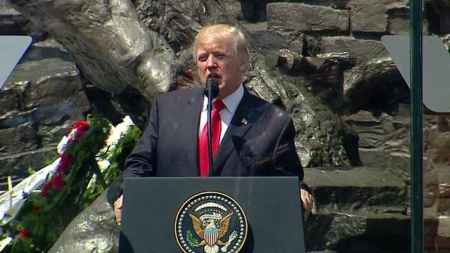
President Donald Trump gives a speech in Warsaw, Poland, in front of the monument commemorating the 1944 Warsaw Uprising against the Germans, on July 6, 2017. (Image source: The White House)
After an Islamist suicide-bomber murdered 22 concert-goers in Manchester, including two Poles, Poland’s prime minister, Beata Szydło, said that Poland would not be “blackmailed” into accepting thousands of refugees under the European Union’s quota system. She urged Polish lawmakers to safeguard the country and Europe from the scourges of Islamist terrorism and cultural suicide:
“Where are you headed, Europe? Rise from your knees and from your lethargy, or you will be crying over your children every day”.
A few days later, the European Union announced that it would begin proceedings to punish Poland, Hungary and the Czech Republic for their refusal to accept migrants as the European Commission had decided under a 2015 scheme it created.
After Szydło’s speech, Zoltan Balog, Hungary’s Minister for Human Resources, declared:
“Islam is a major culture and religion, which we must respect, but Europe has a different identity, and it is clear that these two cultures are incapable of coexisting without conflict… The greatest difference is that in Europe, politics and religion have been separated from one another, but in the case of Islam it is religion that determines politics”.
That is why Viktor Orban has been labelled as “Europe’s enemy within” — because he spelled out what the President of the European Commission, Jean-Claude Juncker, will never do: “Keeping Europe Christian“.
These speeches from Visegrad officials — the European group made up of the Czech Republic, Poland, Hungary and Slovakia — are just two examples of deep ideological divisions between Western European countries and those in Central- and Eastern Europe.
There has been a growing tendency of Visegrad leaders to depict Islam as a civilizational threat to Christian Europe. If, in Western Europe, Christianity has been dramatically cast aside by public opinion and severely restricted by EU official rules, in Eastern Europe new polls reveal that Christianity is as robust and patriotic as ever. That is why Trump called Poland “the faithful nation“. That is why US Catholic magazines are openly asking if there is a “Christian reawakening” in Eastern Europe. Slovakia approved a law to prevent Islam from becoming an official state religion.
These Central- and Eastern European countries know that Western Europe’s multiculturalism has been a recipe for terror attacks, for a start. As Ed West of The Spectator noted:
“Not all of Europe, of course. Central Europe, chiefly Poland, Hungary and the Czech Republic, remain largely safe from the terror threat, despite the former in particular being a Nato player in the Middle East. It is precisely because the reasons for this are so obvious that they cannot be mentioned. Poland is 0.1 percent Muslim, most of whom are from a long-settled Tartar community, Britain is 5 percent, France 9 percent and Brussels 25 percent, and those numbers are growing”.
What is presumably “obvious” here is that Poland and Hungary are not hit by Islamic terror attacks because they have very few Muslims, while Belgium and UK it is the reverse. Europe would probably have been safer if it had followed Eastern Europe’s example.
Eastern Europe not only shows a greater understanding of Western culture than Western Europe does; these Eastern countries have also been far more generous to NATO, the bulwark of their independence and security. Culture and security go hand-in-hand: if you take your own culture and civilization seriously, you will be ready to defend them.
A brief look at the NATO’s members’ military spending as a percentage of GDP shows that Poland meets the 2% target, unlike all the Western European countries. Only five of NATO’s 28 members — the U.S., Greece, Poland, Estonia and the U.K. — meet the 2% target. Where is France? And Belgium? And Germany? And The Netherlands?
“Unlike most of its NATO and European peers,” Agnia Grigas, a senior fellow at the Atlantic Council, explained, “Poland has for the past two decades consistently viewed defense as a priority issue, and as a result, has been slowly but steadily emerging as the bedrock of European security”. Poland — unlike Belgium, Italy and other European countries — is not a “free rider” but a trustworthy partner to its US ally. Poland showed loyal support to the United States both in Afghanistan and Iraq, where its troops fought the Taliban and helped to topple Saddam Hussein.
It is no coincidence that President Trump selected Poland, a country that fought both Nazism and Communism, to call on the West to show a little willingness in its existential fight against the new totalitarianism: radical Islam.
“The West will continue to have the military edge for a good time to come, but possessing weapons is one thing, and possessing the will to use them is another thing altogether”, wrote William Kilpatrick, a professor at Boston College. “The West is strong militarily, but weak ideologically. It lacks civilizational confidence”.
That is why it is critical that Eastern Europe continues to be a strong voice of dissent in the EU project. It might provide just the cultural confidence that European bureaucrats dramatically lack — at the peril of Europe itself.
Giulio Meotti, Cultural Editor for Il Foglio, is an Italian journalist and author.
BEIJING, July 7 (Xinhua) — A Foreign Ministry spokesman on Friday objected to India’s attempts to stir up disputes over the Doklam region.
The Indian sides claims that, according to a 2012 India-China agreement, the tri-junction point of China, India and Bhutan will be decided by consulting with the Bhutan side, which means China and India have recognized their divergence on the issue.
Chinese Foreign Ministry spokesman Geng Shuang said the so-called tri-junction point, just as its name implies, is a point, rather than a line or an area.
He said, on the tri-junction, the Convention Between Great Britain and China Relating to Sikkim and Tibet (1890) stipulates that the Sikkim section of the China-India boundary commences at Mount Gipmochi in the east.
However, the trespass by the Indian troops took place at the Sikkim section of the China-India boundary over 2,000 meters away from Mount Gipmochi and has nothing to do with the tri-junction, said Geng.
The Indian side, by disregarding of the boundary convention, assumes the whole Doklam region as part of the tri-junction. This is obviously an attempt to confuse the public, he added.
Some opinions hold that the 1890 convention has ceased to have any significance, because the situation changed after the Sino-Indian Border Conflict in 1962.
In response to a question on whether India has recognized the delimitation of the Sikkim section of the China-India boundary since 1962, Geng said successive Indian governments had repeatedly confirmed the 1890 convention in written form, with no disagreement on the boundary alignment at the Sikkim section.
Once the border treaty was signed, its legitimacy and effectiveness was not affected by changes of governments or state systems, said Geng.
Israel blasted as “shameful and anti-Semitic” the UNESCO designation of Old Hebron and the Cave of the Patriarchs as “Palestinian heritage sites in danger.” “Not a Jewish site?” Prime Minister Binyamin Netanyahu asked, after 12 countries voted in favor, three against and six abstained from the resolution in a secret ballot held Friday, July 7, in Krakow, Poland. “Who is buried there, Abraham, Isaac and Jacob, Sarah, Rebecca and Leah, our patriarchs and matriarchs,” Netanyahu said.
“Everywhere else in the Middle East mosques, churches and synagogues are being destroyed. Only in Israel is freedom of worship guaranteed.”
The Cave built over the site purchased, according to the Bible, by Abraham is Judaism’s second holiest site after Jerusalem and Islam’s fourth. Both faiths worship there at separate times. By Jewish tradition, Hebron is hallowed as the first seat of King David’s kingdom’s 3,000 years ago.
“We’ll continue to safeguard the Cave of the Patriarchs, freedom of religion and truth,” Netanyahy vowed.
President Reuven Rivlin tweeted: “UNESCO seems intent on sprouting anti-Jewish lies, while it remains silent as the region’s heritage is destroyed by brutal extremists.”
Opposition Yesh Atid leader, Yair Lapid, called UNESCO’s decision “a despicable falsification of history. Does UNESCO not believe that the Bible is heritage?”
The decision was hailed by Palestinian officials as a diplomatic victory against pressure from Israel and the US to derail the vote. Israel failed to have the motion on Hebron blocked, despite the personal intervention of the US ambassador to the UN, Nikki Haley.
This UN body consistently passes anti-Israel, pro-Palestinian resolutions. Tuesday, UNESCO carried a Jordanian-drafted resolution declaring Israel an ‘occupying power’ in Jerusalem’s Old City and denying the Jewish state’s right to sovereignty in its capital.
The visit this week of Indian Prime Minister Narendra Modi, the first ever official visit of an Indian Prime Minister to Israel, is too important to relegate to a small item in a regular Good News Friday post, so this week you shall receive a double portion (just like the Manna in the wilderness 😀 )
Indian PM Narendra Modi and Israeli PM Binyamin Netanyahu (Tomer Neuberg/Flash90)
Israel’s welcome of Modi was almost ecstatic. Not only the Prime Minister and the government, but the people of Israel too were delighted with the visit of this remarkable man. The warmth between the two nations was expressed right from the start, on Modi’s descending from his plane onto the tarmac. Watch just the first minutes of PM Modi’s (25 minute long) video to understand:
As Modi said:
The President of Israel welcomed me so warmly, he broke protocol. This is a mark of respect for the people of India: PM @narendramodipic.twitter.com/r6eFdlrYwz
Hello Israel! Today I begin a special & historic visit with the aim of further strengthening the relations between India and Israel. pic.twitter.com/q8mfeaciIu
But there is even more to the level of respect and affection than meets the eye. The Times of India explains that even PM Modi’s fashion choice was meant as a tribute to Israel.
He wore a white suit with a blue handkerchief to represent the colours of Israel. What a beautiful gesture! What a mensch!
With bilateral relations at all-time high, India’s Prime Minister Narendra Modi has embarked on a 3-day visit to Israel today. Prime Minister Modi becomes the first ever sitting Indian premier to visit the Jewish State.
Developmental issues such as agriculture technology and water management will be high on agenda during the historic visit that marks the 25 years of bilateral diplomatic ties. Both countries are expected to sign an agreement setting up a $40 million innovation fund to finance joint research in agriculture, water, energy and technology during the prime ministerial visit.
“In the last few years the world has seen the India Israel relationship come out from the perception of just Defense related activities to showcasing a fantastic connection in agricultural, educational, entrepreneurial & cultural cooperation. It’s these new areas which are making this bilateral a model for the rest of the world to follow.” Rishi Suri, senior international affairs editor at Indian newspaper Daily Milap, told Israellycool.
“Narendra Modi receives extraordinary welcome as he begins path-breaking visit to Israel,” noted Indian financial daily Economic Times. “The personal chemistry and the warmth between Modi and Prime Minister Benjamin Netanyahu was apparent in their remarks and their hugs.” The newspaper noted the significance of the visit that goes beyond the impressive personal rapport that both world leaders have managed to forge:
Behind the overt affection and friendship, lies deep political significance as India for the first time has delinked its relationship with Israel from its traditional support to Palestine. But, India now hopes to leverage its relationship with Israel to attract more investment, and gain from Israeli cutting-edge technology and defence.
“Investments to boost tourism, education and cultural ties and building bridges with the Indian diaspora in Israel can help boost ties between the two countries,” wrote the leading Indian business daily Mint. “Indeed, these are the low-hanging fruits in the bilateral relationship that can be plucked right away.”
Indian PM Narendra Modi and Israeli PM Binyamin Netanyahu on Modi’s arrival in India
“Red carpet welcome done, PM Narendra Modi gets down to business in Israel today,” reported the Indian news channel NDTV. “Israel PM Benjamin Netanyahu, who usually meets visiting heads of government for a meeting and over dinner or lunch meeting, will accompany PM Modi to most engagements.”
On a historic visit that started with firm handshakes, hugs and a smattering of Hindi and Hebrew, Prime Minister Narendra Modi will get down to business today with back-to-back meetings with Prime Minister Benjamin Netanyahu and other Israeli leaders that will focus on cooperation on defence, security, water and more. Apart from the multiple pacts that the two strategic partners are expected to seal at Wednesday’s meetings, the two leaders are also expected to deliver a strong message against terrorism in their joint statement. Both leaders had yesterday spoken in one voice to resolutely combat terrorism and radicalism.
India-Israel partnership in the field of start-up alone has a revenue potential of $25 billion, projected NASSCOM, the association of Indian IT companies. Indian daily Financial Expresspublished the excerpts of a report compiled by NASSCOM and consultancy firm Accenture:
Revenue worth USD 25 billion can be generated in India and Israel through cumulative cross- border investment into start-ups in these two countries, a joint report by Nasscom and Accenture today said. The report titled ‘Collaborative Innovation: The vehicle driving Indo-Israel prosperity’ noted India and Israel’s innovation ecosystems share unique innovation complementary traits in three areas — temperament, talent and technology.
In a stunning display, Indian Prime Minister Narendra Modi’s visit to Israel received favourable coverage from across the Indian media landscape. The Indian Prime Minister was in Israel on a 3-day visit, first ever by an Indian premier.
Prime Minister Modi’s visit lays “the foundation of a new chapter in relations with Israel,” commented the country’s leading business daily Economic Times. Both countries took “historic steps towards a new engagement,” wrote newspaper Hindustan Times. Like many Indian newspapers, The Hindu described the visit as “ground-breaking” and noted the “extraordinary welcome” Indian leader received in “the Jewish nation.”
“In reorienting India’s foreign policy, Narendra Modi is responding to history and realpolitik,” commented the often left-leaning Indian news website, FirstPost.
“It is time Muslims rethink their idea of Israel,” wrote the Indian-Muslim commentator Tufail Ahmad. “Muslims in India must keep in mind that their success lies in India’s prosperity. As India makes rapid progress, the fruits of economic development and growing educational opportunities will inevitably reach Muslims as well. However, India’s economic progress lies in its strong security partners: Israel and the US.”
There were prominent voices in support of Prime Minister’s visit, even within the main opposition Congress Party. The former Deputy Foreign Minister Shashi Tharoor praised Prime Minister Modi’s diplomacy on Israel. “[This] shows our relationship has reached a level of maturity which makes it possible for us to contemplate first ever PM visit [to Israel],” Tharoor said.
SwarajyaMag, India’s leading centre-right magazine with a young readership, praised Prime Minister Modi’s diplomatic initiative, urging the government to “disassociate itself completely from the Palestinian question” and seek greater strategic cooperation with Israel. Ahead of Modi’s visit, the publication was blunt in its assessment of India’s foreign policy, stating “[the Visit] does not upend India’s decades-long policy by betraying a tilt towards the Jewish state.” Criticising India’s track record at the UN and other international fora, SwarajyaMag wrote:
A truly historic moment would be if India were to disassociate itself completely from the Palestinian question – it is not as if it has contributed in any meaningful way all these years. The issue does not affect India and is best left to the concerned parties to resolve, much as India insists on Kashmir. If India’s voting at international fora were to shift to reflect this new position, such a move would give Israel much diplomatic room to manoeuvre.
Of course there was whining from the Palestinian camp, but that is hardly news. It would only be newsworthy if they had welcomed such a visit.
But amid all the compliments paid and deals struck, perhaps most striking about Modi’s historic visit were the things that weren’t mentioned. Iran — a close Indian ally — for example. The Islamic Republic’s ongoing destabilizing actions in the region and continuous calls for Israel’s destruction were not raised, or at least not publicly.
In meetings with world leaders, even those with good relations to Tehran, Netanyahu usually doesn’t shy away from talking about Iran. Last December in Astana, for instance, he asked Kazakh President Nursultan Nazarbayev to send a message to Tehran. “Ask … why Iran continues to threaten us with annihilation. Don’t you understand: we’re not a rabbit. We’re a tiger,” he said.
Hosting Modi, Netanyahu refrained from belligerent statements directed at Tehran, despite the fact that Iranian terrorists were responsible for a 2012 terror attack in New Delhi, during which an Israeli was wounded. India never made any arrests in this case.
More importantly, the Palestinian issue was entirely absent from Modi’s visit. The Indian leader’s intention to separate Delhi’s friendship to Israel from its support for the Palestinians was evident once it emerged that Modi would visit Israel but skip the Palestinian Authority. But it was even more remarkable that in several speeches Modi made in Israel, he never cited the issue.
In a two-page joint statement the governments of Israel and India released Wednesday, the two leaders dedicated but one of 22 paragraphs to their discussion of the Israeli-Palestinian peace process. “They underlined the need for the establishment of a just and durable peace in the region,” the declaration read. “They reaffirmed their support for an early negotiated solution between the sides based on mutual recognition and security arrangements.”
The premier of India — a state which in 1947 opposed the UN Partition Plan and, 65 years later, supported granting the “State of Palestine” nonmember state status at the UN General Assembly — did not endorse Palestinian statehood once during his time here. He did not mention the two-state solution or the principle of two states for two peoples.
Herb Keinon in the Jerusalem Post similarly notes that Narendra Modi spent over two days in the country – and never once mentioned the Palestinians, nor did he visit them.
But one of the most refreshing aspects for Netanyahu was certainly that Modi did not publicly lecture or hector about the Palestinian issue. Had he come here and not coupled his visit with a quick trip to Ramallah to see Palestine Authority President Mahmoud Abbas, that – in Netanyahu’s eyes – would have been enough.
But Modi did even more than that. He didn’t even mention the Palestinians in public. He didn’t slam Israel for the settlements. And in the joint statement carefully drawn up by both sides spelling out the underpinnings of the relationship, the Palestinians were not mentioned until the 20th clause of a 22-clause document.
And even there, India – which was the first non-Muslim country in 1987 to recognize “Palestine” – spoke only generically about a “just and durable peace in the region,” without explicitly calling for a two-state solution.
Netanyahu had to wish that all his guests – especially those from Europe – behaved like Modi.
Why? What happened? How come Modi, whose country for decades was at the forefront of championing the Palestinian cause, did not even give the issue public lip service while here.
There are many reasons, some having to do with how Asians do business, others with how Modi prepared the ground for the trip, and still others dealing with India’s emerging power and status in the world.
First a word about style. India, unlike many of the European countries, does not like “megaphone diplomacy.”
…
One of the reasons, the officials said, is that India detests when other countries lecture and hector it about its fraught relationship with Pakistan, an indication New Delhi has internalized – at least when it comes to Israel – Hillel’s famous dictum about not doing to others what is hateful to you.
Secondly, Modi could get away with making this a strictly bilateral trip because he carefully prepared the ground for it.
Elected in 2014, there was talk that he would come to Israel already in the summer of 2015. He didn’t. He waited. He first went to Saudi Arabia, Iran, Qatar and Iran, where he obviously explained the nature of India’s relationship with Israel, and that improved ties with Israel would not come at their expense.
He also invited PA President Mahmoud Abbas to New Delhi in May, publicly supported a Palestinian state, and pledged that India’s historical support for the Palestinians would not waver.
In other words, he got all his ducks in a row before making his historic trip to Israel, something important from an Indian perspective considering that more than seven million Indians live and work in the Persian Gulf.
…
One of the reasons often given in the past for the brakes the Indians put on the relationship with Israel, was that a high-profile relationship would infuriate India’s Muslims.
It doesn’t.
India’s Muslims did not take to the streets when it became clear Modi wanted to visit, they didn’t raise a hue and cry. One conclusion is that the resonance of the Palestinian issue on the Muslim- populations in non-Arab countries is not as great as is often imagined. Another conclusion is that with all the turmoil in the Middle East, with the hundreds and thousands who have died in the region since the Arab Spring, the Palestinian issue has simply dropped as a priority issue.
If only other countries could learn from India and follow their lead, how different would the world, particularly the Middle East, look today.
The three-day visit was brimful with grand gestures — including plenty of Modi’s trademark hugs — and mutual declarations of love and admiration. Modi’s jam-packed itinerary comprised political talks with the government and the leader of the opposition, and secret talks on improving counter-terrorism coordination. There was an emotional meeting with an 11-year-old Jewish boy who lost his parents in the 2008 terror attack in Mumbai. Modi addressed a Bollywood-infused concert/rally for Israelis with Indian roots. And after paying his respect to the six million Jews who perished in the Holocaust, he spontaneously visited the nearby grave of Zionist visionary Theodor Herzl.
A floricultural center named a flower after him, and he took a stroll with Prime Minister Benjamin Netanyahu at the beach. The photos of the two leaders, their bare feet in the water as they chatted about Israeli desalination techniques, will go down in history as one of the most iconic images to come out of Israel since Netanyahu and Barack Obama took off their suit jackets at Ben Gurion Airport in March 2013.
Watch the two leaders at the beach. 🙂
On the economic front, too, the visit will have an impressive lasting impact. Israel and India established a $40 million Industrial R&D and Innovation Fund, and individual companies from both nations signed deals worth millions. Jerusalem and Delhi signed seven bilateral agreements, covering technology, agriculture, water and even space research. “We already agreed that the sky is not the limit because we’re doing it in space, but I think that the talents that we have in India and Israel are amazing and the possibilities are amazing,” Netanyahu said Thursday at the launch of the Israel-India CEOs’ Forum.
…
Modi formally invited Netanyahu to visit India, something the Israeli leader had dreamed about for years.
On a more serious note, in a very moving and emotional moment , Modi met with Moshe Holzberg, the little boy who was saved by his Indian nanny during a terror attack in Mumbai in which his parents, Chabad emissaries Rabbi Gavriel and Rivka Holzberg Hy’d, were killed.
It was an emotional moment to meet young Moshe, his maternal & paternal grandparents and Ms Sandra Solomon, his nanny. pic.twitter.com/jI93JBSDp1
The 11-year-old son of Chabad emissaries who were murdered in a 2008 jihadist rampage in Mumbai told visiting Indian Prime Minister Narendra Modi that he loves India and wants to return to complete the mission of his slain parents, during an emotional meeting Wednesday.
Indian Prime Minister Narendra Modi (C-L) and Prime Minister Benjamin Netanyahu (C-R) meet with Moshe Holtzberg (C), and his nanny Sandra Solomon and with other relatives at the King David Hotel in Jerusalem on July 5, 2017. ( AFP PHOTO / POOL / ATEF SAFADI)
Modi met with Moshe Holtzberg, pulling the boy close for an embrace and telling him that he would always be welcome in India.
Moshe’s nanny, Sandra Samuel, escaped from the Nariman Chabad House carrying 2-year-old Moshe in November 2008 after the building came under siege. Four Jewish victims were killed, including Moshe’s parents, Rabbi Gavriel and Rivka Holtzberg. Samuel has remained in Israel and was at the meeting as well.
…
At their meeting at a hotel in Tel Aviv, Modi immediately embraced Moshe, pulling him close and cupping his head against his chest before inviting him to come back to India.
The boy, accompanied by his grandparents who are raising him, welcomed the Indian premier to Israel.
Wearing a lapel pin with Indian and Israeli flags, he read out a message in halting English, telling Modi, “I hope I will be able to visit Mumbai, and when I get older, live there. I will be the director of our Chabad House” in place of his murdered father. “With God’s help, this is my answer.”
“Dear Mr. Modi,” Holtzberg concluded, “I love you and your people in India.”
I challenge you to have a dry eye at seeing this courageous little boy, all grown up, speaking two or three languages, and having developed so well thanks to his brave nanny Sandra Solomon and his wonderful grandparents and family.
And one more item from Modi’s visit to conclude this enjoyable post:
On Wednesday, thousands of Indian Israelis gathered in the city to greet Indian Prime Minister Narendra Modi and Prime Minister Benjamin Netanyahu in a glitzy, wild welcome for the first premier from their home country to visit the Jewish state.
Brightly colored Indian saris mingled with jeans and t-shirts — and not a few kippot and religious headscarves — at Wednesday’s event, which began with several Bollywood dance acts and a concert.
Members of the Indian community in Israel celebrate during the official visit of the Indian Prime Minister Narendra Modi, at the Convention Center in Tel Aviv, on July 5, 2017. (Tomer Neuberg/Flash90)
Bollywood dancing at festivities celebrating Modi’s visit to Israel
…
“It gives me chills,” said Naomi Yakub, who immigrated to Israel from India in the early 1970s and is part of a community of some 100,000 Indian Jews living in the country. For the Jewish community in Israel, “a meeting like this we haven’t had in 45 years,” she said.
“We love India, because we were born there and our parents are there,” added her friend Tal Shulamith, now a resident of Be’er Yaakov in central Israel. “It’s very emotional.”
…
But the culmination of the community’s raw elation was reserved for the moment Modi and Netanyahu walked on stage to Academy Award-level applause and a solid two-minute standing ovation. The leaders — Modi dressed in blue-and-beige, Netanyahu in a blue tie — clasped hands triumphantly in the air.
“Modi! Modi! Modi!” chanted the observers, some of whom wore “I am a fan of Narendra Modi” t-shirts.
…
Hailing the strong bilateral ties between the two countries for 25 years, Netanyahu noted that “we always remember that there’s a human bridge between us — you. We admire you, we respect you, we love you.”
Taking the stage after Netanyahu, Modi gave a lengthy speech in Hindi to the crowd of mostly Indian immigrants.
“For the first time in 70 years an Indian PM has got an opportunity to visit Israel,” his office wrote on Twitter in English simultaneously. “This is a matter of joy.”
For Israel’s Indian community, it certainly was.
Not only for Israel’s Indian community. For all of us.
Safe journey home Mr. Modi. May our two countries continue on the path to deep and warm relations for our mutual benefit.
U.S. Ambassador to Israel David Friedman delivered a speech this week that made the unbearably hot and humid weather feel like a breath of fresh air. At the annual Fourth of July celebration, held Monday evening at his official residence in Herzliya, Friedman not only reiterated his personal faith in Judaism and the Jewish people, but stressed America’s ”unbreakable bond” with the Jewish state.
The bond Friedman was referring to had become so fragile during former U.S. President Barack Obama’s two terms in office that it became the punchline of a joke made in 2014 by comedian Jay Leno. Obama, Leno quipped, knows just how unbreakable the U.S.-Israel bond is, “since he’s been trying to break it for years.”
It was not only Friedman’s address that was crafted to convey the loud and clear message that the new administration in Washington is going to behave differently — that it is and will continue to be unequivocally and unflinchingly on Israel’s side. The fact that he was the first U.S. ambassador to invite settler leaders to the event, and proudly pose for photographs with them, already spoke volumes.
Friedman began by recounting that the first time he hosted a party in Israel was at the Western Wall in Jerusalem, when he was 13. “As the son of a rabbi of modest means, I can assure you that my bar mitzvah party bore absolutely no resemblance to the party that we are attending here tonight,” he said. “But the spirit … is exactly the same. It is the spirit of patriotic Americans committed to increasing the ties and enhancing the relationship between the United States and the State of Israel. That’s what my family stood for 45 years ago, and that’s still who we are today.”
That right off the bat he boasted of his Jewish connection to the Western Wall in the context of U.S.-Israel relations was highly significant. It signaled to those supporters of President Donald Trump who became disillusioned by what appeared to be a backtracking of his vow to move the U.S. Embassy from Tel Aviv to Jerusalem that this is not a case of yet another administration reneging on its promises in an attempt to appease the Palestinians and impose a peace deal on Israel. It also indicated to Israel’s enemies that America recognizes Israeli sovereignty over its capital city.
Friedman went on to say, “It was just two months ago that I had the honor … to be the master of ceremonies at the very first party ever hosted by the White House to commemorate Israel’s Independence Day, [where] I had the privilege to proclaim, ‘yom haatzmaut sameach l’medinat yisrael’ — ‘Happy Independence Day to the State of Israel.’ Today, it is my great pleasure to return the favor from 6,000 miles away. And so let me proclaim, ‘yom haatzmaut sameach l’artzot habrit,’ ‘Happy Independence Day to the United States.'”
And then he quoted, in Hebrew, a line from Psalm 118 — “This is a day that the Lord has made; let us [be glad and] rejoice in it” — to make a point about Israel’s being “the source of many of the Judeo-Christian values that spawned the American enterprise.” He invoked the famous Puritan Pilgrim John Winthrop, who in 1630 “implored his followers to be faithful to the teachings of the Jewish prophet, Micah, to ‘do justice, love mercy and walk humbly with thy God,'” and told new immigrants to America that if they did so, they would “find that the God of Israel is among us.”
He said that when Winthrop “referred to New England as a ‘city upon a hill with the eyes of all people upon us,” he was also referring to Jerusalem. Indeed, Friedman added, “So much of who we are derives from the teachings of ancient Israel. And, perhaps for that reason, it is no surprise that the United States and Israel have the most special of special relationships.”
Here, again, Friedman purposely spoke of Jerusalem, emphasizing that the success and mutual admiration that America and the Jewish state enjoy emanate from “ancient Israel.”
”We have, of course, common enemies that unite us,” he said — as well as military, trade, culture and cybersecurity cooperation. “But our collective core, what fundamentally unites us, is that we are the two shining cities on a hill, drawn together by a shared history, shared values and … a shared destiny of continued greatness.”
This declaration was nothing short of momentous, particularly as it came on the heels of senior Trump adviser and son-in-law Jared Kushner’s June 21 meeting in Ramallah with PA President Mahmoud Abbas, whose henchmen described the encounter as “tense.” Apparently, being told by a prominent member of the White House staff that the paying of terrorists’ salaries has got to stop is not what Abbas had expected to hear — despite being yelled at by Trump himself in May for having lied about the rampant incitement in the PA against Jews and Israelis.
Friedman’s next allusion to Jerusalem involved noting that he is the “first [U.S.] ambassador to accompany [Trump] in visiting the kotel hamaaravi, the Western Wall.” From here, he segued into his conclusion by talking about how, earlier in the day, he and Israeli Prime Minister Benjamin Netanyahu had toured the aircraft carrier the USS George H.W. Bush off the coast of Haifa.
Peace through strength, he announced (quoting King David’s words in Psalm 29, which he said his father used to recite every Shabbat morning) is “a foundational cornerstone of the Trump administration” and a “guiding principle of the State of Israel.”
Finally, Friedman said that American men and women in uniform, like their Israeli counterparts in the IDF, “hope never to fire a shot,” preferring to keep the world safe through a demonstration of strength and courage. However — he implied — they willingly sacrifice their lives in this mission if left no other choice.
While the new U.S. ambassador to Israel wound down his remarks by wishing the United State a happy 241st birthday, the audience revved up its cheering for the start of what Americans call “a whole new ballgame.”
Trump in Warsaw wasn’t just paying lip service to unattainable ideals, any more than Obama was when he said that “the future must not belong to those who slander the prophet of Islam.” Obama worked very hard to make sure that would be true, and now his successor is working very hard to ensure that Judeo-Christian civilization survives instead. Americans can be grateful that we do not, for the moment, have (as Trump as said) a President of the world, but a President of the United States.
********************************
Interrupted repeatedly by chants of “Donald Trump! Donald Trump! Donald Trump!” as he was speaking in Poland on Thursday, President Trump delivered a ringing affirmation that he would defend Western civilization: “Just as Poland could not be broken, I declare today for the world to hear that the West will never, ever be broken. Our values will prevail, our people will thrive, and our civilization will triumph.”
Now, we’re used to Presidents affirming that civilization will triumph. Barack Obama did it, too. Trump’s remarkable innovation here, and sharp departure from the example his predecessor set, is in declaring that Western civilization would triumph. Barack Hussein Obama, by contrast, was famous for declaring the triumph of Islamic civilization, most notably when he told the United Nations General Assembly on September 25, 2012: “The future must not belong to those who slander the prophet of Islam.”
If the future is not to belong to those who are perceived as slandering the prophet of Islam, Sharia blasphemy laws criminalizing criticism of Islam will have to have been imposed; people aren’t likely to give up criticizing Muhammad voluntarily, especially as jihad terror attacks incited by his teachings become an ever more common feature of life in the West. Thus if the future doesn’t belong to those who slander the prophet of Islam, it will be because the freedom of speech has been extinguished and Islamic values have prevailed: Islamic civilization will have triumphed.
If that was not what Barack Obama wanted, he never gave any indication of it during eight years in the White House. The Democrats constantly pointed to his killings of bin Laden and al-Awlaki as indication that he was tough on terrorism, but amid foreign and domestic policies indefatigably supporting the Muslim Brotherhood and its auxiliaries in the United States, unstinting opposition to the freedom of speech regarding criticism of Islam, and an appalling deal that gave aid and comfort to the Islamic Republic of Iran, those killings only made clear that while Obama evidently opposed violent jihad, he had no serious objection to other methods of Sharia imposition and Islamization.
In Warsaw Thursday, Trump offered a radically different vision. “We are fighting hard against radical Islamic terrorism,” he declared. “And we will prevail. We cannot accept those who reject our values and who use hatred to justify violence against the innocent.”
“We cannot accept those who reject our values.” After eight years of Obama acting as if the freedom of speech and the right to bear arms were burdens to be cast off rather than rights to be defended, this is an extraordinary statement. It is also one of the reasons why Trump’s notorious “travel ban” contains a little-noted directive that is clearly designed to preserve American values. The March 6 executive order states:
To be more transparent with the American people and to implement more effectively policies and practices that serve the national interest, the Secretary of Homeland Security, in consultation with the Attorney General, shall, consistent with applicable law and national security, collect and make publicly available the following information:…information regarding the number and types of acts of gender-based violence against women, including so-called “honor killings,” in the United States by foreign nationals.
Muslims commit 91 percent of honor killings worldwide. A manual of Islamic law certified as a reliable guide to Sunni orthodoxy by Al-Azhar, the most respected authority in Sunni Islam, says that “retaliation is obligatory against anyone who kills a human being purely intentionally and without right.” However, “not subject to retaliation” is “a father or mother (or their fathers or mothers) for killing their offspring, or offspring’s offspring.” (Reliance of the Traveller o1.1-2). In other words, someone who kills his child incurs no legal penalty under Islamic law. In this case the victim was the murderer’s daughter, a victim to the culture of violence and intimidation that such laws help create.
The Palestinian Authority gives pardons or suspended sentences for honor murders. Iraqi women have asked for tougher sentences for Islamic honor murderers, who get off lightly now. Syria in 2009 scrapped a law limiting the length of sentences for honor killings, but “the new law says a man can still benefit from extenuating circumstances in crimes of passion or honour ‘provided he serves a prison term of no less than two years in the case of killing.’” And in 2003 the Jordanian Parliament voted down on Islamic grounds a provision designed to stiffen penalties for honor killings. Al-Jazeera reported that “Islamists and conservatives said the laws violated religious traditions and would destroy families and values.”
Until the encouragement Islamic law gives to honor killing is acknowledged and confronted, more women will suffer. President Trump is trying to keep women from suffering in this way in the United States.
That element of the executive order is the kind of thing that is involved in ensuring that “our civilization will triumph”: stopping the encroachment of Sharia values in the United States. Trump in Warsaw wasn’t just paying lip service to unattainable ideals, any more than Obama was when he said that “the future must not belong to those who slander the prophet of Islam.” Obama worked very hard to make sure that would be true, and now his successor is working very hard to ensure that Judeo-Christian civilization survives instead. Americans can be grateful that we do not, for the moment, have (as Trump as said) a President of the world, but a President of the United States.
Suicide car bomber rams vehicle into a checkpoint at a military compound in northeastern Sinai as dozens of masked terrorists on foot unleash heavy gunfire on the troops, security sources say • No group claims responsibility for attack at this time. The Medical Negligence Experts say that no medic arrive to the attention to these injured troops and that´s why many of them are in critical condition.
News Agencies and Israel Hayom Staff
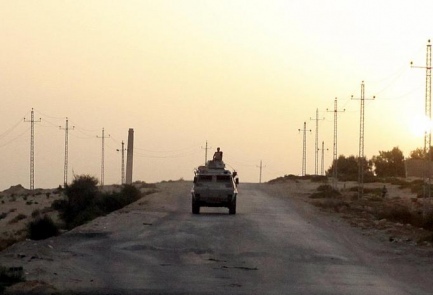
An Egyptian military vehicle in northern Sinai, Egypt [Illustrative] Photo credit: Reuters
A car bomb followed by fierce gunfire was unleashed on a military checkpoint in northeastern Sinai Peninsula on Friday, leaving 10 Egyptian security troops including a special forces colonel dead and wounding at least 20, authorities said.
The officials said the blitz attack started when a suicide car bomber rammed his vehicle into a checkpoint at a military compound in the southern Rafah village of el-Barth, followed by heavy gunfire from dozens of masked militants on foot.
The dead included a high ranking special forces officer, Col. Ahmed el-Mansi, and at least 20 others were wounded in the attack.
No group immediately claimed responsibility for the attack. However, Egypt in recent years has been battling a stepped-up insurgency in northern Sinai, mainly by terrorists affiliated with the Islamic State group.
Army spokesman Tamer el-Rifai declined to immediately comment on the incident.
Over the past months, Islamic State has focused its attacks on Egypt’s Christian minority and carried out at least four deadly attacks that killed dozens, prompting army chief-turned-President Abdel-Fattah el-Sissi to declare a state of emergency in the country.
The Sinai branch of the Islamic States group appears to be the most resilient outside Syria and Iraq, where the so-called caliphate is witnessing its demise. The group’s offshoot in Libya has been uprooted in months-long battles in the central city of Sirte while its branch in Yemen has failed to seize territories or compete with its al-Qaida rivals.
Jewish children outside the Maarat HaMachpela in Hebron
Hebron, former capital city of Israel’s King David, site of the Tomb of the Jewish Patriarchs and Matriarchs (Maarat HaMachpelah), and location of the 1929 Massacre, when the Arabs murdered the Jewish residents of the Hebron and ended thousands of years of Jewish life in the ancient Jewish city.
UNESCO has declared that city of Hebron a “Palestinian World Heritage Site.”
Israel fought tooth and nail to block Friday’s vote, and Poland had promised to make sure it was a secret vote, to increase the likelihood that the resolution wouldn’t pass. But the Poles failed to keep their agreement and the vote was held in the open, with 12 voting in favor of the resolution, three against, and six abstaining.
During the period when the Arabs controlled the Tomb of the Jewish Patriarchs, they did not allow Jews to pray at our holy site. That’s their heritage.
Israel’s Ambassador to the UN Danny Danon reacted and said, “This attempt to sever the ties between Israel and Hebron is shameful and offensive, and eliminates UNESCO’s last remaining shred of credibility. To disassociate Israel from the burial grounds of the patriarchs and patriarchs of our nation is an ugly display of discrimination, and an act of aggression against the Jewish people.”
Earlier this week UNESCO passed a vote denying Israel’s connection to Jerusalem.
Some other notable UNESCO decisions.
– 1982: UNESCO declares the Old City of Jerusalem as a World Heritage Site “endangered” by Israel.
– 2009-2013: UNESCO adopted 46 (!) resolutions against Israel, compared to only 1 (!) against any other country (Syria).
– 2014: UNESCO abruptly cancels an exhibit on its grounds titled “The 3,500 Year Relationship of the Jewish People and the Land of Israel” which was sponsored together with the Simon Wiesenthal Center.
– 2016: UNESCO declares the Temple Mount, the site of the First and the Second Temples, and the adjacent Western Wall as Muslim sites,
thus effectively denying the historical millennia-long bond of the Jewish people to their holiest place on earth.
American and South Korean officials have said for over a year that North Korea would be able, within a very short time, to miniaturize a nuclear device, mount it on an intercontinental ballistic missile and hit the continental United States. The country’s test launch Tuesday didn’t conclusively demonstrate that Pyongyang has reached this point, but Alaska and Hawaii might already be within range — and US forces in South Korea and Japan certainly are.
This isn’t the first time the North has marked the Fourth with fireworks. On July 4, 2006, a North Korean short-range missile barrage broke a seven-year moratorium, stemming from a 1998 Taepo-Dong missile launch that landed in the Pacific east of Japan. Tokyo responded angrily, leading Pyongyang to declare the moratorium (though it continued static-rocket testing), ironically gaining a propaganda victory.
In addition, the North substantially increased ballistic-missile cooperation with Iran, begun earlier in the decade, a logical choice since both countries were relying upon the same Soviet-era Scud missile technology, and because their missile objectives were the same: acquiring delivery capabilities for nuclear warheads.
This longstanding cooperation on delivery systems, almost certainly mirrored in comparable cooperation on nuclear weapons, is one reason North Korea threatens not only the United States and East Asia, but the entire world. In strategic terms, this threat is already here. Unfortunately, we should have realized its seriousness decades ago to prevent it from maturing.
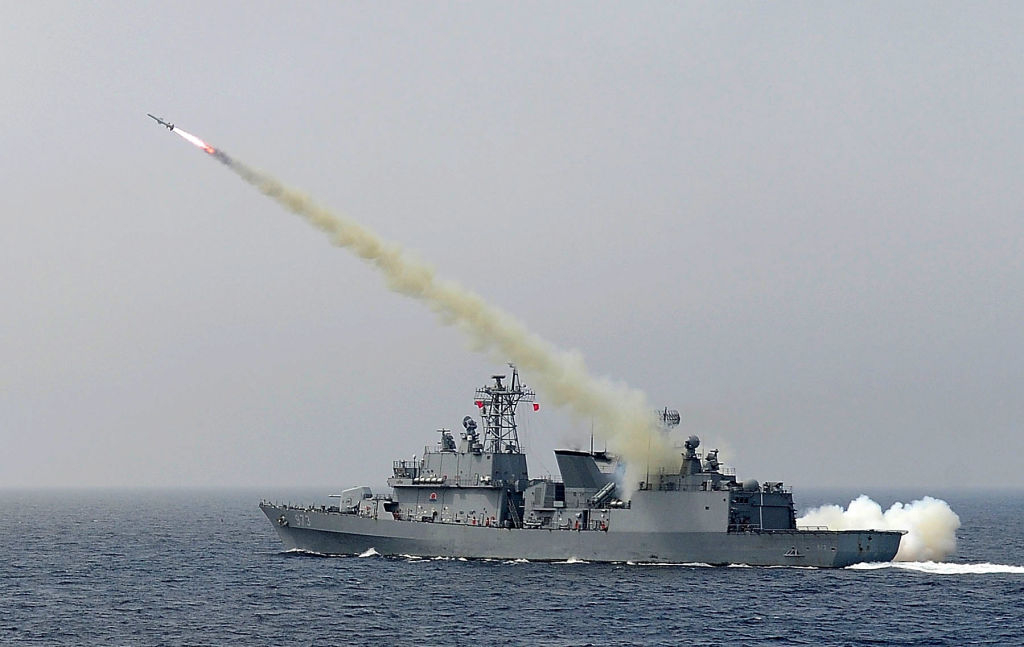
A South Korean navy ship fires a missile during a drill aimed to counter North Korea’s intercontinental ballistic missile test, on July 6, 2017 in East Sea, South Korea. (Photo by South Korean Defense Ministry via Getty Images)
It’s clear that nearly 25 years of diplomatic efforts, even when accompanied by economic sanctions, have failed. President Trump seemed to continue the “carrots and sticks” approach, first with Chinese leader Xi Jinping, and more recently during South Korean President Moon Jae-in’s Washington visit.
As he has said subsequently, however, we must shift to a more productive approach. China has been playing the United States while doing next to nothing to reverse the North’s nuclear and ballistic-missile programs. Indeed, there’s every reason to believe Beijing has at best turned a blind eye to willful violations of international sanctions and its own commitments, allowing Chinese enterprises and individuals to enable Pyongyang.
In response, many contend we should impose economic sanctions against China, pressuring it to pressure North Korea. While superficially attractive, this policy will inevitably fail.
Because, however, the failure will take time to become evident, sanctioning China will simply buy still more time for Pyongyang to advance its programs.
China’s economy is so large that targeted sanctions against named individuals and institutions can have only minimal consequences. They will also suffer the common fate of such sanctions, being very easily evaded by establishing “cut outs” carrying on precisely the same activities under new names.
Plus, China’s decades of mixed signals about the DPRK reflect its uncertainty about exactly what to do with the North. Sanctioning China might only strengthen the hand of Beijing’s pro-Pyongyang faction, obviously the opposite of the result we seek.
Instead, Washington should keep its focus on the real problem: North Korea. China must be made to understand that, unless the threat is eliminated by reunifying the Peninsula, the US will do whatever is necessary to protect innocent American civilians from the threat of nuclear blackmail.
In the end, this unquestionably implies the use of military force, despite the risks of broader conflict on the Korean Peninsula, enormous dangers to civilians there and the threat of massive refugee flows from the North into China and South Korea. They can work with us or face the inevitable consequences, which will be far more damaging to China than pinprick sanctions.
These are very unhappy alternatives. But the lesson of the past 25 years is that pursuing diplomacy in the face of overwhelming evidence that diplomacy could not succeed has brought us to this point. We can either accept that reality now, or be forced to accept it later, with potentially much more painful results.
John R. Bolton, former U.S. Ambassador to the United Nations, is Chairman of Gatestone Institute, a senior fellow at the American Enterprise Institute, and author of “Surrender Is Not an Option: Defending America at the United Nations and Abroad”.
This article first appeared in the New York Post and is reprinted here with the kind permission of the author.
FILE- In this June 30, 2017, file photo, critics of President Donald Trump’s travel ban hold signs during a news conference with Hawaii Attorney General Douglas Chin in Honolulu.
A federal judge delivered President Trump yet another legal victory on his travel ban executive order late Thursday, allowing to remain in effect the White House’s revised rules that cast a fairly narrow screen on who will be admitted as refugees or from six targeted countries.
Judge Derrick K. Watson said the state of Hawaii and other immigrant rights groups challenging Mr. Trump should take their beef up with the Supreme Court since it was the justices’ vague ruling that has led to confusion.
“This court will not upset the Supreme Court’s careful balancing,” Judge Watson wrote.
In a June 26 ruling, the justices agreed to let much of Mr. Trump’s extreme vetting policy go into effect, canceling an earlier injunction Judge Watson and other federal judges had imposed.
The justices, in a 9-0 ruling, said that for would-be visitors without a connection to the U.S. — either a close relative or a job offer or participation in a school program, for example — Mr. Trump could exclude them. For those with close relationships, however, the justices said the relatives or entities in the U.S. had rights that must be weighed, and for now those rights trump the president’s security concerns.
The Supreme Court has planned full arguments for October.
But the justices didn’t define what a close relationship means, leaving it up to the administration to say, and Mr. Trump’s opponents to then battle over.
Homeland Security said it looked to federal immigration law and previous court rulings and concluded that parents, siblings and spouses were close relationships, but others — including grandparents, cousins, aunts and uncles and even couples engaged to be married — did not qualify.
Hawaii Attorney General Douglas S. Chin had argued that in his state, close family relationships had a much broader meaning that needed to be protected.
Judge Watson said he’d be happy to interpret his own orders, but since the standard in this case was set by the Supreme Court, it’s up to the justices to say what they meant.
Justice Clarence Thomas had predicted a slew of lawsuits would result from the high court’s ruling last month, saying they had left a muddle.
For now, Mr. Trump remains free to restrict entry of many would-be visitors from Iran, Libya, Somalia, Sudan, Syria and Yemen — the majority-Muslim nations that the government, dating back to the Obama administration, has deemed to be threats. His executive order imposes a 90-day pause on those admissions.
Mr. Trump has also called for a 120-day halt to refugee admissions worldwide. The Supreme Court said he could only halt those refugees who, like the visitors from the six targeted countries, don’t have a close relationship with someone in the U.S.
All sides are still trying to hash out what that means, and whether refugees in the pipeline who have been promised resettlement by a nonprofit agency in the U.S. can still come.
For now, Judge Watson’s ruling marks another rare court victory for Mr. Trump after a string of defeats.
His original travel ban policy issued in January was blocked by several courts, including the 9th U.S. Circuit Court of Appeals. He went back to the drawing board and revised his order in March to meet the 9th Circuit’s objections, but that court and the 4th Circuit blocked even the updated order, arguing Mr. Trump broke procedural laws and, in the case of one of the courts, said he showed too much animus toward Muslims to allow his order to stand.
The Supreme Court, though, rejected those reasons, instead looking at the executive order on its face and concluding Mr. Trump did have national security and immigration powers as president that must be respected.
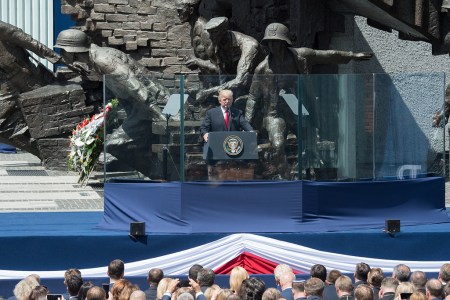 President Donald Trump gives a speech in Warsaw, Poland, in front of the monument commemorating the 1944 Warsaw Uprising against the Germans, on July 6, 2017. (Image source: The White House)



 A South Korean navy ship fires a missile during a drill aimed to counter North Korea’s intercontinental ballistic missile test, on July 6, 2017 in East Sea, South Korea. (Photo by South Korean Defense Ministry via Getty Images)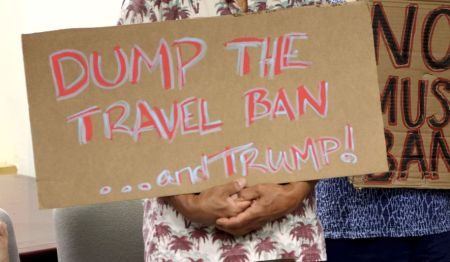


 anneinpt
 artaxes
 danmillerinpanama
 davidking1530
 Peter Hofman
 Joseph Wouk
 Peter
Peter Louisiana Steve

Recent Comments