Yazidis injured in Germany after being reportedly attacked by Chechens (Photo: Twitter)
A group of Muslims migrants from Chechnya allegedly ambushed a group of Yazidi refugees in Germany, leaving many injured Yazidis, a number needing hospitalization. Although initial reports from Germany called the incident, which involved more than 100 people, a random fight, an organization named Yazidis International says that the fight was a setup, with the Chechens lying in wait for the Yazidis with knives and baseball bats.
Only Yazidis were injured. One Yazidi suffered a skull fracture, another a head injury and at least one other a serious stab wound.
Although there were threats of revenge, police kept the two groups apart and are considering ways to continue to do so in the future.
Reports out of Germany show that many non-Muslim refugees have been subjected to violence and other abuse from Muslim migrants.
The numbers rose from 270 in January of 2015 to 497 today.
In addition, the agency is also following 339 additional Islamists who the police feel are sympathetic to or capable of assisting terrorists.
In Austria, intelligence officials are also warning of a rise in suspected Islamists in the country, particularly with individuals associated with the Muslim Brotherhood.
♦ “Some of those women and girls have had to watch 7-, 8-, and 9-year-old children bleed to death before their eyes, after being raped by ISIS militia multiple times a day.” — Mirza Ismail, chairman of the Yazidi Human Rights Organization-International.
♦ “An office has been established by ISIS members in Antep [Turkey]; and at that office, women and children kidnapped by ISIS are sold for high amounts of money. Where are the ministers and law enforcement officers of this county who are talking about stability?” — Reyhan Yalcindag, prominent Kurdish human rights lawyer.
♦ “Five thousand people have been taken as captives. Women and children are raped, and then sold. These must be considered crimes.” — Leyla Ferman, Co-President of the Yazidi Federation of Europe.
♦ “Turkey has signed several international treaties, but it is the number one country when it comes to professional non-compliance with human rights treaties.” — Reyhan Yalcindag.
This month, the German television station, ARD (Consortium of Public Broadcasters in Germany), produced footage documenting the slave trade being conducted by the Islamic State (ISIS) through a liaison office in the province of Gaziantep (also known as Antep) in Turkey, near the border with Syria.
In August 2014, Islamic State jihadists attacked Sinjar, home to over 400,000 Yazidis. The United Nations confirmed that 5,000 men were executed, and as many as 7,000 women and girls made sex slaves.
While some have escaped or been ransomed back, thousands of Yazidis remain missing.
A news report from German broadcaster ARD shows photos of Yazidi slaves distributed by ISIS (left), as well as undercover footage of ISIS operatives in Turkey taking payment for buying the slaves (right).
Last month, after Kurdish forces recaptured the area from ISIS jihadists, mass graves, believed to contain the remains of Yazidi women, were discovered east of Sinjar.
The German TV channels NDR and SWR declared on their website:
“IS [Islamic State] offers women and underage children in a kind of virtual slave market with for-sale photos. … The transfer of money, as the reporter discovered, takes place through a liaison office in Turkey. …
“For weeks, NDR and SWR accompanied a Yazidi negotiator, who, on behalf of the families, negotiates with the IS for the release of the slaves and their children. … the women are sold in a digital slave market to the highest bidder. 15,000 to 20,000 US dollars are a typical price. Similar sums for ransom are also required to free Yazidis. The money is then transferred via IS-liaison offices and middlemen to the terrorist group.
“NDR and SWR were present at the liberation of a woman and her three small children, aged between two and four years old, and followed the negotiations. How many Yazidi slaves are still ‘owned’ by IS is unclear. Experts estimate that there still could be hundreds.”
The negotiator told NDR and SWR that in the course of a year, he transferred more than USD $2.5 million to ISIS from the families of 250 Yazidi women and children, in order to free them.
He also said that to advertise the slaves, ISIS assigns numbers to the female and child slaves, and posts their photographs on the WhatsApp Messenger smartphone app.[1]
In response to these reports, the Gaziantep Bar Association filed a criminal complaint against “Turkey’s National Intelligence Organization (MIT) and law-enforcement officers that have committed neglect of duty and misconduct by not taking required measures, and not carrying out preventive and required intelligence activities before the media covered the said incidents.”
The bar association also demanded that the prosecutors start prosecuting and punishing perpetrators engaged in crimes of “human trafficking, prostitution, genocide, deprivation of liberty, crimes against humanity, and migrant smuggling,” according to the Turkish penal code.
“The tragic reality,” said lawyer Bektas Sarkli, the head of Gaziantep Bar Association, “is that Gaziantep is a crowded city; the suicide bombers easily cross [to Syria and Iraq]. Unfortunately, Gaziantep exports terrorism.”
Sarkli added: “When you see the ammunition captured and especially take into account the money transferred here [it is clear that] ISIS easily shelters in this city. Gaziantep is the logistic site of ISIS.”
Mahmut Togrul, an MP of the pro-Kurdish Peoples’ Democratic Party (HDP), in a motion to Efkan Ala, Turkey’s Interior Minister, asked about the alleged office where ISIS members engage in slavery and the sex trade. His questions included: “How many liaison offices affiliated with ISIS terror organization are there in Gaziantep? If there are, do those liaison offices have any legal basis? Under what names do these offices operate? Are those offices affiliated with any institution?”
Interior Minister Ala has not yet provided any answers.
“According to the local press of Gaziantep, as well as the national press,” Togrul said, “Gaziantep has been turned into a city with sleeper cell houses for the ISIS terror group; ISIS members abound and travel freely.” [2]
The “Struggle Platform for Women Forcefully Seized,” the Democratic Society Congress (DTK) and the Kurdish Congress of Free Women (KJA) in Diyarbakir also filed a criminal complaint, calling for the prosecutors to investigate allegations and bring the perpetrators to account.
Reyhan Yalcindag, a prominent Kurdish human rights lawyer, said, “An office has been established by ISIS members in Antep; and at that office, women and children kidnapped by ISIS are sold for high amounts of money. Where are the ministers and law enforcement officers of this county who are talking about stability?”
“Turkey,” she said, “has signed several international treaties, but it is the number one country when it comes to professional non-compliance with human rights treaties.”
The Co-President of the Yazidi Federation of Europe, Leyla Ferman, referred to the number of the genocides to which the Yazidis say they have been exposed throughout history. “The Yazidis have been given 73 death warrants,” she said, “The people are massacred under the Islamic State. Thousands of Yazidi women are missing. Five thousand people have been taken as captives. Women and children are raped, and then sold. Today, due to the war, women have been scattered all around. These must be considered crimes.”
This is not the first time the presence of ISIS in Antep appeared in the news.
In November 2015, after the terrorist attacks in Paris, a group waving black ISIS flags appeared, honking the horns of their cars and celebrating in the streets of Antep. The footage was shared widely on social media. One user wrote, “This is Turkey supposedly struggling against ISIS. This is the ISIS convoy in Antep celebrating the Paris massacre.”
The Yazidis, a historically persecuted community, are ethnically Kurdish, but not Muslim; their native religion of Yazidism is linked to ancient Mesopotamian religions. The Yazidis are indigenous to northern Mesopotamia and Anatolia; part of the Yazidi homeland is located in what is modern Turkey; other parts are in Syria and Iraq.
Yazidis have been exposed to campaigns of forced Islamization and assimilation, according to the Turkish sociologist Ismail Besikci, a prominent expert on Kurdistan:
“During the 1912-13 Pontic Greek deportations and the 1915 Armenian genocide, Yazidis were also driven out from their lands. Throughout the history of republican Turkey, all methods have been tried to Islamize the Yazidis. Before 1915, for instance, Suruc was an entirely Yazidi town. So was the town of Viransehir. Today, there is not a single Yazidi left in Suruc. Furthermore, the Islamized Yazidis can be seen exhibit insulting behavior towards those who remain Yazidis.”
Because they are Kurds, the state has not recognized their Kurdishness; and because they are Yazidis, the state has not recognized their religion. The section of ‘religion’ in Yazidis’ identity cards has been left empty; or the religion of some has been registered as ‘x’ or ‘-‘ .
“Research states that in 2007, there were only 377 Yazidis left in Turkey,” an Assyrian MP of the Peoples’ Democratic Party (HDP), Erol Dora, said.
“Yazidis, just like other minorities in Turkey, have also been exposed to discrimination and hate speech; that is why they have had to leave their lands. … Their villages and lands have been seized; their agricultural areas have been appropriated, their holy sites have been attacked. All these racist attitudes continue today; the language, religion and culture of Yazidis face extinction.”
Yazidis say they have been subjected to 72 attempts at extermination, or attempted genocide. Today, they are the victims of yet another attempted genocide in Iraq — at the hands of ISIS jihadists.
“According to many escaped women and girls to whom I spoke in Northern Iraq, the abducted Yazidis, mostly women and children, number over 7,000,” said Mirza Ismail, founder and chairman of the Yezidi Human Rights Organization-International, in his speech at the U.S. Congress.
“Some of those women and girls have had to watch 7-, 8-, and 9-year-old children bleed to death before their eyes, after being raped by ISIS militia multiple times a day.
“I met mothers, whose children were torn from them by ISIS. These same mothers came to plead for the return of their children, only to be informed, that they, the mothers, had been fed the flesh of their own children by ISIS. Children murdered, then fed to their own mothers.
“ISIS militias have burned many Yezidi girls alive for refusing to convert and marry ISIS men. Young Yezidi boys are being trained to be jihadists and suicide bombers. All of our temples in the ISIS controlled area are exploded and destroyed. Why? Because we are not Muslims, and because our path is the path of peace. For this, we are being burned alive: for living as men and women of peace.”
The Yazidis, one of the most peaceful people on earth, are struggling to survive yet another Muslim genocide, before the eyes of the entire world.
While much of the world has been silent, a NATO member, Turkey has been openly complicit — the enabler of jihadist terrorism. Reports and eyewitnesses testify that Turkey has contributed to the rise of the Islamic State by letting fighters and arms over the border. Some of the fighters go on to join the jihadist terrorist group.
The latest reports reveal that in Turkey, a country that fancies itself as a candidate for EU membership, Yazidi women and children are enslaved and forced into sexual slavery. Meanwhile, the Turkish government has not even bothered to make a single statement about these reports.
That is what happens when a regime is never held responsible.
Christians, Kurds and Yazidis in the shelters are being attacked by Muslims with increasing frequency and ferocity.
“I fled from the Iranian secret service because I thought that in Germany I could finally live my faith without persecution. But in the refugee shelter, I cannot admit that I am a Christian, or I would face threats… They treat me like an animal. They threaten to kill me.” — An Iranian Christian in a German refugee shelter.
“We have to dispense with the illusion that all of those who are coming here are human rights activists. … We are getting reports of threats of aggression, including threats of beheading, by Sunnis against Shiites, but Yazidis and Christians are the most impacted. Those Christian converts who do not hide their faith stand a 100% probability of being attacked andmobbed.” — Max Klingberg, director of the Frankfurt-based International Society for Human Rights.
“We are observing that Salafists are appearing at the shelters disguised as volunteers and helpers, deliberately seeking contact with refugees to invite them to their mosques to recruit them to their cause.” — Hans-Georg Maaßen, head of German intelligence.
Police are urgently calling for migrants of different faiths to be housed in separate facilities. Some politicians counter that such segregation would go against Germany’s multicultural values.
“The bulk of the migrants who are arriving here cannot be integrated.” — Heinz Buschkowsky, former mayor of Berlin’s Neukölln district.
Muslim asylum seekers are enforcing Islamic Sharia law in German refugee shelters, according to police, who warn that Christians, Kurds and Yazidis in the shelters are being attacked by Muslims with increasing frequency and ferocity.
Muslim migrants from different sects, clans, ethnicities and nationalities are also attacking each other. Violent brawls — sometimes involving hundreds of migrants — are now a daily occurrence.
Police say the shelters, where thousands of migrants are housed together in cramped spaces for months at a time, are seething cauldrons ready to explode. The police are urgently calling for migrants of different faiths to be housed in separate facilities.
Some politicians counter that such segregation would go against Germany’s multicultural values, while others say that separating hundreds of thousands of migrants by religion and nationality would be a logistical impossibility.
As the consequences of unrestrained migration become apparent, the tide of public opinion is turning against the government’s open-door policy. Observers say that German Chancellor Angela Merkel, the so-called most powerful woman in the world, may have met her Waterloo.
A report published by the newspaper Die Welt on September 27 sheds light on the targeting of Christians by Muslims in German refugee shelters. The paper interviewed an Iranian convert to Christianity who said:
“In Iran, the Revolutionary Guards arrested my brother in a house church. I fled from the Iranian secret service because I thought that in Germany I could finally live my faith without persecution. But in the refugee shelter, I cannot admit that I am a Christian, or I would face threats.
“Muslims wake me before the crack of dawn during Ramadan and say that I should eat before sunrise. When I decline, they call me a kuffar, an unbeliever. They spit at me. They treat me like an animal. They threaten to kill me.”
At a refugee shelter in Hemer, a town in North Rhine-Westphalia, 10 Algerian asylum seekers attacked a Christian couple from Eritrea with glass bottles. The Muslims said they were angry that the man was wearing a cross. They ripped the cross from his neck and stole his money and cellphone.
Die Welt also interviewed an Iraqi Christian family from Mosul who were living at a refugee shelter in the Bavarian town of Freising. The father said that threats by Islamists were a daily fact of life. “They shouted at my wife and hit my child,” he said. “They say: ‘We will kill you and drink your blood.'” Life in the shelter, he said, was as if in a prison.
According to the director of the Munich-based Central Committee for Oriental Christians, Simon Jacob, these incidents are only “the tip of the iceberg.” “The actual number of attacks is very high,” he said. “We have to expect further conflict, which the migrants bring to Germany from their homelands. Between Christians and Muslims. Between Shiites and Sunnis. Between Kurds and extremists. Between Yazidis and extremists.”
Max Klingberg, the director of the Frankfurt-based International Society for Human Rights (Internationale Gesellschaft für Menschenrechte, IGFM), says that much of the aggression is being perpetrated by Afghans and Pakistanis, who are “even more Islamic than some Syrians and Iraqis.” He warns that conflict in the refugee shelters will only become worse:
“We have to dispense with the illusion that all of those who are coming here are human rights activists. Among those who are arriving here now, a substantial number are at least as religiously intense as the Muslim Brotherhood.
“We are getting reports of threats of aggression, including threats of beheading, by Sunnis against Shiites, but Yazidis and Christians are the most impacted. Those Christian converts who do not hide their faith stand a 100% probability of being attacked and mobbed.”
In a September 29 interview with the newspaper Passauer Neue Presse, the head of the German police union (Deutschen Polizeigewerkschaft, DPolG), Rainer Wendt, warned that “brutal criminal structures” have taken over the refugee shelters and that police are overwhelmed and unable to guarantee safety and security. He called for Christians and Muslims to be separated before someone gets killed:
“We have been witnessing this violence for weeks and months. Groups based on ethnicity, religion or clan structures go after each other with knives and homemade weapons. When these groups fight each other at night, all those German citizens who welcomed the migrants with open arms at the Munich train station are fast asleep, but the police remain awake and are left standing in the middle…
“We can only estimate the true extent of violence because women and children are often afraid to file a complaint. Since it is also about sexual abuse and rape…
“Sunnis are fighting Shiites, there are Salafists from competing groups. They are trying to impose their rules in the shelters. Christians are being massively oppressed and the Sharia is being enforced. Women are forced to cover up. Men are forced to pray. Islamists want to introduce their values and order at the shelters.
Wendt gave the interview days after 300 Albanian migrants clashed with 70 Pakistani migrants at a refugee shelter in Calden, a town in the state of Hesse, on September 27. More than a dozen people, including three police officers, were injured in the melee, which erupted after two migrants got into a fight while waiting in line at the canteen. It took 50 police officers several hours to restore order at the shelter, which is home to 1,500 migrants from 20 different countries.
More than 60 migrants, including ten children, were injured after Pakistanis and Syrians clashed at the same shelter on September 13. The fight broke out just after midnight, when someone sprayed mace into a tent filled with sleeping migrants. Police did not inform the public about the fight for more than a week, apparently to prevent fueling anti-immigrant sentiments.
Violent brawls are becoming commonplace at German refugee shelters across the country.
In the past two months alone, dozens of violent brawls and riots between different groups of migrants have erupted in Germany’s refugee shelters.
On September 30, migrants went on a rampage at a refugee center in Braunschweig, a city in Lower Saxony. On September 29, Syrian migrants clashed at a refugee shelter in Gerolzhofen, a small town in Bavaria. Also on September 29, migrants from Algeria and Mali clashed at a refugee center in Engelskirchen, a town in North Rhine-Westphalia.
On September 28, more than 150 Syrians and Pakistanis clashed at a refugee shelter on Nöthnitzer Straße in Dresden. The migrants attacked each other with wooden planks and metal bars. Two dozen police officers were needed to restore order. More than 30 Syrians and Pakistanis clashed at the same shelter on August 10.
Also on September 28, between 100 and 150 migrants of different nationalities clashed at a refugee shelter in Donaueschingen, a town in the Black Forest. The trouble started over a dispute about who should be able to use the shower facilities first. On September 22, more than 400 migrants marched through town to protest conditions at the same facility. On September 15, a male migrant was attacked by another migrant for using a female bathroom at the shelter.
On September 24, around 100 Syrians and Afghans clashed at a refugee shelter in Leipzig, the largest city in Saxony. The fight broke out after a 17-year-old Afghan pulled a knife on an 11-year-old Syrian girl at the shelter, which houses 1,800 migrants. On September 23, migrants clashed at a refugee shelter for unaccompanied minors in Nuremberg.
On September 3, Syrian migrants attacked security guards at a refugee shelter in the Moabit district of Berlin. Also on September 3, Iraqi migrants attacked security guards at a refugee shelter in Heidelberg. A total of 21 squad cars were dispatched to restore order. On September 2, Algerian and Tunisian migrants clashed at the same shelter. A dozen police cars were deployed to restore order.
On September 3, migrants clashed at a refugee shelter in Hövelhof, a town in North Rhine-Westphalia. On September 2, migrants clashed at a refugee facility in Wolgast, a town in Mecklenburg-Vorpommern. Also on September 2, migrants clashed at a refugee center inGütersloh, a town in North Rhine-Westphalia.
On September 1, migrants clashed at a refugee shelter in Delitzsch, a town in Saxony. A 27-year-old Tunisian migrant was killed after being stabbed by a 27-year-old migrant from Morocco. Also on September 1, a 15-year-old Somali migrant stabbed a 15-year-old Egyptian migrant with a scissors at a refugee center in the Groß Borstel district of Hamburg.
On September 1, Somali, Syrian and Albanian migrants clashed at a refugee center inTegernsee, a small town in Bavaria. Also on September 1, migrants clashed at a refugee shelter in Heidelberg.
On August 31, Libyan and Tunisian migrants clashed at a refugee shelter in Hoyerswerda, a town in Saxony. Also on August 31, migrants clashed with each other and with security guards at a refugee shelter in Heidelberg. On August 30, a 25-year-old Sudanese migrant was arrested for going on a rampage at a refugee shelter in Jesteburg, a small town in Lower Saxony.
On August 29, a 17-year-old Algerian migrant was arrested for robbing the cellphones of other migrants at a refugee center in Elzach, a town in Baden-Württemberg. On August 25, 60 migrants went on a rampage at a refugee shelter in Karlsruhe.
On August 24, a migrant from Montenegro was stabbed by a migrant from Algeria at a refugee shelter in Seevetal, a town in Lower Saxony.
On August 22, Afghan migrants clashed at a refugee shelter in Rotenburg, a town in Hesse. Also on August 22, at least 20 migrants went on a rampage at a refugee center in Grafing, a town near Munich.
On August 21, migrants clashed at a refugee facility in Schwetzingen, also in Baden-Württemberg. Also on August 21, migrants clashed at a refugee center in the Marienthal district of Hamburg.
On August 16, 50 migrants attacked each other with broken tree branches, umbrellas and trash cans at a refugee center in Friedland, a town in Lower Saxony. The facility, which has a capacity of 700, is home to 2,400 migrants.
On August 19, at least 20 Syrian migrants staying at an overcrowded refugee shelter in the eastern German town of Suhl tried to lynch an Afghan migrant after he tore pages from a Koran and threw them in a toilet. More than 100 police officers intervened; they were attacked with stones and concrete blocks. Seventeen people were injured in the melee, including 11 refugees and six police officers. The Afghan is now under police protection. The president of the German state of Thuringia, Bodo Ramelow, said that to avoid similar violence in the future, Muslims of different nationalities must be separated.
On August 10, 40 migrants clashed at a refugee shelter on Bremer Straße in Dresden.
On August 1, 50 Syrians and Afghans clashed at the same shelter. More than 80 police officers were needed to restore order.
According to Jörg Radek, the vice chairman of Germany’s police union, (Gewerkschaft der Polizei, GdP), police have reached the “absolute breaking point,” and Christian and Muslim migrants should be housed separately. In a September 28 interview with the newspaper Die Welt, Radek said:
“Our officers are increasingly being called to respond to confrontations in refugee shelters. When there are 4,000 people in a shelter which only has space for 750, this leads to aggression where even something as insignificant as a walk to the restroom can lead to fisticuffs.
“We must do everything we can to prevent further outbreaks of violence. I think it makes perfect sense to separate migrants according to their religion.”
Not everyone agrees. In an interview with N24 television, the former mayor of the Neukölln district of Berlin, Heinz Buschkowsky, warned that if migrants are separated by religion and nationality, Germany risks the permanent establishment of parallel societies throughout the country.
Buschkowsky said the first lesson migrants must learn when they arrive in Western countries is tolerance, and if they refuse to accept people of other faiths, their asylum applications should be rejected. He expressed pessimism about the possibility of integrating the current wave of migrants into German society: “The bulk of the migrants who are arriving here cannot be integrated.”
Meanwhile, the head of German intelligence, Hans-Georg Maaßen, was warned that radical Muslims in Germany are canvassing the refugee shelters looking for new recruits. He said:
“Many of the asylum seekers have a Sunni religious background. In Germany there is a Salafist scene that sees this as a breeding ground. We are observing that Salafists are appearing at the shelters disguised as volunteers and helpers, deliberately seeking contact with refugees to invite them to their mosques to recruit them to their cause.”
The editor of the newspaper Neue Westfälische, Ansgar Mönter, reports that Salafists in Bielefeld, a city in North Rhine-Westphalia, have already infiltrated refugee centers in the area by bringing toys, fruits and vegetables for the migrants.
Mönter says “naïve” politicians are contributing to the radicalization of refugees by are asking Muslim umbrella groups in the country to reach out to the migrants.
Mönter points out that the main Muslim groups in Germany all adhere to fundamentalist interpretations of Islam and are anti-Western in outlook. Some groups have ties to the Muslim Brotherhood while others want to implement Sharia law in Germany. According to Mönter, politicians should not be encouraging these groups to establish contact with the new migrants.
Christian migrants in German asylum centres are living under persistent threat, with many fearing for their lives as the hardline Sunni majority within the migrant population attempts to enforce Sharia law in their new host nation. The situation is so bad that Christians claim they live like “prisoners” in Germany, and some have even returned to Middle East.
In the German state of Thuringia, Prime Minister Bodo Ramelow, one of the multiculturalists driving and celebrating the migrant crisis, has been forced to initiate a policy of separating and segregating different cultures as soon as they arrive in Europe.
“In Iran, the Revolutionary Guards have arrested my brother in a house church. I fled the Iranian intelligence, because I thought in Germany I can finally live freely according to my religion,” says Said, a Christian who fled persecution in his native country.
“But I can not openly admit that I am a Christian in my home for asylum seekers. I will be threatened,” he told Germany language paper Die Welt.
This year Germany prepares to absorb a million people in just twelve months – one per cent of its entire population – from numerous, diverse and alien cultures.
“We must rid ourselves of the illusion that all those who arrive here are human rights activists,” says Max Klingberg of the International Society for Human Rights (ISHR), who has worked with refugees for 15 years. “Among the new arrivals is not a small amount of religious intensity, it is at least at the level of the Muslim Brotherhood,” he said.
Said is living in an asylum centre in southern Brandenburg, near the border with Saxony. “They wake me before dawn during Ramadan and say I should eat before the sun comes up. If I refuse, they say I’m a kuffar, an unbeliever. They spit at me… They treat me like an animal. And threaten to kill me.”
“… They are also all Muslims,” he adds.
Gottfried Martens, a pastor of the Evangelical Lutheran Church Trinity in Berlin-Steglitz, has around 600 Afghanis and Iranians in his church, most of whom he baptised himself. “Almost all have big problems in their homes,” says Martens. “Devout Muslims teach their view, that here [in Germany] there is the Sharia, and then there is our law.”
He told Die Welt that the Christian refugees are often stopped from using kitchens to prepare food in asylum centres, and are constantly bullied for not praying five times a day to Mecca. Martens continues:
“And [the Christians] ask the question: What happens when the devout Muslim refugees leave the refugee center, must we continue hiding ourselves as Christians in the future in this country?”
Said’s fear is not unfounded. On the 14th of September German police in the town of Hemer revealed in a statement that an Eritrean Christian and his wife – who was eight months pregnant – had been hospitalised after being brutally attacked with a glass bottle by Algerian Muslims. The man had been wearing a wooden crucifix, which had “insulted” the Algerians.
In September, Syrian refugees rioted in the town of Suhl when an Afghan man tore a few pages out of the Koran. Last week during Ramadan, in Baden-Württemberg Ellwangen, there was a mass brawl between Christians, Yazidis and Muslims, and just this weekend migrant violence erupted as hundreds fought in the city of Kassel, leaving 14 injured.
A young Syrian from Erstaufnahmelager in Giessen, who has reported threats against him, said he is concerned that among the refugees are followers of the Islamic State (IS): “They shout Quranic verses. These are words that IS shouts before they cut off people’s heads. I cannot stay here. I am a Christian,” he said
Die Welt even reports a case of a Christian family from Iraq who was housed in a refugee camp in Bavarian Freising. The family lived like “prisoners” in Germany, they said, so returned to Mosul in Iraq. The father told a TV crew how Syrian Islamists had attacked them in Germany: “You have my wife yelled at and beaten. My child they say… We will kill you and drink your blood.”
Simon Jacob of the Central Council of the Eastern Christians said that stories like this no longer surprise him: “I know a lot of reports of Christian refugees who are under attack. But that’s just the tip of the iceberg.”
“The number of unreported cases is high. We must expect further conflicts that bring the refugees from their homeland to Germany. Between Christians and Muslims. Between Shiites and Sunnis. Between Kurds and extremists. Between Yazidis and extremists,” he said.
But back to the central point, why, then, if America sheltered my family, must the West turn back the refugees of Syria, of Somalia, of Libya?
Because they bring the source of infection with them. Armenians had managed, through some strength I sometimes find difficult to fully grasp, to hang on to their European culture and Christian religion through millenia of conflict with Islam. They had stubbornly resisted assimilation into Islam and its ideals. These refugees, for all that my heart yearns to give them sanctuary and a place to escape to, nonetheless carry Islam with them.
Leftists, take your Weaponized Empathy elsewhere. We understand that the world is full of terrible things, of children dying, of women enslaved. But we have to find our resolve and protect our own.
************************
As some of my readers know, I am part Armenian by ancestry. It used to be a thing that didn’t enter into my daily thought process, for I am also partially of English descent and am fully American, in culture, language and appearance. Armenians can generally tell that I am of Armenian ancestry, but few others can. But as militant Islam made its presence felt, increasingly in recent years, that identity has resurfaced because of the connection my own family has to the affair.
Then I saw this photo of a drowned Syrian boy:
Leftists would have you believe that us on the Right have no empathy. We wish to deny the endless migrations away from crisis areas in the Islamic world and that, they would tell us, is incompatible with human rights, dignity, empathy and so on.
My grandfather told me stories of Armenia (Armenians, then, lived throughout Anatolia), which he remembered only dimly. For he had been only a few years old when my family escaped, just ahead of the genocide in the dying Ottoman Empire. Mostly, he remembered it through the stories told in the Armenian exile community.
Entire villages were erased, all the inhabitants slaughtered, the buildings burnt to the ground, the movable wealth stolen and melted down. Nothing of them remained. In the days before the genocide, two dialects of the Armenian language existed, colloquially referred to as the Western, or Anatolian, dialect and the Eastern dialect. The Western dialect has mostly gone extinct, spoken only by a few elders in the diaspora. My grandfather could speak it, but my mother knew only a few words. Only the Eastern dialect survives. Half of Armenia ceased to exist.
These were hardy Christians who had survived on the edge of the Byzantine and Islamic worlds for centuries. They had fought alongside Greeks and Crusaders. They were among the earliest — perhaps the very first — nations to convert to Christianity. They spoke an ancient language, a variant of the Indo-European language set that appears distantly related to Greek, and unrelated to any other.
Islam nearly erased them.
Now that Christians in the Middle-East are approaching extinction, the new target is the insufficiently Muslim. The Yazidis with their syncretic half-Muslim religion, or the Kurds who elevate their own nationalism over their religion (a rarity in the Muslim world).
I feel for them. I really do. In fact, I cannot tell you how much it pains me to see these things. On my grandfather’s knee, I heard the stories of Armenian survivors. In particular, one woman stands out. She was a child when the Turks came for her family, but she was comely and pretty. Her parents and brothers were killed and she was sold as a slave for a wealthy Turk’s harem. Her story of survival and escape was terrifying to me as a child, and it instilled a sense of resolve where Islam was concerned that has not abated to this day.
Can you imagine this? Seeing your family slaughtered, and only surviving to be used as a sex slave by those who did the deed? Blacks in America lecture me about my White privilege, saying that their ancestors were slaves. Mine were slaves much more recently than theirs. Mine were slaughtered wholesale.
But back to the central point, why, then, if America sheltered my family, must the West turn back the refugees of Syria, of Somalia, of Libya?
Because they bring the source of infection with them. Armenians had managed, through some strength I sometimes find difficult to fully grasp, to hang on to their European culture and Christian religion through millenia of conflict with Islam. They had stubbornly resisted assimilation into Islam and its ideals. These refugees, for all that my heart yearns to give them sanctuary and a place to escape to, nonetheless carry Islam with them.
There are good Muslims in the world, and I want to make this clear. My own family lived only because an Ottoman official warned my great-grandfather that genocide was coming. This man, whose name I cannot remember — something that genuinely pains me, for my grandfather died when I was young and his stories are almost dream-like to me, now — paid for the ticket to America for my family, for English language lessons, and everything else needed to escape before it was too late.
I hope that I will meet this good and righteous man in the life to come. I hope God saw fit to accept him into His kingdom.
But Islam nonetheless is a contagion, even if some maintain a stubborn moral immunity to the infection. Where Islam goes, this violence will follow. You will never save all the little boys, you will never stop the slaughter. All you will do is bring it to your own shores.
And if there is something I know for certain, it is that my ancestors did not escape Islam only to see their descendants fight it again, once more in their own homes.
There were tears in my grandfather’s eyes, at times, as he recounted the things he knew. And I know what his reaction would be to this boy’s death. He would feel empathy and sadness, far more acutely than the moral busybodies of Progressive Leftism. But then he would turn off the TV and tell me the truth: that we could not help them without also dooming ourselves to the same.
So, Leftists, take your Weaponized Empathy elsewhere. We understand that the world is full of terrible things, of children dying, of women enslaved. But we have to find our resolve and protect our own.
For if we do not, it could be my son laying on that distant beach, and that I will not allow.
Perhaps one of the greatest, yet least spoken of, misconceptions of the West concerning the Middle East is its failure to understand the radically different concept of time on which it operates. While Israel predominantly ticks on a Western — if Mediterranean — linear clock, which puts a premium on speed and efficiency, this is overwhelmingly not the case in Arab culture. For Muslims in particular, time is the domain of Allah and from this belief follows a fatalism and an immense patience, which could almost be mistaken for resignation, that in time Allah will see to all things.
There could be no greater contrast to the West, which is impatient to the point of hyperventilation, wishing to solve problems that are not always solvable as fast as possible – and preferably yesterday
***********************
In his speech at the 15th annual Herzliya Conference on Tuesday, Prime Minister Benjamin Netanyahu reaffirmed his commitment to a demilitarized Palestinian state that recognizes the Jewish state. Much more important than this reaffirmation, however, was the prime minister’s subsequent realistic estimation of the actual possibility of establishing such a demilitarized state.
Netanyahu described how he had attempted in vain to talk to Palestinian Authority President Mahmoud Abbas over the course of six and a half years. When he finally met him, in Sharm el-Sheikh, they spoke for six hours and the only thing that Abbas had to say during this session was a demand that Israel extend the freeze on settlement construction.
”So I again call on Abbas to return to the negotiating table without preconditions,” said the prime minister, “but I also know he has very little reason to talk. Why should he talk? He can get by without talking. He can get by with an international community that blames Israel for failing to hold talks. In other words, the Palestinians run from the table. … But the Palestinians have a nifty trick up their sleeve: They refuse to negotiate and then get international pressure, sanctions, boycotts on Israel for there not being negotiations. It’s a perfect catch-22. And there are those who attempt to impose terms on Israel in the U.N. Security Council, because there are no talks, and some of them pretend that the dangers we face are not real dangers at all.”
In fact, the ability of the international community — particularly that of its European members — to willfully close its eyes to the dangers and to the complicated geopolitical circumstances that Israel continues to finds itself in, particularly now, is boundless. The catalogue of malicious actions on the part of the international community, most particularly its European members, to force Israel into acquiescing to concessions is expanding. At the same time, its inability to understand the geopolitical realities of the Middle East grows.
Perhaps one of the greatest, yet least spoken of, misconceptions of the West concerning the Middle East is its failure to understand the radically different concept of time on which it operates. While Israel predominantly ticks on a Western — if Mediterranean — linear clock, which puts a premium on speed and efficiency, this is overwhelmingly not the case in Arab culture. For Muslims in particular, time is the domain of Allah and from this belief follows a fatalism and an immense patience, which could almost be mistaken for resignation, that in time Allah will see to all things.
There could be no greater contrast to the West, which is impatient to the point of hyperventilation, wishing to solve problems that are not always solvable as fast as possible – and preferably yesterday.
It is this impatience, bordering on panic, that characterizes the current efforts of the U.S. and the EU to reach a deal with Iran, rushed even more, of course, by U.S. President Barack Obama’s ego-driven desire to have a deal with Iran as part of his legacy.
The Western impulse to solve problems that may turn out to be unsolvable, especially according to a Western time schedule, and the impatience that accompanies repeated failures to solve said problems, is nowhere more prevalent than concerning the question of Israel and the Palestinians. In fact, the very actions of the international community create a false sense of urgency that would not necessarily exist among the parties if the West did not insist on constantly meddling in the process.
Yet, the conflicts of the Middle East — and the Israeli-Arab conflict is no different in this respect – will not be solved with Western quick fixes, express shuttle diplomacy and emergency meetings in the Security Council, only because the West wishes it to be so. While Israel’s clock may tick on a Western time continuum, its security does not, because its security is tightly connected to its Arab and Persian neighbors, who operate on a different time continuum. During a lecture about the Islamic State group, Dr. Eitan Azani, deputy executive director of the Institute for Counter-Terrorism at the IDC Herzliya, mentioned that this organization — which contrary to popular belief is highly organized, with former Iraqi colonels and intelligence officers at the top — operates under a 100-year plan.
One example of a centuries old conflict in the Middle East, which continues unresolved without enjoying a fraction of the sense of urgency that the West bestows on the Israeli-Palestinian conflict, is the persecution of Christians in the Muslim world, including the PA-controlled territories, where their numbers have dwindled dramatically since the Oslo Accords. Most urgent in this respect is the ethnic cleansing of Christians going on in Iraq, which until now has barely caused Western powers to bat an eye.
Similarly, the Yazidis, an ancient people who live in northern Iraq, have suffered persecution throughout their history, but the current ethnic cleansing of the group by Islamic State has not created any sense of urgency in the West, to put it mildly.
Another example is the persecution of the Kurds, an ancient nation comprising roughly 30 million people, and the blatant denial of national self-determination for them. Western powers brutally let them down in their quest for national self-determination after World War I and subsequently conveniently ignored them, as if they had disappeared from history altogether. Instead, Arab, Turkish and Persian rulers have persecuted them, most infamously perhaps Saddam Hussein, who used chemical weapons against them. In the Kurds’ current battle against Islamic State, the West has not exactly been rushing to aid them.
Finally, the internal Muslim conflict between Shiites and Sunnis is also one that has existed for centuries and will probably continue for centuries to come. The West has never felt any urge to resolve this bitter conflict, not when the Sunni Saddam was murdering Shias in the south of Iraq and not now, when Sunni Islamic State murders Shias — and also any Sunnis who do not adhere to its particular teachings of Islam.
Only one conflict out of the many currently burning in the Middle East has been specifically selected for intense scrutiny and resolution by the West — the Israeli-Palestinian conflict. Further, as the prime minister said, it is Israel, not the Palestinians, that is blamed for not resolving this conflict, despite the fact that the Palestinians have run away from every negotiation table that they have ever seen. This should have caused great concern and outrage among decent people a long time ago and a public debate about the rationale for such skewed and slanted Western policies, but the world remains silent and unquestioning on this and instead rages with fury at Israel.
Israel does not have the luxury of dealing with the rose-tinted, imaginary Middle East of the West, where everybody would get along just fine, swaying to the tune of John Lennon’s ”Imagine,” if only Israel would give in to every single demand. Israel must stick to the harsh realities on the ground and deal with the region, as tough, difficult and dangerous as it actually is. This is the important message that the prime minister communicated in his speech, and it would be most helpful if the West would listen — for once.
(Don’t worry! Be Happy! Obama is in charge so everything will come up roses for sure.
Just ask Obama, the all-wise, all-knowing. He will set it right, as soon as Iran uses the nukes she deserves. — DM)
American warplanes have begun bombing the Islamic State-held Iraqi city of Tikrit in order to bail out the embattled, stalled ground campaign launched by Baghdad and Tehran two weeks ago. This operation, billed as “revenge” for the Islamic State (IS) massacre of 1,700 Shiite soldiers at Camp Speicher last June, was launched without any consultation with Washington and was meant to be over by now, three weeks after much triumphalism by the Iraqi government about how swiftly the terrorist redoubt in Saddam Hussein’s hometown was going to be retaken.
U.S. officials have variously estimated that either 23,000 or 30,000 “pro-government” forces were marshaled for the job, of which only slender minority were actual Iraqi soldiers. The rest consisted of a consortium of Shiite militia groups operating under the banner of Hashd al-Shaabi, or the Population Mobilization Units (PMU), which was assembled in answer to afatwahissued by Iraq’s revered Shiite cleric Ayatollah Ali Sistani in June 2014 following ISIS’s blitzkrieg through northern Iraq. To give you a sense of the force disparity, the PMUs are said to command 120,000 fighters, whereas the Iraqi Army has only got 48,000 troops.
Against this impressive array of paramilitaries, a mere 400 to 1,000 IS fighters have managed to hold their ground in Tikrit, driving major combat operations to a halt. This is because the Islamic State is resorting to exactly the kinds of lethal insurgency tactics which al Qaeda in Iraq (its earlier incarnation) used against the more professional and better-equipped U.S. forces. BuzzFeed’s Mike Giglio has ably documented the extent to which IS has relied upon improvised explosive devices, and just how sophisticated these have been. Even skilled explosive ordnance disposal teams — many guided by Iranian specialists — are being ripped apart by what one termed the “hidden enemy” in Tikrit.
Because IS controls hundreds of square miles of terrain in Iraq, it has an unknown number of bomb manufacturing plants, and because it knows the terrain so well, it’s been able to booby-trap houses and roads. Even Shiite prayer beads left lying on the ground are thought to be rigged to explosives. One Kurdish official told Giglio that the Kurdish Peshmerga fighters alone have “defused or detonated more than 6,000 IEDs along their 650-mile front with ISIS since the war began in August.”
The toll this has taken on the militias is extraordinary. Cemetery workers in Najaf told the Washington Postthat as many as 60 corpses are arriving per day. Former Defense Intelligence Agency officer Derek Harvey tweeted last week that an Iraqi Shiite source told him the number of militia war dead from the Tikrit offensive so far may be as high as 6,000. So the militias’ triumphalism, much of it no doubt manufactured by Iran’s propaganda machine, proved to be misplaced. Jeffrey White, another former DIA analyst now at the Washington Institute for Near East Policy, notes “there’s a failure of will on the part of the militias and government forces. They just didn’t have the sufficient desire and determination to take the fight forward given the casualties they’ve been sustaining.”
So now, the same Iraqi government which earlier dismissed the need for U.S. airpower had to put in an eleventh-hour request for it, lest an easy victory descend into embarrassing folly. But the past few months ought to have shown that even indirectly relying on Iranian agents to conduct a credible ground war against Sunni extremists was always a lousy idea for three reasons: those agents hate the United States and have threatened to attack its interest in Iraq; they’re guilty of IS-style atrocities themselves; and they’re lousy at fighting an entrenched jihadist insurgency.
Chairman of the Joint Chiefs Martin Dempsey told Congress on March 3: “What we are watching carefully is whether the militias — they call themselves the popular mobilization forces — whether when they recapture lost territory, whether they engage in acts of retribution and ethnic cleansing.” He needn’t watch any longer. They are engaging in exactly that.
The crimes of war
On March 10, the United Nations Office of the High Commissioner for Human Rights (OHCHR) released a comprehensive study of human rights violations committed by both IS and pro-Iraqi forces. The Islamic State, OHCHR concluded, has likely committed genocide against the Yazidis, a ethno-religious minority in Iraq, in a catalogue of war crimes and crimes against humanity that include gang-rape and sexual slavery. But OHCHR’s language is equally unambiguous in condemning the other side on the battlefield: “Throughout the summer of 2014,” the report noted, “[PMUs], other volunteers and [Shiite] militia moved from their southern heartlands towards [Islamic State]-controlled areas in central and northern Iraq. While their military campaign against the group gained ground, the militias seem to operate with total impunity, leaving a trail of death and destruction in their wake.” [Italics added.]
Sunni villages in Amerli and Suleiman Bek, in the Salah ad-Din province, have been looted or destroyed by militiamen operating on the specious assumption that all inhabitants once ruled by IS must be IS sympathizers or collaborators. Human Rights Watch has also lately discovered that the “liberation” of Amerli last October — another PMU/Iranian-led endeavor, only this one abetted by U.S. airstrikes in the early stages — was characterized by wide-scale abuses including the looting and burning of homes and business of Sunni residents of villages surrounding Amerli. The apparent aim was ethnic cleansing. Human Rights Watch concluded, from witness accounts, that “building destruction in at least 47 predominantly Sunni villages was methodical and driven by revenge and intended to alter the demographic composition of Iraq’s traditionally diverse provinces of Salah al-Din and Kirkuk.”
Sunnis weren’t the only demographic subjected to collective punishment. A 21-year-old Shiite Turkmen from the Yengija village was “burned with cigarettes and tied to a ceiling fan” by militants of Saraya Tala’a al-Khorasani, another Iran-backed militia. He told Human Rights Watch: “They kept saying, ‘You are ISIS,’ and I kept denying it. They were beating me randomly on my face, head, shoulders using water pipes and the butts of their weapons…. They went to have lunch and then came back and beat us for an hour and half. Later that night they asked me if I was Shia or Sunni. I told them I was Shia Turkoman and they ordered me to prove it by praying the Shia way…. They kept me for nine days.”
This account tracks with a mountain of social media-propagated video and photographic evidence showing that Iraq’s Shiite militias are behaving rather like the Islamic State — beheading and torturing people they assail as quislings, and then exhibiting these atrocities as a means of recruitment. More worrying, a six-month investigation by ABC News has found that U.S.-trained Iraqi Security Force personnel are also guilty of anti-Sunni pogroms, with officers from Iraq’s Special Forces shown in one video accusing an unarmed teenaged boy of being a shooter (a charge the boy denies) before opening fire on him.
Looking the other way
The Obama administration’s counterterrorism-driven policy for the Middle East, and a quietly pursued diplomatic reconciliation with Iran, has resulted in America’s diminishment of grave war crimes committed by Iran’s clients and proxies, and the problem is hardly just confined to Iraq. In Syria, for instance, the National Defense Force, a conglomerate of militias trained and equipped by Iran’s Revolutionary Guards Corps-Quds Force (IRGC) — a U.S.-designated terrorist entity — has been accused by the Syrian Network for Human Rights and the Euro-Mid Observer for Human Rights, of “[burning] at least 81 people to death, including 46 civilians; 18 children, 7 women, and 35 of the armed opposition fighters,” along with other pro-Assad forces. The State Department has offered condolences to Iran’s President Hasan Rouhani on the death of his mother; to date, it has not said a word about the immolation of these Syrians at the hands of a Quds Force-built guerrilla army.
All of which raises the question: Does the United States have a “common interest,” as Secretary of State John Kerry phrased it, with a regime in Tehran whose proxies are currently burning people alive in their houses, playing soccer with severed human heads, and ethnically cleansing and razing whole villages to the ground?
It really ought to surprise no one in the U.S. government that what amounts to an Iranian occupation of the Levant and Mesopotamia would lead to an increase in jihadist bloodletting. Dempsey has less of an excuse than most. A four-star general, he formerly commanded the First Armored Division in Baghdad, which in 2004 was the unit redirected, as it was about to go home, to fight the Shiite militias who had taken over Karbala and other southern cities, so he would have seen the precursor to the PMUs in action. Yet somehow managed to brief legislators that the Islamic Republic’s role in Iraq might yet prove “positive” — provided, that is, it didn’t lead to an uptick in sectarianism. This is like arguing that death wouldn’t be so bad if it didn’t result in being dead. It did not take much, however, for the scales to fall from Dempsey’s eyes. He took a helicopter tour of Baghdad last week and noticedthe “plethora of flags, only one of which happens to be the Iraqi flag,” The rest, he told reporters to evident dismay, belonged to Shiite militias. (He might have also added that posters of Ayatollah Ruhollah Khomeini and Ayatollah Ali Khamenei are now omnipresent in the Iraqi capital where ones of Saddam Hussein used to be.)
Everyone from Gen. David Petraeus to Kurdish intelligence chief Masrour Barzani is acknowledging the obvious: that Shiite militias pose more of a long-term threat to the stability of Iraq than does the Islamic State. Even Ayatollah Sistani has made noises lately about the rampant abuses committed by the “volunteers” he assembled through a religious edict.
While it is true that most Iraqis do not wish to live in a state of vassalage to Iran, it also true that most of the “units” in the PMUs are well-known subsidiaries of the Quds Force. “The indoctrination they’ve been getting is anti-American, Khomeinist ideology,” said Phillip Smyth, an expert on Shiite militias and author of a comprehensive survey of them put out by the Washington Institute for Near East Policy. “Sectarianism has been promoted whether we like it or not.”
According to Chris Harmer, a former U.S. Naval officer and now an analyst at the Institute for the Study of War, there really is no dressing up who the supposed “good guys” in Iraq now are. “They killed hundreds of Americans during the war,” Harmer said. “These are not ‘affiliated’ organizations — they are same guys, the same organizations. And can you find me anybody stupid enough to say that what Iran wants is a stable, unified, secular, non-sectarian Iraq?”
The enemies of our enemy are our enemy
Indeed, quite apart from having American blood on their hands and American interests furthest from their mind, Shiite militias — following Tehran’s favorite playbook — have also taken to conspiratorially blaming the United States for inventing and militarily supporting the Islamic State, while decrying any American anti-IS involvement in Iraq. Take, for instance, the Badr Corps, headed by Hadi al-Amiri, the commander of Hashd al-Shaabi, and a man infamous for “using a power drill to pierce the skulls of his adversaries,” or so the State Department found in a 2009 cable to Washington, which also alleged that al-Amiri “may have personally ordered attacks on up to 2,000 Sunnis.” (Despite this grim record, al-Amiri was invited to the Obama White House in 2011 when he was Iraq’s transportation minister.)
Lately al-Amiri taken to both boasting that Stuart Jones, the current U.S. ambassador to Iraq, personally offered him close air support, whilereprehending those Iraqis who “kiss the hands of the Americans and get nothing in return.” But when it comes to Tehran, he’s full of praise for the “unconditional” support his country has received. Now al-Amiri has found a more modest tongue. He told the Guardian’s Martin Chulov on March 26: “We did not ask for [U.S. airstrikes on Tikrit] and we have no direct contact with the Americans. From what I understand, Prime Minister Haidar al-Abadi made the request. However, we respect his decision.”
Kataeb Hezbollah may be the only Iraqi Shiite militia in Iraq to be designated a terrorist entity by the United States, but that hasn’t stopped it from driving around in Abrams tanks, Humvees, armored personnel carriers, MRAPs, and toting M4 and M16 rifles — all the accidental largesse of Uncle Sam, which has sent $1 billion in military equipment to Baghdad, but has no oversight as to which actors, foreign or domestic, ultimately receive what. An abundance of U.S. weapons hasn’t dissuaded Kataeb Hezbollah from openly inciting violence against the American-led coalition to destroy the Islamic State.
“Recently we had them accusing the United States of supplying [IS] via helicopters,” said Smyth. “Kataeb Hezbollah then came out with a bullshit article claiming that they shot down a British cargo plane carrying arms to [IS]. They also said they were going to move antiaircraft missile batteries in Anbar and north of Baghdad to counter U.S. airdrops to [IS]. Whenever they sense too much of a U.S. influence in Iraq, they start to threaten American soldiers.” Kataeb Hezbollah, it bears mentioning, is headed by Abu Mahdi al-Muhandis, an Iranian spy who is widely believed to have planned the bombings of both the U.S. and French embassies in Kuwait in the 1980s. There’s even a photograph of him holding up a Kuwaiti newspaper fingering him for this act of international terrorism. Kataeb Hezbollah has also been caught on video playing bongos with severed human heads.
Another prominent Shiite militia is Asaib Ahl al-Haq, or the League of the Righteous, which in 2007 set an ambush which killed 5 U.S. servicemen in Karbala. It, too, now also happily motors around Iraq in U.S. armored vehicles, some of them thought to have been stolen from the U.S. consulate in Basra. One unnamed U.S. official told Al Jazeera that Asaib was most recently responsible for burning down homes in Albu Ajil, a village near Tikrit in retaliation for massacres carried out by the Islamic State. It has also been implicated in the abduction and murder of Sheik Qassem Sweidan al-Janabi, one of the Sunni tribal leaders who worked cheek-by-jowl with U.S. forces in fighting al Qaeda in Iraq during the so-called Awakening period.
Remarkably, the demagogic Shiite cleric Muqtada al-Sadr, once the bane of U.S. forces in Baghdad, condemned al-Janabi’s murder — in language more severe than anything contrived by the U.S. State Department’s Marie Harf or Jennifer Psaki. “Did not I tell you that Iraq will suffer from the brazen militias?” al-Sadr was quoted as saying. “Did I tell you that the army must handle the reins?” Al-Sadr demanded that Shiite head-loppers be punished and actually backed up his rhetoric with action, suspending the participation of his own al-Salam Brigades and al-Yaom ak-Mawood military in ongoing operations. (He unsuspended these militias a week ago to help with the battle in Tikrit, but so far, because of the frozen nature of the ground campaign, none of the Sadrists have seen any real action.)
Assad’s friends in Iraq want to kill Americans
The Basij-ization of Iraq of was both inevitable, given the defunct and corrupted state of the U.S.-trained military, and Iran’s outsize influence in Baghdad even before ISIS conquered a third of the country. “When the Iraqi Army was destroyed last July, this was a gift to Iran to build up these militias,” Gen. Najim Jibouri, the former mayor and police chief of Tal Afar, a crucial Iraqi border town now held by the Islamic State, said in a recent interview. “A few days ago, Khaled al-Obaidi, Iraq’s minister of defense, went to Tikrit, but the militias wouldn’t allow him to enter. He had to stay in Samarra.”
All of which makes risible U.S. officials’ continued emphasis that there is no direct American coordination with Iran or its proxies. Gen. James Terry, the U.S. commander of the coalition, claims that the “ongoing Iraqi and coalition air strikes are setting the conditions for offensive action to be conducted by Iraqi forces currently surrounding Tikrit. Iraqi security forces supported by the coalition will continue to gain territory.”
One of the authors personally witnessed in Baghdad how the IRGC targets make their way into the U.S. targeting queue. Shiite militia commanders pass Quds Force-selected targets to Badr-affiliated Iraqi Security Force commanders on the ground (many of whom are, in fact, agents of the militias), who then pass them on as legitimate targets to Iraq’s Defense Ministry representatives in the Joint Operations Centers where U.S. advisors then put those targets into a queue for aerial sorties. This is the pattern of target development that U.S. forces tried to stop during the American occupation of Iraq — when there was actually a military strategy for countering Iranian influence in the country.
But this nefarious chain of putting intelligence into action — and making the United States do the dirty work — has been resurrected. Soleimani knows it, al-Muhandis knows it, al-Amiri and his Badr agents in the Iraq Security Forces know it — so, too, should the Pentagon, whatever claims to the contrary it puts out. Iranian intelligence operatives are now America’s eyes on the ground.
What does this mean for Tikrit? The Islamic State will no doubt be flushed from the city or bombed to death eventually, but it will be a tactical loss for IS, not a strategic one. They’ll still have Mosul and most of Anbar province. The Institute for the Study of War’s Chris Harmer notes that this will have a direct bearing on bigger fights ahead. “These militiamen will say, ‘This is how badly we got beat up in Tikrit, who wants to volunteer to storm that castle in Mosul?’”
Even if Iran’s proxies do end up massing on Mosul, they’ll remain the ultimate occupying force in post-Islamic State Tikrit. The Washington Post’s Loveday Morris tweeted on March 26 that Kataeb Hezbollah and Asaib Ahl al-Haq have now “suspended” their operations in the city, no doubt out of a desire to not appear to be coordinating with the hated United States. But once the Pentagon declares victory, the militias will no doubt try to hijack it and move right in to serve as the occupying force in Tikrit.
Despite reports on Thursday that three Shiite militias were “withdrawing” from operations in objection to U.S. airstrikes, now the news has come that they’ve called off their boycott, largely owing to another edict by Ayatollah Sistani. Even an alleged accidental hit by U.S. warplanes on Asaib Ahl al-Haq barely raised that militia’s pique, according to the New York Times. A Badr Corps representative also told the newspaper, “We haven’t retreated from our positions near Tikrit.” Still, others have indicated that they’re not going to let a good turn go unpunished and intend to strike at American soldiers in Iraq.
Akram al-Kabi, the leader of the Al Nujabaa Brigade, which has also fought with the Assad regime in Syria, has said: “We are staying in Tikrit, we are not leaving and we are going to target the American led coalition in Tikrit and their creation, ISIS.” Today, one of al-Kabi’s spokesmen reiterated thatthreat. Al-Kabi was once a deputy in Asaib Ahl al-Haq and was associatedwith that militia’s attacks against U.S. and British troops in 2008-2011, including an incident in which British contractors were abducted from the Iraqi Finance Ministry and later murdered. CENTCOM commander Gen. Lloyd Austin’s nevertheless briefed the Senate on Thursday with a straight face that “[c]urrently, there are no [Shiite] militia and as reported by the Iraqis today, no [PMU] in that area as well.” This is either propaganda or sheer ignorance about what is transpiring in Austin’s theatre of operations. The Guardian’s Chulov, who just returned from Tikrit, confirmed to one of the authors, in fact, that both al-Amiri and al-Muhandis were indeed in the center of the city on March 26.
Recrimination and resentment by these militias is no light matter. According to Politico, U.S. military planners are now worried that any decision to engage or isolate the Assad regime in Syria will encourage Iran or its cut-outs to attack the some 3,000 U.S. military trainers currently stationed in Iraq. It’s hard to tell where genuine concern bleeds into further excuse-making on the part of an Obama administration that has shown no intention of engaging or isolating the Assad regime, which is responsible for the vast majority of war dead and war crimes in Syria. Regardless, the result is the same: Washington is now behaving as if it needs Tehran’s permission to pursue its own anti-IS strategy, if it can even be called that.
You call this a plan?
“What strategy?” asks Chris Harmer. “We have only consequentially intervened in one part in Syria — Kobani. What’s the plan for countering [the Islamic State] there? Training 5,000 Syrian rebels per year. That is laughable when you consider the 200,000 dead from four years of attritional warfare, the four million refugees, and slow-motion destruction of the country. Five thousand doesn’t even get you into the ballgame. You have to have a significant portion of the population on your side. Moderate Syrians should be on our side. They’re saying the Americans are unreliable, they’re not on our side. This is why the moderate opposition has collapsed and the beneficiaries of that collapse have been al Qaeda, the Islamic State and Assad.”
The loss of confidence in the United States by moderate Sunnis in Syria is mirrored in Iraq. New polling data has confirmed that most Mosulawis, for instance, welcomed IS back into Iraq’s second city not out of ideological sympathy for the terror group, but out of deep-seated political grievances with the Iraqi government. Yet the Obama administration is doing next to nothing to redress these grievances. The Anbar tribal leader Sheikh Ahmed Abu Risha, whose charismatic brother was notoriously gunned down by al Qaeda just days after meeting with President George W. Bush in Baghdad in 2007, simply could not get a meeting with any significant official in White House during a 10-day tour of Washington last February. Vice President Joe Biden was good enough to drop in on a lesser confab, mainly to smile and pat them on the head and tell them to work constructively with the new government of Prime Minister Haider al-Abadi.
“Many of the people in Mosul will stand with [the Islamic State] if Shiite militias invade,” said Gen. Najim Jibouri. “Eighty percent of the population is does not like [IS], but if the militias are involved — 80 percent will stand very strong with [IS]. I told the Americans before, the image now is not like it was in 2003. Now the Sunni people want American forces. They will throw the flowers on them now, because the battle now is not between them and the United States and [IS], it’s between the Sunnis and Iran.” Yet far too many Sunnis still see the United States as aligned with Iran against them, Jibouri said.
Whether or not a nuclear agreement with Iran gets signed in Lausanne this weekend, whether or not Obama inaugurates a perestroika with Tehran as a result, the unshakable truth is that most of Iraq looks in the long term to remain a satrapy of the mullahs. This will only lead to further sectarian violence and civil war. “I met with almost two dozen national leaders in Iraq last week,” Ali Khedery, the longest consecutively serving U.S. diplomat in the Green Zone, told us. “I heard from Sunni, Shiite, Kurdish officials and virtually all of them told me that the real prime minster of the country is Qasem Soleimani and his deputy is Abu Mahdi al-Muhandis.”
(They are probably doomed unless the relevant U.N. high commissioner decrees that they are endangered by climate change rather than by the forces of “peaceful” Islam. Then Obama and Kerry, who claim that climate change is the greatest threat of all, might help. — DM)
Despite the current focus on ISIS, the ongoing barbarity inflicted against the Yazidis, a group of people who have inhabited Iraq’s mountainous northwestern region for centuries, remains largely below the radar. And while this estimated population of approximately 500,000 has been the target of hatred by Muslims who see them as heretical devil-worshipers, ISIS has upped the ante. While the world largely looks away, a genocidal level of extermination proceeds apace. “Our entire religion is being wiped off the face of the earth,” warned Yazidi leader Vian Dakhil—last August.
Early August was the time the carnage ramped up in earnest. Approximately 40,00 Yazidis, including many women and children, were trapped in nine locations around Mount Sinjar, identified in local legend as the final resting place of Noah’s ark. Sinjar was once home to as many as 300,000 Yazidis, but as ISIS advanced, 130,000 fled north to Dohuk, capital of the Dohuk governate of Iraqi Kurdistan, or to Irbil, the capital of the Kurdistan Region and its largest city. Since last June authorities in Irbil have been forced to deal with one of the largest and most rapid refugee movements in decades. As of now approximately 350,000 Yazidis are encamped around Dohuk.
Those remaining behind faced a terrible choice of death by dehydration, or death at the hands of ISIS, who murdered 500 Yazidis, including 40 children, in an initial killing spree. By October the death total inflicted by ISIS had reached into the thousands. U.N. Assistant Secretary-General for Human Rights Ivan Simonovic aptly described what was occurring. “The evidence strongly indicates an attempt to commit genocide,” he said, adding that the only options being given to the Yazidis are “to convert or be killed.”
Not quite. As ISIS has boasted in its propaganda magazine Dabiq, around 300 Yazidi women and girls were abducted, subjected to sexual assault and subsequently sold as slaves to its fighters in Syria. The Islamist terror group considers the women and girls to be “al Sabaya,” defined by the Syrian Observatory for Human Rights (SOHR) as “women captured in war.”
The main reason the Yazidis have slipped below the media radar is because they apparently believe President Obama sufficiently addressed the problem last August, when he announced airstrikes aimed at a twofold purpose: protecting U.S. personnel stationed in Erbil, and saving those Yazidis trapped in around Sinjar without food or water. “People are starving. And children are dying of thirst. Meanwhile, ISIL forces below have called for the systematic destruction of the entire Yazidi people, which would constitute genocide,” Obama said at the time. “And when we have the unique capabilities to help avert a massacre, then I believe the United States of America cannot turn a blind eye. We can act, carefully and responsibly, to prevent a potential act of genocide. That’s what we’re doing on that mountain.”
The strikes and humanitarian aid were initially successful in alleviating some of the suffering, and also opened up an escape route allowing many of those trapped to flee. Yet by October, with U.S. attention diverted elsewhere and airstrikes dwindling, ISIS surrounded Mount Sinjar again. More than 10,000 Yazidis were once again trapped, and ISIS reprised its bloody rampage, capturing one mountain village after another, killing the men and selling the women and children into slavery.
Furthermore, the humanitarian airdrops were also halted. Iraqi helicopters were employed to pick up the slack, but they are old and fly only once or twice a week, according to Sameer Karto Babasheikh, the son of the Yazidi Supreme Religious Council leader, who met with a contingent of senior White House and State Department officials that same month to discuss the problem. “Our hostages, children, women, and girls, between 4,000 and 5,000 of them, have been captured by ISIS and sent to other areas. We need help to rescue these hostages,” he explained. “In Mosul, they opened a market to sell Yazidi girls. Some of them ended up in Fallujah, some of them were taken to Saudi Arabia and Raqqa in Syria.”
Kamal Elias, a Yazidi activist who was part of the delegation that came to Washington, put the crisis in far blunter terms. “President Obama promised that they are not going to let ISIS get any more land, that they are not going to let them get another genocide on the Yazidis,” he said. “But this is going to be worse than in August. If ISIS gets to the mountain, all of these people are going to be slaughtered, and then it’s going to take years for the U.S. or anyone else to get them out of the mountain.”
Elias also illuminated another facet of the problem. “Most of the ISIS members are from the towns around ISIS,” he said. “They were our neighbors. We lived with them for hundreds of years. Now all of a sudden they are ISIS. They joined ISIS.”
The animus directed towards the Yazidis spans centuries. “To this day, many Muslims consider them to be devil worshipers,” says Thomas Schmidinger, an expert on Kurdish politics the University of Vienna. “So in the face of religious persecution, Yazidis have concentrated in strongholds located in remote mountain regions,” he adds.
In fact Yazidis whose total population is around 700,000, the vast majority of whom have been concentrated in northern Iraq around Sinjar, are predominantly Kurdish. But they remain religiously distinct from Iraq’s Sunni Kurdish population. Some scholars contend the religion was founded during the 11th century by an Ummayyad sheikh. Others attribute its origins to Sufi leader Adi ibn Musafir, who settled in Kurdistan in the 12th century and founded a community mixing elements of Islam with local beliefs that predated it. The faith combines elements of Zoroastrianism, a 3500 year old monotheistic religion founded by the Prophet Zoroaster in ancient Iran, with elements of Christianity and Islam. Thus Yazidis embrace Christianity’s sacrament of Baptism, Islam’s tenets on circumcision, and Zoroastrianism’s belief that fire must be revered as a manifestation from God.
The devil-worshipping accusations derive from their worship of a fallen angel, Melek Tawwus, or Peacock Angel. Unlike the permanent fall from grace of Satan in the Judeo-Christian tradition, Melek Tawwus is forgiven by God and returned to heaven, becoming a force for good in Yazidism.
Nonetheless, beginning around the late 16th and early 17th centuries, accusations of devil-worship arose because Muslims believe the story of Tawwus Melek resembles the Qur’an’s Shaytan, a rebellious “djinn” (Muslim spirit) who leads men away from goodness.
Unfortunately, goodness is currently in short supply in among the members of the international community. There is no doubt they are aware of the Yazidi’s continuing plight, but they continue to fail those who are facing imminent extermination.
Murad Ismael, a Yazidi activist in the Sinjar Crisis Group, reported on his December journey during which he reached Sinjar accompanied by Peshmerga forces who have seen 999 fighters killed, and 4596 wounded since they began standing against ISIS last June. It was the first time Yazidis had reached Sinjar since the mass exodus last August.
“We did not see any civilians in Sinjar, except for a few Yazidis who had returned there to retrieve some of their personal belongings,” Ismael revealed to Aljazeera America. “For the 150 kilometers to the Mount Sinjar area, all has been abandoned. No sign of life, except for the forces defending the roads.” Ismael also downplayed reports stating Kurdish fighters had re-captured most of Mount Sinjar in December. “The peshmerga and the Yazidi volunteers did get inside the city of Sinjar.,” he explained. “About three-quarters of the city has been recaptured. However, there are still ISIL (ISIS) snipers. ISIL have been cleared from the northern side of the mountain, but they left behind IEDs. The southern side of the mountain is not safe.”
Ismael also revealed what ISIS left behind. “At least three mass graves have been found,” he said. “Seventy-five bodies have been found. Another mass grave of about 25 or 26 people. I did not get to that location. We saw evidence of destruction. People’s clothes alongside the road. My town, Khanasour, to see how it is now — it’s emotionally overwhelming. Everything’s been burned. All Islamic State banners or writing on the walls. Lots of mass graves, lots of people dead inside the houses. We didn’t look inside.”
Mass grave sightings were confirmed by the Peshmerga four days ago.
The plight of those in the aforementioned refugee camps has been largely ignored as well. Bill Devlin, a co-pastor of the Infinity Bible Church in the Bronx, New York who travelled with Ismael, was appalled. “We visited three camps today, with approximately 5,000 people each,” he said “They’re living in unfinished buildings, living in the street, living with literally nothing. We’ve been going from house to house of unfinished buildings. No food, no kerosene heaters—it’s beyond belief. Some one million Yazidis are dispersed outside the official camps. The need is critical. The issue is dire.”
Co-traveler Lee Mason, a producer for Cumulus Media, illuminated the details, noting there are three types of camps. The first type consists of tent cities organized by the United Nations High Commissioner for Refugees. Yet that organization is belied by dirt streets, no hot water and latrines as much as a half mile away. The second type consists of unofficial camps where people put up tarps or plastic sheeting to protect from the freezing rain. There are dangerous makeshift electricity systems and self-created toilet systems consists of sheds covered with blankets, but no running water. The last group of camps consists of unheated, abandoned buildings with similar makeshift electrical systems.
Last December, Yazidi women who escaped from ISIS detailed their abuse to the BBC. “They said: ‘Yazidis are infidels,” a woman using the pseudonym “Hannan” reported. “Now you will live as Muslims.’ They took many girls for sex. They told us: ‘Forget the life you knew.’” She further reveals that ISIS took the younger girls first and sent many of them to the Syrian city of Raqqa ISIS considers its capitol. Many of women grew so desperate from the abuse they considered suicide a viable alternative. One actually carried it out. “She slashed her wrists,” Hannan revealed “(ISIS) didn’t let us help her. They put us in a room and shut the door. She died. They said: ‘It doesn’t matter, we’ll just dump the body somewhere.’”
Upping the ante on depravity, ISIS has published guidelines on the “proper” use of women as slaves, including a Q&A pamphlet, a video of men awaiting their turn at the slave market, and a statement in Daqib describing the events:
“After capture, the Yazidi women and children were then divided according to Sharia [Islamic law] amongst the fighters of Islamic State who participated in the Sinjar operations…Before Satan sows doubt among the weak-minded and weak-hearted, remember that enslaving the kuffa [infidels] and taking their women as concubines is a firmly-established aspect of Sharia.”
The Yazidis blame several entities for their current predicamen,t including an Iraqi government that has never sufficiently protected them, Kurdish forces who abandoned the fight for Sinjar last August—and an Obama administration whose lack of continuity has given ISIS the impression they can exterminate Yazidis with impunity.
Last month Ismael traveled to Baghdad to plead for help. He met a list of VIPs that included U.S. Ambassador to Iraq Stuart E. Jones, French Ambassador to Iraq François Bartley, Iraqi President Fuad Masum and Minister of Women’s Affairs Bayan Nouri. Al Jazeera America columnist John Batchelor confirms from a separate source that U.S. Ambassador to the United Nations Samantha Power is also aware of the Yazidis’ precarious circumstances. Yet he further notes that she and her staff have “several explanations for why so little has been done for the Yazidis, including the lack of security without U.S. forces in the region.”
No doubt. In the meantime, hundreds of Yazidi women abducted by ISIS remain unaccounted for, children in refugee camps freeze to death, and the Peshmerga remain without the necessary firepower to limit ISIS’s gain, much less defeat them.
Yesterday at the National Prayer Breakfast, Obama once again reminded the world how far he was willing to push the boundaries of moral equivalency in order to spare bloodthirsty Islamists from being singled out. “Unless we get on our high horse and think that this is unique to some other place, remember that during the Crusades and Inquisition, people committed terrible deeds in the name of Christ,” Obama said. “In our home country, slavery and Jim Crow all too often was justified in the name of Christ.”
Those would be the very same Christians, much like the Yazidis, currently being eliminated in the Middle East—even as the same can be said for leadership and morality in the White House.
A man from the minority Yazidi sect stands guard at Mount Sinjar, in the town of Sinjar, Dec. 20, 2014. (photo by REUTERS/Ari Jalal)
[I]t is an unusual overture of friendship for the government of Prime Minister Benjamin Netanyahu, and it will be interesting to see if and how Israel takes up the gauntlet. Given the sensitivity of the matter, it is quite uncertain whether anyone will hear about it.
******************
“They have already killed many of us. What do we have to fear?” Lt. Col. Lukman Ibrahim responded when I asked him if he was afraid to openly communicate with an Israeli in a recent long-distance phone conversation from Tel Aviv to Sinjar, in northwestern Iraq, near the Syrian border. Ibrahim, a Yazidi militia officer, is hoping to obtain military aid from the State of Israel.
“The Arab countries do not recognize us, nor do they recognize you,” he said. “They are telling us that we are infidels. Why should we be afraid to talk to you, when even neighboring Arab countries have become our enemies? We regard you as a friendly state, with an opportunity for relations on the basis of neutrality and respect. We do not want more than that.”
Ibrahim, a journalist by profession, serves as an assistant to Marwan Elias Badl, one of the senior field commanders of the Sinjar Protection Forces, the Yazidi militia established ad hoc in August 2014 to halt the Islamic State (IS) onslaught against Yazidi population centers west of Mosul. The militia numbers some 12,000 fighters, most of them untrained, ordinary men who rushed to take up arms to thwart IS’ designs. A few of them are rank-and-file fighters, while some are officers with the Kurdish peshmerga. According to internal estimates, the IS militants killed thousands in their pogrom against the Yazidis. About 5,000 Yazidis are still being held by IS.
The Yazidis have no formal relations with Israel, nor an organized leadership. Yet they need aid, in particular military assistance, and they have chosen to make a public plea for help. “We appeal to the Israeli government and its leader to step in and help this nation, which loves the Jewish people,” said Ibrahim. “We would be most grateful for the establishment of military ties — for instance, the training of fighters and the formation of joint teams. We are well aware of the circumstances the Israelis are in, and of the suffering they have endured at the hands of the Arabs ever since the establishment of their state. We, too, are suffering on account of them.”
When asked what kind of weapons they needed, Ibrahim cited protective measures. “We are not acting against anyone,” he clarified. “And we do not covet other people’s land. We just want to protect ourselves. For example, [we need] armored [Humvees], machine guns and light weapons.”
Contact with Israel is a dirty business in this neighborhood, military contact all the more so. Be that as it may, in a reality where all levees have been breached and the worst appears to have already befallen the Yazidis, what could they possibly lose by seeking a rapport with Jerusalem?
The conversation with Ibrahim was not the only call with Sinjar. Majdal Rasho, a native of Sinjar, had settled in Germany and built his life there. He married and had a family, making a living as a manufacturing supervisor at a chocolate plant. In his spare time, he served as a photographer for TV stations broadcasting in the Kurdish language. He returned to Sinjar as a fighter, but also in his capacity as a video photographer for German TV networks.
“What I have seen here, I just can’t describe,” he said by phone from a battle zone. “Our people had no choice but to flee. We are not Arabs, nor are we Muslims. We see ourselves as sharing a fate with the Israelis, who went through similar pogroms. Those besieged on the mountain approached me and asked, ‘Maybe our Israeli brethren could lend a hand?’”
Yazidism is a religion with no more than a million followers. Its adherents are centered around Mosul and the Sinjar mountain range, in northern Iraq. Their largest diaspora in the West is in Germany, estimated to number some 100,000.
A common destiny with the Jews is a recurring theme in the Yazidis’ discourse. “What happened to us is the biggest genocide since the Holocaust of the Jews in Europe,” said Dr. Mirza Dinnay, a pediatrician based in Germany. “In the Holocaust, the goal was to annihilate an entire people, the Jews. IS has a similar plan — to exterminate an entire people, the Yazidis. No such extermination process had taken place in the past 500 years, with the exception of the Holocaust and what came to pass in Sinjar.”
Dinnay left Germany for Sinjar at the outbreak of the pogrom, leading a delegation of human rights activists. During one of the aid flights arranged by the Iraqi air force, a helicopter carrying food supplies and medication to the besieged Yazidis crashed. Some of the passengers aboard, among them Dinnay, were injured.
The communication between the Yazidis and the Israeli media has been coordinated by Idan Barir, 34, a researcher at the Tel Aviv University Yavetz School of Historical Studies. In the months since IS’ offensive against Yazidi population centers, Barir has become Israel’s top expert on the Yazidis, thanks to his extensive connections with members of the Yazidi community.
“I can think of a range of activities that Israel is experienced in that would not undermine the world order,” Barir told Al-Monitor. “For example, providing military assistance to the Yazidi forces in Sinjar who are crying out for cooperation and aid; setting up a field hospital for medical and psychological treatment of the casualties among the displaced in northern Iraq — not only Yazidis, by the way; sending humanitarian aid to displaced Yazidis in the refugee camps in Iraqi Kurdistan; absorption of a symbolic number of displaced Yazidis in Israel, with preference given to humanitarian, whether medical or mental, cases; incorporation of young Yazidis into military service in Israel; and support of civil initiatives aimed at strengthening and deepening ties between Israelis and Yazidis. It all depends on the decision made by the Israeli government, on its determination and goodwill.”
So far, Israel has not officially responded to such calls, which have yet to be fully formulated and have only recently began over the last few days. In fact, no formal request has come from the Yazidis for asylum as refugees. Barir is currently trying to find a way to reach decision-makers in Israel to pass on the messages from his faraway friends. Without a doubt, it is an unusual overture of friendship for the government of Prime Minister Benjamin Netanyahu, and it will be interesting to see if and how Israel takes up the gauntlet. Given the sensitivity of the matter, it is quite uncertain whether anyone will hear about it.
“It is a moral obligation to ring every bell and to do everything possible to stop the Yazidi tragedy,” said Attorney Zvi Hauser, the former Cabinet secretary in the most recent Netanyahu government (2009-13). “It is inconceivable that in the 21st century, someone’s attempt to eliminate an entire people, because of its faith and religion, is met with indifference.”
Hauser is the first senior figure in Israel who agreed to comment on the Yazidis’ call for help. As a private person, he refrained from reference to the Yazidis’ request for military aid, taking care to say nothing that might be interpreted as a promise. He believes, however, that Israel should favorably consider the Yazidis’ calls.
“The Yazidi narrative is evocative of ours. We, too, went through 2,000 years of existence without sovereignty, in the course of which we faced extermination schemes,” Hauser said. “Israel is a sovereign state, formed by an ethnic minority. It is the national manifestation of an ancient civilization. It would thus be appropriate to examine ways to establish relations and forge an alliance with them, if only to ensure a pluralistic Middle East. This issue has a universal aspect, as well. The development of human civilization is contingent on the diversity and multiplicity of [ethnic] groups and nations. Hence, the extinction of one of these would hurt not only the Yazidis, but also the entire fabric of human life.”
 Yazidis injured in Germany after being reportedly attacked by Chechens (Photo: Twitter)


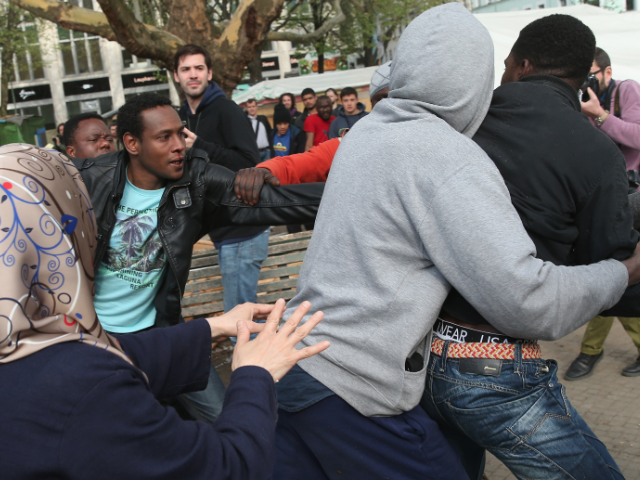


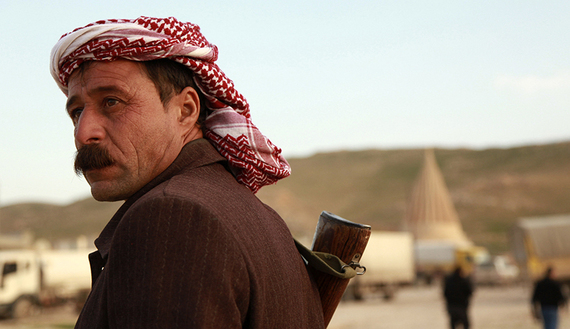




 anneinpt
 artaxes
 danmillerinpanama
 davidking1530
 Peter Hofman
 Joseph Wouk
 Peter
Peter Louisiana Steve
 WarSclerotic

Recent Comments