Archive for the ‘Turkey’ category

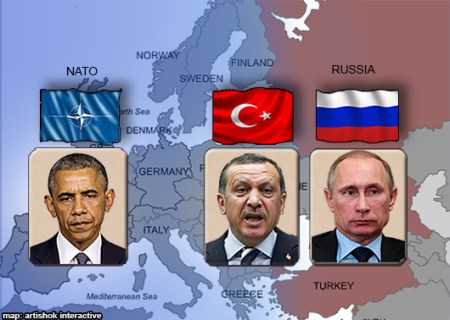
Putin-Erdogan deal for Syria is ME exit for Obama

September 9, 2016

Putin-Erdogan deal for Syria is ME exit for Obama, DEBKAfile, September 9, 2016

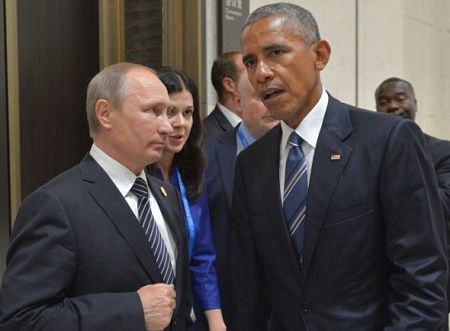
putin_obama_g-20_china

The fledgling “initiatives” reverberating this week in Washington, Moscow, Ankara, Jerusalem and the G20 summit were nothing but distractions from the quiet deals struck by two lead players, Russia and Turkey to seize control of the region’s affairs. Recep Tayyip Erdogan knew nothing would come of his offer on the G20 sidelines to US President Barack Obama to team up for a joint operation to evict ISIS from Raqqa. And, although Moscow was keen on hosting the first handshake in almost a decade between Israeli Prime Minister Binyamin Netanyahu and the Palestinian leader Mahmoud Abbas (Abu Mazen), neither were known to be ready for the last step toward a meeting.

But the game-changing events to watch out for took place in Hangzhou without fanfare – namely, the Obama-Putin talks and the far more fruitful encounter between Putin and Erdogan.

According to DEBKAfile’s intelligence and Mid East sources, Putin virtually shut the door on further cooperation with the United States in Syria. He highhandedly informed Obama that he now holds all the high cards for controlling the Syrian conflict, whereas Washington was just about out of the game.

Putin picked up the last cards, our sources disclose, in a secret deal with Erdogan for Russian-Turkish collaboration in charting the next steps in the Middle East.

The G20 therefore, instead of promoting new US-Russian understanding, gave the impetus to a new Russian-Turkish partnership.

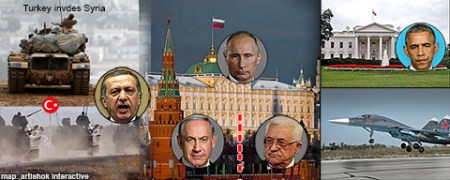
Erdogan raked in instant winnings: Before he left China, he had pocketed Putin’s nod to grab a nice, 4,000-sq.km slice of northern Syria, as a “security zone” under the control of the Turkish army and air force, with Russian non-interference guaranteed.

This Turkish zone would include the Syrian towns of Jarablus, Manjib, Azaz and Al-Bab.

Ankara would reciprocate by withdrawing its support from the pro-US and pro-Saudi rebel groups fighting the Assad army and its allies in the area north of Aleppo.

Turkey’s concession gave Putin a selling-point to buy the Syrian ruler assent to Erdogan’s project. Ankara’s selling-point to the West was that the planned security zone would provide a safe haven for Syrian refugees and draw off some of the outflow perturbing Europe.

kremlinwhitehouse480

It now turns out that, just as the Americans sold the Syrian Kurds down the river to Turkey (when Vice President Joe Biden last month ordered them to withdraw from their lands to the eastern bank of the Euphrates River or lose US support), so too are the Turks now dropping the Syrian rebels they supported in the mud by re-branding them as “terrorists.”

The head of this NATO nation has moreover gone behind America’s back for a deal with the Russian ruler on how to proceed with the next steps of the Syrian conflict.

Therefore, when US Secretary of State John Kerry met Russian Foreign Minister Sergei Lavrov in Geneva Thursday and Friday, Sept. 8-9, for their sixth and seventh abortive sit-downs on the Syrian issue, there was not much left for them to discuss, aside from continuing to coordinate their air traffic over Syria and the eastern Mediterranean.

Washington and Moscow are alike fearful of an accidental collision in the sky in the current inflammable state of relations between the two powers.

As a gesture of warning, a Russian SU-25 fighter jet Tuesday, Sept 6, intercepted a US Navy P8 plane flying on an international route over the Black Sea. When the Russian jet came as close as 12 feet, the US pilots sent out emergency signals – in vain, because the Russian plane’s transponder was switched off. The American plane ended up changing course.

Amid these anomalies, Moscow pressed ahead with preparations to set up a meeting between the Israeli and Palestinian leaders, as the Russian Foreign Ministry announced Thursday.

Putin is keen to succeed where the Obama administration failed. John Kerry abandoned his last effort at peacemaking as a flop two years ago.  But it is hard to see Netanyahu or Abu Mazen rushing to play along with the Russian leader’s plan to demean the US president in the last months of his tenure – especially when no one can tell who will win the November 8 presidential election – Hillary Clinton or Donald Trump – or what policies either will pursue.

All the region’s actors will no doubt be watching closely to see how Turkey’s “Russian track” plays out and how long the inveterate opportunists can hang together.

Satire?| Obama Ratifies Treaty on Sharia Law

September 4, 2016

Satire?| Obama Ratifies Treaty on Sharia Law, Dan Miller’s Blog, September 4, 2016

(The views expressed in this post are mine and do not necessarily reflect those of Warsclerotic or its other editors. — DM)

Having personally ratified the Iran Scam Treaty and the Climate Change Treaty with China, President Obama today met with Turkish, Saudi and Iranian heads of state to ratify a new treaty making Sharia Law binding in the United States. Please see also, The West Needs Sharia Law – Pakistani cleric. Obama, a renowned constitutional scholar, quickly rejected objections by Senate leaders that “He shouldn’t oughta do that because it’s our job” by reminding them that He is the President and is therefore empowered by the Constitution to do whatever pleases Him.

TOTUS Seal

Here is the text of President Obama’s statement on ratification of the Sharia Law Treaty, provided by The Incomparably Honorable I. M. Totus, Teleprompter of the United States:

My beloved Islamist colleagues, men, women and whatever: today, with great pleasure and a heart-felt desire for a better future for all, I today ratified a treaty with The Republic of Turkey, the Kingdom of Saudi Arabia and the Islamic Republic of Iran making Sharia Law officially binding in America just as it is in those great progressive, humanitarian nations.

As United Nations Secretary General Ban Ki-moon recently stated, the debate about the horrors of man-made climate change is over and the issue is settled. So be it with any debate over My success in preventng Iran from using nuclear weapons and, indeed, over My constitutional powers as your humble President. I have settled those matters as well, as all loyal Americans must agree.

Sharia Law will make America a far happier and better place for all including, most importantly, refugees coming to our shores in increasing numbers from other Islamist nations. I can think of no better way to welcome them than by guaranteeing them the dignity, honor and freedoms under Sharia Law they so richly and justly deserve.

For too long has America based its laws on flawed Judeo-Christian principles. But that’s not who we are; we have a long, honorable and mutually beneficial history with Islam and many if not most of our best citizens are Muslims. The treaty I ratified today will finally put us on the right side of history. It will also facilitate My brilliant countering violent extremism initiative by encouraging an honest discussion of Sharia law, long rejected by “America First” nationalists and other Islamophobes who despise Allah and His one true Religion of Peace.

I am confident that all loyal Americans will be happy to abide by our Sharia Laws; common sense steps will be taken to encourage all to do so. Observers from Turkey, Saudi Arabia and Iran will soon come to America to assist us in implementing whatever encouragements may be needed.

We should all thank the three other splendid freedom loving nations which also ratified the new treaty and encourage all other nations of the world to join us as soon as possible.

Thank you and have a pleasant day.

Hated by many Americans until now, The Islamic Republic of Iran has shown that it is a truly glorious example of Islamist democracy in action, where Sharia Law is enforced, followed and enjoyed by all.

hangings_in_iran

With Obama leading the way as always, we are joining them. Just look at the Iranians depicted in the following Iranian propaganda video! They are proud, happy, peaceful, patriotic and loving despite the shameful efforts of America in the past and, indeed, of some war-mongering Americans today, to humble and destroy them and their beloved nation.

No longer will that happen. The President has spoken! This will be the most beneficial and longest lasting of all of His many great leaps forward to make America a country of which He, His beautiful wife Michelle and all other good people can and will be truly proud.

It is anticipated that President Obama will soon issue an executive order changing the name of the country from The United States of America to The Islamist Republic of Obama. The flag of the new Islamist Republic of Obama will combine the best elements of the flags of the Islamic Republic of Iran, the Republic of Turkey and the Kingdom of Saudi Arabia. A photo of Obama as the bringer of true Islamic peace and understanding will be superimposed over the other flag elements.

Obama:

Obama death to America

Iran:
Iranian flag

Turkey:
Flag_of_Turkey.svg

Saudi Arabia:
saudi flag

Oh well.

what me worry

“Liberal” Turkey Claims Europe Is Racist

September 1, 2016

“Liberal” Turkey Claims Europe Is Racist, Gatestone InstituteBurak Bekdil, September 1, 2016

♦ “There is no such religion as Christianity … In reality, Jesus Christ was a Muslim coming from Jewish tradition … The name of the religion revealed to Christ was Islam …” — Abdurrahman Dilipak, columnist, Yeni Akit.

♦ In Turkey, not even the smallest village of a few hundred inhabitants has a non-Muslim mayor.

♦ Against this embarrassing background, Turkey is accusing Europe of being racist. That would be like North Korea accusing Europe of being a rogue state.

It’s not a bad joke; it’s a very bad joke. Turkey, where all variants of ethnic and religious xenophobia are a national pastime, is accusing the West of being racist.

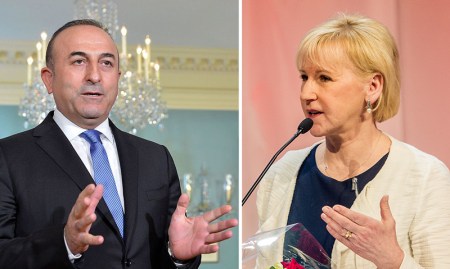
Speaking after a spat with Austria and Sweden over news reports and tweets from those countries that accused Turkey of allowing sex with children under the age of 15, Turkish Foreign Minister Mevlut Cavusoglu claimed that the behavior of European countries reflected the “racism, anti-Islamic and anti-Turkish (trend) in Europe.”

He is talking about the same Europe where the inhabitants of one of its biggest cities, London, recently elected a Muslim as its mayor. In Turkey, not even the smallest village of a few hundred inhabitants has a non-Muslim mayor.

1831Turkish Foreign Minister Mevlut Cavusoglu (left) blasted European countries for “racism, anti-Islamic and anti-Turkish (trend),” partly in response to a tweet by Swedish Foreign Minister Margot Wallstrom (right) that read: “Turkish decision to allow sex with children under 15 must be reversed. Children need more protection, not less, against violence, sex abuse.”

In “racist” Austria, the police immediately arrested two suspects in connection with an attempt to set fire to a Turkish cultural center in the northern Austrian town of Wels — and at a time of rising tensions with Turkey. By contrast, Turkish law enforcement officials arrested five former gendarmerie intelligence officers just recently — nine years after the murder of Turkish-Armenian journalist Hrant Dink. These officers would probably never have been implicated if the two Islamist allies, President Recep Tayyip Erdogan’s ruling Justice and Development Party (AKP) and Fethullah Gulen, his staunchest political ally when Dink was assassinated, had not turned into each other’s worst nemesis in power-sharing fight in 2013.

Yeni Akit is an Islamist newspaper and one of Erdogan’s media darlings, a kind of Turkish Pravda in its fanatical support of the president. Its editors always find a seat in the elite group of journalists who accompany the president in his private jet traveling to foreign capitals.

Recently, one of Yeni Akit’s most prominent columnists, Abdurrahman Dilipak wrote:

“There is no such religion as Christianity … In reality, Jesus Christ was a Muslim coming from Jewish tradition … The name of the religion revealed to Christ was Islam … Christianity is nothing more than a cultural adherence … Judaism is already a tradition that has imprisoned itself to its own race … [Jews’] fears are as big as their rage.”

Funny, Dilipak is an Islamist and his holy book acknowledges the two monotheistic religions he denies.

In another column, Dilipak claimed that “there is no such thing as the Greek nation or the Greek civilization.” Then, in following lines that exhibit typically an Islamist’s confused mind, he claims that “the Greek civilization is a civilization of … plagiarism.”

Yeni Akit did not need to hide its racism even in the aftermath of a bloodshed the entire world — except Islamist- denounced. In July, in Nice, France, shortly after the Islamist terror attack that killed more than 80 civilians, the newspaper’s headline read: “France, the perpetrator of genocide in Africa, deserves worse.”

Yeni Akit is a perfect reflection of Turkey’s popular and official racism. In March, when a jihadist suicide bomber killed three Israelis and one Iranian on a busy Istanbul street, Irem Aktas, head of the women’s and media division of the AKP branch in Istanbul’s Eyup district, commented on social media that: “Let the Israeli citizens be worse, I wish they all died.” When she wrote that in her Twitter account, at least 11 Israeli citizens injured by the bomb were being treated at Turkish hospitals. She was not prosecuted for her remarks that “wished death” to injured Israelis.

Turkey’s religious — and ethnic — xenophobia can take amusing turns, too. In September 2015, Turkish authorities banned showing religious symbols and playing music related to various religions at yoga centers. They said that having Buddha sculptures and mantra symbols, as well as playing religious music and burning incense, could be considered violations which could lead to the closure of these centers.

About a month before Turkey’s war on the “religion of yoga,” the country’s top religious body, the Religious Affairs General Directorate, issued a warning about the spreading of the new “religion” of Jediism” — the religion of the Jedi warriors in the Star Wars series. “Jediism … is spreading today in Christian societies. Around 70,000 people in Australia and 390,000 people in England currently define themselves as Jedis,” the article said, before engaging in an Islamic-based critique of a number of Hollywood blockbusters.

Against this embarrassing background, Turkey is accusing Europe of being racist. That would be like North Korea accusing Europe of being a rogue state.

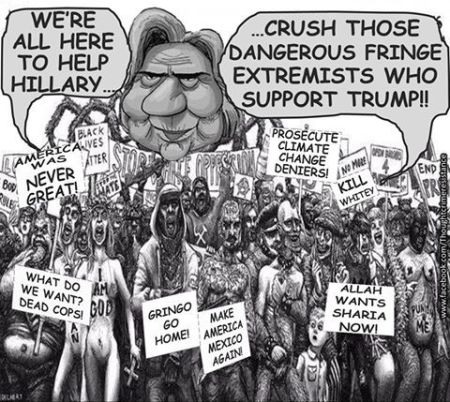
Cartoons of the Day

August 31, 2016

H/t Joop

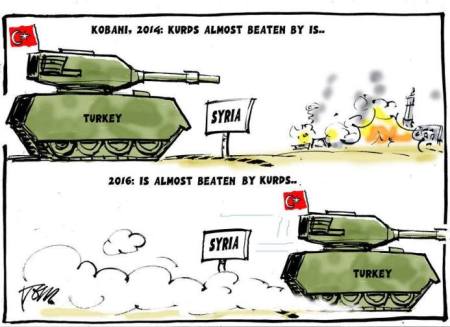
is kurds


H/t Indyfromaz

extremists (1)


H/t Vermont Loon Watch

separated-at-mirth-1


Erdogan tells US: Stop backing the Kurds

August 30, 2016

Erdogan tells US: Stop backing the Kurds, DEBKAfile, August 30, 2016

5 (1)

US-Turkish discord over the Turkish army’s onslaught on the Kurds of northern Syria reached a new low Wednesday, Aug. 30, when the presidential palace spokesman Ibrahim Kalin said in Ankara: “The US must revise its policy of supporting Kurdish forces.”

The demand came after a senior US official called on “all the armed actors in the fight against the Islamic State in northern Syria to stand down,” in an effort to contain the new conflict dragging northern Syria into further chaos.

The call was addressed equally to Ankara to freeze its military operations in Syria and to the Kurdish PYD-YPG militia to halt the flow of fraternal reinforcements for defending Mabij, the Syrian town the militia wrested from ISIS earlier this month with US assistance.

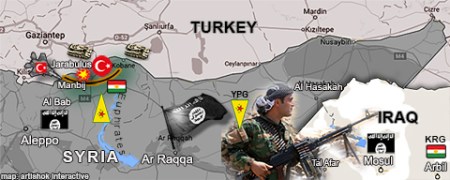
DEBKAfile’s military sources report that the Turkish army and Kurdish forces are already tensely aligned for a decisive battle over Manbij that will determine the outcome of the Turkish invasion of Aug. 24. President Tayyip Erdogan calculates that a Turkish victory will force the Kurds to retreat to the eastern bank of the Euphrates and away from the Turkish border, while Kurdish leaders are determined to halt the Turkish army at the gates of the town, and so brand the invasion a fiasco and carry off an epic victory.

The Obama administration is making a huge effort to avert this confrontation. In the hope of reining in the Turks, Vice President Joe Biden arrived in Ankara on the day their army crossed the Syrian border and met them halfway by issuing an ultimatum to the Kurds to withdraw to east of the Euphrates or else lose US support.

Unheeding of the US warning, the Kurds went forward to build up their fighting strength and engage the Turkish army.

Ankara suspects that the Americans are continuing notwithstanding to give the Kurds weapons and assistance on the quiet.

Washington fears that a Turkish-Kurdish showdown in Manbij will further destabilize the military situation such as it is in northern Syria and northern Iraq, and all their efforts to persuade the Kurds to lead the ground forces of the coalition offensives against ISIS will go for nothing.

In an earlier report on Monday, DEBKAfile covered the conflict between Turkey and the Kurds as it unfolded after the Turkish invasion.

An all-out Turkish-Kurdish war has boiled over in northern Syria since the Turkish army crossed the border last Wednesday, Aug. 24 for the avowed aim of fighting the Islamic State and pushing the Syrian Kurdish YPG militia back. Instead of falling back, the Kurds went on the offensive and are taking a hammering. This raging confrontation has stalled the US-led coalition offensive against ISIS and put on indefinite hold any US plans for campaigns to drive the jihadists out of their Syrian and Iraqi capitals of Raqqa and Mosul.

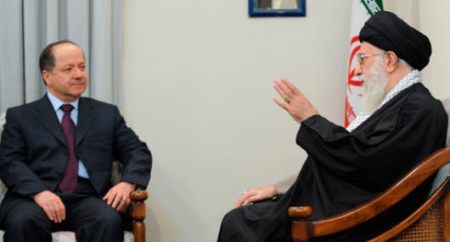
The Kurdish militia ground troops, who were backed by the US and assigned the star role in these campaigns, are now fully engaged in fighting Turkey. And, in another radical turnaround, Iraqi Kurdish leaders (of the Kurdish Regional Republic) have responded by welcoming Iran to their capital, in retaliation for the US decision to join forces with Turkey at the expense of Kurdish aspirations.

The KRG’s Peshmerga are moreover pitching in to fight with their Syrian brothers. Together, they plan to expel American presence and influence from both northern Syria and northern Iraq in response to what they perceive as a US sellout of the Kurds.

DEBKAfile’s military analysts trace the evolving steps of this escalating complication of the Syrian war and its wider impact:

  • Since cleansing Jarablus of ISIS, Turkey has thrown large, additional armored and air force into the battle against the 35.000-strong YPG Kurdish fighters. This is no longer just a sizeable military raid, as Ankara has claimed, but a full-fledged war operation. Turkish forces are continuing to advancing in three directions and by Sunday, Aug. 28 had struck 15-17km deep inside northern Syria across a 100km wide strip.
    Their targets are clearly defined: the Kurdish enclave of Afrin in northwest Syria and the Kurdish enclave of Qamishli and Hassaka in the east, in order to block the merger of Kurdish enclaves into a contiguous Syrian Kurdish state.
    Another goal was Al-Bab north of and within range of Aleppo for a role in a major theater of the Syrian conflict. To reach Al-Bab, the Turkish force would have to fight its way through Kurdish-controlled territory.
  • The Turks are also using a proxy to fight the Syrian Kurds. Thousands of Syrian Democratic Army (SDF) rebels, whom they trained and supplied to fight Syria’s Bashar Assad army and the Islamic State, have been diverted to targeting the Kurds under the command of Turkish officers, to which Turkish elite forces are attached.
  • A Turkish Engineering Corps combat unit is equipped for crossing the Euphrates River and heading east to push the Kurds further back. Contrary to reports, the Turkish have not yet crossed the river itself or pushed the Kurds back – only forded a small stream just east of Jarablus. The main Kurdish force is deployed to the south not the east of the former ISIS stronghold.
KurdishWar480
  • Neither have Turkish-backed Syrian forces captured Manbij, the town 35km south of Jarablus which the Kurds with US support captured from ISIS earlier this month. Contrary to claims by Ankara’s spokesmen, those forces are still only 10-15km on the road to Mabij.
  • Sunday, heavy fighting raged around a cluster of Kurdish villages, Beir Khoussa and Amarneh, where the Turks were forced repeatedly to retreat under Kurdish counter attacks. Some of the villages were razed to the ground by the Turkish air force and tanks. At least 35 villagers were reported killed.
  • In four days of fierce battles, the Kurds suffered 150 dead and the Turkish side, 60.
  • DEBKAfile military sources also report preparations Sunday to evacuate US Special Operations Forces and helicopter units from the Rmeilan air base near the Syrian-Kurdish town of Hassaka. If the fighting around the base intensifies, they will be relocated in northern Iraq.
  • Fighters of the Iraqi-Kurdish Peshmerga were seen removing their uniforms and donning Syrian YPG gear before crossing the border Sunday and heading west to join their Syrian brothers in the battle against Turkey.
  • The KRG President Masoud Barazani expects to travel to Tehran in the next few days with an SOS for Iranian help against the US and the Turks. On the table for a deal is permission from Irbil for the Iranian Revolutionary Guards to win their first military bases in the Iraqi Kurdish republic, as well as transit for Iranian military forces to reach Syria through Kurdish territory..

Turkey’s Official “Cocktail Terror”

August 28, 2016

Turkey’s Official “Cocktail Terror”, Gatestone Institute, Burak Bekdil, August 28, 2016

♦ In its latest attack in Turkey, ISIS used a child suicide bomber to attack a wedding ceremony. More than 50 victims were killed, of whom 26 were less than 18 years old.

♦ This is premeditated, officially-tolerated murder. Evidence? Two opposition parties appealed to parliament five times asking for a parliamentary investigation into ISIS and its activities in Turkey. All five requests were rejected by the votes of the ruling AKP Party, Erdogan’s powerful political machine.

♦ The opposition claims SADAT International Defense Consultancy, which was established by soldiers dismissed from the military due to Islamist activities, offers ISIS operatives training in “intelligence, psychological warfare, sabotage, raiding, ambushing and assassination.” Erdogan this month appointed the owner of SADAT, retired Brigadier General Adnan Tanriverdi, as his chief presidential advisor.

Failing to name Islamic terror has cost Turkey hundreds of lives and will likely cost it hundreds more, as the country’s leaders — and many others, especially in the West — are still too demure to call Islamic terror by its name. Without a realistic diagnosis, the chances of a successful treatment are always close to nil, and Turkey’s leaders stubbornly remain on the wrong side of the right diagnosis.

President Recep Tayyip Erdogan’s theory that “there is no Islamic terror,” coupled with his persistent arguments that Islamist radicals hit Europe because of Islamophobia in the Western world, are not only too remote from reality but have now become a curse in his own country.

As early as 2014, cars began to be seen in the streets of Istanbul sporting the black flag of the Islamic State of Iraq and Syria (ISIS). The same year, Islamists opened a shop selling T-shirts featuring the same flag. ISIS-related magazines went ahead with open hate content even though, in March 2014, ISIS spilled its first blood in Turkey when an ISIS team ambushed a police checkpoint and killed one police officer, one soldier and one civilian.

In its first suicide attack on June 5, 2015, ISIS targeted a pro-Kurdish rally in Diyarbakir, killed four people and injured 279. It targeted, once again, a pro-Kurdish gathering in July 2015 in Suruc, a small town bordering Syria, killed more than 30 people and injured more than 100.

When, in October 2015, Islamists attacked the main train station in Ankara and killed more than 100 civilians in the worst terror attack in Turkey’s history, Turkish officials were once again too demure to blame it on radical Islamists. Instead, they invented an unconvincing concept, “cocktail terror,” putting the blame on a mixture of various terror groups.

In a span of just one year, starting with the Suruc suicide bomb attack in July 2015, ISIS terror attacks in Turkish soil have killed 265 people and injured 1,256.

In its latest attack in Turkey on August 21, ISIS did something it had not done before: it used a child suicide bomber with explosives detonated by a remote controller. The target was a wedding ceremony in the southern city of Gaziantep; most of the victims were children, like the suicide bomber himself. More than 50 victims were killed, of whom 26 were less than 18 years old. Two of the victims had just turned four.

1816On August 21, ISIS terrorists used a child suicide bomber to kill more than 50 people, mostly children, at a wedding in Gaziantep. (Image source: ABC News video screenshot)

This is premeditated, officially-tolerated murder. Evidence? Between Aug. 14, 2014 and June 29, 2016, two opposition parties, the social democrat Republican People’s Party (CHP) and the pro-Kurdish People’s Democratic Party (HDP), appealed to parliament five times asking for a parliamentary investigation into ISIS and its activities in Turkey. All five requests were rejected by the votes of the ruling Justice and Development Party (AKP), Erdogan’s powerful political machine. Why would a ruling party vote down an investigation request into a barbaric terror group that has killed hundreds of people in its own country? But there is more.

In July, slightly more than a month before the ISIS’s child bomber was blown up along with more than 50 others in Gaziantep, a court in the same city reduced the jail sentence of an ISIS militant due to “good conduct.” Good conduct?! The man did not even stand before the court, as the police were unable to apprehend him.

At the end of June, the main opposition party, CHP, made a parliamentary inquiry into the activities of an Istanbul-based defense company accused of having links to ISIS. The opposition claims the SADAT International Defense Consultancy, established in the early 2000s by soldiers dismissed from the military due to Islamist activities, offers “irregular warfare training” in various fields including “intelligence, psychological warfare, sabotage, raiding, ambushing and assassination.” The inquiry said: “…that special commissioned and non-commissioned officers have begun working at this company with high salaries, and that in camps irregular warfare training has been given to ISIS and its derivatives.”

SADAT’s owner and chief official is retired Brigadier General Adnan Tanriverdi widely known for his close relations with Erdogan and the AKP.

Since the opposition made the parliamentary inquiry, it has not heard from the government benches about its request for an investigation into SADAT. But, after the inquiry, the government made a move. In August Erdogan appointed Tanriverdi as his chief presidential advisor.

Turkey’s war with radical jihadists is a too demure and reluctant one — if not fake altogether.

What’s the Plan for Winning the War?

August 25, 2016

What’s the Plan for Winning the War?, Counter Jihad, August 25, 2016

Who is even thinking about how to win the war?  Will the legacy of the Obama administration be a shattered NATO, a Turkey drawn into Russia’s orbit, an Iranian hegemony over the northern Middle East, and a resurgent Russia?  It certainly looks to be shaping up that way.  Russia is playing chess while the US is playing whack-a-mole.  The absence of a coherent governing strategy is glaring.

**********************

Michael Ledeen makes a clever observation:

Everyone’s talking about “ransom,” but it’s virtually impossible to find anyone who’s trying to figure out how to win the world war we’re facing.  The two keystones of the enemy alliance are Iran and Russia, and the Obama administration, as always, has no will to resist their sorties, whether the Russians’ menacing moves against Ukraine, or the Iranians’ moves against us.

The moves are on the chessboard, sometimes kinetic and sometimes psychological warfare.  Like a chess game, we are in the early stages in which maneuver establishes the array of forces that will govern the rest of the game.  Russia’s deployment of air and naval forces to Syria stole a march on the Obama administration.  Its swaying of Turkey, which last year was downing Russian aircraft, is stealing another.  Its deployment of bombers and advanced strike aircraft to Iran is another.  That last appears to be in a state of renegotiation, as Ledeen notes, but that too is probably for show.  The Iranians have too much to gain in terms of security for their nuclear program, at least until they’ve had time to build their own air force.

Iran is making strategic moves as well.  Ledeen notes the “Shi’ite Freedom Army,” a kind of Iranian Foreign Legion that intends to field five divisions of between twenty and twenty-five thousand men each.  Overall command will belong to Quds Force commander Qassem Suliemani, currently a major figure in the assault on Mosul, having recovered from his injury in Syria commanding Iranian-backed militia in the war there.  The fact of his freedom of movement is itself a Russian-Iranian demonstration that they will not be governed by international law:  Suliemani is under international travel bans for his assassination plot against world diplomats, but was received in Moscow and now travels freely throughout the northern Middle East.

Turkey, meanwhile, has been effectively cut off by Iran’s and Russia’s success in the opening game of this global chess match.  As late as the Ottoman Empire, the Turks looked south through Iran and Iraq to power bases as far away as Arabia.  Now the Ayatollahs are going to control a crescent of territory from Afghanistan’s borders to the Levant, leaving the Turks locked out.  One might have expected the Turks to respond by doubling their sense of connection to Europe and NATO.  Instead, the purge following the alleged coup attempt is cementing an Islamist control that leaves the Turks looking toward a world from which they are largely separated by the power of this new Russian-Iranian alliance.  The Turks seem to be drifting toward joining that alliance because being a part of that alliance will preserve their ties to the Islamic world.

For now, the Obama administration seems blind to the fact that these moves are closing off America’s position in the Middle East.  This is not a new policy.  Eli Lake reports that the Obama administration told the CIA to sever its ties to Iranian opposition groups in order to avoid giving aid to the Green revolution.  Their negotiation of last year’s disastrous “Iran deal” has led to Iran testing new ballistic missiles and receiving major arms shipments from Russia.  Yet while all these moves keep being made around them, the Obama administration proceeds as if this were still just an attempt to crush the Islamic State (ISIS).  The commander of the XVIIIth Airborne Corps has been given a task that amounts to helping the Iranians win.  Our incoherent policy has left us on both sides in Syria.  Our only real ally in the conflict, the Kurds, stand abandoned by America.

Who is even thinking about how to win the war?  Will the legacy of the Obama administration be a shattered NATO, a Turkey drawn into Russia’s orbit, an Iranian hegemony over the northern Middle East, and a resurgent Russia?  It certainly looks to be shaping up that way.  Russia is playing chess while the US is playing whack-a-mole.  The absence of a coherent governing strategy is glaring.

Proxy Wars Between Turks and Kurds in Vienna

August 21, 2016

Proxy Wars Between Turks and Kurds in Vienna, Gates of Vienna, , August 21, 2016

(Rather than just provide links to the videos, as the article does, I have taken the liberty of embedding them. — DM)

turkdemovienna

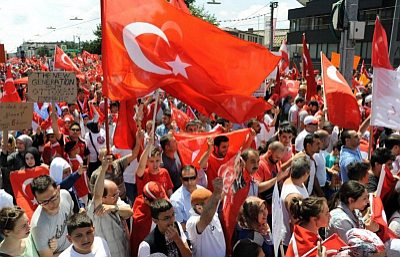
One might easily mistake the above photo for a scene from Istanbul or Ankara. But it was taken at a pro-Turkish demonstration in Vienna in 2013.

Turks stage these demos every week now in downtown Vienna, providing an occasion for near-warfare between Turkish-Austrians and Kurdish-Austrians. Last weekend the situation deteriorated even further than usual.

Many thanks to Nash Montana for translating this article from Politically Incorrect:

Turks in Vienna — Allahu Akhbar — “Like in a war”

https://www.youtube.com/watch?v=dxUZnUE_afo

More and more often there are conflicts that resemble civil war between leftist Kurdish PKK supporters and Turkish fascists, the Grey Wolves, on Austrian as well as on German ground. For quite a while now Kurds have been demonstrating every Saturday on the Stephansplatz to raise awareness of Turkish politics. But as soon as the demonstration begins, the Vienna city center becomes a danger zone. Tourists, residents, and business people are running the gauntlet. The people are in fear. Last weekend the situation escalated. Sonja, Prousek, the owner of the bakery Aida situated next to the Cathedral, was horrified: “It was like in the war.” The Stephansplatz became a bubbling cauldron. Hundreds of people fled in panic into surrounding areas, sought protection in hotels, stores and bars.

The Café Aida saw the most damage. Sonja Prousek told Zeitung Österreich: “Old people cried, children lost their parents. Dishes, drinks and food landed on the floor. We had to close up because customers and employees fled all the way to the other franchise down on Bognergasse.”

https://www.youtube.com/watch?v=dxUZnUE_afo

The Vienna police were present in full gear for security, but admit that these demonstrations, attended by 300 to 400 people, are increasingly becoming a serious problem. But also that there is the freedom to demonstrate.

Already on Friday evening 15 Kurds tried to invade the ORF-center at Vienna’s Küniglberg to force the channel to broadcast a message about Abdullah Öcalan, the PKK leader who is imprisoned in Turkey. Some of them made it all the way to the reception area. But that’s where the terror ended. The SEK WEGA (Special commando department Vienna) and trained dogs ended the chaos and escorted the Turkish mob out the exit. Once again, no one was arrested. There was merely one report for “disturbance of peace”.

In the upper Austrian Weis two young PKK supporters threw Molotov cocktails at a Turkish community center.

By now proxy wars on European ground, not just among these groups, are in full bloom thanks to unconscionable and brainless immigration politics. The escalation was programmed. The colorful future will become a nightmare.

Israel’s let-down: Putin-Erdogan hook-up with Iran

August 9, 2016

Israel’s let-down: Putin-Erdogan hook-up with Iran, DEBKAfile, August 9, 2016

2 (1)

The talks between Presidents Vladimir Putin and Reccep Erdogen in St. Petersburg scheduled for Tuesday, Aug. 9, are causing trepidation among Israel’s policy-makers and military leaders. Their summit takes place on the sidelines of the G-20 summit, concluding nine months of hostility between the two capitals that was sparked by Turkish jets shooting down a Russian SU-24 warplane over the Syrian border on Nov. 24, 2015.

The feud was put to rest on July 17 – two days after Erdogan suppressed the attempted military coup against his rule. The Turkish ruler decided there and then to exploit the episode to expand his strength and use it not only for a massive settling of accounts with his critics, but also as a springboard for parlaying his reconciliation with Moscow for a strategic pact with Russia.

Israel, the worry is that while turning his back on the United States and NATO, Eerdogan will go all the way to bond with Russia to which Iran is also attached as a partner. Indeed, Erdogan has scheduled a trip to Tehran and a meeting with President Hassan Rouhani a few days after his talks with Putin.

The Turkish president’s latest moves look like spawning another new Middle East bloc that would consist of Turkey, Russia, Iran, Iraq, Syria and indirectly the Lebanese Hizballah terrorist group.

This prospect would upend Israel’s key policies for Turkey and Syria.

The Israeli détente with Ankara in recent months hinged on Turkey’s continuing to maintain its close military and intelligence ties with the United States and its integration in an anti-Iran Sunni alliance in partnership with Saudi Arabia, Egypt, the United Arab Emirates and Jordan.

But the Putin-Erdogan meeting Tuesday threatens to throw American, Israeli and moderate Arab rulers’ plans to the four winds. Turkey appears to have opted to line up with a Russian-Shiite front led by Tehran in preference to an anti-Iran Sunni alliance.

Therefore, the expanded military and intelligence cooperation which the Israeli-Turkish rapprochement was to have heralded will be low key at best for two reasons:

1. Israel will beware of sharing its military technology with Turkey lest it find its way to Iran. During the talks with Ankara for patching up their quarrel Israel was constantly on the lookout for indications that Turkey was prepared to break off its ties with Iran.

2. For the sake of keeping Iran and Hizballah away from its borders, Israel entered into arrangements with Russia, some of them never published, at the start of Moscow’s military intervention in Syria last September. Those arrangements included coordination of their air force operations over Syria.

Now, Israel finds itself suddenly up against a Russian-Turkish partnership aimed at strengthening Iranian domination of Syria – the exact reverse of the Netanyahu government’s objective in resolving its dispute with Ankara and forging deals with Moscow.

Erdogan-Gulen Power Struggle Divides European Turks

August 8, 2016

Erdogan-Gulen Power Struggle Divides European Turks, Investigative Project on Terrorism, August 8, 2016

(Please see also, Plotting Jihad in the Poconos—Who the Hell is Fethullah Gulen? — DM)
1167

Millions of European Turks – both immigrants and subsequent generations – ally themselves with the Gulenist movement, or Hizmet. While some call it a cult and claim it represents a zealous Islamic religious movement, others view it as a more moderate strain of Islam and praise Gulen for his interfaith initiatives, and for the hospitals, schools and universities he has founded internationally, including over 100 charter schools in the United States. But since the split between the two men, tensions have also emerged between pro-Gulen and pro-Erdogan groups that are far more virulent than the disputes between those who favor Hizmet and those who condemn it.

********************

On the night of July 15, members of the Turkish military stormed the state-run TRT news agency in Ankara and forced an anchorwoman to read a statement calling President Recep Tayyip Erdogan a “traitor.” Within moments, tanks began to drive menacingly through the streets of Ankara and Istanbul as military planes roared over Turkish skies. The Parliament was bombed. The fifth military coup in the history of modern Turkey had begun, taking even the most anti-government Turks by surprise.

But Erdogan regained complete control within hours, thanks to his fervent supporters who took to the streets in his defense. Throughout the night, pro- and anti-Erdogan military and civilians clashed across the country, leaving nearly 300 dead and 2,100 injured by morning.

The attempted coup and its aftermath, however, soon exploded into more than just a national crisis; it has had incendiary repercussions globally, particularly in the Turkish communities of Europe.

Erdogan declared a state of emergency July 16, and began cracking down on suspected members of the coup plot and their allies. By July 20, more than 45,000 people had been arrested, including 2,700 judges and 15,000 teachers. As Erdogan called for reinstating the death penalty, credible reports emerged of prisoners being tortured and raped.

In the meantime, tens of thousands of others have been fired from their jobs as the state takes over or shuts down nearly all the country’s media outlets – including three news agencies, 16 television channels, 45 newspapers and 15 magazines, Reutersreports. And on Monday, more than three weeks after the failed coup, Turkey recalled five senior diplomats from its embassy in The Hague.

All who have been sacked are accused of complicity in the coup, based on their (ostensible) ties to Fethullah Gulen, a powerful cleric now living in self-imposed exile in Pennsylvania. Once one of Erdogan’s closest allies, Gulen has become his most despised enemy in recent years, thanks in large part to Gulen’s criticism of Erdogan during the 2013 Gezi Park demonstrations. Now Turkey’s president accuses Gulen of being behind the coup attempt, demands his extradition from the United States. Meantime, he continues his crackdown on the cleric’s followers.

But those followers are not just in Turkey, and neither are Tayyip Erdogan’s. Millions of European Turks – both immigrants and subsequent generations – ally themselves with the Gulenist movement, or Hizmet. While some call it a cult and claim it represents a zealous Islamic religious movement, others view it as a more moderate strain of Islam and praise Gulen for his interfaith initiatives, and for the hospitals, schools and universities he has founded internationally, including over 100 charter schools in the United States. But since the split between the two men, tensions have also emerged between pro-Gulen and pro-Erdogan groups that are far more virulent than the disputes between those who favor Hizmet and those who condemn it.

As a result, the clashes between the conflicting sides have spilled beyond the Turkish borders into Europe, and have now exploded since the coup. Often, they have been violent, with pro-Erdogan protesters hurling stones into the windows of Gulen organizations in Gelsenkirchen, Germany and Rotterdam, Holland, or calling to set fire to a building housing a Gulenist organization in Beringen, Belgium (“Burn them alive!” the protesters shouted.). Arsonists also attacked several Gulen buildings in the Netherlands.

In other instances, the attacks are quieter but more sinister: members of 70 different Gulen-affiliated groups in the Netherlands report receiving hate messages and death threats. People believed to support the movement – or who fail to support Erdogan – report being banned from mosques and refused entry to restaurants. Dutch children have told each other “I can’t talk to you anymore.” A number of Gulen followers have gone into hiding, fearing for their safety.

And in Germany, home to Europe’s largest Turkish community, estimated at nearly 3 million, some 30-40,000 Erdogan supporters marched through Cologne on July 31. And while the demonstrations went off without incident, they represent a chasm within the country – not just between Germans and Turks, but – as in the Netherlands – among the Turks themselves. Noted Deutsch-Welle‘s Gero Schliess in an editorial, “After the coup attempt in Turkey, divisions have emerged in this country that no one had seen for a long time – or hadn’t wanted to see. The failed coup and President Erdogan’s massive onslaught against civil rights have deeply divided the Turkish community in Germany. The split runs right through families and neighborhoods, regardless of social strata or profession.”

But at least as disturbing is the idea of 30-40,000 people marching in support of the man who has led the profoundly anti-democratic crackdown in Turkey. While it may be understandable to oppose a military coup, it is something else entirely to continue marching in support in light of the abuses that have followed. Moreover, according to Politico, the situation has also “reignited a decade-long debate in Germany about the Turkish state steering public opinion within the German-Turkish community through a web of lobbying groups, religious institutions, media outlets and public figures.”

Religious groups seem to be chief among those, such as the Turkish-Islamic Union for Religious Affairs, sponsored by the Turkish state. That Turkey is therefore subsidizing mosques in Germany demonstrates the strength not only of the country’s influence on the political visions of German Turks, but on their religious ideas as well. And in an increasingly Islamist Turkey, those ideas no longer reflect the secular, humanist values of Ataturk; rather, they are based on an increasingly strict vision of Sunni Islam in which the state and the mosque are one.

Other Turkish religious groups, including Milli Gorüs, an Islamist group headquartered in Cologne, are also believed to hold sway over European Turks, particularly in the Netherlands.

Behind them all, particularly in Belgium, is the Diyanet, the official Turkish Directorate of Religious Affairs .

Ataturk created the Diyanet soon after the founding of the Turkish republic, to help ensure that imams preached moderate interpretations of Islam. They were critical to maintaining the separation between mosque and state. With the rise of Erdogan and his AK Party, however, it has served to do just the opposite: it now promotes Islamist views in Turkey and among the Turkish community abroad. As Istanbul-based journalist David Lepeska noted last year, the Diyanet‘s budget has quadrupled since 2006 to over $2 billion, with a 2015 budget allocation that was “40 percent more than the Ministry of the Interior’s and equal to those of the Foreign, Energy, and Culture and Tourism ministries combined.” In addition to presiding over Turkey’s own mosques, the directorate governs hundreds of mosques across Europe, has increased the number of religious classes in public schools, and, reports Lepeska, “runs a 24-hour television station, Diyanet television, available via satellite, cable, and YouTube, and manages a Facebook page (with nearly 230,000 fans), two Twitter accounts (more than 50,000 followers), and an Islamic lifestyle hotline.”

The result is a toxic mixture of religion and politics that could not be further from the secular ideals of the founder of modern Turkey. Add Erdogan’s and the AKP’s human rights abuses and dictatorial leanings to this and the cauldron boils hotter and more dangerous than ever. Whatever problems existed previously, the post-coup situation bears far too many parallels to the impulses and ideologies of radical Islamism: whoever does not support Erdogan becomes the enemy. And Erdogan, as the leader of Turkey, is the leader of the Diyanet.

The outcome is a kind of tribalism that already infects the rest of the Middle East: to be outside the Erdogan support core is to be outside the realm of the Diyanet – an apostate of sorts, threatened with death.

That this could become the future of Ataturk’s secular democratic republic is tragic. But there is also a very real possibility of the impulse spreading into Europe. Other events this year, such as the attacks on Dutch journalist Ebru Umar and German comedian Jan Bohmermann, both of whom criticized the Turkish president, demonstrate that many European Turks lean towards such a radicalized and tribalist vision. It is a vision Europe’s leaders would do well to extinguish while they still can.