Archive for the ‘Sanctions’ category

Obama’s shameful betrayal of America

August 18, 2015

Obama’s shameful betrayal of America, Front Page MagazineDr. Majid Rafizadeh, August 18, 2015

secretary_kerry_meets_with_iranian_foreign_minister_zarif_in_paris_to_continue_nuclear_program_negotiations_16107653417

Thanks to President Obama, radical Islam is the winner of the nuclear deal and the US emerges as the biggest loser when it comes to its national, economic, geopolitical and strategic interests. In addition, except for Israel and the United States, almost every country in the world (as well as Shiite militia groups) appear to be benefiting from the nuclear deal – economically, strategically, and geopolitically — as a result of rekindling relationships with the Islamic Republic. Not only does this deal damage the US and Israel’s national and economic interests, but it also strengthens the same forces and axis which have repeatedly sworn war and violence against Americans. 

A strong argument can be made that one of the major birthplaces of fundamentalist Islamism, which at its core aims at opposing and fighting the United States, is the Islamic Republic of Iran.

The mission of anti-Americanism and anti-Semitism began heavily when the ruling mullahs of Iran, with the leadership of Ayatollah Rooh Allah Khamenei, came to power.  This mission remains and will continue to remain the major pillar of the Islamic Republic as well as the keystone of the mullah’s political and ideological establishments.

Since then, the Islamic Republic, with IRGC and its proxies, has been attacking and slaughtering Americans. They also attempt to scuttle US foreign policy. The United States is not their sole target. They also interfere with the national and economic interest of several countries in the Middle East and beyond including Iraq, Lebanon, Syria, Yemen, etc.

Without a doubt, this is a regime that breeds anti-Americanism and hatred towards Jewish and Christian people. So, what is President Obama’s solution to offset such a threat? Surrender — while continuing to give bonuses and gifts to the Iranian regime.

After Russia and China, Switzerland was the first European country to officially lift economic and political sanctions against the Islamic Republic citing the nuclear deal which was reached between the Islamic Republic and six world powers. The sanctions included restrictions on trade in precious metals, petrochemical products, petroleum products as well as the transport of Iranian crude oil. Switzerland issued a statement pointing out that the “Federal Council (government) wishes today’s steps to be seen as a sign of its support for the implementation of the nuclear agreement and its interest in deepening bilateral relations with Iran.” It also added that it will seek to “promote a broad political and economic exchange with Iran.”

Other European countries are going to follow as well. What is going to happen next? Billions off dollars are going to flow into a government whose primary objective is to fight with the United States.

Russia, China, and other rivals will benefit economically, politically, strategically, and ideologically from the nuclear deal. It is the United States which not only is not gaining anything (economically, geopolitically, security-wise, or strategically) from this deal, but also is significantly empowering its rivals.

In the next phase, the nuclear deal will significantly tip the balance of power in favor of US rivals and the anti-American axis. China, Russia and the Iran-Assad-Hezbollah-Haman’s alliance will be considerably strengthened.

What does President Obama think that a political regime — that has been fighting the United States tooth and nail and that is responsible for the killing of many Americans in the Middle East — is going to use the billions of dollars it earns to promote? It certainly will not be pro-American or pro-Israel ideology, democratization, social justice, rule of law, human rights, or freedom of speech, press, and assembly.

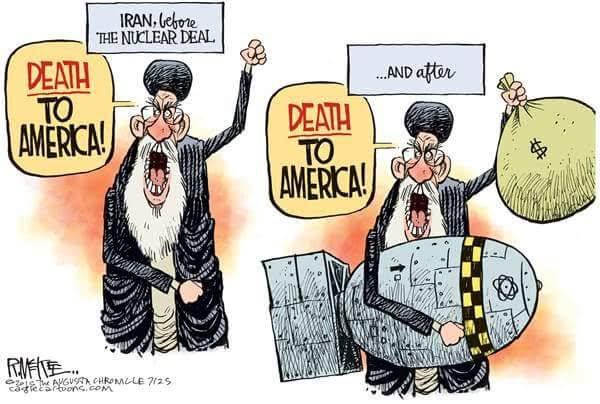
Mr. Obama recently delivered a speech at American University pointing out that “just because Iranian hardliners chant ‘Death to America’ does not mean that that’s what all Iranians believe.” He added, “In fact, it’s those hardliners … chanting ‘Death to America’ who’ve been most opposed to the deal. They’re finding common cause with the Republican Caucus.”

There are several fallacies in his statements. First of all, he is implying the Republicans are similar to those Iranian politicians who are anti-American. Republicans are attempting to preserve the national and economic interest of their country when it comes to the Islamic Republic, but Iranian politicians are sworn to fight American interests and wipe out Israel.

Secondly, President Obama argues that Iranian hardliners are against the nuclear deal. This is absolutely inaccurate. It was because of the approval of  Iran’s Supreme autocrat, Ayatollah Ali Khamenei, that the deal was signed. The hardliners are the ones who will gain the most from this deal.

Third, it is true that not all Iranian people believe in “Death to America,” but Mr. Obama is dodging the major point. When it comes to international politics and the mission of fighting America, it honestly does not matter what Iranian people believe or do not believe. What matters is the political establishment of the Islamic Republic and the government which has the hard power (weapons, military, financial means, oil, etc) to fight with the US.

Finally, it is not only the hardliners that chant “Death to America,” but the entire group of ruling clerics and leaders of the Islamic Republic that believe this with a passion. We should not forget that a major slogan of President Rouhani (the so-called “moderate”) is: “Saying ‘Death to America’ is easy. We need to express ‘Death to America’ with action.” Or, as the other supposed “moderate” and “pragmatist,” Rafsanjani pointed out, “If a day comes when the world of Islam is duly equipped with the arms Israel has in possession, the strategy of colonialism would face a stalemate because application of an atomic bomb would not leave anything in Israel[.]”

United Nations and European Union sanctions on some of Iranian war criminals will also be lifted as part of the nuclear pact. One of these figures is General Qassem Suleimani, the head of Iran’s Islamic Revolutionary Guard Corps—Qods Force, who is the mastermind behind creating Shiite militia groups and terrorists across the region. He oversaw the training, financing, and arming of these militia groups. These groups are directly or indirectly fighting the United States and American soldiers as well.

As Lt. Gen. (ret.) Michael Barbero stated Sunday in The Weekly Standard, the lifting of international sanctions against Gen. Soleimani is a “shameful betrayal” of the “the American families of Suleimani’s casualties, and …those of us who lost friends and comrades.”

What if the Iranian leaders circumvent the guidelines put into place by the deal down the road? Then, too bad. If the Iranian leaders, as predicted, are caught deceiving their way towards obtaining a nuclear bomb, it will be too late to do anything. The economic and political sanctions will have been lifted, leaving the Iranian government with a surplus of funds. The US, which was in a stronger position when sanctions were imposed on the Islamic Republic, will become the weaker player. Russia and China will block any re-imposition of sanctions on the Islamic Republic. At that point, unfortunately, it will be the US in the desperate position, not the Islamic Republic. Radical Islam will exponentially spread against the US, as well as democratic and Western values around the globe.

Iran’s and Obama’s co-dependent mushroom clouds

August 15, 2015

Iran’s and Obama’s co-dependent mushroom clouds, Dan Miller’s Blog, August 15, 2015

(The views expressed in this article are mine and do not necessarily reflect those of Warsclerotic or its other editors. — DM)

Courtesy of Obama, Iran’s mushroom clouds will be produced by detonating atomic bombs. Obama’s mushroom clouds, with help from His friends, have already been and continue to be detonated. They thrive in the absence of light and contain copious quantities of bovine fecal matter.

This limerick, if applied to Obama, makes sense:

Last night I saw upon the stair
A little man who wasn’t there.
He wasn’t there again today.
Oh how I wish he’d go away!

I. Obama gave Iran its mushroom cloud

Several conservative media recently focused on Obama’s claim, made in His August 5, 2015 address praising His “deal,” that Iran had agreed to negotiate only after President Rouhani replaced Mahmoud Ahmadinejad on August 3, 2013:

it was diplomacy, hard, painstaking diplomacy, not saber rattling, not tough talk, that ratcheted up the pressure on Iran. With the world now unified beside us, Iran’s economy contracted severely, and remains about 20 percent smaller today than it would have otherwise been. No doubt this hardship played a role in Iran’s 2013 elections, when the Iranian people elected a new government, that promised to improve the economy through engagement to the world. [Emphasis added.]

A window had cracked open. Iran came back to the nuclear talks.

Obama did not mention that Rouhani could neither have run for office nor been elected without the backing of Iran’s Supreme Leader Khamenei. As far as I have been able to determine, neither Obama nor Kerry has said anything denying, acknowledging or explaining Senator Kerry’s “negotiations” with Iran which, as I noted here on August 13th, had begun in 2011, long before Ahmadinejad left office in 2013.

During those early “negotiations,” Kerry had already conceded Iran’s right to enrich Uranium, that the nuclear dossier would be closed and that the Possible Military Dimensions (“PMDs”) of Iran’s nuclear program would be ignored resolved.

Although Obama has claimed otherwise, the timing of P5+1 negotiations vis a vis  Rouhani’s arrival in office makes little sense. Rouhani sought and got — courtesy of Kerry’s earlier concessions — at least as many concessions from the Obama-led P5+1 farce as Ahmadinejad could have got. Perhaps he got more, due to erroneous perceptions that Rouhani was a moderate and that Iran had changed course for the better. Such perceived changes also led to hopes that Iran would become a helpful U.S. Middle East ally.

Here’s an excerpt from a Front Page Magazine about Obama’s claim:

In 2013, Hassan Rouhani was, for lack of a better word, “elected” president of Iran replacing the noxious Mahmoud Ahmadinejad. Rouhani, a grandfatherly-like figure with an affable smile, appeared to be, at least outwardly, more moderate than his predecessor, but in reality expressed the same rancid, xenophobic views. He was quoted as saying that “the beautiful cry of ‘Death to America’ unites our nation,” and referred to Israel as a “wound,” “a festering tumor” and the “great Zionist Satan,” among numerous other reprehensible pejoratives.

Israel’s Prime Minister Benjamin Netanyahu, in an address to the United Nations, dryly noted that while Ahmadinejad was a wolf in wolf’s clothing, Rouhani was a wolf in sheep’s clothing, but both were wolves nonetheless. What’s more, real power in Iran vests not with the nation’s president, but with its Supreme Leader, Ali Hosseini Khamenei, a pernicious man who seems incapable of addressing crowds without inserting at least one “death to America” reference somewhere in the speech. Indeed, just four days after signing the Joint Comprehensive Plan of Action (JCPOA) he addressed a large crowd and repeated the tired banalities of “death to America” and “death to Israel.” Khamenei is also solely responsible for vetting and approving presidential candidates which means that he found Rouhani to be an acceptable contender and that speaks volumes about what kind of character Rouhani is. [Emphasis added.]

. . . .

Despite the given realities about the Islamic Republic and its malevolent nature, Obama attempted to sell the American public on the nonsensical notion that the election of Rouhani ushered in a new period of Iranian enlightenment and moderation and afforded the U.S. an opportunity for meaningful engagement with the mullahs on their nuclear program. On that premise, he led the American public to believe that it was only after the election of the “moderate” Rouhani that the U.S. chose to engage Iran. [Emphasis added.]

What really rankles, as noted in my August 13th article, is that in 2011 Kerry, representing Obama, led the way for Iran to get what it wanted.

Kerry had representatives of The Sultanate of Oman deliver a letter he had written to Iranian officials recognizing Iran’s Uranium enrichment rights and suggesting secret negotiations. Omani officials discussed the letter with Iranian officials and, when the Iranians appeared skeptical, the Omani official suggested,

Go tell them that these are our demands. Deliver [the note] during your next visit to Oman.’ On a piece of paper I wrote down four clearly-stated points, one of which was [the demand for] official recognition of the right to enrich uranium. I thought that, if the Americans were sincere in their proposal, they had to accept these four demands of ours. Mr. Souri delivered this short letter to the mediator, stressing that this was the list of Iran’s demands, [and that], if the Americans wanted to resolve the issue, they were welcome to do so [on our terms], otherwise addressing the White House proposals to Iran would be pointless and unjustified. [Emphasis added.]

“All the demands presented in this letter were related to the nuclear challenge. [They were] issues we had always come up against, like the closing of the nuclear dossier, official recognition of [the right to] enrichment, and resolving the issue of Iran’s past activities under the PMD [possible military dimensions] heading. After receiving the letter, the Americans said, ‘We are definitely and sincerely willing, and we can resolve the issues that Iran mentioned.’” [Emphasis added.]

The Possible Military Dimensions of Iran’s nuke program are no longer of interest to the Obama administration, if they ever were. On June 16, 2015, the New York Times reported that Kerry said

a full accounting of Iran’s possible past atomic weapons research is not necessarily critical to reaching a nuclear deal with Tehran. His comments came amid concerns the Obama administration is backing down on demands that Iran resolve concerns about previous work as part of an agreement that would curb its nuclear program in exchange for sanctions relief. [Emphasis added.]

. . . .

We know what they did,” Kerry said. “We have no doubt. We have absolute knowledge with respect to certain military activities they were engaged in. What we’re concerned about is going forward. It’s critical to us to know that going forward, those activities have been stopped and that we can account for that in a legitimate way.” [Emphasis added.]

Without knowing what Iran had been doing where, there is no viable way to know what it continues to do. Reliable information of that nature will not be available. Under the apparent terms of its secret deals with Iran, Iranians, not members of the IAEA, will inspect and take samples at military sites used by Iran for nuke weaponization. “Details” of the inspections will not be disclosed.

Kerry also claims to know “exactly” what the secret IAEA – Iran deals say, even though he has neither read nor seen them. In the video provided below, Kerry acknowledges just that beginning at about 10:00.

What aspect(s) of Iran’s nuke weaponization does Kerry have “absolute knowledge” about and how did he get it? The IAEA appears to have accumulated far less information than Kerry claimed to have on June 16th concerning Iran’s nuke militarization. Continuing to quote from the New York Times article linked above,

Much of Iran’s alleged work on warheads, delivery systems and detonators predates 2003, when Iran’s nuclear activity first came to light. But Western intelligence agencies say they don’t know the extent of Iran’s activities or if Iran persisted in covert efforts. An International Atomic Energy Agency investigation has been foiled for more than a decade by Iranian refusals to allow monitors to visit suspicious sites or interview individuals allegedly involved in secret weapons development. [Emphasis added.]

The November 14, 2013 Joint Plan of Action recognized Iran’s right to enrich Uranium for “peaceful purposes” — the reason asserted by Iran for enrichment. Iran’s need to enrich Uranium was mainly premised on its need to generate electricity. However earlier this month, Iran’s Deputy Foreign Minister and senior nuclear negotiator called Iran’s nukes for electricity program “a big loss” economically but necessary to defend the country’s honor.

In a leaked off-the-record meeting with journalists Saturday, Abbas Araqchi stressed that “if we want to calculate the expenses of the production materials, we cannot even think about it.” But, he said, “we paid this price so we protect our honor, independence and progress, and do not surrender to others’ bullying.”

Yet, he explained, “If we value our nuclear program based only on the economic calculations, it is a big loss.” [Emphasis added.]

. . . .

Due to the pressure from above, . . .  the original report was removed by the national broadcasting service, which stated that the publication of Araqchi’s statements was a “misunderstanding.”

Please see also, The Iranian Nuke Deal Depends on This One Myth.

The November 13, 2013 Joint Plan of Action left open only where, how and how much Uranium Iran could enrich. It substantially ignored the nuclear dossier (i.e., nuke weaponization), Iran’s principal but denied reason for enrichment. It should, therefore, have come as no surprise that the 2015 “deal,” in conjunction with the secret deals between Iran and the International Atomic Energy Agency (IAEA), did the same, eliminating any chance that the IAEA might learn what Iran had been doing and whether it continues to do it.

II. Related matters

According to March 31, 2015 article at National Public Radio,

Even before he became president, Barack Obama was imagining the possibilities of a diplomatic breakthrough with Iran. His willingness to reverse decades of official U.S. hostility was one of the things that set Obama apart on the campaign trail.

. . . .

Limited though it may be, the administration’s negotiation with Iran has shaken traditional allies such as Israel and Saudi Arabia. Meanwhile, through its action and inaction elsewhere in the Middle East, the U.S. has left both friends and enemies uncertain about what it will do next.

. . . .

The White House insists a nuclear deal with Iran would defuse the biggest threat to the region.

The Wilson Center’s Miller agreed a negotiated deal that stops or even stalls Iran’s nuclear program is preferable to the likely alternative of military action. But he dismisses as wishful thinking any expectation that Iran’s diplomatic rehabilitation will produce a new, more stable Middle East.

On August 15th, Iran’s Tasnim News Agency published an article stating that

Iran’s Secretary-General of World Assembly of Islamic Awakening Ali Akbar Velayati praised the recent conclusion of nuclear talks between Iran and six world powers, saying that with the deal, Tehran has more strength to support its friends in the Middle East region. [Emphasis added.]

. . . .

Velayati, who is also the head of the Strategic Research Center of Iran’s Expediency Council, stressed the need for the consolidation of the anti-Israeli Resistance Front in the region. [Emphasis added.]

This is the Iranian mushroom cloud provided by Obama and Kerry:

Mushroom cloud

III. Obama’s own mushroom cloud

Here is a photo of Obama’s mushroom cloud with one of His supporters standing contentedly in front of it:

cow manure

Obama’s mushroom cloud, made of bovine fecal matter which Obama et al have asked us to swallow, has grown like Topsy. It’s full of many more lies than merely that He waited until Rouhani became Iran’s president to being nuke negotiations. His other lies, and those of His friends, are even less digestible. Here are just a few from Washington Free Beacon Supercuts to serve as aperitifs.


IV. Conclusions

games

The mushroom cloud detonated by Obama and Friends (“OAFs”) likely means that the “deal” with Iran will soon go into full effect. It will enable Iran to present us with its own nuclear mushroom cloud. It will also be of substantial assistance in furthering Iran’s hegemonic efforts to destabilize the Middle East.

Some mushrooms are good to eat. Obama’s cloud is full of toxic mushrooms. Perhaps they have made Obama, Iran and His other friends drunk with power; they are deadly for the rest of us.

Europeans Rush to Profit from Iran Deal

August 13, 2015

Europeans Rush to Profit from Iran Deal, The Gatestone InstituteSoeren Kern, August 13, 2015

(Sanctions “snap back?” That’s like “anytime, anywhere inspections.” Both are fiction.– DM)

  • Middle East expert Ilan Berman points out that for Iran, trading with Europe is actually the perfect self-defense, a virtual guarantee that it will not face military attack if it cheats on its obligations under the nuclear deal.
  • Sanctions will also be lifted on Supreme Leader Ali Khamenei’s $95 billion business empire, as well as on Iran’s Islamic Revolutionary Guard Corps, which operates a vast network of companies and industries. No wonder European media outlets are referring to Iran as the “new El Dorado,” the “chance of a century,” and the “last untapped market.”
  • “Conducting business with the Iranian regime means to finance the nuclear program, the annihilation threats against Israel, Holocaust denial, the export of Islamist terror and the oppression of the Iranian population.” — Stop the Bomb, Austria.
  • “Everyone is looking at Iran with greed.” — Senior French official.

European politicians and business leaders, resembling the running of the bulls in Spain, are falling over themselves in a rush to secure the “first-mover” advantage in Iran’s $400 billion economy.

Under the nuclear deal reached in Vienna on July 14, international sanctions will be removed on Iran’s banking, energy and trade sectors if Tehran agrees to certain curbs on its nuclear program.

The lifting of sanctions on Iran, a market of 80 million consumers (the second-largest market in the Middle East after Turkey in terms of GDP) creates the potential for staggering business opportunities.

Iranian officials say that investments of $185 billion are required in the oil and gas sector alone during the next five years. The mining sector requires $29 billion between now and 2025. Iran hopes to triple the number of cars manufactured in the country to three million a year by 2025.

Sanctions will also be lifted on Supreme Leader Ali Khamenei’s $95 billion business empire, as well as on Iran’s Islamic Revolutionary Guard Corps, which operates a vast network of companies and industries.

No wonder that European media outlets are referring to Iran as the “new El Dorado,” the “chance of a century,” and the “last untapped market.”

Although the United States Congress will not vote on the accord until September, Europeans appear to be operating on the premise that Iran is now open for business.

Within days of the agreement’s signing, the European Union approved the deal, and senior officials from Germany, France, Italy and the European Union rushed to Tehran to pursue business deals; leaders from Austria, Spain and Sweden are planning to lead trade missions to Iran in September and October.

On August 12, Switzerland — a neutral country that is not a member of the European Union — announced it would unilaterally lift sanctions on Iran effective immediately, presumably providing Tehran with access to technology and the Swiss banking system.

Analysts say the flurry of European activity implies that international sanctions on Iran are crumbling, and if Tehran violates its commitments under the nuclear deal, efforts to re-impose them are unlikely to succeed.

Saeed Ghasseminejad, an Iran analyst with the Washington-based Foundation for the Defense of Democracies, said:

“President Obama’s promise about the snapback sanction has no truth in it. When international companies go to Iran and commit themselves and their shareholders to long-term multi-billion dollar investments, there will be no snapback sanction mechanism.

“It took the U.S. almost a decade to convince Europeans to leave Iran’s market, as the European companies were deeply invested in the country. Those who promise an immediate return of sanctions in future are either naïve or they are not telling the truth.”

In an interview with the New York Times, Philip Gordon, the Obama Administration’s former coordinator for the Middle East who is now with the Council on Foreign Relations, admitted that American negotiators had deliberately left vague the procedures over sanctions snap-back, which means that if Iran fails to comply with the agreement, not all sanctions will necessarily be reapplied.

According to the Times, “The accord stipulates, for instance, that renewed sanctions ‘would not apply with retroactive effect’ to contracts signed before a potential violation is flagged. European companies and governments could argue that contracts signed now would be excluded from any future sanctions.”

Addressing a meeting at Iran’s Strategic Council on Foreign Relations on August 3, Iranian Foreign Minister Javad Zarif bragged that the international sanctions regime against the country has collapsed and will never again be re-imposed. He said:

“The structure of the sanctions that the US had built based on the UN Security Council’s resolutions was destroyed and like the 1990s when no other country complied with the US sanctions against Iran, no one will accept the return of the sanctions in the future.”

In an essay for Politico Europe, Middle East expert Ilan Berman pointed out that for Tehran, trading with Europe is actually the perfect self-defense, a virtual guarantee that it will not face military attack if it cheats on its obligations under the nuclear deal.

“The end result is a situation in which Europe’s growing political and economic stake in the Islamic Republic virtually guarantees that Iran won’t return to its old status as an international pariah, whether or not it ends up abiding by the terms of the JCPOA,” Berman wrote. “The lesson, it seems, is that trading with Europe means never having to say you’re sorry.”

Following is a brief country-by-country round-up of key European trade delegations seeking to open business opportunities with Iran.

Germany. German Vice Chancellor Sigmar Gabriel was the first senior European official to visit Iran after the signing of the Vienna agreement. On July 19, Gabriel, who also serves as Economy Minister, led a delegation of high-ranking German business leaders to Iran to build bilateral trade relations. He said there was “great interest on the part of German industry in normalizing and strengthening economic relations with Iran.”

The German Federation of Industries (Bundesverband der Deutschen Industrie, BDI) believesexports to Iran could rise to more than 10 billion euros ($10.9 billion) within three to four years, up from 2.4 billion euros in 2014.

Gabriel insisted that Iran must improve relations with Israel if it wants closer economic ties with Germany. “For Germany this much is clear: Anyone who wants sustainable relations with us cannot question Israel’s right to exist,” Gabriel said.

But Iranian officials flatly rejected Gabriel’s plea. “We have totally different views from Germany on certain regional issues in the Middle East, and we have explicitly expressed our viewpoints in different negotiations,” a foreign ministry spokesperson said.

France. Foreign Minister Laurent Fabius was the second senior European official to visit Iran after the nuclear deal was signed. Arriving in Tehran on July 29, Fabius proclaimed: “We are two great independent countries, two great civilizations. It is true that in recent years, for reasons that everyone knows, links have loosened, but now thanks to the nuclear deal, things are going to change.”

Imports from Iran to France fell to just 62 million euros in 2013 from 1.77 billion in 2011. French exports to Iran in 2013 fell to 494 million euros from 1.66 billion euros in 2011, according to French foreign ministry estimates.

Fabius, who denied accusations that France’s primary motivation in signing the Iran deal was to create business opportunities for French companies, also conveyed an invitation from French President François Hollande to Iranian President Hassan Rouhani to visit France in November.

Fabius’ visit was marred by Iranian hardliners, who blame him for the spread of AIDS in the country. Some 300 Iranians were infected with tainted blood supplies that were exported to Iran in the mid-1980s, when Fabius was the Socialist prime minister, and when France’s national blood transfusion center knowingly distributed HIV-contaminated blood products. Fabius was charged with manslaughter in 1999 but was later acquitted. Iranian protesters greeted Fabius with flyers depicting him with blood on his hands and the pledge: “We will not forgive or forget.”

Representatives from France’s largest employer federation, MEDEF, are due to visit Iran on September 27-29 to explore investment opportunities and re-establish commercial ties.

In February 2014, more than 100 French business leaders — with representatives from companies including Airbus, Alstom, Citroën, GDF Suez, Lafarge, Peugeot, Renault and Total — visited Iran “in an exploratory capacity.” It was the largest of trade delegation of its kind from Europe since Iran signed an interim agreement in November 2013 promising to limit its nuclear program.

At the time, French Finance Minister Pierre Moscovici said the visit was intended to “convey the message that, if the situation improves, there will be significant commercial opportunities for France in Iran.”

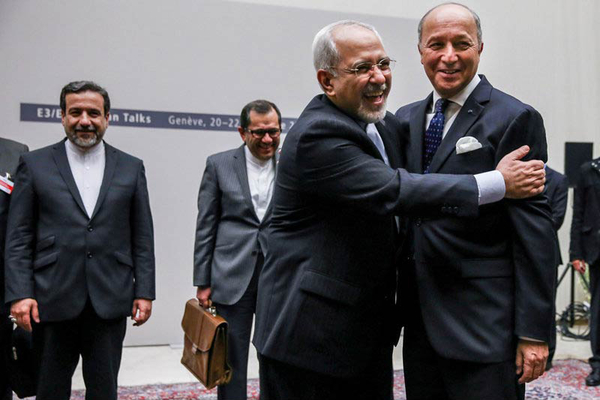
984Foreign Minister Laurent Fabius says: “Trade is very important. It fosters growth. It’s important for the Iranians, it’s important for us,” adding that regarding the current nuclear deal with Iran, “we did not take it for commercial reasons, but for strategic reasons…” Above, Iranian Foreign Minister Javad Zarif hugs Fabius at the close of nuclear talks in Geneva, Nov. 23, 2014. (Image source: ISNA)

Italy. Italian Foreign Minister Paolo Gentiloni and Economic Development Minister Federica Guidi led a high-level trade mission to Iran on August 4-6, aimed at opening export opportunities for Italian companies. According to forecasts by SACE, the Italian export credit company, Italian exports to Iran are expected to grow to €3.8 billion ($4.1 billion) in 2018, up from €1.2 billion currently.

Companies in the oil and gas industry and the machine tool industry, the two sectors most adversely affected by sanctions, are hoping to recapture market share lost due to the trade embargo. Companies active in the machine tools sector (which accounts for nearly 60% of current Italian exports to Iran) have seen their exports drop to €700 million from €1.3 billion during the past five years, according to SACE.

Gentiloni and Guidi met with Iranian Oil Minister Bijan Namdar Zanganeh on August 6. After the meeting, Zanganeh said that Iran had invited the Italian oil and gas giant Eni, as well as other Italian companies, to participate in projects in the Iranian oil industry.

On August 4, SACE, together with the Italian Ministry of Economic Development and Mediobanca, the leading investment bank in Italy, announced the finalization of a Memorandum of Understanding with the Iranian Ministry of Economy and Finance and the Central Bank of Iran, aimed at facilitating the development of future economic and trade relations between the two countries.

Under the agreement, “the parties will collaborate to evaluate short and medium-long term projects of mutual interest implying Italian export and investments and to identify local financial institutions that could benefit from credit lines provided by Mediobanca, and guaranteed by SACE and the Ministry of Economy and Finance of Iran, to support the financing and payment of such transactions.”

Also on August 4, Finmeccanica, Italy’s main industrial group, announced that it had signed a €500 million ($543 million) contract with Iran’s Ghadir Investment Company to build a power plant in the country. Ghadir is 80% owned by the Islamic Revolutionary Guards’ Corps (IGRC). The IRGC, through its elite Quds Force, is responsible for the deaths of at least 1,000 American troops in Iraq.

Austria. Austrian President Heinz Fischer is set to become the first European head of state to visit Iran since 2004 when he travels to Tehran on September 7-9. Fischer will be accompanied by Vice Chancellor and Economy Minister Reinhold Mitterlehner, Foreign Minister Sebastian Kurz, as well as a delegation of high-ranking Austrian business leaders. Mitterlehner said he hopes that Austrian exports to Iran will reach one billion euros per year by 2020, up from 232 million euros today.

On July 23-24, the Austrian Economic Chamber (Wirtschaftskammer Österreich, WKÖ)organized a major EU-Iran trade conference that was attended by nearly 400 Austrian and Iranian business leaders, including Iranian Industry Minister Mohammad Reza Nematzadeh.

According to Nematzadeh: “We are no longer interested in unidirectional importation of goods and machinery from Europe. We are looking for two-way trade, as well as cooperation in development, design, engineering and joint investment for production and export.”

Not all Austrians are happy about the government’s rush to embrace Iran. The Austrian branch of the activist group “Stop the Bomb” organized a protest outside the WKÖ’s headquarters on July 23. In a statement, the group said:

“While the implementation of the nuclear deal with the Iranian has not even started and the sanctions on Iran are still in place, Iran trade lobbyists are set to host the ‘EU-Iran-Conference’ at the Austrian Economic Chamber WKO in Vienna. Among the participants are WKO-President Christoph Leitl and the Iranian Industry & Trade Minister Mohammad Reza Nematzadeh. 70 years after the Shoah, Austrian and German companies are in the first row to boost business ties with the anti-Semitic Iranian regime.

“This conference shows that billions of Euros are going to flow to the Iranian mullahs as a result of the Vienna agreement. This will enable the regime to sponsor its terror proxies like Hamas and Hezbollah and to enforce its aggressive expansion in the region in unprecedented ways. The terror against the Iranian population will not decrease, but increase. Already now more people have been executed under supposedly ‘moderate’ President Rouhani than under his predecessor Ahmadinejad.

“Conducting business with the Iranian regime means to finance the nuclear program, the annihilation threats against Israel, Holocaust denial, the export of Islamist terror and the oppression of the Iranian population.”

Spain. Foreign Minister José Manuel García-Margallo, Industry, Energy and Tourism Minister José Manuel Soria and Development Minister Ana Pastor will lead a high-level trade delegation to Iran in early September. The objective is to open doors for Spanish companies in the energy, telecommunications and infrastructure sectors.

After the sanctions are lifted, Spain hopes to double its exports to Iran to 600 million euros, up from 300 million euros today, according to the Chamber of Commerce. The key sectors of interest for Spanish companies are petroleum, petro-chemical, mining, automobile, infrastructure and rail transport.

Despite the embargo, more than 350 mostly small- and medium-sized Spanish companies are currently active in Iran. On July 19, the newspaper El Mundo reported that more than a dozen Spanish companies sold so-called dual-use materials that could have been used to help Iran build weapons of mass destruction.

Since 2011, Spanish authorities have carried out nearly a dozen police operations aimed at disrupting illegal weapons sales to Iran. One such operation blew the lid off a scheme to sell nine helicopters to Iran. Another operation discovered that a company ostensibly dedicated to importing Persian rugs was trying to sell missile casings to the Iranian military.

A report published by Gatestone Institute in April 2014 found that in addition to Spain, companies or individuals in more than a dozen European countries — including Belgium, Britain, Finland, France, Germany, Hungary, Ireland, Italy, the Netherlands, Norway, Slovenia, Sweden and Switzerland — have been involved in illegal dual-use exports to Iran.

A senior French official interviewed by the Reuters news agency summed it up this way: “Everyone is looking at Iran with greed.”

More bad news for Obama from Iran about the secret deals

August 4, 2015

More bad news for Obama from Iran about the secret deals, Dan Miller’s Blog, August 4, 2015

(The views expressed in this article are mine and do not necessarily reflect those of Warsclerotic or its other editors. — DM)

An Iranian official recently stated that no International Atomic Energy Agency (IAEA) personnel will be permitted to enter military or missile sites. Another stated that “no country is permitted to know the details of future inspections conducted by the IAEA.” Their statements are probably consistent. There may well be other secret deals we don’t know about and perhaps never will. Meanwhile, Iran is preparing to test long range ballistic missiles “to prove that the missile ban was invalid.”

It's not MY fault.

It’s not MY fault.

I. No IAEA inspections of the sites that matter most

Entry-into-Iran-military-sites-forbidden (1)

In an interview on Al Jazeera TV last week Ali Akbar Velayati, Security Adviser to Iran’s Supreme Leader, stated that

United Nations nuclear inspectors from the International Atomic Energy Agency would not be given access to Tehran’s sensitive military nuclear sites.

. . . .

“First, allow me to emphasize that the issue of the missiles and of Iran’s defensive capabilities were not part of the negotiations to begin with,” Velayati said. [Emphasis added.]

“No matter what pressure is exerted, Iran never has negotiated and never will negotiate with others – America, Europe, or any other country – about the nature and quality of missiles it should manufacture or possess, or about the defensive military equipment that it needs. This is out of the question.” [Emphasis added.]

A video of Mr. Velayati remarks, with translations by the Middle East Media Research Institute (MEMRI), is available here. Since I have been unable to find it on You Tube I have no way to embed it.

Unfortunately, Mr. Velayati is essentially correct. The November 2013 Joint Plan of Action focused almost exclusively on Uranium enrichment, to the exclusion of the “possible military dimensions” of Iran’s military nuclear activities including missile research, development and testing.

II. Details of IAEA inspections will not be disclosed

Reza Najafi, Iran’s ambassador and permanent envoy to the IAEA, stated over the weekend that “no country is permitted to know the details of future inspections conducted by the IAEA.”

Najafi’s statement could mean (a) that no details about inspection methodology will be disclosed, (b) that no details about inspection results will be disclosed or (c) both. If inspection methodologies — who did the inspections as well as when, where and how, are not disclosed, what useful purpose will they serve, other than for Iran? If details of the results of inspections are not disclosed, that will also be the case. How, in either or both cases, will the members of the P5+1 negotiating teams have sufficient information to decide whether to “snap back” sanctions — if doing so is now even possible — or anything else?

III. Even details about inspections of non-military sites will be hidden

Considering Parts I and II together, and assuming that the statements of Iranian officials are reasonably consistent and not mere gaffes, IAEA personnel will be permitted to inspect non-military sites only and hence only to keep tabs on Uranium enrichment; even the details of those inspections will not be disclosed. Is that what Kerry and the other P5+1 negotiators had (pardon the expression) in mind?

IV. Iran says, Ballistic missile testing and development are OK

games

As reported by DEBKAfile,

Shortly before US Secretary of State John Kerry was due in Qatar Monday, Aug. 3, Iran’s highest authorities led by supreme leader Ayatollah Ali Khamenei Sunday launched a public campaign to support Tehran’s noncompliance with the Vienna nuclear accord and UN Security Council Resolution 2231 of July 20, on its ballistic missile program. The campaign was designed by a team from Khamenei’s office, high-ranking ayatollahs and the top echelons of the Revolutionary Guards, including its chief, Gen. Ali Jafari. [Emphasis added.]

It was kicked off with a batch of petitions fired off by the students of nine Tehran universities and Qom religious seminaries to Iran’s chief of staff Maj Gen. Hassan Firouzabadi, demanding immediate tests of long-range ballistic missiles to prove that the missile ban was invalid. [Emphasis added.]

. . . .

The Security Council Resolution, which unanimously endorsed the Joint Comprehensive Plan of Action (Vienna nuclear accord) signed by Iran’s Foreign Minister Mohammed Javad Zarif, called on Iran “not to undertake any activity related to ballistic missiles designed to be capable of delivering nuclear weapons, including launches using such ballistic technology until the date eight years after the JCPOA Adoption Day.” [Emphasis added.]

Tehran retorted that none of its ballistic missiles were designed to deliver nuclear weapons, and so this provision was void. Shortly after its passage, the foreign ministry in Tehran issued an assurance that “…the country’s ballistic missile program and capability is untouched and unrestricted by Resolution 2231.” [Emphasis added.]

This appears to confirm that all of Iran’s ballistic missile sites are off-limits to inspectors.

V. What does Kerry know?

When questioned by members of Congress on the secret deals, Secretary Kerry testified that he had neither seen nor read them but that he had been fully briefed and knew “exactly” what they say. Put charitably, it seems unlikely that he knew that much.

Less charitably, Kerry knew far more than he said and declined to be forthcoming. Now that two Iranian officials have provided highly important information, thus far probably unknown to Congress, will Kerry have additional comments? Not if he can help it.

VI. Conclusions

I wrote early and often about the miserable “deal” about to be entered into by P5+1 under Obama’s dubious leadership. As Iranian officials provide additional information it should be clear — even to the most enthusiastic “deal” supporters — that the “deal” is far worse than earlier thought possible and that the U.S. Congress is obligated to disapprove it and to override any Obama veto, partisan politics notwithstanding.

Funding the Mullahs’ exeution spree

August 4, 2015

Funding the Mullahs’ exeution spree, Front Page MagazineDr. Majid Rafizadeh, August 4, 2015

(Yet “progressive” supporters of the “deal” seem not to be bothered — unless an African lion is killed. — DM)

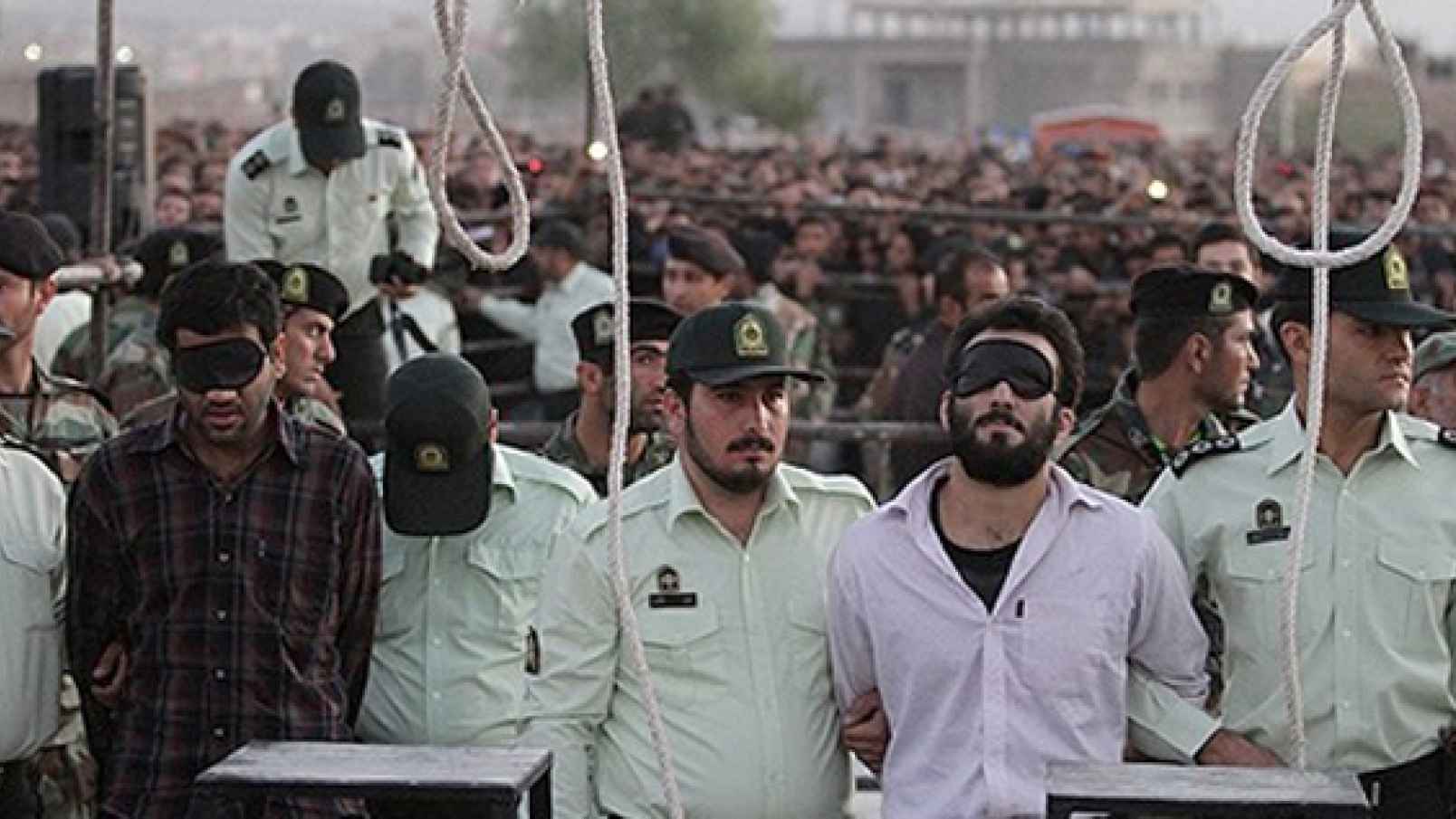
hangings_in_iran_wikimedia_groundreport.com_640_0

Unfortunately, although President Obama is very vocal about defending the nuclear deal, the lifting of economic sanctions on the Ayatollah, the release of over a hundred of billion dollars to the ruling clerics of Iran, he has not issued any serious criticism against the leaders of the Islamic Republic with regards to the execution spree.

***********************

How the Obama administration is facilitating Iran’s unprecedented killing binge.

President Obama is determined to defend the Islamic Republic as a legitimate government that should receive sanctions relief. He has even overstepped his constitutional authority by signing the nuclear deal (a treaty) in the United Nations Security Council without getting the two-third vote of the Senate. He did not give Congress time to review the nuclear deal as he previously promised.

The Obama administration is advocating for a regime that has been on an execution spree on an unprecedented level, according to Amnesty International’s latest report. Since the beginning of this year, the Islamic Republic has executed approximately 700 people.

People being executed are usually not told about their death sentence until the noose is put around their neck and until they reach the gallows. Family members of the victims often do not know about the execution until weeks after.

As Said Boumedouha, deputy director of Amnesty’s Middle East and North Africa program said, “Iran’s staggering execution toll for the first half of this year paints a sinister picture of the machinery of the state carrying out premeditated, judicially-sanctioned killings on a mass scale.” He added, “The use of the death penalty is always abhorrent, but it raises additional concerns in a country like Iran where trials are blatantly unfair.”

I regularly speak with Iranian people living in various cities in Iran including Esfahan, Tehran, Tabriz, and Khorasan in order to obtain a better understanding on the ground. My family lives there too. The words of every one of them (about the current situation in Iran after the nuclear deal was reached) echoes what Zahra, an English teacher in the province of Esfahan, told me. She said, “Any cash given to the these Sheikhs in the government (the clerics) by the powers because of the nuclear deal, will not be distributed to the people. The money will not be used to improve people’s economic standards. The people on top will steal the money, saving it in their bank accounts, or send it to their Arab allies, Bashar Al Assad, Hezbollah, and the Iraqi government. They [Iranian leaders] are also going to increase domestic suppression if they begin seeing the flow of cash.”

If we look at the history of the Islamic Republic closely, we see that when a “reformist” president (Mohammad Khatami) was in power in Iran, the nation witnessed the same increase in executions and suppression. It was one of the worst periods of oppression and crackdowns on civil liberties. In addition, the number of executions normally rises under the so-called “moderates” and “reformists” rules.

When Iranian people feel that they might finally have a better relationships with the West, the ruling establishments ratchets up their imprisonment, torture, suppression and killings in order to show the people who is in charge and in order to impose fear. By using these tactics, they send a clear message that the Islamists are in charge, not the youth.

This staggering number of executions suggests that, as the ruling clerics of the Islamic Republic were gaining global legitimacy due to the nuclear negotiations and “normalizing” relationships with the Obama administration, they have also increased their mass scale killings of their own citizens. At the same time, several American citizens are still spending time in Iran’s prison.

Unfortunately, although President Obama is very vocal about defending the nuclear deal, the lifting of economic sanctions on the Ayatollah, the release of over a hundred of billion dollars to the ruling clerics of Iran, he has not issued any serious criticism against the leaders of the Islamic Republic with regards to the execution spree.

In the Islamic Republic, one can be executed for actions which might not even be a crime or it might be a misdemeanor in other democratic countries. For example, one can be executed for “enmity against Allah” or “corruption on earth.” In addition, a non-Muslim man can be executed for having sex with a Muslim women, but not vice versa. One can be executed or stoned if he/she is married and has sex with an unmarried person. One can also be executed for cursing or using bad words against the prophet.

As the report by Amnesty International described, “They [death sentences] are imposed either for vaguely worded or overly broad offenses, or acts that should not be criminalized at all, let alone attract the death penalty… Trials in Iran are deeply flawed, detainees are often denied access to lawyers, and there are inadequate procedures for appeal, pardon and commutation.”

Boumedouha observed, “For years, Iranian authorities have used the death penalty to spread a climate of fear in a misguided effort to combat drug trafficking, yet there is not a shred of evidence to show that this is an effective method of tackling crime…”

The more the Iranian leaders are empowered and emboldened financially, economically and politically, the more they tighten the noose on all freedoms (including speech, assembly, press, etc.), as well as basic inalienable human rights.

There are currently thousands of innocent people on death row waiting to be unfairly executed in the Islamic Republic. While President Obama finds it urgent to overstep his constitutional authority to quickly sign the nuclear deal with Iran and push for sanctions relief against the ruling clerics, he needs to pay close attention to how the empowerment of the ruling Islamists in Iran is adversely affecting the lives of millions of innocent people.

Contentions| The Real Goal of the Nuclear Deal: Iran Détente

August 3, 2015

Contentions | The Real Goal of the Nuclear Deal: Iran Détente, Commentary Magazine, August 3, 2015

To listen to President Obama and Secretary of State John Kerry defend their nuclear deal in recent weeks, you’d think the issue at stake is a narrow one that solely concerned whether or not the agreement retards Tehran’s quest for a bomb. The assumption from the administration and its apologists that the deal does this even minimally is a dubious one. But one of the subtexts of the misleading way they have been conducting their end of this debate is their effort to distract both Congress and the public from the broader goals of the pact. While critics of the deal have highlighted Obama’s refusal to make the sanctions relief dependent on an end to support for terrorism, ballistic missile production or the nature of Iranian government, the answers from the administration have been consistent. They want to restrict the discussion to purely technical nuclear issues that can be obfuscated by deceptive claims or to the false choice between the agreement and war. But, to its credit, one of the president’s chief media cheerleaders did highlight the real goals of the administration in an article published on Friday. The New York Times feature titled “Deeper Aspirations Seen in Nuclear Deal With Iran” ought to be required reading for all members of the House and Senate. The choice here isn’t one between a flawed nuclear deal and war, but between Iran détente with a tyrannical, anti-Semitic, aggressive Islamist regime and a reboot of the diplomatic process that has been hijacked by appeasers.

As the Times points out, prior to the announcement of the final, lenient terms of the deal that expires in ten years the administration wasn’t so coy about its real objective:

Before his fight for the deal in Congress, Mr. Obama was far more open about his ultimate goals. In an interview in The Atlantic in March 2014, he said that a nuclear agreement with Iran was a good idea, even if the regime remained unchanged. But an agreement could do far more than that, he said:

“If, on the other hand, they are capable of changing; if, in fact, as a consequence of a deal on their nuclear program those voices and trends inside of Iran are strengthened, and their economy becomes more integrated into the international community, and there’s more travel and greater openness, even if that takes a decade or 15 years or 20 years, then that’s very much an outcome we should desire,” he said. …

And in an interview in December, Mr. Obama even seemed to welcome the rise of a powerful Iran. “They have a path to break through that isolation and they should seize it,” he said. “Because if they do, there’s incredible talent and resources and sophistication inside of — inside of Iran, and it would be a very successful regional power.”

The importance of this context for the discussion of the deal cannot be overemphasized.

The deal ought to be defeated on its own merits because it fails to achieve the administration’s stated objectives about stopping Iran’s nuclear ambitions. All it accomplishes, if it can even be said to do that much, is to delay Iran’s march to a bomb for the period of the agreement while permitting to continue research with a large nuclear infrastructure under a loose inspections regime that makes a mockery of its past promises on all these issues.

But the point on which the administration has been most reluctant to comment is the more than $100 billion in frozen assets that will be released to Tehran. Critics rightly believe this money will, one way or another, help subsidize Iran’s terrorist allies and push for regional hegemony that worries neighboring Arab states as well as Israel, whose existence is threatened by Iran becoming a threshold nuclear state with Western approval.

No rational argument can be mustered against this assertion since the money will be Iran’s to use as it likes and any prohibitions on Iranian adventurism are likely to be even less effective in a post-deal environment than they were prior to it. But if, like President Obama, you believe that Iran is in the process of transforming from a revolutionary threat whose goals are mandated by the extreme religious beliefs and Islamist ideology of its rulers into one eager to be friends with the world, the prospect of a stronger Iran doesn’t trouble you.

That’s why President Obama did not predicate these negotiations on any pledges, even ones that were transparently false, of good behavior from Iran. He claims that insisting on an end to Iranian state sponsorship of terror or forcing it to renounce its goal of eliminating Israel would have prevented him from getting a deal on the nuclear question. But that formulation has it backward. The point of the negotiations was never about the nuclear details, something that was made clear by the astonishing series of concessions that the administration made throughout the talks. In October 2012, during his foreign policy debate with Mitt Romney, Obama pledged that any deal would eliminate Iran’s nuclear program. Now he is advocating for one that leaves it in place under Western sponsorship while rewarding Tehran with the lifting of sanctions.

What Obama always wanted was a deal at any price because he thought it was the pathway to a new entente with Iran that would end the conflict with its Islamist leaders. But while a future in which Iran would no longer be a terror sponsor bent on destroying Israel and dominating the Middle East would be a good thing there is no rational reason to imagine this will happen. Indeed, by strengthening its government the president is ensuring that they will never have to choose between their aggressive goals and economic prosperity.

That’s why rather than being sidetracked into debates about the nuclear details, opponents need to focus on the real goal of the deal: détente with a regime that threatens the U.S. and its allies. The deal fails as a nuclear pact. But it is perhaps an even greater disaster when one realizes that its premise is a naive belief that Islamist tyrants are so enraptured with Obama that they are about to abandon their deeply held beliefs and evil intentions.

Iran orders from China 150 J-10 fighter jets that incorporate Israeli technology

July 30, 2015

Iran orders from China 150 J-10 fighter jets that incorporate Israeli technology, DEBKAfile, July 30, 2015

J-10Chinese Chengdu J-10 for Iranian air force

The scale of Iran’s multibillion acquisitions from China and Russia – 550 warplanes in all so far – indicates that Tehran’s top spending priority upon receipt of the funds released by the removal of sanctions, is to be a spanking new air force.

**********************

Iran is about to conclude a transaction with China for the purchase of the Chengdu J-10 multirole jet fighter, known in the West as the Vigorous Dragon, according to an exclusive report from DEBKAfile’s military and intelligence sources. Beijing has agreed to sell Tehran 150 of these sophisticated jets.

While the Chinese J-10 is comparable to the US F-16, our sources report that it is virtually a replica of the Lavi, the super-fighter developed by Israel’s aerospace industry in the second half of the 80s. Israel sold China the technology, after Washington insisted on Its discontinuing the Lavi’s production. The US also objected to the sale of the Lavi’s avionics, claiming that it contained some American components.

The Chinese plane comes in two versions – the multirole single-seat J-10A and the two-seat J-10B, which serves for training, ground assaults and electronic warfare.

Iran has additionally weighing the purchase in Moscow of 250 highly-advanced Sukhoi-Su-30MK1 twinjet multirole air superiority fighters, known in the West as Flanker-H.

On Wednesday, July 29, an Indian Air Force Su-30MK1 took part for the first time in a British air maneuver, Rainbow, where it dueled with the European Typhoon fighter.

The sophisticated Flanker has been found to have a major shortcoming. To carry eight tons of ordnance, it must use both of its AL-31FP engines, and the transition from one to two – and the reverse – often causes engine failure.

The Indian Air Force has reported three such malfunctions in a month, as well another shortcoming: The time needed for making the aircraft serviceable is too long. As a result, only half of the Indian fleet can be airborne at one time.

In a confrontation, the Iranian Air Force may find that, because of these drawbacks, the Chinese Su-30MK1 is outmatched by its American and European counterparts in the service of the Israeli, Saudi and UAE air forces.

On July 22, DEBKAfile revealed that Moscow and Tehran had concluded a giant transaction for the acquisition of a fleet of 100 IL78 MK1 (Midas) in-flight refueling planes for extending the range of its warplanes up to 7,300 km and able to refuel 6-8 planes at once.

DEBKAfile: The scale of Iran’s multibillion acquisitions from China and Russia – 550 warplanes in all so far – indicates that Tehran’s top spending priority upon receipt of the funds released by the removal of sanctions, is to be a spanking new air force.

Cartoon of the day

July 26, 2015

H/t Freedom is just another word


death

Op-Ed The consequences of a bad deal with Iran

July 26, 2015

Op-Ed The consequences of a bad deal with Iran, LA Times, John Bolton, July 26, 2015

American weakness has brought us to this difficult moment. While we obsessed about its economic discomfort, Iran wore its duress with pride. It was never an even match. We now have to rely on a tiny ally to do the job for us. But unless we are ready to accept a nuclear Iran (and, in relatively short order, several other nuclear Middle Eastern states), get ready. The easy ways out disappeared long ago.

***************************

President Obama has made an art form of attacking his opponents rather than substantively defending his own policies, most recently regarding the Vienna agreement on Iran’s nuclear program. Essentially, Obama argues that we must either accept his wretched deal or go to war to prevent Iran from acquiring nuclear weapons.

As is typical, Obama posits the wrong choice, apparently to distract from the unpleasant reality that the agreement won’t work. It will not prevent Iran from getting nuclear weapons. So the real choice we are faced with is dealing with the consequences of military action or the consequences of a nuclear Iran. Neither is palatable, but the latter is far worse. If the real objective is stopping Iran from getting nuclear weapons, preemptive military action is now inescapable.

This rock-and-hard-place outcome has long been foreseeable. Iran’s dogged determination to become a nuclear-weapons state was fiercer and stronger than the West’s frail response. Assuming Iran scrupulously complies with every provision agreed to in Vienna — an absurdly unlikely scenario given the ayatollahs’ objectives and history — its ambitions for nuclear weapons will simply have been delayed eight to 10 years.

In all likelihood, the ayatollahs are already at work violating the accords. After all, Iran has systematically breached its voluntarily-assumed obligations under the Nuclear Non-Proliferation Treaty for more than 30 years. Now the president’s deal will allow Iran to keep the fruits of its violations. Yes, the deal includes restrictions on uranium enrichment, but Tehran can retain its enrichment program, with guaranteed international assistance in improving it. These concessions are fatal mistakes.

Moreover, Iran’s ballistic missile efforts — its development of the means to deliver nuclear weapons all over the world — will barely be touched. Nor does the deal in any way address Iran’s clandestine weaponization efforts, which it has denied and hidden from the International Atomic Energy Agency with great skill.

Last week, the news that the administration has not even seen the texts of two agreements between the energy agency and Iran, both crucial to implementation of the Vienna accords, only raises further doubts. President Obama must provide the texts of these “side deals” to Congress before any serious consideration of the overall agreement is possible.

Some critics of Obama’s plan advocate scuttling the deal and increasing economic sanctions against Iran instead. They are dreaming. Iran and the United States’ negotiating partners have already signed the accords and are straining at their leashes to implement them. There will be no other “better deal.” Arguments about what Obama squandered or surrendered along the way are therefore fruitless. As for sanctions, they were already too weak to prevent Iran’s progress toward the bomb, and they will not be reset now. To paraphrase Bruce Springsteen, “These sanctions are going boys, and they ain’t coming back.”

Patrick Clawson, the director for research at the Washington Institute for Near East Policy, provided the most recent thumbs-down assessment of sanctions: “Iran has muddled through the shock of the sanctions imposed in 2012, and its structural [economic] problems are not particularly severe compared to those of other countries.” He estimates Iran’s nuclear and terrorism-support programs to cost only about $10 billion annually. No wonder administration officials have testified that sanctions (including those imposed piecemeal before 2012) did not slow Iran’s nuclear efforts.

Nor will the deal’s “snapback” mechanism (intended to coerce Iran back into compliance if it breaches its obligations) change that reality. Tehran’s belligerent response is expressly stated in the agreement’s text: “If sanctions are reinstated in whole or in part, Iran will treat that as grounds to cease performing its commitments … in whole or in part.” Tehran does risk losing some future economic benefits should sanctions snap back, but by then it will have already cashed in the assets the deal unfreezes and signed new lucrative trade and investment contracts.

Once those benefits begin flowing all around, the pressure on world governments will only increase to ignore Iranian violations, or to treat them as minor or inadvertent, certainly not warranting the reimposition of major sanctions. The ayatollahs have dusted off Lenin’s barb that “the capitalists will sell us the rope with which we will hang them,” and applied it to the age of nuclear proliferation.

If diplomacy and sanctions have failed to stop Iran, diplomacy alone will fail worse. Like it or not, we now face this unpleasant reality: Iran probably will violate the deal; it may not be detected doing so and if detected, it will not be deterred by “snapback” sanctions. So we return to the hard question: Are we prepared to do what will be necessary to stop Iran from getting nuclear weapons?

Obama most certainly is not, which means the spotlight today is on Israel.

If Israel strikes, there will be no general Middle East war, despite fears to the contrary. We know this because no general war broke out when Israel attacked Saddam Hussein’s Osirak reactor in 1981, or when it attacked the North Korean-built Syrian reactor in 2007. Neither Saudi Arabia nor other oil-producing monarchies wanted those regimes to have nuclear weapons, and they certainly do not want Iran to have them today.

However, Iran may well retaliate. At that point, Washington must be ready to immediately resupply Israel for losses incurred by its armed forces in the initial attack, so that Israel will still be able to effectively counter Tehran’s proxies, Hamas and Hezbollah, which will be its vehicles for retaliation. The United States must also provide muscular political support, explaining that Israel legitimately exercised its inherent right of self-defense. Whatever Obama’s view, public and congressional support for Israel will be overwhelming.

American weakness has brought us to this difficult moment. While we obsessed about its economic discomfort, Iran wore its duress with pride. It was never an even match. We now have to rely on a tiny ally to do the job for us. But unless we are ready to accept a nuclear Iran (and, in relatively short order, several other nuclear Middle Eastern states), get ready. The easy ways out disappeared long ago.

Eyes wide shut

July 24, 2015

Eyes wide shut, Israel Hayom, Ruthie Blum, July 24, 2015

On Thursday, U.S. Secretary of State John Kerry spent more than four hours trying to defend the nuclear deal before the Senate Foreign Relations Committee. Grilled by Republicans furious at the Obama administration’s total surrender to Iran, Kerry remained true to character: He doubled down on meaningless platitudes with self-righteous indignation.

In fairness to America’s top diplomat, whose stupidity is only matched by President Barack Obama’s evil, how else could he respond to rational concerns but to get on his high horse? Indeed, all he had at his disposal in the face of the emerging details of the agreement, each more shocking than the next, was a feeble attempt to invert reality and ridicule his critics in the process.

Referring to a “Citizens for a Nuclear Free Iran” commercial aimed at persuading Congress to vote against the agreement and currently airing across the U.S., Kerry argued, “The alternative to the deal we’ve reached isn’t what we’re seeing ads for on TV. It isn’t a better deal, some sort of unicorn arrangement involving Iran’s complete capitulation. That’s a fantasy, plain and simple.

This was Kerry’s way of insisting that he had not been “bamboozled” by his Iranian counterparts, as Sen. Jim Risch (R-Idaho) asserted, nor “fleeced,” as committee chairman Sen. Bob Corker (R-Tenn.) accused.

In other words, no wool was pulled over his eyes. Not by the Iranians, at any rate. They were clear all along. And loud, as Kerry can attest, since he was the target of Iranian Foreign Minister Mohammad Javad Zarif’s repeated abusive outbursts during the negotiations.

No, if Kerry was “bamboozled” or “fleeced” by anyone it was Obama, who told him to secure a deal at any and all cost, because doing so would be better in the short run. As for the long-term repercussions, well, that would be a future administration’s headache.

The way Obama and Kerry both justify the travesty is even less comforting. They claim that since Iran was going to pursue nuclear weapons anyway — and support terrorism anyway, and violate terms anyway, and threaten to wipe Israel off the map anyway, and burn American flags anyway — it would be wiser to join them than beat them.

The logic is mind-boggling. But it does shed light on the administration’s attitude towards Israel.

Obama has been bent on earning the Nobel Peace Prize he was awarded — simply for entering the Oval Office — by completing a contract with Iran. Kerry has been obsessed with procuring a document declaring “peace” between Israel and the Palestinian Authority in order to become a Nobel laureate himself.

His dreams were dashed, however, when Prime Minister Benjamin Netanyahu was unwilling to cross certain red lines. Though Netanyahu did agree to negotiations, the release of well over 1,000 Palestinian terrorists, a halt in settlement construction, groveling before Turkish President Recep Tayyip Erdoğan and a slew of slights from the White House, he refused to commit Israel to suicide.

It is thus that Palestinian Authority President Mahmoud Abbas would not come to the negotiating table. Had the P5+1 countries not given Iran reason to believe that their red lines were merely rhetorical, Ayatollah Ali Khamenei — Iran’s “supreme leader” in every respect — would not have allowed his puppets to parlay with American and European representatives in the first place.

No wonder Obama and Kerry can’t stand Netanyahu. If the president of the United States can roll over and abdicate to a sworn enemy, who does the prime minister of Israel think he is to remain steadfast?

Understanding this is crucial. What it means is that Obama’s camp is right — and Netanyahu’s is wrong — about not having been able to hold out for a “better deal.” Iran, like the Palestinians it supports, has one goal in mind: demolishing the enemy.

It remains to be seen whether Obama will garner enough support in Congress to enable him to veto opposition to the agreement, which gives Iran carte blanche for its genocidal-weapons development and billions of dollars to bolster global terrorism.

At the moment, it’s not looking good. What’s worse is an annex in the agreement that provides for cooperation between the P5+1 and Iran “to strengthen Iran’s ability to protect against, and respond to nuclear security threats, including sabotage, as well as to enable effective and sustainable nuclear security and physical protection systems.”

This clause is causing a stir in Israel. It was also the focus of a question raised by presidential hopeful Marco Rubio (R-Fla.) during the Senate hearing. He wanted to know if it means the U.S. would be required to protect Iran’s nuclear facilities from a potential Israeli military strike.

“No,” retorted Energy Secretary Ernest Moniz, on hand with Treasury Secretary Jack Lew to help Kerry through the ordeal. Rubio was not convinced.

He did issue a warning, however: “The Iranian regime and the world should know that this deal is your deal with Iran … and the next president is under no legal or moral obligation to live up to it.”

What the rest of us need to know is which will come first, an Israeli attack or a Republican in the White House?