Archive for the ‘Obama’s America’ category

Nuclear Iran: Is the U.S. Really Suicidal?

July 27, 2015

Nuclear Iran: Is the U.S. Really Suicidal? The Gatestone InstituteBassam Tawil, July 27, 2015

  • No wonder Iran’s Supreme Leader sent around a tweet of Obama pointing a pistol at his own head. Iran’s forcing itself on the rest of the world is a central part of Khomeini’s Islamic Revolution.
  • The Ayatollahs’ wish has long been finally to defeat the divided Arabs, and then to move on to defeat Israel, and then the grandest prize of all — the “Great Satan,” the United States.
  • Worse, apparently a “side deal” — classified for the Americans but not for Iran — enables Iran to provide its own soil samples to the International Atomic Energy Agency (IAEA), to which it has been lying for decades. Even still worse, the parties to the agreement are required to help Iran protect its nuclear facilities should anyone try to attack them or sabotage them — including, presumably, any disenchanted signatories.
  • Iran will have been rewarded for having violated the Nuclear Non-Proliferation Treaty, and been given a red carpeted fast track to complete its nuclear bomb.

If Obama and the others who signed the catastrophic nuclear agreement with Iran on the eve of Laylat al-Qadr, the Eve of Destiny, a few days before the end of the Ramadan fast, had studied a little history, they would know that the Battle of Qadisiyyah in 636, in which the Persians suffered a disastrous defeat at the hands of the Arabs, has not yet ended. They would know that Islam had, in fact, been imposed on the Sassanid Empire by force, and that, in protest, the Persians adopted Shi’a Islam, a form of the religion that deviated from and changed the Islam of the Arabs, as a way of rebelling and continuing the fight.

If the West had studied that important event in Islamic history, they would understand they were enabling Iran to achieve a nuclear bomb and accelerate the national religious war between us, the Arabs, and the Shi’ite Iranians. For Iran’s mullahs, the showdown is meant to be apocalyptic.

In that respect, the agreement signed by the American-led powers with Iran’s rulers is a milestone along the path they have been praying for. The Ayatollahs’ wish has long been finally to defeat the divided Arabs, currently at their weakest point since the beginning of the so-called Arab Spring, and then to move on to defeat Israel, and then grandest prize of all: the “Great Satan,” the United States.

The Shi’ite regime of the Ayatollahs in Iran and their proxies are united. And, since the fall of the Shah, they are, sadly, also radical. Between their terrorist wings and influence in the Middle East and abroad, the Ayatollahs are refreshingly open about their determination to defeat the Arabs and achieve religious and national hegemony. Iran’s forcing itself on the rest of the world is a central part of Khomeini’s Islamic Revolution.

U.S. President Barack Obama has harmed us Arabs by abandoning his own red lines — against the emphatic advice of his own military advisors — to accept an agreement that in reality gives the Shi’ites open permission to build nuclear weapons at our expense and, more insanely, to allow Iran intercontinental ballistic missiles (ICBMs) that could reach America.

Worse, apparently a “side deal” — classified for Americans but not for Iran — allows Iran to provide its own soil samples to the International Atomic Energy Agency (IAEA), to which it has been lying for decades. In other words, having the cat guard the milk.

Still worse, the parties to the agreement are required to help Iran protect its nuclear facilities should anyone try to attack them or sabotage them — including, presumably, any disenchanted signatories. No wonder Iran’s Supreme Leader sent a tweet of Obama pointing a pistol at his own head.
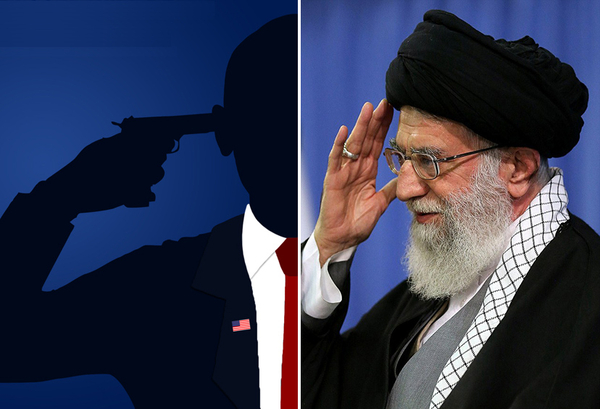
1172On July 25, 2015, Iran’s Supreme Leader (right) sent a tweet of Obama pointing a pistol at his own head.

If we try to look at the positive side of the agreement, it is just possible that Obama looked at the Sunni Islamic states, fractured and at each other’s throats, and at the ruthless terrorist groups and all the other battle zones gaining ground, and decided that we were too fractious for the U.S. to protect.

Now, one minute before the Iranians would have collapsed under the weight of the economic sanctions, the U.S. has given them a new lease on life, and, supported by the arrival of billions of dollars, is enabling them to return to their broad international terrorist activities and continue developing their nuclear weapons and the ICBMs on which to mount them.

Not only Iran will profit, but also the Turks, the Chinese and the Russians, who have already jumped at the chance to shore up Iran and themselves, both economically and militarily.

America will be now marginalized, as will its allies. What is in store for America is obvious to anyone listening to the hate speech of Iran’s Supreme Leader Ayatollah Ali Khamenei. He keeps promising that he will continue fighting against America and Israel, and that Iran will neither stop its nuclear development nor surrender.

Instead of lifting the sanctions, the United States should be increasing them.

When Iran joins the global energy market and strengthens its control of the Gulf maritime route, we, the Arabs, will quickly collapse. The recent visits of the Saudi Arabia foreign minister to American and the American Secretary of Defense to Israel did not help. As the arms embargo and sanctions are lifted, money will begin pouring into Iran. Missiles will be developed that will be capable of reaching first Israel and the Sunni Arab states, then Europe and then the United States. Global terrorism will mushroom. Iran will secretly complete its nuclear project ahead of schedule.

Since the agreement forbids agencies affiliated with America, and now apparently “foreigners,” from visiting Iran’s nuclear installations, the arms industry of Islamic Republic will flourish, and Iran will have been rewarded for having violated the Nuclear Non-Proliferation Treaty, and will be given a red carpeted fast track to build a nuclear bomb.

Satire | Watch out Kim, your nukes are next!

July 27, 2015

Watch out Kim, your nukes are next! Dan Miller’s Blog, July 27, 2015


(The views expressed in this article are mine and do not necessarily reflect those of Warsclerotic or its other editors. — DM)

Having been thoroughly schooled by Iran during the P5+1 nuke negotiations on the necessity for flexibility, the Obama Administration is now even better prepared to take on the Democratic People’s Republic of Korea.

Kim Jong-un learns of U.S.  plans to negotiate

Kim learns of U.S. plans

As North Korea and more recently Iran proved, sanctions are feeble devices for getting rogue nations to eliminate their nuclear weapons programs. Possibly effective in bringing such nations to the bargaining table, they tend to collapse as the negotiators come to understand the benefits their nations would realize by their elimination (the sanctions, not necessarily their nations).

According to a July 26th Washington Post article titled U.S. planning to press harder against North Korea on human rights,

After the Obama administration’s groundbreaking nuclear deal with Iran, there have been calls to replicate that pact with North Korea, a rogue state that already has nuclear-weapons capability.

From Washington to Beijing, analysts and policymakers have been talking about the agreement as a possible “blueprint” for negotiations with Pyongyang. [Emphasis added.]

But Kim Jong Un’s regime has made it clear that it expects to be accepted as a nuclear power — saying this month it is “not interested” in an Iran-style deal. The Obama administration is instead focusing on human rights to further isolate North Korea, encouraged by the outbursts this approach has elicited from Kim’s stubbornly recalcitrant regime — apparently because the accusations cast aspersions at the leader and his legitimacy. [Emphasis added.]

“There is a growing assumption that the North Koreans are not going to surrender their nukes,” Andrei Lankov, a North Korea expert based in Seoul, said after recent meetings with officials in Washington. Human rights are Washington’s “next political infatuation,” he said.

The linked article also notes,

Pyongyang this month denounced the United States for “escalating” its anti-North Korea campaign after Sung Kim, the U.S. special representative for North Korea policy said at a public forum that “pressure is a very critical part of our approach to dealing with North Korea.”

The North’s state-run Korean Central News Agency reported afterward that pressure “being persistently increased” would simply “harden” North Korea’s “will to take tough counter-action against” the United States.

North Korean representatives have been notably responsive at the United Nations to criticism of the country’s human rights record and of the leadership in particular, staging a number of protests at forums in New York. [Emphasis added.]

North Korea’s increased responsiveness shows that nuke negotiations with it may well be even more successful than were those with Iran, giving Dear Leader Obama an even greater giant leap forward in His pursuit of foreign policy legacies.

Engagement with North Korea is becoming increasingly necessary. It has recently been reported that

the North has recently upgraded a missile platform and may be readying to launch a long-range missile around the time of a national anniversary in October.

In addition, North Korea is building a new high explosives assembly facility at its main Yongbyon nuclear complex. North Korea will probably use such explosives internally only for peaceful purposes, while (although not suggested by the linked article) preparing them for shipment elsewhere. Perhaps they may be sold to Iran and sent via diplomatic pouch to ensure safety.

Iran persuaded Washington, once “infatuated” with the “possible military dimensions” of Iran’s nuclear program, that Iran itself should probe those dimensions, turn the results of its investigations over to the indefatigable UN watchdog (the International Atomic Energy Agency, a.k.a. “IAEA”) and thereby negate all suspicions. Following that precedent, North Korea should itself investigate whether there are bases for allegations of its human rights violations. It should then, in no less timely fashion, turn any relevant information it finds over to the appropriate UN agency — perhaps the Security Council, where all permanent members, including stellar human rights advocates Russia and China, have vetoes.

Despite the brilliance of its handling of the Iranian nuke program — and the equal if not even greater brilliance of the plan to proceed with North Korea — unsubstantiated rumors will be spread by warmongering hawks such as those who continue to challenge Obama’s great victory over Iran. For example, it may be claimed that any DPRK officials who provide evidence of human rights violations will be executed by hungry dogs starved for the purpose.

That is nonsense. Most of the dogs in North Korea are already starving. The over-inflated egos of any DPRK officials that cause them to blather irresponsibly about such things would simply be deflated by defensive antiaircraft weapons such as recently used on Defense Minister Hyon Yong Chol. It’s the humane way to deal with those guilty of “disloyalty and showing disrespect to dictator Kim Jong Un.” It would, in fact, be sufficient evidence of North Korea’s respect for human rights (comparable Iran’s) to terminate any further inquiry immediately.

If, as Obama claims, “99% of world” likes the Iran “deal,” at least 200% will love a deal with North Korea under which it demonstrates its respect for human rights while promising not to use its nukes on any nation unless it wants to because Dear Leader Kim is upset. The trade potentials are equally mind-boggling and the deal will be no less a win-win situation for everyone than the “deal” with Iran!

And we will do just as well with North Korea!

And we will do the same with North Korea!

Speaking of the Iran deal (7)

July 27, 2015

Speaking of the Iran deal (7), Power LineScott Johnson, July 27, 2015

Omri Ceren writes to comment on Jay Solomon’s Wall Street Journal article “White House says Iran unlikely to address suspicions of secret weapons program” (accessible here via Google. Omri writes:

The WSJ gained access to some of the documents on the Iran deal that the administration filed with Congress to meet its obligations under the Corker legislation. Two of the documents – both of which are secret and one of which is fully classified (!) – are about the verification process. They reveal that the Obama administration has completely collapsed on the long-standing demand that Iran come clean on the possible military dimensions (PMDs) of its atomic program:

On Iran’s alleged past weapons work, the Obama administration said it concluded: “An Iranian admission of its past nuclear weapons program is unlikely and is not necessary for purposes of verifying commitments going forward…. U.S. confidence on this front is based in large part on what we believe we already know about Iran’s past activities… The United States has shared with the IAEA the relevant information, and crafted specific measures that will enable inspectors to establish confidence that previously reported Iranian [weaponization] activities are not ongoing.”

There’s a history to this collapse. Secretary Kerry made this exact argument to reporters the week before Vienna, but it was a disaster and the State Department immediately retreated: spokesman John Kirby spent the next week telling reporters that they had simply misunderstood Kerry. Ad yet Kerry’s statement is almost word for word what made its way into the documents provided to Congress. Except this time there can’t be a public debate about the stance, because the filing was done in secret and the administration went so far as to classify one of the documents. They’ve made sure that this time there won’t be – there can’t be – any transparency debate over their claims.

Given how the last time went, it’s easy to understand why the administration would want to avoid a robust public discussion over the stance.

On June 11 – a Thursday – the Associated Press revealed that the Obama administration intended to provide Iran with sanctions relief without Tehran resolving the IAEA’s PMD concerns. Instead the Iranians would just have to agree to provide access to inspectors, and the threat of snapback would in theory prevent the them from backsliding [a]. Critics characterized the concession as tantamount to leaving PMD concerns permanentely unresolved, because if current sanctions were inadequate to force Iranian disclosure, how could threatening to restore some of those sanctions later be adequate?

For the next two days – Friday and Monday – the State Department tried arguing that the sequencing would work. They also tried to gaslight reporters by claiming that the administration had always sought access not resolution, leading to exchanges like “our position on this remains the same” vs. “it doesn’t remain the same… you’re lowering the bar even further from address to just agree to give access to” [b].

That wasn’t working so on Tuesday Secretary Kerry teleconferenced into the briefing and introduced a brand new argument: instead of claiming that the Iranians would keep providing PMD-related access after sanctions relief, he declared that the U.S didn’t need to resolve PMDs at all: “We know what they did. We have no doubt. We have absolute knowledge with respect to the certain military activities they were engaged in” [c].

That talking point was even worse. Caving on PMDs guts the verification regime: the IAEA needs to know what the Iranians did and have, so that inspectors can verify they’ve stopped doing those things and given up those assets, and it needs to know how close the Iranians came to a bomb, so that analysts can know how far the Iranians are now [d]. Kerry’s argument – that the West doesn’t need more knowledge because the West already has sufficient knowledge – was indefensible: IAEA chief Amano had said just 3 months before that the agency still lacked adequate insight into Iran’s undeclared activities and former CIA director Michael Hayden published on Wednesday that the same was true of U.S. intelligence community [e][f].

So the rest of the week was retreat. The Obama administration fell back to claiming that reporters had misunderstood Kerry, and that of course the Iranians would still be forced to answer outstanding U.S. and IAEA questions. But since reporters had understood Kerry just fine, the briefings were bloodbaths. On Wednesday seven reporters piled on Kirby, who nonetheless insisted that the plain interpretation of Kerry’s comments was “incorrect” and that “it’s very clear what the expectations are of Iran… we have to resolve our questions about it with specificity. Access is very, very critical” [g]. Ditto for Thursday: “I don’t want to have to rehash this all again today… we were straightforward yesterday about it… nothing has changed about our policy with respect to the possible military dimensions” [h]. Ditto for Friday: “we’ve talked about this before… before there can be a deal, it needs to be determined… that the IAEA will have the access that they need to resolve their concerns” [i].

The converage from Friday to Monday explained why the State Department had retreated. Rep. Devin Nunes, the chair of the House Permanent Select Committee on Intelligence, told Bloomberg View: “My only thought here is that the secretary misspoke or did not understand the question… We clearly don’t have the picture that we need of Iran’s capabilities.” [j]. Veteran diplomat James Jeffrey wrote that “by essentially telling the international community that “the past is past,” Washington and the P5+1 would undercut the arms-control regime that the IAEA is tasked with maintaining globally… there is a term for this that folks all over the region understand, and which Iran greatly values: ‘winning.’ [k]. Politico quoted former IAEA verification chief Olli Heinonen explaining “you need to know how far they got” to calculate breakout [l].

And yet the administration went ahead and put the original Kerry argument, which was crushed when they rolled it out publicly, into the Iran deal.

_________________

[a] http://bigstory.ap.org/article/add1fc3326d74ab08de652e58a5f3060/officials-nuke-deal-wont-answer-iran-weapons-qs-day-1
[b] http://www.state.gov/r/pa/prs/dpb/2015/06/243728.htm
[c] http://www.state.gov/secretary/remarks/2015/06/243892.htm
[d] http://online.wsj.com/news/articles/SB10001424052702304081804579559630836775474
[e] http://www.pbs.org/newshour/bb/iaea-monitoring-irans-nuclear-program/
[f] http://www.washingtontimes.com/news/2015/jun/17/michael-hayden-john-kerrys-unreliable-words-underm/?page=all
[g] http://www.state.gov/r/pa/prs/dpb/2015/06/243942.htm
[h] http://www.state.gov/r/pa/prs/dpb/2015/06/243983.htm
[i] http://www.state.gov/r/pa/prs/dpb/2015/06/244038.htm
[j] http://www.bloombergview.com/articles/2015-06-19/no-u-s-doesn-t-have-absolute-knowledge-on-iran-s-nukes
[k] http://www.washingtoninstitute.org/policy-analysis/view/behind-the-non-flub-on-irans-weaponization-program
[l] http://www.politico.com/story/2015/06/iran-nuclear-deal-ayatollah-fatwa-complication-119244.html

To gratify Tehran and Moscow, new US-Turkish anti-ISIS war campaign in Syria skirts Assad’s forces

July 26, 2015

To gratify Tehran and Moscow, new US-Turkish anti-ISIS war campaign in Syria skirts Assad’s forces, DEBKAfile, July 25, 2015

Tanks_face_IS_at_Syria_25.7.15

Not exactly by chance, the security zone bisects Kurdish territory and holds back Kurdish forces in their assaults on ISIS.

DEBKAfile’s military sources report that a glance at the map betrays an all-out US-Turkish effort not put up backs in Tehran by interfering with Syrian, Hizballah and pro-Iranian militia operations in critical northern Syrian war zones such as Aleppo or give the Syrian rebels a helping hand in the Idlib province.

*********************

After the second successive night of Turkish cross-border bombing attacks on the Islamic State in northern Syria, Ankara and Washington agreed Saturday, July 25, to name the “security zone” covered by a “partial no fly zone” they had declared in northern Syria the “Islamic State free zone.” Click HERE for full-size map!

This name represents a significant US-Turkish concession to Iran of immunity for its allies, Syrian President Bashar Assad and Hizballah, in order to gain Tehran’s cooperation in the campaign Turkey launched against ISIS Friday. Integral to the deal is also a promise to abstain from using the campaign to grant anti-Assad rebel groups any advantages.

This immunity did not extend to the Kurdish Workers Movement (PKK), which were targeted in the course of Turkish air and ground action in and over the new “security zone.” Those warplanes also flew missions Friday night over the PKK bases and logistical facilities in the Qandil Mountains of northern Iraq. The PKK responded Saturday with an announcement that their armistice with Ankara was over. Turkey may consequently expect a recurrence of Kurdish terrorist violence in its cities,DEBKAfile notes.

High-placed sources in Ankara disclosed details of the US-Turkish deal with Iran. US warplanes will have the use of Turkish air bases, and not just the big Incirlik facility, for staging air strikes against ISIS, so long as Syrian targets are avoided. Washington agreed to Ankara using its air and ground operations against ISIS in Syria to drive into the new “security zone” and push toward the east to continue those attacks – eve if they run up against Kurdish forces which are also fighting ISIS.

The security zone’s area covered by a no-fly zone is 90 km wide and 40km deep, running between Mere, a small town 25  km north o Aleppo in the west, to the northwestern town of Jarabulus, which is situated on the west bank of the Euphrates.

Not exactly by chance, the security zone bisects Kurdish territory and holds back Kurdish forces in their assaults on ISIS.

DEBKAfile’s military sources report that a glance at the map betrays an all-out US-Turkish effort not put up backs in Tehran by interfering with Syrian, Hizballah and pro-Iranian militia operations in critical northern Syrian war zones such as Aleppo or give the Syrian rebels a helping hand in the Idlib province.

The combined US-Turkish action moreover greatly supports the Assad-Hizballah war against ISIS gains in Syria and enhances Iranian and Russian influence in Damascus.

US Secretary of Defense Ashton Carter, in Irbil Friday, July 24, assured leaders of the semiautonomous Kurdish Republic of Iraq. “We are trying to build a force through the territory of Iraq, and someday in Syria, that can do what the peshmerga have achieved.”

At the same time, in Syria, the Kurds and their national aspirations look like losing out dramatically in the fallout from the complex US-Turkish partnership for beating ISIS back.

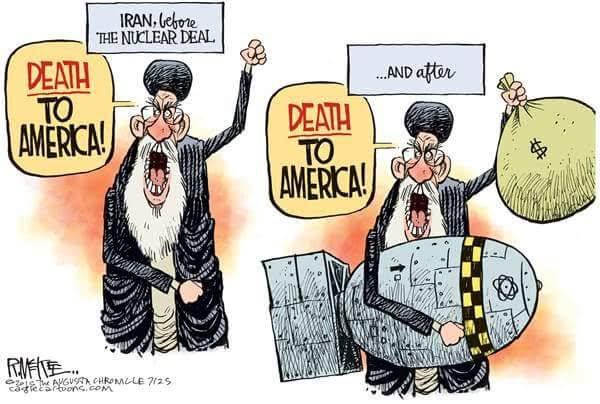
Cartoon of the day

July 26, 2015

H/t Freedom is just another word


death

U.S., Israel on collision course if Iran deal goes through

July 26, 2015

U.S., Israel on collision course if Iran deal goes through, Breitbart NewsJoel B. Pollak, July 26, 2015

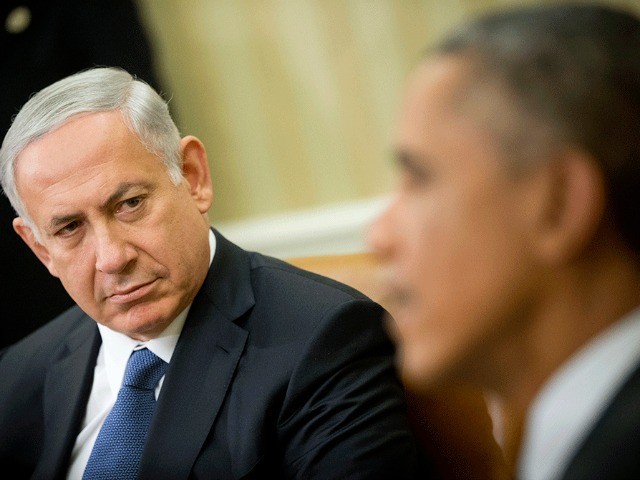
Netanyahu-stares-down-Obama-ap-640x480AP Photo/Pablo Martinez Monsivais

The Iran deal is President Obama’s most important “legacy” achievement. He sees it as the key to his vision of a “new equilibrium” in the region. In the past, he has “preempted” Israel’s preemptive capacity by leaking Israeli attack plans. He may do worse in future–unless Congress defeats the Iran deal and denies him that mandate.

**********************

On his visit to Israel in March 2013, President Barack Obama backed Israel’s right to use force to stop Iran from building a nuclear bomb.

At a joint news conference with Israeli Prime Minister Benjamin Netanyahu, Obama said: “…each country has to make its own decisions when it comes to the awesome decision to engage in any kind of military action, and Israel is differently situated than the United States. And I would not expect that the Prime Minister would make a decision about his country’s security and defer that to any other country…”.

Now, in the wake of the Iran deal, the Obama administration is sending dramatically different signals.On the Today show Friday, Secretary of State Kerry said of a pre-emptive Israeli strike on Iran: “That’d be an enormous mistake, a huge mistake with grave consequences for Israel and for the region, and I don’t think it’s necessary.”

Kerry later tried to deflect concerns that the Iran deal requires world powers to secure Iran’s nuclear facilities, downplaying the chance those clauses could be interpreted as requiring the U.S. to defend Iran against Israel.

Yet faced with a choice between defending Israel and defending the Iran deal, it is become clear that under some circumstances, the Obama administration would choose the latter. That is a radically different position from the one Obama took in public just a short time before formal negotiations began.

True, if Israel were to attack Iran preemptively, it would not be the first time it had done so without U.S. backing. President Ronald Reagan condemned Israel’s attack against Iraq in 1981; George W. Bush said “no” to Israel’s 2007 strike against Syria.

But Obama’s new stance suggests something stronger than mere disapproval.

The Iran deal is President Obama’s most important “legacy” achievement. He sees it as the key to his vision of a “new equilibrium” in the region. In the past, he has “preempted” Israel’s preemptive capacity by leaking Israeli attack plans. He may do worse in future–unless Congress defeats the Iran deal and denies him that mandate.

If the deal holds, Israel may soon face the impossible choice of whether to risk America’s new interests for the sake of its own survival.

Op-Ed The consequences of a bad deal with Iran

July 26, 2015

Op-Ed The consequences of a bad deal with Iran, LA Times, John Bolton, July 26, 2015

American weakness has brought us to this difficult moment. While we obsessed about its economic discomfort, Iran wore its duress with pride. It was never an even match. We now have to rely on a tiny ally to do the job for us. But unless we are ready to accept a nuclear Iran (and, in relatively short order, several other nuclear Middle Eastern states), get ready. The easy ways out disappeared long ago.

***************************

President Obama has made an art form of attacking his opponents rather than substantively defending his own policies, most recently regarding the Vienna agreement on Iran’s nuclear program. Essentially, Obama argues that we must either accept his wretched deal or go to war to prevent Iran from acquiring nuclear weapons.

As is typical, Obama posits the wrong choice, apparently to distract from the unpleasant reality that the agreement won’t work. It will not prevent Iran from getting nuclear weapons. So the real choice we are faced with is dealing with the consequences of military action or the consequences of a nuclear Iran. Neither is palatable, but the latter is far worse. If the real objective is stopping Iran from getting nuclear weapons, preemptive military action is now inescapable.

This rock-and-hard-place outcome has long been foreseeable. Iran’s dogged determination to become a nuclear-weapons state was fiercer and stronger than the West’s frail response. Assuming Iran scrupulously complies with every provision agreed to in Vienna — an absurdly unlikely scenario given the ayatollahs’ objectives and history — its ambitions for nuclear weapons will simply have been delayed eight to 10 years.

In all likelihood, the ayatollahs are already at work violating the accords. After all, Iran has systematically breached its voluntarily-assumed obligations under the Nuclear Non-Proliferation Treaty for more than 30 years. Now the president’s deal will allow Iran to keep the fruits of its violations. Yes, the deal includes restrictions on uranium enrichment, but Tehran can retain its enrichment program, with guaranteed international assistance in improving it. These concessions are fatal mistakes.

Moreover, Iran’s ballistic missile efforts — its development of the means to deliver nuclear weapons all over the world — will barely be touched. Nor does the deal in any way address Iran’s clandestine weaponization efforts, which it has denied and hidden from the International Atomic Energy Agency with great skill.

Last week, the news that the administration has not even seen the texts of two agreements between the energy agency and Iran, both crucial to implementation of the Vienna accords, only raises further doubts. President Obama must provide the texts of these “side deals” to Congress before any serious consideration of the overall agreement is possible.

Some critics of Obama’s plan advocate scuttling the deal and increasing economic sanctions against Iran instead. They are dreaming. Iran and the United States’ negotiating partners have already signed the accords and are straining at their leashes to implement them. There will be no other “better deal.” Arguments about what Obama squandered or surrendered along the way are therefore fruitless. As for sanctions, they were already too weak to prevent Iran’s progress toward the bomb, and they will not be reset now. To paraphrase Bruce Springsteen, “These sanctions are going boys, and they ain’t coming back.”

Patrick Clawson, the director for research at the Washington Institute for Near East Policy, provided the most recent thumbs-down assessment of sanctions: “Iran has muddled through the shock of the sanctions imposed in 2012, and its structural [economic] problems are not particularly severe compared to those of other countries.” He estimates Iran’s nuclear and terrorism-support programs to cost only about $10 billion annually. No wonder administration officials have testified that sanctions (including those imposed piecemeal before 2012) did not slow Iran’s nuclear efforts.

Nor will the deal’s “snapback” mechanism (intended to coerce Iran back into compliance if it breaches its obligations) change that reality. Tehran’s belligerent response is expressly stated in the agreement’s text: “If sanctions are reinstated in whole or in part, Iran will treat that as grounds to cease performing its commitments … in whole or in part.” Tehran does risk losing some future economic benefits should sanctions snap back, but by then it will have already cashed in the assets the deal unfreezes and signed new lucrative trade and investment contracts.

Once those benefits begin flowing all around, the pressure on world governments will only increase to ignore Iranian violations, or to treat them as minor or inadvertent, certainly not warranting the reimposition of major sanctions. The ayatollahs have dusted off Lenin’s barb that “the capitalists will sell us the rope with which we will hang them,” and applied it to the age of nuclear proliferation.

If diplomacy and sanctions have failed to stop Iran, diplomacy alone will fail worse. Like it or not, we now face this unpleasant reality: Iran probably will violate the deal; it may not be detected doing so and if detected, it will not be deterred by “snapback” sanctions. So we return to the hard question: Are we prepared to do what will be necessary to stop Iran from getting nuclear weapons?

Obama most certainly is not, which means the spotlight today is on Israel.

If Israel strikes, there will be no general Middle East war, despite fears to the contrary. We know this because no general war broke out when Israel attacked Saddam Hussein’s Osirak reactor in 1981, or when it attacked the North Korean-built Syrian reactor in 2007. Neither Saudi Arabia nor other oil-producing monarchies wanted those regimes to have nuclear weapons, and they certainly do not want Iran to have them today.

However, Iran may well retaliate. At that point, Washington must be ready to immediately resupply Israel for losses incurred by its armed forces in the initial attack, so that Israel will still be able to effectively counter Tehran’s proxies, Hamas and Hezbollah, which will be its vehicles for retaliation. The United States must also provide muscular political support, explaining that Israel legitimately exercised its inherent right of self-defense. Whatever Obama’s view, public and congressional support for Israel will be overwhelming.

American weakness has brought us to this difficult moment. While we obsessed about its economic discomfort, Iran wore its duress with pride. It was never an even match. We now have to rely on a tiny ally to do the job for us. But unless we are ready to accept a nuclear Iran (and, in relatively short order, several other nuclear Middle Eastern states), get ready. The easy ways out disappeared long ago.

Congress can’t see the P5+1 side deals available to Iran’s Parliament

July 25, 2015

Congress can’t see the P5+1 side deals available to Iran’s Parliament, Dan Miller’s Blog, July 25, 2015

(The views expressed in this article are mine and do not necessarily reflect those of Warsclerotic or its other editors. — DM)

Iran scam Part III

Kerry says that although he has neither read nor even seen the”classified” side deals between Iran and the IAEA about the “possible military dimensions” of Iran’s nuclear program, he has been fully briefed, knows “exactly” what they say and will brief Congress in closed session.

Parts I and II of this series deal with the bases for and absurdities of the January 14th U.S. approval of the Joint Comprehensive Plan of Action. From a national security perspective, the published “deal” was absurd even without recently discovered but secret and “classified” side deals about the military dimensions of Iran’s nuclear program. With them, the “deal” has gone from merely absurd to insane.

The “deal” and U.S. law

The  nuke deal provides that the UN International Atomic Energy Agency (IAEA) will

negotiate separately with Iran about the inspection of a facility long-suspected of being used to research long-range ballistic missiles and nuclear weapons.

The Iran Nuclear Agreement Review Act of 2015, signed by Obama on May 22, 2015,

amends the Atomic Energy Act of 1954 to direct the President, within five days after reaching an agreement with Iran regarding Iran’s nuclear program, to transmit to Congress:

the text of the agreement and all related materials and annexes; . . . [Emphasis added.]

It does not exclude any related materials, “classified” or not such as “side deals,” from those required to be provided to the Congress. However, they have been “classified” and cloaked in secrecy to achieve that end.

The side deals

We do not know precisely what the side deals say; only the signatories, Iran and the IAEA, know. However, according to an article titled Iran Bombshell: It Will Inspect Itself,

This week brought the stunning news that Senator Tom Cotton (R., Ark.) and Representative Mike Pompeo (R., Kan.) had discovered, during a meeting with IAEA officials, the existence of secret side deal between the IAEA and Tehrana side deal that will not, like the main nuclear agreement, be shared with Congress. So critics of the agreement were understandably eager to hear an explanation from Secretary of State John Kerry when he and other senior administration officials testified before the Senate Foreign Relations Committee yesterday. [Emphasis added.]

The hearing produced a new bombshell: In its investigation of Iran’s past nuclear-weapons-related work, the IAEA will rely on Iran to collect samples at its Parchin military base and other locations. [Emphasis added.]

. . . .

In his questioning of administration witnesses, Risch said:

Parchin stays in place. Now, does that sound like it’s for peaceful purposes? Let me tell you the worst thing about Parchin. What you guys agreed to was [that] we can’t even take samples there. The IAEA can’t take samples there. [Iranians are] going to be able to test by themselves! Even the NFL wouldn’t go along with this. How in the world can you have a nation like Iran doing their own testing? [Emphasis added.]

. . . Are we going to trust Iran to do this? This is a good deal? This is what we were told we were going to get when we were told, “Don’t worry, we’re going to be watching over their shoulder and we’re going to put in place verification[s] that are absolutely bullet proof”? We’re going to trust Iran to do their own testing? This is absolutely ludicrous.

The issue became even more interesting when Senator Robert Menendez (D., N.J.), who learned about the side deal from Risch’s question, had the following exchange with Kerry:

Menendez: “Is it true that the Iranians are going to be able to take the samples, as Senator Risch said? Because chain of custody means nothing if at the very beginning what you’re given is chosen and derived by the perpetrator.”

Kerry: “As you know, senator, that is a classified component of this that is supposed to be discussed in a classified session. We’re perfectly prepared to fully brief you in a classified session with respect to what will happen. Secretary Moniz has had his team red-team that effort and he has made some additional add-ons to where we are. But it’s part of a confidential agreement between the IAEA and Iran as to how they do it. The IAEA has said they are satisfied that they will be able to do this in a way that does not compromise their needs and that adequately gives them answers that they need. We’ve been briefed on it, and I’d be happy to brief you.” [Emphasis added.]

Menendez: “My time is up. If that is true, it would be the equivalent of the fox guarding the chicken coop.”

Here’s a video of Sen. Menendez questioning Kerry. The interesting part begins at about 10:00 into the video.

Kerry acknowledged that he had neither read nor even seen the side deals but that he and his scientific expert, Secretary Moniz — who leads the effort to uncover the non-existence extent of any “possible military dimensions” (PMD) of Iran’s nuke activities — have been fully briefed and know “exactly” what the side deals say. They promised to tell members of Congress in closed session.

A blast from the past

A blast from the past

Kerry and Moniz, like others in the Obama administration, are committed to the “deal” and to having the Congress accept rather than reject it. Kerry would be very “embarrassed” if the “deal” were killed. So would Obama. It is reasonable to expect that any briefings they provide will be conducted with those goals firmly in mind — just as it is reasonable to expect that Iranian inspections of, and collection of samples from, Parchin and other military sites will be conducted with the goal of negating the existence of any “possible military dimensions.”

Are there additional side deals that have yet to be discovered and reported? At this point, probably only Iran and the IAEA know.

It’s “Déjà vu all over again”

In a “blast from the past,” the UN agency charged with ensuring that all of Syria’s chemical weapons were disposed of properly did not do so:

International inspectors failed to stop Syria from stockpiling chemical weapons, in spite of an international agreement in 2013, according to a new report by the Wall Street Journal on Friday. International inspectors were skeptical of Syria’s claims to have disposed of its stockpiles, but were afraid that reporting violations would destroy the overall deal: “Members of the inspection team didn’t push for answers, worried that it would compromise their primary objective of getting the regime to surrender the 1,300 tons of chemicals it admitted to having.” [Emphasis added.]

. . . .

The Syrian guards assigned to inspections convoys also drove slowly, failed to destroy chemical weapons when asked to do so, and appeared to be intermingled with Iranian soldiers who were guarding Syrian chemical weapons sites. As a result, Syria remains unaccountable.

The IAEA faces comparable difficulties in evaluating Iran’s “possible military dimensions” and, if reports about the side deals are even partially accurate, will continue to bow to Iranian interests in denying the existence of those dimensions.

Conclusions

The “possible military dimensions” of Iran’s nuclear program are why a “deal” was deemed necessary. Aside from its military dimensions, there would have been few objections to a peaceful Iranian nuclear program devoted to electrical generation, medical research and the like. Iran’s conduct over the years and continuing through the present has belied its claims about the exclusively peaceful nature of its actions.

The Obama administration seeks to keep the members of Congress — and the “little people” who elect them — ignorant of gaping holes in the P5+1 “deal,” particularly those relevant to Iran’s militarization of nukes, the most important of all gaping holes thus far discovered. It is now obfuscating, and will continue to obfuscate, the IAEA – Iran side deals.

As a signatory to the side deals with the IAEA, Iran has the texts. The Iranian parliament will approve or reject the “deal,” apparently after the sixty day period granted to the U.S. Congress to review it. The Iranian parliament will be subject to pressures and obfuscations by the Khamenei regime, their nature depending on whether it wants the deal to be approved or rejected. Between shouts of “death to America” and “death to Israel,” Khamenei has given mixed signals about his desires. The Iranian parliament, unlike the U.S. Congress, will likely see the texts of the side deals if, as is also likely, they drastically limit IAEA investigations of Iran’s nuke militarization activities and hence enhance the “deal’s” appeal.

By whom have the texts of the side deals been “classified?” The Obama administration? Treating the texts as “classified” is very likely a ploy to avoid Congressional and public scrutiny. Kerry and Moniz claim to know “exactly” what the unread side deals say, and contend that they will tell members of Congress, in closed session, what they know. They will do so with the goal of making the “deal” appear to be as good for Obama as they can. They may very well persuade many if not most Democrats to approve the “deal.”

If the Obama administration even approached being as transparent as Obama has often claimed, He would waive all relevant classifications and allow the briefings to be in open, rather than closed, session, with the full texts of all side deals before the members of the Congress and available to the public at large. He won’t. He could (but won’t) be threatened with impeachment for blocking legislative action by the Congress. Even if Obama were threatened, He would know it to be an empty gesture; the Senate would reject any bill of impeachment adopted by House.

At least until Obama has left office (hopefully, in January of 2017), we are stuck. Like Obama’s America, Israel, perhaps in conjunction with Saudi Arabia and other Arab nations, has the ability to destroy Iran’s nuclear weaponization facilities which threaten them. Whether they, unlike Obama’s America, have the will to do it is a different matter.

ADDENDUM

According to a Washington Examiner article posted this evening,

House Speaker John Boehner and Senate Majority Leader Mitch McConnell insisted in a letter to President Obama that the administration hand over any side agreements between Iran and the IAEA as well, saying that’s what’s required by a law passed earlier this year giving Congress a chance to review the deal.

Kerry I’ll be embarrassed in front of Ayatollah if Irand deal is killed

July 24, 2015

Kerry I’ll be embarrassed in front of Ayatollah if Irand deal is killed, Front Page Magazine, Daniel Greenfield, July 24, 2015

john-kerry (2)Come on guys, don’t embarrass John Kerry in front of his cool Ayatollah friends.

As a bonus, if the Iran nuclear sellout deal dies, John Kerry will be too embarrassed to show his long face in Vienna again. Or Havana or Tehran.

If you won’t think of the Ayatollahs, won’t you think of John Kerry forced to retire back to his windsurfing tax-free Elba with his rich wife, too humiliated to negotiate with any more terrorists?

A congressional vote to undermine the Obama administration’s diplomatic negotiations with Iran would be a major setback for the United States on the world stage and personally humiliating Secretary of State John Kerry said on Friday.

“I would be embarrassed to try to go out,” Kerry said during remarks at the Council on Foreign Relations. “What am I going to say to people after this? ‘Come negotiate with us.’ ‘Can you deliver?'”

“Do you think the ayatollah is going to come back to the table if Congress refuses this and negotiate this again?” he added.

Come on guys, don’t embarrass John Kerry in front of his cool Ayatollah friends.

John Kerry really wants Iran’s Supreme Ayatollah to like him so he can get invited to all his cool “Death to America” parties. He’s still haunted by memories of the time Russia wouldn’t return his phone calls for a week or ask him to the prom.

Kerry’s slip acknowledges that the entire facade of the “moderate” president is meaningless and it’s the Ayatollah that matters. Also the Ayatollah hasn’t actually approved the deal. But there’s another angle.

John Kerry is whining that America will look bad if it pulls back from the deal now. But Obama had no problem violating agreements with Israel, Poland and Libya. Here’s an example.

Secretary of State Hillary Clinton is denying that there were understandings between the Bush Administration and the Sharon and Olmert governments that limited natural growth of settlements but permitted some construction within agreed constraints.

Today, Elliott Abrams, who headed the Mideast team at the Bush White House and participated in the key discussions with Israeli officials about the settlements freeze issue, weighed in with an op-ed in the Wall Street Journal stating forcefully that, “There were indeed agreements between Israel and the United States regarding the growth of Israeli settlements on the West Bank…principles that would permit some continuing growth….They emerged from discussions with American officials and were discussed by Messrs. Sharon and Bush at their Aqaba meeting in June 2003….The prime minister of Israel relied on them in undertaking a wrenching political reorientation — the dissolution of his government, the removal of every single Israeli citizen, settlement and military position in Gaza, and the removal of four small settlements in the West Bank…For reasons that remain unclear, the Obama administration has decided to abandon the understandings about settlements reached by the previous administration with the Israeli government. We may be abandoning the deal now, but we cannot rewrite history and make believe it did not exist.”

Nobody in Obama Inc. was embarrassed to violate a deal with Israel. And that was a deal in which Israel did its part by withdrawing from Gaza.

Kerry whines that he would be embarrassed in front of the Ayatollah if Congress rejects a deal that wasn’t even finalized and in which Iran has yet to do its part.

But that’s just where the priorities of this administration are.

The Ayatollah is a “cool” enemy of the United States whom Kerry wants to impress. Just like he wanted to impress the Viet Cong in Paris and the Sandanistas and Assad. But he could care less what allies like Israel or Poland think.

They like America. So they’re not cool. There’s no need for the administration’s manchildren to impress them or win their approval.

Iran Bombshell: It Will Inspect Itself

July 24, 2015

Iran Bombshell: It Will Inspect Itself, Center for Security Policy, Fred Fleitz, July 24, 2015

I am glad that Senator Risch ignored the Obama administration’s ridiculous demand to treat the side deal as a classified matter. One has to ask, Classified from whom? Certainly not for Iran, since it is a party to the agreement. I believe Obama officials insisted the deal was classified in order to keep knowledge of it from the American people, and possibly from Middle Eastern states such as Israel and Saudi Arabia that oppose the agreement.

***********************

This week brought the stunning news that Senator Tom Cotton (R., Ark.) and Representative Mike Pompeo(R., Kan.) had discovered, during a meeting with IAEA officials, the existence of secret side deal between the IAEA and Tehran — a side deal that will not, like the main nuclear agreement, be shared with Congress. So critics of the agreement were understandably eager to hear an explanation from Secretary of State John Kerry when he and other senior administration officials testified before the Senate Foreign Relations Committee yesterday.

The hearing produced a new bombshell: In its investigation of Iran’s past nuclear-weapons-related work, the IAEA will rely on Iran to collect samples at its Parchin military base and other locations.

As a former intelligence analyst experienced in the collection of environmental samples for investigations of weapons of mass destruction, I found this allegation impossible to believe when I heard Senator James Risch (R., Idaho) make it yesterday morning.

In his questioning of administration witnesses, Risch said:

Parchin stays in place. Now, does that sound like it’s for peaceful purposes? Let me tell you the worst thing about Parchin. What you guys agreed to was [that] we can’t even take samples there. The IAEA can’t take samples there. [Iranians are] going to be able to test by themselves! Even the NFL wouldn’t go along with this. How in the world can you have a nation like Iran doing their own testing?

. . . Are we going to trust Iran to do this? This is a good deal? This is what we were told we were going to get when we were told, “Don’t worry, we’re going to be watching over their shoulder and we’re going to put in place verification[s] that are absolutely bullet proof”? We’re going to trust Iran to do their own testing? This is absolutely ludicrous.

The issue became even more interesting when Senator Robert Menendez (D., N.J.), who learned about the side deal from Risch’s question, had the following exchange with Kerry:

Menendez: “Is it true that the Iranians are going to be able to take the samples, as Senator Risch said? Because chain of custody means nothing if at the very beginning what you’re given is chosen and derived by the perpetrator.”

Kerry: “As you know, senator, that is a classified component of this that is supposed to be discussed in a classified session. We’re perfectly prepared to fully brief you in a classified session with respect to what will happen. Secretary Moniz has had his team red-team that effort and he has made some additional add-ons to where we are. But it’s part of a confidential agreement between the IAEA and Iran as to how they do it. The IAEA has said they are satisfied that they will be able to do this in a way that does not compromise their needs and that adequately gives them answers that they need. We’ve been briefed on it, and I’d be happy to brief you.”

Menendez: “My time is up. If that is true, it would be the equivalent of the fox guarding the chicken coop.”

The revelation that Iran will collect samples concerning its own nuclear-weapons-related activity makes the whole agreement look like a dangerous farce. This is not just an absurd process; it also goes against years of IAEA practice and established rules about the chain of custody for collected physical samples.

Senator Risch suggested in his remarks that the IAEA would remotely monitor the Iranians’ taking of samples by video. But even if there were a reliable way to ensure that Iranian “inspectors” were carefully monitored, took samples from locations identified by the IAEA, and provided these samples directly to IAEA officials, the process would still be a sham, since it would still place unacceptable limitations on IAEA inspections. To be meaningful, IAEA inspectors must have unfettered access to suspect facilities and be free to take samples anywhere, using whatever collection devices they choose. Only by collecting samples at locations and with methods that Iranian officials may not have anticipated can inspectors reliably find possible evidence of nuclear-weapons-related work that Iran tried to clean up.

That the Obama administration would agree to let Iran collect its own samples at Parchin (where explosive testing related to nuclear-warhead development reportedly took place) and other sites is consistent with reports that surfaced in June (and about which I wrote National Review articles on June 15 and June 17) that Kerry had offered to let Iran off the hook for past nuclear-weapons-related work. Iranian supreme leader Ali Khamenei reportedly rejected this offer as being insufficiently generous.

Remember also that Kerry told reporters on June 16: “We’re not fixated on Iran specifically accounting for what they did at one point in time or another. We know what they did.” Kerry walked back this comment, but I believe it represented part of the Obama administration’s negotiating strategy in the Iran talks.

The Obama administration claims that the Iran–IAEA side deal is a confidential and bilateral arrangement reached between IAEA officials and Tehran, and says that it has been briefed on the deal but not seen its actual language. As I wrote here on July 23, I find this impossible to believe, since the apparent arrangement so clearly reflects Secretary Kerry’s attempt last month to make concerns about Iran’s past nuclear-weapons-related work go away.

I am glad that Senator Risch ignored the Obama administration’s ridiculous demand to treat the side deal as a classified matter. One has to ask, Classified from whom? Certainly not for Iran, since it is a party to the agreement. I believe Obama officials insisted the deal was classified in order to keep knowledge of it from the American people, and possibly from Middle Eastern states such as Israel and Saudi Arabia that oppose the agreement. I also believe that Congress would not know about this matter at all if IAEA officials had not told Senator Cotton and Congressman Pompeo about it.

Possibly making the situation worse, Fox News analyst Monica Crowley said in a tweet yesterday that there are additional side deals. Omri Ceren, managing director of the Israel Project, a nonprofit advocacy organization, e-mailed me yesterday, writing that “the Israelis are saying there will be several more.”

These new developments indicate that not only did the Obama administration negotiate a nuclear deal with Iran that was worse than anyone outside the Obama administration knew only a few days ago, but it also tried to shield a sham inspections process from congressional review, in violation of the law. The entire nuclear agreement is not just a bad deal; it is a deal that now displays the bad faith of the Obama administration toward Congress and the American people. The secret side agreements are yet another compelling reason for a large bipartisan majority in Congress to reject the dangerous nuclear accord with Iran.