Archive for the ‘Islamism’ category

Humor: Brian Williams should replace Secretary Kerry

February 7, 2015

Brian Williams should replace Secretary Kerry, Dan Miller’s Blog, February 6, 2015

(The views expressed in this article are not necessarily mine or those of Warsclerotic or its other editors. — DM)

Although it would be hypocritical for NBC to fire Mr. Williams for mis- speaking  lying, it would enhance his chances of becoming our next Secretary of State. Like Hillary Clinton, Williams sorta told some truth when he admitted to lying for a dozen years. Hillary became Obama’s Secretary of State in 2009. Williams, also a very good liar, deserves no less this year. After that? Perhaps “our” next President.

brian_williams_airwolf_2-5-15-1

Here is a timeline of the progression of Williams’ tall tales, based on a Stars and Stripes article:

In late March 2003, the New York Daily News reported that “the one (helicopter) carrying Williams and (Retired General and current NBC consultant Wayne) Downing landed” after another chopper ahead of them had been hit by “a rocket-fired grenade.” Even this early report appears to have been exaggerated. Larry O’Connor at Truth Revolt, reacting to Williams’ on-air statement Wednesday night, noted that Williams was really “in an aircraft that followed the one hit by RPG fire by an entire hour.”

Several days later, USA Today reported that Williams “was stranded in the Iraqi desert for three days.” That hardly appears to be the case. In a comment at an NBC Facebook page, a clearly frustrated Lance Reynolds, the flight engineer on the helicopter that was hit, wrote: “I remember you guys taking back off in a different flight of Chinooks from another unit and heading to Kuwait to report your ‘war story’ to the Nightly News.”

By 2007, the helicopter that was hit was, according to a Williams blog entry, “the chopper flying in front of ours.” A University of Notre Dame press release in 2010, the year he gave the commencement address there, referred to how “the lead helicopter was shot down.”

In March 2013, Williams told Alec Baldwin of “being in a helicopter I had no business being in in Iraq with rounds coming into the airframe,” and, after prompting, said that he “briefly” thought he would die.

Later that month, Williams crossed the fairy-tale Rubicon, telling David Letterman that “two of the four helicopters were hit by ground fire, including the one I was in,” and that after that, the problem was how “we figure out how to land.” We?

Finally, on January 30, Williams, applying even more mustard, told the nation on Nightly News that “the helicopter we were travelling in was forced down after being hit by an RPG.”

The indispensable Kristinn Taylor at Gateway Pundit has found that “speech promotional bios touted Williams’ bravery in returning to Iraq after he claimed being under fire.”

Here’s a video of Williams’ 2013 love feast with David Letterman. His Iraq narrative begins at 2:50.

According to Sharyl Attkisson, Presidential Candidate Clinton [like Brian Williams],

never fully explained how she could have made such a mistake as saying she had ducked sniper fire when there hadn’t been a sniper in sight. Initially, she stated “I was sleep deprived and I misspoke.”

But as my report below (“Clinton Doubles Down”) shows, Clinton told varieties of the embellishment over a long period of time, not just when she was sleep deprived.

Had Clinton somehow convinced herself that it had all really happened? Or did she knowingly advance a false story?

“So I made a mistake,” Clinton also stated at one point. “It proves I’m human, which you know, for some people, is a revelation.”

Whoops.

Clinton1web_2831249b

In the next video, Mr. Williams and a guest from NBC discuss Clinton’s Bosnia adventures, Senator Obama’s candidacy and their anticipated consequences for her 2008 Democrat presidential nomination. Note the apparent puzzlement about why Clinton confessed to having “misspoken.”

Clinton didn’t get the Democrat presidential nomination in 2008 but was confirmed as Obama’s Secretary of State in 2009. Doesn’t Williams deserve a promotion comparable to what Clinton got (from failed Presidential Candidate to SecState)? Shouldn’t he be held to the same standard?

Williams had seen what happened to Clinton just weeks earlier, yet kept telling his own fish tale. To paraphrase one of his own NBC colleagues, this isn’t Little League, it’s a nightly news anchor with an audience of millions. Will he be held to the same standards to which NBC and the rest of the media held Clinton?

What standards were those then and, of more importance, what have they been since? She still “deserves” to become “our” next President.

Tom Brokaw, also of NBC, contends that Williams should go. Perhaps, however, NBC will forgive and forget.

The Los Angeles Times, quoting anonymous NBC News execs, reported that Williams’s on-air apology has been accepted internally and that he’s expected to face no disciplinary action for his serious journalistic lapse, which included showing video of a combat-damaged helicopter and representing it wrongly as the Chinook on which Williams had been a passenger.

As noted by Howard Kurtz at Fox News,

When it comes to the NBC franchise, Brian Williams is too big to fail. He’s the face of the network, he hosts the top-rated network newscast, he guest-hosts “Saturday Night Live.” He’s a bankable asset. And in fairness, Williams has a pretty unblemished track record.

Oh well.

Reality is often unpleasant and hard to deal with, so we need a creative Secretary of State who will continue to reject reality, base policy on fantasy and do so with impunity for a decade or more.

Clinton, a likely Presidential Candidate for 2016, did her “best.”

Obama does what Obama does and gets away with it. According to an article at Breitbart, the seven Muslims at a recent White House meeting on domestic and foreign policy issues have been named.

According to a White House statement on the President’s meeting, the domestic issues discussed were the “Affordable Care Act, anti-Muslim violence and discrimination, the 21st Century Policing Task Force, and the upcoming White House Summit on Countering Violence Extremism.” On the foreign policy front, “the President discussed the need to continue countering ISIL and other groups that commit horrific acts of violence, purportedly in the name of Islam,” while also congratulating Muslims on their “remarkable contributions” to America. [Emphasis added.]

. . . .

Comedian and left-wing pundit Dean Obeidallah revealed that he was one of the fifteen Muslim-American “leaders” brought to the White House on Wednesday afternoon.

“The No.1 issue raised: The alarming rise in anti-Muslim bigotry in America,” Obeidallah said of the meeting with the President. Their chief collective concern was not the rise of the Sunni Islamic State, nor the expansion of the Caliphatist Shiite Iranian regime and its messianic drive towards nuclear weapons, but instead, “anti-Muslim bigotry in America.” [Emphasis added.]

. . . .

The Detroit Free Press also revealed that senior Obama advisers Valerie Jarrett and Ben Rhodes were present in the Muslim leaders’ meeting. [Emphasis added.]

Dean Obeidallah also revealed that Farhana Khera, executive director of Muslim Advocates, was behind the effort to get Muslim leaders to the White House.

Muslim Advocates reveals on its website that its three main objectives are to “end profiling,” “strengthen [Muslim] charities,” and “counter hate.” Its Press Center section is filled with posts demanding intelligence organizations, such as the New York Police Department and federal agencies, end their “Muslim Suspicionless Spying Program,” while also dictating to the media that it should “Report Accurately on Muslims.” Another post reads, “What You Need to Know About the New Federal Racial Profiling Policy.” Review of Muslim Advocates’ press releases reveals that the only foreign policy issue with which the group has concerned itself over the past year was urging Sec. of State John Kerry to ensureMuslim “Americans are able to safely perform the annual religious Hajj pilgrimage in Saudi Arabia.” [Emphasis added.]

Keep up the good work, Big Guy, Insha’Allah.

Fantasy Island Obama

Kerry has bravely continued the march.

Williams, who should be rehabilitated as quickly as was Senator Clinton, could not be worse and might even be better than Kerry. Then, his path to the presidency should be clear even if he (unlike Obama) is candid in public on rare occasions.

Hey, Grandpa! I need some of that stuff.

The Glamor of Evil

February 6, 2015

The Glamor of Evil, Mark Stein on line, February 5, 2015

1157

President Obama’s response was to go to the National Prayer Breakfast and condescendingly advise us – as if it’s some dazzlingly original observation rather than the lamest faculty-lounge relativist bromide – to “remember that during the Crusades and the Inquisition, people committed terrible deeds in the name of Christ“.

[C]ivilization is a fragile and unnatural state of affairs. Droning on about the Crusades and Jim Crow, Obama offers the foreign policy of Oscar Wilde’s cynic: He knows the price of everything and the value of nothing. And so, as the world burns, he, uh, redoubles his, uh, vigilance, uh uh uh… Whatever. That and $16.4 million will buy you coffee and some trauma counseling in Kiev.

****************

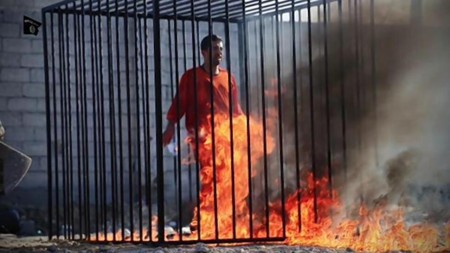
On Tuesday the Islamic State released a 22-minute video showing Flight Lieutenant Muath al-Kasasbeh of the Royal Jordanian Air Force being doused in petrol and burned to death. It is an horrific way to die, and Flt Lt al-Kasasbeh showed uncommon bravery, standing stiff and dignified as the flames consumed him. And then he toppled, and the ISIS cameras rolled on, until what was left was charred and shapeless and unrecognizable as human.

King Abdullah’s response to this barbaric act was to execute two ISIS prisoners the following morning, including the evil woman who was part of the cell that blew up the lobby of my favorite hotel in Amman, the Grand Hyatt.

President Obama’s response was to go to the National Prayer Breakfast and condescendingly advise us – as if it’s some dazzlingly original observation rather than the lamest faculty-lounge relativist bromide – to “remember that during the Crusades and the Inquisition, people committed terrible deeds in the name of Christ“.

Gee, thanks. If you’re watching on ISIS premium cable, I’m sure that’s a great consolation when they’re reaching for the scimitar and readying you for your close-up. Oh, and, even by the standards of his usual rote cookie-cutter shoulder-to-shoulder shtick that follows every ISIS beheading of western captives, the President could barely conceal his boredom at having to discuss the immolation of Flt Lt al-Kasasbeh:

Aaand it, I think, will redouble [pause] the vigilance aaand determination on the part of our global coalition to, uh, make sure that they are degraded and ultimately defeated. Ummmm. [Adopting a whimsical look] It also just indicates the degree to which whatever ideology they’re operating off of, it’s bankrupt. [Suppressing a smirk, pivoting to a much more important subject.] We’re here to talk about how to make people healthier and make their lives better.

The lack of passion – the bloodlessness – of Obama’s reaction to atrocity is always striking. He can’t even be bothered pretending that he means it.

I am not a great fan of the Hashemites, and there is great peril for Jordan in getting sucked deeper into a spiral that could quickly consume one of the weakest polities in the region and turn the least-worst Sunni monarchy into merely the latest Obama-era failed-state – after Iraq, Syria, Libya, Yemen, etc. The UAE took advantage of Flt Lt al-Kasasbeh’s capture to cease participation in sorties entirely, and, given the general halfheartedness of Obama’s “coalition”, King Abdullah could have been forgiven for also deciding to head for the exit.

Yet he understood the necessity of action. Obama, by contrast, declares action, and then does nothing. His war against ISIS was supposed to be one in which the US would not put “boots on the ground”, but instead leave that to our allies. The allies have the boots, but they could use some weapons, too. Obama has failed to supply the Kurds or anybody else with what they need to defeat our enemies. It’s becoming what they call a pattern of behavior. Elliott Abrams draws attention to this passage in a New York Times story about Ukraine:

The Russians have sent modern T-80 tanks, whose armor cannot be penetrated by Ukraine’s aging and largely inoperative antitank weapons, along with Grad rockets and other heavy weapons. Russian forces have also used electronic jamming equipment to interfere with the Ukrainians’ communications….

Ukraine has requested arms and equipment, including ammunition, sniper rifles, mortars, grenade launchers, antitank missiles, armored personnel carriers, mobile field hospitals, counterbattery radars and reconnaissance drones.

Hmm. So how much of that shopping list have we responded to? Obama won’t write Ukraine a blank check, but he will write them a blanket check:

The $16.4 million in aid that Mr. Kerry will announce in Kiev is intended to help people trapped by the fighting in Donetsk and Luhansk. The aid will be used to buy basic items like blankets and clothing, along with counseling for traumatized civilians.

Could be worse. He might have thrown in another James Taylor singalong. Then they really would need trauma counselors.

With at least another two years of civilizational retreat to go, we’re gonna need a lot more security blankets, which is good news for whichever Chinese factory makes them.

~As Kyle Smith points out, the video of Flt Lt al-Kasasbeh’s death is an extremely sophisticated and professional production. US news media have declined to run it, because it’s too disturbing, as opposed to, say, Brian Williams’ ripping yarns of derring-do about being shot out of the sky by an RPG. There are really two parallel media structures now: Consumers of Brian Williams-delivered “news” aren’t even aware of the metastasizing of evil. Meanwhile, out there on Twitter and Facebook it’s the hottest recruiting tool on the planet. You’ll recall Hannah Arendt’s tired and misleading coinage “the banality of evil”, derived from her observation of Adolf Eichmann at his trial in Jerusalem. As I wrote last August:

Hitler felt obliged to be somewhat coy about just how final the final solution was. As Eichmann testified at his trial, when typing up the minutes of the Wannsee conference, “How shall I put it? Certain over-plain talk and jargon expressions had to be rendered into office language by me.” Even the Nazis were reluctant to spell it out.

The Germans didn’t have social media, but they had newsreels, and Hitler knew enough not to make genocide available to Pathé or “The March of Time”. He had considerations both domestic and foreign. Pre-Wannsee, in Poland and elsewhere, German troops had been ordered to shoot Jewish prisoners in cold blood, and their commanders reported back to Berlin that too many soldiers had found it sickening and demoralizing. So the purpose of “the final solution” was to make mass murder painless, at least for the perpetrators – more bureaucratic, removed, bloodless.

As for foreign considerations, Germany expected to be treated as a civilized power by its enemies, and that would not have been possible had they been boasting about genocide.

Seventy years on, the Islamic State has slipped free of even these minimal constraints. They advertize their barbarism to the world, because what’s the downside? Let’s say the guys who burned Flt Lt al-Kasasbeh are one day captured by Americans. They can look forward to a decade or two of a soft, pampering sojourn in the US justice system, represented by an A-list dream-team that’ll string things along until the administration figures it’ll cut its losses and ship them to Qatar in exchange for some worthless deserter.

As for the upside, “the banality of evil” may have its appeal for lower-middle-class Teuton bureaucrats, but the glamor of evil is a far more potent and universal brand. The Islamic State has come up with the ultimate social-media campaign: evil goes viral! At some level German conscripts needed to believe they were honorable soldiers in an honorable cause, no different from the British or Americans. But ISIS volunteers are signing up explicitly for the war crimes. The Islamic State burned Flt Lt al-Kasasbeh alive not only to kill him but to inspire the thousands of ISIS fanbois around the globe, like Moussa Coulibaly, the guy who stabbed three French policemen outside a Jewish school in Nice this week.

For many of its beneficiaries, modern western life is bland, undemanding and vaguely unsatisfying. Some seek a greater cause, and turn to climate change or LGBTQWERTY rights. But others want something with a little more red meat to it. Jihad is primal in a way that the stodgy multiculti relativist mush peddled by Obama isn’t. And what the Islamic State is offering is Jihad 2.0, cranking up the blood-lust and rape and sex slavery and head-chopping and depravity in ways that make Osama-era al-Qaeda look like a bunch of pantywaists.

Success breeds success. The success of evil breeds darker evil. And the glamorization of evil breeds ever more of those “recent Muslim converts” and “lone wolves” and “self-radicalized extremists” in the news. That’s a Big Idea – a bigger idea, indeed, than Communism or Nazism. Islam, as we know, means “submission”. But Xtreme-Sports Hyper-Islam, blood-soaked and baying, is also wonderfully liberating, offering the chance for dull-witted, repressed young men to slip free of even the most basic societal restraints. And, when the charms of the open road in Headchoppistan wear thin, your British and Canadian and Australian and European welfare checks will still be waiting for you on the doormat back home.

By contrast, civilization is a fragile and unnatural state of affairs. Droning on about the Crusades and Jim Crow, Obama offers the foreign policy of Oscar Wilde’s cynic: He knows the price of everything and the value of nothing. And so, as the world burns, he, uh, redoubles his, uh, vigilance, uh uh uh… Whatever. That and $16.4 million will buy you coffee and some trauma counseling in Kiev.

U.S. Seen in Middle East as Ally of Terrorists

February 4, 2015

U.S. Seen in Middle East as Ally of Terrorists, The Gatestone InstituteKhaled Abu Toameh, February 5, 2015

Many Egyptians and moderate Arabs and Muslims were shocked to hear that the U.S. State Department recently hosted a Muslim Brotherhood delegation. They were equally shocked when an EU court decided to remove Hamas from the bloc’s list of terror groups.

“Just two days after the controversial visit, the Brotherhood called for a war against their fellow Egyptians.” — Linda S. Heard, Middle East Expert, Gulf News.

“The Muslim Brotherhood is seeking to return to the political arena through the American door and terrorist attacks. The U.S. policy appears to be devious and unreliable.” — Ezzat Ibrahim, columnist, Al Ahram.

“[Ousted Egyptian President] Mohamed Morsi, before his election, described these Jews as descendants of apes and pigs. In English, the Muslim Brotherhood says one thing and in Arabic something completely different.” — Mohamed Salmawi, Egyptian columnist

While the Egyptian government has been waging war on the Muslim Brotherhood and other Islamic radical groups, the U.S. Administration and some Europeans are continuing to hamper efforts to combat terrorism.

Many Egyptians and moderate Arabs and Muslims were shocked to hear that the U.S. State Department recently hosted a Muslim Brotherhood delegation. They were equally shocked when an EU court decided to remove Hamas from the bloc’s list of terror groups.

The State Department’s hosting of the Muslim Brotherhood leaders has outraged Egypt’s President Abdel Fattah Sisi, who has been waging a relentless war against the organization over the past year.

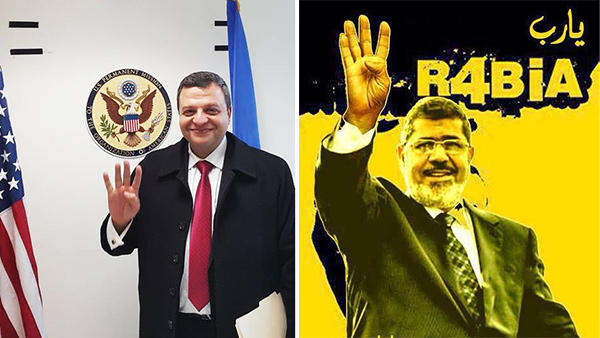
One member of the delegation, Muslim Brotherhood judge Waleed Sharaby, posed for a picture while at Foggy Bottom, as he held up the organization’s four-finger “Rabia” sign. (The gesture is named for Cairo’s Rabia Square, where counter-demonstrations backing ousted Egyptian President Mohamed Morsi — who is from the Muslim Brotherhood — took place in August 2013.)

919While being hosted by the State Department on a visit to Washington, Muslim Brotherhood judge Waleed Sharaby (left) flashed the organization’s four-finger “Rabia” sign. At right, ousted Egyptian President Mohamed Morsi (from the Muslim Brotherhood) displays the Rabia sign.

“If the White House is out to offend some of its closest Arab allies and is intent on heightening their suspicions, it’s succeeded,” wrote Middle East expert Linda S. Heard. “If there’s a plot, then it’s unfolding,” she added. “Just two days after the controversial visit, the Brotherhood called for a war against their fellow Egyptians.”

A statement issued by the Muslim Brotherhood said, “It is incumbent upon everyone to be aware that we are in a process of a new phase, where we summon what is latent our strength, where we recall the meanings of jihad and prepare ourselves, our wives, our sons, our daughters, and whoever marched on our path to a long, uncompromising fight, and during this stage we ask for martyrdom.”

The Egyptian government condemned the hosting of the Muslim Brotherhood officials by the State Department. Egyptian Foreign Minister Same Shoukry denounced the State Department’s move, saying, “The Muslim Brotherhood is not a political party, but according to the Egyptian law, which must be respected, it is designated as a terrorist organization.”

The timing of the meeting between State Department officials and Muslim Brotherhood leaders could not have been worse for many Egyptians — it took place shortly after Islamist terrorists killed 31 soldiers and wounded 45 others in a series of attacks on Egypt’s Sinai Peninsula.

Although the Islamic State terror group took credit for the attacks, Sisi held the Muslim Brotherhood responsible. “Egypt is waging a war against the strongest clandestine group over the past two decades,” he said. “This organization has secretive arms, secretive thoughts and secretive forums.”

Egyptian columnists and newspaper editors have also attacked the U.S. Administration for its ties with the Muslim Brotherhood.

“The U.S. Administration is continuing to jeopardize its relations with Egypt by appeasing Muslim Brotherhood,” remarked columnist Ezzat Ibrahim. “The Muslim Brotherhood is seeking to return to the political arena through the American door and terrorist attacks. The U.S. policy appears to be devious and unreliable.”

Another Egyptian columnist, Mohamed Salmawi, launched a scathing attack on the U.S. Administration; he accused it of deception and double standards. He said that the meeting between U.S. officials and Muslim Brotherhood leaders exposes the U.S. Administration’s deceptive policy toward Islamic terror groups.

“The U.S. Administration says it is combating these groups at home while it is supporting them abroad,” Salmawi wrote. “This meeting has grave indications because it shows that Washington has not abandoned its policy of double standards toward Islamic terrorism.

Salmawi also took issue with the U.S. Administration for turning a blind eye to the hypocrisy and double talk of the Muslim Brotherhood. “One of the leaders of Muslim Brotherhood, for example, told the world that he welcomes the Jews of Israel,” he added. “But this same leader announced in front of the Egyptian people that they should march in the millions to liberate Jerusalem from the occupation of the Jews. [Ousted President] Mohamed Morsi, before his election, described these Jews as descendants of apes and pigs. In English, the Muslim Brotherhood says one thing and in Arabic something completely different.”

Said Lindawi, a prominent Egyptian international affairs expert, said that the meeting of the Muslim Brotherhood leaders with State Department officials means that the Obama Administration has given the organization a green light to carry out terrorist attacks against Egypt.

“The U.S. Administration has refused to recognize the Muslim Brotherhood as a terror group,” hesaid. “The Americans continue to insist that the Muslim Brotherhood is not responsible for the terrorist attacks in Egypt.”

By embracing the Muslim Brotherhood, the U.S. Administration has sent the wrong message to moderate Arabs and Muslims. This is a message that says that Washington believes that there are good terrorists and bad terrorists.

Judging from the angry reactions of Egyptians, it has become obvious that most moderate Arabs and Muslims no longer see the U.S. as an ally in the war against Islamic terror groups. What is even more disturbing is that they view the U.S. as an ally and friend of the terrorists.

Islam and Appeasement

February 4, 2015

Islam and Appeasement, American ThinkerG. Murphy Donovan, February 4, 2015

The US State Department is one of the few institutions in America, other than the Nation of Islam, blessed with the gift of prophecy.  Logic, reason, and morality have been subverted to serve the cause of appeasement. Pandering to savages has always been the one policy choice that guarantees that things will get worse.

**********************

Europe and America are impaled on the horns of a strategic dilemma. On the one hand, the world is besieged by jihadi religious terror, barbarity, and serial wars with jihadists.  Concurrently, most of the civilized world defends the very religious cultures, Sunni and Shia Islam especially, where the problems originate.  To be clear at the outset; with Islam today, there seems to be less and less daylight between secular and religious imperatives.

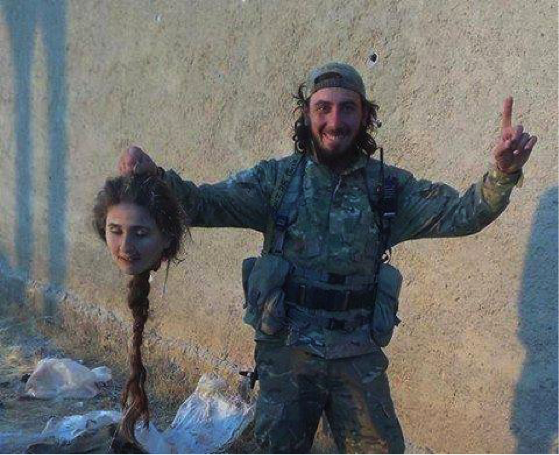
RehanaISIS Islamist with the head of “Rehana,” Peshmerga fighter.

Theology, for the most part, is the a priori premise for Muslim politics and evangelism, Islamism if you will. Culture proceeds from or is conditioned by religious writ or tradition in the Ummah.  The adjective “Islamic” before the noun “republic” is not just an historical artifact.

Indeed, since the 1979 Shia religious coup in Persia, the political trend lines throughout dar al Islam are clearly theocratic. You might call the recent Shia coup in Yemen a copycat killing. Secular Islam is in the crosshairs. The trend suffered a setback in Egypt recently, but only at the expense of a military coup.

Theocracy or the generals are the two political default settings in the Muslim world today. Priests and brass hats are never far from the nexus of power. If behavior is a measure of merit in the Ummah, the generals are to be preferred over the ayatollahs, Islamic scholars, mullahs, or imams. Cairo might take a nervous bow here.

A priori or unwarranted assumptions are not limited, however, to the Islamic side of the geo-strategic conundrum. European and American intellectuals, politicians, generals, and academics, are handicapped with the same infirmity.

Terror provides a snapshot of the logic that flows from flawed premises, foregone conclusions that attempt to absolve Islam.

After most atrocities, East or West, the specter of the late Edward Said reappears. Said is the Palestinian apologist, tenured at Columbia University, who coined the theory of “Orientalism,” a grab bag of complaints that cover a host of shibboleths that permit blanket absolution for the Muslim majority today.

Infidels in the West usually begin with ritual handwringing about the horrors of bombs, bullets, and beheadings, followed immediately by a logical hairball where moral poles are reversed — a universe where the Islamist villain morphs into the Muslim victim. Shooters and bombers are rhetorically excommunicated by Western Quislings.  Such is the “logic” that allows a black  politician from Chicago to declare emphatically that “ISIS is not Islam,” a little like parsing jackals from coyotes.

In contrast, few prominent Muslims condemn or ostracize jihadists. Jihad is as Muslim as Mohammed. Indeed, nearly 50 countries in dar al Islam now send Islamist fighters to ISIS, hirsute recruits that are happy to execute, in the name of Allah, any European, American, or East Asian that falls into their hands. Most recently, two Japanese civilians lost their heads. The executioner of choice at the moment apparently carries a British passport.

Before the blood dries after such barbarism, politicians and media pundits go on defense lest atrocity stain the veil of immunities created for all Muslims. Indeed, when the President of the United States or the Prime Minister of Britain says that ISIS, or any terror group, is not Islamic, they confer blanket amnesty on a sixth of the world’s population, the now celebrated “pacific,” passive-aggressive, Muslim majority.

The anointing of Islam as victim is underwritten by a litany of lesser and equally unsupportable excuses including but not limited to: colonialism, exploitation, poverty, illiteracy, imperialism, racism (sic), and moral equivalence. Of these, moral equivalence is the most absurd.

Few Muslim scholars, ayatollahs, or imams make any claim of moral equivalence. Mohamed, Islam, the Koran, and Hadith are thought to be a unity, the final, singular, and unalterable truth. The Islamist sees all other religions, Jewish, Christian, Buddhist, and Hindu especially, as infidels or apostasies, vessels of ignorance. Ecumenism and multiculturalism is only possible, and only a tactic at that, in polities where Muslims are a minority. Tolerance is nearly absent where Muslim majorities prevail.

Within major religions, moral consistency is now an oxymoron. Discrimination in the West is a still a vice while bigotry in Islam has been ordained a cultural virtue.

Jews and Christians have been removed from most Arab states and are in peril in the Muslim world at large. Jews in Europe are also under siege now by a coalition of traditional anti-Semites on the Left, augmented by irredentist Muslim immigrants on the Right.  In contrast, 1.5 million Muslim Arabs still thrive in the tiny state of Israel.

Equality is a claim made by western apologists on behalf of Islam. Few Sunni or Shia clerics or scholars confer equality, civic or religious, on the unbeliever — infidel or apostate. Among Muslims, small minorities like the Kurds, the Zezidi, Ahmadiyya, and the Sufi might legitimately think of themselves as moderates, but they represent only five percent of Islam.

Premature absolution of Islam is now the knee jerk response to all atrocity. Never mind that most terror groups are Muslim and proudly array themselves with all the predictable kit: incantations, black surah flags, the Koran, the Hadith, beards, and burkas — all in the name of Mohammed. Somehow we are supposed to believe that none of this has anything to do with true Islam. The Ummah plays the victim with the passive approvals of believers and the active collaboration of infidels. “Great religion” indeed!

A standard mantra claims that the majority of Islamist victims are Muslims, another absurd tautology. The summary execution of milquetoast Muslims by righteous Muslims is a kind of cultural masochism. Jihadists who kill, or are themselves killed, are celebrated from Gaza to Kabul as heroes or martyrs.

There is no organized, universal opposition to the bomb, bullet, or the knife in the Arab League or the 56 nations of the Organization of the Islamic Conference (OIC).  Indeed, the surah, the sword and the gun are the staples of modern Muslim iconography. Flags and banners alone put the lie to the “moderate” meme.

194001_5_Islam in London

When the goal is submission, the modalities for victory are clear, indeed, endorsed by scripture. No Muslim cleric argues that any surah, Koranic admonition, needs amendment or reform. Individual or isolated voices might be raised against violence, but there is no reform movement.

The reform vacuum has its own logic. The reformer would be an apostate and a target in any case.  The penalty for apostasy is death!  Ayaan Hirsi Ali and Salman Rushdie are examples. What is there to alter if you believe that you have the immutable word of God as guidance? And why change anything if you are winning?

The imperial Islamic 5th column in the West now punctuates evangelism with periodic massacres like Charlie Hebdo in Paris just to remind infidels which side has the upper hand.  Global terror may not be orchestrated by any one Muslim group or Islamic state. Alas, centrifugal terror is a tactical conundrum for the West and a strategic asset for the Islamist. Nothing succeeds like viral success.

Strategy in Brussels and Washington has deteriorated to what amounts to “whack-a-mole,” a carnival game where the hammer falls only where the rodent raises its head. ISIS is the rodent du jour. The tunnels of Gaza are the literal incarnation of such Muslim tactics, the strategic significance of which is designed to bleed Israel, in particular, and the West, in general, into submission.

Appeasement in the West and serial terror in the East makes for a calculus where new terror groups or Islamic states are likely to proliferate. ISIS, Boko Haram, and Hisb ut Tahrir provide some of the more recent evidence.

ISIS is the new and now more candid face of Islamo-fascism, savage and uncompromising, with a flair for public relations. Brute force is the attribute that merits the fascist label. Preliminary evidence suggests that ISIS tactics, on a global scale, are better proselytizers and recruiters than any al Qaeda atrocities. Al Baghdadi is not just another Sunni Osama bin Laden.  Baghdadi is worse — and more effective at the same time.

When American soldiers like Chris Kyle used words like “savages” to describe Islamists, he was only giving voice to the least offensive description of those who kill in God’s, Mohamed’s, or Islam’s name.

Boko Haram is another metastasizing menace. With the assistance of the US State Department, these Islamic slave traders flew under the terror radar for decades. The ninnies at Foggy Bottom can’t bring themselves to put the words “black Muslim slave trading terrorists” in the same sentence. Political correctness in Washington is a kind of Yankeefatwa nowadays, a death warrant, especially for African schoolgirls.

Political correctness is now the official Achilles heel of social democracies.

Hizb ut Tahrir is another caliphate proselytizer flying under the media radar with an assist from the US State Department and the Intelligence Community. HT activities seldom see the light of day although this mutation of Sunni Islamism now operates openly, like al Ikhwan (aka, the Muslim Brotherhood), without a US terrorist designation and associated scrutiny. If the activists of HT, al Ikhwan, and affiliates were audited, the totals would number in the hundreds of millions.

Moderation among Muslims is not a function of kinetics so much as it is a function of cultural affiliations and sympathies. The Pew Research Center and World Health Organization surveys provide ample testimony to toxic Islamic attitudes and social abuses like capital apostasy, polygamy, and consanguinity.

At the moment we live in an era where the Muslim Brotherhood, and affiliates (see CAIR), are welcomed at the Oval Office, but the Prime Minister of Israel is snubbed and reviled. The reasons for such folly are clear: fear for the economy, fear for energy sources, fear of global Muslim numbers, and ultimately the fear that terrorism might get worse.

The US State Department is one of the few institutions in America, other than the Nation of Islam, blessed with the gift of prophecy.  Logic, reason, and morality have been subverted to serve the cause of appeasement. Pandering to savages has always been the one policy choice that guarantees that things will get worse.


ISIS Purifies Islam Through Fire

February 4, 2015

ISIS Purifies Islam Through Fire, Front Page Magazine, February 4, 2015

(The “non-Islamic” Islamic State is not the only Islamic entity that “purifies” by fire. That’s how many “honor killings” are done. When The Islamic Republic of Iran uses nukes against its enemies, it will “purify” them wholesale.– DM)

Islamic purification

Fire is symbolic of the destruction of evil. Symbolically people who are burned alive are human sacrifices that are expiating evil from the community. Tainted victims are purified through fire.

Filming and disseminating the ritual killing strikes fear into the hearts of enemies and attracts new recruits. Similar to an arsonist that is fascinated with fire, disaffected young people will be attracted to this ritual burning. Like moths to a flame.

*****************

On Tuesday February 3, 2015 the Islamic State released a video showing Jordanian pilot, Lt. Muath al-Kaseasbeh, 26 being burned alive while locked in a metal cage. The 22 minute video includes footage of Jordan’s King Abdullah II declaring his support for the anti-ISIS coalition. It shows Lt. Al-Kaseasbeh, who was captured by the Islamic State in December after his aircraft crashed over Syria, being interrogated, paraded in front of heavily armed men, walking towards the cage, and then standing inside the cage wearing an orange jumpsuit that is doused in flammable liquid. The executioner uses a torch to light a trail of gasoline that leads to his feet. Lt. Al-Kasasbeh is engulfed in flames and remains alive for over 1 minute and half and collapses to the floor. Militants pour broken masonry and other debris over the cage which is then flattened with a bulldozer with the body still inside. Despite the surprise and shock of seeing a young man burned alive, this is not a new tactic. In fact it is a common method of ritual murder in Iraq and other countries particularly in honor killings and the murder of Christians. The significant difference is that the Islamic State media films the execution using sophisticated editing and highly choreographed techniques turning the killing into a scripted reality show.

Hundreds of women in the Muslim world have been murdered by fire in honor killings. The murders were often disguised as suicides or accidents. In the first six months of 2007, in Iraqi Kurdistan, 255 women were killed, three-quarters of them by burning. An earlier report cited 366 cases of women who were the victims of so called fire accidents in Dohuk in 2006, up from 289 the year before. In Irbil, there were 576 burn cases since 2003, resulting in 358 deaths. In 2006 in Sulaimaniyah, Iraq there were 400 cases of women burned. In Tunisia in May 2014 a father burned his 13 year old daughter to death for walking home with a boy. In October 2013 a 15 year old Yemeni girl was burned to death by her father for communicating with her fiancé. In March 2009, a sixteen year old Muslim girl suspected of having a relationship with a boy was burned to death by four male neighbors in her village in Ghaziabad, North India. They came to the girl’s house and demanded to know why the young man frequently visited her, and then the men beat her, doused her with kerosene and set her on fire. There are numerous more examples of women burned alive. This form of punishment is not just reserved for women. In April 2011 three men were set on fire in Iraq for being gay. A video of that incident is easily accessible online. In June 2008, the Taliban burned three truck drivers of the Turi tribe alive for supplying the Pakistan Armed Forces. There have been numerous reports of Christians burned alive by Islamist jihadists. In November 2014 a Christian couple in Pakistan Sajjad Maseeh, 27, and his wife Shama Bibi, 24, were burned alive in a brick furnace after it was rumored that they had burned verses from the Quran.”Bibi, a mother of four who was four months pregnant, was wearing an outfit that initially didn’t burn…… The mob removed her from over the kiln and wrapped her up in cotton to make sure the garments would be set alight.” These incidents are rarely reported by the mainstream media and were difficult for most people to comprehend as real until ISIS started filming documentaries of their ritual murders.

Fire is symbolic of the destruction of evil. Symbolically people who are burned alive are human sacrifices that are expiating evil from the community. Tainted victims are purified through fire. Fire is considered a powerful transformer of the negative to the positive. Because of such properties, fire is commonly found in purification rites throughout the world. In other cultures polluted persons may be required to walk around, jump over, or jump through fire. Historically, burning a person to death was reserved for the most threating evil, such as heresy or witchcraft and considered an extreme form of purification. In the context of honor killing the use of fire is not only symbolic but practical. Practical in Iraq because most of the homes do not have electricity so every house has a large supply of oil which makes it easier to conceal honor killings under the guise of suicide or kitchen accidents. In the context of the murder of Lt. Muath al-Kaseasbeh fire is an Islamic purification ritual that serves vengeance and restores honor and purity to the community of believers.

Islamist jihadists from different movements, countries, sects, and factions all emphasize the need to cleanse Islam of its impurities. Al Qaeda’s ideological belief is the purification of Islam through violent struggle. Bin Laden and Al-Zawahiri have continually called on supporters to purify Muslim holy lands of infidels, un-Islamic beliefs, and practices. The Islamic State cleanses Islam of its impurities while protecting its territory in the same manner as Mexican cartels, using brutal tactics that are justified as vengeance.

The title of the video, Healing the Believers’ Chests, is a quote from the Quran: “Fight them, and Allah will punish them by your hands, cover them with shame, help you over them, heal the breasts of Believers.” (Qur’an 9:14). It was reported to mean ‘giving them pleasure’ – interpreted as a reference to achieving revenge. That is one interpretation, however healing is symbolic of purification, the title Healing the Believers’ Chests can be understood as cleansing the community of the contamination of impurity. Lt. Muath al-Kaseasbeh’s alleged crimes symbolically unleashed an epidemic of contagious evil. The function of the burning ritual is a communal act of expiation, expelling the contagious evil of an infidel enemy through fire. Having ISIS fighters participate and watch makes it a communal sacrificial ritual. Ritualizing the violence justifies it and makes it sacred. Once the transgressor is ritually killed the impurity is removed, the evil has been expelled, taboo has been ameliorated and justice is served. The body is immediately buried under the earth, another purifying element, restoring honor and purity.

Filming and disseminating the ritual killing strikes fear into the hearts of enemies and attracts new recruits. Similar to an arsonist that is fascinated with fire, disaffected young people will be attracted to this ritual burning. Like moths to a flame.

Basis in Islamic Jurisprudence (Shariah) and Scripture for Execution of Jordanian Pilot

February 4, 2015

Basis in Islamic Jurisprudence (Shariah) and Scripture for Execution of Jordanian Pilot, Counter Jihad Report, February 4, 2015

(Please visit Counter Jihad Report frequently for information about Islam and Jihad. It is an invaluable source.

When the Islamic State and its cohorts are branded as “non-Islamic” and as “having nothing to do with any religion,” we substitute fantasy for reality. We cannot, and therefore will not, defeat an enemy whose rightful context we are unwilling even to mention. — DM)

Obama refers to this “bankrupt ideology” that has come, apparently, out of nowhere. King Abdullah, in Washington, is apparently amazed and flabbergasted at these people, who have absolutely nothing to do with Islam. And the rest of the world’s leaders are also horrified, and amazed, and presumably puzzled, as to this “ideology” that comes out of nowhere, that has “nothing to do with Islam” and for which no texts, not a single sentence, can be found that is not in the Qur’an, or not in the Hadith, or not in essence discoverable in the biography (Sira) of Muhammad, beginning with that of Ibn Ishaq.

This menace, and this misinformation about that menacee, and this growing mistrust of those all over the West who have a duty to instruct as well as protect us, will not go away. It will not lessen. It will only get worse.

**************

Terror Trends Bulletin, by Christopher Holton, Feb. 3, 2015:

“Indeed, those who disbelieve in Our verses – We will drive them into a Fire. Every time their skins are roasted through We will replace them with other skins so they may taste the punishment. Indeed, Allah is ever Exalted in Might and Wise.”

Quran Sura 4:56

In the burning scene video the Islamic State gave the Islamic edict straight from the top Islamic authority of Ibn Taymiyya’s jurisprudence:

“So if horror of commonly desecrating the body is a call for them [the infidels] to believe [in Islam], or to stop their aggression, it is from here that we carry out the punishment and the allowance for legal Jihad”

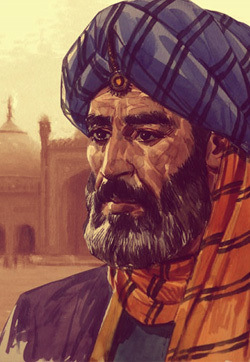
Ibn Taymiyya was one of the most esteemed Sunni Islamic scholars of all time. He is considered one of the originators of the Hanbali school of Shariah. He originated the practice of declaring Jihad on Muslims who did not follow the Shariah based on the belief that they were not true Muslims, despite their claims to the faith.

taymiyya

***

“Healing The Chests Of Believers,” And The Duty To Instruct As Well As Protect

NER,  by Hugh Fitzgerald

That was the title, that was the theme, that was the point, of the video of the burning alive of Moaz Al-Kasasbeh. Obama refers to this “bankrupt ideology” that has come, apparently, out of nowhere. King Abdullah, in Washington, is apparently amazed and flabbergasted at these people, who have absolutely nothing to do with Islam. And the rest of the world’s leaders are also horrified, and amazed, and presumably puzzled, as to this “ideology” that comes out of nowhere, that has “nothing to do with Islam” and for which no texts, not a single sentence, can be found that is not in the Qur’an, or not in the Hadith, or not in essence discoverable in the biography (Sira) of Muhammad, beginning with that of Ibn Ishaq. Perhaps someone should offer a sufficiently high reward — say, $25 million, the price the American government put on the head of Osama bin Laden — to anyone who can come forward with the presumably fictional quotes from Qur’an and Hadith that the Islamic State relies on.

If you happen to google — it takes about 30 seconds — “heal the chests of believers” or a variant, you will find what I found, in Sura 9, ayat 14.

Read here.

For a story about setting fire to someone regarded as an enemy — a Jew of the Khaybar Oasis, because he didn’t want to give up all of his property to Muhammad and his marauding followers at Khaybar — who was set alight, and then decapitated, google “Kinana” and, if you need to, “Ibn Ishaq,” and you will discover that Kinana first had his chest set alight. And then he was decapitated. And his propoerty taken. And his wife Safiya taken by Muhammad to be his sex slave. Youu can read more about it, in Ibn Ishaq and in the Hadith, here.

Obama — and other Western leaders — cannot continue this attempt to hide from those to whom they have a duty not only to protect, but to instruct — what is in the Qur’an, Hadith, and Sira. They think they can continue this indefinitely. They apparently think it is possible to “keep the support” — what support, really? — of our “staunch allies” in the Middle East such as Saudi Arabia, and also “keep the support” — what support, really? — of Muslims in the West, and yet not lose the support of non-Muslims who in ever greater numbers will be alarmed, as they find out what is being kept from them, and will, already do, distrust their governments, distrust much of the media, and wonder why they cannot be properly informed so that they may, in turn, vote for candidates who understand the problem abroad, and the problem within our countries too.

This menace, and this misinformation about that menacee, and this growing mistrust of those all over the West who have a duty to instruct as well as protect us, will not go away. It will not lessen. It will only get worse.

Defining The Taliban as the Enemy

February 1, 2015

Defining The Taliban as the Enemy, Fox News via You Tube, January 31, 2015


Pakistan: Between Civility and Fanaticism

January 31, 2015

Pakistan: Between Civility and Fanaticism, The Gatestone InstituteSalim Mansur, January 31, 2015

(The history of Pakistan, “the land (or home) of the pure,” may provide insights into the future of Egypt and other Islamic nations. — DM)

A country made for Muslims has turned into a nightmare for Muslims.

The wish of Mohammad Ali Jinnah, the father of Pakistan, was that the country evolved into a modern democratic state where Muslims, as a majority population, could feel at ease.

But the modernizers who succeeded the colonial authorities in taking power aroused expectations that were simply beyond their abilities to deliver.

But religious authorities were agitating, warning the bewildered masses that these defeats were divine punishments for betraying the true message of Islam by not faithfully abiding by its requirements.

Qutb in his writings recast the division in the world from the classic Muslim one between the House of Islam and the House of War, to one between Islam and jahiliyya, a condition of paganism that preceded the coming of Islam to Arabia. Jahiliyya has now become all-pervasive in the modern world, supposedly sparing none, including Muslims, except for that small coterie of Muslims who took flight [hijra] from the corrupted world and prepared for jihad [armed struggle].

Together, Hasan al-Banna, Abul A’la Maududi and Sayed Qutb fashioned political Islam as a closed system, in opposition to all other competing ideologies.

The theology of takfir — declaring other Muslims apostates or unbelievers; excommunication — obsessed with “unbelief,” has provided the politics of jihad [armed struggle] with the theological justification that arms any Muslim to freelance as a soldier of Allah.

The strategic requirement for advancing global jihad was to convince Muslims that they are liable to be found committing heresy if they support non-Muslim or infidel authorities, such as the United States and its allies, or if they wage war against Muslims, such as members of al-Qaeda.

The theology of takfir and jihad has now come full circle. Many Pakistanis, when they disagree, now find themselves trapped in denunciations that they are unbelievers.

It is from these madrasas that the jihadi fighters come forth as cannon fodder for an endless jihad that has become a growth industry in Pakistan. The entire political elite in Pakistan has profited, just as the Iranian elite continues profiting by doing the same.

For many, being “pure” required separating oneself from non-Muslims.

“The Taliban were not providing strategic depth to Pakistan, but Pakistan was providing strategic depth to the Taliban.” — Ahmed Rashid, foremost scholar of the Taliban.

The recent massacre of school children by Taliban jihadists in a Peshawar army school just lowered even further the bar of atrocities carried out under the banner of Islam in Pakistan. As authorities floundered in the face of mounting violence, with serious implications for new wars in the region, the 2014 Global Terrorism Index ranked Pakistan third behind Iraq and Afghanistan among countries most impacted by terrorism. In addition, the “failed states index” elevated the status of Pakistan to being among the top dozen failed states of the world.

According to the intelligence report of the last conversation before the murders, monitored by Pakistan’s security agency, one of the jihadists informed his handler, “We have killed all the children in the auditorium.” He then asked, “What do we do now?” The handler answered, “Wait for the army people, kill them before blowing up yourself.”[1]

When the mayhem was over, 132 children were dead, among 145 people killed by the jihadists.

The Peshawar massacre has once again, just as in 1971, opened a window onto internal fault lines rupturing the country: those of ideology, ethnicity, sectarianism, and class. Of these, the most severe is the rupture over ideology — between those who insist that the country is insufficiently Islamic and those who fear that religious extremism has brought the country to ruin. This ideological fault line also intensifies the other divisions.

There is not only the immense risk of Pakistan’s nuclear arsenal getting into the hands of Islamist terrorists, but that Pakistan has more or less turned into a safe-haven for them. For religious extremists of Islam, Pakistan has become a secure fortress, from which they can wage their global jihad.

The injunction against the deliberate killing of children has, unfortunately, often been breached in times of war; the Peshawar massacre of children by militants of Tehreek-e-Taliban Pakistan [TTP] were, apparently, revenge killings for the loss of their women and children as a result of Pakistan’s military operations in North Waziristan, along the border with Afghanistan.

The TTP leaders, however, went further. They defended their revenge killing in the name of Islam, as a jihad against their enemies. Umar Khorasani, a spokesman for the TTP, justified the massacre by comparing it to the massacre by the Prophet Muhammad of the Jewish tribe of Banu Qurayza, in which children were also killed.

In offering this justification, Khorasani’s reference to Sahih Bukhari — one of the authoritative sources for Sunni Muslims on the traditions (Sunnah) of the Prophet — carried the message that those who even question the religious legitimacy of the killings would be held responsible for igniting any violence against them by the Pakistani Taliban and their supporters, on the charge of having insulted the Prophet. Such a denunciation by the Taliban of their opponents is consistent with Pakistan’s blasphemy law; it forbids any remark that might be taken as insulting the Prophet or the Quran, with the maximum penalty of death, under which some members of the minority religious communities have been indicted — often unfairly — and held in prison.

The Peshawar massacre and the manner in which the TTP offered its justification for it, have roped the Pakistan’s political and military elite into a fix on how to refute Taliban’s interpretation of Islam’s sacred texts, without getting drawn into a potentially deadly conflict that would only deepen sectarian and ideological differences even more.

If the country is not to slide deeper into the lethal mix of Taliban-type fanaticism and armed globaljihad, the elite need to respond forcefully. The prospect, however, is gloomy.

The Pakistani Taliban is the creature of the ruling elite, especially the directorate of the Inter-Services Intelligence [ISI]. There is also a problem of widespread pride, nurtured by the elite over the past four decades, in Pakistan’s identity as an Islamic state. And since the identity of the elite is closely bound with the ideology of the religious establishment — and not merely with that of the Taliban — it follows that the various Islam-oriented parties and their supporters will fight to preserve their Islamist ideology.

The impasse in which Pakistan finds itself needs explaining. Pakistan was established on the basis of religion, on Islam, and the claim that Muslims in an undivided British India deserved a state of their own to preserve their religion and culture, for fear of losing both if ruled by the Hindu majority population once the British departed from the subcontinent.

The argument to have a separate state based on religion was flawed. But that flaw would only become apparent during the break-up of Pakistan in 1971 — despite the shared belief in Islam.

The circumstances under which India was partitioned in August 1947 still remains contentious, given the subsequent history of wars fought by the successor states, the unsettled nature of the Kashmir conflict, and the break up of Pakistan in 1971 as a reminder that this could happen again.

The pressure for partitioning India in 1947 largely succeeded because an exhausted Britain, after the Second World War in 1945, did not have the stomach to suppress the communal violence escalating between those who supported a separate Pakistan, and their opponents who insisted on keeping India united.

The seeds of religious extremism — adherence to Islam as the line of demarcation, using violence, if necessary, against non-Muslims — were embedded in the initial demand made to Britain for creating Pakistan.

The father of Pakistan, Mohammed Ali Jinnah (1876-1948), exploited this demand. He persuaded the British authorities to partition India. Jinnah himself was a nominal Muslim with a taste for things British. He was an Anglophile who barely spoke Urdu, the vernacular language of Muslims of northern India. He married a non-Muslim woman, the daughter of a wealthy Parsi (Zoroastrian) industrial magnate of Bombay (now Mumbai); and he died a little over a year after Pakistan had been launched in a sea of immense communal violence that accompanied its beginning.

For Jinnah, ironically, religion had been a matter of personal choice. He had taken to Islam as a lawyer, not as a theologian. He had been persuaded, against his earlier political inclinations as an Indian nationalist, that the Muslims in India deserved to have a state of their own in the eventuality that Britain granted India independence. His wish[2] was that the country evolve into a modern democratic state where Muslims, as a majority population, could feel at ease, as opposed to the unease they had felt as a minority population in an undivided India.

As Jinnah said to the assembled politicians of the new country, “Now I think we should keep in front of us as our ideal and you will find that in course of time Hindus would cease to be Hindus and Muslims would cease to be Muslims, not in the religious sense, because that is the personal faith of each individual, but in the political sense as citizens of the State.”[3]

But Jinnah was old, gravely ill, and probably could not even imagine that the forces of religious extremism he had unleashed would devour his vision of Pakistan as simply a peaceful homeland for the Muslims of India.
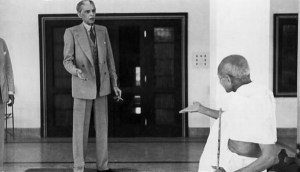
910Mohammed Ali Jinnah, the founder of Pakistan, in conversation with India’s Mahatma Gandhi

It did not take long, however, for all the various contradictions of ethnicity, language, sect, and class, to surface soon after Pakistan’s birth, between the Muslim refugees from India and the people who had been born there.

The country was also physically divided into two halves, separated in the middle by over a thousand miles of northern India. The demand for a Pakistan based on Islam had carried emotional appeal, but what Pakistan would mean as a Muslim state had not been given much thought.

Then there was a problem with Kashmir. Jinnah, according to biographers, felt cheated by the British. Kashmir, with a Muslim majority population, but ruled by a hereditary Hindu prince, was left to India, instead of Pakistan. Jinnah was prepared to force Kashmir’s union with Pakistan. But after pressure from the British military officers still in command of British India’s joint armed forces, Jinnah dropped his plans.[4]

Much of the divisiveness within Pakistan resulted in the inability of politicians to draft and ratify a constitution for nearly a decade – unlike India, where, after independence, a republican constitution for a parliamentary system of government was drafted, ratified, and adopted in fewer than thirty months.

In Pakistan, the irresolvable differences were over the nature of the Islamic state, its ideals and objectives, and how such a state was to be organized.

There were, on one side, modernist or reform-oriented Muslims, educated within the Western liberal tradition, with Jinnah as their model. They believed the Quran and the Sunnah (traditions of the Prophet) could be reconciled through liberal-reformist interpretation with the requirements of a modern democratic and representative form of government.

The religious establishment, on the other side, with its traditionalist-minded ulema (religious scholars), was insistent that the law of the land could be based only on the Quran and the Sunnah, which provided the complete and unalterable social and political code for an Islamic society. They required, therefore, that Shariah – Islamic law compiled in the 9th-12th centuries C.E. – was made the law of the land.

Then there was Abul A’la Maududi (1903-79), with the title of Maulana (a learned scholar), bestowed by his followers, as the founder and leader of Jamaat-i-Islami – the South Asian counterpart of Ikhwan-i-Muslimin (the Muslim Brotherhood), founded by the Egyptian, Hasan al-Banna (1906-49). Maududi went even farther by demanding that the constitution recognize the sole sovereignty of Allah, and the state as His agent, be limited only to implementing the Shariah.

Ultimately the difference in these two views was unbridgeable. As a result, holding the country together by authoritarian means became unavoidable.

Men in uniform replaced feckless politicians. General (later made Field Marshal) Ayub Khan, a military chief, seized power in October 1958, and set the pattern of military rule for the country. During the decade he ruled, he imposed on the country a constitution of his making; supervised economic development; invested in the defense establishment; worked to undermine the religious establishment; and in 1965 launched a poorly conceived war against India over Kashmir, which backfired. He was eventually forced, in the midst of political unrest across the country, to hand over power in 1969 to yet another general.

The military rule of Ayub Khan’s successor, General Yahya Khan, ended dismally in December 1971 with the break-up of Pakistan. It was preceded by an election for a national assembly in 1970, which Yahya Khan had arranged with the express purpose of handing power to a civilian government. But when a political party from East Pakistan won the largest number of seats in the assembly and was poised to form a government, Yahya Khan reneged on his promise. The people in East Pakistan (now Bangladesh) – estranged from those in West Pakistan (now Pakistan) over ethnic and language differences, and grievances over socioeconomic disparities – rose in opposition to military rule. The situation rapidly deteriorated, a civil conflict turned into a bloody military repression and massacre of unarmed people by the military. It ended with Pakistan declaring war against India, and the surrender of the Pakistani army to Indian forces in Dhaka, the capital of East Pakistan (now independent Bangladesh), on December 16, 1971.

After this humiliating defeat, Pakistanis in general were demoralized and the military discredited. In these circumstances, Zulfikar Ali Bhutto and the party he founded, the Pakistan People’s Party, maneuvered to fill the void. Bhutto belonged to the wealthiest landlord family in the province of Sind; as a young lawyer-politician, he had been appointed a junior minister in the military regime of Ayub Khan. His later disagreements with Ayub Khan’s policies, following the 1965 war fought by Pakistan and India over Kashmir, forced him out of the government and into opposition against military rule.

In the 1970 election Bhutto’s party had emerged with second largest number of seats in the national assembly, behind the party from East Pakistan. Bhutto claimed this as his mandate to form a civilian government, with himself as president, to replace military rule.

In 1973 he presented the country with its third constitution, and had it adopted by the national assembly. But, as the old differences over the nature of an Islamic state and the place of the Shariah resurfaced, the constitution failed to win the support of the religious establishment.

Bhutto was a populist and a demagogue. Although he was one of the most powerful feudal landlords in Pakistan, he nevertheless appealed for electoral support from students, workers and peasants by posing as a defender of the poor and oppressed in society, and, as an ally of China’s then supreme leader Mao Zedong, by embracing the left-wing politics of anti-imperialism. There was showmanship here, and some grandstanding as a leader of a third world nation. It was at this time – and soon after India tested a nuclear device in 1974 – that he determined that Pakistan must acquire nuclear capability of its own. His populism however would not save him from the wrath of the religious establishment.

But, as the country searched for an identity in the aftermath of 1971, Bhutto was temperamentally unsuited to calm the tensions around him. The Muslim religious leaders and their followers distrusted him as another liberal-secularist; he tried to appease them by meeting their demand in declaring as non-Muslims those belonging to the minority Ahmediyya sect within Islam.

In 1977, the military under General Zia ul-Haq staged a comeback, removed Bhutto from office and put him under arrest. While in prison he was indicted for plotting the murder of his political opponent, and put on trial. The court found him guilty, his appeal was denied, and he was hanged in April 1979.

Zia ul-Haq, the third military dictator to take power, ruled until his death in a mysterious plane crash in August 1988. He was a devout orthodox Sunni Muslim, and, unlike his two military predecessors – Ayub Khan and Yahya Khan – he publicly showed respect for Muslim religious leaders and their various organizations. He sought their support, and embraced their religiously directed political agenda to turn Pakistan officially into an Islamic society (Nizam-i-Islam).

ii.

The decades of sixties and seventies in the twentieth century were times of social and political unrest in the West. There was a crisis of values as the young questioned the dominant secular politics mostly concerned with material gain and economic well being, while America’s involvement in the war in Vietnam became increasingly divisive at home. The youth in general defied the authorities on both the Soviet and Western sides of the Cold War. They pushed counter-cultural movements and sought “enlightenment” through sexual freedom, drugs, music, and experimenting with the rites of non-European cultures.

In the Muslim world, the situation was vastly different. The thin veneer of modernity barely penetrated the surface of a world steeped in traditional culture. Islam as understood and practiced for generations sustained the vast majority of people at the edge of poverty. Colonialism had made only a small difference, once independence came, in preparing Muslim societies to meet the immense challenge the modern world posed for them. A tiny segment of the population had received a modern liberal education and had risen in the ranks of colonial administrations as junior civil servants, technocrats, and military officers. On their shoulders fell the task, as in Pakistan after 1947, to lead the country forward and somehow meet the swelling demands of the people for the promise of a better life.

The political leadership of the newly independent states generally looked to the West in terms of their own respective economic and social developments. Within the Muslim world – apart from the few oil-rich Arab states on the Gulf – there was a general consensus among those who held power that there was no alternative to the path for development as historically charted by the advanced Western countries, irrespective of whether those countries were capitalist democracies or socialist.

But the modernizers who succeeded the colonial authorities in taking power – the men in uniform who seized power through military coups due to the fecklessness of politicians, as in Egypt (Colonel Gamal Abdel Nasser) or in Pakistan (General Ayub Khan) – aroused expectations that were simply beyond their abilities to deliver.

The sixties and the seventies of the last century were the decades when the political roof caved in over the heads of the Muslim world’s modernizers. The immediate cause was military defeat. In the Arab world, the June war of 1967 with Israel was a catastrophic defeat for Egypt under Nasser; and, similarly, for Pakistan the December 1971 war with India was a colossal humiliation in which the army lost half the country when East Pakistan, with support of the Indian military, seceded to become an independent Bangladesh.

On the political margins of these Muslim countries, religious parties were agitating, warning the bewildered masses that these defeats were divine punishments for betraying the true message of Islam by not faithfully abiding by its requirements.

These were the decades when old theological debates from the medieval past of the Muslim world re-surfaced and were widely disseminated. Muslims were repeatedly told by religious scholars that to reverse their humiliations, they needed to return to their authentic past, to emulate the ways of their revered ancestors (salaf) and the companions of the Prophet, and to establish the rule of Islam.

In the Arab world, the Muslim Brotherhood of Hasan al-Banna and Syed Qutb (1906-66), and in Pakistan the Jamaat-i-Islami of Maulana Maududi, gained in popularity with a populace increasingly frustrated with its own political authorities.

In Egypt, Syed Qutb, as one of the leaders of the Muslim Brotherhood that declared a jihadagainst Nasser’s military-led government, was sent to the gallows. In death, Qutb became a martyr-scholar for a whole new generation of Muslims who were searching for meaning in the midst of cultural despair and political authoritarianism.

An earlier generation before 1967 in the Middle East – as elsewhere in Asia and Africa – had sought answers in the revolutionary politics of Marx and Lenin; had supported the Vietnamese communists in their war against the United States, and had admired Mao Zedong and the Chinese revolution.

In the period after 1967, and before the 1973 October war that brought the Arab oil-producing states to quadruple the price of oil and turn it into a political weapon, it was the writings of Syed Qutb that appealed to the young in the Middle East. Hasan al-Banna and the Muslim Brotherhood had turned Islam into a political doctrine – Islamism – as a total answer to all the problems of the Muslim world. Qutb had described the solution in terms of an Islamic state implementing Shariah as the fundamental law of the land. Al-Banna’s message was also directed at the lslamic ummah,the whole Muslim nation.

Qutb in his writings refined and deepened the message of al-Banna. In a significant departure from other Muslim thinkers of his time, Qutb recast the binary division in the world made by Muslim traditionalists, one between Dar al-Islam (House of Islam) and Dar al-Harb (House of War), into one between Islam and jahiliyya (a condition of barbarism or paganism) that had preceded the coming of Islam in Arabia.

Qutb developed this concept of jahiliyya as one of the key explanations for the decline of Islam in the world, and the miserably broken condition of Muslims in it. In his ultimately extreme view, and one that caught the imagination of his most devoted followers, jahiliyya had become all pervasive in the modern world, sparing none, including Muslims, except for that small coterie of Muslims who understood the situation, took flight (hijra) or withdrew from the corrupted world, and prepared for jihad (holistic struggle, including warfare) in the cause of Islam.

Qutb’s views were in part influenced by the writings of Abul A’la Maududi, in the extent to which Maududi had revived the theological views of medieval Muslim jurists on matters of God’s sovereignty in human affairs. Maududi’s innovation was in insisting that Islam was a complete system of faith and politics, in other words a totalitarian ideology promoting a social revolution, and the necessity of jihad as the instrument for realizing God’s plan on earth.

Together, Hasan al-Banna, Maududi, and Syed Qutb had fashioned political Islam as a closed system, in opposition to all other competing ideologies confronting Muslims. It was at once simple, rigidly based on the Quran and the Sunnah (traditions) of the Prophet, and provided Muslims with an armed doctrine of jihad to quell their doubts, overcome their fears, and direct them towards the objective of establishing an Islamic state or gaining martyrdom in the pursuit of it. When the Islamic revolution did successfully occur, however, it was in Iran, and in February 1979.

The Iranian followers of a religious leader in exile, Ayatollah Khomeini (1902-89), seized control of the popular uprising and eventually turned Iran into a theocratic Islamic republic.

Iran had been a monarchical regime, and the anti-monarchist revolution, even though Iranians followed the minority Shi’ite version of Islam, caught the imagination of the majority Sunni Muslims on either side of its borders. The leader of the Palestinian movement, Yasser Arafat, for instance, travelled to Tehran and embraced the founder of Iran’s Islamic revolution, Ayatollah Ruhollah Khomeini, as the leader of anti-imperialist revolution.

If Iranians could topple the Shah of Iran, an ally of the United States, then it was not unimaginable that Muslims elsewhere could also overthrow similarly pro-American or pro-Soviet authoritarian regimes that they felt had been repressing them into a state of jahiliyya. As a result, the year 1979 – the beginning of the fifteenth century in the Islamic calendar – became a pivotal year in the Muslim world.

Earlier, in November 1979, there had been a failed attempt by a small group of Saudi Wahhabi extremists to ignite a movement against the ruling House of Saud. They seized the grand mosque in Mecca, at the center of which stands the Ka’aba (the ancient cube-like structure), and held the grand mosque for several days until French paratroopers flushed them out. Although this effort was doomed to fail, it signified unrest within the most conservative Arab state, and the messianic wish for an even stricter version of Islam than the one practiced by Saudi rulers.

Then, at the end of 1979, came the Soviet invasion of Afghanistan. The occupation of a Muslim country by an infidel power became a magnet around which to rally Muslim jihadists, and encourage them to head for Afghanistan and join Afghan mujahideen (freedom fighters) in theirjihad against a military superpower.

iii.

Zia ul-Haq (1924-88), an army general who was then president, turned Pakistan into a frontline state in the decade long Afghan war. Zia viewed the Afghan war as the opportunity to reverse the humiliation of 1971, rebuild the morale of the army, and make Pakistan the key ally of the United States in the war against Soviet Communism.

Under Zia’s direction Islamabad forged a new strategic partnership with President Ronald Reagan’s Washington and the Saudi monarchy to help the Afghan mujahideen (freedom fighters) liberate their country from Soviet occupation.

But the blowback from the Afghan war in time has turned Pakistan from a cockpit of global jihadinto a land increasingly torn and bloodied by armed warriors of Islam.

On seizing power, Zia reached out to the religious establishment and made Islamization of Pakistan his military regime’s domestic priority. He believed the country suffered from a crisis of identity, for which it had paid dearly in 1971. Although the country had been established on the basis of Islam, Zia would regularly remind the people in public speeches and interviews, that the political leadership had failed to establish an Islamic-based society.

Zia’s solution was to encourage an Islamic identity to replace, or supersede, ethno-linguistic and sectarian identities that had weakened and divided the country. Accordingly, the measures he adopted were to make the fundamental law of the land, the Constitution, conform to the dictates of the Quran and the Sunnah, and implement the requirements of the Shariah in society. To push for the Islamization of the country, Zia established the Federal Shariah Court and the Shariah Appellate Bench of the Supreme Court.

What Zia could not have foreseen was how the Afghan war would become the petri-dish of Islamist theology and jihadi politics. As Arabs attracted by the appeal of jihad congregated in and around Peshawar, Afghanistan and the Afghan war became the cradle of the global jihadistmovement. The actual contribution of these “Afghan Arabs” in defeating the Soviet Union was negligible, but it was here they found a safe haven to engage in arcane theological debates that shaped the thinking and politics of those who had been radicalized through the writings of Syed Qutb and Maududi.

The Afghan war may be divided into three phases. The first was the war against the Soviet forces, ending with their full withdrawal in February 1989. The Soviet withdrawal marked the beginning of the second phase until 9/11. During this period, the war turned into an internal struggle among the various tribal groups and factions for the control of Afghanistan. Despite the fall of Kabul, the capital, to Afghan Taliban warriors under Mullah Omar in September 1996, this internal conflict raged on. The third phase began after the 9/11 terrorist attacks on New York and Washington, and led to the U.S. sending forces into Afghanistan to search out and destroy the al Qaeda leadership and network.

In Pakistan during the summer and fall of 1988 after the airplane crash that killed Zia, one could see that although the first phase of the Afghan war was winding down, the country was on edge and the military and security forces were everywhere. In Islamabad, at the Institute of Strategic Studies, one could hear the elite opinion about the Afghan war: that the Soviet defeat had been brought about by Pakistan, and that, despite risks, Zia’s bold vision had turned out right.

In helping the Afghan mujahideen liberate their country, Pakistan had acquired strategic depth in its confrontation with India. The victory also celebrated undoing the defeat of 1971, and providing the military establishment with experience in conducting asymmetrical warfare against an enemy larger in size and resources. Pakistan has always been obsessed with India, and the Afghan war gave its men in uniform new confidence on how to engage with India in Kashmir.

The build-up of the military with the offshore money that flowed into Pakistan from Saudi Arabia in aid of the Afghan war further entrenched the special place it occupies in the country. The observation first made by Sir John Morrice James, Britain’s High Commissioner to Pakistan during the rule of Ayub Khan – that re-arming the military by the Americans “was to risk creating a situation where it would not be so much a case of Pakistan having an army as of the Army having Pakistan”[5] – seemed uncannily true at the end of the Zia era. Since Pakistan’s independence in 1947, and at the end of the first phase of the Afghan war, the military had ruled Pakistan for more than half the period, and the men in uniform, given their self-important role as the guarantor of the country’s security, had acquired a sense of entitlement.

During subsequent visits, it seemed as if the victory in the Afghan war that gave most Pakistanis pride and the right to boast was an illusion. War had laid waste to Afghanistan. Virtually the entire Afghani population within the country – as well as in the neighboring countries of Pakistan and Iran – had been turned into refugees. Pakistan had become home for several million Afghan refugees, mostly of Pashtun/Pathan ethnicity, indistinguishable from Pathans on the Pakistani side of the frontier. With these refugees, the war inside Afghanistan was imported across the border into Pakistan, and the struggles of the Afghan mujahideen against Soviet occupation of their country invariably began to change the political landscape inside Pakistan.

The Afghan Taliban emerged from the ranks of its own refugee population in Pakistan. Their struggles against the Soviet forces in their country in turn persuaded their ethnic brethren, the Pakistani Pathans, to join them. In time, the distinction between Afghani and Pakistani Taliban dissolved even as the frontier between the two countries became irrelevant.

Ahmed Rashid, the world’s foremost expert on the Taliban, observed:

“Throughout Afghan history no outsider has been able to manipulate the Afghans, something the British and the Soviets learnt to their cost. Pakistan, it appeared, had learnt no lessons from history while it still lived in the past, when CIA and Saudi funding had given Pakistan the power to dominate the course of the jihad. Moreover, the Taliban’s social, economic and political links to Pakistan’s Pashtun borderlands were immense, forged through two decades of war and life as refugees in Pakistan. The Taliban were born in Pakistani refugee camps, educated in Pakistanimadrassas and learnt their fighting skills from Mujaheddin parties based in Pakistan. Their families carried Pakistan identity cards.”[6]

The Pakistani military, through its ISI intelligence services, had raised, trained, and armed the Taliban to be its proxy inside Afghanistan. The ISI provided key material and logistic support to the Taliban leader, Mullah Omar through the 1990s right to the present. In addition, the ISI’s deep connection with the Taliban, approved at the highest levels of the Pakistani military leadership, became the preferred approach for raising and supporting other Islamist militias to wage secret warfare against India in Kashmir. The ISI’s investment in Taliban was made for returns to its own liking, when needed, in terms of Pakistan’s strategic interests. So the idea of Afghanistan as a strategic depth for Pakistan, was made by Pakistan’s political establishment into an article of faith not to be doubted.

Ahmed Rashid also noted, however, that “the backwash from Afghanistan was leading to the ‘Talibanization’ of Pakistan. The Taliban were not providing strategic depth to Pakistan, but Pakistan was providing strategic depth to the Taliban.”[7] This was shown in the Afghan war, after September 11, 2001, when American and the allied forces under NATO/ISAF (North Atlantic Treaty

Organization/International Security Assistance Force) command found how difficult it was – and still is – to pacify Afghanistan when the Taliban have continued to operate out of safe havens inside Pakistan. The leaders of both the Pakistani and Afghani Talibans are able to slip back and forth across the border to hide with ease.

The Taliban were raised, on both sides of the border, in the Deobandi school of fundamentalist Islam, different in tradition from what the “Afghan Arabs” brought with them to Pakistan.

The “Afghan Arabs” are Arabs who headed for Afghanistan in 1979 following the Soviet invasion of that country. Osama bin Laden and his entire al Qaeda crew, for instance, came to be referred to as “Afghan Arabs” to distinguish them from native Afghans and this is why the quotes. The “Afghan Arabs” introduced the doctrine of takfir [excommunication] theology to non-Arab Muslimjihadis, especially the Afghani and Pakistani Talibans in their pursuit of global jihad.

The Deobandi school, originating out of the nineteenth century Darul Ulum Deoband – an Islamic school that took its name from the town, Deoband, located in north India where it was foundedcirca 1867 – has been, since it was established, the flag-bearer of jihadi movements in India and Central Asia.

The religious scholars at Deoband, were practitioners of taqlid (imitation): of strictly adhering to the authoritative interpretations of the traditional four schools of fiqh (jurisprudence) in Sunni Islam. They insisted that Muslims follow the Shariah-code as required by their faith and tradition.

The “Afghan Arabs” brought with them to Afghanistan and Pakistan the more rigid teachings of the medieval jurist, Ibn Taymiyya (1263-1328), especially his stringent pronouncements on apostasy and jihad.

The mainline consensus of Sunni Muslim jurists on what constitutes Muslim belief, in accordance with the Shariah’s minimal requirement, is the utterance of the Shahada, or the formula of the Islamic creed: “There is no god other than Allah and Muhammad is His Messenger.” The saying of obligatory prayers, keeping the fast during the month of Ramadan, making pilgrimage at least once in lifetime, and giving charity (zakat) have been traditionally considered the key pillars of Islam, as stipulated in the Quran, and abiding by them is evidence of Muslim piety.

Ibn Taymiyya ruled, however, that such minimal requirement was insufficient, especially when a Muslim ruler failed to implement the Shariah, and when any Muslim failed to engage in jihad(armed struggle) to demand the rule of Shariah. From such a standpoint, as Ibn Taymiyya underscored, when a Muslim ruler transgressed the Shariah-code, or set aside the rule of Shariah in territory under his control, he turned into an infidel, or apostate, and thereupon became a legitimate object for jihad.

Ibn Taymiyya’s medieval excursions into jurisprudence and theology, once revived, became the hallmark of the new generation of Arab Islamists. They made takfir (declaring someone to be an apostate or an unbeliever, excommunication) a signature instrument of their jihad, and readily used such pronouncements to attack their opponents.

The most striking example of this from recent history was in pronouncing takfir on President Anwar Sadat for signing the peace agreement with Israel. That act turned him into an object ofjihad, which eventually brought about his public assassination in October 1981.

Ibn Taymiyya’s hard line extremist thinking was a result of the upheaval in Arab lands during the Mongol invasion of the thirteenth century. His views were a marginal innovation in medieval Islamic theology, but nonetheless became the signature of the contemporary jihadis, the “Afghan Arabs.” In mainline traditional Sunni jurisprudence, the ulema (religious scholars) stressed the importance of obeying Muslim rulers and in avoiding fitnah (disorder or internecine warfare) as a major sin.

The theology of takfir, declaring other Muslims apostates, was, and is, riddled with Muslim-on-Muslim violence. From the earliest decades of Islamic history, Muslim extremists have given a theological justification for their violence against Muslims with whom they disagree, such as Shiites, and other minority sects.

Consequently, in contemporary times within the Muslim world, the fear or apprehension of early Muslim jurists – based on lessons, drawn from the earliest phase of Islamic history, of fratricide and tribal conflicts – has become widespread.

iv.

The theology of takfir, obsessed with “unbelief,” has provided the politics of jihad with the sort of theological justification that arms any Muslim to freelance as soldier of Allah.

A soldier, for instance, in the security detail of Salman Taseer – the governor of Punjab and Pakistan’s largest province with an estimated population of around one hundred million – shot him dead in January 2011 to punish him for his efforts to amend the blasphemy law in the penal code. Furthermore, Pakistani lawyers praised his murderer.

The law was first introduced in the colonial period, and the Zia regime further broadened its scope, as part of the Islamization process, by requiring anyone accused of insulting the Prophet or desecrating the Quran to be imprisoned ahead of an investigation.

After the swift defeat of the Taliban by American forces in Afghanistan in 2001, the “Afghan Arabs” of the al-Qaeda network were on the run in search of sanctuary. Many of them, including Osama bin Laden and his deputy, Ayman al-Zawahiri, found safe haven in the Pathan tribal areas of Waziristan within Pakistan, and dug in there for the long struggle of the global jihad. They indoctrinated the Taliban and other elements of the Pakistani jihadi militias based in Punjab with their highly polarized doctrine of takfir theology, culled from the writings of Ibn Taymiyya. (Among the most well known militias besides the Pakistani Taliban are the fiercely anti-Shia and Deobandi trained jihadists of Sipah-e-Sahaba and Lashkar-e-Jhangvi; the Jaish-e-Mohammad operatives in Kashmir; and jihadists of Laskar-e-Taiba, funded by the ISI, and accused of plotting the 2001 attack on the Indian parliament in New Delhi, and of carrying out the 2008 attack in Mumbai.)

For the jihadi theorists among “Afghan Arabs,” the strategic requirement for advancing globaljihad was to convince Muslims that they are liable to be found committing heresy if they support non-Muslim or infidel authorities, such as the United States and its allies, or if they wage war against Muslims, such as members of al Qaeda network.

The “Afghan Arabs” also sought to convince their jihadi allies among Muslims in the Afghanistan-Pakistan region, especially the Islamists among them, to declare their co-religionists apostates if they were found unwilling to establish Shariah rule in society and assist the global jihad.

The logic behind the doctrine of takfir theology for “Afghan Arabs” – as they instructed the Pakistani Islamists – was straightforward: Once Islamists in Pakistan – with many inside the military, and especially those inside the ISI – became convinced that Pakistan could not be considered any longer an Islamic state due to its role as a junior partner of the United States in the war against the global jihad – represented by Islamist organizations, such as al Qaeda – then the Pakistani Islamists would likely lead a revolt. A successful revolt in Pakistan would then make the country the most important base of global jihad.

The theology of takfir has borne fruit within Pakistan. The assassination in 2007 of Benazir Bhutto – a former prime minister and opposition leader and daughter of Ali Bhutto (hanged by the military in 1979) – and then of Salman Taseer, the governor of Punjab, in 2011, were two high profile jihadi executions. Since 2001, there has been a steady toll of victims from jihadi violence inside Pakistan. Taliban and jihadi militias have directed terrorist attacks and suicide missions against the minority Shia population; against Ahmediyyas, declared non-Muslims; against Christian and Hindu minorities; against Sufi shrines and Sufi Muslims (those devoted to a mystical tradition of spiritual Islam) as heretics; and even against Pakistani military targets, such as the naval base in Karachi in May 2011 and an air force installation in Peshawar in December 2012.[8]

In nearly four decades of strife, warfare, and jockeying for power inside Afghanistan, with the epicenter in the mountainous areas bordering on Pakistan, a culture of jihad and takfir took root. The Pakistan army, answerable to no higher authority than itself, contributed to the making of this culture. The Pakistan army is in part responsible for creating the jihadi militias, which have become monsters that cannot be entirely controlled by the ISI. It is also widely believed that the ISI and some segment of the military establishment are in league with Islamists, and supportive of the goals of global jihad.

The fecklessness and corruption of politicians and civilian authorities work to the advantage of the military establishment, still viewed by a majority of the people as the one institution – in spite of the record – trusted to maintain Pakistan’s security.

Because of Pakistan’s rivalry with India and the unwillingness of the Pakistani population, pushed by Islamist rhetoric, to negotiate with India a peaceful settlement of the Kashmir conflict – which, with rising civilian casualties has worsened over the years as a result of jihadi organized terrorism – the military establishment is unlikely to end its support for jihadi militias operating inside Kashmir from bases inside Pakistan. Similarly, by hanging onto the illusion of Afghanistan as some sort of strategic depth for Pakistan, the military will not disband the Pakistani Taliban.

The Islamization of Pakistan has given more official encouragement and “teeth” to Islamists armed with the theology of takfir. These Islamists have shown, that, when squeezed too hard by the military or civilian authorities, they are ready to bite with attacks on military installations, such as one on the naval base in Karachi, or by assassinations, such as in the killings of Salman Taseer and Benazir Bhutto.

Large segments of the Pakistani population live in poverty. The most impoverished region is in the tribal areas of northwest Pakistan, and home to the Taliban. For a vast majority of the people, basic needs in terms of medicine, clean water, nutrition, education and jobs are barely met by the state. The insult to the human dignity of those more or less abandoned to endless destitution is compounded by the lifestyle of the rich and the privileged. The people in the military are the most privileged among the Pakistanis, and resentment against them is not far below the surface of a society seething with tensions.

The Taliban attack on the Peshawar army school, and the murder of the children there, most of whom came from military homes, went beyond revenge. It signified class-based hostility against a system of privilege for a tiny minority. There are over one hundred specially built army schools, such as the one in Peshawar, for children of the military establishment and the civilian elite, to provide for modern education.

In contrast, there are nearly 14,000 madrasas (religious seminaries) where, under the supervision of Deobandi scholars, a Quran-based education of rote learning and memorization, ill-equipped for modern needs, is provided to an estimated two million children of the poor. It is from these madrasas that the jihadi fighters come forth as cannon fodder for an endless jihad that has become a growth industry in Pakistan. The entire political elite in Pakistan has profited, just as the entire Saudi elite has profited by funding the Islamists, and just as the entire Iranian elite continues to profit by doing the same.

Politics in Pakistan has carried in its blood stream the virus of religious fanaticism right from the outset of its creation. The name chosen for the country at birth, “Pakistan,” in Urdu means “the land (or home) of the pure.” For many, the significance of being a Pakistani came to mean striving, as Muslims, to be “pure,” and that a true believer required separating themselves from non-Muslims. But this mentality turned full circle. Infected by the theology of takfir and the politics of jihad, Pakistanis, when they disagree, now find themselves trapped in denunciations that they are unbelievers. A country made for Muslims has now turned into a nightmare for Muslims. The children killed in the Peshawar army school by Taliban were innocent of the politics of their elders, even as these children were their sad victims.


[1] Ismail Khan, “We have killed all the children… What do we do now?” Reported in Dawn(Karachi), 18 December 2014.

[2] As he indicated in his address to Pakistan’s Constituent Assembly meeting for the first time in Karachi in August 1947

[3] See Stanley Wolpert, Jinnah of Pakistan (New York: Oxford University Press, 1984), pp. 337-340.

[4] See Wolpert, Jinnah, pp. 347-354.

[5] Cited in Shuja Nawaz, Crossed Swords: Pakistan, its Army, and the Wars Within (Karachi: Oxford University Press, 2008), p. 200.

[6] Ahmed Rashid, Taliban: Militant Islam, Oil and Fundamentalism in Central Asia (New Haven & London: Yale University Press, 2000), p. 185.

[7] Rashid, Taliban, p. 187.

[8] See Declan Walsh, “Pakistani commandos regain control of Karachi military base,” in The Guardian (UK), 23 May 2011, for report on the attack on the naval base in the port city of Karachi; and see Ismail Khan, “Audacious attack on Peshawar PAF base,” in Dawn (Karachi), 16 December 2012 for report on the attack on the air force base in Peshawar.

A thought experiment about Islam

January 15, 2015

A thought experiment about Islam, Dan Miller’s Blog, January 15, 2015

(The views expressed in this article are mine, and do not necessarily reflect those of Warsclerotic or its other editors. — DM)

A religion which blesses and encourages the slaughter of those who offend it or its “prophet” should be condemned, not praised, unless and until it stops doing both. 

On January 14th, I posted an article titled Obama plans to restrain media offensiveness to Islam. As a thought experiment, this less than obviously relevant cartoon appeared at the top:

Islamic pig

I considered the cartoon offensive and hope that everyone else did too. It might depict Mohamed, or it might not. Beyond vague descriptions, likely of questionable value, we have little information about Mohamed’s physical appearance. The cartoon could depict any obese human male wearing a turban. The same is true of other cartoons purporting to depict Mohamed in various poses.

Had a similar cartoon shown instead a Roman Catholic priest or a rabbi on a roasting spit, with a giant pencil extending into his anus and thence through his body and mouth, present day Christians, Jews and those of most other world religions, as well as those of no religion, would quite likely be offended; far less because of the religious significance of the victim than because we do not do that sort of thing to people. We would not on either account murder the cartoonist. Many Muslims might well consider the cartoon funny and approve of what they consider an appropriate consequence of being Jewish or Christian.

As far as I am aware, no world religion other than Islam worships, and seeks to have its followers emulate, a “prophet” or saint who condoned and demanded the killing of those who mocked or otherwise offended him. Mohamed did. Neither Jesus nor Moses did. Nor, as far as I am aware, did any prophet or saint of any other current world religion.

Other Mohamed cartoons of which I am aware do not show him being killed or tortured. For example this cartoon, which inspired the vicious animosity of many Muslims, merely depicts him with a bomb in his turban and gazing with hatred at someone or some thing. It does not depict him being tortured or killed.

turbanbomb1

Rather than consider it offensive, I consider it a humorous way of depicting one (of the many) barbaric things done by Muslims in the name, and with the blessing, of their religion. Current day non-Muslims also use bombs and some of the same weapons. They use more advanced weapons as well. However, they do not generally do it in the name and with the blessings of their religions because of what they perceive as insults to those religions. That is a significant difference.

Modern cultures should not seek to prevent the publication of cartoons presenting Mohamed, or anyone else, in an unfavorable light. Nor should they seek to prevent cartoons of the objectionable type I posted on January 14th. They can also generate controversy and, hopefully, peaceful discussion. A cartoon of the sort suggested above, depicting a Roman Catholic priest or Jewish rabbi instead of Mohamed, probably would generate nothing more than peaceful controversy, aside from the pleasure of some Muslims.

If cartoons cause bad people to kill those who create or publish them, all of the subsequent adverse consequences should befall those who kill, not those who would create or publish more cartoons.Obama is intent upon imposing adverse consequences on the latter, while claiming that those who kill or attempt to kill in the name of Allah act on behalf of no religion. He would, and would have the rest of us, shield the murderers’ coreligionist supporters even from our displeasure. Obama is a disgrace to civilized humanity.

ISIS scared

ADDENDUM

Free Fire Zone- A Strategy to defeat Global Jihad

January 15, 2015

Free Fire Zone- A Strategy to defeat Global Jihad, Blackfive, January 15, 2015

(I look forward to learning the substance of their proposal. — DM)

The Islamists are attacking all over the world. They are enslaving and killing innocents and the best the free world can come up with is more hashtags. I am glad to see some organizations standing up for freedom of speech and liberty, but it is maddening to watch the United States of America unwilling to even name the enemy facing us all. It is Islamist Extremists and they are proud to let us know.

President Obama has no strategy and is anything has shown a complete unwillingness and inability to deal with the reality we face. The Center for Security Policy has taken the ball and in the absence of leadership from the Commander in Chief, written a comprehensive strategy for dealing with and defeating the Global Jihad. We will release the document tomorrow Friday, January 16 at 12 Noon at the National Press Club in DC.