Archive for the ‘Islamisation of Europe’ category

Europe Surrenders to Radical Islam

June 24, 2017

Europe Surrenders to Radical Islam, Gatestone Institute, Guy Millière, June 24, 2017

(The suicide watch can be canceled. Formerly Great Britain and Much of Europe appear to be dead. — DM

Britain — in spite of the Brexit referendum and even though it is more undermined by Islamization than most other European countries — is fully imbued with a European, defeatist state of mind that corrodes its existence and is present throughout Europe.

British political commentator Douglas Murray writes in his important new book, The Strange Death of Europe: “Europe is committing suicide. Or at least its leaders have decided to commit suicide”. He then wonders if the Europeans will agree to go along with what is happening. For the moment, it seems, the answer is yes.

**********************************

In spite of three attacks in three months, Britain does not seem to be choosing the path of vigilance and determination. June is not even over but the media barely talk about terrorism any more.

Then, in the early hours of June 19, a man who acted alone drove a van into a crowd of Muslims leaving Finsbury Park Mosque in London: the main “threat” to the British right now was soon presented in several newspapers as “Islamophobia”.

Decolonization added the idea that the Europeans had oppressed other peoples and were guilty of crimes they now had to redeem. There was no mention of how, throughout history, recruits to Islam had colonized the great Christian Byzantine Empire, Greece, Sicily, Corsica, North Africa and the Middle East, most of the Balkans and eastern Europe, Hungary, northern Cyprus and Spain.

While most jihadist movements were banned by the British government, more discreet organizations have emerged and demurely sent the same message. The Islamic Forum for Europe, for example, depicts itself as “peaceful”, but many of those it invites to speak are anything but that. The Islamic Human Rights Commission uses the language of defending human rights to disseminate violent statements against the Jews and the West.

London, June 5, 2017. A minute of silence is held at Potters Field Park, next to the City Hall, to pay tribute to the victims of the London Bridge jihadist attack three days before. Those who came have brought flowers, candles and signs bearing the usual words: “unity”, “peace” and “love”. Faces are sad but no trace of anger is visible. The Mayor of London, Sadiq Khan, a Muslim, gives a speech emphasizing against all evidence that the killers’ ideas have nothing to do with Islam.

A few hours after the attack, Britain’s Prime Minister Theresa May also refuses to incriminate Islam, but dares to speak of “Islamic extremism”. She was immediately accused of “dividing” the country. On election day, June 8, her Conservative party lost the majority in the House of Commons. Jeremy Corbyn, a pro-terrorist, “democratic socialist”, who demands the end of British participation in the campaign against the Islamic State (ISIS), led the Labour party to thirty more seats than it had earlier. In spite of three attacks in three months, Britain does not seem to choose the path of vigilance and determination. June is not even over but the media barely talk about terrorism any more. A devastating fire destroyed a building in North Kensington, killing scores of residents. Mourning the victims seems to have completely erased all memory of those killed in the terrorist attacks.

Then, in the early hours of June 19, a man who acted alone drove a van into a crowd of Muslims leaving Finsbury Park Mosque in London: the main “threat” to the British right now was soon presented in several newspapers as “Islamophobia”.

The United Kingdom is not the main Muslim country in Europe, but it is the country where, for decades, Islamists could comfortably call for jihad and murder. Although most jihadist movements were banned by the British government, more discreet organizations have emerged and demurely spread the same message. The Islamic Forum for Europe, for example, depicts itself as “peaceful”, but many of those it invites to speak are anything but that. One was Anwar al-Awlaki, who for years planned al-Qaeda operations until he was killed in Yemen in 2011 in an American drone strike. The Islamic Human Rights Commission uses the language of defending human rights to disseminate violent statements against Jews and the West.

The most flamboyant radical preachers have all but disappeared. The most famous among them, Anjem Choudary, was recently sentenced to five years and six months in prison for his open support of the Islamic State, but hundreds of imams throughout the country continue similar work. No-go zones, forbidden to the “infidels”, continue to grow in big cities, and sharia courts continue to dispense a form of justice parallel to, but different from, the national one. Khuram Shazad Butt, one of the three London Bridge terrorists, could raise the Islamic State flag in front of cameras, be the main character of a documentary on jihad in Britain and still be considered “low priority” by the police. Salman Abedi, the Manchester killer, travelled to Libya and Syria for training before he decided to act; he could easily cross borders without being stopped.
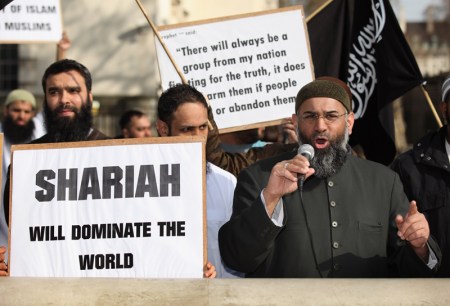
The most famous of Britain’s radical Islamic preachers, Anjem Choudary (pictured holding the microphone), was recently sentenced to five years and six months in prison for his open support of the Islamic State, but hundreds of imams throughout the country continue similar work. (Photo by Oli Scarff/Getty Images)

Attempts to sound an alarm are rare, and quickly dismissed. Left-wing British politicians long ago chose to look the other way and indulge in complicity. Conservatives did not do much to help, either: after the uproar sparked by Enoch Powell’s “Rivers of Blood” speech in 1968, British conservatives avoided the subject and became almost as complacent as their political opponents. In 2002, while portraying Islamism as the “new Bolshevism”, Margaret Thatcher noted that “most Muslims deplore” terrorism. She described the “jihadist danger” without saying a single word on radical Muslims spreading Islamism in her own country.

In 2015, David Cameron said, “We need far more Muslim men and women at the head of British companies, more Muslim soldiers at the highest command posts, more Muslims in parliament, Muslims in a position of leadership and authority”. He did not mention those who were joining jihad in London even as he was speaking.

When he was at the head of Britain’s UKIP party, Nigel Farage said that there is a Muslim “fifth column” in the country. He was ferociously criticized for these words. Paul Weston, chairman of the GB Liberty party, was arrested by the police in 2014 for reading in public a text on Islam written by Winston Churchill. One wonders how Churchill would be regarded today.

Britain — in spite of the Brexit referendum and even though it is more undermined by Islamization than most other European countries — is fully imbued with a European, defeatist state of mind that corrodes its existence and is present throughout Europe.

At the end of World War II, Europe was exhausted and largely destroyed. The idea that prevailed among politicians was that it was necessary to make a clean sweep of the past. Nazism was described as the rotten fruit of nationalism and military power, and the only war that seemed to have to be waged was a war against war itself. Decolonization added the idea that the Europeans had oppressed other peoples and were guilty of crimes they now had to redeem. There was no mention of how, throughout history, recruits to Islam had colonized the great Christian Byzantine Empire, Greece, Sicily, Corsica, North Africa and the Middle East, most of the Balkans and eastern Europe, Hungary, northern Cyprus and Spain. Cultural relativism gained ground. The anti-Western revision of history gradually gained ground in media, culture, politics and education.

Immigrants from the Muslim world arrived in increasing numbers. They were not encouraged to integrate or respect the countries to which they came. In school, their children were told that European powers had misbehaved towards the Muslim world and that Muslim culture was at least as respectable as the Western one, maybe even more

Muslim districts emerged. Radical Islam spread. Whole neighborhoods came under the control of gangs and imams.

When violence erupted and riots took place, European politicians chose to placate them. European populations sometimes tried to resist, but they were constantly told that criticism of immigration and Islam is “racist”. They were intimidated, pushed to shut up.

What is happening now in the United Kingdom and elsewhere in Europe is merely a continuation.

European political leaders all know that radical Islam has swept throughout the continent, that hundreds of Muslim areas are under Islamic control, that thousands of potential jihadists are there, hidden among the immigrants and ready to murder, and that the police are overwhelmed.

They know that radical Islam has declared war on the Western world and that it is a real war. They see that they are prisoners of a situation they no longer control and that reversing the course of events would involve drastic actions they are not ready to take, such as closing thousands of mosques, taking back lost territories by force, arresting thousands of suspects, and deporting foreign jihadists.

They are aware that an apparently unstoppable replacement of population is underway in Europe and that there will be more attacks. They speak as if to limit the damage, not prevent it.

European populations also see what is happening. They watch as entire areas of European cities become foreign zones on European soil; they view the attacks, the wounded, the corpses. It seems as if they have simply lost the will to fight. They seem to have chosen preemptive surrender.

British political commentator Douglas Murray writes in his important new book, The Strange Death of Europe: “Europe is committing suicide. Or at least its leaders have decided to commit suicide”. He then wonders if the Europeans will agree to go along with what is happening. For the moment, it seems, the answer is yes.

Dr. Guy Millière, a professor at the University of Paris, is the author of 27 books on France and Europe.

Will anyone rescue European women?

June 20, 2017

Will anyone rescue European women? Israel National News, Marc Arsak, June 20, 2017

(The holy Multiculturalist Scriptures supersede all others, except the even holier Islamic scriptures. — DM)

This circus of self-flagellation, self-repudiation, self-hatred and fanatical self-criticism has been pursued professionally as a career for Europe’s caste of globalist politicians. Meanwhile, the sources of our exponential crime rates and territorial disintegration, on the other hand, continue to be systematically exonerated of all suspicions and elevated to unattainable levels of absolute perfection and utter sainthood.

***********************************

Barely a week into Emmanuel Macron’s presidency, a petition was launched to bring the daily lives of many native European women to his attention. It was nothing more than a fruitless wishful attempt.

The facts are that the female residents of a Parisian neighborhood, have had enough of “being spat at, daily insults in different languages, forced robbery, the presence of pickpockets, drunkards and the smell of urine,” as the petition states. Many do not dare leave their houses alone, not to mention wearing a skirt or tight pants, lest they are attacked or insulted. They are not welcome in local bars and restaurants where they are greeted by the lewdness of gangs of drunk and unemployed young men who are either French citizens of foreign heritage or recent illegal migrants.

There is no shortage of this type of neighborhoods in Europe, long abandoned to the rule of gangs, drug dealers, and illegal migrants. Even so, any concern or criticism expressed by native Europeans is regarded as blasphemous towards multiculturalism. Which explains why as soon as some of these women expressed their displeasure at being dispossessed from their way of life, they were accused of prejudice and ‘racism.’

Smears and accusations of racism and bigotry are today’s price for telling the truth and describing the reality in Europe. Also, the fear of being called ‘racist’ further dissuades the authorities to take any concrete actions, even if they were ever going to. Besides, most people even fail or prefer not to recognize that these problems do exist and keep getting worse. Politicians from across the board believe that the thugs reigning in European territories are flawless and irreproachable in essence. Therefore, the situation could be ultimately and solely explained by the alleged evils of the European people and their past.

According to their delusional narrative, racist, bigoted, unwelcoming and parsimonious Europeans who colonized the otherwise cultivated, flourishing and prosperous Third World nations have to pay for some committed and mostly uncommitted ancestral sins eternally. Hence, it is, for instance, the fault of the French people, if they are turning into an unprotected ethnic minority in their own homeland. Consequently, had Europeans had not committed these cardinal ancestral sins, had they been less racist and more welcoming today, these masses of unemployed men would not only assimilate and abandon rape, crime, and terror, but they would also make Europe as advanced, civilized, cultivated and modern as the countries they fled.

This circus of self-flagellation, self-repudiation, self-hatred and fanatical self-criticism has been pursued professionally as a career for Europe’s caste of globalist politicians. Meanwhile, the sources of our exponential crime rates and territorial disintegration, on the other hand, continue to be systematically exonerated of all suspicions and elevated to unattainable levels of absolute perfection and utter sainthood.

Feminists are also doing their fair share in the ongoing circus. Following the controversy, Caroline De Haas, a leading feminist figure, proposed to solve the problem by expanding the sidewalks in the neighborhood in question. And no, in case you were wondering, she is not a comedian. The expansion of sidewalks, according to her, will address the issue and make women feel safe again. Her method, at best, might prove to be as efficient as France’s new counterterrorism measure. In case you have not heard of it, “you won’t have my hatred” has become this fancy buzz phrase that many French people are determined to fight terrorism with. Anything more efficient than candles, solidarity hashtags and “you won’t have my hatred,” would be – you guessed it – racist. Thank God, not many people thought of combating Nazism with this you-won’t-have-my-hatred type of servile idiocy.

With no solution on the horizon, it seems that Parisian women will simply have to learn to live with insults, robbery, sexual harassment and all the other wonders of multiculturalism just as their peers in Cologne did. The mere denunciation of this reality is deemed ‘racist’ by the thought police, just as any other thought, word or action advocating the rights of native Europeans to self-preservation is considered to be so. Failing to address the real racism that many people from White South Africans to Christians in Arab countries suffer from, those who use the word to slander Europeans resisting cultural and ethnic substitution have rendered it devoid of any meaning.

Sadly, however, the myth of racist Europeans does not seem to stop the ever-growing flow of criminals, rapists, and terrorists from coming into the continent. Will Europeans soon be told that their very existence, even as an unprotected ethnic minority in their homelands, is racist? Does anyone care enough to rescue the European women, at least?

Islamization of Europe: Erdogan’s New Muslim Political Network

June 11, 2017

Islamization of Europe: Erdogan’s New Muslim Political Network, Gatestone Institute, Yves Mamou, June 11, 2017

What is notable is that France’s new Muslim party, the Equality and Justice Party (PEJ), is an element of a network of political parties built by Turkey’s President Erdogan and AKP to influence each country of Europe, and to influence Europe through its Muslim population.

What is their program? The classic one for an Islamic party: abolishing the founding secularist law of 1905, which established the separation of church and state; mandatory veils for schoolgirls; and community solidarity (as opposed to individual rights) as a priority. All that is wrapped in the not-so-innocent flag of the necessity to “fight against Islamophobia”, a concept invented to shut down the push-back of all people who might criticize Islam before they can even start.

“[The Islamist party’s] purpose is to conquer the world, not just have a mandate. Its mechanics were already established…. Islamists took power in the name of democracy, then suspended democracy by using their power…. Convert the clothes, the body, the social links, the arts, nursing homes, schools, songs and culture, then, they just wait for the fruit to fall in the turban… An Islamist party is an open trap: you cannot let it in. If you refuse it, your country switches to a dictatorship, but if you accept it, you are at risk of submission….” — Kamel Daoud, Algerian writer, in Le Point, 2015.

In the legislative elections that will take place June 11 and 18 in France, political parties are finalizing preparations: choosing their candidates, and printing posters and stickers. Business as usual? Not really.

(Image source: Rama/Wikimedia Commons)

One newcomer arose in the political spectrum: a Muslim party, the Parti Egalité Justice (“Equality and Justice Party”; PEJ). What is notable is that PEJ is an element of a network of political parties built by Trukey’s President Recep Tayyip Erdogan and his Justice and Development Party (AKP), to influence each country of Europe, and to influence Europe through its Muslim population.

PEJ: A Pro-Erdogan Party in France

The PEJ was created in 2015 in Strasbourg, the de facto capital of eastern France, on the border with Germany. PEJ has already approved 68 candidates — not enough to cover the whole territory but enough to compete efficiently in districts where Turkish and Muslim populations are strongly represented. French citizens of Turkish origin are estimated to represent 600,000 people in France, out of a Muslim population estimated at 5-15 million, but official statistics do not exist.

Another Muslim party, “Français et Musulmans” (“French and Muslims”), is also quietly preparing to erupt on the political scene of the French legislative elections. “Français et Musulmans” originates from L’Union des Organisations Islamiques de France (UOIF) which has been rebaptized “Muslims of France”. “Français et Musulmans” is the French branch of Muslim Brotherhood.

The PEJ, is the first party in France established by Turks. PEJ already participated in elections of the Provincial General Assembly in March 2015, but was eliminated in the first round. According to the magazine Marianne: “PEJ is closely connected to Council for justice, equality and peace (Cojep), an international NGO which represents, everywhere it is based, an anchor for AKP”, the party of Turkey’s president, Recep Tayip Erdogan. According to L’Express “many managers of PEJ are also in charge in Cojep”.

What is their program? The classic one for an Islamist party: abolishing the founding secularist law of 1905, which established the separation of church and state; veils mandatory for schoolgirls in public schools; halal food for all schools; support for Palestinians; and community solidarity (as opposed to individual rights) as a priority. All that is wrapped in the not-so-innocent flag of the necessity to “fight against Islamophobia”, a concept invented to shut down the push-back of all people who might criticize Islam before they can even start.

According to the magazine Marianne, Mine Gunbay, responsible for women’s rights in the city council of Strasbourg, fearlessly and tirelessly denounced the metamorphosis of Strasbourg into “political laboratory of the AKP”. Strasbourg is the city where Erdogan was authorized by former president Hollande to hold an electoral rally in October 2015. Legally.

Another noteworthy Turkish move in France is the probable nomination of Ahmet Ogras, the representative of Turkish Islam in France, as next president of the Conseil français du culte musulman (“French Council of Muslim worship”, CFCM). Ahmet Ogras is known for his good relationship with Erodgan’s AKP party. CFCM is the legal structure built by French politicians to have a single Muslim talking-partner. Until now, all presidents of CFCM were of Algerian or Moroccan origin.

Austria

In Austria, in 2016, “Turkish citizens” founded the New Movement for the Future (NBZ) party. The goal of the party is to give Turks a voice in politics across Austria. The NBZ Chairman, Adnan Dinçer, explained that the rise of extremist right-wing parties have caused them to work faster. “Political actors are making decisions about the minorities working here, but we are not involved in this decision-making mechanism,” he said. The NBZ makes it clear that they support controversial Turkish President Recep Tayyip Erdogan and condemn the “Gülen movement”, which the Turkish government claims carried out a coup attempt in July 2016.

Netherlands

Denk, a party founded by Tunahan Kuzu and Selçuk Öztürk in March 2017, became the first-ever ethic minority party in the Dutch parliament. The party, apparently a mouthpiece for Turkish president Erdogan, won three seats in the recent election, which was focused on immigration.

Party leader Tunahan Kuzu said: “This is the beginning of a new chapter in our history. The new Netherlands has given a vote in the House.”

Bulgaria

The Muslim population of Bulgaria is made up of Turks (Sunni), some Shi’ites, Bulgarians and Roma, who together represent 7-8% of the total population. In Bulgaria, there are three Muslim political parties, in which most of the members are Turkish and Muslim.

One of these parties is The Movement for Rights and Freedoms (HÖH), founded in 1990 by Ahmet Doğan. In 2014, HÖH was represented by 38 people in the 240-member parliament and had four MEPs in the European Parliament (EP).

HÖH, which made a coalition with the Bulgarian Socialist Party (BSP), thus has a say in the country’s administration, even though leadership changed after a 2013 assassination attempt against Doğan.

Because Erdogan was not satisfied with HÖH, he has worked to create other pro-Turkish parties in Bulgaria.

Germany

Many Germans of Turkish descent have chosen to invest in German established political parties and influence them from within. Some, however, are trying to influence policy from without.

The Allianz Deutscher Demokraten (“Alliance of German Democrats”, ADD) is a small party founded by Remzi Aru, evidently as a reaction to the German Parliament’s recognition of the Armenian Genocide.

ADD is friendly toward Erdogan and has been trying to establish an electoral base within immigrant and Muslim communities. Its leaders nevertheless had difficulty collecting the 1,000 signatures necessary to participate in the May 2017 North Rhine-Westphalia state election.

Another Muslim-German party is the Bündnis für Innovation und Gerechtigkeit (“Alliance for Innovation and Justice”, BIG), which has existed since 2010, but without much success.

German law prohibits foreign funding of political parties, and a party of Turks would have to fulfill a certain range of obligations to get its certification as an official political party.

The Islamist Trap

An Islamist party in a democracy is, according the Algerian writer, Kamel Daoud, “a trap”. Especially in France. In an op-ed published in Le Point in 2015, he writes:

“An Islamic party in France? What a fascinating political object: one cannot refuse it, but one cannot accept it. Nothing better summarizes the situation as a French trap… If France says Yes, she submits in the long term. An Islamic party is an Islamist party by a natural slope…. By definition. Its purpose is to conquer the world, not just to have a mandate. Its mechanics were already established…. Islamists took power in the name of democracy, then suspended democracy by using their power. At best. At worse, Islamists opted for the approach of the crab that keeps its claws behind his back: no political ambitions, but a millenary ambition in the mind: convert the clothes, the body, the social links, the arts, nursing homes, schools, songs and culture, then, they just wait for the fruit to fall in the turban… An Islamist party is an open trap: you cannot let it in. If you refuse it, your country switches to a dictatorship, but if you accept it, you are at risk of submission….

“As soon as it bursts onto the political scene, the same consequences appear as in Algeria, Egypt, Pakistan, the Sahel or Tunisia: it divides the country between Eradicators (those who want to eradicate the Islamists) and Reconcilers (those who advocate dialogue with Islamist monologue) and the Fatalists (those who are waiting for something good to happen).”

As a fine political analyst, Kamel Daoud knows — and everybody knows with him — that nobody in France has the solution to confront the Islamist problem. The only question is: who will win? Reconcilers or Eradicators? One thing is sure for now, Reconcilers are in power for the next five years.

Another thing is sure: the first veiled woman elected as a Member of Parliament will trigger a civilizational that which has no equivalent in French history.

Yves Mamou, based in France, worked for two decades as a journalist for Le Monde.

The Identity Crisis Fueling European Muslim Radicalization

June 7, 2017

The Identity Crisis Fueling European Muslim Radicalization, Investigative Project on Terrorism, Abigail R. Esman, June 7, 2017

When tanks entered the streets of Istanbul and Ankara last summer in an attempt to overthrow the Turkish government, people swarmed the streets to fight them off. At the urging of their president, Recep Tayyip Erdogan, they pushed back against the coup, some waving Turkish flags, others waving guns. “What else would you do?” A friend in Istanbul asked me some months later. “When your government and your country are attacked, you fight back. It’s to be expected.”

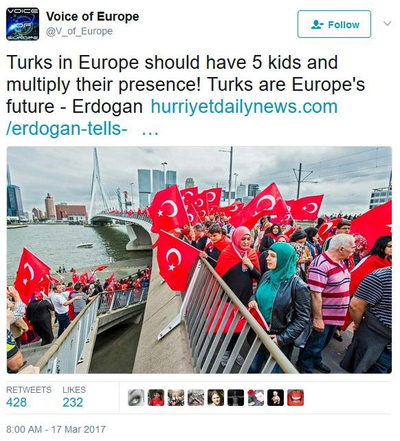
Less expected, however, were the crowds of Turkish-Europeans who also took to the streets in cities like Rotterdam, where dozens demonstrated on the city’s Erasmus Bridge, waving Turkish flags and, in some cases, crying out “Allahu Akbar.” For many non-Turkish Europeans, the action felt almost threatening: Were these people Turkish or European? Could they reasonably be both? Or did they represent a fifth column, aiming to overtake Europe from within?

In Holland, members of Leefbaar Rotterdam (Livable Rotterdam), the populist political party founded by the late Pim Fortuyn, determined to address the issue head-on. They held a public panel discussion last week to debate the question of who these demonstrators were: traitors? Dual citizens with torn allegiances? Could they be true to both their Turkish heritage and to the Dutch culture in which they were born and raised?

Left unspoken were the more pressing questions, the ones the non-Turks really meant: do Dutch Turks identify more with the Islamist policies and values of Erdogan and his regime, or with the secular Enlightenment, the democratic culture of the West? What, after all, to think of the fact that the vast majority of European Turks voted for Erdogan in the November 2015 elections, and again voted against democracy in Turkey’s April 16 referendum, which gave him virtually limitless powers until 2029?

While this particular debate took place in Rotterdam, once the home of the Renaissance humanist Erasmus, these questions have hovered over all of Europe since the 2004 terrorist attacks in Madrid and, even more, the 2005 attacks in London – and not only about the Turks, but about Muslim immigrants in general.

With Europe facing a near-continual onslaught of Islamist terrorist attacks often perpetrated by homegrown extremists, those questions feel more urgent than ever.

But both the issue and its urgency are far more complex than a matter of allegiance. For many second- and third-generation immigrant youth, especially those from Turkey and Morocco, it is also a matter of identity. As dark-skinned immigrants with names like Fatima and Mohammed, they are often discriminated against in their home countries. The values of their families and their religious leaders do not always mesh with the values of their communities and governments. But when they visit their cousins and grandparents in Anatolia and rural Morocco, they find they don’t fit in there, either.

Many counterterrorism experts maintain that this situation makes Muslim European youth especially vulnerable to radicalization and recruitment by terror groups. As Belgian-Palestinian jihad expert Montasser AIDe’emeh has noted of Belgian Moroccan extremists such as the Paris and Brussels attackers, “The Islamic State is giving them what the Belgian government can’t give them – identity, structure. They don’t feel Moroccan or Belgian. They don’t feel part of either society.” And speaking to PBS’s Judy Woodruff, Peter Neumann, director of the International Center for the Study of Radicalization, observed that “the cause [of radicalization] is ultimately a conflict of identity. It is about second- or third-generation descendants of Muslim immigrants no longer feeling at home in their parents’ or grandparents’ culture, at the same time not being accepted into European societies.”

If this is true, then what to make of the Turkish-European dual citizens choosing, as most have, to support Erdogan’s Islamist policies while living in the liberal West? Are they integrated, assimilated, into the cultures in which they live, as most insisted during the Rotterdam debate? Or are they rather true to the norms of a Turkey that is becoming increasingly religious, turning increasingly eastward, and to a president who is gradually unraveling the secular Western vision of the republic’s founder, Mustafa Kemal Ataturk?

At the same time, does waving the Turkish flag when the country is attacked mean they are not actually Dutch? Should Dutch Jews not fly the flag of Israel, or Dutch-Americans have left their stars and stripes at home after 9/11?

“It’s more than just flags,” Ebru Umar, a Dutch-Turkish journalist who moderated last week’s event, explained in an e-mail. “The flags symbolize who they are…. They claim to be soldiers of Erdogan.” Hence, she said, “the people [demonstrating] on the [Erasmus] bridge were and are seen as not integrated. Ask them and they’ll answer they are integrated. And [yet] they tell you of course they adore Erdogan.” Indeed, she noted, they even stated it at the debate: “‘You can’t ask a child whom they love more: mum or dad.'”

It is a false equivalency, however. This is not about loving one parent more than another, but about accepting one of two opposing sets of values: those of secular democracies, or those of Islamist theocracies. There is no combining the two. There is no compromise.

Which is what makes these questions so very critical right now – not just for the Dutch, but for all Europeans, as they confront a complex, existential dilemma. Should they continue to alienate the growing population of young Muslims, and should those same young Muslims continue to resist assimilation, they will together be laying out the welcome mat for recruiters for jihad. But should Europe instead accept the Islamist leanings of those same Muslim youth, it will soon discover there was a fifth column after all – a movement to Islamize the West. And it will have succeeded.

European Art Contest (Vivid point)

June 4, 2017

European Art Contest (Vivid point), via e-mail

(I couldn’t find it on the internet, but it portrays Europe’s Islamisation problem very well — DM)

This art piece sums it all up…Europeans will regret letting in millions of Muslims to leech off their generous welfare systems, and then still foment terrorism against the very same people who are their hosts. The caption at the bottom explains where this originated. Look at it carefully and let it sink in. It is quite profound when understood.

Recently there was an amateur art contest in the Netherlands, and people were invited to create a work of art depicting the current era of multiculturalism in Europe – a depiction of their experience in the modern melting pot. This was the winner.

Europe: Denying the Threat of Islamic Imperialism

May 11, 2017

Europe: Denying the Threat of Islamic Imperialism, Gatestone InstituteMaria Polizoidou, May 11, 2017

The UN report and Erdogan’s rhetoric both evidently expresses the Muslim world’s thoughts about what it apparently thinks should be the fate of Israel and Europe. So far, not a single Muslim state has condemned or opposed Erdogan’s aggression against Judeo-Christian civilization.

The enemy is already inside the gates; many European regimes seem unaware that there is even a threat.

The logic of much of Europe’s religious and political community seems to be that if the elephant in the room is spoken to nicely and made to look cute and adorable, people will not think of it as a threat to their safety.

The Western world can no longer ignore the latest elephant in the room: Islamic imperialism. Europe has gone so far as to hamper free speech on the subject, apparently preferring to put the safety of its citizens at risk over admitting that the elephant exists.

Meanwhile, Muslim countries make not the slightest effort to hide their intentions, as recent actions of 18 such states at the United Nations illustrate. They cooperated in the preparation of the report released in March by the U.N. Economic and Social Commission for Western Asia (UNESCWA), which accused Israel of “the crime of apartheid,” despite knowing full well that such a baseless claim would be rejected by the world body now that Donald Trump is at the helm of the free world. The reason they went ahead with it anyway was to convey to the West that delegitimizing the Jewish state was merely the first step in a master plan to unravel all of Judeo-Christian civilization and values.

For a body such as UNESCWA to declare the State of Israel in an official Institute’s report, as being guilty of “the crime of apartheid” according to international law, shows that Islamic expansionism is a real and an active political problem.

UNESCWA must have had some idea, before publishing the report, that such a loopy conclusion could not be adopted, even by the UN, which has been doing its utmost to rewrite historical facts. In the last few years, UNESCO has repeatedly declared pre-Islamic historical sites Islamic.

Nevertheless, UNESCWA proceeded to pass this surreal political concoction, probably to declare to the Western world again its attempts to delegitimize the State of Israel and all the freedoms it represents in the Judeo-Christian world that might threaten the expansion of Islam.

It was an attempt to project power.

Recep Tayyip Erdogan’s Turkey, which even before his new, absolute powers, wanted to represent all of Sunni Islam, shows to the Western world the true face of Islamic imperialism and the conventional, irregular and cyber war it appears to have declared on the Christian world.

The UN report and Erdogan’s rhetoric both evidently expresses the Muslim world’s thoughts about what it apparently thinks should be the fate of Israel and Europe. So far, not a single Muslim state has condemned or opposed Erdogan’s aggression against Judeo-Christian civilization.

ANKARA, TURKEY – APRIL 17: Turkish President Tayyip Erdogan gives a referendum victory speech to his supporters at the Presidential Palace on April 17, 2017 in Ankara Turkey. Erdogan declared victory in Sunday’s historic referendum that will grant sweeping powers to the presidency, hailing the result as a “historic decision. 51.4 per cent per cent of voters had sided with the “Yes” campaign, ushering in the most radical change to the country’s political system in modern times.Turkey’s main opposition calls on top election board to annul the referendum. OSCE observers said that a Turkish electoral board decision to allow as valid ballots that did not bear official stamps undermined important safeguards against fraud. (Photo by Elif Sogut/Getty Images)

According to Turkish Minister of Foreign Affairs Mevlut Cavusoglu, “[T]here will soon be religious wars inside Europe”. The enemy is already inside the gates; many European regimes seem unaware that there is even a threat.

Corrupted elites, with the help of many in the international community, try to suffocate Israel economically; and the biased and dishonest media seem to be trying to hide from the public that they work as proxies of Islamic imperialism, promoting Islamic ideology and condemning the values of the West.

Pope Francis and Greek Orthodox Patriarch Bartholomew use Jesus’s phrase “Love each other as I have loved you” as a religious justification to love people who are ordered — under threat of eternal hellfire — not only never to love you, but to have nothing whatever to do with you, apart from trying to win you over to their firmly-held belief:

“O you who have believed, do not take the Jews and the Christians as allies. They are [in fact] allies of one another. And whoever is an ally to them among you – then indeed, he is [one] of them.” — Qur’an 5:51

The logic of much of Europe’s religious and political community seems to be that if the elephant in the room is spoken to nicely and made to look cute and adorable, people will not think of it as a threat to their safety.

Left-wing ideologues and unwitting fellow travelers hide the nature of the elephant. This was the approach of President Obama, who, along with European leaders, provided space in which the elephant could operate, grow and undermine the fabric of Western societies.

Key to this enabling has been a Western focus on fake politics — such as the obsession with issues such as transgender bathrooms and rights for women who are already blessed with rights — while Islamists are actually oppressing gays and women in the most rigid fashion.

The Obama administration metamorphosed real politics into fake politics, where people talk — instead of about freedom and democracy — about feminism, gender studies, transgender bathrooms, feeling offended and endless vaginology.

Christian leaders have also been trying to deflect from the threat. Both Pope Francis and Greek Orthodox Patriarch Bartholomew I use Jesus’s phrase, “Love each other as I have loved you” to disguise and minimize it.

Meanwhile, the elephant in the room gets bigger and bigger and is ready, according to the Turkish president’s statements, to destroy the house.

The West seems addicted to prettying up terrorist organizations such as the Muslim Brotherhood or the PLO. Wishing away danger is nothing new to the West. It was not until President Ronald Reagan exposed the Soviet Union as an “evil empire,” for example, that the threat of Communism began to be taken seriously. Within six years, the USSR collapsed.

The behavior of many Western political leaders, jumping from one definition to another about the “true nature of Islam,” has so far been disastrous. The tenets of Islam are there or all to see; people in the West seem not to want to look.

What are we Westerners doing trying to tell Muslims what their religion is, in the first place? Do they try to tell us what “real Christianity” is?

Sadly, too much of what we have seen of Islam in the West has been violent. Countless attacks, with shouts of “Allahu Akbar” have been claimed in the name of Islam. In terms of what their religion stands for, you at least have to give them credit for being forthright. We in the West are the ones who have lied.

Ultimately, if we do not confront this problem, this problem will confront us.

Europe’s Rising Islam-Based Political Parties

April 21, 2017

Europe’s Rising Islam-Based Political Parties, Investigative Project on Terrorism, Abigail R. Esman, April 21, 2017

So far, none of the existing [Islamic) parties has had a great deal of success – and the emerging parties have yet to make their platforms known, let alone acquire active supporters. But as Denk founder Tunahan Kuzu proudly announced after the March elections, a new voice has now gained power in a European government. But what that voice ultimately will be, and the strength of its commitment to secular and democratic values, remains yet to be seen.

*****************************

These past several months, eyes across the world have been trained on a growing far-right movement sweeping Europe and America – from the neo-Nazi groups in Germany and the United States to the increasing popularity of France’s National Front. But another, far less noticed but sometimes equally-radical movement is also emerging across Europe: the rise of pro-Islam political parties, some with foreign support from the Muslim world. And the trend shows no sign of stopping.

Holland’s Denk (“Think”) party, established and led by two Turkish immigrants, is among the most significant. Denk won three seats in the Dutch parliament last month, becoming the country’s “fastest-growing” new party, according to Dutch daily NRC Handelsblad. Its platform: replace ideas of integration with “mutual acceptance” – a charming but antiquated idea in a culture where one group accepts gay marriage and the other is taught that homosexuals should be shoved off of tall buildings; an “acceptance monitor” to measure the extent to which such “mutual acceptance” has succeeded; and the establishment of a dedicated “anti-racism” police force.

While not the first of such Islamic parties in European politics, Denk’s March 15 win makes it an inspiration to others. Existing parties now see a new chance for success, while political aspirants across Europe are making plans to start similar parties of their own.

Hence, while the focus in next week’s French elections will be on Marine le Pen’s National Front, many European Muslims will also be watching the Equality and Justice Party (PEJ), led by French-Turk Sacir Çolak. Like Denk, the party claims to be a voice for the downtrodden, aimed at fighting “inequalities and injustices,” according to a report by the Turkish Anadolu news agency. But also like Denk, it has been accused of representing not the political interests of French citizens, but those of Turkey’s president – a man who has spoken out against assimilation and integration and called on European Turks to reject Western values.

The PEJ is not alone in France: The French Union of Muslim Democrats (UDMF), founded in 2012, made headlines when it entered the 2015 electoral race. Its platform seems more moderate than many of its fellow Muslim parties across Europe: founder Nagib Azergui has insisted in interviews that he respects the secular foundation of the French republic, and advocates philosophy and civic education classes that would help mitigate against the recruitment efforts of Muslim extremists.

The party does, however, seek to establish sharia-compliant banks and calls for Turkey to become a member of the European Union. Further, it seeks to re-install the right of Muslim girls to wear headscarves in public schools, a move that could be seen as a gesture towards re-introducing religion into the secular sphere.

Austria, too, has seen a rise in Islamic political parties, such as the New Movement for the Future (NBZ), founded, like Denk and the PEJ, by Turkish immigrants. Unlike the others, however, NBZ has made little effort to hide its loyalty to Turkey. Following the failed 2016 Turkish coup, for instance, its leader, Adnan Dinçer, called on Austria to respect Turkish President Recep Tayyip Erdogan’s clampdown on the country and the mass arrests that followed. It is worth noting, however, that Austria’s far right has been particularly virulent in its anti-Islam activity, calling for Islam itself to be banned from the country. Such motions inevitably bring forth counter-movements from the targeted groups, and it was, just those actions which mobilized Dinçer to form the NBZ.

But it was Denk’s success, above all, that inspired Lebanese-Belgian activist Dyab Abou Jahjah to establish his newest political effort: a party (to date, unnamed) aimed at “Making Brussels Great Again, a la Bernie Sanders,” according to an interview in Belgian newspaper de Morgen.

This would be a third attempt for Jahjah, who first came into the public eye in 2002 as the founder of the Brussels-based Arab-European League, a pan-European political group that aimed to create what he called a Europe-wide “sharocracy” – a sharia-based democracy. In 2003, the AEL further organized a political party, RESIST, to run in the Brussels elections: it received a mere 10,000 votes. Now, Jahjah, who also runs an activist group called Movement X, hopes to run again in Brussels’ 2018 elections. While his party has yet to declare a platform, his anti-American, anti-Israel, pro-Palestinian and anti-European rants on Facebook and elsewhere give an indication of his plans. So, too, did a recent blog post in which he wrote: “we must defeat the forces of supremacy, the forces of sustained privileges, and the forces of the status-quo. We must defeat them in every possible arena.”

But he, too, is not alone: days after Denk’s win, fellow Belgian Ahmet Koç announced his own initiative, the details of which have also still to be determined. However, some things are easy enough to predict on the basis of his past: the Turkish-Belgian politician was thrown out of Belgium’s socialist party in 2016 for supporting Erdogan’s efforts to censor Europeans who insult him publicly, and calling for Belgian Turks to rise up against the “traitors” of the 2016 coup.

Both Koç and Jahjah will have to reckon with the ISLAM party, which has already established itself in the Brussels area. Founded in 2012, ISLAM – which poses as an acronym for “Integrité, Solidarité, Liberté, Authenticité, Moralité” is unapologetically religious. Leaders pride themselves on following the Quran, not party politics. With divisions already in place in the Brussels districts of Anderlecht, Molenbeek (the center of Belgian radicalism) and Luik, the party now plans to expand throughout the Brussels region.

So far, none of the existing parties has had a great deal of success – and the emerging parties have yet to make their platforms known, let alone acquire active supporters. But as Denk founder Tunahan Kuzu proudly announced after the March elections, a new voice has now gained power in a European government. But what that voice ultimately will be, and the strength of its commitment to secular and democratic values, remains yet to be seen.

Europe: Making Itself into the New Afghanistan?

April 21, 2017

Europe: Making Itself into the New Afghanistan? Gatestone Institute, Giulio Meotti, April 21, 2017

“Those (migrants) who come to seek freedom in France must participate in freedom. Migrants did not come to seek asylum in Saudi Arabia, but in Germany. Why? For security, freedom and prosperity. So they must not come to create a new Afghanistan,” said Algerian writer Kamel Daoud. Right. But it is the European mainstream that is letting them turn our cultural landscape into another Afghanistan.

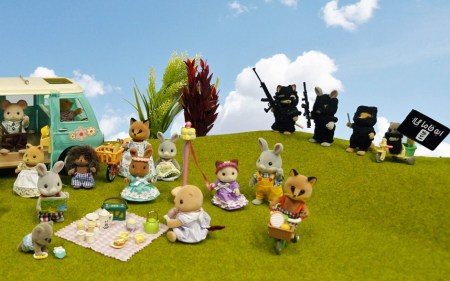
The West used to be proud of being the land of the free. European museums, instead, are rapidly submitting to Islamic correctness. The exhibition “Passion for Freedom” at the Mall Gallery in London censored the light box tableaux of a family of toy animals living in an enchanted valley.

“The Louvre will be dedicating a new section to the artistic heritage of Eastern Christians”, then President Nicholas Sarkozy announced in 2010. But the project was scrapped by the museum’s new management, with the approval of President Hollande’s culture ministry. So today, the Louvre has a section dedicated to Islamic art, but nothing on Eastern Christianity.

Maastricht, in the Netherlands, is the picturesque city that gave its name to the famous treaty signed in 1992 by the twelve nations of the European Community at the time, and which paved the way for the foundation of today’s European Union and the single currency, the euro.

Maastricht, however, is also the home of “Tefaf”, the most important art and antiques fair in the world. The art work “Persepolis” by the Italian artist Luca Pignatelli was already scheduled when the commission ordered it removed. The work, built in 2016, combined a Persian Islamic rug and a female head. “We are all humbled and speechless”, Pignatelli declared, pointing out that his work had initially aroused the enthusiasm of the commission. The fair’s explanation was that Pignatelli’s work was “provocative“.

The officials of fair presumably did not want to offend Islam and possible Muslim buyers with Pignatelli’s combination of the mat (used by Muslims for prayer) with the woman’s face. “We are shocked, this is the first time this has happened and I think it is legitimate to talk about it”, Pignatelli said. “If in Rome it can happen that you decide to veil art works to avoid offending foreign visitors, well, I do not agree”. The reference is at the Italian government decision to veil the antique Roman statues to avoid offending Iran’s visiting President Hassan Rouhani.

If Europe wants a future, it should be less ideological about Maastricht’s treaty and more against Maastricht’s capitulation to fear. The brave Algerian writer Kamel Daoud said:

“Those (migrants) who come to seek freedom in France must participate in freedom. Migrants did not come to seek asylum in Saudi Arabia, but in Germany. Why? For security, freedom and prosperity. So they must not come to create a new Afghanistan”.

Right. But it is the European mainstream that is letting them turn our cultural landscape into another Afghanistan. The Taliban have killed artists and destroyed art works. The West used to be proud of being the land of the free.

European museums, instead, are rapidly submitting to Islamic correctness. The exhibition “Passion for Freedom,” at the Mall Gallery in London, censored the light box tableaux of a family of toy animals living in an enchanted valley. Entitled, “ISIS Threaten Sylvania“, it was eliminated after the British police referred to its “inflammatory” content. Previously, the Tate Gallery in London banned a work by John Latham that displayed a Koran embedded in glass.

The brave work of the artist Mimsy, “ISIS Threaten Sylvania”, which satirized the brutality of ISIS, was removed from London’s Mall Galleries after the British police defined it “inflammatory.” (Image source: Mimsy)

Another British artist, Grayson Perry, admitted that he censored himself out of fear that he might end up like Theo van Gogh, the Dutch filmmaker slain by an extremist Muslim, Mohammed Bouyeri, for having made a film about women under Islam. “I have censored myself,” Perry said. “The reason I have not gone all out in attacking Islamism in my art is because I have real fear that someone will slit my throat”.

The Victoria and Albert Museum in London first showed, then withdrew, a portrait of the Prophet of Islam, a work of devotional art image of Muhammad. The photographer Syra Miah, a British native whose family came from Bangladesh, saw her work withdrawn from an Art Gallery in Birmingham after protests by a group of Muslims. The photo portrayed a half-naked woman, mentally ill, who lives under a bus stop in Bangladesh.

The Museum of Cultures of the World in Gothenburg, Sweden, opened with an exhibition entitled “AIDS in the Era of Globalization”. In it, the artist Louzla Darabi exhibited a work, “Scène d’amour”, that depicts a woman having sex with a man whose face cannot be seen. A verse from the Koran is written on it in Arabic. Less than three weeks after the inauguration of the exhibition, the museum removed the painting. The Hergé Museum in Louvain, Belgium, was planning an exhibition to pay tribute to Charlie Hebdo‘s cartoonists; that event, too, was cancelled.

French President François Hollande eliminated a section of the Louvre Museum dedicated to the Eastern Christians, who in the last two years have been decimated by the Islamic State. “The Louvre will be dedicating a new section to the artistic heritage of Eastern Christians”, then President Nicholas Sarkozy announced in 2010. But the project was scrapped by the museum’s new management, with the approval of Hollande’s culture ministry.

Marie-Hélène Rutschowscaya — former head of the Louvre’s Coptic section and one of the world’s leading scholars on Eastern Christianity — denounced the move. “The dramatic events we are currently seeing in the Middle East and Eastern Europe should instead spur us to do more to promote lasting cultural ties,” Rutschowscaya wrote in her letter to Hollande. So today, the Louvre has a section dedicated to Islamic art, but nothing on Eastern Christianity.

Perhaps the Iranian ayatollahs were right in asking the Capitoline Museums in Rome to veil the nude statues during President Rouhani’s visit. Perhaps the Islamic fundamentalists are wrong, the West is not as free as it claims. Perhaps we should apologize to the Taliban for criticizing their destruction of the great Buddhas of Afghanistan. According to the West’s new cultural sanctimony, today these statues might be considered “blasphemous” too.

Oh, How the Mighty Have Fallen

March 29, 2017

Oh, How the Mighty Have Fallen, American Thinker, Rabbi Aryeh Spero, March 29, 2017

(Please see also, Pope Francis Tells EU Leaders: Populism Is ‘Egotism.’ — DM)

Instead of fighting and becoming angry, we light candles and turn off the lights in tall buildings. We vow to fight a nonspecific theory called “terrorism” instead of protecting our borders from whom and where it is precisely coming. In response to the terrorism in our cities, we call for even more multiculturalism and appeasement. We have become the pitiful we, pathetic, because of Barack Obama’s repeated sermonette of: “That’s not who we are.” Whenever suggestions were made for the urgent need to monitor some of the mosques or the young men most likely to commit future terrorist acts against us, Obama would declare: “That’s not who we are.”

********************************

The fear and scrambling of citizens in London a few days ago was a humiliating scene, wherein a powerful city and its entire government came to a halt because of one man, an Islamist with an axe and a truck. We have seen similar things happen in other major Western cities. Humiliating the West is one of the primary goals of militant Islam. It is a victory for their deity, as demonstrated by the ubiquitous shouts of “Allahu Akhbar” prior to the terror act, a time-worn declaration of Islamic victory and humiliation of the infidel. The multiculturalists do not see it as a humiliation against us, for the us — an us with an identity — is no longer important or recognized by them. In contrast, those on the other side killing and reshaping us have a confidence and pride in their identity.

Instead of fighting and becoming angry, we light candles and turn off the lights in tall buildings. We vow to fight a nonspecific theory called “terrorism” instead of protecting our borders from whom and where it is precisely coming. In response to the terrorism in our cities, we call for even more multiculturalism and appeasement. We have become the pitiful we, pathetic, because of Barack Obama’s repeated sermonette of: “That’s not who we are.” Whenever suggestions were made for the urgent need to monitor some of the mosques or the young men most likely to commit future terrorist acts against us, Obama would declare: “That’s not who we are.”

When it comes to Islamic terror or shariah imposition, Obama and other globalists preach a type of defenselessness and impotence: something we have to abide. For many liberals, virtue signaling, the epitome of vanity, is more important than saving lives, even the lives of their countrymen.

Heroic people, however, know exactly who they are: They are those who defend their country and families from terrorism, death and injury. People with an identity know who they are and thus fight for it. Transnationalists don’t… and, with sophistry, try to stop others from doing so.

As uber-multiculturalists, these globalist leaders are making a nation’s accommodation to Islam, and the incorporation of Islamic ways and demands, the litmus test of multicultural compliance. Islam is their fast-track tool for transforming Western societies and is being catapulted by them into religious and cultural stardom. It is being romanticized as the new global commonality and outlook, a catchall for all that is right-minded and progressive. By being the new “victim” of Western intolerance and oppression, Islam is automatically elevated and ennobled as something enlightened and most tolerant, especially by those abandoning and running from their Christian ancestry and upbringing and seeking an exotic system in which to pour all their utopian and rebellious yearnings.

Many in the political class demonizing Americanism and nationalism are celebrating transnationalism, which is being pushed today by global multiculturalists. Until now, Western countries retained with pride their distinctive culture and norms, while recognizing and enjoying the varied qualities found in nations different than their own. Transnationalism is radically different. It wishes to denude each Western country of its uniqueness and severely marginalize that segment of the population wishing to preserve and live by the historic values and customs of their country. It is banal uniformity on a global scale, often a consequence of embarrassment and repudiation of anything overtly Christian or Old Testament.

Transnationalism takes power away from a country’s people and imposes laws and norms from above by an almost interchangeable global ruling class which treats its country’s patriots as malcontents and second class, as “unenlightened” citizens entitled to fewer freedoms than anti-nationalists or preferred minorities. The ruling class has more sympathy and identity with the ruling class of other countries than with citizens of their own country. It is cosmopolitanism run riot, so that American liberals, for example, feel a kinship more with Parisians than those from Peoria.

Whereas until very recently, highly patriotic leaders were chosen to lead countries, under the mantle of transnationalism leaders are advanced who downplay and characterize as “extreme” the patriotic members within society. Barack Obama and Hillary Clinton in America, Angela Merkel in Germany, as well as the Scandinavian and Flemish leaders, the EU and the Hague, are representative of those in an expanding political class and club who see their power deriving from a global multiculturalism that marginalizes conservative voters to ineffective fringes.

These leaders reinforce and aid each other by speaking to voters beyond their own country. They speak of the need of voters elsewhere to elect those candidates who will be part of a globalist order and fraternity upon which rests the “guarantee of peace, harmony, prosperity, and environmental purity”. Transnationalism is the age-old universalist and socialist dystopia come true, just under a new nomenclature. Those opposed are labeled xenophobic; those questioning open borders are labeled racist. No one has a right any longer to an opinion except those issuing leftist, transnational creeds. These accusations, the name calling, are some of the most powerful weapons in the globalist arsenal.

Many making the accusations of xenophobia live in rarified societies and neighborhoods or in high-end and fashionable apartment buildings with security guards and doormen, immune from the consequences of Open Borders, loss of manual jobs, overseas nation-building, and the harmful effects arising from perfunctory background checks and superficial vetting.

It is not American nationalism that warrants our alarm, rather transnationalism and fierce multiculturalism. In the name of faux morality and twisted tolerance it seeks to erase the identity, touchstones, and values that made us who we are. It imperils our future.

A bloodied ISIS staggers on

March 26, 2017

A bloodied ISIS staggers on, Israel Hayom, Prof. Eyal Zisser, March 26, 2017

(According to the first sentence in the article, “Europe is learning the hard way what Israel learned decades ago.” If so, Europe must be an extremely slow learner. More likely, it resembles a terminally ill lung cancer victim who continues to smoke cigarettes and to inhale the smoke in hopes that it will cure him. Please see also, Islam, Not Christianity, is Saturating Europe. — DM)

Europe is learning the hard way what Israel learned decades ago. The war on terror is an ongoing struggle with ups and downs, and always painful failures. This fight requires patience and determination. There is no magic knockout punch, not by a spectacular military operation in the Syrian hinterlands or the assassination of some terrorist cell or another in a Paris or London suburb. A fight such as this can go on for years, as the reality prevalent in Europe is not about to change.

An equally important lesson, which Europe is also about to learn, is that terror constantly changes shape. In the past, al-Qaida spearheaded the waves of terrorist attacks in Europe. Now Islamic State has taken the reigns, and we can assume that if it fades and disappears, another Islamist group will take its place. The name and the headlines will change, to be sure, but the ideology will remain the same; the targets will continue to be innocent civilians across Europe, and the attackers will continue to be the same Muslim youths so enraptured by religious madness. It will be no different than our experience in Israel.

The terrorist attack perpetrated by Islamic State in London came on the heels of stinging defeats in its strongholds in Syria and Iraq. The organization’s dream of establishing an Islamic caliphate is on the verge of falling apart with the approaching fall of its government centers in Mosul, Iraq and Raqqa, Syria, which serves as its capital. The organization has already lost nearly half the territory it once held, and the signals being sent by the new administration in Washington point to U.S. President Donald Trump’s willingness and even determination to send American troops into the fray to fight the organization in a decisive manner.

Islamic State’s defeat will apparently induce a monumental battle between the winners — Iran and its allies — on one side, and Turkey and the moderate Arab states on the other. Iran, to be certain, will try filling the void left by Islamic State by establishing a land corridor from Tehran to Beirut. Its adversaries, meanwhile, will try preventing the Islamic republic from achieving its goals. All this, while Russia and the U.S. will watch from the sidelines and perhaps even fan the flames in order to advance their own interests in the region.

What is important to understand, however, is that the defeat of Islamic State and the fall of the country it created in the Middle East will not be the end of the story, not for the organization itself and certainly not for the ideology it espouses. We must keep in mind that Islamic State is first and foremost an extremist ideology, which enjoys support from local populations in the Middle East and from Muslim communities across the globe.

It is also an organization that rallies support from disenfranchised populations in the region — which feel persecuted by their centralized governments — whether these are Sunnis in Iraq or eastern Syria, or Bedouin tribes in the Sinai Peninsula. Thus, even if the state it created in eastern Syria and northern Iraq crumbles, we can assume Islamic State will withdraw deep into the desert from which it came and shift to operating as a ruthless underground organization that still enjoys support from local populations. Case in point, in Sinai the group continues to operate successfully despite being pummeled by Egypt.

Islamic State also has other areas within which it can operate, such as Libya or Yemen, where it has established footholds under the cover of the civil wars persisting there unabated. There has been a great deal of speculation recently over the possibility that the group could transfer its government centers to these places. Finally, sentiment for the organization and its ideas will continue to inspire and compel Muslim youths from across the globe to carry out terrorist attacks. Other radical Islamist organizations, which are more than willing to pick up where Islamic State ends, are also vying for the hearts and minds of these youths.

The waves of terror, therefore, will continue crashing into Europe, despite all the efforts to stop them and despite the military successes against Islamic State’s leaders and commanders in Syria and Iraq. Yet the fight must remain unrelenting, as this is the nature of the war against terror. It is the only way to ensure normal life in Europe. As the Israeli experience teaches, this should be the goal, even with the knowledge that terror has not been completely defeated.