Archive for the ‘Islamisation of Britain’ category

UK Government to Hold Pro-Terrorism Expo in London?

May 30, 2017

UK Government to Hold Pro-Terrorism Expo in London? Gatestone InstituteDenis MacEoin, May 30, 2017

(Will Formerly Great Britain soon hold a celebration in honor of the Islamic State in Manchester? Failure to do so would be Islamophobic. A concert would, of course, be appropriate. — DM)

“‘Friends of Al-Aqsa’ is one of the more extremist Islamist organizations at work in Britain today. It supports the Muslim Brotherhood-linked charity ‘Interpal’ (proscribed by the US Treasury) and advertises it on its website. It collaborates with the Khomenist Iranian-funded faux human rights organization known as the Islamic Human Rights Commission in organizing events such as Al Quds day at which public support is expressed for the Iranian proxy militia Hizbollah.” — UK Media Watch.

Under these definitions, Hamas is exposed as a terrorist organization both by its repeated use of indiscriminate killing and the contents of its two Charters from 1988 and 2017.

“There is no solution for the Palestinian problem except through jihad…” — Hamas Charters of 1988 and 2017, Articles 18 and 21.

Hamas is not the only extremist organization to which Friends of Al-Aqsa has lent its support.

Mere weeks after the terrorist attacks in Britain — on May 22 in Manchester and earlier in Westminster — there is planned in London, on July 8-9, a major event which its organizers describe as:

Palestine Expo: the biggest social, cultural and entertainment event on Palestine to ever take place in Europe. In a year of immense significance for Palestine, we are pleased to announce, Palestine Expo 2017

The “biggest ever in Europe”: heady stuff. In a major coup, the exposition will take place, not in a scruffy hall on the outskirts of the city, but in the Queen Elizabeth II Centre in Westminster, near the Houses of Parliament, in the shadow of Big Ben and Westminster Abbey. The prestigious centre is owned by the UK Government and its operation is conducted by an executive agency of the Department for Communities and Local Government. It has 2,000 square metres of exhibition space, four main auditoria, seven conference rooms and many smaller rooms, and specialises in events for more than 1,000 delegates. Palexpo[1] will occupy five of its six levels.

Events listed include:

Inspirational Speakers
Interactive Zones
Knowledge village
Food Court
Live Entertainment
Academic Workshop (“will be run by a group of academics from leading UK universities”)
Student Hub
Gallery
Shopping Quarter

On the surface, it might appear that this is merely a cultural event designed to give the British public a taste of Palestinian cooking, music, art, in particular, history (starting in 1948!). A closer examination, however, reveals something less pleasant. Underneath the surface, this exposition is dedicated to a presentation of Palestinian victimhood and “resistance” (read terrorism), the same “resistance” as in Israel, and on similar false pretexts.

In Israel, the false pretext is that Jews — who have lived in Canaan and Judea for 3,000 years, as is substantiated by enough documentary and archaeological evidence to sink a supertanker — are supposedly occupying “Palestinian land”. In Europe, the false pretext is “revenge for colonialism”, which has historically existed under the Muslims, in their conquests of Iran, the Byzantine Empire, North Africa and the Middle East, northern Cyprus, Spain and most of Eastern Europe. This expansion has continued in the present day to Lebanon, northern Cyprus, Indonesia, the Philippines and is working its way through Europe, Canada and Australia. The Europeans are evidently gullible enough, it seems, to swallow all pretexts without bothering to check any facts.

The Queen Elizabeth II Centre is the venue for the upcoming “Palestine Expo 2017”, organized by the anti-Semitic pro-Hamas activist group, “Friends of Al-Aqsa”. (Image source: Jdforrester/Wikimedia Commons)

Who has organized this massive upcoming London event? One might have expected it to be the Palestinian Mission of the UK (often treated erroneously as an embassy, as it claims to represent the “State of Palestine”, which does not exist). However, although the Mission will probably be a participant in the exposition, a direct link for it cannot be found. The same is true for the West Bank’s Palestinian Authority.

The organizers of the event are, in fact, a relatively small British organization, Friends of Al-Aqsa (FOA), founded in 1997 by a British optician, Ismail Patel, closely involved in several Islamic organizations such as the British Muslim Initiative (BMI). The BMI is a front group for Hamas, and has been for many years “the most active organization in the U.K Muslim Brotherhood”. Patel was a spokesman for the BMI. And the BMI was the chief organizer of London’s 2008 IslamExpo, which Britain’s Minister of Communities and Local Government at the time, Hazel Blears, strongly criticized:

“It was clear that because of the views of some of the organisers, and because of the nature of some of the exhibitors, this was an event that no Minister should attend. Organisers like Anas al-Tikriti, who believes in boycotting Holocaust Memorial Day. Or speakers like Azzam Tamimi, who has sought to justify suicide bombing. Or exhibitors like the Government of Iran.”

Friends of Al-Aqsa is, itself, an anti-Semitic pro-Hamas activist group. It helped establish in London the anti-Israel al-Quds Day events, in which extremists march to support the terror group Hizbullah and the theocratic Iranian regime that calls for England, Israel and America to be wiped from the pages of time.

Patel himself is an outspoken upholder of these values. In 2009, he addressed a Stop the Gaza Massacre demonstration in support of Hamas:

“Hamas is no terrorist organization. The reason they hate Hamas is because they refuse to be subjugated, occupied by the Israeli state, and we salute Hamas for standing up to Israel […] to the state of Israel: you no longer represent the Jewish people.”

Hamas has, in fact, been condemned as a terrorist group by the US, the UK, the EU countries, Egypt, Japan, New Zealand, and Australia. Terrorism itself has been difficult to define legally, mostly because the countries that use it do not wish to define it; nevertheless, several countries have matching definitions. The British 2006 Terrorism Act provides a basic list of activities that constitute terrorism:

(1) In this Act “terrorism” means the use or threat of action where-

(a) the action falls within subsection (2),
(b) the use or threat is designed to influence the government or an international governmental organisation or to intimidate the public or a section of the public, and
(c) the use or threat is made for the purpose of advancing a political, religious, racial or ideological cause.
(2) Action falls within this subsection if it-

(a) involves serious violence against a person,
(b) involves serious damage to property,
(c) endangers a person’s life, other than that of the person committing the action,
(d) creates a serious risk to the health or safety of the public or a section of the public, or
(e) is designed seriously to interfere with or seriously to disrupt an electronic system.

Section 1(3) to (5) goes on to expand on the effect and extent of this definition.

The Canadian Department of Justice definition reads in similar terms. Another definition also attributed to Canada reads:

“A terrorist is a man who murders indiscriminately, distinguishing neither between civilian and innocent and guilty nor soldier and civilian.”

Under these definitions, Hamas is exposed as a terrorist organization both by its repeated use of indiscriminate killing and the contents of its two Charters from 1988: (“la hall li’l-qadiyya al-Filastiniyya illa bi’l-jihad — There is no solution for the Palestinian problem except through jihad.” Article 13) and 2017:

“Hamas confirms that no peace in Palestine should be agreed on, based on injustice to the Palestinians or their land. Any arrangements based on that will not lead to peace, and the resistance and Jihad will remain as a legal right, a project and an honor for all our nation’s people.” — Article 21. (Emphasis added.)

Hamas is not the only extremist organization to which Friends of Al-Aqsa has lent its support. The outlawed Northern branch of the Islamic Movement in Israel, which has close Hamas affiliations, is led by Shaykh Raed Salah. Salah has aided organizations that fund Hamas, and claims that Jews were behind the 9/11 attacks (and that 4,000 Jews stayed away from work at the World Trade Center that day). Salah has also called Osama Bin Laden a martyr, and has said that honor killings of young women are acceptable.

According to Tamar Pileggi:

“In late 2015, Israel banned the radical Northern Branch of the Islamic Movement, accusing it of maintaining links to terror groups and of stoking a wave of violence that saw dozens of deaths in a spate of stabbing, car-ramming and shooting attacks.”

Before that, in 2011, FOA along with other extremist groups brought Salah to the UK, despite a travel ban. When Salah was arrested and to be deported, Patel spoke out in support for him. But Salah had well before that delivered bloodcurdling sermons calling on Palestinians to become martyrs while attacking Israeli soldiers.

According to UK Media Watch:

“Friends of Al Aqsa” is one of the more extremist (sic) Islamist organizations at work in Britain today. It supports the Muslim Brotherhood-linked charity “Interpal” (proscribed by the US Treasury) and advertises it on its website. It collaborates with the Khomenist Iranian-funded faux human rights organization known as the Islamic Human Rights Commission in organizing events such as Al Quds day at which public support is expressed for the Iranian proxy militia Hizbollah.

For the Jewish community of the UK, Friends of Al-Aqsa and Patel represent a real threat. The group has published anti-Semitic authors. One, the journalist Khalid Amayreh, claimed that Jews control America, and that the Iraq war “was conceived in and planned by Israel through the mostly Jewish neocons in Washington”. Another was the Jewish British self-declared Holocaust denier Paul Eisen, who runs the anti-Israel organization Deir Yassin Remembered. Friends of Al-Aqsa has also published material by Gilad Atzmon, who has accused the Jews of Germany of waging war against Hitler and has said of the Holocaust:

“The Holocaust became the new Western religion. Unfortunately, it [the Holocaust] is the most sinister religion known to man. It is a license to kill, to flatten, no nuke, to wipe, to rape, to loot and to ethnically cleanse. It made vengeance and revenge into a Western value.”

Of the speakers listed for Palexpo, several are well-known for their pro-Hamas, anti-Israel and anti-Semitic views. Ilan Pappé of Exeter University is a highly radical and much-criticized historian who has called for the elimination of Israel and its replacement by a single Arab state.

John Pilger is an Australian journalist and film-maker, one of whose documentaries has been described as “a veritable encyclopedia of every anti-Israel canard in existence today”. He has suggested that terrorist group Hezbollah represented “humanity at its noblest”; approvingly cited the arguments of the above-mentioned anti-Semite and Holocaust denier Gilad Atzmon; has suggested that “influential” Jews around the world are culpable in “Israeli crimes” and has likened Israel’s treatment of the Palestinians to the Nazi’s treatment of the Jews. According to Pilger , “the Zionist state remains the cause of more regional grievance and sheer terror than all the Muslim states combined.”

Pilger has also asserted that “killing children seems like sport for the IDF [Israel Defence Forces]”. His distortions are breathtaking. He has defended Hamas strenuously. Here, for example, he accuses his most hated countries, American and Israel, of distorting the truth:

“The majority [of Gazans] voted for the ‘wrong’ party, Hamas, which the U.S. and Israel, with their inimitable penchant for pot-calling-the-kettle-black, describe as terrorist.”

He added the astonishing comment that, “Indeed, the vote for Hamas was actually a vote for peace” — about an organization whose Charter declares that, as mentioned, “The only solution to the Palestinian question is through jihad”.

Ben White is one of the UK’s most extreme anti-Israel speakers and writers. In his eyes, Israel can do no right; the Palestinians, including Hamas, no wrong. He “writes extensively about what he terms ‘Palestine/Israel’ to the point of near obsession and was a regular contributor to [the Guardian’s] ‘Comment is Free’ and the virulently anti-Israel ‘Electronic Intifada'”. Here is a list of quotations from his writings. He is a supporter of the anti-Jewish one-state solution and an ardent promoter of the fiction that Israel is an “apartheid state”. He regularly downplays Hamas and Palestinian terrorism, and instead places all blame for violence on Israel.

Among other speakers with reputations for extremist views are Miko Peled, who regards the Israeli army as terrorists (despite international recognition of it as “the most moral army in the world”). His anti-Semitism became clear when, commenting on a US-Israel aid deal, he said:

“Then theyr [sic] surprised Jews have reputation 4being sleazy thieves. #apartheidisrael doesn’t need or deserve these $$.”

Peled has compared Israel to Nazi Germany and called for a Palestinian state to replace Israel.

Tariq Ramadan is a famous Egyptian-Swiss Muslim scholar, philosopher and writer closely linked to the Muslim Brotherhood (he is the grandson of the Brotherhood’s founder, Hasan al-Banna’). He is famous for duplicity and use of doublespeak.[2] He has donated money to the terrorist group Hamas, which is the Palestinian branch of the Muslim Brotherhood, and he has been denied a visa to the United States for his links to Hamas. He “was barred under a section of the Patriot Act, which bars entry to foreigners who have used a ‘position of prominence … to endorse or espouse terrorist activity.'” He “has often been accused of being an Islamist, anti-Semitic, and sexist. He has drawn severe criticism from numerous Western public figures, ranging from scholars and journalists to political, religious, and community leaders”.

The other speakers listed fall into similar categories as supporters of trying to destroy Israel through economic means, Palestinian “resistance” to Israel, and anti-Semitism.

Currently, Friends of Al-Aqsa and the Palestine Solidarity Campaign are planning to sue Jewish Human Rights Watch (JHRW) for libel, forcing the rights group to instruct lawyers to act in their defence. From the evidence presented here, JHRW could scarcely have a better case. Its appeal to the management of the Queen Elizabeth II Centre for the cancellation of a terror-linked event is entirely in line with British concerns about radical and terrorist ideologies, anti-Semitism, and international terrorism. Friends of Al-Aqsa, the Palestine Solidarity Campaign, their supporters, and the various organizations to which they are linked, have never changed their beliefs regarding Israel, the Jewish people, or the West.

Dr Denis MacEoin PhD (Cambridge 1979) is a scholar of Islam and Persia, a former lecturer in Arabic and Islamic Studies and currently a Distinguished Senior Fellow at the Gatestone Institute.


[1] Not to be confused with Geneva’s Palexpo: Palais des Expositions et des Congrès

[2] See Caroline Fourest, Brother Tariq: The Doublespeak of Tariq Ramadan, New York, London, 2008 and Paul Berman Flight of the Intellectuals, NY and London, 2011, Chapter One. See also Christopher Hitchens here.

Islam in the Heart of England and France

April 23, 2017

Islam in the Heart of England and France, Gatestone InstituteDenis MacEoin, April 23, 2017

For many years, the British government has fawned on its Muslim population; evidently the government thought that Muslims would in due course integrate, assimilate, and become fully British, as earlier immigrants had done. More than one survey, however, has shown that the younger generations are even more fundamentalist than their parents and grandparents, who came directly from Muslim countries.

********************************

“There are plenty of private Muslim schools and madrasas in this city. They pretend that they all preach tolerance, love and peace, but that isn’t true. Behind their walls, they force-feed us with repetitive verses of the Qur’an, about hate and intolerance.” — Ali, an 18-year-old of French origin, whose father was radicalized.

“In England, they are free to speak. They speak only of prohibitions, they impose on one their rigid vision of Islam but, on the other hand, they listen to no-one, most of all those who disagree with them.” — Yasmina, speaking of extremist Muslims in the UK.

“Birmingham is worse than Molenbeek” — the Brussels borough that The Guardian described as “becoming known as Europe’s jihadi central.” — French commentator, republishing an article by Rachida Samouri.

The city of Birmingham in the West Midlands, the heart of England, the place where the Industrial Revolution began, the second city of the UK and the eighth-largest in Europe, today is Britain’s most dangerous city. With a large and growing Muslim population, five of its electoral wards have the highest levels of radicalization and terrorism in the country.

In February, French journalist Rachida Samouri published an article in the Parisian daily Le Figaro, in which she recounted her experiences during a visit there. In “Birmingham à l’heure islamiste” (“Birmingham in the Time of Islam”) she describes her unease with the growing dislocation between normative British values and those of the several Islamic enclaves. She mentions the Small Heath quarter, where nearly 95% of the population is Muslim, where little girls wear veils; most of the men wear beards, and women wear jilbabs and niqabs to cover their bodies and faces. Market stalls close for the hours of prayer; the shops display Islamic clothes and the bookshops are all religious. Women she interviewed condemned France as a dictatorship based on secularism (laïcité), which they said they regarded as “a pretext for attacking Muslims”. They also said that they approved of the UK because it allowed them to wear a full veil.

Another young woman, Yasmina, explained that, although she may go out to a club at night, during the day she is forced to wear a veil and an abaya [full body covering]. She then goes on to speak of the extremists:

“In England, they are free to speak. They speak only of prohibitions, they impose on one their rigid vision of Islam but, on the other hand, they listen to no-one, most of all those who disagree with them.”

Speaking of the state schools, Samouri describes “an Islamization of education unthinkable in our [French] secular republic”. Later, she interviews Ali, an 18-year-old of French origin, whose father has become radicalized. Ali talks about his experience of Islamic education:

“There are plenty of private Muslim schools and madrasas in this city. They pretend that they all preach tolerance, love and peace, but that isn’t true. Behind their walls, they force-feed us with repetitive verses of the Qur’an, about hate and intolerance.”

Samouri cites Ali on the iron discipline imposed on him, the brutality used, the punishment for refusing to learn the Qur’an by heart without understanding a word of it, or for admitting he has a girlfriend.

Elsewhere, Samouri notes young Muslim preachers for whom “Shari’a law remains the only safety for the soul and the only code of law to which we must refer”. She interviews members of a Shari’a “court” before speaking with Gina Khan, an ex-Muslim who belongs to the anti-Shari’a organization One Law for All. According to Samouri, Khan — a secular feminist — considers the tribunals “a pretext for keeping women under pressure and a means for the religious fundamentalists to extend their influence within the community”.

Another teenager of French origin explains how his father prefers Birmingham to France because “one can wear the veil without any problem and one can find schools where boys and girls do not mix”. “Birmingham,” says Mobin, “is a little like a Muslim country. We are among ourselves, we do not mix. It’s hard”.

Samouri herself finds this contrast between secular France and Muslim England disturbing. She sums it up thus:

“A state within a state, or rather a rampant Islamization of one part of society — [is] something which France has succeeded in holding off for now, even if its secularist model is starting to be put to the test”.

Another French commentator, republishing Samouri’s article, writes, “Birmingham is worse than Molenbeek” — the Brussels borough that The Guardian described as “becoming known as Europe’s jihadi central.”

The comparison with Molenbeek may be somewhat exaggerated. What is perplexing is that French writers should focus on a British city when, in truth, the situation in France — despite its secularism — is in some ways far worse than in the UK. Recent authors have commented on France’s growing love for Islam and its increasing weakness in the face of Islamist criminality. This weakness has been framed by a politically-correct desire to stress a multiculturalist policy at the expense of taking Muslim extremists and fundamentalist organizations at face value and with zero tolerance for their anti-Western rhetoric and actions. The result? Jihadist attacks in France have been among the worst in history. It is calculated that the country has some some 751 no-go zones (“zones urbaines sensibles”), places where extreme violence breaks out from time to time and where the police, firefighters, and other public agents dare not enter for fear of provoking further violence.

Many national authorities and much of the media deny that such enclaves exist, but as the Norwegian expert Fjordman has recently explained:

If you say that there are some areas where even the police are afraid to go, where the country’s normal, secular laws barely apply, then it is indisputable that such areas now exist in several Western European countries. France is one of the hardest hit: it has a large population of Arab and African immigrants, including millions of Muslims.

There are no such zones in the UK, certainly not at that level. There are Muslim enclaves in several cities where a non-Muslim may not be welcome; places that resemble Pakistan or Bangladesh more than England. But none of these is a no-go zone in the French, German or Swedish sense — places where the police, ambulances, and fire brigades are attacked if they enter, and where the only way in (to fight a fire, for example) is under armed escort.

Samouri opens her article with a bold-type paragraph stating:

“In the working-class quarters of the second city of England, the sectarian lifestyle of the Islamists increasingly imposes itself and threatens to blow up a society which has fallen victim to its multicultural utopia”.

Has she seen something British commentators have missed?

The Molenbeek comparison may not be entirely exaggerated. In a 1000-page report, “Islamist Terrorism: Analysis of Offences and Attacks in the UK (1998-2015),” written by the respected analyst Hannah Stuart for Britain’s Henry Jackson Society, Birmingham is named more than once as Britain’s leading source of terrorism. [1]

One conclusion that stands out is that terror convictions have apparently doubled in the past five years. Worse, the number of offenders not previously known to the authorities has increased sharply. Women’s involvement in terrorism, although still less than men’s, “has trebled over the same period”. Alarmingly, “Proportionally, offences involving beheadings or stabbings (planned or otherwise) increased eleven-fold across the time periods, from 4% to 44%.” (p. xi)

Only 10% of the attacks are committed by “lone wolves”; almost 80% were affiliated with, inspired by or linked to extremist networks — with 25% linked to al-Muhajiroun alone. As the report points out, that organization (which went under various names) was once defended by some Whitehall officials — a clear indication of governmental naivety.

Omar Bakri Muhammed, who co-founded the British Islamist organization al-Muhajiroun, admitted in a 2013 television interview that he and co-founder Anjem Choudary sent western jihadists to fight in many different countries. (Image source: MEMRI video screenshot)

A more important conclusion, however, is that a clear link is shown between highly-segregated Muslim areas and terrorism. As the Times report on the Henry Jackson Society review points out, this link “was previously denied by many”. On the one hand:

Nearly half of all British Muslims live in neighbourhoods where Muslims form less than a fifth of the population. However, a disproportionately low number of Islamist terrorists — 38% — come from such neighbourhoods. The city of Leicester, which has a sizeable but well-integrated Muslim population, has bred only two terrorists in the past 19 years.

But on the other hand:

Only 14% of British Muslims live in neighbourhoods that are more than 60% Muslim. However, the report finds, 24% of all Islamist terrorists come from these neighbourhoods. Birmingham, which has both a large and a highly segregated Muslim population, is perhaps the key example of the phenomenon.

The report continues:

Just five of Britain’s 9,500 council wards — all in Birmingham — account for 26 convicted terrorists, a tenth of the national total. The wards — Springfield, Sparkbrook, Hodge Hill, Washwood Heath and Bordesley Green — contain sizeable areas where the vast majority of the population is Muslim.

Birmingham as a whole, with 234,000 Muslims across its 40 council wards, had 39 convicted terrorists. That is many more than its Muslim population would suggest, and more than West Yorkshire, Greater Manchester and Lancashire put together, even though their combined Muslim population is about 650,000, nearly three times that of Birmingham. There are pockets of high segregation in the north of England but they are much smaller than in Birmingham.

The greatest single number of convicted terrorists, 117, comes from London, but are much more widely spread across that city than in Birmingham and their numbers are roughly proportionate to the capital’s million-strong Muslim community.

Hannah Stuart, the study’s author, has observed that her work has raised “difficult questions about how extremism takes root in deprived communities, many of which have high levels of segregation. Much more needs to be done to challenge extremism and promote pluralism and inclusivity on the ground.”

Many observers say Birmingham has failed that test:

“It is a really strange situation,” said Matt Bennett, the opposition spokesman for education on the council. “You have this closed community which is cut off from the rest of the city in lots of ways. The leadership of the council doesn’t particularly wish to engage directly with Asian people — what they like to do is have a conversation with one person who they think can ‘deliver’ their support.”

Clearly, lack of integration is, not surprisingly, the root of a growing problem. This is the central theme of Dame Louise Casey’s important report of last December to the British government. Carried out under instructions of David Cameron, prime minister at the time, “The Casey Review: A review into opportunity and integration” identifies some Muslim communities (essentially those formed by Pakistani and Bangladeshi immigrants and their offspring) as the most resistant to integration within British society. Such communities do little or nothing to encourage their children to join in non-Muslim education, events, or activities; many of their women speak no English and play no role within wider society, and large numbers say they prefer Islamic shari’a law to British law.

Casey makes particular reference to the infamous Trojan Horse plot, uncovered in 2014, in which Muslim radicals conspired to introduce fundamentalist Salafi doctrines and practices into a range of Birmingham schools — not just private Muslim faith schools but regular state schools (pp. 114 ff.): “a number of schools in Birmingham had been taken over to ensure they were run on strict Islamic principles…”

It is important to note that these were not ‘Muslim’ or ‘faith’ schools. [Former British counterterrorism chief] Peter Clarke, in his July 2014 report said:

“I took particular note of the fact that the schools where it is alleged that this has happened are state non-faith schools…”

He highlighted a range of inappropriate behaviour across the schools, such as irregularities in employment practices, bullying, intimidation, changes to the curriculum, inappropriate proselytizing in non-faith schools, unequal treatment and segregation. Specific examples included:

  • a teachers’ social media discussion called the “Park View Brotherhood”, in which homophobic, extremist and sectarian views were aired at Park View Academy and others;
  • teachers using anti-Western messages in assemblies, saying that White people would never have Muslim children’s interests at heart;
  • the introduction of Friday Prayers in non-faith state schools, and pressure on staff and students to attend. In one school, a public address system was installed to call pupils to prayer, with a member of the staff shouting at students who were in the playground, not attending prayer, and embarrassing some girls when attention was drawn to them because girls who are menstruating are not allowed to attend prayer; and
  • senior staff calling students and staff who do not attend prayers ‘k****r’. (Kuffar, the plural of kafir, an insulting term for “unbelievers”. This affront reproduces the Salafi technique of condemning moderate or reformist Muslims as non-Muslims who may then be killed for being apostates.)

Casey then quotes Clarke’s conclusion:

“There has been co-ordinated, deliberate and sustained action, carried out by a number of associated individuals, to introduce an intolerant and aggressive Islamic ethos into a few schools in Birmingham. This has been achieved in a number of schools by gaining influence on the governing bodies, installing sympathetic headteachers or senior members of staff, appointing like-minded people to key positions, and seeking to remove head teachers they do not feel sufficiently compliant.”

The situation, Casey states, although improved from 2014, remains unstable. She quotes Sir Michael Wilshaw, Her Majesty’s Chief Inspector, in a letter to the Secretary of State for Education, which declared as late as July 8, 2016, that the situation “remains fragile”, with:

  • a minority of people in the community who are still intent on destabilising these schools;
  • a lack of co-ordinated support for the schools in developing good practice;
  • a culture of fear in which teachers operate having gone underground but still there;
  • overt intimidation from some elements within the local community;
  • organised resistance to the personal, social and health education (PSHE) curriculum and the promotion of equality.

Elsewhere, Casey notes two further issues in Birmingham alone, which shed light on the city’s Muslim population. Birmingham has the largest number of women who are non-proficient in English (p. 96) and the largest number of mosques (161) in the UK (p. 125).

For many years, the British government has fawned on its Muslim population; evidently the government thought that Muslims would in due course integrate, assimilate, and become fully British, as earlier immigrants had done. More than one survey, however, has shown that the younger generations are even more fundamentalist than their parents and grandparents, who came directly from Muslim countries. The younger generations were born in Britain but at a time when extremist Islam has been growing internationally, notably in countries with which British Muslim families have close connections. Not only that, but a plethora of fundamentalist preachers keep on passing through British Muslim enclaves. These preachers freely lecture in mosques and Islamic centres to youth organizations, and on college and university campuses.

Finally, it might be worth noting that Khalid Masood, a convert to Islam who killed four and injured many more during his attack outside the Houses of Parliament in March, had been living in Birmingham before he set out to wage jihad in Britain’s capital.

It is time for some hard thinking about the ways in which modern British tolerance of the intolerant and its embrace of a wished-for, peace-loving multiculturalism have furthered this regression. Birmingham is probably the place to start.

________________

[1] Hard copies of the report may be purchased via PayPal here. Essays, summaries etc. may be linked to from here. An excellent summary by Soeren Kern is available online here.

Europe: Making Itself into the New Afghanistan?

April 21, 2017

Europe: Making Itself into the New Afghanistan? Gatestone Institute, Giulio Meotti, April 21, 2017

“Those (migrants) who come to seek freedom in France must participate in freedom. Migrants did not come to seek asylum in Saudi Arabia, but in Germany. Why? For security, freedom and prosperity. So they must not come to create a new Afghanistan,” said Algerian writer Kamel Daoud. Right. But it is the European mainstream that is letting them turn our cultural landscape into another Afghanistan.

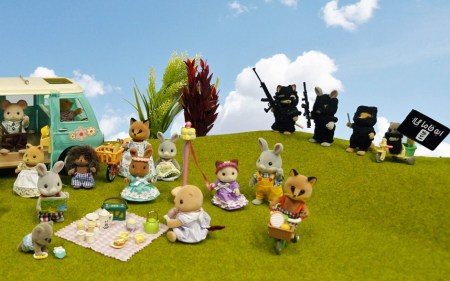
The West used to be proud of being the land of the free. European museums, instead, are rapidly submitting to Islamic correctness. The exhibition “Passion for Freedom” at the Mall Gallery in London censored the light box tableaux of a family of toy animals living in an enchanted valley.

“The Louvre will be dedicating a new section to the artistic heritage of Eastern Christians”, then President Nicholas Sarkozy announced in 2010. But the project was scrapped by the museum’s new management, with the approval of President Hollande’s culture ministry. So today, the Louvre has a section dedicated to Islamic art, but nothing on Eastern Christianity.

Maastricht, in the Netherlands, is the picturesque city that gave its name to the famous treaty signed in 1992 by the twelve nations of the European Community at the time, and which paved the way for the foundation of today’s European Union and the single currency, the euro.

Maastricht, however, is also the home of “Tefaf”, the most important art and antiques fair in the world. The art work “Persepolis” by the Italian artist Luca Pignatelli was already scheduled when the commission ordered it removed. The work, built in 2016, combined a Persian Islamic rug and a female head. “We are all humbled and speechless”, Pignatelli declared, pointing out that his work had initially aroused the enthusiasm of the commission. The fair’s explanation was that Pignatelli’s work was “provocative“.

The officials of fair presumably did not want to offend Islam and possible Muslim buyers with Pignatelli’s combination of the mat (used by Muslims for prayer) with the woman’s face. “We are shocked, this is the first time this has happened and I think it is legitimate to talk about it”, Pignatelli said. “If in Rome it can happen that you decide to veil art works to avoid offending foreign visitors, well, I do not agree”. The reference is at the Italian government decision to veil the antique Roman statues to avoid offending Iran’s visiting President Hassan Rouhani.

If Europe wants a future, it should be less ideological about Maastricht’s treaty and more against Maastricht’s capitulation to fear. The brave Algerian writer Kamel Daoud said:

“Those (migrants) who come to seek freedom in France must participate in freedom. Migrants did not come to seek asylum in Saudi Arabia, but in Germany. Why? For security, freedom and prosperity. So they must not come to create a new Afghanistan”.

Right. But it is the European mainstream that is letting them turn our cultural landscape into another Afghanistan. The Taliban have killed artists and destroyed art works. The West used to be proud of being the land of the free.

European museums, instead, are rapidly submitting to Islamic correctness. The exhibition “Passion for Freedom,” at the Mall Gallery in London, censored the light box tableaux of a family of toy animals living in an enchanted valley. Entitled, “ISIS Threaten Sylvania“, it was eliminated after the British police referred to its “inflammatory” content. Previously, the Tate Gallery in London banned a work by John Latham that displayed a Koran embedded in glass.

The brave work of the artist Mimsy, “ISIS Threaten Sylvania”, which satirized the brutality of ISIS, was removed from London’s Mall Galleries after the British police defined it “inflammatory.” (Image source: Mimsy)

Another British artist, Grayson Perry, admitted that he censored himself out of fear that he might end up like Theo van Gogh, the Dutch filmmaker slain by an extremist Muslim, Mohammed Bouyeri, for having made a film about women under Islam. “I have censored myself,” Perry said. “The reason I have not gone all out in attacking Islamism in my art is because I have real fear that someone will slit my throat”.

The Victoria and Albert Museum in London first showed, then withdrew, a portrait of the Prophet of Islam, a work of devotional art image of Muhammad. The photographer Syra Miah, a British native whose family came from Bangladesh, saw her work withdrawn from an Art Gallery in Birmingham after protests by a group of Muslims. The photo portrayed a half-naked woman, mentally ill, who lives under a bus stop in Bangladesh.

The Museum of Cultures of the World in Gothenburg, Sweden, opened with an exhibition entitled “AIDS in the Era of Globalization”. In it, the artist Louzla Darabi exhibited a work, “Scène d’amour”, that depicts a woman having sex with a man whose face cannot be seen. A verse from the Koran is written on it in Arabic. Less than three weeks after the inauguration of the exhibition, the museum removed the painting. The Hergé Museum in Louvain, Belgium, was planning an exhibition to pay tribute to Charlie Hebdo‘s cartoonists; that event, too, was cancelled.

French President François Hollande eliminated a section of the Louvre Museum dedicated to the Eastern Christians, who in the last two years have been decimated by the Islamic State. “The Louvre will be dedicating a new section to the artistic heritage of Eastern Christians”, then President Nicholas Sarkozy announced in 2010. But the project was scrapped by the museum’s new management, with the approval of Hollande’s culture ministry.

Marie-Hélène Rutschowscaya — former head of the Louvre’s Coptic section and one of the world’s leading scholars on Eastern Christianity — denounced the move. “The dramatic events we are currently seeing in the Middle East and Eastern Europe should instead spur us to do more to promote lasting cultural ties,” Rutschowscaya wrote in her letter to Hollande. So today, the Louvre has a section dedicated to Islamic art, but nothing on Eastern Christianity.

Perhaps the Iranian ayatollahs were right in asking the Capitoline Museums in Rome to veil the nude statues during President Rouhani’s visit. Perhaps the Islamic fundamentalists are wrong, the West is not as free as it claims. Perhaps we should apologize to the Taliban for criticizing their destruction of the great Buddhas of Afghanistan. According to the West’s new cultural sanctimony, today these statues might be considered “blasphemous” too.


