H/t The Jewish Press

Dispelling the ‘Few Extremists’ Myth – the Muslim World Is Overcome with Hate, National Review, David French, December 7, 2015
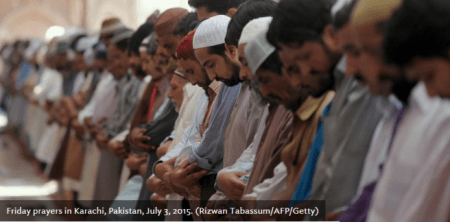 Friday prayers in Karachi, Pakistan, July 3, 2015. (Rizwan Tabassum/AFP/Getty)
It is simply false to declare that jihadists represent the “tiny few extremists” who sully the reputation of an otherwise peace-loving and tolerant Muslim faith. In reality, the truth is far more troubling — that jihadists represent the natural and inevitable outgrowth of a faith that is given over to hate on a massive scale, with hundreds of millions of believers holding views that Americans would rightly find revolting. Not all Muslims are hateful, of course, but so many are that it’s not remotely surprising that the world is wracked by wave after wave of jihadist violence.
To understand the Muslim edifice of hate, imagine it as a pyramid — with broadly-shared bigotry at the bottom, followed by stair steps of escalating radicalism — culminating in jihadist armies that in some instances represent a greater share of their respective populations than does the active-duty military in the United States.
The base of the pyramid, the most broadly held hatred in the Islamic world, is anti-Semitism, with staggering numbers of Muslims expressing anti-Jewish views. In 2014, the Anti-Defamation League released the results of polling 53,100 people in 102 countries for evidence of anti-Semitic attitudes and beliefs. The numbers from the majority-Muslim world are difficult to believe for those steeped in politically correct rhetoric about Islam. A full 74 percent of North African and Middle Eastern residents registered anti-Semitic beliefs, including 92 percent of Iraqis, a whopping 69 percent of relatively secular Turks, and 74 percent of Saudis.
The trend toward Muslim anti-Semitism continues even when Muslim nations are far removed from the Arab–Israeli conflict. A solid majority — 61 percent — of majority-Muslim Malays harbor anti-Semitic attitudes, while only 13 percent of neighboring majority-Buddhist Thais are anti-Jewish.
The next level of the pyramid is Muslim commitment to deadly Islamic supremacy. In multiple Muslim nations, overwhelming majorities of Muslims support the death penalty for apostasy or blasphemy. Collectively, this means that hundreds of millions of men and women support capital punishment for the exercise of the basic human rights of freedom of expression and free exercise of religion:

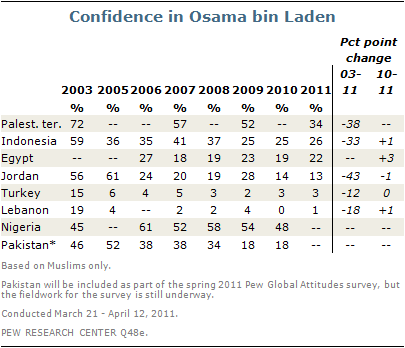
Moving beyond Islamic supremacy to the next step of the pyramid, enormous numbers of Muslims are terrorist sympathizers. It is still stunning to see how popular Osama bin Laden was early last decade, and even as his popularity plunged (as he grew weaker and more isolated), his public approval remained disturbingly high:
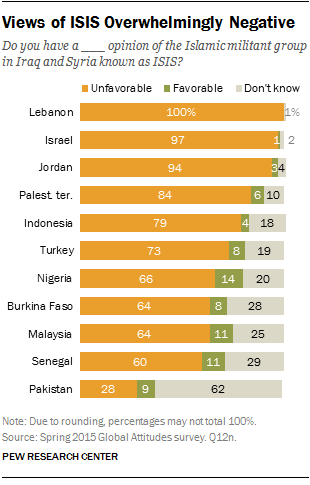
But what about ISIS — the world’s most savage and deadly terror organization? The latest polling data show that while a majority of Muslims reject ISIS, extrapolating from the populations of polled countries alone shows that roughly 50 million people express sympathy for a terrorist army that burns prisoners alive, throws gay men from buildings, and beheads political opponents. In Pakistan a horrifying 72 percent couldn’t bring themselves to express an unfavorable view of ISIS:
But sympathy for terror is different from active support, and here’s where the numbers are difficult to pin down. I know of no reliable database that shows how many Muslims give to jihadist charities, spread jihadist propaganda on social media, support radical preachers, or otherwise take concrete actions to advance the terrorists’ cause. We do know, for example, that anti-Israel terrorism is so popular in Saudi Arabia that a telethon once raised $100 million to support the 2002 intifada. Shows of support included this charming scene:
A 6-year-old boy, with a plastic gun slung over his shoulder and fake explosives strapped around his waist, walked into a donation center and made a symbolic donation of plastic explosives, according to Al Watan daily.
It is from this fertile soil that jihadists grow. And here the numbers decisively belie the “few extremists” rhetoric. In Iran alone, the Revolutionary Guard represents a proportionate share of the population similar to the combined strength of the active-duty Army and Marines here in the United States. Between Boko Haram, the Al-Nusra front, ISIS, Hezbollah, Hamas, al-Qaeda, the Taliban, Yemeni militias, Libyan militias, and many others, the number of active jihadists numbers in the hundreds of thousands; some estimates indicate that 100,000 are fighting in Syria alone.
Interfaith dialogue is more urgent today than any time: professor, Tehran Times, Javad Heirannia, December 8, 2015
(Did Nader Entessar ghost write parts of Obama’s December 6th address to the nation? — DM)
TEHRAN – Regarding Ayatollah Ali Khamenei’s second letter to the Western youth in which he called terrorism “our common enemy”, Professor Nader Entessar says it is necessary to counter “Islamophobia no matter where it emanates”.
In part of his letter issued on November 29, the Leader of Islamic Revolution said: Anyone who has benefited from affection and humanity is affected and disturbed by witnessing these [terrorist] scenes- whether it occurs in France or in Palestine or Iraq or Lebanon or Syria.
Entessar, professor and chair of political science at South Alabama University, tells the Tehran Times that “interfaith dialogue is more urgent today than any time in the past fifty or sixty years.”
Following is the text of the interview:
Q: Ayatollah Khamenei in his second letter to the Western youth has talked about terrorism and its roots. What is the importance of this issue?
A: Terrorism has been a major global scourge for some time now. Although the term “terrorism” is used extensively by journalists, pundits and politicians, there is no universal agreement on what terrorism is. There is certainly a need for a dispassionate treatment of this phenomenon and its root causes if one is serious about confronting the threat of terrorism in today’s world.
Q: Ayatollah Khamenei has emphasized in his message that Islam is the religion of friendship, however why do some try to equate Islam with violence?
A: In the West, Islam has become a political buzzword for politicians and political parties of differing ideological stripes to advance their personal agenda. In many ways, the term “Islam” has replaced communism as a rallying cry against which many politicians in the West can coalesce and advance their electoral agendas. For example, the Republican Party in the United States has incorporated Islamophobia as an essential part of its 2016 presidential campaign. In addition, the same trend can be witnessed at state and local elections as well where running against “Islam” has become a badge of honor for many U.S. politicians.
Q: Why do some try to associate Islam with terrorism whenever a terrorist act happens?
A: The emergence of such violent groups as al-Qaeda and Daesh in recent years and their terrorist campaigns under the guise of “Islam” has given a field day to the Islamophobes to advance their message. Unfortunately, the thrust of Islamophobia is not limited to extremist groups in the West. Several liberal groups and personalities have also jumped on the anti-Islam bandwagon in many Western countries. Again, as I previously indicated, it pays political dividends to adopt an anti-Islam posture in the West. Being an anti-Muslim bigot is relatively cost-free but may bring political advantages to a politician or would-be politician in several Western countries.
Q: What is the importance of Ayatollah Khamenei’s letter at this juncture of time?
A: It is very important to confront Islamophobia no matter where it emanates. Interfaith dialogue is more urgent today than any time in the past fifty or sixty years. Therefore, leaders of religious faith groups have a special responsibility to try to reach to other faith communities and highlight what unites the human race in order to promote the common good.
*********
[highlight]
“In the West, Islam has become a political buzzword for politicians and political parties of differing ideological stripes to advance their personal agenda,” Entessar says in an interview with the Tehran Times.
Euro MPs: Don’t Use Border Controls to Fight Terror, Clarion Project, December 1, 2015
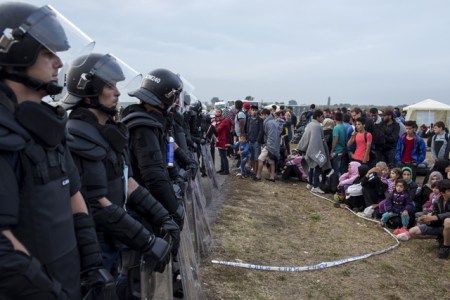 Hungarian police and immigrants. (Photo: © Reuters)
Members of the European Parliament (MEPs) voted on an amendment to a bill opposing the reintroduction of border controls into Europe to combat terrorism.
Amendment 48 to the ‘Prevention of Radicalization and Recruitment of European Citizen’s bill’ was tabled by the Socialists & Democrats group (S&D).
The amendment adds a new paragraph to the bill, stating that the EU “vehemently believes, in light of the current refugee and migrant crisis in Europe, that Member States must refrain from using any border control measures aimed at fighting terrorism and stopping the travel of suspected terrorists, for immigration control purposes.”
In other words, S&D opposes curbing or controlling immigration to prevent terrorism.
The lawmakers justified their stance highlighting “the risk of such measures being based on arbitrariness and racial or ethnic profiling, which is totally contrary to EU principles and values.”
The amendment was one of three put together, the other two adding more judicial restrictions on separating Islamist extremists from the general population in prisons and collecting evidence against terrorists.
The S&D group is a collation of various left-aligned parties in the European parliament. The group has 190/751 MEPs made up of representatives from each of the 28 European Union countries.
Parties included in the coalition include the Socialist Party in France (12), the Social Democratic Party of Germany (27), the Democratic Party of Italy (30), the Labour Party of the UK (20) and the Spanish Socialist Workers Party (14).
MEPs from anti-immigration parties strongly criticized the amendment.
“After the events of Paris I am astounded that Labour MEPs have voted for these amendments” said Diane James, an MEP for Britain’s UKIP party. “The free movement of people has led to the free movement of jihad and the only way to combat this is for Member States to regain control of their borders immediately.”
PBS discusses the European migrant crisis and fears of terrorist infiltration:
U.S. Officials Can’t Ask Syrian Refugees Key Questions, The Federalist, Kyle Shideler, November 23, 2015
(Please see also, John Kerry describes how useless the “vetting” of Syrian refugees is. — DM)

If U.S. law enforcement agents are no longer able to question individuals who are already known to have terror affiliations about their ideological views or the organizations with which they associate, how much more pressure will there be to avoid pertinent questions to Syrian refugees, a hot-button issue upon which the Obama administration has taken a strong public position?
************************
The Obama administration appears to have taken yet another terrorism-fighting tool away from U.S. law enforcement trying to screen Syrian refugees.
U.S. law enforcement officials involved in screening Syrian refugees are forbidden from asking key questions about individuals’ religious affiliations or beliefs based on policy guidance created by the Obama administration, according to a recent report published at The Daily Caller.
The piece notes that both Department of Homeland Security (DHS) and Federal Bureau of Investigation (FBI) policies have increasingly restricted the ability of law enforcement to query individuals about their religious behaviors or associations.
“These gradual but severe restrictions were coupled with a simultaneous reduction in accurate, fact-based training to address the nature of the threat we face, leaving us inadequately prepared for the challenges we face today,” The Daily Caller cites a “government source familiar with national security” as saying.
That means DHS officers screening for Syrian refugees are likely prohibited from asking questions like, “Are you a member or supporter of the Muslim Brotherhood or Tablighi Jamaat?”
These Are Dangerous Buddies to Have
The Muslim Brotherhood is the oldest global Islamist group in the world. Muslim Brotherhood thinkers formed the core ideology of al-Qaeda, and former FBI Director Robert Mueller testified in 2011 that “elements of the Muslim Brotherhood both here and overseas have supported terrorism.” Tablighi Jamaat is an Islamic proselyting group that al-Qaeda has used as a cover to facilitate moving across borders, and which U.S. intelligence has described as “willingly supporting terrorists.”
A 2005 report on the Pakistan-based group noted:
Tablighi Jamaat has also facilitated other terrorists’ missions. The group has provided logistical support and helped procure travel documents. Many take advantage of Tablighi Jamaat’s benign reputation. Moroccan authorities say that leaflets circulated by the terrorist group Al-Salafiyah al-Jihadiyah urged their members to join Islamic organizations that operate openly, such as Tablighi Jamaat, in order ‘to hide their identity on the one hand and influence these groups and their policies on the other.’
It would also prohibit law enforcement from asking key questions about how an individual views jihadist ideologues, such as Anwar Awlaki, Abu Muhammad al-Maqdisi, or Yusuf al Qaradawi. That’s vital when such jihadi scholars have played roles in influencing terror attacks.
For example, support and admiration for Awlaki was key to terror cases including the Christmas Day underwear bomber, the Fort Hood shooter, the Charlie Hebdo killers, and the more recent Chattanooga Recruiting Center shooter.
Yet during an investigation into Fort Hood shooter Nidal Hassan before his attack, the FBI described email correspondence from Hassan to Awlaki as “not pertinent” to the investigation.
Islamist Sympathizers Place Pressure
In 2011, the Civil Rights Civil Liberties division of DHS launched an investigation into multiple Customs and Border Protection agents, because of complaints by groups like Hamas-linked Council on American–Islamic Relations (CAIR) that agents were asking individuals questions about their affiliation with Islamic organizations (including those linked to the Muslim Brotherhood), or attendance at conferences where pro-jihadist ideologues are known to have spoken.
According to DHS authorities, one officer was being investigated because he had asked for an individual’s view of Anwar al-Awlaki. In another, FBI agents referenced the underwear bombing plot. Even that much was considered offensive.
The CRCL investigation was motivated by pressure from the American Civil Liberties Union, CAIR, and Muslim Advocates, a group closely linked with U.S. Muslim Brotherhood groups and with a long history of opposing U.S. counterterrorism efforts.
In response to lawsuits related to the issue of questioning by CBP officers, the DHS established a “hands-off” list of known individuals with terror ties,which included Muslim Brotherhood leader Jamal Badawi, an unindicted co-conspirator in the Holy Land Foundation Hamas finance trial. These individuals were given a green light to enter the country, and were not to be referred to secondary questioning. Sen. Chuck Grassley investigated the matter in 2014, calling it “disturbing.”
If U.S. law enforcement agents are no longer able to question individuals who are already known to have terror affiliations about their ideological views or the organizations with which they associate, how much more pressure will there be to avoid pertinent questions to Syrian refugees, a hot-button issue upon which the Obama administration has taken a strong public position?
Brussels Placed at Highest Alert Level; Subway Is Closed, New York Times,
 Belgian soldiers patrolled a nearly deserted street on Saturday in central Brussels, after the government raised the country’s threat level to its highest. Credit Youssef Boudlal/Reuters
BRUSSELS — The Belgian authorities halted public transit, canceled soccer games and warned citizens to avoid shopping centers, airports, train stations and concerts in the Brussels region early Saturday, warning that the capital was vulnerable in the wake of the Paris terrorist attacks.
The Belgian government’s threat analysis unit raised the country’s threat level to 3 on Monday, warning of a “possible and likely threat.” On Friday night, it raised the threat level to 4 for the capital region, Prime Minister Charles Michel announced.
“Level 4 means that the threat is serious and imminent,” Mr. Michel told reporters on Saturday. “The raising of the threat is a result of information, relatively precise, of a risk of an attack similar to the one that unfolded in Paris.” He said the threat involved “multiple individuals capable of striking a number of sites with weapons and explosives, maybe at the same time.”

Abdelhamid Abaaoud, who is believed to have been the chief planner and who died in a police raid outside Paris on Wednesday, lived in the Molenbeek neighborhood, as did Ibrahim Abdeslam, one of the suicide bombers, and his brother Salah, who is at large. Another suicide bomber, Bilal Hadfi, lived in the Neder-Over-Heembeek district.
The arrests of two other Belgians in connection with the attacks have further raised alarm here.
A person who was arrested on Friday in Brussels has been charged with “participation in terrorist attacks and participation in the activities of a terrorist organization,” a federal magistrate, Eric Van der Sijpt, announced on Saturday.
A search of the person’s house came up with a weapon, but no explosives, Mr. Van der Sijpt said. He did not name the person, but several Belgian newspapers described him as a 39-year-old Moroccan who lives in the Jette section of Brussels, gave help to Salah Abdeslam after the attacks and has a brother who is fighting in Syria. The government had already arrested two other Belgians, accusing them of helping Mr. Abdeslam by driving him from Paris to Brussels.
Also on Saturday, Turkish authorities arrested an Islamic State militant at a luxury hotel in Antalya, along with two others. They identified him as Ahmad Dahmani, 26, a Belgian of Moroccan descent, and said he was trying to illegally cross the border into Syria.
“We believe that Dahmani was in contact with the terrorists who perpetrated the Paris attacks,” said a Turkish official who spoke on condition of anonymity, in line with government protocol.
Mr. Dahmani arrived from Amsterdam on Nov. 14 — the day after the Paris attacks. “There is no record of the Belgian authorities having warned Turkey about Dahmani — which is why there was no entry ban,” the official said, adding, “Had the Belgian authorities alerted us in due time, Dahmani could have been apprehended at the airport.”
The storming on Friday of a hotel in Bamako, Mali, added to the anxieties in Belgium. Six Belgians were held hostage in the hotel, of whom four were released and two were killed, Foreign Minister Didier Reynders said on Saturday.
Mr. Michel, in his news conference, said the suspension of service on the Brussels Métro would be reassessed on Sunday afternoon.
“We ask you to remain peaceful and avoid panic,” Mr. Michel said. “It is a serious situation and we are trying with the security forces to do everything to keep the situation under control.”
Earlier in the week, Mr. Michel said he would push legal changes to make it easier to capture and try suspected terrorists operating in Belgium and seek constitutional changes to extend, to 72 hours from 24 hours, the period terrorism suspects can be held by the police without charge.
Beware of Islamic terrorism, Israel Hayom, Yoram Ettinger, November 20, 2015
(Religion and its history are viewed by many in largely secular western societies as essentially irrelevant to how devout Muslims behave. Ignoring the religious foundations of their conduct is a very dangerous mistake. — DM)
All Islamic terrorists — not only the Islamic State group and al-Qaida — systematically and deliberately target civilians, stabbing their Muslim and “infidel” host countries in the back, abusing their hospitality to advance 14 centuries of megalomaniac aspirations to rule the globe in general, and to reclaim the “waqf” (Allah-ordained) regions of Europe in particular.
Emboldened by Western indifference, these destabilizing and terror-intensifying aspirations have been bolstered by the Islamic educational systems in Europe, the U.S. and other Western countries. These proclaim a supposedly irrevocable Islamic title over the eighth-century Islamic conquests of Lyon, Nice and much of France, as well as all of Spain; the ninth-century subjugation of parts of Italy; and the ninth- and 10th-century occupations of western Switzerland, including Geneva.
Europe has underestimated the critical significance of this long anti-Western history in shaping contemporary Islamic education, culture, politics, peace, war, and the overall Islamic attitude toward Europe, North America, Australia, and other “arrogant infidels.” “Infidel” France has been the prime European target for Islamic terrorists, with 11 reported attacks in 2015, despite France’s systematic criticism of Israel and support for the Palestinian Authority — dispelling conventional “wisdom” that Islamic terrorism is Israeli or Palestinian-driven.
Europe has ignored the significant impact the crucial milestones in the life of the Prophet Muhammad have had on contemporary Islamic geostrategy, such as his seventh-century Hijrah, when Muhammad, along with his loyalists, emigrated or fled from Mecca to Yathrib (Medina), not to be integrated and blend into Medina’s social, economic or political environment, but to advance and spread Islam through conversion, subversion and terrorism, if necessary. Asserting himself over his hosts and rivals in Medina, Muhammad gathered a critical mass of military might to conquer Mecca and launch Islam’s drive to dominate the world.
In 1966, this Hijrah precedent was applied by Mahmoud Abbas, Yasser Arafat and the entire Fatah leadership, which emigrated or fled from Syria to Jordan and incited the Palestinian population there, but failed in their attempt to topple the host Hashemite regime. They emigrated or fled from Jordan in 1970, and in 1976, failed in their attempt to topple the host regime in Beirut. In 1990, they collaborated with Saddam Hussein’s invasion and plunder of Kuwait, stabbing the back of the Sabah family, which had hosted them, their relatives and PLO associates after they emigrated or fled from Egypt in the mid-1950s.
On Friday morning, Nov. 13, 2015, a few hours before Islamic terrorists launched their offensive against France, French Muslim children were being taught, and French Muslim adults were hearing in French mosques, that according to the Quran, humanity must submit to Muhammad and the “infidel” must accept Shariah law; that “holy war” (jihad) must be waged on behalf of Islam; and that taking part in jihad brings the reward of the benefits of paradise. Muslims are taught that the Abode of Islam (“Dar al-Islam”) must be expanded by the sword into the Abode of War (“Dar al-Harab’) and the Abode of Infidel (“Dar al-Kufr”). They are taught that they, the believers, are prohibited from submitting to the rule of the infidel, except as a temporary tactic; and that agreements with infidels are provisional, a mere prelude to subordinating the infidel. They learn that emigration of the believers must serve the historical, supremacist goal of Islam; and that shielding the believers from infidels may require the Quran-sanctioned “taqiyya” — double-talk and deception-based statements and agreements to be ignored, contradicted and abrogated once conditions are ripe.
France and all other Western countries tolerate and fund anti-Western Islamic hate-education institutions — in Muslim states and in the West — despite the fact that they are the most effective production line of anti-Western Islamic terrorists.
Europe has failed to read the piercing, bloody writing on the wall, sacrificing long-term homeland security on the altar of short-term convenience and naive, self-destructive interpretation of human rights. Through its immoral tradition of moral equivalence, Europe has embraced Muslim immigrants who are largely ruthlessly controlled and manipulated by rogue terrorist, supremacist organizations and regimes — which use them as a Trojan horse.
In 1982, in the aftermath of Islamic/Palestinian terrorist attacks in Paris that claimed the lives of Israeli diplomat Yaacov Bar-Simantov (April 4) and six patrons of the Chez Jo Goldenberg restaurant (Aug. 9), Israeli Ambassador to France Meir Rosenne denounced the Palestine Liberation Organization but also blamed countries that legitimize and host PLO operatives and supporters for bringing the wrath of terrorism upon themselves. Rosenne was threatened with expulsion from France, but would not retract.
Have France and other Western governments come to grips with reality? Are they ready to heed Rosenne’s warning and dramatically overhaul their ideological and operational approach to counterterrorism, and realize that draining the hate-education swamps is a prerequisite for eliminating the individual mosquitoes?
Or, are they determined to learn from history by repeating — rather than avoiding — past devastating mistakes, which would condemn them, and the rest of the world, to exponentially more ravaging terrorism?
Attkisson: Obama won’t read intelligence on groups he doesn’t consider terrorists, Breitbart, Pam Key, November 18, 2015
Wednesday on Newsmax TV’s “The Steve Malzberg Show,” veteran journalist Sharyl Attkisson said her sources have told her that President Barack Obama does not want and will not read intelligence reports on groups “he does not consider terrorists,” despite being on a U.S. list of designated terrorists.
Attkisson said, “I have talked to people who have worked in the Obama administration who firmly believe he has made up his mind. I would say closed his mind, they say, to their intelligence that they’ve tried to bring him about various groups that he does not consider terrorists, even if they are on the U.S. list of designated terrorists. He has his own ideas, and there are those who’ve known him a long time who say this dates back to law school. He does not necessarily—you may think it’s a good trait you may think it’s a bad trait—he does not necessarily listen to the people with whom he disagrees. He seems to dig in. I would suppose because he thinks he’s right. He is facing formidable opposition on this particular point.”
Attkisson continued, “I don’t know the reason for it. I’ve only been told by those who have allegedly attempted to present him, or have been in the circle that has attempted to present him, with certain intelligence that they said he doesn’t want it. He said he doesn’t want it or he won’t read it, in some instances.”




 anneinpt
 artaxes
 danmillerinpanama
 davidking1530
 Peter Hofman
 Joseph Wouk
 Peter
Peter Louisiana Steve
 WarSclerotic
Recent Comments