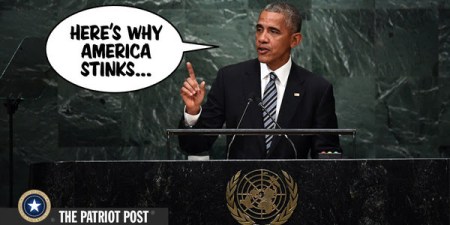
Robert Spencer on Barack Obama’s Fantasy Islam, Jihad Watch via YouTube, October 5, 2016
Minneapolis taxpayers must pay public housing rent for Somalis that spend their income on travel back to Somalia, American Thinker, Thomas Lifson, October 2, 2016
What a deal! Come to the United States, and if you spend your income (even that from welfare and refugee programs) on travel to Somalia instead of paying your rent in public housing, whey [sic] the suckers taxpayers of Minneapolis will pick up the tab. The Minneapolis Star-Tribune reports (via Refugee Resettlement Watch):
Public housing residents in Minneapolis will no longer need to pay their normal monthly rent when travel abroad erases their income, a change particularly sought by East African immigrants.
The board of the Minneapolis Public Housing Authority approved this week reverting to its previous policy of collecting only minimal rent during extended absences. The change takes effect once approved by federal housing officials, which is expected by year’s end.
Abdi Warsame, a City Council member, told the board that the policy in place for the past five years works a particular hardship on elderly East Africans who must save for long periods if they want to visit their homelands. He said that many receive federal Supplemental Security Income, which is halted when the recipient is outside the United States.
Of course nothing bad, like training in terror activities, ever happens when Muslim refugees go back too their homelands. Oh, wait: Minnesota actually has contributed more fighters to ISIS than any other state.
Robert Spencer, Jihad Watch, YAFTV via YouTube, September 24, 2016
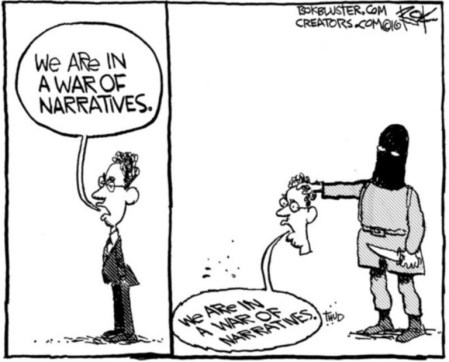
(The video deals with Obama’s “narrative” on Islamist terrorism. — DM)
Daddy’s Issues, Washington Free Beacon,
(Even if Hillarys’ top aide Huma Abedin, like the Islamic State, has “nothing to do with Islam,” the article provides insights into the thinking of those who do. — DM)
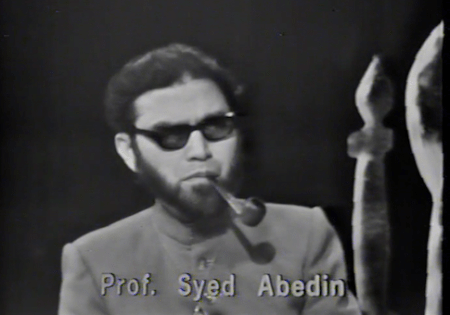
Syed Abedin, the father of top Hillary Clinton aide Huma, outlined his view of Sharia law and how the Western world has turned Muslims “hostile” during a wide-ranging video interview that shines newfound light on the reclusive thinker’s world views, according to footage exclusively obtained by theWashington Free Beacon.
Abedin, a Muslim scholar who was tied to the Saudi Arabian government until his death in 1993, has remained somewhat of a mystery as the media turns its eye to his daughter Huma, a top Clinton campaign aide who recently announced her separation from husband Anthony Weiner following his multiple sex scandals.
Syed Abedin explained his views on the Muslim world and spread of Islam during a 1971 interview titled The World of Islam, which was first broadcast on Western Michigan University television.
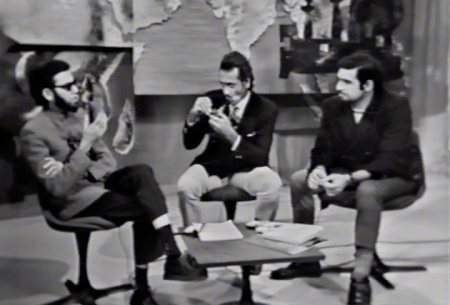
Abedin said that Arab states must police the upholding of Sharia, or Islamic law, and explained why the majority of Muslims view Israel and the Western world in primarily “hostile” terms.
The video provides a window into the Abedin family’s ideology, which has been marred by accusations it is connected to the Muslim Brotherhood.
Abedin, who was then a professor in the university’s college of general studies, said that Western intervention in the Arab world has sparked a backlash among many faithful Muslims.
“The response to the West has been of two kinds,” Abedin said. “By and large the response has taken more of a hostile form.”
“The first impulse of the average Muslim in the Islamic world is that this kind of borrowing [culturally] would be somehow an alien factor into our social fabric and thereby destroying the integrity of our ethos … the integrity of our culture,” he added.
In a separate discussion on the state’s role in a person’s life, Abedin said it is necessary to police the application of Sharia law.
“The state has to take over” as Muslim countries evolve, he argued. “The state is stepping in in many countries … where the state is now overseeing that human relationships are carried on on the basis of Islam. The state also under Islam has a right to interfere in some of these rights given to the individual by the Sharia.”
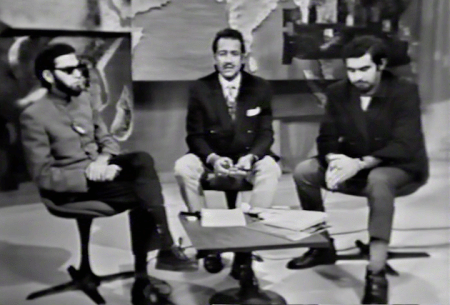
“Suspicion” runs rampant in the Muslim world, Abedin said, citing it as a reason why Western governing values have not been quickly adopted in the region.
“In the contemporary Islamic world, religious leadership is of very crucial significance because any change that will be abiding, that will make any positive contribution to the development of Muslim life, must come from that source, and that is one reason why ideologies like socialism or communism that have been introduced into the Muslim world have never really taken root,” Abedin said. “They have always been considered as foreign importations. … It’s a kind of suspicion.”
Abedin also discussed the clash between modernity and the Islamic world.
“When you talk of an Islamic state … does it have to have a caliph?” he asked. “What does it mean? What is the Islamic concept of good in the present day world?”
Any cultural change, Abedin concluded, will have to be validated by the tenets of Islam.
“The main dynamics of life in the Islamic world are still supplied by Islam,” he said. “Any institution, as I said before, any concept, any idea, in order to be accepted and become a viable thing in the Islamic world has to come through … Islam.”
Abedin’s views on religion have become a central topic among those who have questioned Clinton’s choice to elevate Human Abedin into such a prominent role.
The Abedins helped create the Journal of Muslim Minority Affairs, a publication accused of having ties to the Muslim Brotherhood and of promoting a hardline Islamic ideology.
Huma Abedin served as an assistant editor of the journal for 12 years and also played a role in its offshoot, the Institute of Muslim Minority Affairs, a think-tank established in Saudi Arabia by an accused financier of the al Qaeda terror group, according to the Jerusalem Post.
Canadian Red Cross Outsources Guide for Refugees to CAIR, Clarion Project, John Goddard, September 28, 2016
 Photo: images from the teacher’s guide
The Canadian Red Cross has funded a teachers’ guide depicting Canadian society as practicing a “terrorist ideology of hate” against Muslims.
The guide, written ostensibly to coach teachers on how to help Syrian refugee children adapt, suggests that “hate,” “discrimination” and “Islamophobia” amount to a terrorist ideology, and that non-Muslim Canadians are its perpetrators. The solution is Islam, the guide says.
“The core values and central tenants of Islam are immutable,” it says, “and are the best counter-narrative to the terrorist ideology of hate.”
The Red Cross is expressing vague misgivings about the publication.
“The original intention… was to provide educators with a resource to help children deal with cultural transition and possible trauma due to war and significant cultural change,” the charity’s spokesperson said in an interview. “In our view, the majority of the publication achieves its intended purpose, but there are specific areas that we don’t feel fit with its original intention.”
To produce the booklet, the Red Cross gave $3,000 from its “Syrian refugee resettlement fund” to the National Council of Canadian Muslims (NCCM), formerly CAIR-Canada. The group changed its name three years ago after its parent organization, the Washington-based Council on American-Islamic Relations (CAIR), was repeatedly shown to have ties to the Muslim Brotherhood and Hamas.
Canada has accepted 31,000 Syrian refugees in the past year, but the guide shows less concern for refugee children than for “Canadian Muslim youth.” The word “refugees” does not even appear in the title, “A Guide for Educators: Helping Students Deal with Trauma Related to Geopolitical Violence & Islamophobia.”
The 16-page booklet portrays Muslim youth as under attack not from Islamic State terrorists or President Bashar al-Assad’s Syrian forces, but from non-Muslim Canadians.
“To constantly feel under attack, to have to defend one’s faith, and to be continuously called upon to condemn the actions of criminals and terrorists is emotionally traumatic,” the booklet says.
The word “trauma” appears often, mostly referring to Muslim life in Canada. “Trauma can be related to historical events such as the history of colonization,” the guide says. And: “Being marginalized and categorized as ‘the other’… can be traumatic.”
The guide includes specific tips for teachers. One is to examine oneself for anti-Muslim bias — “recognize your own judgments and biases.” Another is to let Muslims proselytize in schools — “provide space for Muslim students to speak to their peers about their faith.”
In italics, the tip sheet says: “Care should be taken by teachers on the language and tone they take when discussing world events and the Islamic faith.”
TV commentator Ezra Levant put the last point in plainer language. “This is an instruction to anybody working in the school system to shut-up about Islam — it is a favored religion,” he said last week on his online news channel, The Rebel.
The self-described conservative channel sent the Red Cross more than $25,000 this summer to help with forest-fire relief in Fort McMurray, Alberta, but will never donate to the Red Cross again, Levant told viewers of The Ezra Levant Show.
“I think the Red Cross should withdraw its support [for the booklet] and apologize to Canadians,” he said.
Two years ago, the Royal Canadian Mounted Police abruptly cut its collaboration with the NCCM on a “United Against Terrorism” guide. The police force “could not support the adversarial tone” of the booklet, they said.
The Red Cross said its specific objections to the teachers’ booklet include three reprinted op-ed pieces. One is by the head of the Winnipeg-based Islamic Social Services Association, a partner on the booklet, comparing the circumstances of Canadian Muslims to that of Japanese-Canadians interned during World War Two.
“We are in discussions with the organization that produced the publication,” the Red Cross spokesperson said. “I’m not sure what the end result will be.”
Another collaborator on the guidebook was the Canadian Human Rights Commission, an ostensibly neutral federal government body, which “translated the booklet into French to reach a broader audience,” a spokesperson said.
Two years ago, the NCCM sued then-Prime Minister Stephen Harper and his press secretary for libel when the press secretary referred to NCCM as “an organization with documented ties to a terrorist organization such as Hamas.” The case is still before the courts.
In Debate, Hillary Dodges Blame for Libya, What Obama Called His “Greatest Mistake”, Counter Jihad, September 27, 2016

The first Presidential debate revealed a Democratic candidate who believes she has all the answers even though her failed performance as Secretary of State led directly to the formation of the Islamic State (ISIS), aided the rise of Iran, and furthered much of the chaos in the Middle East. She cannot learn anything while she believes she already knows everything. Electing her promises more of the same, and ‘the same’ has been a disaster.
The Republican challenger, meanwhile, has much still to learn about the security structure he would command as President. Clinton’s strongest moment against him on foreign policy came as she chided him for appearing to suggest that America would not honor its mutual defense treaties with Japan or South Korea. Nothing is more important to the world than the reliability of America’s word. Clinton should know that: it was her former boss, President Obama, who personally kicked off the refugee crisis bedeviling Europe by failing to enforce his red line against Syria’s use of chemical weapons against its own people. His failure to keep his word on a security agreement gave the Syrian regime free rein to wage war on its own population, putting millions on the road to Europe.
Trump’s strongest moment against Clinton came when he accused her of bad judgment in the formation of ISIS. She attempted to respond by saying that George W. Bush had negotiated the withdrawal from Iraq, and that “the only way that American troops could have stayed in Iraq is to get an agreement from the then-Iraqi government that would have protected our troops, and the Iraqi government would not give that.”
That’s all true, but whose job was it to obtain such an agreement? That was her job. She was the one who was supposed to obtain that agreement, and she failed utterly. As our earlier coverage states:
It was her job to negotiate an arrangement with the Iraqi government that would do two things: allow a stabilizing US military presence to remain in Iraq, and allow the US Department of State the freedom of movement it would need to step up as guarantors of the peace. The peace, you see, had been purchased not only by the US military’s victory on the battlefields, but also by its patient negotiation with militants formerly aligned with al Qaeda in Iraq. These tribes, mostly but not exclusively Sunni, had rejected the terrorism of al Qaeda in Iraq in return for promises of fair treatment from the Iraqi central government. This included jobs, assistance for communities recovering from the war, and many other things that the government promised to provide in return for the support of these former enemies. The United States helped to negotiate all these agreements, and promised to see that they would be kept faithfully.
Instead, the Secretary of State failed to produce either a new Status of Forces agreement that would permit US troops to remain in Iraq, or an agreement that would allow State Department personnel to move about the country safely to observe whether agreements were being kept. In the wake of the precipitous withdrawal of US forces, Prime Minister Maliki moved to arrest Sunni leaders in government, and broke all his promises to the tribes.
The result was that the western part of Iraq once again became fertile ground for an Islamist insurgency.
Clinton was similarly unreflective when she argued that Trump had supported “the actions we took in Libya,” without pausing for a moment to acknowledge what a destabilizing mistake it was. Effecting regime change with no capacity to control the outcome is what allowed radical groups, including ISIS, to expand into the vacuum. That one is also her fault personally, as she pushed President Obama to take this action. Her own President says that he considers ataking her advice on Libya to be his “worst mistake.” Yet again, she has learned nothing, and does not seem to be aware that there is even anything to learn.
A similar failure to understand the lessons of the recent past occurred in their exchange on NATO. Trump is right to be critical of the institution’s continuing relevance, but he is criticizing it on the wrong grounds. That the other nations do not pay their way is true, but it is not the problem with NATO. That it does not focus on terrorism is partly true, but it does not render the organization obsolete because a resurgent Russia remains a security challenge for western Europe.
Nevertheless, Clinton’s smug response is un-reflective and wrong.
You know, NATO as a military alliance has something called Article 5, and basically it says this: An attack on one is an attack on all. And you know the only time it’s ever been invoked? After 9/11, when the 28 nations of NATO said that they would go to Afghanistan with us to fight terrorism, something that they still are doing by our side.
What Clinton fails to mention here is that, like all of NATO’s decisions, invoking Article 5 must be done unanimously. The reason to question NATO’s continued relevance is that the Turkish drift into Islamist politics makes it unlikely that a unanimous vote could still be reached. Turkey has also shown signs recently of falling into Russia’s orbit. If Turkey becomes a Russian ally in the way that China is, NATO may be rendered obsolete simply because it can never take a decision. If Turkey becomes a Russian satellite, NATO will indeed have been rendered obsolete. In either case, NATO’s continued relevance turns on figuring out how to swing Turkey away from Islamist thought and Russian influence, eliminating the unanimity requirement on NATO actions, or else developing a mechanism to expel the Turks from the alliance. None of that exists, and since Turkey would have to agree to any of those changes, none of it is likely to come to exist.
Finally, on Iran, Clinton is wedded to a policy that Trump rightly describes as a disaster.
You look at the Middle East, it’s a total mess. Under your direction, to a large extent.
But you look at the Middle East, you started the Iran deal, that’s another beauty where you have a country that was ready to fall, I mean, they were doing so badly. They were choking on the sanctions. And now they’re going to be actually probably a major power at some point pretty soon, the way they’re going.
The horror show in Syria is linked to the Iran deal, as Obama decided to let Syria fester in order to pursue Iran’s approval of his deal. Clinton’s role in this deal is something she herself has celebrated, so she cannot walk away from it. Since then, Iran has developed new ballistic missiles that make sense only as a delivery mechanism for nuclear payloads. It has bought advanced anti-aircraft missiles, and installed them around one of the nuclear sites allegedly to be made harmless by this wonderful “deal.” Why is it hardening this site against air strikes if it intends to live by the deal? Why develop a delivery mechanism for weapons you don’t intend to build?
Clinton cannot even ask these questions, because she is wedded to her failures.
Islamic State, a new and deadlier enemy, The Gorka Briefing, Sebastian Gorka, PhD, September 26, 2016
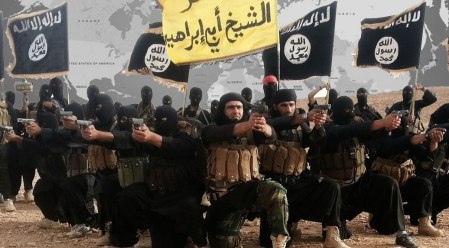
An analysis/opinion piece that my wife Katharine and I wrote that was published in the Washington Times:
On the evening of May 2, 2011, America had a chance at closure.
We had lost thousands of our fellow Americans nine years earlier on that beautifully sunny September morning, and thousands more of our citizen-soldiers on the battlefields of Afghanistan and Iraq.
But now President Obama gave the word: The master jihadi is dead.
In an audacious operation deep within Pakistan, Osama bin Laden had been located. And killed. Al Qaeda would soon be described by the commander in chief, as “on the ropes,” condemned to ever-increasing irrelevance. But this was not the end. There would be no closure for our nation.
A new, deadlier enemy has since emerged. A foe responsible for the carnage of San Bernardino and Orlando, and scores of attacks around the world. Now we are at war with the Islamic State — a threat group that has already claimed responsibility for one of the recent attacks — and its new caliph, Abu Bakr al Baghdadi. Al Qaeda may no longer frighten us, but the Islamic State has dethroned it and is on the march.
We may be in the final stages of a presidential campaign which has polarized opinion on all matters, mundane and significant, but the facts speak for themselves.
According to the National Counterterrorism Center, part of the Office of the Director of National Intelligence, the Islamic State currently has “fully operational” affiliates in 18 nations around the world. Two years ago, the number was seven. Some of these branches are far from Iraq and Syria, including Afghanistan, where numerous Taliban commanders have sworn allegiance to Abu Bakr, and Nigeria, where Boko Haram — one of the deadliest jihadi groups active today — has changed its name to the West Africa Province of the Islamic State. According to the analysts of the SITE Intelligence Group, the totalitarian message of jihadism is so popular around the world that since June 2, outside the war zones of Iraq and Syria, there has been a jihadi attack somewhere around the world every 84 hours.
But does this mean that Americans are in greater danger today than on Sept. 10, 2001? Unfortunately, the answer is a resounding yes, and the empirical data is merciless in its incontrovertibility.
In its latest report titled “Muslim-American Involvement with Violent Extremism,” the University of North Carolina has compiled all the metadata on jihadi plots on U.S. soil since 2001. The trend they describe is an exponential one. The number of successful and intercepted terrorist attacks has grown every year (with an inordinate spike in 2009), and most disturbingly, with 2015 witnessing the greatest number of jihadi plots in America since the Sept. 11 attacks 15 years ago. Jihadism has not been weakened. Not abroad. Not in the States. With the attacks in California, Florida, and now apparently Minnesota, and potentially New York and New Jersey, ISIS has displaced al Qaeda, and it has done so here in America, too, not just in the Middle East or Africa.
In our report “ISIS: The Threat to the United States,” we answer the same question for the Islamic State that the University of North Carolina answered for all jihadists secreted within America.
The facts prove than our new enemy is more prevalent than al Qaeda ever was, with federal and state law enforcement arresting three times as many ISIS supports per month than the average for al Qaeda arrests since 2001. Here are the numbers: Since Abu Bakr declared the new caliphate from the pulpit of the Grand Mosque of Mosul at the end of June 2014, we have killed or interdicted 110 terrorists linked to ISIS, (the last one being two weeks ago in Roanoke, Va). And when one looks at what they were actually doing the picture is grimmest of all.
Just over 40 percent had sworn allegiance to ISIS and were set on leaving the United States to fight for jihad in Iraq and Syria. Just under 20 percent were management-level terrorists, the talent-spotters and recruiters who were facilitating the foreign passage of the “travelers,” as the FBI euphemistically calls them. But a full third of the ISIS suspects, like the San Bernardino killers, and Omar Mateen, the Orlando jihadi, had already decided that they could best serve the new Islamic State not by leaving but by killing infidels here on U.S. soil. This is the reality of life in the West today. Whether it is in California or Florida, or in Brussels, Paris or Nice.
As we start the 16th year of what has turned into our longest war ever, we must radically reassess our strategy for victory. The Islamic State has displaced al Qaeda and it is richer, better at propaganda, and has more fighters than bin Laden ever had.
November represents not only a choice of who the new commander in chief should be, but also what our new strategy to defeat ISIS and the global jihadi movement should be. We owe at least this to the memories of those lost on the beautifully sunny morning 15 years ago.
A Muslim slashed a New York cop with a meat cleaver on September 15. Another Muslim planted bombs in New York and New Jersey; one went off, wounding 29 people in Chelsea on September 17. In response, the city of New York is launching a campaign against jihad terror, calling on Muslims to institute honest, transparent, and inspectable programs inside New York mosques, teaching Muslims why they must reject jihad violence and any attempt, violent or stealthy, to bring Sharia to the U.S. They’re starting a “Stop Jihad” ad campaign on buses and subway cars.
I’m kidding, of course. None of that is happening. In reality, New York City is starting a campaign against “Islamophobia.” Because as far as New York authorities (and many others) are concerned, whenever Muslims attack non-Muslims, the real victims are…Muslims. The one thing we must remember after every jihad attack is that Muslims are victims who deserve special accommodation.
Imagine if FDR after Pearl Harbor had launched a campaign: “I am Japanese. I am USA.” He would have been accused of defeatism at best, and treason at worst. Muslims attacked New York City twice in September because they consider themselves to be jihadis at war with the United States. The proper response would be to fight that war, not to focus on the putative victimhood of other people who share the belief system and ideology of the enemy combatants.
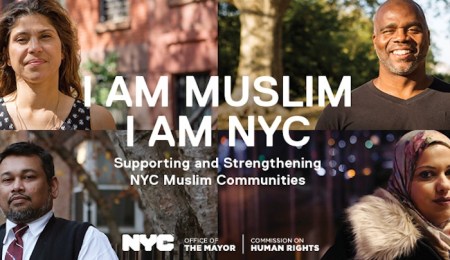
“New York launches ad campaign to fight anti-Muslim rhetoric, violence,” by Ellen Wulfhorst, Reuters, September 26, 2016:
NEW YORK (Thomson Reuters Foundation) – New York City kicked off a social media advertising campaign on Monday to combat negative perceptions of Muslims and counteract increasing instances of threats and violence, officials said.
Showing an array of photographs of Muslim men and women, the campaign reads “I am Muslim. I am NYC”, according to the New York City Commission on Human Rights.
The campaign is aimed at addressing negative depictions and rhetoric, officials said.
Anti-Muslim sentiment has been playing a major role as the U.S. presidential race has heated up. Republican nominee Donald Trump claimed he saw thousands of people cheering after the Sept. 11, 2001 attacks and has called for shutting down mosques and banning Muslims from certain countries from entering the United States.
In New York, an Afghan-born man is accused of wounding 31 people in a bombing on Sept. 17 that authorities called a “terrorist act”. The suspect had embraced militant Islamic views, authorities say.
“Now more than ever, it is important for every New Yorker to stand united as one city and reject hate and violence,” Mayor Bill de Blasio said in a statement announcing the ad campaign.
“In New York, everyone deserves to be treated with respect. Christian, Muslim, Jewish, Sikh, Hindu, agnostic and atheist — it doesn’t matter,” he said. “We are all New Yorkers and we all deserve to live safely and free from hatred or discrimination.”
Some 3.3 million Muslims live in the United States, and thousands live in New York City, according to the commission.
The ads will be placed on Facebook, Twitter and Instagram with the hashtag #IamMuslimNYC….
Pentagon’s top brass explores Islamic ideology’s ties to terror, Washington Times, Rowan Scarborough, September 25, 2016
 President Barack Obama walks with Marine Gen. Joseph Dunford Jr., his nominee to be the next chairman of the Joint Chiefs of Staff, after speaking in the Rose Garden of the White House in Washington, Tuesday, May 5, 2015.
U.S. Special Operations Command has privately pressed the staff of the nation’s highest-ranking military officer to include in his upcoming National Military Strategy a discussion of the Sunni Muslim ideology underpinning the brutality of the Islamic State group and al Qaeda.
Thus, behind the scenes, the Pentagon’s top brass have entered a debate coursing through the presidential campaign: how to define an enemy the U.S. military has been fighting for 15 years.
The National Military Strategy, authored by the Joint Chiefs of Staff chairman, is one of the most important guidances issued to global combatant commanders. It prioritizes threats to the nation and how to blunt them.
Marine Corps Gen. Joseph F. Dunford took the chairmanship of the Joint Chiefs of Staff two months later and is now preparing his first National Military Strategy.
It is during this process that Special Operations Command, which plays a major role in hunting down terrorists, has provided its input to the Joint Staff, Gen. Dunford’s team of intelligence and operations officers at the Pentagon.
Special Operations Command wants the National Military Strategy to specifically name Salafi jihadism as the doctrine that inspires violent Muslim extremists. Salafi jihadism is a branch within Sunni Islam. It is embraced by the Islamic State and used to justify its mass killings of nonbelievers, including Shiite Muslims, Sunnis and Kurds, as well as Christians.
People knowledgeable about the discussion told The Washington Times that SoCom has not been able to persuade Gen. Dunford’s staff to include Salafi jihadism in any strategy draft. It is unclear whether Gen. Dunford has been briefed on the proposals.
Spokesmen for the Joint Staff and U.S. Special Operations Command in Tampa, Florida, told The Times that they could not comment on a pending strategy. Gen. Dunford’s strategy will be classified in its entirety, meaning there will be no public version as was issued by his predecessor, Army Gen. Martin Dempsey, in 2015.
Special Operations Command is headed by Army Gen. Raymond A. Thomas III, a veteran terrorist hunter who led Joint Special Operations Command, the unit that killed Osama bin Laden and many other extremists.
There does not appear to be an effort to include the words “radical Islamic terrorism” in the strategy. But including a discussion of Salafi jihadism would tie acts of terrorism to Islamic ideology.
President Obama has fiercely rejected any connection between Islam the faith and al Qaeda, the Islamic State or any other Muslim terrorist organizations. He argues that they have corrupted the teachings of the Prophet Muhammad and the Koran. His administration refers to them as simply “extremists.”
The counterargument from many U.S. national security analysts and Muslim scholars is that mass killings are rooted in the Koran and other primary writings and preachings of credible Islamic scholars and imams. These teachings at some mosques and on social media encourage youths to become radical Islamists.
Abu Bakr al-Baghdadi, the ruthless Islamic State founder, is a cleric who studied at a seminary in Iraq. Al-Baghdadi has a Ph.D. in Koranic studies from Iraq’s Saddam University.
‘War of ideas’
If the cycle of global jihadism is to be broken, they say, U.S. officials must accurately assess the nature of the threat and its doctrines. If not, Gen. Dunford’s National Military Strategy is, in essence, directing commanders to ignore threat doctrine and relinquish the information battlefield to the enemy.
“If you look at threat doctrine from that perspective, it’s a much bigger problem because it’s not just the violent jihadists; it’s the nonviolent jihadists who support them,” said one person knowledgeable about the National Military Strategy. “Pretending there is no relationship between the violent jihadists and Islam isn’t going to win. We’re completely ignoring the war of ideas. We’re still in denial. We’re pretending the enemy doesn’t exist.”
A joint counterterrorism report by the American Enterprise Institute and the Institute for the Study of War concluded:
“Salafi-jihadi military organizations, particularly ISIS and al Qaeda, are the greatest threat to the security and values of American and European citizens.”
The Islamic State is also known as ISIS, ISIL and Daesh.
Albert M. Fernandez, who was the State Department’s chief of strategic communication, said that on some level, if not the U.S. directly, people need to talk about the form of Salafi jihadism that promotes violence.
“Using the word ‘extremism’ is extraordinarily vague language,” he said.
Some voices in the Muslim hierarchy differ with Mr. Obama and say the encouragement of violence is a problem that Islam must confront.
One such leader is Hassen Chalghoumi, imam of the Drancy Mosque in Paris. France has Europe’s largest Muslim population and has been wracked by a series of brutal terrorist attacks planned and inspired by the Islamic State.
Mr. Chalghoumi spoke last year at a conference in Washington sponsored by the Middle East Media Research Institute, which tracks jihadi social media and promotes moderate Islamic leaders.
Mr. Chalghoumi said mosques are one “battlefront” in the war on extremism.
“The third battlefront is the mosques, in many of which there is incitement to anti-Semitism, hate and ultimately violence,” he said. “This is the most critical battlefront regarding the future of Islam and its relationship with other religions. But even this one is not solely internal. The government should have a role in prohibiting money from terrorist organizations from reaching mosques and guiding their activities. It should prevent extremist leaders from preaching in pulpits from which they can abuse their power and spew hate and violence. It should make sure that the people who preach religion to others are qualified and endorse human values.”
Teaching terrorism
Advocates of publicly discussing the influence of Salafi jihadism point to Sahih al-Burkhari. It is a nine-volume collection of Sunni Muslim dictates from historical figures that is held as only second in importance to the Koran.
Volume 4, Book 56, justifies the killings of non-Muslims. “Whoever changed his Islamic religion, then kill him,” says one apostle of the Prophet Muhammad.
Volume 9, Book 88, contains this: “During the last days there will appear some young foolish people who will say the best words but their faith will not go beyond their throats (i.e., they will have no faith) and will go out from (leave) their religion as an arrow goes out of the game. So, where-ever you find them, kill them, for who-ever kills them shall have reward on the Day of Resurrection.”
Robert Spencer is an author who runs Jihad Watch, a nonprofit that reports on Islamic extremism.
He explains that Salafi Jihadism is a vehicle for taking the teachings of the Koran and applying them to jihad.
“The Islamic State scrupulously follows the Koran and Sunnah in its public actions, including its pursuit of jihad, and provides in Dabiq its Islamic justification for even its most controversial actions,” he said. “Thus the Islamic State is essentially the apotheosis [highest form] of Salafi Jihadism.”
The Sunnah contains the sayings of the Prophet Muhammad. Dabiq is a town in Syria where a final battle between Muslims and Christians supposedly will take place.
A 2008 strategy paper from Harvard University’s John M. Olin Institute said:
“Like all ideologies, Salafi-Jihadists present a program of action, namely jihad, which is understood in military terms. They assert that jihad will reverse the tide of history and redeem adherents and potential adherents of Salafi-Jihadist ideology from their misery. Martyrdom is extolled as the ultimate way in which jihad can be waged — hence the proliferation of suicide attacks among Salafi-Jihadist groups.”
Defining the enemy
How to define the Islamic State, which controls territory in Syria and Iraq and has franchises in over 20 countries, has been a hot topic in the U.S. presidential campaign.
Republican nominee Donald Trump criticizes Democratic nominee Hillary Clinton for refusing to define the threat as “radical Islamic terrorism.”
He has surrounded himself with advisers who do see the threat that way. Former CIA Director James Woolsey, who has authored papers on the extremist Islamic threat, has joined the campaign as a foreign policy adviser.
Another Trump spokesman is retired Army Lt. Gen. Michael T. Flynn, who led the Defense Intelligence Agency under Mr. Obama. He has said he was fired by the White House for promoting the idea that there is a radical Islamic movement that must be confronted.
One of Mr. Trump’s most ubiquitous surrogates is former New York Mayor Rudolph W. Giuliani, who was on Fox News on Saturday morning again criticizing Mrs. Clinton for not defining the threat.
Mrs. Clinton at one point said “radical jihadists” is the proper description. After the Pulse nightclub massacre in Orlando, Florida, by an Islamic State follower, she said “radical Islam” is permissible. She infrequently uses either term.
“Inflammatory anti-Muslim rhetoric and threatening to ban the families and friends of Muslim Americans as well as millions of Muslim businesspeople and tourists from entering our country hurts the vast majority of Muslims who love freedom and hate terror,” she said in June, taking a swipe at Mr. Trump. “So does saying that we have to start special surveillance on our fellow Americans because of their religion.”
The Defense Department on a few occasions has purged from its ranks those who advocate a discussion on how Islam the religion encourages violence.
In 2008, during the George W. Bush administration, the Pentagon ended a contract with Stephen Coughlin, an Army Reserve officer and lawyer. His consulting work centered on showing the links between Islamic law and violent extremism.
In 2012, in the Obama administration, Gen. Dempsey, then the Joint Chiefs chairman, publicly admonished Army Lt. Col. Matthew Dooley for linking the roots of Islamic teachings to the terrorism’s ideology today. Col. Dooley was removed as a teacher at Joint Forces College within the National Defense University and given a poor performance evaluation.
A student linked some of his training materials, and Muslims complained to the White House.
Gen. Dempsey called Col. Dooley’s training materials “academically irresponsible.”
The university’s teaching guidance says it permits outside-the-box instruction.
Muslim groups have petitioned the White House to end what they consider anti-Muslim training.
One set of complaints came in an October 2011 letter from 57 Islamic groups to Mr. Obama’s chief counterterrorism adviser, John O. Brennan, now the CIA director. Mr. Brennan refuses to use the words “Islamic extremists” or “radical Islamic terrorism.”
Some of the groups were unindicted co-conspirators in a federal terrorist financing prosecution in Texas. They also have ties to the global Muslim Brotherhood, whose goal is a world ruled by Islamic law.
Gen. Dempsey issued the Pentagon’s last National Military Strategy a little over a year ago.
It says the two leading terrorist organizations are al Qaeda and the Islamic State, which are defined as “violent extremist organizations.” That is the paper’s only use of the word “Islamic,” and there is no use of “Muslim” or “Salafi.”




 anneinpt
 artaxes
 danmillerinpanama
 davidking1530
 Peter Hofman
 Joseph Wouk
 Peter
Peter Louisiana Steve



 WarSclerotic
Recent Comments