Archive for the ‘Iran scam’ category

Obama’s $150 Billion ‘Signing Bonus’ To Iran Hits Legal Snag

December 2, 2015

Obama’s $150 Billion ‘Signing Bonus’ To Iran Hits Legal Snag, Jewish Business News, December 2, 2015

Iran's President Hassan Rouhani smiles while replying to a question during a news conference on the sidelines of the 69th United Nations General Assembly at United Nations Headquarters in New York September 26, 2014. REUTERS/Adrees Latif

Iran’s President Hassan Rouhani smiles while replying to a question during a news conference on the sidelines of the 69th United Nations General Assembly at United Nations Headquarters in New York September 26, 2014. REUTERS/Adrees Latif

As part of July’s nuclear deal, President Barack Obama agreed to release Iranian assets that have been frozen in US banks since the takeover of the US Embassy in Tehran in 1979. But Shurat HaDin – Israel Law Center, a non-profit legal assistance group based in Tel Aviv, has sent a letter to 11 American banks warning them that releasing the money now would be a violation of a current US court order intended to compensate victims of Iran-sponsored terrorism.

The banks addressed in the letter are believed to be holding frozen Iranian assets, and awaiting certification by the administration than Iran has met certain preliminary benchmarks for the release of that money.

US courts, however, have awarded judgments to a number of American families against the Iranian government as victims of terrorism perpetrated by Iran-sponsored terror groups such as Hamas and Hezbollah.

One such case dates back to Sept. 4, 1997, when Hamas executed triple suicide bombings on the Ben Yehuda Street pedestrian mall in Jerusalem. The attack killed five Israelis and severely injured a number of Americans.

Families of those Americans injured in the bombing filed suit against the Iranian regime for damages. Iran is a financial and military patron of Hamas. The case, Rubin v. The Islamic Republic of Iran, was decided in favor of the plaintiffs. Yet previous efforts to attach certain Iranian assets, notably museum artifacts being repatriated to Iran, have failed. A number of courts have ruled that historical artifacts are not exempt from sovereign immunity, and thus cannot be seized to make payment.

Cash, however, appears to be another matter.

On Oct. 26, the plaintiffs obtained a Citation to Discover Assets in the federal district court in the Northern District of Illinois. The granting of this proceeding takes the plaintiffs’ case one step further, in that it permits them to discover what assets the Iranian government has frozen in the U.S., for the purposes of collecting the judgment against them.

“Because Iran hired counsel in the antiquities proceeding in Chicago, we had the chance to serve their attorneys with the citation. As a result we can act to restrain the banks from releasing funds,” says Nitsana Darshan-Leitner, director of Shurat HaDin.

Those accounts are not a matter of public record. This has led to some confusion about the amount that could actually end up being repatriated to the Iranian government under the terms of the deal.

Shurat HaDin’s letter to the 11 US banks states, “You are hereby warned that all accounts maintained by your financial institution at any of its branches in the name of Iran, the Central Bank of Iran, the Naftiran Intertrade Company, the National Iranian Oil Company, the National Iranian Tanker Company or any other agency or instrumentality of Iran are restrained and subject to a lien in favor of my clients under United States law.”

Shurat HaDin notes that, to date, $43 billion has been awarded to US victims of Iranian-sponsored terror, and that if that money leaves the country, there is little to no chance that those claims will ever be paid.

For Darshan-Leitner, this isn’t just a legal matter — it’s a moral one.

“They want to ensure that what happened to these people doesn’t happen to other innocent families,” she says. “We all understand that allowing these frozen funds to be returned to Tehran ensures that terror groups like Hamas and Hezbollah will have the resources to continue their extremist violence against Jews and Westerners. After Paris, could you imagine providing a $100 billion to ISIS (Islamic State)? This is the exact same situation.”

IAEA’s PMD Report Is Being Written In Negotiation With Iran, Not Independently

November 29, 2015

Statements By Iranian Deputy Foreign Minister Abbas Araghchi Indicate: IAEA’s PMD Report Is Being Written In Negotiation With Iran, Not Independently, MEMRI, November 27, 2015

(Here’s a link to a July 16, 2015 interview in which Kerry stated,

“The possible military dimensions, frankly, gets distorted a little bit in some of the discussion, in that we’re not fixated on Iran specifically accounting for what they did at one point in time or another,” Kerry said. “We know what they did. We have no doubt. We have absolute knowledge with respect to the certain military activities they were engaged in. What we’re concerned about is going forward. It’s critical to us to know that going forward, those activities have been stopped, and that we can account for that in a legitimate way.”

— DM)

Araghchi’s interview indicates that Iran has been following the writing of the IAEA report and has been submitting comments to the IAEA and the P5+1, and has in fact been exerting constant pressure on Amano and on the P5+1 in order to ensure that the PMD dossier be closed and the report be worded unequivocally and to Iran’s complete satisfaction.

********************

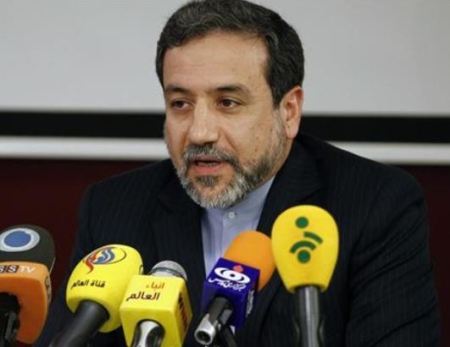
In a November 25, 2015 interview on Iranian television, Iran’s deputy Foreign Minister Abbas Araghchi said that he recently held talks with IAEA director-general Yukiya Amano on “closing the Possible Military Dimension (PMD) dossier”, and the latter filled him in about “some of the points he is to present” in the upcoming IAEA report on this issue. Araghchi noted that he had also spoken with the Americans and Europeans in Vienna, and had understood from them that “they too were heading towards closing the PMD dossier.” [1]

25842Abbas Araghchi (Image: Press TV, Iran)

It should be recalled that Ali Akbar Salehi, the head of Iran’s Atomic Energy Organization and a member of the nuclear negotiation team, said in a June 21, 2015 interview on Iranian television that Iran had “reached understandings with the IAEA” on the PMD issue, and added: “Now there is political backing [of the P5+1], and the [PMD] issue should be resolved.” He stated further: “By December 15, [2015], at the end of the year, the issue [of the PMD] should be determined. The IAEA will submit its report to [its] board of governors. It will only submit it. The Joint Comprehensive Plan of Action will continue independently of the results of this report. We have reached understandings with the IAEA… The technical issues are now being resolved in a political framework. They have set a time frame and, God willing, the issue must be resolved by December 15.” In response to the interviewers’ remark that the IAEA has “a bad record” (in terms of cooperating with Iran), Salehi stated: “In short, they [the IAEA] will be the losers. As I have said, the issue has received political backing. The work of [the IAEA] must be reasonable. They cannot do anything unreasonable. When there is no political backing, they do whatever they want, but now there is political backing, and the issue should be resolved.”[2]

In a recent news conference, Amano said that that “the report will not be black and white,” and that the PMD issue “is an issue that cannot be answered by ‘yes’ or ‘no'”.[3]

In his November 25 interview, Araghchi said: “In the next few days our experts will be in contact with the IAEA experts, and if necessary they will bring up additional points. I may also meet with Amano again… They [our experts] told us there were some weak points in the IAEA report and I commented on them. I am optimistic that they will be corrected…”

He added: “I don’t think there is any plan behind the scenes to leave the PMD dossier open. We have not received any indications that there is a plan [of this kind] behind the scenes. In any case I provided the Americans and Europeans with the necessary comments.”

He stated further: “On December 1, 2015, we expect this report to be published and submitted to the [IAEA] Board of Governors. A special board meeting has been scheduled for December 15, 2015, in which a resolution on the IAEA report will be taken. During this time [until December 15], the P5+1 group will submit a [draft] resolution [to the IAEA Board of Governors] with the objective of  closing the PMD dossier, and [this draft resolution] will come up for a vote in its December 15, 2015 meeting. Also, on December 7, 2015, there will be a meeting of the JCPOA Joint Commission in Vienna, attended by [representatives of] Iran and the P5+1, in which we will discuss the P5+1 [draft] resolution on closing the PMD. We have taken all the necessary steps so that on December 15, 2015, [the IAEA Board of Governors] will resolve to close the PMD dossier and this issue will be put to rest.”

According to Araghchi, “if the [IAEA] Board of Governors does not close the PMD dossier, the process of implementing the JCPOA will stop. Hence, the P5+1 must decide between the PMD and the JCPOA… In the past, the P5+1 chose the JCPOA. The [Supreme] Leader [Khamenei]’s letter on Iran’s implementation of the nuclear steps [a document published by Khamenei in October 21 detailing 9 additional conditions for Iranian compliance with the JCPOA][4] likewise emphasizes that they must choose between the JCPOA and the PMD.”[5]

According to Iran’s Press TV news agency, Araghchi said in the same interview: “If Yukiya Amano or the [IAEA’s] board of governors will present their report in such a way that it does not meet the stipulated commitments, the Islamic Republic of Iran will also stop [the implementation of] the JCPOA.”[6] In this statement, Araghchi implies that Iran has received commitments that the PMD dossier will be closed.

Araghchi’s interview indicates that Iran has been following the writing of the IAEA report and has been submitting comments to the IAEA and the P5+1, and has in fact been exerting constant pressure on Amano and on the P5+1 in order to ensure that the PMD dossier be closed and the report be worded unequivocally and to Iran’s complete satisfaction.

It should also be recalled that the inspection of the Parchin military facility, carried out to determine whether Iran’s program had military dimensions, consisted of Iran submitting samples that were not collected in the presence of IAEA inspectors and were later submitted to the IAEA, so that their origin cannot be absolutely determined.

As for the steps currently being taken by Iran to comply with the JCPOA, Araghchi clarified that “none of the steps so far taken by Iran in this matter contravenes the [Supreme] Leader’s letter…  and, as far as I know, [we] are still in the stage of dismantling the inactive centrifuges.” (Both Iranian Atomic Agency Spokesman  Behrouz Kamalvandi and Iranian National Security Council secretary Ali Shamkhani have indeed said that Iran has transferred inactive centrifuges from one facility to another, but no active centrifuges have been dismantled).[7]


Endnotes:

[1] ISNA (Iran), November 25, 2015.

[2] See MEMRI TV Clip No. 5014,  We Have Reached Understandings with the IAEA about the PMD; Technical Issues Are Now Being Resolved on a Political Level, July 21, 2015.

[3] Reuters.com, November 26, 2015.

[4] See MEMRI Daily Brief No.65, MEMRI: ‘The Emperor Has No Clothes,’ October 30, 2015.

[5] ISNA (Iran), November 25, 2015.

[6] Press TV (Iran), November 26, 2015.

[7] Kamalvandi: ISNA (Iran), November 3, 2015; Shamkhani: Fars (Iran), November 10, 2015.

Iran threatens to walk away from nuke deal

November 26, 2015

Iran threatens to walk away from nuke deal, Washington ExaminerPete Kasperowicz, November 26, 2015

A top Iranian official warned Thursday that Iran would stop its efforts to comply with the Iran nuclear agreement unless international inspectors stop their investigation into Iran’s past work on its nuclear program.

Under the deal, inspectors were instructed to examine the “possible military dimensions” of Iran’s nuclear program, or PMDs.

International Atomic Energy Agency chief Yukiya Amano is expected to release a new report on Iran’s nuclear program on Dec. 1. Iran’s deputy foreign minister, Seyyed Abbas Araqchi, warned that if the Dec. 1 report doesn’t close the file on PMDs, Iran will walk away.

“In case Yukiya Amano or the Board of Governors presents their report in such a way that it does not meet the stipulated commitments, the Islamic Republic of Iran will also stop [the implementation of] the JCPOA,” he said, according to PressTV, Iran’s state-owned news service.

The JCPOA is the Joint Comprehensive Plan of Action, informally known as the Iran deal.

Iran’s new threat could be a significant problem for the implementation of the deal. On the same day Araqchi spoke, Amano delivered remarks in Vienna in which he said it’s still not clear how much undeclared nuclear material might exist in Iran.

“As my latest report on safeguards implementation in Iran shows, the agency continues to verify the non-diversion of nuclear material declared by Iran under its Safeguards Agreement,” IAEA Director General Yukiya Amano said in a prepared statement in Vienna, Austria.

“But we are not in a position to provide credible assurance about the absence of undeclared nuclear material and activities in Iran, and therefore to conclude that all nuclear material in Iran is in peaceful activities,” he added.

Amano has made similar remarks all year, and it’s a strong sign that Iran has yet to fully cooperate with inspectors under the Iran nuclear agreement.

Satire(?) | Obama declares Islamophobia a felony hate crime

November 23, 2015

Obama declares Islamophobia a felony hate crime, Dan Miller’s Blog, November 23, 2015

(The views expressed in this article are mine and do not necessarily reflect those of Warsclerotic or its other editors. — DM)

Phobia is an abnormal, irrational fear. As now defined, however, Islamophobia is merely “prejudice against, hatred towards, or fear of the religion of Islam or Muslims.” Rational “Prejudice,” “hatred” and “fear” of Islam are, therefore, now Islamophobic.

islamophobe1

Obama often proclaims that there is no reason to fear Islam —  the religion of truth and love — and that He welcomes it in His America. It is permissible, indeed even patriotic, to fear and oppose the Non-Islamic Islamic State, but to fear and to oppose Islam runs counter to American values and is, therefore, worse than merely vile.

By virtue of His constitutional obligation under Article II to do whatever He damn well pleases, He has determined that anyone who criticises Islam is guilty of felony hate speech, which has long been recognized not to be entitled to protections under the First Amendment. To think Islamophobic thoughts leads to hate speech and must also be criminalised as hate thought.

Once again, Obama shows that He is a great leader — not a mere follower — in America’s quest finally to become a great nation of which He can finally be proud. An article by Jonathan Turley is titled Forty Percent of Millennials Favor Censorship of Offensive Speech By Government. Turley, a liberal in the old-fashioned sense of the word and among the few “liberals” to remain strong defenders of free speech, notes that

I have long argued that the West appears to have fallen out of love with free speech, which is more often viewed as a rising scourge rather than a defining value in some countries. A recent poll of the Pew Research Center shows just how many people we have lost to those calling for greater censorship and criminalization of speech. It is not surprisingly more prevalent with younger age groups, though Democrats are almost twice as likely favor censorship than Republicans. The largest (and most alarming) group is the millennials — 40% of whom favor government censorship of speech offensive to minority groups. [Emphasis added.]

Clearly, Obama is — as always — on the right side of history, leading from the front.

obama_muslim3

Here is the text of Obama’s address to the nation, to be delivered on Thanksgiving Day.

My fellow, blessedly multicultural, Americans, Thanksgiving is the day we all now understand was forced upon us to commemorate the vile treatment of Native Americans by settlers — just as Israeli settlers now abuse native Palestinians. To treat Muslims as we treated Native Americans, as Israel treats peaceful Palestinians — and indeed as Christian Crusaders just a short time ago treated peaceful Muslims  — is the worst type of anti-American prejudice I can imagine. Therefore, under the powers vested in Me under the U.S. Constitution, I hereby decree that anyone — no matter who or where and even in the halls of Congress — criticises the Religion of Peace and Love shall be tried and summarily convicted of felony Hate speech.

Some may say — falsely — that this is a drastic and unwarranted measure. It is neither. Islamophobia is intensely harmful to Muslims fleeing persecution by Christians and Jews abroad. It may even deter Muslims from coming to My America to enjoy the benefits of liberty and freedom as ordaned under the Constitution. They all desire to be assimilated into America and to live here with peace and honour killings in accord with our traditions of freedom and justice; traditions which are envied by those fleeing persecution and which they yearn to enjoy in My America. To persecute innocent Muslims here, as they are persecuted abroad is a disgrace; as long as I am your President I shall not permit it.

The spectre of hate thought also now darkens America and leads to hate speech against Muslims everywhere — even those in The Islamic State Republic of Iran, with which I successfully negotiated an historic deal to eliminate the spectre of nuclear weapons in, and to bring peace to, most of the Middle East.

Just as I have decreed that hate speech against Muslims shall be punished, so must hate thought. Accordingly, all candidates for public office in My America will now be required to answer questions seeking to probe their deepest unspoken, but dreadful, anti-Islamic thoughts. The Council on Islamic-American Relations will prepare the questions and agents of the Federal Bureau of Investigation will ask them. Those found to harbour anti-Islamic  — and therefore un-American — thoughts will be declared unfit for, and disqualified from holding, public office. The First Amendment, of course, provides no protection for freedom of thought; even if it did, it would provide no protection for hate thought.  This is necessary if My America is, once again, to lead the free world.

(Wait for vigorous applause.)

Thank you. Now, for your Thanksgiving pleasure, here is a tribute to Me by my favorite vocal group, the Muslim Brotherhood Chorus.

Was Thucydides right about democracies in peril?

November 20, 2015

Was Thucydides right about democracies in peril? National Review, Victor Davis Hanson, December 7, 2015 print issue

President Obama is not so much complacent as an appeaser of radical Islam — an identification he refuses to employ. Yet the president condemns Christianity by reminding us at prayer breakfasts of its violent Crusader roots, or he lists false glories of the Muslim world, as in his Cairo speech. Obama’s rhetoric of the last seven years has been predicated on the false assumption that his own supposed multicultural fides and his father’s Islamic connections would make him the perfect Western emissary to defuse radical Islam. This has not come to pass, as we see from the recent Paris mass murders. Never has the Middle East been more unhinged and never has the U.S. been more disliked by it.

During the Obama administration, radical Islam finally has grasped that the way to destroy Western societies is to employ Western political correctness against them, leading eventually to their paralysis — as long as the war is waged carefully, insidiously, and over decades.

************************

The historian Thucydides felt that democracies were characteristically volatile and yet complacent when existential dangers loomed on the horizon. But once faced with impending doom — such as the near collapse of Athens after the disaster of the Sicilian Expedition — they usually proved the most capable of marshaling the entire population for war. Accordingly, the recent ISIS terrorist strike in Paris — a result of lax security and failure to monitor borders — even at the eleventh hour should wake up the French to the existential danger they face.

America’s wars of the 20th century seem to confirm that ancient wisdom. A complacent, naïve, and isolationist United States came late to both world wars. Nonetheless, once engaged, the United States almost immediately amassed huge armies ex nihilo and produced unprecedented quantities of arms to ensure Allied victories in both conflicts. No other power fought in so many theaters of battle to such effect and with such consideration for reducing its own casualties.

The pattern of the ensuing Cold War was hauntingly similar: initial Western-democratic naïveté about the vicious nature of the erstwhile wartime ally the Soviet Union, precipitate post-war disarmament — and finally, during the Korean War, an abrupt remaking of the American military, characterized by the development of a sophisticated deterrent strategy that kept the global, Communist Soviet Empire contained until its collapse in 1989.

Ostensibly, that same pattern of initial blinkered indifference and lack of attention ended by sudden reawakening and panicked mobilization marked the American response to radical Islam. The fall of the shah of Iran, the subsequent Khomeini revolution, and the appeasement embraced by the Carter administration between 1979 and 1980 — all in the depressed landscape of the post-Vietnam era — illustrated how the United States was initially baffled by and indifferent to the rise of radical Islam.

At first the U.S. assumed that radical Islam was primarily an aberrant Iranian and Shiite phenomenon uncharacteristic of our Sunni and Wahhabist friends in the Gulf. Some Cold War–era analysts of the time believed that the Iranians were analogous to Marxist-inspired Palestinian terrorists of the 1960s and 1970s, even though the latter were secular and were funded and often trained by Moscow and its appendages. Later, leftists sought to cite proof of American culpability — colonialism, neo-imperialism, racism, capitalist exploitations, etc. — that might in some fashion contextualize the seemingly illogical anger of the Muslim world toward the United States.

In the 20-year interval between the Tehran hostage-taking and the cataclysmic September 11 suicide attacks, radical Islamists, of both the Shiite and Sunni varieties, declared a veritable war against the West in general and in particular the United States — most notably with the Beirut Marine-barracks/U.S.-embassy bombing (1983), the first World Trade Center bombing (1993), the Khobar Towers bombing (1996), the East Africa embassy bombings (1998), and the attack on the USS Cole (2000). But in these two decades before 9/11, radical Islamists, especially those of al-Qaeda organized by Osama bin Laden, were never directly confronted by the United States in any lethal way. Islamists were explained away as either an irritant incapable of inflicting existential damage given their lack of a nation-state arsenal or a passing phenomenon in the manner of former Middle East terrorists of the sort led by Abu Nidal against Western and especially Israeli interests.

There were grounds to be baffled at first, perhaps in the fashion of bewilderment at Hitler’s fanaticism in 1936 or Stalin’s betrayal of his wartime Western allies in 1946. After all, in the 1930s and 1940s, the Islamic Middle East had been enamored of secular fascism inspired by Nazi Germany. Subsequent Pan-Arabism, Baathism, Soviet-inspired Communism, and Palestinian nationalism were likewise mostly secular in nature. And these ideologies similarly proved transient manifestations of the Middle East constant of tribalism, poverty, statism, authoritarianism, anti-Semitism, and religious and cultural intolerance.

Why, then, at the end of the 20th century, had terrorist movements reverted back to seventh-century fundamentalism? Why was it that the wealthier the petroleum-rich Middle East became, the more globalized — and Western-oriented — communications, entertainment, and popular culture grew, the more knowledge that the Islamic world gained of relative global wealth and poverty, and the more the post–Cold War United States proved postmodern in its attitude about the causes and origins of war, all the more did radical Islamists despise the West? Islamists apparently were confident either that Western economic and military power was a poor deterrent against their own supposedly ancient martial courage or that such material and technological power would never fully be unleashed by confused elites uncertain about their own degree of culpability for the mess they found themselves in.

In any case, deterrence was lost. A 20-year path of appeasement of radical Islam inexorably led to 9/11. Then, as with past aroused democracies, 2001 seemingly changed everything, as the West seemed to gear up to restore its security and strategy of deterrence. Almost every aspect of American life was soon altered by just a handful of Islamist planners in Afghanistan and their suicide henchmen in hijacked planes, even as economic recession followed the 9/11 attacks. Intrusive new security standards changed forever the way we boarded airline flights, took the train, and visited public buildings. The Patriot Act accorded intrusive powers of surveillance to government agencies to monitor communications that fit particular criteria learned from prior terrorist attacks.

These Patriot Act measures and their affiliated protocols played a key role in ensuring that in the subsequent 14 years  there was no attack on the United States analogous to 9/11, despite horrific but isolated killings such as the Fort Hood massacre and the Boston Marathon bombing. A cultural war erupted over the causes of Islamic violence, with both Republican and Democratic administrations seeking some magical formula that might reassure the world’s billion Muslims, in and outside the West, that the United States did not see any innate connection between Islam and Islamist terrorism. Such a profession was supposed to remind the Islamic world to police its own, on the assumption that there were no logical grounds for any Muslims to hate the U.S. The age-old antithesis — that the West did not much care what the non-West thought of it as long as it understood preemptory attacks against the West were synonymous with the aggressors’ own destruction — was apparently unpalatable to a sophisticated and leisured public that even after 9/11 did not see the Islamic threat as intruding into the life of their suburb or co-op.

How, then, is the supposed war on Islamic-inspired terror currently proceeding, especially in comparison with past U.S. efforts in World Wars I and II and the Cold War? At first glance, it appears the realists were correct that Islamism is hardly an enemy comparable to the Nazis or Soviets. First, other than the case of Iran after 1980, the terrorists still have not openly and proudly assumed the reins of a large nation-state with a formidable arsenal. Second, for all the talk of the spread of WMD, they have not staged a major nuclear, biological, or chemical attack. Third, fracking and horizontal drilling inside the United States, along with petroleum price wars among Middle Eastern exporters, crashed the price of oil, robbing terrorists of petrodollars and aiding Western economies.

That price drop — coupled with a supposed Western exhaustion with war after the experience of Afghanistan and Iraq — has fooled Westerners into thinking the Middle East is now less strategically important than it has been in the past, as if most of the world were becoming as self-sufficient in oil and gas as is the United States. Are the realists correct in reminding us that we still do not face from radical Islamic terrorists an existential threat analogous to those of the 20th century during World War II and the Cold War?

In the decade and a half after September 11, the Islamists have influenced Americans far more than we them — well aside from inflicting a level of destruction inside the United States, in New York and Washington, that neither Nazi Germany nor Soviet Russia was ever able to achieve. Everyday life has been radically altered, from using public transportation to entering a government building for minor business. Westerners are losing the propaganda war: While al-Qaeda and ISIS have matched their blood-curdling rhetoric with equally savage snuff videos, we have been emasculated by euphemisms. “Death to America” is matched by “workplace violence,” “man-caused disasters,” and “overseas-contingency operations.” Jihad is redefined by American-government officials as a personal spiritual odyssey and the Muslim Brotherhood as a largely secular organization. After the Danish-cartoon attacks and the Charlie Hebdo killings, fearful Westerners are voluntarily self-censoring in a manner that Islamists themselves do not have to enforce by direct coercion.

President Obama is not so much complacent as an appeaser of radical Islam — an identification he refuses to employ. Yet the president condemns Christianity by reminding us at prayer breakfasts of its violent Crusader roots, or he lists false glories of the Muslim world, as in his Cairo speech. Obama’s rhetoric of the last seven years has been predicated on the false assumption that his own supposed multicultural fides and his father’s Islamic connections would make him the perfect Western emissary to defuse radical Islam. This has not come to pass, as we see from the recent Paris mass murders. Never has the Middle East been more unhinged and never has the U.S. been more disliked by it. Westerners are as likely to join ISIS as reformed terrorists are to enlist in the fight against the jihadists in their midst.

In other words, the Islamist threat is so far unquenchable because it has the West’s number: Radical Islam understands that the more pre-modern it becomes, the more postmodern is the likely Western response — a situation analogous to a deadly parasite that does not quickly kill but slowly sickens a host that in turn scratches at, but does not kill, the stealthy tormenter. Obama has described ISIS as a “JV” organization and al-Qaeda as “on the run.” On the eve of the Paris attacks, he deprecated ISIS as “contained,” while Secretary of State John Kerry warned that its “days are numbered.” A supposedly right-wing video maker, not a pre-planned al-Qaeda assault, explained our dead in Benghazi. Such euphemism is not just symptomatic of political correctness and an arrogant assumption that postmodern Westerners have transcended the Neanderthalism of war, but also rooted in a 1930s-like fear of expending some blood and treasure now to avoid expending far more later.

The first decade and a half of the current phase of the Islamic war were characterized by insidious alterations in Western life to accommodate low-level but nonetheless habitual terrorist attacks. As long as the Islamists did not take down another Western skyscraper, blow up a corner of the Pentagon, or kill thousands in one operation, Westerners were willing to put up with inconvenience and spend trillions of dollars in blood and treasure on anti-terrorism measures at home and the killing abroad of thousands of Islamists from Kabul to Baghdad.

But conflicts that do not end always transmogrify, and the war on terror of 2015 is not that of 2001, much less that of 1979.

Time for now is on the Islamists’ side. Not if but when Iran will acquire nuclear weapons is the question. Not if but when ISIS strikes a major American city is what’s in doubt. As America abdicates from its role in the Middle East, Vladimir Putin creates an Iran–Syria–Hezbollah arc of influence, reassuring the terrified Sunni Gulf states that he is a far better friend — and could be a far worse enemy — than the United States.

More important, Russia, Iraq, and Iran — and the Gulf monarchies — could act in concert under the aegis of Putin and thereby control 75 percent of the world’s daily exports of oil. It is also conceivable that ISIS could fulfill something akin to its supposedly JV notion of creating a caliphate, given that it has already carved out a rump state from Syria and Iraq. A nuclear Iran could play the berserker role with Russia of a crazy nuclear North Korea cuddling up to China. Meanwhile, our new relationship with Iran makes it hard to partner with moderate Sunni states against ISIS, given that the Iranians enjoy the bloodsport that ISIS plays among both Westerners and Sunni regimes.

In short, on four broad fronts — the emergence of terrorist nation-states, the acquisition of nuclear weapons, the global reach of terrorists, and the ability to alter global economic contours — the Islamists are making more progress than at any time in the last 35 years.

Was Thucydides, whose notions of democracy were echoed from Aristotle to Winston Churchill, correct that democracies in the eleventh hour galvanize to meet existential threats?

So far, not this time. During the Obama administration, radical Islam finally has grasped that the way to destroy Western societies is to employ Western political correctness against them, leading eventually to their paralysis — as long as the war is waged carefully, insidiously, and over decades. In their various rantings, Osama bin Laden and his successor Ayman al-Zawahiri referenced the Western failure both to enact campaign-finance reform and to address global warming — topics not usually associated with the agendas of radical Islam. While ISIS mowed down Parisians, Al Gore was on the top of the Eiffel Tower doing a marathon webcast about the existential danger of climate change and prepping for a Parisian global conference that will now take place amid the detritus of a recent mass terrorist attack — all echoing President Obama’s assertion that the greatest danger to our security is carbon, not radical Islamic terrorism.

The war will be lost when listless and weak Westerners no longer realize that they are in a war but have largely become exactly what their enemies had envisioned them to be all along.

Iran breaks the world executions record

November 17, 2015

Iran breaks the world executions record, Front Page MagazineDr. Majid Rafizadeh, November 17, 2015

Iranian executions

Is the Obama administration aware that it is trusting and dealing with a country that has just broken the world record in executions? Of course the President is aware of that, and it seems that he has decided to turn a blind eye to Iran’s increasing aggression and oppression inside and outside of its own country.

According to the recent and fifth report by the special United Nations investigator of human rights, human rights violations in Iran are rising even since the nuclear agreement was reached. Accordingly, execution rates have been increasing at “an exponential rate” in Iran. In 2014, 753 were executed and at least 694 people (including women and juveniles) were executed from January 2015 till mid-September. This is reported to be the highest rate of execution the Islamic Republic has had in 25 years.

If we take the ratio of the population into consideration, the Islamic Republic breaks the world record in number of executions per capita. As Ahmed Shaheed, the U.N. special rapporteur for human rights in Iran, pointed out, “The Islamic Republic of Iran continues to execute more individuals per capita than any other country in the world. Executions have been rising at an exponential rate since 2005 and peaked in 2014, at a shocking 753 executions[.]” According to the UN analyst, Iran is on track to execute more than 1000 people by the end of this year. Of course, these are only the official numbers being reported by the Iranian regime, the unreported number of executions by the government is likely much higher.

An execution may be ordered over many things, such as insulting the Supreme Leader, enmity toward Allah, and other non-violent offenses. According to the U.S. State Department’s  Human Rights report on Iran, “the law criminalizes dissent and applies the death penalty to offenses such as ….‘attempts against the security of the state,’ ‘outrage against high-ranking officials,’ ….(moharebeh), and ‘insults against the memory of Imam Khomeini and against the supreme leader of the Islamic Republic.’”

In addition, when it comes to journalists, social media activists, and women, political rights, discriminatory laws, as well as arbitrary detentions have been on the rise as well. According to the global gender gap index of the World Economic Forum, the Islamic Republic is ranked 137 out of 142, followed by Mali, Syria, Chad, Pakistan and Yemen.

In contrast to the report, a more liberal, softer and open image of the Islamic Republic has been repeatedly projected to the international community by Iranian President Hassan Rouhani, Mohammad Javad Zarif, the Western-educated foreign minister, and his technocratic team.

There was an assumption by liberals that several developments, including the improving ties between the West and Iran, the nuclear agreement, and the presidency of a moderate political figure would translate into improving civil liberties, social justice and removing restrictions on political critics in Iran. However, the real picture inside the country suggests a much different landscape. As Azita, an Iranian human rights activist and teacher from the ethnically Azeri-populated city of Tabriz said, “This is similar to, or even worse than, the period of Khatami where Basij, moral police, and IRGC increased suppression in order to tell the young people particularly that the laws will not changed.”

The State Department report clearly highlights the notion that the superficial illusion of a softer image projected by Iran belies the social, political, and economic reality inside the country.

This explains three phenomena. First, although President Rouhani promised that he will improve several critical issues such as civil liberties, social justice, freedom of expression, assembly, and press, and women’s rights, he decided to instead solely focus on the nuclear deal in order to get Iran out of the financial sanctions that restrained its growth.

Secondly, one can make the argument that President Rouhani has also decided not to cross the boundaries of Iran’s Revolutionary Guard Corps (IRGC) by cooperating with them and allowing them to have full control over domestic social and political policies, as well as foreign policy (Syria, Hezbollah, etc.).

Third, the hardliners are increasing their repressive tools and cracking-down on civil liberties in order to send a message to the Iranian young people and the West that the nuclear agreement does not mean Tehran is going to open up its political system and loosen Sharia law.

Iran’s Supreme Leader, Ayatollah Ali Khamanei, and his social base (the hardliners) are very concerned that Iranian youth might become a source of revolution. As a result they attempt to keep the country closed and they fear Western political and cultural influence on young people.

As Mr. Khamanei warned the senior cadre of the IRGC, “The main purpose of the enemies is for Iranians to give up on their revolutionary mentality…Enemy means global arrogance, the ultimate symbol of which is the United States….Economic and security breaches are definitely dangerous, and have dire consequences…But political and cultural intrusion by the enemy is a more serious danger that everyone should be vigilant about.”

Finally, the nuclear agreement seems to have overshadowed the human rights conditions inside Iran and the repressive Shiite Islamist laws. European countries and the Obama administration appear to have been turning a blind eye and have been becoming less critical of the Islamic Republic’s human rights record since the nuclear negotiation began and after the nuclear deal was signed.

It is time for the Obama administration to draw attention to the real face of the so-called moderate president of Iran who contradicts the truth by depicting himself and his country in a softer image to the world while simultaneously allowing executions and egregious, appalling and atrocious human rights abuses on his watch.

France’s Politically Correct War on Islamic Terror

November 16, 2015

France’s Politically Correct War on Islamic Terror, The Gatestone InstituteSoeren Kern, November 16, 2015

(Please see also, Why Islam is a religion of war. — DM)

  • French leaders consistently act in ways that undermine their stated goal of eradicating Islamic terror.
  • Critics of the policy say “Daesh” is a politically correct linguistic device that allows Western leaders to claim that the Islamic State is not Islamic — and thus ignore the root cause of Islamic terror and militant jihad.
  • French leaders have also been consistently antagonistic toward Israel, a country facing Islamic terror on a daily basis. France is leading international diplomatic efforts to push for a UN resolution that would lead to the establishment of an independent Palestinian state within a period of two years. The move effectively whitewashes Palestinian terror.
  • French critics of Islam are routinely harassed with strategic lawsuits that seek to censor, intimidate and silence them. In a recent case, Sébastien Jallamion, a 43-year-old policeman from Lyon was suspended from his job and fined 5,000 euros after he condemned the death of Frenchman Hervé Gourdel, who was beheaded by jihadists in Algeria.
  • “Those who denounce the illegal behavior of fundamentalists are more likely to be sued than the fundamentalists who behave illegally.” — Marine Le Pen, leader of France’s Front National.

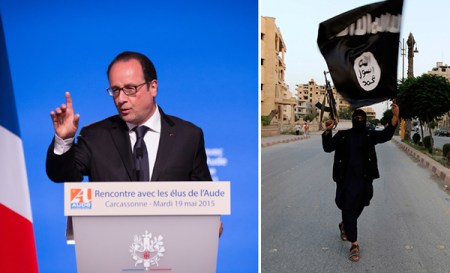
French President François Hollande has vowed to avenge the November 13 jihadist attacks in Paris that left more than 120 dead and 350 injured.

Speaking from the Élysée Palace, Hollande blamed the Islamic State for the attacks, which he called an “act of war.” He said the response from France would be “unforgiving” and “merciless.”

Despite the tough rhetoric, however, the question remains: Does Hollande understand the true nature of the war he faces?

Hollande pointedly referred to the Islamic State as “Daesh,” the acronym of the group’s full Arabic name, which in English translates as “Islamic State of Iraq and the Levant,” or “ISIL.”

The official policy of the French government is to avoid using the term “Islamic State” because, according to French Foreign Minister Laurent Fabius, it “blurs the lines between Islam, Muslims and Islamists.”

Critics of the policy say “Daesh” is a politically correct linguistic device that allows Western leaders to claim that the Islamic State is not Islamic — and thus ignore the root cause of Islamic terror and militant jihad.

Islamic ideology divides the world into two spheres: the House of Islam and the House of War. The House of War (the non-Muslim world) is subject to permanent jihad until it is made part of the House of Islam, where Sharia is the law of the land.

Jihad — the perpetual struggle to expand Muslim domination throughout the world with the ultimate aim of bringing all of humanity under submission to the will of Allah — is the primary objective of true Islam, as unambiguously outlined in its foundational documents.

Consequently, even if the Islamic State were to be bombed into oblivion, France and the rest of the non-Muslim world will continue to be the target of Islamic supremacists. The West cannot defeat Islamic terrorism by attempting to conceptually delink it from true Islam. But still they try.

After the January 2015 jihadist attacks on the Paris offices of the magazine Charlie Hebdo that left 12 people dead, President Hollande declared:

“We must reject facile thinking and eschew exaggeration. Those who committed these terrorist acts, those terrorists, those fanatics, have nothing to do with the Muslim religion.”

French Prime Minister Manuel Valls said: “We are in a war against terrorism. We are not in a war against religion, against a civilization.” Again, he said: “We are at war with terrorism, jihadism and radicalism. France is not at war against Islam and Muslims.”

At a June conference with more than 100 leaders of the French Muslim community, Valls denied there is any link between extremism and Islam. He also refused to raise the issue of radicalization because the topic was “too sensitive.” Instead, he said:

“Islam still provokes misunderstandings, prejudices and is rejected by some citizens. Yet Islam is here to stay in France. It is the second largest religious group in our country.

“We must say all of this is not Islam: The hate speech, anti-Semitism that hides behind anti-Zionism and hate for Israel, the self-proclaimed imams in our neighborhoods and our prisons who are promoting violence and terrorism.”

1348After the January 2015 jihadist attacks in Paris, France’s President François Hollande declared: “We must reject facile thinking and eschew exaggeration. Those who committed these terrorist acts, those terrorists, those fanatics, have nothing to do with the Muslim religion.”

France is home to around 6.5 million Muslims, or roughly 10% of the country’s total population of 66 million. Although most Muslims in France live peacefully, many are drawn to radical Islam. A CSA poll found that 22% of Muslims in the country consider themselves Muslim first and French second. Nearly one out of five (17%) Muslims in France believe that Sharia law should be fully applied in France, while 37% believe that parts of Sharia should be applied in the country.

France is also one of the largest European sources of so-called foreign fighters in Syria: More than 1,500 French Muslims have joined the Islamic State in Iraq and Syria, and many more are believed to be supporters of the group in France.

Since the Charlie Hebdo attacks, the French government has introduced a raft of new counter-terrorism measures — including sweeping surveillance powers to eavesdrop on the public — aimed at preventing further jihadist attacks.

French counter-terrorism operatives have foiled a number of jihadist plots, including a plan to attack a major navy base in Toulon, and an attempt to murder a Socialist MP in Paris.

As the latest attacks in Paris (as well as the failed attack on a high-speed train from Amsterdam to Paris in August) show, surveillance is not foolproof. Claude Moniquet, a former French intelligence operative, warns that European intelligence agencies are overwhelmed by the sheer number of people who may pose a threat. He writes:

“Some 6,000 Europeans are or were involved in the fighting in Syria (they went there, they were killed in action, they are still in IS camps, they are on their way there or their way back.)

“If you have 6,000 ‘active’ jihadists, this probably means that if you try to count those who were not identified, the logistics people who help them join up, their sympathizers and the most radical extremists who are not yet involved in violence but are on the verge of it, you have something between 10,000 and 20,000 ‘dangerous’ people in Europe.

“To carry out ‘normal’ surveillance on a suspect on a permanent basis, you need 20 to 30 agents and a dozen vehicles. And these are just the requirements for a ‘quiet’ target.

“If the suspect travels abroad, for instance, the figure could go up to 50 or 80 agents and necessitate co-operation between the services of various countries. Work it out: to keep watch on all the potential suspects, you’d need between 120,000 and 500,000 agents throughout Europe. Mission impossible!”

Meanwhile, French leaders consistently act in ways that undermine their stated goal of eradicating Islamic terror.

The French government has been one of the leading European proponents of the nuclear deal with Iran, the world’s biggest state sponsor of terrorism. Although Iran and its proxy, Hezbollah, are responsible for deaths of scores of French citizens, Fabius wasted no time in rushing to Tehran in search of business opportunities for French companies. In July, Fabius proclaimed:

“We are two great independent countries, two great civilizations. It is true that in recent years, for reasons that everyone knows, links have loosened, but now thanks to the nuclear deal, things are going to change.”

Fabius also extended an invitation for Iran’s President, Hassan Rouhani, to visit France in November. This trip — which has been mired in controversy, not over terrorism or nuclear proliferation, but over Iran’s demand that no wine be served during a formal dinner at the Élysée Palace — was postponed indefinitely after the Paris attacks. Hollande’s advisors apparently concluded that this is not the right moment for a photo-op with Rouhani, a career terrorist.

French leaders have also been consistently antagonistic toward Israel, a country facing Islamic terror on a daily basis.

After Israel launched a military offensive aimed at stopping Islamic terror groups in the Gaza Strip from launching missiles into the Jewish state, France led international calls for Israel to halt the operation. French Defense Minister Jean-Yves Le Drian said:

“France calls for an immediate ceasefire… to ensure that every side starts talking to each other to avoid an escalation that would be tragic for this part of the world.”

More recently, France has been a leading European advocate of a European Union policy that now requires Israel to label products “originating in Israeli settlements beyond Israel’s 1967 borders.” The move is widely seen as part of an international campaign to delegitimize the State of Israel. Israeli Prime Minister Benjamin Netanyahu slammed the move:

“The labelling of products of the Jewish state by the European Union brings back dark memories. Europe should be ashamed of itself. It took an immoral decision… this will not advance peace, it will certainly not advance truth and justice. It is wrong.”

France is also leading international diplomatic efforts to push for a United Nations resolution that would lead to the establishment of an independent Palestinian state within a period of two years. The move effectively whitewashes Palestinian terror. Netanyahu responded:

“The only way to reach an agreement is through bilateral negotiations, and we will forcibly reject any attempts to force upon us international dictates.

“In the international proposals that have been suggested to us — which they are actually trying to force upon us — there is no real reference to Israel’s security needs or our other national interests.

“They are simply trying to push us into indefensible borders while completely ignoring what will happen on the other side of the border.”

Meanwhile, after more than a year as a member of the US-led coalition against the Islamic State, French officials waited until late September to begin striking targets in Syria. But they refused to destroy the headquarters of the Islamic State in Raqqa — where the Paris attacks were reportedly planned.

Back in France, critics of Islam are routinely harassed with strategic lawsuits that seek to censor, intimidate and silence them.

In a recent case, Sébastien Jallamion, a 43-year-old policeman from Lyon, was suspended from his job and fined 5,000 euros after he condemned the death of Frenchman Hervé Gourdel, who was beheaded by jihadists in Algeria in September 2014. Jallamion explained:

“According to the administrative decree that was sent to me today, I am accused of having created an anonymous Facebook page in September 2014, showing several ‘provocative’ images and commentaries, ‘discriminatory and injurious,’ of a ‘xenophobic or anti-Muslim’ nature. As an example, there was that portrait of the Calif al-Baghdadi, head of the Islamic State, with a visor on his forehead. This publication was exhibited during my appearance before the discipline committee with the following accusation: ‘Are you not ashamed of stigmatizing an imam in this way?’ My lawyer can confirm this… It looks like a political punishment. I cannot see any other explanation.

“Our fundamental values, those for which many of our ancestors gave their life are deteriorating, and that it is time for us to become indignant over what our country is turning into. This is not France, land of Enlightenment that in its day shone over all of Europe and beyond. We must fight to preserve our values, it’s a matter of survival.”

Meanwhile, Marine Le Pen, the leader of France’s Front National (FN) and one of the most popular politicians in the country, went on trial in October 2015 for comparing Muslim street prayers to the wartime occupation of France. At a campaign rally in Lyon in 2010, she said:

“I’m sorry, but for those who really like to talk about World War II, if we’re talking about an occupation, we could talk about the [street prayers], because that is clearly an occupation of territory.

“It is an occupation of sections of the territory, of neighborhoods in which religious law applies — it is an occupation. There are no tanks, there are no soldiers, but it is an occupation nevertheless, and it weighs on people.”

Le Pen said she was a victim of “judicial persecution” and added:

“It is a scandal that a political leader can be sued for expressing her beliefs. Those who denounce the illegal behavior of fundamentalists are more likely to be sued than the fundamentalists who behave illegally.”

Responding to the jihadist attacks in Paris, Le Pen said:

“France and the French are no longer safe. It is my duty to tell you. Urgent action is needed.

“France must finally identify her allies and her enemies. Her enemies are those countries that have friendly relationships with radical Islam, and also those countries that have an ambiguous attitude toward terrorist enterprises.

“Regardless of what the European Union says, it is essential that France regain permanent control over its borders.

“France has been rendered vulnerable; it must rearm, because for too long it has undergone a programmed collapse of its defensive capabilities in the face of predictable and growing threats. It must restore its military resources, police, gendarmerie, intelligence and customs. The State must be able to ensure again its vital mission of protecting the French.

“Finally, Islamist fundamentalism must be annihilated. France must ban Islamist organizations, close radical mosques and expel foreigners who preach hatred in our country as well as illegal migrants who have nothing to do here. As for dual nationals who are participating in these Islamist movements, they must be stripped of their French nationality and deported.”

In the aftermath of the attacks, Le Pen, who has long been critical of President Hollande’s politically correct counter-terrorism policies, is certain to rise in public opinion polls. This will increase the political pressure on the government to take decisive action against the jihadists.

Faced with similar pressure after the Charlie Hebdo attacks in January, Hollande seemed reluctant to push too far, apparently fearful of the consequences of confronting the Muslim community in France. It remains to be seen whether the latest attacks in Paris, which some are describing as France’s September 11, mark a turning point.

Western leaders ignore ‘apocalyptic Islam’ at their peril

November 15, 2015

Western leaders ignore ‘apocalyptic Islam’ at their peril, Israel National News, Ari Soffer, November 15, 2015

img634813Bataclan concert hall following terror attackReuters

[G]laringly absent from the discussions [of the Paris attack] are any serious attempts to understand the ideological motivations of the Muslim extremists, several of them French citizens, who carried out the worse terror attacks in France in a generation – including the first-ever suicide bombings on French soil.

**************************

Despite years of warnings by intelligence agencies that radicalized Muslims would eventually emerge from the battlefields of Syria and Iraq to launch bloody attacks in the West, Europe has been blindsided by one of the most brutal terrorist atrocities in recent memory.

The coordinated attacks by three teams of ISIS terrorists in Paris on Friday sent shockwaves far beyond France, with the massacre of at least 129 people reigniting the debate around immigration after it was revealed that at least two of the attackers entered Europe posing as “refugees.”

The attacks also fueled debate over how to end the Syrian civil war, as well as over ongoing efforts to defeat ISIS on the battlefields of Syria and Iraq, the latter of which has seen several successes over the past few weeks.

But glaringly absent from the discussions are any serious attempts to understand the ideological motivations of the Muslim extremists, several of them French citizens, who carried out the worse terror attacks in France in a generation – including the first-ever suicide bombings on French soil.

That, says best-selling author Joel Rosenberg, is the reason such acts of terror are bound to repeat themselves.

Joel spoke to me prior to the attacks at the recent Jerusalem Leaders Policy Summit, and voiced concern that by failing to grapple with the apocalyptic ideology behind actors such as ISIS, Western states would never be able to decisively defeat them.

Watch: Author Joel Rosenberg speaks in Jerusalem:

A jovial, somewhat self-deprecating character, Rosenberg – who worked for Binyamin Netanyahu during his failed prime ministerial bid in 1999, as well as Natan Sharansky – describes himself as “a failed political consultant,” but boasts a rather more successful career as writer, selling millions of novels highlighting the threat of radical Islam.

Today he lives in Netanya in northern Israel with his family, having made aliyah from the US last August at the height of Operation Protective Edge (though a practicing Christian his father was Jewish, making him eligible for aliyah under the Right of Return). From there, he has continued his efforts to explain “the threats we mutually face as Israelis and Americans from radical Islam” – a threat he says he only fully appreciated after working with Netanyahu.

“Misunderstanding the nature of the threat… of evil, is to risk being blindsided by it,” he said, citing Peal Harbor and 9/11 as examples. “And we’re going to be blindsided by a nuclear Iran, just like we’re being blindsided by ISIS.”

“At the core of it, American leaders are refusing to deal with the theology and eschatology of our enemy,” he said. “Not every Muslim is a terrorist, not every Muslim is a threat, not every Muslim is a problem – in fact the vast majority are not.

“The question is, the ones who are – what do they want? What do they say they want? What motivates them?”

The current US administration is particularly hesitant to label the threat as it is.

“Obama refuses to even acknowledge radical Islam. Come on – really? At this stage in the 21st century you’re not even ready to acknowledge the ideology that is motivating these folks? That’s a problem.”

Days later, as the attacks in Paris unfolded, some criticized the US president for once again failing to mention radical Islam at all in his speech reacting to the massacre.

Watch: Obama delivers response to Paris attacks:

But beyond the relatively wide umbrella of “radical Islam” Rosenberg warns of a far deadlier threat.

“Radical Islam encompasses a wide range of groups… Hamas, the Muslim Brotherhood, Hezbollah, the Taliban, Al Qaeda – all of these are serious threats,” he noted. “But apocalyptic Islam is now the biggest threat. this is the Iranian leadership, this is ISIS.”

He argues that the hyper-messianic ideologies shared by both sides of the Shia-Sunni jihadist coin are unprecedented in the history of modern western civilization.

“Apocalyptic Islam is motivated by the idea that the end of days has come, that the Mahdi [Muslim messiah – ed.] is coming at any moment to establish a global Islamic kingdom or Caliphate, and that the way to hasten his coming is to annihilate two countries: Israel the ‘Little Satan,’ and America the ‘Big Satan,'” he explained, describing the messianic beliefs shared by both ISIS and the “Twelver Shia” sect which figures prominently among Iran’s leadership.

“But the western political class doesn’t want to even deal with the theological ideas that are driving the radical Islamists – let alone to explain the end of times theologies of two ‘nation states’,” he continued, referring to Iran and ISIS’s self-declared “Islamic State,” which encompasses huge swathes of territory in Iraq and Syria.

“Never in history have we had one, much less than two states, whose leaders are trying to force the end of the world,” Rosenberg noted.

While Jews and Christians also have their own beliefs in the “end of times” or the messianic age, the difference is that “we don’t believe we have to commit a genocide to bring about the end of times.”

While some strategic and doctrinal differences do clearly exist between Iran and ISIS – who are themselves mortal enemies – Rosenberg emphasized that the fundamental threat was essentially the same.

“Shia apocalypticism and Sunni apocalypticism are similar. Both believe the messiah is coming soon, that his kingdom is coming, they need to change their behavior to accelerate his coming… but the eschatology and strategies are different.

“ISIS’s strategy is to commit genocide today, because the goal is to build the caliphate, to force the hand of the messiah to come.

“Iran is not trying to build a caliphate today. They’re building the infrastructure to build nuclear weapons. Why? Because while ISIS wants to commit genocide today Iran wants to commit genocide tomorrow. The point is: don’t launch until you’re ready. Rather than kill thousands in one day, Iran wants to eventually kill millions.”

He disagreed with assessments shared by some experts that the Iranian regime, while extreme, ultimately functions as a rational actor, insisting their words, beliefs and actions only led to one conclusion.

“When you look a the messages of annihilation they are saying… when you look at the infrastructure they’re building and when you look at the eschatology, these roads converge.

“They’re not interested in negotiating something together with us – they’re taking a gift,” he said of the nuclear deal Tehran signed with world powers. “You’re giving us two paths to a nuclear bomb: if we cheat, or if we don’t cheat? OK we’ll take it!”

In the shorter term Iran might they use its nuclear capabilities for more limited political goals such as “blackmail or to give a cover for terror,” he said.

But in the long term its goals were just as bloodthirsty as ISIS. In facing down both threats, the West must recognize it is facing a zero-sum game.

“For these guys killing is at the center of what they’re doing. When you bear that in mind making concessions isn’t just a mistake or misguided – it’s insane.”

Democrats seek to undo political damage of the Iran Deal

November 12, 2015

Democrats seek to undo political damage of the Iran Deal, Legal Insurrection, November 12, 2015

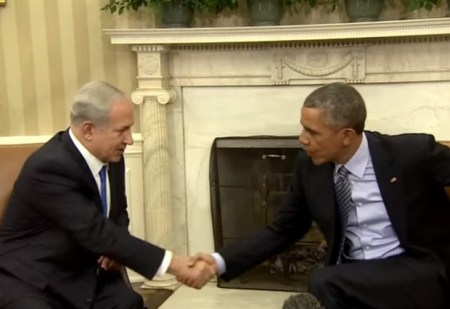
The New White House Meme About Bibi: He Doesn’t Understand.

2015-11-12_090314_Netanyahu_Obama-620x426

[T]he nuclear deal has done tremendous political damage to the Democrats. And while much of the media is portraying Netanyahu’s D.C. visit as Netanyahu’s chance to mend fences, I think it’s been Obama’s.

Polling shows that despite the tensions between Obama and Netanyahu, which Jonathan Tobin correctly characterizes as being exacerbated by Obama, bipartisan support for Israel is strong and growing. Obama and Congressional Democrats are quite aware of this.

****************************

The New White House Meme About Bibi: He Doesn’t Understand.

In a look at the history of the tensions between President Barack Obama and Israeli Prime Minister Benjamin Netanyahu, The New York Times several days ago started with an interesting anecdote.

For President Obama, it was a day of celebration. He had just signed the most important domestic measure of his presidency, his health care program. So when Prime Minister Benjamin Netanyahu of Israel arrived at the White House for a hastily arranged visit, it was likely not the main thing on his mind.

To White House officials, it was a show of respect to make time for Mr. Netanyahu on that day back in March 2010. But Mr. Netanyahu did not see it that way. He felt squeezed in, not accorded the rituals of such a visit. No photographers were invited to record the moment. “That wasn’t a good way to treat me,” he complained to an American afterward.

The tortured relationship between Barack and Bibi, as they call each other, has been a story of crossed signals, misunderstandings, slights perceived and real. Burdened by mistrust, divided by ideology, the leaders of the United States and Israel talked past each other for years until the rupture over Mr. Obama’s push for a nuclear agreement with Iran led to the spectacle of Mr. Netanyahu denouncing the president’s efforts before a joint meeting of Congress.

It’s interesting because this is not at all how I remembered it. I remember that the lack of attention to the meeting was perceived as an intentional slight of Netanyahu. A quick check of the contemporaneous reporting confirmed this.

(Later when describing the meeting the article says that the situation was “made worse by exaggerated stories of shabby behavior in Israeli news media.” I don’t know that exaggerations were necessary.)

Reuters: In a sign of lingering tensions, the Obama administration withheld from Netanyahu some of the usual trappings of a White House visit. Press coverage of the Oval Office talks was barred, and the leaders made no public statements afterward.

Jackson Diehl of The Washington Post (who was, in fact, quoted by Prof. Jacobson at the time): Finally, Obama has added more poison to a U.S.-Israeli relationship that already was at its lowest point in two decades. Tuesday night the White House refused to allow non-official photographers record the president’s meeting with Netanyahu; no statement was issued afterward. Netanyahu is being treated as if he were an unsavory Third World dictator, needed for strategic reasons but conspicuously held at arms length. That is something the rest of the world will be quick to notice and respond to. Just like the Palestinians, European governments cannot be more friendly to an Israeli leader than the United States.

New York Magazine: It was an ominous signal when the White House didn’t provide photos or briefings after the much-anticipated meeting between President Obama and Israeli Prime Minister Benjamin Netanyahu earlier this week. After Joe Biden was blindsided by a surprise Israeli announcement of a new East Jerusalem housing project a couple of weeks earlier, the Obama administration was clearly sending a message of extreme displeasure.

BBC: But the White House had no immediate comment on their content. In a break with convention, reporters were not invited to witness the pair shake hands at the start of their discussions. It was a pointed contrast with the traditional public welcome for Israeli leaders at the White House, the BBC’s Steve Kingstone in Washington reports.

New York Time editorial a few days later: Mr. Obama was right to demand that Mr. Netanyahu repair the damage. Details of their deliberately low-key White House meeting (no photos, no press, not even a joint statement afterward) have not been revealed. We hope Israel is being pressed to at least temporarily halt building in East Jerusalem as a sign of good faith. Jerusalem’s future must be decided in negotiations.

In none of these accounts, was there any mention of the signing of Obamacare, (which did take place earlier that day.) The “low-key” approach to the meeting between the leaders was reported as a deliberate attempt by the administration to signal its displeasure with Netanyahu. I saw no indication that the administration tried to fight that impression at the time.

My best guess is that the New York Times reporters were simply writing the administration’s revisionist account of the events in 2010, without doing the necessary due diligence to ensure that the information they were given was accurate.

Still the article is mostly well-reported covering both sides. There are a few significant omissions (this and this, for example), but the article tries very hard to make the case that any tension between Obama and Netanyahu is the result not of malice, but of Netanyahu misunderstanding Obama. Perhaps the clearest expression of this came in a a description of meetings between Obama and American-Jewish leaders:

In those meetings, Mr. Obama expressed distress. “He bore his soul about how much he cares about Israel,” Mr. Foxman said. “It was painful, hurtful. ‘I care about Israel, I love Israel.”‘ Why did Mr. Netanyahu not understand?

So yes, I think we have a new meme, Obama is pro-Israel but misunderstood. The question is why the administration is so sensitive right now.

I have an idea.

First consider where the Democratic party is nearly one year before the next presidential election.

As Aleister noted recently, the Democrats have lost 12 governorship, 69 House seats, 14 Senate seats and over 900 local legislative seats in 7 years under Obama. While Obama’s personal popularity hovers just a little below 50%, this represents a widespread rebuke to his governance. Remember, his two signal achievements, Obamacare and the Iran nuclear deal were unpopular. As everyone sees increasing health insurance rates and the consequences of the nuclear deal are reported, voters will have reminders of schemes that were enabled by legislative manipulation lacking popular support.

The Sun-Sentinel reported on Saturday on the significance of the Obama-Netanyahu meeting:

The region is home to an estimated 500,000 Jewish residents — sizable enough to tip the results in the biggest swing state in the country. Florida awards 29 electoral votes, more than 10 percent of the total needed to win the presidency.

Changing the outcome “doesn’t require a majority shift,” said Steven Abrams, a county commissioner who was Palm Beach County chairman for Newt Gingrich’s unsuccessful 2012 presidential campaign. “The Jewish vote only needs to change by a percent or two or three in order to make a difference in the outcome of the state.” …

“I have three words: Iran nuclear deal,” Abrams said, referring to the Obama administration’s controversial effort to prevent Iran from developing a nuclear weapon. “It’s one of President Obama’s major initiatives. It’s not a small policy. And it’s a very prominent policy for Jewish voters and many Jewish Democrats and many more Jewish independents are not enthralled by it, and those are targeted voters.”

To be sure the Sun-Sentinel quoted several Democrats saying otherwise, but the nuclear deal according to polling throughout the summer is extremely unpopular.

A Quinnipiac poll in August found that voters in the crucial swing states Ohio, Pennsylvania and Florida opposed the deal by a ratio of greater than 2 to 1. And every time Iran arrests an American or stops cooperating with the terms of the nuclear deal, the deal will be in the news and everyone involved in making the deal will look worse. Even many of the senators who supported the deal and defied popular opinion to block a vote on the deal made persuasive cases about the dangers of the deal.

In terms of Jewish opinion, it’s fascinating that not a single Jewish federation backed the deal. Too many of them, for sure took no position, but none supported the deal. Aside from J-Street, not a single major Jewish organization backed the deal. (The question as to whether J-Street is primarily a Jewish organization is a different question.) Even the ADL, which is now headed by a former Obama staffer, Jonathan Greenblatt, opposed the deal. If nothing else, suggests a strong consensus in the organized Jewish community that the nuclear was a bad deal that endangers Israel.

This suggests that the nuclear deal has done tremendous political damage to the Democrats. And while much of the media is portraying Netanyahu’s D.C. visit as Netanyahu’s chance to mend fences, I think it’s been Obama’s.


So even if cynical in the extreme, the meme that Obama loves Israel but his love was misunderstood by Bibi makes perfect sense. It’s a way of tidying up the past and putting the best face on a contentious relationship.

It is also a pose one would expect the president to strike if he were trying to woo back Jewish voters who are concerned about the threats to Israel presented by the nuclear deal.

Although much of the media has portrayed Netanyahu’s trip to the United States as his bid to mend relations with the administration and more generally with Democrats, there is evidence that the opposite dynamic is in play.

In addition to Obama’s “misunderstood” meme, Jennifer Rubin observed that in the wake of the nuclear deal 16 Democratic senators – 14 of whom supported the deal – are “scrambling for cover” and urging Obama to extend and strengthen the “Memorandum of Understanding” governing the terms of American security assistance to Israel in the face of the Iranian threat. Democratic Whip, Rep. Steny Hoyer, who supported the nuclear deal, has released a letter calling on the United States and its partner to ensure that Iran is held accountable for any cheating.

Polling shows that despite the tensions between Obama and Netanyahu, which Jonathan Tobin correctly characterizes as being exacerbated by Obama, bipartisan support for Israel is strong and growing. Obama and Congressional Democrats are quite aware of this.

No good news in the Mid East for Obama or Netanyahu when they meet Monday

November 8, 2015

No good news in the Mid East for Obama or Netanyahu when they meet Monday, DEBKAfile, November 8, 2015

Obama_Bibi2480

After more than a year, Israeli Prime Minister Benyamin Netanyahu meets President Barack Obama at the White House on Monday, Nov. 9, with the deck heavily stacked against him – and not just because of the Islamic State, which is a universal bane, or Obama’s Iran policy – or even the evaporation of the peace process with the Palestinians. This time, Netanyahu is not getting a dressing-down over the disappearance of the two-state solution, because even the US president has decided to shelve it for the remainder of his presidency which ends in January 2017.

This is not because the Netanyahu government has missed any chances for talks with the Palestinians, as the Israeli opposition loudly claims, but because it is unrealistic.

Palestinian Authority Chairman Abu Mazen (Mahmud Abbas), who lost all credibility on the Palestinian street long ago, has been quietly but continuously encouraging the continuous Palestinian wave of terror by knives, guns and cars.

The Israeli prime minister had his most promising card snatched from him just ten days before he traveled to Washington. He had intended presenting the US president with the quiet alliance he had formed with key moderate Arab governments as a viable alternative for the deadlocked Palestinian peace process, with the promise of a measure of stability for its members in the turbulence around them.

However, the linchpin Egyptian President Abdel-Fatteh El-Sisi’s position was suddenly shaken up badly by the downing of the Russian passenger plane over Sinai on Oct. 31, presenting him with his most dangerous crisis since he took power in 2013.

In addition, the security situation in Syria, including along Israel’s northern border, especially the Golan, has gone from bad to worse – especially since Russia built up its military presence in Syria.

Israel has been forced to forego most of its red lines for defending its security as no longer relevant. Although no Israeli official says so openly, Israel’s military options in Syria have shrunk, and even the overflights by its air force flights for keeping threats at bay are seriously restricted..

Iran and Hizballah, under Russian air cover, have been slowly but surely making gains in their attempt to retake southern Syria from the rebels and hand it over to the army of Syrian President Assad.

Israel is still insisting that it will not allow the deployment of Iranian or Hizballah forces on the Syrian side of the Golan, but these statements are losing their impact. If the coalition of Russia, Iran, Syria and Hizballah defeats the rebels in southern Syria and moves in up to its border, Israel will find it extremely difficult to prevent this happening.

It would also mark the end of more than three years of investment and building of ties with various elements in southern Syria as part of a strategic decision to transform those groups into a buffer between Israel and Iran in the Golan area.

Netanyahu’s struggle against the nuclear deal with Iran was not just aimed at Washington’s recognition of Iran’s nuclear program, but ever more at Obama’s acknowledgement of Iran as America’s strategic partner and leading Middle East power. But in this respect, the US president is most likely chafing over the setbacks to his own cherished plan, as a result of four developments:

1. Iran has plunged more deeply than ever predicted into the Syrian conflict. For the first time since the 19th century, Iran has not only sent its military to fight beyond its borders, but it is coordinating its moves with Moscow, not Washington.

Even if Israel needed to turn to the US administration for a helping hand against Iran, it would have no address because Washington too has been displaced as a power with any say in the Syrian picture.

2. Although the alliance by Israel and moderate Arab countries was designed by Netanyahu to serve as a counterweight to the US-Iranian partnership,  that alliance too is far from united on Syria:  Egyptian President El-Sisi, for example, supports President Bashar Assad, and is in favor of keeping him in power in Damascus.

3. The Islamic State continues to go from strength to strength in Syria and the Sinai Peninsula which share borders with Israel as well as in Iraq.

4. Israel’s political, defense and intelligence elite have badly misread or missed altogether four major events in the region:

  • Assad’s persistent grip on power
  • The deep Russian and Iranian military intervention in Syria
  • The strengthening of ISIS
  • The eruption of a new, deadly Palestinian campaign of terror which strikes unexpectedly in every town, highway and street.

These errors are taking their toll on Israel’s security, wellbeing and prestige.

Even if Israeli Prime Minister Netanyahu and US President Obama, like Defense Minister Moshe Yaalon and Secretary of Defense Ashton Carter, do reach an agreement on Israel’s security needs for the coming years and US military assistance, such an agreement may not withstand the test of Middle East volatility. The rapidly changing conditions are for now all to the detriment of the US and Israel.