Archive for the ‘Hollande’ category

The French Appetite for Appeasement

June 4, 2016

The French Appetite for Appeasement, Gatestone InstituteGeorge Igler,  June 4, 2016

♦ France’s Socialist Party government has unveiled a new legislative program designed to decrease the likelihood of further Islamic atrocities, largely it seems that would have ensured the success of the jihadist attacks committed so far.

♦ n the measures revealed, proactively combatting criminals appears to have taken a back seat to placating the communities from which they are drawn.

♦ Whereas protests by French people against Islamization or government policy, have been rigorously curtailed by the authorities, migrant gangs have still felt able to terrorize French towns, stampede French motorways, or conduct mass armed brawls in Paris, with little fear of intervention from either security services or the law.

♦ In 2014, an ICM poll discovered that 27% of French citizens aged 18-24 supported ISIS.

Last year Muslim jihadists murdered more people in France, than were killed by terrorism in the country during the entire 20th century.

In response, the Prime Minister of France, Manuel Valls, has announced a range of innovative legal measures, introduced in response to the terrorist outrages which struck France in 2015.

On January 7, of that year, Saïd and Chérif Kouachi stormed the Paris offices of the satirical magazine Charlie Hebdo, massacring twelve and injuring eleven others.

In the days that followed, a comrade of the earlier jihadists committed a string of murders, which culminated in a siege at the kosher supermarket. Amedy Coulibaly killed five and injured eleven more.

On February 3, 2015, three military personnel guarding a Jewish community center in Nice were stabbed, by Moussa Coulibaly.

On June 26, the severed head of Hervé Cornara was placed on display, at the gas factory near Lyon where he worked, alongside twin ISIS flags, by Yassine Salhi.

On August 21, an attempted mass shooting on the Thalys high-speed train between Amsterdam and Paris, by Moroccan-born Ayoub El Khazzani, was foiled by American tourists, leading to the wounding of four.

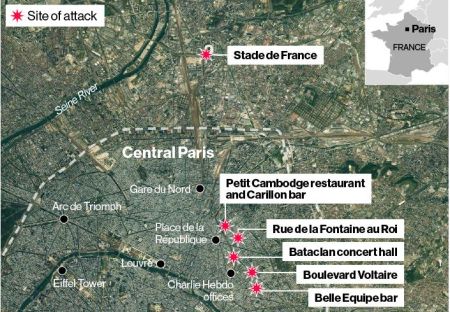
In two days, starting on November 13, multiple jihadist attacks once again struck the French capital. 130 were killed and 352 injured, by perpetrators operating in three teams of three, which included suicide bombers.
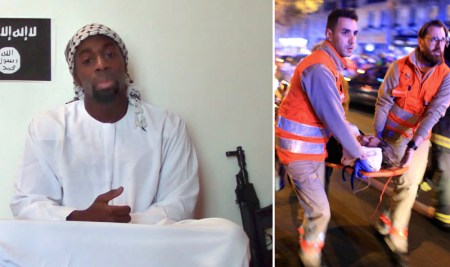
1432 (1)Last January, Amedy Coulibaly (left) murdered a policewoman and four Jews in Paris, before being shot dead by police. Right: Medics carry a victim wounded in an attack by Islamist terrorists, who shot hundreds of concert-goers, killing 90, at the Bataclan theater in Paris on November 13, 2015.

France’s Socialist Party government has unveiled a new legislative program designed to decrease the likelihood of further Islamic atrocities, largely it seems that would have ensured the success of the jihadist attacks committed so far.

“A range of measures” are set to be introduced to combat the alleged “Social, Ethnic and Territorial Apartheid” currently blighting France.

Not only were the jihadist proclivities of most of last year’s perpetrators fully known to the authorities in France, some had been released from prison early following crimes of violence involving automatic weapons.

In the measures revealed by Prime Minister Manuel Valls, however, proactively combatting criminals appears to have taken a backseat to placating the communities from which they are drawn.

The first aim of the new laws contained within the Equality and Citizenship bill, reports Le Monde, is to centralize the provision of social housing in France. Until now the growth of Islamized areas has largely been limited to suburbs around major urban centers.

Much as in Germany, where Muslim migrants to Europe are being sent directly into rural areas, the prime minister is proposing a new nationwide system designed, “to make a better distribution of the public housing supply” in France. This nationwide transformation of housing policy is aimed at curtailing “concentrations of poverty,” within problematic Islamic enclaves infamous as no-go zones.

Recalcitrant” locally-elected mayors who oppose the construction of new housing projects in their areas will be overruled by the state in the interests of “social diversity.”

Second, in the guise of improving literacy in French amongst those of immigrant descent, a new fast-track employment scheme has also been drawn up.

The scheme “will allow youths with few or no qualifications” to enter France’s “citizens’ reserve,” a government initiative established last year which links the nation’s education system with its civil service, allowing an accelerated path into state employment.

The euphemism “youths” is used in the French media to describe the country’s increasingly problematic young Muslim population. In 2014, an ICM poll discovered that 27% of French citizens aged 18-24 supported ISIS.

The glowing account given to the proposals being forwarded by Prime Minister Valls, in his country’s leading left-wing daily, fails to mention how the newly foreseen “third path” job scheme will address the greater key issues.

Unease is growing at the level of Islamist sympathies already held by state employees in France, such as members of the military and police.

Third, as nationwide protests continue to mount over migrant chaos in French towns, spread across the coast of the English Channel, even greater criminal penalties against free speech are also set to be introduced by the new bill.

Verbal communication has, apparently, been largely exempted from legal free speech curtailment in France, unless recorded and posted online. Such cases then fall under the same strict law that governs the printed word, originally passed in 1881.

This law is why Charlie Hebdo is famous for distributing its most challenging content in the form of cartoons, thereby seeking to exempt itself from strict sanctions against “defamation” in print. Fictional novels published this year about France’s Islamic future have sought to do the same.

Under the legislation currently being proposed by Valls, this existing status quo is set for a radical shake-up. The new restrictions planned for France are more in line with the Europe-wide harmonization of hate speech offences, mandated by the European Union.

The augmented provisions against incitement to hatred, previously limited to the 1881 press law, are set to be expanded throughout the French criminal justice system, under the new bill.

Much as in the UK, the new creation of aggravated offences will also ensure that any existing crime can be claimed, by its victim, also to contain a “hate speech” component, incurring far stiffer penalties against the alleged perpetrator.

The application of existing French laws, however, after the last major atrocity in Paris, on November 13, point to the likely reasons for the new proposals being put forward by France’s government.

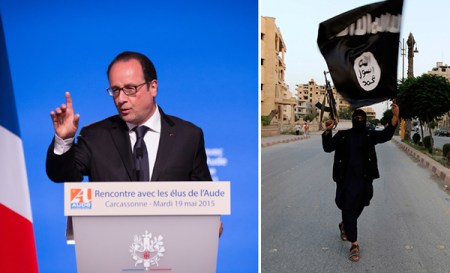
Since the massacre at the Bataclan nightclub and suicide bombings that struck the French capital, the Republic of France has been in a state of emergency. This gives the country’s President, François Hollande, “extraordinary powers” under Article 16 of the French Constitution.

In February, the duration of these powers, which enable warrantless searches whilst limiting freedom of expression and peaceful assembly, were extended until May 26 by the lower house of the French legislature, the Assemblée Nationale.

In the intervening period, soldiers have become such a common sight in the French capital, that they often give Paris the impression of being under martial law. Half of the country’s army is now deployed on the streets of France.

Yet, whereas protests by French people against Islamization or government policy have been rigorously curtailed by the authorities, migrant gangs have still felt able to terrorize French towns,stampede French motorways, or conduct mass armed brawls in Paris, with little fear of intervention from either security services or the law.

Although the law being introduced by Mr. Valls is chiefly claimed to be about “youth engagement,” the new bill seems more the result of a realization that one group in France — its natives — can generally be relied upon to obey the law, while apparently another cannot.

There is a certain group of young people, however, with whom Manuel Valls clearly does not wish to engage. He recently excoriated members of the controversial Europe-wide Identitarian Movement, a nationalist youth group notorious for engaging in acts of civil disobedience in response to the changing culture and demography of France and Europe.

Described as the “hipster right” by some outlets, Mr. Valls decried supporters of the movement — which began in his country — as “those who want the country closed while dreaming of going back to a France that never existed.”

“I believe in my country, in its message and its universal values,” Valls added. In the interview published by Libération, on April 12, he continued:

I would like us to be capable of demonstrating that Islam, a great world religion and the second religion of France, is fundamentally compatible with the Republic, democracy, our values, and equality between men and women.

Manuel Valls was later forced to admit, in the interview, that this “compatibility” is something doubted by “a majority of our fellow citizens.”

Some 3.3 million people have dual citizenship in France, most of them Muslim. After President Hollande had announced that his country was “at war,” in the immediate aftermath of November’s attacks, the French Prime Minister unveiled plans to amend France’s constitution.

The proposed amendment was intended to strip French citizenship from dual-nationals convicted of terrorism offences. At the time Manuel Valls was described, in the left-wing media, as a “strongman” who had taken a “hard line against terror.”

On March 30, however, after a split within the Socialist Party over the issue, the Prime Minister’s plans were dropped.

The new, more comprehensive, legislative proposals are set to go before the Assemblée nationale this month.
French Political Gymnastics and How to Help the Palestinians

May 23, 2016

French Political Gymnastics and How to Help the Palestinians, Gatestone InstituteShoshana Bryen, May 23, 2016

“I call on the Palestinian people to elect new leaders, leaders not compromised by terror. I call upon them to build a practicing democracy, based on tolerance and liberty. If the Palestinian people meet these goals, they will be able to reach agreements with Israel, Egypt and Jordan on security and other arrangements for independence.” — President George W. Bush, 2002.

The Palestinians do not have “a practicing democracy based on tolerance and liberty,” but erasing Israel evidently remains their goal.

Rather than offering the Palestinians no-cost recognition, the French should demand a few changes first.

The French government seems to be falling over itself to undo its craven vote in favor of a UNESCO resolution accusing Israel — referred to as the “Occupying Power” in Jerusalem — of destroying historic structures on the Temple Mount:

  • Prime Minister Manuel Valls apologized. “This UNESCO resolution contains unfortunate, clumsy wording that offends and unquestionably should have been avoided, as should the vote.”
  • Interior Minister Bernard Cazeneuve apologized. [I do] “not take a supportive view of the text.” The resolution “should not have been adopted” and “was not written as it should have been.”
  • President François Hollande apologized. [The vote was] “unfortunate,” and, “I would like to guarantee that the French position on the question of Jerusalem has not changed… I also wish to reiterate France’s commitment to the status quo in the holy places in Jerusalem… As per my request, the foreign minister will personally and closely follow the details of the next decision on this subject. France will not sign a text that will distance her from the same principles I mentioned.”
  • Foreign Minister Jean-Marc Ayrault did not quite apologize: “France has no vested interest but is deeply convinced that if we do not want to let the ideas of the Islamic State group prosper in this region, we must do something.”

It sounds as if they thought they had made a mistake. But the vote was not a mistake. Underestimating the depth of Israel’s anger about it might have been a mistake, but not the vote. The French — who, according to their foreign minister, have “no vested interest” but need to “do something” about Islamic State — could not have thought that a UNESCO resolution that offended Israel would do anything to slow ISIS “in the region” or in Europe. There is no way it could; the two are not connected.

The French however, apparently thought a vote accusing Israel of something, anything, would keep the Palestinian Authority from presenting a resolution on Palestinian independence to the UN Security Council; Ayrault implied in Israel that the UNESCO vote was a quid pro quo. Why? The French have a veto they could exercise in the UN Security Council. But the Palestinians might then object to France replacing the U.S. as the “Great Power” in the “peace process.” They already have experience with a veto-wielding interlocutor — the U.S. — and they do not want another. The price of an elevated status for the French appears to entail not vetoing Palestinian resolutions, voting for them in UNESCO, and sacrificing Israel in a process that will end in French recognition of a Palestinian State, whether Israel agrees to be bound to the altar or not.

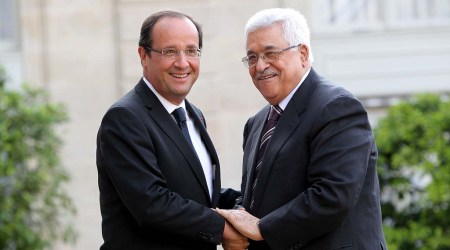
1614French President François Hollande welcomes Palestinian Authority President Mahmoud Abbas in Paris, July 8, 2012. (Image source: Office of the President of France)

It should be noted that the Russians immediately put out a statement that the UN-sponsored Middle East Quartet is the “only mechanism” for resolving the Palestinian issue. It is not clear whether Putin was supporting American or Israeli interests. Iran and ISIS are similarly disinclined to see the French ascend on this issue.

The Palestinians, on the other hand, are thrilled to have an international conference where others will make demands of Israel as the Palestinian experiment in self-government degenerates into poverty and chaos by its own economic, political and social choices, looking more like Venezuela every day.

For Palestinians in the street, killing Jews in the “knife intifada” did not take the edge off the popular anger and frustration with their own leadership.

Under the circumstances, the French, and France’s enabler, U.S. Secretary of State John Kerry, might usefully consider the approach taken in fact by President George W. Bush, which required changes in Palestinian behavior as a prerequisite for support for statehood. Honored mainly in the breach, Bush’s 2002 speech nevertheless remains the best statement of American, and Western, interest in moving the Palestinians toward a functioning state:

It is untenable for Israeli citizens to live in terror. It is untenable for Palestinians to live in squalor and occupation. And the current situation offers no prospect that life will improve. Israeli citizens will continue to be victimized by terrorists, and so Israel will continue to defend herself…

Peace requires a new and different Palestinian leadership, so that a Palestinian state can be born.

I call on the Palestinian people to elect new leaders, leaders not compromised by terror. I call upon them to build a practicing democracy, based on tolerance and liberty. If the Palestinian people meet these goals, they will be able to reach agreements with Israel, Egypt and Jordan on security and other arrangements for independence.

And when the Palestinian people have new leaders, new institutions and new security arrangements with their neighbors, the United States of America will support the creation of a Palestinian state whose borders and certain aspects of its sovereignty will be provisional until resolved as part of a final settlement in the Middle East.

I wrote at the time that,

“Mr. Bush made one huge leap of faith in the speech when he said, ‘I’ve got confidence in the Palestinians. When they fully understand what we’re saying, that they’ll make the right decisions when we get down the road for peace.’ What, in fact, will the U.S. do if the Palestinian people weigh a new constitution and free political parties and STILL decide that blowing up Jews is better? What if they have transparent government, economic advancement and an independent judiciary, and STILL decide Jewish sovereignty must be eradicated with the blood of their children?”

The Palestinians have answered half the question. They do not have a “practicing democracy based on tolerance and liberty,” but erasing Israel evidently remains their goal. Rather than offering no-cost recognition, the French should demand a few changes first.

The French Peace Initiative: From de Gaulle to Haaretz

May 17, 2016

The French Peace Initiative: From de Gaulle to Haaretz, Gatestone InstituteFred Maroun, May 17, 2016

♦ France’s peace initiative is French President François Hollande’s equivalent of de Gaulle’s betrayal of Israel.

♦ France has already announced that if the peace initiative fails, France will recognize a Palestinian state. Israeli Prime Minister Benjamin Netanyahu has rightly concluded that “this ensures that a conference will fail.”

♦ France knows that the peace initiative is pointless, but it is using it for theatrical value to embarrass Israel’s government and curry favor with Arab regimes.

♦ Those who claim to support peace, but who in fact work to undermine it, are partly responsible for the anti-Semitic campaign against Israel. They should be prominently named and exposed for collaborating with bigots, anti-Semites, and terrorists.

When I hear about the current French peace initiative for Israel and the Palestinians, I have to keep pinching myself to make sure that I am not dreaming. After the powerful United States tried repeatedly and unsuccessfully to bring peace between these protagonists, what makes the French think that they can do better?

France’s boldness is particularly shocking, since France long ago lost the right to be considered a friend of Israel. In 1967, French President Charles de Gaulle imposed an arms embargo on Israel when the Jewish nation was under threat from a coalition of Arab countries. In doing so, de Gaulle threw the Jews under the bus in order to improve France’s relations with the Arab world. Thanks to Israeli ingenuity and resiliency, Israel still defeated the Arab coalition in the Six Day War and impressed the United States, which then replaced France as Israel’s main ally.

France’s peace initiative, which includes an international summit in Paris on May 30 to discuss the “parameters” of a peace deal, is French President François Hollande’s equivalent of de Gaulle’s betrayal of Israel. France has already announced that if the peace initiative fails, France will recognize a Palestinian state. Israeli Prime Minister Benjamin Netanyahu has rightly concluded that “this ensures that a conference will fail.”

1602France’s peace initiative, which includes an international summit in Paris on May 30 to discuss the “parameters” of a peace deal, is French President François Hollande’s equivalent of de Gaulle’s betrayal of Israel.

It is clear that no solution would be acceptable to Israel unless it protects Israel against continued Arab aggression, and unless it finds a solution to the millions of descendants of Palestinian refugees with which the Arab world insists on flooding Israel.

There is no sign that the Arab world, including the Palestinians, are anywhere close to accepting these conditions. France’s recognition of “Palestine” without any deal would mean that France does not consider those two conditions necessary.

France’s recognition of “Palestine” without any deal would provide no solution for Palestinian refugees. It would provide no solution to Palestinian terrorism. It would not make the concept of a Palestinian state any more real than it is today. It would not provide Israel with secure borders.

France’s unilateral recognition of “Palestine” would simply provide one more moral victory for the corrupt Palestinian President Mahmoud Abbas, and one less reason for him to negotiate peace in good faith or to give his people what they really need: a thriving economy and a functioning civil society.

If France’s initiative had any chance of success at all (which is doubtful considering the U.S. failures under more favorable circumstances, when the Palestinian leadership was keener on negotiations and when Hamas was weaker), France eliminated that chance by announcing that it would recognize “Palestine” regardless of what happens.

Is the French government so naïve that it would play into Abbas’ hands and sabotage its own initiative? Maybe, but the more likely explanation seems to be that France knows that the peace initiative is pointless, but it is using it for theatrical value to embarrass Israel’s government and curry favor with Arab regimes.

The Israeli newspaper Haaretz, which is often more “pro-Palestinian” (read anti-Israel) than the Palestinians, demands that Netanyahu accept the French initiative.

Haaretz takes the position that “there is no reason to reject the French initiative, which, even if it doesn’t resolve the fundamentals of the conflict, will at least put it back on the global agenda.” The theory that the conflict remains unresolved due to it not being on the “global agenda” is mind-boggling, considering the vocal and vicious worldwide anti-Israel movement. The conflict is very much on the “global agenda” — too much so, in fact — compared to other conflicts that are deadlier and get far less attention.

Haaretz claims that the French initiative “may also generate some original ideas and steps toward a solution.” Considering the attention that this conflict receives, the lack of “ideas” is far from being the problem. Pro-Israel and anti-Israel editorialists and bloggers have generated an immense body of “ideas,” most of which are totally impractical, and all of which are unrealistic until the Arab side of the conflict stops promoting hate against Israel and starts negotiating in good faith.

Haaretz‘s pathetic defense of the French initiative is followed by wholesale accusations, which have no substance, against Netanyahu. Haaretz, for instance, tries to convince readers that Netanyahu’s willingness to negotiate without conditions is itself a condition! As Haaretz is into the business of redefining words, why not say that the conflict is not really a conflict and be done with it!

Haaretz concludes by saying that Netanyahu “should give it [the French initiative] substance that will ensure the security and well-being of Israel’s citizens.” If this were possible, that would indeed be commendable, but as France, by promising the Palestinians recognition without negotiation, destroyed what little chance of success the initiative might have had. Asking Netanyahu miraculously to give the initiative “substance” is at best naïve, and at worst treacherous.

It could also be a trap to set Netanyahu up for failure, which, considering Haaretz‘s antipathy towards Israel’s Prime Minister, is likely.

Contrary to Haaretz‘s assertion that “there is no reason to reject the French initiative,” as the initiative is almost certain to fail, its failure will be one more weapon used by anti-Israel activists to demonize Israel, so there is every reason to not lend the initiative a legitimacy it does not deserve.

Israel survived de Gaulle’s betrayal, and it will likely survive Hollande’s betrayal. But one more failed initiative and one more meaningless recognition of “Palestine” will push peace and Palestinian statehood even farther away.

As Alan Dershowitz wrote recently, those who aided the Nazis in killing Jews, even indirectly, hold a part of the responsibility for the Holocaust. Those — in France, at Haaretz, or elsewhere — who claim to support peace but in fact work to undermine it, are partly responsible for the anti-Semitic campaign against Israel. They should be prominently named and exposed for collaborating with bigots, anti-Semites, and terrorists.

White House Scrubs Translation of French President Saying ‘Islamist Terrorism’

April 1, 2016

White House Scrubs Translation of French President Saying ‘Islamist Terrorism’ BreitbartCharlie Spiering, April 1, 2016

Obama-WH-Censors-Islamist-Terrorism-White-House-Photo-640x480

White House staffers appear to have scrubbed the mention of “Islamist terrorism” from a video of a speech delivered by French President Francois Hollande at a bilateral meeting with President Obama.

According to the White House translation of Francois’ speech, he said the following:

We are also making sure that between Europe and the United States there can be a very high level coordination. But we’re also well aware that the roots of terrorism, Islamist terrorism, is in Syria and in Iraq. We, therefore, have to act both in Syria and in Iraq, and this is what we’re doing within the framework of the coalition. And we note that Daesh is losing ground, thanks to the strikes we’ve been able to launch with the coalition.

But in the White House video, the translated portion of his remarks about Islamist terrorism is muted, starting at 4:48 in this video, according to a report posted by the Media Research Center.

Watch the official White House video below:

In the White House video, starting at 4:48, Hollande’s female translator goes silent, while he continues speaking for about 15 seconds before the translation restarts.

Hollande’s reference to Islamist terror also appears to have been muted in the White House video.

The White House’s edited version of the video also has Hollande saying the following: “But we’re also well aware that the roots of terrorism–and we note that Daesh is losing ground thanks to the strikes we’ve been able to launch with the coalition.”

The edit excludes this passage; “Islamist terrorism is in Syria and in Iraq. We, therefore, have to act both in Syria and in Iraq, and this is what we’re doing within the framework of the coalition.”

The official video of the remarks posted by the Nuclear Security Summit was not edited, and includes the translation of Hollande’s remarks referring to “Islamist” terror.
Watch below:

A White House spokesman did not respond to Breitbart News’ request for comment.

The New French “Résistance”

December 2, 2015

The New French “Résistance,” Gatestone InstituteGuy Millière, December 2, 2015

  • Some spoke of “resistance,” but to them, resistance meant listening to music. A man on a talk show said he was offering “free hugs.”
  • A French judge, Marc Trevidic, in charge of all the major Islamic terrorism cases over the last ten years, said a few days before the November attacks in Paris that the situation was “getting worse” and that “radicalized groups” could “carry out attacks resulting in hundreds of deaths.” He was quickly transferred to a court in northern France, where he has been assigned to petty crimes and divorce cases.
  • All the French political leaders know that the situation is out of control, but not one will say so publicly. Not one has asked the government why it took almost three hours for the police to intervene during the attack at the Bataclan Theater, where 89 people were murdered and over 200 wounded.
  • France’s political leaders are apparently hoping that people will get used to being attacked and learn to live with terrorism. In the meantime, they are trying to divert the attention of the public with — “climate change!”

Several weeks have passed since Islamist attackers bloodied Paris. France’s President François Hollande is describing the killers as just “a horde of murderers” acting in the name of a “mad cause.” He adds that “France has no enemy.” He never uses the word “terrorism.” He no longer says the word “war.”

France never was, in fact, at war. Police were deployed on the streets. Special Forces had to “intervene” a few days later in the Paris suburb of Saint-Denis. That was it.

French forces did bomb positions of the Islamic State in Syria; and Hollande traveled the world to find coalition, but could not. Now he says he wants to turn a page. The French public seems to want to turn a page, too.

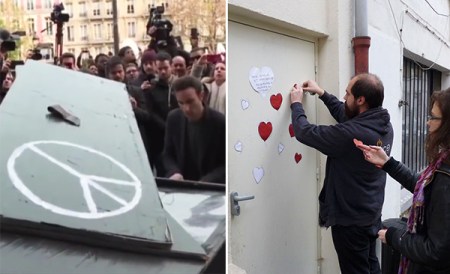
From the beginning, pacifism and appeasement filled the air. A German pianist came to playJohn Lennon’s Imagine in front of the Bataclan Theater; since then, other pianists have come. On the Place de la République, people assemble every evening to sing more songs by the Beatles: All You Need Is Love; Love Me Do. Candles are lit, and banners deployed, calling for “universal brotherhood.”

Those invited to speak on TV about what happened allude to “senseless acts.” They do not blame anyone.

Some spoke of “resistance,” but to them, resistance meant listening to music. To others, it meant having a drink with friends in a bar. In a widely circulated video, a man tries to reassure his child. “They have guns,” he mutters, “but we have flowers.”

Heart-shaped stickers are posted on mosques. Words such as “We love you” and “We share your pain” are written on the hearts.

1372

Just after the attacks, French philosopher Michel Onfray said that France for many years had led Islamophobic bombings against the Muslim world, so “it was logical if the Muslims now attacked France.”

When his words were used in an Islamic State propaganda video, and reporters asked him if he regretted what he said, he replied, “No.”

A man who lost his wife in the Bataclan massacre said on a talk show that he would live in the future as he did before; that he had no hatred at all against the murderers, just compassion. Another man on a different talk show said he was offering “free hugs.”

If some French think otherwise, they are silent.

All political leaders in France speak like Hollande. They say the country must show “unity” and “solidarity.” All of them know the mood of the vast majority; even those who might want to say more, stay silent.

Almost no one mentions radical Islam. Those who do, prefer the word “jihadism,” and rush to emphasize that “jihadism” is “not related to Islam.”

Hollande, when he still spoke of war, said that France had “an enemy.” He avoided the word “Islamic,” instead referring to the Islamic State by its Arabic acronym, “Daesh.”

He knew that “Daesh” could not be defeated without an American intervention that would not take place. With symbolic gestures, he did the best he could.

He also seems to know that the main enemy of France is not in Syria or Iraq, but inside the country: France already finds herself defeated.

More than half the Islamists who attacked Paris on November 13 were Muslims born and raised in France. Mohamed Merah, the murderer of Jewish children in Toulouse in 2012, and those who attacked the satirical magazine Charlie Hebdo and the kosher supermarket in January all were Muslims born and raised in France.

Over 750 no-go zones — autonomous areas ruled by radical imams and Muslim gangs — exist in France.

Radical imams and Muslim gangs also control most of France’s prisons: 70% of prison inmates in France are apparently Muslim. Non-Muslim inmates are attacked and threatened; many are forced to convert to Islam.

A British survey published in 2014 showed that 16% of French approve of the Islamic State. Among people aged 18-25, the proportion rose to 27%. Within the French Muslim population, the numbers are undoubtedly higher.

More than 1000 French Muslims have left France to fight for the Islamic State. At least 400 havereturned without being stopped or vetted at a border. Thousands of radicalized French Muslims have never left. Many are good, loyal citizens; but many could have learned all they wanted to know on the internet and on Islamic satellite television stations. Still others — hundreds of thousands of French Muslims — are not radicalized but are ready to help the radicalized ones; ready to host them or offer them asylum.

More than 10,000 French Muslims are classified as extremely dangerous by the police and are linked to “jihadist activities”. They are registered in what the French government calls “S files,” but there is no way to monitor their whereabouts. Placing them all in detention centers would involve a complete break with what is left of the rule of law in France.

All of the French Muslims who participated in the November 13 attacks were registered in “S files,” but that did not change anything. They were free to act, and they did.

For the first time in Europe, suicide bomb attacks took place. The explosive used to make suicide belts, triacetone triperoxide (TATP), is powerful and extremely sensitive to friction, temperature change and impact. Making belts containing TATP requires a “professional.”

A French judge, Marc Trevidic, in charge of all the main Islamic terrorism cases over the last ten years, said a few days before the November attacks that the situation was “getting worse,” was now “out of control,” and that “radicalized groups” established in the country could “carry out attacks resulting in hundreds of deaths.” He was quickly transferred to a court in Lille, northern France, where he was assigned to petty crimes and divorce cases.

All the French political leaders know that Marc Trevidic is right — that the situation is out of control — but not one will say so publicly. Not one has asked the government why it took almost three hours for the police to intervene during the attack at the Bataclan Theater, where 89 people were murdered and over 200 wounded. There are simply not enough well-trained police, and not enough weapons in the hands of the police, and not enough bulletproof vests.

For the next few months, more soldiers and police officers will be placed in front of public buildings, synagogues, churches and mosques, but “soft” targets, such as theaters, cafés and restaurants, are not protected. It is as easy to enter a theater in Paris today as it was on November 13. French police do not have the right to carry a weapon when they are on duty.

In a few weeks, French military actions against the Islamic State will doubtless stop. President Hollande, the French government, and most French political leaders probably hope that the French will soon forget the attacks. They know that the problems are now too widespread to be solved without something resembling a civil war. When more attacks occur, they will talk of “war” again. They are supposedly hoping that people will get used to being attacked and learn to live with terrorism.

In the meantime, French politicians are trying to divert the attention of the public with — “climate change!” The conference in Paris will last a fortnight. President Hollande says he wants save the planet. He will be photographed next to America’s Barack Obama and China’s Jiang Zemin.

French journalists are no longer discussing jihad; they are discussing “climate change.”

Until December 11, at least, Paris will be the safest city.

In June 2015, five months after the January attacks, French Prime Minister Manuel Valls said that the French had to “adapt to Islam”. In November, he added that “Islam has to stand up to jihadism”. The French Council of the Muslim Faith, offering “condolences” to the families of the victims, specified that Muslims were “victims” too, and that they should not be “stigmatized.”

Regional elections will be held on December 6th and 13th, the same time as the conference on climate change.

Polls show that the rightist party, National Front, will almost certainly win in a landslide. Marine Le Pen, leader of the National Front, did not depart from the calls for “unity” and “solidarity.” She is, however, the only politician to say unambiguously that the main enemy is not outside the country, but within. She is also the only politician to say that a return to security implies a return to border controls. A National Front victory does not, however, mean that Marine Le Pen will win the 2017 presidential election: all the other parties and the media might band together against her.

France’s National Front is part of the increasingly popular rejection of the European Union. Thei nvasion of Europe by hundreds of thousands of mostly Muslim migrants has strengthened that stance. The Islamist attacks in Paris, combined with the state of emergency decreed in Belgium for several days after the attacks, have helped this rejection to gain more ground. In addition, the news that several of the Paris terrorists came to France among illegal migrants — and had successfully used false Syrian passports to enter Europe, where they could go from country to country unhindered — did not help.

The rise of populism is slowly destroying the unelected, unaccountable, and untransparent European Union. Many European mainstream journalists see this change as a “threat.”

The real threat to Europe might be elsewhere.

“The barbarians,” wrote the commentator Mark Steyn, “are inside, and there are no gates.”

After the attacks in Paris, Judge Marc Trevidic, again, raised the possibility of simultaneous attacks in several cities in France and in Europe. He said that if these attacks took place, the situation would become “really serious”. He said he had documents to show that Islamist groups were planning to organize such attacks. If the suicide bombers, he said, had been on time at the Stade de France, before the 79,000 spectators had entered, the death toll could have been worse. He concluded that too little had been done for too long, and that now it was probably too late.

During the November 27 official ceremony in Paris honoring the victims of the attacks, a song, If We Only Have Love, by Jacques Brel — selected by President Hollande – was sung: “If we only have love – We can melt all the guns – And then give the new world – To our daughters and sons.”

How could an Islamist not be moved by that?

France’s Politically Correct War on Islamic Terror

November 16, 2015

France’s Politically Correct War on Islamic Terror, The Gatestone InstituteSoeren Kern, November 16, 2015

(Please see also, Why Islam is a religion of war. — DM)

  • French leaders consistently act in ways that undermine their stated goal of eradicating Islamic terror.
  • Critics of the policy say “Daesh” is a politically correct linguistic device that allows Western leaders to claim that the Islamic State is not Islamic — and thus ignore the root cause of Islamic terror and militant jihad.
  • French leaders have also been consistently antagonistic toward Israel, a country facing Islamic terror on a daily basis. France is leading international diplomatic efforts to push for a UN resolution that would lead to the establishment of an independent Palestinian state within a period of two years. The move effectively whitewashes Palestinian terror.
  • French critics of Islam are routinely harassed with strategic lawsuits that seek to censor, intimidate and silence them. In a recent case, Sébastien Jallamion, a 43-year-old policeman from Lyon was suspended from his job and fined 5,000 euros after he condemned the death of Frenchman Hervé Gourdel, who was beheaded by jihadists in Algeria.
  • “Those who denounce the illegal behavior of fundamentalists are more likely to be sued than the fundamentalists who behave illegally.” — Marine Le Pen, leader of France’s Front National.

French President François Hollande has vowed to avenge the November 13 jihadist attacks in Paris that left more than 120 dead and 350 injured.

Speaking from the Élysée Palace, Hollande blamed the Islamic State for the attacks, which he called an “act of war.” He said the response from France would be “unforgiving” and “merciless.”

Despite the tough rhetoric, however, the question remains: Does Hollande understand the true nature of the war he faces?

Hollande pointedly referred to the Islamic State as “Daesh,” the acronym of the group’s full Arabic name, which in English translates as “Islamic State of Iraq and the Levant,” or “ISIL.”

The official policy of the French government is to avoid using the term “Islamic State” because, according to French Foreign Minister Laurent Fabius, it “blurs the lines between Islam, Muslims and Islamists.”

Critics of the policy say “Daesh” is a politically correct linguistic device that allows Western leaders to claim that the Islamic State is not Islamic — and thus ignore the root cause of Islamic terror and militant jihad.

Islamic ideology divides the world into two spheres: the House of Islam and the House of War. The House of War (the non-Muslim world) is subject to permanent jihad until it is made part of the House of Islam, where Sharia is the law of the land.

Jihad — the perpetual struggle to expand Muslim domination throughout the world with the ultimate aim of bringing all of humanity under submission to the will of Allah — is the primary objective of true Islam, as unambiguously outlined in its foundational documents.

Consequently, even if the Islamic State were to be bombed into oblivion, France and the rest of the non-Muslim world will continue to be the target of Islamic supremacists. The West cannot defeat Islamic terrorism by attempting to conceptually delink it from true Islam. But still they try.

After the January 2015 jihadist attacks on the Paris offices of the magazine Charlie Hebdo that left 12 people dead, President Hollande declared:

“We must reject facile thinking and eschew exaggeration. Those who committed these terrorist acts, those terrorists, those fanatics, have nothing to do with the Muslim religion.”

French Prime Minister Manuel Valls said: “We are in a war against terrorism. We are not in a war against religion, against a civilization.” Again, he said: “We are at war with terrorism, jihadism and radicalism. France is not at war against Islam and Muslims.”

At a June conference with more than 100 leaders of the French Muslim community, Valls denied there is any link between extremism and Islam. He also refused to raise the issue of radicalization because the topic was “too sensitive.” Instead, he said:

“Islam still provokes misunderstandings, prejudices and is rejected by some citizens. Yet Islam is here to stay in France. It is the second largest religious group in our country.

“We must say all of this is not Islam: The hate speech, anti-Semitism that hides behind anti-Zionism and hate for Israel, the self-proclaimed imams in our neighborhoods and our prisons who are promoting violence and terrorism.”

1348After the January 2015 jihadist attacks in Paris, France’s President François Hollande declared: “We must reject facile thinking and eschew exaggeration. Those who committed these terrorist acts, those terrorists, those fanatics, have nothing to do with the Muslim religion.”

France is home to around 6.5 million Muslims, or roughly 10% of the country’s total population of 66 million. Although most Muslims in France live peacefully, many are drawn to radical Islam. A CSA poll found that 22% of Muslims in the country consider themselves Muslim first and French second. Nearly one out of five (17%) Muslims in France believe that Sharia law should be fully applied in France, while 37% believe that parts of Sharia should be applied in the country.

France is also one of the largest European sources of so-called foreign fighters in Syria: More than 1,500 French Muslims have joined the Islamic State in Iraq and Syria, and many more are believed to be supporters of the group in France.

Since the Charlie Hebdo attacks, the French government has introduced a raft of new counter-terrorism measures — including sweeping surveillance powers to eavesdrop on the public — aimed at preventing further jihadist attacks.

French counter-terrorism operatives have foiled a number of jihadist plots, including a plan to attack a major navy base in Toulon, and an attempt to murder a Socialist MP in Paris.

As the latest attacks in Paris (as well as the failed attack on a high-speed train from Amsterdam to Paris in August) show, surveillance is not foolproof. Claude Moniquet, a former French intelligence operative, warns that European intelligence agencies are overwhelmed by the sheer number of people who may pose a threat. He writes:

“Some 6,000 Europeans are or were involved in the fighting in Syria (they went there, they were killed in action, they are still in IS camps, they are on their way there or their way back.)

“If you have 6,000 ‘active’ jihadists, this probably means that if you try to count those who were not identified, the logistics people who help them join up, their sympathizers and the most radical extremists who are not yet involved in violence but are on the verge of it, you have something between 10,000 and 20,000 ‘dangerous’ people in Europe.

“To carry out ‘normal’ surveillance on a suspect on a permanent basis, you need 20 to 30 agents and a dozen vehicles. And these are just the requirements for a ‘quiet’ target.

“If the suspect travels abroad, for instance, the figure could go up to 50 or 80 agents and necessitate co-operation between the services of various countries. Work it out: to keep watch on all the potential suspects, you’d need between 120,000 and 500,000 agents throughout Europe. Mission impossible!”

Meanwhile, French leaders consistently act in ways that undermine their stated goal of eradicating Islamic terror.

The French government has been one of the leading European proponents of the nuclear deal with Iran, the world’s biggest state sponsor of terrorism. Although Iran and its proxy, Hezbollah, are responsible for deaths of scores of French citizens, Fabius wasted no time in rushing to Tehran in search of business opportunities for French companies. In July, Fabius proclaimed:

“We are two great independent countries, two great civilizations. It is true that in recent years, for reasons that everyone knows, links have loosened, but now thanks to the nuclear deal, things are going to change.”

Fabius also extended an invitation for Iran’s President, Hassan Rouhani, to visit France in November. This trip — which has been mired in controversy, not over terrorism or nuclear proliferation, but over Iran’s demand that no wine be served during a formal dinner at the Élysée Palace — was postponed indefinitely after the Paris attacks. Hollande’s advisors apparently concluded that this is not the right moment for a photo-op with Rouhani, a career terrorist.

French leaders have also been consistently antagonistic toward Israel, a country facing Islamic terror on a daily basis.

After Israel launched a military offensive aimed at stopping Islamic terror groups in the Gaza Strip from launching missiles into the Jewish state, France led international calls for Israel to halt the operation. French Defense Minister Jean-Yves Le Drian said:

“France calls for an immediate ceasefire… to ensure that every side starts talking to each other to avoid an escalation that would be tragic for this part of the world.”

More recently, France has been a leading European advocate of a European Union policy that now requires Israel to label products “originating in Israeli settlements beyond Israel’s 1967 borders.” The move is widely seen as part of an international campaign to delegitimize the State of Israel. Israeli Prime Minister Benjamin Netanyahu slammed the move:

“The labelling of products of the Jewish state by the European Union brings back dark memories. Europe should be ashamed of itself. It took an immoral decision… this will not advance peace, it will certainly not advance truth and justice. It is wrong.”

France is also leading international diplomatic efforts to push for a United Nations resolution that would lead to the establishment of an independent Palestinian state within a period of two years. The move effectively whitewashes Palestinian terror. Netanyahu responded:

“The only way to reach an agreement is through bilateral negotiations, and we will forcibly reject any attempts to force upon us international dictates.

“In the international proposals that have been suggested to us — which they are actually trying to force upon us — there is no real reference to Israel’s security needs or our other national interests.

“They are simply trying to push us into indefensible borders while completely ignoring what will happen on the other side of the border.”

Meanwhile, after more than a year as a member of the US-led coalition against the Islamic State, French officials waited until late September to begin striking targets in Syria. But they refused to destroy the headquarters of the Islamic State in Raqqa — where the Paris attacks were reportedly planned.

Back in France, critics of Islam are routinely harassed with strategic lawsuits that seek to censor, intimidate and silence them.

In a recent case, Sébastien Jallamion, a 43-year-old policeman from Lyon, was suspended from his job and fined 5,000 euros after he condemned the death of Frenchman Hervé Gourdel, who was beheaded by jihadists in Algeria in September 2014. Jallamion explained:

“According to the administrative decree that was sent to me today, I am accused of having created an anonymous Facebook page in September 2014, showing several ‘provocative’ images and commentaries, ‘discriminatory and injurious,’ of a ‘xenophobic or anti-Muslim’ nature. As an example, there was that portrait of the Calif al-Baghdadi, head of the Islamic State, with a visor on his forehead. This publication was exhibited during my appearance before the discipline committee with the following accusation: ‘Are you not ashamed of stigmatizing an imam in this way?’ My lawyer can confirm this… It looks like a political punishment. I cannot see any other explanation.

“Our fundamental values, those for which many of our ancestors gave their life are deteriorating, and that it is time for us to become indignant over what our country is turning into. This is not France, land of Enlightenment that in its day shone over all of Europe and beyond. We must fight to preserve our values, it’s a matter of survival.”

Meanwhile, Marine Le Pen, the leader of France’s Front National (FN) and one of the most popular politicians in the country, went on trial in October 2015 for comparing Muslim street prayers to the wartime occupation of France. At a campaign rally in Lyon in 2010, she said:

“I’m sorry, but for those who really like to talk about World War II, if we’re talking about an occupation, we could talk about the [street prayers], because that is clearly an occupation of territory.

“It is an occupation of sections of the territory, of neighborhoods in which religious law applies — it is an occupation. There are no tanks, there are no soldiers, but it is an occupation nevertheless, and it weighs on people.”

Le Pen said she was a victim of “judicial persecution” and added:

“It is a scandal that a political leader can be sued for expressing her beliefs. Those who denounce the illegal behavior of fundamentalists are more likely to be sued than the fundamentalists who behave illegally.”

Responding to the jihadist attacks in Paris, Le Pen said:

“France and the French are no longer safe. It is my duty to tell you. Urgent action is needed.

“France must finally identify her allies and her enemies. Her enemies are those countries that have friendly relationships with radical Islam, and also those countries that have an ambiguous attitude toward terrorist enterprises.

“Regardless of what the European Union says, it is essential that France regain permanent control over its borders.

“France has been rendered vulnerable; it must rearm, because for too long it has undergone a programmed collapse of its defensive capabilities in the face of predictable and growing threats. It must restore its military resources, police, gendarmerie, intelligence and customs. The State must be able to ensure again its vital mission of protecting the French.

“Finally, Islamist fundamentalism must be annihilated. France must ban Islamist organizations, close radical mosques and expel foreigners who preach hatred in our country as well as illegal migrants who have nothing to do here. As for dual nationals who are participating in these Islamist movements, they must be stripped of their French nationality and deported.”

In the aftermath of the attacks, Le Pen, who has long been critical of President Hollande’s politically correct counter-terrorism policies, is certain to rise in public opinion polls. This will increase the political pressure on the government to take decisive action against the jihadists.

Faced with similar pressure after the Charlie Hebdo attacks in January, Hollande seemed reluctant to push too far, apparently fearful of the consequences of confronting the Muslim community in France. It remains to be seen whether the latest attacks in Paris, which some are describing as France’s September 11, mark a turning point.

Hollande, Obama lack the troops and will for total war on ISIS. Mid East rulers are even more reluctant

November 16, 2015

Hollande, Obama lack the troops and will for total war on ISIS. Mid East rulers are even more reluctant, DEBKAfile, November 16, 2015

French_anti-terror_police_15.11.15French anti-terror police

When French President Francois Hollande declared war on ISIS and called the attack in Paris an “act of war,” he gave the terrorist organization’s leader Abu Bakr Al-Baghdadi an unexpected boost. He upgraded the Muslim caliphate to a fully-fledged state against which France is now at war. US President Barack Obama was more cautious, declaring at the G-20 summit in Antalya that his country and France would fight together against terror, without specifying how.

Obama has problems of his own. The attempt to portray the Kurdish conquest of the city of Sinjar in northern Iraq as an important achievement in the war against ISIS dissipated quickly after Peshmerga troops were shown on TV moving into a city that was empty and lying in ruins, after it was abandoned by Islamic State forces. There was no battle there either.

Also, the US and Kurdish claims that they had severed the main road link between the ISIS capitals in Iraq and Syria, Mosul and Raqqa, proved hollow as ISIS had stopped using that route months ago after it became vulnerable to American air strikes.

If that wasn’t enough, Obama ran into an obstacle in Antalya.

The summit’s host, Turkish President Tayyip Erdogan, who is consumed by an overriding aversion to an independent Kurdish state rising on his country’s border, demanded a declaration that all Kurdish forces, including the Peshmerga, the PKK and the YPG, on which the US depends heavily for fighting the war against ISIS, be classified as terrorists and targeted by the West just like ISIS.

Therefore, before broaching any decisions about intensifying the war on the Islamist terrorists, Western and Muslim countries were already at odds on targets.

It therefore makes no sense for President Hollande to try and invoke Article 5 of the NATO charter under which an act of war against one member of the alliance is tantamount to a war on all. Furthermore, making this a NATO operation would rule out a priori any collaboration with Russia in the campaign against ISIS, despite their common objective.  Vladimir Putin was already vexed over the feeble Western response to the bombing of a Russian airliner killing 224 people, compared to the global outcry over the Paris outrage.

In their responses and commentaries on what to do after the Paris assault, Western politicians and security experts seemed to agree that putting their own boots on the ground for finally getting to grips with ISIS was not on the cards – there would just be “more of the same,’ as one American security expert put it.

Others advised assigning the ground battle to the Egyptian, Jordanian, Kurdish, Iraqi, Saudi and other Gulf Arab states.

Who were they kidding? None of those Arab governments or armies is capable or willing to declare full-scale war on the Islamic State. The Kurds alone have stepped into the breach and are confronting the Islamists face to face, but they have sought in vain for the weapons they need, which the US refuses to supply.

Egypt, for instance, even after an ISIS network was able to breach its security system in Sharm El-Sheikh to plant a bomb on the Russian airliner on Oct. 31, has held back from a major military assault on the strongholds of the Ansar Beit Al-Maqdis, otherwise known as ISIS-Sinai. Egypt’s President Fattah Al-Sisi has not uttered a word on the Islamist threat since then.

French security and intelligence services demonstrated that they were unprepared for war on ISIS, and are pretty much in the same boat as other Western powers.

Since the outrage in Paris, French and Belgian security forces have conducted raid after raid to pick up Islamists, claiming to be rounding up the masterminds and confederates of the nine bombers and shooters who attacked Paris and murdered 132 people  In fact, they are acting more to calm a jittery public than in the expectation of achieving meaningful results in the war on terror. Till now, neither France nor any Western government knows exactly how many people were involved in the attack on Paris, or the numbers and locations of the Islamic Caliphate’s worldwide terror networks.

French President Hollande was top target in multiple terror atrocity in Paris

November 14, 2015

French President Hollande was top target in multiple terror atrocity in Paris, DEBKAfile, November 14, 2015

Paris_Bataclan_concert_hall13.11.15

Our sources suspect that the survivors of the group are lying low and may be planning to emerge for a second round of atrocities in the coming hours or days, like after the Charlie Hebdo episode ten months ago, which was quickly succeeded by a massacre at the Jewish kosher store.

2.  A second group of back-up confederates was made up of drivers, who drove the terrorists to the scenes of attack and were ready to extricate any survivors. They handed the attackers their bomb belts, automatic weapons and explosives and acting also as spotters who watched and recording the movements of French security forces. They also photographed the incident.

******************************

The geography of the six Paris locations targeted by terrorists Friday night points to precise advance planning in support of a primary target, namely, French President Francois Hollande, while at the same time sowing bloody havoc in the French capital, frightening tourists away and shaking the French governing system to the core. The cost in lives has not been finally tallied. Estimates range from 127 to 153 with dozens of people injured.

Paris_map_attacks_13-14.11.15_1

DEBKAfile’s counterterrorism sources note that the parties who orchestrated the deadliest terrorism attack on any European capital took into account that President Hollande would be attending a friendly French-German football match at the Stade de France, presenting them with a high-quality target for assassination or capture as their hostage. Saturday, the president was the first French official to explicitly accuse ISIS of “an act of war” against France.

Hollande_13.11.15

One of the terrorists shouted before he died, “Francois Hollande’s foreign policy is to blame!” Another was reported by a witness as shouting “This is for Syria!” while spraying gunfire in one of the targeted restaurants: The other attacks on at least six locations were a kind of vicious subplot with the dual purpose of bloody terror per se as well as a diversionary tactic to confuse French security forces and keep them running around in several directions. The president’s bodyguards were meant to be distracted by two earsplitting explosions staged by two suicide bombers outside the stadium.

The guards however quickly whisked the president out of the stadium in time to escape harm.

Whatever their primary objective, coordinating so many simultaneous terror attacks by a large team called for months of preparation, precise intelligence, a variety of weapons and a large team of dedicated killers backed by exceptional staff work and organization.

Our analysts attribute the multiple assaults to a collaborative effort between Al Qaeda and the Islamic State. Together they were capable of putting up the necessary resources which included: –

1. A group of at least 20 terrorists for executing the six attacks. The French Prosecutor’s office reported Saturday that seven died in suicide bombings and the eighth was killed by security forces when they raided the concert hall, where dozens of hostages were being killed. Others may still be at large.

Our sources suspect that the survivors of the group are lying low and may be planning to emerge for a second round of atrocities in the coming hours or days, like after the Charlie Hebdo episode ten months ago, which was quickly succeeded by a massacre at the Jewish kosher store.

2.  A second group of back-up confederates was made up of drivers, who drove the terrorists to the scenes of attack and were ready to extricate any survivors. They handed the attackers their bomb belts, automatic weapons and explosives and acting also as spotters who watched and recording the movements of French security forces. They also photographed the incident.

3. A command group planned the attacks, enlisted operatives, directed and coordinated them, and maintained communications among the different teams.

At least 200 operatives at various levels were completely in the picture and directly involved in at least two months of advance planning.

The night of November 14 will be remembered for the failure of France’s Director-General for Internal Security (DGSI) and Director-General for External Security (DGSE) – or their refusal – to pick up the slightest clue to the massive preparations afoot for a horrendous, wide-scale terrorist outrage against their capital city.

Reclusive Muslim communities populate whole Paris suburbs and often practice an extremist Islamic life style which does not recognize the authority of the French Republic. When French police are forced to enter those areas they take care to have an armored military escort with automatic rifles. Rife with crime, poverty and deprivation, these communities are perfect breeding grounds for terrorist networks.

The alienation of the Paris Muslim community and the experiences of young radicals in former Islamic terrorist operations in the past two years have raised a high wall against penetration by French intelligence and police services and any attempts by them to enlist informers, undercover agents or collaborators able to whisper a warning when trouble lies ahead.

The French agencies therefore work in the almost total absence of human intelligence from Arabic speakers conversant with the local dialect, and rely almost exclusively on “signal Intelligence” (SIGINT) for warnings of a deadly threat of the kind that swept Paris Friday and is unlikely to end any time soon.

Since it could not have been the work of 200 lone wolves, but only a large organization with headquarters in Syria and Iraq and impressive multinational capabilities, it is hard to understand how the far-reaching preparations for a multiple Paris terror assault were not detected by any Western signals intelligence branches, including ECHELON, the all-seeing American digital surveillance system and its small brother, Frenchelon. This is bad news for other Western capitals, which ISIS has placed under threat.