Archive for the ‘Foreign policy’ category

Iran Threatens to Walk Away From Nuke Deal After New Missile Test

March 8, 2016

Iran Threatens to Walk Away From Nuke Deal After New Missile Test, Washington Free Beacon, March 8, 2016

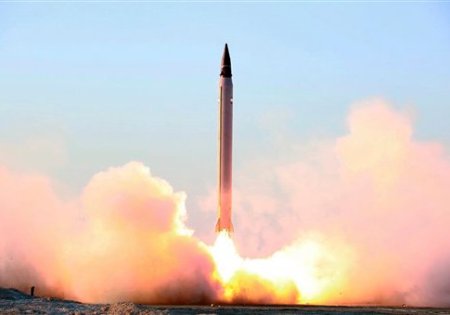
FILE - This file picture released by the official website of the Iranian Defense Ministry on Sunday, Oct. 11, 2015, claims to show the launching of an Emad long-range ballistic surface-to-surface missile in an undisclosed location. Iran tested a ballistic missile again in November 2015, a U.S. official said Dec. 8, describing the second such test since this summerís nuclear agreement. The State Department said only that it was conducting a "serious review" of such reports. The test occurred on Nov. 21, according to the official, coming on top of an Oct. 10 test Iran confirmed at the time. The official said other undeclared tests occurred earlier than that, but declined to elaborate. The official wasnít authorized to speak on the matter and demanded anonymity. (Iranian Defense Ministry via AP)

FILE – This file picture released by the official website of the Iranian Defense Ministry on Sunday, Oct. 11, 2015, claims to show the launching of an Emad long-range ballistic surface-to-surface missile in an undisclosed location. Iran tested a ballistic missile again in November 2015, a U.S. official said Dec. 8, describing the second such test since this summerís nuclear agreement. The State Department said only that it was conducting a “serious review” of such reports. The test occurred on Nov. 21, according to the official, coming on top of an Oct. 10 test Iran confirmed at the time. The official said other undeclared tests occurred earlier than that, but declined to elaborate. The official wasnít authorized to speak on the matter and demanded anonymity. (Iranian Defense Ministry via AP)

Iranian leaders now say that they are poised to walk away from the deal if the United States and other global powers fail to advance the Islamic Republic’s “national interests.”

*************************

Iran on Tuesday again threatened to walk away from the nuclear agreement reached last year with global powers, hours after the country breached international agreements by test-firing ballistic missiles.

Iran’s most recent ballistic missile test, which violates current U.N. Security Council resolutions, comes a day after the international community’s nuclear watchdog organization disclosed that it is prohibited by the nuclear agreement from publicly reporting on potential violations by Iran.

Iranian leaders now say that they are poised to walk away from the deal if the United States and other global powers fail to advance the Islamic Republic’s “national interests.”

“If our interests are not met under the nuclear deal, there will be no reason for us to continue,” Abbas Araqchi, Iran’s deputy foreign minister, warned during remarks delivered to a group of Iranian officials in Tehran.

“If other parties decide, they could easily violate the deal,” Araqchi was quoted as saying by Iran’s state-controlled media. “However, they know this will come with costs.”

Araqchi appeared to allude to the United States possibly leveling new economic sanctions as a result of the missile test. The Obama administration moved forward with new sanctions earlier this year as a result of the country’s previous missile tests.

Iran’s latest missile test drew outrage from longtime regime critics on Capitol Hill.

“The administration’s response to Iran’s new salvo of threatening missile tests in violation of international law cannot once again be, it’s ‘not supposed to be doing that,’” Sen. Mark Kirk (R., Ill.) said in a statement. “Now is the time for new crippling sanctions against Iran’s Islamic Revolutionary Guard Corps, Ministry of Defense, Aerospace Industries Organization, and other related entities driving the Iranian ballistic missile program.”

House Majority Leader Kevin McCarthy (R., Calif.) warned that the nuclear agreement has done little to moderate Iran’s rogue behavior.

“Far from pushing Iran to a more moderate engagement with its neighbors, this nuclear deal is enabling Iran’s aggression and terrorist activities,” McCarthy said in a statement. “Sanctions relief is fueling Iran’s proxies from Yemen to Iraq to Syria to Lebanon. Meanwhile, Khamenei and the Iranian regime are acting with impunity because they know President Obama will not hold them accountable and risk the public destruction of his nuclear deal, the cornerstone of the president’s foreign policy legacy.”

McCarthy went on to demand that the Obama administration step forward with new sanctions as punishment for the missile test.

Meanwhile, the U.S. State Department had difficulty Monday explaining why the nuclear agreement limits public reporting by the International Atomic Energy Agency, or IAEA, on potential deal violations by Iran.

Yukiya Amano, the IAEA’s chief, disclosed on Monday that his agency is no longer permitted to release details about Iran’s nuclear program and compliance with the deal. The limited public reporting is a byproduct of the nuclear agreement, according to Amano.

When asked about these comments again Tuesday, a State Department official told the Free Beacon that the IAEA’s reports would continue to provide a complete picture of Iran’s nuclear program, though it remains unclear if this information will be made publicly available.

“There isn’t less stringent monitoring or reporting on Iran’s nuclear program,” the official said. “The IAEA’s access to Iran’s nuclear program and its authorization to report on it has actually expanded. It’s a distortion to say that if there is less detail in the first and only post-Implementation Day IAEA report then that somehow implies less stringent monitoring or less insight into Iran’s nuclear program.”

While the IAEA “needs to report on different issues” under the final version of the nuclear agreement, the agency continues to provide “a tremendous amount of information about Iran’s current, much smaller nuclear program,” the source maintained.

The IAEA’s most recent February report—which was viewed by nuclear experts as incomplete and short on detail—“accurately portrays the status of Iran’s nuclear program,” including its efforts to uphold the nuclear deal, the official added.

“We expect this professional level of reporting to continue in the future,” the official said.

Turkey and Saudi Arabia hit back for the Obama-Putin Syrian pact

March 5, 2016

Turkey and Saudi Arabia hit back for the Obama-Putin Syrian pact, DEBKAfile, March 5, 2016

Zaman_4.3.16Headline of last issue of Turkey’s Zaman before government takeover

Turkey and Saudi Arabia have taken separate steps to break free from Washington’s dictates on the Syrian issue and show their resistance to Russia’s highhanded intervention in Syria. They are moving on separate tracks to signal their defiance and frustration with the exclusive pact between Presidents Barack Obama and Vladimir Putin which ostracizes Riyadh and Ankara on the Syrian question.

Turkey in particular, saddled with three million Syrian refugees (Jordan hosts another 1.4 million), resents Washington’s deaf ear to its demand for no-fly zones in northern and southern Syria as shelters against Russian and Syrian air raids.

Last year, President Reccep Erdogan tried in desperation to partially open the door for a mass exit of Syrian refugees to Europe. He was aghast when he found that most of the million asylum-seekers reaching Europe were not Syrians, but Muslims from Africa, Afghanistan and Pakistan, in search of a better life in the West. Most of the Syrians stayed put in the camps housing them in southern Turkey.

Even the Turkish intelligence agency MIT was hard put to explain this setback.  According to one partial explanation, organized crime gangs of Middle East dope and arms smugglers, in which ISIS is heavily represented, seized control of the refugee traffic heading to Europe from Libya, Iraq and Syria.
This human traffic netted the gangs an estimated $1 billion.

Turkey was left high and dry with millions of Syrian refugees on its hands and insufficient international aid to supply their needs. No less painful, Bashar Assad was still sitting pretty in Damascus.

Finding Assad firmly entrenched in Damascus is no less an affront for Saudi Arabia. Added to this, the Syrian rebel groups supported by Riyadh are melting away under continuing Russian-backed government assaults enabled by the Obama-Putin “ceasefire” deal’

The oil kingdom’s rulers find it particularly hard to stomach the sight of Iran and Hizballah going from strength to strength both in Syria and Lebanon.

The Turks threatened to strike back, but confined themselves to artillery shelling of Syrian areas close to the border. While appearing to be targeting the Kurdish YPD-YPG militia moving into these areas, the Turkish guns were in fact pounding open spaces with no Kurdish presence. Their purpose was to draw a line around the territory which they have marked out for a northern no-fly or security zone.

Saturday, March 5, President Erdogan proposed building a “new city” of 4,500 square kilometers on northern Syrian soil, to shelter the millions of war refugees. He again tried putting the idea to President Obama.

The Saudi Defense Minister, Deputy Crown Prince Mohammed bin Salman put together a more high-risk and comprehensive scheme. Its dual purpose is to hit pro-Iranian Hizballah from the rear and forcied [Sic] the two big powers to treat Riyadh seriously as a player for resolving the Syrian imbroglio.

The scheme hinged in the cancellation of a $4 billion Saudi pledge of military aid to the Lebanese army, thereby denying Hizballah, which is a state within the state and also dominates the government, access to Saudi funding. But it also pulled the rug from under Lebanon’s hopes for combating ISIS and Al Qaeda’s Nusra Front, which have grabbed a strip of Lebanese territory in the northern Beqaa Valley.

The Saudi action, by weakening the Lebanese military and its ability to shore up central government in Beirut, risks tipping Lebanon over into another civil war.

The London Economist commented that this Saudi step against Lebanon seems “amateurish.” Under the young prince (30), “Saudi Arabia sometimes acts with bombast and violence that makes it look like the Donald Trump of the Arab World,” in the view of the magazine.

But the Saudi step had a third less obvious motive, a poke in the eye for President Obama for espousing Iran’s claim to Middle East hegemony. Resentment on this score is common to the Saudi royal house and the Erdogan government.

As a crude provocation for Washington, the Turkish president ordered police Friday, March 4, to raid Turkey’s largest newspaper Zaman, after an Istanbul court ruling placed it under government control.

The newspaper released its final edition ahead of the raid declaring the takeover a “shameful day for free press” in the country. A group of protesters outside the building was dispersed with tear gas, rubber bullets and water cannons.

Zaman is owned by the exiled Muslim cleric Felhullah Gulen, who heads the powerful Hizmet movement, which strongly contests Erdogan government policies. A former ally of the president, the two fell out years ago. In 1999, after he was accused of conspiring to overthrow the government in Ankara, Gulen fled to the United States.

Today, the exiled cleric runs the Hizmet campaign against the Turkish president from his home in Pennsylvania, for which he has been declared a terrorist and many of his supporters arrested.

The takeover of Zaman was intended both as a blow by Ankara against Muslim circles opposed to the Erdogan regime and as an act of retaliation against the United States, for harboring its opponents and sidelining Turkey from Obama administration plans for Syria.

Oddly enough, the Turkish president finds himself in a position analogous to Egyptian President Abdel-Fatteh El-Sisi, who is at war with the Muslim Brotherhood, a movement which enjoys Obama’s support.

Israeli Prime Minister Binyamin Netanyahu has his own dilemmas. Struggling to keep his balance while walking a tight rope on the Syrian situation between Israel’s longstanding ties with Washington and handling the Russian tiger lurking next door, he is in no hurry to welcome Erdogan’s determined overtures for the resumption of normal relations.

Turkey is in trouble with both major world powers and, after living for five years under hostile abuse from Ankara, Israel does not owe Erdogan a helping had for pulling  him out of the mess.

Palestinians: The Right Time to Take Big Steps?

March 4, 2016

Palestinians: The Right Time to Take Big Steps? Gatestone InstituteBassam Tawil, March 4, 2016

♦ Despite the “official” surveys taken among Palestinians, which show support for Hamas, the residents of the West Bank are terrified that Hamas will gain control and destroy our lives and property, the way they did in the Gaza Strip.

♦ The BDS organizations are trying to boycott products made in the West Bank, which only throws masses of Palestinians out of good jobs in an effort to force Israel into a hasty withdrawal that has no chance of taking place. The Israelis and everyone else remember all too well that the last Israeli withdrawals — from southern Lebanon and the Gaza Strip — led to the terrorist takeover of the vacuums created.

♦ Ikrima Sabri, the former Mufti of Jerusalem, often said that Palestinians were better off with the Jews in charge of Al-Aqsa mosque and Jerusalem, because in the future they could be removed and killed off, but if the Crusaders returned to Jerusalem — such as an international commission headed by the French — it would be harder to get rid of them.

During a visit to Berlin, German Chancellor Angela Merkel told Israel’s Prime Minister Benyamin Netanyahu that now is not time to move forward with the “two-state solution” and the establishment of a Palestinian state.

Merkel, evidently seeing Israel as a dam protecting Europe from Islamist extremists, told Netanyahu that while the Germans recognized the terrorist threat faced by Israel, and that a peace process had to be advanced based on two states for two peoples, now was not the right time to take big steps.

1494Agreed: It’s not a good time to establish a Palestinian state. Pictured: Israeli Prime Minister Benjamin Netanyahu and German Chancellor Angela Merkel address a press conference in Berlin, Germany, on February 16, 2016. (Image source: Israel Government Press Office)

The Palestinians living in the Gaza Strip are well aware that they are hostages of the terrorist organizations, in particular Hamas. Jibril Rajoub, a senior official in the Palestinian Authority (PA), told Al-Jazeera TV the same thing just last week.

The Palestinians in the West Bank, regardless of public declarations, also secretly support security collaboration with Israel, which protects us from radical Islamist terrorism. Therefore, despite the “official” surveys taken among Palestinians, which show support for Hamas, the residents of the West Bank are terrified that Hamas will gain control and destroy our lives and property the way they did in the Gaza Strip. We do want a Palestinian state, but one that will preserve the lifestyle and accomplishments we have built over the years — not a state that will have them fall to the horrors of Hamas and ISIS.

In light of the quiet, passive public support for the regime of Mahmoud Abbas, Hamas is inciting Palestinians against it. Hamas, in an attempt to overthrow the Palestinian Authority, is portraying Abbas’s security forces as traitors who transmit information to Israel.

Like Germany — and unlike Sweden and France — Britain has recently instituted a more balanced policy. The UK has begun to fight the anti-Israel BDS (Boycott, Divestment and Sanctions) organizations. Matthew Hancock, Britain’s Minister for the Cabinet Office, who coordinates activities between various government ministries, is advancing protocols to prevent the ongoing boycotts by the British establishment.

These BDS organizations are trying to boycott products made in the West Bank, but the boycott only throws masses of Palestinians out of good jobs and great benefits in an effort to force Israel into a hasty withdrawal that has no chance of taking place. The Israelis and everyone else remember all too well that the last Israeli withdrawals — from southern Lebanon and the Gaza Strip — were nothing more than case-studies for the terrorist takeover of the vacuums created, exactly the same way as the U.S. withdrawal from Iraq made room for the Islamic State (ISIS).

As Palestinians we know that the BDS may or may not harm Israel, but it does untold damage to the Palestinians who support their families by working in the settlement factories and would otherwise be unemployed and then, as a scarcity of jobs will have been created, hired by various terrorists. When the SodaStream factory moved out of the West Bank, 500 Palestinians lost their well-paid jobs.

In view of the current U.S. helplessness in dealing with the Russians, Iranians and Syrians, the Obama administration has now chosen to bare its fangs at Israel. Despite what are apparently his predictable personal objections, U.S. President Barack Obama is expected to sign into law the Trade Facilitation and Trade Enforcement Act, which includes anti-BDS provisions. It introduces new policy language by including all “Israeli-controlled territories” as part of Israel. Meanwhile, the American customs authority is still continuing to enforce a 20-year-old law, marking products made in the West Bank and hurting Palestinians. Labeling products hurts the Palestinians, who then are driven look for work in the eager arms of the terrorist organizations radicalizing the region.

The French, as usual, slither and shift. A number of months ago, they tried to build up steam for an international commission of inquiry into the Al-Aqsa mosque. Both the Israelis and the Palestinians objected.

Ikrima Sabri, the former Mufti of Jerusalem, often said that Palestinians were better off with the Jews in charge of Al-Aqsa mosque and Jerusalem, because in the future they could be removed and killed off, but if the Crusaders returned to Jerusalem through the back door — such as an international commission headed by the French — it would be harder to get rid of them.

The French, fearing for their lives at the hands of their own local Islamist enclaves, are in dire straits and doggedly try one maneuver after another to appease them. In desperation, they have proposed peace negotiations for the Palestinians and Israel “with international mediation.” They even brazenly suggested that if the negotiations failed, they would recognize the Palestinian state. The outcome is written on the wall: the Palestinians, who will have no reason to negotiate, will fall over themselves rushing to the conference, then automatically veto every proposal or possible compromise, and then receive the promised recognition of Palestine.

The French are masters of diplomatic flimflam: on the one hand, they will do anything to appease their own Islamists at the expense of Israel, and on the other, they know full well neither Israel nor any other Western country will accept their self-serving suggestion. The French keep revealing their duplicity again and again. They refuse to designate Iranian-backed Hezbollah as a terrorist organization; they instead call it a “political party,” despite its full participation in slaughtering Sunni Muslims in Syria. Hezbollah is also one of the main actors pushing the countless asylum-seekers (and occasional ISIS operative) flooding Europe, Turkey and Jordan.

The atrocities committed today in the Middle East are the direct result of the refusal of Europe (including France) and the United States to intervene, and the stunning silence of the Arab states. Unwilling to fight ISIS, they are more than willing to condemn, slander and criticize Israel, while the Middle East slips into anarchy.

The result for us Palestinians will be bloodletting, either in the Hamas-Fatah rivalry, or as collateral damage in the Israelis’ war against Islamist terrorism, or, when the Palestinian Authority falls, at the hands of ISIS and Al-Qaeda and the Al-Nusra Front as they sweep through the Jordan Valley on their way to attack Israel.

Al-Jazeera TV is also trying to serve its master, Qatar, radicalize the Palestinians by saying that the Palestinian Authority’s security coordination with Israel, which benefits everyone here by keeping out Islamic terrorists, is betraying the Palestinian cause. In addition, Israeli intelligence, by saying that a seaport for Hamas should be built is, for some mysterious reason, trying to kill off the Palestinian Authority by strengthening Hamas. Both the Egyptians and we Palestinians — and even the Israelis — do not need Hamas strengthened at our expense. Hamas and the many other extremist organizations that have infiltrated the Gaza Strip, including ISIS, are what enable Israelis to justify their security concerns as well as those regarding peace negotiations with the Palestinians, and that prevent a withdrawal from the West Bank. Given the current situation in the Middle East, Angela Merkel was correct. It is not the right time now to take big steps.

Off Topic | Deserve Hillary? Then vote for her

March 3, 2016

Deserve Hillary? Then vote for her, Dan Miller’s Blog, March 3, 2016

(The views expressed in this post are mine and do not necessarily reflect those of Warsclerotic or its other editors. — DM)

Democrats have done a bang up job for their people for the last fifty years. Want more of the same? Vote for Hillary.


How about Mit Romney? Surely, he must be right. After all, the proud godfather of ObamaCare did so well in 2012. His part of the video starts at 23:00.


So, all of you RINOs who prefer Hillary to Trump, have at it. Heck, with the RINOs and the Dems in charge, the country will stay in the very best of hands.


How American Soldiers Used Pig’s Blood and Corpses to Fight Muslim Terrorism

February 26, 2016

How American Soldiers Used Pig’s Blood and Corpses to Fight Muslim Terrorism, Front Page Magazine, Daniel Greenfield, February 26, 2016

(Wouldn’t that suggest that terrorists are Muslims? Unthinkable! — DM)

mn


A century before American soldiers fought Muslim terrorism in the Middle East, they fought it in the Philippines. Their attackers were Moro Muslims whose savage fanaticism appeared inexplicable. A formerly friendly Muslim might suddenly attack American soldiers, local Muslim rulers promised friendship while secretly aiding the terrorists and the yellow left-wing press at home seized on every report of an atrocity to denounce American soldiers as murderers whose honor was forever soiled.

Much of what went on in that conflict, including the sacrifices of our soldiers, has been forgotten. The erasure has been so thorough that the media casually claims that the American forces did not use pig corpses and pig’s blood to deter Muslim terrorists. Media fact checks have deemed it a “legend”.

It’s not a legend. It’s history.

The practice began in the Spanish period. A source as mainstream as the New Cambridge History of Islam informs us that, “To discourage Juramentados, the Spaniards buried their corpses with dead pigs.”

Juramentados was the Spanish term for the Muslim Jihadists who carried out suicide attacks against Christians while shouting about Allah. American forces, who had little experience with Muslim terrorists, adopted the term and the Spanish tactics of burying Muslim terrorists alongside dead pigs.

It was a less sensitive age and even the New York Times blithely observed that, “The Moros, though they still admire these frenzied exits from the world, have practically ceased to utilize them, since when a pig and a man occupy a single grave the future of the one and the other are in their opinions about equal.”

The New York Times conceded that the story “shocked a large number of sensitive people,” but concluded that, “while regretting the necessity of adopting a plan so repugnant to humane ideas, we also note that the Moros can stop its application as soon as they choose, and therefore we feel no impulse either to condemn its invention or to advise its abandonment. The scheme involves the waste of a certain amount of pork, but pork in hot climates is an unwholesome diet, anyhow, and the less of it our soldiers and other ‘infidels’ in the Philippines have to eat the better for them.”

Colonel Willis A. Wallace of the 15th Cavalry claimed credit for innovating the practice in March 1903 to dissuade the Muslim terrorist who believed that “every Christian he kills places him so much closer in contact with the Mohammedan heaven.”

“Conviction and punishment of these men seemed to have no effect,” Colonel Wallace related. After a “more than usually atrocious slaughter” in the marketplace, he had the bodies of the killers placed on display and encouraged “all the Moros in the vicinity who cared to do so to come and see the remains”.

“A great crowd gathered where the internment was to take place and it was there that a dead hog, in plain view of the multitude, was lifted and placed in the grave in the midst of the three bodies, the Moro grave-diggers themselves being required to do this much to their horror. News of the form of punishment adopted soon spread.”

“There is every indication that the method had a wholesome effect,” Colonel Wallace concluded.

Colonel Wallace was certainly not the only officer to bury pigs with Muslim terrorists in the Philippines, though he was apparently the only one to discuss it in such great detail.

Medal of Honor winner Colonel Frank West buried three pigs with three Muslim terrorists after the murder of an American officer. He appears to have done so with the approval of General Perishing. Some stories mention Colonel Alexander Rodgers of the 6th Cavalry becoming so celebrated for it that he was known to Moro Muslims as “The Pig”. One contemporary account does describe him burying a pig with the corpse of a Muslim terrorist who had murdered an American soldier.

Rear Admiral Daniel P Mannix III had contended that, “What finally stopped the Juramentados was the custom of wrapping the dead man in a pig’s skin and stuffing his mouth with pork”.

Media fact checks have claimed that General John “Black Jack” Perishing would not have offended Muslims by authorizing such a course of action and that any claims of his involvement are also a legend.

General Perishing however wrote in his autobiography that, “These Juramentado attacks were materially reduced in number by a practice that the Mohamedans held in abhorrence. The bodies were publicly buried in the same grave with a dead pig. It was not pleasant to have to take such measures, but the prospect of going to hell instead of heaven sometimes deterred the would-be assassins.”

We can be certain then that the practice of burying Muslim terrorists with pigs was indeed real and fairly widespread. Was pig’s blood also used on Muslim terrorists as a deterrent to prevent attacks?

The Scientific American described just such an event. In a hard look at the area, it wrote of a place where, “Polygamy is universally practiced and slavery exists very extensively. Horse stealing is punishable by death, murder by a fine of fifty dollars. The religion is Mohamedan.”

A Muslim terrorist, the magazine wrote, “will suddenly declare himself ‘Juramentado’, that is inspired by Mohammed to be a destroyer of Christians. He forthwith shaves his head and eyebrows and goes forth to fulfill his mission.”

The Scientific American described how a Muslim terrorist who had disemboweled an American soldier was made an example of. “A grave was dug without the walls of the city. Into this the murderer was unceremoniously dropped. A pig was then suspended by his hind legs above the grave and the throat of the animal cut. Soon the body lay immersed in gore… a guard stood sentry over the grave until dusk when the pig was buried side by side with the Juramentado.”

“This so enraged the Moros that they besieged the city. Matters became so grave that General Wood felt called upon to disperse the mob resulting in the death of a number of Moros.”

It is clear from these accounts which encompass General Perishing’s autobiography, the New York Times and the Scientific American that the use of pig corpses and pig’s blood in the Philippines was not a legend, but fact. It was not carried out by a few rogue officers, but had the support of top generals. It was not a single isolated incident, but was a tactic that was made use of on multiple occasions.

American forces in the Philippines faced many of the same problems that our forces do today. But they were often free to find more direct solutions to them. When Muslim rulers claimed that they had no control over the terrorists whom they had sent to kill Americans, our officers responded in kind.

“Shortly after General Bates’ arrival on the island, the Sultan sent word that there were some half dozen Juramentados in Jolo over whom he had no control. General Bates replied, ‘Six hundred of my men have turned Juramentado and I have no control over them.’”

Another version of this story by Rear Admiral Mannix III had Admiral Hemphill dispatching a gunboat to shell the Sultan’s palace and then informing him that the gunboat had “turned Juramentado”. As with pig corpses and blood, such blunt tactics worked. Unfortunately political correctness makes it difficult to utilize them today. And political correctness carries with it a high price in American lives.

It is important that we remember the real history of a less politically correct time when American lives mattered more than upsetting those whom the New York Times deemed “sensitive people” and what another publication dismissed as the “sensitive spirit” of the Muslim terrorist.

But as that publication suggested, “It is not necessary to go into spasms about the insult to the Mahometan conscience. Every Christian that walks the earth is a living insult to that ‘sensitive spirit’”.

“The murderer may feel that he is unduly treated by being defiled with the touch of the swine, but he can avoid it by refraining from becoming a practical Juramentado. Our sympathies, if anywhere, are with the innocent pig slaughtered for such a purpose and buried in such company.”

These days we do not bury pigs with Muslim terrorists. Our political and military leaders shudder at the thought of Muslims accusing us of blasphemy. And so instead we bury thousands of American soldiers.

Fundamentalists and Revolutionary Guards steal Iran’s elections

February 26, 2016

Fundamentalists and Revolutionary Guards steal Iran’s elections, DEBKAfile, February 26, 2016

Rafsanjani_RouhaniOpposition leaders to Khamenei Hashemi Rafsanjani (l.) and President Hassan Rouhani

US President Barack Obama and Secretary of State Kerry fondly hoped that the nuclear agreement signed with Iran would bring to the surface a new type of leader – more liberal and less liable to restart the nuclear program – in the twin elections taking place in the Islamic Republic Friday, Feb. 26.

They are in for a disappointment, say DEBKAfile’s Iran analysts.

But one change is almost certain. The Iranian voter will be choosing for the first time on one day a new parliament (Majlis) and the Assembly of Experts, the only body competent to choose the republic’s next supreme leader. The incumbent, 75-year-old Ayatollah Ali Khamenei, is not expected to outlast the four-year term of the next Assembly of Experts. He has been struggling with prostate cancer for more than five years. Treatment and surgery have failed to halt its spread to other parts of his body. And strong medication is necessary to keep him looking alert and vigorous in his public appearances.

Speculation is already rife in Tehran about who the next Assembly of Experts will choose as his successor.

Seen from the perspective of Iran’s Islamic regime, the supreme leader’s overarching duty is to continue the legacy of its revolutionary founder, Ayatollah Ruhollah Khomeini and his successor, Ali Khamenei.

Rather than meeting the expectations of the US president, his main job is to continue strengthening Iran on its path of religious extremism, ideological subversion, export of the Shiite revolution (by terror) and the continuation of the nuclear program.

The biggest political bombshell of the election campaign was a proposal by former President Hashemi Rafsanjani to establish a national leadership council now, instead of choosing a new leader later. This was intended to replace the single dictatorial rule of the supreme leader by a collective leadership.

Iran’s fundamentalists, especially the powerful Revolutionary Guards Corps (IRGC), were in uproar about a proposal they viewed as so dangerous for the regime that they threatened to confiscate the Rafsanjani clan’s extensive property and put him on trial for corruption and fraud.

His beloved son Mahdi has already been in jail for months on those charges.

But Rafsanjani is not easily cowed. He knew that if he backed down, the extremists would crack down on him still harder.

So this week, he announced that he had pulled the strings which gave Hassan Rouhani victory in the last presidential election. And, in the campaign leading up to the Assembly of Experts vote, he threw his support behind a moderate cleric, Hassan Khomeini, who happens to be the grandson of the Islamic regime’s iconic founder.

The IRGC and radical mullahs thereupon launched an offensive to thwart what they believed to be Rafsanjani’s dangerous plan to establish a triumvirate with Rouhani and Khomeini Junior to head a future government.

Senior radical clerics, such as ayatollahs Ahama Alam-Alhoda, Mohammad Mesbah-Yazdi, Ahmad Jannati, and Mohammad Yazi, slandered him and fought to remove his candidates for the twin slates.

They branded the former president and members of a “reformist” list as British agents, a particularly malicious charge because the UK is still seen in Iran as a symbol of colonialism and meddler in foreign politics.

Ayatollah Khamenei himself harshly denounced “foreign agents” as “addicted to foreign influence,” who should be barred from the Assembly of Experts.

Young Khomenei saw the light and withdrew his candidacy for its membership. But Rafsanjani stood out to the last as a central figure in the two campaigns, even after a majority of the candidates condemned as “moderates and reformists” were barred from the elections.

In the end, the two slates were left with no more than 30 moderate candidates out of a total of 3,000 vying for the 375 seats in the two bodies.

Their defeat as a group was predestined, and the two elections leave Iran more politically and religiously radicalized than before.

A key figure expected to take center stage in the new parliament is Gholam-Ali Haddad-Adel, whose daughter is married to Khamenei’s mover-and-shaker son. Another is Haddad-Adel, one of Khamenei’s top advisers, who heads a faction of religious fundamentalists and IRGC officers. He is the frontrunner to succeed Ali Larijani as Speaker of the next Majlis.

They are all expected to gang up to prevent President Rouhani from running for a second term when it runs out in two years – contrary to the Obama administration’s hopes. They will also do their best to make him a lame duck and whipping boy for all the country’s economic ills for the remainder of his presidency.

He will find the new parliament less cooperative than the outgoing House under Larijani when he tries to introduce liberal policies.

Unofficial results of the two elections are expected to be released Friday night. The extremists and hardliners have engineered them so that they will win big and set Iran on a course that it is even more radical than before on such key issues as its nuclear weapons program and intervention in Syria and other Middle East conflicts. They will keep the feud with Saudi Arabia alive and pursue every possible means of venting their bottomless hatred of Israel and seeking its destruction.

Immigration or an IPhone

February 25, 2016

Immigration or an IPhone, Front Page Magazine, Daniel Greenfield, February 25, 2016

male-refugees

The public argument between Apple and the FBI over cracking the encryption on an iPhone used by the San Bernardino Muslim terrorists is one of those ongoing civil liberties debates that negotiate the terms on which we are asked to sacrifice our civil liberties for the sake of Muslim immigration.

We have already made a thousand accommodations and we will make a thousand more. There will be more databases, naked scanners, eavesdropping, vans that can see through walls, backdoors to every server, registrations, warrantless searches, interceptions and regulations. There will be heavily armed police on the streets. And then curfews and soldiers. These things exist in Europe. They’ll come here.

Some libertarians will argue that we should have none of this and no restrictions on immigration. That we should just shrug off each terror attack and move on with our lives.

Eventually though there will be a terror attack that we can’t shrug off and that can’t be minimized by using the cheap statistical trick of comparing Terror Attack X to the number of people who die every year from cancer. Or there will just be an endless parade of daily attacks, bombings, stabbings or shootings, as in Israel, which create a constant climate of terror that will preclude any hollow rhetoric about the number of people falling off ladders each year or getting struck by lightning.

Some hawks will cheer every terror fighting measure short of closing the door on the root cause of the problem. They would rather see every American wiretapped, strip searched and monitored every hour of the day then just stop the flow of Muslim terrorists into this country.

The encryption methods of an iPhone, like the question of how many ounces there are in your tiny bottle of mouthwash, would not be much of an issue, if Muslim migration did not make it one.

Terrorists adapt to the terrain. They use the native population as protective coloration. They can find a way to transform a shoe, a tube of toothpaste or instant messaging on a game console into a terror tool. Just as the left can ‘politicize’ everything, Muslim terrorists can ‘terrorize’ everything. When everything is a potential terrorist tool, then there can be no such thing as privacy or civil rights.

Muslim immigration is forcing us to constantly choose between our lives and our civil liberties. It’s a Catch 22 decision with no good choices. Terrorists push governments toward totalitarianism so that their own alternative totalitarian state starts to seem like a less terrible alternative. But the refusal to fight terrorism also makes the totalitarian state of the terrorists more viable.

With every Muslim terror attack, successful or only attempted, they win and we lose. The pressure of terror attacks discredit Western ideologies and worldviews, both on the right and the left. Each attack helps generate new converts for Islam and more political influence for Islamist organizations.

Vociferous debates over the choice between civil liberties and security make it seem as if we have to choose between our worldviews because something in our society is the problem. It isn’t.

We do not have an American terror network problem. The Amish aren’t using iPhones or obscure apps to coordinate terror attacks. We have a Muslim terror network problem. It’s not because of the Methodists that we have to weigh our mouthwash or take our shoes off and put them in a greasy plastic tray at the airport. It’s because 19 Muslims entered this country, hijacked our airplanes and murdered thousands of Americans. Guantanamo Bay is not an issue because Buddhists are at war with America. It’s an issue because Muslim terrorists are at war with America.

We do not have an iPhone encryption problem or a shoe problem or a mouthwash problem. We have a Muslim terror problem.

Whatever decision is made about iPhone encryption will not be the last word. The simple reality is that privacy carries too high a price as long as we have large numbers of people in this country who want to kill us in equally large numbers. If we want our privacy back, it’s not the FBI that is standing in our way. It’s the religious organizations that are paid to bring Muslim “refugees” to this country. It’s the liberal, libertarian and even conservative voices that think there is something wrong with pausing the mass migration of the group that is disproportionately responsible for our terror problem. It’s the media that would rather discuss anything and everything than discuss the problem we are really dealing with.

The source of this problem is not whether the FBI handled the iPhone correctly or whether Apple should be obligated to build a way for law enforcement to access its devices. These arguments would exist even without Muslim terrorism, but they would lack the same level of life and death urgency.

This is not an iOS problem. It’s an immigration problem.

The San Bernardino massacre by Muslim terrorists would not have happened without Muslim immigration. The security flaw here was not in the work of FBI agents or of Apple programmers, but of our immigration laws. Just as we cannot and will not intercept every single Muslim terrorist who finds a way to hide explosives in his underwear, shoes, soda or laptop, we will not ever be able to crack every single encrypted Muslim terrorist device. And their underwear bombs and encrypted iPhones would not be an issue if we did not have Muslim terrorists in America in the first place.

Instead of discussing the Islamic root cause, we put stress on our own competing institutions, technology providers face off with law enforcement, hawks and civil libertarians berate each other as if they were each part of the threat. But we are not the problem here. They are the problem.

The only backdoor that should be at issue here is the one that Muslim terrorists use to enter America. We don’t need to violate everyone’s rights to close it. We just need the political will to do the common sense thing and shut down the source of the threat. Either that or give up on our privacy.

Our choice is very simple. We can have external security or an internal police state. But neither of the above is not an option. We can have open borders that fill our country with criminals, but that means that eventually any livable middle class neighborhood will have a cop on every corner. We can have airport security for the people coming into this country. Or we can have airport security for everyone.

Ongoing Muslim migration makes a police state inevitable. But to avoid the perils of profiling and the appearance of discrimination, it will be a universal police state that will strip away rights from everyone without regard to guilt or innocence in the hopes of averting the next Muslim terror attack.

The only way to protect our lives and our freedoms from Muslim terrorism and its consequences is by shutting down Muslim immigration. If we fail to do this, then we will lose our lives and our liberties.

Canadian PM: ‘Islam is compatible with secular West’

February 22, 2016

Canadian PM: ‘Islam is compatible with secular West’, Israel National News, Ari Yashar, February 22, 2016

Canadian Prime Minister Justin Trudeau of the Liberal Party has already made a number of eyebrow-raising statements since taking office last November, but on Sunday CIJ News revealed yet another questionable sentiment he raised twice in TV interviews in recent months.

In the two interviews, both with CBC, Trudeau insisted that Islam is “not incompatible with the Western secular democracy.”

In the most recent interview on January 31, he said “we need to make sure that we’re working with communities like the Muslim community, for example, to demonstrate that Islam is not incompatible with free and open Western societies.”

The statement echoed his words from another interview last November 24, when he said, “Canadians are quick to point out that ISIS is wrong, that Islam is not incompatible with the Western secular democracy, a free place like Canada.”

CIJ News went further in documenting the trend by pointing out a video message from Trudeau to the annual Reviving the Islamic Spirit convention at the Metro Toronto Convention Center last December 25-27.

In the message, Trudeau said the convention “is also about celebrating our shared beliefs in justice, fairness, equality of opportunity and acceptance. The work you do in communities across the country is what builds and strengthens our multicultural fabric.”

Trudeau’s stance towards the Islamic world has been raising question marks. Last Tuesday he was grilled in parliament for proposing to give UNRWA $15 million despite its well-documented ties to the Hamas terrorist organization in Gaza, and largely ignored the question on the topic.

In more questionable behavior vis-a-vis Hamas, Trudeau appointed Omar Alghabra as Parliamentary Secretary to the Minister of Foreign Affairs; Alghabra was previously the head of the radical Canadian Arab Federation (CAF), which ran afoul of the state for its open support of Hamas.

Last month amid heavy concerns that jihadists and rapists have infiltrated the massive influx of migrants from the Middle East to the West, Trudeau defended his policy of mass immigration, saying he is confident in people who “don’t think a lot about politics, don’t think a lot about terrorism.”

Palestinians: Kerry and the Game of Obfuscation

February 22, 2016

Palestinians: Kerry and the Game of Obfuscation, Gatestone InstituteKhaled Abu Toameh, February 22, 2016

♦ “intifada” is simply a further phase in a larger plan to destroy Israel. When the plan began officially, with the establishment of the PLO in 1964, there were no “settlements” — not until after the June 1967 War — so what exactly were the Palestinians planning to “liberate”?

♦ The current conflict is not about “defending” any mosque from being contaminated by the “filthy feet” of Jews: it is about seeing Israel forced to its knees. Abbas and others seek to reap delicious political fruits from this “intifada.”

♦ Here is a novel idea: Kerry could put pressure on the Palestinian and Jordanian leadership to cease anti-Israeli incitement and indoctrination. Now that would be pressure well applied.

♦ Abbas is expected to become a partner in the fight against ISIS and radical Islamist groups. All well and good. Why then is he not expected to stop cheering on and glorifying young Palestinians who attack Jewish Israelis?

U.S. Secretary of State John Kerry is back in town. This time he is meeting with Jordanian and Palestinian leaders about “ongoing security issues in the region and continued tensions between Israel and the Palestinians.”

For those not involved in political newspeak, here is a translation:

“Ongoing security issues” = the Islamic State terror group (ISIS).

“Tensions between Israel and the Palestinians” = the ongoing wave of Palestinian stabbing, car-ramming and shooting attacks that began in October 2015.

Jordan and the Palestinian Authority (PA) fighting ISIS? Now that’s an idea! Jordanian King Abdullah and PA President Mahmoud Abbas ending “tensions” between Israel and the Palestinians? Let’s think about that.

Kerry comes back, but never calls a spade a spade. The “tensions” to which he deceptively alludes are knifings and car-rammings. And what is the biggest spade that Kerry avoids calling by its name? The new generation of Palestinians brainwashed to believe that Israel can be defeated with knives and car-attacks.

This “intifada” is simply a further phase in a larger plan to humiliate and destroy Israel. This plan began officially, with the establishment of the Palestine Liberation Organization (PLO), in May 1964. At that time there were no “settlements” — not until after the June 1967 War — so what exactly were the Palestinians planning to “liberate”?

The plan continued in 1974, at the twelfth session of the Palestinian National Council in Cairo, with the 10-point “Phased Plan” (see Appendix below for full text of the Phased Plan). Article 2 called for “armed struggle” (terrorism) to establish “an independent combatant national authority” that is “liberated” from Israeli rule.

Contrary to Palestinian leaders’ pap, the current conflict is not about “defending” any mosque from being contaminated by the “filthy feet” of Jews: it is about seeing Israel forced to its knees. Abbas and others seek to reap delicious political fruits from this “intifada.”

That is why, in his meeting with Kerry, Abbas made it clear that he intends to pursue unilateral moves to impose a solution on Israel, with the help of the international community.

Abbas also told Kerry that he intends to continue with his efforts to seek a UN Security Council resolution condemning Israel over “settlement construction.”

Never mind that on Palestinian maps, all of Israel is regarded as one big “settlement.”

1271Palestinian Authority leaders, official television, schools and media outlets often display maps showing Palestine stretching from the River Jordan to the Mediterranean Sea. The maps do not show the existence of Israel.

But back to Kerry. His “tensions” imply two sides engaged in some kind of a dispute that has aggravated a situation and strained relations between them, instead of what it really is: Palestinians openly trying to supplant Israelis — the entire state.

So the game of obfuscation continues. No doubt, we will witness more pressure on Israel to make concessions that will supposedly ease the “tensions.”

Kerry and his friends either do not “get it” or do not want to “get it.” Palestinians are waging an out-and-out war against Israel with the goal of making Israelis suffer to a point at which they will beg their leaders to capitulate. In the Palestinian view, such behavior pays off royally.

It is a Palestinian commonplace that the two previous uprisings — in 1987 and 2000 — brought major achievements to the Palestinians.

The first “intifada” led to Israel’s recognition of the PLO as the “sole legitimate representative of the Palestinians” — a move that was followed by the signing of the Oslo Accords and the creation of the Palestinian Authority.

The second “intifada,” the Palestinians argue, led to Israel’s full withdrawal from the Gaza Strip in the summer of 2005.

And so we arrive at the newest wave of attacks. As the saying goes: Step-by-step.

Kerry would like to see an end to the Palestinian attacks on Israeli Jews. The only problem is that his vacuous rhetoric prevents him from having a snowball’s chance in a Middle Eastern summer from attaining that goal.

Let us also not underestimate Palestinian Authority rejectionism. On the eve of the Kerry-Abbas meeting, Palestinian Authority officials were quoted as saying that they did not expect anything positive to come out of the talks “because the U.S. remains biased in favor of Israel.”

As always, the Palestinian stance is, “My way or the highway.”

Moreover, Kerry is dreaming if he thinks that President Mahmoud Abbas or King Abdullah are able to stop the attacks on Israelis. Neither has the mandate or the credibility to do so. In any case, they and their media outlets are too busy with their anti-Israeli ranting to do much on that score.

Thus far, not a word has been uttered by either of the two Arab leaders that could be even vaguely interpreted by their people as “stop killing Israelis.” In the Palestinian Looking Glass, it is Israel that is responsible for the deadly attacks. After all, claims that are untrue about Israelis “storming and desecrating the Al-Aqsa Mosque and other Islamic holy sites” are provocative, to say the least.

Here is a novel idea: Kerry could put pressure on the Palestinian and Jordanian leadership to cease anti-Israeli incitement and indoctrination. Now that would be pressure well applied. And it does not even require funding.

President Abbas is expected to become a partner in the fight against ISIS and radical Islamist groups. All well and good. Why then is he not expected to stop cheering on and glorifying young Palestinians who attack Jewish Israelis?

When Kerry and his crew finally wake up to the fact that it is precisely this incitement that is driving Palestinians into the open arms of ISIS, Hamas and other terror groups, perhaps, finally, we will be able to hope for “easing tensions in the region.”

Meanwhile, Kerry is back blathering about peace in the Middle East. Unfortunately, he seems incapable of calling a spade a spade — especially when that spade’s name is Palestinian prevarication.

What to Expect in Iran

February 22, 2016

What to Expect in Iran, Gatestone InstituteJagdish N. Singh, February 22, 2016

♦ “The destruction of Israel is non-negotiable.” — Mohammad Neza Naghdi, Commander of Iran’s Basij paramilitary force.

♦ Sanctions relief will mainly benefit Ayatollah Khamenei and members of the Revolutionary Guards: they control up to one-third of Iran’s economy.

♦ Part of the Iranian regime’s grand strategy is to inflict “death to America” and replace it with its own radical version of Islamic governance. Ayatollah Khamenei himself called for America’s destruction amid nuclear negotiations.

♦ Officials also believe Iran is indirectly funding the Islamic State (IS) in the Sinai. “Suitcases of cash” are sent directly to Hamas officials in the Gaza Strip; part of the money is then transferred to IS.

♦ Iran now poses an even greater threat. If democracies today continue their present policies towards Iran, it will only embolden Iran’s regime to continue its quest to obtain nuclear weapons as well as its terrorism and human rights violations.

Humanity seldom seems to learn its lessons. The governments of the world’s leading democracies appear to be suffering from this predicament in their nuclear dealings with the Islamic Republic of Iran. To avoid catastrophe, democracies need quickly to correct their course.

One of the fatal blunders of Western democracies is their repeated commitment to appeasing and delaying action against aggressive regimes. Between the two World Wars, despite plenty of evidence of the widely-declared global racist agenda of Germany’s Adolf Hitler, democratic powers waited to take action until it was too late. Hitler was able to carry out a genocide that continues to haunt many nations.

Today, Western democratic governments, with their Eastern counterparts such as India, seem on a similar course in dealing with the Islamic Republic of Iran.

The domestic and international agenda of the Khomeinist government is publicly documented. Since the Iranian Revolution of 1979, part of the regime’s open grand strategy is to inflict “death to America,” the leader of the free world, and replace it with its own radical version of Islamic governance. Under the current Supreme Leader Ayatollah Ali Khamenei and his Islamic Revolutionary Guards Corps (IRGC), Iran has been gaining influence across the Middle East, Latin America, the Caribbean and South Asia. Despite nuclear talks with the West, Iran’s goal of “death to America” remains. The Ayatollah himself even called for America’s destruction amid nuclear negotiations.

Currently, Iran is a major player in aiding the autocratic regime of Basher al-Assad in Syria, the Houthis in Yemen, Hezbollah in Lebanon, Palestinian Islamic Jihad and Hamas in the West Bank and Gaza and the Islamic State (IS) in Egypt’s Sinai Peninsula.

To advance its imperial agenda, Iran has proceeded to develop its conventional and nuclear ballistic missile program. According to Director of National Intelligence James Clapper, Iran has “one of the largest inventories of ballistic missiles in the Middle East.”

In line with Iran’s missile development program, Iran’s Revolutionary Guard Navy Rear Commander, Ali Fadavi, announced: “Based on the fifth five-year plan, we should materialize our objective of mass-producing military speedboats with the speed of 80 knots per hour… and are equipped with missiles with a range of 100km; the vessels no one can catch.”

Aside from its military aspirations, since the fall of the Shah in 1979, successive Iranian governments have voiced their plans to annihilate the State of Israel, the only pluralist democracy in the Middle East, and an effective military deterrent to Iran’s designs in the region.

Hostile messages have been pouring forth from Iran. Mohammad Neza Naghdi, Commander of the Basij paramilitary force, stated in clear terms in April 2015, that, “The destruction of Israel is non-negotiable.”

Major General Yahya Rahim Safavi, a former IRGC commander and a top military aide to Khamenei, warned in May 2015, that “More than 80,000 missiles are ready to rain down on Tel Aviv and Haifa.”

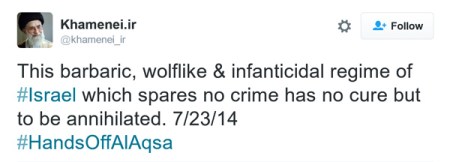
As late as November, Iran’s Supreme Leader Khamenei himself tweeted, “This barbaric, wolflike & infanticidal regime of #Israel which spares no crime has no cure but to be annihilated.”
1477

Bewilderingly, Western democracies have chosen to overlook Iran’s speeches and actions. They chose instead to appease the regime. Last July, despite genuinely serious reservations expressed by international strategic and military experts (including retired American military officers), the United States, United Kingdom, France and Germany – the four democracies in the P5+1 — concluded a nuclear deal with themselves that they proposed to Iran. Iran so far has not signed the deal, and apparently even if it did, according to the U.S. Department of State, the deal would not be legally binding.

Tehran will greatly benefit financially from the terms of the nuclear agreement in the months to come. Under the administration of President Barack Obama, nuclear sanctions against Iran have been lifted. To advance the deal and make it more appealing to Iran, the president has also agreed to pay Iran a $1.7 billion settlement for $400 million in “frozen” assets held in the United States since 1981.

The Society for Worldwide Interbank Financial Telecommunication (SWIFT), “the electronic bloodstream of the global financial system,” had disconnected 15 Iranian banks from its system in 2012. after coming under pressure from both the United States and the European Union at the height of efforts to curb Iran’s nuclear ambitions. Today, SWIFT is ready to let those banned banks, including the Central Bank of Iran, use its system once again. Iran now has an even greater ability to fund its terrorist proxies around the world.

European political and business leaders have been rushing to Tehran to sign new agreements. On January 28, in Paris, Iran’s President Hassan Rouhani and France’s President Francois Hollande signed major business deals, including a joint venture between car-makers PSA Peugeot Citroen and Iran’s Khodro. Iran is in the process of buying 118 Airbus passenger planes to update its aging fleet. The construction group Bouygues and the French airport operator ADP are now set to build an extension for Tehran’s airport, while Vinci, another construction firm, has been commissioned to design, build and operate new terminals for the Mashhad and Isfahan airports. The French oil company Total has agreed to buy Iranian crude oil, and agreements in shipping, health, agriculture and water provision have also been signed.

Democratic India is also cultivating relations with Iran. In a meeting in May, India’s Minister of Road Transport and Highways, Nitin Gadkari, and Iranian Transport and Urban Development Minister, Abbas Ahmad Akhoundi signed a Memorandum of Understanding on India’s participation in the development of the Chabahar Port in Iran.

The Chabahar project will impart strategic leverage to India and its access to Afghanistan and energy-rich Central Asia by bypassing Pakistan. The distance between the Chabahar Port and Gujarat – India’s westernmost state, located near the Persian Gulf, is less than the distance between Delhi and Mumbai. Transit times are estimated to be reduced by a third. Indian firms have already agreed to lease two existing berths at the port and operate them as container and multi-purpose cargo terminals.

The Chabahar project, New Delhi calculates, will be highly beneficial. As India has invested over $2 billion in Afghanistan, the Indian government plans to link the Chabahar port with the Zaranj-Delaram road it built in Afghanistan, thereby opening alternative routes to Afghanistan and enhancing access to regional and global markets.

Russia and China, permanent members of the UN Security Council, are also strengthening their cooperation with Iran. Both Russia and China adopted a policy of ambivalence towards Iran and saw to it that sanctions imposed by the West were not too tough. They also repeatedly blocked attempts at sanctioning Iran’s ally, the current Syrian regime, out of concern over financial ties in the region.

China is also capitalizing on the lifting of sanctions against Iran. Chinese President Xi Jinping rushed to Iran after the so-called nuclear agreement to discuss a 25-year strategic cooperation plan. In a landmark deal worth up to $600 billion, Xi committed to increase trade between the two nations during the next decade. Beijing and Tehran also agreed to enhance security cooperation through intelligence-sharing, counter-terror measures, military exchanges and coordination. Incidentally, despite international sanctions, China-Iran trade increased from $3 billion in 2001 to more than $50 billion in 2014.

Given its fanatical and sectarian ideological agenda, Iran is likely to use the new funds to boost its armament program and ongoing clandestine terror acts. Sanctions relief will mainly benefit Khamenei and members of the IRGC: they control up to one-third of Iran’s economy.

Iran now poses an even greater threat to the entire civilized world. The pattern of Tehran’s behavior shows the government can never be trusted on any promises it makes not to advance its nuclear weapons program. Khamenei has made an open declaration that Tehran will not allow effective inspections of its military sites or interviews with its nuclear scientists.

The links of the IRGC’s Qods Force with Hezbollah, Hamas, Palestinian Islamic Jihad, the Houthis and other terror militias pose a major threat to peace and stability in the Middle East.

Hezbollah’s networks have expanded over the years, infiltrating Latin America and the Caribbean through Shiite cultural centers in the region. According to an official Argentine report, Tehran has established its terrorist, intelligence and operational networks throughout Latin America as far back as the 1980s. Iran’s intelligence activities in the region are being conducted directly by Iranian officials or through its proxy, Hezbollah. Criminal activity may already be underway in Brazil, Colombia, Chile, Paraguay, Uruguay, Suriname and Trinidad and Tobago. Iran’s involvement in the cocaine trade has bolstered the regimes regional access and strengthened ties with its allies in Venezuela, Ecuador, Bolivia and elsewhere.

According to senior Western intelligence officials, the IRGC has transferred tens of millions of dollars to Hamas to be used for weapons, military equipment and training, and that Iran also delivers arms and funds to Hamas through the Red Sea and the Sinai. Officials also believe Iran is indirectly funding the Islamic State (IS) in the Sinai. “Suitcases of cash” are sent directly to Hamas officials in the Gaza Strip; part of the money is then transferred to IS.

Tehran’s links with Hamas and IS are part of a grander strategy of using proxy forces to gain hegemony over the Middle East and undermining American allies such as Egypt and Israel. In Lebanon, Iraq and Syria, Iran seeks to preserve its influence. By fighting IS, Iran strengthens existing pro-Iran regimes and maintains its relevance in the region.

While Iran does support IS indirectly in the Sinai, the government’s goal is to weaken the current Egyptian regime and the Sunni Arab alliance between Egypt, Saudi Arabia and Jordan. It has no problem with IS gaining strength in the Sinai right now. If IS does gain more power in the Sinai, Iran can use it to impose its own agenda in the future. Tehran evidently wants to use IS victories against Sunni states as an opportunity to take over.

Iran also supports the Gaza-based terror group al-Sabireen [“The Patient Ones”], established in the wake of previous tensions between Iran, Hamas and Islamic Jihad. The group has about 400 followers and its emblem is identical to that of Hezbollah. Each member receives a monthly salary of $250-$300, while senior members receive at least $700. Annually, the terror group receives a budget of $10 million from Iran, smuggled in suitcases through tunnels along the border with Egypt. Potential members are wooed by al-Sabireen through familiar channels of philanthropy and education. The group’s publications refer to the United States as “the source of superpower terrorism,” and its slogan is, “The road to the liberation of Palestinian goes through Karbala” — a Shiite holy city in Iraq.

Al-Sabireen has extended its operations from the Gaza Strip to the West Bank and Jerusalem with Iran’s backing. Hisham Salim, the founder of al-Sabireen, admitted that his group is directly financed by Iran. “We have an armed branch whose goal is to wage war on the Israeli occupation everywhere,” Salim said. “Within this framework we have members in the West Bank and Jerusalem.”

The Obama administration has forged ahead with its Iran policies despite knowing the regime’s support of global terrorism. U.S. President Barack Obama himself spoke about Iran’s terror activities in a press conference last year. “Now, we’ll still have problems with Iran’s sponsorship of terrorism; its funding of proxies like Hezbollah that threaten Israel and threaten the region; the destabilizing activities that they’re engaging in, including place like Yemen,” he said, adding that the nuclear “deal is not contingent on Iran changing its behavior. Its not contingent on Iran suddenly operating like a liberal democracy.”

History urges those living in democracies today to rein in their governments and correct their fatal Iran policies. The world cannot afford to overlook the damage of these governments. If democracies today continue their present policies towards Iran, it will only embolden Iran’s regime to continue its quest to obtain nuclear weapons as well as its terrorism and human rights violations.